TECHNOLOGY EXPLAINER
Metal-Organic Frameworks (MOFs)
— making "crystals with designed holes" without collapse, and in quantity
A MOF (metal–organic framework) is a material in which metal ions and organic molecules are combined into a crystal with regular pores. The 2025 Nobel Prize in Chemistry went to Susumu Kitagawa, Richard Robson and Omar M. Yaghi "for the development of metal–organic frameworks". This article covers structure, how to read surface-area figures (the difference between BET and Langmuir), synthesis and stability, examples of industrial production that official material can confirm, and how far gas adsorption, separation, catalysis and water harvesting have progressed, based on papers, the Nobel Prize's official documents and companies' official pages.
- What a MOF is (the short version)
- Structure — metal nodes and organic linkers
- Pores and surface area — which model produced the number
- Our calculation: how many times apart the models put the same material
- A materials engineer's view (1): read surface-area figures through activation and model
- Synthesis and stability — water, heat, pressure
- Industrial production — what official material can confirm
- Applications — gas adsorption, separation, catalysis and water harvesting by stage
- How this relates to the official announcement of the 2025 Nobel Prize in Chemistry
- A materials engineer's view (2): from laboratory crystal to usable form
- What could not be confirmed / how this fits with other articles in the series
- Glossary / Primary sources / Claim-to-source audit
Sourced = a statement in a paper, official document or company's official page (link given)
Our calculation = a figure this article derived, with the assumptions spelled out
Not yet confirmed = a plan or outlook with no confirmed record
Materials-design interpretations are marked separately as Commentary.
Company figures and announcements are marked "manufacturer's stated" or "company announcement". The Nobel Prize's official announcement is a recognition of discovery and development, not a guarantee of any product's performance or safety.
Definition and regulation of nanomaterials are covered in our explainer on that subject.
1. What a MOF is (the short version)
A MOF is a crystal with cavities, made by linking metal ions (nodes) with long organic molecules (linkers). On 8 October 2025 the Royal Swedish Academy of Sciences announced that the Nobel Prize in Chemistry would go to Susumu Kitagawa (Kyoto University), Richard Robson (University of Melbourne) and Omar M. Yaghi (University of California, Berkeley) "for the development of metal–organic frameworks" Sourced [Ref. 1].
- Definition: the IUPAC recommendation calls a MOF "a coordination network with organic ligands containing potential voids", a subset of coordination polymers Sourced [Ref. 2].
- Numbers: a 2013 review states that more than 20,000 MOFs had been reported, with typical porosity above 50% of the crystal volume and surface areas typically from 1,000 to 10,000 m²/g Sourced [Ref. 3]. The Nobel announcement says "tens of thousands" Sourced [Ref. 1].
- The challenge: being able to make it in the laboratory is not the same as surviving water, heat and pressure, being producible in quantity, and becoming a usable shape. The official scientific background says stability, scalability and cost-effectiveness have improved to the point of industrial-scale use, and that new companies have emerged Sourced [Ref. 2].
Read MOF numbers (surface area, pores, uptake) together with "which material, activated how, analysed by which model". Even for one material, BET and Langmuir surface areas differ by a factor of more than 1.3 (Chapter 4). And the best values in papers are for powders at laboratory scale. Making a usable form brings stability and shaping as separate problems (Commentary).
2. Structure — metal nodes and organic linkers
The basis of MOF design is which linker of which length to attach to which metal node. Yaghi and co-workers showed the "isoreticular" idea: keep the same node (secondary building unit, SBU) and the same net (topology) while lengthening the linker, to tune the size of the cavity. As examples, IRMOF-16 has pores of 2.8 nm and IRMOF-74-XI apertures of up to 9.8 nm Sourced [Ref. 2].
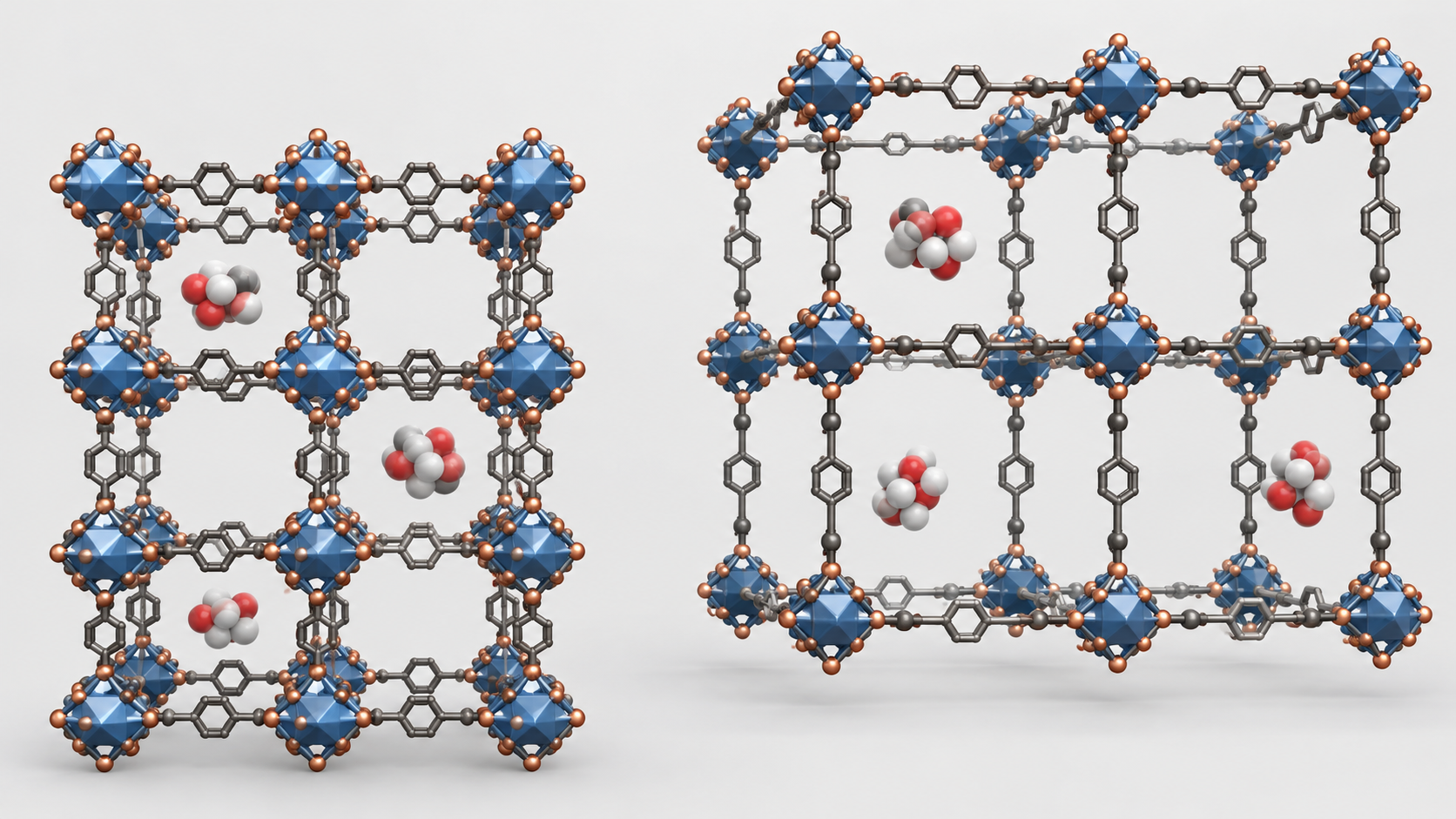
Shapes, colors and dimensions are illustrative. Consult the original schematic below for exact values and label correspondence.
View the original SVG schematic and exact annotations
Reading guide and original schematic labels: MOF structure: nodes and linkers, and longer linkers widen the cavity (concept) / A two-dimensional simplification. Real nets are three-dimensional, and linker shapes and node counts differ by material / Short linkers: small cavities / Long linkers: large cavities (same net) / Red = metal node; grey = organic linker; dashed box = cavity / Lengthening the linker enlarges the cavity / Swap only the linker on the same net to tune cavity size and function (isoreticular design) / * The isoreticular idea and pore examples (IRMOF-16: 2.8 nm; IRMOF-74-XI: up to 9.8 nm) are from the Nobel scientific background [Ref. 2]. / * A schematic two-dimensional drawing; not a real crystal structure or dimensions.
Representative frameworks are listed with reported numbers (all from papers or official documents, with differing samples and conditions).
| Framework | Composition | Reported features (with conditions) |
|---|---|---|
| HKUST-1 | Cu(II) carboxylate paddlewheels, BTC linker | Channels with a pore size of about 1 nm; the framework is stable up to 240 °C (thermogravimetry and high-temperature single-crystal diffraction) Sourced [Ref. 7]. From nitrogen adsorption, a BET surface area of about 690 m²/g, a Langmuir area of about 920 m²/g and a pore volume of about 0.3 cm³/g Sourced [Ref. 2] |
| MOF-5 | Zn₄O carboxylate clusters, BDC linker | Remains crystalline when fully desolvated and stable when heated to 300 °C; a higher apparent surface area and pore volume than most crystalline zeolites Sourced [Ref. 6]. A Langmuir area of about 2,900 m²/g (nitrogen) and a pore volume of about 0.6 cm³/mL Sourced [Ref. 2] |
| MIL-101 | Cr terephthalate | A giant cell volume (about 702,000 ų), extra-large pores of about 30 to 34 Å, and a nitrogen Langmuir surface area of about 5,900 ± 300 m²/g Sourced [Ref. 8] |
| UiO-66 family | Zr₆ clusters (Zr–O bonds) | Reported to have a decomposition temperature above 500 °C, resistance to most chemicals, and crystallinity retained after exposure to 10 tons/cm² Sourced [Ref. 10] |
| ZIF-8 | Zn imidazolate (zeolite nets) | Langmuir 1,810 m²/g, thermally stable to 550 °C, resistant to boiling alkaline water and organic solvents (ZIF-8 and -11) Sourced [Ref. 9] |
| CALF-20 | Zn-based (for CO₂) | Physisorbs CO₂, preferentially adsorbs CO₂ even at 40% relative humidity, and keeps its performance under 150 °C flue-gas conditions Sourced [Ref. 14] |
As stated in each paper or document. The difference between BET and Langmuir, and differing activation and measurement conditions, mean the table does not rank the rows (Chapters 3 and 4).
3. Pores and surface area — which model produced the number
MOF surface areas are mostly reported from nitrogen adsorption isotherms using the BET or the Langmuir model. The Nobel scientific background lists values by model, sometimes for the same framework Sourced [Ref. 2].
| Framework | Reported surface area (model) | Notes (as the source puts it) |
|---|---|---|
| HKUST-1 | BET about 690 m²/g / Langmuir about 920 m²/g | Pore volume about 0.3 cm³/g; nitrogen adsorption Sourced [Ref. 2] |
| MOF-5 | Langmuir about 2,900 m²/g | Pore volume about 0.6 cm³/mL. Zeolites have surface areas of several hundred m²/g, and activated carbon can reach higher values (the document's comparison) Sourced [Ref. 2] |
| MOF-177 | Langmuir about 4,500 m²/g | Noted for CO₂ and H₂ adsorption Sourced [Ref. 2] |
| MOF-210 | Langmuir over 10,000 m²/g / BET about 6,240 m²/g | CO₂ uptake of 2,400 mg/g (also for MOF-200); the conditions are not given in the document Sourced [Ref. 2] |
| NU-110 | BET about 7,140 m²/g | Obtained with supercritical CO₂ activation, avoiding pore collapse. Reported among the highest BET values Sourced [Ref. 12] |
| DUT-60 | BET about 7,839 m²/g | Accessible pore volume about 5.0 cm³/g Sourced [Ref. 2] |
As stated in each document. Samples, activation and adsorption conditions differ, so the table does not rank the rows.
Whether BET numbers can be trusted has itself been examined in papers. In 2007 Walton and Snurr generated nitrogen isotherms by Monte Carlo simulation and reported that BET surface areas obtained from them agreed very well with the accessible surface areas computed geometrically from the crystal structures, and also agreed well with experimental reports. The starting point was that MOF pores are far from flat and some adsorb by pore filling, so it was unclear whether BET numbers were meaningful Sourced [Ref. 11]. In 2012 Farha and co-workers reported two MOFs with BET areas of about 7,000 m²/g, made possible by supercritical CO₂ activation that removes solvent without collapsing the pores, and calculated that using efficient acetylene-based linker units could raise the hypothetical maximum to about 14,600 m²/g or more (against about 10,500 m²/g previously envisioned) Sourced [Ref. 12].
4. Our calculation: how many times apart the models put the same material
Our calculation
- HKUST-1: 920 ÷ 690 = about 1.33 times (Langmuir exceeds BET)
- MOF-210: 10,000 ÷ 6,240 = at least 1.60 times (Langmuir is "over 10,000", so this is a lower bound)
- NU-110 and graphene: 7,140 ÷ 2,630 = about 2.7 times (the two-face value for graphene is the calculation in our graphene explainer, assuming a 0.142 nm bond length)
- A water-harvesting example (using the numbers in Chapter 8): if a prototype with up to 1.2 kg of MOF-801 yields 100 g per kg per day, then 1.2 × 100 = about 120 g/day (about 0.12 L/day)
Assumptions and limits: the BET-to-Langmuir ratio comes from only two examples, HKUST-1 and MOF-210, and cannot be applied as is to other MOFs. The Langmuir model describes monolayer adsorption, and the general understanding that it tends to give larger values for ultramicroporous materials is something we did not confirm in our sources. The comparison with graphene is an order-of-magnitude guide; MOF values are apparent areas from nitrogen adsorption. The water calculation simplifies by assuming the whole 1.2 kg works at the same yield (Commentary).
5. A materials engineer's view (1): read surface-area figures through activation and model
A MOF's surface area changes greatly with "activation", the step that removes solvent from the pores before measurement. Farha et al. say supercritical CO₂ activation was the key to avoiding pore collapse when solvent is removed and to obtaining samples with BET areas of about 7,000 m²/g Sourced [Ref. 12]. The checks for acceptance and comparison are as follows (Commentary).
- Model and range: BET or Langmuir? If BET, over what relative-pressure range, and is that appropriate for adsorption in micropores? (Walton and Snurr tested the validity of BET against areas computed from crystal structures.)
- Activation conditions: how solvent was exchanged and dried (heating under vacuum, supercritical CO₂ and so on), temperature and time. A collapsed sample gives a low value.
- Adsorbate: nitrogen, argon or CO₂? The numbers in the Nobel document are nitrogen adsorption.
- Residual water or solvent: for MOFs that take up water in storage, values differ before and after (Chapter 6).
- Per volume or per mass: a large m²/g figure does not mean a large uptake per volume if the powder packs loosely (Commentary; we did not confirm density figures in our sources).
6. Synthesis and stability — water, heat, pressure
The standard laboratory route is the solvothermal method, in which a metal salt and an organic linker are heated in solvent to crystallise. On its technology page Atomis describes this method as having "poor batch efficiency", using "large amounts of organic solvent" and being a "high-temperature, high-pressure process", and says it posed many challenges for scale-up Sourced (company statement) [Ref. 19].
Stability is read by "against what". The review by Howarth et al. says chemical stability (in acidic, basic and neutral aqueous solutions), thermal stability and mechanical stability each matter, and that design principles and synthesis strategies have been worked out for them Sourced [Ref. 13]. Cavka et al. report a Zr₆-cluster MOF with a decomposition temperature above 500 °C, resistance to most chemicals, and crystallinity retained under an external pressure of 10 tons/cm², attributed to strong Zr–O bonds and to the cluster's ability to rearrange reversibly through µ₃-OH groups. They also state that the weak thermal, chemical and mechanical stability of most MOFs is probably the most important property limiting their use in large-scale industrial applications Sourced [Ref. 10].
7. Industrial production — what official material can confirm
On industrial production and commercialisation of MOFs we write only what official material could confirm. The Nobel scientific background describes industry's role as follows: industry has played a continuous and active role in the discovery of MOFs and the expansion of their applications; not only established corporations but many new companies have emerged, specifically focused on discovery and commercialisation; and it has been shown that frameworks of high chemical and thermal stability can be produced cost-effectively and at scale Sourced [Ref. 2].
| Example | What the official material says (with conditions) | Kind |
|---|---|---|
| Atomis (Japan): volume production | Building on the research of Professor Susumu Kitagawa of Kyoto University, it says it developed several proprietary production methods that resolve the problems of the standard laboratory (solvothermal) route (poor batch efficiency, large amounts of organic solvent, high temperature and pressure), and that it completed a pilot plant with a capacity of 20 t/year in 2023. It also says it has a proprietary structure database of more than 100,000 entries (POROS) Sourced (company statement) [Ref. 19] | Company announcement (pilot) |
| Atomis: gas container | On 1 September 2026 it announced that a special-effects production company had begun using its next-generation high-pressure gas container "CubiTan" as a container for liquefied carbon dioxide, aiming to reduce the burden of carrying gas containers and make safety management more efficient Sourced (company announcement; it does not state the container's material or its relation to MOFs, which we could not confirm) [Ref. 20] | Company announcement (customer adoption) |
| Svante (Canada): CO₂ capture | It positions "solid sorbents, particularly MOFs coated onto structured adsorbents ('filters')" as the next generation of commercial carbon-capture technology, and says its solid sorbent CALF-20 is best suited to CO₂ concentrations of 12% and higher. For lower-concentration flue gas it offers BASF's liquid amine, OASE blue Sourced (company statement) [Ref. 21]. The Nobel scientific background says CALF-20's high and selective CO₂ capacity prompted its application to carbon capture on an industrial scale Sourced [Ref. 2] | Company announcement (commercial positioning) |
| The "structuring" problem | A review on structuring (shaping) porous reticular materials for energy applications at industrial scales argues that advancing structuring strategies is key to closing the gap between laboratory research and industrial utilisation Sourced (part of the abstract) [Ref. 18] | Review |
We could not confirm from official material the production volumes or specifications of MOFs from other companies, such as BASF, so we state none (Chapter 11).
Our calculation
- 20 t = 20,000 kg. 20,000 ÷ 365 = about 55 kg/day (a simplification of running at 100% all year)
Assumptions and limits: Atomis's 20 t/year is the capacity of the pilot plant as the company states it, not actual output or sales. Which framework it makes, and at what yield and purity, are not given on the page.
8. Applications — gas adsorption, separation, catalysis and water harvesting by stage
| Application | Report or statement (with conditions) | Stage |
|---|---|---|
| Gas adsorption and storage | In 1997 Kondo, Kitagawa and co-workers reported coordination polymers of Co, Ni and Zn with 4,4′-bipyridine that reversibly adsorb CH₄, N₂ and O₂ at 1 to 36 atm without deforming the framework; the channel cross-sections are about 3 × 6 Å and 3 × 3 Å Sourced [Ref. 5]. The Nobel document cites the methane capacity of Al-soc-MOF-1 exceeding US Department of Energy criteria, and MOF-177's high hydrogen capacity at ambient temperature and moderate pressure Sourced [Ref. 2] | Papers (laboratory). Adoption in containers or products not confirmed |
| CO₂ separation and capture | The zinc-based MOF (CALF-20) physisorbs CO₂, preferentially adsorbs it even at 40% relative humidity and keeps its performance under 150 °C flue-gas conditions. Its binding site sits at the centre of the pore, which precludes hydrogen-bonded water networks Sourced [Ref. 14] | Paper plus company announcement (Chapter 7) |
| Water harvesting | Kim et al. used a MOF with a steep rise in water uptake over a narrow relative-humidity range and heated it with ambient sunlight alone, obtaining 2.8 litres of water per kilogram of MOF per day at 20% relative humidity Sourced [Ref. 15]. Fathieh et al. tested a prototype with up to 1.2 kg of MOF-801 first in the laboratory and then in the Arizona desert, and reported 100 g of water per kilogram per day-and-night cycle with only natural cooling and ambient sunlight. An aluminium-based MOF-303 delivers more than twice as much; operation was shown even at a subzero dew point Sourced [Ref. 16] | Outdoor test (prototype). Product not confirmed |
| Catalysis and decomposition | Mondloch et al. report that a porous MOF with ultrawide channels and excellent chemical stability is highly efficacious for the catalytic decomposition of chemical warfare agents containing phosphonate ester bonds Sourced [Ref. 17]. The Nobel document says MIL-101 has been used in catalysis and in storage of H₂ and CO₂ Sourced [Ref. 2] | Papers (laboratory) |
Our calculation
- Kim et al.'s "2.8 L per kg per day" = 2,800 g ÷ 100 g = about 28 times Fathieh et al.'s "100 g per kg per day"
- Fathieh et al.'s prototype: 1.2 kg × 100 g/kg = about 120 g/day (about 0.12 L)
Assumptions and limits: the former is a report at 20% relative humidity (from the summary of the abstract we saw, we could not tell whether it was laboratory or outdoor), and the latter is a measured desert test with natural cooling only and one cycle per day and night. The test conditions and the way the amount of MOF is counted both differ. The factor of 28 does not mean one of them is worse; it shows that setting numbers with different premises (cycles, cooling, sunlight, humidity) side by side shifts the order of magnitude. The 120 g/day is our simplification that all 1.2 kg works at the same yield.
9. How this relates to the official announcement of the 2025 Nobel Prize in Chemistry
The official announcement of 8 October 2025 gives the prize motivation as "for the development of metal–organic frameworks" and describes MOFs as crystals with large cavities in which metal ions function as cornerstones linked by long organic molecules. It also says that, by design, MOFs can be made to capture and store specific substances, can drive chemical reactions and can conduct electricity Sourced [Ref. 1].
- Robson: in 1989 he combined copper ions with a four-armed molecule that had, at the end of each arm, a chemical group attracted to copper, and obtained a well-ordered, spacious crystal. It was like a diamond filled with innumerable cavities; he saw the potential immediately, but it was unstable and collapsed easily Sourced [Ref. 1].
- Kitagawa and Yaghi: between 1992 and 2003 they made, separately, a series of revolutionary discoveries. Kitagawa showed that gases can flow in and out of the constructions and predicted that MOFs could be made flexible. Yaghi created a very stable MOF and showed that it can be modified by rational design to give new and desirable properties Sourced [Ref. 1].
- Applications as worded: the announcement says MOFs can be used to harvest water from desert air, capture carbon dioxide, store toxic gases or catalyse chemical reactions. It goes on to say that applications such as separating PFAS from water, breaking down traces of pharmaceuticals in the environment, capturing carbon dioxide or harvesting water from desert air may contribute to solving some of humankind's greatest challenges Sourced [Ref. 1].
| Application in the official announcement | What we confirmed, and the stage |
|---|---|
| Harvest water from desert air | Fathieh et al. (2018): outdoor test of a prototype, 100 g per kg per day-and-night cycle (Chapter 8). Product not confirmed Sourced [Ref. 16] |
| Capture carbon dioxide | The paper by Lin et al. (2021) and Svante's company statement (Chapter 7) Sourced [Ref. 14, 21] |
| Catalyse chemical reactions | Mondloch et al. (2015), decomposition of chemical warfare agents (laboratory) Sourced [Ref. 17] |
| Store toxic gases | We could not confirm a primary source |
| Separate PFAS; break down pharmaceuticals in the environment | The caption of a figure in the Nobel scientific background says UiO-67 has been used to adsorb PFAS from water, but we did not check the original paper Sourced [Ref. 2] |
The Nobel announcement is an assessment of discovery and development. It does not guarantee any product's performance, safety or the timing of practical use (Commentary).
10. A materials engineer's view (2): from laboratory crystal to usable form
- Form: Svante says it coats MOFs onto structured adsorbents (filters) Sourced [Ref. 21]. Presumably, pressure drop, dust and packing density are the problems with bare powder (Commentary). The review on structuring also argues that structuring is key to closing the gap between laboratory and industry Sourced [Ref. 18].
- Mechanical strength: the UiO-66 family is reported to stay crystalline at 10 tons/cm² Sourced [Ref. 10]. How shaping (pressing, binders) blocks pores or changes surface area differs by framework, and we did not confirm figures in our sources (Commentary).
- Living with water: CALF-20 is reported to preferentially adsorb CO₂ even at 40% relative humidity Sourced [Ref. 14]. Real flue gas contains water, so look at selectivity under stated humidity (Commentary).
- Reading numbers: surface area depends on activation and model (Chapters 3 and 5), a water-harvesting yield depends on conditions (Chapter 8), and a company's production figure is a capacity, not output (Chapter 7).
- Difficulty of volume production: the solvothermal route is said to be limited by batch efficiency, the amount of organic solvent and high temperature and pressure Sourced (company statement) [Ref. 19]. The cost of the raw material (linker) and solvent recovery are also design items on the materials side (Commentary).
11. What could not be confirmed / how this fits with other articles in the series
(1) What we could not confirm within the scope of this article
- Official material on the production volumes, specifications and prices of MOFs from companies other than Atomis and Svante, such as BASF, could not be confirmed Not yet confirmed.
- Atomis's type, yield and purity of MOF produced at volume, the material of CubiTan and its relation to MOFs, and Svante's production scale (in tonnes) of CALF-20 could not be confirmed on the official pages.
- For the storage of toxic gases, separation of PFAS and breakdown of pharmaceuticals that the official announcement mentions, we did not check the primary papers.
- Toxicity of MOFs, their release to the environment (for example metal leaching) and their regulatory status are not confirmed here. We give no individual safety advice.
- The number and content of an international standard for measuring surface area by adsorption could not be confirmed on the standards body's official page, so none is stated.
- The cost, cycle life and long-term field data of water harvesting could not be confirmed Not yet confirmed.
(2) How this fits with other articles in the series
The definition and regulation of nanomaterials in general are covered in our explainer on that subject; hydrogen-related uses that include gas separation with porous materials in the hydrogen energy articles; and the use of MOFs in drug delivery in our explainer on liposomes and nanocarriers. The calculation of graphene's surface area is in our graphene explainer.
- MOFs are crystals of metal nodes and organic linkers, and the subject of the 2025 Nobel Prize in Chemistry. The laureates are Kitagawa, Robson and Yaghi Sourced
- Read surface area by model and activation. HKUST-1 is BET about 690 and Langmuir about 920 m²/g (about 1.33 times); MOF-210 is 6,240 and over 10,000 (at least 1.60 times) Sourced Our calculation
- Stability is three separate axes: heat, chemicals and mechanics. The UiO-66 family above 500 °C; ZIF-8 to 550 °C and boiling alkaline water Sourced
- Industrial production can be confirmed only within companies' announcements. Atomis completed a 20 t/year pilot in 2023; Svante offers the solid sorbent CALF-20 Sourced (company announcements)
- The outdoor water-harvesting test gave 100 g per kg per day-and-night cycle. The conditions differ from a laboratory projection of 2.8 L per day Sourced Our calculation
- The official announcement words applications as "may contribute", and the stage differs by application. Sourced
12. Glossary
- MOF (metal–organic framework)
- A coordination network of metal ions and organic linkers that contains cavities. In the IUPAC definition, a subset of coordination polymers.
- Metal node / SBU
- The metal ion or metal cluster at a "joint" of the framework (secondary building unit).
- Linker
- The organic molecule connecting metal nodes. Changing its length changes the cavity size.
- Isoreticular
- A design idea in which the same net and the same node are kept while only the linker is changed.
- BET surface area
- Specific surface area from nitrogen adsorption. For microporous materials such as MOFs, the range of validity needs care.
- Langmuir surface area
- Specific surface area from a monolayer-adsorption model. It can come out larger than BET for the same material.
- Activation
- Removing solvent from the pores so that the material can adsorb. Some methods collapse the pores.
- Solvothermal synthesis
- Growing crystals by heating in solvent. The standard laboratory route.
- Physisorption
- Adsorption by weak forces without forming chemical bonds. The energy needed to release it is small.
- CALF-20
- A zinc-based MOF reported to physisorb CO₂ and to be usable with humid flue gas.
- Structuring (shaping)
- Turning MOF powder into a usable form such as a filter coating or pellet.
- PFAS
- A group of organofluorine compounds. Removal from water is a challenge, and adsorption by MOFs is being studied.
13. Primary sources
- The Royal Swedish Academy of Sciences "Press release: Nobel Prize in Chemistry 2025", 8 October 2025 — nobelprize.org
- The Nobel Committee for Chemistry "Scientific Background to the Nobel Prize in Chemistry 2025: Metal-Organic Frameworks", 8 October 2025 (PDF) — nobelprize.org
- Furukawa H, Cordova KE, O'Keeffe M, Yaghi OM "The Chemistry and Applications of Metal-Organic Frameworks", Science 2013;341:1230444 (review) — doi.org/10.1126/science.1230444
- Yaghi OM, Li G, Li H "Selective binding and removal of guests in a microporous metal–organic framework", Nature 1995;378:703–706 — doi.org/10.1038/378703a0
- Kondo M, Yoshitomi T, Matsuzaka H, Kitagawa S, Seki K "Three-Dimensional Framework with Channeling Cavities for Small Molecules: {[M2(4,4′-bpy)3(NO3)4]·xH2O}n (M = Co, Ni, Zn)", Angew Chem Int Ed Engl 1997;36:1725–1727 — doi.org/10.1002/anie.199717251
- Li H, Eddaoudi M, O'Keeffe M, Yaghi OM "Design and synthesis of an exceptionally stable and highly porous metal-organic framework", Nature 1999;402:276–279 — doi.org/10.1038/46248
- Chui SS-Y et al. "A Chemically Functionalizable Nanoporous Material [Cu3(TMA)2(H2O)3]n", Science 1999;283:1148–1150 — doi.org/10.1126/science.283.5405.1148
- Férey G et al. "A Chromium Terephthalate-Based Solid with Unusually Large Pore Volumes and Surface Area", Science 2005;309:2040–2042 — doi.org/10.1126/science.1116275
- Park KS et al. "Exceptional chemical and thermal stability of zeolitic imidazolate frameworks", Proc Natl Acad Sci USA 2006;103:10186–10191 — doi.org/10.1073/pnas.0602439103
- Cavka JH et al. "A New Zirconium Inorganic Building Brick Forming Metal Organic Frameworks with Exceptional Stability", J Am Chem Soc 2008;130:13850–13851 — doi.org/10.1021/ja8057953
- Walton KS, Snurr RQ "Applicability of the BET Method for Determining Surface Areas of Microporous Metal−Organic Frameworks", J Am Chem Soc 2007;129:8552–8556 — doi.org/10.1021/ja071174k
- Farha OK et al. "Metal–Organic Framework Materials with Ultrahigh Surface Areas: Is the Sky the Limit?", J Am Chem Soc 2012;134:15016–15021 — doi.org/10.1021/ja3055639
- Howarth AJ et al. "Chemical, thermal and mechanical stabilities of metal-organic frameworks", Nat Rev Mater 2016;1:15018 (review) — doi.org/10.1038/natrevmats.2015.18
- Lin J-B et al. "A scalable metal-organic framework as a durable physisorbent for carbon dioxide capture", Science 2021;374:1464–1469 — doi.org/10.1126/science.abi7281
- Kim H et al. "Water harvesting from air with metal-organic frameworks powered by natural sunlight", Science 2017;356:430-434 (the summary of the abstract was checked) — doi.org/10.1126/science.aam8743
- Fathieh F et al. "Practical water production from desert air", Sci Adv 2018;4:eaat3198 — doi.org/10.1126/sciadv.aat3198
- Mondloch JE et al. "Destruction of chemical warfare agents using metal-organic frameworks", Nat Mater 2015;14:512-516 (summary checked) — doi.org/10.1038/nmat4238
- Asgari M et al. "The structuring of porous reticular materials for energy applications at industrial scales", Chem Soc Rev 2025;54:4701-4744 (part of the abstract checked) — doi.org/10.1039/d5cs00166h
- Atomis "Technologies", technology page (in Japanese), description of "Industrial-Scale Manufacturing" (checked October 2026); company statement — atomis.co.jp
- Atomis "Next-generation high-pressure gas container CubiTan begins deployment in special effects production" (in Japanese), news release, 1 September 2026 — atomis.co.jp
- Svante Technologies "Technology", product and technology page (checked October 2026); company statement — svanteinc.com
14. Claim-to-source audit
| Claim in the text | Basis | Label |
|---|---|---|
| 8 October 2025: the Nobel Prize in Chemistry to Susumu Kitagawa (Kyoto University), Richard Robson (University of Melbourne) and Omar M. Yaghi (University of California, Berkeley) "for the development of metal–organic frameworks"; metal ions as cornerstones linked by long organic molecules into crystals with large cavities; use to harvest water from desert air, capture carbon dioxide, store toxic gases or catalyse reactions; the work of Robson (1989) and of Kitagawa and Yaghi (1992 to 2003); tens of thousands of MOFs; PFAS separation, pharmaceutical breakdown, CO₂ capture and water harvesting that may contribute | Nobel Prize announcement[Ref. 1] https://www.nobelprize.org/prizes/chemistry/2025/press-release/ | Sourced |
| Scientific background: the IUPAC definition of a MOF; Kitagawa 1997 adsorption of CH₄, N₂ and O₂; Yaghi 1998 Zn(BDC) (Langmuir about 300 m²/g); MOF-5 (Langmuir about 2,900 m²/g, pore volume about 0.6 cm³/mL); HKUST-1 (stable to 240 °C, pore about 1 nm, BET about 690 and Langmuir about 920 m²/g); isoreticular design (IRMOF-16: 2.8 nm; IRMOF-74-XI: up to 9.8 nm); MOF-177 (Langmuir about 4,500); MOF-210 (Langmuir over 10,000, BET about 6,240); DUT-60 (BET about 7,839, pore volume about 5.0 cm³/g); NU-110 (BET about 7,140); CO₂ uptake of 2,400 mg/g; the methane capacity of Al-soc-MOF-1; industry's role (new companies, cost-effectiveness and scalability) | Nobel Scientific Background[Ref. 2] https://www.nobelprize.org/uploads/2025/10/advanced-chemistryprize2025.pdf | Sourced |
| More than 20,000 MOFs, typical porosity above 50% of crystal volume and surface areas of 1,000 to 10,000 m²/g (review) | Furukawa et al. 2013 (Science)[Ref. 3] https://doi.org/10.1126/science.1230444 | Sourced |
| 1995: a microporous MOF (the paper in which the term MOF began to be used); thermally stable to 350 °C after removal of guests | Yaghi et al. 1995 (Nature)[Ref. 4] https://doi.org/10.1038/378703a0 | Sourced |
| Co, Ni and Zn coordination polymers with 4,4′-bipyridine reversibly adsorb CH₄, N₂ and O₂ at 1 to 36 atm without deformation; channels of about 3 × 6 Å and 3 × 3 Å | Kondo et al. 1997 (Angew Chem)[Ref. 5] https://doi.org/10.1002/anie.199717251 | Sourced |
| MOF-5: crystalline when desolvated, stable to 300 °C, higher apparent surface area and pore volume than most crystalline zeolites | Li et al. 1999 (Nature)[Ref. 6] https://doi.org/10.1038/46248 | Sourced |
| HKUST-1: pore size of about 1 nm, accessible porosity of about 40%, framework stable to 240 °C | Chui et al. 1999 (Science)[Ref. 7] https://doi.org/10.1126/science.283.5405.1148 | Sourced |
| MIL-101: cell volume of about 702,000 ų, pores of about 30 to 34 Å, nitrogen Langmuir area of about 5,900 ± 300 m²/g | Férey et al. 2005 (Science)[Ref. 8] https://doi.org/10.1126/science.1116275 | Sourced |
| ZIF-8 and ZIF-11: Langmuir 1,810 m²/g, thermally stable to 550 °C, resistant to boiling alkaline water and organic solvents | Park et al. 2006 (PNAS)[Ref. 9] https://doi.org/10.1073/pnas.0602439103 | Sourced |
| A Zr₆-cluster MOF: decomposition above 500 °C, resistance to most chemicals, crystalline after 10 tons/cm²; the low stability of many MOFs limits large-scale use | Cavka et al. 2008 (JACS)[Ref. 10] https://doi.org/10.1021/ja8057953 | Sourced |
| Applicability of BET: BET areas from simulated isotherms agree well with geometrically computed accessible areas; the issue of micropores and pore-filling adsorption | Walton and Snurr 2007 (JACS)[Ref. 11] https://doi.org/10.1021/ja071174k | Sourced |
| Supercritical CO₂ activation gave two MOFs of about 7,000 m²/g BET; a hypothetical maximum of about 14,600 m²/g or more (against about 10,500 previously envisioned) | Farha et al. 2012 (JACS)[Ref. 12] https://doi.org/10.1021/ja3055639 | Sourced |
| A review of the chemical (acidic, basic and neutral aqueous), thermal and mechanical stability of MOFs (design principles and synthesis strategies) | Howarth et al. 2016 (Nat Rev Mater)[Ref. 13] https://doi.org/10.1038/natrevmats.2015.18 | Sourced |
| CALF-20 (zinc-based): physisorbs CO₂, preferentially adsorbs it at 40% relative humidity, keeps performance under 150 °C flue-gas conditions, binding site at the pore centre precluding hydrogen-bonded water networks | Lin et al. 2021 (Science)[Ref. 14] https://doi.org/10.1126/science.abi7281 | Sourced |
| 2.8 litres of water per kilogram of MOF per day at 20% relative humidity (heated by sunlight) | Kim et al. 2017 (Science)[Ref. 15] https://doi.org/10.1126/science.aam8743 | Sourced |
| A prototype with up to 1.2 kg of MOF-801 tested in the laboratory and the Arizona desert, 100 g per kg per day-and-night cycle with only natural cooling and sunlight; MOF-303 more than twice; operation at a subzero dew point | Fathieh et al. 2018 (Sci Adv)[Ref. 16] https://doi.org/10.1126/sciadv.aat3198 | Sourced |
| A porous MOF with ultrawide channels and excellent chemical stability is highly efficacious for the catalytic decomposition of chemical warfare agents containing phosphonate ester bonds | Mondloch et al. 2015 (Nat Mater)[Ref. 17] https://doi.org/10.1038/nmat4238 | Sourced |
| The argument that advancing structuring (shaping) of porous reticular materials is key to closing the gap between laboratory research and industrial utilisation (part of the abstract) | Asgari et al. 2025 (Chem Soc Rev)[Ref. 18] https://doi.org/10.1039/d5cs00166h | Sourced |
| Atomis: founded on Professor Kitagawa's research; the challenges of the solvothermal route (batch efficiency, organic solvent, high temperature and pressure); several proprietary production methods; a 20 t/year pilot plant completed in 2023; a structure database of more than 100,000 entries (POROS) | Company statement. Atomis technology page[Ref. 19] https://www.atomis.co.jp/technology/ | Sourced |
| Atomis, 1 September 2026: a special-effects company began using the high-pressure gas container CubiTan as a container for liquefied carbon dioxide. The announcement does not state the container's material or any relation to MOFs | Company announcement. Atomis news (September 2026)[Ref. 20] https://www.atomis.co.jp/news/3855/ | Sourced |
| Svante: solid sorbents with MOFs coated onto structured adsorbents (filters) as the next generation of commercial carbon capture; CALF-20 best suited to CO₂ at 12% and higher; BASF's OASE blue for lower concentrations | Company statement. Svante technology page[Ref. 21] https://www.svanteinc.com/technology/ | Sourced |
| 920 ÷ 690 for HKUST-1, 10,000 ÷ 6,240 for MOF-210, about 2.7 times for NU-110 over graphene's two faces (2,630), 1.2 kg MOF-801 × 100 g/kg = about 120 g/day, Kim's 2,800 g ÷ Fathieh's 100 g = about 28 times, and 20 t/year ÷ 365 days = about 55 kg/day | Our calculation. The graphene two-face value (0.142 nm bond length), the whole 1.2 kg working at the same yield and 100% operation all year are our assumptions. The two water-harvesting figures were obtained under different conditions. | Our calculation |
| MOF production volumes and specifications of other companies such as BASF, Atomis's type, yield and purity of production and CubiTan's material, Svante's CALF-20 production scale, primary papers on storing toxic gases, separating PFAS and breaking down pharmaceuticals, MOF toxicity and regulation, a standard for adsorption measurement, and the cost and lifetime of water harvesting | No primary source could be confirmed within the scope of this article, so none is stated (Commentary). | Not yet confirmed |
| Reading surface area by activation, model and adsorbate; reading stability on the three axes of heat, chemicals and mechanics; a powder's best value versus a shaped body's performance; matching the official announcement's applications with the stage we confirmed; the grouping of application stages; the choice of milestones | This article's own organisation and commentary based on the published material; not views stated by the authors or institutions. | Commentary |
| Figs. 1, 3, 5 and 6 are explanatory drawings; Fig. 2 is drawn with our calculation; the hero image and Fig. 4 are AI-generated | Our note. | Commentary |
Last updated 9 October 2026. Sources are limited to primary material (the Nobel Prize's official announcement and scientific background, peer-reviewed papers and companies' official pages). Because the article includes materials-design interpretations, those are marked as Commentary and kept separate from sourced fact. Production volumes and specifications of other companies' MOFs, details of Atomis's production and CubiTan's material, the production scale of Svante's CALF-20, primary papers on storing toxic gases, separating PFAS and breaking down pharmaceuticals, MOF toxicity and regulation, a standard for adsorption measurement, and the cost and lifetime of water harvesting are not stated because no primary source could be confirmed. Statements from Atomis and Svante are company announcements, not third-party verification. The Nobel announcement is an assessment of discovery and development and does not guarantee any product's performance or safety. The values in Chapters 3 and 8 come from reports with different samples, activation and conditions and are not a ranking. All figures are explanatory concept graphics. Figs. 1, 3, 5 and 6 are vector drawings, Fig. 2 includes our calculation, and the hero image and Fig. 4 are AI-generated images; none of them shows a real crystal structure, micrograph or physical product.