COMPANY PROFILE / NANOTECHNOLOGY
First Graphene
A materials company near Perth that exfoliates graphite electrochemically into multi-layer graphene (PureGRAPH) and supplies it as a tiny-dose additive for cement, composites, rubber and coatings
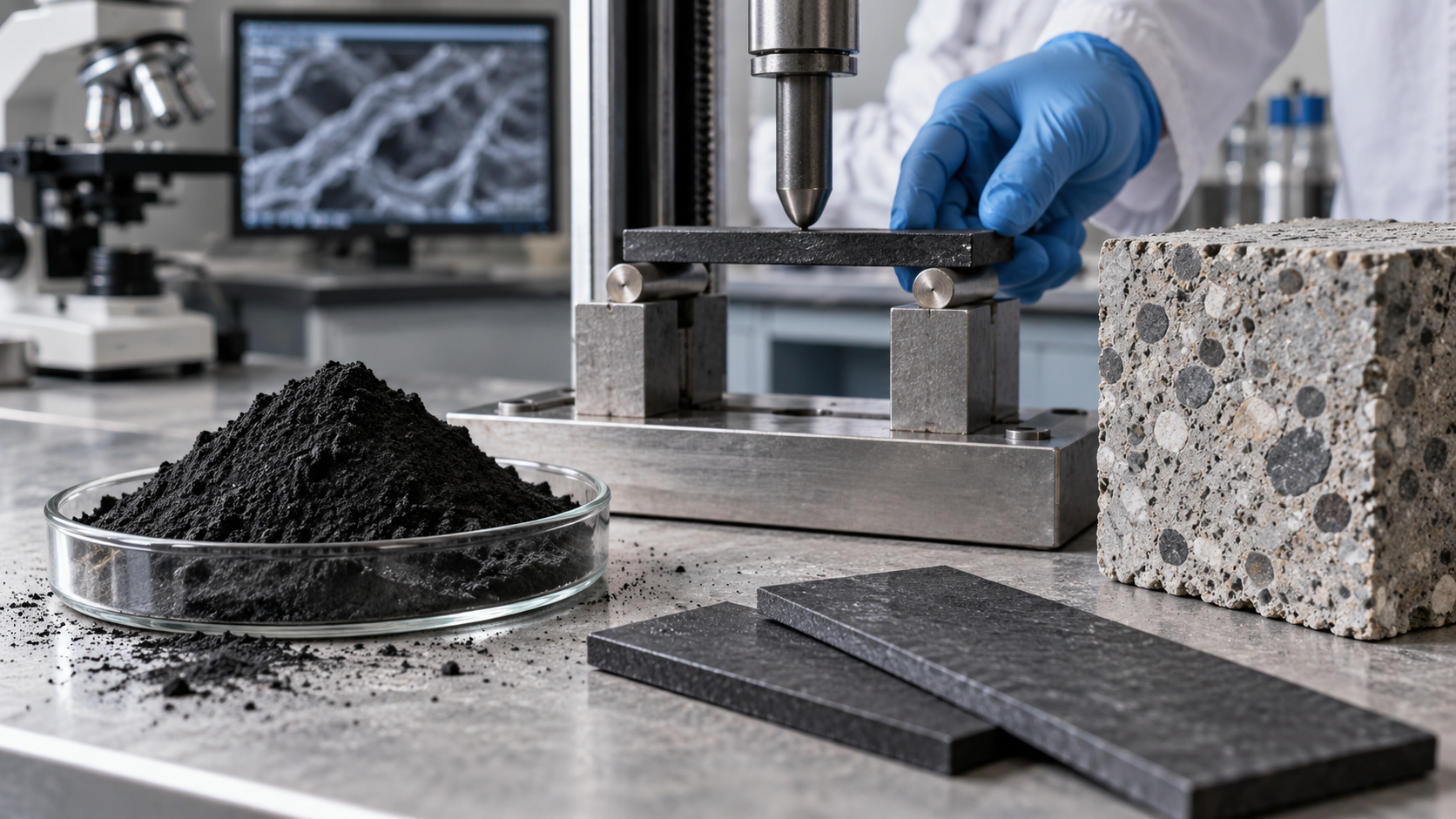
First Graphene (FGR) is an Australian nanomaterial producer that takes high-grade graphite from Sri Lanka and turns it, by electrochemical exfoliation, into graphene nanoplatelets sold as PureGRAPH. It supplies them as powders, water-based dispersions and masterbatches (concentrates) for cement and concrete, composites, elastomers (rubber), coatings, and battery and solar-cell materials. By the company's account, the plant in Henderson, Western Australia, has a stated capacity of 100 tonnes a year. Yet sales in the year to June 2025 were only A$468,397, and the loss attributable to members was A$5.40 million. In April and June 2026 it agreed to buy the assets of small companies in the US and Australia (MITO Material Solutions, Ionic Industries and Imagine Intelligent Materials), broadening its range into graphene oxide, functionalized graphene and coatings. Drawing on the company's ASX filings (annual and half-year reports), investor presentation, press releases and technical data, this article sets out what could be confirmed and what could not, and explains from a materials engineer's view what it means to mix large flakes in without letting them clump.
- At a glance: FGR and its place in nanotechnology
- Logo and naming
- Where the company sits in nanotechnology
- Company scale
- Resources committed to nanotechnology
- Track record
- Plans
- What the company is aiming for in nanotechnology
- Partnership map for nanotechnology
- Technologies, products and services
- Risks
- Glossary
- References
- Claim-to-source audit
1. At a glance: FGR and its place in nanotechnology
(ACN 007 870 760)An Australian company. The product brand PureGRAPH® is separate from the company name
(near Perth)Head office and plant on the same site. R&D and marketing in Manchester, UK
OTCQB: FGPHFAlso quoted in Frankfurt (M11). Share price A$0.06 on 29 May 2026 and market capitalization of about A$50 million (company materials)
(multi-layer graphene)Supplies graphene powders, dispersions and additives; does not make end products
exfoliated from graphiteFive grades with lateral sizes of 5 to 50 µm and average thickness under 10 nm (manufacturer's stated value)
(Henderson plant)Company statement. Actual output and utilization are not disclosed
(not found in these materials)R&D employee expense was A$644,857 in FY2025
FGR's distinguishing feature is that it has a plant with a stated capacity of 100 tonnes a year for making graphene from graphite, and is trying to sell it into several industries as a small-dose material. At the same time, sales are very small next to that capacity (A$468,397 in FY2025), operations make a loss, and the company relies on equity raisings and Australia's R&D tax incentive to fund itself Sourced. The company's materials are full of phrases such as "the only company in the world" and "unmatched by any competitor"; these are all the company's own description. The outlook in the July 2026 presentation (expected income of about A$1.5 million, and opportunities above A$10 million over 18-24 months) is the company's forecast and is not settled Not yet confirmed.
2. Logo and naming

The logo is the main logo published on the company's official website (firstgraphene.net): a hexagon symbol with the wordmark "FIRSTGRAPHENE". It is taken as it is, as an SVG. It has not been recreated with generated images.
Naming: the company is First Graphene Limited (short form FGR, also its ASX code). PureGRAPH (PureGRAPH®) is the registered brand of its products and is separate from the company name. To avoid confusion with other graphene companies (such as the separate Australian company Graphene Manufacturing Group), this article uses the full company name. Its UK subsidiary is First Graphene (UK) Ltd.
Official site: https://firstgraphene.net/3. Where the company sits in nanotechnology
FGR's primary type is nanomaterial producer, with no secondary type. Customers make the finished goods (cement, shoes) and FGR supplies the additive. The core is multi-layer graphene (graphene nanoplatelets). The uses confirmed in the company's materials are as follows.
| Material / use | Where it stands at FGR | Primary sources confirmed | Status |
|---|---|---|---|
| Cement and concrete additive (PureGRAPH-CEM) | The use given most weight. With Breedon Group of the UK it made about 600 t of graphene-enhanced cement at the Hope Cement Works (July-December 2025, per the company). FP McCann of the UK trialled more than 10,000 concrete roof tiles | Half-year report, investor presentation | Sourced (company description) |
| Composites (glass and carbon fibre) | Repeat orders, for example for fibreglass swimming pools. In October 2026 a three-year development and commercialization agreement with Aeropreg of Turkey on carbon-fibre prepreg (subject to trial results) | Half-year report, press release (October 2026) | Sourced / commercialization is Not yet confirmed |
| Elastomers and footwear | Masterbatch of TPU for safety and mining work boots (a first order of 500 kg from PT Alasmas Berkat Utama of Indonesia). In October 2026, a first order for sports shoes from Flux Footwear of the US | Half-year report, press release (October 2026) | Sourced (company description) |
| Carbon paste for perovskite solar cells | An exclusive licence with Halocell of Australia (November 2025, 12 months, with a 10% royalty on sales paid to Halocell) | Press release (November 2025) | Sourced / Not yet confirmed |
| Coatings, textiles, defence and aerospace | Buying the assets of MITO and Ionic adds functionalized graphene, graphene oxide and geotextile coatings. Defence and aerospace work is at the pipeline stage | Press releases (April and June 2026), investor presentation | Sourced / sales not confirmed |
| Batteries and supercapacitors | Listed as uses in the investor presentation. The Ionic assets are said to include intellectual property in battery and supercapacitor materials. No commercial sales could be confirmed | Investor presentation | Not confirmed |
4. Company scale
FGR is a small ASX-listed company and reports in Australian dollars. The latest full year is FY2026 (to June 2026), but the body of the annual report (lodged with the ASX on 25 September 2026) could not be confirmed for this article. The most recent figures that could be confirmed are below Sourced.
| Item (A$) | FY2025 (full year to June 2025) | Half-year to December 2025 |
|---|---|---|
| Revenue from contracts with customers | 468,397 (goods 349,611; services 118,786) | 313,777 (up 53% on the same half; goods 164,138; services 149,639) |
| Other income (R&D tax incentive and grants) | 805,282 (R&D tax incentive 580,123; grants 225,159) | 619,816 (R&D tax credits 518,632; grants 101,184) |
| Research and development expense | 1,228,120 | 475,586 |
| General and administrative expense | 3,192,112 | 1,453,824 |
| Loss attributable to members | 5,401,029 (loss from ordinary activities attributable to members; net loss 5,483,025) | 3,348,722 (the company says the operating loss is 1,454,384 excluding non-cash finance costs of 1,729,010 and share-based payments of 165,328) |
| Cash flow from operating activities | about -2.7 million | -836,687 (second quarter -73 thousand, which the company calls roughly cash-neutral for the first time) |
| Cash and cash equivalents (end of period) | 2,612,941 | 4,899,585 (after a A$3.5 million placement in November 2025) |
| Total assets / net assets | 8,083,525 / 4,493,179 | 9,786,298 / 8,815,098 |
| Item | What was confirmed |
|---|---|
| Listing and shares | ASX: FGR. OTCQB (USA): FGPHF. Frankfurt: M11 (quoted). The July 2026 presentation shows about 880 million shares on issue, about 80 million listed options (exercise price A$0.085, expiring June 2027), a share price of A$0.06 and a market capitalization of about A$50 million (as of 29 May 2026, per the company) |
| Production capacity | 100 t a year at the Henderson plant (stated; the website says "100,000 kg a year"). Actual annual output is not disclosed. With goods sales of about A$350 thousand in FY2025, most of the capacity looks unused, but because prices and volumes are not disclosed, this article does not calculate utilization |
| Customers and sales network | The company says it has more than 35 active customers (more than 38 on another page), 11 distributors covering more than 20 countries, and about 50 commercial agreements. Most customer names are not disclosed |
| Company outlook (July 2026) | Income of "about A$1.5 million" expected from existing customers, development work and grants. It says there are opportunities above A$10 million over the next 18-24 months, and aims to reduce cash burn toward break-even (company forecast) |
| Employees | The headcount could not be confirmed. Sites: Henderson, Australia (head office and plant); Manchester, UK (R&D and marketing); and the acquired US and Australian sites |
The FY2025 financial report was lodged with the ASX as preliminary figures (Appendix 4E) with the audit still in progress. FY2024 figures are restated values, and the report notes that 2024 grant income was reclassified as other income. The net loss in the December 2025 half-year report (A$3.35 million) also includes a non-cash finance cost of A$1.73 million relating to a 2021 funding agreement. The full-year figures for FY2026 could not be confirmed for this article Not yet confirmed.
5. Resources committed to nanotechnology
The table sorts what could and could not be confirmed under four headings: people, money, outside investments and academia or public funds.
| Item | What was confirmed | Status |
|---|---|---|
| People (R&D sites and staff) | Manufacturing and head office are in Henderson, Western Australia, and R&D and marketing in Manchester, UK. R&D employee expense was A$644,857 in FY2025. The number of employees and researchers could not be confirmed | Sourced / not confirmed |
| Money (R&D spending and capital spending) | R&D expense: A$1,228,120 in FY2025 and A$475,586 in the half-year to December 2025. Equipment purchases were small, A$19,312 in the half (it uses an existing plant). Inventory (mainly graphite feedstock and product): A$2,882,650 at December 2025 (of which non-current A$2,527,650) | Sourced |
| Outside investments, acquisitions, joint ventures, divestitures | Acquisitions: in April 2026, an agreement to buy the manufacturing, intellectual property and development assets of Ionic Industries and Imagine Intelligent Materials for A$250,000 (cash and shares). In June, an agreement to buy the product lines, equipment and intellectual property of MITO Material Solutions (cash plus shares tied to sales targets; the amount could not be confirmed here). Licence: Halocell (carbon paste). Wind-down: 2D Fluidics, a 66.67% subsidiary (judged commercially unfeasible; deregistered in July 2025). Financing: a share placement agreement of up to A$8 million with Specialty Materials Investments, LLC in May 2021 (the related financial liability was gone by December 2025) | Sourced / amount not confirmed (MITO) |
| Universities, institutes and public funds | The website lists the University of Adelaide (fire-retardant paint, concrete additives), Flinders University (synthesis processes) and the Australian Research Council's graphene research hub as collaborators. With Halocell, a joint development agreement (June 2022) and a CRC-P (Cooperative Research Centre Projects) partners agreement (August 2023). Australian and UK R&D tax incentives (A$580,123 in FY2025) and grants (A$225,159) | Sourced |
Status of main production facilities
Capacity is the company's stated figure. Actual output, utilization and yields are not published.
| Facility / site | Location | Scale (stated) | Stage | Date and source |
|---|---|---|---|---|
| Graphene production plant | Henderson, Western Australia | 100 t/year (100,000 kg a year). Single-step conversion from graphite; the company says the conversion rate exceeds 95% | Operating (the company says it meets Western Australian environmental standards). No new build or expansion plan could be confirmed | Website; annual report FY2024 |
| UK site | Manchester, UK | R&D and marketing | Operating | Website |
| Graphite feedstock | Sri Lanka (the company's mine) | The annual report lists a Sri Lankan subsidiary, MRL Graphene, under mining and exploration | The website says graphite comes from its own mines, but the half-year report says the Sri Lankan mining site is under care and maintenance. The current mining status could not be confirmed | Website; half-year report |
| MITO's US site | USA | Commercial base including toll manufacturing | In integration after the acquisition, per the company (July 2026 materials). The agreement was signed in June 2026 | Press release (June 2026) |
6. Track record
| When | What happened | What it means |
|---|---|---|
| May 2021 | Share placement agreement with Specialty Materials Investments, LLC (up to A$8 million; final subscription amount about A$8.48 million) | Funding for the plant's start-up phase |
| June 2022 and August 2023 | Joint development agreement with Halocell (June 2022) and a CRC-P partners agreement (August 2023) | The start of work on carbon paste for solar cells |
| February 2025 | Updated the PureGRAPH technical data sheet (five grades) | Publication of product specifications |
| May-July 2025 | Applied to deregister 2D Fluidics, a 66.67% subsidiary, after judging its technology commercially unfeasible | Tidying up the business |
| July-December 2025 | About 600 t of graphene-enhanced cement made at a Breedon plant (the company calls it one of the largest commercial production runs of its kind in the world) | Industrial-scale track record in cement |
| November 2025 | A$3.5 million placement. Exclusive carbon paste licence from Halocell (12 months) | Funds secured and a solar-cell product added |
| 28 April 2026 | Agreement to buy the assets of Ionic Industries and Imagine Intelligent Materials (A$250,000) | Adds geotextile coating technology |
| 4 June 2026 | Agreement to buy the assets of MITO Material Solutions | Adds graphene oxide, functionalized graphene and a US sales base |
| July 2026 | Updated the investor presentation (more than 35 active customers, 11 distributors) | Statement of the market-expansion approach |
| September-October 2026 | Annual report lodged with the ASX on 25 September. On 29 September, an announcement on an expanded UK partnership and the market entry of PureGRAPH heat sensors (content not checked for this article). On 4 October, a carbon-fibre agreement with Aeropreg. On 6 October, a first order from Flux Footwear | Commercialization in new uses |
7. Plans
(existing customers, development, grants)The company's forecast of July 2026. It says opportunities above A$10 million exist over 18-24 months
aim for break-evenCompany policy. No target date could be confirmed
pursue defence and aerospaceThe company says U.S. EPA registration is "in progress" (the outcome and timing could not be confirmed)
with AeropregCommercialization depends on trial results. No timing set
The company's main approach is not to add capacity but to raise the use of existing equipment (growing sales) and to widen the range through acquisitions. Against a stated capacity of 100 t a year, any new capacity expansion plan does not appear in the official materials Not yet confirmed.
None of the following appears in the primary sources, or the body of the document could not be checked for this article Not yet confirmed.
Full-year FY2026 financials (the body of the annual report) / headcount / actual annual output and utilization / the current source of graphite feedstock (the Sri Lankan mine is under care and maintenance) / the amount paid for MITO / the outcome of U.S. EPA registration / the content of the 29 September 2026 announcement on the UK partnership / sales by customer / timing of profitability / whether the 100 t a year band under EU REACH has been obtained.
8. What the company is aiming for in nanotechnology
This section includes points the company does not state directly. They are given as inferences drawn from the primary sources, with the basis.
| What can be read | Primary basis | Status |
|---|---|---|
| The near-term goal is to grow orders and uses, not to add equipment | July 2026 presentation: capacity of 100 t a year is "established"; the focus is converting about 50 commercial agreements and integrating two acquisitions. Operations are funded by grants, R&D tax incentives and equity raisings | Sourced (company description) / Inference |
| It is making cement and concrete the volume pillar, and widening into composites, footwear and coatings | Half-year report: cement, composites and footwear drive revenue. The 2026 acquisitions point to composites, coatings and the US market | Inference |
| It is using the US defence and aerospace market and a non-Chinese supply chain as a foothold | Investor presentation: MITO's US base, toll manufacturing for ITAR-compliant supply chains, "Buy American" and similar themes. These policy readings are the company's own view | Inference |
| It aims to move from selling plain graphene powder to additives tailored to each use (masterbatches, dispersions, functionalized grades) | Product lines now include PureGRAPH Aqua, Custom Masterbatches, graphene oxide, E-GO and LIGRA (investor presentation) | Sourced (company description) |
The reason for reading "orders first, equipment later" is the gap between capacity and sales. Stated capacity is 100 t a year, but goods sales were A$349,611 in FY2025 and A$164,138 in the half-year to December 2025, and the company itself writes that delays in customers' product launches affected revenue. The July 2026 presentation expects income of only about A$1.5 million. In that situation there is little reason to plan new capital spending, and indeed equipment purchases were A$19,312 in the half. Instead it is widening products and customers through two acquisitions (a few hundred thousand Australian dollars in total). This is our reading of how the official statements fit together; whether the company intends to expand capacity in future cannot be confirmed Not yet confirmed.
9. Partnership map for nanotechnology
FGR's relationships are marked by separate customers and partners for each use, many customers, but small deals. Few deals have volumes or amounts that can be confirmed from official materials (for example about 600 t of cement at Breedon), and the concentration of sales among major customers cannot be confirmed Not yet confirmed.
10. Technologies, products and services
The following draws on the company's technical data, website and investor presentation. All values are the manufacturer's stated values or company claims, with the test method given alongside. They do not show superiority over any other maker's product Sourced.
| Grade | Mean particle size D50 | Bulk density | Tapped density |
|---|---|---|---|
| PureGRAPH 5 | 5 µm | 0.036 g/cm³ | 0.038 g/cm³ |
| PureGRAPH 20 | 20 µm | 0.074 g/cm³ | 0.084 g/cm³ |
| PureGRAPH 50 | 50 µm | 0.144 g/cm³ | 0.177 g/cm³ |
There are five grades, at 5, 7, 10, 20 and 50 µm (the table shows the three with values confirmed in the data sheet; values for 7 µm and 10 µm were not checked for this article). Test methods as stated by the company: particle size by laser diffraction (Malvern Mastersizer 3000E) on powder dispersed in water with a surfactant; bulk density to ASTM D6683; tapped density to ASTM D7481. The company says Raman spectroscopy confirms multi-layer graphene nanoplatelets, but numbers such as the layer-number distribution, oxygen content and a defect indicator (ID/IG ratio) are not published. The website states an "average thickness of under 10 nm".
| Product / use | Company description (company claims) | Conditions and cautions |
|---|---|---|
| Cement and concrete (PureGRAPH-CEM) | Compressive and flexural strength up 25-30% at less than 0.1% of binder. The company says CO₂ can be cut by 16-20% by replacing clinker, and that permeability (voids) falls 12-19%. At Breedon about 600 t of cement was made, with carbon emissions cut by up to 20% by its account. On roof tiles, up to 14% CO₂ reduction | Strength values are for 28-day mortar (per the chart in the presentation). The basis and scope of the CO₂ figures are not stated, so they cannot be compared with other products |
| Composites and polymers | Toughness up more than 230%, tensile modulus up more than 45%, ultimate tensile strength up more than 140%. It says weight can fall more than 30% with strength up more than 30% at the same time | Base material, loading and test standard are not stated. Read these as values from best-case examples |
| Elastomers (footwear, mining liners) | TPU masterbatch (a first order of 500 kg). Aims at better abrasion, tear resistance and durability | No basis for the figures is stated |
| PureGRAPH Aqua, dispersions and masterbatches | Water-based dispersion paste, custom dispersions, masterbatches in LDPE, EVA and others | A product data sheet (Aqua) is on the company site; figures need to be checked per product |
| Functionalized graphene and graphene oxide (from MITO) | The E-GO, LIGRA, OMEGA and DELTA lines. Additives for thermoset and thermoplastic resins, coatings and resins | Assets bought in June 2026. Sales by FGR could not be confirmed |
| Geotextile coatings (from Ionic) | Coatings that give barrier and conductive properties to geotextiles such as dam and landfill liners | Bought in April 2026. Sales could not be confirmed |
(1) How it is made: a voltage drives ions between the graphite layers and pushes them apart. The company's method applies a voltage to graphite so that ions enter between the layers (intercalation) and force them apart, which is electrochemical exfoliation. In general, this route can yield flakes under gentler conditions than chemical oxidation, but oxygen-containing groups can form at edges and faces, and layer number and thickness can vary; these are known issues (a general explanation, not something confirmed for this company's product). The company says its flakes are "defect-free", but the Raman ID/IG ratio and the oxygen content are not in its materials. See our explainer on graphene.
(2) What "large flakes" mean: barrier and reinforcement. The company's grades have lateral sizes of 5-50 µm and an average thickness under 10 nm. A flake that is wide relative to its thickness (a high aspect ratio) makes the path for water and gas through a resin or cement longer (barrier effect) and also raises the area that carries load. The company's citing a lower permeability and higher strength together is probably because it uses this shape (inference). On the other hand, the larger the flake, the harder it is to keep it from clumping and to mix it in.
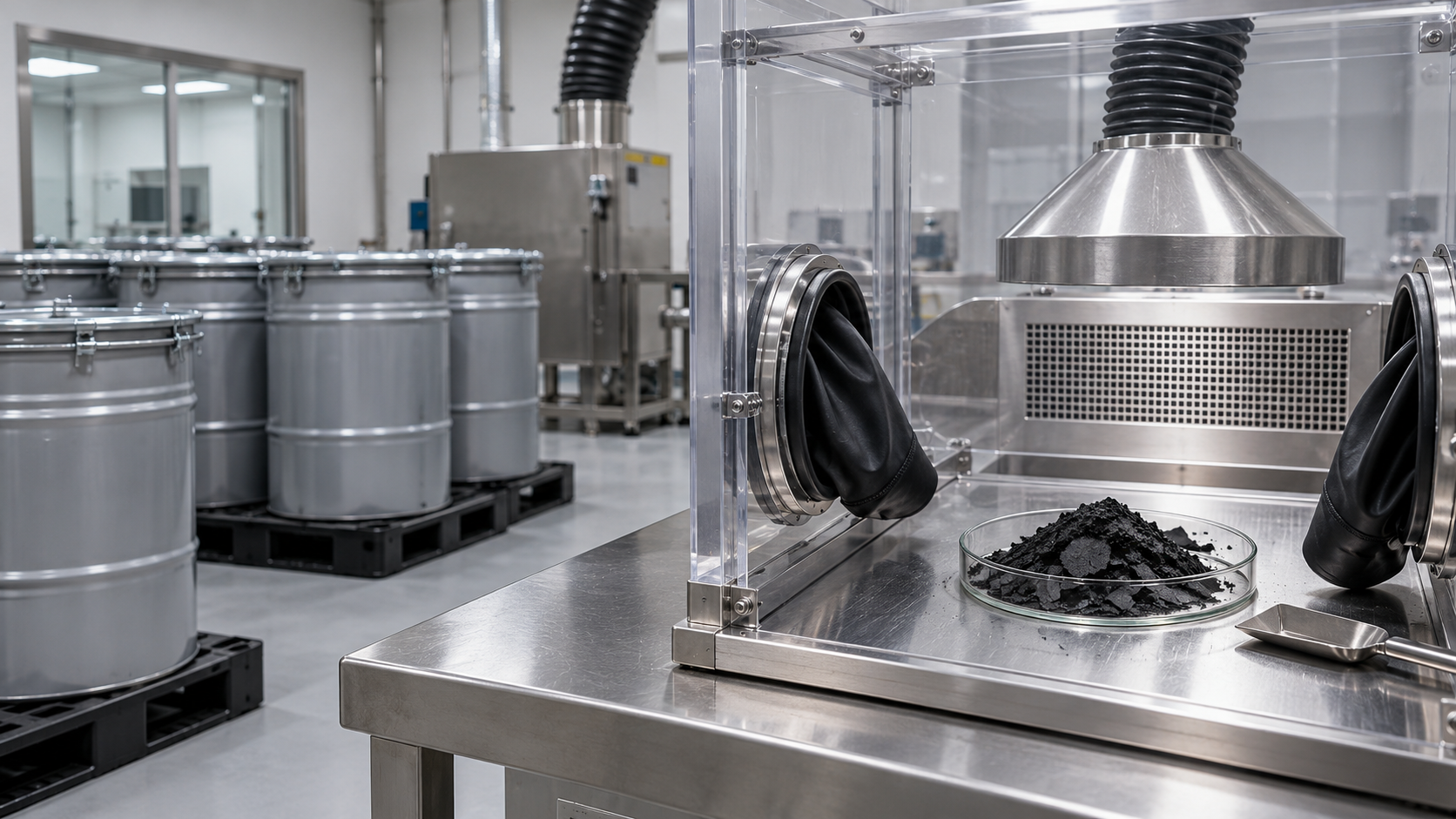
(3) What a low bulk density means. The bulk density of PureGRAPH 5 is 0.036 g/cm³, and even PureGRAPH 50 is only 0.144 g/cm³: very fluffy powders. Because so little mass fits in a given volume, transport, storage and metering efficiency and dust handling become issues. The company offers water-based pastes (Aqua) and masterbatches probably so that customers do not have to use the powder as it is, but can use a form pre-treated for their own process (inference).
(4) Regulation: registration as a new substance is required for nanomaterials. The company says that because PureGRAPH's average thickness is under 10 nm, it must be registered as a new chemical substance as a nanomaterial. In the EU it holds the 10 t a year band under REACH and is working toward the 100 t band; in Australia it is certified under AICIS, and U.S. registration is in progress (company statements). Selling the stated capacity of 100 t a year in the EU would call for the 100 t band, but whether it has been obtained could not be confirmed. See also our explainers on the definition and regulation of nanomaterials and on polymer blends and fillers.
11. Risks
| Risk | Details | Status |
|---|---|---|
| Dependence on funding | Operations make a loss, and the half-year report says continuing the business depends on raising more share capital (the directors judged that there was no material uncertainty after the November 2025 raising). The share price is low (A$0.06 on 29 May 2026), and raisings dilute shareholders | Sourced (company description) |
| Capacity is large relative to sales | Stated capacity is 100 t a year, but goods sales were A$349,611 in FY2025. The company says delays in customers' product launches affected sales. Actual output is not disclosed | Sourced |
| Feedstock supply | Graphite is said to come from the company's mines in Sri Lanka, but the half-year report says the mining site is under care and maintenance. Damages relating to the year to June 2017 are being assessed by Sri Lankan courts, and the amount is not settled | Sourced / not confirmed (current source) |
| Regulatory stage | EU REACH holds at the 10 t a year band (100 t is being sought), and U.S. registration is in progress. If registration is delayed, the volume and regions in which it can sell are limited | Sourced (company description) / Not yet confirmed |
| The 2021 funding agreement | Non-cash finance costs under the share placement agreement with Specialty Materials Investments, LLC (up to A$8 million; about A$8.48 million of shares) are weighing on results (A$1.73 million in the half-year to December 2025). The related financial liability was gone by the end of December 2025 | Sourced |
| Integrating acquisitions | MITO and Ionic have to be integrated quickly. The price for MITO includes shares tied to sales targets. Sales and profit of the acquired businesses could not be confirmed | Sourced / Not yet confirmed |
| Strength of claims | Phrases such as "the only company in the world" and "unmatched by any competitor" are common, and no basis (other companies' figures) is shown. Market-size figures are market-research estimates (Fortune Business Insights and others), which this article does not use | Sourced (company description) |
| Reliance on public support | Most other income is the R&D tax incentive and grants (A$805,282 in FY2025, about 1.7 times sales). A change in the scheme, or loss of eligibility, would cut income | Sourced / our calculation |
| Competitors and substitutes | Competition from other graphene companies and from substitutes such as carbon black and carbon nanotubes. The company's materials give no competitor figures, and this article does not assess them | Inference |
12. Glossary
- Graphene nanoplatelets
- Flakes in which graphene is stacked a few to a dozen or so layers. FGR's PureGRAPH is multi-layer, with an average thickness under 10 nm.
- Electrochemical exfoliation
- Applying a voltage to graphite so that ions enter between its layers, push them apart, and peel off flakes.
- D50
- The particle size below which 50% of the volume of particles falls.
- Bulk density / tapped density
- Density of a powder poured loosely / after the container is lightly tapped to pack it.
- Raman spectroscopy
- A method that reads the number of layers and the defects in carbon materials from scattered light. The ID/IG ratio is an indicator of defects.
- Masterbatch
- Pellets of resin with a high concentration of additive kneaded in. Customers dilute them in use.
- REACH
- The EU chemicals regulation. Registration is required according to the volume made or imported (one tonne a year or more). For nanomaterials, information is required substance by substance.
- AICIS
- Australia's scheme for introducing industrial chemicals. New chemicals must be registered.
- Appendix 4E
- The document an ASX-listed company lodges as a preliminary version of its full-year results. It can include unaudited figures.
- R&D tax incentive
- A scheme in Australia and elsewhere under which part of research spending comes back as a tax offset or refund. It makes up part of FGR's income.
- Manufacturer's stated value / company claim
- A performance value or description given by the maker itself. Without test conditions and version, it cannot be compared with other products.
13. References
- First Graphene Investor Presentation, July 2026 (ASX: FGR). Capacity, customers, acquisitions, distribution network, outlook. https://firstgraphene.net/wp-content/uploads/2026/07/FGR-Corporate-Presentation-July-2026.pdf
- First Graphene Interim Financial Report for the half year ended 31 December 2025 (lodged with the ASX on 25 February 2026). Half-year results, financing, financial position. https://announcements.asx.com.au/asxpdf/20260225/pdf/06wrjp2nrhdxnh.pdf
- First Graphene ASX Appendix 4E – Preliminary Financial Report for the year ended 30 June 2025 (lodged with the ASX on 29 August 2025). Full-year results, financial position and notes. https://announcements.asx.com.au/asxpdf/20250829/pdf/06nl9dx84x3tnm.pdf
- First Graphene FGR Annual Report FY2023/24 (year to June 2024). Business, risks, regulation, subsidiaries. https://firstgraphene.net/wp-content/uploads/2024/10/FGR-ANNUAL-REPORT-2024.pdf
- First Graphene PureGRAPH Data Sheet (version of 13 February 2025). Grades, particle size, densities, test methods. https://firstgraphene.net/wp-content/uploads/2025/02/PureGRAPH-Data-Sheet-V1_13Feb25.pdf
- First Graphene Company website, Graphene Manufacturing Process & Technology. Electrochemical exfoliation, graphite feedstock, 100,000 kg a year capacity, research partners. https://firstgraphene.net/about-us/technology/
- First Graphene Company website, Regulatory. Registration of nanomaterials as new substances, REACH (10 t a year), AICIS, status of U.S. registration. https://firstgraphene.net/about-us/regulatory/
- First Graphene Company website, Locations. Head office and plant (Henderson) and UK site. https://firstgraphene.net/about-us/locations/
- First Graphene FGR accelerates USA expansion & defence sector exposure with strategic acquisition of MITO Material Solutions (press release, 4 June 2026, distributed by PR Newswire). https://www.aap.com.au/aapreleases/cision20260603ae75719/
- First Graphene FGR enters agreement to acquire advanced graphene coatings companies (press release, 28 April 2026, distributed by PR Newswire). Ionic Industries and Imagine Intelligent Materials. https://www.aap.com.au/aapreleases/cision20260427ae43646/
- First Graphene FGR secures exclusive global graphene carbon paste production and sale rights (press release, 25 November 2025, distributed by PR Newswire). Exclusive licence from Halocell. https://www.prnewswire.com/news-releases/fgr-secures-exclusive-global-graphene-carbon-paste-production-and-sale-rights-302626371.html
- First Graphene FGR advances carbon fibre commercialisation with Aeropreg agreement (press release, 4 October 2026, distributed by PR Newswire). http://www.prnewswire.com/news-releases/fgr-advances-carbon-fibre-commercialisation-with-aeropreg-agreement-302897732.html
- First Graphene First PureGRAPH production order secured with global sports shoes company (press release, 6 October 2026, distributed by PR Newswire). https://www.prnewswire.com/news-releases/first-puregraph-production-order-secured-with-global-sports-shoes-company-302899581.html
- ASX List of company announcements for First Graphene Limited (ASX: FGR) on the ASX website, including the annual report lodged on 25 September 2026. https://www.asx.com.au/markets/trade-our-cash-market/announcements.fgr
- First Graphene Company website, home page (source of the logo image and company overview). https://firstgraphene.net/
14. Claim-to-source audit
| Claim in the text | Status | Source |
|---|---|---|
| Listing (ASX: FGR, OTCQB: FGPHF, Frankfurt: M11), head office and plant (Henderson), UK site (Manchester), directors, company overview | Sourced | Reference 2, 8, 15 https://announcements.asx.com.au/asxpdf/20260225/pdf/06wrjp2nrhdxnh.pdf https://firstgraphene.net/about-us/locations/ https://firstgraphene.net/ |
| FY2025 income statement, balance sheet, R&D, other income, inventory; deregistration of 2D Fluidics; preliminary figures with audit in progress; the Specialty Materials Investments agreement | Sourced | Reference 3 https://announcements.asx.com.au/asxpdf/20250829/pdf/06nl9dx84x3tnm.pdf |
| Half-year to December 2025: income, cash, financing (A$3.5 million), non-cash finance costs, going-concern statement, status of the Sri Lankan mine, subsequent events | Sourced | Reference 2 https://announcements.asx.com.au/asxpdf/20260225/pdf/06wrjp2nrhdxnh.pdf |
| FY2024 finances, business description, regulation (AICIS and REACH), risks, subsidiaries (Sri Lanka, 2D Fluidics) | Sourced | Reference 4 https://firstgraphene.net/wp-content/uploads/2024/10/FGR-ANNUAL-REPORT-2024.pdf |
| July 2026 investor presentation (capacity, customers, distribution, acquisitions, cement test results, composite figures, outlook, capital structure, share price) | Sourced (company description) / outlook is not yet confirmed | Reference 1 https://firstgraphene.net/wp-content/uploads/2026/07/FGR-Corporate-Presentation-July-2026.pdf |
| PureGRAPH's five grades, D50, bulk density, tapped density and test methods (Malvern, ASTM D6683 and D7481) | Sourced (company description) | Reference 5 https://firstgraphene.net/wp-content/uploads/2025/02/PureGRAPH-Data-Sheet-V1_13Feb25.pdf |
| Electrochemical exfoliation, Sri Lankan graphite feedstock, 100,000 kg a year capacity, conversion above 95%, research partners (University of Adelaide, Flinders University, ARC) | Sourced (company description) | Reference 6 https://firstgraphene.net/about-us/technology/ |
| Registration of nanomaterials as new substances, REACH (10 t a year, aiming for 100 t), AICIS, status of U.S. registration | Sourced (company description) | Reference 7 https://firstgraphene.net/about-us/regulatory/ |
| Agreement to buy the assets of MITO Material Solutions (4 June 2026), what is acquired and the US base | Sourced | Reference 9 https://www.aap.com.au/aapreleases/cision20260603ae75719/ |
| Agreement to buy the assets of Ionic Industries and Imagine Intelligent Materials (A$250,000, 28 April 2026) | Sourced | Reference 10 https://www.aap.com.au/aapreleases/cision20260427ae43646/ |
| Exclusive licence from Halocell (12 months, 10% royalty, 25 November 2025) | Sourced | Reference 11 https://www.prnewswire.com/news-releases/fgr-secures-exclusive-global-graphene-carbon-paste-production-and-sale-rights-302626371.html |
| Three-year development and commercialization agreement with Aeropreg (4 October 2026) | Sourced / commercialization is not yet confirmed | Reference 12 http://www.prnewswire.com/news-releases/fgr-advances-carbon-fibre-commercialisation-with-aeropreg-agreement-302897732.html |
| First order from Flux Footwear (6 October 2026) and footwear track record (Steel Blue, PT Alasmas Berkat Utama) | Sourced | Reference 13 https://www.prnewswire.com/news-releases/first-puregraph-production-order-secured-with-global-sports-shoes-company-302899581.html |
| Annual report lodged 25 September 2026; headlines of company announcements of 29 September, 4 October and 6 October 2026 (ASX) | Sourced | Reference 14 https://www.asx.com.au/markets/trade-our-cash-market/announcements.fgr |
| The logo image was taken from the main logo published on the official website | Sourced | Reference 15 https://firstgraphene.net/ |
| Full-year FY2026 financials, headcount, actual output, current graphite source, amount paid for MITO, outcome of U.S. EPA registration, content of the 29 September announcement, timing of profitability | Not yet confirmed | Our own organization and reasoning (includes items the primary sources did not confirm; this article) |
| Readings such as "orders before equipment", "cement as the volume pillar, widening uses", "using US defence and aerospace as a foothold", and "pre-treating powder into additives" | Inference | Reference 1, 2, 3 https://firstgraphene.net/wp-content/uploads/2026/07/FGR-Corporate-Presentation-July-2026.pdf https://announcements.asx.com.au/asxpdf/20260225/pdf/06wrjp2nrhdxnh.pdf https://announcements.asx.com.au/asxpdf/20250829/pdf/06nl9dx84x3tnm.pdf |
| The classification of FGR as a "nanomaterial producer", the four-type grouping, and the ratio of public support to sales (about 1.7 times) | Our calculation | Our own organization and reasoning (includes items the primary sources did not confirm; this article) |
| Technical explanations such as electrochemical exfoliation, aspect ratio and barrier effects, and the meaning of bulk density | Our calculation | Our own organization and reasoning (includes items the primary sources did not confirm; this article) |
Last updated: 9 October 2026 / Troy Technical
This article is based on FGR's ASX filings (the preliminary financial report for FY2025 and the half-year report to December 2025), the annual report for FY2024, the July 2026 investor presentation, press releases and technical data. It uses no market-research estimates or press-based figures (the market-size statements in the investor presentation are market-research estimates and are not used). Items marked "Inference" are our reading of the primary sources and are not company disclosures. Product performance values are company claims and cannot be compared with values obtained by different methods. Company plans and targets are not yet confirmed and are not guaranteed. FY2026 full-year financials could not be confirmed for this article. This article does not advise individual readers on handling or safety of nanomaterials, or on investment decisions.