COMPANY PROFILE / NANOTECHNOLOGY
Shoei Chemical
An electronic-materials maker that built on metal-nanoparticle know-how to mass-produce quantum dots for displays, and in 2023 acquired the quantum dot business of Nanosys of the U.S. (quantum dots only)
Shoei Chemical Inc. is a Tokyo electronic-materials maker whose mainstays are metal powders, such as nickel, and pastes for electronic components. This article covers only its quantum dot (QD) business. The company says it developed mass-production technology in 2017 for indium phosphide (InP) quantum dots, semiconductor nanoparticles 2 to 10 nm across, and began making and selling them in 2021. In August 2020 it agreed to make materials exclusively for Nanosys, a U.S. quantum dot company, and in 2023 it acquired substantially all the assets of Nanosys's quantum dot business. Nanosys's own announcement dates the acquisition to 6 September 2023, and the Nanosys brand is kept (Shoei Chemical's company history says "August 2023," so the dates differ). Sales, production capacity and the purchase price of the quantum dot business are not published. Drawing on Shoei Chemical's website and Nanosys's official announcements, this article sets out what could be confirmed and what could not, and then explains, from a materials engineer's view, how size control, core/shell structure and surface (ligand) design bear on performance.
- At a glance: Shoei Chemical and its place in nanotechnology
- Logo and naming
- Where the company sits in nanotechnology
- Company scale
- Resources committed to nanotechnology
- Track record
- Plans
- What the company is aiming for in nanotechnology
- Partnership map for nanotechnology
- Technologies, products and services
- Risks
- Glossary
- References
- Claim-to-source audit
1. At a glance: Shoei Chemical and its place in nanotechnology
(Shoei Kagaku Kogyo in Japanese)Founded April 1956 (company history). Renamed to the present name in 1959
(Shinjuku Mitsui Building)No statement on a share listing could be found on the website. Capital: ¥480 million
for displaysThe company says it mass-produces InP quantum dots with a full width at half maximum (FWHM) of 31 nm
(per Nanosys)Shoei Chemical's history says "August 2023." The purchase price has not been published
(and Silicon Valley, U.S.)The Itoshima site opened in January 2024. Nanosys's Silicon Valley labs and facilities also moved to Shoei Chemical
Shoei Chemical is an electronic-materials maker long engaged in producing metal nanoparticles, and quantum dots are a newer business within it. Judging from the website, most of company-wide sales (¥88.1 billion) appear to come from electronic materials such as metal powders and pastes, but the quantum dot share is not disclosed Sourced. What changed the quantum dot business was the 2023 acquisition of Nanosys's business. Nanosys, which describes itself as "the world's largest independent quantum dot company," had been supplied exclusively by Shoei Chemical since 2020. With the deal, Nanosys's sales, R&D staff, Silicon Valley laboratories, and patents and trademarks became Shoei Chemical's. But sales, production capacity and the purchase price of the quantum dot business are not published, so this article gives no amounts. "Mass production at the world's largest scale" is the company's own claim, and no comparison with other makers is offered Not yet confirmed.
2. Logo and naming

The logo is the corporate logo (a blue mark and the white lettering SHOEI) published in the footer of Shoei Chemical's official website, shoeichem.co.jp, obtained as-is. Because the lettering is white, it is placed in a dark frame so it can be seen. It is not a generated reproduction.
A note on names: the company is SHOEI CHEMICAL INC. (Shoei Kagaku Kogyo in Japanese; this article uses Shoei Chemical). Its related companies include Shoei Co., Ltd. (a separate entity), SHOEI ELECTRONIC MATERIALS, INC. (U.S.) and SHOEI CANADA CORPORATION (Canada). Nanosys continues as a Shoei Chemical brand after the acquisition. This article covers only the quantum dot business, not the metal powder and paste businesses.
Official website: https://www.shoeichem.co.jp/en/3. Where the company sits in nanotechnology
Shoei Chemical's primary type is nanomaterial producer; it has no secondary type. It does not make displays. It delivers quantum dot material (the particles, or a material in which they are dispersed) to the makers of films and parts, and through them to the makers of televisions, monitors and IT equipment. The table below sets out the materials, processes and uses covered in this article, as far as they could be confirmed.
| Material, process, use | Shoei Chemical's position | Primary sources | Status |
|---|---|---|---|
| InP quantum dots (core/shell structure) | The centre of this article. Semiconductor nanoparticles 2 to 10 nm across. Particle size is controlled to less than one atomic layer, and the company says it mass-produces InP quantum dots with an FWHM of 31 nm ("the world's narrowest" is its claim) | Shoei Chemical website (products; technology and R&D) | Sourced (company statement) |
| Quantum dots for displays (LCD, OLED, mini-LED and others) | Used in displays that need high colour purity and reproducibility, it says. Nanosys says it supplies materials for LCDs, mini-LEDs, OLEDs, micro-LEDs and nano-LEDs | Shoei Chemical and Nanosys websites | Sourced (company statement) |
| Contract quantum dot manufacturing (Global Foundry) | It says it takes a customer's quantum dot recipe from glassware to full-scale production, and can make them in 3,000-litre reactors | Nanosys website (Global Foundry) | Sourced (company statement) |
| Other new uses (paint, agricultural film, 3D-printing filament and so on) | Presented as examples on Nanosys's website. Commercial scale could not be confirmed | Nanosys website | Sourced (presented) / Not yet confirmed |
| Nickel powder, conductive, resistive and insulating pastes and other electronic materials | Shoei Chemical's mainstay, but outside this article | - | - |
4. Company scale
Shoei Chemical publishes sales, headcount and similar figures on its website. The table below shows company-wide scale briefly, followed by what is disclosed for quantum dots Sourced.
| Item | Detail |
|---|---|
| Sales | ¥88.1 billion in FY2025 (year to March 2026; company overview page). A figure for all electronic materials; quantum dots are not broken out |
| Capital and employees | Capital of ¥480 million. 620 employees (including 11 contract, part-time and similar staff) |
| Headquarters and sites | Headquarters: 43rd floor, Shinjuku Mitsui Building, 2-1-1 Nishi-Shinjuku, Tokyo. Japan: Tosu site (Saga) and Itoshima site (Fukuoka, opened January 2024). Overseas: the U.S. (California), Canada (Quebec) and Malaysia (Sarawak) |
| Business and related companies | Manufacture, sale, import and export of electronic materials. Related companies: Shoei Co., Ltd., SHOEI CANADA CORPORATION, SHOEI ELECTRONIC MATERIALS, INC. Quality: certified to ISO 9001 and IATF 16949 (as stated on Nanosys's website) |
| Listing and financial disclosure | No statement on a share listing could be found on the website. The only financial figure published is sales (no profit or assets figures found) |
| Item disclosed for the quantum dot business | Detail |
|---|---|
| Sales and profit | Not disclosed |
| Production capacity | Not disclosed (tonnes a year). It cites "mass production at the world's largest scale" and "3,000-litre reactors." In April 2023 Nanosys said it had shipped more than 140 tonnes of quantum dot material in total (its claim before the acquisition) |
| Headcount and researchers | Not disclosed. With the acquisition, Nanosys's sales and marketing staff, R&D team and Silicon Valley laboratories moved to Shoei Chemical |
| R&D spending and capital investment | Quantum-dot-only figures are not disclosed. The investment at the Itoshima site could not be confirmed either |
| Patents | In April 2023 Nanosys cited "more than 800 unique patents." Shoei Chemical lists U.S. patent numbers related to quantum dots, including those from Nanosys, on Nanosys's website (as examples, not an exhaustive list) |
Nanosys's August 2020 announcement quotes a forecast of quantum dot display shipments from a research firm (DSCC), but this article does not use market-research estimates. Nanosys's "1,000th quantum dot display product" and its claim of all the top-10 TV brands as customers are also its own pre-acquisition statements. And Shoei Chemical's ¥88.1 billion in sales is a company-wide figure, not a measure of quantum dot sales Not yet confirmed.
5. Resources committed to nanotechnology
Almost nothing is disclosed on staffing and investment for the quantum dot business alone. The table covers four points (people, money, external stakes and deals, universities and public funding) and says whether each could be confirmed.
| Item | What was confirmed | Status |
|---|---|---|
| People (R&D sites, headcount) | Headcount working on quantum dots is not disclosed. Company-wide: 620 employees. In 2018 the R&D function of the Ome site in Tokyo moved to the Tosu site (company history). Nanosys said the 2023 acquisition brought in its sales and marketing staff, a "world-class quantum dot research and development team" and its Silicon Valley (California) laboratories. Manufacturing and development are handled by the Tosu and Itoshima sites, it says | Sourced / not disclosed |
| Money (R&D spending, capital investment) | Quantum-dot-only R&D and capital spending, the investment at the Itoshima site and the price paid for Nanosys's business could not be confirmed. On the Nanosys side, a Series B financing of more than US$50 million was announced in July 2022 (before the acquisition) | Sourced / not disclosed (individual amounts) |
| Outside stakes, acquisitions, joint ventures, divestitures | Shoei Chemical and its U.S. subsidiary SHOEI ELECTRONIC MATERIALS, INC. acquired substantially all the assets of Nanosys's quantum dot business (asset purchase agreement). In 2007 it made Canadian Electronic Powders Corporation of Canada a wholly owned subsidiary, merged in 2013 (on the metal powder side). In October 2022 Nanosys sold its micro-LED fabrication facility and engineers to Avicena, so that part is not within Shoei Chemical's acquisition | Sourced / not confirmed (purchase price) |
| Universities, research institutes, public funding | Joint research with universities or public institutes, and public funding, for quantum dots could not be confirmed in Shoei Chemical's or Nanosys's official materials (it says it owns analytical instruments: XPS, FE-SEM, GC-MS and STEM) | Not confirmed |
Status of main products and facilities
| Product, facility | Location | Scale | Stage | Date, source |
|---|---|---|---|---|
| Mass production of quantum dots by Shoei Chemical | Tosu and Itoshima sites and others (the website names only the Itoshima plant as a quantum dot plant) | Capacity not disclosed. Can make in 3,000-litre reactors, it says | Operating (manufacture and sales began in 2021; exclusive manufacturing for Nanosys from August 2020) | Company history; Nanosys announcement of 3 August 2020 |
| Itoshima site (Fukuoka) | Itoshima, Fukuoka | Not disclosed | Opened (January 2024). Nanosys's website calls it the Itoshima QD plant | Company history; Nanosys website |
| Nanosys's Silicon Valley plant and laboratories | California, U.S. | Not disclosed | Now under Shoei Chemical (effective 6 September 2023). Nanosys had announced an expansion into a larger production facility in Milpitas, California, in 2013 | Nanosys announcements of 7 September 2023 and April 2013 |
| Customized quantum dot manufacturing (Global Foundry) | U.S. and Japan | Not disclosed | On offer (company statement). It claims it can supply high-quality nanocrystals by the tonne | Nanosys website |
6. Track record
| When | What happened | Meaning |
|---|---|---|
| 1956 | Eiichi Asada founded Shoei Chemical Co. (Tsukiji, Tokyo). It became Shoei Chemical Inc. (Shoei Kagaku Kogyo) in 1959 | Founding |
| 1991-2007 | Developed spray-pyrolysis production of metal powders (1991), a new spray-pyrolysis method (2002) and PVD-based ultrafine metal powder technology (2007) | Built nanoparticle manufacturing know-how before quantum dots (company history) |
| 2001 | Nanosys began developing quantum dots (according to its company page) | The starting point of the company later acquired |
| 2017 | Developed mass-production technology for quantum dots (company history) | Technical starting point of the business |
| 3 August 2020 | Announced a quantum dot materials supply and service agreement with Nanosys. Shoei Chemical makes Nanosys's quantum dots exclusively, as sole manufacturing partner for capacity expansion and for heavy-metal-free quantum dots. Nanosys said production volumes would more than double soon and costs fall by making closer to Asian customers | Start of the tie-up, through contract manufacturing |
| 2021 | Began manufacturing and selling quantum dot products (company history) | Shipment of volume products |
| July and October 2022 | Nanosys raised more than US$50 million (July) and sold its micro-LED fab and engineers to Avicena (October) | Nanosys narrowing to quantum dots (before the acquisition) |
| April 2023 | Nanosys announced the 1,000th quantum dot display product, more than 140 tonnes shipped in total and more than 800 patents | The company's description of its record before the acquisition |
| August-September 2023 | Shoei Chemical acquired substantially all the assets of Nanosys's quantum dot business (Nanosys's announcement is dated 7 September 2023 and effective 6 September; Shoei Chemical's history says "August 2023"). The Nanosys brand is kept | Materials, sales and R&D brought together |
| January 2024 | Opened a site in Itoshima, Fukuoka | A quantum dot production site (introduced on Nanosys's website as the Itoshima QD plant) |
7. Plans
3D-printing filament and othersPresented as examples on Nanosys's website. No timing or scale
The news section of Shoei Chemical's website currently carries only a notice of a website redesign (March 2026), so no recent announcement on the quantum dot business could be confirmed. Nanosys's website lists "new frontiers" such as automotive paint, agricultural film and 3D-printing filament, but gives no timing or scale for commercialization Not yet confirmed.
None of the following appears in primary sources Not yet confirmed.
Quantum dot sales, profit and production capacity (tonnes a year) / the purchase price and terms / the investment at the Itoshima site / headcount in the quantum dot business / the measurement conditions for the 31 nm FWHM (emission peak, method) / luminous efficiency and durability figures for the products / volumes by customer / the regulatory position of the cadmium-free claim / registration status under chemical regulations in each region / any further expansion plan.
8. What the company is aiming for in nanotechnology
This section includes points the company does not state directly. They are given as inferences readable from the primary sources, with the grounds alongside.
| What can be read | Primary sources behind it | Status |
|---|---|---|
| Shoei Chemical is growing quantum dots as a materials business that draws on its metal-nanoparticle manufacturing know-how, aimed at displays | Website: technology to control particle size to less than one atomic layer, mass production at the world's largest scale, InP quantum dots with an FWHM of 31 nm. History: mass-production technology in 2017, manufacture and sales in 2021 | Sourced (company statement) |
| Through the Nanosys acquisition it is bringing together materials manufacturing (Shoei Chemical) and sales and application development (Nanosys) | The exclusive manufacturing agreement of 2020, then the acquisition three years later. The September 2023 announcement describes "the combination of Shoei Chemical's manufacturing capabilities and Nanosys's quantum dot technology" and continuing the Nanosys brand and customer service | Sourced (company statement) |
| It aims to widen quantum dots to uses beyond displays | Nanosys's website presents automotive paint, agricultural film, 3D-printing filament and so on as new fields | Inference |
| Quantum dots are probably still a new business within Shoei Chemical, and small beside the mainstay electronic materials | The website's product page lists powders and pastes first, with quantum dots the fifth item. The product-related column of the history ends with quantum dots in 2017 and 2021. Sales are given only company-wide | Inference |
The reason for reading "the acquisition aims to bring manufacturing together with sales and application development" is how short the path to the deal was, and what it covered. In the August 2020 agreement, Shoei Chemical became the exclusive manufacturer of Nanosys's quantum dots, and Nanosys aimed to more than double output and make it closer to Asian customers. Three years later, in September 2023, Shoei Chemical took over substantially all the assets (sales and marketing, the R&D team and the Silicon Valley laboratories). Together with Nanosys's sale of its micro-LED facility in 2022 and focus on quantum dots, it looks like a shift from a contract-manufacturing relationship to putting manufacturing and development in a single company. This is our reading of combined statements in official documents, and no document in which Shoei Chemical sets out the purpose and terms of the acquisition in detail could be confirmed Not yet confirmed.
9. Partnership map for nanotechnology
What stands out about Shoei Chemical's relationships is that it moved from contract manufacturing for Nanosys to acquiring the business, and that it now stands in the place of Nanosys in the tie-ups Nanosys made before the deal (component makers, display developers). Nanosys's announcements describe its customers as "all of the top-10 television brands" and "four of the top-five IT brands," among others, but that is a pre-acquisition claim, and the customers and terms after the acquisition could not be confirmed from Shoei Chemical's official documents Not yet confirmed.
10. Technologies, products and services
The following draws on Shoei Chemical's official website and the website and announcements of Nanosys. Numbers such as luminous efficiency, emission peak, particle structure (materials and thickness of core and shell) and durability do not appear on the public pages, so none are given. The 31 nm FWHM is the company's statement, with no measurement conditions Sourced.
| Product, use | What the company's documents say (manufacturer's statements) |
|---|---|
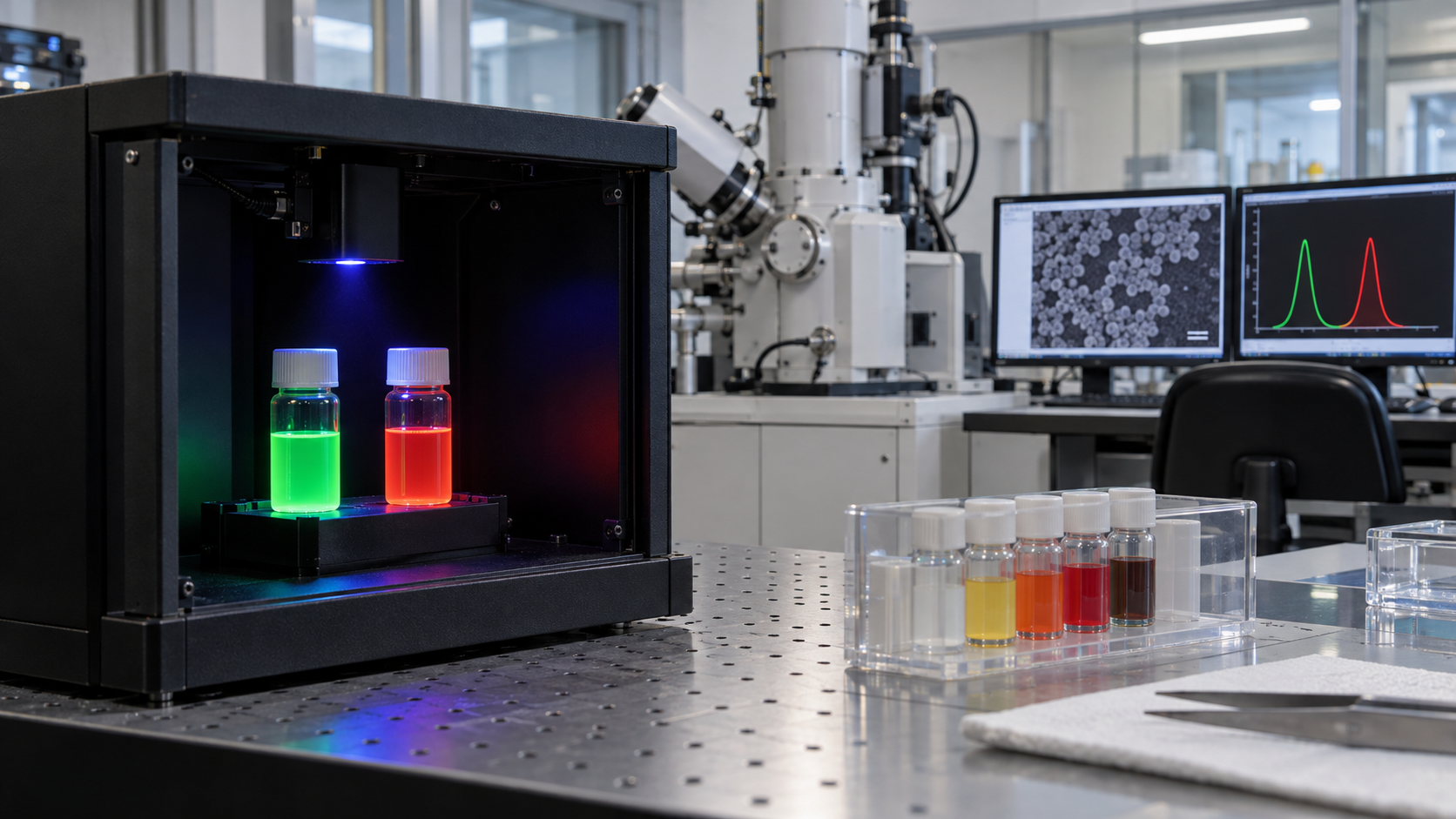
| Quantum dots (Shoei Chemical) | Semiconductor nanoparticles about 2 to 10 nm in diameter (about one hundred-thousandth the thickness of a hair). By the "quantum confinement" effect, emission colour changes with particle size alone, and the narrow emission spectrum gives high colour reproducibility with a fast response. The company controls particle size to less than one atomic layer and says it mass-produces InP quantum dots with "the world's narrowest spectral linewidth (FWHM of 31 nm)". Compared with its conventional high-end nickel products, they are less than one-tenth the size and less than one-thousandth the volume |
| Why they are hard to make at volume | Quantum dots change character greatly with a size difference of only 1 nm, and a complex core/shell structure has to be built inside a particle a few nanometres across. The company describes this as a material long thought hard to mass-produce, and claims to have succeeded at the world's largest scale (no basis for comparison is given) |
| Ligand design (Nanosys's description) | By engineering the ligands (the molecules attached to the particle surface), quantum dots can be adapted to a wide range of solution processing: solvents, monomers, polymer films, inks and photoresists. Attaching them to biomolecules or cells is also mentioned |
| Spectrum design (Nanosys's description) | Particles can be tuned to absorb ultraviolet light and to emit and detect from the visible to the infrared |
| Cadmium-free quantum dots (Nanosys's description) | It says it has enabled 100% cadmium (heavy metal)-free quantum dot TVs and monitors since 2015 (the company's claim; the regulatory position was not checked) |
| Global Foundry (contract manufacturing) | Takes a customer's quantum dot recipe from glassware to large-scale production. Features: 3,000-litre reactors, reliability-testing facilities, and IP protection under the parent company, Shoei Chemical. It says it can deliver high-quality nanocrystals by the tonne |
| Components and brands (Nanosys) | QDEF, xQDEF (diffuser plate) and HYPERION are shown as trademarks owned by Shoei Chemical. Nanosys announced barrier-free laminated and extruded quantum dot components, launched with other companies (September 2021, April 2022) |
(1) Colour follows size, so uniform size means colour purity. A quantum dot's emission wavelength is set by the particle diameter (quantum confinement). If the particles are not uniform in size, the emitted colour smears and the spectrum broadens. The company's stress on controlling size "to less than one atomic layer" and on an FWHM of 31 nm suggests that keeping the size distribution narrow bears directly on a display's colour purity (our general framing; the measurement conditions for 31 nm are not disclosed) (inference).
(2) Core/shell: balancing luminescence and stability. In particles a few nanometres across, a large share of atoms sit at the surface, and surface defects are known to quench emission. A common remedy is to coat the emitting core with a shell of another semiconductor, and Shoei Chemical says it builds a core/shell structure. The shell's material and thickness are not published, so nothing about the structure beyond "InP-based" could be confirmed.
(3) Surface molecules (ligands) decide what the dots can be mixed into. Nanosys says ligand design lets the dots go into solvents, resins, inks and photoresists. A quantum dot cannot be used as bare particles; the practical issue is dispersing it evenly in a film or resin and protecting it from air and moisture. Nanosys's announcements of "barrier-free" components can be read as development that has the particle and resin side, rather than the film side, provide this protection, but the detailed structure is not public (inference).
(4) Scale-up: how to keep batches alike. Because a 1 nm size difference changes properties, the larger the reactor, the harder it is to keep temperature and concentration uniform (a general challenge, our framing, not a description of Shoei Chemical's individual processes). The company says it can make dots in 3,000-litre reactors, but figures for batch-to-batch variation and yield are not disclosed. For background, see this series' explainer on quantum dots.
A limit on use. "The world's narrowest," "the world's largest scale" and "100% cadmium-free" are all company statements, and no comparison or measurement conditions are given. This article does not rank Shoei Chemical's quantum dots against other makers'.
11. Risks
| Risk | Detail | Status |
|---|---|---|
| Thin disclosure | Quantum dot sales, capacity and purchase price are not published. The news section of the website now carries just one item. The business's profitability and investment priority cannot be read from official documents | Sourced / Not yet confirmed |
| Integration after the acquisition | The 2023 deal brought in sales and R&D staff and a Silicon Valley site. How far integration has gone, and whether people and customers were retained, could not be confirmed from official documents | Inference |
| Dependence on display demand | The main use of quantum dots is displays, so volumes follow demand for TVs, monitors and the like, and competition with other display technologies such as OLED. The company's materials give no demand outlook, and this article does not assess one | Inference |
| Concentrated customers and brands | Before the acquisition, Nanosys named major brands. Terms and customers after the acquisition are unknown, and a few large customers may account for much of the business | Sourced (company statement) / Inference |
| Unclear conditions behind claims | "The world's narrowest spectral linewidth," "the world's largest scale," "the world's largest independent quantum dot company," "more than 140 tonnes in total" and "100% cadmium-free" are company statements whose measurement conditions and definitions are not public | Sourced (company statement) |
| Intellectual property | Shoei Chemical shows a list of U.S. patents on quantum dots and the trademarks as its own. Nanosys sued Nanoco Technologies of the U.K. for patent infringement in 2009 and settled (Nanosys's announcements). No current dispute could be confirmed | Sourced |
| Concentrated production | Volume production appears centred on Japan (Itoshima and others) and the U.S. Capacity by site is unknown, and the effect of an accident or stoppage cannot be read from official documents | Inference |
| Regulation and safety status | How quantum dot materials (with or without cadmium) are handled depends on chemical regulations by region and on rules for electrical and electronic equipment. Shoei Chemical's registration or notification status could not be confirmed from official documents. "Nano" does not make a material safe or unsafe as a general rule (see this series' explainer on definition and regulation of nanomaterials) | Not yet confirmed |
12. Glossary
- Quantum dot (QD)
- A semiconductor particle a few nanometres across. Its emission colour is set by its size. Used, for example, for colour conversion in display backlights.
- Quantum confinement
- When a particle is small enough, the range in which electrons can move is limited, and particle size sets the energy (and so the colour of the light).
- InP (indium phosphide)
- A semiconductor used for quantum dots. Used as a cadmium-free material.
- Core/shell structure
- A structure in which an emitting core is coated with a shell of another material. Used to improve emission and stability.
- Full width at half maximum (FWHM)
- The width of an emission spectrum at half its peak height. The smaller it is, the purer the colour.
- Ligand
- A molecule attached to a particle's surface. It prevents aggregation and sets compatibility with solvents and resins.
- QDEF
- A film containing quantum dots (a Nanosys trademark), a component that widens the colour gamut of liquid crystal displays.
- Mini-LED and micro-LED
- Very small LEDs used for backlights or pixels. They differ in size.
- Barrier layer
- A protective layer on the outside of a film that keeps moisture and oxygen from reaching the quantum dots.
- Asset purchase
- Buying the assets that make up a business (equipment, patents, people and so on) rather than the company itself.
- ISO 9001 and IATF 16949
- International quality-management standards (IATF 16949 is for the automotive sector). Certification shows a company meets them.
- Manufacturer's statement
- An explanation or figure given by the manufacturer itself. It cannot be compared with another product's unless the method and conditions are the same.
13. References
- Shoei Chemical Company overview (company website, Japanese page; the English page is at the same path under /en/). Name, address, capital, sales for FY2025 (year to March 2026), employees, related companies. https://www.shoeichem.co.jp/company/about/
- Shoei Chemical History (company website, Japanese page). Founding in 1956, mass-production technology for quantum dots in 2017, the August 2020 collaboration with Nanosys, quantum dot sales in 2021, the August 2023 acquisition of Nanosys's quantum dot business, the Itoshima site in January 2024. https://www.shoeichem.co.jp/company/history/
- Shoei Chemical Locations (company website, Japanese page). Headquarters, the Tosu and Itoshima sites, and sites in the U.S., Canada and Malaysia. https://www.shoeichem.co.jp/company/location/
- Shoei Chemical Products (company website, Japanese page). Description of quantum dots (2-10 nm, InP, FWHM of 31 nm, differences from existing materials). https://www.shoeichem.co.jp/solutions/products/
- Shoei Chemical Technology and R&D (company website, Japanese page). The quantum dot field, analytical instruments. https://www.shoeichem.co.jp/solutions/technology/
- Shoei Chemical News (company website, Japanese page). Currently only a notice of the website redesign (19 March 2026). https://www.shoeichem.co.jp/news/
- Nanosys Shoei Chemical Acquires Quantum Dot Business from Nanosys (7 September 2023). Asset purchase agreement, effective 6 September 2023, the brand kept. https://www.nanosys.com/press-releases/shoei-chemical-acquires-quantum-dot-business-from-nanosys
- Nanosys Nanosys and Shoei Chemical Announce Quantum Dot Supply Agreement to Serve Rapidly Growing Quantum Dot Display Market (3 August 2020). Exclusive manufacturing, capacity expansion. https://www.nanosys.com/press-releases/2020/8/3/nanosys-and-shoei-chemical-announce-quantum-dot-supply-agreement-to-serve-rapidly-growing-quantum-dot-display-market
- Nanosys 2023 is the "Year of the Quantum Dot" (11 April 2023). The 1,000th quantum dot display product, more than 140 tonnes shipped in total, more than 800 patents, customer brands. https://www.nanosys.com/press-releases/2023yearofthequantumdot
- Nanosys Quantum Dot and MicroLED Pioneer Nanosys Secures Over $50 Million in Growth Capital Financing (25 July 2022). https://www.nanosys.com/press-releases/quantum-dot-and-microled-pioneer-nanosys-secures-over-50-million-in-growth-capital-financing
- Nanosys Avicena acquires microLED fab facility and engineering team from Nanosys (18 October 2022). https://www.nanosys.com/press-releases/avicena-acquires-microled-fab-facility-and-engineering-team-from-nanosys
- Nanosys Press releases (company website). List of announcements from 2009 to 2023 (the 2013 Milpitas expansion, the 2009 Nanoco lawsuit and settlement, CYD in 2021, SmartKem and Bready in 2022 and others). https://www.nanosys.com/press-releases
- Nanosys Company (company website). Quantum dot development since 2001, acquisition by Shoei Chemical in 2023, the Itoshima QD plant. https://www.nanosys.com/about
- Nanosys Product (company website). Ligand design, spectrum design, cadmium-free quantum dots. https://www.nanosys.com/product
- Nanosys Global Foundry (company website). Contract manufacturing, 3,000-litre reactors, the Itoshima QD plant, Silicon Valley and Japan facilities. https://www.nanosys.com/global-foundry
- Nanosys Patent & Trademark Notice (company website). List of U.S. patents related to quantum dots (examples) and the trademarks (Nanosys, QDEF, xQDEF, HYPERION and others), owned by Shoei Chemical. https://www.nanosys.com/patent
- Nanosys ISO and IATF Certifications (company website). Shoei Chemical's ISO 9001 and IATF 16949 certifications. https://www.nanosys.com/certifications
- Shoei Chemical Company website (source of the logo image: the footer logo). https://www.shoeichem.co.jp/en/
14. Claim-to-source audit
| Claim in the text | Status | Source |
|---|---|---|
| Shoei Chemical's company overview (name, address, capital of ¥480 million, FY2025 sales of ¥88.1 billion for the year to March 2026, 620 employees, related companies) | Sourced | Reference 1 https://www.shoeichem.co.jp/company/about/ |
| The 1956 founding, the 1959 renaming, mass-production technology for quantum dots in 2017, the August 2020 collaboration with Nanosys, quantum dot manufacture and sales in 2021, the August 2023 acquisition of Nanosys's quantum dot business, the January 2024 Itoshima site, and the history of metal powder technologies | Sourced | Reference 2 https://www.shoeichem.co.jp/company/history/ |
| The headquarters address (43rd floor, Shinjuku Mitsui Building), the Tosu and Itoshima sites, the sites in the U.S., Canada and Malaysia, and manufacturing and development at Tosu and Itoshima | Sourced | Reference 3 https://www.shoeichem.co.jp/company/location/ |
| The description of quantum dots (about 2-10 nm, quantum confinement, an FWHM of 31 nm for InP quantum dots, size control to less than one atomic layer, mass production at the world's largest scale) and the differences from existing materials (less than one-tenth the size, less than one-thousandth the volume) | Sourced (company statement) | Reference 4 https://www.shoeichem.co.jp/solutions/products/ |
| The description of the quantum dot field (properties change with a 1 nm size difference, core/shell structure, a material hard to mass-produce), analytical instruments (XPS, FE-SEM, GC-MS, STEM), the 2018 move of R&D | Sourced (company statement) | References 5 & 2 https://www.shoeichem.co.jp/solutions/technology/ https://www.shoeichem.co.jp/company/history/ |
| That the website's news section carries only the notice of the website redesign (March 2026) | Sourced | Reference 6 https://www.shoeichem.co.jp/news/ |
| The acquisition of substantially all the assets of Nanosys's quantum dot business (asset purchase agreement, effective 6 September 2023), the transfer of sales and marketing, the R&D team and the Silicon Valley laboratories, the Nanosys brand kept, and no purchase price given | Sourced (company statement) | Reference 7 https://www.nanosys.com/press-releases/shoei-chemical-acquires-quantum-dot-business-from-nanosys |
| The August 2020 quantum dot materials supply and service agreement (Shoei Chemical manufactures Nanosys's quantum dots exclusively, sole manufacturing partner for capacity expansion and heavy-metal-free quantum dots, production volumes to more than double) | Sourced (company statement) | Reference 8 https://www.nanosys.com/press-releases/2020/8/3/nanosys-and-shoei-chemical-announce-quantum-dot-supply-agreement-to-serve-rapidly-growing-quantum-dot-display-market |
| Nanosys's April 2023 announcement (1,000th quantum dot display product, more than 140 tonnes shipped in total, more than 800 patents, customer brands, supply for LCD, mini-LED, OLED, micro-LED and nano-LED) | Sourced (company statement) | Reference 9 https://www.nanosys.com/press-releases/2023yearofthequantumdot |
| Nanosys's financing of more than US$50 million (Series B) in July 2022 | Sourced (company statement) | Reference 10 https://www.nanosys.com/press-releases/quantum-dot-and-microled-pioneer-nanosys-secures-over-50-million-in-growth-capital-financing |
| Nanosys's sale of its micro-LED fabrication facility and engineers to Avicena in October 2022 | Sourced | Reference 11 https://www.nanosys.com/press-releases/avicena-acquires-microled-fab-facility-and-engineering-team-from-nanosys |
| Nanosys's earlier announcements (the 2013 Milpitas production expansion, the 2009 patent suit against Nanoco and its settlement, CYD in September 2021, the SmartKem joint development agreement in February 2022, Bready in April 2022) | Sourced (company statement) | Reference 12 https://www.nanosys.com/press-releases |
| That Nanosys has developed quantum dots since 2001, was acquired by Shoei Chemical in 2023, the Itoshima QD plant, and the introduction of Shoei Chemical | Sourced (company statement) | Reference 13 https://www.nanosys.com/about |
| Ligand design, spectrum design (ultraviolet absorption, infrared emission and so on), and the statement that cadmium-free quantum dot TVs and monitors have been enabled since 2015 | Sourced (company statement) | Reference 14 https://www.nanosys.com/product |
| Global Foundry (contract manufacturing, 3,000-litre reactors, supply by the tonne, Silicon Valley and Japan facilities) | Sourced (company statement) | Reference 15 https://www.nanosys.com/global-foundry |
| The list of U.S. patents on quantum dots (examples) and the trademarks (Nanosys, QDEF, xQDEF, HYPERION and others) shown as owned by Shoei Chemical | Sourced | Reference 16 https://www.nanosys.com/patent |
| Shoei Chemical's ISO 9001 and IATF 16949 certifications | Sourced | Reference 17 https://www.nanosys.com/certifications |
| The logo image is the corporate logo published in the footer of the company website | Sourced | Reference 18 https://www.shoeichem.co.jp/en/ |
| Quantum dot sales, profit and production capacity; the purchase price and terms; the Itoshima investment; quantum dot headcount; the measurement conditions for the 31 nm FWHM; luminous efficiency and durability figures; customers and terms after the acquisition; registration status under chemical regulations; further expansion plans; whether the company is listed | Not yet confirmed (could not be confirmed) | References 1 & 2 https://www.shoeichem.co.jp/company/about/ https://www.shoeichem.co.jp/company/history/ |
| Readings that the acquisition aims to bring manufacturing together with sales and application development, that quantum dots are still small within the company, that the aim is to widen beyond displays, the reading of size distribution and colour purity, the aim of barrier-free components; the organization of integration and customer-concentration risks | Inference | References 8 & 7 & 1 & 14 https://www.nanosys.com/press-releases/2020/8/3/nanosys-and-shoei-chemical-announce-quantum-dot-supply-agreement-to-serve-rapidly-growing-quantum-dot-display-market https://www.nanosys.com/press-releases/shoei-chemical-acquires-quantum-dot-business-from-nanosys https://www.shoeichem.co.jp/company/about/ https://www.nanosys.com/product |
| Classifying Shoei Chemical as a nanomaterial producer, and the four-type framework (including how it differs from the example list in Fig. 1) | Our calculation | Our own organization and calculation (technical explanations are general commentary, not values for the company's individual products; see the series' explainers) |
| Technical explanations of quantum dot size, core/shell structure, ligands and scale-up (general commentary) | Our calculation | Our own organization and calculation (technical explanations are general commentary, not values for the company's individual products; see the series' explainers) |
Last updated: 9 October 2026 / Troy Technical
This article is based on Shoei Chemical's official website and on Nanosys's official announcements and website. No statutory disclosure (such as a securities report) could be confirmed, because the website does not mention a listing; the only financial figure is sales on the website. It uses no market-research estimates (such as the shipment forecast in Nanosys's announcement) or press-based figures. Items marked "Inference" are our reading of the primary sources and are not company disclosures. Product features and performance values are the company's own statements, including some without stated measurement conditions. Company plans and targets are not yet confirmed and are no guarantee of outcomes. This article does not advise individual readers on handling or safety of materials, or on investment.