COMPANY PROFILE / NANOTECHNOLOGY
Zeon
A materials maker that mass-produces ZEONANO single-walled carbon nanotubes, using the Super-Growth method that extends catalyst life with a trace of water
Zeon Corporation is a chemical company on the Tokyo Stock Exchange Prime Market, best known for synthetic rubber and optical resins. This article covers only its ZEONANO single-walled carbon nanotube (SWCNT) business. Zeon turned the Super-Growth (SG) method, first reported by Japan's National Institute of Advanced Industrial Science and Technology (AIST) in 2004, into a production process, and it makes and sells SWCNTs at its Tokuyama Plant in Yamaguchi Prefecture. In April 2026 Zeon decided to expand SWCNT output at Tokuyama, and it held a groundbreaking ceremony for the new plant on 25 August 2026. The company says capacity will rise to tens of times the current level and that it aims for full-scale operation during 2028 (a plan). Sales of SWCNTs, however, are not disclosed separately in its results materials. Drawing on the company's press releases, results materials, product data and public documents of Japan's Ministry of Economy, Trade and Industry (METI), this article sets out what could be confirmed and what could not, and then explains, from a materials engineer's view, how the shape and purity of the SWCNT "forest," dispersion and conductive pastes bear on performance.
- At a glance: Zeon and its place in nanotechnology
- Logo and naming
- Where the company sits in nanotechnology
- Company scale
- Resources committed to nanotechnology
- Track record
- Plans
- What the company is aiming for in nanotechnology
- Partnership map for nanotechnology
- Technologies, products and services
- Risks
- Glossary
- References
- Claim-to-source audit
1. At a glance: Zeon and its place in nanotechnology
(Nippon Zeon Co., Ltd. in Japanese)Founded 12 April 1950. The English name follows the company's own website
TSE Prime (4205)SWCNTs are made at the Tokuyama Plant, Shunan, Yamaguchi. Listing market as stated in a 30 January 2026 company disclosure
Mainly battery conductive additiveMade by the Super-Growth method. The company names lithium-ion batteries as its top priority
(plan)Groundbreaking on 25 August 2026. Capacity expected at tens of times the current level (company statement)
(maximum subsidy about ¥5.1 billion)Supply security plan certified 17 February 2026. The subsidy is a ceiling; the amount actually awarded could not be confirmed
Zeon's SWCNT business is small within the company, and its sales are not published. It draws attention because Zeon says it was the first in the world to mass-produce SWCNTs by the SG method, and the Japanese government has certified its expansion investment as a supply security plan Sourced. The new plant, which broke ground in August 2026, has a building footprint slightly smaller than the existing plant's (2,000 m² against 2,200 m²), yet the company says a new synthesis process will raise capacity to tens of times the present level. Both that capacity and the timing of full operation (during 2028) are company plans and not yet confirmed. Whether the material will actually be used in battery makers' mass-production cells is, in the company's own words, something it "aims" to achieve; the customers and volumes have not been disclosed Not yet confirmed.
2. Logo and naming

The logo is the corporate logo (the blue "ZEON" lettering) published in the header of Zeon's official website, zeon.co.jp, obtained as-is. It is not a generated reproduction.
A note on names: the company is Nippon Zeon Co., Ltd. in Japanese and Zeon Corporation in English (short form Zeon). ZEONANO® is its brand of single-walled carbon nanotubes, and the powder product is ZEONANO® SG101. The official website also lists Zeon Group affiliates in Japan and abroad; this article covers Zeon Corporation, the entity confirmed as making and selling the SWCNTs.
Official website: https://www.zeon.co.jp/3. Where the company sits in nanotechnology
Zeon's primary type is nanomaterial producer; it has no secondary type. Zeon does not make batteries; it supplies SWCNTs as a material. (Conductive paste, a liquid in which SWCNTs are dispersed in a solvent, is made by SiAT of Taiwan, in which Zeon has invested.) The table below sets out the materials, processes and uses covered in this article, as far as they could be confirmed.
| Material, process, use | Zeon's position | Primary sources | Status |
|---|---|---|---|
| Synthesis of single-walled CNT (ZEONANO® SG101) by the SG method | The centre of this article. Makes and sells SWCNT powder with high purity, high specific surface area and a high aspect ratio, synthesized by the SG method | Official press releases, product page, technical sheets | Sourced |
| Conductive material for lithium-ion batteries (conductive paste) | The use the company puts first. It expects applications in electric vehicles, drones, eVTOL aircraft, backup power for AI servers (BBU) and stationary storage (ESS) | Press releases of April and August 2026; METI certification summary (item: "conductive additive") | Sourced (company statement) |
| Dispersions (water, NMP) | Offered as samples (0.2 and 0.4 wt% in water; 0.4 wt% in NMP, N-methyl-2-pyrrolidone) | Official technical sheet | Sourced |
| Additive in resins and rubber (antistatic and others) | Prototype examples, such as a trace addition to PTFE, are published in technical sheets. Business scale could not be confirmed | Official technical sheets (prototypes) | Sourced (prototype examples) |
| Multi-walled CNT, graphene, quantum dots and other nanomaterials | Could not be confirmed in the company's materials. On the website's CNT page, Zeon's nanomaterial offering is single-walled CNT only | - | Not yet confirmed |
4. Company scale
Zeon is a large company whose core business is synthetic rubber and optical resins. The table below shows company-wide scale, followed by what is disclosed for SWCNTs Sourced.
| Item | Detail |
|---|---|
| Consolidated sales | ¥411,966 million in FY2025 (year to March 2026); ¥420,647 million the year before |
| Operating profit | ¥36.4 billion (¥29.3 billion the year before). Ordinary profit ¥40,038 million; net profit ¥36.2 billion |
| Segments (sales / operating profit) | High-performance materials ¥124.2 billion / ¥22.4 billion; elastomers ¥223.7 billion / ¥11.7 billion; other businesses and eliminations ¥64.1 billion / ¥2.3 billion |
| Employees | 4,425 consolidated; 2,503 non-consolidated (end of March 2026) |
| Capital | ¥24,211 million (end of March 2026) |
| R&D spending (company-wide) | About ¥17 billion a year (FY2025 actual, as stated on the company website) |
| Headquarters and listing | 1-6-2 Marunouchi, Chiyoda-ku, Tokyo. Tokyo Stock Exchange Prime Market, code 4205 |
| Item disclosed for the SWCNT business | Detail |
|---|---|
| Sales | Not disclosed. The medium-term plan progress materials (June 2026) give a sales CAGR (compound annual growth rate) target for single-walled CNT of 127% (2024-30) and an actual of -15% (2024-25). The company notes that the -15% is a reaction to FY2024, when shipments were bunched together. No amounts are given |
| Which segment includes it | Could not be confirmed from the results presentation |
| Headcount and researchers | Not disclosed (company-wide figures only) |
| R&D spending and capital investment | Company-wide R&D is about ¥17 billion a year. SWCNT-only R&D is not disclosed. METI's certification summary for the new plant lists "funds required: about ¥14.7 billion" (a planned amount) |
The medium-term plan materials (June 2025) also show a growth rate for the lithium-ion battery SWCNT "market" (72% a year, 2024-30) and a 2030 market size, but the materials say only that these are "the company's own estimates," and give neither the method nor a source. This article does not use market-size or market-growth figures. The "SWCNT sales CAGR of 127% (2024-30)" in the same materials is labelled "company plan", that is, a company target. The chart sets FY2024 at an index of 100 and reaches above 10,000 in FY2030, so 127% reads naturally as an annual rate (inference), but the explanatory note puts it as "sales growth of 127% by FY2030," and the definition is not stated in the materials. Because the base sales figure is not disclosed, it cannot be converted into an amount either Not yet confirmed.
5. Resources committed to nanotechnology
Almost nothing is disclosed on staffing and investment for the SWCNT business alone. The table covers four points (people, money, external stakes and deals, universities and public funding) and says whether each could be confirmed.
| Item | What was confirmed | Status |
|---|---|---|
| People (R&D sites, headcount) | Headcount working on SWCNTs is not disclosed. Company-wide: 4,425 consolidated and 2,503 non-consolidated employees (end of March 2026). Production is at the Tokuyama Plant in Shunan, Yamaguchi. In 2016 a joint laboratory with AIST (the Zeon-AIST Nanotube Industrialization Cooperative Research Laboratory) was set up at AIST's Tsukuba Center, with about ten staff planned at the time. The current set-up could not be confirmed | Sourced / not disclosed |
| Money (R&D spending, capital investment) | Company-wide R&D is about ¥17 billion a year (FY2025). SWCNT-only R&D is not disclosed. METI's certification summary for the new plant gives "funds required: about ¥14.7 billion (maximum subsidy: about ¥5.1 billion)". Zeon says its company-wide plan to invest ¥150 billion in new projects through FY2026 is "expected to be fully used up at this stage"; the materials do not say whether the SWCNT plant is included in that total | Sourced / not disclosed (individual amounts) |
| Outside stakes, acquisitions, joint ventures, divestitures | Invested in Sino Applied Technology (SiAT), a Taiwanese conductive-paste maker (basic agreement May 2025, investment agreement August, announced 30 October). Zeon led SiAT's Series C round (US$22 million in total) and is appointing a director. Zeon's investment amount and shareholding could not be confirmed. No acquisitions, joint ventures or divestitures in SWCNTs were confirmed | Sourced / not confirmed (amount, joint ventures) |
| Universities, research institutes, public funding | AIST developed the SG method in 2004 and worked with Zeon on mass-production technology. Zeon took part in projects of NEDO (New Energy and Industrial Technology Development Organization): a CNT capacitor development project (FY2006-2010) and development of innovative CNT composite materials (FY2010-2013). Using METI's FY2009 supplementary budget, Zeon and AIST built a demonstration plant (2011). In 2026 Zeon applied for a subsidy under the METI supply security plan certification (up to about ¥5.1 billion). Joint research with overseas universities or institutes could not be confirmed (Zeon says it does joint research on safety with universities and public bodies in Japan and abroad, without naming them) | Sourced / not confirmed (overseas) |
Status of main products and facilities
Production capacity (tonnes a year) is not disclosed; only a relative figure, "tens of times the present level," is given. The battery-equivalent figure (GWh a year) is a planned value in METI's certification summary, not current capacity.
| Product, facility | Location | Scale | Stage | Date, source |
|---|---|---|---|---|
| SG-method SWCNT demonstration plant | AIST Tsukuba Center | Not disclosed | Built 2011. As of 2014, run by AIST and Zeon, which supplied samples (current operation could not be confirmed) | Press release, 15 May 2014 |
| SWCNT production plant (existing) | Tokuyama Plant, Shunan, Yamaguchi | Capacity not disclosed. Building footprint 2,200 m² | Operating (completed November 2015; the company calls it the world's first SG-method mass-production plant). The company website says commercial production began in 2016 | Press release, 7 April 2016; June 2026 plan materials; product page |
| SWCNT new plant (new line) | Within the Tokuyama Plant site | Capacity expected at tens of times the present level. Footprint 2,000 m². METI's summary: equivalent to 128 GWh a year of batteries | Under construction (groundbreaking 25 August 2026). Full operation is a plan for 2028 (supply start December 2028 in the certification summary). Not yet confirmed | Press releases of 24 April and 25 August 2026; METI summary |
| ZEONANO® SG101 (powder) and dispersions | - | Powder is packed in 1 kg fibre drums and 10 g PE bottles | On sale (powder) / samples (dispersions) | Official technical sheet |
| SiAT's conductive-paste capacity | Taiwan | 5,000 tonnes a year, to 25,000 tonnes by 2030 (SiAT's plan; includes expansions not yet carried out) | SiAT's plan; Zeon supports it as a main supplier | Press release, 30 October 2025 |
6. Track record
| When | What happened | Meaning |
|---|---|---|
| 1991 | Sumio Iijima reported carbon nanotubes (Nature 354, 56-58) | Starting point for CNTs (journal paper) |
| 2004 | Kenji Hata and colleagues at AIST reported the SG method, which extends catalyst life with a trace of water (Science 306, 1362-1364). Zeon says AIST developed the base SG technology in NEDO's Nanocarbon Application Product Creation Project (FY2003-2005) | Origin of the synthesis route behind ZEONANO |
| FY2006-2013 | Took part in NEDO's CNT capacitor development project (FY2006-2010) and its innovative CNT composite materials project (FY2010-2013) | Publicly supported work on mass production and applications |
| 2011 | AIST and Zeon built a mass-production demonstration plant with METI's FY2009 supplementary budget, and began spreading the technology through samples | Step before mass production |
| May 2014 | Announced a plant for high-grade SWCNTs by the SG method inside the Tokuyama Plant (mass production planned for the second half of FY2015) | Decision to invest in mass production |
| November 2015 | The mass-production plant at Tokuyama was completed and began operation (announced 4 November). The company calls it the world's first SG-method SWCNT mass-production plant | Start of mass production (company statement) |
| March-April 2016 | With AIST, won the Jury's Special Award at the 45th Japan Industrial Technology Award, run by Nikkan Kogyo Shimbun, for the mass production of super-growth carbon nanotubes (the company's awards page says March 2016; its press release is dated 7 April) | External recognition |
| June-July 2016 | Set up the Zeon-AIST Nanotube Industrialization Cooperative Research Laboratory (effective 1 July 2016, at the Tsukuba Center) | Research on next-generation synthesis and cost reduction |
| May 2025 | Basic agreement to invest in SiAT (announced 26 May). In June, the STAGE30 medium-term plan (phase 3, FY2025-2028) placed single-walled CNT as a "next growth driver" | Expansion into battery conductive pastes |
| August and October 2025 | Investment agreement with SiAT (August), investment announced (30 October). Led SiAT's Series C (US$22 million in total) | First step toward vertical integration with a paste maker (company statement) |
| 17 February 2026 | METI certified Zeon's production-base investment for conductive additive (SWCNT) as a battery supply security plan (certification no. 2025 Battery No. 9-1) | The state backs the capacity expansion |
| 24 April 2026 | Announced the decision to expand SWCNT output at Tokuyama (capacity expected at tens of times the present level; full operation targeted in 2028) | Decision to add capacity |
| 25 August 2026 | Groundbreaking for the new plant (44 attendees). Announced a facility comparable in scale to the existing one, with capacity expected at tens of times the present level | Construction begins (operation is a plan) |
7. Plans
(plan)METI's summary gives December 2028 as the supply start. Capacity expected at tens of times the present level (company statement)
(FY2025-2028)Single-walled CNT is a "next growth driver." The company aims to grow faster than its target market
(company plan)The base sales figure is not disclosed, so it cannot be converted into an amount. Estimated market growth rates are not used in this article
adoption in conductive pastesWording in the June 2026 plan materials. Customers and volumes are not disclosed
Zeon says the new line will use a proprietary process developed from its existing method, to raise production efficiency and quality. The plan materials describe a breakthrough in synthesis technology and say capacity rises to tens of times the present level even though the building footprint is smaller than the existing plant's. What the new process actually involves (reaction conditions, catalyst, yield and so on) has not been published Not yet confirmed.
On how much capacity grows: the Japanese releases of both 24 April and 25 August say "tens of times." The English release of 25 August says "tens of times," but the English release of 24 April says "more than tenfold," so only the April English wording differs. This article follows the Japanese releases and the August English release, and treats the actual multiple as unpublished.
None of the following appears in primary sources Not yet confirmed.
SWCNT sales (amount) and production capacity (tonnes a year) / the absolute capacity of the new plant / what the new process involves / the final investment amount for the new plant (the ¥14.7 billion in the certification summary is "funds required," not a figure Zeon has presented as final) / confirmation of the subsidy actually paid / the names of battery makers using the material and the timing of mass-production adoption / the amount and shareholding of Zeon's investment in SiAT / the segment that includes SWCNTs / joint research with overseas universities and institutes / registration status under chemical regulations in each region.
8. What the company is aiming for in nanotechnology
This section includes points the company does not state directly. They are given as inferences readable from the primary sources, with the grounds alongside.
| What can be read | Primary sources behind it | Status |
|---|---|---|
| Zeon wants to grow SWCNTs as a conductive material for lithium-ion batteries, made from a domestically produced material | Press releases name batteries as the priority use. The plan materials say the material is made in Japan, with low geopolitical risk. METI certified a supply security plan (item: conductive additive) | Sourced (company statement) |
| It aims to secure its link to battery makers by covering the paste (dispersion) side as well, not only by selling the material | Plan materials list vertical integration (raw material to conductive paste) through the SiAT stake in the sales plan. The October 2025 release says Zeon plans to expand powder output as SiAT's main supplier | Sourced (company statement) |
| The near-term key is less the added capacity than whether battery makers adopt the material in mass-production cells | The June 2026 plan materials say only that Zeon "aims" for full-scale adoption in conductive pastes. FY2025 SWCNT sales fell 15% from the prior year (the company attributes this to bunched shipments in FY2024). Shipments appear to move in large lumps tied to individual customers | Inference |
| The new plant marks a generational change in process, not an extension of the existing one | April and August 2026 releases: a proprietary process that further enhances the existing one. Plan materials: a smaller footprint with capacity at tens of times | Inference |
The reason for reading "the near-term key is adoption" is how the numbers behave. The plan materials show FY2025 SWCNT sales down 15% on the prior year. Zeon notes this was a reaction to bunched shipments in FY2024, which suggests deliveries moving in lumps by project rather than a shrinking market. The same materials also set a sales CAGR of 127% for FY2024-30 (company plan). Because the base is undisclosed the amount cannot be read, but it is natural to conclude that current sales are small and the plan depends on large adoptions. And since new capacity is expected at tens of times the present level, capacity is being added first and demand has to be confirmed afterwards. This is our interpretation of combined statements in official documents, and how firm an outlook Zeon has on adoption cannot be confirmed from official documents Not yet confirmed.
9. Partnership map for nanotechnology
Zeon's relationships rest on three pillars: long joint development with public research bodies (AIST, NEDO), state support for the expansion through certification, and an investment in a battery-paste company. Dealings with battery makers are anonymous in its announcements. Zeon writes that pastes containing ZEONANO have drawn strong interest from many battery makers and have been evaluated, that improvements in energy output and cycle life were confirmed, and that further performance testing is under way, but the conditions, figures and manufacturers' names behind this are not public Not yet confirmed.
10. Technologies, products and services
The following draws on Zeon's official product pages, technical sheets and press releases. The figures are the company's "typical properties," which its documents say are not guaranteed. Where a document does not state the measurement method or test conditions, this is marked "not stated" Sourced.
| Product, use | What the company's documents say (manufacturer's stated values) |
|---|---|
| ZEONANO® SG101 (SWCNT powder) | Black powder. Specific surface area above 1,100 m²/g, length in the forest 300-500 μm, average diameter 3-5 nm, impurities (including metals) below 500 ppm, carbon purity 99% or higher (all typical values; measurement method and sample pretreatment for surface area not stated). Packed in 1 kg (150-litre fibre drum) and 10 g (PE bottle). SWCNTs synthesized by the SG method, with long tubes, high specific surface area and high purity as the stated features |
| SG101 dispersions (samples) | Dispersions in water (0.2 and 0.4 wt% CNT) and in NMP (0.4 wt%) are available as samples |
| PTFE composite (prototype PL001TF-RD) | Adding 0.05 wt% of SG101 to PTFE gives a volume resistivity of 4.6×10³ Ω·cm (plain PTFE: above 10¹⁵ Ω·cm; a 2 wt% carbon black example: 1.9×10⁴ Ω·cm). Tensile strength is 96% of PTFE's (53% for the carbon black example). TOC (total organic carbon) after 24 hours in ultrapure water at 85 °C is below 100 μg/L, and elution of 34 elements is below the detection limit (0.1 ppb). The intended use is parts for semiconductor manufacturing equipment (a prototype; business scale could not be confirmed) |
| THz-wave absorption by SG101 sheet | A binder-free SG101 sheet (163 μm thick, conductivity 11 S/cm) is reported to absorb across a wide band above 200 GHz (THz time-domain spectroscopy, transmission method). Uses cited: noise countermeasures for Beyond 5G/6G and electromagnetic absorption boxes for experiments |
| CNT sheet to suppress lithium dendrites | Done with AIST. In an accelerated test on symmetric lithium metal / SGCNT-sheet cells at 10 mA/cm² and 10 mAh/cm², cells with the sheet kept a stable overvoltage after 200 hours (cell details not stated) |
| Published safety and environmental test results | A table of results from tests based on OECD test guidelines is published, covering human health (skin irritation, mutagenicity, a 13-week rat inhalation study and others) and the environment (acute and chronic toxicity to algae, daphnia and fish, biodegradability and others). The company also says it studies CNT degradation with universities and public institutes. This article does not interpret individual results or generalize them to other CNTs |
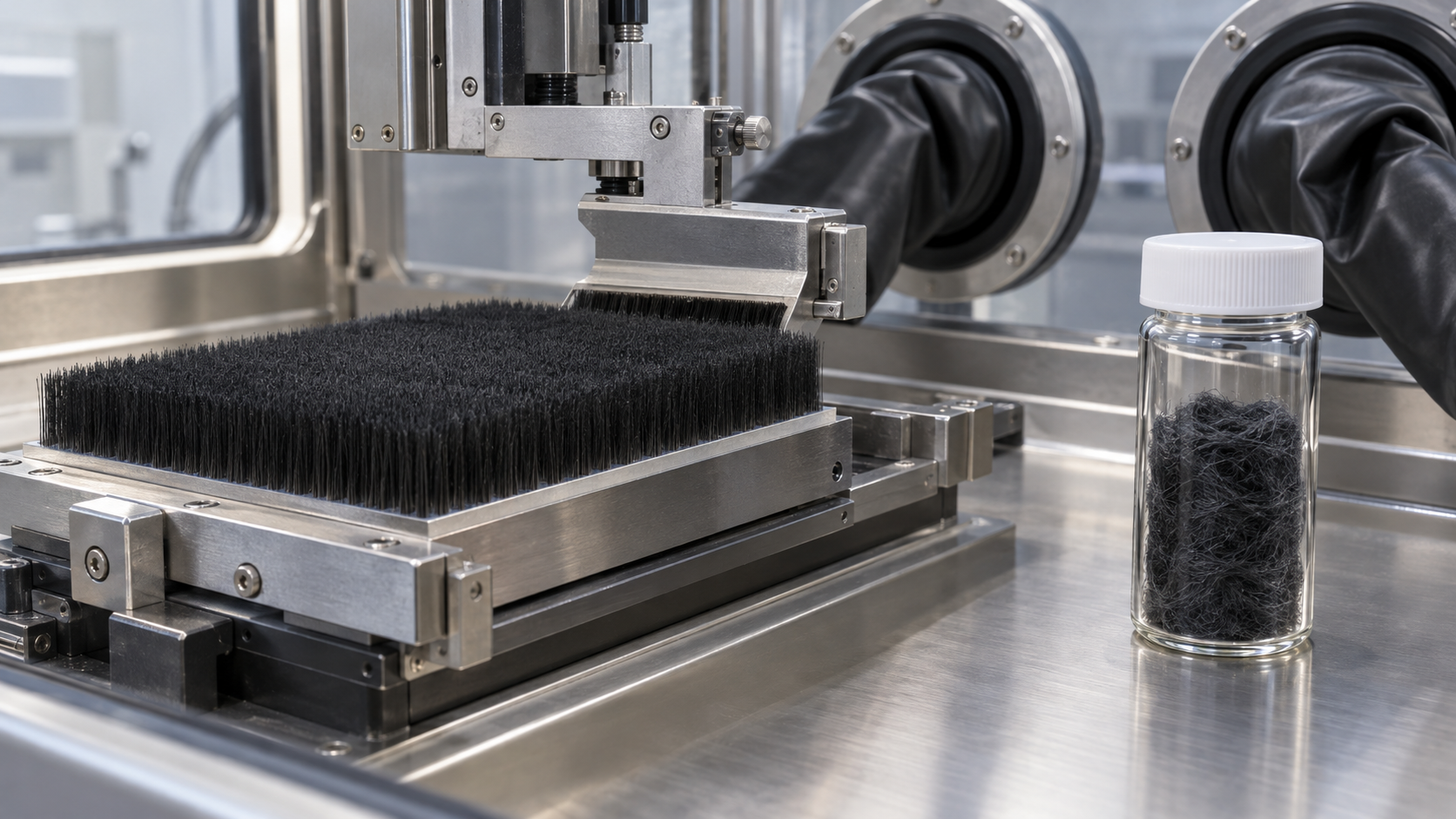
(1) Synthesis: extend catalyst life and grow a vertical "forest." In the SG method, a trace of water (parts-per-million level) is added during chemical vapour deposition (CVD), extending the catalyst's life from a few seconds to tens of minutes. According to an AIST article (AIST TODAY, June 2007), SWCNTs then grow at very high density, aligned vertically from the substrate, into a structure called a "forest." The article reports a forest 2.5 mm tall in 10 minutes in 2004, and a catalyst-metal concentration of 0.013% or less in the as-grown, unpurified material (results from the AIST laboratory, not values for Zeon's production material; the paper is Science 306, 1362, 2004). Zeon states the forest height of its production material as 300-500 μm. Its website says the SG method raised productivity more than 1,000-fold, but this is the company's statement and the baseline conditions are not given.
(2) Purity: little leftover catalyst metal matters in a battery. Zeon says SG101 contains very little residual metal catalyst and does not react with the electrolyte, which is why it suits battery electrodes (stated impurities: below 500 ppm). The general reasoning is that, inside an electrode, catalyst metal can dissolve or cause side reactions as potentials change (our general framing, not an individual test result for SG101).
(3) Length and thinness: a small amount forms an electrical path. The longer and thinner the tubes (the higher the aspect ratio), the less is needed for them to touch and form a conductive network. In the PTFE prototype, adding just 0.05 wt% of SG101 lowers volume resistivity by many orders of magnitude, to a value below that of the 2 wt% carbon black example (values under the company's prototype conditions; they do not show a general ranking against other materials). Hard mixing can cut tubes short, and bundles are hard to unravel; these are general challenges for CNTs (our general framing). One reason Zeon pairs with a paste maker for batteries may be that the powder's performance can only be drawn out once it is unraveled evenly into a coatable liquid (inference).
(4) Specific surface area: a guide to how far the bundles are unraveled. The theoretical external specific surface area of CNTs depends on diameter and bundle thickness, and thicker bundles give smaller values (Peigney et al., Carbon 39, 507, 2001). Zeon's stated value of more than 1,100 m²/g is consistent with thin bundles, with tubes fairly well separated, but because the measurement method is not stated, it cannot be compared directly with other makers' values (inference). For background, see this series' explainers on carbon nanotubes and graphene.
A limit on use. The prototypes above (PTFE, THz-absorbing sheet, dendrite suppression) are examples the company shows in technical sheets at the prototype or research stage; they are not specifications of mass-production products. For battery conductive pastes, the company says only that improvements were confirmed and that additional performance testing is in progress.
11. Risks
| Risk | Detail | Status |
|---|---|---|
| Demand ramp-up (uncertain adoption) | Full-scale battery adoption is something the company "aims" for. FY2025 SWCNT sales fell 15% from the prior year (the company says FY2024 shipments came in a lump). Customers and volumes are not disclosed | Sourced / Inference |
| Capacity ahead of demand | The new plant is planned at tens of times current capacity. If demand falls short of the plan, utilization could drop. The company's materials give no outlook for utilization or depreciation | Not yet confirmed |
| Starting up a new process | The new line will use for the first time, at production scale, a process further developed from the existing one. Yield and quality ramp-up could not be confirmed from official documents | Inference |
| Concentrated sales channel (SiAT) | SiAT is a Taiwanese start-up, and Zeon plans to expand powder output as its main supplier. SiAT customers' evaluation results could feed directly into Zeon's sales. SiAT's finances were not checked for this article | Inference |
| Subsidy and certification terms | METI's certification is of a plan, and the "maximum subsidy of about ¥5.1 billion" is a ceiling. How the amount is finalized and how plan changes are handled could not be confirmed | Sourced / Not yet confirmed |
| Competition and pricing | The company sets a goal of winning share from other makers' single-walled CNTs and cites its "pricing policy." Competitors' moves and prices are not described concretely in its documents, and this article does not rank Zeon against other makers | Sourced (company statement) |
| Regulation and safety status | Zeon publishes test results, but how CNTs are handled depends on chemical regulations by region and on trends in definitions of nanomaterials. Zeon's registration or notification status for its SWCNTs in each region could not be confirmed from official documents. "Nano" does not make a material safe or unsafe as a general rule (see this series' explainer on definition and regulation of nanomaterials) | Not yet confirmed |
| Company-wide earnings structure | More than half of company sales come from elastomers such as synthetic rubber. SWCNTs are a small business within the company, and management decisions are affected by company-wide raw-material prices and market conditions. In its May 2026 briefing the company described passing on higher costs through surcharges | Sourced (company statement) |
12. Glossary
- Single-walled carbon nanotube (SWCNT)
- A structure in which one sheet of carbon atoms in a hexagonal arrangement is rolled into a tube. Diameters are a few nanometres, and lengths can be tens of thousands of times the diameter or more.
- Super-Growth (SG) method
- A CNT synthesis method that adds a trace of water during growth to extend catalyst life and grow tall tubes. AIST reported it in 2004.
- Forest
- An assembly of tubes standing aligned on a substrate. Zeon states a forest length of 300-500 μm.
- Chemical vapour deposition (CVD)
- A family of synthesis methods in which a carbon-containing gas is passed over a catalyst at high temperature to grow CNTs.
- Specific surface area (BET)
- Surface area per gram (m²/g), obtained from the amount of gas adsorbed. The value depends on measurement conditions.
- Conductive additive, conductive paste
- An additive that builds electrical pathways inside a battery electrode. A paste is the additive dispersed in a solvent.
- Percolation threshold
- The smallest amount of additive at which the particles connect and the whole material conducts. It is lower for long, thin materials.
- BBU and ESS
- BBU: a battery backup unit, such as a backup power module for AI servers. ESS: a stationary energy storage system that stores power from renewable sources, for example.
- Supply security plan for storage batteries
- Under Japan's Economic Security Promotion Act, the state certifies plans for stable supply of key goods and supports them. Here, a plan certified by METI.
- NMP
- N-methyl-2-pyrrolidone, an organic solvent used in battery electrode manufacturing, among other things.
- CAGR
- Compound annual growth rate. In Zeon's materials it is used for the sales plan for 2024-30.
- Manufacturer's stated value / typical value
- A performance value given by the manufacturer itself. It cannot be compared with another product's unless the method, sample and conditions are the same.
13. References
- Zeon Press release on the groundbreaking for the new plant (25 August 2026). Start of construction, capacity expected at tens of times the present level, full operation planned for 2028, METI certification. https://www.zeon.co.jp/en/news/assets/pdf/260825.pdf
- Zeon Press release on the decision to expand single-walled carbon nanotube production (24 April 2026; the English version says "more than tenfold"; the Japanese version, at https://www.zeon.co.jp/news/assets/pdf/260424.pdf, says tens of times). New process, SiAT investment, place in the medium-term plan. https://www.zeon.co.jp/en/news/assets/pdf/260424.pdf
- Zeon Press release on the investment in Sino Applied Technology (30 October 2025). Series C, director appointment, SiAT's capacity plan. https://www.zeon.co.jp/en/news/assets/pdf/251030.pdf
- Zeon Press release on the basic agreement to invest in Sino Applied Technology (26 May 2025). https://www.zeon.co.jp/en/news/assets/pdf/250526-2.pdf
- Ministry of Economy, Trade and Industry (METI) Summary of the supply security plan (Nippon Zeon Co., Ltd., certified 17 February 2026, certification no. 2025 Battery No. 9-1; in Japanese). Item: conductive additive; supply start December 2028; 128 GWh a year equivalent; funds required about ¥14.7 billion; maximum subsidy about ¥5.1 billion. https://www.meti.go.jp/policy/economy/economic_security/battery/battery_41_1.pdf
- Ministry of Economy, Trade and Industry (METI) Storage batteries (economic security) page (in Japanese). List of certified supply security plans (Nippon Zeon is no. 41, certified 17 February 2026; maximum subsidy about ¥5.1 billion). https://www.meti.go.jp/policy/economy/economic_security/battery/index.html
- Zeon FY2025 results presentation (13 May 2026; in Japanese). Sales and operating profit by segment, progress on growth investments. https://www.zeon.co.jp/ir/financial/bs/pdf/260513.pdf
- Zeon FY2025 results briefing, explanatory text (held 13 May 2026; in Japanese). The SWCNT expansion, progress against the ¥150 billion new-investment plan. https://www.zeon.co.jp/ir/financial/bs/pdf/260529.pdf
- Zeon Medium-term business plan phase 3 (FY2025-2028) progress presentation (June 2026; in Japanese). The new SWCNT plant, sales CAGR target and actual. https://www.zeon.co.jp/ir/library/midtermplan/pdf/260610.pdf
- Zeon Medium-term business plan phase 3 (FY2025-2028) presentation (11 June 2025; in Japanese). SWCNT differentiators, the SiAT stake, the "company estimate" and "company plan" labels. https://www.zeon.co.jp/ir/library/midtermplan/pdf/250611.pdf
- Zeon Medium-term business plan phase 3 (FY2025-2028) explanatory summary (27 June 2025; in Japanese). Explanation of the SWCNT growth rate, domestic production and geopolitical risk. https://www.zeon.co.jp/ir/library/midtermplan/pdf/250627.pdf
- Zeon Company profile (company website; in Japanese). Founding, capital, consolidated sales, employees (end of March 2026). https://www.zeon.co.jp/company/profile/
- Zeon Zeon by the numbers (company website; in Japanese). R&D spending of about ¥17 billion a year (FY2025 actual). https://www.zeon.co.jp/company/special/data/
- Zeon Notice Concerning Revisions to Financial Results Forecasts (30 January 2026; English translation). Company name, representative, code 4205, TSE Prime Market. https://www.zeon.co.jp/en/news/assets/pdf/260130.pdf
- Zeon Corporation Carbon Nanotube (company website). Features of ZEONANO SG101, typical values, explanation of the SG method, safety efforts. https://www.zeon.co.jp/en/business/enterprise/nanotube/carbonnanotube/
- Zeon Corporation ZEONANO SG101 / Powder, Dispersion (technical sheet). Typical values (not guaranteed), packaging, dispersion samples. https://www.zeon.co.jp/en/business/enterprise/nanotube/pdf/INDEX_001.pdf
- Zeon Corporation ZEONANO SG101 / PTFE composites (technical sheet). Volume resistivity at 0.05 wt%, mechanical properties, cleanliness tests. https://www.zeon.co.jp/en/business/enterprise/nanotube/pdf/INDEX_003.pdf
- Zeon Corporation ZEONANO SG101 Dispersion / Terahertz Wave Absorption (technical sheet). https://www.zeon.co.jp/en/business/enterprise/nanotube/pdf/INDEX_004.pdf
- Zeon Corporation CNT Sheet / Inhibiting Lithium Dendrite (technical sheet). Done with AIST. https://www.zeon.co.jp/en/business/enterprise/nanotube/pdf/INDEX_002.pdf
- Zeon Corporation Safety of ZEONANO SG101 (technical sheet). Table of test results under OECD test guidelines. https://www.zeon.co.jp/en/business/enterprise/nanotube/pdf/INDEX_006.pdf
- Zeon Press release: "Completion of mass-production technology for super-growth carbon nanotubes" wins a Special Award at the 45th Japan Industrial Technology Award (7 April 2016; in Japanese). Completion of the mass-production plant in November 2015. https://www.zeon.co.jp/news/assets/pdf/160407.pdf
- Zeon Press release: World's First Super-Growth Carbon Nanotube Mass Production Plant Opens (4 November 2015). Results of NEDO projects, samples since 2011. https://www.zeon.co.jp/en/news/assets/pdf/151104.pdf
- Zeon Corporation Awards (company website). 45th Japan Industrial Technology Award, Jury's Special Award, Nikkan Kogyo Shimbun (March 2016). https://www.zeon.co.jp/en/company/award/
- Zeon / AIST Establishment of the Zeon-AIST Nanotube Industrialization Cooperative Research Laboratory (3 June 2016). https://www.zeon.co.jp/en/news/assets/pdf/160603.pdf
- Zeon ZEON to Build Manufacturing Plant for Carbon Nanotubes (15 May 2014). NEDO projects, the 2011 demonstration plant. https://www.zeon.co.jp/en/news/assets/pdf/140515.pdf
- National Institute of Advanced Industrial Science and Technology (AIST) AIST TODAY, June 2007: Kenji Hata, "Super-Growth: a breakthrough single-walled CNT synthesis technology" (in Japanese). Water addition, catalyst life, forest, purity. https://www.aist.go.jp/Portals/0/resource_images/aist_j/aistinfo/aist_today/vol07_06/vol07_06_p24_p25.pdf
- Journal paper Hata K. et al., Water-Assisted Highly Efficient Synthesis of Impurity-Free Single-Walled Carbon Nanotubes, Science 306, 1362-1364 (2004). DOI checked against Crossref. https://doi.org/10.1126/science.1104962
- Journal paper Iijima S., Helical microtubules of graphitic carbon, Nature 354, 56-58 (1991). DOI checked against Crossref. https://doi.org/10.1038/354056a0
- Journal paper Peigney A. et al., Specific surface area of carbon nanotubes and bundles of carbon nanotubes, Carbon 39, 507-514 (2001). DOI checked against Crossref. https://doi.org/10.1016/S0008-6223(00)00155-X
- Zeon Company website (source of the logo image). https://www.zeon.co.jp/
14. Claim-to-source audit
| Claim in the text | Status | Source |
|---|---|---|
| Zeon makes and sells single-walled CNTs (ZEONANO) by the SG method; its statement that in 2015 it became the first in the world to mass-produce SG-method SWCNTs; production at the Tokuyama Plant | Sourced (company statement) | References 2 & 1 & 15 https://www.zeon.co.jp/en/news/assets/pdf/260424.pdf https://www.zeon.co.jp/en/news/assets/pdf/260825.pdf https://www.zeon.co.jp/en/business/enterprise/nanotube/carbonnanotube/ |
| The 24 April 2026 decision to expand; the 25 August 2026 groundbreaking (44 attendees); a new plant comparable in scale to the existing one with capacity expected at tens of times the present level; full operation targeted during 2028; use of a new process | Sourced (company statement) | References 2 & 1 https://www.zeon.co.jp/en/news/assets/pdf/260424.pdf https://www.zeon.co.jp/en/news/assets/pdf/260825.pdf |
| New-plant building footprint of 2,000 m² (existing 2,200 m²); the "synthesis breakthrough" description; aiming for full-scale adoption in conductive pastes; SWCNT sales CAGR target of 127% (company plan) and actual of -15% (a reaction to bunched shipments in FY2024); "next growth driver" positioning | Sourced (company statement) | References 9 & 10 https://www.zeon.co.jp/ir/library/midtermplan/pdf/260610.pdf https://www.zeon.co.jp/ir/library/midtermplan/pdf/250611.pdf |
| Market growth of 72% and the market size labelled "company estimate" in the materials (not used here); the definition of 127% (the chart sets FY2024 at an index of 100); the aim of winning share from other makers' SWCNTs; the statement that domestic production keeps geopolitical risk low; the CNT length comparison (company estimate) | Sourced (company statement) | References 10 & 11 https://www.zeon.co.jp/ir/library/midtermplan/pdf/250611.pdf https://www.zeon.co.jp/ir/library/midtermplan/pdf/250627.pdf |
| METI's certification of the supply security plan (17 February 2026, no. 2025 Battery No. 9-1); item is conductive additive; supply start December 2028; 128 GWh a year of batteries equivalent; funds required about ¥14.7 billion; maximum subsidy about ¥5.1 billion; requested support is a subsidy | Sourced | References 5 & 6 https://www.meti.go.jp/policy/economy/economic_security/battery/battery_41_1.pdf https://www.meti.go.jp/policy/economy/economic_security/battery/index.html |
| The company's statement that it will receive a subsidy under the METI certification; the plan to invest ¥150 billion in new projects through FY2026 expected to be used up; FY2025 results (sales ¥412.0 billion, operating profit ¥36.4 billion, net profit ¥36.2 billion); the decision to expand SWCNT capacity | Sourced (company statement) | References 8 & 7 https://www.zeon.co.jp/ir/financial/bs/pdf/260529.pdf https://www.zeon.co.jp/ir/financial/bs/pdf/260513.pdf |
| Company-wide consolidated sales of ¥411,966 million; employees (4,425 consolidated, 2,503 non-consolidated); capital of ¥24,211 million; founding on 12 April 1950; R&D spending of about ¥17 billion a year | Sourced | References 12 & 13 https://www.zeon.co.jp/company/profile/ https://www.zeon.co.jp/company/special/data/ |
| Segment sales (high-performance materials ¥124.2 billion, elastomers ¥223.7 billion, other ¥64.1 billion) and operating profit (¥22.4 billion, ¥11.7 billion, ¥2.3 billion) | Sourced | Reference 7 https://www.zeon.co.jp/ir/financial/bs/pdf/260513.pdf |
| Tokyo Stock Exchange Prime Market, code 4205; the head-office address (1-6-2 Marunouchi, Chiyoda-ku, Tokyo) | Sourced | References 14 & 2 https://www.zeon.co.jp/en/news/assets/pdf/260130.pdf https://www.zeon.co.jp/en/news/assets/pdf/260424.pdf |
| The investment in SiAT (basic agreement May 2025, investment agreement August, announced 30 October); Series C of US$22 million in total; director appointment; SiAT's paste capacity from 5,000 to 25,000 tonnes by 2030 (including expansions not yet carried out); Zeon expanding powder as main supplier; SiAT paste evaluations and further testing | Sourced (company statement) | References 3 & 4 https://www.zeon.co.jp/en/news/assets/pdf/251030.pdf https://www.zeon.co.jp/en/news/assets/pdf/250526-2.pdf |
| Typical values for SG101 (specific surface area above 1,100 m²/g, forest 300-500 μm, average diameter 3-5 nm, impurities below 500 ppm, carbon purity 99% or higher); that typical values are not guaranteed; packaging; dispersion samples; the statement that the SG method raised productivity more than 1,000-fold | Sourced (company statement) | References 15 & 16 https://www.zeon.co.jp/en/business/enterprise/nanotube/carbonnanotube/ https://www.zeon.co.jp/en/business/enterprise/nanotube/pdf/INDEX_001.pdf |
| PTFE composite (volume resistivity of 4.6×10³ Ω·cm at 0.05 wt%; the 2 wt% carbon black comparison; 96% tensile strength; TOC and 34-element tests) | Sourced (company statement) | Reference 17 https://www.zeon.co.jp/en/business/enterprise/nanotube/pdf/INDEX_003.pdf |
| THz-wave absorption of the SG101 sheet (163 μm thick, 11 S/cm, above 200 GHz); the CNT sheet for suppressing lithium dendrites (done with AIST) | Sourced (company statement) | References 18 & 19 https://www.zeon.co.jp/en/business/enterprise/nanotube/pdf/INDEX_004.pdf https://www.zeon.co.jp/en/business/enterprise/nanotube/pdf/INDEX_002.pdf |
| Publication of safety and environmental test results under OECD test guidelines; joint research with universities and public institutes | Sourced (company statement) | References 20 & 15 https://www.zeon.co.jp/en/business/enterprise/nanotube/pdf/INDEX_006.pdf https://www.zeon.co.jp/en/business/enterprise/nanotube/carbonnanotube/ |
| Development of the SG method by Kenji Hata and colleagues at AIST (2004); water addition, catalyst life, forest; 2.5 mm in 10 minutes in 2004; catalyst metal at 0.013% or less before purification (results from AIST's laboratory) | Sourced | References 26 & 27 https://www.aist.go.jp/Portals/0/resource_images/aist_j/aistinfo/aist_today/vol07_06/vol07_06_p24_p25.pdf https://doi.org/10.1126/science.1104962 |
| Iijima's report on carbon nanotubes (1991); description of CNT structure | Sourced | References 28 & 15 https://doi.org/10.1038/354056a0 https://www.zeon.co.jp/en/business/enterprise/nanotube/carbonnanotube/ |
| That the theoretical external specific surface area of CNTs depends on diameter and bundle thickness | Sourced | Reference 29 https://doi.org/10.1016/S0008-6223(00)00155-X |
| Participation in NEDO projects (FY2006-2010, FY2010-2013); the 2011 demonstration plant built with METI's FY2009 supplementary budget; the May 2014 announcement of a plant at Tokuyama; mass production planned for the second half of FY2015 | Sourced | Reference 25 https://www.zeon.co.jp/en/news/assets/pdf/140515.pdf |
| Completion and start of operation of the mass-production plant in November 2015 (announced 4 November); AIST's development of the base SG technology in NEDO's FY2003-2005 project; the 45th Japan Industrial Technology Award, Jury's Special Award (2016) | Sourced (company statement) | References 22 & 23 & 21 https://www.zeon.co.jp/en/news/assets/pdf/151104.pdf https://www.zeon.co.jp/en/company/award/ https://www.zeon.co.jp/news/assets/pdf/160407.pdf |
| Establishment of the Zeon-AIST Nanotube Industrialization Cooperative Research Laboratory (effective 1 July 2016, Tsukuba Center, about ten staff) | Sourced | Reference 24 https://www.zeon.co.jp/en/news/assets/pdf/160603.pdf |
| The logo image is the corporate logo published in the header of the company website | Sourced | Reference 30 https://www.zeon.co.jp/ |
| SWCNT sales (amount) and production capacity (tonnes a year); the absolute capacity of the new plant; what the new process involves; the final investment amount; confirmation of the subsidy actually paid; names of customers and timing of mass-production adoption; the amount and shareholding of the SiAT investment; the segment containing SWCNTs; joint research with overseas institutes; registration status under chemical regulations | Not yet confirmed (could not be confirmed) | References 7 & 9 https://www.zeon.co.jp/ir/financial/bs/pdf/260513.pdf https://www.zeon.co.jp/ir/library/midtermplan/pdf/260610.pdf |
| Readings that the near-term key is adoption in battery makers' mass-production cells; that the new plant is a generational change in process; that the paste partnership exists to draw out the powder's performance; the reading of bundle unravelling from specific surface area; sales-channel concentration; start-up risk for the new process | Inference | References 9 & 2 & 3 https://www.zeon.co.jp/ir/library/midtermplan/pdf/260610.pdf https://www.zeon.co.jp/en/news/assets/pdf/260424.pdf https://www.zeon.co.jp/en/news/assets/pdf/251030.pdf |
| Classifying Zeon as a nanomaterial producer, and the four-type framework | Our calculation | Our own organization and calculation (technical explanations are general commentary, not values for the company's individual products; see the series' explainers) |
| Where SWCNTs sit within the company, and the technical explanations of conductive materials, dispersion and purity (general commentary) | Our calculation | Our own organization and calculation (technical explanations are general commentary, not values for the company's individual products; see the series' explainers) |
Last updated: 9 October 2026 / Troy Technical
This article is based on Zeon's press releases, results presentations, medium-term plan materials and technical sheets, and on public METI documents. It uses no market-research estimates or press-based figures (the "company estimate" market figures in the medium-term plan materials are not used). Items marked "Inference" are our reading of the primary sources and are not company disclosures. Product features and performance values are the company's own statements (typical values), not guaranteed specifications. Company plans and targets are not yet confirmed and are no guarantee of outcomes. This article does not advise individual readers on handling or safety of materials, or on investment.