TECHNOLOGY EXPLAINER
Data Centers and Energy Storage
— From batteries that keep the lights on to batteries that talk to the grid
For years, the batteries in a data center were insurance that mattered only during an outage. AI computing has changed how these facilities draw power, and grid operators have begun to treat the sudden, simultaneous disconnection of data centers as a reliability problem in its own right. The same batteries are now asked to smooth load swings, ride through grid disturbances and respond to demand signals. This article walks through what a UPS does, why the industry has been moving from lead-acid to lithium-ion, and what a battery has to deliver in this job, using public-agency and company primary sources plus calculations of our own with every assumption stated.
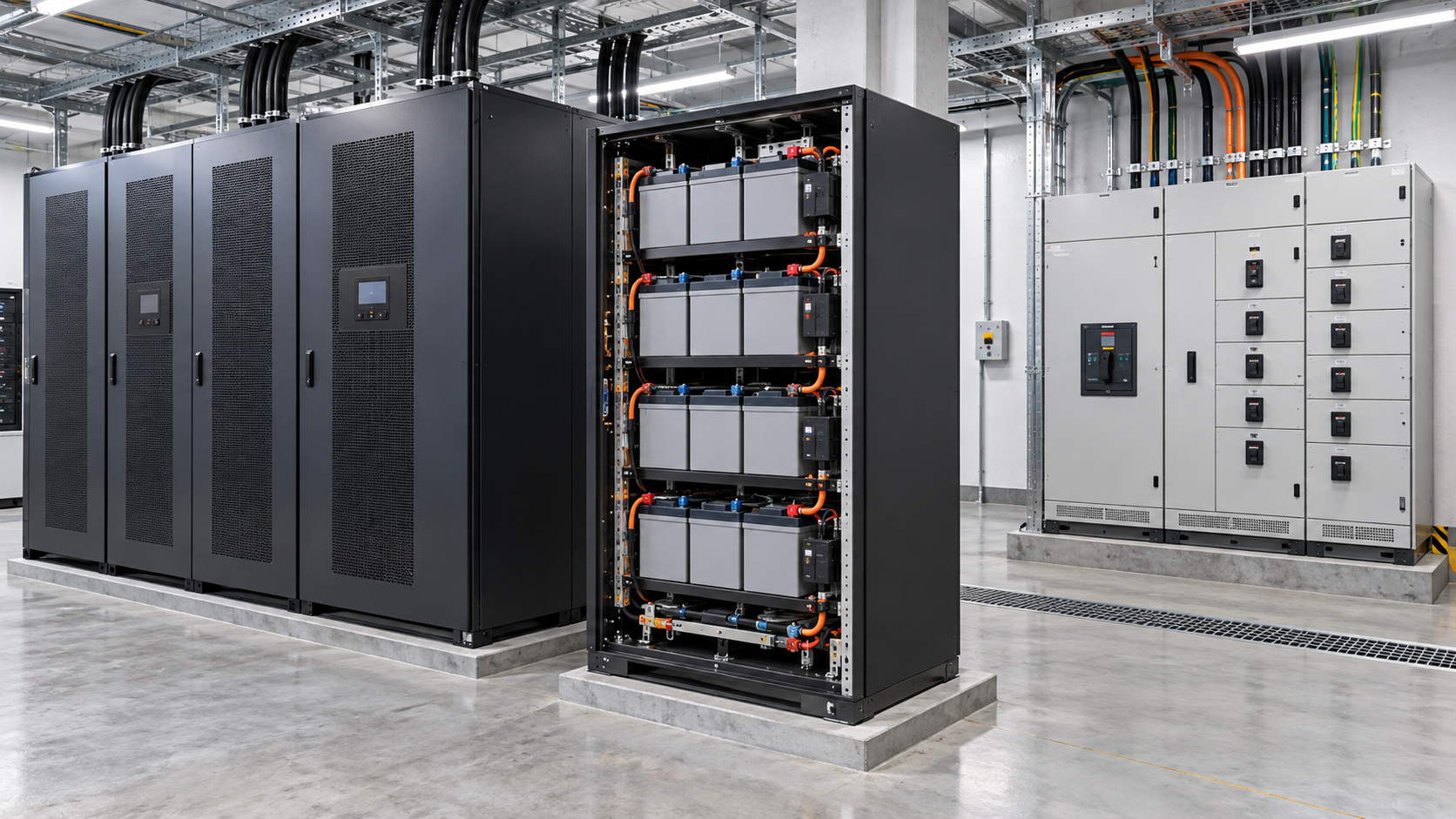
- Data centers and storage in brief
- What a UPS does, and how it is built
- From lead-acid to lithium-ion
- What the battery has to deliver: power, life, safety
- Our calculation 1: how many battery racks does a 5 MW UPS need?
- AI load swings and storage
- Our calculation 2: how many cycles a year does smoothing add?
- Backup power, grid connection and demand response: examples, and who is making each claim
- How supercapacitors fit in
- Limits, and what we could not confirm
- How to read evaluations and standards
- Glossary
- References
- Claim-to-source audit
Sourced = stated in a published source (linked)
Our calculation = a value we computed from stated assumptions (every assumption is written out)
Not yet confirmed = a plan, target or outlook with no confirmed result
Our own readings of materials and design are marked Commentary, and weakly supported guesses are marked Inference.
Company announcements are treated as company claims and kept apart from independently verified values. Battery numbers are given with what they refer to (cell, pack or system) and the conditions.
We do not use market-size estimates. This article explains how power systems are built; it is not advice on designing, buying or operating any facility, or on fire safety.
1. Data centers and storage in brief
- The traditional job: the battery in a UPS (uninterruptible power supply) takes the load at the moment of an outage or voltage disturbance and carries it for the short time until a standby generator starts. NERC (the North American Electric Reliability Corporation) describes the UPS battery bank as designed not to carry the load for long, but for the brief disturbance, or, in a complete outage, long enough to start a backup generator Sourced [Ref. 1].
- The changing job: AI training load swings sharply because many GPUs ramp up and down together. NVIDIA has published a design with capacitors in the rack power shelf, and a facility-level battery system (BESS) to condition the boundary with the grid Sourced (company claim) [Refs. 6 and 8]. Meanwhile grid operators treat data centers switching to UPS and vanishing from the grid all at once as a reliability risk Sourced [Refs. 1 and 2].
- What this asks of the battery: full output within minutes (high power), a long life while sitting near full charge (long life), and safe installation inside or beside a building (safety), all at once. In our calculation, for a 5 MW UPS with a short hold time, the number of battery racks is set by power, not energy (Chapter 5).
A data-center battery is judged less on capacity (kWh) than on power (kW), on ageing while it waits, and on safe installation. And from the grid's point of view, the battery doing its job (the UPS taking over) can itself become the grid's problem. The battery is moving from protecting the equipment inside to keeping a promise to the grid outside. That shift is changing what is asked of the materials and the design.
A report from Lawrence Berkeley National Laboratory (LBNL), released by the U.S. Department of Energy (DOE), estimates that U.S. data centers used about 4.4% of U.S. electricity in 2023, up from 58 TWh in 2014 to 176 TWh in 2023 Sourced [Ref. 17]. The IEA estimates that data centers worldwide used about 415 TWh in 2024 (about 1.5% of global electricity) Sourced [Ref. 16]. Both are estimates with different scopes and methods, so we do not compare them directly. The IEA's figure of about 945 TWh for 2030 is its Base Case outlook Not yet confirmed.
2. What a UPS does, and how it is built
The UPS standard IEC 62040-3:2021 sets performance and test requirements for equipment that takes AC input up to 1,000 V, delivers AC output up to 1,000 V, includes an energy-storage device up to 1,500 V DC, and has continuity of load power as its primary function Sourced [Ref. 12]. The battery is that "energy-storage device".
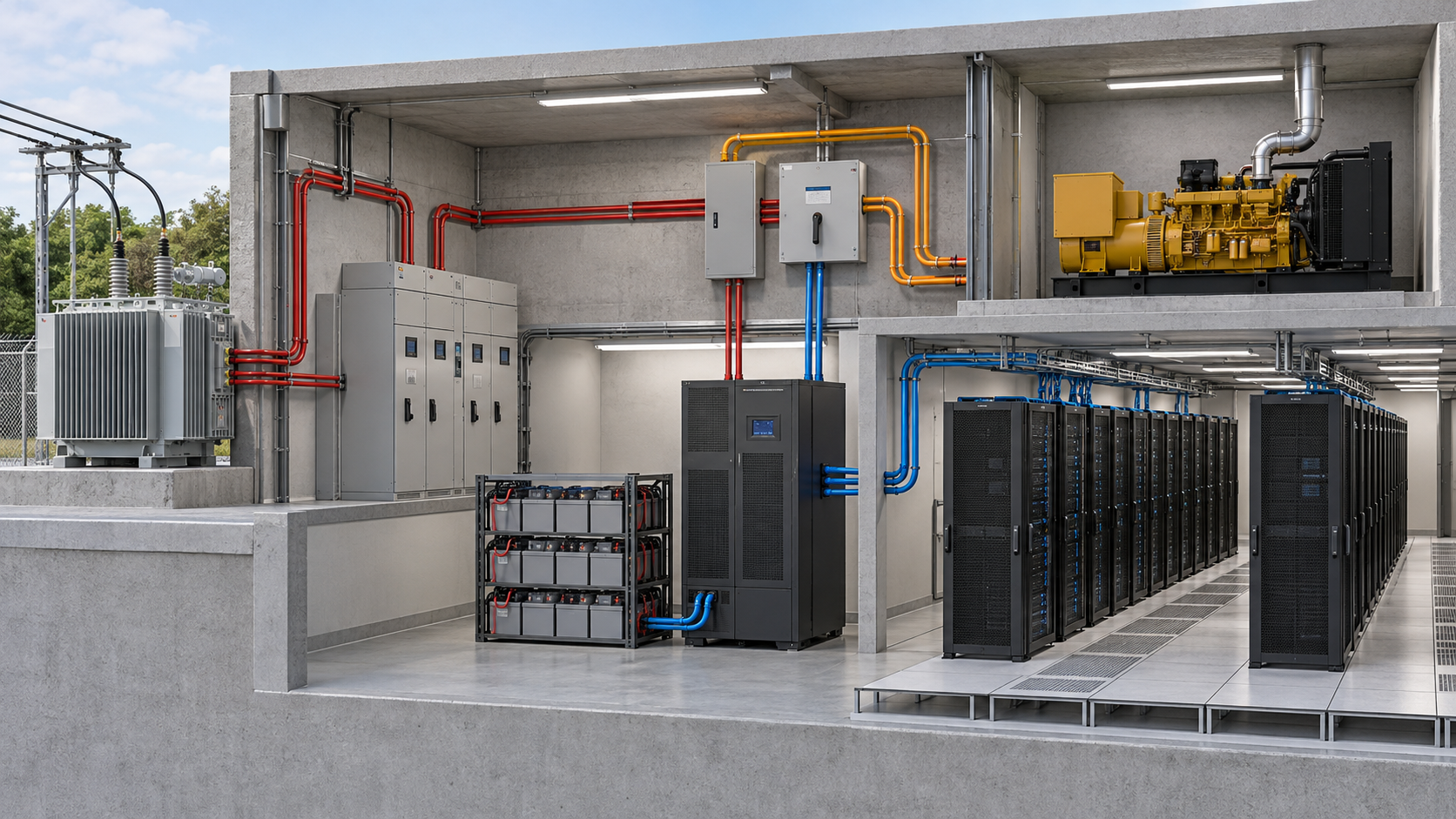
View the original SVG schematic and exact annotations
In its review of the July 2024 incident, NERC sorted data-center UPS systems into three designs Sourced [Ref. 1].
| Design | What NERC says | Role of the battery |
|---|---|---|
| Centralized (static) | UPS units at the load-center level, "typically in the range of 2–5 MWs". Power electronics switch the load to a battery bank | The battery bank is not meant to supply the load for long, but for short disturbances or long enough to start a backup generator |
| Decentralized | Many small rack-level UPS units, "typically in the range of 3–4 kW". They behave like the centralized design at a smaller scale | Same, at smaller scale |
| Rotary (DRUPS) | A flywheel provides uninterrupted power and a clutch quickly connects a diesel engine | No battery; the flywheel's kinetic energy does the job |
All Sourced (a summary of the NERC incident review [Ref. 1]).
What matters here is that a UPS moves the load to the battery even for a voltage dip of a few tens of milliseconds. In NERC's review the voltage dips lasted between 42 and 66 milliseconds Sourced [Ref. 1]. With a static UPS the load returns to the grid once the disturbance clears, whereas with a DRUPS the load typically has to be transferred back manually, the review notes. This behavior leads to the grid-side problem described in Chapters 6 and 8.
3. From lead-acid to lithium-ion
UPS batteries in data centers were for a long time valve-regulated lead-acid (VRLA) or flooded lead-acid. In 2019 the chief technical officer of the Uptime Institute listed the advantages of lithium-ion as higher power density, so more power from a smaller footprint, and more charge-discharge cycles without degrading. Lead-acid, he wrote, must be replaced when it reaches about 80% of its original capacity because capacity then falls off quickly, while lithium-ion loses capacity gradually and predictably. He also noted that suppliers claim a lower total cost of ownership despite the higher initial cost, but that not all such claims can be substantiated with long-term data Sourced (expert opinion, 2019) [Ref. 10].
On adoption, a January 2023 Uptime Institute article says that in its Global Data Center Survey 2021 nearly half of operators had adopted lithium-ion for centralized UPS plants, up from about a quarter three years earlier, and that the 2022 survey showed a further rise Sourced (survey responses) [Ref. 11]. The respondent pool and the definition of "adopted" are not given, so we do not use the figure as a market share.
| Aspect | Lead-acid (VRLA / flooded) | Lithium-ion | Source |
|---|---|---|---|
| Power and footprint | Needs a larger footprint for the same power | Higher power density; same power from a smaller footprint | Uptime Institute (2019) [Ref. 10] |
| How it ages | Capacity drops sharply after about 80%, so replaced before that | Capacity declines gradually and predictably | Same |
| Fire risk | Relatively lower | Higher than lead-acid (Uptime says NFPA and others share this view). Cell breakdown produces gases and thermal runaway can spread | Uptime Institute (2023) [Ref. 11] |
| UPS-side readiness | n/a | Charging circuits and controls differ from lead-acid, so check that an existing UPS supports lithium-ion | Uptime Institute (2019) [Ref. 10] |
| Total cost of ownership | n/a | Suppliers claim it is lower; long-term data do not fully support the claim | Same (as a supplier claim) |
All Sourced (expert opinion and survey statements). Because the conditions are not given, we make no judgement on cost.
The Uptime Institute writes that a UPS rarely goes onto battery; when it does, the time is short (about 15 minutes in the worst case), the batteries normally sit on float charge, and the usual pattern is one discharge followed by one recharge Sourced [Ref. 10].
This suggests that what limits life is not the cycle count but ageing while waiting (calendar ageing) (Commentary). The Samsung SDI specification for a UPS battery system gives the float voltage as 4.2 V per cell, the same as the maximum voltage Sourced (manufacturer's stated value, first draft) [Ref. 9]. A nominal 3.8 V and maximum 4.2 V per cell is, as an Inference, consistent with a layered-oxide cathode and a graphite anode (the specification does not state the chemistry).
Holding a layered-oxide cathode at high potential for a long time is generally explained as driving electrolyte oxidation and transition-metal dissolution, with SEI growth on the anode eating capacity (Commentary; see our SEI explainer). "A battery on standby does not age" is not true, and this is the starting point for UPS cell design. We do not quantify the rate here.
In lead-acid the same "float" state wears the cell out by different mechanisms, such as grid corrosion at the positive electrode and lead-sulfate build-up (Commentary). Even for the same "standby" duty, different materials fail differently, so replacement criteria and monitoring items differ.
4. What the battery has to deliver: power, life, safety
Here is one real specification. Samsung SDI's end-customer product specification for its lithium-ion battery system for UPS (U6A4) describes a rack built from 17 modules of 8 series-connected 67 Ah cells (136 cells in series). However, the document's revision history shows only one entry, "2025.04.28, First draft (0.0)", and we could not confirm that a final version exists Sourced (manufacturer's stated values) [Ref. 9].
| Item | Stated in the specification (manufacturer's stated value) | Conditions |
|---|---|---|
| Cell capacity | 67 Ah | Charge/discharge at 1/3C (22.3 A), 25 °C |
| Nominal energy (system) | 34.6 kWh | 136 cells in series, nominal 516.8 V (3.8 V per cell), 1/3C, 25 °C |
| Continuous discharge power | 183.6 kW | Constant-power discharge, up to 450 A at the end-of-discharge voltage of 408 V (3.0 V per cell) |
| Charging | 67 A continuous (1C); 250 A peak (2 s) | CC-CV; float voltage 571.2 V (4.2 V per cell) |
| After a discharge | After a full discharge at maximum continuous power, cool for at least 12 hours | To avoid over-temperature protection |
| Standards evaluated | UL 1642 (cell); UN 38.3 (cell, module); UL 1973, UL 991 and UL 1998 (module, system); IEC 62619 and others | From the specification's "Evaluation" table; test reports are separate documents |
All Sourced (Samsung SDI product specification, first draft [Ref. 9]). Cycle life, warranty period and cell chemistry could not be confirmed from this document.
From these numbers we calculated the following Our calculation.
- 183.6 kW continuous ÷ 34.6 kWh nominal = about 5.3C equivalent. Time to use all the energy: 34.6 ÷ 183.6 × 60 = about 11.3 minutes.
- 450 A ÷ 67 Ah = about 6.7C (peak current rate per cell).
- These rates are relative to the nominal capacity defined at 1/3C; at high rates the capacity that can be extracted can be smaller than nominal (Commentary). The specification does not quantify the difference.
The specification asks for at least 12 hours of cooling after a full discharge at maximum continuous power, to avoid over-temperature protection Sourced [Ref. 9].
At discharge rates around 5C, electrode resistance and slow ion diffusion turn into heat (Commentary). High-power cells generally lower internal resistance with thin electrodes, small particles, more conductive additive and an open pore structure (see our explainers on conductive additives and binders, and on graphite anodes and electrode design). The cost is usually lower energy density (Wh/kg and Wh/L).
For UPS duty, what sets the design is the power (kW) the pack can deliver in a short time, more than the energy (kWh) (see the calculation in Chapter 5). The figures of merit become how fast the pack can deliver, and how many hours it takes to cool (Commentary).
What the standards look at
| Standard | Scope | What we confirmed |
|---|---|---|
| IEC 62040-3:2021 | Performance and tests of a complete UPS | Performance and test requirements for UPS. Battery safety is covered by other standards [Ref. 12] |
| IEC 62619:2022 | Safety of secondary lithium cells and batteries for industrial use, including stationary | Requirements and tests for safe operation in industrial applications, including stationary; stationary uses listed include telecom, UPS and electrical energy storage [Ref. 13] |
| UL 9540A | Test method for thermal-runaway fire propagation in battery energy storage systems | UL Solutions says it is the only consensus standard cited explicitly in NFPA 855 for large-scale fire testing; the 6th edition was published in 2026 [Ref. 14] |
| NFPA 855 (2026 edition) | Installation of stationary energy storage systems | Minimum requirements for mitigating the hazards of energy storage systems; the current edition is 2026 [Ref. 15] |
All Sourced (official pages of the standards bodies and certifier). The standards' texts are paid, so we give only titles and scope.
5. Our calculation 1: how many battery racks does a 5 MW UPS need?
Taking 5 MW, the upper end of the centralized UPS range NERC cites (2–5 MW), we count how many racks of the specification above would be needed Our calculation.
• Load: 5 MW (5,000 kW). Hold times of 5, 10 and 15 minutes.
• Battery rack: the specification above (nominal 34.6 kWh, 183.6 kW continuous).
• Conversion efficiency of the inverter etc.: 95% (assumed).
• End-of-life (EOL) capacity: 80% of initial (assumed, matching the roughly 80% replacement point for lead-acid cited by the Uptime Institute above).
• Each rack limited to 183.6 kW continuous; no allowance for temperature, rising internal resistance, redundancy (N+1 etc.) or end-of-discharge voltage margin.
| Hold time | Energy used by load | Battery-side energy (÷0.95) | Nameplate allowing for 80% at EOL | Racks for energy | Racks for power | Racks actually needed |
|---|---|---|---|---|---|---|
| 5 min | 417 kWh | 439 kWh | 548 kWh | 16 | 29 | 29 |
| 10 min | 833 kWh | 877 kWh | 1,097 kWh | 32 | 29 | 32 |
| 15 min | 1,250 kWh | 1,316 kWh | 1,645 kWh | 48 | 29 | 48 |
All Our calculation. Racks for power = 5,000 ÷ 0.95 ÷ 183.6 = 28.7, rounded up to 29. Racks for energy = nameplate ÷ 34.6, rounded up.
The result: at a 5-minute hold, energy alone would need 16 racks, but power requires 29. At 10 minutes the two roughly balance, and at 15 minutes energy dominates at 48 racks Our calculation. In other words, for holds of a few minutes the battery is sized by buying power, not capacity, and about half the stored energy is never used.
These assumptions (95% efficiency, 80% at EOL, 183.6 kW per rack) are not a design. In practice internal resistance rises toward end of life, so deliverable power falls and more racks are needed, and redundancy adds more. The calculation shows what sets the count (power or energy), not an actual count.
6. AI load swings and storage
(1) What is swinging
A paper by NVIDIA, Microsoft and OpenAI (arXiv, August 2025) explains that AI training spans tens of thousands of GPUs and that in each iteration compute-heavy and communication-heavy phases alternate in lockstep, so power swings widely. It adds that if the frequency of the swings coincides with critical frequencies of utilities, physical damage to grid infrastructure can result Sourced (from the abstract) [Ref. 7]. NVIDIA's technical blog says that where ordinary data-center workloads are asynchronous and average out, in AI training many GPUs move in step, so grid-level power mirrors and amplifies the pattern of a single node Sourced (company claim) [Ref. 6].
(2) Which layer takes which swing
The NVIDIA GB300 NVL72 smooths with three mechanisms: a power cap on ramp-up, short-term storage in electrolytic capacitors, and a "burner" that dissipates power in the GPUs during ramp-down. About half the volume of the power supply is capacitors, with 65 J per GPU of storage, optimized with power-supply maker LITEON. From measurements on a GB200 rack power shelf, NVIDIA reports that the peak power seen by the grid fell 30% when training Megatron LLM Sourced (company claim, NVIDIA's measurement) [Ref. 6].
65 J covers a 65 W difference for one second Our calculation (65 J = 65 W × 1 s). So storage in the rack is for swings of a second or less up to a few seconds, a different time layer from the batteries that bridge outages (minutes and up).
In a June 2026 blog, NVIDIA says facility-level BESS takes the residual transients that rack-level smoothing leaves, and protects the generators and the grid interface. It also stresses that BESS is a control system that exchanges power with the grid through power converters and controls, not just a store Sourced (company claim) [Ref. 8]. The same blog says that existing interconnection standards do not yet cover the behaviors AI factories need (load smoothing, switching between grid-connected and islanded modes, coordination with on-site generation), and it presents its own self-qualification guidelines Sourced (company claim) [Ref. 8]. That the standards lag is NVIDIA's view, not that of a standards body.
7. Our calculation 2: how many cycles a year does smoothing add?
When a battery smooths load swings, it is used in a completely different way from one full charge-discharge a day. We computed the scale for a hypothetical load Our calculation. It is not the shape, period or amplitude of any real AI training load.
• Load: a square wave alternating between 100 MW and 60 MW with a 10-second period (5 s each). The mean is 80 MW.
• Battery job: flatten the load to 80 MW. Discharge 20 MW for 5 s, then charge 20 MW for 5 s, repeatedly.
• Discharge per period: 20 MW × 5 s = 100 MJ = 27.8 kWh. Periods per day: 86,400 ÷ 10 = 8,640.
• Daily discharge: 27.8 kWh × 8,640 = about 240 MWh. Battery capacities of 5, 10 and 20 MWh; 365 days a year; equivalent full cycles computed.
• Round-trip efficiency ignored for the cycle count. Depth of discharge (DoD) per period is small (0.14% for 20 MWh).
| Battery capacity | Required power rate (20 MW ÷ capacity) | Equivalent full cycles per day | Equivalent full cycles per year | DoD per period |
|---|---|---|---|---|
| 5 MWh | 4C | 48 | 17,520 | 0.56% |
| 10 MWh | 2C | 24 | 8,760 | 0.28% |
| 20 MWh | 1C | 12 | 4,380 | 0.14% |
All Our calculation (hypothetical load). Equivalent full cycles = total discharged energy ÷ battery capacity.
Three things stand out Our calculation.
- The count is orders of magnitude higher. One cycle a day is 365 a year. Using the same battery to smooth swings gives thousands to over ten thousand equivalent full cycles a year (4,380 to 17,520 in this example).
- Vast numbers of shallow cycles. DoD per period is under 1%. How shallow cycling affects ageing depends on the materials and conditions, and we do not generalize.
- Heat. At an assumed 90% round-trip efficiency, daily charging is about 267 MWh (240 ÷ 0.9), of which about 27 MWh becomes heat, or about 1.1 MW on average (assumed round-trip efficiency: 90%). Cooling must be designed for that amount.
Standby (UPS) duty keeps the cell near full charge and barely cycles it, so ageing is dominated by calendar ageing that advances with time (see above; Commentary). Smoothing duty piles up shallow cycles, so cycle ageing comes to the front: electrode expansion and contraction each cycle, repeated SEI formation and heat accumulation (Commentary; see our explainer on battery evaluation and degradation).
Whether a cell optimized for UPS can also be used for smoothing depends on how closely the cycle-life test conditions (depth of discharge, rate, temperature) match actual operation. A rated cycle count measured as "to 80% capacity at 1C and 100% DoD" is a different test from "10,000 cycles at 1% DoD and 4C". Numbers measured under different conditions cannot be compared.
That is likely why, as in NVIDIA's design in Chapter 6, the fastest swings are taken by capacitors rather than batteries, which keeps them from adding to the battery's cycle count (Commentary).
8. Backup power, grid connection and demand response: examples, and who is making each claim
(1) The grid's problem: when the UPS works as designed, the load vanishes at once
NERC's incident review (published 8 January 2025) reports an event in the U.S. Eastern Interconnection at about 7 p.m. on 10 July 2024 Sourced [Ref. 1].
- A lightning arrester failed on a 230 kV line, causing a permanent fault. The line made three automatic reclosing attempts, producing six successive faults (voltage dips) within 82 seconds, each lasting 42–66 ms.
- At the same time, about 1,500 MW of load disappeared. It was not disconnected by utility equipment but by customers' own protection and controls, and all of it was data-center-type load.
- The data centers had transferred their load to backup power in response to the disturbance. Many used a scheme that counts voltage dips within a set time and stays off the grid until manually reconnected (typically three dips within one minute); about 1,260 MW dropped at the third dip and stayed off for hours.
- Frequency rose to a maximum of 60.047 Hz and returned to 60.0 Hz in about four minutes. Voltage peaked at 1.07 per unit, and operators removed shunt capacitor banks to bring it back.
NERC's September 2026 document describes what followed Sourced [Ref. 2]. Some data centers changed the time over which voltage dips are "counted" and the number that triggers disconnection. On 18 April 2026, a fault with similar characteristics in the same area led to only about 500 MW of sustained load loss. In July 2026, however, Virginia saw a customer-initiated load reduction of nearly 4 GW, and NERC says the risk "is increasing, not abating" (that event was still being analyzed as of September 2026). At the direction of FERC, NERC plans to finish registry criteria and foundational Reliability Standards for large computational loads by the end of 2026 Not yet confirmed.
A UPS battery and its transfer controls are designed to protect equipment. Moving to battery at the first voltage disturbance is the design working as intended; NERC notes that data-center protection and controls are designed to avoid equipment outages from voltage disturbances [Ref. 1].
The grid side, however, has begun to treat a large load vanishing all at once much as it treats the loss of a power plant. The battery's job has widened from protecting equipment to helping the site ride through grid disturbances while staying connected (Commentary).
For the battery's materials and design, what changes is how long and at what power the battery must hold the load. Switching over and back at every short disturbance adds cycles. If the battery must carry the load longer to ride through, the energy required grows, as Chapter 5 shows. NVIDIA says that with BESS, loads can stay stable on their backup sources while the site meets grid-side ride-through expectations [Ref. 8] (company claim).
(2) The examples: who says what, and how far
| Case (date) | What was announced | Who is claiming, and caveats |
|---|---|---|
| Google, Saint-Ghislain, Belgium (announced 21 April 2022) | A 2.75 MW Fluence battery system to reduce use of diesel backup. Total energy capacity is 5.5 MWh, of which 2.75 MWh is optimized by Centrica for demand-response programs and participation in the ancillary-services market of the Belgian transmission operator Elia | A Centrica announcement (company claim). The release calls it a first of its kind for Google. We could not find operating-result figures |
| Microsoft, Dublin, Ireland (article of 7 July 2022) | Lithium-ion batteries in the UPS and a "grid-interactive UPS" developed with Eaton, planned to take part in EirGrid's system-services market via Enel X. Baringa estimates that if grid-interactive UPS replaced the services fossil plants provide, about 2 million tonnes of CO2 could be avoided in 2025 in Ireland and Northern Ireland | Microsoft's article. The Baringa estimate is an analysis commissioned by Microsoft. The article speaks of "later this year" in the future tense, and we could not confirm results after commissioning |
| Google, demand response (4 August 2025) | Agreements with Indiana Michigan Power and TVA for demand response targeting machine-learning workloads, a first. In a demonstration with OPPD it cut ML power demand during three grid events the previous year. The method is to shift non-urgent compute tasks | Google's announcement (company claim). Google itself says flexibility has limits and is available only at certain sites, since Search and Maps need high reliability |
| Redwood Materials x Crusoe (27 June 2025; updated 24 March 2026) | A 12 MW / 63 MWh microgrid built from repurposed EV batteries in just under four months. Redwood states 99.2% operational availability and announces expansion to 20 more modular data centers | Redwood's announcements (company claim). We could not confirm how availability is calculated. For the repurposing idea, see our explainer on battery recycling and second use |
| NVIDIA (28 July 2025; 10 June 2026) | Capacitors in the GB300 power shelf (65 J per GPU), and BESS design and self-qualification guidelines | NVIDIA technical blogs (company claim). We could not confirm independent verification |
All Sourced (a summary of company announcements; these are company claims, not independently verified values).
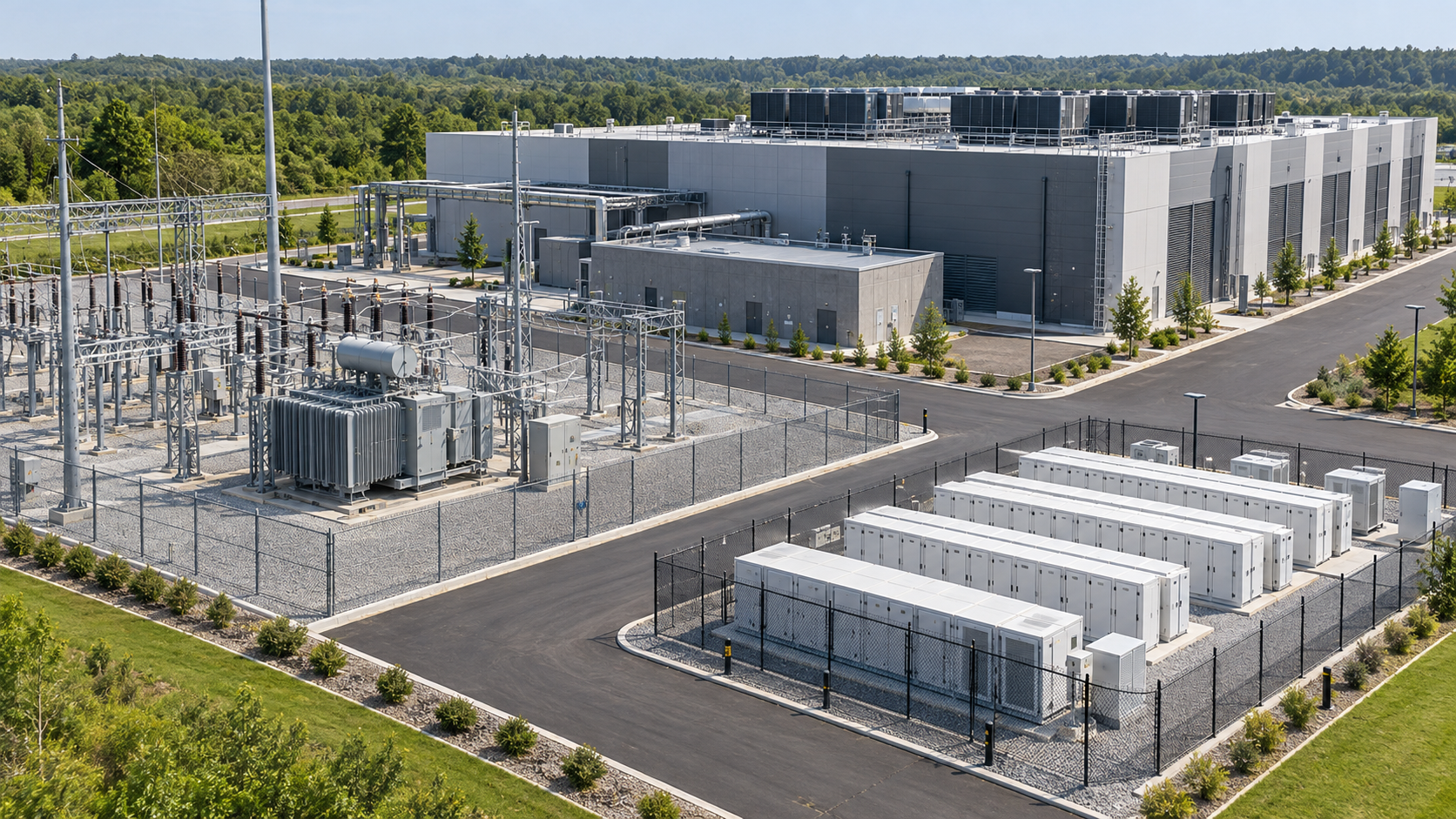
(3) Three jobs compete for the same battery
NVIDIA lists the jobs expected of a data-center BESS as transient smoothing, keeping reserve for ride-through, and demand response or generator coordination, notes that "those missions can compete with each other", and says the design needs explicit priorities and a strategy to prevent uncontrolled state-of-charge (SOC) drift Sourced (company claim) [Ref. 8].
In the Belgian case, only 2.75 MWh of the 5.5 MWh was optimized for demand response Sourced [Ref. 4]. It is natural to read the rest as held back as backup reserve, but the announcement does not say so Inference. How to divide capacity between insurance for emergencies and everyday revenue operation is at the center of this application's design (Commentary).
- Backup: keep supplying power at the moment of an outage or disturbance. The battery must always hold reserve near full charge.
- Grid connection: raise and lower load at a speed the grid allows, and ride through. The battery needs power and fast response.
- Demand response: cut load or discharge in response to grid supply and demand. The battery must withstand repeated charge and discharge and restore the reserve used in daily operation.
Every role demands high power, long life and safety at the same time. For cost evaluation (how levelized cost is built), see our explainer on the economics of storage. For the grid-scale side, see our explainers on grid-scale storage systems and on virtual power plants and distributed energy resources.
(4) Safety: treating fire as a design premise
The Uptime Institute discusses the fire at a data center in Pangyo, South Korea, in October 2022. It says the fire started in a battery room, took about eight hours to bring under control, and took down services including KakaoTalk. At the time of the article the root cause had not been disclosed, and claims about the battery maker's battery-management-system records conflicted. We therefore do not attribute a cause to that fire. The design lessons the article draws are choice of suppression, spacing of battery cabinets, and fire-resistant compartments in battery rooms Sourced (Uptime Institute analysis) [Ref. 11].
On installation, NFPA 855 (2026 edition) sets minimum requirements for stationary energy storage systems, and UL 9540A (6th edition) defines a test method for thermal-runaway fire propagation [Refs. 14 and 15]. For batteries inside buildings, conformity to these standards and local fire regulations is a precondition. We make no judgement on any individual facility. The mechanism of thermal runaway is covered in our explainer on thermal runaway and battery safety.
9. How supercapacitors fit in
Our explainer on supercapacitors sets out that they store energy by adsorbing ions, not by chemical reaction, so they are strong on power and life but orders of magnitude lower in energy density than batteries. In the time layers of Fig. 4 this means they suit swings longer than an electrolytic capacitor can cover and shorter than a battery is efficient at (in our reading, from about one second to about a minute) (Commentary; the band in Fig. 4 is a rough guide with no evidence of deployment behind it).
- What we confirmed: the NVIDIA GB300 power shelf uses electrolytic capacitors Sourced [Ref. 6]. They are not supercapacitors.
- What we could not confirm: we could not find, in public-agency or operator primary sources, the scale or track record of supercapacitor use in data centers. A supercapacitor maker listing AI data centers among its customer segments on its own website, as covered in the supercapacitor explainer, remains a company statement.
Which storage element goes in which time layer depends on cost, volume, life and maintenance together. We do not rank any approach.
10. Limits, and what we could not confirm
- We use no market sizes. We did not use market-size or market-share estimates for UPS batteries or lithium-ion, since they come from research firms. The Uptime Institute's "adopted" share has no stated definition, so we do not treat it as a market share.
- The Samsung SDI specification is a "first draft", and we could not confirm a final version. It gives no cycle life, warranty or cell chemistry.
- Operating results (Google in Belgium, Microsoft in Dublin) are plans or equipment descriptions as of the announcements; we could not confirm results after commissioning from primary sources.
- Individual accidents such as the Pangyo fire: we do not state causes because we could not confirm a published root cause. We also could not confirm official investigation results for the 2025 fire at a South Korean government-systems data center, so we do not cover it.
- The nearly 4 GW event in Virginia in July 2026 was still under analysis at the time of NERC's document (September 2026), so the details may change.
- Our calculations (Chapters 5 and 7) are structural explanations under stated assumptions. They do not show real UPS counts, real AI training loads or real battery life.
- UL 1973: apart from its appearing as a test standard in the Samsung SDI specification, we could not confirm its title and edition on the standards body's own page.
- A UPS battery is "a few minutes of insurance"; NERC puts centralized UPS units at about 2–5 MW Sourced
- For holds of a few minutes, rack count is set by power. For 5 MW and 5 minutes, energy alone gives 16 racks, but power requires 29 Our calculation
- The advantages of lithium-ion are compactness, high power and predictable ageing. The Uptime Institute also says its fire risk is higher than lead-acid Sourced
- The UPS transferring to battery has become a grid problem. The roughly 1,500 MW load drop in July 2024 was the result of data-center protection operating Sourced
- Smoothing swings with a battery can mean thousands to over ten thousand equivalent full cycles a year (hypothetical example) Our calculation
- The numbers in the examples are company claims. We could not confirm independent verification of operating results.
11. How to read evaluations and standards
Before comparing which number is larger, align the basis of comparison in the following order. This is an editorial reading checklist, not a set of test conditions or acceptance limits prescribed by a standard.
- 1. What was measured?
- deliverable power, hold-up time, transfer time and total ownership cost. Check the units and whether the result describes a material, component or complete system.
- 2. Under which conditions?
- load changes, redundancy, cooling, backup boundary and end-of-life capacity. Treat results under different conditions as separate results before comparing them.
- 3. The comparison trap
- Do not confuse kW with kWh or nameplate capacity with runtime at the actual load.
- 4. What does the standard cover?
- Check the identifier, title, edition and scope in the issuing body’s material. Distinguish test methods, safety, interoperability and management requirements. Naming a standard alone does not establish that a test, conformity assessment or certification has been completed.
Keep a comparison note containing the object, units, conditions, sample count and variation, comparator, standard edition and unresolved points. Do not invent numerical conditions or acceptance limits from a public abstract of a standard.
12. Glossary
- UPS (uninterruptible power supply)
- Equipment that keeps feeding the load through an outage or voltage disturbance. Built from a rectifier, inverter, battery and more.
- VRLA
- Valve-regulated lead-acid battery. The sealed lead-acid type long used in data-center UPS.
- DRUPS
- Rotary UPS. A flywheel keeps power uninterrupted and a clutch quickly connects a diesel engine.
- BESS
- Battery energy storage system. Batteries combined with power converters and controls into equipment that exchanges power with the grid.
- Ride-through
- Staying connected and operating through short grid voltage or frequency disturbances.
- Float charge
- Holding the cell at a near-full-charge voltage while on standby. The normal state of a UPS battery.
- C-rate
- Current that would charge or discharge the rated capacity in one hour is 1C. At 5C, the full capacity lasts about 12 minutes.
- Calendar ageing
- Degradation that advances with time even when the cell is not used. Faster at high state of charge and high temperature.
- Equivalent full cycles
- Total discharged energy divided by battery capacity. A way to add up shallow cycles.
- Demand response
- Customers changing how they use electricity in response to grid supply and demand.
- EOL (end of life)
- The state in which a battery is judged to have reached the end of its use. In this article, capacity at 80% of initial.
- Thermal runaway
- A chain of heat-generating reactions inside a cell that sharply raises temperature and pressure.
13. References
- NERC "Incident Review: Considering Simultaneous Voltage-Sensitive Load Reductions", 8 January 2025 (PDF) — https://www.nerc.com/globalassets/our-work/reports/event-reports/incident_review_large_load_loss.pdf
- NERC "Reliability Insights: Large Computational Load Risks Due to Voltage Sensitivity", September 2026 (PDF) — https://www.nerc.com/globalassets/who-we-are/news/2026/09/reliability-insights_large-computational-load-risks-due-to-voltage-sensitivity.pdf
- Microsoft "Microsoft datacenter batteries to support growth of renewables on the power grid", 7 July 2022 — https://news.microsoft.com/source/features/sustainability/ireland-wind-farm-datacenter-ups/
- Centrica "Fluence and Centrica work with Data Centre in Belgium to Provide and Optimise its first Zero-Emission Backup Power System", 21 April 2022 — https://www.centrica.com/media-centre/news/2022/fluence-and-centrica-work-with-data-centre-in-belgium-to-provide-and-optimise-its-first-zero-emission-backup-power-system
- Google "How we're making data centers more flexible to benefit power grids", 4 August 2025 — https://blog.google/innovation-and-ai/infrastructure-and-cloud/global-network/how-were-making-data-centers-more-flexible-to-benefit-power-grids/
- NVIDIA "How New GB300 NVL72 Features Provide Steady Power for AI", 28 July 2025 — https://developer.nvidia.com/blog/how-new-gb300-nvl72-features-provide-steady-power-for-ai/
- Choukse et al. (arXiv) "Power Stabilization for AI Training Datacenters", arXiv:2508.14318 (August 2025) — https://arxiv.org/abs/2508.14318
- NVIDIA "Designing Production-Ready Battery Energy Storage Systems for AI Factories", 10 June 2026 — https://developer.nvidia.com/blog/designing-production-ready-battery-energy-storage-systems-for-ai-factories/
- Samsung SDI "Lithium Ion Battery System for UPS – U6A4, Product Specification for End Customers", first draft, 28 April 2025 (PDF, hosted on Vertiv's site) — https://www.vertiv.cn/49f6fc/globalassets/shared/lithium-ion-batteries-system-for-ups---u6a4-ul-250428-product-specification.pdf
- Uptime Institute "Lithium Ion Batteries for the data center. Are they ready for production yet?", November 2019 — https://journal.uptimeinstitute.com/lithium-ion-batteries-in-the-data-center/
- Uptime Institute "Major data center fire highlights criticality of IT services", January 2023 — https://journal.uptimeinstitute.com/major-data-center-fire-highlights-criticality-of-it-services/
- IEC "IEC 62040-3:2021 Uninterruptible power systems (UPS) – Part 3: Method of specifying the performance and test requirements" — https://webstore.iec.ch/en/publication/60140
- IEC "IEC 62619:2022 Secondary cells and batteries containing alkaline or other non-acid electrolytes – Safety requirements for secondary lithium cells and batteries, for use in industrial applications" — https://webstore.iec.ch/en/publication/64073
- UL Solutions "UL 9540A Test Method for Battery Energy Storage Systems (BESS)" — https://www.ul.com/services/UL-9540A-test-method
- NFPA "NFPA 855 Standard for the Installation of Stationary Energy Storage Systems" (current edition 2026) — https://www.nfpa.org/codes-and-standards/nfpa-855-standard-development/855
- IEA "Energy and AI" (executive summary) — https://www.iea.org/reports/energy-and-ai/executive-summary
- U.S. Department of Energy (DOE) "DOE Releases New Report Evaluating Increase in Electricity Demand from Data Centers", 20 December 2024 (introducing the LBNL report) — https://www.energy.gov/articles/doe-releases-new-report-evaluating-increase-electricity-demand-data-centers
- Redwood Materials "Redwood Energy: Fast, low-cost storage to power the age of AI and a changing grid", 27 June 2025 — https://www.redwoodmaterials.com/news/redwood-energy-fast-low-cost-storage-to-power-the-age-of-ai-and-a-changing-grid/
- Redwood Materials "Redwood and Crusoe expand compute to 7x scale after 99.2% microgrid uptime", 24 March 2026 — https://www.redwoodmaterials.com/news/redwood-and-crusoe-expand-compute-to-7x-scale/
14. Claim-to-source audit
| Claim in the text | Basis | Label |
|---|---|---|
| On 10 July 2024 at about 7 p.m., a lightning-arrester failure on a 230 kV line led to six voltage dips (42-66 ms) within 82 seconds, and about 1,500 MW of load was disconnected by customers' protection and controls. All of it was data-center-type load. The load had been transferred to backup power. Some sites used a scheme counting voltage dips (for example three in one minute); about 1,260 MW dropped at the third dip and stayed off for hours. Frequency peaked at 60.047 Hz and voltage at 1.07 per unit. UPS designs are grouped as centralized (2-5 MW), distributed (rack-level, 3-4 kW) and DRUPS. The battery bank supplies the load only for short disturbances or until a generator can start | NERC incident review (8 January 2025)[Reference 1] https://www.nerc.com/globalassets/our-work/reports/event-reports/incident_review_large_load_loss.pdf | Sourced |
| That some data centers changed their protection and control settings; that a similar fault on 18 April 2026 led to about 500 MW of sustained load loss; that in July 2026 Virginia saw a customer-initiated load reduction of nearly 4 GW, under analysis as of September 2026 | NERC Reliability Insights (September 2026)[Reference 2] https://www.nerc.com/globalassets/who-we-are/news/2026/09/reliability-insights_large-computational-load-risks-due-to-voltage-sensitivity.pdf | Sourced |
| That NERC plans to complete registry criteria and foundational Reliability Standards by the end of 2026 at FERC's direction | NERC (September 2026) describes this as a plan; completion has not been confirmed[Reference 2] https://www.nerc.com/globalassets/who-we-are/news/2026/09/reliability-insights_large-computational-load-risks-due-to-voltage-sensitivity.pdf | Not yet confirmed |
| That at its Dublin data center Microsoft put lithium-ion batteries in the UPS and, with a grid-interactive UPS developed with Eaton, planned to participate in EirGrid's market via Enel X; the Baringa estimate (about 2 million tonnes, commissioned by Microsoft); that the article spoke of "later this year" in the future tense | Microsoft (7 July 2022)[Reference 3] https://news.microsoft.com/source/features/sustainability/ireland-wind-farm-datacenter-ups/ | Sourced |
| Google's 2.75 MW / 5.5 MWh battery in Belgium, the 2.75 MWh optimized for demand response, participation in Elia's ancillary-services market, and the statement that it is a first of its kind for Google. Centrica's estimate of about 20 GW of diesel backup generators across the industry | Centrica announcement (21 April 2022)[Reference 4] https://www.centrica.com/media-centre/news/2022/fluence-and-centrica-work-with-data-centre-in-belgium-to-provide-and-optimise-its-first-zero-emission-backup-power-system | Sourced |
| That Google agreed demand response targeting machine-learning workloads with Indiana Michigan Power and TVA; that in a demonstration with OPPD it cut ML power demand during three events the previous year; the method of deferring non-urgent compute; Google's statement that flexibility has limits | Google (4 August 2025)[Reference 5] https://blog.google/innovation-and-ai/infrastructure-and-cloud/global-network/how-were-making-data-centers-more-flexible-to-benefit-power-grids/ | Sourced |
| Electrolytic capacitors in the GB300 power shelf, 65 J per GPU, about half the power-supply volume, joint optimization with LITEON; that measurements on a GB200 rack power shelf showed a 30% drop in peak power when training Megatron LLM; power caps and a burner for ramp-up and ramp-down; that in AI training the GPUs move in step so variation is amplified | NVIDIA technical blog (28 July 2025). A company measurement and claim[Reference 6] https://developer.nvidia.com/blog/how-new-gb300-nvl72-features-provide-steady-power-for-ai/ | Sourced |
| The mechanism of AI-training power swings, and that swing frequencies coinciding with critical utility frequencies can physically damage grid infrastructure (from the abstract) | Choukse et al., arXiv:2508.14318[Reference 7] https://arxiv.org/abs/2508.14318 | Sourced |
| That BESS is a control system combining batteries, power converters, controls and telemetry; that it takes residual swings left by rack-level smoothing; ride-through, generator coordination, competing missions and SOC drift; the view that existing interconnection standards do not yet cover AI-factory behaviors, and the self-qualification guidelines | NVIDIA technical blog (10 June 2026). A company claim[Reference 8] https://developer.nvidia.com/blog/designing-production-ready-battery-energy-storage-systems-for-ai-factories/ | Sourced |
| Samsung SDI UPS battery system values (67 Ah cell, 136 in series, 34.6 kWh, nominal 516.8 V, 183.6 kW continuous, up to 450 A, end-of-discharge voltage 408 V, float voltage 571.2 V = 4.2 V per cell, 12-hour cool-down after a maximum-power discharge, standards evaluated). That the revision history has only the first draft (0.0) of 28 April 2025 | Samsung SDI product specification (manufacturer's stated value)[Reference 9] https://www.vertiv.cn/49f6fc/globalassets/shared/lithium-ion-batteries-system-for-ups---u6a4-ul-250428-product-specification.pdf | Sourced |
| Lithium-ion advantages (power density, ageing with cycling, predictable capacity decline), lead-acid replacement at about 80%, how UPS batteries are used (transfers are not frequent, worst case about 15 minutes), the supplier claim on total cost of ownership, checking UPS-side compatibility | Uptime Institute (November 2019, chief technical officer's opinion)[Reference 10] https://journal.uptimeinstitute.com/lithium-ion-batteries-in-the-data-center/ | Sourced |
| Outline of the Pangyo fire and that the root cause had not been disclosed; the Uptime view that lithium-ion carries higher fire risk than lead-acid; survey-based adoption (nearly half of operators in 2021); lessons on suppression, cabinet spacing and fire-resistant compartments | Uptime Institute (January 2023, the institute's own analysis)[Reference 11] https://journal.uptimeinstitute.com/major-data-center-fire-highlights-criticality-of-it-services/ | Sourced |
| Title and scope of IEC 62040-3:2021 (AC input and output up to 1,000 V, energy storage up to 1,500 V DC, continuity of load power) | IEC standard page[Reference 12] https://webstore.iec.ch/en/publication/60140 | Sourced |
| Title and scope of IEC 62619:2022 (safety of secondary lithium cells and batteries for industrial use, including stationary) | IEC standard page[Reference 13] https://webstore.iec.ch/en/publication/64073 | Sourced |
| Title and purpose of UL 9540A; UL Solutions' statement that it is the consensus standard NFPA 855 cites for large-scale fire testing; that a 6th edition has been published | UL Solutions page[Reference 14] https://www.ul.com/services/UL-9540A-test-method | Sourced |
| Title of NFPA 855 and that the current edition is 2026 | NFPA standard page[Reference 15] https://www.nfpa.org/codes-and-standards/nfpa-855-standard-development/855 | Sourced |
| That data centers worldwide used about 415 TWh (about 1.5%) in 2024; the IEA Base Case of about 945 TWh in 2030 | IEA Energy and AI (executive summary). The 2030 value is an IEA Base Case outlook[Reference 16] https://www.iea.org/reports/energy-and-ai/executive-summary | Not yet confirmed |
| That U.S. data centers are estimated to have used about 4.4% of U.S. electricity in 2023 (176 TWh; 58 TWh in 2014) | U.S. Department of Energy (introducing the LBNL report)[Reference 17] https://www.energy.gov/articles/doe-releases-new-report-evaluating-increase-electricity-demand-data-centers | Sourced |
| Redwood Materials and Crusoe's 12 MW / 63 MWh microgrid, 99.2% operational availability, expansion to 20 modules | Redwood Materials (27 June 2025). A company claim[Reference 18] https://www.redwoodmaterials.com/news/redwood-energy-fast-low-cost-storage-to-power-the-age-of-ai-and-a-changing-grid/ | Sourced |
| Redwood Materials' announcement of 99.2% operational availability and expansion to 20 modules | Redwood Materials (24 March 2026). A company claim[Reference 19] https://www.redwoodmaterials.com/news/redwood-and-crusoe-expand-compute-to-7x-scale/ | Sourced |
| Racks needed for a 5 MW UPS (29 at 5 minutes, 32 at 10, 48 at 15); 183.6 kW ÷ 34.6 kWh = about 5.3C equivalent, full discharge in about 11.3 minutes, 450 A ÷ 67 Ah = about 6.7C; 65 J = 65 W × 1 s | Our calculation. The assumptions (5 MW load, 95% conversion efficiency, 80% capacity at end of life, 183.6 kW per rack, no allowance for redundancy, temperature or rising internal resistance) are given in Chapter 5. It does not show an actual design | Our calculation |
| Equivalent full cycles when a hypothetical load (100 MW and 60 MW on a 10-second period) is smoothed by a battery (17,520, 8,760 and 4,380 a year for 5, 10 and 20 MWh), DoD per period, and heat at 90% round-trip efficiency | Our calculation. The assumptions are given in Chapter 7. It does not show a real AI training load or real battery life | Our calculation |
| The chemistry of the Samsung SDI cells (layered-oxide cathode and graphite anode as an inference), ageing mechanisms while on standby (electrolyte oxidation, transition-metal dissolution, SEI growth), ageing mechanisms of lead-acid, trends in high-power electrode design, the reading that the battery's role has changed, and the placement of supercapacitors | Commentary and inference based on published material. The specification does not state the chemistry. These are not views stated by any company or agency | Commentary |
| Market size and share estimates for UPS batteries, the title and edition of UL 1973, operating results after commissioning in Dublin and Belgium, the root cause of the Pangyo fire, official findings on the 2025 South Korean data-center fire, and the scale of supercapacitor use in data centers | Could not be confirmed from primary sources within the scope of this article, so none is stated (Commentary) | Commentary |
| That Figs. 1 and 6 are AI-generated images and Figs. 2 to 5 are explanatory drawings, not real facilities or measured data | Our note | Commentary |
Last updated 10 October 2026. Sources are limited to primary material (standards bodies, public agencies, company announcements and a preprint). Company figures are treated as company claims and kept apart from independently verified values. We use no market-size or share estimates. Our calculations (Chapters 5 and 7) explain structure under stated assumptions and do not show a real design, load or battery life. That the Samsung SDI specification is a first draft, operating-result figures, the root cause of the fire, and the scale of supercapacitor use could not be confirmed from primary sources and are not asserted. Figs. 1 and 6 are AI-generated images and Figs. 2 to 5 are vector drawings; none of them shows a real facility, product or measured data.