TECHNOLOGY EXPLAINER
Long-Duration Storage (Iron-Air and Zinc-Based)
— What do you give up to buy "long" cheaply?
The U.S. Department of Energy (DOE) defines long-duration storage as storage of more than 10 hours, and set a goal of cutting its cost by 90% within the decade. With lithium-ion, cost rises roughly in proportion to energy capacity (kWh). So approaches are being tried that earn capacity from cheap materials such as iron and zinc and give up round-trip efficiency and power density in exchange. Form Energy's iron-air battery advertises "up to 100 hours", and its first commercial batteries began arriving in Minnesota in 2025. Meanwhile NGK announced that it will end manufacture and sale of NAS batteries. This article separates what is confirmed fact from what is a company's claim.
- What "long-duration" means (the short version)
- Duration bands, and the durations each technology states
- Our calculation: why the cost per kWh must be low
- Iron-air batteries: reversible rusting
- Zinc-based: Eos's zinc battery, and zinc-air
- Material prices are small: our calculation
- The trade-off of low round-trip efficiency
- NAS (sodium-sulfur) batteries, briefly
- Policy and the state of demonstration
- Limits, and what could not be confirmed
- How to read evaluations and standards
- Glossary
- References
- Claim-to-source audit
Sourced = stated in a published source (source linked)
Our calculation = a value this article calculated from stated assumptions
Not yet confirmed = a plan, target or outlook for which no result has been confirmed
Readings about materials and structure are marked as commentary. Inference marks a reading that was not confirmed in a primary source.
A company's announcement is "the company's claim" and has not been verified by a third party. Manufacturer values carry their object (cell, module, system) and conditions. PNNL figures are estimates based on developer surveys, not market prices.
This article is a technical explainer. It is not advice on operating or safety of equipment, or on investment or procurement.
1. What "long-duration" means (the short version)
- There is no single definition. In July 2021 the DOE defined long-duration storage as storage "for more than 10 hours at a time" and announced a goal of cutting its cost by 90% within the decade, across all technologies (electrochemical, mechanical, thermal, chemical carriers) Sourced [Ref. 1]. The DOE "Liftoff" slides segment duration as up to 10 h = short, 10-36 h = inter-day, 36-160 h = multi-day/week, above 160 h = seasonal Sourced [Ref. 2]. Japan's long-term decarbonization power source auction (bid year FY2025) requires pumped hydro, batteries and long-duration storage systems to be able to run continuously for 6 hours or more at least once a day Sourced [Ref. 19].
- What improves with duration is the cost per unit of energy. Power-side equipment (kW) stays the same as duration grows, but energy capacity (kWh) grows in proportion. A system that does not discharge many times a year needs an extremely low equipment cost per kWh (the calculation in section 3).
- There is something to give up. With iron-air and zinc-based systems the price is low round-trip efficiency (35% in a review's reported figure, 64% in PNNL's zinc-air estimate), power density and a thin track record. Confirmed demonstrations are small and the companies are financially unstable (ESS Tech's going-concern doubt, NGK's NAS exit).
2. Duration bands, and the durations each technology states
The figure overlays the durations that companies and agencies state in their documents on the DOE segmentation. The stated durations are on different conditions and are not a ranking of performance. For large lithium-ion systems, CAISO's market monitor writes that most large-scale storage in operation has a maximum duration of 4 hours Sourced [Ref. 16].
In DOE's terms, lithium-ion sits in the short band; vanadium flow batteries, Eos's zinc battery and iron flow batteries aim at up to about 10 hours or a little beyond; and iron-air and zinc-air (one developer's case) aim at the band above 10 hours. Note that the "up to 100 hours" in the figure is Form Energy's own description; it does not mean a 100-hour continuous discharge has been confirmed in operation.
3. Our calculation: why the cost per kWh must be low
In PNNL's estimate for 2021 values, the installed cost of a 100 MW grid lithium-ion (LFP) system is US$385/kWh at 4 hours and US$356/kWh at 10 hours Sourced [Ref. 3]. Stretching the duration 2.5 times lowers the cost per kWh only by about 7.5% ((385 - 356) / 385) Our calculation. As long as more cells are added, cost rises almost in proportion to capacity (commentary).
For equipment cost of X US$ per kWh, this estimates the capital cost per kWh discharged in one cycle Our calculation.
- Assumptions: 8% discount rate and 20 years give a capital recovery factor of 0.1019 (= 0.08 × 1.0820 / (1.0820 - 1)). Each kWh of capacity is fully discharged n times a year. O&M, round-trip efficiency, degradation and power-side costs are excluded.
- Calculation: capital cost per MWh discharged = X × 0.1019 / n × 1,000. At US$356/kWh (PNNL's LFP, 10-hour estimate) it is about US$99/MWh at 365 cycles a year, about 363 at 100, about 725 at 50 and about 1,813 at 20. At US$100/kWh (assumption) it is about 28, 102, 204 and 509; at US$20/kWh (assumption) about 5.6, 20, 41 and 102 US$/MWh.
Assumptions and limits: US$100/kWh and US$20/kWh are this article's assumptions for thinking about the level long-duration storage must reach; they are not any company's price. The numerical value of DOE's own target could not be confirmed in the sources this article read (they say only a 90% reduction). Levelized cost of storage (LCOS) is covered in our series' explainer on storage economics.
Fig. 2 shows that for a system cycled only 20 times a year, at LFP price levels the capital cost alone is about US$1,800 per MWh delivered Our calculation. To serve uses that arise only a few to a few dozen times a year (preparing for multi-day bad weather), the equipment cost per kWh must fall by about an order of magnitude. That is why cheap materials such as iron, zinc, water and air, and simple structures, are being pursued (commentary).
PNNL's relationship between duration and cost of the battery proper
PNNL estimates the DC storage block of a 10 MW vanadium RFB at US$352/kWh for 2 hours, 263 for 4 hours, 210 for 10 hours and 179 for 100 hours. For zinc-air (one developer's information) it is US$208/kWh at 8 hours, 174 at 10, 94 at 24, 66 at 48 and 51 at 100 (all 2021 values) Sourced [Ref. 3]. For zinc-air PNNL writes that "no pilot-plant-scale or demonstrations have been done" and that the costs have not been validated through real grid-scale deployment.
4. Iron-air batteries: reversible rusting
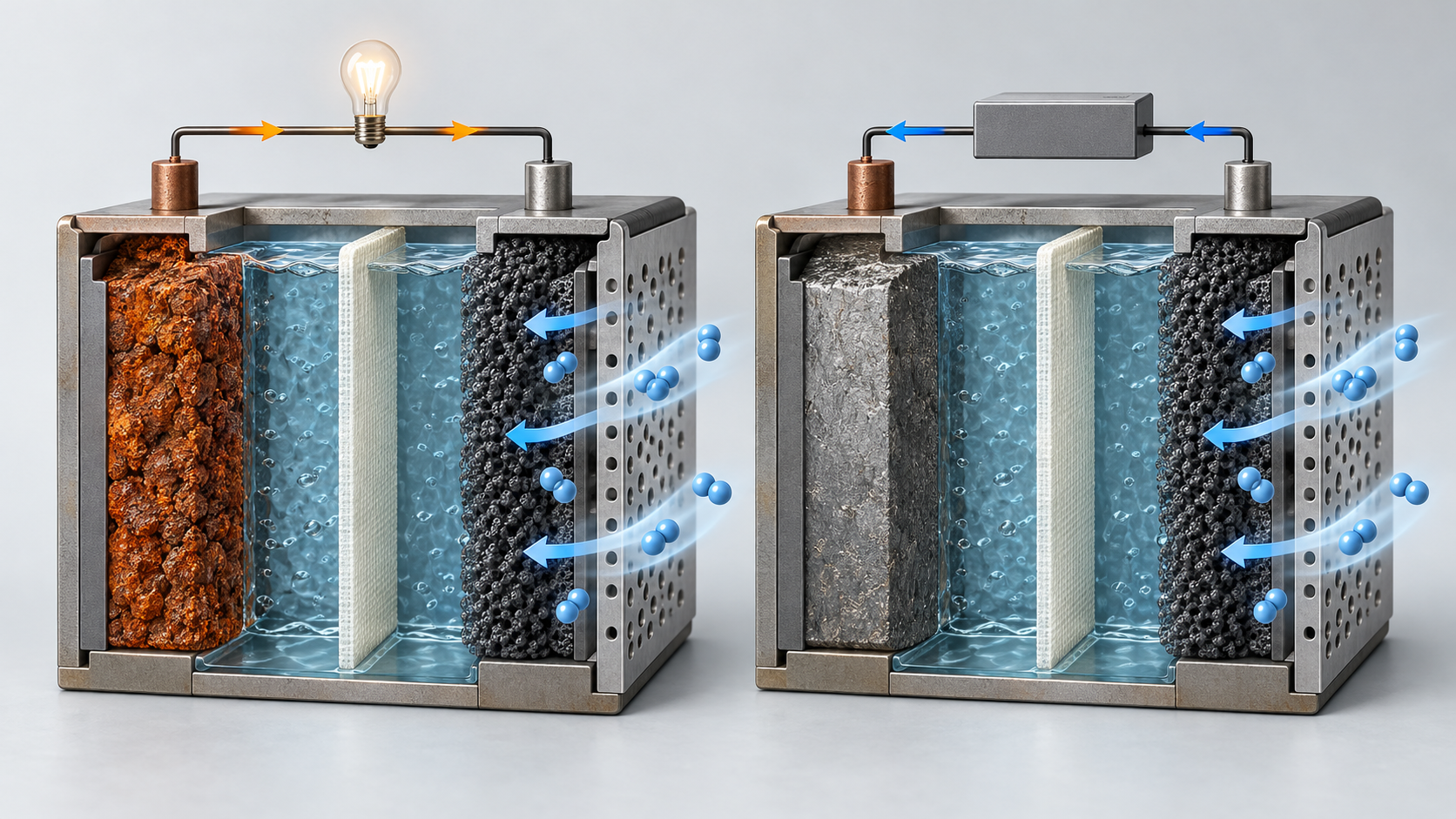
Form Energy explains the principle of its iron-air battery as "reversible rusting": on discharge the battery takes in oxygen from the air and turns iron metal into rust; on charge an electric current turns the rust back into iron and the battery releases oxygen Sourced (the company's description) [Ref. 5]. Each cell holds iron and air electrodes and a water-based, non-flammable electrolyte (the company likens it to the electrolyte in AA batteries); the cells are stacked into modules, housed in enclosures about the size of a shipping container, and grouped into megawatt-scale power blocks [Ref. 5].
View the original SVG schematic and exact annotations
The abstract of a review (McKerracher et al., 2014) gives, for the iron-air system, a predicted open-circuit potential of 1.28 V, a specific charge capacity below 300 Ah/kg and reported efficiencies of 96% (charge), 40% (voltage) and 35% (energy) Sourced. It lists as remaining challenges efficient, moderately priced bifunctional oxygen electrodes (working for both charge and discharge), low-cost iron electrodes that curb corrosion and hydrogen evolution, new cell designs and models to improve performance [Ref. 4]. That 35% is a compilation of old, laboratory reports and is not a value for Form Energy's current system. Whether the company publishes an official round-trip efficiency could not be found on the company pages this article checked (technology page, press releases).
Reading the review's challenges from the materials side, the difficulty concentrates in three places (commentary).
- Iron electrode: when iron is deposited on charge, hydrogen evolves on the same electrode and part of the current is wasted. Corrosion while idle becomes self-discharge. These are clues for thinking about why the reported charge efficiency (96%) is so much higher than the voltage and energy efficiencies (inference: the background to the review's numbers was not confirmed here).
- Oxygen electrode: a two-way catalyst is needed, reducing oxygen on discharge and evolving it on charge. Oxygen reactions are known as ones with large voltage losses (commentary based on general understanding).
- Air quality: a system that takes in air is exposed to its moisture and carbon dioxide. The zinc-air system PNNL describes supplies air scrubbed free of carbon dioxide Sourced [Ref. 3]. Whether iron-air uses a similar measure could not be confirmed.
Confirmed demonstrations and plans (company claims kept apart from third-party statements)
- Safety (company claim): in December 2024 Form Energy announced that its iron-air cells completed UL 9540A (cell-level) testing with no flame or thermal-event propagation and no thermal runaway. The company says the test simulated fault and abuse conditions known to trigger thermal runaway in other batteries, and quotes a PNNL researcher. This article did not see the test report itself Sourced [Ref. 6].
- First installation: on 15 August 2024 Great River Energy (a Minnesota electric cooperative) and Form Energy announced the groundbreaking of a 1.5 MW multi-day storage pilot in Cambridge, Minnesota, described as storing "up to 100 hours" Sourced [Ref. 8] (150 MWh at 100 hours: our calculation Our calculation). A Latitude Media article shared by the cooperative (29 October 2025) says that deployment of the first commercial batteries began that month and the project is expected to be fully operational in 2026 Sourced [Ref. 9]. No official material showing full operation could be confirmed as of October 2026.
- A large plan: on 24 February 2026 Xcel Energy announced, as part of an agreement for a Google data center in Minnesota, a 300 MW (30 GWh) Form Energy iron-air installation. The announcement says the electric service agreement needs approval from the Minnesota Public Utilities Commission Not yet confirmed [Ref. 10].
- The company's finances (company announcement): on 12 August 2026 Form Energy announced a US$750 million Series G round, bringing total equity raised to more than US$2 billion. It says its backlog grew from about 20 GWh to 80 GWh earlier in the year (a company claim; contract terms and timing were not checked here) Sourced [Ref. 7].
5. Zinc-based: Eos's zinc battery, and zinc-air
Eos Energy Enterprises (static zinc-based batteries)
Eos describes itself as a manufacturer and provider of zinc-based battery energy storage systems and calls its product "Znyth". Its Z3 battery module is aimed at applications needing 3 to 12 hours or longer of discharge, and the main raw materials are five: zinc halide salts, felt, resin, titanium and conductive polymer (10-K for the year to December 2025) Sourced. It says the module is a static design with no pumps or compressors, operates from -20 to 50 °C without the narrow temperature band lithium-ion needs, and that the underlying chemistry "has demonstrated durability over more than 3 million cycles" (a company claim). It also says modules are manufactured at zero voltage and 0% state of charge [Ref. 11].
- Funding: on 26 November 2024 it set up a loan facility guaranteed by the U.S. Department of Energy (principal up to US$277.5 million plus capitalized interest up to US$26.0 million, for up to US$303.5 million in total). The company calls this "the first Title XVII battery loan closed". By 31 December 2025 it had drawn US$90.9 million, the first tranche. The plan is to expand manufacturing capacity to 8 GWh by 2027 Not yet confirmed Sourced [Ref. 11].
- Business position: the 10-K says that, given the capital raised in 2025, management concluded there is no longer substantial doubt about going concern [Ref. 11].
- How it sees competitors: it names ESS Inc., Enervenue, Ambri and Form Energy as longer-duration competitors (the company's description) [Ref. 11].
Zinc-air (one developer's case described by PNNL)
PNNL describes the zinc-air system as having a charge stack and a discharge stack and a tank. On charge, the zincate formed on discharge is pumped to the stack, zinc is plated loosely and flushed to the storage tank. On discharge, the slurry goes to the discharge stack and air scrubbed free of carbon dioxide is fed to the air electrode. Operation is at 60 °C, and the cathode is assumed to be replaced every 20,000 hours at US$200/kW. The estimate comes from one developer, with round-trip efficiency of 64% and cycle life of 12,500 (constant from 8 to 100 hours) Sourced. PNNL said that a 40 kW / 160 kWh unit was expected in British Columbia, Canada, and two 100 kW systems of 10 and 15 hours in New York State by the end of 2022. What happened afterwards could not be confirmed [Ref. 3].
The raw materials in Eos's 10-K are felt (electrode substrate), resin (frames and housing), titanium (current collector), conductive polymer and a zinc halide electrolyte. In place of the nickel, cobalt and lithium of lithium-ion, resins and seals that survive a water-based, acidic, halogen-containing liquid, and the titanium surface, read as the key to reliability (inference: the 10-K gives no detailed material specifications).
In zinc-air (PNNL), the air electrode is replaced every 20,000 hours, so the consumable sits on the electrode side. This matches oxygen electrodes being the hard part of iron-air. In a system that uses air, the life of the air electrode and the ease of replacing it set the operating cost (commentary).
6. Material prices are small: our calculation
This estimates the raw-material cost of the active iron and zinc themselves from theoretical capacity Our calculation.
- Iron: taking Fe to Fe²⁺ (two electrons), theoretical specific charge = 2 × 96,485 / 55.845 / 3,600 = 0.960 Ah/g. Multiplying by 1.28 V (the review's predicted value) gives 1.229 kWh/kg. One MWh (theoretical, 100% utilization) needs about 814 kg of iron. According to USGS the average iron ore price in the first nine months of 2025 was US$99.07 per tonne (62% iron), about US$0.160/kg of contained iron. That is about US$0.13 per kWh.
- Zinc: taking Zn to Zn²⁺ (two electrons), 0.820 Ah/g. With an average voltage assumed to be 1.5 V (the actual voltage of Eos and others could not be confirmed; this is this article's assumption), 1.23 kWh/kg. USGS's estimate of the 2025 LME zinc price is 130 cents per pound (about US$2.87/kg), so about US$2.3 per kWh.
Assumptions and limits: these are theoretical values and exclude utilization, excess plate material and the price of processed forms (iron as powder or plate rather than ore, zinc as powder). Real costs are larger. The USGS figures are market prices of iron ore and zinc metal Sourced [Ref. 18, 17].
The point of this calculation is that the raw-material cost of the active material is, in theory, less than 1% of the system installed cost (in PNNL's 2021 estimates the installed costs shown in this article are about US$330-760/kWh), and that most of the cost comes from electrodes, cells, enclosures, auxiliaries, installation and low efficiency (commentary). "The material is cheap" therefore does not mean "the system is cheap". Manufacturing processes (forming electrodes, mass-producing air electrodes) and life set the cost.
7. The trade-off of low round-trip efficiency
| System | Round-trip efficiency confirmed | Object, conditions, source |
|---|---|---|
| Lithium-ion (LFP) | 82.59% | AC-AC, transformer level, estimate for 2021 values (PNNL) [Ref. 3] |
| Vanadium RFB | 65% | AC-AC, transformer level, estimate for 2021 values (PNNL) [Ref. 3] |
| Zinc-air (one developer) | 64% | Estimate taken as constant from 8 to 100 hours (PNNL) [Ref. 3] |
| Iron-air (review's compilation) | 35% | Energy efficiency compiled from old, laboratory reports. Not a current product [Ref. 4] |
| Iron-air (Form Energy) | Could not be confirmed | Not stated on the company's technology page or press releases [Ref. 5] |
| Zinc-based (Eos) | Could not be confirmed | The 10-K gives no numerical round-trip efficiency [Ref. 11] |
Table 1 Round-trip efficiencies that could be confirmed (Sourced). Objects and conditions differ, so this is not a ranking. "Could not be confirmed" means the material this article checked did not state it.
The charging-energy cost per MWh discharged is charging price / round-trip efficiency Our calculation. At assumed efficiencies of 85%, 65%, 50% and 40%, a charging price of US$20/MWh gives 23.5, 30.8, 40.0 and 50.0 US$/MWh, and US$50/MWh gives 58.8, 76.9, 100.0 and 125.0 US$/MWh (Fig. 6).
Assumptions and limits: 85, 65, 50 and 40% are illustrations, not measured values of any company. The charging prices are this article's assumptions. Long-duration storage can choose when to charge, so if it can use hours when charging energy is cheap (surplus renewables) the effect of low efficiency is smaller; where charging energy is expensive, low efficiency becomes cost directly (commentary).
8. NAS (sodium-sulfur) batteries, briefly
The NAS battery is a secondary battery with sodium at the negative electrode, sulfur at the positive electrode and a fine-ceramic electrolyte between them, said to have been put into practical use first by NGK. NGK's product page gives a container unit with a rated output of 800 kW and rated capacity of 4,800 kWh (six hours), and says the cells and modules are certified to UL 1973 and the container has a UL 9540A test report (company statement) Sourced [Ref. 14].
- Withdrawal: at its board meeting on 31 October 2025 NGK resolved to discontinue manufacture and sale of NAS batteries and to stop taking new orders. It says NAS was first commercialized in 2002 and that it had cooperated with BASF since 2019 on performance, cost and sales network, but that talks about bringing in other companies to expand supply and cut costs ended in September 2025. As reasons it cites that stable, continuous demand for long-duration, large-capacity storage will take time to emerge, surging material costs and intensifying competition with lithium-ion, and says stable operations and profitability would be difficult Sourced [Ref. 13].
- Outlook: final shipment is scheduled for January 2027 Not yet confirmed. Existing orders will be shipped from inventory and maintenance parts for delivered products will continue to be supplied. An extraordinary loss of about ¥18,000 million is expected for the year ending March 2026. Net sales of the energy storage business for the year to March 2025 were ¥6,473 million (1.04% of consolidated) Sourced [Ref. 13].
Comparison of NAS with other batteries (chemistry and performance) is covered in our series' explainer on next-generation battery chemistries and comparison. Here only one fact is recorded: even a chemistry regarded as suited to long duration and large capacity may not sustain a business under the conditions of demand and cost.
9. Policy and the state of demonstration
| Party | Item | What could be confirmed | Type |
|---|---|---|---|
| U.S. DOE | Long Duration Storage Shot (July 2021) | A goal of cutting the cost of storage of more than 10 hours by 90% within the decade, technology-neutral across electrochemical, mechanical, thermal and chemical carriers [Ref. 1] | Target Not yet confirmed |
| Japan, OCCTO | Long-term decarbonization power source auction (bid year FY2025; results on 13 May 2026) | Awarded batteries are 10 lithium-ion projects totalling 551,469 kW and 9 non-lithium-ion projects totalling 699,658 kW (summed by this article from the annex list). Awarded resources earn capacity revenue at a fixed-cost level in principle for 20 years. The guidelines require batteries to run continuously for 6 hours or more at least once a day. The annex does not say which chemistries the "non-lithium-ion" projects use [Ref. 19, 20, 21] | Sourced Our calculation |
| Form Energy | Great River Energy (Minnesota), 1.5 MW pilot | Groundbreaking in August 2024; deployment of the first commercial batteries began in October 2025; full operation expected in 2026 (no official confirmation of full operation as of October 2026) [Ref. 8, 9] | Sourced Not yet confirmed |
| Form Energy | Xcel Energy and Google (Minnesota), 300 MW (30 GWh) | Announced 24 February 2026. The electric service agreement needs approval of the state utilities commission [Ref. 10] | Not yet confirmed |
| Eos Energy Enterprises | DOE-guaranteed loan facility (up to US$303.5 million) | Set up 26 November 2024; US$90.9 million drawn by the end of 2025; plan for 8 GWh of manufacturing capacity in 2027 [Ref. 11] | Sourced Not yet confirmed |
| ESS Tech | Iron flow battery | For the year to December 2025, revenue of US$1.6 million, net loss of US$63.4 million and substantial doubt about going concern. Says production versions of Energy Base are still under development [Ref. 12] | Sourced |
| NGK | Exit from NAS batteries | Resolved 31 October 2025; final shipment scheduled for January 2027 [Ref. 13] | Sourced Not yet confirmed |
Table 2 State of policy, demonstrations and business (sources in each cell). A company's announcement is the company's claim and has not been verified by a third party.
10. Limits, and what could not be confirmed
(1) Third-party data on efficiency and life
Form Energy's round-trip efficiency, the life of real iron-air batteries and Eos's round-trip efficiency were not stated in the material this article checked. The 35% for iron-air in Table 1 is a compilation of old laboratory reports.
(2) Confirmation of operation
No official material showing that the Great River Energy pilot is fully operational could be confirmed as of October 2026. Xcel's 300 MW (30 GWh) is described at the planning stage, subject to state approval.
(3) Cost targets
Numerical values of DOE's target (for example per kWh or as levelized cost) could not be confirmed in the material this article consulted. "Target costs per kWh" set by companies were not confirmed in third-party material either.
(4) What became of zinc-air
The outcome of the installations PNNL listed as planned for the end of 2022 could not be confirmed.
(5) Safety
Form Energy's cell-level UL 9540A result rests on the company's announcement (including a PNNL researcher's comment); the test report itself was not seen. System-level safety is not assessed here. The basics of battery safety are covered in our series' explainer on thermal runaway and battery safety.
(6) Division of labour with other explainers
Our series covers flow-battery membranes and electrolytes in "Redox flow batteries", chemistry comparisons in "Next-generation battery chemistries and comparison", economics in "Storage economics", and how grids use storage in "Grid-scale battery energy storage systems".
- The definition of "long" differs by source: more than 10 hours at DOE (bands at 36 and 160 hours) and 6 hours or more in Japan's long-term decarbonization auction Sourced
- For a system cycled 20 times a year, at LFP price levels capital cost alone is about US$1,800 per MWh delivered. That is why the equipment cost per kWh must fall by about an order of magnitude Our calculation
- Iron-air is "reversible rusting". The hard parts are the bifunctional oxygen electrode and corrosion and hydrogen evolution at the iron electrode. No official round-trip efficiency could be confirmed; a review's reported figure was 35% Sourced
- The raw-material cost of the active iron and zinc is, in theory, about US$0.13 to 2.3 per kWh. Most of the cost lies elsewhere Our calculation
- Demonstrations are small and companies are unstable. ESS Tech has going-concern doubt, NGK is leaving NAS, and Form is waiting for its first 1.5 MW to be fully operational Sourced
11. How to read evaluations and standards
Before comparing which number is larger, align the basis of comparison in the following order. This is an editorial reading checklist, not a set of test conditions or acceptance limits prescribed by a standard.
- 1. What was measured?
- power, discharge duration, efficiency, energy cost and power cost. Check the units and whether the result describes a material, component or complete system.
- 2. Under which conditions?
- technology, continuous operation, standby losses, location, auxiliaries and life. Treat results under different conditions as separate results before comparing them.
- 3. The comparison trap
- A long-duration label does not make efficiency, siting or economics directly comparable.
- 4. What does the standard cover?
- Check the identifier, title, edition and scope in the issuing body’s material. Distinguish test methods, safety, interoperability and management requirements. Naming a standard alone does not establish that a test, conformity assessment or certification has been completed.
Keep a comparison note containing the object, units, conditions, sample count and variation, comparator, standard edition and unresolved points. Do not invent numerical conditions or acceptance limits from a public abstract of a standard.
12. Glossary
- Long-duration energy storage (LDES)
- Storage of electricity for more than a few hours. DOE defines it as more than 10 hours; segmentation differs by source.
- Round-trip efficiency (RTE)
- Energy that can be discharged divided by the energy used to charge.
- Reversible rusting
- Form Energy's description: iron is oxidized to rust on discharge and the rust is turned back into iron on charge.
- Air electrode
- An electrode that reduces oxygen (discharge) or evolves it (charge). Used in iron-air and zinc-air.
- Bifunctional catalyst
- A catalyst that works for both oxygen reduction and oxygen evolution. It governs air-electrode performance.
- Zinc halide
- A salt of zinc and a halogen. Listed as a raw material for Eos in its 10-K.
- Zincate
- The dissolved form zinc takes with hydroxide ions. The discharge product of zinc-air.
- Storage block (SB)
- PNNL's cost category for the battery proper.
- Capital recovery factor
- A factor that converts an equipment cost into a yearly cost for a given discount rate and number of years.
- UL 9540A
- A test method for evaluating thermal runaway and fire propagation in energy storage systems, with cell, module, unit and installation levels.
- Going concern
- The accounting assumption that a company will continue in business. Doubt about it is disclosed.
- NAS battery
- A high-temperature secondary battery using sodium, sulfur and a fine-ceramic electrolyte, developed by NGK.
- Tranche
- One stage of a loan that is drawn in stages.
13. References
- U.S. Department of Energy (DOE)Press release, "Secretary Granholm Announces New Goal to Cut Costs of Long Duration Energy Storage by 90 Percent" (14 July 2021) — energy.gov
- U.S. Department of Energy (DOE)"Pathways to Commercial Liftoff: Long Duration Energy Storage Opportunities" (slide deck, March 2023 version, PDF; duration segmentation on slide 13) — energy.gov
- Pacific Northwest National Laboratory (PNNL)"2022 Grid Energy Storage Technology Cost and Performance Assessment" (PNNL-33283, August 2022) — pnnl.gov
- McKerracher et al."A Review of the Iron–Air Secondary Battery for Energy Storage", ChemPlusChem 80, 323–335 (2015), DOI 10.1002/cplu.201402238 (abstract checked) — doi.org
- Form Energy"Battery Technology" page (checked October 2026) — formenergy.com
- Form EnergyPress release, "Form Energy's Breakthrough Iron-Air Battery Technology Sets a New Benchmark for Safety in Energy Storage Systems" (12 December 2024) — formenergy.com
- Form EnergyPress release, "Form Energy Secures $750M in Series G Financing…" (12 August 2026) — formenergy.com
- Great River EnergyPress release, "Great River Energy, Form Energy break ground on first-of-its-kind multi-day energy storage project" (15 August 2024) — econdev.greatriverenergy.com
- Great River Energy (sharing a Latitude Media article)"Latitude Media: Form's first 100-hour batteries are hitting the grid" (29 October 2025) — econdev.greatriverenergy.com
- Xcel EnergyPress release, "Xcel Energy to power new Google data center in Minnesota" (24 February 2026) — newsroom.xcelenergy.com
- Eos Energy Enterprises, Inc. (U.S. SEC filing)Form 10-K for the year ended 31 December 2025 (filed February 2026) — sec.gov
- ESS Tech, Inc. (U.S. SEC filing)Form 10-K for the year ended 31 December 2025 (filed 2026) — sec.gov
- NGK (formerly NGK Insulators)"Notice Regarding Discontinuation of Manufacturing and Sales Activities of NAS Batteries" (English version, 31 October 2025, PDF) — ssl4.eir-parts.net
- NGK (formerly NGK Insulators)"NAS Batteries (Sales Discontinued)" product page — ngk-insulators.com
- Invinity Energy Systems"Invinity VS3-022 Six Pack Vanadium Flow Battery Data Sheet" (MAR00016, January 2023 edition, PDF) — invinity.com
- CAISO Department of Market Monitoring"2024 Special Report on Battery Storage" (May 2025, PDF) — caiso.com
- U.S. Geological Survey (USGS)"Mineral Commodity Summaries 2026: Zinc" (February 2026, PDF) — pubs.usgs.gov
- U.S. Geological Survey (USGS)"Mineral Commodity Summaries 2026: Iron Ore" (February 2026, PDF) — pubs.usgs.gov
- Organization for Cross-regional Coordination of Transmission Operators, Japan (OCCTO)"Long-Term Decarbonization Power Source Auction: Bidding Guidelines (bid year FY2025)" (in Japanese, 3 September 2025, PDF) — occto.or.jp
- Organization for Cross-regional Coordination of Transmission Operators, Japan (OCCTO)"Capacity Market: Long-Term Decarbonization Power Source Auction, Results (bid year FY2025)" (in Japanese, 13 May 2026, PDF) — occto.or.jp
- Organization for Cross-regional Coordination of Transmission Operators, Japan (OCCTO)Same, Annex: list of awarded resources (in Japanese, 13 May 2026, PDF) — occto.or.jp
14. Claim-to-source audit
| Claim in the text | Basis | Type |
|---|---|---|
| DOE's announcement (14 July 2021): long-duration storage defined as storage for more than 10 hours; a goal of cutting cost by 90% (within the decade); technology-neutral across electrochemical, mechanical, thermal and chemical carriers | U.S. Department of Energy (DOE) Reference 1 https://www.energy.gov/articles/secretary-granholm-announces-new-goal-cut-costs-long-duration-energy-storage-90-percent | Sourced Not yet confirmed |
| DOE Liftoff slides: segmentation into short (up to 10 h), inter-day (10-36 h), multi-day/week (36-160 h) and seasonal (160 h+) | U.S. Department of Energy (DOE) Reference 2 https://www.energy.gov/sites/default/files/2023-09/Pathways%20to%20Commercial%20Liftoff%20Long%20Duration%20Energy%20Storage%20Opportunities_508.pdf | Sourced |
| PNNL: installed cost of 100 MW LFP (US$385/kWh at 4 h, US$356/kWh at 10 h), round-trip efficiency of LFP and vanadium RFB (82.59%, 65%), DC storage-block cost of RFB (10 MW), DC storage-block cost of zinc-air (8-100 h), zinc-air round-trip efficiency of 64% and cycle life of 12,500, two stacks and carbon-dioxide-free air, 60 °C, air-electrode replacement (every 20,000 hours at US$200/kW), "no pilot-plant-scale or demonstrations", and planned installations | Pacific Northwest National Laboratory (PNNL) Reference 3 https://www.pnnl.gov/sites/default/files/media/file/ESGC%20Cost%20Performance%20Report%202022%20PNNL-33283.pdf | Sourced |
| Abstract of McKerracher et al.: predicted open-circuit potential of 1.28 V for iron-air, specific charge capacity below 300 Ah/kg, reported efficiencies (96% charge, 40% voltage, 35% energy), challenges (bifunctional oxygen electrode, iron electrodes that curb corrosion and hydrogen evolution, cell design, mathematical models) | McKerracher et al. Reference 4 https://doi.org/10.1002/cplu.201402238 | Sourced |
| Form Energy's description: the reversible-rusting principle, cell make-up (iron and air electrodes, aqueous non-flammable electrolyte), modules and container-sized enclosures, and up to 100 hours (company claim) | Form Energy Reference 5 https://formenergy.com/technology/battery-technology/ | Sourced |
| Form Energy's UL 9540A announcement (12 December 2024): no flame or thermal-event propagation and no thermal runaway in cell-level testing, and a quoted PNNL researcher (company claim) | Form Energy Reference 6 https://formenergy.com/form-energys-breakthrough-iron-air-battery-technology-sets-a-new-benchmark-for-safety-in-energy-storage-systems/ | Sourced |
| Form Energy's financing announcement (12 August 2026): US$750 million Series G, total equity raised above US$2 billion, backlog growing from about 20 GWh to 80 GWh (company claim) | Form Energy Reference 7 https://formenergy.com/form-energy-secures-750m-in-series-g-financing/ | Sourced |
| Groundbreaking announcement of the 1.5 MW pilot by Great River Energy and Form Energy (15 August 2024) and the description of storage for up to 100 hours | Great River Energy Reference 8 https://econdev.greatriverenergy.com/news/in-the-news/p/item/59190/press-release-great-river-energy-form-energy-break-ground-on-firstofitskind-multiday-energy-storage-project | Sourced |
| Latitude Media article as shared (29 October 2025): start of deployment of the first commercial batteries and the expectation of full operation in 2026 | Great River Energy (sharing a Latitude Media article) Reference 9 https://econdev.greatriverenergy.com/news/p/item/66011/latitude-media-forms-first-100hour-batteries-are-hitting-the-grid | Sourced Not yet confirmed |
| Xcel Energy's announcement (24 February 2026): Form Energy's 300 MW (30 GWh) iron-air battery; the agreement needs state approval | Xcel Energy Reference 10 https://newsroom.xcelenergy.com/news/xcel-energy-to-power-new-google-data-center-in-minnesota | Sourced Not yet confirmed |
| Eos 10-K: Z3 for applications of 3 to 12 hours or longer, main raw materials (zinc halide salts, felt, resin, titanium, conductive polymer), static design with no pumps or compressors, operating range of -20 to 50 °C, durability of the chemistry over 3 million cycles (company claim), manufacture at zero voltage and 0% state of charge, the DOE loan facility (26 November 2024, up to US$303.5 million, first tranche US$90.9 million), the plan for 8 GWh in 2027, resolution of going-concern doubt, and the competitor list | Eos Energy Enterprises, Inc. (U.S. SEC filing) Reference 11 https://www.sec.gov/Archives/edgar/data/1805077/000162828026011961/eose-20251231.htm | Sourced Not yet confirmed |
| ESS Tech 10-K: applications of up to 12 hours, revenue of US$1.6 million and net loss of US$63.4 million for the year to December 2025, substantial doubt about going concern, and that production versions of Energy Base are under development | ESS Tech, Inc. (U.S. SEC filing) Reference 12 https://www.sec.gov/Archives/edgar/data/1819438/000181943826000012/ghw-20251231.htm | Sourced |
| NGK's resolution (31 October 2025): end of manufacture and sale of NAS batteries, commercialization in 2002, cooperation with BASF and the end of talks, reasons for withdrawal, final shipment in January 2027 (scheduled), extraordinary loss of about ¥18,000 million, and energy storage net sales of ¥6,473 million for the year to March 2025 (1.04% of consolidated) | NGK (formerly NGK Insulators) Reference 13 https://ssl4.eir-parts.net/doc/5333/tdnet/2705285/00.pdf | Sourced Not yet confirmed |
| NGK product page: make-up of NAS, container unit of 800 kW and 4,800 kWh, and the UL 1973 and UL 9540A statements | NGK (formerly NGK Insulators) Reference 14 https://www.ngk-insulators.com/en/product/nas.html | Sourced |
| Invinity VS3-022 data sheet: discharge duration of 2 to 12 hours (manufacturer's stated value) | Invinity Energy Systems Reference 15 https://invinity.com/wp-content/uploads/2023/03/Invinity-VS3-022-Vanadium-Flow-Battery-Data-Sheet-MAR00016-2023-01.pdf | Sourced |
| CAISO's description that most large-scale storage in operation is lithium-ion with a maximum duration of 4 hours | CAISO Department of Market Monitoring Reference 16 https://www.caiso.com/documents/2024-special-report-on-battery-storage-may-29-2025.pdf | Sourced |
| USGS: iron ore price for the first nine months of 2025 (US$99.07/tonne, 62% iron) and the estimated 2025 LME zinc price (130 cents/lb) | U.S. Geological Survey (USGS) Reference 18 https://pubs.usgs.gov/periodicals/mcs2026/mcs2026-iron-ore.pdf U.S. Geological Survey (USGS) Reference 17 https://pubs.usgs.gov/periodicals/mcs2026/mcs2026-zinc.pdf | Sourced |
| OCCTO's guidelines (bid year FY2025): requirements for batteries, pumped hydro and long-duration storage systems (30,000 kW minimum at the transmission end, continuous run of 6 hours or more at least once a day, annual average of 6 hours or more) and the definition of a long-duration storage system (excluding batteries and pumped hydro) | Organization for Cross-regional Coordination of Transmission Operators, Japan (OCCTO) Reference 19 https://www.occto.or.jp/assets/market-board/market/jitsujukyukanren/files/250903_boshuyoukou_long_2025.pdf | Sourced |
| OCCTO's results (13 May 2026): capacity revenue at a fixed-cost level for 20 years in principle, the battery categories (lithium-ion and non-lithium-ion), and the list of awarded resources | Organization for Cross-regional Coordination of Transmission Operators, Japan (OCCTO) Reference 20 https://www.occto.or.jp/assets/various/capacity-market/jitsujukyukanren/2025_boshuyoukou_long/260513_longauction_youryouyakujokekka_kouhyou_ousatsu2025.pdf Organization for Cross-regional Coordination of Transmission Operators, Japan (OCCTO) Reference 21 https://www.occto.or.jp/assets/various/capacity-market/jitsujukyukanren/2025_boshuyoukou_long/260513_longauction_youryouyakujokekka_kouhyou_besshi_ousatsu2025.pdf | Sourced |
| Section 3 calculations (capital recovery factor 0.1019; capital cost per MWh discharged of 99, 363, 725 and 1,813 / 28, 102, 204 and 509 / 5.6, 20, 41 and 102 US$/MWh; about 7.5% for LFP from 4 to 10 hours), section 6 calculations (iron 0.960 Ah/g, 1.229 kWh/kg, about 814 kg per MWh, about US$0.13/kWh; zinc 0.820 Ah/g, about US$2.3/kWh at an assumed 1.5 V), section 7 calculations (charging-energy cost of 23.5, 30.8, 40.0 and 50.0 / 58.8, 76.9, 100.0 and 125.0 US$/MWh), 1.5 MW x 100 hours = 150 MWh for the Great River Energy pilot, and the sums of battery awards in the OCCTO annex (551,469 kW and 699,658 kW) | Our calculation. The 8% discount rate and 20 years, full discharge n times a year, US$100 and US$20 per kWh, the zinc average voltage of 1.5 V, round-trip efficiencies of 85, 65, 50 and 40%, and charging prices of US$20 and 50 per MWh are assumptions or illustrations set by this article. These are theoretical values that exclude O&M, efficiency, degradation and processing costs | Our calculation |
| The reading that 'even cheap materials leave most of the cost outside the material', the relation of longer duration to capital cost, the readings of the iron electrode, oxygen electrode and air quality (including inference), the reading of peripheral parts (resin, seals, titanium) in zinc systems, and the way Tables 1 and 2 are organized | Our summary and commentary based on published content. Not views expressed by the institutions or companies | Commentary |
| Form Energy's round-trip efficiency, the life of real iron-air batteries, Eos's round-trip efficiency, the numerical value of DOE's target, full operation of the Great River Energy pilot, the outcome of zinc-air installations, and a third-party UL 9540A test report | Could not be confirmed in published primary sources within the scope of this article, so not stated | Commentary |
| That Figs. 1 to 4 and 6 are explanatory drawings (Figs. 2, 3 and 6 include our calculations or published values) and that the hero image and Fig. 5 are AI-generated images | Our note | Commentary |
Last updated October 2026. Sources are limited to primary material (DOE and PNNL documents, company announcements and SEC filings, NGK's disclosure, documents of the Organization for Cross-regional Coordination of Transmission Operators, Japan, USGS, and peer-reviewed papers). News reports were not used. No market-research estimates were used. Company announcements are treated as company claims and kept apart from third-party statements. Readings about materials and structure are marked as commentary and kept separate from sourced fact. Form Energy's round-trip efficiency, the life of real iron-air batteries, Eos's round-trip efficiency, the numerical value of DOE's target, full operation of the Great River Energy pilot and the outcome of zinc-air installations could not be confirmed in published primary sources and are therefore not stated. The calculations in this article are derived from the formulas and stated assumptions and are not forecasts for any particular project or plant. Figs. 1 to 4 and 6 are explanatory vector drawings (Figs. 2, 3 and 6 include our calculations or published values); the hero image and Fig. 5 are AI-generated images, and none of them shows a real facility, component or product.