TECHNOLOGY EXPLAINER
Battery Recycling and Second Use
— Reading how "recovery rate" is counted, and finding the next job for a used battery
A used battery has two possible paths. It can keep working as a battery in another application (second use, or "second life"), or it can be turned back into materials (recycling). The "recovery rate" of recycling means very different things depending on whether it is counted on total mass or element by element, for lithium or cobalt for instance. This article follows the chain from collection and pre-treatment, through the three recycling routes (pyrometallurgical, hydrometallurgical and direct), to the targets and calculation rules of the EU Batteries Regulation and the thinking and problems of second use. Primary sources are the legal texts, public-agency reports and standards-body pages. Company results are kept apart as company claims.
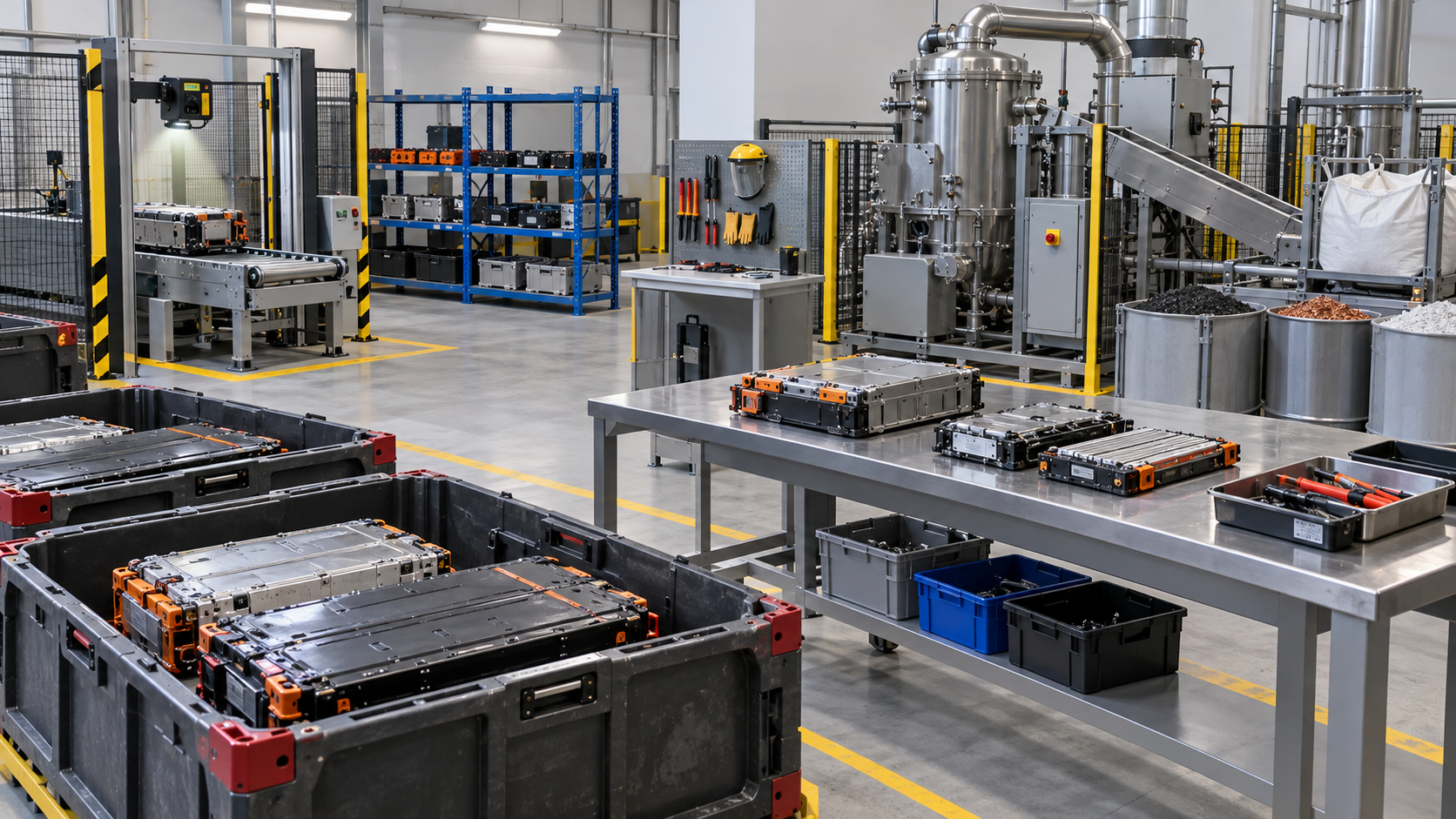
- Battery recycling and second use in brief
- Collection and pre-treatment: discharge, dismantling and black mass
- Pyrometallurgical, hydrometallurgical and direct recycling
- A materials engineer's view 1: what is mixed in, and what is hard
- Definitions of recovery rate and purity: how the regulation counts
- EU targets and recycled content: proposed, adopted and applying
- Our calculation 1: how many new-battery kWh can one spent kWh serve?
- Second use (second life): the idea and the problems
- Our calculation 2: at what price does a second-life battery match a new one on LCOS?
- A materials engineer's view 2: degradation history stays inside the cell
- Company results: from official sources, as company claims
- Limits, and what we could not confirm
- How to read evaluations and standards
- Glossary
- References
- Claim-to-source audit
Sourced = stated in a published source (linked)
Our calculation = a value we computed from stated assumptions (every assumption is written out)
Not yet confirmed = a plan, target or outlook with no confirmed result
Our own readings of materials and design are marked Commentary, and weakly supported guesses are marked Inference.
For regulation we separate proposed, adopted and applying, and give the date we checked (10 October 2026). Delegated acts are moving, so things may have changed since. Company announcements are treated as company claims and kept apart from independently verified values. We use no market-size estimates.
This article explains how battery resource recovery works; it is not advice on disposal, handling, legal compliance or business decisions. Spent lithium-ion batteries can ignite and contain hazardous substances, and they must be managed by qualified operators.
1. Battery recycling and second use in brief
- Two paths: the EU Batteries Regulation separates what happens to a battery at end of use into "preparation for re-use", "repurposing", "remanufacturing" and recycling. Repurposing means using a battery that is not waste for a purpose or application other than the one it was designed for Sourced [Ref. 1].
- "Recovery rate" is two different things: the regulation sets a mass-based recycling efficiency (for lithium-based batteries 65% by the end of 2025 and 70% by the end of 2030) and an element-based material recovery rate (for lithium 50% by the end of 2027 and 80% by the end of 2031) separately Sourced [Ref. 1]. Slag can count toward the first, but lithium in slag does not count toward the second [Ref. 2].
- The recycled-content share cannot yet be counted: the regulation sets minimum recycled shares from August 2031 (cobalt 16%, lithium 6%, nickel 6%) Sourced [Ref. 1], but we could not confirm that the delegated act setting out how to calculate and verify them had been adopted as of 10 October 2026. A July 2026 JRC study describes the delegated act as still to be made [Ref. 4].
When you hear "95% recovery", always ask what numerator and denominator it is. Total mass, or an element such as lithium? The black-mass (intermediate) stage, or a refined material? The same "95%" can be an entirely different promise. The EU regulation fixes this counting in detail in a delegated act.
The Batteries Regulation as a whole (the battery passport, carbon footprint, due diligence and so on) is covered in our explainer on the Batteries Regulation and the battery passport. This article takes up only the recycling targets, recycled-content shares and the definitions of second use, and does not go into the contents of the passport. The LCOS formula is in our explainer on the economics of storage, the mechanism of thermal runaway in our explainer on thermal runaway and battery safety, and resources and sourcing in our explainer on resources and sourcing of battery materials.
2. Collection and pre-treatment: discharge, dismantling and black mass
Recycling begins before a battery reaches the plant. The review by Harper et al. (Nature, 2019) says electric-vehicle packs are large, heavy and high in voltage, so electrocution and short-circuiting during dismantling are dangers; a short circuit means rapid discharge, which can lead to heating and thermal runaway and to toxic by-products including HF. It also lists the flammable electrolyte, toxic additives and the toxicity of electrode materials as chemical hazards Sourced [Ref. 6].
The regulation touches on pre-treatment safety as well. Annex XII of Regulation (EU) 2023/1542 requires that treatment include removal of fluids and acids, and that waste lithium-based batteries be protected from excessive heat, water and crushing, stored in their normal orientation (never inverted), in well-ventilated areas, covered with high-voltage rubber insulation, and in marked storage areas Sourced [Ref. 1].
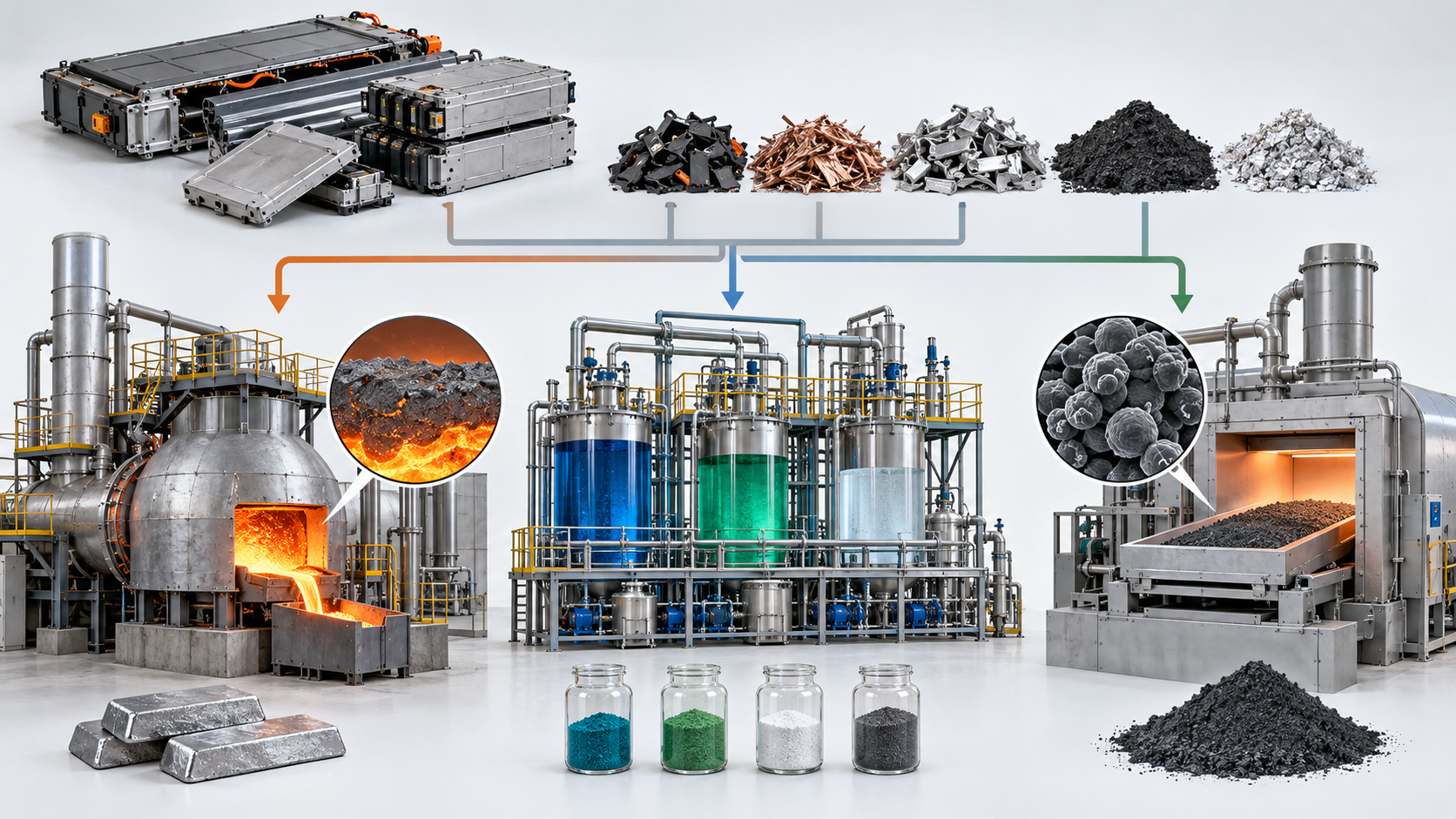
View the original SVG schematic and exact annotations
Pre-treatment runs roughly as follows (Commentary). First the pack is discharged to lower the voltage, dismantled into modules or cells, and sorted by material. The cells are then shredded and the light plastics, foils and electrode powders are separated. Harper et al. call the fine product after shredding "black mass" and describe it as the electrode coatings (metal oxides and carbon) [Ref. 6].
The EU Delegated Regulation (EU) 2025/606 defines black mass as "a cathode fraction or a mixture of cathodic and anodic materials generated through (thermo-)mechanical treatment" and states that it is an "intermediate fraction" that cannot be considered an output fraction. Recovering the metals in it needs further processing, and only after that processing do they count in the recovery rates Sourced [Ref. 2].
3. Pyrometallurgical, hydrometallurgical and direct recycling
Recycling routes fall roughly into three. Harper et al. describe pyrometallurgy, which turns metals into an alloy with heat, hydrometallurgy, which dissolves and extracts metals from aqueous solutions, and direct recycling, which takes out electrode material, reconditions it and returns it to new batteries Sourced [Ref. 6]. The review by Neumann et al. (Advanced Energy Materials, 2022) says recycling of lithium-ion batteries is "far from maturity" and that the variety of battery chemistries and materials makes it hard to establish one robust procedure for all kinds of batteries Sourced [Ref. 3].
| Route | What is done (from the literature and official pages) | Outputs and where lithium goes | Cautions |
|---|---|---|---|
| Pyrometallurgy (heat) | A high-temperature furnace reduces metal oxides to an alloy of Co, Cu, Fe and Ni. Because the batteries are simply "smelted", it is established commercially for consumer lithium-ion batteries [Ref. 6]. Umicore describes smelting above 1,000 °C into a Ni-Co-Cu alloy, a lithium-containing flue dust and a slag usable in construction (company claim) [Ref. 12] | The slag can retain Al, Mn and Li. Harper et al. say lithium and the others in the slag can be reclaimed by further hydrometallurgical processing, but may also go to other industries such as cement [Ref. 6] | The electrolyte and plastics (about 40–50% of battery weight) are normally not reclaimed in pyrometallurgy [Ref. 6]. An advantage is that it uses the chemical energy in the battery |
| Hydrometallurgy (leaching, precipitation) | Cathode material is leached with an aqueous solution (the most common combination is H2SO4/H2O2), then metals are taken out by solvent extraction and pH-controlled precipitation. H2O2 acts as a reducing agent, turning insoluble Co(III) into soluble Co(II) [Ref. 6] | Cobalt comes out as sulfate, oxalate, hydroxide or carbonate, and lithium as a lithium carbonate or phosphate precipitate [Ref. 6] | The quality of sorting upstream and control of impurities (Al, Fe, Cu and so on) set product purity (Commentary) |
| Direct recycling | Cathode or anode material is taken from the electrode, reconditioned and used in new batteries. In principle a mixed-metal-oxide cathode can go back into a new electrode with minimal change to its crystal morphology, but lithium must be replenished because of degradation in use and recovery in a discharged state [Ref. 6]. The DOE ReCell Center describes it as recovery, regeneration and reuse of battery components without breaking down the chemical structure [Ref. 7] | The output is regenerated cathode active material. Harper et al. note that work has focused mainly on laptop and phone batteries [Ref. 6] | Tightly wound structures such as cylindrical cells make electrodes hard to separate [Ref. 6]. It tends to presuppose feedstock sorted by chemistry (Commentary) |
All Sourced (summaries of the literature and official pages; Umicore's is a company claim). Many processes combine steps (pyro then hydro), so the three do not separate cleanly.
The DOE's ReCell Center says current hydrometallurgical and pyrometallurgical recycling can recover only specific metals, often in forms of low value to battery makers, and aims through direct recycling to use less energy and recover materials in higher-value forms Sourced (a DOE research center's description) [Ref. 7].
4. A materials engineer's view 1: what is mixed in, and what is hard
A lithium-ion cell is made of a cathode active material (a layered oxide or iron phosphate), graphite for the anode, aluminum and copper foils, binders such as PVDF, an organic electrolyte containing LiPF6, a polyolefin separator and a casing (see our explainers on conductive additives and binders, and on electrolytes and separators). The heart of the difficulty in recycling is separating these, from a "mixed powder", into the target materials.
- Cathode composition. NMC contains valuable Ni, Co and Mn, whereas LFP is mainly iron and phosphate and has little besides lithium that is valuable (Commentary). So even the same "95% recovery" has very different economics depending on chemistry. The Delegated Regulation also requires that, from January 2030, carbon, iron and phosphorus be counted in the recycling-efficiency calculation [Ref. 2], which suggests that the treatment of iron and phosphorus in LFP is an issue for the calculation method (Commentary).
- Graphite and electrolyte. In pyrometallurgy graphite and electrolyte burn as a heat source and are hardly recovered as materials (Harper et al., above). Redwood Materials says its reducing-atmosphere calcination suppresses the burning of graphite and plastics (company claim) [Ref. 13]. The JRC also names graphite as an example of a "fraction not currently recovered" [Ref. 5].
- Fluorine in the electrolyte. LiPF6 can react with heat or water to give toxic gases such as HF (Harper et al.) [Ref. 6]. In hydrometallurgy fluorine also becomes an impurity in effluent and refining, so how the electrolyte is handled in pre-treatment affects every later step (Commentary).
- Lithium recovery lags. The JRC writes that lithium recovery is "not yet fully implemented at industrial scale" [Ref. 5]. In pyrometallurgy it tends to end up in slag, and in hydrometallurgy it is taken from the liquor left after Ni and Co have been recovered, so its economics tend to be weaker (Commentary).
So the difficulty of recycling is not "can the metals be extracted?" but "can they be extracted economically as a material pure enough for the application?"
5. Definitions of recovery rate and purity: how the regulation counts
The Delegated Regulation (EU) 2025/606 (adopted 21 March 2025 and published in the Official Journal on 4 July 2025) sets the method for calculating and verifying recycling efficiency and material recovery rates, and the format of the documentation Sourced [Ref. 2]. The main definitions are as follows.
| Term | Definition in the delegated regulation (key points) |
|---|---|
| Input fraction | The mass of waste batteries entering recycling (water-free, per year, in tonnes), including components dismantled during storing, sorting, discharging, depollution and dismantling. It includes casing, cables integral to the battery, external parts such as boards, cells and modules discarded from preparation for re-use or repurposing and sent to recycling, and manufacturing waste when in the form of cells, modules or packs |
| Intermediate fraction | Neither input nor output; goes to later steps that turn it into outputs (for example black mass) |
| Output fraction | Obtained from recycling and converted into materials, substances or products. It excludes landfill construction, backfilling, use as fuel and energy recovery. It includes converted casings and external parts, converted plastics and converted slag (for calculating recycling efficiency only). Metals such as lithium contained in slag are not taken into account in the material recovery rate |
| Recycling efficiency (RE) | Mass of output fractions / mass of input fractions × 100 (mass %). Calculated separately for lead-acid, lithium-based, nickel-cadmium and other batteries. Until the end of 2029, oxygen, carbon, iron, phosphorus, chlorine and sulfur may be counted. From 1 January 2030, carbon, iron and phosphorus must be counted, and oxygen, chlorine and sulfur may be |
| Material recovery rate (RM) | Mass of the target element (Co, Cu, Pb, Li, Ni) at the calculation point / mass of the same element in the input fraction × 100. The "calculation point" is the step where the element is recovered as a material, substance or product that can substitute for primary material in industrial manufacturing. The recovered material must have a content of the target element "as high as technically feasible while avoiding excessive costs" |
All Sourced (summary of the Annex of Delegated Regulation (EU) 2025/606 [Ref. 2]).
Several things can be read from this.
- RE (mass) and RM (element) are different numbers. RE can count casings, plastics and slag as outputs, whereas RM counts element by element. So a process could, by definition, meet the RE target (65 to 70% for lithium-based batteries) while recovering almost no lithium (Commentary; whether that happens depends on the process and on how the targets interact).
- No numerical purity standard is written down. For recovered material the regulation says only that the content of the target element should be "as high as technically feasible while avoiding excessive costs"; there is no figure such as "99% or more" [Ref. 2]. In practice purity is probably set by the specification of the buyer, a battery maker (precursor feedstock specification) Inference.
- A black-mass "recovery rate" is not a recovery rate under the regulation. Black mass is an intermediate fraction, so "x% of black mass recovered" is an intermediate number apart from RM and RE.
6. EU targets and recycled content: proposed, adopted and applying
Regulation (EU) 2023/1542 was adopted on 12 July 2023 and has applied since 18 February 2024 (some provisions from other dates) Sourced [Ref. 1]. What we checked is the original text in the Official Journal (the EUR-Lex text). We did not check later amendments (such as the postponement of due diligence, outside the scope of this article).
(1) Recovery targets (Annex XII)
| Measure | Deadline (to be achieved by) | Target | Stage |
|---|---|---|---|
| Recycling efficiency (lithium-based batteries, mass) | 31 December 2025 | 65% | Adopted and applying. We could not confirm a public tally of achievement |
| Recycling efficiency (lithium-based batteries, mass) | 31 December 2030 | 70% | Not yet confirmed |
| Material recovery (Co, Cu, Pb, Ni) | 31 December 2027 | 90% | Not yet confirmed |
| Material recovery (Co, Cu, Pb, Ni) | 31 December 2031 | 95% | Not yet confirmed |
| Material recovery (lithium) | 31 December 2027 | 50% | Not yet confirmed |
| Material recovery (lithium) | 31 December 2031 | 80% | Not yet confirmed |
Values and deadlines are Sourced (Regulation (EU) 2023/1542, Annex XII, Parts B and C [Ref. 1]). Targets whose deadlines have not arrived are future obligations written in the regulation, not achieved results.
Under Article 71(5) the Commission was to assess by 18 August 2026 whether the targets need revising [Ref. 1]. The JRC's technical assessment (published 14 September 2026) focused on lithium-based batteries and found "no immediate need to amend any of the existing targets"; it says the targets, though challenging, are supported by a flexible calculation method that lets recyclers temporarily exclude certain fractions, and that monitoring scientific and technical progress is crucial for fractions not currently recovered, such as graphite, and for lithium, not yet fully implemented at industrial scale Sourced [Ref. 5].
(2) Minimum recycled content (Article 8)
| Item | Date | Content |
|---|---|---|
| Documentation duty | 18 August 2028, or 24 months after the delegated act enters into force, whichever is later | Industrial batteries above 2 kWh, EV batteries and SLI batteries must carry documentation of the share of Co, Li and Ni in active materials, and of Pb in the battery, recovered from manufacturing or post-consumer waste |
| Minimum shares (stage 1) | 18 August 2031 | Recycled share in active materials: cobalt 16%, lithium 6%, nickel 6%. Lead 85% (in the battery) |
| Minimum shares (stage 2) | 18 August 2036 | Cobalt 26%, lithium 12%, nickel 15%. Lead 85% |
| Exemption | — | These provisions do not apply to batteries already on the market that undergo preparation for re-use, preparation for repurposing, repurposing or remanufacturing |
All Sourced (Regulation (EU) 2023/1542, Article 8 [Ref. 1]). Dates are as in the Official Journal text.
Article 8 provides that the Commission adopts, by 18 August 2026, a delegated act setting the method for calculating and verifying the recycled shares and the format of the documentation [Ref. 1]. However, a study published by the JRC on 13 July 2026 describes the method as one to be set by a "forthcoming" delegated act, and presents calculation and verification blueprints for two traceability options Sourced [Ref. 4]. We could not confirm an adopted delegated act in the Official Journal or other primary sources. Press and third-party sites say there was a consultation on a draft in August 2026 (12 August to 9 September), but we have not confirmed this on the Commission's own pages, so it remains no more than an inference.
The JRC is also reported to say that there is no reliable method yet for directly measuring the recycled-metal share in a finished battery (secondary information; we did not confirm the full text). Verification is likely to rely on documentation and supply-chain data Inference. Until the method is settled, battery makers cannot fix how to count recycled content.
7. Our calculation 1: how many new-battery kWh can one spent kWh serve?
Minimum recycled shares raise the question of whether that much recycled material exists at all. Here we assume spent batteries have the same composition as new ones, take the metals in one spent kWh recovered at the end-2031 targets, and compute how many kWh of new battery (August 2031 minimum recycled shares) they could supply Our calculation.
• NMC811 (LiNi0.8Mn0.1Co0.1O2, molar mass 97.28 g/mol): specific capacity 200 mAh/g, mean voltage 3.7 V (the same assumption as in our economics explainer). About 1.35 kg of cathode material per cell-kWh.
• Element mass per cell-kWh: Ni 0.652 kg, Co 0.082 kg, Li 0.096 kg.
• LFP: the assumptions of our economics explainer (150 mAh/g, 3.2 V). Lithium per cell-kWh is 0.092 kg.
• Spent batteries have the same composition and cathode quantity as new ones, and recovery meets the end-2031 targets (Co and Ni 95%, Li 80%).
• The minimum recycled shares are those of Article 8 for August 2031 (Co 16%, Ni 6%, Li 6%).
• Differences in purity, losses, lithium from the electrolyte, manufacturing scrap and compositional change over time are not included.
| Element | Recycled material needed per new kWh (g) | Recoverable from one spent kWh (g) | New kWh that can be served |
|---|---|---|---|
| Cobalt (NMC811) | 0.16 × 82 = 13.1 | 0.95 × 82 = 77.8 | 5.9 |
| Nickel (NMC811) | 0.06 × 652 = 39.1 | 0.95 × 652 = 619.6 | 15.8 |
| Lithium (NMC811) | 0.06 × 96.4 = 5.8 | 0.80 × 96.4 = 77.1 | 13.3 |
| Lithium (LFP) | 0.06 × 91.6 = 5.5 | 0.80 × 91.6 = 73.3 | 13.3 |
All Our calculation. Numbers are rounded. "New kWh that can be served" = recoverable amount / amount needed.
Three things can be read Our calculation.
- Cobalt is the tightest. Against a 16% recycled share, one spent kWh serves only 5.9 new kWh. Lithium and nickel serve 13 to 16 kWh. For the same composition, the higher the required recycled share, the more spent batteries are needed.
- The quantity problem is about timing more than the share. Spent batteries are those made several to a dozen years ago. The IEA says EV battery deployment in 2025 was more than seven times that of 2020 (1.2 TWh) [Ref. 8], and also that because of feedstock limitations it will take about a decade before recycling has a significant impact on primary mineral demand [Ref. 9]. Even if one spent kWh can serve 13 kWh, the amount of spent batteries now is far smaller than the amount of batteries now being made, so whether the shares can be met depends on the total volume of spent batteries.
- Chemistry changes the picture. LFP's lithium can serve as much new battery as NMC's, but LFP contains almost none of the cobalt and nickel for which recycled shares are set (Commentary). The real burden of the recycled-content rules differs by chemistry.
8. Second use (second life): the idea and the problems
When a battery can no longer serve in an EV, it still holds part of its capacity. The EU regulation defines this "next job" in distinct terms Sourced [Ref. 1].
| Term | Definition in the regulation (key points) |
|---|---|
| Preparation for re-use | As defined in the Waste Framework Directive (2008/98/EC) |
| Preparation for repurposing | Any operation by which a waste battery, or parts of it, is prepared so that it can be used for a purpose or application different from that for which it was designed |
| Repurposing | Any operation that results in a battery that is not a waste battery, or parts of it, being used for a purpose or application other than that for which it was originally designed |
| Remanufacturing | Any technical operation on a used battery that includes disassembly and evaluation of all its cells and modules and use of new, used or recovered cells and modules or other components, to restore capacity to at least 90% of the original rated capacity, with the state of health of all individual cells differing by no more than 3%, and that results in the battery being used for the same purpose or application as originally |
| State of health (SOH) | A measure of the general condition of a rechargeable battery and its ability to deliver specified performance compared with its initial condition |
All Sourced (definitions in Article 3 of Regulation (EU) 2023/1542 [Ref. 1]).
There are standards for second use too. UL 1974:2023, "Evaluation for Repurposing or Remanufacturing Batteries", covers the sorting and grading of packs, modules and cells originally used for other purposes such as EV propulsion, together with application-specific requirements for repurposed batteries (the Standards Council of Canada's page for the standard; published 9 November 2023) Sourced [Ref. 10]. IEC 63330-1:2024, "Repurposing of secondary batteries – Part 1: General requirements", specifies a procedure to evaluate the performance and safety of used cells, modules, packs and systems originally made for applications such as EVs, and basic requirements for applying them; it targets lithium-ion products and data traceability Sourced [Ref. 11]. The full texts are paid, so we give only titles and scope.
Problems
- The degradation history is not known. Harper et al. describe SOH as the degree to which a battery meets its initial design specification and say diagnosis requires measurements on packs, modules and cells [Ref. 6]. Records of history (how it was charged, temperature, any incident) decide whether re-use is possible. That is why the standard calls for data traceability [Ref. 11].
- Variation between packs and cells. In old packs the cells do not degrade evenly. The "SOH within 3%" in the definition of remanufacturing is the flip side of this problem [Ref. 1].
- Safety. Spent batteries can catch fire during pre-treatment and storage. Harper et al. write that reports of fires in metal-recovery facilities are increasing, in part because consumer lithium-ion batteries get hidden among lead-acid batteries and the like [Ref. 6]. Second-use installations are expected to meet installation standards (NFPA 855, UL 9540A and so on; see our explainer on data centers and storage).
- Treatment under the regulation. Repurposed batteries fall outside the recycled-content provisions for their original use (Article 8(4)). How responsibility as a new manufacturer shifts after repurposing we did not confirm.
- Economics. As prices of new batteries fall, it gets harder for second-life batteries to pay their way (next chapter's calculation).
9. Our calculation 2: at what price does a second-life battery match a new one on LCOS?
Whether second-life batteries get used is not decided by "cheaper than new" alone. They have lost capacity (more kWh are needed for the same energy), may have shorter life and may be less efficient. Using the base case of our economics explainer, we compute what share of the new-battery price a second-life battery must be bought for to give the same system LCOS Our calculation.
• Reference: the base case of our economics explainer (new, 4 hours, capex 334 US$/kWh, 7% discount rate, 15-year life, 85% round-trip efficiency, one cycle a day, charging at 40 US$/MWh). LCOS is 184 US$/MWh (definition A).
• Share of capex that is battery: 60% (the other 40%, inverter, site, electrical equipment, labor and so on, is the same as for a new system).
• Second-life battery: usable capacity 70% of rated (so 1/0.7 = 1.43 kWh of battery per kWh delivered), life 10 years, round-trip efficiency 80%. Fixed O&M is 4% of capex per year (the same share as new).
• The second-life battery price is the purchase price including testing, sorting and rebuilding, as a share p of the new-battery price.
• Differences from new in speed of degradation, extra safety measures and warranty are not included beyond life and efficiency.
With these assumptions the break-even price is about 47% of the new-battery price Our calculation. In other words, unless second-life batteries (testing, sorting and rebuilding included) can be bought at half the price of new batteries or less, the LCOS does not match that of a new system. The table below gives the break-even price as the inputs vary (as a % of the new-battery price).
| Battery share of capex / usable capacity | 8-year life | 10-year life | 12-year life |
|---|---|---|---|
| 50% / 60% | 25% | 36% | 46% |
| 50% / 80% | 33% | 49% | 61% |
| 60% / 70% (base) | 36% | 47% | 56% |
| 70% / 60% | 35% | 43% | 50% |
| 70% / 80% | 46% | 58% | 67% |
All Our calculation (round-trip efficiency 80%, other inputs as above). Values are the break-even second-life battery price as a share of the new-battery price.
Three things can be read Our calculation.
- Life matters most. In the base case, extending life from 8 to 12 years lifts the break-even from 36% to 56%. The value of a second-life battery depends heavily on how many years it can be used (the same conclusion as our economics explainer).
- Non-battery costs do not go away. Inverter, site and construction costs are the same for second use, so even if the battery were free (p = 0), LCOS would only fall to about 117 US$/MWh, about 63% of the 184 US$/MWh of a new system.
- If new-battery prices fall, the second-life advantage shrinks. The break-even is a share of the new-battery price, so as new batteries get cheaper, the second-life price must be lower still in absolute terms.
Redwood Materials says its systems using reused batteries cost "up to 50% lower" in total installed cost than legacy systems (company claim; the basis of comparison and conditions could not be confirmed) [Ref. 15]. Our calculation does not judge whether that claim is true.
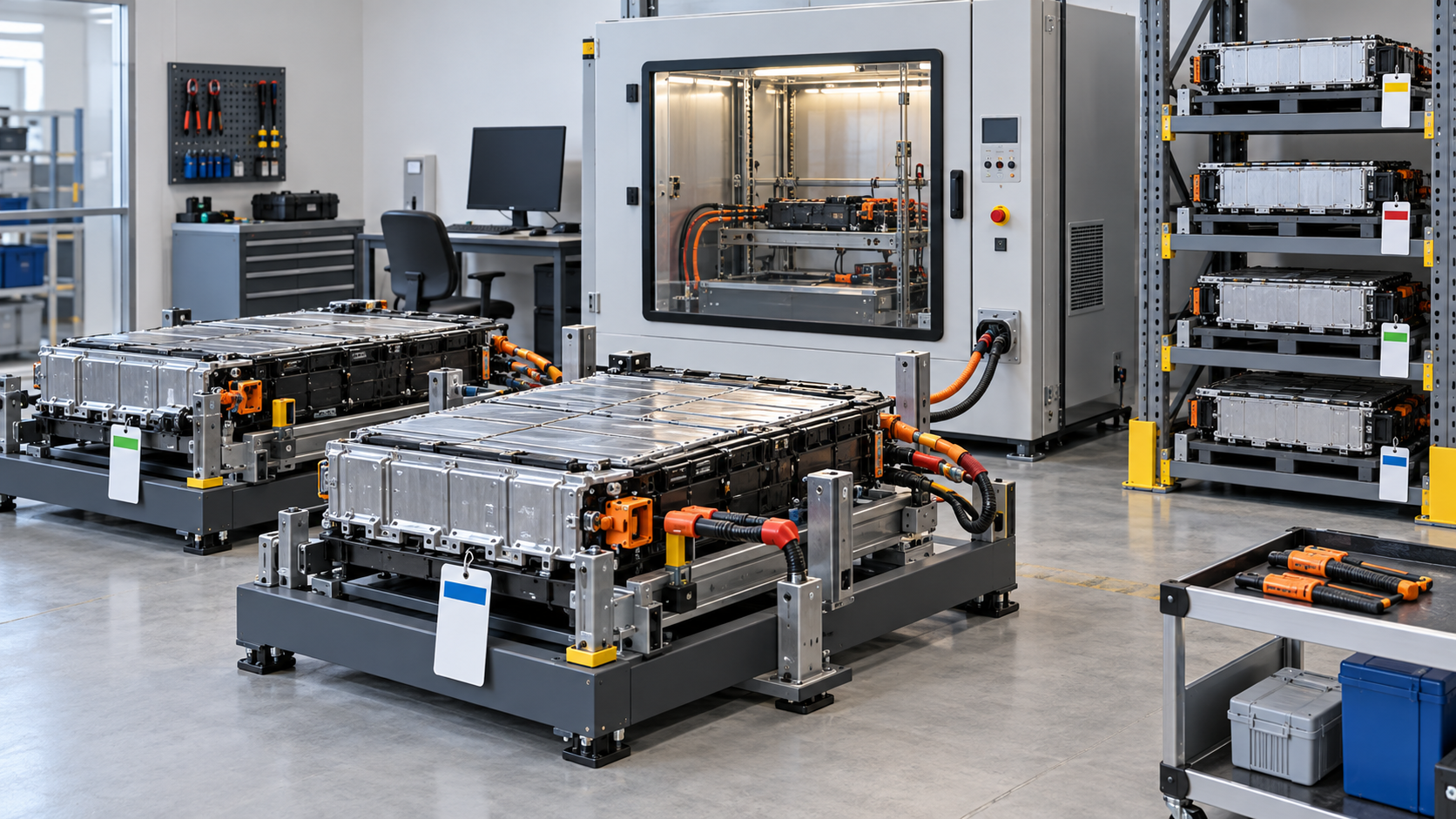
10. A materials engineer's view 2: degradation history stays inside the cell
Judging a second-life battery takes more than the remaining capacity (Commentary).
- Rising resistance. A degraded cell loses capacity and also gains internal resistance. Higher resistance means more heat at the same power and lower round-trip efficiency. Setting the second-life efficiency at 80% (85% for new) in the calculation above is an illustration of this effect.
- The "shape" of degradation. Whether capacity falls in a straight line or drops steeply after some point (for lead-acid, the Uptime Institute says it falls sharply below about 80%; see our explainer on data centers and storage) depends on materials and use. Remaining life is not determined by the capacity figure alone.
- History on the anode side. Fast charging and charging at low temperature are known to favor lithium-metal plating on the anode surface (see our explainers on dendrites and on lithium-metal anodes). A history of plating shows up little in capacity or resistance values and may bear on later safety (Commentary; this does not indicate the safety of any individual battery).
- Cell-to-cell variation. If the cells in a pack do not degrade evenly, the weakest cell sets the whole. The "SOH within 3%" of the remanufacturing definition [Ref. 1] is the regulatory line drawn against this problem.
That is why standards such as UL 1974 and IEC 63330-1 call for sorting and grading and data traceability [Refs. 10 and 11]. The economics of second use depend in part not on the battery's price but on how far the history information can be trusted (Commentary).
11. Company results: from official sources, as company claims
Every number in a company's official material is a company claim. We keep them apart from independently verified values, and where conditions are not given, we say we could not confirm them.
| Company | What the official material says (company claim) | Cautions |
|---|---|---|
| Redwood Materials (recycling) | April 2024 article: its hydrometallurgy facility recovers 95% of lithium from scrap battery materials. Its reductive calciner can process live batteries, consumer electronics and EV modules and handle over 40,000 tonnes a year (about 15–20 GWh); calcination makes no alloy or slag. It cites a Stanford LCA for 80% less energy and 70% less CO2. June 2025 article: it receives over 20 GWh of batteries a year (the equivalent of 250,000 EVs), which it says is about 90% of the lithium-ion batteries and battery materials recycled in North America [Refs. 13 and 15]. October 2022: Argonne tested NMC811 cathode made from Redwood's recycled metal sulfates, and Redwood says cycle life, discharge capacity and Coulombic efficiency were identical to cathode made from virgin-metal sulfates [Ref. 14] | The 95% for lithium is for battery manufacturing scrap, not for spent EV batteries, and it does not say whether it is an RM-type rate or how it was calculated. The LCA was commissioned by the company from Stanford. The receipts and share figures come only from the company's own announcements |
| Umicore (recycling) | A "pyro-hydro" process combining pyrometallurgy (smelting above 1,000 °C) and hydrometallurgy. It gives a Ni-Co-Cu alloy, a lithium-containing flue dust and a slag usable in construction. More than 95% recovery for cobalt, copper and nickel and more than 90% for lithium. The plant in Hoboken, Belgium, has a capacity of 7,000 tonnes and was upgraded in 2022 to cover automotive batteries [Ref. 12] | The page does not define "recovery rate" (whether it is the EU's RM), the chemistries or the measurement conditions. We could not confirm a date on the page (viewed 10 October 2026) |
| Nissan and 4R Energy (second use) | Nissan and Sumitomo Corp. set up 4R Energy before the first LEAF reached the market. Reused batteries are graded "A", "B" or "C": A for new EV battery units, B for industrial machinery and large stationary storage, C for backup power. 4R Energy's engineers estimate a life of about 10 to 15 years for recovered batteries. A plant in Namie, Japan, handles reuse and recycling [Ref. 16] | 10 to 15 years is an estimate, not a result. The grading criteria and test conditions are not given. We could not confirm a date on the page (viewed 10 October 2026) |
| Redwood Energy (second use) | A 12 MW / 63 MWh microgrid built from reused EV batteries in just under four months, supplying a data center. It says many spent EV batteries "retain more than 50%" of their usable capacity [Ref. 15] | The distribution of retained capacity and the grading criteria could not be confirmed on that page. For availability figures see our explainer on data centers and storage |
All Sourced (summaries of each company's official material). These are company claims, not independently verified values.
12. Limits, and what we could not confirm
- We could not confirm an adopted delegated act on the calculation of recycled content (as of 10 October 2026). Even after the Article 8 deadline (18 August 2026) the JRC describes it as "forthcoming" [Ref. 4]. The dates of the consultation on a draft come from third-party information and were not confirmed from primary sources.
- We could not confirm a public tally of whether the end-2025 recycling-efficiency target (65% for lithium-based batteries) was met. For the Commission's own report under Article 71(5) (September 2026) we confirmed only the JRC's technical assessment [Ref. 5], not the Commission report itself.
- What we checked on EUR-Lex is the Official Journal text of Regulation (EU) 2023/1542. We did not check later consolidated amendments or corrections.
- The regulation has no numerical purity standard. We could not confirm purity specifications used by battery makers from published primary sources.
- Company recovery rates, throughput and performance are all company claims, and some do not give the definition of the rate (whether it is the EU's RM), the object (scrap or spent EV batteries) or the measurement conditions. We could not confirm independently verified values.
- Our calculations (Chapters 7 and 9) are structural explanations under stated assumptions. They do not show real battery compositions, volumes of spent batteries or second-life prices.
- The systems of other countries and regions (Japan, the United States, China and others) are outside the scope of this article.
- We use no market-size or recycling-market estimates. Figures from the JRC and IEA are quoted only where needed and within the reports' scope.
- Recovery rate means two things. The EU's recycling efficiency is on total mass and the material recovery rate on elements. Slag counts toward the former, but lithium in slag does not count toward the latter Sourced
- Black mass is an intermediate and is not counted as an output. The regulation has no numerical purity standard Sourced
- Recycling efficiency for lithium-based batteries is 65% by end 2025 and 70% by end 2030. Lithium recovery is 50% by end 2027 and 80% by end 2031 Sourced (from 2027 on Not yet confirmed)
- We could not confirm that the method for counting minimum recycled shares (cobalt 16% in 2031 and so on) had been adopted as of October 2026. The JRC calls it forthcoming Sourced
- One spent kWh could serve about 5.9 new kWh of recycled-cobalt share and 13 to 16 kWh for nickel and lithium (same-composition assumption) Our calculation
- Second-life batteries must be bought at about half the new-battery price (testing and sorting included) for LCOS to match (a calculation with stated assumptions) Our calculation
13. How to read evaluations and standards
Before comparing which number is larger, align the basis of comparison in the following order. This is an editorial reading checklist, not a set of test conditions or acceptance limits prescribed by a standard.
- 1. What was measured?
- recovery yield, recovered-material quality, remaining capacity and cost. Check the units and whether the result describes a material, component or complete system.
- 2. Under which conditions?
- element recovered, process boundary, contaminants, service history and sorting criteria. Treat results under different conditions as separate results before comparing them.
- 3. The comparison trap
- Separate mass recovery from recovery at a quality suitable for reuse in batteries.
- 4. What does the standard cover?
- Check the identifier, title, edition and scope in the issuing body’s material. Distinguish test methods, safety, interoperability and management requirements. Naming a standard alone does not establish that a test, conformity assessment or certification has been completed.
Keep a comparison note containing the object, units, conditions, sample count and variation, comparator, standard edition and unresolved points. Do not invent numerical conditions or acceptance limits from a public abstract of a standard.
14. Glossary
- Black mass
- The powder of cathode and anode (metal oxides and carbon) obtained after shredding. An intermediate fraction in the EU regulation.
- Pyrometallurgy
- Recycling that melts metals at high temperature and separates them into an alloy and slag.
- Hydrometallurgy
- Recycling that dissolves metals with acid (leaching) and takes them out by solvent extraction or precipitation.
- Direct recycling
- Restoring and reusing cathode material and the like without destroying its crystal structure.
- Slag
- The oxide residue that separates from metal in smelting. It counts toward recycling efficiency, but the metals in it do not count toward material recovery.
- Recycling efficiency (RE)
- Mass of output fractions divided by mass of input fractions, calculated by battery chemistry.
- Material recovery rate (RM)
- Mass of the target element that becomes a material at the calculation point divided by that element's mass in the input.
- Repurposing
- Using a battery that is not waste for a purpose different from the one it was designed for.
- Remanufacturing
- Disassembling and evaluating a battery, restoring capacity to at least 90% of rated, and using it for the same purpose.
- SOH (state of health)
- How well a battery can deliver specified performance compared with its initial condition.
- Recycled-content share
- The share of Co, Li and Ni in a battery's active materials (and of Pb in the battery) recovered from manufacturing scrap or spent batteries.
- Delegated act
- An EU legal act adopted by the Commission to supplement a basic regulation. It is published in the Official Journal and enters into force on a set date.
15. References
- European Parliament and Council Regulation (EU) 2023/1542 concerning batteries and waste batteries, 12 July 2023 (EUR-Lex, Official Journal text) — https://eur-lex.europa.eu/legal-content/EN/TXT/HTML/?uri=CELEX:32023R1542
- European Commission Commission Delegated Regulation (EU) 2025/606 on the methodology for calculation and verification of recycling efficiency and recovery of materials, adopted 21 March 2025, published 4 July 2025 — https://eur-lex.europa.eu/legal-content/EN/TXT/HTML/?uri=CELEX:32025R0606
- Neumann et al. "Recycling of Lithium-Ion Batteries—Current State of the Art, Circular Economy, and Next Generation Recycling", Advanced Energy Materials 12 (2022; DOI 10.1002/aenm.202102917) — https://doi.org/10.1002/aenm.202102917
- European Commission JRC Pierri et al., "JRC study on harmonised rules for the calculation and verification of recycled content in batteries – JRC recommendations to support the provisions of Article 8 of Regulation (EU) 2023/1542", JRC146717, 13 July 2026 — https://publications.jrc.ec.europa.eu/repository/handle/JRC146717
- European Commission JRC Orefice, Manni and Mathieux, "JRC technical assessment in relation to Article 71(5) of the Batteries Regulation", JRC145625, 14 September 2026 — https://publications.jrc.ec.europa.eu/repository/handle/JRC145625
- Harper et al. "Recycling lithium-ion batteries from electric vehicles", Nature 575, 75–86 (2019; DOI 10.1038/s41586-019-1682-5) — https://www.nature.com/articles/s41586-019-1682-5
- U.S. Department of Energy (DOE) ReCell Center ReCell Center home page (description of direct recycling) — https://recellcenter.org/
- IEA "Global EV Outlook 2026: Electric vehicle batteries" — https://www.iea.org/reports/global-ev-outlook-2026/electric-vehicle-batteries
- IEA "Global EV Outlook 2025: Electric vehicle batteries" — https://www.iea.org/reports/global-ev-outlook-2025/electric-vehicle-batteries
- Standards Council of Canada "ANSI/CAN/UL 1974:2023 Evaluation for Repurposing or Remanufacturing Batteries" (standard page) — https://scc-ccn.ca/standardsdb/standards/4032178
- IEC "IEC 63330-1:2024 Repurposing of secondary batteries – Part 1: General requirements" — https://webstore.iec.ch/en/publication/66561
- Umicore "Pyro-hydro technology" (Battery Recycling Solutions) — https://www.umicore.com/en/about/battery-materials-solutions/battery-recycling-solutions/pyro-hydro-technology/
- Redwood Materials "Building the most sustainable (and scalable) battery materials process", 18 April 2024 — https://www.redwoodmaterials.com/news/sustainable-battery-materials-process/
- Redwood Materials "U.S. Department of Energy's Argonne National Laboratory verifies performance of Redwood cathode from recycled content", 13 October 2022 — https://www.redwoodmaterials.com/news/argonne-national-laboratory-verifies-redwood-cathode-performance/
- Redwood Materials "Redwood Energy: Fast, low-cost storage to power the age of AI and a changing grid", 27 June 2025 — https://www.redwoodmaterials.com/news/redwood-energy-fast-low-cost-storage-to-power-the-age-of-ai-and-a-changing-grid/
- Nissan "Nissan gives EV batteries a second life" (on 4R Energy; no date on the page) — https://www.nissan-global.com/EN/STORIES/RELEASES/4r/
16. Claim-to-source audit
| Claim in the text | Basis | Label |
|---|---|---|
| That Regulation (EU) 2023/1542 has applied since 18 February 2024; the definitions in Article 3 (preparation for re-use, preparation for repurposing, repurposing, remanufacturing with capacity restored to at least 90% and cell SOH within 3%, SOH); Annex XII Part A (removal of fluids and acids, storage of lithium-based batteries), Part B (recycling efficiency of lithium-based batteries: 65% by end 2025, 70% by end 2030) and Part C (material recovery: Co, Cu, Pb, Ni 90% and Li 50% by end 2027; Co, Cu, Pb, Ni 95% and Li 80% by end 2031); Article 8 (documentation from 18 August 2028 or 24 months after the delegated act, whichever is later; minimum recycled shares from 18 August 2031 of Co 16%, Pb 85%, Li 6%, Ni 6% and from 18 August 2036 of Co 26%, Pb 85%, Li 12%, Ni 15%; exemption for re-used batteries; delegated-act deadline of 18 August 2026); Article 71 (delegated-act deadline of 18 February 2025; assessment of targets by 18 August 2026) | EUR-Lex Regulation (EU) 2023/1542[Reference 1] https://eur-lex.europa.eu/legal-content/EN/TXT/HTML/?uri=CELEX:32023R1542 | Sourced |
| The recycling-efficiency and material-recovery targets to end 2031, the minimum recycled shares (2031 and 2036) and the achievement of targets from 2027 on | Future obligations written in the regulation, not achieved results. Targets whose deadlines have not arrived are treated as not yet confirmed[Reference 1] https://eur-lex.europa.eu/legal-content/EN/TXT/HTML/?uri=CELEX:32023R1542 | Not yet confirmed |
| The definitions in Delegated Regulation (EU) 2025/606 (adopted 21 March 2025, published 4 July 2025): input fraction, intermediate fraction, output fraction (slag only for recycling efficiency; metals such as lithium in slag are not counted in material recovery), black mass (an intermediate fraction, not an output), the formulas for RE and RM, calculation by chemistry, the treatment of oxygen, carbon, iron, phosphorus, chlorine and sulfur until end 2029 and from 2030, the calculation point, and that recovered material has an element content as high as technically feasible | EUR-Lex Delegated Regulation (EU) 2025/606[Reference 2] https://eur-lex.europa.eu/legal-content/EN/TXT/HTML/?uri=CELEX:32025R0606 | Sourced |
| That recycling of lithium-ion batteries is far from maturity and one robust procedure for all batteries is hard to establish | Neumann et al. (2022)[Reference 3] https://doi.org/10.1002/aenm.202102917 | Sourced |
| That a JRC study published on 13 July 2026 describes the method for calculating and verifying recycled content as set by a forthcoming delegated act, and presents calculation and verification blueprints for two traceability options | JRC146717[Reference 4] https://publications.jrc.ec.europa.eu/repository/handle/JRC146717 | Sourced |
| The JRC technical assessment (14 September 2026): focused on lithium-based batteries, no immediate need to amend the existing targets, a flexible calculation method, and the importance of monitoring fractions not currently recovered such as graphite and lithium, not yet fully implemented at industrial scale | JRC145625[Reference 5] https://publications.jrc.ec.europa.eu/repository/handle/JRC145625 | Sourced |
| Hazards of dismantling EV packs (short circuit, thermal runaway, HF); pyrometallurgy (alloy, slag, gases; Al, Mn and Li in slag; electrolyte and plastics at about 40–50% of battery weight not normally reclaimed), hydrometallurgy (H2SO4/H2O2 leaching, solvent extraction, pH precipitation, lithium carbonate and others), direct recycling (crystal structure retained, lithium replenished, work centered on small batteries), the description of black mass, the definition of SOH, and increasing reports of fires in metal-recovery facilities | Harper et al. (Nature, 2019)[Reference 6] https://www.nature.com/articles/s41586-019-1682-5 | Sourced |
| The description of direct recycling (recovering, regenerating and reusing components without breaking down chemical structure) and that current hydrometallurgical and pyrometallurgical recycling recover only specific metals, often in low-value forms | DOE ReCell Center[Reference 7] https://recellcenter.org/ | Sourced |
| That EV battery deployment in 2025 was more than seven times that of 2020 (1.2 TWh) | IEA Global EV Outlook 2026[Reference 8] https://www.iea.org/reports/global-ev-outlook-2026/electric-vehicle-batteries | Sourced |
| That because of feedstock limitations it will take about a decade before recycling has a significant impact on primary mineral demand | IEA Global EV Outlook 2025[Reference 9] https://www.iea.org/reports/global-ev-outlook-2025/electric-vehicle-batteries | Sourced |
| The title and scope of UL 1974:2023 (sorting and grading, application-specific requirements for repurposed batteries, remanufacturing), published 9 November 2023 | Standards Council of Canada[Reference 10] https://scc-ccn.ca/standardsdb/standards/4032178 | Sourced |
| The title and scope of IEC 63330-1:2024 (general requirements for repurposing, lithium-ion, data traceability) | IEC standard page[Reference 11] https://webstore.iec.ch/en/publication/66561 | Sourced |
| Umicore's pyro-hydro process (smelting above 1,000 °C, alloy, flue dust and slag, over 95% for cobalt, copper and nickel and over 90% for lithium, 7,000 tonnes, a 2022 upgrade) | Umicore (company claim)[Reference 12] https://www.umicore.com/en/about/battery-materials-solutions/battery-recycling-solutions/pyro-hydro-technology/ | Sourced |
| Redwood Materials' 95% lithium recovery in hydrometallurgy (from battery manufacturing scrap), a reductive calciner over 40,000 tonnes a year (about 15–20 GWh), and claims of 80% less energy from a Stanford LCA | Redwood Materials, April 2024 (company claim)[Reference 13] https://www.redwoodmaterials.com/news/sustainable-battery-materials-process/ | Sourced |
| The Argonne evaluation of NMC811 cathode made from Redwood's recycled metal sulfates (13 October 2022) | Redwood Materials, October 2022 (company claim)[Reference 14] https://www.redwoodmaterials.com/news/argonne-national-laboratory-verifies-redwood-cathode-performance/ | Sourced |
| Redwood Energy's 12 MW / 63 MWh microgrid of reused EV batteries, the claim that many spent EV batteries retain over 50% of their capacity, the claim of installed cost up to 50% lower than legacy systems, and receipt of over 20 GWh a year (about 90% of what is recycled in North America) | Redwood Materials, June 2025 (company claim)[Reference 15] https://www.redwoodmaterials.com/news/redwood-energy-fast-low-cost-storage-to-power-the-age-of-ai-and-a-changing-grid/ | Sourced |
| Nissan and Sumitomo Corp.'s 4R Energy, the A, B and C grades, the estimated life of 10 to 15 years for recovered batteries, and the Namie plant | Nissan (company claim)[Reference 16] https://www.nissan-global.com/EN/STORIES/RELEASES/4r/ | Sourced |
| The new-battery kWh that one spent kWh can serve (Co 5.9, Ni 15.8, Li 13.3 kWh) and the element masses (NMC811: Ni 0.652, Co 0.082, Li 0.096 kg per kWh) | Our calculation. The assumptions (NMC811 at 200 mAh/g and 3.7 V, LFP at 150 mAh/g and 3.2 V, spent batteries with the same composition as new, recovery at the end-2031 targets) are in Chapter 7. Real composition, losses and timing are not included | Our calculation |
| The second-life battery price at which LCOS equals a new system (about 47% in the base case), the break-even table as inputs vary, and that LCOS only falls to about 117 US$/MWh even with a free battery | Our calculation. The assumptions (battery at 60% of capex, usable capacity 70%, life 10 years, round-trip efficiency 80%, other inputs as in the economics explainer's base case) are in Chapter 9. It does not show a real project | Our calculation |
| The reading that there is no numerical purity standard for black mass, that a process could meet the recycling-efficiency target while recovering little lithium, the economics of NMC versus LFP, the reading that lithium recovery tends to be a weaker process, the difference between a 70%-capacity battery and a new one, the degradation history (rising resistance, lithium plating on the anode), and the inference that purity is set by buyers' specifications | Commentary and inference based on published material. They are not views stated by any company or agency, and do not indicate the safety of any individual battery | Commentary |
| An adopted delegated act on the calculation method for recycled content, a public tally of achievement of the 65% recycling-efficiency target (end 2025), the Commission's own Article 71(5) report, a numerical purity standard, companies' definitions and measurement conditions for recovery rates, and the systems of other countries and regions | Could not be confirmed from primary sources within the scope of this article, or left out of scope, so none is stated (Commentary) | Commentary |
| That Figs. 1 and 6 are AI-generated images and Figs. 2 to 5 are explanatory drawings, not real facilities or measured data | Our note | Commentary |
Last updated 10 October 2026. Sources are limited to primary material (the text of EU regulations and delegated regulations, reports of the European Commission's JRC, a DOE research center, pages of standards bodies and certifiers, peer-reviewed papers and company official material). For regulation we separated the stage (adopted, applying) and gave dates, as far as we could confirm them from the legal texts. An adopted delegated act on the calculation of recycled content, the achievement of the recycling-efficiency target, a numerical purity standard and the measurement conditions of company recovery rates could not be confirmed and are not asserted. Company numbers are treated as company claims and kept apart from independently verified values. Our calculations (Chapters 7 and 9) are structural explanations under stated assumptions and do not show real compositions, volumes or prices. Figs. 1 and 6 are AI-generated images and Figs. 2 to 5 are vector drawings; none of them shows a real facility or measured data.