COMPANY PROFILE / NEXT-GEN ENERGY STORAGE
Amprius Technologies
A NYSE-listed company that designs and sells silicon-anode battery cells; its customers are mainly in aviation, such as drones, and much of its production is outsourced to contract manufacturers
Amprius Technologies designs and sells silicon-anode lithium-ion battery cells. It is headquartered in Fremont, California, and listed on the NYSE (ticker AMPX). Its main uses are drones (unmanned aircraft), high-altitude pseudo-satellites (HAPS) and light electric vehicles (such as electric motorcycles); its 10-K says it is "not focused on the EV market today". It has two products: its own nanowire-type silicon anode, SiMaxx, and SiCore, which uses a particle-type anode material developed with Berzelius of Nanjing, China.
For the year to December 2025, revenue was US$73.0 million (up 202% from the year before) and the net loss was US$44.0 million. In the first half of 2026, revenue was US$62.6 million (up 137%) and the net loss US$8.2 million, and the company raised its full-year revenue outlook to "at least US$140 million" (a company outlook). It has Berzelius and contract manufacturers (a South Korean consortium, Nanotech Energy in the U.S. and others) make SiCore, while its own Fremont pilot line is being expanded to the 10 MWh scale. In September 2026 it signed an Other Transaction Agreement of up to US$75 million with the U.S. Government for domestic production for small drones.
Drawing on the 10-K, 10-Q and 8-Ks filed with the U.S. Securities and Exchange Commission (SEC) and the company's product catalog, this article sets out what could be confirmed and what could not. Data-sheet figures are manufacturer's stated values and differ cell by cell and condition by condition.
- At a glance: Amprius Technologies and its place in next-generation energy storage
- Logo and naming
- Where the company sits in next-generation energy storage
- Company scale
- Resources committed to next-generation energy storage
- Track record
- Plans
- What the company is aiming for in next-generation energy storage
- Partnership map for next-generation energy storage
- Technologies, products and services
- Risks
- Glossary
- References
- Claim-to-source audit
1. At a glance: Amprius Technologies and its place in next-generation energy storage
California, U.S.1180 Page Avenue, Fremont, CA 94538 (per the 10-K). The lease was extended to June 2034 in August 2026
SiCore and SiMaxxSiCore: a particle-type anode material (from Berzelius). SiMaxx: the company's own nanowire type. Cathodes are NMC and NMCA (data sheets)
Outside contract makersThe pilot line is being expanded to the 10 MWh scale. For contract makers, the company says it has "access to annual production exceeding 2.0 GWh" (June 2026)
(end of 2025)97 full-time plus 12 temporary and contract. 27 full-time in R&D and 45 in manufacturing. Mostly in Fremont
Net loss US$44.0 million (2025)Gross profit US$8.3 million (gross margin 11%). First half of 2026: revenue US$62.6 million, net loss US$8.2 million
Amprius's strength is that its cells' gravimetric energy density is high (up to 450 Wh/kg on the data sheets) and has a track record in aviation such as drones. The 10-K says customers including AALTO Airbus, AeroVironment, BAE Systems, Teledyne FLIR and the U.S. Army have validated it, and that more than 4.2 million cells were shipped from inception to the end of 2025. The 10-K figures are statutory disclosures of a listed company Sourced.
However, the highest-energy-density cells are rated at about 150 cycles (under stated test conditions), while the cells with long cycle life have lower energy density. Conditions differ by product, so no single number describes performance. And much of its revenue comes from reselling cells made outside the company (Berzelius and contract makers), so the cells it makes itself are limited Not yet confirmed. The contract of up to US$75 million is mostly unfunded and depends on future appropriations.
2. Logo and naming

The logo is the image published on the company's official website (amprius.com): a mark of red circles beside the lowercase word "amprius", in the black-lettered version made for light backgrounds. It is taken as it is; it has not been recreated with generated images.
Naming: the company is Amprius Technologies, Inc. (Amprius for short). SiCore and SiMaxx are the brand names of its cells, separate from the company name. It says it has produced batteries commercially since 2018. In this article, "the company" means Amprius.
Official site: https://amprius.com/3. Where the company sits in next-generation energy storage
Amprius's primary type is cells & materials maker (silicon-anode cells), with no secondary type. Official materials do not describe products for stationary storage or the power grid. Its business, as far as the 10-K and other filings confirm, is as follows.
| Business / use | Where it stands at Amprius | Primary sources confirmed | Status |
|---|---|---|---|
| Drones (unmanned aircraft) and HAPS | The main use. The 10-K says it has supplied cells for AALTO Airbus's stratospheric Zephyr since 2018, and that a 67-day continuous flight record was set in 2025. Customers include AeroVironment, BAE Systems, Teledyne FLIR and Nokia Drone Networks | 10-K (year to December 2025) | Sourced (company description) |
| Light electric vehicles (electric motorcycles and others) | In its August 2026 results it announced a multi-year supply agreement with Stark Future, a Barcelona electric-motorcycle maker, starting in 2027 (a revenue opportunity it describes as "more than US$100 million") | 8-K (August 2026) | Sourced / the amount is Not yet confirmed |
| eVTOL (electric vertical take-off aircraft) | It says it has run technical evaluations with leading eVTOL makers since 2021. Adoption could not be confirmed | 10-K | Sourced / adoption not confirmed |
| EVs (cars) | "Not focused today". It shipped SiMaxx A-sample EV cells to the U.S. Advanced Battery Consortium (USABC) in November 2024 and says they met most of USABC's 2025 goals | 10-K | Sourced (company description) |
| Stationary storage and the grid | Not described in official materials | - | Not confirmed |
| Cell production | Its own pilot line (SiMaxx, being expanded to the 10 MWh scale) and outside contract makers (SiCore) | 10-K, 10-Q | Sourced |
4. Company scale
Amprius is a listed company, so the figures below center on the 10-K and 10-Q. They are statutory disclosures under U.S. accounting standards Sourced.
| Item | What was confirmed |
|---|---|
| Revenue (year to December 2025) | US$73,011 thousand (US$24,167 thousand the year before, up 202%). Battery sales rose by US$49.5 million, of which SiCore US$48.1 million. One customer accounted for US$27.1 million (about 37.1% of revenue, our calculation) Our calculation |
| Profit and loss (2025) | Gross profit US$8,264 thousand (gross margin 11%; a gross loss of US$18,330 thousand the year before). R&D US$9,430 thousand, SG&A US$22,956 thousand, impairment and other US$22,524 thousand (including US$19.1 million on the right-of-use asset and construction in progress at the Brighton site). Operating loss US$46,646 thousand; net loss US$44,024 thousand |
| First half of 2026 | Revenue US$62,568 thousand (up 137%), gross profit US$15,020 thousand (margin 24%), R&D US$7,898 thousand, net loss US$8,200 thousand. The second quarter alone: revenue US$34.0 million and gross margin 27%. Full-year outlook: revenue of at least US$140 million, gross margin of at least 28%, net loss below US$10 million (company outlook) |
| Financial position | End of 2025: cash US$90.5 million, total assets US$156,891 thousand, stockholders' equity US$103,815 thousand, no debt. End of June 2026: cash US$74.5 million. Through its ATM program it raised US$97.5 million net in total, using up the program in December 2025 |
| Employees | 109 (97 full-time, 12 temporary and contract). 27 full-time in R&D and 45 in manufacturing. Mainly in Fremont |
| Sites | Headquarters and pilot manufacturing facility in Fremont. A lease of 774,000 square feet in Brighton, Colorado (for a planned GWh-scale plant) was terminated in January 2026 |
| Patents | 86 at the end of 2025 (74 issued: 35 in the U.S. and 39 in the EU, Korea, Japan, China, Taiwan and Israel; 10 pending; and 2 U.S. patents licensed from Stanford University). Issued patents expire between 2030 and 2039 |
| Customers | Over 500 customers had validated its cells (end of 2025), and it shipped to "hundreds" in 2025. Main customers named in the 10-K: AALTO Airbus, AeroVironment, BAE Systems, Kraus Hamdani Aerospace, Nokia Drone Networks, Nordic Wing, Teledyne FLIR and the U.S. Army. At the end of 2025, 64% of receivables were from one major customer |
Phrases such as "the only known 100% silicon anode technology free of inactive additives" and "the leader in high-performance batteries" are the company's own description. This article makes no judgment on rankings or superiority against other companies. The 10-K names competitors, including large graphite-cell makers and silicon-composite anode companies such as Berzelius, BTR, Enovix, Group14, Nexeon, Sila and StoreDot, and this article does not compare it with any of them.
5. Resources committed to next-generation energy storage
The four points (people, money, outside deals, and universities or public funding) are set out below, with what could and could not be confirmed.
| Item | What was confirmed | Status |
|---|---|---|
| People (R&D sites and headcount) | 27 full-time in R&D and 45 in manufacturing (end of 2025). The site is Fremont. It says many staff hold doctorates or master's degrees. R&D headcount rose in 2025 (the cause of higher R&D cost). The technology originated at Stanford University (2008) | Sourced |
| Money (R&D, capital expenditure, funding) | R&D US$9,430 thousand (2025, 12.9% of revenue, our calculation) Our calculation and US$7,898 thousand in the first half of 2026. Cash used in investing was US$4.4 million in 2025. Funding: about US$63.7 million from stock sales (ATM) in 2025, and US$97.5 million cumulatively under the 2023 program. In 2026 it exchanged warrants for shares. It has no debt (2025 and the first half of 2026) | Sourced |
| Outside stakes, acquisitions, joint ventures, divestments | Stakes, acquisitions, joint ventures or divestments by Amprius could not be confirmed. Contracts: an exclusive purchase agreement with Berzelius (November 2023), and contract manufacturing (a South Korean consortium, the "Amprius Korea Battery Alliance", and Nanotech Energy in the U.S., January 2026). Its former parent, Amprius Holdings, dissolved in October 2024 and distributed its shares to its holders | Not confirmed (its own investments) / contracts are sourced |
| Universities, research institutes and public funding | University: two U.S. patents licensed from Stanford University. Public funding: a contract with the U.S. Defense Innovation Unit (DIU) (US$14.8 million in July 2025, later increased to US$18.1 million); the September 2026 OTA (up to US$75 million, of which about US$22 million has been obligated); a federal manufacturing tax credit of US$0.5 million (2025). Grants or loans from the U.S. Department of Energy could not be confirmed | Sourced / DOE not confirmed |
Status of main products and facilities
The table covers what the 10-K, 10-Q and 8-Ks confirm. Capacity is the annual production capacity the company has access to by contract (company statement); actual shipments and utilization are not published.
| Facility | Location | Scale | Stage | Date and source |
|---|---|---|---|---|
| Fremont pilot line | California | Being expanded from kWh scale to 10 MWh scale, adding the ability to make SiCore prototypes quickly. The DIU contract is speeding it up | Expanding. In August 2026 it said installation of about 40% of the production tools had begun | 10-K; August 2026 results release |
| Contract manufacturing (SiCore) | South Korea and elsewhere; the Berzelius production line (Nanjing, China) | Access to more than 2.0 GWh a year (pouch, cylindrical and prismatic). The same wording at the end of June 2026 | Operating (capacity under contract; actual output not disclosed) | 10-K; 10-Q |
| Nanotech Energy (U.S. contract manufacturing) | California | Scale not stated | Partnership announced (January 2026). Production status could not be confirmed | 10-K |
| Brighton plant (GWh-scale plan) | Colorado | A 774,000-square-foot lease for a plan at GWh scale | Cancelled. A US$19.1 million impairment at the end of 2025; the lease was terminated on 30 January 2026 for a US$20.0 million fee | 10-K; 8-K (February 2026) |
| Building domestic production (Project acCELLerate) | U.S. (no site stated) | Domestic production of high-energy-density pouch cells for small drones (Groups 1 to 3). Up to US$75 million | Planned (base period 23 September 2026 to 22 September 2028). Not yet confirmed | 8-K (September 2026) |
6. Track record
| When | What happened | What it means |
|---|---|---|
| 2008 to 2018 | The silicon anode technology was developed at Stanford University in 2008. Commercial production since 2018 | More than 15 years of R&D (company statement) |
| 14 September 2022 | Listed on the NYSE through a business combination with Kensington Capital Acquisition Corp. IV | Secured a way to raise capital |
| 2023 | March: a prototype cell above 500 Wh/kg (25 degrees C, said to be verified by a third party). April: the Brighton lease. November: an exclusive purchase agreement with Berzelius (U.S., Canada, Mexico). Limited shipments of SiCore | Sourcing a particle-type anode material, and a GWh-scale plant plan |
| 2024 | January: full commercial launch of SiCore. October: former parent Amprius Holdings dissolved. November: SiMaxx EV cells shipped to USABC | A move to outside manufacturing, and an EV evaluation |
| 2025 | January: a 360 Wh/kg SiCore cell. July: DIU contract (US$14.8 million). Revenue of US$73.0 million (up 202%). December: the ATM program used up, and the Brighton impairment | A surge in drone shipments, and the withdrawal of the GWh-scale plant plan |
| January 2026 | 30 January: the Brighton lease terminated (US$20.0 million fee). A partnership with Nanotech Energy, a U.S. contract manufacturer | From a large own plant to a contract-based model |
| May to August 2026 | May: public warrants exchanged for shares. 4 August: the full-year revenue outlook raised to at least US$140 million (orders from Stark Future and a European drone maker). 7 August: the Fremont lease extended to 2034 | A higher outlook, and keeping its headquarters site |
| 23 September 2026 | Signed the OTA "Project acCELLerate" (up to US$75 million) with the U.S. Government | Plans to get funding for domestic production from the state |
7. Plans
Gross margin of at least 28%The company's outlook of August 2026. Net loss below US$10 million, adjusted EBITDA of at least US$4 million, capital expenditure under US$10 million
Two-year base period (to September 2028)About US$22 million obligated. The rest depends on future appropriations. Either party can end it on 30 days' notice (8-K)
Installation under wayIn August 2026 it said installation of about 40% of the production tools had begun
Revenue opportunity "over US$100 million"A multi-year supply agreement. The amount is the company's expectation, not confirmed
The company says it will keep widening its global network of contract manufacturers, choosing large, experienced companies Not yet confirmed. EV cells are in development, and the 10-K says cycle life, volume and cost need to improve.
None of the following is stated in primary materials Not yet confirmed.
The names of the contract plants, and their actual shipments and utilization (including Berzelius and the South Korean consortium); the structure and silicon content of the SiCore anode material (SiMaxx is stated as 99.5 to 99.9% silicon; SiCore has no figure); the site, scale and timing of Project acCELLerate; products for stationary storage; grants or loans from DOE; a firm amount for the Stark Future contract; a data sheet matching the "1,150 Wh/L" on the catalog cover (the highest on the data sheets is 1,000 Wh/L).
8. What the company is aiming for in next-generation energy storage
This chapter includes points the company does not state directly. They are given as inferences, to the extent the primary sources allow, with the basis for each.
| What can be read | Primary basis | Status |
|---|---|---|
| Moving to a business model that assumes outside manufacturing and grows revenue through design and brand | The 10-K's explanation that contract manufacturing "enables rapid capacity expansion with minimal capital investment". The Brighton impairment and termination. SiCore is sourced from contract plants and Berzelius | Sourced (company description) / the positioning is an inference |
| Making drones and defense the main field, and seeking domestic supply that meets U.S. procurement rules (the NDAA) | The DIU contract, Project acCELLerate (compliance with Section 842 of the NDAA), and the 10-K's statement that it must secure NDAA-compliant suppliers | Sourced (company description) / inference |
| Widening to light electric vehicles (electric motorcycles) to build revenue outside aviation | The Stark Future contract; the 10-K lists light electric vehicles as a use | Sourced / inference |
| EVs are a long-term goal, not a current priority | The 10-K: "not focused on the EV market today". Samples have been shipped to USABC | Sourced (company description) |
The reading that "it has moved to an outside-manufacturing model" rests on the company writing down and withdrawing its GWh-scale plant plan at the end of 2025 while putting outside cell capacity (more than 2.0 GWh) and a partnership with a U.S. contract maker in the foreground. The 10-K explains the Brighton impairment by "larger industry dynamics, particularly our ability to access global contract manufacturing to rapidly service the demand from our customers".
Still, the names and shipments of the outside contract plants are not disclosed, and the 10-K itself lists the risk of losing control of quality and intellectual property. This is our reading of the 10-K Not yet confirmed.
9. Partnership map for next-generation energy storage
The company's relationships are marked by dependence on outside parties for most anode material and manufacturing (Berzelius in China, a South Korean consortium, Nanotech Energy in the U.S.) and dependence on the U.S. Government for part of its funding and sales. Apart from Berzelius and Nanotech Energy, the names of its contract manufacturers cannot be confirmed from official materials Not yet confirmed.
10. Technologies, products and services
The following is based on the 10-K and the product catalog (Q3 2026). All figures are manufacturer's stated values, and the test conditions differ by data sheet. Do not pull a single number out and compare it with another company's. The highest-energy-density cell and the longest-life cell are different cells Sourced.
| Cell (model, type) | Energy density (manufacturer's stated value) | Cycle life (conditions) | External pressure and notes |
|---|---|---|---|
| SA04 (8.9 Ah, pouch, NMC) long-life cell | 315 Wh/kg (including packaging), 680 Wh/L (30% SOC) | 1,400 cycles (+1C/-1C, 100% DOD, to 80% capacity). 3,000 cycles (87% DOD) | No clamping note could be found |
| SA02 (11.25 Ah, pouch, NMC) balanced | 340 Wh/kg (1C discharge), 770 Wh/L | 700 cycles (+1C/-1C, 100% DOD, to 80%). 1,000 cycles (90% DOD) | No clamping note could be found |
| SA03 (11.84 Ah, pouch, NMC) energy | 400 Wh/kg, 875 Wh/L | 300 cycles (+0.3C/-1C, 100% DOD, to 80%). 700 cycles (70% DOD, to 90%) | External clamping of 15 PSI recommended |
| SA24 (3.8 Ah, 18650, NMC) | 280 Wh/kg, 790 Wh/L | 600 cycles (+0.5C/-1C, 4.2 to 2.75 V, to 70%) | Cylindrical |
| SA133 (70 Ah, pouch, NMC) | 340 Wh/kg, 700 Wh/L | 1,000 cycles (+1C/-1C, 100% DOD, to 80%) | A large cell. Data sheet revision "P1" |
| SA102 (4.24 Ah, pouch, NMCA) "PRELIMINARY" | 450 Wh/kg, 950 Wh/L | 150 cycles (+0.2C/-0.2C, 100% DOD, to 80%) | External clamping of 30 PSI required |
| SA109 (11.5 Ah, pouch, NMCA) "PRELIMINARY" | 450 Wh/kg (0.1C discharge), 1,000 Wh/L | 150 cycles (+0.2C/-0.2C, 100% DOD, to 80%) | External clamping of 30 PSI required |
The values in the table are from the data sheets in the product catalog (Q3 2026). PSI means pounds per square inch (about 6.9 kPa). The catalog cover says "up to 450 Wh/kg and 1,150 Wh/L", but no data sheet shows 1,150 Wh/L; the highest on the data sheets is 1,000 Wh/L. The 10-K's "up to 450 Wh/kg" and "cycle life as long as 1,400" also come from different cells (the SA102 type and SA04 above).
| Item | Statement in the 10-K (manufacturer's stated value) |
|---|---|
| SiCore (energy design) | Up to 450 Wh/kg and 950 Wh/L (discharge up to 1C), cycle life up to 150 cycles (100% DOD) |
| SiCore (power design) | Up to 360 Wh/kg and 800 Wh/L (discharge up to 10C), cycle life up to 200 cycles. 0 to 80% charge in under 6 minutes |
| SiCore (balanced design) | Up to 340 Wh/kg and 770 Wh/L (discharge up to 3C), cycle life up to 700 cycles (100% DOD) or 1,000 cycles (about 90% DOD) |
| SiCore cylindrical | 4 Ah in 18650 and 6.5 Ah in 21700; cycle life up to 500 cycles |
| SiMaxx A-sample (for EVs) | 360 Wh/kg at beginning of life (above USABC's end-of-life target of 275 Wh/kg), power density of 1,200 W/kg, charging to 90% in 15 minutes (USABC's target is 80%) |
(1) SiMaxx: silicon nanowires grown on a foil. According to the 10-K, a nanowire template is grown on a metal foil, coated with low-density silicon, and then wrapped in a thin layer of high-density silicon. There are more than one million nanowires per square centimeter; nano- and micro-scale voids absorb the silicon's expansion (up to 300% for particles, it says), and the wires stay in electrical contact because they are rooted in the foil. The anode's silicon content is 99.5 to 99.9%, which the company calls "100% silicon". It is also studying compounds added to the silane gas to improve cycle life. The absence of binder and conductive additive is the big difference from particle-based approaches (such as Sila and Group14), but this article does not judge which is better.
(2) SiCore: a particle-type anode material from Berzelius. The 10-K describes "a bottom-up structure with an ultra-fine silicon nanostructure interior and multilayer surface protection". It says the material can be processed in the same equipment and environment as graphite, and that its robust structure lets it be pressed into dense, thin electrodes. The silicon content, particle size and surface-protection material are not given. It can be combined with active materials such as graphite, and with binders and conductive agents. For the general ideas behind silicon anodes, see our explainer on silicon anodes and nanostructured electrodes.
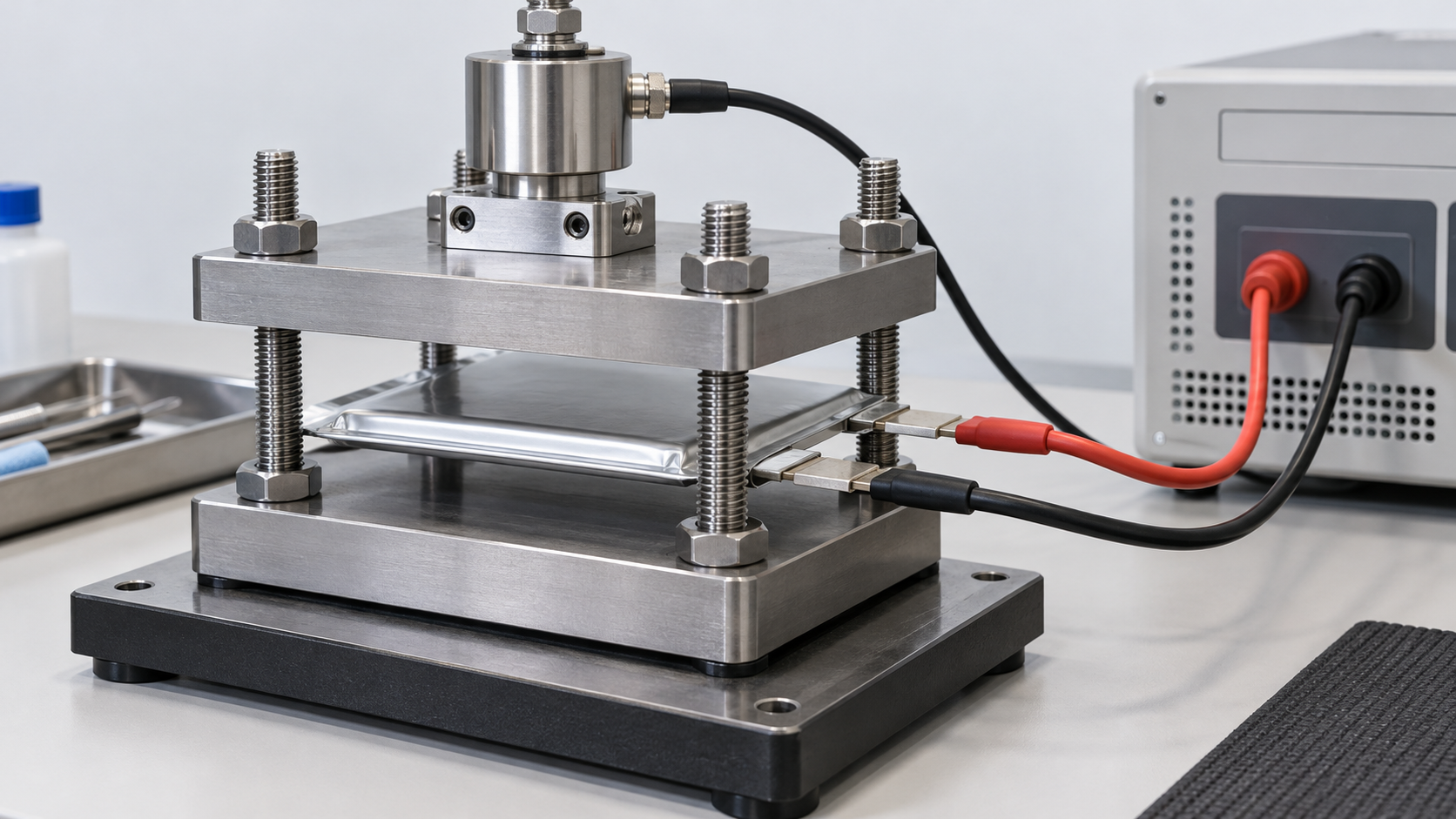
(3) Potential and clamping. The 10-K says a silicon anode works at a potential at least 100 mV higher than graphite, which helps fast charging and low-temperature operation and lowers the overcharge risk. On the other hand, the data sheets of the high-energy designs carry a note that external clamping (15 to 30 PSI) is required. This reads as a design that holds the cell from outside to restrain expansion, and it affects pack design (inference).
(4) The trade-off between energy density and life. As the table shows, the 450 Wh/kg cells are rated at 150 cycles and the 315 Wh/kg cell at 1,400, even within one company. Depth of discharge (DOD), charge rate (+0.2C or +1C), temperature and clamping differ, so no single number can be set against another company's value to say who wins. The difference in cathodes (NMC, NMCA) also matters.
(5) Where the material comes from. The SiCore anode material is supplied exclusively by Berzelius of Nanjing, China. The 10-K says the NDAA will in future restrict U.S. defense procurement of batteries and components from "foreign entities of concern", and that under the DIU contract it must secure NDAA-compliant suppliers. For customers, particularly in defense, where a material comes from can become a condition for choosing a product.
11. Risks
| Risk | Details | Status |
|---|---|---|
| Losses and funding | The 2025 net loss was US$44.0 million, and the first half of 2026 US$8.2 million. The outlook for the full year is a net loss below US$10 million (company outlook). It has no debt, but the ATM program is used up. Cash at the end of June 2026 was US$74.5 million. The company says it expects cash and revenue to cover at least the next 12 months | Sourced / the outlook is Not yet confirmed |
| Reliance on outside makers and suppliers | SiCore depends on Berzelius and contract plants. The 10-K lists the risks of losing control of the manufacturing process, quality, intellectual property and delivery. Berzelius is a former affiliated company, and a director of Amprius (its former CEO) is on Berzelius's board (10-K). The names of the contract makers are not public | Sourced (company description) |
| U.S. procurement rules and tariffs | The 10-K says the NDAA will in future restrict defense procurement of batteries and components from "foreign entities of concern", and that under the DIU contract it must secure compliant suppliers. It also mentions the effect of U.S. tariffs on China. This article has not checked the details or the stage (proposed, adopted, in force) of the rules | Sourced (company description) / not confirmed |
| Customer concentration | In 2025 one customer accounted for US$27.1 million (about 37.1% of revenue, our calculation) Our calculation. One major customer made up 64% of receivables. A large part of revenue is from European customers. A change in customer demand would affect results | Sourced / our calculation |
| Conditions behind performance figures | The highest-energy cells have short life, and some models need external clamping. A data sheet for the "1,150 Wh/L" on the catalog cover could not be found. The 10-K says EV cells need better life, cost and volume | Sourced (manufacturer's stated value) / not confirmed |
| Terms of government contracts | About US$22 million of the OTA (up to US$75 million) has been obligated, and most depends on future appropriations. Payments are by milestone, and either side can end it on 30 days' notice. The DIU contract was increased (US$14.8 million to US$18.1 million) | Sourced / Not yet confirmed |
| Changed plans | It withdrew the GWh-scale Brighton plan (US$19.1 million impairment and a US$20.0 million termination fee), which hit the 2025 loss and 2026 cash. Its future production policy may be updated | Sourced |
| Competition and alternatives | The 10-K names large graphite-cell makers and silicon-composite anode companies (Group14, Sila, Enovix and others), and in future lithium-metal and solid-state batteries. This article does not judge superiority | Sourced (company description) |
| Safety and certification | It says drone cells passed a nail-penetration test (a clause of MIL-PRF-32383, 2022), but this is a result for a specific cell under specific conditions and cannot be generalized. The 10-K lists product liability risk | Sourced (company description) |
12. Glossary
- SiCore
- Amprius's main brand of silicon-anode cells, using a particle-type anode material (from Berzelius).
- SiMaxx
- The brand of Amprius's own nanowire-type silicon-anode cells.
- Berzelius
- A company in Nanjing, China (Berzelius (Nanjing) Co., Ltd.), described in the 10-K as a "former affiliated company".
- Wh/kg and Wh/L
- Energy per unit mass and per unit volume. They change with conditions (discharge rate, temperature, whether packaging is included).
- DOD and SOH
- Depth of discharge / state of health (remaining capacity after aging). "To 80%" means until capacity falls to 80% of the start.
- Clamping (PSI)
- Force that holds a cell from outside. PSI is pounds per square inch (about 6.9 kPa).
- HAPS
- High-altitude pseudo-satellites that fly in the stratosphere for long periods on solar power and batteries.
- UAS and eVTOL
- Unmanned aircraft systems (drones) / electric vertical take-off and landing aircraft.
- USABC
- The U.S. Advanced Battery Consortium, which sets and evaluates EV battery targets.
- DIU
- The U.S. Department of Defense's Defense Innovation Unit, which contracts to bring in commercial technology.
- OTA (Other Transaction Agreement)
- A U.S. Government contract in a form different from ordinary procurement rules, paid on milestones.
- NDAA
- The U.S. National Defense Authorization Act, which sets defense procurement rules. The 10-K says it will in future restrict the origin of batteries and components.
- ATM (at-the-market offering)
- A way of raising capital by selling new shares gradually through brokers at market prices.
- Manufacturer's stated value
- A description or performance figure given by the maker itself. It cannot be compared with another product's unless the test conditions and version match.
13. References
- U.S. SEC (Amprius Technologies) Form 10-K for the year ended December 2025 (filed 6 March 2026). Business, products, manufacturing, patents, headcount, finances, risks. https://www.sec.gov/Archives/edgar/data/1899287/000189928726000015/ampx-20251231.htm
- U.S. SEC (Amprius Technologies) Form 10-Q for the quarter ended 30 June 2026 (filed 6 August 2026). First-half 2026 results, liquidity, the increase of the DIU contract, the Brighton lease termination. https://www.sec.gov/Archives/edgar/data/1899287/000189928726000059/ampx-20260630.htm
- U.S. SEC (Amprius Technologies) Form 8-K, Exhibit 99.1 (4 August 2026). Second-quarter 2026 results and full-year outlook. https://www.sec.gov/Archives/edgar/data/1899287/000189928726000056/ampx-2026x08x04x8kex991.htm
- U.S. SEC (Amprius Technologies) Form 8-K (filed 28 September 2026). Other Transaction Agreement "Project acCELLerate" (up to US$75 million). https://www.sec.gov/Archives/edgar/data/1899287/000189928726000065/ampx-20260923.htm
- U.S. SEC (Amprius Technologies) Form 8-K (filed 3 February 2026). Termination of the lease in Brighton, Colorado (termination fee of US$20 million). https://www.sec.gov/Archives/edgar/data/1899287/000189928726000005/ampx-20260130.htm
- U.S. SEC (Amprius Technologies) Form 8-K (filed 12 January 2026). Completion of the at-the-market (ATM) program (about US$97.5 million net). https://www.sec.gov/Archives/edgar/data/1899287/000189928726000003/ampx-20260112.htm
- U.S. SEC (Amprius Technologies) Form 8-K (filed 7 May 2026). Agreements to exchange public warrants for shares. https://www.sec.gov/Archives/edgar/data/1899287/000189928726000047/ampx-20260506.htm
- U.S. SEC (Amprius Technologies) Form 8-K (filed 13 August 2026). Extension of the Fremont lease (to June 2034). https://www.sec.gov/Archives/edgar/data/1899287/000189928726000062/ampx-20260807.htm
- Amprius Technologies Product Portfolio Q3 2026 (product catalog; cell-by-cell data sheets such as AMP-TDS-SA02-R7). https://amprius.com/documents/Amprius_Product_Catalog.pdf
- Amprius Technologies Company website (source of the logo image). https://amprius.com/
14. Claim-to-source audit
| Claim in the text | Status | Source |
|---|---|---|
| Business overview, uses (drones, HAPS, light electric vehicles), customers, more than 4.2 million cells shipped, descriptions of SiCore and SiMaxx, manufacturing and supply, patents (86), R&D directions, competitors, headcount (109) | Sourced | Reference 1 https://www.sec.gov/Archives/edgar/data/1899287/000189928726000015/ampx-20251231.htm |
| Year-to-December 2025 revenue of US$73,011 thousand (up 202%), results, gross margin of 11%, R&D, SG&A, impairment and other, cash, total assets, equity, one customer at US$27.1 million, 64% of receivables, share count | Sourced | Reference 1 https://www.sec.gov/Archives/edgar/data/1899287/000189928726000015/ampx-20251231.htm |
| SiMaxx nanowire structure (over one million per cm2, 99.5 to 99.9% silicon), the description of SiCore's structure, additives to silane gas, the potential at least 100 mV higher, the nail-penetration test, the USABC A-sample, the Berzelius contract, the "former affiliated company" description, NDAA risk | Sourced (company description) | Reference 1 https://www.sec.gov/Archives/edgar/data/1899287/000189928726000015/ampx-20251231.htm |
| The Brighton impairment and the policy (a move to contract manufacturing), the DIU contract of US$14.8 million, expansion of the pilot line | Sourced (company description) | Reference 1 https://www.sec.gov/Archives/edgar/data/1899287/000189928726000015/ampx-20251231.htm |
| First-half 2026 revenue of US$62,568 thousand, gross profit, R&D and net loss, cash of US$74.5 million, the DIU increase (US$18.1 million), the warrant exchange, the accounting for the Brighton lease termination | Sourced | Reference 2 https://www.sec.gov/Archives/edgar/data/1899287/000189928726000059/ampx-20260630.htm |
| Second-quarter 2026 results (revenue US$34.0 million, gross margin 27%), full-year outlook (revenue of at least US$140 million, gross margin of at least 28%, net loss under US$10 million), the Stark Future contract (from 2027, over US$100 million expected), the US$24 million order from a European drone maker, supply to Redwire, 40% of pilot-line tools being installed | Sourced (company description) / the outlook is not yet confirmed | Reference 3 https://www.sec.gov/Archives/edgar/data/1899287/000189928726000056/ampx-2026x08x04x8kex991.htm |
| Project acCELLerate: up to US$75 million, about US$22 million obligated, base period 23 September 2026 to 22 September 2028, compliance with Section 842 of the NDAA, termination on 30 days' notice | Sourced / the plan is not yet confirmed | Reference 4 https://www.sec.gov/Archives/edgar/data/1899287/000189928726000065/ampx-20260923.htm |
| Termination of the Brighton lease (30 January 2026, a US$20.0 million fee, return of the deposit) | Sourced | Reference 5 https://www.sec.gov/Archives/edgar/data/1899287/000189928726000005/ampx-20260130.htm |
| Completion of the ATM program (about US$97.5 million net, 12 January 2026) | Sourced | Reference 6 https://www.sec.gov/Archives/edgar/data/1899287/000189928726000003/ampx-20260112.htm |
| Exchange of public warrants for shares (6 May 2026) | Sourced | Reference 7 https://www.sec.gov/Archives/edgar/data/1899287/000189928726000047/ampx-20260506.htm |
| Extension of the Fremont lease (to June 2034, 7 August 2026) | Sourced | Reference 8 https://www.sec.gov/Archives/edgar/data/1899287/000189928726000062/ampx-20260807.htm |
| Product catalog: values and conditions on the data sheets (SA02, SA03, SA04, SA24, SA102, SA109, SA133), clamping, "PRELIMINARY", the cover's "up to 450 Wh/kg and 1,150 Wh/L" | Sourced (manufacturer's stated value) | Reference 9 https://amprius.com/documents/Amprius_Product_Catalog.pdf |
| The logo image is the one published on the company's website | Sourced | Reference 10 https://amprius.com/ |
| The names and shipments of contract plants, the structure and content of the SiCore anode material, the site, scale and timing of Project acCELLerate, products for stationary storage, DOE grants, a data sheet for 1,150 Wh/L, whether the full-year outlook is met | Not yet confirmed | Our own summary and outlook (items not confirmed in primary sources; this article) |
| The readings "a move to an outside-manufacturing model", "drones and defense as the main field" and "widening to light electric vehicles", and the view that clamping affects pack design | Inference | Reference 1, 3, 4, 5, 9 https://www.sec.gov/Archives/edgar/data/1899287/000189928726000015/ampx-20251231.htm https://www.sec.gov/Archives/edgar/data/1899287/000189928726000056/ampx-2026x08x04x8kex991.htm https://www.sec.gov/Archives/edgar/data/1899287/000189928726000065/ampx-20260923.htm https://www.sec.gov/Archives/edgar/data/1899287/000189928726000005/ampx-20260130.htm https://amprius.com/documents/Amprius_Product_Catalog.pdf |
| Classifying Amprius as "cells & materials"; the top customer's share of revenue (about 37.1%) and R&D as a share of revenue (about 12.9%) | Our calculation | Our own classification and calculation (this article) |
| The materials engineer's view (the structural difference between SiMaxx and SiCore, potential and clamping, energy density versus life, sourcing of material) | Commentary | Our commentary (the 10-K and catalog organized from a materials viewpoint; this article) |
Last updated: 10 October 2026 / Troy Technical
This article is based on Amprius Technologies' filings with the U.S. SEC (10-K, 10-Q and 8-K), its product catalog and its website. It uses no market-research estimates or press-based figures. Items marked "Inference" are our reading of the primary sources and are not company disclosures. Product performance values are the manufacturer's stated values under data-sheet conditions and cannot be compared with other values. Company outlooks and plans are not yet confirmed and are not guaranteed. This article does not advise individual readers on handling or safety of batteries, or on investment or procurement decisions.