COMPANY PROFILE / NEXT-GEN ENERGY STORAGE
Asahi Kasei
Narrowed to the battery separator, a company shifting from an EV-led business toward stationary storage as well
Asahi Kasei appears in next-generation energy storage because it has supplied Hipore, a wet-process separator, since 1983. A separator is the thin porous film that sits between the positive and negative electrodes of a lithium-ion battery (LIB). The company has added a coating line in Charlotte, North Carolina (completion ceremony in August 2026) and is building an integrated plant in Ontario, Canada that makes the film and coats it in one site. It has also said it expects to delay the start-up of the Canadian plant by 1.5 to 2 years from the original plan, because growth in the North American EV market has slowed. Meanwhile, in the first quarter of fiscal 2026 it reported that sales volume of Hipore for energy storage systems (ESS) was more than ten times the level of a year earlier. This profile covers LIB separators only, not Asahi Kasei as a whole, and sets out from primary sources what the company has committed, with whom it works and how much it discloses. It is written afresh from a separator perspective, apart from the Asahi Kasei profiles in this series' hydrogen energy and polymers and resins fields.
- Asahi Kasei in 30 seconds, and where it stands in next-generation energy storage
- The logo and how the name is written
- Where the company sits in the field
- Scale (kept brief, limited to what concerns separators)
- Resources committed to next-generation energy storage
- What it has done so far
- What comes next
- What the company is aiming for in energy storage
- Map of partnerships in next-generation energy storage
- Technologies, products and services
- The risks this company carries
- Glossary, references and claim-to-source audit
1. Asahi Kasei in 30 seconds, and where it stands in next-generation energy storage
securities code 3407Prime Market, as stated in the Securities Report
(separators)Sells a battery component, not the battery itself
base film and coated filmThe dry-process Celgard is made by a group company
Canada (integrated plant)Coating line ceremony in August 2026; the Canadian plant is under construction
10x a year earlierFirst quarter of fiscal 2026. Absolute volume not disclosed
Asahi Kasei's separator business is not a company that makes batteries. It is a company that sells a component to battery makers. Its results therefore move with the investment plans and demand of its customers, the battery and automotive manufacturers Sourced. The Securities Report names, as a business challenge, the possibility that separator demand falls short of expectations as slower EV growth leads customers to revisit their investment plans. It also reports that the subsidiary running the separator business, Asahi Kasei Battery Separator Corporation, has identified signs of impairment because its operating results have stayed negative, but that no impairment loss was recognized because estimated future cash flows exceed the carrying amount of ¥95,963 million. So Asahi Kasei's separators are a story of North American plants being built, and equally a story of investment being adjusted as the demand outlook changes.
2. The logo and how the name is written

A note on names: the legal entity is Asahi Kasei Corporation. The separator (Hipore) business was transferred on 1 October 2024 to a wholly owned subsidiary, Asahi Kasei Battery Separator Corporation, which is a separate legal entity. The dry-process separator Celgard is made by a subsidiary of Polypore International, LLC, acquired in 2015; it differs from the wet-process Hipore at the centre of this profile in both manufacturing method and company. Asahi Kasei Honda Battery Separator Corporation, which operates in Canada, is a joint venture in which Honda Motor Co., Ltd. holds 25%. This profile covers separators only, and is written afresh from an energy storage perspective, separately from the Asahi Kasei profiles in this series' hydrogen energy and polymers and resins fields. The logo image was taken from Asahi Kasei's official website.
Official site: https://www.asahi-kasei.com/jp/3. Where the company sits in the field
This series sorts companies in next-generation energy storage into four types: cells & materials, long-duration & new chemistries, storage systems & operators, and recycling. Asahi Kasei is a cells & materials company, and within that it specializes in one component of the battery, the separator. It does not sell battery cells, so its customers are battery makers and automakers that source batteries for their own vehicles.
4. Scale (kept brief, limited to what concerns separators)
Asahi Kasei is a diversified chemical group with three domains: Healthcare, Homes and Materials. Separators sit in the Energy & Infrastructure business within Materials, alongside ion-exchange membranes for chlor-alkali electrolysis, water-treatment membranes and hydrogen-related businesses. Only the group totals and the figures for this business are shown here Sourced.
| Indicator | Year to March 2025 | Year to March 2026 |
|---|---|---|
| Net sales (consolidated, ¥ million) | 3,037,312 | 3,074,505 |
| Operating profit (consolidated, ¥ billion) | 211.9 | 231.2 |
| R&D expenses (whole group, ¥ million) | 110,641 | 110,537 |
| Materials segment net sales (¥ million) | n/a | 1,306,240 (operating profit ¥68.3 billion) |
| Capital expenditure (whole group) | n/a | about ¥222.3 billion |
| Consolidated employees | 50,352 | 47,895 (of which Materials 20,377) |
Paid-in capital is ¥103,389 million. Of fiscal 2025 capital expenditure, the Securities Report lists expanding Hipore coating capacity and building an integrated film-making and coating line among the main Materials items.
Operating profit of the Energy & Infrastructure business, which includes separators
| Operating profit (¥ billion) | Fiscal 2024 (actual) | Fiscal 2025 (actual) | Fiscal 2027 (revised plan) |
|---|---|---|---|
| Energy & Infrastructure (separators, ion-exchange membranes, membranes and water treatment, hydrogen) | 2.8 | 0.5 | 1.0 Not yet confirmed |
| Same business, first quarter (April to June) | Fiscal 2025: 1.2 | Fiscal 2026: -1.3 | n/a |
The figures above for this business also include ion-exchange membranes for chlor-alkali electrolysis and hydrogen-related products, so they are not separator-only results. Sales and operating profit for Hipore alone are not disclosed in the materials we reviewed Not yet confirmed. For the first-quarter fall in profit in fiscal 2026, the company points to the separator business as the main cause, citing the effect of transferring the lead-acid battery separator business, the difference in product mix of Hipore, and higher fixed costs from running more equipment to support higher sales. It expects the business's operating profit for the full fiscal 2026 year to be "about flat" on the prior year and EBITDA (a pre-depreciation profit measure) to improve, but this is the company's outlook, not a settled figure. The company also shows a market outlook (how large separator demand will be) in its materials, but it is the company's own estimate and not an actual reported figure, so this article does not use those numbers.
5. Resources committed to next-generation energy storage
Most headcount and money figures are not disclosed for separators alone. What we could confirm, and what we could not, is set out below.
| Type of resource | What primary sources confirm | Category |
|---|---|---|
| People | The separator business was spun off on 1 October 2024 into Asahi Kasei Battery Separator Corporation (paid-in capital ¥39 billion), with production sites in Moriyama, Shiga and Hyuga, Miyazaki (company website). Headcount and R&D staffing are not disclosed (we could not find that company's employee count) | Sourced / not disclosed |
| Money (R&D) | Group R&D expenses were ¥110.5 billion in the year to March 2026. The separator share is not disclosed | Sourced / not disclosed |
| Money (capital expenditure) | Since 2000, capacity expansion for Hipore has cost about ¥130 billion cumulatively (as of the March 2023 briefing). In October 2023 the company decided on about ¥40 billion of coating-capacity expansion (US, Japan, Korea). In April 2024 it decided on the Canadian integrated plant at an estimated ¥180 billion (assuming US$1 = ¥145). The fiscal 2026 capex plan for Materials as a whole is ¥187 billion; the Hipore share is not disclosed | Sourced (including plans) |
| Money (carrying values) | Property, plant, equipment and intangibles of Asahi Kasei Battery Separator are ¥95,963 million (2.3% of consolidated total assets); those of Polypore International, LLC (dry-process separators and others) are ¥29,705 million (0.7%). Signs of impairment were identified for both, but no impairment loss was recognized | Sourced |
| Investment, M&A, joint ventures, divestment | Honda invests 25% in the Canadian joint venture (shareholders' agreement in November 2024). The Development Bank of Japan (DBJ) provides ¥28 billion through preferred shares. A capacity-rights agreement with the US subsidiary of Toyota Tsusho (July 2025). Polypore was acquired in 2015 and about ¥185 billion was booked as an extraordinary loss in fiscal 2022. The Daramic lead-acid battery separator business was sold to entities set up by Kingswood Capital Management (1 December 2025) | Sourced |
| Public funding and research institutions | For Japan, the company says its investment has been certified under the Ministry of Economy, Trade and Industry's "plan for ensuring stable supply of storage batteries" (October 2023 release). For Canada, it says it will be supported under the Japan-Canada memorandum of cooperation on the battery supply chain (September 2023) and expects subsidies and tax incentives from the Canadian federal and Ontario governments (amounts not found). Joint research with universities or public research institutes was not found | Sourced / not found |
Status of main products and facilities
| Facility | Location | Scale | Stage | Dates and notes |
|---|---|---|---|---|
| Hipore film-making plants | Moriyama, Shiga; Hyuga, Miyazaki | Base-film capacity not found | Operating | Production sites listed on the company website. The company says Hipore has been a product since 1983 |
| Coating-capacity expansion (decided 2023) | Charlotte, US; Hyuga, Japan; Pyeongtaek, Korea | About 700 million m²/year | Decided (plan at the time) | Announced 31 October 2023. Start-up in stages from the first half of fiscal 2026 was planned, bringing group coating capacity to about 1.2 billion m²/year. The July 2026 results presentation lists "about 600 million m²/year at Charlotte and Hyuga" and does not mention Pyeongtaek. We could not find an explanation. |
| Charlotte coating line | North Carolina, US (on the Celgard plant site) | Capacity of the line alone not found | Completed. Commercial production Not yet confirmed | Trial operation began in March 2026 and the completion ceremony was held on 20 August 2026. Commercial production is planned for the second half of fiscal 2026. Supply to Toyota Tsusho is planned from mid-2027 |
| Canadian integrated film-making and coating plant | Port Colborne, Ontario | About 700 million m²/year (coated-film basis) | Under construction | Groundbreaking on 14 November 2024. Commercial production was originally planned for 2027, but the April 2026 materials assume a 1.5 to 2 year delay, and the July 2026 materials show completion and start of commercial production in fiscal 2029. Full-capacity operation is expected after 2030 Not yet confirmed |
The "about 700 million m²/year" in the company's announcements is an area converted to coated film, as stated explicitly in the Canadian plant announcement Sourced. Hipore production has two stages: making the polyolefin base film (film-making) and applying a ceramic or similar layer on top (coating), and the company supplies both base film and coated film. So more coating capacity does not necessarily mean the same increase in base-film capacity. The 2023 expansion was announced as coating capacity, while the Canadian plant was announced as a site that does film-making and coating together, so what increases is different. Figures counted on a different basis, such as base-film area, cannot be set against these numbers to rank anyone.
6. What it has done so far
| When | What happened | Why it matters |
|---|---|---|
| 1983 | Hipore became a product (company website) | The company says it was making wet-process separators before the LIB market took off in the early 1990s |
| August 2015 | Acquired Polypore International, LLC (US) | Brought in dry-process LIB separators (Celgard) and lead-acid battery separators (Daramic) |
| September 2021 | Polypore and SEMCORP (China) set up a joint venture in China for dry-process separators | Based on a licence of Celgard's dry-process polypropylene separator technology and intellectual property. Its present status was not found |
| March 2023 | Separator business briefing: the company stops running Hipore and Polypore as one business and runs each independently. About ¥185 billion booked as an extraordinary loss in fiscal 2022 (the company says it corresponds to the remaining book value of goodwill in the broad sense recognized at the 2015 acquisition) | A turning point at which the company acknowledged performance far below the plan at the time of acquisition |
| September to October 2023 | Japan and Canada sign a memorandum of cooperation on the battery supply chain (September). Asahi Kasei decides on about ¥40 billion of Hipore coating-capacity expansion (31 October) | Building supply in North America, Japan and Korea |
| April 2024 | Decides to build the Canadian plant (estimated ¥180 billion). Basic agreement with Honda; agreement on ¥28 billion of preferred shares with DBJ | A decision to have integrated wet-process production, from film-making to coating, in North America |
| October to November 2024 | Separator business transferred to Asahi Kasei Battery Separator Corporation (1 October). Shareholders' agreement with Honda (1 November). Groundbreaking in Canada on 14 November | A spin-off to speed decisions, and a joint venture |
| July 2025 | Capacity-rights agreement signed with the US subsidiary of Toyota Tsusho | The company says the aim is to keep utilization high and soften the risk of market swings |
| December 2025 | Lead-acid battery separator business "Daramic" sold (1 December) | Provisional loss on sale of ¥7,166 million; the sold business had net sales of ¥26,601 million in fiscal 2025 |
| March to August 2026 | Trial operation starts in Charlotte (March). A delay in the Canadian plant's start-up is assumed (April). ESS volume more than 10x a year earlier (first quarter, 31 July). Completion ceremony for the Charlotte coating line (20 August) | North American supply is shifting from an EV-led mix toward one that includes ESS |
7. What comes next
second half of FY2026Ceremony held August 2026. The company's plan
commercial production in FY2029Originally 2027. A 1.5 to 2 year delay is assumed; full capacity expected after 2030
operating margin about 20%FY2030 onward. Assumes US$1 = ¥140
All four items are the company's plans and outlook, not results achieved Not yet confirmed. The company says that until the North American market takes off in earnest, it will serve it by exporting from its Japanese and Korean plants Sourced. At the groundbreaking in November 2024 its president also said it aims to win a market share of 30% or more in North America, which is likewise a company target Not yet confirmed.
None of the following appears in the primary sources we reviewed Not yet confirmed.
The names of major customers (apart from Toyota Tsusho, no counterparty is named for the long-term supply contracts) / the absolute volume of ESS sales and the cell chemistry involved (whether LFP) / Hipore base-film production capacity / the start-up date of the Hyuga coating line / what became of the Pyeongtaek coating expansion in Korea / the subsidy amounts from Canada and Ontario / performance figures for the products (thickness, pore size, porosity, puncture strength). Press-reported figures are not used here.
8. What the company is aiming for in energy storage
This section includes points the company has not stated directly. They are inferences from what the primary sources say, and each is given with its basis.
| What can be read from it | Primary-source basis | Category |
|---|---|---|
| Having local supply in North America first is a central aim of the business | The Securities Report says that, to meet demands for localizing the supply chain mainly in North America, it is putting production sites in North America ahead of demand | Sourced |
| Moving from an EV-only footing to several uses, including ESS and data centres | The progress material on the medium-term plan says it is shifting to a sales-portfolio strategy that yields stable earnings "rather than concentrating on automotive"; ESS volume in the first quarter of fiscal 2026 was more than 10x a year earlier | Sourced (company policy) |
| It wants to sell coated film for ESS too, to raise profitability | In the Q&A the company said it is considering whether it can increase coated-film sales in ESS to improve profitability. We could not confirm that this has happened | Inference |
| It intends to support plant utilization through contracts | On the capacity-rights agreement with Toyota Tsusho, the company says it will keep utilization high and soften the risk of market swings | Sourced |
| The Canadian plant will be built first, with start-up adjusted to demand | The materials say the start-up timing will be controlled "to maximize profit in light of demand", while construction proceeds as planned | Inference |
In the first quarter of fiscal 2026, the company says, Hipore sales volume for ESS was more than ten times that of a year earlier Sourced. The driver was stationary storage systems for the power grid, which it began selling in the fourth quarter of fiscal 2025, and sales for battery backup units (BBU), used to ride through momentary power interruptions at data centres, are also rising. But this is a ratio, and because the volume a year earlier is not disclosed, the absolute volume is unknown. If the base was very small, a tenfold rise adds little to the total. Indeed, operating profit fell in the same quarter, and one reason the company gives is that the difference in product mix between ESS and consumer or automotive uses limited the improvement in profit. At its 2023 business briefing, Asahi Kasei also explained that batteries with LFP-type cathodes tend to suit dry-process separators. Whether Hipore's growth in ESS reflects battery chemistry, price or film thinness cannot be told from the primary sources. This article does not assert a reason, and reads it only as "uses have broadened, but the effect on earnings is still to come" Not yet confirmed.
9. Map of partnerships in next-generation energy storage
10. Technologies, products and services
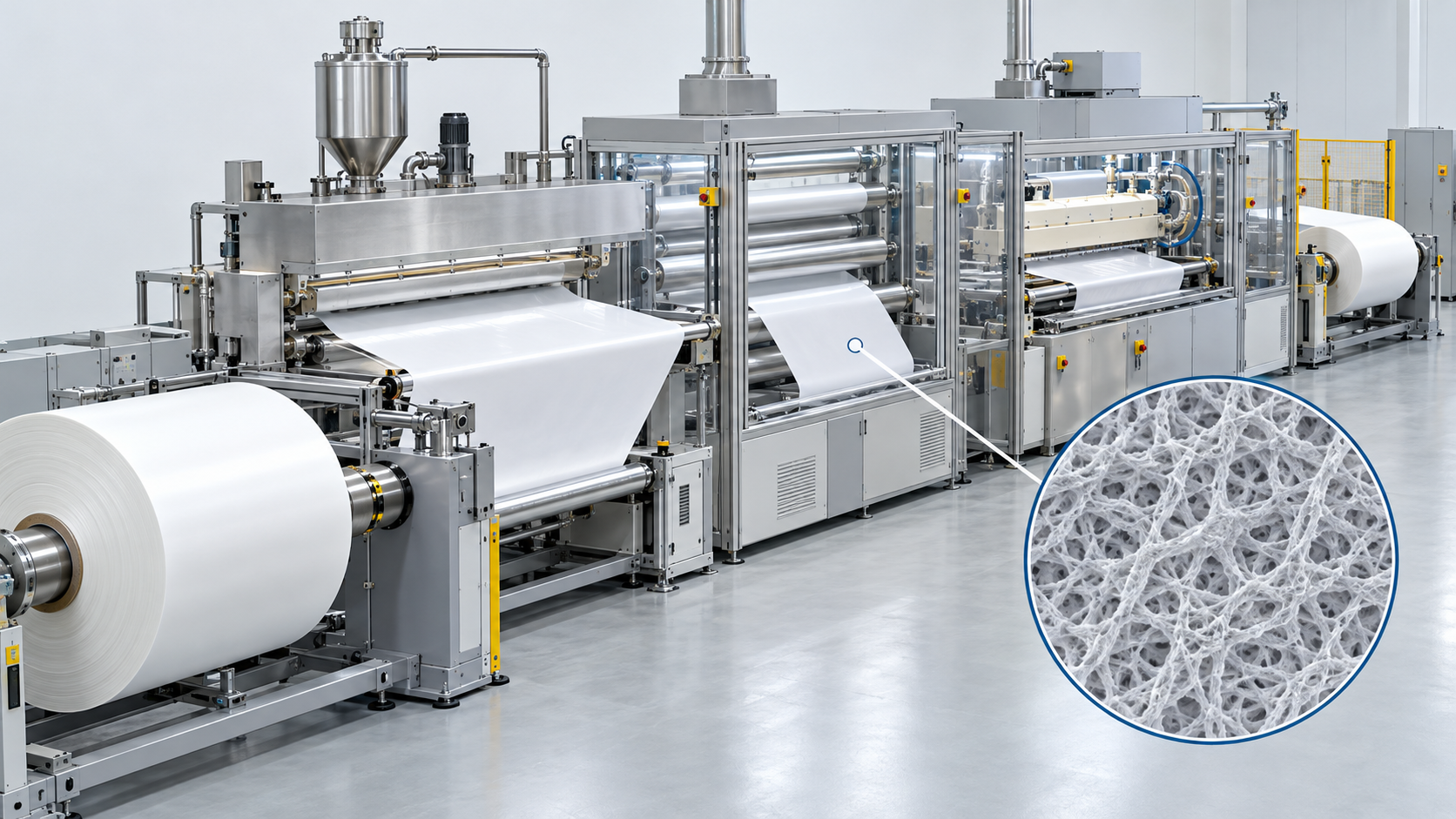
The company supplies wet-process Hipore (base film and coated film) as its LIB separator. The difference between the two manufacturing methods, as the company describes it, is as follows Sourced. In the wet process, polyethylene (PE) is the main raw material; it is mixed with a plasticizer and formed into a film, then the plasticizer is removed with a solvent to leave fine pores. In the dry process, polypropylene (PP) is the main raw material and the film is stretched without solvent to open the pores.
| Product or area | What official materials say | Note |
|---|---|---|
| Hipore base film | A microporous polyolefin film. The properties the company lists are a uniform small pore size, high porosity, uniform thickness, high puncture strength, a wide range of thicknesses and functional coatings. It says the film is used in LIBs for EVs, PHEVs, smartphones, ESS and other uses | Numerical values (thickness range, pore size, porosity, puncture strength) are not given on the official website, and we could not confirm them |
| Hipore coated film | Base film with a ceramic or similar layer applied. The company speaks of "a wide range of coated films" and says that expanding coating capacity will broaden its supply of higher-value-added separators | Which coating goes into which battery could not be confirmed from official materials |
| Broadening uses | EV and consumer uses (smartphones, PCs), plus stationary storage systems for the grid (on sale since the fourth quarter of fiscal 2025) and BBU for data centres | Sales volume is disclosed only as a ratio. See chapter 8 |
| Celgard (dry process, group company) | Made under Polypore in the US. The Securities Report says sales for hybrid vehicles are rising, but sales for other eco-friendly vehicles and for ESS are weak, and low utilization continues | This profile centres on Hipore; Celgard is mentioned as part of the business |
| Lead-acid battery separators (Daramic) | Sold on 1 December 2025 | No longer an Asahi Kasei business |
| Intellectual property | Asahi Kasei Battery Separator says on its website that it holds many patents related to Hipore in Japan and abroad, and publishes a list of patent numbers | The list is on the official website. We do not assess its contents here |
The company says the strengths of the wet process lie in flexible pore design and thin-film technology, together with a wide range of coated films Sourced. At its 2023 business briefing it said that batteries with high-nickel ternary cathodes (NMC, NCA), which became the mainstream for EVs, use wet-process separators with an inorganic layer, and that batteries with LFP-type cathodes suit dry-process separators Sourced (this is the company's view, not a measurement of why battery makers chose them).
As a general point, a thinner separator can allow more electrode material in the same cell volume. But the thinner the film, the harder it is to keep it resistant to puncture by foreign particles or rough electrode surfaces (puncture strength) and to hold the thickness uniform. The pores bear on both how easily lithium ions pass and how well the film keeps the electrodes from shorting. A coating layer is commonly used to limit shrinkage of the film at high temperature. This is our own general commentary and not performance values published by Asahi Kasei (see also our explainer on electrolytes and separators).
Conversely, which values Asahi Kasei's individual films reach could not be confirmed from official materials Not yet confirmed. This article does not rank them against other makers' films.
11. The risks this company carries
| Risk | What it involves | Category |
|---|---|---|
| Slower EV demand | The Securities Report names the possibility that separator demand falls below expectations as slower EV growth leads automakers and battery makers to revisit their investment plans | Sourced |
| Impairment of fixed assets | Asahi Kasei Battery Separator carries fixed assets of ¥95,963 million. Its operating results are continuously negative and signs of impairment have been identified. No impairment loss is recognized at present because future cash flows are estimated to exceed the carrying amount, but the company records that changes in expected growth of EV and ESS battery markets and in order outlook could affect the next fiscal year | Sourced |
| Delay of the Canadian plant | Start-up is assumed to be delayed by 1.5 to 2 years, with full capacity expected after 2030. Recovery of a roughly ¥180 billion investment moves further out. The company says construction itself is proceeding as planned | Sourced |
| Price and technology competition | The Securities Report cites intensifying price and technology competition with makers in China, Korea and elsewhere, swings in raw-material and energy prices, and the effects of geopolitical risk and national policy. At the 2023 briefing the company also said cost pressure on separators was growing more severe each year | Sourced |
| Product mix and profitability | In the first quarter of fiscal 2026, even with ESS volume up sharply, profit improvement was limited by the product-mix difference from consumer and automotive uses, and the Energy & Infrastructure business posted an operating loss of ¥1.3 billion | Sourced |
| Impairment from past acquisitions | About ¥185 billion of goodwill-equivalent value from the Polypore acquisition was written off as an extraordinary loss in fiscal 2022. The Securities Report says the dry-process business, other than for hybrid vehicles, has weak sales and continues to run at low utilization | Sourced |
| Parts that cannot be checked from outside | Hipore-only sales and profit, base-film capacity, absolute ESS volumes, and the counterparties and terms of long-term supply contracts are not disclosed, so progress cannot be fully verified from outside | Not yet confirmed |
| Dependence on policy | The company records that localization of North American supply chains and national policies affect its business environment. This article has not checked the specific subsidy, tariff and regulatory measures, or their stages, against government sources | Not yet confirmed |
12. Glossary
- Separator
- A thin porous film placed between a battery's positive and negative electrodes. It keeps the electrodes from touching (a short circuit) while letting lithium ions through.
- Wet process / dry process
- Two ways to make a separator. In the wet process, PE is mixed with a plasticizer, made into a film, and the plasticizer is removed with a solvent to leave pores. In the dry process, PP is stretched without solvent to open pores.
- Base film / coated film
- The base film is the porous polyolefin film itself. The coated film has a layer of ceramic or similar material applied on top.
- Hipore
- Asahi Kasei's brand of wet-process separator. A product since 1983.
- ESS
- Energy storage system: equipment that stores electricity for later use, for the grid, data centres and other purposes.
- BBU
- Battery backup unit. A battery unit placed per rack in a data centre to bridge power interruptions lasting seconds to minutes.
- Capacity-rights agreement
- A contract that gives a specific customer priority access to part of a plant's production capacity.
- Preferred shares
- Shares that rank ahead of ordinary shares for dividends and for distribution of remaining assets. One way to raise funds.
- NMC / NCA / LFP
- Types of cathode material: nickel manganese cobalt oxide, nickel cobalt aluminum oxide, and lithium iron phosphate.
- Securities Report
- The annual report that listed companies in Japan file under the Financial Instruments and Exchange Act.
13. References
- Asahi Kasei 135th Securities Report (1 April 2025 to 31 March 2026), in Japanese. Company overview, segments and employees, capital expenditure, R&D expenses, accounting estimates on impairment of fixed assets (Asahi Kasei Battery Separator, Polypore), the Daramic divestment, the shareholders' agreement with Honda, and business challenges. https://www.asahi-kasei.com/content/dam/asahi-kasei/jp/ja/ir/library/financial-report/pdf/135j-0624.pdf
- Asahi Kasei Medium-Term Management Plan 2027: progress report (15 April 2026, updated in July 2026 with fiscal 2025 actuals), in Japanese. Operating profit of the Energy & Infrastructure business, the Hipore North America roll-out (Canadian plant delay, Charlotte), the Hipore business plan and partnerships. https://www.asahi-kasei.com/content/dam/asahi-kasei/jp/ja/ir/library/initiative/pdf/2607j.pdf
- Asahi Kasei Fiscal 2026 first-quarter results presentation (31 July 2026), in Japanese. Operating profit of the Energy & Infrastructure business, and major capital projects (coating-capacity expansion, the integrated line in Canada, completion timing). https://www.asahi-kasei.com/content/dam/asahi-kasei/jp/ja/ir/library/financial-briefing/pdf/2606-analyst.pdf
- Asahi Kasei Fiscal 2026 (year to March 2027) first-quarter results briefing, Q&A summary (held 31 July 2026), in Japanese. Hipore sales volume for ESS, the reasons for the fall in profit, and the full-year outlook. https://www.asahi-kasei.com/content/dam/asahi-kasei/jp/ja/ir/library/financial-briefing/pdf/260807jtxt.pdf
- Asahi Kasei Separator business briefing, summary (8 March 2023), in Japanese. The background to the Polypore acquisition and impairment, the positioning of wet, dry and lead-acid separators, and Hipore sales volume and capacity-expansion investment. https://www.asahi-kasei.com/jp/ir/library/business/pdf/230308jtxt.pdf
- Asahi Kasei Asahi Kasei to significantly expand coating capacity for lithium-ion battery separators (31 October 2023), in Japanese. https://www.asahi-kasei.com/jp/news/2023/ze231031
- Asahi Kasei Construction of a lithium-ion battery separator plant in Canada (25 April 2024), in Japanese. https://www.asahi-kasei.com/jp/news/2024/ze240425.html
- Asahi Kasei and Honda Shareholders' agreement signed to form a joint venture for separator production in Canada (1 November 2024), in Japanese. https://www.asahi-kasei.com/jp/news/2024/ze241101-3.html
- Asahi Kasei Asahi Kasei Battery Separator holds groundbreaking ceremony for a new plant in Port Colborne, Canada (18 November 2024), in Japanese. https://www.asahi-kasei.com/jp/news/2024/ze241118.html
- Asahi Kasei and Toyota Tsusho Capacity-rights agreement signed for lithium-ion battery separators (31 July 2025), in Japanese. https://www.asahi-kasei.com/jp/news/2025/ze250731.html
- Asahi Kasei Completion of the separator coating line in Charlotte, North Carolina (release dated 26 August 2026; ceremony on 20 August), in Japanese. https://www.asahi-kasei.com/jp/news/2026/ze260826
- Asahi Kasei Establishment of a joint venture in China for dry-process separators (22 September 2021), in Japanese. Includes the description of the wet and dry processes. https://www.asahi-kasei.com/jp/news/2021/ze210922.html
- Asahi Kasei Battery Separator Products page (features of Hipore, a product since 1983, and its uses), in Japanese. https://www.asahi-kasei.co.jp/ak-bsc/products
- Asahi Kasei Battery Separator Company overview (establishment, capital, production sites), in Japanese. https://www.asahi-kasei.co.jp/ak-bsc/company
- Asahi Kasei Battery Separator Intellectual property (disclosure of Hipore-related patents), in Japanese. https://www.asahi-kasei.co.jp/ak-bsc/intellectual-property
- Asahi Kasei Official website (source of the logo). https://www.asahi-kasei.com/jp/
14. Claim-to-source audit
| Claim in the article | Category | Source |
|---|---|---|
| Legal name, head office, incorporation, Tokyo Stock Exchange Prime Market, paid-in capital of ¥103,389 million | Sourced | Reference 1 https://www.asahi-kasei.com/content/dam/asahi-kasei/jp/ja/ir/library/financial-report/pdf/135j-0624.pdf |
| Net sales (¥3,037,312 million, year to March 2025; ¥3,074,505 million, year to March 2026), R&D expenses of ¥110,641 million and ¥110,537 million, 47,895 employees (Materials 20,377), capital expenditure of about ¥222.3 billion, Materials segment net sales of ¥1,306,240 million (operating profit ¥68.3 billion) | Sourced | Reference 1 https://www.asahi-kasei.com/content/dam/asahi-kasei/jp/ja/ir/library/financial-report/pdf/135j-0624.pdf |
| Group operating profit of ¥211.9 billion (fiscal 2024) and ¥231.2 billion (fiscal 2025) | Sourced | Reference 2 https://www.asahi-kasei.com/content/dam/asahi-kasei/jp/ja/ir/library/initiative/pdf/2607j.pdf |
| Energy & Infrastructure operating profit of ¥2.8 billion (fiscal 2024), ¥0.5 billion (fiscal 2025) and ¥1.0 billion (fiscal 2027 revised plan) | Sourced | Reference 2 https://www.asahi-kasei.com/content/dam/asahi-kasei/jp/ja/ir/library/initiative/pdf/2607j.pdf |
| Energy & Infrastructure first-quarter operating profit of ¥1.2 billion (fiscal 2025) and -¥1.3 billion (fiscal 2026), the reasons for the fall, and the full-year outlook | Sourced | Reference 3 and 4 https://www.asahi-kasei.com/content/dam/asahi-kasei/jp/ja/ir/library/financial-briefing/pdf/2606-analyst.pdf https://www.asahi-kasei.com/content/dam/asahi-kasei/jp/ja/ir/library/financial-briefing/pdf/260807jtxt.pdf |
| Medium-term outlook for Hipore (FY2030 onward: sales of ¥110 billion or more, operating margin about 20%, US$1 = ¥140) | Not yet confirmed | Reference 2 https://www.asahi-kasei.com/content/dam/asahi-kasei/jp/ja/ir/library/initiative/pdf/2607j.pdf |
| ESS sales volume more than 10x a year earlier; grid storage systems on sale since the fourth quarter of fiscal 2025; BBU sales also rising | Sourced | Reference 4 https://www.asahi-kasei.com/content/dam/asahi-kasei/jp/ja/ir/library/financial-briefing/pdf/260807jtxt.pdf |
| Fixed assets of Asahi Kasei Battery Separator of ¥95,963 million (2.3% of consolidated total assets) and of Polypore of ¥29,705 million (0.7%); no impairment loss recognized | Sourced | Reference 1 https://www.asahi-kasei.com/content/dam/asahi-kasei/jp/ja/ir/library/financial-report/pdf/135j-0624.pdf |
| Possibility of separator demand falling short of expectations, price and technology competition, and national policy trends are named as business challenges | Sourced | Reference 1 https://www.asahi-kasei.com/content/dam/asahi-kasei/jp/ja/ir/library/financial-report/pdf/135j-0624.pdf |
| Separator business transferred to Asahi Kasei Battery Separator on 1 October 2024 (paid-in capital ¥39 billion); production sites in Moriyama and Hyuga | Sourced | Reference 14 and 1 https://www.asahi-kasei.co.jp/ak-bsc/company https://www.asahi-kasei.com/content/dam/asahi-kasei/jp/ja/ir/library/financial-report/pdf/135j-0624.pdf |
| Hipore a product since 1983; its listed properties (uniform small pore size, high porosity, uniform thickness, high puncture strength, wide range of thicknesses, functional coatings); uses (EVs, PHEVs, smartphones, ESS) | Sourced | Reference 13 https://www.asahi-kasei.co.jp/ak-bsc/products |
| The difference between wet process (PE plus plasticizer removed by solvent) and dry process (PP, stretched without solvent) | Sourced | Reference 12 https://www.asahi-kasei.com/jp/news/2021/ze210922.html |
| Base film and coated film as the two products; about ¥40 billion of coating-capacity expansion (US, Japan, Korea); about 700 million m²/year; group coating capacity of about 1.2 billion m²/year after expansion; start-up in stages from the first half of fiscal 2026 planned; METI certification for the Japanese part | Sourced | Reference 6 https://www.asahi-kasei.com/jp/news/2023/ze231031 |
| Decision on the Canadian plant (estimated ¥180 billion, about 700 million m²/year, planned for 2027), basic agreement with Honda, ¥28 billion of DBJ preferred shares, subsidies and tax incentives expected, Japan-Canada memorandum of cooperation (September 2023) | Sourced | Reference 7 https://www.asahi-kasei.com/jp/news/2024/ze240425.html |
| Honda invests 25% (about CAD 417 million to be contributed), and the location, capital and ownership ratios of the joint venture | Sourced | Reference 8 https://www.asahi-kasei.com/jp/news/2024/ze241101-3.html |
| Asahi Kasei Honda Battery Separator Corporation (capital CAD 240 million, 75% voting rights) and the shareholders' agreement with Honda (1 November 2024) | Sourced | Reference 1 https://www.asahi-kasei.com/content/dam/asahi-kasei/jp/ja/ir/library/financial-report/pdf/135j-0624.pdf |
| Groundbreaking of the Canadian plant (14 November 2024) and the president's comment aiming for a North American market share of 30% or more | Sourced | Reference 9 https://www.asahi-kasei.com/jp/news/2024/ze241118.html |
| Capacity-rights agreement with Toyota Tsusho's US subsidiary, supply from the Charlotte coating equipment from mid-2027, and the aim of keeping utilization high | Sourced | Reference 10 https://www.asahi-kasei.com/jp/news/2025/ze250731.html |
| Completion ceremony of the Charlotte coating line (20 August 2026) and planned commercial production in the second half of fiscal 2026 | Sourced | Reference 11 https://www.asahi-kasei.com/jp/news/2026/ze260826 |
| Start of trial operation in Charlotte (March 2026), the assumed 1.5 to 2 year delay of the Canadian plant, full capacity after 2030, exports from the Japanese and Korean plants, and the operating profit outlook | Sourced | Reference 2 https://www.asahi-kasei.com/content/dam/asahi-kasei/jp/ja/ir/library/initiative/pdf/2607j.pdf |
| The Canadian plant to be completed and start commercial production in fiscal 2029, and coating-capacity expansion of about 600 million m²/year (Charlotte and Hyuga) | Sourced | Reference 3 https://www.asahi-kasei.com/content/dam/asahi-kasei/jp/ja/ir/library/financial-briefing/pdf/2606-analyst.pdf |
| About ¥130 billion cumulative capacity-expansion investment since 2000, sales volume growth of about 17% a year, the Polypore acquisition background, about ¥185 billion extraordinary loss in fiscal 2022, the move to independent operation, and the company's view on wet separators with an inorganic layer for NMC/NCA and dry separators for LFP | Sourced | Reference 5 https://www.asahi-kasei.com/jp/ir/library/business/pdf/230308jtxt.pdf |
| Polypore acquired (August 2015), Daramic sold (1 December 2025; provisional loss on sale of ¥7,166 million; net sales of ¥26,601 million), and low utilization of the dry-process business | Sourced | Reference 1 https://www.asahi-kasei.com/content/dam/asahi-kasei/jp/ja/ir/library/financial-report/pdf/135j-0624.pdf |
| The dry-process separator joint venture between Polypore and SEMCORP (formed 2021) | Sourced | Reference 12 https://www.asahi-kasei.com/jp/news/2021/ze210922.html |
| Many Hipore-related patents held in Japan and abroad, with a list published | Sourced | Reference 15 https://www.asahi-kasei.co.jp/ak-bsc/intellectual-property |
| Hipore-only sales and operating profit, base-film capacity, performance values (thickness, pore size, porosity, puncture strength), absolute ESS volumes, counterparties and terms of long-term contracts, and Canadian and Ontario subsidy amounts | Not yet confirmed | References 1, 2, 3, 4, 13 https://www.asahi-kasei.com/content/dam/asahi-kasei/jp/ja/ir/library/financial-report/pdf/135j-0624.pdf https://www.asahi-kasei.com/content/dam/asahi-kasei/jp/ja/ir/library/initiative/pdf/2607j.pdf https://www.asahi-kasei.com/content/dam/asahi-kasei/jp/ja/ir/library/financial-briefing/pdf/2606-analyst.pdf https://www.asahi-kasei.com/content/dam/asahi-kasei/jp/ja/ir/library/financial-briefing/pdf/260807jtxt.pdf https://www.asahi-kasei.co.jp/ak-bsc/products |
| Joint research with universities or public institutes, start-up timing of the Hyuga coating line, what became of the Pyeongtaek coating expansion, and the current status of the SEMCORP joint venture | Not yet confirmed | References 3, 6, 12 https://www.asahi-kasei.com/content/dam/asahi-kasei/jp/ja/ir/library/financial-briefing/pdf/2606-analyst.pdf https://www.asahi-kasei.com/jp/news/2023/ze231031 https://www.asahi-kasei.com/jp/news/2021/ze210922.html |
| A shift from an EV-only footing to several uses including ESS and data centres (as stated in the company's policy) | Sourced | Reference 2 https://www.asahi-kasei.com/content/dam/asahi-kasei/jp/ja/ir/library/initiative/pdf/2607j.pdf |
| The four-type classification (cells & materials, long-duration & new chemistries, storage systems, recycling) and Asahi Kasei's position | Our calculation | Our own classification; company names are examples from those covered in this series |
| Market estimates the company shows, such as the size of separator demand | Not yet confirmed | The company's own estimates and not reported actuals, so this article does not use the figures; no outlook is given here |
| The reading that it wants to sell coated film for ESS to raise profitability | Inference | Our own reading of the Q&A reply that it is "considering" this |
| The reading that the Canadian plant will be built first and its start-up adjusted to demand | Inference | Our own reading of the statement that start-up timing will be controlled |
| The reading that "ESS up tenfold" is a ratio and says little about absolute volume or earnings impact | Inference | Our own reading, because the volume a year earlier is not disclosed |
| How thinness, pores and coating act in a battery (general points) | Our calculation | This is our own general commentary and not Asahi Kasei's performance values; see also our explainer on electrolytes and separators |
| That coating capacity and film-making capacity are counted differently, and that figures on other bases cannot be ranked against these | Our calculation | Our commentary, organized from the wording of the company's announcements |
| Checking of subsidies, tariffs and regulatory stages | Not yet confirmed | This article has not checked these against government or regulatory sources and keeps to the company's own statements |
Last updated 10 October 2026 / Troy Technical
Figures in this article come from Asahi Kasei's Securities Report, results presentations, official releases and official websites. No research-firm estimates, press-reported figures or the company's own market estimates have been used. Items marked "Inference" are our reading of the primary sources and are not statements by the company. The company's plans and targets are not yet confirmed and are not results achieved.