COMPANY PROFILE / NEXT-GEN ENERGY STORAGE
Fluence Energy
A U.S. integrator of storage-system design, integration and software. Backlog is at a record, but delays in ramping manufacturing led it to cut its FY2026 revenue outlook
Fluence Energy comes up in discussions of next-generation storage because it is a pure-play integrator, born of a Siemens and AES joint venture, that does not make cells but supplies storage systems built from several battery makers' cells, along with control software and operating services. In the third quarter of fiscal 2026 (April to June), its backlog reached a record US$6.4 billion. Gross margin fell to 5.1%, however, and the company cut its FY2026 revenue outlook to about US$3.0 billion in August and about US$2.4 billion in September, citing mainly delay in ramping up a U.S. contract manufacturing facility (Houston). This profile follows the 10-K, 10-Q and 8-K filings as written and sets out what can and cannot be confirmed. It is not an assessment of the company's financial condition.
- Fluence Energy in 30 seconds, and where it stands in next-generation storage
- The logo and how the name is written
- Where the company sits in next-generation storage
- Scale
- Resources committed to next-generation storage
- What it has done so far
- What comes next
- What the company is aiming for
- Partnership map
- Technologies, products and services
- The risks this company carries
- Glossary, references and claim-to-source audit
1. Fluence Energy in 30 seconds, and where it stands in next-generation storage
Virginia, U.S.Moved within the city on 1 September 2026
(integrator)Buys cells; manufacturing by contract manufacturers
Fluence Energy is a company that does not make battery cells itself, but supplies storage-system design, integration, control software and operating services Sourced. Its 10-K describes a "capital-light" model in which manufacturing is left to contract manufacturers (in Utah, Arizona, Southeast Asia and elsewhere). Orders and backlog reached a record (US$6.4 billion at end of June 2026), yet gross margin in April to June 2026 was 5.1% (14.8% a year earlier), and the company cut its fiscal 2026 revenue outlook to about US$3.0 billion in August and again to about US$2.4 billion in September. The reason it gives is delay in ramping up a U.S. contract manufacturing facility (Houston) Sourced. The company's own explanation is that demand is not the problem, but that manufacturing ramp-up is not keeping pace; that is the central issue today.
2. The logo and how the name is written
A note on naming: the legal name is Fluence Energy, Inc., and the logo is the word "FLUENCE" with the line "A Siemens and AES Company". It was formed in 2017 as a joint venture of Siemens (Germany) and AES (U.S.). Its products are Gridstack Pro, Gridstack, Ultrastack and Smartstack; its control software is Fluence OS, and its digital products are Mosaic (trading optimization) and Nispera (asset performance management). The logo image is the one used in the header of the company's official website (fluenceenergy.com).
Official website: https://fluenceenergy.com/3. Where the company sits in next-generation storage
As Fig. 1 shows, Fluence is a pure-play integrator in the "pack cells for the grid" type. Its 10-K divides what it offers into three parts: storage systems (hardware plus software), operating and maintenance services, and digital applications Sourced. Unlike the big battery makers, it buys cells from several "Tier 1" manufacturers and leaves module and pack assembly to contract manufacturers. The 10-K names Tesla, Wärtsilä, Sungrow and CATL among its key competitors (company statement). See also our explainers on grid-scale storage systems, battery management systems and the economics of storage.
4. Scale
The fiscal year runs from October to September. The figures are from the annual report (10-K) for the year ended September 2025 and the quarterly report (10-Q) for the period ended June 2026 (the third quarter) Sourced.
| Item (US$ millions) | FY2024 | FY2025 | Apr-Jun 2026 (year earlier) | First nine months of FY2026, Oct-Jun (year earlier) |
|---|---|---|---|---|
| Revenue | 2,698.6 | 2,262.8 | 649.8 (602.5) | 1,590.0 (1,220.9) |
| Gross profit | 341.1 | 295.8 | 33.2 (89.1) | 102.9 (152.9) |
| Gross margin | 12.6% | 13.1% | 5.1% (14.8%) | 6.5% (12.5%) |
| R&D expense | 66.2 | 86.2 | — | — |
| Net income (loss) | +30.4 | (68.0) | (44.3); year earlier +6.9 | (136.1); year earlier (92.1) |
| Other indicators | Figure | As of |
|---|---|---|
| Backlog (remaining performance obligations) | US$5.3 billion / US$6.4 billion (the company's highest ever) | 30 Sep 2025 / 30 Jun 2026 |
| Storage systems deployed (cumulative) | 6.8 GW, 17.8 GWh / 7.4 GW, 19.3 GWh | 30 Sep 2025 / 30 Jun 2026 |
| Contracted backlog (storage systems) | 9.1 GW / 12.6 GW | Same |
| Pipeline (storage systems) | 35.7 GW, 122.0 GWh / 45.6 GW, 163.7 GWh (an estimate of sales opportunities, not confirmed) | Same |
| Employees | About 1,670 full-time, in 15 countries | 30 Sep 2025 |
| Cash | US$691 million / US$339 million (cash and cash equivalents; including restricted cash about US$365 million and total liquidity about US$863 million at the latter date) | 30 Sep 2025 / 30 Jun 2026 |
| Customer concentration | The two largest customers were about 41% of FY2025 revenue (AES and its affiliates about 24%). The top three were about 48% in the first nine months of FY2026 | 10-K, 10-Q |
| Patents | Over 165 granted and over 161 pending | September 2025 |
The figures above are set out as they appear in the statutory filings; they are not an assessment of the company's financial condition. The 10-K states that "backlog" and "pipeline" may not become actual revenue or profit Not yet confirmed. "Deployed" means the cumulative systems that have reached substantial completion and have not been decommissioned; it is not an annual figure. Full-year FY2026 results had not yet been published when this article was prepared (October 2026).
5. Resources committed to next-generation storage
The whole of Fluence is a storage business, so company-wide figures are almost entirely storage figures. For each of the four headings, the table says whether we could confirm it.
| Type of resource | What primary sources confirm | Status |
|---|---|---|
| People | About 1,670 people in 15 countries (end of September 2025). R&D sites are a system-level test facility (Pennsylvania, U.S.) and a test facility in Erlangen, Germany. On 15 September 2026 Bernerd Da Santos, formerly with AES, became Chief Operating Officer | Sourced |
| Money | R&D expense was US$86.2 million in FY2025 (US$66.2 million the year before; the increase was for materials and consulting on Smartstack and Gridstack Pro). Purchases of property and equipment were US$14.88 million in FY2025 (US$8.12 million the year before; the free-cash-flow table in the 10-K). Manufacturing is left to contract manufacturers | Sourced |
| Investments, acquisitions, joint ventures, divestments | No investment or acquisition by Fluence in another company appears in the 10-K and 10-Q we checked. On the receiving side, Siemens, AES and Qatar Holding (QIA) are principal stockholders | Could not confirm / receiving side sourced |
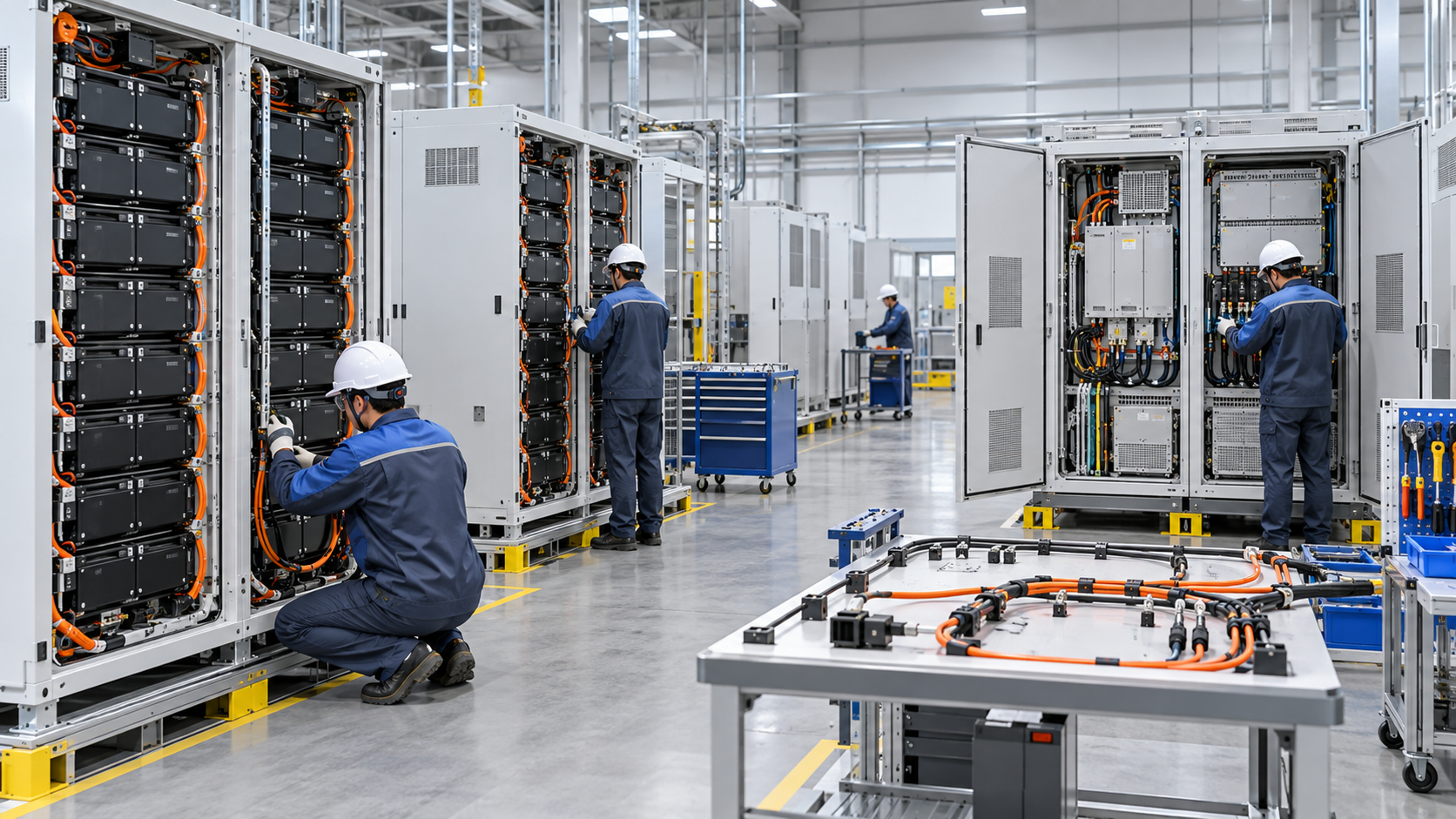
| Partnerships, manufacturing, sourcing | Contract manufacturers: Salt Lake City, Utah (from September 2022), Arizona (new facility commissioned in 2025), Houston (ramping up), and Southeast Asia. Cells are bought from several Tier 1 manufacturers (cells made in Tennessee are used in products for U.S. domestic content). Supplier names do not appear in the 10-K | Sourced / names not disclosed |
| Universities, research institutions, public funding | No university collaboration or DOE grant or loan appears in the 10-K or 10-Q we checked. On policy, the U.S. investment tax credit (Section 48E) and the advanced manufacturing production credit (Section 45X) bear on customers' deployment and on its sourcing policy (as modified by the OBBBA; company description) | Sourced (company description) / partly not confirmed |
Next, manufacturing and sourcing. Stages are given in the company's own wording; production capacities are not disclosed.
| Manufacturing / sourcing | Location | Scale | Stage | Date | Source |
|---|---|---|---|---|---|
| Contract manufacturing (Salt Lake City) | Utah, U.S. | Not disclosed | Operating, supporting domestic deliveries. Domestic module production began in September 2024 | Sep 2022 onward | Reference 1 |
| Contract manufacturing (Arizona) | Arizona, U.S. | Not disclosed | The contract manufacturer commissioned a new facility in 2025 and is scaling production | 2025 | Reference 1 |
| Contract manufacturing (Houston) | Texas, U.S. | Not disclosed | Ramp-up delayed. The company cites it as the main reason for cutting its FY2026 outlook, and says the contract manufacturer took corrective actions that raised daily output | 16 Sep 2026 | References 2, 4 |
| Contract manufacturing (Southeast Asia) | Southeast Asia (country not given) | Not disclosed | Operating. The August statement also mentions production problems at an international contract manufacturing facility | 2025; Aug 2026 | References 1, 3 |
| Fluence-designed battery packs | Utah (contract manufacturer); cells made in Tennessee | Not disclosed | Used in the Gridstack Pro 2000 series; for products with high domestic content | Sep 2024 onward | Reference 1 |
6. What it has done so far
| When | What happened | Why it matters |
|---|---|---|
| 30 Jun 2017 | Fluence Energy, LLC formed as a joint venture of Siemens and AES. It began operations on 1 January 2018 | Combined the two parents' storage businesses |
| Apr to Sep 2021 | Intellectual property assignment and licence agreements with Siemens and AES (6 April and 9 September 2021, among others) | Ownership of patents and mutual rights of use |
| 1 Nov 2021 | Initial public offering (IPO) | Nasdaq listing |
| Sep 2022 | Began working with a contract manufacturer in Salt Lake City, Utah | Addressing supply chain constraints with U.S. production |
| 2024 | Added an Arizona contract manufacturer. Domestic module production began in September 2024 | Wider U.S. manufacturing |
| Dec 2024 | Issued US$400 million of 2.25% convertible senior notes due 2030 | Raising funds |
| FY2025 | Revenue of US$2.26 billion (down 16.1%), net loss of US$68 million. Smartstack announced. The Arizona plant began operating | A new product, and lower revenue on falling prices |
| 25 Nov 2025 | Filed its 10-K | — |
| 12 May 2026 | Principal stockholders (AES Grid Stability, SPT Holding, SARL, Qatar Holding LLC) sold 20,000,000 shares at US$21.00. AES Grid Stability also redeemed units (10,066,414) | Stockholders' holdings reached the market; this was not a capital raise by the company |
| 5 Aug 2026 | Reported April to June 2026: order intake above US$1.44 billion (about triple a year earlier), about US$850 million of data-center business through July, gross margin of 5.1%. Cut full-year revenue guidance from US$3.2 to 3.6 billion to US$2.9 to 3.1 billion | Lower revenue and margin from production delays |
| 1 Sep 2026 | Moved its headquarters to another address in Arlington. A Siemens-designated director joined the board | — |
| 16 Sep 2026 | Revised FY2026 outlook again (revenue about US$2.4 billion, adjusted EBITDA about minus US$200 million). Bernerd Da Santos became COO | The company points mainly to delays in ramping the Houston contract manufacturing facility |
7. What comes next
neutral to positiveCompany goal: to deliver the backlog without external capital
The figures above are the company's targets and outlook, not results Not yet confirmed. In August the company said about US$400 million of deliveries would slip into fiscal 2027, and on 16 September it cut the outlook again. It says it is restructuring its operations organization and streamlining planning across supply chain, manufacturing and delivery (company statement).
The names of cell suppliers and contract manufacturers, and cell volumes / production capacity and utilization at each contract manufacturer / shipment records for new products such as Smartstack / when the Houston ramp-up will be complete / full-year FY2026 results (not yet published as of this writing) / details of the FY2027 plan. None appears in the 10-K, 10-Q or 8-K filings we checked.
8. What the company is aiming for in next-generation storage
This section separates what the company says directly from what we infer. Inference marks our own reading of primary information.
| What can be read | Primary information behind it | Status |
|---|---|---|
| The aim is to be a company that offers "storage systems + software + services" on a capital-light basis | The 10-K describes the capital-light policy of leaving manufacturing to contract manufacturers, the three pillars of storage systems, services and digital products, and the control software (Fluence OS) | Sourced (company statement) |
| It wants data centers to be a new pillar of demand | In April to June 2026 it won its first large behind-the-meter order, and in July about US$550 million of awards from a hyperscaler. Data-center business through July was about US$850 million | Sourced (company statement) |
| U.S. manufacturing and sourcing are central to its pitch | The 10-K describes aligning U.S. contract manufacturers and U.S.-made cells with IRA and OBBBA incentives | Sourced (company statement) |
| For now the weight is on getting manufacturing up and securing cash rather than expanding revenue | The FY2026 outlook has been cut twice, and the FY2027 goal is to deliver the backlog "without external capital" | Inference |
| Leaving manufacturing to others also means it cannot fix ramp-up delays by itself | The company attributes the cut to a delay in a contract manufacturer's ramp-up, and says that manufacturer implemented corrective actions | Inference |
The basis for the last row is the announcement of 16 September 2026. The company says demand remains strong at home and abroad and its international supply chain has worked well, but that delays in ramping up the Houston contract manufacturing facility are the main reason it cut its outlook Sourced. Leaving manufacturing to contract manufacturers spares the company from owning factories, but it also means a delay at a contractor shows up directly in revenue and margin. How much control the company can actually exert over its contractors is not written in official materials, so this is not a firm conclusion Not yet confirmed.
9. Partnership map for next-generation storage
The pattern in Fluence's relationships is that its founding partners (Siemens and AES) are at once stockholders, counterparties to cross licences of patents, large customers, nominators of directors and providers of guarantees Sourced. According to the 10-K and 10-Q, AES and its affiliates were about 24% of FY2025 revenue and 13% of backlog, and Fluence also signs back-to-back contracts with the affiliates of both parents. By contrast, the names of contract manufacturers and cell suppliers are not public, so this article does not name individual suppliers.
10. Technologies, products and services
The 10-K does not give detailed performance figures for its products (efficiency, life, density). This article therefore shows no manufacturer's stated values and makes no comparison with other makers' products. Company claims are shown as company claims.
| Product / service | What the 10-K and other sources state | What we could not confirm |
|---|---|---|
| Gridstack Pro | For large front-of-the-meter use, sold to independent power producers, developers and utilities. 2- and 4-hour configurations. Built from several interoperable enclosures. The 2000 series uses Fluence-designed battery packs | Cell chemistry, power and capacity, stated efficiency |
| Gridstack / Ultrastack | Gridstack is an industrial design for front-of-the-meter use. Ultrastack meets the strict requirements of distribution and transmission networks (availability, IT security, synthetic inertia, oscillation damping and so on) | Specifications of each |
| Smartstack | Announced in FY2025. A "split architecture" that separates control systems from battery packs, with a sensor network and edge computing. The website claims "approximately 30% higher energy density compared to other leading market solutions" (company claim) | The premises and conditions of the comparison; shipment record |
| Fluence OS | The company's own control software supplied with every storage system. Delivers grid services such as frequency regulation, peak shaving and voltage regulation | — |
| Mosaic / Nispera | Mosaic is software for bid optimization and forecasting (available in Australia, California, Texas and Japan). Nispera is AI-driven asset performance management (storage, solar, wind) | A breakdown of software revenue |
| Operations and maintenance services | 24/7 remote monitoring, maintenance, performance guarantees. 5.6 GW under management (end of September 2025) and 7.0 GW of contracted backlog | A breakdown of services revenue (the 10-K gives it; we have not extracted it) |
| Safety (company description) | Features that prevent, detect and contain thermal events. Fire testing at cell, module, unit and installation levels, incorporating the UL 9540A standard and also deliberately starting a full-scale fire to measure propagation, safe distances and gas emissions | Test results, reports, and the version of the standard |
Fluence does not state the cell chemistry in its 10-K. It describes its core as the design of modules, packs, thermal management, controls and enclosures Sourced. In its supply chain section it lists raw materials such as iron phosphate, graphite, lithium carbonate and hydroxide, nickel and cobalt, and says it buys thermal management parts (liquid cooling systems, heat exchangers, control units) from specialist vendors Sourced. From the materials side, two things matter most (general explanation, not Fluence's own design values) Not yet confirmed. (1) Heat paths in cell and enclosure: the design of liquid-cooling channels and the limiting of temperature differences between cells bear on the spread in life and on how easily a thermal event can chain. (2) Sourcing rules for materials: the 10-K cites anti-dumping and countervailing duty investigations on Chinese graphite anode material (preliminary rates in 2025) and the OBBBA's "prohibited foreign entity" restrictions, and says the origin of anode material and cells bears directly on cost and tax credits (we have not checked the text of the law). See our explainers on battery materials resources and sourcing, graphite anodes and electrode design, thermal runaway and battery safety, and battery regulation and the battery passport.
11. The risks this company carries
| Risk | Detail | Status |
|---|---|---|
| Delay in ramping manufacturing | Delay at the Houston contract manufacturing facility is the main reason the FY2026 revenue outlook went from about US$3.0 billion to about US$2.4 billion (company statement). About US$400 million of deliveries slip into FY2027 (August statement) | Sourced |
| Lower margins and losses | Gross margin was 5.1% in April to June 2026 and the net loss for October to June was US$136 million. Adjusted EBITDA is expected to be about minus US$200 million for FY2026. FY2025 also ended in a net loss (the year before was profitable) | Sourced |
| Customer concentration and related parties | The top two were about 41% (FY2025) and the top three about 48% (nine months of FY2026). AES and its affiliates were about 24% | Sourced |
| Uncertainty of backlog and pipeline | The 10-K says backlog and pipeline may not turn into revenue or profit, and that customers may in some cases have rights to cancel or defer | Sourced |
| Funding | Cash fell from US$691 million at end of September 2025 to US$339 million at end of June 2026. The company's FY2027 goal is to deliver the backlog without external capital. It has US$400 million of convertible notes (due 2030) and supply-chain financing facilities (US$185 million) | Sourced / Not yet confirmed |
| Tariffs and origin rules | Additional tariffs on Chinese cells and parts, anti-dumping and countervailing duty investigations on graphite anode material, and the OBBBA's foreign-entity restrictions (10-K). The supply of high-domestic-content products affects customers' tax credits | Sourced (company description; we have not checked the text of the law) |
| Safety and reputation | The 10-K lists, as general risks, that lithium-ion battery defects can lead to smoke and flame, that fires involving others can bring tighter rules and local opposition, and that fires at customers' sites (whether or not attributable to its products) can affect reputation and lead to litigation. This article does not discuss the cause of any individual incident | Sourced (general risk) |
| Competition | Competition from Tesla, Wärtsilä, Sungrow, CATL and others. Falling battery prices lower selling prices (the main reason for lower FY2025 revenue) | Sourced |
This article is an overview of a company. It is not advice on battery safety or installation. Installing and operating a storage system follows the laws, standards and authorities of the relevant country or locality, and the manufacturer's instructions.
12. Glossary
- Integrator
- A company that combines cells, power conversion, controls and enclosures into a storage system, then designs, delivers and operates it.
- Contract manufacturer
- The operator of an outside factory that assembles and produces products on a manufacturer's behalf.
- Backlog
- The value of contracts signed but not yet recognized as revenue (remaining performance obligations).
- Pipeline
- An estimate of sales opportunities. It is not a volume that has been contracted.
- Front-of-the-meter / behind-the-meter
- Storage placed on the grid side / storage placed on a customer's premises.
- Adjusted EBITDA
- A company-defined profit measure that excludes items such as interest, taxes, depreciation and stock-based compensation (non-GAAP).
- Investment tax credit (ITC, Section 48E) / advanced manufacturing production credit (Section 45X)
- U.S. tax credits for investment in storage / for domestic manufacturing (company description).
- UL 9540A
- A U.S. test method for evaluating how thermal runaway propagates in energy storage systems.
- 10-K / 10-Q / 8-K
- The annual / quarterly / current reports that U.S.-listed companies file with the SEC.
13. References
- Fluence Energy, Inc. Form 10-K for the fiscal year ended September 30, 2025 (filed with the U.S. SEC on 25 November 2025). Business overview, products (Gridstack Pro, Smartstack and others), contract manufacturing and supply chain, headcount, customer concentration, revenue and profit, key operating metrics (deployed, backlog, pipeline), tariffs and tax credits, related parties. https://www.sec.gov/Archives/edgar/data/1868941/000186894125000081/flnc-20250930.htm
- Fluence Energy, Inc. Form 10-Q for the quarterly period ended June 30, 2026 (filed 5 August 2026). Revenue and profit for April to June and the nine months, deployments, backlog, cash, related parties, ramp-up of the contract manufacturer in Houston. https://www.sec.gov/Archives/edgar/data/1868941/000186894126000029/flnc-20260630.htm
- Fluence Energy, Inc. Form 8-K of 5 August 2026, Exhibit 99.1, "Reports Third Fiscal Quarter 2026 Results". Order intake, data-center orders, and the first revision of full-year guidance. https://www.sec.gov/Archives/edgar/data/1868941/000186894126000028/flncq3fy26earningspressrel.htm
- Fluence Energy, Inc. Form 8-K of 16 September 2026, Exhibit 99.1. A further revision of fiscal 2026 guidance (revenue of about US$2.4 billion, adjusted EBITDA of about minus US$200 million) and the reason (delays at a U.S. contract manufacturer). https://www.sec.gov/Archives/edgar/data/1868941/000110465926108270/tm2625477d1_ex99-1.htm
- Fluence Energy, Inc. Form 8-K of 16 September 2026 (main document). Appointment of Bernerd Da Santos as Chief Operating Officer, effective 15 September 2026. https://www.sec.gov/Archives/edgar/data/1868941/000110465926108270/tm2625477d1_8k.htm
- Fluence Energy, Inc. Form 8-K of 15 May 2026. Underwriting agreement of 12 May 2026 for the sale of 20,000,000 shares by principal stockholders (AES Grid Stability, SPT Holding, SARL and Qatar Holding LLC), and the redemption of units by AES Grid Stability. https://www.sec.gov/Archives/edgar/data/1868941/000110465926062654/tm2614667d1_8k.htm
- Fluence Energy, Inc. Form 8-K filed 1 September 2026. Move of the principal executive offices (effective 1 September 2026) and appointment of a Siemens-designated director. https://www.sec.gov/Archives/edgar/data/1868941/000186894126000037/flnc-20260827.htm
- Fluence Energy, Inc. Company website (home page). The logo, the "A Siemens and AES Company" wording, and the company's statement on Smartstack. https://fluenceenergy.com/
14. Claim-to-source audit
| Claim in the text | Status | Source |
|---|---|---|
| Legal name, headquarters, listing, the origin as a Siemens and AES joint venture, the IPO, headcount of about 1,670, patents, customer concentration | Sourced | Reference 1 https://www.sec.gov/Archives/edgar/data/1868941/000186894125000081/flnc-20250930.htm |
| FY2024 and FY2025 revenue, gross profit, R&D, net income (loss), deployments, backlog and pipeline, and cash | Sourced | Reference 1 https://www.sec.gov/Archives/edgar/data/1868941/000186894125000081/flnc-20250930.htm |
| April to June 2026 and nine-month revenue, gross margin, net loss, deployments, backlog and pipeline, cash, related parties, and the ramp-up in Houston | Sourced | Reference 2 https://www.sec.gov/Archives/edgar/data/1868941/000186894126000029/flnc-20260630.htm |
| Order intake above US$1.44 billion, about US$850 million of data-center business, US$6.4 billion of backlog, total liquidity, and the first revision of FY2026 guidance | Sourced | Reference 3 https://www.sec.gov/Archives/edgar/data/1868941/000186894126000028/flncq3fy26earningspressrel.htm (company announcement) |
| The second revision of the FY2026 outlook (revenue about US$2.4 billion, adjusted EBITDA about minus US$200 million), its reason, and the FY2027 goal | Sourced | Reference 4 https://www.sec.gov/Archives/edgar/data/1868941/000110465926108270/tm2625477d1_ex99-1.htm (company outlook) |
| Bernerd Da Santos becoming COO (15 September 2026) | Sourced | Reference 5 https://www.sec.gov/Archives/edgar/data/1868941/000110465926108270/tm2625477d1_8k.htm |
| The sale of 20,000,000 shares by principal stockholders (12 May 2026, US$21.00 a share) and AES Grid Stability's redemption of units | Sourced | Reference 6 https://www.sec.gov/Archives/edgar/data/1868941/000110465926062654/tm2614667d1_8k.htm |
| The headquarters move (1 September 2026) and the appointment of a Siemens-designated director | Sourced | Reference 7 https://www.sec.gov/Archives/edgar/data/1868941/000186894126000037/flnc-20260827.htm |
| The company's statement on Smartstack (about 30% higher energy density), the logo, and "A Siemens and AES Company" | Sourced | Reference 8 https://fluenceenergy.com/ (company claim) |
| Contract manufacturers (Utah, Arizona, Houston, Southeast Asia), cell sourcing policy, product lines, Fluence OS, safety testing description, competitors, and statements on tariffs, tax credits and origin rules | Sourced | Reference 1 https://www.sec.gov/Archives/edgar/data/1868941/000186894125000081/flnc-20250930.htm |
| Classification of Fluence (storage systems & operators) | Our calculation | our own grouping, based on the 10-K and the 2026 Forms 8-K |
| Cell suppliers and contract manufacturers by name, production capacity, full-year FY2026 results, details of the FY2027 plan, the breakdown of services revenue | Not yet confirmed | Not in the 10-K, 10-Q or 8-K we checked; this article does not estimate them (items we could not confirm) |
| Investments or acquisitions by Fluence in other companies, university collaborations, DOE grants or loans | Not yet confirmed | Not in the disclosures we checked; this article does not claim that none exist (limit of our check) |
| The FY2026 revenue and adjusted EBITDA outlook and the FY2027 operating cash flow goal | Not yet confirmed | Reference 4 https://www.sec.gov/Archives/edgar/data/1868941/000110465926108270/tm2625477d1_ex99-1.htm a company outlook, not a result |
| Reading that the weight is on manufacturing ramp-up and cash, and that dependence on contract manufacturing passes delays straight through | Inference | Reference 4 https://www.sec.gov/Archives/edgar/data/1868941/000110465926108270/tm2625477d1_ex99-1.htm Reference 2 https://www.sec.gov/Archives/edgar/data/1868941/000186894126000029/flnc-20260630.htm our interpretation of the outlook cuts |
| General statements on heat paths and on sourcing rules | Not yet confirmed | our own explanation (general statement, not Fluence's own design values) |
Last updated: 10 October 2026 / Troy Technical
The figures in this article come from the statutory filings (Forms 10-K, 10-Q and 8-K) that Fluence Energy, Inc. submitted to the U.S. Securities and Exchange Commission, and from the company's website. Market-research estimates and press-report-only figures are not used. This is not an assessment of the company's financial condition. Passages marked "Inference" are our own reading of primary information and are not statements by the company.