COMPANY PROFILE / NEXT-GEN ENERGY STORAGE
Peak Energy
A privately held U.S. company that builds cooling-free grid storage systems around sodium-ion cells. The factory and the cell supply are still to come
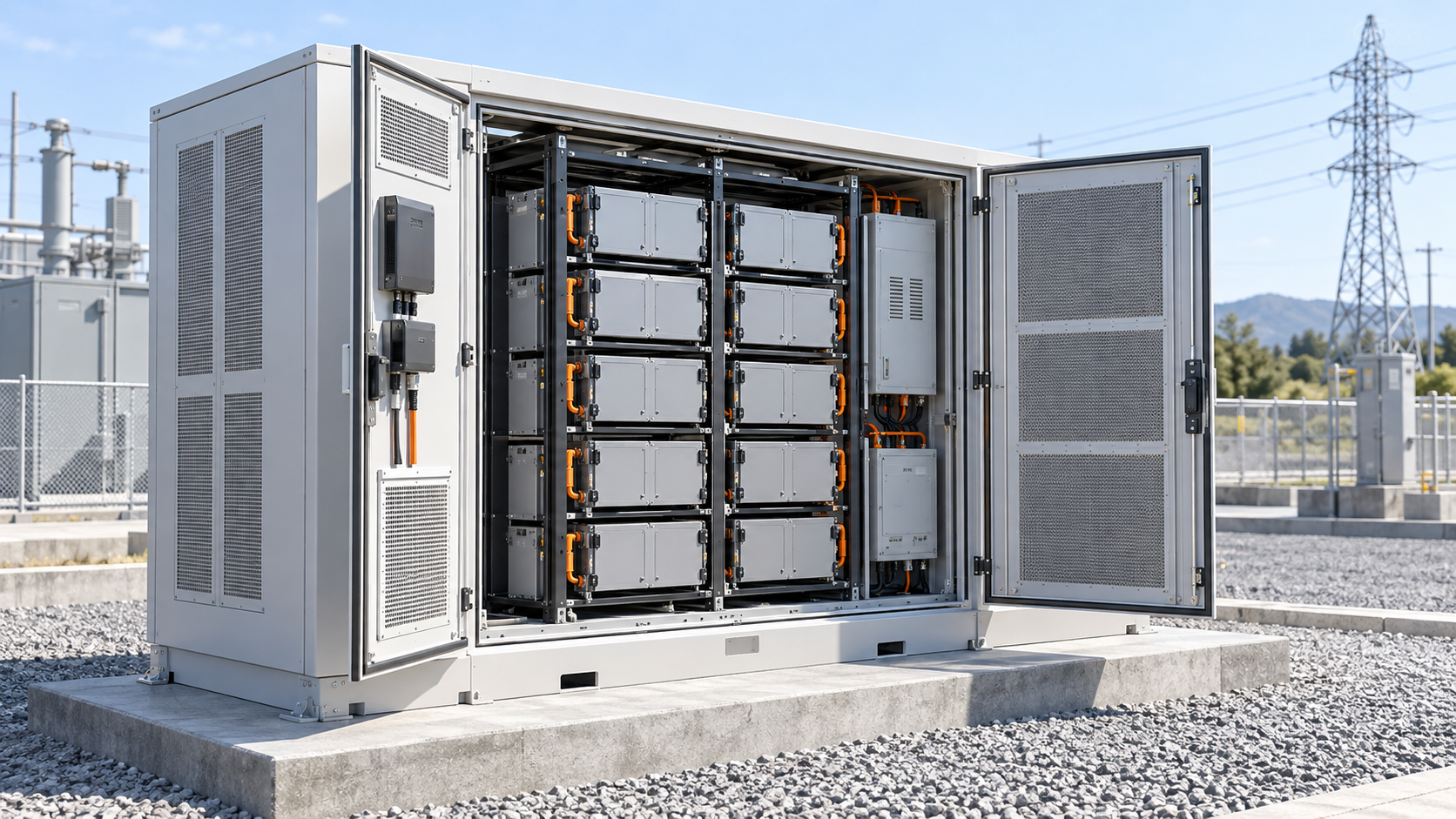
Peak Energy comes up in discussions of next-generation storage because it is a U.S. start-up that builds and sells grid-scale storage systems with no fans, compressors or chillers (passively cooled), using sodium-ion (NFPP) batteries. The company says it shipped its first system in July 2025 and has had it connected to the grid in Colorado since August 2025. In 2026 it announced GM as a cell development partner, a plan for a Sacramento plant (up to 4 GWh a year), and contracts with Energy Vault and RWE Americas. But the plant is only a plan, with shipments expected from the first quarter of 2027, and the "more than 6 GWh contracted" includes options and is the company's own figure. Drawing on the news section of the company's website and Energy Vault's SEC filing, this profile sets out what can and cannot be confirmed. All performance figures are the company's stated values, not third-party assessments.
- Peak Energy in 30 seconds, and where it stands in next-generation storage
- The logo and how the name is written
- Where the company sits in next-generation storage
- Scale
- Resources committed to next-generation storage
- What it has done so far
- What comes next
- What the company is aiming for
- Partnership map
- Technologies, products and services
- The risks this company carries
- Glossary, references and claim-to-source audit
1. Peak Energy in 30 seconds, and where it stands in next-generation storage
California, U.S.Headquarters (company statement). Cell R&D is in Broomfield, Colorado
Long-duration & new chemistries (secondary)Sells grid systems built on sodium-ion
NFPPCell design is its own, per the company. A GM-made next-generation cell is planned
passively cooled storage system3.1 MWh per unit (manufacturer's stated value); 4-, 6- and 8-hour models
up to 4.75 GWh2027 to 2030. About 720 MWh in 2027 is the firm part; the rest is an option
up to 4 GWh a yearCompany plan (not yet confirmed). Shipments expected from Q1 2027
Peak Energy sells passively cooled grid-scale storage "systems", not battery cells: it is a start-up Sourced. The company says it shipped its first system in July 2025 and has had it connected to the grid and operating in Colorado since August 2025. But the contracts and plant it announced in 2026 are about to enter volume production: the Sacramento plant is a plan with shipments expected from the first quarter of 2027 (not yet confirmed) Not yet confirmed. On cells, in June 2026 it partnered with GM, which will develop a next-generation sodium-ion cell and retain the manufacturing rights. Who makes the cells in use today is something we could not confirm from official materials. The "more than 6 GWh contracted" that the company cites includes options and phased contracts; it is the company's figure, not confirmed revenue.
2. The logo and how the name is written

A note on naming: the company name is "Peak Energy" and its logo is the capital letters "PEAK". The product is the GS1.1 (some pages write GS-1.1). This is not related to other companies that use "Peak" in their names. The logo image is the logo (SVG) published on the company's official website (peakenergy.com).
Official website: https://www.peakenergy.com/3. Where the company sits in next-generation storage
As Fig. 1 shows, Peak's main position is on the "pack cells for the grid" side. What it sells is a container-type system about 7.3 m (24 ft) long (dimensions in the table later) with sodium-ion cells inside, and its distinguishing feature is having no fans, compressors, chillers or coolant loops (company description, manufacturer's stated value) Sourced. It uses a new chemistry (sodium-ion), so it also has a "new chemistries" side, but the discharge durations it offers are 4 to 8 hours, not "100-hour" long-duration storage. See also our explainers on grid-scale storage systems, sodium-ion batteries and battery management systems.
4. Scale
The company is privately held, so revenue, profit and headcount are not published. What can be confirmed from official materials is set out below Sourced.
| Item | What we could confirm | Source |
|---|---|---|
| Founded and founders | June 2023 (company history). The company says it was founded by veterans of Tesla, Enovix and Northvolt. CEO Landon Mossburg and COO Liam O'Connor are co-founders | Reference 3 |
| Capital raised | A US$10 million seed in October 2023; a US$55 million Series A in June to July 2024 (led by Xora Innovation, with Eclipse, TDK Ventures, Tishman Speyer and others taking part); an investment from GM Ventures in June 2026 (amount not disclosed). We could not find other rounds | References 3, 8, 10 |
| Revenue and headcount | Not disclosed (the company does expect a net 348 new jobs across Sacramento and Burlingame by 2030, which is a plan) | Reference 9 |
| Size of contracts (company statement) | The home page says more than 6 GWh is contracted through 2030 and cites US$1.1 billion. These include options and phased contracts and are not confirmed revenue | References 2, 5 |
| Operating record | On the grid in Watkins, Colorado since August 2025 (company statement). The company says a nine-customer pilot has been completed | References 1, 2, 3 |
The company's word "contracted" may mix final contracts, intentions and options. For example, in the Jupiter Power agreement about 720 MWh in 2027 is the firm part, while the 4 GWh for 2028 to 2030 is an option under a capacity reservation, in the company's words. "Could exceed US$500 million in contract value" is likewise a figure that includes the option Not yet confirmed.
5. Resources committed to next-generation storage
Because the company is private, most headcount, R&D and capital-spending figures are not disclosed. What official materials do show is organized below under four headings.
| Type of resource | What primary sources confirm | Status |
|---|---|---|
| People | The website profiles a leadership team with backgrounds at Tesla, Northvolt, Enovix, Lyft, Solid Power, Powin and others. System design is based in Burlingame and cell R&D in Broomfield. Headcount is not disclosed | Sourced / headcount not disclosed |
| Money | Raised to date: US$10 million seed plus US$55 million Series A. The Sacramento plant is up to US$71 million in capital investment (company announcement). R&D spending is not disclosed | Sourced / partly not disclosed |
| Investments, acquisitions, joint ventures, divestments | No record that Peak has invested in or acquired another company, or formed a joint venture, in the official materials we checked. On the receiving side, it has investment from GM Ventures and others | Could not confirm |
| Partnerships (supply, deployment, cells) | Jupiter Power (up to 4.75 GWh), Energy Vault (a 1.5 GWh supply agreement, confirmed in Energy Vault's own SEC filing), RWE Americas (pilot), GM (next-generation cell) | Sourced |
| Universities, research institutions, public funding | The company says the Broomfield cell engineering center was opened in collaboration with the Colorado Office of Economic Development and International Trade (OEDIT) and the City and County of Broomfield (no amount given). The Sacramento project is said to carry a US$10.5 million California tax credit, "CalCompetes" (the company says it was awarded in May 2026; we have not checked the state's own records). No university collaboration or DOE grant appears in the materials we checked | Sourced (company statement) / partly not confirmed |
Next, the status of products and facilities. Stages are given in the company's own wording.
| Product / facility | Location | Scale | Stage | Date | Source |
|---|---|---|---|---|---|
| First GS1.1 grid connection | Watkins, Colorado | Not disclosed (the company says "megawatt-hour scale") | Operating (part of a shared pilot; company statement) | Jul to Aug 2025 | References 3, 6 |
| Battery cell engineering center | Broomfield, Colorado | Not disclosed | Operating (integration, testing and validation of cells, cathodes and anodes; company statement) | 16 Dec 2024 | Reference 11 |
| Manufacturing plant | Sacramento, California (Metro Air Park, 183,000 sq ft) | Up to 4 GWh a year (systems) | Site selection announced. Capital investment of up to US$71 million; shipments expected from Q1 2027 (plan) | 8 Jul 2026 | Reference 9 |
| Development and manufacture of the next-generation sodium-ion cell | Michigan, U.S. (GM's battery labs) | Not disclosed | Development. A partnership in which GM develops the cell and retains manufacturing rights (no volume-production date given) | 9 Jun 2026 | Reference 8 |
6. What it has done so far
| When | What happened | Why it matters |
|---|---|---|
| Jun 2023 | Founded. The company says it was started by veterans of Tesla, Enovix and Northvolt | A team with battery, automation and sourcing experience |
| Oct 2023 | Ended stealth with a US$10 million seed | Backing for a "full-stack storage" strategy |
| Jun to Jul 2024 | US$55 million Series A, led by Xora Innovation (a Temasek-backed fund). The article of the time said a plant was planned to open in 2027 and pilots with six customers would start in 2025 | Funds for productization and pilots |
| Sep 2024 | First system (A1) commissioned and tested in California (company history) | An early prototype |
| 16 Dec 2024 | Opened a battery cell engineering center in Broomfield | Keeps cell design and testing in house |
| 30 Jul 2025 | Announced and shipped its first sodium-ion storage system, in a shared pilot with nine utility and independent-power-producer customers | The company calls it the first grid-scale sodium-ion system on the U.S. grid |
| Aug 2025 | Connected to the grid and operating in Colorado (company history) | Start of real operation |
| 27 Oct 2025 | Held "Energy Day" (47 customers and development partners) and described the first phase as complete | A showcase for customers |
| 12 Nov 2025 | Contract with Jupiter Power for up to 4.75 GWh (2027 to 2030). About 720 MWh in 2027 | The company calls it the largest sodium-ion deployment announced to date |
| 9 Feb 2026 | Energy Vault said it had executed a definitive supply agreement for 1.5 GWh of Peak's storage systems (Energy Vault's SEC filing) | A data-center-related project |
| 11 Mar 2026 | Pilot agreement with RWE Americas (eastern Wisconsin) | The company describes it as the first sodium-ion project in the MISO region |
| 9 Jun 2026 | Strategic partnership with GM, with an investment from GM Ventures. GM develops a next-generation cell and retains manufacturing rights | Makes the source of future cells clearer |
| 8 Jul 2026 | Announced it will build a plant in Sacramento (up to 4 GWh a year, up to US$71 million of capital investment) | Shipments expected from Q1 2027 (plan) |
| 4 Aug 2026 | Named its first Vice President of Sales (Paul D. Menson) | Building out the sales organization |
7. What comes next
from Q1 2027Up to 4 GWh a year. Company plan (not yet confirmed)
1 GWh in 2027The company's outlook in the strategy section of its home page
2028 to 2030: up to 4 GWhThe latter is an option under a capacity reservation
The figures above are the company's targets and outlook, not results Not yet confirmed. Other plans in official materials include:
- Energy Vault: co-development for data centers; Energy Vault says it executed a definitive supply agreement for 1.5 GWh (as stated by Energy Vault)
- GM: GM develops the next-generation sodium-ion cell in its Michigan labs and retains manufacturing rights; Peak builds it into its own systems
- RWE Americas: a pilot installed at RWE's lab in eastern Wisconsin
- Jobs: a net 348 new jobs across Sacramento and Burlingame by 2030 (company expectation)
Who makes the cells in use today, and in what volume / the construction and equipment-ordering status of the Sacramento plant and the final investment amount / the amount, terms and volume-production timing of the GM partnership / certificates and test reports for UL 9540, UL 9540A, UL 1973 and so on / measured field data for GS1.1 (efficiency, degradation, availability) / revenue and headcount / the confirmed value of orders. None appears in the official materials we checked.
8. What the company is aiming for in next-generation storage
This section separates what the company says directly from what we infer. Inference marks our own reading of primary information.
| What can be read | Primary information behind it | Status |
|---|---|---|
| The aim is to be a supplier of grid-scale storage systems that claims "vertical integration from cell to installed project" | The website calls it "America's first vertically integrated energy storage company" and speaks of "from cell to delivered project". Cell manufacturing, however, is planned to sit with GM, which will hold the manufacturing rights | Sourced (company statement) / Inference |
| The main differentiator is cutting running costs by dropping cooling hardware | The product page claims "no fans, compressors, chillers, coolant loops or fire-suppression hardware", "95% less auxiliary power", and a total-cost-of-ownership benefit of US$75/kWh (net present value) (company claims) | Sourced (company claim) |
| It will leave cell manufacturing to GM rather than mass-produce cells itself | The release says GM develops the cell and retains manufacturing rights, and Peak builds it into its systems. No cell plant of its own appears (Sacramento is described as a "systems" plant) | Inference |
| It sees AI data centers and large power producers as lead customers | The Energy Vault project, the home page's "for AI data centers" pitch, and contracts with independent power producers such as Jupiter Power | Sourced (company statement) / Inference |
| It wants to become an "integrated energy company" beyond storage | The home page speaks of an "integrated energy company" and, from 2028, generation, transmission and distribution. No specifics | Sourced (company statement) |
The basis for reading "it leaves the cell to GM" is the June 2026 partnership. GM will develop the sodium-ion cell in its Michigan battery labs and hold exclusive manufacturing rights, while Peak builds the cell into its storage systems and, in its own words, "solidifies its supply chain as domestic manufacturing scales" Sourced. The Sacramento plant Peak announced is a plant for systems; it is not described as a cell plant. From this we read Peak as placing its added value in "system design, thermal management and operation" rather than in cells, but because the supplier of today's cells has not been disclosed, this is not a firm conclusion Not yet confirmed.
9. Partnership map for next-generation storage
The pattern in its partnerships is that its customers are themselves the deploying parties (independent power producers and data-center-oriented operators), while cell development relies on an automaker, GM Sourced. The Energy Vault project differs from the others in that the buyer, Energy Vault, itself calls it a "definitive supply agreement" in an SEC filing, so it can be confirmed from a third party's document. By contrast, part of the final quantity in the Jupiter Power contract is an option and the RWE project is a pilot at a test facility, so the strength of the contracts differs.
10. Technologies, products and services
The product figures below are manufacturer's stated values from the specification table on the company's product page and similar sources. Most come without test conditions (temperature, charge/discharge rate, depth of discharge). This article does not compare them with other makers' products, rank them, or set figures of differing conditions side by side.
| Item | What the official materials state (manufacturer's stated value) | What we could not confirm |
|---|---|---|
| Product | GS1.1, in 4-, 6- and 8-hour models. Outdoor container type (about 7.3 x 2.6 x 3.2 m; maximum weight about 49.9 tonnes). IP66 | Individual specifications of the 6- and 8-hour models |
| Chemistry | Sodium-ion (NFPP; the company's release writes "sodium-ion phosphate pyrophosphate"). "No lithium, no cobalt, no nickel, no graphite" (company statement) | Anode, electrolyte and separator materials; who manufactures the cell |
| Capacity and power | Usable energy 3.1 MWh; DC power 775 kW at 4 hours; operating voltage 750 to 1,500 V | Power of the 6- and 8-hour models |
| Round-trip efficiency | 96% (DC) | Test conditions (temperature, rate, reference point) |
| Temperature and thermal management | Operates at ambient temperatures of −40 to +55°C. Passive cooling plus resistive heating. No fans, compressors, chillers, coolant loops or fire-suppression hardware (company statement) | Temperature distribution and degradation data from cooling-free field operation |
| Life | Design life of 20 years. 7,300 guaranteed cycles. No scheduled maintenance and no augmentation (company statement) | Degradation rate; the conditions of the guarantee (depth, temperature, rate) |
| Availability | 99% guaranteed under a long-term service agreement (LTSA) (company statement) | The terms of the agreement; measured values |
| Codes | The "Codes and compliance" field of the specification table lists UL 9540, UL 9540A, UL 1973, UN 38.3 and NFPA 855 | Certificates and test reports; whether this means certified or "designed to comply" |
| Cost | A total-cost-of-ownership benefit of US$75/kWh (net present value), and storage cost about 20% below conventional systems (both company claims; the basis is not given on the page) | The basis and the comparison used |
The company says it can omit cooling because of the stability of the NFPP-type cell combined with a passive thermal design of the whole system Sourced. From the materials side, three things matter most (what follows is general explanation, not measurements on Peak's cells) Not yet confirmed. (1) The cold end: higher electrolyte viscosity makes ions move more slowly, and anode reactions slow down. The company says it uses electric resistive heaters, and we cannot confirm output or charging conditions at −40°C. (2) The hot end: electrolyte decomposition and film growth speed up ageing. In a design with no cooling, temperature differences between cells tend to turn into differences in ageing. (3) Heat generated: from the stated 96% round-trip efficiency, if all of the loss became heat, one cycle of charging and discharging 3.1 MWh would lose about 0.12 MWh (3.1 x 0.04) Our calculation (no test conditions are given, so this is only an upper-bound guide, and it includes DC-side losses such as wiring). How that heat is carried out of the container (the shell, the air path inside, the cell layout) is likely the heart of a passive design. The anode is not described in official materials. From the statement "no graphite", we guess it is likely hard carbon, the usual choice in sodium-ion cells Inference. See our explainers on hard carbon anodes, thermal runaway and battery safety, and grid-scale storage systems.
The product page also carries claims such as "89% of incident causes removed by design", "higher round-trip efficiency than LFP under training loads" and "FERC docket RM26-4 treats 4 to 8 hours of storage as a regulatory unlock". These are claims the company has arranged from its own viewpoint, and because we could not confirm the source documents or conditions, we do not repeat them here as fact.
11. The risks this company carries
| Risk | Detail | Status |
|---|---|---|
| No factory yet | For Sacramento only the site selection has been announced; shipments are expected from Q1 2027 (plan). Construction and equipment-ordering status could not be confirmed | Sourced / Not yet confirmed |
| Cell supply | The maker of today's cells is not disclosed. The next-generation cell is planned to be made by GM, which holds the manufacturing rights, and no timing for GM's production is given. Cell supply can govern system production | Sourced / Inference |
| Differences in contract strength | Part of Jupiter is an option; RWE is a pilot. "More than 6 GWh contracted" is the company's figure and includes options and phased contracts | Sourced |
| Hard to verify externally | Efficiency, life, availability and cost claims are the company's own, and we could not find test conditions, third-party reports or long-term field data. Real operation began in August 2025, so the 20-year design life is untested | Not yet confirmed |
| The premise of a cooling-free design | The cost advantage rests on holding life across a wide range (−40 to +55°C) with no cooling. We cannot confirm that this premise holds in the field | Inference |
| Funding | A privately held company; the rounds we could confirm are the seed, the Series A and GM Ventures' investment. We could not confirm the overall financing of the plant | Not yet confirmed |
| Dependence on policy and supply chains | "U.S.-made, domestic supply chain" is central to its pitch, so changes in U.S. policy such as tax credits and tariffs affect its environment (we have not checked the text of the law) | Inference |
| Competing chemistries | Competition from lithium iron phosphate (LFP) and other sodium-ion batteries. The company arranges its comparison with LFP from its own viewpoint | Inference |
This article is an overview of a company. It is not advice on battery safety or installation. Installing and operating a storage system follows the laws, standards and authorities of the relevant country or locality, and the manufacturer's instructions.
12. Glossary
- Sodium-ion battery
- A battery in which sodium ions, rather than lithium ions, move between the cathode and anode.
- NFPP
- Generally sodium iron pyrophosphate phosphate: a polyanionic cathode material for sodium-ion batteries.
- Passive cooling
- A design that sheds heat without powered cooling hardware such as fans or compressors.
- Auxiliary power
- Electricity that a storage system uses for its own cooling and control. It is one factor that lowers round-trip efficiency.
- IPP
- Independent power producer: a company that generates and sells power separately from the utilities.
- LTSA
- Long-term service agreement: a long-term contract covering maintenance and performance guarantees.
- Augmentation
- Adding batteries later to make up for capacity lost to degradation.
- UL 9540 / UL 9540A / UL 1973
- A U.S. safety standard for energy storage systems / a test method for how thermal runaway propagates in them / a safety standard for stationary batteries.
- NFPA 855 / UN 38.3
- A U.S. standard for installing stationary energy storage systems / the United Nations transport tests for lithium batteries.
- SOP
- Start of production.
13. References
- Peak Energy Product page, "GS1.1". Specification table (chemistry, capacity, power, round-trip efficiency, temperature range, design life, codes field), the passive thermal design, and the company's claims on total cost of ownership and availability. https://www.peakenergy.com/product/gs1.1
- Peak Energy Company home page. Business description, the three-phase strategy, the volume the company calls "contracted" (more than 6 GWh), and the news list (to August 2026). https://www.peakenergy.com/
- Peak Energy Company page, "About". Leadership, history (founded June 2023 to the first operation in August 2025), sites. https://www.peakenergy.com/company/about
- Peak Energy Company page, "Strategy". Mission, and the company's framing of problems and solutions (the case for domestic supply). https://www.peakenergy.com/company/strategy
- Peak Energy News: contract with Jupiter Power for up to 4.75 GWh (12 November 2025, distributed by PR Newswire). About 720 MWh in 2027; 4 GWh for 2028 to 2030 is an option. https://www.peakenergy.com/news/latest/peak-energy-signs-4-75-gwh-contract
- Peak Energy News: launch and shipment of the first U.S. grid-scale sodium-ion storage system (30 July 2025, distributed by PR Newswire). A shared pilot with nine customers. https://www.peakenergy.com/news/latest/peak-energy-delivers-first-grid-scale-sodium-ion-battery-storage-system-in-the-u-s
- Peak Energy News: pilot agreement with RWE Americas (11 March 2026, distributed by PR Newswire). Installed at RWE's lab in eastern Wisconsin. https://www.peakenergy.com/news/latest/peak-signs-agreement-to-deploy-misos-first-low-cost-sodium-ion-grid-storage-battery
- Peak Energy News: strategic partnership with GM (9 June 2026, distributed by PR Newswire). GM develops a next-generation sodium-ion cell and retains manufacturing rights; GM Ventures invests. https://www.peakenergy.com/news/latest/gm-partnership
- Peak Energy News: manufacturing plant in Sacramento, California (8 July 2026, distributed by PR Newswire). Up to 4 GWh a year, capital investment of up to US$71 million, shipments expected from the first quarter of 2027. https://www.peakenergy.com/news/latest/gigafactory-announcement
- Peak Energy (article carried from TechNode Global) News: close of the US$55 million Series A (article dated 19 July 2024). Led by Xora Innovation, with Eclipse, TDK Ventures and others taking part. https://www.peakenergy.com/news/latest/xora-innovation-leads-55m-series-a-funding-round-in-us-battery-maker-peak-energy
- Peak Energy (article carried from PV Magazine USA) News: opening of the battery cell engineering center in Broomfield, Colorado (dated 16 December 2024), in collaboration with the Colorado Office of Economic Development and International Trade (OEDIT) and the City and County of Broomfield. https://www.peakenergy.com/news/latest/opening-cell-engineering-center-in-broomfield-2024
- Peak Energy News: "Energy Day" (27 October 2025). Hosted 47 customers and development partners to mark power-on of the first passively cooled storage system. https://www.peakenergy.com/news/latest/energy-day
- Energy Vault Holdings, Inc. (NYSE: NRGV) Form 8-K filed 11 February 2026, Exhibit 99.1. Refers to a definitive supply agreement with Peak Energy for 1.5 GWh of sodium-ion storage systems (announced 9 February 2026). https://www.sec.gov/Archives/edgar/data/1828536/000110465926013399/tm265927d1_ex99-1.htm
14. Claim-to-source audit
| Claim in the text | Status | Source |
|---|---|---|
| Founding (June 2023), founders and leadership, sites (Burlingame, Broomfield), history (seed, Series A, A1, first operation) | Sourced | Reference 3 https://www.peakenergy.com/company/about |
| Details of the US$55 million Series A (led by Xora Innovation, with Eclipse, TDK Ventures and others) | Sourced | Reference 10 https://www.peakenergy.com/news/latest/xora-innovation-leads-55m-series-a-funding-round-in-us-battery-maker-peak-energy |
| GS1.1 specifications (NFPP, 3.1 MWh, 775 kW, 96%, -40 to +55 C, 20 years, 7,300 cycles, IP66, codes field) | Sourced | Reference 1 https://www.peakenergy.com/product/gs1.1 (manufacturer's stated values; conditions not given) |
| Passive cooling, no fans, compressors or chillers, 99% availability, a total-cost-of-ownership benefit of US$75/kWh and similar claims | Sourced | Reference 1 https://www.peakenergy.com/product/gs1.1 (company claims) |
| The Jupiter Power contract for up to 4.75 GWh (about 720 MWh in 2027, a 4 GWh option for 2028 to 2030, value could exceed US$500 million) | Sourced | Reference 5 https://www.peakenergy.com/news/latest/peak-energy-signs-4-75-gwh-contract (company statement; the value includes the option) |
| Launch and shipment of the first grid-scale sodium-ion storage system, and the nine-customer shared pilot (30 July 2025) | Sourced | Reference 6 https://www.peakenergy.com/news/latest/peak-energy-delivers-first-grid-scale-sodium-ion-battery-storage-system-in-the-u-s |
| The pilot agreement with RWE Americas (eastern Wisconsin, 11 March 2026) | Sourced | Reference 7 https://www.peakenergy.com/news/latest/peak-signs-agreement-to-deploy-misos-first-low-cost-sodium-ion-grid-storage-battery |
| The strategic partnership with GM (GM develops the next-generation cell and retains manufacturing rights; GM Ventures invests; 9 June 2026) | Sourced | Reference 8 https://www.peakenergy.com/news/latest/gm-partnership |
| The Sacramento plant (183,000 sq ft, up to 4 GWh a year, up to US$71 million of capital investment, shipments expected from Q1 2027, jobs, CalCompetes) | Sourced | Reference 9 https://www.peakenergy.com/news/latest/gigafactory-announcement (company announcement and plan) |
| The Broomfield battery cell engineering center (16 December 2024, with OEDIT and the City and County of Broomfield) | Sourced | Reference 11 https://www.peakenergy.com/news/latest/opening-cell-engineering-center-in-broomfield-2024 |
| Energy Day (27 October 2025, 47 customers and development partners, first phase complete) | Sourced | Reference 12 https://www.peakenergy.com/news/latest/energy-day |
| The definitive 1.5 GWh supply agreement with Energy Vault (announced 9 February 2026; referred to in Energy Vault's SEC filing) | Sourced | Reference 13 https://www.sec.gov/Archives/edgar/data/1828536/000110465926013399/tm265927d1_ex99-1.htm |
| More than 6 GWh contracted, US$1.1 billion, 5 projects in 2026 and 1 GWh in 2027, 4 GWh and Q1 2027 shipments from Sacramento (company outlook) | Sourced | Reference 2 https://www.peakenergy.com/ Reference 9 https://www.peakenergy.com/news/latest/gigafactory-announcement (company claims and outlook) |
| Strategy and mission, and the "vertical integration" claim | Sourced | Reference 4 https://www.peakenergy.com/company/strategy Reference 3 https://www.peakenergy.com/company/about |
| Classification of Peak (storage systems as main, long-duration and new chemistries as secondary) | Our calculation | our own grouping, based on the website and the 2025 to 2026 news |
| Heat-loss guide (about 0.12 MWh per cycle from 96%) | Our calculation | Reference 1 https://www.peakenergy.com/product/gs1.1 our calculation: 3.1 MWh x (1 - 0.96); test conditions unknown, so an upper-bound guide |
| Headcount, revenue, R&D spending, the current cell maker, certificates, field data, and the terms of the GM partnership | Not yet confirmed | Not in the official materials we checked; this article does not estimate them (items we could not confirm) |
| Investments, acquisitions or joint ventures by Peak, university collaborations, and DOE grants | Not yet confirmed | Not in the official materials we checked; this article does not claim that none exist (limit of our check) |
| Construction and equipment ordering at Sacramento, and shipments from Q1 2027 | Not yet confirmed | A company plan, not a result (outlook) |
| Reading that the anode is likely hard carbon | Inference | Reference 1 https://www.peakenergy.com/product/gs1.1 our guess from the statement "no graphite" |
| Reading that cells are left to GM and added value sits on the system side | Inference | Reference 8 https://www.peakenergy.com/news/latest/gm-partnership Reference 9 https://www.peakenergy.com/news/latest/gigafactory-announcement our interpretation of the GM partnership and the Sacramento announcement |
| General statements on the cold end, the hot end and heat generated | Not yet confirmed | our own explanation (general statement, not a measurement on Peak's cells) |
Last updated: 10 October 2026 / Troy Technical
This article draws on the product page, company pages and news posted on Peak Energy's website (including articles distributed by PR Newswire and others) and on a filing that Energy Vault Holdings, Inc. submitted to the U.S. SEC. Market-research estimates and press-report-only figures are not used. The performance figures are the company's stated values; most come without conditions, and we have not found third-party verification. Passages marked "Inference" are our own reading of primary information and are not statements by the company.