TECHNOLOGY EXPLAINER
MXenes and Nanosheets
— carved-out two-dimensional materials, where storage matters more than synthesis
MXenes are two-dimensional materials made by dissolving the aluminium (or similar) layers out of a layered metal carbide, the MAX phase, with acid and then separating the layers that remain. They conduct electricity like a metal and their surfaces take up water. Dispersed in water, however, they oxidise and degrade. This article covers MXene structure and synthesis, surface terminations, oxidation and storage, where other two-dimensional nanosheets (oxides, boron nitride, transition metal dichalcogenides) fit, and how far each application has progressed from the laboratory, all based on papers.
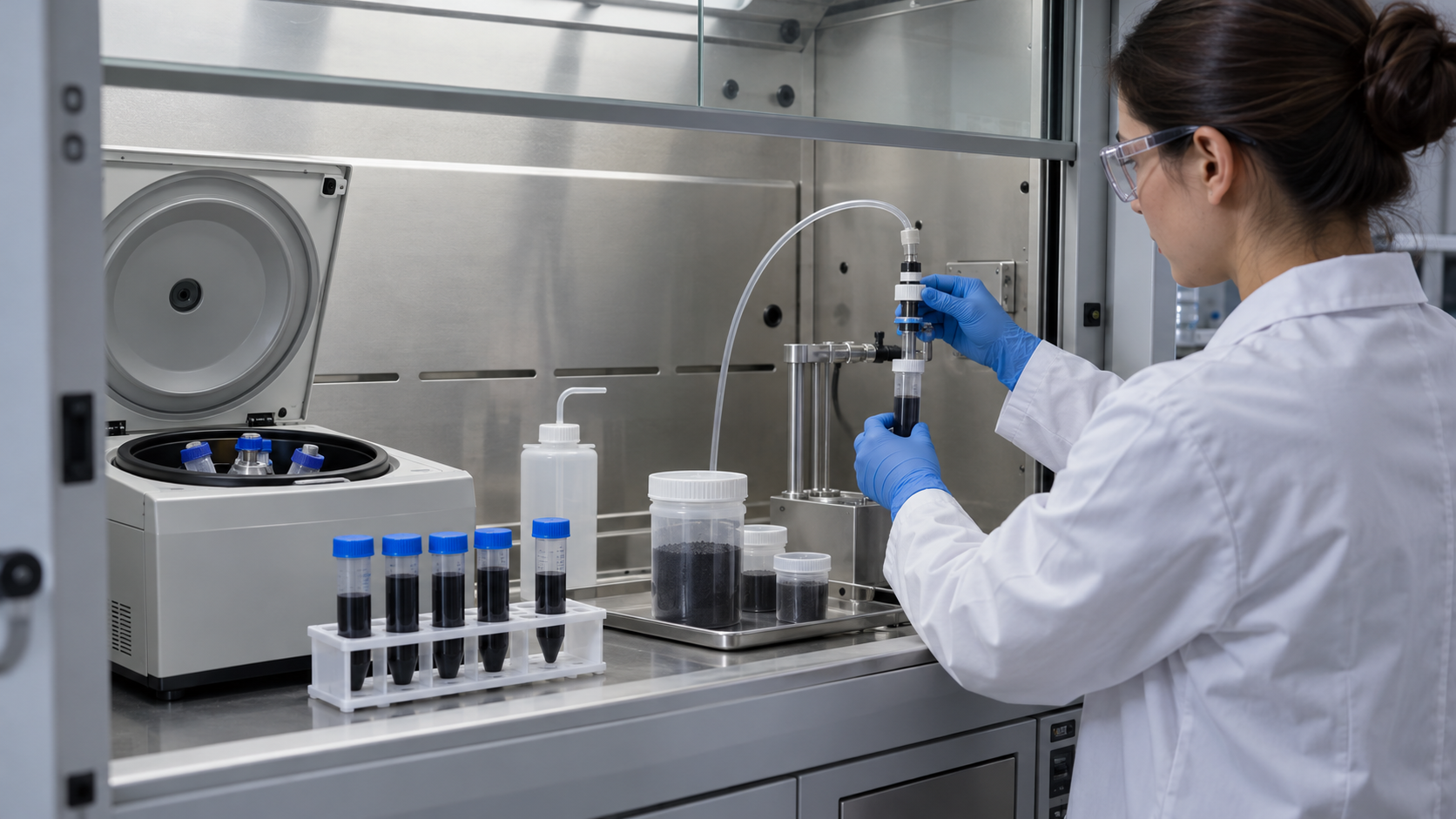
- What MXenes and nanosheets are (the short version)
- Structure and synthesis — dissolving the A layer out of a MAX phase
- Our calculation: how much termination changes the formula mass
- A materials engineer's view (1): "Ti₃C₂T x " is not one compound
- Oxidation stability and storage
- Our calculation: storage time, film sheet resistance and shielding figures
- Where other two-dimensional nanosheets fit — conductor, semiconductor, insulator
- Applications — laboratory and demonstration stages
- A materials engineer's view (2): turning storage into a procedure
- What could not be confirmed / how this fits with other articles in the series
- How to read evaluations and standards
- Glossary
- Primary sources
- Claim-to-source audit
Sourced = a statement in a paper (link given)
Our calculation = a figure this article derived, with the assumptions spelled out
Not yet confirmed = a plan or outlook with no confirmed record
Materials-design interpretations are marked separately as Commentary.
Graphene is covered in our graphene explainer and carbon nanotubes in our carbon nanotube explainer. This article covers the other two-dimensional materials (MXenes above all, plus oxides, boron nitride and transition metal dichalcogenides).
Syntheses that use acids (hydrofluoric acid and others) need special equipment and procedures. This is not a synthesis manual and gives no advice on any particular work.
1. What MXenes and nanosheets are (the short version)
An MXene is a two-dimensional transition metal carbide or nitride made by selectively etching the A layer out of a MAX phase (Mn+1AXn: a transition metal M, a group-A element A, and carbon or nitrogen X). MAX phases are metallically conductive layered solids held together by strong metallic, ionic and covalent bonds Sourced [Ref. 2]. The first report was in 2011, when Naguib and co-workers exfoliated Ti₃AlC₂ in hydrofluoric acid (HF) at room temperature and obtained Ti₃C₂ nanosheets, multilayer structures and conical scrolls Sourced [Ref. 1].
- Metallic conductivity and a water-loving surface: MXenes combine the metallic conductivity of transition metal carbides with the hydrophilic nature of hydroxyl- or oxygen-terminated surfaces, and behave as “conductive clays” Sourced [Ref. 2]. About 20 have been synthesised and dozens more predicted Sourced [Ref. 4].
- Freedom on the making side: because the process dissolves material out of a precursor (top-down), the amount can be scaled with reactor volume. Ti₃C₂Tx made in 1 g and 50 g batches was reported to be essentially the same in structure and composition Sourced [Ref. 9].
- The difficulty is storage: MXene dispersed in water is oxidised by dissolved oxygen to anatase (TiO₂). In an open vial degradation was reported to be complete in 15 days Sourced [Ref. 7] (Chapter 5).
Read an MXene number together with “from which precursor, by which method, with which surface, after how much storage”. Even for the same “Ti₃C₂”, the proportions of surface groups change with the etching method Sourced [Ref. 6] and resistance to oxidation changes with the crystallinity of the precursor Sourced [Ref. 8]. When conductivity figures differ by an order of magnitude, first check whether the material differs or only how long it was stored (Commentary).
2. Structure and synthesis — dissolving the A layer out of a MAX phase
A MAX phase is a stack of M–X layers with A layers sandwiched in between. MXene synthesis selectively dissolves only A and leaves the remaining M–X layers (Mn+1Xn) with their surfaces capped by functional groups (T). That is why the formula is written Mn+1XnTx.
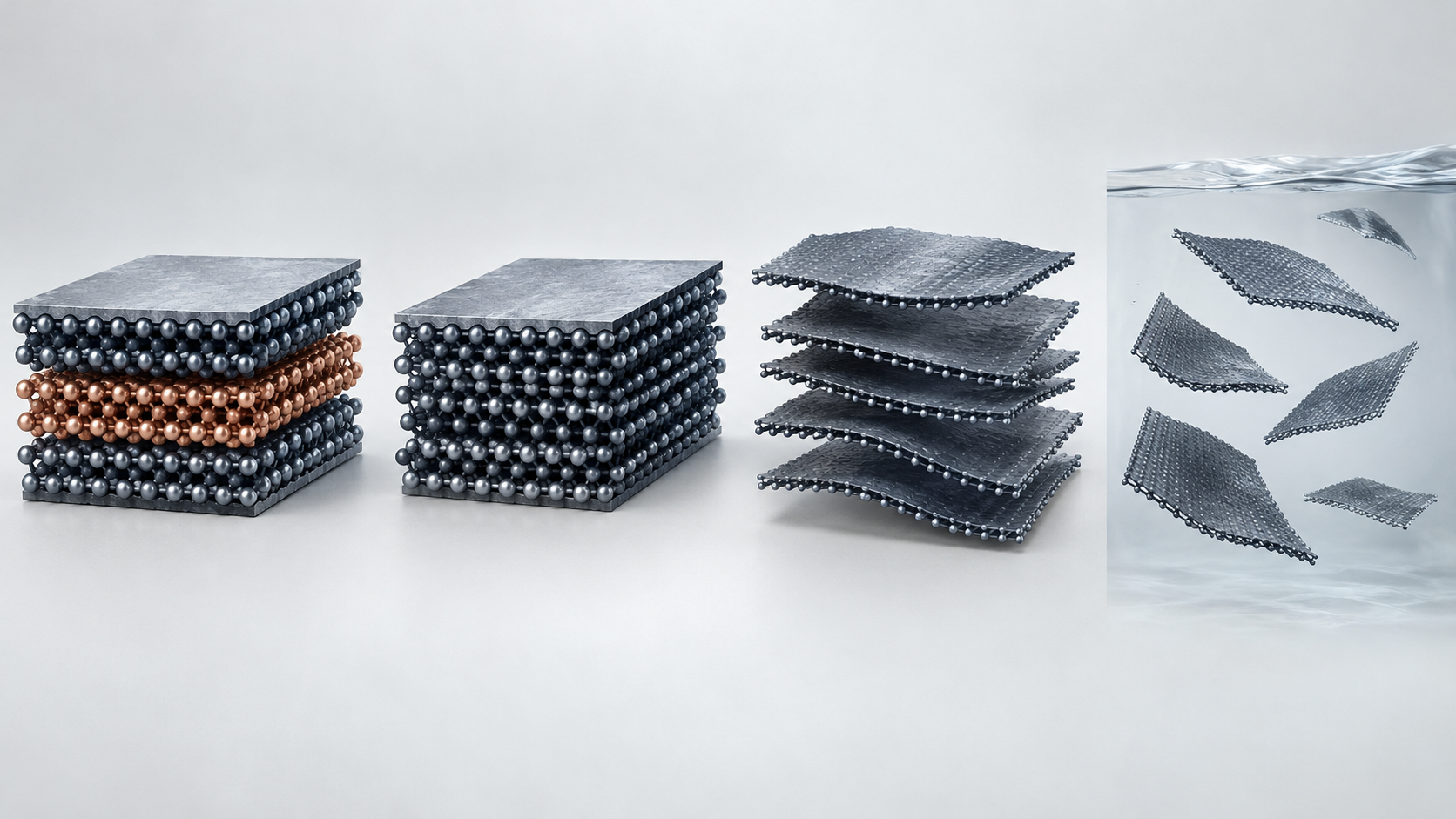
Shapes, colors and dimensions are illustrative. Consult the original schematic below for exact values and label correspondence.
View the original SVG schematic and exact annotations
Reading guide and original schematic labels: From MAX phase to MXene (concept) / The example is Ti₃AlC₂ to Ti₃C₂Tₓ. Layer counts, spacings and atom positions are schematic / 1 MAX phase / 2 Dissolve A / 3 Multilayer stack / 4 Delamination / M–X layers (blue) and / A layers (yellow) stacked / Acid etches away only / the A layer, selectively / Water and ions enter / between layers; surfaces / end in –O, –OH, –F / A dispersion in water of / single to few-layer sheets / Oxidises in storage (Chapter 5) / * 1: a MAX phase is a layered solid with A layers between [Ref. 2]. 2 to 4: selective etching and terminations [Ref. 2, 4]. / * Colours, atom positions and layer counts are illustrative; real stack thickness and interlayer species are not shown. / * The etchant (HF, or LiF with HCl, and so on) changes the form obtained and the surface (see the table below).
| Report | Method and what was obtained (with conditions) | What to read as a materials engineer |
|---|---|---|
| Naguib et al. 2011 | Ti₃AlC₂ exfoliated in HF at room temperature gave two-dimensional Ti₃C₂ nanosheets, multilayer structures and conical scrolls. Ti₃AlC₂ is one of a group of more than 60 layered ternary carbides and nitrides, so the approach can be extended Sourced [Ref. 1] | The first report. It uses a strong acid (HF). The forms obtained (sheets, multilayers, scrolls) are mixed (Commentary) |
| Ghidiu et al. 2014 | Aluminium was etched in a mixture of lithium fluoride (LiF) and hydrochloric acid (HCl). The hydrophilic product swells when hydrated, can be shaped like clay and dried into a highly conductive solid, or rolled into films tens of micrometres thick. Additive-free films reach a volumetric capacitance of up to 900 F/cm³. It avoids handling concentrated HF and gives a much faster route to films Sourced [Ref. 3] | The “clay” route. The authors present avoiding HF as easier on equipment and safety. Surface species and interlayer ions differ from the HF route (Commentary) |
| Lipatov et al. 2016 | A modified synthesis gave high-quality monolayer Ti₃C₂Tx flakes, from which field-effect transistors were made. One flake has a conductivity of 4600 ± 1100 S/cm and a field-effect electron mobility of 2.6 ± 0.7 cm²/V·s. The resistivity of multilayer films is only about an order of magnitude above that of a single flake Sourced [Ref. 5] | The paper separates the value for a single flake from that for a film. The authors say it shows good transport between flakes |
| Shuck et al. 2020 | Ti₃C₂Tx was synthesised in 1 g and 50 g batches. SEM, XRD, DLS, Raman, XPS, UV-visible and conductivity showed the two to be essentially identical in structure and composition. Because etching happens throughout the volume, the amount scales with reactor volume Sourced [Ref. 9] | 50 g is a laboratory batch scale, not a record of manufacturing scale (Commentary) |
As stated in each paper’s abstract. Precursors, etchants and measurement methods differ, so the table does not rank the rows.
3. Our calculation: how much termination changes the formula mass
The MXene surface is capped with hydroxyl (–OH), oxygen (–O) and fluorine (–F) groups Sourced [Ref. 4]. Hope et al.’s nuclear magnetic resonance (NMR) study showed that on the internal surfaces of Ti₃C₂Tx –F and –OH are intimately mixed, that –OH is far less common than –F or –O, and that the proportions depend strongly on the synthesis method Sourced [Ref. 6]. Let us see through the formula mass how much termination matters for per-mass figures Our calculation.
- Assumptions: atomic masses Ti 47.867, C 12.011, O 15.999, F 18.998, H 1.008 (standard values). The ideal case of two terminating groups per Ti₃C₂ unit (x = 2).
- Bare Ti₃C₂: 3 × 47.867 + 2 × 12.011 = 167.6
- Ti₃C₂O₂: 167.6 + 2 × 15.999 = 199.6 (about 1.19 times bare)
- Ti₃C₂(OH)₂: 167.6 + 2 × 17.007 = 201.6 (about 1.20 times)
- Ti₃C₂F₂: 167.6 + 2 × 18.998 = 205.6 (about 1.23 times)
Assumptions and limits: x = 2 is an idealisation; real samples differ in proportions and in vacancies. The paper shows only qualitatively that proportions change with the synthesis method; the formula masses used here are our calculation. Conclusion: whether or not you include termination changes the formula mass by about 19 to 23%, while the difference between termination types (–O, –OH, –F) is at most about 3%. So a per-mass capacity or conductivity moves by about 20% depending on whether it was divided by the terminated formula mass, and a change in the proportion of terminations is worth a few per cent (Commentary).
4. A materials engineer’s view (1): “Ti₃C₂Tx” is not one compound
Under the name “Ti₃C₂Tx” sit materials with four different histories. Read as items to check when buying or accepting (the following is Commentary):
- Precursor (MAX phase): adding excess Al when synthesising the MAX phase improves crystallinity and carbon stoichiometry, and the MXene made from it resists oxidation better and reaches a conductivity of up to 20,000 S/cm Sourced [Ref. 8]. Check the precursor lot and how it was made.
- Etchant: the HF route and the LiF/HCl route differ in surface species and interlayer ions (Chapters 2 and 3). “HF-free” is a safety feature, not a statement that properties are the same.
- Flake size: smaller flakes are less stable Sourced [Ref. 7]. Larger flakes help conductivity but change dispersion and film-forming conditions.
- Storage history: days since making, atmosphere and temperature in storage, dispersion or dried film. The same lot can become a different material within weeks (Chapter 5).
5. Oxidation stability and storage
A major obstacle to practical use of MXenes is how fast freshly made samples oxidise and degrade as aqueous suspensions Sourced [Ref. 8]. Zhang et al. studied colloidal Ti₃C₂Tx solutions in water and reported that in open vials 42%, 85% and 100% degraded after 5, 10 and 15 days, leaving cloudy-white solutions made mainly of anatase (TiO₂). By contrast, storage in hermetic argon-filled bottles at 5 °C kept the solution well preserved, because dissolved oxygen, the main oxidant, was eliminated. Degradation starts at the flake edges, small flakes are the least stable, and the paper shows how the degradation time constant can be used to estimate flake size in situ from UV-visible spectra Sourced [Ref. 7].
Lipatov et al. followed the conductivity of a single Ti₃C₂Tx flake in humid air and reported that it stays highly conductive beyond 24 hours, and that after an initial exponential decay the conductivity falls linearly with time, consistent with oxidation at the flake edges Sourced [Ref. 5]. Mathis et al. reported that adding excess aluminium when synthesising the MAX phase gives Al–Ti₃AlC₂ of improved crystallinity and carbon stoichiometry, and that aqueous suspensions of the resulting Al–Ti₃C₂ keep for more than 10 months (1 to 2 weeks for conventional Ti₃C₂), with oxidation in air starting at temperatures 100 to 150 °C higher. Freestanding films made from suspensions stored for ten months showed minimal loss of conductivity and negligible oxidation Sourced [Ref. 8].
6. Our calculation: storage time, film sheet resistance and shielding figures
Let us tie the papers’ numbers together to check orders of magnitude Our calculation.
- Ratio of shelf lives: taking 10 months as about 300 days (30 days a month, our assumption), 300 ÷ 14 = about 21 and 300 ÷ 7 = about 43. In Mathis et al.’s report that is about 21 to 43 times or more the conventional 1 to 2 weeks (“over 10 months”, so a lower bound).
- Sheet resistance of a film: for Shahzad et al.’s films, conductivity 4600 S/cm and thickness 45 µm (= 4.5 × 10⁻³ cm), sheet resistance = 1 ÷ (conductivity × thickness) = 1 ÷ (4600 × 4.5 × 10-3) = about 0.048 Ω/sq. For 2.5 µm: 1 ÷ (4600 × 2.5 × 10-4) = about 0.87 Ω/sq.
- Shielding as a fraction: 92 dB means transmitted power of 10-9.2 = about 6.3 × 10⁻¹⁰; 50 dB is 10-5 (one part in 100,000).
Assumptions and limits: “10 months = 300 days” is our assumption. The ratio of shelf lives compares values from different studies and different precursors, not a like-for-like test. The sheet-resistance formula assumes a uniform film with the same conductivity throughout (the 4600 S/cm is Shahzad et al.’s value). The dB conversion follows the definition that shielding effectiveness is ten times the common logarithm of the transmitted power ratio.
7. Where other two-dimensional nanosheets fit — conductor, semiconductor, insulator
Since the discovery of graphene, exfoliable layered crystals have been treated as a broad family of materials. In 2005 Novoselov and co-workers used micromechanical cleavage to make two-dimensional crystals, including single layers of graphite, boron nitride, dichalcogenides and complex oxides, and reported them stable in air, of high crystal quality and continuous on a macroscopic scale Sourced [Ref. 11]. In 2013 Geim and Grigorieva reviewed “van der Waals heterostructures”, in which such crystals are disassembled into individual atomic planes and reassembled in a designed order Sourced [Ref. 12].
| Family | Reported values and statements (with conditions) | Production and what to read as a materials engineer |
|---|---|---|
| Oxide and hydroxide nanosheets | Cation-exchangeable layered transition-metal oxides and anion-exchangeable layered hydroxides are exfoliated into individual host layers (nanosheets), about 1 nm thick with lateral sizes from sub-micrometre to tens of micrometres, and can be assembled by solution processes into multilayer films and nanocomposites Sourced [Ref. 13]. A lepidocrocite-type layered titanate was exfoliated with tetrabutylammonium hydroxide solution to give a stable colloid (1996) Sourced [Ref. 14]. Dielectric nanosheets could serve as insulators and gate dielectrics in next-generation nanoelectronics, in contrast with conducting graphene Sourced [Ref. 15] | A “solution” route in which bulky ions widen the gap between layers. As with MXenes, aligning layers in solution and controlling restacking are the issues (Commentary) |
| Hexagonal boron nitride (h-BN) | Pure h-BN single crystals grown at high pressure and temperature show a dominant luminescence peak near 215 nm characteristic of a direct gap, with evidence of room-temperature ultraviolet lasing Sourced [Ref. 16]. Graphene on single-crystal h-BN has mobility “almost an order of magnitude” better than on SiO₂ (see our graphene explainer) Sourced [Ref. 17] | An insulating, atomically flat “substrate”. The quality of the boron nitride single crystal tells on the stacked device (Commentary) |
| Transition metal dichalcogenides (TMDs) | As MoS₂ is thinned, the indirect gap shifts up by more than 0.6 eV, becoming a direct-gap material at one layer, and the monolayer emits light strongly (luminescence quantum efficiency more than 104 times that of the bulk) Sourced [Ref. 18]. A single-layer MoS₂ transistor with an HfO₂ gate dielectric showed a room-temperature mobility of at least 200 cm²/V·s, an on/off ratio of 1 × 10⁸ and ultralow standby power Sourced [Ref. 19]. MX₂-type compounds (M such as Mo or W; X = S, Se, Te) are a promising alternative as semiconductors Sourced [Ref. 20] | They have the band gap that graphene lacks. The mobility figure depends on the gate dielectric, the substrate and the measurement method (Commentary) |
| Liquid exfoliation (general) | Layered compounds such as MoS₂, WS₂, MoSe₂, MoTe₂, TaSe₂, NbSe₂, NiTe₂, BN and Bi₂Te₃ can be dispersed efficiently in common solvents and made into flakes or films. WS₂ and MoS₂ reinforce polymers, and WS₂/carbon-nanotube hybrid films have high conductivity and promising thermoelectric properties Sourced [Ref. 21] | The same principle as liquid-phase exfoliation of graphene (Chapter 3 of our graphene explainer). Size and thickness are mixed (Commentary) |
As stated in each paper’s abstract. Materials, samples and measurement conditions differ, so the table does not rank the rows.
8. Applications — laboratory and demonstration stages
Most applications of MXenes and two-dimensional nanosheets are laboratory reports. Here, what has been reported is separated by the stage we could confirm. We could not confirm products sold as such within the scope of this article (Chapter 10).
| Application | Report or statement (with conditions) | Stage |
|---|---|---|
| Energy storage (MXene) | Additive-free films of Ti₃C₂ “clay” made with LiF/HCl have a volumetric capacitance of up to 900 F/cm³ with excellent cyclability and rate performance. The paper cites about 300 F/cm³ as the best for carbon-based electrodes and 1,000 to 1,500 F/cm³ for hydrated ruthenium oxide, only in thin films Sourced [Ref. 3]. A review says about 20 MXenes have been synthesised, with uses in energy storage, EMI shielding, composite reinforcement, water purification, sensors, lubrication and catalysis Sourced [Ref. 4] | Laboratory. Values are for electrode films, not for a cell or package (Commentary) |
| EMI shielding (MXene) | A 45 µm Ti₃C₂Tx film had a shielding effectiveness of 92 dB (over 50 dB even for a 2.5 µm film), which the paper says is the highest among synthetic materials of comparable thickness. The causes are a conductivity of 4600 S/cm and multiple internal reflections among flakes in the film Sourced [Ref. 10] | Laboratory. Do not generalise the authors’ claim of “the highest” |
| Synthesis scale (MXene) | Ti₃C₂Tx was synthesised at 1 g and 50 g, with essentially identical structure and properties. The authors say that because the amount scales with reactor volume it can be expanded towards commercialisation Sourced [Ref. 9] | A laboratory batch. Volume production not confirmed Not yet confirmed |
| Transistors (TMD) | A single-layer MoS₂ transistor with a room-temperature mobility of at least 200 cm²/V·s, an on/off ratio of 108 and very low standby power Sourced [Ref. 19] | Demonstration of a single device. Volume production not confirmed |
| Dielectrics (oxide nanosheets) | A review arranges dielectric nanosheets as candidate replacements in memories, capacitors and gate dielectrics Sourced [Ref. 15] | Research (review) |
9. A materials engineer’s view (2): turning storage into a procedure
From the reports in Chapter 5, the handling of aqueous MXene can be read as the following procedure (Commentary; this is not advice on any particular work).
- Remove dissolved oxygen: the main oxidant is dissolved oxygen Sourced [Ref. 7]. The basic approach is to divide into oxygen-free containers and seal them, and to open them as few times as possible.
- Storage temperature: low temperature (5 °C) is what was reported Sourced [Ref. 7]. Whether freezing causes other problems is not something we confirmed in these sources.
- Keep dates and history: date made, flake size (which can be estimated from UV-visible spectra Sourced [Ref. 7]) and precursor lot. Think of an older sample from the same lot as a different material.
- Film or dispersion: a report says that even films made from a dispersion stored for 10 months lost little conductivity Sourced [Ref. 8]. If it must sit a long time before use, designing around a stable form (a dried film or powder) is an option (Commentary; we did not confirm a primary source on the storage stability of powders).
- Reading numbers: read conductivity or capacitance together with “how many days after making was it measured”. Lipatov et al. say conductivity stays high beyond 24 hours and then falls with edge oxidation Sourced [Ref. 5].
10. What could not be confirmed / how this fits with other articles in the series
(1) What we could not confirm within the scope of this article
- Official material on companies selling MXenes as a product, prices and specifications, and guaranteed performance values for production goods, could not be confirmed Not yet confirmed.
- Public bodies’ assessments of the biological or environmental effects and handling regulation of MXenes are not covered here (and we give no individual safety advice).
- Figures for the oxidation stability of nitride MXenes and compositions other than Ti₃C₂Tx are not covered. The numbers in Chapter 5 are for Ti₃C₂Tx.
- Primary sources on the long-term storage stability of powders and dried films, and on the effect of freezing, could not be confirmed.
- Volume production and products of oxide nanosheets, h-BN and TMDs could not be confirmed Not yet confirmed.
- How ISO/TS 80004-13 (vocabulary for graphene and other two-dimensional materials) defines terms such as MXene was not confirmed, because the text of the standard is paywalled.
(2) How this fits with other articles in the series
Graphene is covered in our graphene explainer and carbon nanotubes in our carbon nanotube explainer. Transistors using transition metal dichalcogenides belong to our explainer on nanoscale transistors; two-dimensional materials in batteries and capacitors to our explainers on supercapacitors and on silicon anodes and nanostructured electrodes; and photocatalysis, which is close to oxide nanosheets, to our explainer on titanium dioxide and photocatalysis.
- MXenes are made by dissolving the A layer out of a MAX phase. From the HF route (2011) to the LiF/HCl “clay” route (2014) Sourced
- Surfaces are capped with –O, –OH and –F, in proportions that change with the synthesis method. The formula mass with termination is about 1.19 to 1.23 times that of bare Ti₃C₂ Sourced Our calculation
- Storage is the difficulty. Degradation was complete in 15 days in an open vial but is held back under argon, sealed, at 5 °C. A better precursor has given over 10 months of shelf life Sourced
- Two-dimensional nanosheets can be organised by role as conductors (graphene, MXenes), semiconductors (TMDs) and insulators (h-BN, oxides) Sourced
- Most applications are laboratory reports. EMI shielding of 92 dB (45 µm), volumetric capacitance up to 900 F/cm³, and synthesis in 50 g batches Sourced
- Sale as a product or volume production could not be confirmed here. Not yet confirmed
11. How to read evaluations and standards
Before comparing which number is larger, align the basis of comparison in the following order. This is an editorial reading checklist, not a set of test conditions or acceptance limits prescribed by a standard.
- 1. What was measured?
- conductivity, film resistance, capacitance and chemical stability. Check the units and whether the result describes a material, component or complete system.
- 2. Under which conditions?
- composition, surface termination, oxidation, thickness, orientation and humidity. Treat results under different conditions as separate results before comparing them.
- 3. The comparison trap
- Distinguish a single sheet from a stacked film or composite.
- 4. What does the standard cover?
- Check the identifier, title, edition and scope in the issuing body’s material. Distinguish test methods, safety, interoperability and management requirements. Naming a standard alone does not establish that a test, conformity assessment or certification has been completed.
Keep a comparison note containing the object, units, conditions, sample count and variation, comparator, standard edition and unresolved points. Do not invent numerical conditions or acceptance limits from a public abstract of a standard.
12. Glossary
- MXene
- A two-dimensional transition metal carbide or nitride obtained by etching the A layer out of a MAX phase. Formula Mn+1XnTx.
- MAX phase
- A layered ternary compound Mn+1AXn (transition metal M, group-A element A, carbon or nitrogen X). Metallically conductive.
- Surface termination (T)
- The functional groups (–O, –OH, –F) that cover an MXene surface. Their proportions change with the synthesis method.
- Delamination
- Separating a layered stack into one- to few-layer sheets, giving a dispersion in water.
- Clay route
- Etching with LiF and HCl to give an MXene that swells with water and can be shaped like clay.
- Nanosheet
- A sheet-like crystal one atom or molecule thick and extending laterally.
- TMD (transition metal dichalcogenide)
- A layered semiconductor of MX₂ type (M such as Mo or W; X = S, Se, Te). MoS₂ is the typical example.
- h-BN
- Hexagonal boron nitride. An insulating, atomically flat layered crystal.
- Van der Waals heterostructure
- A structure of different two-dimensional crystals stacked in a designed order, held by weak forces.
- Volumetric capacitance (F/cm³)
- Capacitance per unit volume of an electrode. Volume is the constraint in portable devices.
- EMI shielding effectiveness (dB)
- How much an electromagnetic wave is blocked. The larger the dB, the smaller the transmitted power (a tenth for each 10 dB).
- Anatase
- A crystal form of titanium dioxide (TiO₂). It is what MXene oxidation produces.
- DLS
- Dynamic light scattering. A method for the size distribution of particles in a dispersion.
13. Primary sources
- Naguib M et al. “Two-Dimensional Nanocrystals Produced by Exfoliation of Ti3AlC2”, Adv Mater 2011;23:4248–4253 — doi.org/10.1002/adma.201102306
- Naguib M, Mochalin VN, Barsoum MW, Gogotsi Y “25th Anniversary Article: MXenes: A New Family of Two-Dimensional Materials”, Adv Mater 2014;26:992–1005 — doi.org/10.1002/adma.201304138
- Ghidiu M et al. “Conductive two-dimensional titanium carbide ‘clay’ with high volumetric capacitance”, Nature 2014;516:78–81 — doi.org/10.1038/nature13970
- Anasori B, Lukatskaya MR, Gogotsi Y “2D metal carbides and nitrides (MXenes) for energy storage”, Nat Rev Mater 2017;2:16098 — doi.org/10.1038/natrevmats.2016.98
- Lipatov A et al. “Effect of Synthesis on Quality, Electronic Properties and Environmental Stability of Individual Monolayer Ti3C2 MXene Flakes”, Adv Electron Mater 2016;2:1600255 — doi.org/10.1002/aelm.201600255
- Hope MA et al. “NMR reveals the surface functionalisation of Ti3C2 MXene”, Phys Chem Chem Phys 2016;18:5099–5102 — doi.org/10.1039/c6cp00330c
- Zhang CJ et al. “Oxidation Stability of Colloidal Two-Dimensional Titanium Carbides (MXenes)”, Chem Mater 2017;29:4848–4856 — doi.org/10.1021/acs.chemmater.7b00745
- Mathis TS et al. “Modified MAX Phase Synthesis for Environmentally Stable and Highly Conductive Ti3C2 MXene”, ACS Nano 2021;15:6420–6429 — doi.org/10.1021/acsnano.0c08357
- Shuck CE et al. “Scalable Synthesis of Ti3C2Tx MXene”, Adv Eng Mater 2020;22:1901241 — doi.org/10.1002/adem.201901241
- Shahzad F et al. “Electromagnetic interference shielding with 2D transition metal carbides (MXenes)”, Science 2016;353:1137–1140 — doi.org/10.1126/science.aag2421
- Novoselov KS et al. “Two-dimensional atomic crystals”, Proc Natl Acad Sci USA 2005;102:10451–10453 — doi.org/10.1073/pnas.0502848102
- Geim AK, Grigorieva IV “Van der Waals heterostructures”, Nature 2013;499:419–425 — doi.org/10.1038/nature12385
- Ma R, Sasaki T “Nanosheets of Oxides and Hydroxides: Ultimate 2D Charge-Bearing Functional Crystallites”, Adv Mater 2010;22:5082–5104 — doi.org/10.1002/adma.201001722
- Sasaki T et al. “Macromolecule-like Aspects for a Colloidal Suspension of an Exfoliated Titanate”, J Am Chem Soc 1996;118:8329–8335 — doi.org/10.1021/ja960073b
- Osada M, Sasaki T “Two-Dimensional Dielectric Nanosheets: Novel Nanoelectronics From Nanocrystal Building Blocks”, Adv Mater 2012;24:210–228 (review) — doi.org/10.1002/adma.201103241
- Watanabe K, Taniguchi T, Kanda H “Direct-bandgap properties and evidence for ultraviolet lasing of hexagonal boron nitride single crystal”, Nat Mater 2004;3:404–409 — doi.org/10.1038/nmat1134
- Dean CR et al. “Boron nitride substrates for high-quality graphene electronics”, Nat Nanotechnol 2010;5:722–726 — doi.org/10.1038/nnano.2010.172
- Mak KF, Lee C, Hone J, Shan J, Heinz TF “Atomically Thin MoS2: A New Direct-Gap Semiconductor”, Phys Rev Lett 2010;105:136805 — doi.org/10.1103/PhysRevLett.105.136805
- Radisavljevic B et al. “Single-layer MoS2 transistors”, Nat Nanotechnol 2011;6:147–150 — doi.org/10.1038/nnano.2010.279
- Manzeli S et al. “2D transition metal dichalcogenides”, Nat Rev Mater 2017;2:17033 — doi.org/10.1038/natrevmats.2017.33
- Coleman JN et al. “Two-Dimensional Nanosheets Produced by Liquid Exfoliation of Layered Materials”, Science 2011;331:568–571 — doi.org/10.1126/science.1194975
14. Claim-to-source audit
| Claim in the text | Basis | Label |
|---|---|---|
| MAX phases are metallically conductive layered solids held by strong metallic, ionic and covalent bonds; MXenes come from selective etching of A; they combine metallic conductivity with the hydrophilic nature of hydroxyl- or oxygen-terminated surfaces and behave as “conductive clays” | Naguib et al. 2014 (Adv Mater)[Ref. 2] https://doi.org/10.1002/adma.201304138 | Sourced |
| 2011: Ti₃AlC₂ exfoliated in HF at room temperature gave Ti₃C₂ nanosheets, multilayer structures and conical scrolls; Ti₃AlC₂ is one of more than 60 layered ternary carbides and nitrides | Naguib et al. 2011 (Adv Mater)[Ref. 1] https://doi.org/10.1002/adma.201102306 | Sourced |
| Etching with LiF and HCl; swells when hydrated and can be shaped like clay; films tens of micrometres thick; additive-free films up to 900 F/cm³; avoids concentrated HF. About 300 F/cm³ for the best carbon electrodes and 1,000 to 1,500 F/cm³ for hydrated ruthenium oxide (thin films) | Ghidiu et al. 2014 (Nature)[Ref. 3] https://doi.org/10.1038/nature13970 | Sourced |
| About 20 MXenes synthesised and dozens predicted; surface terminations (hydroxyl, oxygen, fluorine); the list of applications (energy storage, EMI shielding, composite reinforcement, water purification, sensors, lubrication, catalysis) | Anasori et al. 2017 (Nat Rev Mater)[Ref. 4] https://doi.org/10.1038/natrevmats.2016.98 | Sourced |
| One monolayer Ti₃C₂Tx flake: conductivity 4600 ± 1100 S/cm and field-effect mobility 2.6 ± 0.7 cm²/V·s; multilayer film resistivity about an order of magnitude above a flake; high conductivity beyond 24 hours in humid air, then linear decline consistent with edge oxidation | Lipatov et al. 2016 (Adv Electron Mater)[Ref. 5] https://doi.org/10.1002/aelm.201600255 | Sourced |
| NMR: –F and –OH intimately mixed, –OH far fewer than –F and –O, proportions depend strongly on the synthesis method | Hope et al. 2016 (PCCP)[Ref. 6] https://doi.org/10.1039/c6cp00330c | Sourced |
| Aqueous Ti₃C₂Tx degrades 42%, 85% and 100% in open vials after 5, 10 and 15 days to cloudy anatase; well preserved in sealed Ar-filled bottles at 5 °C; dissolved oxygen the main oxidant; degradation from the edges; small flakes least stable | Zhang et al. 2017 (Chem Mater)[Ref. 7] https://doi.org/10.1021/acs.chemmater.7b00745 | Sourced |
| MXene from an Al-rich MAX phase: suspension shelf life over 10 months (1 to 2 weeks before), conductivity up to 20,000 S/cm, air oxidation starting 100 to 150 °C higher; films from ten-month-old suspensions lose little conductivity | Mathis et al. 2021 (ACS Nano)[Ref. 8] https://doi.org/10.1021/acsnano.0c08357 | Sourced |
| Ti₃C₂Tx synthesised in 1 g and 50 g batches with essentially identical structure and composition; the amount scales with reactor volume | Shuck et al. 2020 (Adv Eng Mater)[Ref. 9] https://doi.org/10.1002/adem.201901241 | Sourced |
| A 45 µm Ti₃C₂Tx film: shielding effectiveness 92 dB (over 50 dB at 2.5 µm), conductivity 4600 S/cm, the authors’ claim of the highest among synthetic materials of comparable thickness | Shahzad et al. 2016 (Science)[Ref. 10] https://doi.org/10.1126/science.aag2421 | Sourced |
| Micromechanical cleavage of graphite, boron nitride, dichalcogenides and complex oxides into two-dimensional crystals stable in air | Novoselov et al. 2005 (PNAS)[Ref. 11] https://doi.org/10.1073/pnas.0502848102 | Sourced |
| Disassembly of layered crystals into atomic planes and their reassembly in a designed order (van der Waals heterostructures) | Geim and Grigorieva 2013 (Nature)[Ref. 12] https://doi.org/10.1038/nature12385 | Sourced |
| Exfoliation of layered oxides and hydroxides into nanosheets about 1 nm thick, sub-micrometre to tens of micrometres wide, assembled by solution processes | Ma and Sasaki 2010 (Adv Mater)[Ref. 13] https://doi.org/10.1002/adma.201001722 | Sourced |
| A lepidocrocite-type layered titanate exfoliated with tetrabutylammonium hydroxide solution to a stable colloid (1996) | Sasaki et al. 1996 (JACS)[Ref. 14] https://doi.org/10.1021/ja960073b | Sourced |
| Dielectric nanosheets as insulators and gate dielectrics against conducting graphene (review) | Osada and Sasaki 2012 (Adv Mater)[Ref. 15] https://doi.org/10.1002/adma.201103241 | Sourced |
| h-BN single crystal with luminescence near 215 nm characteristic of a direct gap and evidence of room-temperature UV lasing | Watanabe et al. 2004 (Nat Mater)[Ref. 16] https://doi.org/10.1038/nmat1134 | Sourced |
| Graphene on single-crystal h-BN has mobility and carrier homogeneity “almost an order of magnitude” better than on SiO₂ | Dean et al. 2010 (Nat Nanotechnol)[Ref. 17] https://doi.org/10.1038/nnano.2010.172 | Sourced |
| Thinning MoS₂ raises the indirect gap by more than 0.6 eV, giving a direct gap at one layer, with more than 104 times the luminescence quantum efficiency of the bulk | Mak et al. 2010 (PRL)[Ref. 18] https://doi.org/10.1103/PhysRevLett.105.136805 | Sourced |
| Single-layer MoS₂ transistor: room-temperature mobility of at least 200 cm²/V·s (HfO₂ gate dielectric), on/off ratio of 1 × 10⁸, gap of 1.8 eV; graphene has no band gap | Radisavljevic et al. 2011 (Nat Nanotechnol)[Ref. 19] https://doi.org/10.1038/nnano.2010.279 | Sourced |
| TMDs of MX₂ type are semiconductors with a direct gap and others, with MoS₂ the most studied | Manzeli et al. 2017 (Nat Rev Mater)[Ref. 20] https://doi.org/10.1038/natrevmats.2017.33 | Sourced |
| MoS₂, WS₂, MoSe₂, MoTe₂, TaSe₂, NbSe₂, NiTe₂, BN and Bi₂Te₃ disperse in common solvents; WS₂ and MoS₂ reinforce polymers; WS₂/CNT films have promising thermoelectric properties | Coleman et al. 2011 (Science)[Ref. 21] https://doi.org/10.1126/science.1194975 | Sourced |
| Formula masses of Ti₃C₂ (167.6), Ti₃C₂O₂ (199.6), Ti₃C₂(OH)₂ (201.6) and Ti₃C₂F₂ (205.6), about 1.19 to 1.23 times bare; the shelf-life ratio (300 days ÷ 7 to 14 days = about 21 to 43 or more); sheet resistance (about 0.048 Ω/sq at 45 µm, about 0.87 Ω/sq at 2.5 µm); 92 dB = transmitted power about 6.3 × 10⁻¹⁰, 50 dB = 10-5 | Our calculation. The x = 2 idealisation, standard atomic masses, “10 months = 300 days” and film uniformity are our assumptions. The shelf-life ratio compares values from different studies and precursors. | Our calculation |
| MXenes sold as products (companies, prices, specifications), guaranteed values for production goods, biological and environmental assessments and handling regulation, oxidation stability of nitride MXenes, long-term storage stability of powders and dried films, volume production of oxide nanosheets, h-BN and TMDs, and how ISO/TS 80004-13 defines MXene terms | No primary source could be confirmed within the scope of this article, so none is stated (Commentary). | Not yet confirmed |
| Re-reading “Ti₃C₂Tx” by precursor, etchant, flake size and storage history; turning the reports into storage and acceptance procedures; the three-way split into conductors, semiconductors and insulators; the grouping of application stages | This article’s own organisation and commentary based on the published material; not views stated by the authors. | Commentary |
| Figs. 1, 2, 3 and 5 are explanatory drawings; the hero image and Fig. 4 are AI-generated | Our note. | Commentary |
Last updated 9 October 2026. Sources are limited to primary material (peer-reviewed papers). Because the article includes materials-design interpretations, those are marked as Commentary and kept separate from sourced fact. Sale of MXenes as products, guaranteed values for production goods, biological and environmental assessments and handling regulation, the oxidation stability of nitride MXenes and the long-term storage stability of powders and dried films are not stated because no primary source could be confirmed. The values in Chapters 5, 7 and 8 come from studies with different precursors, samples and measurement conditions and are not a ranking. Syntheses that use acids need special equipment and procedures, and this article gives no advice on any particular work. All figures are explanatory concept graphics. Figs. 1 to 3 and 5 are vector drawings; the hero image and Fig. 4 are AI-generated images, and none of them shows a real micrograph or physical product.