TECHNOLOGY EXPLAINER
Titanium Dioxide and Photocatalysis
— a white powder that cleans surfaces with light
Titanium dioxide (TiO2) has long been used as a white pigment in paints and paper. Made into nano-sized particles and lit with ultraviolet light, it decomposes organic matter and turns the surface water-loving, which is why it is used for anti-soiling, antibacterial action, and air and water purification. Seen from the materials side, what sets performance is crystal form, particle size and how much light actually arrives, and under weak indoor ultraviolet the amount of light itself can be rate-limiting. This article covers the difference between anatase and rutile, the bandgap and ultraviolet response, the thinking behind visible-light response (doping and the like) and its cost, uses, test standards (JIS and ISO numbers checked against a list from the Photocatalysis Industry Association of Japan) and public safety assessments of nano TiO2 (IARC, NIOSH, EFSA and the EU), drawing on papers and official documents.
- What titanium dioxide and photocatalysis are, in three points
- Anatase and rutile: bandgap and ultraviolet light
- What happens in photocatalysis: two reactions
- A materials engineer's view (1): activity depends not only on crystal form but on whether charge reaches the surface
- Visible-light response: the thinking behind doping and similar routes
- A materials engineer's view (2): working in visible light costs activity in the ultraviolet
- Uses: anti-soiling, antibacterial and water treatment
- The amount of light: how many photons does indoor ultraviolet supply?
- How to read evaluations and standards
- A materials engineer's view (3): read test numbers together with the light conditions
- Public safety assessments of nano TiO 2
- What this article could not confirm, and a summary
- Glossary
- References (primary sources)
- Claim-to-source audit
Sourced = stated in a published document, paper or law (link given)
Our calculation = a value this article derived from assumptions it states
Not yet confirmed = a plan, outlook or matter not yet settled
Structural readings and materials-design interpretations are marked separately as Commentary.
This article explains materials, principles, evaluation and regulation. It does not rank any product or company, and it is not individual health or safety advice.
One cannot say “nano means dangerous” or “nano means safe”; results differ with shape, size, surface and route of exposure. Statements by the Photocatalysis Industry Association of Japan (PIAJ) are statements of an industry body, not assessments by a public authority.
The definition of nanomaterial is covered in our explainer on the definition and regulation of nanomaterials.
1. What titanium dioxide and photocatalysis are, in three points
- What it is: The review by Hashimoto, Irie and Fujishima says that among candidate photocatalysts, TiO2 has the most efficient photoactivity, the highest stability and the lowest cost, and that having been used as a white pigment since ancient times, its safety is guaranteed by history (the authors’ view) Sourced. Under ultraviolet light two reactions proceed at the surface: redox reactions of adsorbed substances, and conversion of the TiO2 itself to a water-loving surface
- What it is made of: The main crystal forms are anatase and rutile, with bandgaps of about 3.2 eV and 3.0 eV. That is why ultraviolet light is needed (statement of Luttrell et al.) Sourced (Chapter 2)
- What is hard: Extending response to visible light (doping and so on) can cost activity in the ultraviolet. Indoors, the amount of light is short. Test conditions, and public safety assessments of nano TiO2, must be understood route by route Sourced (Chapters 6, 8 and 11)
The performance of a photocatalyst is set by the product of “material performance” and “the amount of light”. However much the material is refined with anatase or doping, the reaction does not proceed if the number of photons reaching the surface is short by orders of magnitude. Indoor ultraviolet is small: in our calculation, the ultraviolet photons falling on a surface in an hour amount to only some tens of times the number of surface sites (Chapter 8). When reading numbers, always check which light, and how much, was used to measure them (Commentary).
2. Anatase and rutile: bandgap and ultraviolet light
TiO2 has several crystal forms, of which the most common are anatase and rutile. Luttrell et al. state that the bandgap of TiO2 is larger than 3 eV (about 3.0 for rutile and about 3.2 for anatase), thus making pure TiO2 primarily active for ultraviolet light Sourced. They also state that the most common commercial photocatalyst is Degussa P25 (now Evonik), a powder consisting of both rutile and anatase crystallites, and that mixing different polymorphs is known to have synergistic effects Sourced. A paper has also asked “What is Degussa (Evonik) P25?” by analysing crystalline composition, reconstructing from isolated pure particles and testing photocatalytic activity (Ohtani et al., from the title) Sourced.
From the relation E ≈ 1239.84 ÷ λ between wavelength λ [nm] and energy E [eV], estimate the wavelength at which absorption begins (the absorption edge) Our calculation.
- Anatase (about 3.2 eV): about 387 nm / rutile (about 3.0 eV): about 413 nm
- For reference, the “visible light” in the nitrogen-doping report (Asahi et al.) was below 500 nm, and 500 nm is about 2.48 eV
Assumptions and limits: The absorption edge shifts with whether the gap is direct or indirect, with particle size and with defects. The values above are guides converted from the bandgap. PIAJ explains that TiO2 does not absorb visible light and needs ultraviolet of 400 nm or shorter (a statement of an industry body) Sourced.
3. What happens in photocatalysis: two reactions
The history of photocatalysis begins with the 1972 paper in which Fujishima and Honda reported that water is decomposed by light at a semiconductor (TiO2) electrode (titled “Electrochemical Photolysis of Water at a Semiconductor Electrode”) Sourced. The review by Hashimoto et al. organises the photochemical reactions at the surface of TiO2 under ultraviolet light into two types Sourced.
- Photo-induced redox reactions of adsorbed substances. Known since the early 20th century; they lead to decomposition of organic matter, removal of odours and harmful gases, and antibacterial action
- Photo-induced hydrophilic conversion. Found only at the end of the century; the TiO2 surface itself changes to a state that water wets readily
PIAJ explains the redox mechanism as follows (a statement of an industry body). When light strikes, an electron (e−) and a hole (h+) are produced; O2 in the air reacts with e− and H2O reacts with h+, generating at the surface two active oxygen species, the superoxide ion (O2−) and the hydroxyl radical (•OH), which decompose organic matter Sourced.
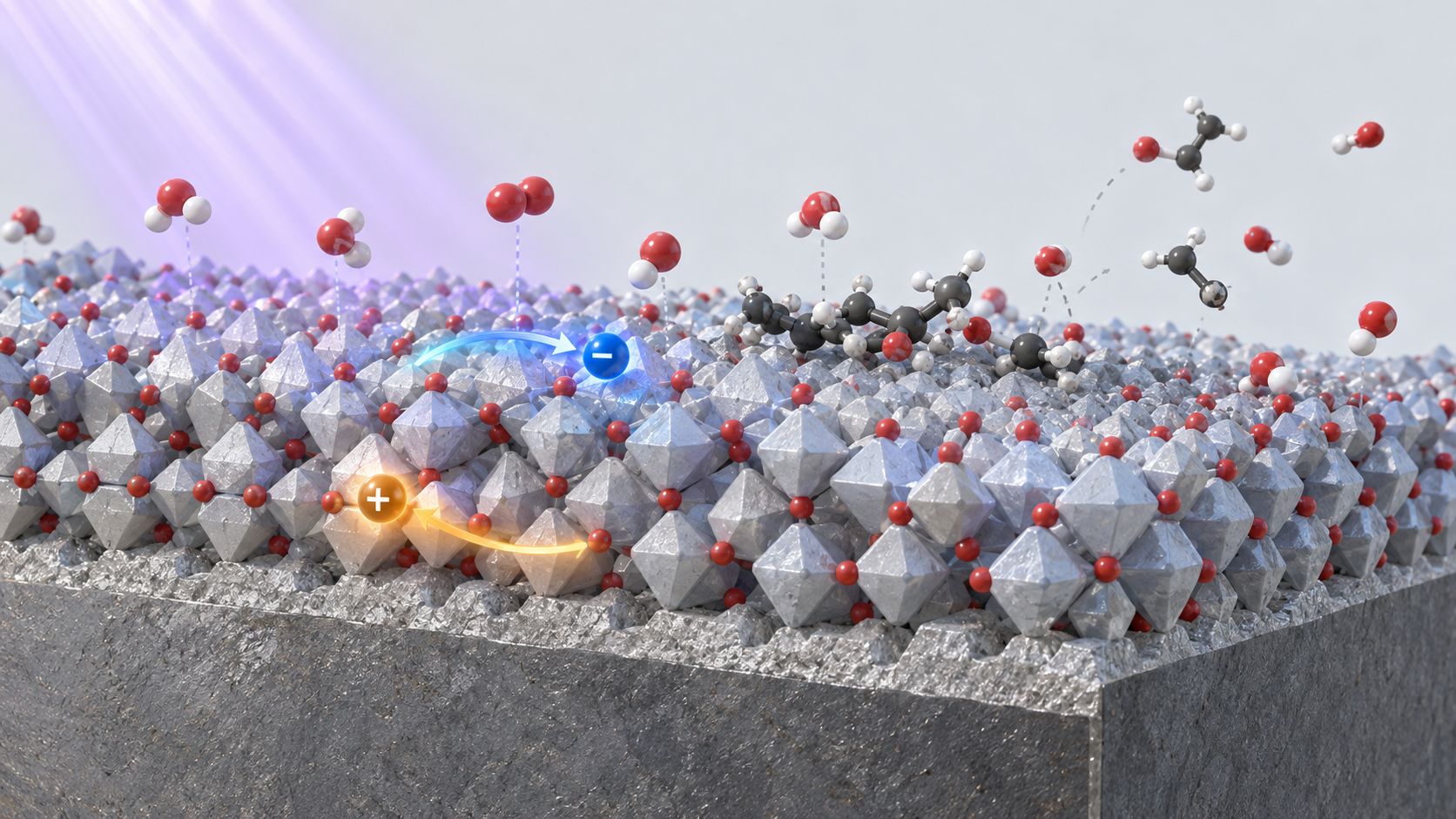
Shapes, colors and dimensions are illustrative. Consult the original schematic below for exact values and label correspondence.
View the original SVG schematic and exact annotations
Reading guide and original schematic labels: What happens in TiO₂ photocatalysis (concept) / Band diagram and photoexcitation / conduction band / valence band / UV light / e⁻ / h⁺ / Eg / Anatase: about 3.2 eV = about 387 nm / Rutile: about 3.0 eV = about 413 nm / (gaps: Luttrell et al.; wavelengths: our conversion) / Two reactions at the surface / 1. Redox of adsorbed species / e⁻ + O₂ → O₂⁻ (superoxide) / h⁺ + H₂O → •OH (hydroxyl radical) / → decomposes organics, odours, kills bacteria / (after the PIAJ explanation) / 2. Photo-induced hydrophilicity / The TiO₂ surface turns water-loving / → water lifts dirt and washes it off / → anti-fogging / (Hashimoto et al. review; PIAJ explanation) / Note: conceptual; no energies, detailed pathways or rates are shown. Based on Refs. 2, 3 and 19 (explanatory only).
4. A materials engineer’s view (1): activity depends not only on crystal form but on whether charge reaches the surface
- The general rule and its unsettled reason: Luttrell et al. state that anatase is generally more active than rutile, but no consensus exists to explain this Sourced. They list possible explanations: bandgap and valence-band position, longer carrier lifetime from an indirect gap, and differences in charge transport.
- An experiment varying film thickness: In the same paper, high-quality epitaxial films of different thickness were tested, and for anatase the activity increases for films up to about 5 nm thick, while rutile films reach their maximum activity at about 2.5 nm. Charge carriers excited deeper in the bulk contribute to surface reactions in anatase more than in rutile Sourced.
- Implication for particle design: If particles are too small they absorb less light; if too large, charge in the depths recombines before reaching the surface; there is a balance. In terms of “charge reaching the surface”, particle size and crystallinity (defects) can matter as much as crystal form (Commentary; this article has not confirmed any specific optimum size).
- Mixed phases: It is widely known that powders mixing anatase and rutile, such as P25, can show high activity (statement of Luttrell et al.). But the crystal composition, particle size and surface area of commercial “titanium dioxide” differ from product to product, so when comparing results check which sample was measured (Commentary).
5. Visible-light response: the thinking behind doping and similar routes
That TiO2 works only in ultraviolet means it cannot use most of indoor light or sunlight. Attempts to make it work in visible light have therefore continued. Representative examples follow.
- Nitrogen doping: In 2001 Asahi et al. reported that films and powders of TiO2−xNx improved on TiO2 under visible light (wavelength below 500 nm) in the photodegradation of methylene blue and gaseous acetaldehyde and in the hydrophilicity of the film surface. They state that nitrogen doped into substitutional sites proved indispensable for band-gap narrowing and photocatalytic activity, as assessed by first-principles calculations and X-ray photoemission spectroscopy Sourced.
- Carbon doping: Irie et al. made yellow carbon-doped anatase powders by oxidative annealing of TiC; the carbons sat at oxygen sites, the absorbance edge shifted to longer wavelength, and 2-propanol was decomposed to CO2 via acetone under visible light (400–530 nm) Sourced.
- Surface modification (grafting): Irie et al. published a paper on grafting Cu(II) ions onto TiO2 and WO3 photocatalysts to make efficient visible-light-sensitive photocatalysts (from the title; this article has not confirmed the content) Sourced.
- Disorder by hydrogenation (“black TiO2”): In 2011 Chen et al. showed a conceptually different approach to the dopant route of narrowing the band gap: enhancing solar absorption by introducing disorder in the surface layers of nanophase TiO2 through hydrogenation. The nanocrystals showed solar-driven photocatalytic activity, including photo-oxidation of organic molecules in water and hydrogen production with a sacrificial reagent Sourced.
6. A materials engineer’s view (2): working in visible light costs activity in the ultraviolet
- Visible-light quantum yield is lower than in the ultraviolet: Irie et al. compared TiO2−xNx powders of low nitrogen concentration (x below 0.02) by gaseous 2-propanol decomposition at the same number of absorbed photons. Regardless of x, the quantum yield under visible light was lower than under ultraviolet light, and they read this as the visible response coming from an isolated narrow band formed above the valence band Sourced.
- Doping lowers ultraviolet activity: The same paper also showed that raising the nitrogen concentration lowered the quantum yield under ultraviolet light, indicating that the doping sites could also serve as recombination sites Sourced.
- How to read it: Visible-light response is a trade-off between “absorbing light” and “using the charge”. An absorption spectrum that reaches further and a faster reaction are different things, and comparisons must be made in yield per absorbed photon (Commentary).
- Stability and reproducibility: Results change with dopant amount and position, firing conditions and surface state. This article found no primary source showing long-term durability of visible-light photocatalysts.
7. Uses: anti-soiling, antibacterial and water treatment
(1) Anti-soiling (self-cleaning)
The mechanism of anti-soiling corresponds to the two reactions (Chapter 3): organic dirt on the surface is oxidatively decomposed, and hydrophilicity lets rainwater get beneath the dirt and carry it away (PIAJ explanation) Sourced. The change of a surface by light to one that water wets was reported in Nature in 1997 by Wang et al. under the title “Light-induced amphiphilic surfaces” (from the title) Sourced. PIAJ explains that the effect acts only on what is on the surface and cannot decompose what is distant; that it is roughly proportional to the amount of light and the illuminated area; that when no effect is seen, lack of light (ultraviolet) is usually the cause; that effect can be lost when non-decomposable matter (inorganic substances or heavy soiling) covers the surface, and can be restored by washing with water and exposure to light; and that lifetime may end through degradation or peeling of the resin that fixes the titanium dioxide (statements of an industry body) Sourced.
(2) Antibacterial
As one of the earliest reports of photocatalytic sterilisation, Matsunaga et al. reported in 1985 that when powder of platinum-loaded TiO2 (TiO2/Pt) was put in a culture suspension under a metal halide lamp, coenzyme A (CoA) in the cells was photoelectrochemically oxidised and respiration was inhibited, and 103 cells/mL of Lactobacillus acidophilus, Saccharomyces cerevisiae and Escherichia coli were completely sterilised in 60–120 minutes Sourced. In 1999 Maness et al. showed, using production of malondialdehyde (MDA) as an index of membrane damage, that lipid peroxidation is the underlying mechanism of death of E. coli K-12 cells irradiated with near-UV light in the presence of TiO2. MDA production rose exponentially over 30 minutes of illumination, 77 to 93% of cell respiratory activity was lost at the same time, and the kinetics paralleled cell death Sourced. Both are laboratory reports with specific bacteria and conditions; they do not show that the same effect appears on the surface of a real product (Commentary). PIAJ explains that many products aimed at antibacterial action have an antibacterial agent such as silver added so that they work even where there is little light (statement of an industry body) Sourced.
(3) Water treatment
The review by Ibhadon and Fitzpatrick describes photocatalysis as a versatile, low-cost and environmentally benign treatment technology for low-level pollutants of biological, organic and inorganic origin in water and air, and says that as an advanced oxidation technology that removes low levels of persistent organic pollutants and microorganisms from water, it is being commercialised in many areas of the world Sourced. As concrete data, Mehling et al. tested floating immobilised spherical TiO2 catalysts with sunlight in the secondary effluent of a wastewater treatment plant. Micro-pollutants were degraded to an average of 55% after 9 hours of irradiation, but degradation rates varied by a factor of up to 3.5 between substances, and substance-specific adsorption behaviour was the major limitation; with increasing adsorption limitation the kinetics changed from pseudo-first order to pseudo-zero order. For diclofenac 95% degradation was achieved at a radiation dose of approximately 190 mWh/m² Sourced. In water treatment, then, the light dose, the way the catalyst is fixed and the adsorption of each substance decide the result, and one cannot say in a single number that “it decomposes” (Commentary). PIAJ also states that splitting water into oxygen and hydrogen by light is still insufficient in efficiency and will take more time to reach practical use (statement of an industry body; see also the photoelectrochemical cells in our hydrogen energy series) Sourced.
8. The amount of light: how many photons does indoor ultraviolet supply?
As a guide to indoor ultraviolet, PIAJ gives the ultraviolet amount at an illuminance of 1,000 lux (in µW/cm²): incandescent bulb 60 W, 5; ordinary fluorescent lamp W colour 7, N colour 13, D colour 14; three-band fluorescent lamp W colour 8, N colour 9, D colour 10; sunlight through window glass, 15. It explains that the ultraviolet amount is proportional to illuminance, so that with a three-band N-colour fluorescent lamp at 500 lux it is 4.5 µW/cm², and that with a luminaire that has a cover it is considerably less than the table values (a statement of an industry body) Sourced.
Convert the 4.5 µW/cm² above into a photon number, assuming light of wavelength 365 nm (photon energy 1239.84 ÷ 365 ≈ 3.40 eV ≈ 5.44 × 10⁻¹⁹ J) Our calculation.
- Photon number = 4.5 × 10⁻⁶ W/cm² ÷ 5.44 × 10⁻¹⁹ J ≈ 8.3 × 10¹² per cm² per second
- In one hour: 8.3 × 1012 × 3,600 ≈ 3.0 × 10¹⁶ per cm²
- If the density of adsorption sites is assumed to be 1015 per cm², that is about 30 photons per site per hour (about 0.008 per site per second)
Assumptions and limits: The wavelength of 365 nm and the site density of 1015/cm² are assumptions. The above is an upper bound for the case in which every photon is absorbed and the quantum yield is 100%; in practice, absorption in a thin film, recombination and scattering mean fewer photons are used for reaction. The ultraviolet amount differs several-fold between lamp types. Even so, a photon flow that does not even reach 0.01 per site per second shows why reactions of indoor photocatalysts are strongly limited by the amount of light (Commentary).
9. How to read evaluations and standards
There are JIS and ISO test methods for each function in evaluating photocatalysts. The table organises the numbers and years of standards listed in the PIAJ list “JIS/ISO status of test methods for evaluating photocatalytic performance (year established or latest revised; as of April 2025)”. The right-hand column gives the performance criteria PIAJ uses in its PIAJ product certification (a voluntary standard of an industry body), not provisions of JIS or ISO themselves Sourced.
| Test item | JIS (year) | ISO (year) | PIAJ criterion (product certification) |
|---|---|---|---|
| Self-cleaning: water contact angle (UV) | R 1703-1 (2020) | ISO 27448 (2009) | Limiting contact angle of 30° or less |
| Self-cleaning: methylene blue decomposition (UV) | R 1703-2 (2014) | ISO 10678 (2010) | Decomposition activity index of 5 nmol/L/min or more |
| Air purification: nitrogen oxides (UV) | R 1701-1 (2016) | ISO 22197-1 (2016) | NOx removal of 0.50 µmol or more |
| Air purification: acetaldehyde / toluene / formaldehyde (UV) | R 1701-2, -3, -4 (2016) | ISO 22197-2 (2019), -3 (2019), -4 (2021) | 0.17 µmol/h or more for each |
| Air purification: nitrogen oxides (visible-light type) | R 1751-1 (2013) | ISO 17168-1 (2018) | (not confirmed in this article) |
| Antibacterial (UV) | R 1702 (2020) | ISO 27447 (2019) | Antibacterial activity value RL ≥ 2.0 (UV intensity is the claimed value), light effect ΔR ≥ 0.3 |
| Antibacterial (visible-light type) | R 1752 (2020) | ISO 17094 (2014) | RF-I ≥ 2.0 (500 lux), ΔR ≥ 0.3 |
| Antiviral (UV / visible light) | R 1706 (2020) / R 1756 (2020) | ISO 18061 (2014) / ISO 18071 (2016) | VL ≥ 2.0 (UV: claimed value) / VF-I ≥ 2.0 (500 lux), ΔV ≥ 0.3 |
| Water quality: dimethyl sulfoxide decomposition | R 1704 (2007) | ISO 10676 (2010) | (not confirmed in this article) |
| Light sources (UV / visible) | R 1709 (2014) / R 1750 (2012) | ISO 10677 (2011) / ISO 14605 (2013) | — |
Note: standard numbers and years are from the PIAJ list (April 2025). The official titles and text of the standards could not be confirmed on the standards bodies’ websites. The criteria are PIAJ’s for its product certification.
The PIAJ glossary explains the antibacterial activity value as the difference in the logarithm of viable cell counts between a photocatalytically treated product and an untreated product, both inoculated with bacteria and measured after irradiation Sourced. Converting to numbers Our calculation:
- RL = 2.0 means the viable count is 10-2 = 1/100 of the untreated product (a 99% reduction)
- A light effect ΔR = 0.3 means a viable-count difference of 100.3 ≈ about 2 times (compared with leaving the sample in the dark)
Assumptions and limits: These are numbers converted from the definition; the bacteria and conditions are fixed by the standard. They do not show the effect of any particular product.
10. A materials engineer’s view (3): read test numbers together with the light conditions
- The dark effect is mixed in: The PIAJ glossary says the antibacterial activity value also includes the decrease in viable count obtained without light irradiation Sourced. To show that the effect appears only with light, one must therefore look at the light effect ΔR compared with the dark. It can be read that the criteria demand both RL ≥ 2.0 and ΔR ≥ 0.3 for this distinction (Commentary).
- The light condition is part of the criterion: For ultraviolet antibacterial and antiviral criteria, measurement is at “UV intensity: claimed value”, that is, the ultraviolet intensity at the place of use the product assumes. For visible-light types it is 500 lux, a level PIAJ set for places bright enough for simple tasks (living rooms, kitchens, classrooms) Sourced. Values at different light intensities cannot be compared, so a number always comes with an illuminance (Commentary).
- The test light source is also standardised: There are standards for ultraviolet (JIS R 1709) and visible (JIS R 1750) sources, and if the spectral distribution of the source differs, the number of photons the catalyst absorbs differs even at the same “illuminance” (Commentary; the idea behind the calculation in Chapter 8).
- Evaluating lifetime and durability: PIAJ requires, as a condition of certification, that data on the persistence of effect and on safety be obtained and kept available for disclosure Sourced. This article did not confirm concrete standards for how to evaluate after weathering or abrasion.
11. Public safety assessments of nano TiO2
What is covered here are assessments of TiO2 particles by public bodies. Because the object of assessment (inhalation in the workplace, ingestion as a food additive) and the conclusions differ, read them route by route. One cannot generalise to “nano means dangerous” or “nano means safe”, and one cannot judge whether a specific product may be used. PIAJ’s remark that TiO2 is “considered harmless at present” is the view of an industry body, not an assessment by a public authority. This article is not individual health or safety advice.
(1) Inhalation (workplace exposure)
- IARC (International Agency for Research on Cancer): In February 2006 an IARC Monographs Working Group re-evaluated carbon black, titanium dioxide and talc (the full evaluation is in Volume 93; Baan et al. summarise the conclusions). For titanium dioxide it concluded that epidemiological studies in the production industry gave inadequate evidence of carcinogenicity and that rodent cancer studies gave sufficient evidence, and evaluated it overall as possibly carcinogenic to humans (Group 2B). The Working Group noted that prolonged exposure to inhaled particles at sufficiently high concentrations may impair clearance in the alveolar region and lead to excessive lung burdens and chronic inflammation, and that impaired lung clearance in rodents exposed to ultrafine particles occurs at much lower mass concentrations than with fine particles Sourced.
- NIOSH (US National Institute for Occupational Safety and Health): Current Intelligence Bulletin 63 (2011) addresses occupational inhalation exposure only and says its conclusions should not be inferred to non-occupational exposures. It recommends exposure limits, as time-weighted averages for up to 10 hours per day in a 40-hour week, of 2.4 mg/m3 for fine TiO2 and 0.3 mg/m3 for ultrafine (including engineered nanoscale) TiO2. It determined that ultrafine TiO2 is a potential occupational carcinogen, while data are insufficient to classify fine TiO2 as one Sourced.
- EU CLP (classification and labelling): In its opinion of 14 September 2017 the RAC (the ECHA Committee for Risk Assessment) proposed classifying TiO2 as carcinogenic category 2 by inhalation, and Commission Delegated Regulation (EU) 2020/217 (dated 4 October 2019; Official Journal 18 February 2020) set “Carc. 2, H351 (inhalation)” for titanium dioxide “in powder form containing 1% or more of particles with aerodynamic diameter ≤ 10 µm”. It applied from 9 September 2021 Sourced.
- The litigation: The General Court annulled this Delegated Regulation 2020/217 in its judgment of 23 November 2022 (T-279/20 and others). The Court of Justice dismissed the appeals in its judgment of 1 August 2025 (C-71/23 P and C-82/23 P) Sourced. How TiO2 is classified in the EU after the annulment, and whether any new proposal exists, could not be confirmed in this article Not yet confirmed
(2) Ingestion (food additive)
- EFSA (European Food Safety Authority): Its 2021 opinion re-assessed the food additive titanium dioxide (E 171) on new evidence including data obtained with TiO2 nanoparticles. It found that less than 50% of constituent particles by number in E 171 have a minimum external dimension below 100 nm; that studies of general and organ toxicity showed no adverse effects with E 171 up to 1,000 mg/kg body weight per day or with TiO2 nanoparticles (>30 nm) up to the highest dose tested of 100 mg/kg body weight per day. On the other hand, TiO2 particles have the potential to induce DNA strand breaks and chromosomal damage; no clear correlation was seen between physico-chemical properties and genotoxicity outcomes, and a cut-off particle size could not be identified. It therefore concluded that a concern for genotoxicity could not be ruled out, and given the many uncertainties E 171 can no longer be considered as safe when used as a food additive Sourced.
- EU regulation: Commission Regulation (EU) 2022/63 (dated 14 January 2022) amended the food additives rules so that E 171 is not authorised in the food categories listed in Parts D and E of Annex II. Foods produced under the earlier rules before 7 February 2022 may be placed on the market until 7 August 2022 and may then remain on the market until their date of minimum durability or ‘use by’ date. For E 171 as a colour in medicinal products the Commission is to review the need to maintain it within three years of entry into force Sourced.
(3) What differs for photocatalytic products
The assessments above concern TiO2 particles themselves (inhaled as a powder, ingested as a food additive). In photocatalytic products, TiO2 is held by a binder in a coating or moulding, and how much is released as particles during use or processing differs by product and process (Commentary). PIAJ explains that for certified products it checks, product by product, acute oral toxicity, primary skin irritation, mutagenicity, skin sensitisation and so on under its own rules (a statement of an industry body) Sourced. What exposure occurs and how much needs evaluation product by product and process by process, and this article makes no such judgement. For processes that handle powder (mixing, spraying, grinding), check the workplace recommended limits in (1), the laws of each country and the operator’s safety data sheets.
- How particle size is treated differs: NIOSH sets different recommended limits for fine and ultrafine (including nanoscale) particles (2.4 and 0.3 mg/m3). IARC notes that lung clearance is impaired at lower mass concentrations with ultrafine particles. EFSA, on the other hand, found no clear correlation between physico-chemical properties and genotoxicity outcomes and could not identify a particle-size cut-off Sourced. The picture is that whether size matters depends on the endpoint and the route (Commentary).
- A change of form changes the route: Powder, dispersion, coating and moulding differ in route and amount of exposure. Checking which form and which route an assessment covers is the first step in avoiding misreading (Commentary).
- Regulation distinguishes stages: RAC’s opinion (a proposal), the adoption, publication and start of application of a delegated regulation, and annulment by a court are different stages. What is in force now is checked by date and stage (Fig. 6).
12. What this article could not confirm, and a summary
- Official titles and text of the standards: The JIS and ISO numbers and years come from the PIAJ list (April 2025). The standards bodies’ websites could not be opened, so titles, text and test conditions (such as light intensity) are unconfirmed.
- Criteria for visible-light types: PIAJ’s criteria for visible-light nitrogen oxide removal (JIS R 1751-1) and water quality (JIS R 1704) were not checked.
- Durability of visible-light photocatalysts: No primary source showing long-term durability was confirmed. The content of the Cu(II)-grafting paper is also confirmed from its title only.
- Optimal particle size: The optimum particle size or film thickness for photocatalysis depends on material and use and was not confirmed here (the thickness results of Luttrell et al. are for epitaxial films).
- Treatment in the EU after annulment: What the EU classification of TiO2 is after the 2022 annulment and the 2025 dismissal of the appeals, and whether a new proposal exists, could not be confirmed.
- Public assessments in Japan: Assessments of nano TiO2 by Japanese agencies and institutes, and its regulatory treatment in Japan, were not examined.
- Effect and safety of individual products: Individual products are not evaluated.
- Photocatalysis makes electrons and holes with ultraviolet light and causes two reactions, redox and hydrophilic conversion. Anatase about 3.2 eV (about 387 nm), rutile about 3.0 eV (about 413 nm) Sourced Our calculation
- Anatase is not always better. Activity also depends on whether charge reaches the surface, and there is no consensus on the reasons Sourced
- Visible-light response has a cost. In nitrogen doping, the visible quantum yield was lower than in the ultraviolet, and raising nitrogen content lowered the ultraviolet quantum yield Sourced
- Indoors, the amount of light can be rate-limiting. In a calculation with assumptions, fewer than 0.01 photons per site per second Our calculation
- Read standard numbers together with light conditions. The antibacterial activity value includes reduction in the dark, so look also at the light effect ΔR Sourced
- Read safety assessments route by route. Inhalation: IARC 2B, NIOSH recommended limits, and the EU classification annulled in 2022. Ingestion: EFSA could not consider the food additive E 171 safe, and the EU amended its rules so that it is not authorised in food Sourced. Treatment after the annulment is Not yet confirmed
13. Glossary
- Photocatalyst
- A material that absorbs light and shows catalytic action; TiO2 is the representative one.
- Anatase / rutile
- Representative crystal forms of TiO2, with bandgaps of about 3.2 eV and 3.0 eV.
- Bandgap
- The range of energy electrons cannot occupy; it sets which wavelengths can be absorbed.
- Hole
- The vacancy left when an electron is excited; it carries oxidation reactions.
- Active oxygen
- Strongly oxidising oxygen species such as the superoxide ion and hydroxyl radical.
- Hydrophilic conversion
- The change by light of a surface to one that water wets well.
- P25
- A commercial TiO2 powder that mixes anatase and rutile (Degussa, now Evonik).
- Doping
- Adding a small amount of an element to change the electronic structure.
- Quantum yield
- The fraction of absorbed photons that cause a reaction.
- Antibacterial activity value (R)
- Difference in log viable counts from the untreated product; includes reduction in the dark.
- Light effect (ΔR)
- Difference in log viable counts between a sample under light and one left in the dark.
- PIAJ
- Photocatalysis Industry Association of Japan; an industry body that runs product certification and standardisation of evaluation methods.
- CLP
- The EU Regulation (EC) No 1272/2008 on classification, labelling and packaging of substances and mixtures.
- E 171
- The number for TiO2 as a food additive.
14. References (primary sources)
- Fujishima A, Honda K Electrochemical Photolysis of Water at a Semiconductor Electrode. Nature 1972;238:37–38 — doi.org/10.1038/238037a0
- Hashimoto K, Irie H, Fujishima A TiO2 Photocatalysis: A Historical Overview and Future Prospects. Jpn J Appl Phys 2005;44:8269 — doi.org/10.1143/jjap.44.8269
- Luttrell T et al. Why is anatase a better photocatalyst than rutile? – Model studies on epitaxial TiO2 films. Sci Rep 2014;4:4043 — doi.org/10.1038/srep04043
- Ohtani B et al. What is Degussa (Evonik) P25? Crystalline composition analysis, reconstruction from isolated pure particles and photocatalytic activity test. J Photochem Photobiol A 2010;216:179–182 — doi.org/10.1016/j.jphotochem.2010.07.024
- Scanlon DO et al. Band alignment of rutile and anatase TiO2. Nat Mater 2013;12:798–801 (title only checked) — doi.org/10.1038/nmat3697
- Wang R et al. Light-induced amphiphilic surfaces. Nature 1997;388:431–432 (title only checked) — doi.org/10.1038/41233
- Asahi R et al. Visible-Light Photocatalysis in Nitrogen-Doped Titanium Oxides. Science 2001;293:269–271 — doi.org/10.1126/science.1061051
- Irie H, Watanabe Y, Hashimoto K Nitrogen-Concentration Dependence on Photocatalytic Activity of TiO2−xNx Powders. J Phys Chem B 2003;107:5483–5486 — doi.org/10.1021/jp030133h
- Irie H, Watanabe Y, Hashimoto K Carbon-doped Anatase TiO2 Powders as a Visible-light Sensitive Photocatalyst. Chem Lett 2003;32:772–773 — doi.org/10.1246/cl.2003.772
- Irie H et al. Efficient visible light-sensitive photocatalysts: Grafting Cu(II) ions onto TiO2 and WO3 photocatalysts. Chem Phys Lett 2008;457:202–205 (title only checked) — doi.org/10.1016/j.cplett.2008.04.006
- Chen X et al. Increasing Solar Absorption for Photocatalysis with Black Hydrogenated Titanium Dioxide Nanocrystals. Science 2011;331:746–750 — doi.org/10.1126/science.1200448
- Matsunaga T et al. Photoelectrochemical sterilization of microbial cells by semiconductor powders. FEMS Microbiol Lett 1985;29:211–214 — doi.org/10.1111/j.1574-6968.1985.tb00864.x
- Maness P-C et al. Bactericidal Activity of Photocatalytic TiO2 Reaction: toward an Understanding of Its Killing Mechanism. Appl Environ Microbiol 1999;65:4094–4098 — doi.org/10.1128/aem.65.9.4094-4098.1999
- Ibhadon AO, Fitzpatrick P Heterogeneous Photocatalysis: Recent Advances and Applications. Catalysts 2013;3:189–218 — doi.org/10.3390/catal3010189
- Mehling S et al. Floating immobilized TiO2 catalyst for the solar photocatalytic treatment of micro-pollutants within the secondary effluent of wastewater treatment plants. Water Sci Technol 2023;87:1082–1095 — doi.org/10.2166/wst.2023.066
- Photocatalysis Industry Association of Japan (PIAJ) JIS/ISO status of test methods for evaluating photocatalytic performance (as of April 2025; in Japanese) — piaj.gr.jp
- Photocatalysis Industry Association of Japan (PIAJ) Certified functions and performance criteria (in Japanese) — piaj.gr.jp
- Photocatalysis Industry Association of Japan (PIAJ) Glossary (in Japanese) — piaj.gr.jp
- Photocatalysis Industry Association of Japan (PIAJ) Introduction to photocatalysis, Q&A, and illuminance of visible light indoors (in Japanese) — piaj.gr.jp
- Photocatalysis Industry Association of Japan (PIAJ) Amount of ultraviolet from lamps (in Japanese) — piaj.gr.jp
- Baan RA Carcinogenic Hazards from Inhaled Carbon Black, Titanium Dioxide, and Talc not Containing Asbestos or Asbestiform Fibers: Recent Evaluations by an IARC Monographs Working Group. Inhal Toxicol 2007;19(Suppl 1):213–228 — doi.org/10.1080/08958370701497903
- NIOSH Current Intelligence Bulletin 63: Occupational Exposure to Titanium Dioxide. 2011 (DHHS (NIOSH) Publication No. 2011-160) — doi.org/10.26616/nioshpub2011160
- EFSA Panel on Food Additives and Flavourings Safety assessment of titanium dioxide (E171) as a food additive. EFSA Journal 2021;19(5):6585 — doi.org/10.2903/j.efsa.2021.6585
- European Commission Commission Regulation (EU) 2022/63 of 14 January 2022 as regards the food additive titanium dioxide (E 171) — eur-lex.europa.eu
- European Commission Commission Delegated Regulation (EU) 2020/217 of 4 October 2019 (Official Journal L 44/1, 18 February 2020), harmonised classification of titanium dioxide — eur-lex.europa.eu
- General Court of the European Union Judgment of 23 November 2022, Joined Cases T-279/20, T-288/20 and T-283/20 — eur-lex.europa.eu
- Court of Justice of the European Union Judgment of 1 August 2025, Joined Cases C-71/23 P and C-82/23 P — eur-lex.europa.eu
- Chen X, Mao SS Titanium Dioxide Nanomaterials: Synthesis, Properties, Modifications, and Applications. Chem Rev 2007;107:2891–2959 (further reading; this article quotes no numbers from it) — doi.org/10.1021/cr0500535
15. Claim-to-source audit
| Claim in the text | Basis | Label |
|---|---|---|
| That TiO₂ has the most efficient photoactivity, the highest stability and the lowest cost, and has long been used as a white pigment so that its safety is guaranteed by history (the authors’ view); the two reactions under ultraviolet light (redox of adsorbed species and photo-induced hydrophilic conversion), the former known since the early 20th century and the latter at its end | Reference 2 https://doi.org/10.1143/jjap.44.8269 | Sourced |
| That a 1972 paper reported the photolysis of water at a TiO₂ semiconductor electrode (from the title) | Reference 1 https://doi.org/10.1038/238037a0 | Sourced |
| That the bandgap of TiO₂ is above 3 eV (about 3.0 for rutile, about 3.2 for anatase) and it is active in ultraviolet light; that P25 is a powder of rutile and anatase; that anatase is generally more active than rutile but there is no consensus on the reason; the film-thickness experiment (about 5 nm for anatase, about 2.5 nm for rutile) | Reference 3 https://doi.org/10.1038/srep04043 | Sourced |
| That a paper analyses the crystalline composition of P25, reconstructs it from isolated particles and tests its photocatalytic activity (from the title) | Reference 4 https://doi.org/10.1016/j.jphotochem.2010.07.024 | Sourced |
| That a paper deals with the band alignment of rutile and anatase (from the title) | Reference 5 https://doi.org/10.1038/nmat3697 | Sourced |
| That a paper on surfaces that water wets after light (Light-induced amphiphilic surfaces, 1997) exists (from the title) | Reference 6 https://doi.org/10.1038/41233 | Sourced |
| That films and powders of TiO₂₋ₓNₓ (nitrogen-doped) improved under visible light below 500 nm in methylene blue and acetaldehyde decomposition and hydrophilicity, and that nitrogen in substitutional sites is indispensable for band-gap narrowing and activity | Reference 7 https://doi.org/10.1126/science.1061051 | Sourced |
| That for powders of low nitrogen concentration (x below 0.02) the visible-light quantum yield is lower than the ultraviolet one at the same absorbed photon number, and that raising nitrogen lowers the ultraviolet quantum yield and the doping sites can be recombination sites | Reference 8 https://doi.org/10.1021/jp030133h | Sourced |
| That carbon-doped anatase powders made by oxidative annealing of TiC decomposed 2-propanol to CO₂ under 400–530 nm visible light | Reference 9 https://doi.org/10.1246/cl.2003.772 | Sourced |
| That a paper exists on grafting Cu(II) ions onto TiO₂ and WO₃ photocatalysts as visible-light-sensitive photocatalysts (from the title) | Reference 10 https://doi.org/10.1016/j.cplett.2008.04.006 | Sourced |
| That black TiO₂ with surface disorder from hydrogenation increases solar absorption, with activity in photo-oxidation of organics in water and hydrogen production with a sacrificial reagent | Reference 11 https://doi.org/10.1126/science.1200448 | Sourced |
| That TiO₂/Pt powder completely sterilised 10³ cells/mL of lactic acid bacteria, yeast and E. coli in 60–120 minutes under a metal halide lamp through oxidation of coenzyme A and inhibition of respiration | Reference 12 https://doi.org/10.1111/j.1574-6968.1985.tb00864.x | Sourced |
| That lipid peroxidation is the mechanism of death of E. coli K-12 under near-UV light with TiO₂, that MDA production rose exponentially over 30 minutes, and that 77–93% of respiratory activity was lost | Reference 13 https://doi.org/10.1128/aem.65.9.4094-4098.1999 | Sourced |
| That photocatalysis is a versatile, low-cost, environmentally benign technology for low-level pollutants in water and air, and that it is being commercialised in many areas as an advanced oxidation technology | Reference 14 https://doi.org/10.3390/catal3010189 | Sourced |
| The results with floating immobilised spherical TiO₂ in secondary effluent under sunlight: 55% average in 9 hours, up to 3.5-fold differences between substances, adsorption as the main limitation, and diclofenac at 95% at about 190 mWh/m² | Reference 15 https://doi.org/10.2166/wst.2023.066 | Sourced |
| The JIS and ISO numbers and years (April 2025): R 1703-1/ISO 27448, R 1703-2/ISO 10678, R 1701-1 to -4/ISO 22197-1 to -4, R 1751-1/ISO 17168-1, R 1702/ISO 27447, R 1752/ISO 17094, R 1706/ISO 18061, R 1756/ISO 18071, R 1704/ISO 10676, R 1709/ISO 10677, R 1750/ISO 14605 | Reference 16 https://www.piaj.gr.jp/registered_products/jis-iso/ | Sourced |
| PIAJ product-certification criteria (limiting contact angle 30° or less, decomposition activity index 5 nmol/L/min or more, NOx removal 0.50 µmol or more, 0.17 µmol/h each, antibacterial RL ≥ 2.0 and ΔR ≥ 0.3, 500 lux for visible light, antiviral VL ≥ 2.0 and ΔV ≥ 0.3); that UV intensity is a claimed value; that data on persistence of effect and on safety must be kept | Reference 17 https://www.piaj.gr.jp/registered_products/performance_criteria/ | Sourced |
| That the antibacterial activity value is the difference in log viable counts from the untreated product and includes reduction in the dark; that the light effect is the difference from the dark; the roles of JIS R 1702, 1703, 1701, 1704 and 1706; that UV sources are specified in JIS R 1709 | Reference 18 https://www.piaj.gr.jp/guidance/glossary/ | Sourced |
| PIAJ explanations: the two active oxygen species O₂⁻ and •OH, hydrophilicity, ultraviolet of 400 nm or shorter needed, acts only on surface matter, proportional to light and area, lack of light as the usual cause of no effect, recovery by washing and light, lifetime ended by resin degradation, silver and similar agents in many antibacterial products, water splitting not yet efficient enough, safety checked product by product (acute oral toxicity, skin irritation, mutagenicity, skin sensitisation), definition of 500 lux | Reference 19 https://www.piaj.gr.jp/guidance/faq/ | Sourced |
| The ultraviolet amount per 1,000 lux by lamp (µW/cm²): incandescent 5, ordinary fluorescent W 7, N 13, D 14, three-band W 8, N 9, D 10, sunlight through window glass 15; 4.5 µW/cm² for a three-band N lamp at 500 lux | Reference 20 https://www.piaj.gr.jp/guidance/uv-rays/ | Sourced |
| The evaluation by an IARC Working Group (February 2006) of TiO₂: inadequate epidemiological evidence, sufficient rodent evidence, Group 2B; impaired lung clearance and lower mass concentrations for ultrafine particles | Reference 21 https://doi.org/10.1080/08958370701497903 | Sourced |
| NIOSH CIB 63 (2011): occupational inhalation only; recommended limits of 2.4 mg/m³ for fine and 0.3 mg/m³ for ultrafine TiO₂ (TWA, up to 10 hours per day, 40-hour week); ultrafine a potential occupational carcinogen; insufficient data to classify fine | Reference 22 https://doi.org/10.26616/nioshpub2011160 | Sourced |
| EFSA (2021): less than 50% of constituent particles of E 171 below 100 nm by number; no adverse effects in general toxicity and reproductive toxicity; potential for DNA strand breaks and chromosomal damage; a genotoxicity concern not ruled out; E 171 no longer considered safe as a food additive | Reference 23 https://doi.org/10.2903/j.efsa.2021.6585 | Sourced |
| Regulation (EU) 2022/63 (14 January 2022): E 171 not authorised in food categories of Parts D and E; foods produced before 7 February 2022 may be marketed until 7 August 2022; review for medicinal-product colour | Reference 24 https://eur-lex.europa.eu/legal-content/EN/TXT/?uri=CELEX:32022R0063 | Sourced |
| Delegated Regulation (EU) 2020/217 (4 October 2019; Official Journal 18 February 2020): RAC opinion (14 September 2017), Carc. 2 and H351 (inhalation) for TiO₂ powder with 1% or more particles of aerodynamic diameter 10 µm or less, application from 9 September 2021 | Reference 25 https://eur-lex.europa.eu/legal-content/EN/TXT/?uri=CELEX:32020R0217 | Sourced |
| That the General Court’s judgment of 23 November 2022 annulled Delegated Regulation 2020/217 | Reference 26 https://eur-lex.europa.eu/legal-content/EN/TXT/?uri=CELEX:62020TJ0279 | Sourced |
| That the Court of Justice’s judgment of 1 August 2025 (C-71/23 P, C-82/23 P) dismissed the appeals | Reference 27 https://eur-lex.europa.eu/legal-content/EN/TXT/?uri=CELEX:62023CJ0071 | Sourced |
| Anatase at 3.2 eV is about 387 nm, rutile at 3.0 eV about 413 nm, and 500 nm is about 2.48 eV (E ≈ 1239.84 ÷ λ) | our own calculation | Our calculation |
| 4.5 µW/cm² (assumed 365 nm) is about 8.3 × 10¹² per cm² per second, about 3.0 × 10¹⁶ per cm² in an hour, and about 30 per site per hour for an assumed 10¹⁵ sites per cm² (about 0.008 per second) | our own calculation | Our calculation |
| An antibacterial activity value of 2.0 is 1/100 of the viable count (a 99% reduction), and ΔR of 0.3 is about a two-fold difference | our own calculation | Our calculation |
| The reading that activity depends on whether charge reaches the surface and on a balance of particle size and crystallinity, the trade-off between absorption and charge use in visible-light response, the organisation that photocatalyst performance is limited by the amount of light, the distinction between the antibacterial activity value and ΔR, checking the form and route an assessment covers, and the organisation that exposure from photocatalytic products differs by product and process | this article (commentary) | Commentary |
| The treatment of TiO₂ in the EU classification after the annulment and any new proposal, the official titles, text and test conditions of the standards, criteria for visible-light types, and Japanese public assessments | could not be confirmed within the scope of this article (our own note) | Not yet confirmed |
Last updated October 2026. Sources are limited to primary material (peer-reviewed papers, public assessments by IARC, NIOSH and EFSA, and EU legislation and judgments), plus material from the Photocatalysis Industry Association of Japan (marked as statements of an industry body). The JIS and ISO numbers and years come from the PIAJ list; the official titles, text and test conditions of the standards could not be confirmed on the standards bodies’ websites. PIAJ’s criteria are its own voluntary standards, not provisions of JIS or ISO. Because the article includes structural readings and materials-design interpretations, those are marked as Commentary and kept separate from sourced fact. The EU classification after the annulment, the text and test conditions of the standards, criteria for visible-light types, public assessments in Japan and the long-term durability of visible-light photocatalysts are not covered, because they could not be confirmed in primary sources. This article explains materials, principles, evaluation and regulation. It does not rank any product or company, and it is not individual health or safety advice. The hero image and Fig. 4 are AI-generated images and the other figures are vector drawings; none of them shows a real instrument, product or measurement result.