TECHNOLOGY EXPLAINER
Conductive Polymers and Ionic Conductors
— polymers that carry electrons, polymers that carry ions, and how to read the single number “conductivity”
Conductive polymers (PEDOT:PSS, polyaniline, polypyrrole and others) are materials in which a pathway for electrons (holes) has been built into the polymer backbone. Ionic conductors (ionic liquids, polymer electrolytes, ion gels), by contrast, carry not electrons but ions. Both are quoted by “conductivity (S/cm)”, yet what is moving (electrons or ions) and under what conditions it was measured (film thickness, humidity, temperature, frequency) change the meaning of the number entirely. This article sets out, from primary sources, doping and how conductivity arises, the treatments that raise the conductivity of PEDOT:PSS and how to read those numbers, stability (water, oxygen, heat), ionic liquids, polymer electrolytes and ion gels, their relation to solid electrolytes, uses in organic electronics, sensors, actuators and capacitors, and how to read the evaluation standards.
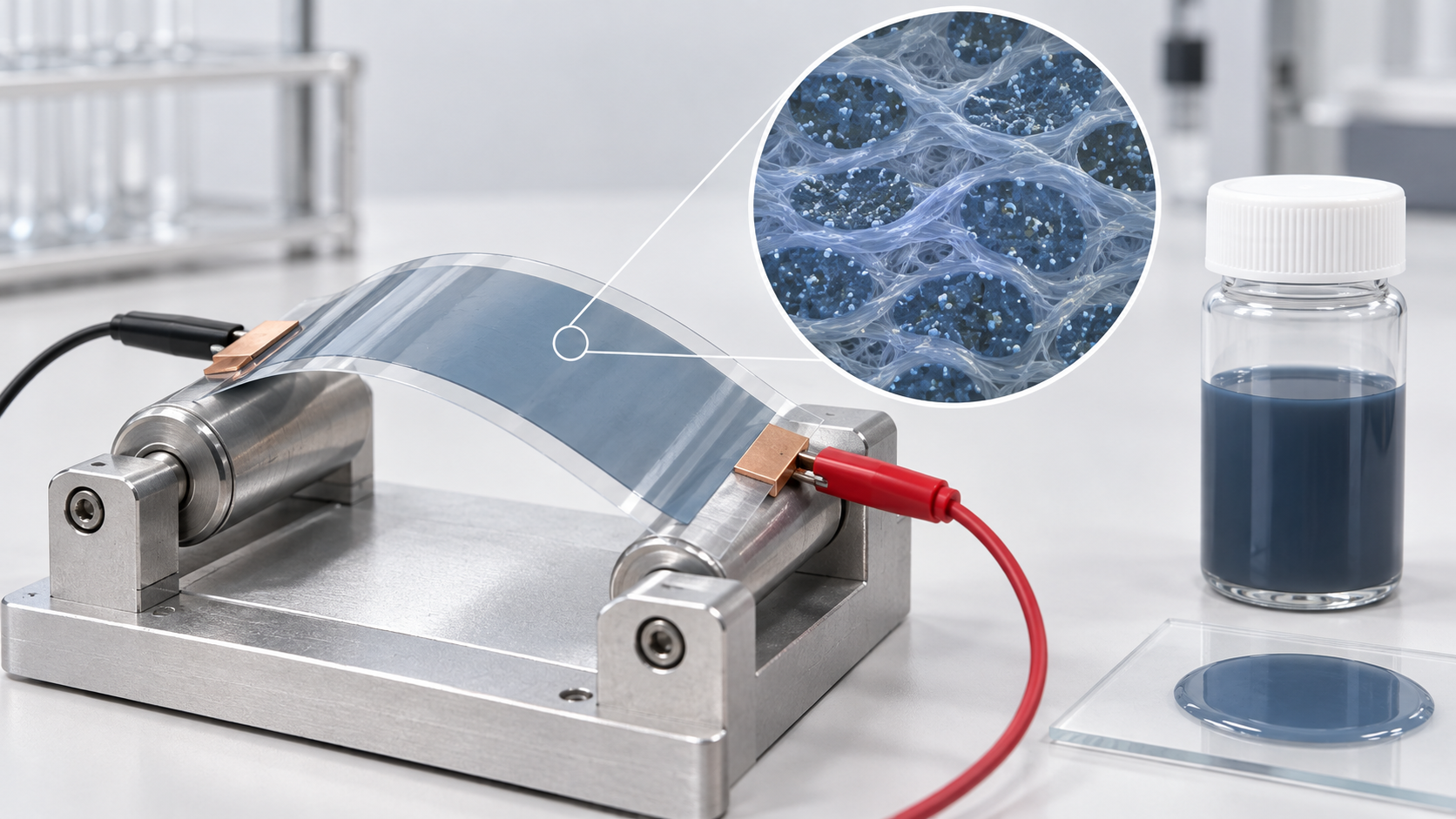
- Conductive polymers and ionic conductors (the short version)
- What a conductive polymer is — conjugation and doping
- PEDOT:PSS — treatments that raise conductivity, and how to read the numbers
- Our calculation: sheet resistance from conductivity and film thickness
- Polyaniline and polypyrrole — processability and stability
- A materials engineer's view 1: conductive polymers are vulnerable to water, oxygen, heat and potential
- Ionic conductors — ionic liquids, polymer electrolytes, ion gels
- Our calculation: area resistance and voltage drop of an electrolyte layer
- A materials engineer's view 2: conductivity alone does not decide
- Relation to solid electrolytes
- How they are used — organic electronics, sensors, actuators, capacitors
- Measurement conditions for conductivity, and stability pitfalls
- Laboratory performance versus deployment
- Limits, and what could not be confirmed
- How to read evaluations and standards
- Glossary
- References (primary sources)
- Claim-to-source audit
Sourced = stated in published material (link given)
Our calculation = a figure this article derived, with the assumptions spelled out
Not yet confirmed = a plan, schedule or research-stage matter whose record has not been confirmed
Materials-design interpretations are marked separately as Commentary. Inference is shown in bold.
The conductivity, ionic conductivity and stability figures here are results for particular samples measured at particular film thicknesses, temperatures, humidities and frequencies in the laboratory, or manufacturers’ stated values. Please do not read laboratory champion data as the performance of production items or of real-use conditions. Manufacturers’ values are marked “manufacturer’s stated value”, and values obtained under different conditions are not ranked. This article does not rank companies or products. Solid electrolytes for all-solid-state batteries are covered in our all-solid-state battery explainers, PFAS regulation and electrolytes in our explainer on electrolytes and separators, PEDOT:PSS in thermoelectrics in our explainer on thermoelectric materials, and electrochromics in our explainer on electrochromic materials and smart windows.
1. Conductive polymers and ionic conductors (the short version)
- Plastic that conducts electricity: the Nobel Foundation’s announcement of 2000 (Chemistry: Heeger, MacDiarmid, Shirakawa) explains that for a polymer to conduct current, its carbon atoms must be joined alternately by single and double bonds, and it must also be “doped”: electrons removed (oxidation) or introduced (reduction)Sourced [Source 1]
- There are two kinds of “conductivity”: conductive polymers carry electrons (holes) and ionic conductors carry ions, while materials such as PEDOT:PSS, which carry both, are “mixed conductors”. Rivnay et al. state that conducting polymers can efficiently transport both holes and ions when sufficiently hydratedSourced [Source 13]
- The number changes by orders of magnitude with conditions: the conductivity of PEDOT:PSS, no more than about 1 S/cm as cast, rises by two to three orders of magnitude with polar solvents, strong acids and the like, with the best values reaching about 4,000 S/cm. But values swing widely with film thickness, humidity and treatment; the film swells with moisture and the aqueous dispersion is strongly acidic (pH 1)Sourced [Source 12]
A conductive polymer is a material made of “electrons, dopant and water” together. Its conductivity is set not only by the polymer backbone but by the amount of dopant (PSS and the like), how much water the film holds and the film’s crystallinity, and the value moves when the environment changes. For ionic conductors, the transference number (which ion moves), mechanical strength and the electrochemical window matter as much as conductivity. Read a number together with film thickness, temperature, humidity, frequency and measurement method.
2. What a conductive polymer is — conjugation and doping
According to the Nobel Foundation’s announcement, for a polymer to conduct current it needs single and double bonds alternating between carbon atoms (conjugation) and it must be “doped”, that is, electrons removed (oxidation) or introduced (reduction), so that these “holes” or extra electrons can move along the molecule. Heeger, MacDiarmid and Shirakawa made their seminal findings at the end of the 1970s, and conductive plastics are used in, or being developed industrially for, anti-static substances for photographic film, shields for computer screens against electromagnetic radiation and “smart” windowsSourced [Source 1]. Chiang et al. reported that the conductivity of doped polyacetylene can be varied systematically and continuously over eleven orders of magnitude, with a metal-to-insulator transition at dopant concentrations near 1%Sourced [Source 2]. Shirakawa et al. reported the synthesis of halogen derivatives of polyacetylene (doped) in 1977 (as given by the title)Sourced [Source 3].
The review by Le et al. says conducting polymers have electrical and electrochemical properties similar to both traditional semiconductors and metals, with mild synthesis and processing conditions, chemical and structural diversity, tunable conductivity and structural flexibilitySourced [Source 5]. Because conductivity changes from insulator to conductor with the amount of dopant, a number in a paper is read together with the degree of doping (our commentary).
3. PEDOT:PSS — treatments that raise conductivity, and how to read the numbers
PEDOT:PSS is a water-dispersible complex of the conductive polymer PEDOT (poly(3,4-ethylenedioxythiophene)) and the polyanion polystyrene sulfonate (PSS). Kayser and Lipomi call it perhaps the most well-known example of an organic conductor, highly conductive, largely transmissive to light, processible in water and flexible, though stretchable only up to around 10%Sourced [Source 14]. The review by Shi et al. calls PEDOT:PSS the most remarkable conducting polymer, owing to its good film-forming properties, high transparency, tunable conductivity and excellent thermal stability, and summarises physical and chemical approaches to improving its conductivity together with their mechanismsSourced [Source 11]. Rivnay et al. describe PEDOT:PSS dispersions as gel-like particles of a PEDOT-enriched core stabilised by a PSS-rich shell, and the film as consisting of PEDOT:PSS-rich cores and a PSS-rich matrixSourced [Source 13].
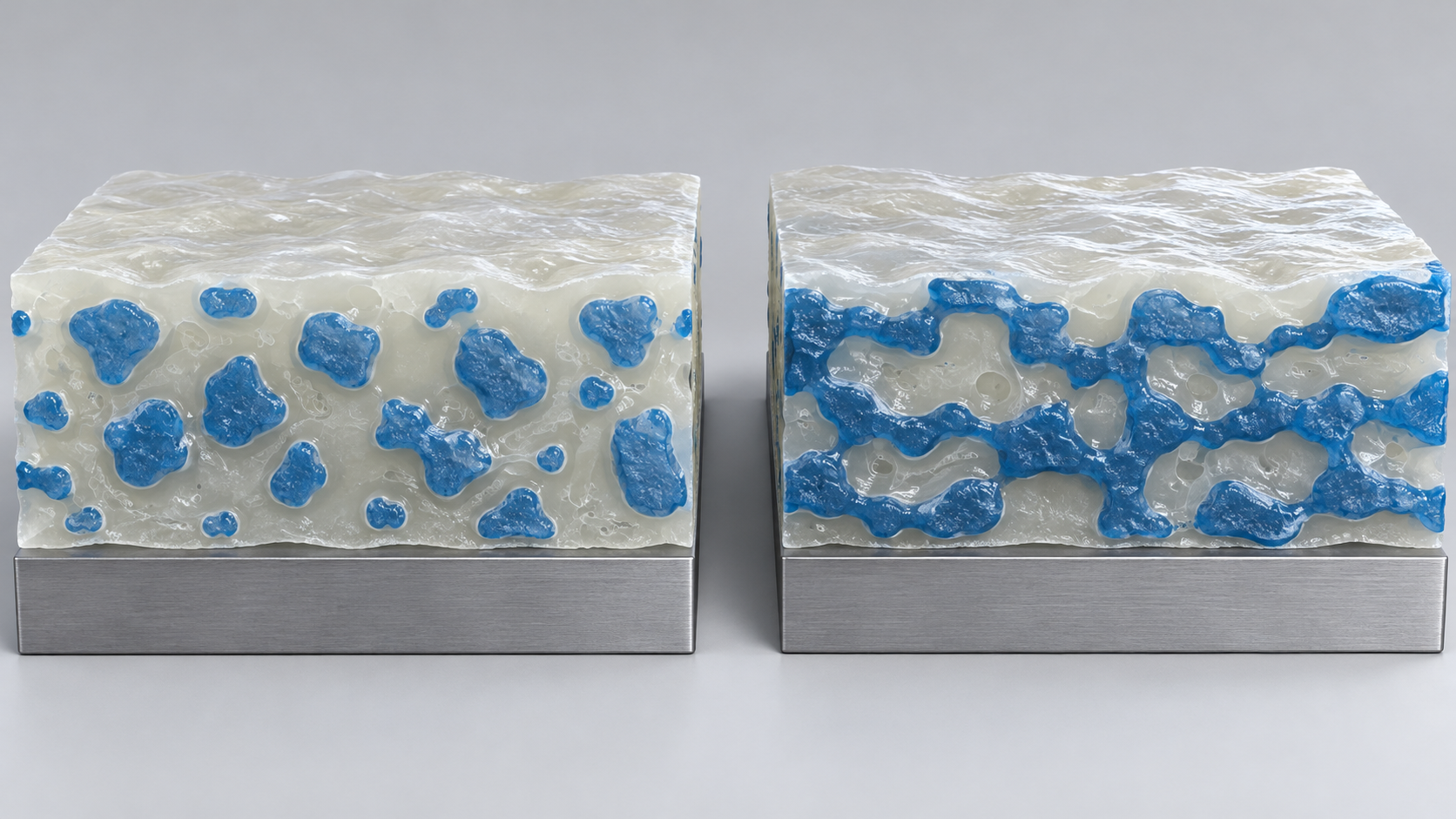
View the original SVG schematic and exact annotations
Examples of treatments that raise conductivity are shown below with the values of each paper (conditions differ).
| Treatment / report | Reported value | Conditions and caution | Source |
|---|---|---|---|
| As cast (untreated) | 1 S/cm or less | A statement in a review. Modification raises it by two to three orders of magnitude, with the best values said to reach about 4,000 S/cm | Review by Fan et al. [12] Sourced |
| Dilute sulfuric acid treatment | 0.3 → 3,065 S/cm. Sheet resistance 39 Ω/sq, transparency about 80% at 550 nm | Xia et al.; they claim conductivity and transparency comparable to ITO | Xia et al. [9] Sourced |
| Concentrated sulfuric acid (solution-processed crystallisation) | Nanofibrils of 4,380 S/cm. Sheet resistance 46 Ω/sq, 90% transmittance | Kim et al.; they describe a structural rearrangement into highly ordered, densely packed nanofibrils | Kim et al. [10] Sourced |
| Manufacturer’s stated value (Clevios) | Conductivity up to 1,000 S/cm; transparency (Y) as high as 90% at a thickness of 100 nm | Manufacturer’s stated value. The product page does not give the conditions of measurement (treatment, thickness, date) | Heraeus Epurio [15] Sourced |
| More co-solvent (EG) | Electronic conductivity rises, but the mobility of K+ ions falls from 2.2 × 10⁻³ to 1.3 × 10⁻³ cm²/(V·s) (EG 0 → 50 vol%) | Rivnay et al.; electronic and ionic transport change in opposite directions | Rivnay et al. [13] Sourced |
Conductivity changes with film thickness, measurement method and treatment. The values lined up here are laboratory results under different conditions and manufacturer’s stated values, and are not a ranking. Treatments with strong acids (such as concentrated sulfuric acid) carry constraints for substrates, equipment and safety (our commentary).
4. Our calculation: sheet resistance from conductivity and film thickness
For thin films such as transparent electrodes, the practical measure is sheet resistance (Rs) rather than conductivity (σ). The review by Fan et al. gives the relation obtained by the van der Pauw method, σ = 1 / (Rs·t), where t is film thicknessSourced [Source 12]. Assuming a film 100 nm thick (1 × 10⁻⁵ cm), this gives about 100,000 Ω/sq at σ = 1 S/cm, about 10,000 Ω/sq at 10 S/cm, about 1,000 Ω/sq at 100 S/cm, about 100 Ω/sq at 1,000 S/cm, and about 23 Ω/sq at 4,380 S/cmOur calculation. Applying the same relation backwards to the reported values, σ = 3,065 S/cm with Rs = 39 Ω/sq (Xia et al.) implies a thickness of about 84 nm, and σ = 4,380 S/cm with Rs = 46 Ω/sq (Kim et al.) about 50 nm, both plausible thicknesses for transparent electrodesOur calculation (these thicknesses are not stated in the papers; we back-calculated them).
5. Polyaniline and polypyrrole — processability and stability
Polyaniline (PANI): the IUPAC technical report by Stejskal and Gilbert describes eight people at five institutions in different countries polymerising aniline by the same protocol (aniline hydrochloride oxidised with ammonium peroxydisulfate in water at ambient temperature). The yield was above 90% in all cases, and the electrical conductivity of the polyaniline hydrochloride was 4.4 ± 1.7 S/cm (average of 59 samples, room temperature). The average conductivity of the corresponding polyaniline bases was 1.4 × 10⁻⁸ S/cm, about eight orders of magnitude lower. Conductivity falls on storage: by about 10% after more than a year, with more pronounced ageing in powders than in compressed samplesSourced [Source 4]. Polypyrrole (PPy): Ansari’s review covers the preparation, characterisation, thermal and environmental stabilities and applications of polypyrrole, and the factors affecting its electrical, electrochemical, thermal and environmental stabilitySourced [Source 6].
Both have long been regarded as hard to process (they tend to be insoluble and infusible) and as prone to degradation in the environment (our commentary). One reason PEDOT:PSS is so widely used is that it can be dispersed in water and coated into a film; Kayser and Lipomi also describe it as processible in water [Source 14].
6. A materials engineer’s view 1: conductive polymers are vulnerable to water, oxygen, heat and potential
The conductivity of a conductive polymer rests on the pairing of positive charges on the backbone (carbocations) with counter-ions (dopants) that stabilise them. Sethumadhavan et al. report that when PEDOT is exposed to 1 mM aqueous salt solutions, the anion decides between two outcomes: doping, with oxidation of PEDOT, or SN1 hydrolysis of the carbocation to give hydroxylated PEDOT, with the boundary at a pKa of about 6.4 for the conjugate acid of the anion. They note that this bears on using doped conducting polymers in aqueous environments such as sensing, energy storage and biomedical devicesSourced [Source 8].
The weak points of PEDOT:PSS: the review by Fan et al. says the aqueous dispersion is acidic at pH 1 and PSS may diffuse into other components of a device and cause detrimental reactions; that, because PSS is hygroscopic, the film absorbs water from humid surroundings and swells, harming structural stability; and that as-cast films have poor stability against heat and moisture. For thermal degradation it cites Choulis et al.: the mobility of hole polarons in PEDOT oligomers rises, and the ionic bonds between PEDOT and PSS separate. Films treated with strong acid, on the other hand, showed no noticeable loss of conductivity even at high temperature (about 160 °C), probably owing to the large removal of PSSSourced [Source 12].
Overoxidation: Holze’s review says that intrinsically conducting polymers may undergo significant changes of molecular structure and properties when exposed to highly oxidising conditions or very positive electrode potentials (overoxidation), which in many cases contributes to material and device degradation, and that these changes may proceed, at much lower rates, even at lower potentials close to the reversible redox processes used in electrochemical energy conversion and electrochromismSourced [Source 7].
Commentary: the lifetime of a conductive polymer is decided by “which water, which potential, which temperature, which light”. The same material degrades for different main reasons in a dry electronic component (a capacitor, an anti-static coating) and in an environment with water and applied potential (a biological electrode, an electrochromic device).
7. Ionic conductors — ionic liquids, polymer electrolytes, ion gels
An ionic conductor carries electricity not by electrons but by moving ions. In their review of polymer electrolytes used in lithium batteries, fuel cells and water desalination, Hallinan and Balsara sort homogeneous electrolytes into five types (I: classical liquid electrolytes; II: gel electrolytes; III: dry polymer electrolytes; IV: dry single-ion-conducting polymer electrolytes; V: solvated single-ion-conducting polymer electrolytes). They say it is desirable to decouple the mechanical properties of polymer electrolyte membranes from ionic conductivity, and that one way is microphase-separated polymers in which one microphase conducts ions while the other gives mechanical rigiditySourced [Source 18].
Ionic liquids
Armand et al. review ionic-liquid materials for the electrochemical challenges of the future (as given by the title)Sourced [Source 16]. The perspective by MacFarlane et al. says ionic liquids combine low volatility with high electrochemical and thermal stability and ionic conductivity, making them candidate electrolytes for batteries, supercapacitors, actuators, dye-sensitised solar cells and thermo-electrochemical cellsSourced [Source 17]. Among the anions of ionic liquids, fluorine-containing structures such as TFSI (bis(trifluoromethanesulfonyl)imide) need to be sorted against the definition in the EU’s PFAS restriction proposal; that arrangement is in our explainer on electrolytes and separators.
Polymer electrolytes (PEO-based)
Poly(ethylene oxide) (PEO) is the representative host that dissolves lithium salts. The review by Arya and Sharma states that PEO is a semi-crystalline polymer with about 70–85% crystallinity at room temperature, a glass transition temperature of about −60 °C and a melting point of about 65 °C, and that ion migration occurs mainly in amorphous regions above the glass transition temperature, aided by segmental motion of the polymer chainsSourced [Source 19]. The same review introduces, as an example of a study adding a lithium salt and an ionic liquid to PEO, a rise of the room-temperature conductivity of PEO + 20 wt% LiTFSI from 2.50 × 10⁻⁶ S/cm to 1.43 × 10⁻⁵ S/cm with 2.5 wt% ionic liquid and to 2.08 × 10⁻⁴ S/cm with 12.5 wt%Sourced (one study’s example, not a representative value for PEO systems) [Source 19]. Timachova et al. measured the self-diffusion coefficients of Li+ and TFSI− in LiTFSI in PEO by pulsed-field-gradient NMR, showed how the cation transference number can be determined over a wide range of PEO molecular weights and salt concentrations, and state that the salt is fully dissociatedSourced [Source 24].
Ion gels
Susan et al. reported ion gels (self-standing, flexible, transparent films) made by in situ radical polymerisation of methyl methacrylate in an ionic liquid (EMITFSI). The temperature dependence of ionic conductivity follows the VTF equation, the ionic conductivity at ambient temperature reaches a value close to 10−2 S/cm, and the cation transference number increases as the EMITFSI concentration fallsSourced [Source 20]. Lee et al. reported polymer thin-film transistors using an ion gel (ionic liquid plus a triblock copolymer) as the gate dielectric, with a gate capacitance as large as 40 µF/cm² at 10 Hz and 2 µF/cm² at 1 kHz, and a polarisation response much faster than earlier solid polymer electrolytesSourced [Source 21].
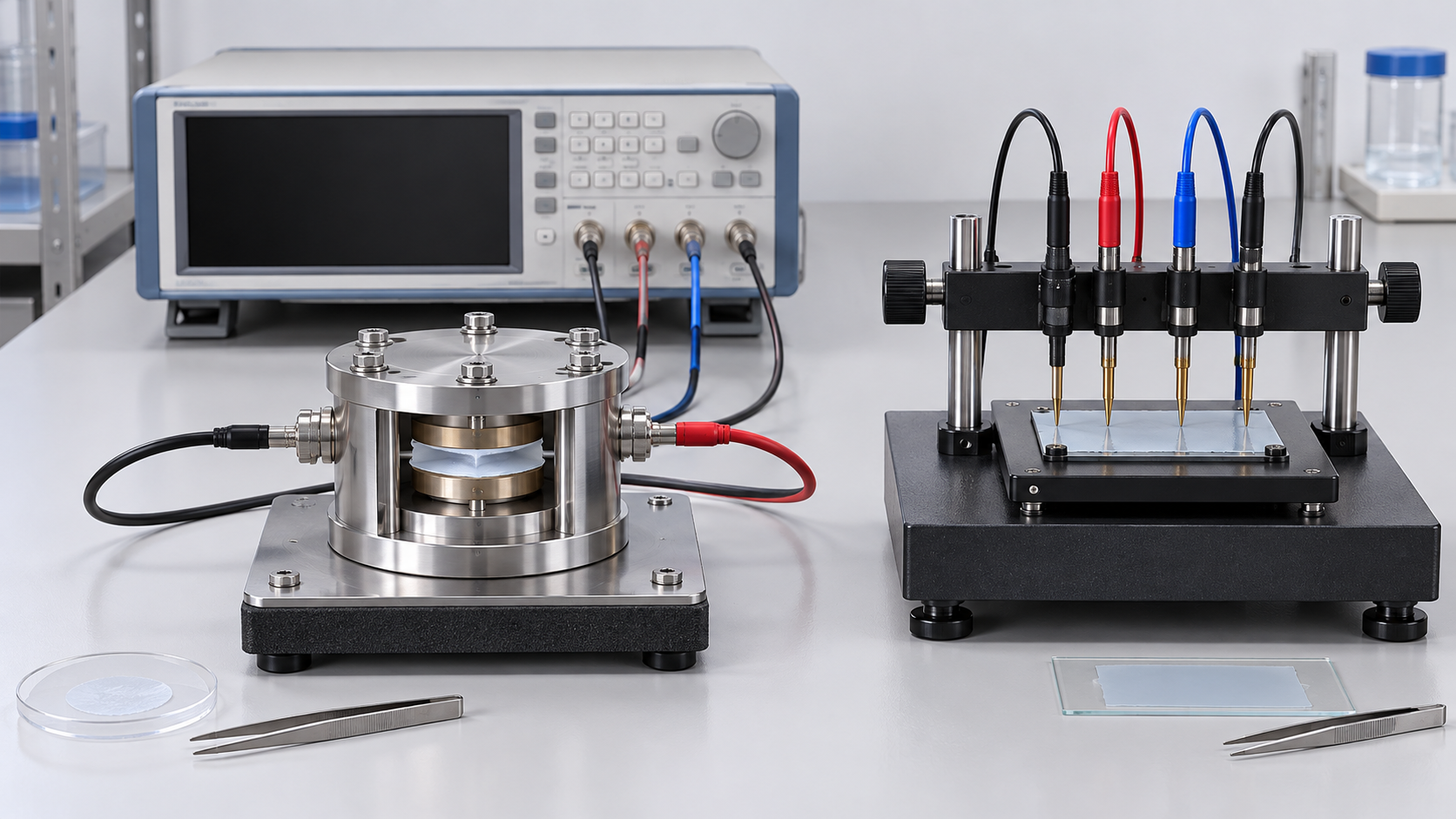
8. Our calculation: area resistance and voltage drop of an electrolyte layer
In an electrolyte layer of a battery, the area-specific resistance is “L / σ” from the ionic conductivity (σ) and the thickness (L). For a layer 20 µm (2 × 10⁻³ cm) thick, it is about 0.2 Ω·cm² at σ = 10−2 S/cm (close to the ambient-temperature value reported for ion gels), about 2 Ω·cm² at 10−3 S/cm, about 20 Ω·cm² at 10−4 S/cm and about 200 Ω·cm² at 10−5 S/cmOur calculation. Assuming an electrode of 3 mAh/cm² discharged at 1C (a current of 3 mA/cm²), the voltage drop due to the layer’s resistance alone is about 0.6 mV, 6 mV, 60 mV and 0.6 V respectivelyOur calculation (concentration polarisation, interfacial resistance and cation transference number are not included).
9. A materials engineer’s view 2: conductivity alone does not decide
Transference number: in a battery only Li+ is wanted to move, but in an electrolyte with a dissolved salt the anions move too. Hallinan and Balsara distinguish single-ion-conducting polymer electrolytes (types IV and V) as separate types of homogeneous electrolyte [Source 18]. Evans, Vincent and Bruce proposed an electrochemical measurement of transference numbers in polymer electrolytes (as given by the title) [Source 23]. Even for electrolytes of the same conductivity, if the anions carry much of the current, a concentration gradient builds near the electrode and the current that can actually be used falls (our commentary).
The conductivity–strength trade-off: PEO-type materials do not conduct in their crystalline regions (Arya and Sharma); the more they are made amorphous, the more the chains move and the conductivity rises, but the material also softens (our commentary). Hallinan and Balsara cite microphase separation, with one phase carrying ions and another keeping strength [Source 18]. The same relation appears in the section on the trade-offs of polymers in our explainer on hybrid electrolytes.
The mixed-conductor trade-off: in PEDOT:PSS, increasing the co-solvent EG raises electronic conductivity but lowers ion mobility (K+ mobility from 2.2 × 10⁻³ to 1.3 × 10⁻³ cm²/(V·s) from EG 0 to 50 vol%). Rivnay et al. state that an optimal morphology allowing balanced ionic and electronic transport is critical for mixed-conductor devicesSourced [Source 13]. They add that hole transport benefits from well-ordered, compact crystallites, while ion transport benefits from an open, hydrogel-like morphologySourced [Source 13].
Temperature dependence: the review by Aziz et al. sets out the two ion-transport models, Arrhenius and Vogel–Tammann–Fulcher (VTF), that describe the patterns of dc conductivity versus 1000/TSourced [Source 22]. When comparing a value at one temperature with a value at another, check the form of the temperature dependence.
10. Relation to solid electrolytes
In the field of batteries, ionic conductors are organised as a spectrum: liquids (organic electrolytes, ionic liquids), polymers, gels and inorganic solids (sulfides, oxides, halides). Here we do not go into the individual inorganic solid electrolytes (sulfide, oxide and halide types and argyrodites); see the corresponding articles in our all-solid-state battery explainers (sulfide solid electrolytes, oxide solid electrolytes, halide solid electrolytes, argyrodite, hybrid electrolytes, and interfacial resistance).
| Aspect | Polymer electrolytes and ion gels (this article) | Inorganic solid electrolytes (all-solid-state battery articles) |
|---|---|---|
| What moves | Cations and anions (types in which a salt is dissolved). Single-ion-conducting types also exist [18] | Mainly Li+, as generally explained (our commentary) |
| Conduction mechanism | Segmental motion of chains (amorphous regions in PEO) [19]. Temperature dependence follows Arrhenius or VTF [22] | Hopping of ions in crystals and glasses (our commentary; details in each article) |
| Mechanics | Soft. There is a trade-off between conductivity and strength [18] | Hard and brittle. Grain boundaries and interfacial contact are issues (each article) |
| Processing | Can be made by solution, coating and film formation | Powder pressing, sintering, film deposition and so on |
| Combining the two | The “hybrid electrolyte”, which combines the softness of polymers with the conductivity of inorganics, is covered in our explainer on hybrid electrolytes (this article does not go into detail) | |
This table is our own arrangement. We do not compare individual values (conductivity, transference number, interfacial resistance) here because the conditions differ.
11. How they are used — organic electronics, sensors, actuators, capacitors
- Organic electronics and transparent electrodes: Xia et al. state that sulfuric-acid-treated PEDOT:PSS has conductivity and transparency comparable to ITO and can replace ITO as the transparent electrode of optoelectronic devicesSourced [Source 9]. The review by Fan et al. sorts PEDOT:PSS uses into solar cells, displays, transistors and sensing electronics such as strain, pressure, temperature, humidity and biosensorsSourced [Source 12]. For transparent conductive materials, see our explainer on transparent conductive films
- Bioelectronics and mixed conduction: an organic electrochemical transistor (OECT) is a device in which ions injected from an electrolyte modify the hole conductivity of a conducting-polymer layer. Because of their high transconductance, they serve as transducers of biological activity, from neural interfacing to biosensing, and the inverse mode, in which the polymer injects ions into an electrolyte, is used for drug delivery, say Rivnay et al.Sourced [Source 13]
- Actuators: the review by Hu et al. says PEDOT and PEDOT:PSS give a promising materials platform for soft actuators and artificial muscles. Compared with other conducting polymers, PEDOT offers higher conductivity and chemical stability and lower density and operating voltage. But PEDOT-based actuators are at an early stage of development, with many unknowns and challengesSourced [Source 25]. Actuation relies on the volume change from ions moving in and out (our commentary)
- Solid electrolytic capacitors: Heraeus Epurio lists, among applications of Clevios PEDOT:PSS, high-performance electrolytic capacitors, flexible displays, anti-static and conductive protective and shielding layers, and printed electronics (the manufacturer’s description)Sourced [Source 15]. IEC 60384-25 is the sectional specification for fixed aluminium electrolytic surface mount capacitors with conductive polymer solid electrolyteSourced [Source 29]
- Anti-static: the Nobel Foundation lists anti-static treatment of photographic film among uses of conductive plasticsSourced [Source 1], and Heraeus Epurio lists antistatic and electrostatic-discharge (ESD) coatings among its applications (the manufacturer’s description)Sourced [Source 15]
- Batteries and dimmable windows: polymer-plus-ionic-liquid windows are covered in our explainer on electrochromic materials and smart windows. For the use of polymer electrolytes in batteries, see our explainer on hybrid electrolytes above
12. Measurement conditions for conductivity, and stability pitfalls
| What is measured | Typical method | Conditions and pitfalls that move the number | Basis and label |
|---|---|---|---|
| Electronic conductivity of a film | Measure sheet resistance (four-point probe, van der Pauw) and divide by thickness (σ = 1 / (Rs·t)) | An error in thickness is directly an error in conductivity. Humidity swells the film and changes conductivity and shape. Treatment (solvent, acid), coating method and film anisotropy (in-plane versus through-plane) also change it | [12] [35] Sourced. Saha et al. state that controlling the shape and orientation of PEDOT:PSS grains leads to control of the anisotropic conductivity of films [35] |
| Resistivity of blocks and moulded parts | ISO 3915 (resistivity of conductive plastics), JIS K 7194 (four-point-probe resistivity of conductive plastics) | ISO 3915 applies to materials with resistivity below 106 Ω·cm and states that the result is not strictly a volume resistivity because of surface conduction (the effect is usually negligible) | [26] [30] Sourced |
| Moderately conductive materials | Methods for insulators are unsuitable; a separate method for moderately conductive materials is used | ASTM D257 is stated as unsuitable for moderately conductive materials, which D4496 is to be used for. A listing on the ANSI Webstore says D4496 addresses moderately conductive materials (neither good insulators nor good conductors) | [33] [34] Sourced |
| Ionic conductivity | AC impedance spectroscopy (EIS), analysed with an equivalent circuit; temperature dependence arranged with Arrhenius or VTF | Temperature, moisture (water contamination affects the electrochemical window), electrode contact, sample thickness, frequency range. When comparing, check the form of the temperature dependence too | [22] [18] Sourced |
| Transference number (cation fraction) | Electrochemical measurement (the Bruce–Vincent method), NMR self-diffusion coefficients | Depends on molecular weight, salt concentration and temperature. Values from different methods are not guaranteed to agree even for the same sample, so check the method (our commentary) | [23] [24] Sourced |
| Change on storage (ageing) | Follow the conductivity of the same sample over time | PANI falls by about 10% after more than a year of storage, with powders changing more than compressed samples. PEDOT:PSS degrades with humidity and heat | [4] [12] Sourced |
13. Laboratory performance versus deployment
| Aspect | Shown in laboratory or by manufacturer’s stated value | What deployment asks | Source and label |
|---|---|---|---|
| Conductivity | 1 S/cm or less untreated, up to about 4,000 S/cm after treatment in reports. Manufacturer’s stated value up to 1,000 S/cm (conditions not given) | Whether the treatment can be reproduced in volume (strong acid, solvents), the effect on substrates and equipment, uniformity of thickness | [12] [10] [15] Sourced (including a manufacturer’s stated value) |
| Stability | Films treated with strong acid reported with no noticeable loss of conductivity even at about 160 °C | Years to decades under humidity, heat, light and potential | [12] [7] Sourced; long term is Not yet confirmed |
| Ionic conductivity | Ion gels close to 10−2 S/cm at ambient temperature. Examples of PEO-type materials at the 10−6–10−5 S/cm level at room temperature | Transference number, mechanical strength, electrochemical window, moisture, making thin self-standing films over large areas | [20] [19] [18] Sourced |
| Actuators | PEDOT-based materials have high conductivity and chemical stability and a low operating voltage | The review describes PEDOT-based actuators as being at an early stage. Durability, response and force could not be quantified | [25] Sourced |
| Capacitors and anti-static | Listed by the manufacturer as practical uses | Conformity to standards (IEC 60384-25). The performance of individual products could not be confirmed | [15] [29] Sourced |
14. Limits, and what could not be confirmed
(1) Individual numerical values of materials
The conductivity of PEDOT:PSS and of PANI and PPy, and the ionic conductivity of ionic liquids and polymer electrolytes, are values from papers with different conditions (film thickness, humidity, temperature, treatment, salt and molecular weight), and this article gives no representative values. The conductivity of PPy and the official data sheet of a production PEDOT:PSS grade (conductivity, solid content, treatment) could not be confirmed.
(2) The texts of papers
We checked the open full texts on PubMed Central of the review by Fan et al. (Adv. Sci. 2019), Rivnay et al. (Nat. Commun. 2016) and Saha et al. (Nanomaterials 2024), and the arXiv text of the review by Arya and Sharma. We could not check the abstract of the ionic-liquid review by Armand et al., the original paper of Shirakawa et al. or the OECT review by Rivnay et al. (Nat. Rev. Mater. 2018); they are either used only to the extent of their titles or not cited.
(3) The texts of standards, and correspondence
We have not checked the texts (which are paid) of ISO 3915, IEC 62631-3-1 and 3-2, IEC 60384-25, JIS K 7194, JIS K 0130 and JIS C 2139. The correspondence between JIS and ISO or IEC, and the years of editions, were not checked here. We could not confirm a dedicated standard for measuring the ionic conductivity of solid ionic conductors.
(4) Safety and regulation
We did not check the toxicity, environmental aspects or the status of regulation (REACH, the PFAS restriction proposal and so on) of individual conductive polymers and ionic liquids. For the relation between the PFAS restriction proposal and ionic liquids and electrolyte salts, see the arrangement in our explainer on electrolytes and separators. We do not generalise ionic liquids or nanomaterials as “safe” or “dangerous”.
(5) Other applications
Thermoelectric conversion (see our explainer on thermoelectric materials), the design of materials inside organic solar cells and OLEDs, proton-conducting membranes for fuel cells, products of artificial muscles, and the safety and long-term reliability of biological electrodes are not covered here.
- A conductive polymer carries electrons (holes) after its conjugated backbone is doped. The conductivity of PEDOT:PSS is reported from 1 S/cm or less as cast to about 4,000 S/cm at most after treatmentSourced
- From conductivity to a practical measure: assuming a 100 nm film, 1,000 S/cm is about 100 Ω/sq and 4,380 S/cm about 23 Ω/sqOur calculation
- Stability is a matter of water, heat and potential. PEDOT:PSS absorbs moisture and swells, and its aqueous dispersion is at pH 1. In salt water, depending on the anion, the carbocation of PEDOT is hydrolysedSourced
- For ionic conductors read the transference number, strength and temperature dependence as well as conductivity. For a 20 µm layer, 10−5 S/cm gives about 200 Ω·cm² and 10−2 S/cm about 0.2 Ω·cm²Our calculation
- Methods and standards split by subject. Standards exist for the resistivity of conductive plastics (ISO 3915, JIS K 7194), resistance of insulating materials (IEC 62631-3) and conductive-polymer capacitors (IEC 60384-25), but we could not confirm a dedicated standard for measuring the ionic conductivity of polymer electrolytesSourced
15. How to read evaluations and standards
What is measured: for conductive polymers, the sheet resistance and conductivity of films (four-point probe, van der Pauw), the resistivity of blocks and moulded parts, and change with humidity, temperature and time. For ionic conductors, the ionic conductivity obtained by AC impedance spectroscopy (EIS), its temperature dependence (Arrhenius or VTF), the cation transference number (electrochemical methods, NMR), the electrochemical window and mechanical strength. We could not confirm, within what we searched, any ISO, IEC or IEEE standard that names conductive polymers or ionic conductors and fixes how to measure their conductivity, except for the resistivity of conductive plastics (ISO 3915), the resistance of insulating materials (IEC 62631-3) and capacitors (IEC 60384-25)Sourced (a statement of what could not be confirmed).
| Item evaluated | ISO | IEC / IEEE | JIS | ASTM | What changes the value with measurement conditions |
|---|---|---|---|---|---|
| Resistivity of conductive plasticsSourced | ISO 3915:2022 (Plastics – Measurement of resistivity of conductive plastics). Edition 2, February 2022, replacing ISO 3915:1981. It covers specially prepared specimens of plastics made conductive by conductive fillers and the like, and applies to materials of resistivity below 106 Ω·cm. The result is not strictly a volume resistivity because of surface conduction [26] | Could not be confirmed | JIS K 7194 (Japanese title: test method for resistivity of conductive plastics by the four-point probe method; our translation). The year of the edition and the correspondence to ISO 3915 were not checked [30] | ASTM D4496 (Standard Test Method for D-C Resistance or Conductance of Moderately Conductive Materials). Title and subject (materials that are neither good insulators nor good conductors) confirmed from the D4496-13 listing on the ANSI Webstore [34] | Specimen preparation, electrode arrangement, temperature, humidity, contribution of surface conduction. Thin films use the sheet-resistance method, so the conditions differ |
| Volume and surface resistance of insulating materials (the anti-static range)Sourced | Could not be confirmed | IEC 62631-3-1:2023 (Dielectric and resistive properties of solid insulating materials – Part 3-1: Determination of resistive properties (DC methods) – Volume resistance and volume resistivity – General method). Edition 2.0, 23 January 2023. IEC 62631-3-2:2023 (same – Part 3-2: … – Surface resistance and surface resistivity). Edition 2.0, 16 October 2023. Replaces IEC 60093 [27, 28] | JIS C 2139-3-1 and 3-2 (Japanese titles: dielectric and resistive properties of solid electrical insulating materials, measurement of resistive properties by applying DC voltage, volume resistance and surface resistance; our translation). The year of the edition and the correspondence to IEC were not checked [32] | ASTM D257 (Standard Test Methods for DC Resistance or Conductance of Insulating Materials). Confirmed from the D257-14 listing on the ANSI Webstore. It states that it is not suitable for moderately conductive materials, for which D4496 should be used [33] | Electrode arrangement, applied voltage and time, humidity (an environmental condition to be recorded). A standard for insulators may be unsuitable for the high-conductivity range of conductive polymers (the statement in D257) |
| Electrical conductivity of liquids (solutions of ionic liquids and electrolytes)Sourced | Could not be confirmed | Could not be confirmed | JIS K 0130 (Japanese title: general rules for the measurement of electrical conductivity; our translation). Whether it applies to ionic liquids and polymer electrolytes was not checked [31] | Could not be confirmed | Temperature (conductivity changes strongly with temperature), cell constant, moisture. For the ionic conductivity of solids and gels, EIS is used [22] |
| Ionic conductivity and transference number of polymer electrolytesNot yet confirmed | Could not be confirmed | Could not be confirmed | Could not be confirmed | Could not be confirmed | No dedicated standard could be confirmed; papers use EIS (with equivalent circuits), Arrhenius/VTF, the Bruce–Vincent method and NMR [22, 23, 24] |
| Conductive-polymer capacitorsSourced | Could not be confirmed | IEC 60384-25:2021 (Fixed capacitors for use in electronic equipment – Part 25: Sectional specification – Fixed aluminium electrolytic surface mount capacitors with conductive polymer solid electrolyte). Edition 3.0, 14 July 2021, stability date 2030 [29] | JIS C 5101-25 (Japanese title: fixed capacitors for use in electronic equipment, Part 25: sectional specification, surface mount fixed aluminium solid (conductive polymer) electrolytic capacitors; our translation). The year of the edition and the correspondence to IEC were not checked [36] | Could not be confirmed | A standard for components, not for the conductivity of the material. It cannot be used to compare conductive-polymer materials (our commentary) |
Which standard we match to which item is our own arrangement (Our calculation). Numbers and titles were checked on the official ISO page for ISO, the IEC Webstore for IEC, and the JISC JIS search for JIS. The two ASTM standards were checked on non-ASTM pages (the ANSI Webstore), and the ASTM website was not opened.
How the standards differ in standing
- ISO and IEC are international standards; JIS is Japan’s national standard. The correspondence of JIS K 7194 to ISO 3915, and of JIS C 2139 to IEC 62631-3 (the titles are close), was not checked here
- ASTM is a US-centred standards organisation. D257 and D4496 are used according to the conductivity of the subject (an insulator, or a moderately conductive material) [33, 34]
- IEC 60384-25 is a standard for a component (a capacitor), not for a material.
Cautions in reading the standards
- A standard is a test method, not a guarantee of performance. A thin film of a conductive polymer is evaluated from sheet resistance and thickness, so it is not the same test as the methods for blocks and moulded parts such as ISO 3915 [12, 26]
- The same named property can differ in method by standard and edition. Distinguish whether “conductivity” is of electrons, of ions, or of both (a mixed conductor), and check the frequency, humidity and temperature of measurement [13]
- Read a manufacturer’s value together with the standard, edition and test conditions it follows. Heraeus Epurio’s “up to 1,000 S/cm” and “transparency up to 90% at 100 nm” come without treatment, measurement method or date on the product page [15]
- The gap between a standard’s range and conditions of use: a conductivity measured dry does not include the changes of humidity, heat and time. PEDOT:PSS absorbs moisture and swells, and PANI loses conductivity on storage [12, 4]
16. Glossary
- Conjugation (conjugated double bonds)
- A structure in which single and double bonds alternate and electrons are delocalised.
- Doping
- Giving conductivity by oxidation (removing electrons) or reduction (introducing them).
- PEDOT:PSS
- A complex of the conductive polymer PEDOT and polystyrene sulfonate (PSS), dispersible in water.
- Sheet resistance (Ω/sq)
- The area resistance of a thin film; the reciprocal of conductivity times thickness.
- Mixed conductor
- A material that carries both electrons (holes) and ions.
- OECT
- Organic electrochemical transistor: ions moving in and out change the conductivity of a conducting polymer.
- Ionic liquid
- A salt that is liquid near room temperature (a liquid made only of ions).
- Polymer electrolyte
- A polymer in which a salt is dissolved so that it carries ions. PEO-based ones are representative.
- Ion gel
- A soft, solid-like electrolyte holding an ionic liquid in a polymer network.
- Transference number
- The fraction of the current carried by a given ion (for example the cation).
- EIS
- Electrochemical impedance spectroscopy: separating resistance components by changing the AC frequency, to obtain ionic conductivity.
- VTF
- The Vogel–Tammann–Fulcher equation, describing the temperature dependence of conductivity in systems near a glass transition.
17. References (primary sources)
- The Royal Swedish Academy of Sciences (Nobel Foundation) Press release, “The 2000 Nobel Prize in Chemistry” (10 October 2000) — nobelprize.org/prizes/chemistry/2000/press-release
- Chiang C. K. et al. “Electrical Conductivity in Doped Polyacetylene”, Phys. Rev. Lett. 39, 1098–1101 (1977), DOI 10.1103/PhysRevLett.39.1098 — doi.org/10.1103/PhysRevLett.39.1098
- Shirakawa H. et al. “Synthesis of electrically conducting organic polymers: halogen derivatives of polyacetylene, (CH)x“, J. Chem. Soc., Chem. Commun. 578 (1977), DOI 10.1039/C39770000578 — doi.org/10.1039/C39770000578
- Stejskal J., Gilbert R. G. “Polyaniline. Preparation of a conducting polymer (IUPAC Technical Report)”, Pure Appl. Chem. 74, 857–867 (2002), DOI 10.1351/pac200274050857 — doi.org/10.1351/pac200274050857
- Le T.-H., Kim Y., Yoon H. “Electrical and Electrochemical Properties of Conducting Polymers”, Polymers 9, 150 (2017), DOI 10.3390/polym9040150 (open access) — doi.org/10.3390/polym9040150
- Ansari R. “Polypyrrole Conducting Electroactive Polymers: Synthesis and Stability Studies”, E-Journal of Chemistry 3, 186–201 (2006), DOI 10.1155/2006/860413 — doi.org/10.1155/2006/860413
- Holze R. “Overoxidation of Intrinsically Conducting Polymers”, Polymers 14, 1584 (2022), DOI 10.3390/polym14081584 (open access) — doi.org/10.3390/polym14081584
- Sethumadhavan V. et al. “Hydrolysis of doped conducting polymers”, Commun. Chem. 3, 153 (2020), DOI 10.1038/s42004-020-00404-y (open access) — doi.org/10.1038/s42004-020-00404-y
- Xia Y., Sun K., Ouyang J. “Solution-Processed Metallic Conducting Polymer Films as Transparent Electrode of Optoelectronic Devices”, Adv. Mater. 24, 2436–2440 (2012), DOI 10.1002/adma.201104795 — doi.org/10.1002/adma.201104795
- Kim N. et al. “Highly Conductive PEDOT:PSS Nanofibrils Induced by Solution-Processed Crystallization”, Adv. Mater. 26, 2268–2272 (2014), DOI 10.1002/adma.201304611 — doi.org/10.1002/adma.201304611
- Shi H. et al. “Effective Approaches to Improve the Electrical Conductivity of PEDOT:PSS: A Review”, Adv. Electron. Mater. 1, 1500017 (2015), DOI 10.1002/aelm.201500017 — doi.org/10.1002/aelm.201500017
- Fan X. et al. “PEDOT:PSS for Flexible and Stretchable Electronics: Modifications, Strategies, and Applications”, Adv. Sci. 6, 1900813 (2019), DOI 10.1002/advs.201900813 (open access; checked in the full text on PubMed Central) — doi.org/10.1002/advs.201900813
- Rivnay J. et al. “Structural control of mixed ionic and electronic transport in conducting polymers”, Nat. Commun. 7, 11287 (2016), DOI 10.1038/ncomms11287 (open access; checked in the full text on PubMed Central) — doi.org/10.1038/ncomms11287
- Kayser L. V., Lipomi D. J. “Stretchable Conductive Polymers and Composites Based on PEDOT and PEDOT:PSS”, Adv. Mater. 31, 1806133 (2019), DOI 10.1002/adma.201806133 — doi.org/10.1002/adma.201806133
- Heraeus Epurio “Clevios Conductive Polymers” product page (the manufacturer’s description) — heraeus-epurio.com/en/applications/clevios
- Armand M. et al. “Ionic-liquid materials for the electrochemical challenges of the future”, Nat. Mater. 8, 621–629 (2009), DOI 10.1038/nmat2448 (checked by title only) — doi.org/10.1038/nmat2448
- MacFarlane D. R. et al. “Energy applications of ionic liquids”, Energy Environ. Sci. 7, 232–250 (2014), DOI 10.1039/C3EE42099J — doi.org/10.1039/C3EE42099J
- Hallinan D. T., Balsara N. P. “Polymer Electrolytes”, Annu. Rev. Mater. Res. 43, 503–525 (2013), DOI 10.1146/annurev-matsci-071312-121705 — doi.org/10.1146/annurev-matsci-071312-121705
- Arya A., Sharma A. L. “Insights into the use of polyethylene oxide in energy storage/conversion devices: A critical review”, J. Phys. D: Appl. Phys. 50, 443002 (2017) (checked in the arXiv text, arXiv:1808.03699) — arxiv.org/abs/1808.03699
- Susan M. A. B. H. et al. “Ion Gels Prepared by in Situ Radical Polymerization of Vinyl Monomers in an Ionic Liquid and Their Characterization as Polymer Electrolytes”, J. Am. Chem. Soc. 127, 4976–4983 (2005), DOI 10.1021/ja045155b — doi.org/10.1021/ja045155b
- Lee J. et al. “Ion Gel Gated Polymer Thin-Film Transistors”, J. Am. Chem. Soc. 129, 4532–4533 (2007), DOI 10.1021/ja070875e — doi.org/10.1021/ja070875e
- Aziz S. B. et al. “A conceptual review on polymer electrolytes and ion transport models”, J. Sci.: Adv. Mater. Devices 3, 1–17 (2018), DOI 10.1016/j.jsamd.2018.01.002 — doi.org/10.1016/j.jsamd.2018.01.002
- Evans J., Vincent C. A., Bruce P. G. “Electrochemical measurement of transference numbers in polymer electrolytes”, Polymer 28, 2324–2328 (1987), DOI 10.1016/0032-3861(87)90394-6 (checked by title only) — doi.org/10.1016/0032-3861(87)90394-6
- Timachova K., Watanabe H., Balsara N. P. “Effect of Molecular Weight and Salt Concentration on Ion Transport and the Transference Number in Polymer Electrolytes”, Macromolecules 48, 7882–7888 (2015), DOI 10.1021/acs.macromol.5b01724 — doi.org/10.1021/acs.macromol.5b01724
- Hu F. et al. “PEDOT-Based Conducting Polymer Actuators”, Front. Robot. AI 6, 114 (2019), DOI 10.3389/frobt.2019.00114 (open access) — doi.org/10.3389/frobt.2019.00114
- ISO “ISO 3915:2022” page — iso.org/standard/81838.html
- IEC “IEC 62631-3-1:2023” product page (IEC Webstore) — webstore.iec.ch/en/publication/62314
- IEC “IEC 62631-3-2:2023” product page (IEC Webstore) — webstore.iec.ch/en/publication/62315
- IEC “IEC 60384-25:2021” product page (IEC Webstore) — webstore.iec.ch/en/publication/64363
- Japanese Industrial Standards Committee (JISC) JIS search listing for “JIS K 7194” — jisc.go.jp (JIS K 7194)
- Japanese Industrial Standards Committee (JISC) JIS search listing for “JIS K 0130” — jisc.go.jp (JIS K 0130)
- Japanese Industrial Standards Committee (JISC) JIS search listing for “JIS C 2139” — jisc.go.jp (JIS C 2139)
- ANSI Webstore (a non-ASTM sales page) Listing giving the title and scope of ASTM D257-14 — webstore.ansi.org/standards/astm/astmd25714
- ANSI Webstore (a non-ASTM sales page) Listing giving the title and scope of ASTM D4496-13 — webstore.ansi.org/standards/astm/astmd449613
- Saha A. et al. “Effect of Film Morphology on Electrical Conductivity of PEDOT:PSS”, Nanomaterials 14, 95 (2024), DOI 10.3390/nano14010095 (open access; checked in the full text on PubMed Central) — doi.org/10.3390/nano14010095
- Japanese Industrial Standards Committee (JISC) JIS search listing for “JIS C 5101-25” — jisc.go.jp (JIS C 5101-25)
18. Claim-to-source audit
| Claim in the text | Basis | Label |
|---|---|---|
| The 2000 Nobel Prize in Chemistry (Heeger, MacDiarmid, Shirakawa), conjugation and doping, uses of conductive plastics (anti-static photographic film, electromagnetic shielding of screens, smart windows) | Nobel Foundation press release Reference 1 https://www.nobelprize.org/prizes/chemistry/2000/press-release/ | Sourced |
| The conductivity of doped polyacetylene varying over eleven orders of magnitude, a metal-insulator transition near 1% dopant | Chiang et al. (1977) Reference 2 https://doi.org/10.1103/PhysRevLett.39.1098 | Sourced |
| The synthesis of halogen derivatives of polyacetylene (1977; from the title) | Shirakawa et al. (1977) Reference 3 https://doi.org/10.1039/C39770000578 | Sourced |
| Conductivity of polyaniline hydrochloride 4.4 ± 1.7 S/cm (59 samples), of the base form 1.4 × 10⁻⁸ S/cm, a fall of about 10% on storage, more change in powders | IUPAC technical report (2002) Reference 4 https://doi.org/10.1351/pac200274050857 | Sourced |
| The electrical and electrochemical properties of conducting polymers, mild synthesis and processing, chemical diversity, tunable conductivity | Le et al. (2017) Reference 5 https://doi.org/10.3390/polym9040150 | Sourced |
| A review of polypyrrole preparation and of the factors affecting its electrical, electrochemical, thermal and environmental stability | Ansari (2006) Reference 6 https://doi.org/10.1155/2006/860413 | Sourced |
| Overoxidation of conducting polymers (strongly oxidising conditions and positive potentials) and degradation, proceeding slowly even at lower potentials | Holze (2022) Reference 7 https://doi.org/10.3390/polym14081584 | Sourced |
| PEDOT in 1 mM aqueous salt solutions: doping or hydrolysis of the carbocation depending on the anion, a boundary at a conjugate-acid pKa of about 6.4 | Sethumadhavan et al. (2020) Reference 8 https://doi.org/10.1038/s42004-020-00404-y | Sourced |
| Dilute-sulfuric-acid treatment of PEDOT:PSS (0.3 to 3,065 S/cm, 39 Ω/sq, about 80% transparency at 550 nm) and the claim that it can replace ITO | Xia et al. (2012) Reference 9 https://doi.org/10.1002/adma.201104795 | Sourced |
| PEDOT:PSS nanofibrils from concentrated sulfuric acid (4,380 S/cm, 46 Ω/sq, 90% transmittance) | Kim et al. (2014) Reference 10 https://doi.org/10.1002/adma.201304611 | Sourced |
| The arrangement of PEDOT:PSS as a conducting polymer with good film formation, high transparency, tunable conductivity and thermal stability, and mechanisms of conductivity improvement | Review by Shi et al. (2015) Reference 11 https://doi.org/10.1002/aelm.201500017 | Sourced |
| As-cast conductivity of 1 S/cm or less, two to three orders of magnitude of improvement and about 4,000 S/cm at best, σ = 1/(Rs·t) (van der Pauw), the aqueous dispersion at pH 1, swelling by moisture, stability against heat and moisture, stability of strong-acid films at about 160 °C, the thermal degradation mechanism of Choulis et al., uses (solar cells, displays, transistors, sensors) | Review by Fan et al. (2019) (open full text on PubMed Central) Reference 12 https://doi.org/10.1002/advs.201900813 | Sourced |
| PEDOT:PSS as a mixed conductor, PEDOT:PSS-rich cores and a PSS-rich matrix, conductivity above 1,000 S/cm, K+ mobility falling from 2.2 × 10⁻³ to 1.3 × 10⁻³ cm²/(V·s) with EG, OECTs, drug delivery and actuators | Rivnay et al. (2016) (open full text on PubMed Central) Reference 13 https://doi.org/10.1038/ncomms11287 | Sourced |
| PEDOT:PSS as the best-known organic conductor, stretchability only to about 10%, processible in water | Kayser and Lipomi (2019) Reference 14 https://doi.org/10.1002/adma.201806133 | Sourced |
| Clevios stated values (up to 1,000 S/cm; transparency up to 90% at 100 nm) and uses (capacitors, anti-static, flexible displays, shielding layers, printed electronics). The manufacturer’s description | Heraeus Epurio product page Reference 15 https://www.heraeus-epurio.com/en/applications/clevios/ | Sourced |
| That a review of ionic-liquid materials exists (from the title) | Armand et al. (2009) Reference 16 https://doi.org/10.1038/nmat2448 | Sourced |
| The low volatility, high electrochemical and thermal stability and ionic conductivity of ionic liquids, and their use as electrolytes | MacFarlane et al. (2014) Reference 17 https://doi.org/10.1039/C3EE42099J | Sourced |
| Five types of homogeneous electrolyte (I–V), decoupling mechanics from ionic conductivity by microphase separation, water contamination | Hallinan and Balsara (2013) Reference 18 https://doi.org/10.1146/annurev-matsci-071312-121705 | Sourced |
| PEO about 70–85% crystalline at room temperature, Tg about −60 °C, melting point about 65 °C, ion conduction in amorphous regions, the room-temperature conductivity example of PEO + LiTFSI + ionic liquid (2.50 × 10⁻⁶, 1.43 × 10⁻⁵, 2.08 × 10⁻⁴ S/cm), methods for transference number | Review by Arya and Sharma (arXiv text) Reference 19 https://arxiv.org/abs/1808.03699 | Sourced |
| Ion gels (EMITFSI + PMMA) with ambient-temperature conductivity close to 10−2 S/cm, the VTF equation, the concentration dependence of cation transference number | Susan et al. (2005) Reference 20 https://doi.org/10.1021/ja045155b | Sourced |
| Polymer thin-film transistors with an ion-gel gate dielectric (capacitance up to 40 µF/cm² at 10 Hz, 2 µF/cm² at 1 kHz, operation above 100 Hz) | Lee et al. (2007) Reference 21 https://doi.org/10.1021/ja070875e | Sourced |
| The principle of EIS, equivalent circuits, and the Arrhenius and VTF ion-transport models | Aziz et al. (2018) Reference 22 https://doi.org/10.1016/j.jsamd.2018.01.002 | Sourced |
| A proposed electrochemical measurement of transference numbers in polymer electrolytes (from the title) | Evans et al. (1987) Reference 23 https://doi.org/10.1016/0032-3861(87)90394-6 | Sourced |
| Self-diffusion coefficients (NMR) of Li+ and TFSI− in LiTFSI/PEO and the cation transference number, dependence on molecular weight and salt concentration, complete dissociation of the salt | Timachova et al. (2015) Reference 24 https://doi.org/10.1021/acs.macromol.5b01724 | Sourced |
| PEDOT-based actuators (high conductivity and chemical stability, low density and operating voltage), at an early stage of development | Hu et al. (2019) Reference 25 https://doi.org/10.3389/frobt.2019.00114 | Sourced |
| Number, title and edition: ISO 3915:2022 (Edition 2, February 2022, below 106 Ω·cm, effect of surface conduction) | ISO Reference 26 https://www.iso.org/standard/81838.html | Sourced |
| Number, title and edition: IEC 62631-3-1:2023 (Edition 2.0, 23 January 2023, replacing IEC 60093) | IEC Webstore Reference 27 https://webstore.iec.ch/en/publication/62314 | Sourced |
| Number, title and edition: IEC 62631-3-2:2023 (Edition 2.0, 16 October 2023) | IEC Webstore Reference 28 https://webstore.iec.ch/en/publication/62315 | Sourced |
| Number, title and edition: IEC 60384-25:2021 (Edition 3.0, 14 July 2021, stability date 2030) | IEC Webstore Reference 29 https://webstore.iec.ch/en/publication/64363 | Sourced |
| Number and title: JIS K 7194 (Japanese title on the JISC listing) | JISC JIS search Reference 30 https://www.jisc.go.jp/app/jis/general/GnrJISNumberNameSearchList?show&jisStdNo=K7194 | Sourced |
| Number and title: JIS K 0130 (Japanese title on the JISC listing) | JISC JIS search Reference 31 https://www.jisc.go.jp/app/jis/general/GnrJISNumberNameSearchList?show&jisStdNo=K0130 | Sourced |
| Number and title: JIS C 2139-3-1 and 3-2 (Japanese titles on the JISC listing) | JISC JIS search Reference 32 https://www.jisc.go.jp/app/jis/general/GnrJISNumberNameSearchList?show&jisStdNo=C2139 | Sourced |
| Title and scope of ASTM D257 (insulating materials; unsuitable for moderately conductive materials, for which D4496 is used), confirmed on a non-ASTM sales page; the ASTM website was not opened | ANSI Webstore Reference 33 https://webstore.ansi.org/standards/astm/astmd25714 | Sourced |
| Title and subject of ASTM D4496 (moderately conductive materials, neither good insulators nor good conductors), confirmed on a non-ASTM sales page; the ASTM website was not opened | ANSI Webstore Reference 34 https://webstore.ansi.org/standards/astm/astmd449613 | Sourced |
| That controlling the shape and orientation of PEDOT:PSS grains leads to control of the anisotropic conductivity of films | Saha et al. (2024) (open full text on PubMed Central) Reference 35 https://doi.org/10.3390/nano14010095 | Sourced |
| Number and title: JIS C 5101-25 (sectional specification for surface-mount aluminium solid (conductive polymer) electrolytic capacitors) | JISC JIS search Reference 36 https://www.jisc.go.jp/app/jis/general/GnrJISNumberNameSearchList?show&jisStdNo=C5101-25 | Sourced |
| Sheet resistance (for an assumed 100 nm: about 100,000 Ω/sq at 1 S/cm, about 10,000 at 10, about 1,000 at 100, about 100 at 1,000, and about 23 at 4,380 S/cm), back-calculated thicknesses (about 84 nm for Xia et al., about 50 nm for Kim et al.), electrolyte area resistance (20 µm: about 0.2, 2, 20 and 200 Ω·cm² at 10−2, 10−3, 10−4 and 10−5 S/cm) and the voltage drop at 1C (3 mA/cm²; about 0.6 mV, 6 mV, 60 mV and 0.6 V) | Our calculation. Sheet resistance = 1 / (conductivity x thickness); the 100 nm thickness is an assumption and the back-calculated thicknesses are not stated in the papers. Area resistance = thickness / conductivity. The assumption is that 1C for a 3 mAh/cm² electrode is 3 mA/cm²; only the layer’s resistance is counted (no interfaces, concentration polarisation or transference number) | Our calculation |
| The conductivity of PPy, the official data sheet values of a production PEDOT:PSS grade, a dedicated standard for the ionic conductivity of solids, the toxicity and regulatory status of individual conductive polymers and ionic liquids, and the texts of the papers by Armand et al., Shirakawa et al. and Evans et al. | Not given, because they could not be confirmed in the primary sources accessible to this investigation | Commentary |
| The readings “conductivity is kept by the dopant being there”, “polyaniline and polypyrrole are hard to process and prone to degrade in the environment”, “a low transference number lowers the current that can actually be used”, “PEO-type materials trade conductivity against softness by becoming amorphous”, “IEC 60384-25 is a standard for a component”. The comparison table with inorganic solid electrolytes | Our own arrangement and commentary based on the published material; not views expressed by the companies or institutions | Commentary |
| That Figs. 2, 3 and 5 are explanatory drawings, not real data, and that Figs. 1 and 4 are AI-generated images | Note from this article | Commentary |
Last updated 10 October 2026. Sources are limited to primary material (peer-reviewed papers, an IUPAC technical report, official pages of the Nobel Foundation, Heraeus Epurio, ISO, IEC and JISC). The texts of standards are paid and could not be checked. The ASTM International website was not opened. Because the article includes structural readings and materials-design interpretations, those are marked as Commentary and kept separate from sourced fact. The conductivity of polypyrrole, the official data sheet of production PEDOT:PSS, a dedicated standard for measuring the ionic conductivity of solids, the toxicity and regulatory status of individual conductive polymers and ionic liquids, and the texts of standards could not be confirmed and are not stated here. Conductivities and ionic conductivities are results for particular samples and conditions or manufacturers’ stated values, and cannot be generalised to other samples or products. All figures are explanatory concept graphics. Figs. 2, 3 and 5 are vector drawings; Figs. 1 and 4 are AI-generated images, and none of them shows a real photograph, measured data or a physical product.