TECHNOLOGY EXPLAINER
Antimicrobial and Anti-Corrosion Coatings
— reading “kills microbes” and “stops rust” as results under stated conditions
No material “completely prevents” microbial growth or corrosion. A number depends on which microbe, in which broth, at what temperature and humidity, for how many hours, or on which environment, how many hours of salt spray or how many years outdoors a coating withstood. This article sets out, from primary sources, how silver, copper, zinc oxide and quaternary ammonium antimicrobials work and how to read their tests; three ideas of corrosion protection (barrier, sacrificial zinc, inhibitor-based active protection); the move away from chromates; conducting polymers and self-healing anti-corrosion coatings; the limits of salt spray testing; and regulation such as the EU Biocidal Products Regulation (BPR).
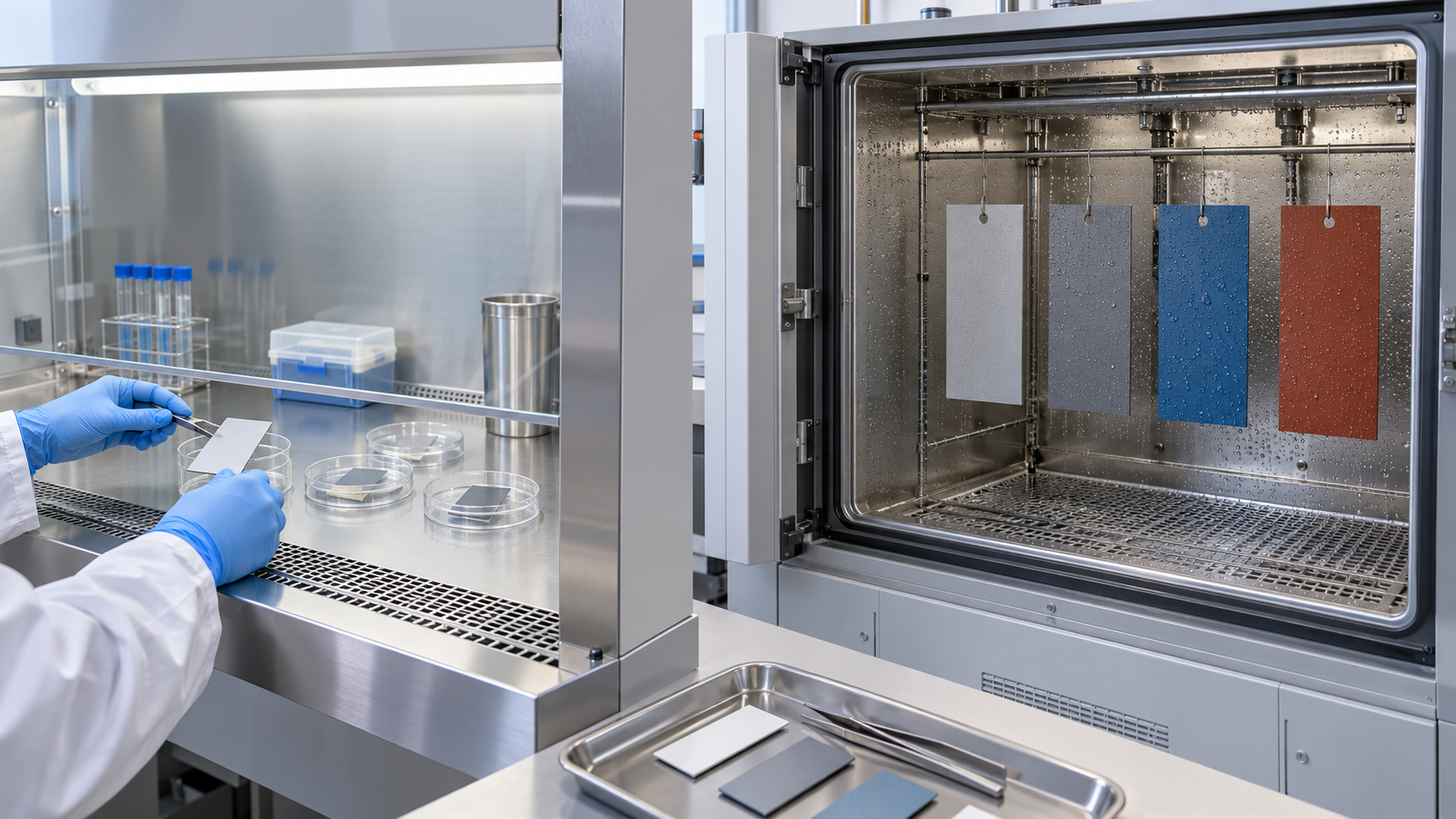
- The short version
- A map of antimicrobial mechanisms — silver, copper, zinc oxide and photocatalysts, quaternary ammonium
- Evaluating antimicrobial action — test conditions change the result
- Ideas of corrosion protection — barrier, sacrificial, active
- Chromate-free — why the "two-sided inhibition and self-healing" of hexavalent chromium is hard to replace
- Conducting polymers, and self-healing anti-corrosion coatings
- Testing corrosion protection — salt spray matches outdoor results only in part
- Regulation — the Biocidal Products Regulation (BPR) and hexavalent chromium: proposal, adoption and application kept apart
- Limits, and what could not be confirmed
- How to read evaluations and standards
- Glossary
- References (primary sources)
- Claim-to-source audit
Sourced = stated in published material (link given)
Our calculation = a figure this article derived, with the assumptions spelled out
Not yet confirmed = a plan or schedule whose record has not been confirmed
Materials-design interpretations are marked separately as Commentary. Inference is shown in bold.
The antimicrobial and anti-corrosion figures here are laboratory results for which specimen shape, microbe, broth, temperature and humidity, time and salt concentration were fixed. They do not describe effects or life in actual use. Please do not read “antimicrobial”, “anti-corrosion”, “safe” or “completely prevents” as a guarantee of performance or safety. This article does not call materials such as silver, copper, zinc oxide or quaternary ammonium “safe” or “hazardous” in general, and gives no medical or hygiene advice. Regulatory statements are limited to the texts of laws and official gazettes, keep proposal, adoption and application apart, and carry a checking date (10 October 2026). This article does not rank products or companies.
1. The short version
- Antimicrobial action is not a property of a material; it is a result under test conditions. A recent paper reports that for the same contact-killing coating, changing only the test broth moved the reduction in microbes from 0.4–3.5 log to more than 5 logSourced [Source 9]. Copper lost antibacterial and antifungal efficacy at low humidity [Source 2]
- Corrosion protection combines barrier, sacrificial action and inhibitors. Hexavalent chromium inhibits both anodic and cathodic reactions and rebuilds a protective film at damage (self-healing), so a like-for-like replacement has not been established so farSourced [Source 10]
- Salt spray testing can serve for pass/fail decisions, but not for predicting life. A study comparing 19 coatings for hydraulic steelwork in the neutral salt spray test (ISO 9227) with five years of outdoor and immersion exposure found a correlation in only 6 of 12 comparisons, and coatings without a zinc primer passed in the laboratory but failed outdoorsSourced [Source 15]
“99.9% antibacterial” or “1,000 hours of salt spray” means something only when its conditions are stated. Check against what (microbe, environment), compared with what (untreated specimen, reference material), and under what (broth, humidity, time, temperature). The number does not by itself show the effect or life in actual use.
This article concentrates on mechanisms and on how to read evaluations. Antimicrobial action of photocatalytic titanium dioxide is in our explainer on titanium dioxide and photocatalysis; how to read self-healing evaluations in our explainer on self-healing materials and vitrimers; microcapsules in our explainer on microcapsules; the definition and regulation of nanomaterials in our explainer on nanomaterial definitions and regulation; and anti-fouling of ships in our explainer on superhydrophobic, anti-icing and anti-fouling coatings.
2. A map of antimicrobial mechanisms — silver, copper, zinc oxide and photocatalysts, quaternary ammonium
(1) Silver — silver ions, more than particles
Xiu et al. conclude that the toxicity of silver nanoparticles (AgNPs) comes from released silver ions (Ag+). When AgNPs were synthesised and tested under strictly anaerobic conditions, which prevent Ag+ release, they showed no toxicity, and the dose-response of AgNPs of different sizes and coatings followed that of Ag+ (added as AgNO3). Moreover, at low (sublethal) concentrations (3–8 μg/L Ag+, 12–31% of the minimum lethal concentration), survival of E. coli was stimulated (a hormetic-type response), which they note would be counterproductive to antimicrobial applicationsSourced [Source 3]. The review by Dakal et al. states that the size, shape, surface charge, concentration and colloidal state of AgNPs affect antimicrobial activity, and that action is through several mechanisms (adhesion to and penetration of cells, generation of reactive oxygen species, modulation of signal transduction). The same review notes that AgNPs cause cytotoxicity, genotoxicity and inflammatory responses in human cells, depending on cell type [Source 4].
(2) Copper — contact killing on dry metal, and the effect of humidity
The review by Grass et al. calls the rapid death of bacteria, yeasts and viruses on metallic copper “contact killing”, and gives a killing rate of at least 7 to 8 logs per hour, with no live microorganisms generally recovered after prolonged incubationSourced [Source 1]. Cunliffe et al. (2026), on the other hand, say that moisture is often overlooked in standard test methods. They developed a method that places small droplets (ten 1 μL droplets) on copper (and inert stainless steel) and recovers the microbes while the droplets are still wet and 2 hours after they have dried. With this method copper showed decreased antibacterial and antifungal efficacy at low relative humidity, while high antiviral efficacy was kept. The same paper states that current standards sometimes use conditions far from the end-use environment, such as relative humidity above 90%, and that a test with constant moisture can overemphasise the efficacy of some materials; copper surfaces can pass standards such as ISO 22196 because water is available throughout the test [Source 2].
(3) Zinc oxide and photocatalysts — reactive oxygen species
The review by Sirelkhatim et al. states that the antibacterial action of zinc oxide nanoparticles (ZnO-NPs) depends on particle size, concentration, morphology, defects, surface modification and ultraviolet illumination. As mechanisms it names generation of reactive oxygen species (such as H2O2 and hydroxyl radicals), cell-wall damage, increased membrane permeability and uptake of dissolved zinc ionsSourced [Source 5]. For photocatalysts such as titanium dioxide, there are separate standards that evaluate antibacterial activity by the number of microbes under ultraviolet light (ISO 27447, JIS R 1702), covered in our explainer on titanium dioxide and photocatalysis.
(4) Quaternary ammonium — action on the cell membrane, and resistance
Quaternary ammonium compounds (QACs) have been used for about a century as disinfectants whose main action is to disrupt the cell membrane and lyse the cell. The review by Jennings et al. says that QACs were once thought to be immune to resistance, but that qac genes encode efflux pumps that lower susceptibility to QACs, and that these genes can be transferred horizontally on plasmids and are often carried together with antibiotic-resistance genesSourced [Source 7]. The review by Hegstad et al. likewise states that resistance to QACs is widespread among diverse microorganisms and that evidence of co-resistance and cross-resistance with other antibiotics and disinfectants is increasing [Source 8].
As an example of immobilisation on a surface, Tiller et al. sprayed an aqueous suspension of bacteria (Staphylococcus aureus) onto glass slides to which poly(4-vinyl-N-alkylpyridinium bromide) was covalently attached, and let them dry; depending on the alkyl chain, up to 94 ± 4% of the cells were killed. On surfaces modified with N-hexylated poly(4-vinylpyridine), viable cells of other bacteria (S. epidermidis, Pseudomonas aeruginosa, E. coli) dropped by more than 100-fold compared with the original amino glass. Under the same conditions, viable cells did not decline significantly on ceramics, plastics, metals and woodSourced [Source 6].
Silver, copper and zinc can be read as working through release of ions [Sources 3, 1, 5]. A release type has a life set by its “reservoir” and its “release rate”, and because release needs water its behaviour changes with humidity (the copper example [2]), washing and abrasion. A misreading can arise in which a standard test run wet gives a good result that does not carry over to dry real use. A design that immobilises QAC on a surface, on the other hand, needs the surface functional groups to reach the microbe, and is thought to work less well when soil or a film covers the surface (Commentary; the primary source confirmed here is an example in which an immobilised polycation killed bacteria under particular conditions [6]).
The reviews also point out that widely used biocidal components such as QACs can act as selection pressure for resistance genes [Sources 7, 8]. The spread of “antimicrobial” uses and the problem of resistance are items to consider together in choosing materials (Commentary).
3. Evaluating antimicrobial action — test conditions change the result
ISO 22196:2011 and JIS Z 2801 are used to evaluate antibacterial activity on plastics and other non-porous surfaces (a paper lists ISO 22196, ASTM E2180 and JIS Z 2801 side by side as the same kind of test [Source 9]). ISO 22196:2011 specifies a method for evaluating the antibacterial activity of antibacterial-treated plastics and other non-porous product surfaces. Its scope excludes textile products (ISO 20743) and photocatalytic materials (ISO 27447), and it is not to be used to document biodegradability or secondary effects such as the prevention of biodeterioration and odourSourced [Source 20].
A recent paper states that for regulatory compliance and efficacy testing, only three variants of the required standard testing method — ISO 22196, ASTM E2180-18 and JIS Z 2801 — are in practice used; they are simple, affordable and ideal for screening, but the choice of conditions has a large effect on the resultSourced [Source 9].
| Condition to check | How the result changes | Examples confirmed in primary sources |
|---|---|---|
| Broth, inoculum volume, agitation | With the same material, the reduction in microbes changes greatly with test design | For a contact-killing coating of poly-ε-lysine and hyaluronic acid on titanium alloy, a reduction of more than 5 log in MHB broth against 0.4–3.5 log in TSB broth. The main source of variation was the type of broth, then agitation speed and inoculum volume [9] |
| Moisture (relative humidity, drying of droplets) | Release-type materials can look stronger in tests where water is always present | Copper lost antibacterial and antifungal efficacy under drying conditions. Current standards sometimes use conditions, such as humidity above 90%, that differ from the end-use environment [2] |
| Kind of microbe | Bacteria, fungi and viruses respond differently | In the copper example, antiviral efficacy stayed high even as antibacterial and antifungal efficacy fell [2] |
| Specimen form and excluded materials | Textiles and photocatalytic materials have separate standards | ISO 22196 excludes textile products (ISO 20743) and photocatalytic materials (ISO 27447) [20] |
| Change in use (washing, abrasion, soil) | The specimen is new; performance after use is another matter | Within this article’s survey, no statement was found that the standard method guarantees performance after use (Commentary) |
The “Examples confirmed” column is Sourced (van Agtmaal et al. [9], Cunliffe et al. [2], the official ISO page [20]). The last row is commentary by this article.
A log reduction says by what power of ten the count of microbes fellOur calculation.
- 1-log reduction: 1/10 left (90% less) / 2-log: 1/100 (99% less) / 3-log: 1/1,000 (99.9% less) / 5-log: 1/100,000 (99.999% less)
- 0.4-log reduction: 10-0.4 ≈ 0.40 left (about 60% less) / 3.5-log: 10-3.5 ≈ 0.00032 left (about 99.97% less)
- The range in the report of van Agtmaal et al. runs from about 60% less to about 99.97% less (TSB) against more than 99.999% less (MHB); for the same coating, simply changing the broth changes the fraction of microbes left by a factor of a thousand or more (within the TSB range alone, 0.40 ÷ 0.00032 ≈ 1,300; against more than 5-log it is larger still)
Assumptions and limits: the conversion treats a log reduction as the common logarithm of the ratio of microbe counts on the treated specimen to those on the comparison. The actual comparison (untreated specimen or count before the test), contact time and temperature are defined by each standard or paper. This is a conversion to give a feel for how to read the figures; it is not a judgement value of any particular standard.
Cunliffe et al. state that standard test methods favour reproducibility and ease of testing, so they may not represent the end-use scenario and can overemphasise the efficacy of materials that need moisture (such as those releasing metal ions) [Source 2]. ISO 22196 also limits its own scope (textiles and photocatalytic materials are excluded) [Source 20].
What a materials engineer should check is (a) whether there is a value at the humidity of dry real use, (b) whether the value is after washing, abrasion and ultraviolet exposure, (c) the target microbe (bacteria, fungi, viruses) and the conditions of that test, (d) how the count on the untreated control changed during the test, and (e) how much of the treatment component dissolves or flakes off in use (Commentary). A single “antibacterial rate” does not tell any of these.
4. Ideas of corrosion protection — barrier, sacrificial, active
Ways of limiting corrosion of metals can be organised into three broad ideas (this article’s grouping).
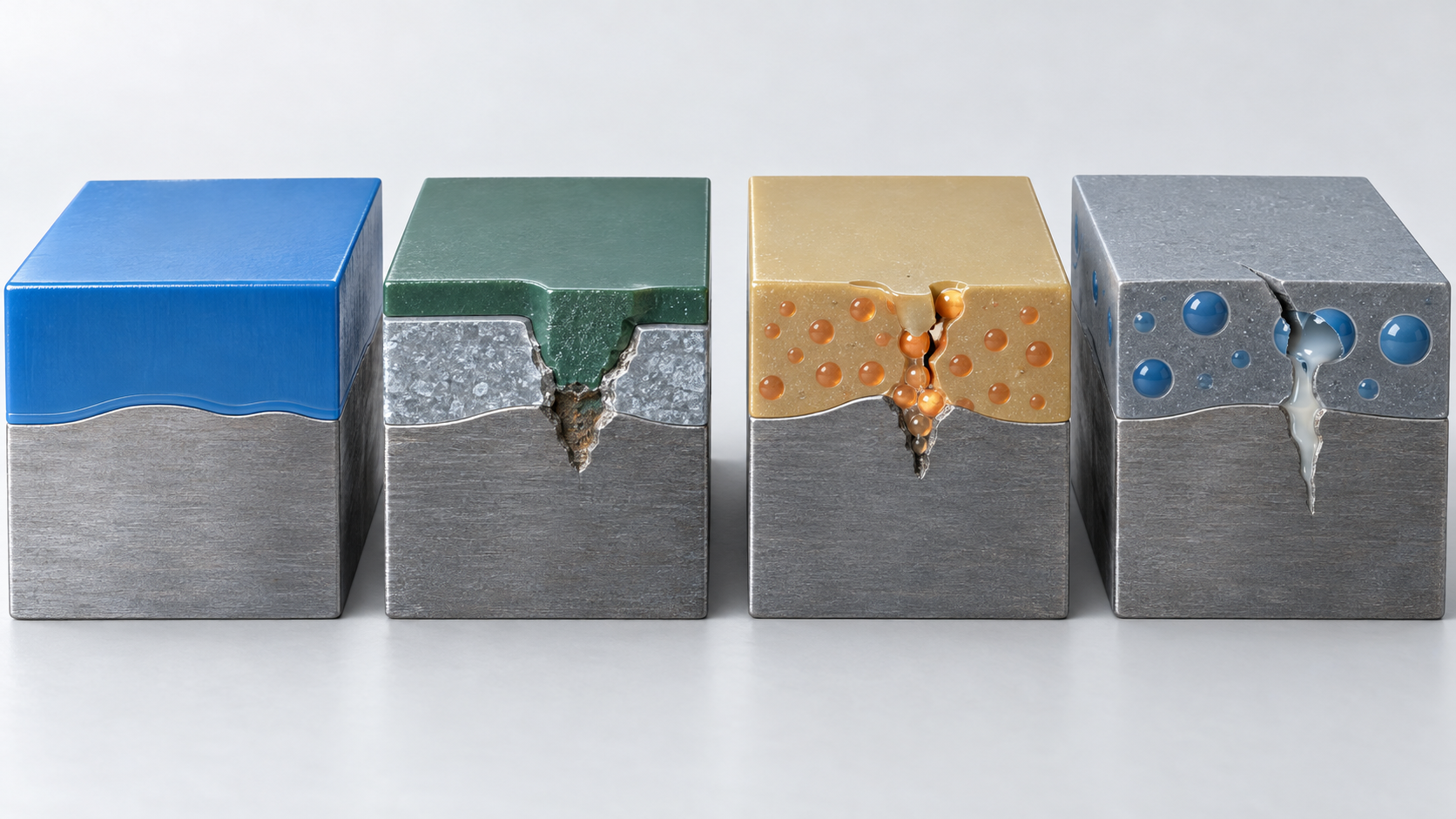
View the original SVG schematic and exact annotations
- Barrier: a coating that is slow to pass water, oxygen and chloride ions separates the substrate. If there is a scratch or defect, corrosion advances from that spot
- Sacrificial: cover the steel with a metal more electrochemically active than it (zinc), so that the zinc dissolves first and protects the steel. Bolsanello et al. studied, with scanning electrochemical techniques (SECM and SVET) in simulated acid rain, the localised electrochemical reactions at the cut edge of zinc-alloy-coated steel (ZnAlMg-galvanized steel) between the exposed steel and the more active coatingSourced [Source 11]
- Inhibitor (active protection): build a corrosion-inhibiting component into the coating so that it acts on damage. Chromate is the representative case (Section 5), and designs that store the inhibitor in containers also exist (Section 6)
Bolsanello et al. report that cut edges strongly promoted oxygen consumption and alkalisation (pH 10–11) over the iron, with later depletion of oxygen neutralising the nearby electrolyte; that a thinner coating intensified the cathodic activation of the exposed iron despite the lower amount of sacrificial anode; and that the corners showed localised acidification below pH 4 that sustained hydrogen evolution at spots of the steel–coating interface [Source 11] (these results are for ZnAlMg-galvanized steel in simulated acid rain). ISO 1461:2022 specifies the general properties and test methods of hot dip galvanized coatings applied by dipping fabricated iron and steel articles in a zinc melt containing not more than 2% of other metals. It does not apply to continuously galvanized sheet, wire and mesh, or tube and pipe galvanized in automatic plantsSourced [Source 23]. For electroplated zinc there is ISO 2081:2025, which covers zinc coatings with supplementary treatment in solutions containing hexavalent chromium [Source 24].
We estimate the years until the zinc layer is gone as thickness ÷ zinc loss per yearOur calculation, assuming the loss is constant.
- Zinc layer 100 μm: 100 years at 1 μm/year, 20 years at 5 μm/year
- Zinc layer 50 μm: 50 years at 1 μm/year, 10 years at 5 μm/year
- Zinc layer 20 μm: 20 years at 1 μm/year, 4 years at 5 μm/year
Assumptions and limits: thickness and loss rate are illustrative values, not data for real products or environments. In practice the loss rate changes by orders of magnitude with the environment (time of wetness, salt, pollutants), need not be constant over time, and corrosion also concentrates at scratches and cut edges. Even so, it conveys that with the same zinc thickness, life can differ several-fold or more between environments. ISO 9223:2012 is a framework that classifies the corrosivity of atmospheres by the first-year corrosion rate of standard specimensSourced [Source 25].
ISO 12944-2:2017 classifies the environments to which steel structures are exposed, and their corrosivity, with atmospheric-corrosivity categories based on mass (or thickness) loss of standard specimens [Source 26]. In selecting a protective paint system the corrosivity category is one of the key conditions. From a materials standpoint, a figure such as “this coating withstands 1,000 hours of salt spray” has meaning only when tied to a corrosivity category and to the service life expected. The classification of the environment (atmosphere, immersion, soil), the pretreatment of the steel and the design of the coat build-up together make the performance of the product (Commentary).
5. Chromate-free — why the “two-sided inhibition and self-healing” of hexavalent chromium is hard to replace
According to the review by Gharbi et al. (npj Materials Degradation, 2018), hexavalent chromium (Cr(VI)) films are defined by exceptional versatility, remarkable corrosion protection and cost-effectiveness. Chromates are both anodic and cathodic inhibitors, restricting both metal dissolution and the reduction of oxygen and water. When a coating or primer develops a defect, chromate ions (CrO42-) leach into the electrolyte and the “active sites”, are cathodically reduced and form a protective chromium oxide (Cr2O3) film, which is poorly soluble across the pH range and adherent to the metal — a barrier that repairs damage by itselfSourced [Source 10].
The same review states that a “universal” replacement compound has not yet been identified, and organises the main alternatives as follows [Source 10].
| Alternative | What the review says |
|---|---|
| Trivalent chromium (Cr(III)) conversion coatings | Started in the early 1990s on aluminium alloys. Baths contain fluoride salts, trivalent chromium salts and hexafluorozirconate; hydrated zirconia and trivalent chromium hydroxide co-precipitate, giving high barrier properties. However, because the coating contains no hexavalent chromium, the self-healing properties fell significantly. It has also been reported that during coating growth trivalent chromium may be oxidised to hexavalent chromium by hydrogen peroxide, with fluoride argued to promote this. Even so, it is the most common replacement for conversion coatings on aluminium and zinc alloys, and is on the market |
| Rare earths (cerium and others) | Considered since the late 1980s. They form oxides and hydroxides at high pH (above 10) and inhibit cathodic reactions. Effective on zinc, galvanized steel, magnesium and aluminium alloys, but the oxides dissolve in an acidic environment, so the layer is less stable and durable than the Cr2O3 layer formed from hexavalent chromium |
| Others (lithium-containing coatings, magnesium-rich primers, smart coatings and so on) | Lithium-containing coatings leach Li+ and carbonate at a defect and form an Al–Li hydroxide protective layer. Magnesium-rich primers give sacrificial cathodic protection. Smart coatings trigger self-healing by pH, moisture or light |
All Sourced (Gharbi et al. [Source 10]). The statements are those of a 2018 review; later progress was not checked.
The value of hexavalent chromium lies in the fact that (a) barrier, (b) inhibition of both anodic and cathodic reactions, (c) self-healing on damage, (d) stability over a wide pH range and (e) low cost are gathered in one substance [Source 10]. The alternatives differ in which of these functions they carry (for example, trivalent chromium conversion coatings carry barrier properties, rare earths cathodic inhibition, and Mg-rich primers sacrificial protection). From a materials standpoint, it is more practical to evaluate a replacement not by the single question “is it equivalent to chromate?” but function by function (barrier, repair on damage, compatibility with the substrate, bath control, cost) in the intended environment (Commentary). The review itself says that the lack of demonstrated substitutes is what is driving research in this field [Source 10].
6. Conducting polymers, and self-healing anti-corrosion coatings
(1) Conducting polymers — a proposed “protection zone” mechanism
Conducting polymers (ICPs) such as polyaniline and polypyrrole have become key materials in the search for high-performance coatings that protect metals from corrosion. Merz, Uebel and Rohwerder used dedicated model samples and Kelvin-probe measurements to find that disconnected ICP particles in composite coatings on iron and zinc inhibit oxygen reduction in their vicinity, creating a “protection zone” where no or only very slow delamination occurs. The mechanism relies on the ICP’s high potential and redox activity, and its efficiency may depend on the ICP type, thickness and counter-anionSourced [Source 12].
This is an analysis of a mechanism on model samples, and it does not show the life of an actual coated product. Anti-corrosion by conducting polymers is a field in which the mechanisms (protection of the anode, suppression of oxygen reduction and so on) are still discussed, and this article keeps to one proposed mechanism confirmed in a primary source (a note by this article). Conducting polymers in general are covered in our explainer on conducting polymers and ionic conductors.
(2) Self-healing anti-corrosion coatings — stored in containers, released on damage
Habib et al. loaded halloysite nanotubes (HNTs) with a corrosion inhibitor (NaNO3) and urea–formaldehyde microcapsules with a healing agent (linseed oil), added them to a polymer coating and applied it to polished mild steel. They report that inhibitor was released from the HNTs over time in response to pH change, that the coating showed “decent” self-healing against controlled mechanical damage, and that electrochemical impedance spectroscopy (EIS) indicated promising anti-corrosion performanceSourced [Source 13]. The review by Poornima Vijayan and Al-Maadeed (2019) organises the extrinsic strategies for self-healing anti-corrosion coatings and the methods of evaluating them (accelerated salt immersion test, EIS, the scanning vibrating electrode technique SVET and scanning electrochemical microscopy SECM) [Source 14].
A 2024 review states that an established standard method for assessing the efficiency of self-healing in coatings does not yet exist (assessments divide into visual and quantitative methods)Sourced [Source 16]. How to read this is covered in our explainer on self-healing materials and vitrimers.
For reservoir-type protection it is usual to scribe a scratch, immerse in electrolyte and watch the recovery of resistance by EIS and similar methods [Sources 13, 14]. The result changes with the width and depth of the scratch, the immersion liquid and the time. In actual use, damage may occur repeatedly and at several places, and the reservoir of inhibitor may run out (the limit of extrinsic types) (Commentary). The kind and amount of inhibitor also need assessment from the standpoint of release to the environment, so a generalisation such as “environmentally friendly” should be avoided; confirm the component, the amount and how it is released first.
7. Testing corrosion protection — salt spray matches outdoor results only in part
ISO 9227:2022 specifies the apparatus, reagents and procedure for the neutral salt spray (NSS), acetic acid salt spray (AASS) and copper-accelerated acetic acid salt spray (CASS) tests, for assessing the corrosion resistance of metallic materials with or without permanent or temporary corrosion protection. However, the standard does not specify the exposure period for a particular product, the dimensions or types of specimens, or the interpretation of results; such details are given in the appropriate product specifications. The salt spray tests are described as particularly useful for detecting discontinuities such as pores and other defects in metallic, organic, anodic oxide and conversion coatingsSourced [Source 27].
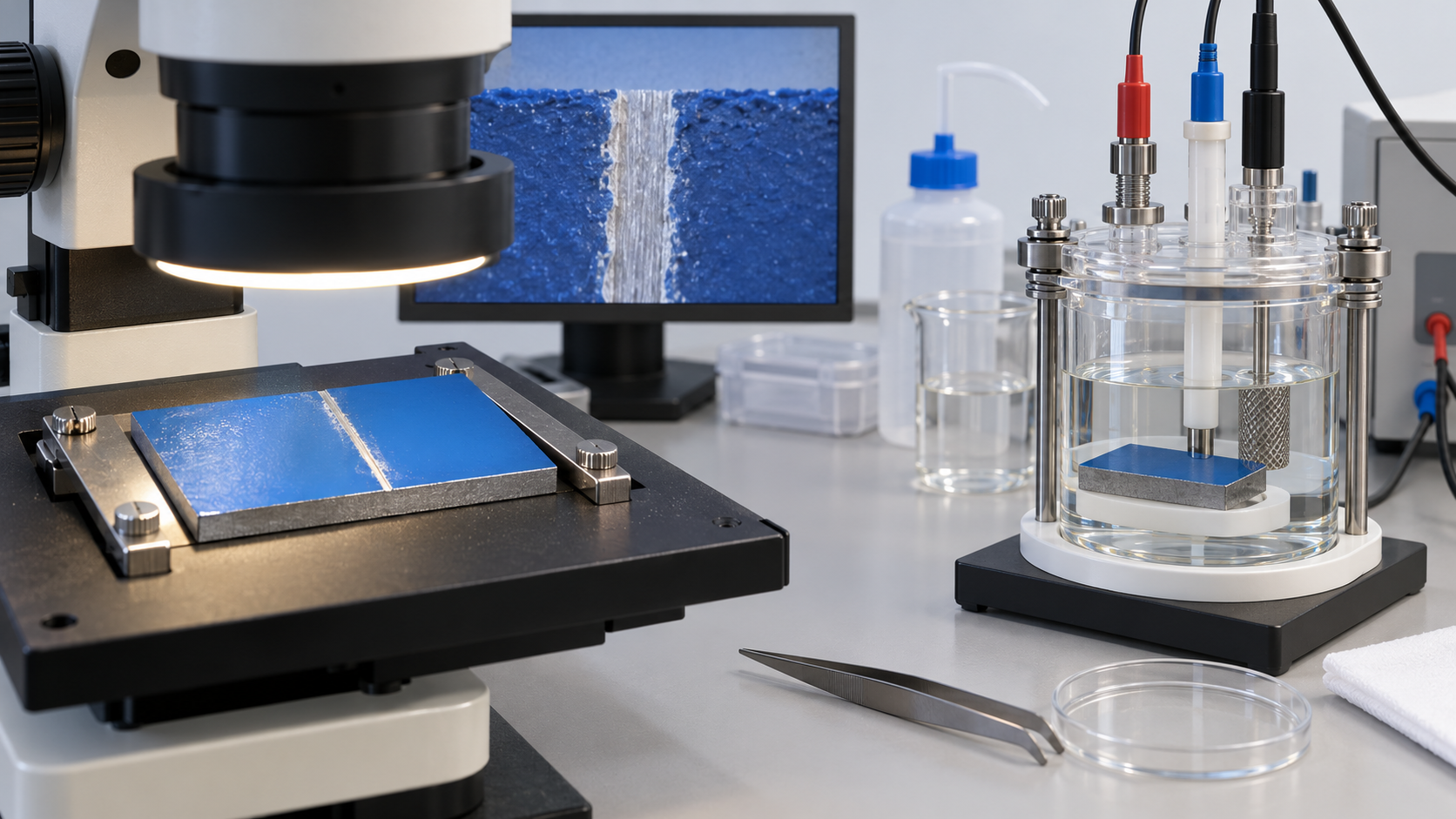
Schmid (2024) compared 19 organic coatings for hydraulic steelwork in the neutral salt spray test (ISO 9227), in mechanical-property tests, and in five years of outdoor exposure at four locations in the atmospheric, splash and immersion zones. The results were as followsSourced [Source 15].
- No correlation was found between the mechanical properties of a coating and its anti-corrosion performance in outdoor exposure
- The NSS test correlated with the field results in 6 of 12 cases (half). At the fresh-water site (Trier) the correlation proved very good
- The biggest difference between laboratory and field was for coatings without a zinc primer, which passed in the laboratory and failed outdoors
- Even so, the results of NSS testing can be useful as approval testing with predefined pass/fail criteria
In other words, salt spray is not a tool for saying “N hours means M years“. As cyclic corrosion tests that alternate wetting and drying there are ISO 11997-1:2026 (one of four defined wet (salt fog)/dry/humid cycles) [Source 28] and JIS K 5600-7-9 (cyclic corrosion test method: salt spray/dry/wet), but these too are not predictors of outdoor life and are one means of evaluation (a note by this article).
For electrochemical evaluation of coatings, electrochemical impedance spectroscopy (EIS) has the ISO 16773 series, whose Part 1 gives terms and definitionsSourced [Source 29].
Schmid’s results show that using salt spray for (a) pass/fail approval, (b) ranking materials and (c) predicting life should be treated as different things [Source 15]. That results in the laboratory and outdoors diverged with and without a zinc primer suggests that the action of sacrificial protection (Section 4) may not be fully reproduced under salt spray conditions (Inference). A materials engineer combines, according to purpose, (a) the target environment and corrosivity category [Sources 25, 26], (b) in addition to salt spray, cyclic corrosion, EIS and outdoor exposure (such as the general rules of JIS Z 2381) [Source 38], and (c) whether specimens are scratched or not (Commentary).
8. Regulation — the Biocidal Products Regulation (BPR) and hexavalent chromium: proposal, adoption and application kept apart
(1) The EU Biocidal Products Regulation (BPR) and “treated articles”
Regulation (EU) No 528/2012 (dated 22 May 2012, applying from 1 September 2013) governs the making available on the market and use of biocidal products. A biocidal product is a substance or mixture consisting of, containing or generating one or more active substances, intended to destroy, deter, render harmless, prevent the action of or otherwise exert a controlling effect on any harmful organism by any means other than mere physical or mechanical action. A treated article that has a primary biocidal function is considered a biocidal product. A treated article is any substance, mixture or article which has been treated with, or intentionally incorporates, one or more biocidal productsSourced [Source 19].
For treated articles that are not biocidal products (such as products given an antimicrobial finish), Article 58 provides that all active substances contained in the biocidal products used for treatment must be approved for the relevant product-type and use (with any conditions met) before the article may be placed on the market. It also requires labelling where the manufacturer claims biocidal properties, among other cases (a statement that the article incorporates biocidal products, the names of the active substances, and, for nanomaterials, the word “nano” in brackets), and requires the supplier to give a consumer who asks information on the biocidal treatment free of charge within 45 daysSourced [Source 19]. One of the product-types (product-type 21) is “antifouling products”, used to control the growth and settlement of fouling organisms on vessels, aquaculture equipment or other structures used in water [Source 19].
Which product-types each active substance (silver, copper compounds, zinc compounds, quaternary ammonium and so on) is approved for was not checked in this article. Also, what this article checked is the text published in the Official Journal in 2012, and later amendments were not checked.
(2) Hexavalent chromium — REACH authorisation, RoHS restriction
Commission Regulation (EU) No 348/2013 (dated 17 April 2013) added to Annex XIV (the authorisation list) of REACH, as entries 16 to 22, chromium trioxide, acids generated from chromium trioxide, and sodium, potassium and ammonium dichromate, potassium chromate and sodium chromate. For every entry the latest application date is 21 March 2016 and the sunset date is 21 September 2017Sourced [Source 17]. Gharbi et al. state that chromium compounds are restricted unless authorised by the European Chemicals Agency (ECHA) and that authorisations are limited in time [Source 10]. The content and current status of authorisations for individual uses were not checked in this article.
Annex II of the RoHS Directive (2011/65/EU, dated 8 June 2011) sets, as the maximum concentration by weight in homogeneous materials of electrical and electronic equipment, hexavalent chromium 0.1% (lead 0.1%, mercury 0.1%, cadmium 0.01% and others). Annex III lists exemptions, one example being hexavalent chromium as an anticorrosion agent of the carbon steel cooling system in absorption refrigerators (up to 0.75% by weight in the cooling solution). The deadline for Member States to transpose it was 2 January 2013Sourced [Source 18] (the text as published; later amendments were not checked).
Regulation of hexavalent chromium has separate frameworks for the substance (REACH authorisation) and the product (RoHS, for electrical and electronic equipment). The BPR is a framework for approval of active substances and circulation of treated articles. What a materials engineer should check is (a) which framework one’s own product falls under (substance, mixture, article, electrical and electronic equipment), (b) the stage of the rule (adopted, applying, sunset date passed), (c) whether there is an exemption for the use or an authorisation, and (d) how content is confirmed in the supply chain (analytical methods). Do not judge the scope of regulation from the function name “antimicrobial” or “anti-corrosion” alone (Commentary).
9. Limits, and what could not be confirmed
(1) Conditions in the papers’ bodies
For Xiu et al., Dakal et al., Sirelkhatim et al., Tiller et al., Jennings et al., Hegstad et al., Merz et al., Habib et al. and Poornima Vijayan et al., this article relied on abstracts (the review by Gharbi et al. was read in its main sections; Schmid and Cunliffe et al. are also abstract-level). Strains, broths, test times and concentrations should be checked in each paper.
(2) Persistence of antimicrobial action, and performance after use
Antimicrobial performance after washing, abrasion and ultraviolet exposure, the life of release types (reservoir and release rate) and effects in actual use were not checked. Effects on humans and the environment (the behaviour of silver ions, zinc and quaternary ammonium in the environment) are not covered and are not generalised.
(3) Scope of regulation
For the BPR, the text as published was checked and amendments were not. The approval status of individual active substances, the content of individual REACH authorisations, the latest amendments and exemptions of RoHS, and regulation in Japan, the United States and China were not checked.
(4) Standards
The texts of ISO, JIS and ASTM standards were not checked. Corresponding IEC and IEEE standards, and a standard method of evaluating the efficiency of self-healing anti-corrosion, could not be confirmed. For ASTM standards on zinc coatings, because the ASTM website is not opened, no non-ASTM source giving a number and title was found, so they could not be confirmed.
(5) Items not covered
Details of conversion treatment of aluminium and magnesium alloys, anodising, metallic coatings other than plating (such as thermal-sprayed aluminium), anti-fouling of ships (our explainer on superhydrophobic, anti-icing and anti-fouling coatings) and antimicrobial action of photocatalysts (our explainer on titanium dioxide and photocatalysis) are not covered.
- Antimicrobial action is a result under test conditions. Even for the same coating, the broth split the result into a 0.4–3.5-log reduction and one above 5-log, and copper lost antibacterial and antifungal efficacy at low humiditySourced / Our calculation
- Corrosion protection combines barrier, sacrificial action and inhibitors. Hexavalent chromium combines two-sided inhibition with self-healing, so replacements must be evaluated function by functionSourced
- Salt spray serves for pass/fail judgements but not for life prediction. The correlation with outdoor exposure was 6 of 12 comparisonsSourced
- Regulation has a different framework and stage for each substance or product. Hexavalent chromium is on the REACH authorisation list (sunset date 21 September 2017) and limited to 0.1% under RoHS, and the BPR governs approval of active substances and circulation of treated articlesSourced
10. How to read evaluations and standards
Antimicrobial evaluation inoculates treated and untreated specimens with microbes, incubates them under fixed conditions, compares viable counts and expresses antimicrobial activity as the difference (such as a log reduction). Corrosion evaluation uses rust, blistering and mass loss after salt spray or wet/dry cycles, electrochemical impedance (EIS), and the results of outdoor and immersion exposure. What standards define is the method of each test; they do not give pass criteria or performance for “antimicrobial” or “anti-corrosion”.
| Item | ISO | IEC / IEEE | JIS | ASTM | What changes the value with test conditions |
|---|---|---|---|---|---|
| Antibacterial activity (plastics, non-porous surfaces)Sourced | ISO 22196:2011 (antibacterial activity on antibacterial-treated plastics and other non-porous surfaces; textiles and photocatalysts excluded) | Could not be confirmed | JIS Z 2801 (antibacterial-treated products: test method for antibacterial activity and efficacy). Degree of agreement with ISO 22196 not confirmed | E2180 (method for determining the activity of antimicrobial agents incorporated in polymeric or hydrophobic materials) | Species, broth, inoculum volume, humidity, temperature, time, choice of control [9, 2] |
| Antibacterial activity (textile products)Sourced | ISO 20743:2021 (antibacterial activity of textile products; absorption, transfer and printing methods) | Could not be confirmed | JIS L 1902 (textile products: test method for antibacterial activity and efficacy) | E2149 (antimicrobial activity of antimicrobial agents under dynamic contact conditions) | Inoculation method, agitation, contact time |
| Antibacterial activity (photocatalytic materials)Sourced | ISO 27447:2019 (antibacterial activity of semiconducting photocatalytic materials under ultraviolet light; powders, granules and porous materials not included; due for revision) | Could not be confirmed | JIS R 1702 (fine ceramics: test method for antibacterial activity and efficacy of photocatalytic materials) | Could not be confirmed | Intensity and time of ultraviolet light, species |
| Mould resistanceSourced | Could not be confirmed | Could not be confirmed | JIS Z 2911 (mould resistance test methods) | Could not be confirmed | Species, culture conditions |
| Zinc coatingsSourced | ISO 1461:2022 (specifications and test methods for hot dip galvanized coatings on fabricated iron and steel articles), ISO 2081:2025 (electroplated zinc with Cr(VI) treatment) | Could not be confirmed | JIS H 8641 (hot-dip zinc coating), JIS H 8610 (electrogalvanizing; titles in Japanese) | Could not be confirmed | Coating thickness, after-treatment (chromate or not), substrate |
| Classification of atmospheric corrosivitySourced | ISO 9223:2012 (classification, determination and estimation of atmospheric corrosivity), ISO 12944-2:2017 (classification of environments for steel structures) | Could not be confirmed | JIS Z 2381 (general rules for atmospheric exposure tests), JIS K 5600-7-6 (outdoor exposure weathering) | Could not be confirmed | First-year corrosion rate, time of wetness, salinity and sulfur dioxide |
| Salt spraySourced | ISO 9227:2022 (NSS, AASS, CASS; exposure period and interpretation not specified) | Could not be confirmed | JIS Z 2371 (salt spray testing method), JIS K 5600-7-1 (neutral salt spray resistance) | B117 (practice for operating salt spray (fog) apparatus) | Salt concentration, temperature, presence of a scratch, test time. Match with outdoors only in part [15] |
| Cyclic corrosionSourced | ISO 11997-1:2026 (resistance of coatings to one of four defined wet (salt fog)/dry/humid cycles) | Could not be confirmed | JIS K 5600-7-9 (cyclic corrosion test: salt spray/dry/wet) | G85 (described in a paper as the Annex A5 dilute-electrolyte cyclic fog/dry test; title not checked) | Type of cycle, solution, temperature and time |
| Electrochemical impedance (EIS)Sourced | ISO 16773-1:2016 (terms for EIS on coated and uncoated metallic specimens). Later parts not checked here | Could not be confirmed | Could not be confirmed | G106 (cited in a paper for EIS measurements; title not checked) | Frequency range, amplitude, electrolyte, area |
| Efficiency of self-healing anti-corrosionSourced | Could not be confirmed | Could not be confirmed | Could not be confirmed | Could not be confirmed | How the scratch is made, immersion liquid, time [16] |
Numbers and titles of ISO standards were checked on the official ISO pages and those of JIS on the JIS search of the Japanese Industrial Standards Committee (JISC); JIS titles are our translation of the Japanese titles. For ASTM standards, the ASTM website was not opened; numbers and titles were checked only through statements in peer-reviewed papers and their reference lists. The ASTM column gives no test content, conditions or acceptance criteria. The arrangement of the table is Our calculation.
Where each standard sits — international, national, trade body
- ISO standards are international, JIS standards are Japanese national, and ASTM standards are issued by a US standards organisation. ISO 22196, JIS Z 2801 and ASTM E2180 are listed together as the same kind of test in a paper [Source 9], but the degree of agreement among them (identical, modified and so on) was not confirmed because the bodies of the standards were not checked
- ISO 11997-1 is the 2026 edition (fourth edition), ISO 2081 the 2025 edition (fifth edition), and ISO 9227 the 2022 edition (fifth edition, with one amendment). ISO 22196 is the 2011 edition (second edition), confirmed in 2026. Even for the same number, a different edition can mean a different procedure
- ISO 27447 is marked due for revision (“to be revised”), and so is ISO 12944-2
Cautions when reading
- A standard is a “test method” and does not guarantee a material’s performance. “99.9% antibacterial according to ISO 22196” is a result under that test’s conditions and does not mean the effect in the use environment or against other microbes
- The same named property can be measured differently depending on the standard or edition. Antibacterial activity has separate standards for plastics (ISO 22196), textiles (ISO 20743) and photocatalysts (ISO 27447). Values from different standards cannot be compared directly
- Read manufacturer values together with the standard, edition and test conditions they followed. “N hours of salt spray” goes with the coating thickness, the presence of a scratch, the substrate of the panel and the pass criterion. ISO 9227 does not specify the exposure period or the interpretation of results [Source 27]
- Watch the gap between the range of a standard and real service conditions. Standard methods fix conditions for reproducibility [Source 2]. How results shift under real humidity, washing, soil and environment cannot be known from a standard alone
11. Glossary
- Log reduction
- By what power of ten the microbe count fell. 1-log = 90% less.
- Contact killing
- Microbes dying on touching a surface; reported for copper and for immobilised polycations.
- Ag+ (silver ion)
- The ion released from silver; one report infers it is the toxicant of AgNPs.
- Reactive oxygen species (ROS)
- Hydrogen peroxide, hydroxyl radicals and so on; involved in antibacterial action of zinc oxide and photocatalysts.
- QAC
- Quaternary ammonium compounds: disinfectants acting on the cell membrane; resistance genes are reported.
- Biocidal product (BPR)
- A product containing an active substance that controls harmful organisms. There are also rules for treated articles.
- Sacrificial protection
- A more active metal (zinc) dissolves first and protects the substrate.
- Inhibitor
- A substance that slows corrosion: anodic, cathodic or both.
- Chromate
- A hexavalent-chromium inhibitor or film; forms a Cr2O3 film at damage.
- REACH Annex XIV
- The authorisation list. After the sunset date only authorised uses are allowed.
- Neutral salt spray (NSS)
- An accelerated corrosion test with a salt fog; suited to pass/fail and quality control, not to predicting life.
- EIS
- Electrochemical impedance spectroscopy: follows the resistance of a coating and the recovery of a scratch.
12. References (primary sources)
- Grass G., Rensing C., Solioz M. “Metallic Copper as an Antimicrobial Surface”, Appl. Environ. Microbiol. 77, 1541–1547 (2011), DOI 10.1128/AEM.02766-10 — doi.org/10.1128/aem.02766-10
- Cunliffe A. J. et al. “Assessing antibacterial, antiviral, and antifungal efficacy of non-porous materials using small droplet transfer: the simulated splash method”, Appl. Environ. Microbiol. 92, e02304-25 (2026), DOI 10.1128/aem.02304-25 (open access) — doi.org/10.1128/aem.02304-25
- Xiu Z. et al. “Negligible Particle-Specific Antibacterial Activity of Silver Nanoparticles”, Nano Lett. 12, 4271–4275 (2012), DOI 10.1021/nl301934w — doi.org/10.1021/nl301934w
- Dakal T. C. et al. “Mechanistic Basis of Antimicrobial Actions of Silver Nanoparticles”, Front. Microbiol. 7, 1831 (2016), DOI 10.3389/fmicb.2016.01831 (open access) — doi.org/10.3389/fmicb.2016.01831
- Sirelkhatim A. et al. “Review on Zinc Oxide Nanoparticles: Antibacterial Activity and Toxicity Mechanism”, Nano-Micro Lett. 7, 219–242 (2015), DOI 10.1007/s40820-015-0040-x (open access) — doi.org/10.1007/s40820-015-0040-x
- Tiller J. C., Liao C.-J., Lewis K., Klibanov A. M. “Designing surfaces that kill bacteria on contact”, Proc. Natl. Acad. Sci. USA 98, 5981–5985 (2001), DOI 10.1073/pnas.111143098 — doi.org/10.1073/pnas.111143098
- Jennings M. C., Minbiole K. P. C., Wuest W. M. “Quaternary Ammonium Compounds: An Antimicrobial Mainstay and Platform for Innovation to Address Bacterial Resistance”, ACS Infect. Dis. 1, 288–303 (2015), DOI 10.1021/acsinfecdis.5b00047 — doi.org/10.1021/acsinfecdis.5b00047
- Hegstad K., Langsrud S., Lunestad B. T. et al. “Does the Wide Use of Quaternary Ammonium Compounds Enhance the Selection and Spread of Antimicrobial Resistance and Thus Threaten Our Health?”, Microb. Drug Resist. 16, 91–104 (2010), DOI 10.1089/mdr.2009.0120 — doi.org/10.1089/mdr.2009.0120
- van Agtmaal J. et al. “Test parameter selection affects the perceived antibacterial efficacy of a contact-killing coating developed to prevent prosthetic joint infection”, Front. Bioeng. Biotechnol. 14 (2026), DOI 10.3389/fbioe.2026.1854828 (open access; only the comparison of test conditions is used, and the medical assessment is not covered) — doi.org/10.3389/fbioe.2026.1854828
- Gharbi O., Thomas S., Smith C., Birbilis N. “Chromate replacement: what does the future hold?”, npj Mater. Degrad. 2, 12 (2018), DOI 10.1038/s41529-018-0034-5 (open access) — nature.com/articles/s41529-018-0034-5
- Bolsanello M. et al. “Contributions to a More Realistic Characterization of Corrosion Processes on Cut Edges of Coated Metals Using Scanning Microelectrochemical Techniques, Illustrated by the Case of ZnAlMg-Galvanized Steel with Different Coating Densities”, Materials 17, 1679 (2024), DOI 10.3390/ma17071679 (open access) — doi.org/10.3390/ma17071679
- Merz A., Uebel M., Rohwerder M. “The Protection Zone: A Long-Range Corrosion Protection Mechanism around Conducting Polymer Particles in Composite Coatings: Part I. Polyaniline and Polypyrrole”, J. Electrochem. Soc. 166, C304–C313 (2019), DOI 10.1149/2.0971912jes — doi.org/10.1149/2.0971912jes
- Habib S. et al. “Self-Healing Performance of Multifunctional Polymeric Smart Coatings”, Polymers 11, 1519 (2019), DOI 10.3390/polym11091519 (open access) — doi.org/10.3390/polym11091519
- Poornima Vijayan P., Al-Maadeed M. “Self-Repairing Composites for Corrosion Protection: A Review on Recent Strategies and Evaluation Methods”, Materials 12, 2754 (2019), DOI 10.3390/ma12172754 (open access) — doi.org/10.3390/ma12172754
- Schmid R. “Correlation Between the Anticorrosive Performance of Protective Coatings Under Neutral Salt Spray Testing and Outdoor Atmospheric and Immersion Exposure”, Corros. Mater. Degrad. 5, 490–512 (2024), DOI 10.3390/cmd5040023 (open access) — doi.org/10.3390/cmd5040023
- Panahi, Khorasani, Mensah “A review of the characterization methods for self-healing assessment in polymeric coatings”, Prog. Org. Coat. 186, 108055 (2024), DOI 10.1016/j.porgcoat.2023.108055 (the content of the abstract was checked through a European Coatings news summary) — doi.org/10.1016/j.porgcoat.2023.108055
- European Commission “Commission Regulation (EU) No 348/2013 of 17 April 2013 amending Annex XIV to Regulation (EC) No 1907/2006 (REACH)”, OJ L 108, 18.4.2013 (Publications Office of the EU) — publications.europa.eu/resource/celex/32013R0348
- European Parliament and Council “Directive 2011/65/EU of 8 June 2011 on the restriction of the use of certain hazardous substances in electrical and electronic equipment (RoHS)”, OJ L 174, 1.7.2011 (Publications Office of the EU) — publications.europa.eu/resource/celex/32011L0065
- European Parliament and Council “Regulation (EU) No 528/2012 of 22 May 2012 concerning the making available on the market and use of biocidal products”, OJ L 167, 27.6.2012 (Publications Office of the EU) — publications.europa.eu/resource/celex/32012R0528
- ISO “ISO 22196:2011 Measurement of antibacterial activity on plastics and other non-porous surfaces” — iso.org/standard/54431.html
- ISO “ISO 20743:2021 Textiles — Determination of antibacterial activity of textile products” — iso.org/standard/79819.html
- ISO “ISO 27447:2019 Fine ceramics (advanced ceramics, advanced technical ceramics) — Test method for antibacterial activity of semiconducting photocatalytic materials” — iso.org/standard/69874.html
- ISO “ISO 1461:2022 Hot dip galvanized coatings on fabricated iron and steel articles — Specifications and test methods” — iso.org/standard/81435.html
- ISO “ISO 2081:2025 Metallic and other inorganic coatings — Electroplated coatings on iron and steel using zinc treated with solutions containing chromium (VI)” — iso.org/standard/88302.html
- ISO “ISO 9223:2012 Corrosion of metals and alloys — Corrosivity of atmospheres — Classification, determination and estimation” — iso.org/standard/53499.html
- ISO “ISO 12944-2:2017 Paints and varnishes — Corrosion protection of steel structures by protective paint systems — Part 2: Classification of environments” — iso.org/standard/64834.html
- ISO “ISO 9227:2022 Corrosion tests in artificial atmospheres — Salt spray tests” — iso.org/standard/81744.html
- ISO “ISO 11997-1:2026 Paints and varnishes — Determination of resistance to cyclic corrosion conditions — Part 1: Wet (salt fog)/dry/humid” — iso.org/standard/87280.html
- ISO “ISO 16773-1:2016 Electrochemical impedance spectroscopy (EIS) on coated and uncoated metallic specimens — Part 1: Terms and definitions” — iso.org/standard/64794.html
- Japanese Industrial Standards Committee (JISC) JIS search, JIS Z 2801 (Antibacterial products — Test for antibacterial activity and efficacy; title in Japanese) — jisc.go.jp (Z2801)
- Japanese Industrial Standards Committee (JISC) JIS search, JIS L 1902 (Testing for antibacterial activity and efficacy on textile products; title in Japanese) — jisc.go.jp (L1902)
- Japanese Industrial Standards Committee (JISC) JIS search, JIS R 1702 (Fine ceramics — Test method for antibacterial activity of photocatalytic materials and efficacy; title in Japanese) — jisc.go.jp (R1702)
- Japanese Industrial Standards Committee (JISC) JIS search, JIS Z 2911 (Methods of test for fungus resistance; title in Japanese) — jisc.go.jp (Z2911)
- Japanese Industrial Standards Committee (JISC) JIS search, JIS H 8641 (Hot dip zinc coatings; title in Japanese) — jisc.go.jp (H8641)
- Japanese Industrial Standards Committee (JISC) JIS search, JIS H 8610 (Electroplated zinc coatings; title in Japanese) — jisc.go.jp (H8610)
- Japanese Industrial Standards Committee (JISC) JIS search, JIS Z 2371 (Methods of salt spray testing; title in Japanese) — jisc.go.jp (Z2371)
- Japanese Industrial Standards Committee (JISC) JIS search, JIS K 5600-7 (Testing methods for paints — Part 7: Long-term durability of film; Section 1 neutral salt spray resistance, Section 6 outdoor exposure weathering, Section 9 cyclic corrosion test method; titles in Japanese) — jisc.go.jp (K5600-7)
- Japanese Industrial Standards Committee (JISC) JIS search, JIS Z 2381 (General rules for atmospheric exposure testing; title in Japanese) — jisc.go.jp (Z2381)
- Publicly available papers used to confirm ASTM numbers and titles (the ASTM website was not consulted): E2180 in Molecules 31, 137 (2025), DOI 10.3390/molecules31010137 / E2149 in J. Funct. Biomater. 14, 524 (2023), DOI 10.3390/jfb14100524 / B117 in Heliyon (2024), DOI 10.1016/j.heliyon.2024.e40681 / G85 in Materials 17, 2304 (2024), DOI 10.3390/ma17102304 / G106 in Sci. Rep. (2024), DOI 10.1038/s41598-024-64323-x — doi.org/10.3390/molecules31010137 (and others)
13. Claim-to-source audit
| Claim in the text | Basis | Class |
|---|---|---|
| Contact killing on metallic copper (bacteria, yeasts, viruses; at least 7 to 8 logs per hour) | Abstract of Grass et al. (2011) Reference 1 https://doi.org/10.1128/aem.02766-10 | Sourced |
| Copper’s antibacterial and antifungal efficacy falling at low humidity while antiviral efficacy stays high; that conditions such as humidity above 90% in current standards can overemphasise efficacy; the limits of standard methods (reproducibility first) | Abstract of Cunliffe et al. (2026) Reference 2 https://doi.org/10.1128/aem.02304-25 | Sourced |
| Ag+ as the toxicant, no toxicity without oxygen, stimulation of E. coli survival at low concentration (3–8 μg/L), particle properties acting through Ag+ release | Abstract of Xiu et al. (2012) Reference 3 https://doi.org/10.1021/nl301934w | Sourced |
| Factors affecting the antimicrobial action of AgNPs, several mechanisms, and cytotoxicity to human cells depending on cell type | Abstract of Dakal et al. (2016) Reference 4 https://doi.org/10.3389/fmicb.2016.01831 | Sourced |
| Factors affecting the antibacterial action of ZnO-NPs (size, concentration, ultraviolet light and others), reactive oxygen species, cell-wall damage and uptake of zinc ions | Abstract of Sirelkhatim et al. (2015) Reference 5 https://doi.org/10.1007/s40820-015-0040-x | Sourced |
| Contact killing by immobilised poly(4-vinyl-N-alkylpyridinium) (up to 94 ± 4%, more than 100-fold, no significant decline on ceramics, plastics, metals and wood) | Abstract of Tiller et al. (2001) Reference 6 https://doi.org/10.1073/pnas.111143098 | Sourced |
| The action of QACs (cell membrane), qac genes and efflux pumps, horizontal transfer, co-transmission with antibiotic-resistance genes | Abstract of Jennings et al. (2015) Reference 7 https://doi.org/10.1021/acsinfecdis.5b00047 | Sourced |
| The spread of resistance to QACs and the evidence of co-resistance and cross-resistance | Abstract of Hegstad et al. (2010) Reference 8 https://doi.org/10.1089/mdr.2009.0120 | Sourced |
| The three variants used for regulatory compliance and efficacy testing (ISO 22196, ASTM E2180-18, JIS Z 2801), more than 5-log in MHB against 0.4–3.5-log in TSB for the same coating, the main sources of variation (broth, agitation, inoculum volume) | van Agtmaal et al. (2026) Reference 9 https://doi.org/10.3389/fbioe.2026.1854828 | Sourced |
| Two-sided inhibition and self-healing by hexavalent chromium (Cr2O3 film), no universal replacement found, reduced self-healing of trivalent chromium conversion coatings and the report of oxidation to hexavalent, dissolution of rare earths in acid, lithium-containing, magnesium-rich and smart coatings, the explanation of REACH authorisation | Gharbi et al. (2018) Reference 10 https://www.nature.com/articles/s41529-018-0034-5 | Sourced |
| Electrochemical behaviour at the cut edge of ZnAlMg-galvanized steel (oxygen consumption and pH 10–11, intensified cathodic activation of the steel with thinner coating, acidification and hydrogen evolution at the corners) | Abstract of Bolsanello et al. (2024) Reference 11 https://doi.org/10.3390/ma17071679 | Sourced |
| The “protection zone” around conducting polymer particles (model samples on iron and zinc, Kelvin probe) | Abstract of Merz et al. (2019) Reference 12 https://doi.org/10.1149/2.0971912jes | Sourced |
| A self-healing anti-corrosion coating with HNTs, NaNO3, microcapsules and linseed oil; pH-responsive release; EIS | Abstract of Habib et al. (2019) Reference 13 https://doi.org/10.3390/polym11091519 | Sourced |
| Strategies and evaluation methods for self-healing anti-corrosion (salt immersion test, EIS, SVET, SECM) | Abstract of Poornima Vijayan and Al-Maadeed (2019) Reference 14 https://doi.org/10.3390/ma12172754 | Sourced |
| Comparison of the salt spray test (ISO 9227) and five years of outdoor exposure (19 coatings, four sites, correlation in 6 of 12 comparisons, a difference for coatings without zinc primer, usefulness for approval testing) | Abstract of Schmid (2024) Reference 15 https://doi.org/10.3390/cmd5040023 | Sourced |
| That no established standard method exists for assessing self-healing of coatings | Abstract of Panahi et al. (2024) (checked through a European Coatings summary) Reference 16 https://doi.org/10.1016/j.porgcoat.2023.108055 | Sourced |
| The addition of hexavalent chromium compounds to REACH Annex XIV (entries 16–22, regulation dated 17 April 2013, latest application date 21 March 2016, sunset date 21 September 2017) | Regulation (EU) No 348/2013 Reference 17 https://publications.europa.eu/resource/celex/32013R0348 | Sourced |
| Hexavalent chromium 0.1% in the RoHS Directive (Annex II), the exemption for the anticorrosion agent in absorption refrigerators (0.75%), the date of the directive (8 June 2011), the transposition deadline of 2 January 2013 | Directive 2011/65/EU (text as published) Reference 18 https://publications.europa.eu/resource/celex/32011L0065 | Sourced |
| The BPR’s definitions (biocidal product, treated article), Article 58 (approved active substances, labelling, information within 45 days), product-type 21, the date of the regulation (22 May 2012) and application from 1 September 2013 | Regulation (EU) No 528/2012 (text as published) Reference 19 https://publications.europa.eu/resource/celex/32012R0528 | Sourced |
| Numbers, titles, editions and scope of ISO 22196:2011, ISO 20743:2021, ISO 27447:2019, ISO 1461:2022, ISO 2081:2025, ISO 9223:2012, ISO 12944-2:2017, ISO 9227:2022, ISO 11997-1:2026 and ISO 16773-1:2016 | Official ISO pages Reference 20 https://www.iso.org/standard/54431.html Reference 21 https://www.iso.org/standard/79819.html Reference 22 https://www.iso.org/standard/69874.html Reference 23 https://www.iso.org/standard/81435.html Reference 24 https://www.iso.org/standard/88302.html Reference 25 https://www.iso.org/standard/53499.html Reference 26 https://www.iso.org/standard/64834.html Reference 27 https://www.iso.org/standard/81744.html Reference 28 https://www.iso.org/standard/87280.html Reference 29 https://www.iso.org/standard/64794.html | Sourced |
| Numbers and titles of JIS Z 2801, L 1902, R 1702, Z 2911, H 8641, H 8610, Z 2371, K 5600-7 (-1, -6, -9) and Z 2381 | JIS search of the Japanese Industrial Standards Committee (JISC) Reference 30 https://www.jisc.go.jp/app/jis/general/GnrJISNumberNameSearchList?show&jisStdNo=Z2801 Reference 31 https://www.jisc.go.jp/app/jis/general/GnrJISNumberNameSearchList?show&jisStdNo=L1902 Reference 32 https://www.jisc.go.jp/app/jis/general/GnrJISNumberNameSearchList?show&jisStdNo=R1702 Reference 33 https://www.jisc.go.jp/app/jis/general/GnrJISNumberNameSearchList?show&jisStdNo=Z2911 Reference 34 https://www.jisc.go.jp/app/jis/general/GnrJISNumberNameSearchList?show&jisStdNo=H8641 Reference 35 https://www.jisc.go.jp/app/jis/general/GnrJISNumberNameSearchList?show&jisStdNo=H8610 Reference 36 https://www.jisc.go.jp/app/jis/general/GnrJISNumberNameSearchList?show&jisStdNo=Z2371 Reference 37 https://www.jisc.go.jp/app/jis/general/GnrJISNumberNameSearchList?show&jisStdNo=K5600-7 Reference 38 https://www.jisc.go.jp/app/jis/general/GnrJISNumberNameSearchList?show&jisStdNo=Z2381 | Sourced |
| Numbers of ASTM E2180, E2149, B117, G85 and G106 and what papers say of them (the ASTM website was not consulted; checked through statements in peer-reviewed papers and their reference lists) | Open-access peer-reviewed papers Reference 39 https://doi.org/10.3390/molecules31010137 (and others listed at the end of the references) | Sourced |
| The conversion of log reductions (1-log = 90% less and so on; 0.4-log = about 60% less; 3.5-log = about 99.97% less; the ratio of about 1,300 within the TSB range) and the life of a zinc layer (the 100, 50 and 20 μm, 1 and 5 μm/year examples) | Our calculation. A simple conversion of log reductions and an illustration assuming a constant loss rate; not data for real products or environments | Our calculation |
| The BPR approval status of individual active substances; the individual content of REACH authorisations; amended content of RoHS and the BPR; regulation in Japan, the United States and China; antimicrobial action after washing and abrasion; the life of release types; ASTM standards for zinc coatings; corresponding IEC and IEEE standards; a standard efficiency measure for self-healing anti-corrosion | Could not be confirmed in the primary sources accessible within this article’s survey, so not stated | Commentary |
| The readings: “release and immobilised types differ in life and in the traps of evaluation”, “a standard method is a test for reproducibility”, “read corrosion protection with the classification of the environment”, “evaluate a replacement function by function”, “separate the roles of a test (pass/fail, comparison, life prediction)”, “read the stage of regulation and the scope of use separately”; the grouping in Figs. 2, 4 and 7 | This article’s own organisation and interpretation of published content. Not the views of any company or institution | Commentary |
| That Figs. 2 to 5 and 7 are explanatory drawings, not real observations or data, and that Figs. 1 and 6 are AI-generated images | This article’s note | Commentary |
Last updated 10 October 2026. Sources are limited to primary material (peer-reviewed papers, EU acts in the Official Journal and standards-body pages). Many papers were checked only to the extent of their abstracts, and the test conditions in the body were not checked for some of them. Because the article includes structural readings and materials-design interpretations, those are marked as Commentary and kept separate from sourced fact. The BPR approval status of individual active substances, the individual content of REACH authorisations, the content of the regulations and the directive after amendment, antimicrobial action after washing and abrasion, and ASTM standards for zinc coatings could not be confirmed and are not stated here. The antimicrobial and anti-corrosion figures are results under fixed conditions in the laboratory and cannot be generalised to other materials or real use. They are not a guarantee of “safe” or “completely prevents”. All figures are explanatory concept graphics. Figs. 2 to 5 and 7 are vector drawings; Figs. 1 and 6 are AI-generated images, and none of them shows a real micrograph, experimental data or physical product.