TECHNOLOGY EXPLAINER
Permanent Magnets and Rare Earths
— coercivity is set by interfaces more than by composition, and the weak link in supply is refining and magnet-making more than mining
Neodymium magnets are a mature material that already reaches about 80% of their theoretical limit. Two problems remain. One is getting coercivity — the ability to resist demagnetization at high temperature — without leaning too hard on scarce heavy rare earths (dysprosium and terbium). The other is that rare-earth refining and magnet manufacturing are concentrated in a few countries, while export controls keep moving between announced, in force and suspended. This article sets out how to read Br, HcJ and (BH)max; how neodymium, samarium-cobalt, ferrite and bonded magnets differ; grain boundary diffusion; the temperature constraint; and the supply picture that official sources (USGS, IEA, the European Union and China’s Ministry of Commerce) allow us to confirm.
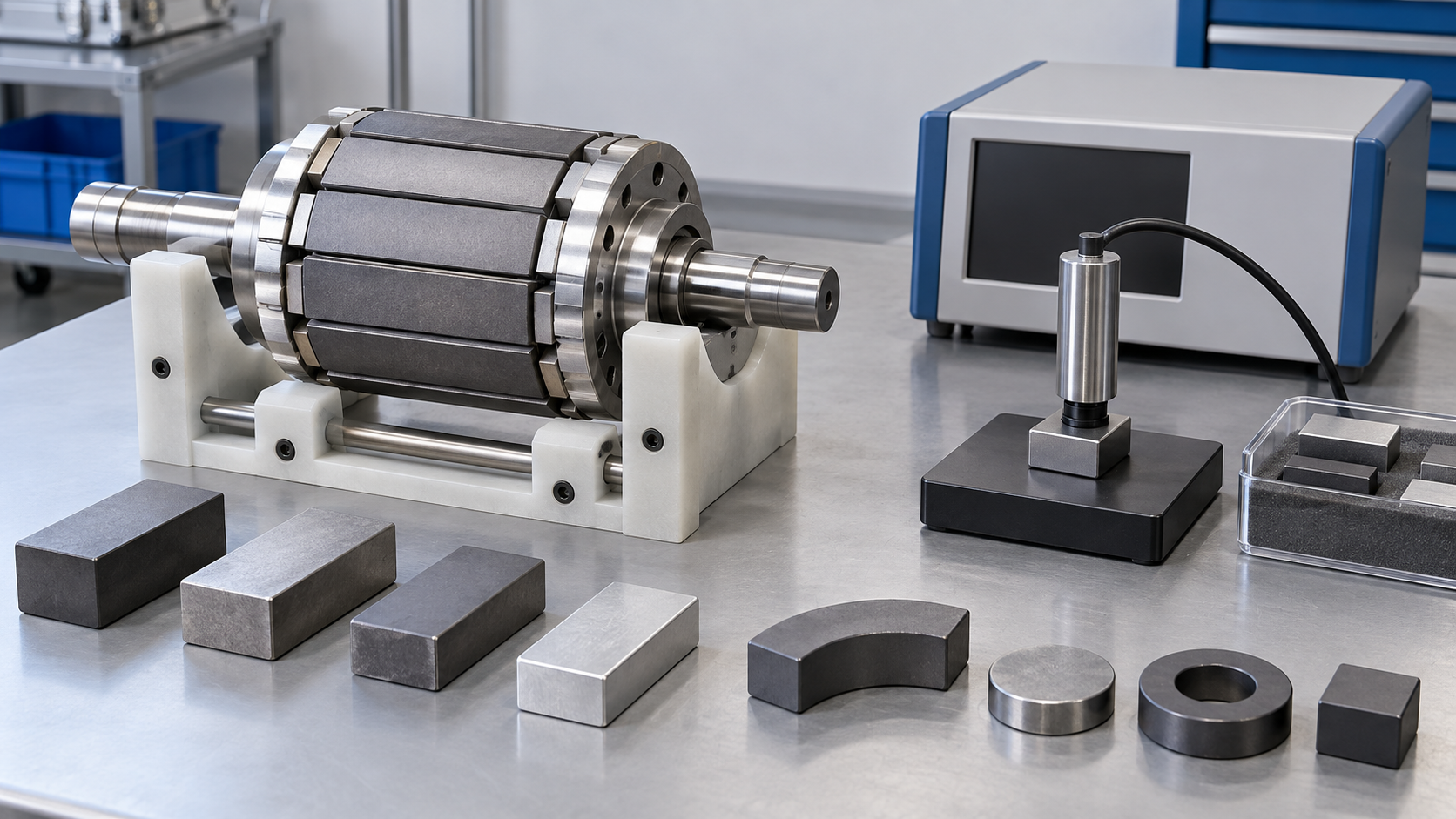
- What a permanent magnet is (the short version)
- Reading performance — the demagnetization curve and Br, HcJ, (BH)max
- Four families — sintered neodymium, samarium-cobalt, ferrite, bonded magnets
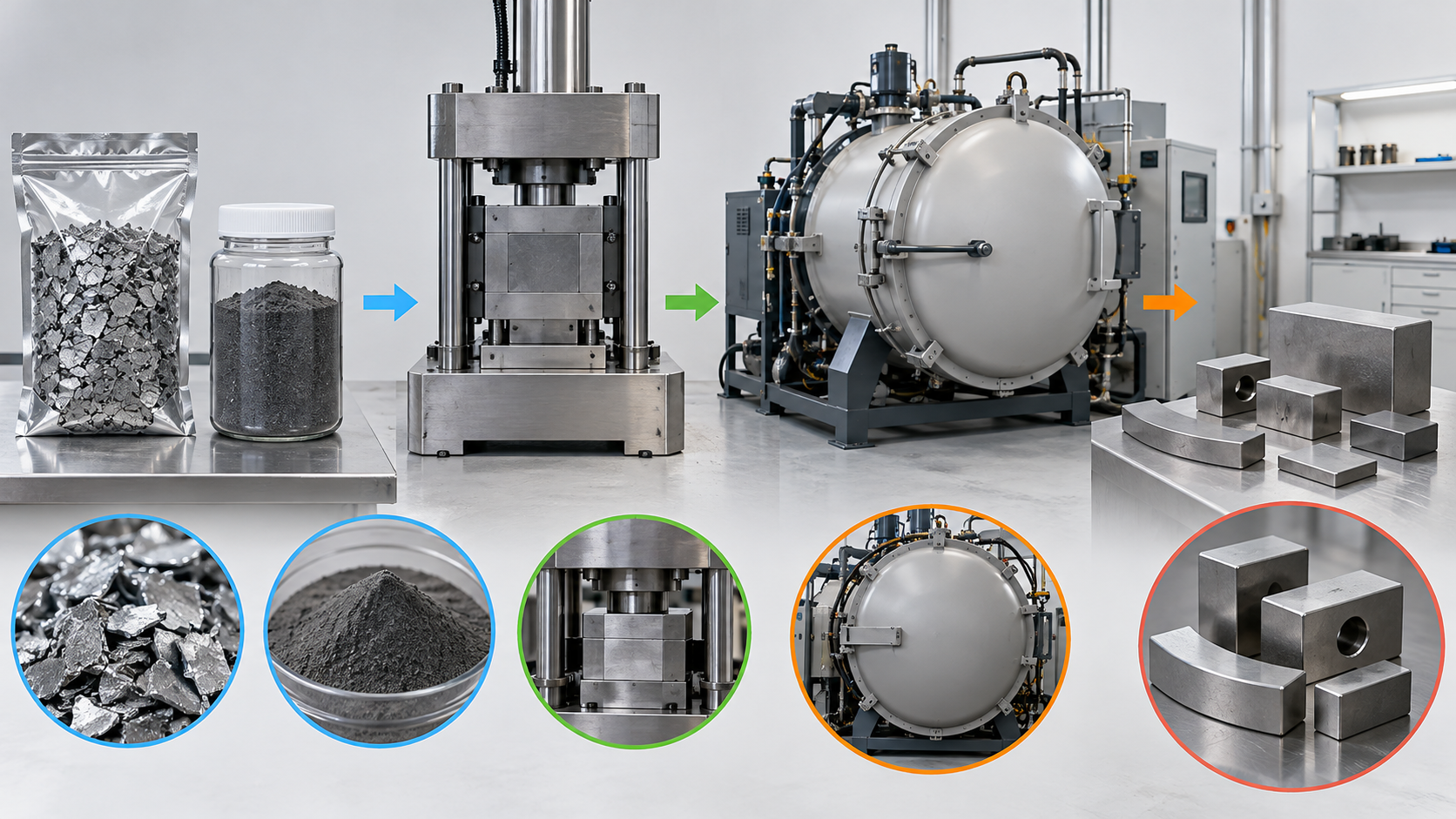
- How a neodymium magnet is made, and where coercivity is decided
- Using less heavy rare earth — grain boundary diffusion, finer grains, light rare-earth substitution
- The temperature constraint — usable temperature is set by coercivity
- Applications — EV motors and wind power
- Rare-earth supply — mining, refining, and China's export controls (stages and dates)
- Policy — the EU Critical Raw Materials Act and Japan's specified critical materials
- Limits, and what could not be confirmed
- How to read evaluations and standards
- Glossary
- References (primary sources)
- Claim-to-source audit
Sourced = stated in published material (link given)
Our calculation = a figure this article derived, with the assumptions spelled out
Not yet confirmed = a plan, target, suspended measure or scenario whose record or effect has not been confirmed
Materials-design interpretations are marked separately as Commentary. Inference is shown in bold. For laws and measures, the stages (announced / in force / suspended) are kept apart.
Magnet numbers always carry conditions: sintered or bonded, the temperature of measurement, and whether the value is typical or a guaranteed minimum. The magnet values here come from manufacturers’ stated values (catalogs and datasheets), peer-reviewed papers and standards bodies, and are given with their conditions. Values for different families or sample forms are not set side by side to rank them. Rare-earth prices and price forecasts are not covered. Resource statistics are USGS and IEA published values and include estimates and revisions.
1. What a permanent magnet is (the short version)
- Performance is read from three quantities: Br (how strongly magnetization remains), HcJ (how much reverse field the magnet withstands) and (BH)max (a measure of the energy it can deliver outside itself). Br is set almost entirely by the main phase, whereas HcJ is set by the material’s internal microstructureSourced [Sources 3, 4, 10]
- Strong, but weak to heat: neodymium magnets are the strongest, but their coercivity falls sharply as temperature rises. Drive motors in hybrid vehicles are said to reach about 200 °C, and the coercivity needed at that temperature has been supplied by dysprosium and terbiumSourced [Sources 3, 4]
- The supply chain is long: mining, refining (separation and smelting) and alloy and magnet manufacture are each concentrated in different countries, and China’s export controls move through announcement, entry into force and suspension. At the date checked (10 October 2026), the expanded measures announced in October 2025 are suspended until 10 November 2026Sourced [Sources 15, 17, 24]
A magnet’s strength (Br) is set almost entirely by the main phase, but the temperature it can be used at (HcJ) is set by the grain-boundary microstructure and by how heavy rare earths are put in. And supply risk sits more in refining and in making magnets than in digging up oreSourced [Sources 3, 4, 17, 18].
2. Reading performance — the demagnetization curve and Br, HcJ, (BH)max
A magnet’s performance is read from its demagnetization curve — the second quadrant of the magnetization curve, traced as a reverse field is applied to a magnetized magnet. The same curve defines the following quantitiesSourced [Source 10].
| Quantity | Meaning | Points to watch |
|---|---|---|
| Br (remanence) | The flux density the magnet keeps with no external field. A measure of strength | A closed-circuit value. Lower in bonded magnets because the volume fraction of magnetic powder is lower |
| HcB (coercivity) | The reverse field at which flux density B reaches zero | The magnet is not demagnetized on reaching HcB; when the field is removed it returns toward Br |
| HcJ (intrinsic coercivity) | The reverse field at which magnetization J reaches zero. A measure of resistance to demagnetization | Changes strongly with temperature. Test methods in standards specify the measurement temperature (Chapter 11) |
| Hk and squareness | Hk is the reverse field at which J falls to 0.9 Br. Hk divided by HcJ is the “squareness”; the closer to 1, the squarer the J curve | Arnold gives 0.90–0.95 for good neodymium and ferrite and 0.85–0.93 for samarium-cobalt |
| (BH)max (maximum energy product) | The largest value of B times H on the curve. A measure of the energy available per unit size of magnet | For well-aligned magnets, (BH)max ≈ Br² / 4μ0μrec (μrec is about 1.035–1.06) |
| α(Br), α(HcJ) | Temperature coefficients of Br and HcJ (%/°C): the average rate of change between two temperatures | The change is not linear, so the temperature range must be stated. Common ranges: 20–100 °C for ferrite, 20–150 °C for samarium-cobalt, and 20 °C to the maximum use temperature for neodymium |
All Sourced (Arnold Magnetic Technologies technical note TN 1501 [Source 10]).
When a magnet is used in a motor or similar device, its working point is where the load line, set by the magnet’s shape and the magnetic circuit, meets the B curve. In a design that minimizes magnet volume, the working point sits at the (BH)max point (roughly H = Br/2), so at the operating temperature the intrinsic coercivity, expressed as a flux density (μ0HcJ), must exceed half of Br. Hirosawa et al. explain this condition as a reason for using heavy rare earthsSourced [Source 3].
For a well-aligned magnet, the theoretical upper limit of (BH)max follows from the saturation magnetization Ms as (1/4)μ0Ms². For Nd2Fe14B, μ0Ms = 1.61 T (Coey, Table 2), giving about 516 kJ/m³Sourced [Source 4].
Our calculation Arnold’s sintered neodymium N52 has a typical value of 406 kJ/m³ (51 MGOe), about 79% of that limit (406 / 516). The first sintered magnet reported in 1984 (composition Nd15B8Fe77, (BH)max = 290 kJ/m³) was about 56% of it [Source 1]. Over about 40 years the typical value has risen about 1.4-fold (406 / 290). As a cross-check, computing (BH)max ≈ Br² / 4μ0μrec from the N52 Br of 1.45 T gives about 395–404 kJ/m³ for μrec = 1.035–1.06, close to the catalog’s 406 kJ/m³.
Assumptions and limits: N52 is Arnold’s stated typical value, and the 1984 value is a single laboratory composition. The comparison is a rough guide to how far development has gone, not a ranking of products and not a statement about other makers’ values.
Br and saturation magnetization are properties of the main phase, fixed by crystal structure and composition. Coercivity is different: for the same main phase it can change several-fold with microstructure, an “extrinsic” quantity. According to Coey, even reaching a coercivity of 20–30% of the anisotropy field HA — the physical upper bound on the reversal field — has usually taken many years of development [Source 4]. In Hirosawa et al.’s table, HA of Nd2Fe14B is 5.33 MA/m [Source 3]. The minimum HcJ of Arnold’s standard N grades is 955 kA/m, which is Our calculation about 18% of that anisotropy field (955 / 5,330).
For a materials engineer, this means “improving a magnet” is less a search over compositions than the work of building in grain size, grain-boundary phases and the locations of defects (Chapter 4). One caution: the ratio compares a guaranteed minimum with a room-temperature theoretical value, and using typical values would give a somewhat higher fraction (commentary in this article).
3. Four families — sintered neodymium, samarium-cobalt, ferrite, bonded magnets
The permanent magnets in use today can be sorted by main phase and by how they are made (sintered or bonded). Coey puts production of rare-earth magnets at about 1.4×10⁵ t a year and ferrite magnets at about 1×10⁶ t a year (as stated in a paper of around 2018)Sourced [Source 4]. The table below sets manufacturers’ stated values and a paper’s values side by side with their conditions. Because the conditions differ, it does not rank the rows.
| Family (source, conditions) | Br | HcJ | (BH)max | Temperature guide | Notes |
|---|---|---|---|---|---|
| Sintered neodymium N35 (Arnold, typical / minimum) | 1,210 mT (typical) | 955 kA/m or more | 282.5 kJ/m³ (typical) | Max use temperature 80 °C, α(Br) −0.12 %/°C, α(HcJ) −0.618 %/°C | The strongest family. Curie temperature about 310 °C [1, 4] |
| Sintered neodymium N52 (same) | 1,450 mT | 875 kA/m or more | 406 kJ/m³ | Max use temperature 60 °C | A grade that prioritizes strength; lower coercivity |
| Sintered neodymium N35EH (same) | 1,200 mT | 2,388 kA/m or more | 279 kJ/m³ | Max use temperature 200 °C, α(HcJ) −0.472 %/°C | About the same strength as N35 with about 2.5 times the coercivity. A grade that uses heavy rare earths |
| Sintered samarium-cobalt Recoma 28 (Arnold, Sm2Co17) | 1.10 T (typical) | 2,000 kA/m (typical), 1,200 (minimum) | 225 kJ/m³ (typical) | Max use temperature 350 °C, α(Br) −0.035 %/K (20–150 °C) | Strong at high temperature. (BH)max is about 55% of the N52 typical value (225 / 406, our calculation) |
| Sintered samarium-cobalt Recoma 18 (same, SmCo5) | 0.87 T (typical) | 2,400 kA/m (typical), 2,000 (minimum) | 143 kJ/m³ (typical) | Max use temperature 250 °C, α(Br) −0.045 %/K | The maker says SmCo magnets have high corrosion resistance and can in most cases be used without a protective coating |
| Sintered ferrite Y30H-1 (Eclipse Magnetics, distributor datasheet) | 380–400 mT | 235–290 kA/m | 27–32 kJ/m³ | Up to about 250 °C (about 300 °C in some cases), per the same source | Iron-oxide based, with low strength. High-performance La-Co substituted types also exist [9, 29] |
| Bonded Nd-Fe-B (isotropic, press-molded with epoxy, paper) | 0.722 T | 718 kA/m (Hci) | 83.5 kJ/m³ | Not stated in this paper | MQP-B powder. Flexible in shape, but low strength |
All Sourced (Arnold catalog Rev. 210607 [Source 7] and Recoma table Rev. 160205a [Source 9], Eclipse Magnetics datasheet [Source 11], Qin and He (2013) [Source 12]). Maximum use temperatures are manufacturers’ stated values, and the manufacturer itself notes that under strong demagnetizing fields or a low load line they can be considerably lower [Source 9]. Curie temperature: Sagawa et al. (585 K) and Coey (315 °C) [Sources 1, 4].
Even with the same main phase, how the powder is consolidated changes how strong the result can be. Coey sets out the ideal maximum energy products for Nd2Fe14B (Ms = 1.28 MA/m)Sourced [Source 4].
| Form | Ideal (BH)max | Efficiency per unit of magnetic material (Coey’s definition) |
|---|---|---|
| Aligned, sintered | 515 kJ/m³ | 100% |
| Aligned, bonded (fill factor f = 0.7) | 252 kJ/m³ | 70% ((BH)max scales with f²; efficiency equals f) |
| Random (unaligned), sintered | 129 kJ/m³ | 25% |
| Random, bonded (f = 0.7) | 63 kJ/m³ | 18% |
All Sourced (Coey’s Table 1 [Source 4]; ideal upper limits, not measured values).
What the table says is that both alignment and fill factor bear on (BH)max. A bonded magnet has a lower share of magnetic powder because of the resin, and an isotropic one cannot use the advantage of alignment. Even so, Coey notes that bonded magnets are used where shape freedom, dimensional accuracy and magnetization in any desired direction matter, as in the spindle motors of hard disk drives [Source 4].
Read the table down the columns. The families run neodymium, samarium-cobalt, bonded, ferrite in order of (BH)max, and the order of usable temperature is roughly the reverse. Neodymium is the strongest but its Curie temperature is relatively low at about 310 °C (Coey puts it at 315 °C and calls it a weakness that limits the usable temperature range), so it is the family most sensitive to temperature [Sources 1, 4]. Samarium-cobalt gives up strength but, according to the maker, has a small Br temperature coefficient (−0.035 to −0.045 %/K) and a high maximum use temperature [Source 9]. Ferrite is weak and iron-oxide based [Source 11].
The point for a materials engineer is that choosing a family fixes strength, temperature and resource constraints all at once. Coey describes neodymium as optimized over the years for a wide range of applications that need high performance at reasonable cost, and samarium-cobalt as the choice when high-temperature stability is required [Source 4]. The strain of using neodymium at high temperature lands on “the heavy rare earths that keep coercivity up” (Chapter 5). For cobalt resources, see our explainer on battery raw materials and supply chains (commentary in this article).
4. How a neodymium magnet is made, and where coercivity is decided
Neodymium magnets were reported side by side in J. Appl. Phys. in 1984 by Sagawa et al. and Croat et al. (Coey dates the discovery to 1982)Sourced [Sources 1, 2, 4]. Sagawa et al. found a tetragonal compound of Nd, Fe and B (about 1 wt%) with lattice constants a = 0.880 nm and c = 1.221 nm, a Curie temperature of 585 K, an anisotropy constant of about 3.5 MJ/m³ and a saturation magnetization of 1.35 T (the value reported at the time). For a sintered magnet of composition Nd15B8Fe77 they give Br = 1.23 T, HcI = 960 kA/m, (BH)max = 290 kJ/m³ and a Br temperature coefficient of −1260 ppm/KSourced [Source 1].
The main points of the process are as followsSourced [Source 5].
- Strip casting: molten alloy is poured onto a water-cooled copper wheel and cooled fast. This suppresses dendrites of α-Fe and improves the distribution of the Nd-rich phase (α-Fe is hard to powder and hinders alignment)
- Hydrogen decrepitation (HD): hydrogen is absorbed first by the grain-boundary phase, which swells and cracks intergranularly; the main phase then absorbs hydrogen and cracks, leaving a coarse powder. The reaction gives off heat and the powder reacts readily with oxygen, so it is handled under inert atmosphere
- Jet milling: particles are collided in gas jets at 5–10 bar, giving a narrow size distribution and low oxygen content
- Pressing in a field: the easy axes of all particles are aligned with the final magnetization direction and the powder is compacted. The green compact is about 60% of theoretical density
- Sintering and heat treatment: in inert gas or vacuum, aiming for over 95% of theoretical density. A post-sinter heat treatment can heal defects in the grain-boundary phase, make the Nd-rich phase more continuous, and raise coercivity
The place where coercivity is decided is not the “inside” of a crystal grain but the grain boundaries and surfaces. The Hirosawa et al. review (NIMS) sets this out as followsSourced [Source 3].
- Grains are micrometre-sized, far larger than the domain-wall width (about 4 nm) or the exchange length (about 1.2 nm in Nd2Fe14B). Even so, coercivity is governed by nanometre-scale local properties
- The grain-boundary phase between grains (about 2 nm thick) was found by three-dimensional atom probe to contain about 80 at.% or more Fe and Co, and three methods showed it to be ferromagnetic
- Nd ions and some Fe atoms at the interface have in-plane (negative) anisotropy, which lowers coercivity
Coey adds that reverse magnetization tends to nucleate at irregularities on the surface at edges and corners of the magnet, because the demagnetizing field is largest there in cylinders and blocks [Source 4].
This continues view 1 in Chapter 2. The ideal is to separate each Nd2Fe14B grain from the next by a thin non-magnetic (or weakly magnetic) Nd-rich phase, which breaks the magnetic coupling and stops reversal from spreading (commentary in this article). According to the Hirosawa et al. review, though, the real grain-boundary phase is ferromagnetic, and raising its Nd content to about 80% makes it paramagnetic. They also state that the sides facing the (001) plane (top and bottom of a grain) can be brought close to paramagnetic, while the sides perpendicular to (001) stay ferromagnetic, rich in Fe and Co [Source 3].
So coercivity is set less by composition than by grain size, the amount and thickness of grain-boundary phase, and the distribution of elements along the boundary, and the state of the boundary differs from one crystal face to another. In process terms, powder particle size, sintering temperature and time, heat treatment, additive elements (such as Ga) and oxygen content are all design variables for coercivity (commentary in this article; the effects of additive elements were not checked against primary sources here and are not described individually).
5. Using less heavy rare earth — grain boundary diffusion, finer grains, light rare-earth substitution
According to Coey, heavy rare earths (Dy and Tb) are added because they raise uniaxial anisotropy through spin-orbit interaction. In high-temperature grades of around 2011, Dy and Tb were about 5% by weight, the Dy/Nd ratio was about 0.16, and raw-material cost was about double that of a magnet with no heavy rare earths. That situation spurred research into magnets with less or no heavy rare earthSourced [Source 4]. There is a price to pay. Adding heavy rare earths raises anisotropy but weakens magnetization (Coey) [Source 4]. In effect, strength is given up to buy coercivity.
There are three main ways to use less heavy rare earth.
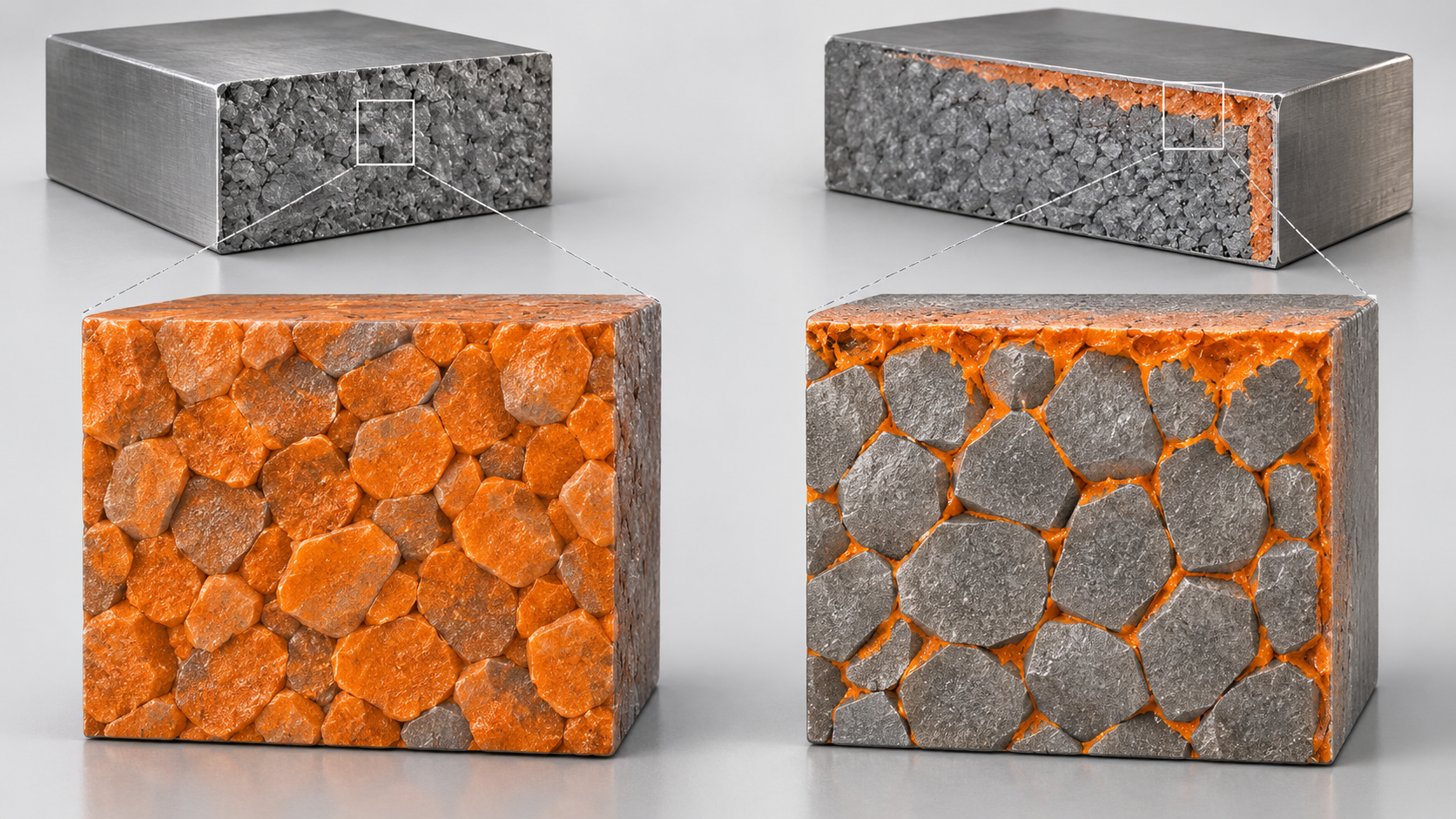
- Grain boundary diffusion (GBD): reverse magnetization tends to nucleate at irregular spots on surfaces and grain boundaries, so only those spots are strengthened with Dy or Tb. After sintering, heavy rare earth is introduced from the surface and diffuses along the grain boundariesSourced [Sources 4, 6, 8]
- Finer grains: reducing powder particle size to the 1 µm range has cut the heavy rare earth neededSourced [Source 4]. Hirosawa et al. explain that with smaller grains the effective demagnetizing field produced by reversed surface grains is smaller [Source 3]
- Substituting light rare earths: replacing part of the Nd with the more abundant, cheaper La and CeSourced [Sources 4, 14] (rare-earth-free magnets are covered in our explainer on rare-earth-free magnets)
View the original SVG schematic and exact annotations
The effect of grain boundary diffusion can be seen in Arnold’s catalogs. The company says its “GBD Neo” magnets enhance coercivity while using less Dy and Tb and limiting the loss of remanence, and that they suit thin magnets (under 6 mm) or laminated materialSourced [Source 8]. Set side by side at the same coercivity class, standard and grain-boundary-diffused grades compare as follows.
| HcJ class (minimum) | Standard grade | Grain-boundary-diffused grade | Difference (our calculation) |
|---|---|---|---|
| 1,592 kA/m (the 150 °C class) | N42SH: Br 1,310 mT, (BH)max 330 kJ/m³ | G52SH: Br 1,440 mT, (BH)max 402 kJ/m³ | Br +9.9%, (BH)max +21.8% |
| 1,990 kA/m (the 180 °C class) | N40UH: Br 1,270 mT, (BH)max 318 kJ/m³ | G54UH: Br 1,450 mT, (BH)max 418 kJ/m³ (minimum HcJ 1,910) | Br +14.2%, (BH)max +31.4% (HcJ about 4% lower) |
| 2,388 kA/m (the 200 °C class) | N40EH: Br 1,270 mT, (BH)max 314 kJ/m³ | G46EH: Br 1,360 mT, (BH)max 362 kJ/m³ | Br +7.1%, (BH)max +15.3% |
Sourced (Arnold catalog Rev. 210607 [Sources 7, 8]; typical Br and (BH)max, minimum HcJ). The difference column is Our calculation (diffused grade divided by standard grade, minus 1). This is a comparison within one maker and does not show other makers’ values. Diffused grades suit thin magnets, so shape and size conditions differ.
Our calculation At the same HcJ class, the diffused grades show Br about 7–14% higher and (BH)max about 15–31% higher than the standard grades. That fits grain boundary diffusion helping to obtain the same coercivity without giving up magnetization (the reduction in the amount of Dy and Tb itself could not be confirmed from primary sources and is not given).
Assumptions and limits: these are Arnold’s stated typical values compared with each other, and for some pairs the minimum coercivity is not identical (the minimum HcJ of G54UH is 1,910 kA/m). The diffused grades target magnets under 6 mm thick, so the same effect cannot be expected in large magnets (diffusion does not reach deep into the interior), which is a design constraint [Source 8].
Besides grain boundary diffusion, there are routes that avoid heavy rare earths altogether. The next two items are company announcements and do not carry over directly to other companies or applications.
- Hot-deformed magnets: on 12 July 2016, Honda and Daido Steel announced that they had become the first in the world to put into practical use, in a hybrid vehicle’s drive motor, a hot-deformed neodymium magnet containing no heavy rare earth. The hot-deformation method is said to give crystal grains about one tenth the size of those in a sintered magnet, and Honda states that, with the magnet and rotor shapes revised, the motor showed torque, output and heat resistance equivalent to a motor using a conventional magnetSourced (company announcement) [Source 13].
- Lanthanum-cerium substitution: on 20 February 2018, Toyota announced a magnet that replaces part of the Nd with La and Ce, cuts Nd use by up to 50%, uses no Tb or Dy, and has heat resistance equivalent to earlier neodymium magnets. The company said it would advance mass-production technology and aim for early adoption in automobiles and roboticsSourced (company announcement) [Source 14]. Its status of practical use was not checked here Not yet confirmed.
Putting Dy or Tb into the whole alloy raises main-phase anisotropy and coercivity but lowers magnetization (Coey). Grain boundary diffusion is a design that places heavy rare earth only in the thin surface layer where coercivity is needed, the idea of paying only where it is needed [Source 4].
In the view of the Hirosawa et al. review, the more fundamental answer is to get coercivity without heavy rare earths by controlling the magnetic nature of the grain boundary and the microstructure. Their target is a room-temperature coercivity of 2 MA/m in submicron-grain anisotropic Nd-Fe-B (the value needed to run safely at 160 °C). They say the coercivity of Dy-free magnets made by hot deformation and grain boundary diffusion seems to have reached that level, and that the remaining task is bringing Br closer to the level of commercial sintered magnets [Source 3]. In materials terms, the work is to shift, bit by bit toward the upper right, the position on the trade-off between “coercivity raised but magnetization lowered” (commentary in this article).
6. The temperature constraint — usable temperature is set by coercivity
A magnet’s properties change with temperature. Coey divides the losses into three kindsSourced [Source 4].
- Reversible loss: Br and HcJ fall as temperature rises, because Ms and K1 depend on temperature, and recover on returning to room temperature. It cannot be avoided
- Irreversible loss: from changes in the metastable domain structure of a fully magnetized magnet at high temperature. Remagnetizing at room temperature restores it
- Irredeemable loss: from changes in composition or microstructure, such as oxidation or volatilization of rare earths
Coey also says that suppliers of magnets for high-temperature use sometimes “condition” the magnet at a temperature about 50 K above the working range, so that irreversible losses are worked out in advance [Source 4].
Our calculation From the table in the Arnold technical note [Source 10], the average coefficients from 20 to 180 °C are α(Br) = −0.12 %/°C and α(HcJ) = −0.465 %/°C for N40UH, and α(Br) = −0.035 %/°C and α(HcJ) = −0.254 %/°C for Recoma R33E. The values at 20 °C are, for N40UH, Br typical 1,270 mT and HcJ minimum 1,990 kA/m [Source 7], and for Recoma 33E, Br typical 1.16 T and HcJ minimum 1,750 kA/m [Source 9]. Multiplying by the 160 °C temperature difference gives the following.
- Br: N40UH: 1,270 × (1 − 0.0012 × 160) = about 1,026 mT. Recoma 33E: 1,160 × (1 − 0.00035 × 160) = about 1,095 mT. At 20 °C N40UH is higher (1,270 versus 1,160), but at 180 °C the order reverses
- HcJ: N40UH: 1,990 × (1 − 0.00465 × 160) = about 509 kA/m. Recoma 33E: 1,750 × (1 − 0.00254 × 160) = about 1,040 kA/m. Retention relative to 20 °C is about 26% for the former and about 59% for the latter
Assumptions and limits: this is a rough estimate that fits a straight line to average coefficients. Real curves are not straight, and irreversible demagnetization and aging are not included. The 20 °C values mix a typical value (Br) and a minimum (HcJ), and the products differ. The maximum use temperature of N40UH is 180 °C (Arnold technical note), so this calculation indicates how much margin the magnet keeps near that temperature.
Temperature has other sides tooSourced [Source 10].
- Low temperature: neodymium undergoes a “spin reorientation” at about 140 K, where the easy axis of magnetization becomes a cone and magnetic properties fall markedly. Replacing 80% or more of the Nd with Pr removes this reorientation
- Ferrite is the opposite: coercivity rises with temperature. In exchange, coercivity becomes small at low temperature; the practical lower limit is −40 °C for standard ferrite and about −60 °C for La-Co ferrite
- Maximum use temperature depends on conditions: the maximum use temperature a manufacturer gives can fall substantially under strong demagnetizing fields or a low load line [Source 9]
As temperature rises, Br of neodymium falls at a rate of −0.12 %/°C, but that is reversible and can be designed around. What is dangerous is HcJ falling below the demagnetizing field at the working point at the operating temperature, which causes irreversible demagnetization (Chapter 2). Hirosawa et al. estimate that, for an HEV application where operation at about 200 °C calls for a sintered Nd-Dy-Fe-B magnet with a room-temperature coercivity of 2.4 MA/m (3 T), assuming an average temperature coefficient of −0.5 %/K for coercivity, the HcJ required at the operating temperature is about 600 kA/m [Source 3].
A manufacturer’s maximum use temperature reads as a value for a particular load line (Arnold notes that under strong demagnetizing fields or a low load line it can be considerably lower) [Source 9]. A materials engineer should read the temperature on a datasheet not as “the magnet’s limit” but as “the limit in one magnetic circuit”, and check with the motor or circuit designer which working point will be used (commentary in this article).
7. Applications — EV motors and wind power
USGS estimates that the largest use of rare earths worldwide is magnets (in the United States, catalysts)Sourced [Source 15]. Hirosawa et al. list, in order of production volume, automobiles (other than electric vehicles), disc drives, HEVs and EVs, electric bicycles, and transducers (including loudspeakers), and name wind generators and other power-generation and energy-storage equipment as near-future fields that will use large volumes of high-performance magnetsSourced [Source 3].
Most drive motors in EVs and HEVs are IPM (interior permanent magnet) types, with magnets buried in thin slots in the rotor. In this type the magnets receive the strong demagnetizing field produced by the stator windings, so high coercivity is a prerequisite. At high speed the magnets’ flux induces a large voltage in the windings, which must be cancelled by “flux weakening”, and that adds losses, according to Hirosawa et al. [Source 3].
Hirosawa et al. show that the type of motor changes the properties wanted from the magnet. A conventional IPM motor wants high coercivity and the largest possible Br. A variable-flux motor, which deliberately demagnetizes the magnets at high speed and remagnetizes them at low speed, suits low-coercivity (weak) magnets, and reluctance-assisted types that can use weak magnets such as ferrite are still under development. The same paper expects IPM motors to remain mainstream for the time being, with high-coercivity neodymium continuing as the core of large-scale applicationsSourced [Source 3].
From the materials side, improving the magnet and designing a motor that asks less of the magnet are two different ways of solving the same resource problem. The route to using less heavy rare earth runs on both the magnet side (Chapter 5) and the circuit side (designs that need less coercivity) (commentary in this article).
The IEA sees rare earths as a small share of the final product. Its Global Critical Minerals Outlook 2026 says rare earths account for about 40% of permanent magnet costs but less than 1% of a vehicle’s valueSourced [Source 17]. This is stated in the context that, even when prices rise, the effect on the final product can be limited; it is not a price outlook.
The mass of magnet, and the rare-earth content, per wind generator or EV motor varies widely with design and capacity. This article could not confirm a single representative figure from public bodies or peer-reviewed papers, so it gives no number (Chapter 10).
8. Rare-earth supply — mining, refining, and China’s export controls (stages and dates)
(1) Where it is mined, and where it is refined
According to the USGS Mineral Commodity Summaries 2026 (February 2026), world rare-earth mine production in 2025 (estimate) was about 390,000 t (oxide equivalent): China 270,000 t, the United States 51,000 t, Australia 29,000 t and Myanmar 22,000 tSourced [Source 15]. Our calculation China’s share is about 69% (270,000 / 390,000). Reserves are 44 Mt in China and over 75 Mt worldwide (USGS), so China’s share is under 60% (44 / over 75).
Refining is more concentrated than mining. The IEA states that for gallium, graphite, manganese and rare earths the top refiner, China, accounts for over 90% of global supply. It also says rare-earth refining was an exception, with concentration falling slightly in 2023–2025 thanks to new projects in the United States and higher output in MalaysiaSourced [Sources 17, 18].
For heavy rare earths (Tb, Dy and others), USGS writes that the United States mined heavy-rare-earth minerals in 2025 but no company produced heavy-rare-earth compounds or metals at sustained commercial scale. US import sources for 2021–2024 were China for 100% of terbium and 100% of holmium (USGS)Sourced [Source 16]. It also records government-linked financing to support separation facilities [Source 16].
(2) The IEA’s outlook (scenarios)
In IEA scenarios, existing and announced projects would give, by 2035 outside China, mining capacity of about 50 kt of rare earths, planned refining and separation capacity of under 40 kt (mainly Malaysia and the United States), and downstream capacity for metals, alloys and magnets of only about 18 kt (rare-earth content)Not yet confirmed [Source 18]. The same report says diversified refining capacity would equal about two thirds of 2035 mined supply while planned magnet production capacity is only about one third, and it estimates that diversifying magnet rare-earth supply chains would need about USD 60 billion of investment over the next decadeNot yet confirmed [Source 17].
Reading the numbers down the chain: mining (China about 69%) → refining (over 90%) → (according to the IEA) magnet production capacity, with concentration and shortfall growing downstream. For a materials engineer this means that choosing an element is, in effect, choosing dependence on whichever countries hold the equipment and know-how for each step. Heavy rare earths (Dy and Tb) have especially thin supply, which is why they became the target of design-based reduction (Chapter 5).
China’s export controls are designed to reach not only minerals but magnets, manufacturing equipment and manufacturing technology (next section). Battery materials show the same pattern (where the mining and refining countries differ), covered in our explainer on battery raw materials and supply chains (commentary in this article).
(3) China’s export controls — keeping announced, in force and suspended apart
Stages and dates were checked against official announcements of China’s Ministry of Commerce (MOFCOM) and the General Administration of Customs. The date checked is 10 October 2026; later changes are not reflected.
| Measure | Content (official announcement) | Stage (checked 10 October 2026) |
|---|---|---|
| Announcement No. 18 of 2025 (4 April 2025) | Metals, alloys, oxides and compounds of seven elements: Sm, Gd, Tb, Dy, Lu, Sc, Y. Includes Sm-Co magnet material and Nd-Fe-B magnets containing Tb or Dy (magnets and magnet powder). Exporters must apply for a licence. “This announcement takes effect on the date of issue” [19] | In force. USGS records that the April measures remained in effect (as of December 2025) and that general licences began to be issued to some exporters [15, 16] |
| Announcement No. 57 of 2025 (9 October 2025) | Metals, alloys, oxides and compounds of five elements: Ho, Er, Tm, Eu, Yb. For Ho this includes permanent magnet material, magnetic refrigeration material and magnetostrictive material. “Takes effect from 8 November 2025” [20] | Announced; suspended under No. 70 |
| Announcement No. 56 of 2025 (same day) | Rare-earth production and processing equipment (centrifugal extraction equipment, roasting kilns, vacuum induction reduction furnaces, vacuum induction strip-casting furnaces for rare-earth permanent magnets, etc.) and raw and auxiliary materials (extractants, etc.). “Takes effect from 8 November 2025” [21] | Announced; suspended under No. 70 |
| Announcement No. 61 of 2025 (same day) | Extraterritorial application. Licences required for foreign-made items containing 0.1% or more by value of China-origin rare-earth items, for items produced abroad using China-origin rare-earth technology, and others. “Parts 1(1) and 1(2) take effect from 1 December 2025; part 1(3) from the date of issue” [22] | Announced; suspended under No. 70 |
| Announcement No. 62 of 2025 (same day) | Technology for rare-earth mining, separation and smelting, metal smelting, magnet manufacturing and recycling of secondary resources (and technology for assembling, commissioning, maintaining, repairing and upgrading the production lines). “Magnet manufacturing” technology means technology for making Sm-Co, Nd-Fe-B and Ce magnets. “Takes effect from the date of issue” [23] | Announced; suspended under No. 70 |
| Announcement No. 70 of 2025 (7 November 2025) | Suspends Nos. 55, 56, 57 and 58 and Nos. 61 and 62 with immediate effect until 10 November 2026. The legal status shown is “currently valid” [24] | Suspended. Ends 10 November 2026. The position after that could not be confirmed Not yet confirmed |
| MOFCOM Announcement No. 1 of 2026 (6 January 2026) | Prohibits the export of all dual-use items to Japanese military users and military end uses, and to any end use that helps raise Japan’s military strength. It also states legal liability for organizations and individuals anywhere who transfer or supply China-origin dual-use items to Japanese organizations or individuals in breach [25] | In force (from the date of issue). Treatment of civilian use cannot be read from the text |
All Sourced (original texts of announcements by China’s Ministry of Commerce and Customs [Sources 19-25]; USGS [Source 15]). Nos. 55 and 58 concern superhard materials and battery materials, not rare earths, so they are not treated in this table. English renderings of the announcements were made by this article.
Measures reported as “China tightened rare-earth export controls” include some in force (No. 18 of April 2025) and some announced but suspended (Nos. 56, 57, 61 and 62 of October 2025). The IEA also records that the April 2025 measures led some automakers to cut utilization or briefly halt operations, and that the October expansion was suspended for one year until November 2026 but “the vulnerabilities remain”Sourced [Source 17]. The IEA estimates that, if fully implemented, about USD 6.5 trillion a year of downstream production outside China would be at riskNot yet confirmed (a scenario estimate) [Source 17]. For actual decisions, check each government’s latest announcements. The dates in this article may change after the date checked.
9. Policy — the EU Critical Raw Materials Act and Japan’s specified critical materials
European Union: Regulation (EU) 2024/1252 (the Critical Raw Materials Act) lists “rare earth elements for permanent magnets (Nd, Pr, Tb, Dy, Gd, Sm, and Ce)” among its strategic raw materials. Its 2030 benchmarks (Article 5) are: extraction in the EU of at least 10% of annual consumption, processing of at least 40%, recycling of at least 25%, and no single third country supplying more than 65%Sourced [Source 26].
Permanent magnets have dedicated provisions (Articles 28 and 29). For products including MRI devices, wind generators, industrial robots, motor vehicles, heat pumps and electric motors, they require a label showing whether permanent magnets are present and of which type (neodymium-iron-boron, samarium-cobalt, aluminium-nickel-cobalt, ferrite), and a data carrier giving the weight, location and chemical composition of the magnets and how to remove them. The Commission is to adopt the implementing act by 24 November 2026, and the requirements apply two years after that act enters into force (products designed primarily for defence or space are outside Article 28). Disclosure of the recycled-content share (Nd, Dy, Pr, Tb, B, Sm, Ni, Co) is due by 24 May 2027 or two years after the delegated act enters into force, whichever is laterSourced [Source 26]. Whether the implementing and delegated acts have been adopted was not checked here Not yet confirmed.
Japan: according to the Cabinet Office, in December 2022 (Reiwa 4) a Cabinet Order designated 11 items, including permanent magnets, as specified critical materials under the Economic Security Promotion ActSourced [Source 27]. The individual certifications and support measures were not checked here.
Recycling today: USGS writes that only limited quantities of rare earths are recovered from batteries, permanent magnets and fluorescent lamps in the United States [Source 15]. The IEA says magnet recycling could benefit as end-of-life volumes grow from early generations of EVs and wind turbinesNot yet confirmed [Source 17]. Recycling technology is not covered in this article (Chapter 10).
10. Limits, and what could not be confirmed
(1) Manufacturers’ numbers
Arnold’s typical and minimum values are stated values for its standard grades, not other makers’ values. The diffused grades target magnets under 6 mm thick. The Eclipse Magnetics figures come from a distributor datasheet, not a maker’s specification. The TDK ferrite datasheet could not be reached from this site and was not checked. The bonded-magnet values are one example from one paper (MQP-B powder, epoxy, press molding).
(2) The amount of heavy rare earth saved
The percentage (by weight) of Dy and Tb saved by grain boundary diffusion or hot deformation could not be confirmed from primary sources and is not given. The Honda and Daido Steel and Toyota announcements are company announcements and cannot be generalized to other applications or other makers’ magnets. The status of practical use of Toyota’s magnet was not checked.
(3) Typical usage figures
The mass of magnet, or rare-earth content, per wind generator or EV motor could not be confirmed as a single representative value from public bodies or peer-reviewed papers, so it is not given.
(4) Supply and policy
The suspension under China’s Announcement No. 70 runs to 10 November 2026 (about a month after the date checked), and the position after that could not be confirmed. Whether the EU’s implementing and delegated acts on permanent magnets have been adopted, and the content of individual certifications and support under Japan’s specified critical material “permanent magnets”, were not checked. The effect of No. 1 of 2026 on civilian use cannot be read from the text of the announcement.
(5) Out of scope
Alnico magnets, recycling technology (such as hydrogen processing), prices and price forecasts, corrosion and surface treatment of magnets, and safety (handling strong magnetic fields) are not covered. Rare-earth-free magnets are in our explainer on rare-earth-free magnets, magnetocaloric materials in our explainer on magnetocaloric materials and magnetic refrigeration, and magnetic thin-film materials in our explainer on spintronic materials.
- Magnets are read through Br, HcJ and (BH)max, and all are conditional. The typical (BH)max of Arnold’s N52 is about 79% of the theoretical limit; the first sintered magnet of 1984 was about 56%Sourced / Our calculation
- Coercivity is set by microstructure, and heavy rare earth is an additive that “pays strength to buy coercivity”. At the same coercivity class, grain boundary diffusion gives Br about 7–14% and (BH)max about 15–31% higher (a comparison of Arnold’s stated values, for thin magnets)Sourced / Our calculation
- Temperature reorders the families. At 20 °C the Br of neodymium is higher, but near 180 °C the rough estimate from average coefficients puts samarium-cobalt aheadOur calculation
- The weak links in supply are refining and magnet-making. China holds about 69% of mining and over 90% of refining (IEA). Of China’s export controls, the April 2025 measures are in force, and the October expansion is announced but suspended until 10 November 2026Sourced
- Policy is moving. The EU will require magnet labels, data and recycled-content shares (the implementing act is due by 24 November 2026), and Japan has designated permanent magnets as a specified critical materialSourced / Not yet confirmed
11. How to read evaluations and standards
A permanent magnet’s performance is measured by tracing the demagnetization curve and reading Br, HcB, HcJ and (BH)max from it. The usual methods are a closed-circuit hysteresigraph (electromagnet method), in which the sample is clamped between electromagnet poles, and an open-circuit method for very-high-coercivity magnets (for example a vibrating-sample magnetometer with a superconducting magnet). Results depend on sample shape, temperature and the degree of magnetization [Sources 10, 30, 32]. Standards divide into test methods and specifications of minimum values for each material.
| Item evaluated | ISO | IEC / IEEE | JIS | ASTM (number and title only) | What changes the value with measurement conditions |
|---|---|---|---|---|---|
| Demagnetization curve; Br, HcB, HcJ, (BH)max (closed circuit) | Could not be confirmed | IEC 60404-5:2015 “Magnetic materials – Part 5: Permanent magnet (magnetically hard) materials – Methods of measurement of magnetic properties” (3rd edition, 2015-04-16) [28] IEEE: could not be confirmed | JIS C 2501:2019 “Methods of test for permanent magnet” (a modified adoption, MOD, based on IEC 60404-5:2015) [31] | ASTM A977/A977M “Standard Test Method for Magnetic Properties of High-Coercivity Permanent Magnet Materials Using Hysteresigraphs” (edition seen: A977M-07, reapproved 2013) [10] | Measurement temperature (JIS C 2501 recommends 23 ± 5 °C and strongly recommends ± 1 °C for materials with large temperature coefficients). Above an HcJ of 1.6 MA/m, a closed circuit can give large errors because the pole pieces saturate (note in JIS C 2500 [32]) |
| Open-circuit measurement of high-coercivity magnets (superconducting magnet, demagnetizing-field correction) | Could not be confirmed | IEC 60404-18:2025 “Permanent magnet (magnetically hard) materials – Methods of measurement of the magnetic properties in an open magnetic circuit using a superconducting magnet” (1st edition, 2025-02-20) [30] | JIS C 2500:2022 “Methods of measurement of the magnetic properties of permanent magnet (magnetically hard) materials in an open magnetic circuit using a superconducting magnet” (established with reference to IEC TR 63304:2021) [32] | Could not be confirmed | Sample shape and the demagnetizing-field correction method change the measured curve. JIS C 2500 says the method can characterize magnets with HcJ above 2 MA/m |
| Minimum values for material grades | Could not be confirmed | IEC 60404-8-1:2023 “Magnetic materials – Part 8-1: Specifications for individual materials – Permanent magnet (magnetically hard) materials” (4th edition, 2023-09-20) [29] | JIS C 2502:2019 “Materials for permanent magnet” (MOD, based on IEC 60404-8-1:2015) [33] | ASTM A1101 “Standard Specification for Sintered and Fully Dense Neodymium Iron Boron (NdFeB) Permanent Magnets” (edition seen: A1101-23) [34] ASTM A1054 “Standard Specification for Sintered Ferrite Permanent Magnets” (edition seen: A1054-16) [35] | A specification’s minimum is a guaranteed value and differs from a maker’s “typical value”. The materials covered change with the edition (the 2023 IEC edition adds hot-deformed Nd-Fe-B and others) |
| Temperature coefficients; maximum use temperature | Could not be confirmed | Arnold says temperature-coefficient terms follow IEC definitions [10]. No standard defining a maximum use temperature could be confirmed | Could not be confirmed | Could not be confirmed | A coefficient needs its temperature range stated (20–100 °C for ferrite, 20–150 °C for SmCo, and so on). Maximum use temperature changes strongly with load-line conditions [9] |
Standard numbers, titles and editions in each row are Sourced (checked on IEC, JSA, BSI and AFNOR catalogue pages and in the references of an Arnold technical note). Arranging the table is an editorial task of Our calculation. For ASTM standards, the ASTM site was not opened; only numbers and titles confirmed from non-ASTM public sources are given, and no test conditions, procedures or acceptance criteria are described. The texts of the standards are paid and were not checked.
How the positions differ: IEC 60404 is an international standard (TC 68, magnetic alloys and steels). JIS C 2501 and C 2502 are national standards that technically modify the 2015 editions of IEC 60404-5 and 60404-8-1 (MOD). JIS C 2500 was established in 2022 with reference to IEC TR 63304:2021. IEC has IEC 60404-18:2025, covering the same kind of open-circuit method with a superconducting magnet (SCM-VSM and SCM extraction methods). ASTM standards are US industry standards used alongside IEC and JIS. JIS C 2502 is based on the 2015 edition of IEC 60404-8-1, and whether JIS has taken in the additions of the 2023 edition (hot-deformed Nd-Fe-B and others) was not checked here Not yet confirmed.
Cautions when reading standards
- A standard is a “test method”; it does not guarantee performance. The minimum values in IEC 60404-8-1 and JIS C 2502 are guaranteed-side values for a grade and differ from the “typical values” in catalogs
- The same “HcJ” can change with how it is measured. The closed-circuit electromagnet method is prone to error for high-HcJ magnets, and the open-circuit superconducting-magnet method needs a demagnetizing-field correction. Check which method, and at what temperature, a value was measured
- Read a maker’s value together with the standard, edition, measurement temperature, and whether it is typical or minimum. A maximum use temperature is not a quantity in a standard; it reads as a value the maker gives under conditions such as a load line
12. Glossary
- Br (remanence)
- The flux density a magnet keeps with no external field. A measure of strength.
- HcB / HcJ
- The reverse field at which B / J reaches zero. HcJ (intrinsic coercivity) is the resistance to demagnetization.
- (BH)max
- Maximum energy product: the largest value of B times H.
- Hk, squareness
- The reverse field at which J falls to 0.9 Br, and Hk divided by HcJ.
- α(Br), α(HcJ)
- Average temperature coefficients of Br and HcJ. State the temperature range.
- Anisotropy field HA
- The physical upper bound on the field needed to turn the magnetization.
- Load line, working point
- A line set by the magnetic circuit; where it meets the B curve is the magnet’s working point.
- HD
- Hydrogen decrepitation: breaking an alloy by letting it absorb hydrogen.
- GBD
- Grain boundary diffusion: introducing Dy or Tb along grain boundaries from the surface.
- HREE / LREE
- Heavy rare earths (Dy, Tb and others) / light rare earths (La, Ce, Nd and others).
- IPM
- Interior permanent magnet: a motor with magnets buried inside the rotor.
- REO
- Rare-earth oxide equivalent: quantity expressed as the mass of oxide.
- Dual-use item
- Goods or technology usable for both civilian and military purposes; the term for what China’s export controls cover.
- Curie temperature
- The temperature at which ferromagnetism is lost.
13. References (primary sources)
- Sagawa M. et al. “New material for permanent magnets on a base of Nd and Fe (invited)”, J. Appl. Phys. 55, 2083–2087 (1984), DOI 10.1063/1.333572 — doi.org/10.1063/1.333572
- Croat J. J. et al. “Pr-Fe and Nd-Fe-based materials: A new class of high-performance permanent magnets (invited)”, J. Appl. Phys. 55, 2078–2082 (1984), DOI 10.1063/1.333571 — doi.org/10.1063/1.333571
- Hirosawa S., Nishino M., Miyashita S. (NIMS) “Perspectives for high-performance permanent magnets: applications, coercivity, and new materials”, Adv. Nat. Sci.: Nanosci. Nanotechnol. 8, 013002 (2017), DOI 10.1088/2043-6254/aa597c (open access) — doi.org/10.1088/2043-6254/aa597c
- Coey J. M. D. “Perspective and Prospects for Rare Earth Permanent Magnets”, Engineering 6, 119–131 (2020), DOI 10.1016/j.eng.2018.11.034 (open access) — doi.org/10.1016/j.eng.2018.11.034
- Herraiz Lalana E. “Permanent magnets and its production by powder metallurgy”, Rev. Metal. 54(2), e121 (2018), DOI 10.3989/revmetalm.121 (open access) — doi.org/10.3989/revmetalm.121
- Hirota K. et al. “Coercivity Enhancement by the Grain Boundary Diffusion Process to Nd–Fe–B Sintered Magnets”, IEEE Trans. Magn. 42, 2909–2911 (2006), DOI 10.1109/TMAG.2006.879906 (bibliographic record only checked) — doi.org/10.1109/TMAG.2006.879906
- Arnold Magnetic Technologies “Neodymium Iron Boron Magnet Catalog” (Rev. 210607) — arnoldmagnetics.com/…/Arnold-Neo-Catalog.pdf
- Arnold Magnetic Technologies “Grain Boundary Diffused Neodymium Iron Boron Magnet Catalog” (Rev. 210607) — arnoldmagnetics.com/…/Arnold-Grain-Boundary-Diffused-Neo-Catalog.pdf
- Arnold Magnetic Technologies “RECOMA Summary of main grades of SmCo5 and Sm2Co17” (table Rev. 160205a, Recoma Combined) — arnoldmagnetics.com/…/Recoma-Combined-160301.pdf
- Arnold Magnetic Technologies “What is the Magnetic Hysteresis Loop” (TECHNote TN 1501 rev.2015a) — arnoldmagnetics.com/…/Tech-Notes_Hysteresis-Loop.pdf
- Eclipse Magnetics “Ferrite and ceramic magnets datasheet” (distributor datasheet) — eclipsemagnetics.com/…/ferrite_and_ceramic_datasheet.pdf
- Qin W., He J. “Research on Composite Powder and Magnet Properties of Bonded NdFeB Magnets Prepared by Press Molding”, Appl. Mech. Mater. 345, 218–222 (2013), DOI 10.4028/www.scientific.net/AMM.345.218 (abstract checked) — scientific.net/AMM.345.218
- Honda and Daido Steel “Daido Steel and Honda Adopt World’s First Hybrid Vehicle Motor Magnet Free of Heavy Rare Earth Elements” (12 July 2016, news release) — global.honda/en/newsroom/news/2016/4160712eng.html
- Toyota Motor Corporation “Toyota Develops New Magnet for Electric Motors Aiming to Reduce Use of Critical Rare-Earth Element by up to 50%” (20 February 2018, news release) — global.toyota/en/newsroom/corporate/21139684.html
- U.S. Geological Survey (USGS) “Mineral Commodity Summaries 2026: Rare Earths” (February 2026) — pubs.usgs.gov/periodicals/mcs2026/mcs2026-rare-earths.pdf
- U.S. Geological Survey (USGS) “Mineral Commodity Summaries 2026: Rare Earths (Heavy)” — pubs.usgs.gov/periodicals/mcs2026/mcs2026-rare-earths-heavy.pdf
- International Energy Agency (IEA) “Global Critical Minerals Outlook 2026”, Executive summary — iea.org/reports/global-critical-minerals-outlook-2026/executive-summary
- International Energy Agency (IEA) “Global Critical Minerals Outlook 2026”, Outlook — iea.org/reports/global-critical-minerals-outlook-2026/outlook
- China, Ministry of Commerce and General Administration of Customs Announcement No. 18 of 2025, decision on export controls on certain medium and heavy rare-earth items, 4 April 2025 (in Chinese) — mofcom.gov.cn/…/art_5e663d0b…
- China, Ministry of Commerce and General Administration of Customs Announcement No. 57 of 2025, decision on export controls on certain medium and heavy rare-earth items, 9 October 2025 (in Chinese) — mofcom.gov.cn/…/art_9510f263…
- China, Ministry of Commerce and General Administration of Customs Announcement No. 56 of 2025, decision on export controls on certain rare-earth equipment and raw and auxiliary materials, 9 October 2025 (in Chinese) — mofcom.gov.cn/…/art_22129555…
- China, Ministry of Commerce Announcement No. 61 of 2025, decision on export controls on overseas rare-earth items, 9 October 2025 (in Chinese) — mofcom.gov.cn/…/art_e2587592…
- China, Ministry of Commerce Announcement No. 62 of 2025, decision on export controls on rare-earth technologies, 9 October 2025 (in Chinese) — mofcom.gov.cn/…/art_04a2df12…
- China, Ministry of Commerce and General Administration of Customs Announcement No. 70 of 2025, decision to suspend implementation of Announcements Nos. 55, 56, 57, 58, 61 and 62, 7 November 2025 (in Chinese) — mofcom.gov.cn/…/art_da147202…
- China, Ministry of Commerce Announcement No. 1 of 2026, announcement on strengthening export controls on dual-use items to Japan, 6 January 2026 (in Chinese) — mofcom.gov.cn/…/art_5acdf514…
- European Parliament and Council “Regulation (EU) 2024/1252 establishing a framework for ensuring a secure and sustainable supply of critical raw materials” (11 April 2024; Official Journal 3 May 2024) — eur-lex.europa.eu/…CELEX:32024R1252
- Cabinet Office of Japan Supply chain resilience initiatives (system for securing a stable supply of critical materials) (in Japanese) — cao.go.jp/keizai_anzen_hosho/suishinhou/supply_chain/supply_chain.html
- IEC “IEC 60404-5:2015” product page (IEC Webstore) — webstore.iec.ch/en/publication/22142
- IEC “IEC 60404-8-1:2023” product page (IEC Webstore) — webstore.iec.ch/en/publication/68440
- IEC “IEC 60404-18:2025” product page (IEC Webstore) — webstore.iec.ch/en/publication/76495
- Japanese Standards Association (JSA) JIS C 2501:2019 “Methods of test for permanent magnet”, viewing preview (in Japanese) — webdesk.jsa.or.jp/preview/pre_jis_c_02501_000_000_2019_j_ed10_ch.pdf
- Japanese Standards Association (JSA) JIS C 2500:2022 “Methods of measurement of the magnetic properties of permanent magnet (magnetically hard) materials in an open magnetic circuit using a superconducting magnet”, viewing preview (in Japanese) — webdesk.jsa.or.jp/preview/pre_jis_c_02500_000_000_2022_j_ed10_ch.pdf
- Japanese Standards Association (JSA) JIS C 2502:2019 “Materials for permanent magnet”, viewing preview (in Japanese) — webdesk.jsa.or.jp/preview/pre_jis_c_02502_000_000_2019_j_ed10_ch.pdf
- British Standards Institution (BSI) “ASTM A1101-23” catalogue page (BSI Knowledge; not an ASTM site) — knowledge.bsigroup.com/…/ndfeb-permanent-magnets-1
- AFNOR “ASTM A1054-16” catalogue page (AFNOR Editions; not an ASTM site) — boutique.afnor.org/…/am95890/275610
14. Claim-to-source audit
| Claim in the text | Basis | Category |
|---|---|---|
| The 1984 Nd-Fe-B work: tetragonal Nd-Fe-B compound (a = 0.880 nm, c = 1.221 nm, Curie temperature 585 K, anisotropy constant about 3.5 MJ/m³); sintered Nd15B8Fe77 with Br 1.23 T, HcB 880 kA/m, HcI 960 kA/m, (BH)max 290 kJ/m³ and a Br temperature coefficient of −1260 ppm/K | Abstract of Sagawa et al. (1984) Reference 1 https://doi.org/10.1063/1.333572 | Sourced |
| Discoverers and year of Nd-Fe-B (Sagawa and Croat, 1982); production of rare-earth magnets (about 1.4×10⁵ t/year) and ferrite (about 1×10⁶ t/year); the table of ideal (BH)max (515, 252, 129, 63 kJ/m³); Nd2Fe14B with μ0Ms = 1.61 T, Curie 315 °C and (BH)max limit 516 kJ/m³; the years needed to reach 20–30% of HA; heavy rare earths in about 2011 (Dy and Tb about 5 wt%, Dy/Nd about 0.16, raw-material cost about doubled); heavy rare earths raising anisotropy and lowering magnetization; grain boundary diffusion, finer grains and La/Ce substitution; the three classes of loss and conditioning about 50 K above; nucleation at edges and corners; efficiency and uses of bonded magnets | Review by Coey (2020) Reference 4 https://doi.org/10.1016/j.eng.2018.11.034 Reference 2 https://doi.org/10.1063/1.333571 | Sourced |
| The need for HcJ to exceed half of Br at the operating temperature; HEV operation near 200 °C; the grain-boundary phase (about 2 nm, about 80 at.% or more Fe and Co, ferromagnetic); negative anisotropy at the interface; domain wall about 4 nm and exchange length 1.2 nm; HA = 5.33 MA/m; paramagnetism at about 80% Nd in the boundary; (001) face versus side faces; the submicron-grain target (2 MA/m at room temperature for 160 °C); the estimate of about 600 kA/m HcJ; IPM versus variable-flux motors; uses in order of production volume | Hirosawa et al. (2017, NIMS) Reference 3 https://doi.org/10.1088/2043-6254/aa597c | Sourced |
| The process for sintered neodymium (strip casting, hydrogen decrepitation, jet milling, pressing in a field with a green density of about 60%, sintering to over 95% density, heat treatment raising coercivity) | Herraiz Lalana (2018) Reference 5 https://doi.org/10.3989/revmetalm.121 | Sourced |
| That grain boundary diffusion has been reported as a way to raise coercivity of sintered Nd-Fe-B (bibliographic record only) | Title and record of Hirota et al. (2006) Reference 6 https://doi.org/10.1109/TMAG.2006.879906 | Sourced |
| Stated values for sintered neodymium (Br, HcJ, (BH)max, α(Br), α(HcJ) and maximum use temperature for N35, N52, N35EH, N40UH and others) and values for N42SH, N40UH and N40EH | Arnold Neodymium Iron Boron Magnet Catalog (Rev. 210607) Reference 7 https://www.arnoldmagnetics.com/wp-content/uploads/2019/06/Arnold-Neo-Catalog.pdf | Sourced |
| Values for grain-boundary-diffused grades (G52SH, G54UH, G46EH and others); the statement that Dy and Tb use is reduced and the grades suit thin magnets (under 6 mm) or laminated material | Arnold Grain Boundary Diffused Neo Catalog (Rev. 210607) Reference 8 https://www.arnoldmagnetics.com/wp-content/uploads/2019/06/Arnold-Grain-Boundary-Diffused-Neo-Catalog.pdf | Sourced |
| Values for samarium-cobalt Recoma 18, 28 and 33E (Br, HcJ, (BH)max, α(Br), maximum use temperature); the note that maximum use temperature can be considerably lower under strong demagnetizing fields or a low load line; the corrosion statement | Arnold RECOMA (table Rev. 160205a) Reference 9 https://www.arnoldmagnetics.com/wp-content/uploads/2017/10/Recoma-Combined-160301.pdf | Sourced |
| Hysteresis-curve terms (definitions of HcB, HcJ, Hk, squareness, (BH)max and α); (BH)max ≈ Br² / 4μ0μrec; the usual temperature ranges for coefficients; average coefficients for N40UH and R33E; spin reorientation (about 140 K and Pr substitution); temperature behaviour of ferrite; the number and title of ASTM A977M as a reference | Arnold TECHNote TN 1501 rev.2015a Reference 10 https://www.arnoldmagnetics.com/wp-content/uploads/2017/10/FINAL_Tech-Library_Tech-Notes_Hysteresis-Loop.pdf | Sourced |
| Range for sintered ferrite Y30H-1 (Br 380–400 mT, Hcj 235–290 kA/m, (BH)max 27–32 kJ/m³) and the temperature guide | Eclipse Magnetics datasheet (distributor) Reference 11 https://www.eclipsemagnetics.com/site/assets/files/22199/eclipsemagnetics_ferrite_and_ceramic_datasheet.pdf | Sourced |
| Bonded Nd-Fe-B (MQP-B powder, epoxy, press molding): Br 0.722 T, Hcb 457 kA/m, Hci 718 kA/m, (BH)max 83.5 kJ/m³ | Abstract of Qin and He (2013) Reference 12 https://www.scientific.net/AMM.345.218 | Sourced |
| Honda and Daido Steel’s heavy-rare-earth-free hot-deformed neodymium magnet (announced 12 July 2016; grains about one tenth of sintered; torque, output and heat resistance equal to conventional) | Honda news release (company announcement) Reference 13 https://global.honda/en/newsroom/news/2016/4160712eng.html | Sourced |
| Toyota’s up to 50% Nd reduction, no Tb or Dy, La and Ce substitution (announced 20 February 2018) and the aim of early adoption. Status of practical use not checked | Toyota news release (company announcement and target) Reference 14 https://global.toyota/en/newsroom/corporate/21139684.html | Not yet confirmed |
| USGS: 2025 estimated mine production (world 390,000 t, China 270,000, United States 51,000, Australia 29,000, Myanmar 22,000, Thailand 4,800, Madagascar 2,700); reserves (China 44 Mt, world over 75 Mt); magnets as the largest world use; limited recycling; China’s April and October 2025 measures and the one-year suspension in November; the April measures remaining in effect with general licences beginning | USGS MCS 2026 Rare Earths Reference 15 https://pubs.usgs.gov/periodicals/mcs2026/mcs2026-rare-earths.pdf | Sourced |
| Heavy rare earths: the United States mined heavy-rare-earth minerals in 2025 but had no sustained commercial-scale production; 2021–2024 import sources (terbium and holmium 100% from China); the April measures in effect as of December 2025 | USGS MCS 2026 Rare Earths (Heavy) Reference 16 https://pubs.usgs.gov/periodicals/mcs2026/mcs2026-rare-earths-heavy.pdf | Sourced |
| IEA: rare earths about 40% of permanent magnet cost and under 1% of a vehicle’s value; the effect of the April 2025 measures and the October expansion with its one-year suspension; refining concentration as a slight exception; the outlook for recycling; the loss estimate (about USD 6.5 trillion a year); diversified refining capacity about two thirds of mined supply, magnet capacity about one third; about USD 60 billion of investment | IEA Global Critical Minerals Outlook 2026 (Executive summary) Reference 17 https://www.iea.org/reports/global-critical-minerals-outlook-2026/executive-summary | Sourced |
| IEA: the top refiner (China) over 90% for gallium, graphite, manganese and rare earths; 2035 mining of about 50 kt outside China, refining and separation under 40 kt, downstream about 18 kt (scenario) | IEA Global Critical Minerals Outlook 2026 (Outlook) Reference 18 https://www.iea.org/reports/global-critical-minerals-outlook-2026/outlook | Not yet confirmed |
| Announcement No. 18 of 2025: seven elements, Sm-Co magnets, Nd-Fe-B magnets containing Tb or Dy; in effect from the date of issue | Announcement of MOFCOM and Customs Reference 19 https://www.mofcom.gov.cn/zcfb/blgg/gg/2025/art/2025/art_5e663d0bfec7452dabd950d0f0e42153.html | Sourced |
| Announcement No. 57 of 2025: Ho, Er, Tm, Eu, Yb; permanent magnet, magnetic refrigeration and magnetostrictive materials of Ho; in effect from 8 November 2025 | Announcement of MOFCOM and Customs Reference 20 https://www.mofcom.gov.cn/zcfb/blgg/gg/2025/art/2025/art_9510f263c3c246d8936fbfa684a58ca8.html | Sourced |
| Announcement No. 56 of 2025: rare-earth production and processing equipment (including strip-casting furnaces for permanent magnets) and raw and auxiliary materials; in effect from 8 November 2025 | Announcement of MOFCOM and Customs Reference 21 https://www.mofcom.gov.cn/zcfb/blgg/gg/2025/art/2025/art_2212955575594a8f9c518d7317f6189e.html | Sourced |
| Announcement No. 61 of 2025: extraterritorial application (0.1% or more, China-origin technology, China-origin items); parts 1(1) and 1(2) from 1 December 2025, part 1(3) from issue | Announcement of MOFCOM Reference 22 https://www.mofcom.gov.cn/zcfb/blgg/gg/2025/art/2025/art_e2587592fd774f23a62925ee51641071.html | Sourced |
| Announcement No. 62 of 2025: export control on rare-earth technology; “magnet manufacturing” means technology for Sm-Co, Nd-Fe-B and Ce magnets; in effect from issue | Announcement of MOFCOM Reference 23 https://www.mofcom.gov.cn/zcfb/blgg/gg/2025/art/2025/art_04a2df12aa7c4529be797fd70eaf0dc8.html | Sourced |
| Announcement No. 70 of 2025: Nos. 55 to 58 and Nos. 61 and 62 suspended until 10 November 2026; legal status “currently valid” (on the date checked). The position after the end date could not be confirmed | Announcement of MOFCOM and Customs Reference 24 https://www.mofcom.gov.cn/zcfb/blgg/gg/2025/art/2025/art_da147202d0934ddebe252772e95ed7b3.html | Not yet confirmed |
| MOFCOM Announcement No. 1 of 2026: prohibition of dual-use exports to Japanese military users and uses; in effect from issue | Announcement of MOFCOM Reference 25 https://www.mofcom.gov.cn/zcfb/blgg/gg/2026/art/2026/art_5acdf51490094b39b7ffb381280b2a3b.html | Sourced |
| EU Regulation 2024/1252: rare earths for magnets as strategic raw materials; 2030 benchmarks (10%, 40%, 25%, 65%); Articles 28 and 29 (labels, data carrier, recycled-content share; implementing act due 24 November 2026). Adoption status not checked | EUR-Lex (text of the regulation) Reference 26 https://eur-lex.europa.eu/legal-content/EN/TXT/?uri=CELEX:32024R1252 | Sourced |
| Japan: designation in December 2022 of 11 items including permanent magnets as specified critical materials | Cabinet Office Reference 27 https://www.cao.go.jp/keizai_anzen_hosho/suishinhou/supply_chain/supply_chain.html | Sourced |
| Standards: IEC 60404-5:2015 (3rd edition, 2015-04-16, scope), IEC 60404-8-1:2023 (4th edition, 2023-09-20, scope and additions), IEC 60404-18:2025 (1st edition, 2025-02-20, scope) | IEC Webstore Reference 28 https://webstore.iec.ch/en/publication/22142 Reference 29 https://webstore.iec.ch/en/publication/68440 Reference 30 https://webstore.iec.ch/en/publication/76495 | Sourced |
| Standards: JIS C 2501:2019 (MOD of IEC 60404-5:2015; 23 ± 5 °C recommended), JIS C 2500:2022 (with reference to IEC TR 63304:2021; closed-circuit error above HcJ of 1.6 MA/m), JIS C 2502:2019 (MOD of IEC 60404-8-1:2015) | JSA viewing previews Reference 31 https://webdesk.jsa.or.jp/preview/pre_jis_c_02501_000_000_2019_j_ed10_ch.pdf Reference 32 https://webdesk.jsa.or.jp/preview/pre_jis_c_02500_000_000_2022_j_ed10_ch.pdf Reference 33 https://webdesk.jsa.or.jp/preview/pre_jis_c_02502_000_000_2019_j_ed10_ch.pdf | Sourced |
| Standards: ASTM A1101-23 (title), ASTM A1054-16 (title and description of scope), ASTM A977M-07 (title; Reference 10). The ASTM site was not opened; confirmed from BSI and AFNOR catalogue pages and an Arnold reference list | BSI Knowledge and AFNOR Editions Reference 34 https://knowledge.bsigroup.com/products/standard-specification-for-sintered-and-fully-dense-neodymium-iron-boron-ndfeb-permanent-magnets-1 Reference 35 https://www.boutique.afnor.org/en-gb/standard/astm-a105416/standard-specification-for-sintered-ferrite-permanent-magnets/am95890/275610 | Sourced |
| Share of the theoretical limit (N52 about 79%, 1984 sample about 56%), about 1.4-fold over about 40 years, the check of (BH)max ≈ Br² / 4μ0μrec (about 395–404 kJ/m³), HcJ of 955 kA/m being about 18% of HA, the difference between diffused and standard grades (Br +7–14%, (BH)max +15–31%), the 180 °C estimates of Br and HcJ (N40UH: about 1,026 mT and 509 kA/m; Recoma 33E: about 1,095 mT and 1,040 kA/m), and China’s share of mine production (about 69%) | Our calculation, from Arnold stated values, the USGS table and Coey’s values. Br is a typical value, HcJ a minimum, and temperature is a straight-line approximation from average coefficients; real curves are not straight. A comparison of values with different products and conditions; not a ranking | Our calculation |
| Mass of magnet or rare-earth content per wind generator or EV motor; the percentage of Dy and Tb saved by grain boundary diffusion or hot deformation; TDK ferrite values; alnico; recycling technology; prices | Could not be confirmed in the primary sources reachable for this article, or not covered by this article’s policy, and so not stated | Commentary |
| The readings “coercivity is set by microstructure, not a material constant”, “the four families are a three-way trade between strength, temperature and resources”, “designing the grain boundary”, “heavy rare earth pays strength to buy coercivity”, “maximum use temperature is a property of material plus magnetic circuit”, “motor design changes what is asked of the magnet” and “the weak links are refining and making magnets”; the explanation that the grain-boundary phase spreads reversal through magnetic coupling | This article’s own arrangement and interpretation of published material; not views stated by any company or body | Commentary |
| That Figs. 2 to 6, 8 and 9 are explanatory drawings, not measured figures or real data, and that Figs. 1 and 7 are AI-generated images | Note from this article | Commentary |
Last updated 10 October 2026. Sources are limited to primary material (peer-reviewed papers, magnet makers’ stated values, USGS and IEA reports, announcements of China’s Ministry of Commerce, an EU regulation, and standards-body catalogue pages). The texts of standards are paid and were not checked. The ASTM International site was not opened, because that body states that AI use of the site is not permitted. Magnet numbers are makers’ stated values and papers’ values, given with their conditions (temperature, sintered or bonded, typical or minimum). Because the article includes structural readings and materials-design interpretations, those are marked as Commentary and kept separate from sourced fact. Usage per wind generator or EV, the reduction in heavy rare earth, the position after the end of the suspension under Announcement No. 70, the adoption status of EU implementing acts and the practical use of Toyota’s magnet could not be confirmed and are not stated here. All figures are explanatory concept graphics. Figs. 2 to 6, 8 and 9 are vector drawings; Figs. 1 and 7 are AI-generated images, and none of them shows a real micrograph or physical product.