COMPANY PROFILE / FUNCTIONAL MATERIALS
Furukawa Techno Material
— A nickel-titanium (shape memory and superelastic alloy) specialist that makes its own alloy from melt to wire and tube
Furukawa Techno Material is an alloy maker based in Hiratsuka, Kanagawa Prefecture, and a wholly owned subsidiary of Furukawa Electric. Its core is nickel-titanium (Ni-Ti, known by the trade name Nitinol) alloy, and, by the company’s own description, its main use is as material for guidewires and stents in minimally invasive medical devices. This profile covers a company that is unlisted and does not publish its sales, working from its official site, Furukawa Electric’s securities report and publications from public bodies such as JST and KISTEC. Financial figures are marked “not disclosed,” and we separate what is known from what is not. We give no medical advice.
- Furukawa Techno Material at a glance, and its place in functional materials
- Logo and naming
- Where the company sits in functional materials
- Company scale
- Resources committed to functional materials
- Track record
- Plans
- What the company appears to be aiming for
- Partnership map
- Technologies and products
- Risks
- Glossary / References / Claim-to-source audit
1. Furukawa Techno Material at a glance, and its place in functional materials
100% subsidiary of Furukawa ElectricFurukawa Electric’s securities report for the year to March 2026
Shape memory and superelasticityAlso copper-nickel and other special metals
¥300 million capitalOriginally named Furukawa Special Metal Industry
Furukawa Techno Material makes alloy material (wire and tube), not finished parts Sourced. Guidewires and stents are made by medical-device makers who process the company’s nickel-titanium wire and tube Sourced. The company’s site says that spring forming and centerless grinding are outsourced processing, which suggests a line between supplying the material and making the part. A second feature is narrowing of the business. On 1 April 2026 it moved its fire prevention business to Furukawa Electric Power Systems and became a pure special-metals business Sourced. This profile explains the material and the company; it is not advice about medical procedures or any specific medical device.
2. Logo and naming
A note on naming: the legal name is Furukawa Techno Material Co., Ltd. (abbreviated FTM). Its parent Furukawa Electric, the recipient of its fire prevention business Furukawa Electric Power Systems, and Furukawa Elecom, which sold its fire prevention products, are all separate legal entities. Many group companies carry the Furukawa name, so we keep them distinct.
Official site: https://www.furukawa-ftm.com/3. Where the company sits in functional materials
Furukawa Techno Material can be classed as a materials and raw-material maker Our calculation. The company says it has “integrated production from melting to final product size” at Hiratsuka Sourced. Its core is nickel-titanium alloy, but its research also reaches copper-aluminum-manganese (Cu-Al-Mn) superelastic alloy and iron-based superelastic alloy. Our explainer “Shape memory alloys” describes the principles of this field; this company stands on the manufacturing side of the alloy.
4. Company scale
Because the company is unlisted, no sales or profit figures are published. The figures it does publish are below Sourced.
| Item | Detail | Type of source |
|---|---|---|
| Founding | December 1958, as Furukawa Special Metal Industry Co., Ltd. In June 1992 it took over the fire prevention business from Furukawa Electric and adopted its current name | Company history |
| Capital | ¥300 million (the parent’s securities report also lists ¥300 million) | Company profile; securities report |
| Employees | 220 (end of FY2025) | Company profile |
| Ownership | Furukawa Electric holds 100.0% of the voting rights. The parent’s report places it in the “Automotive Products and Electronics” group and describes a relationship in which the parent sells its products and supplies some of its raw materials | Securities report |
| Sales and profit | Not disclosed. We could not find standalone sales or profit in the parent’s report either | — |
| Certifications | ISO 9001 (obtained October 2000) and ISO 14001 (obtained October 2003) | Company history |
There are no statutory disclosures that would back up the company’s sales or market share. A page of the Kanagawa Institute of Industrial Science and Technology (KISTEC) describes the company as having the top domestic share of the shape memory alloy business, but that is KISTEC’s wording, and no statistic or method is given. We do not adopt the ranking as fact Not yet confirmed. We also use no market-research estimates.
5. Resources committed to functional materials
| Type of resource | What the sources show | Status |
|---|---|---|
| People | 220 employees (end of FY2025). R&D is carried out by the technology development and R&D sections of the Special Metals Division, which keep publishing joint papers with universities. On 1 April 2025 the company appointed Minoru Nishida, professor emeritus of Kyushu University, as technical advisor (the company calls him a leading researcher on Ni-Ti alloy). The number of researchers is not disclosed | Sourced |
| Money (R&D and capital expenditure) | Not disclosed. The history records completion of the Second NT plant (April 2019) and the Third NT plant (December 2020), but gives no investment amount or capacity | Not disclosed |
| Investments, acquisitions, joint ventures, disposals | The parent is Furukawa Electric (100%). On 1 April 2026 the fire prevention business was transferred to Furukawa Electric Power Systems (absorption-type split). We could not find any investment in or acquisition of another company by Furukawa Techno Material | Sourced; investments not confirmed |
| Universities, research institutes, public funding | The company took part in JST A-STEP several times as the project-leader company (FY2009-2010, FY2011-2015, October 2019 to January 2021, and October 2021 to March 2026). It joined a KISTEC industry-academia-public collaboration project (April 2020 to March 2023) with the former Tokyo Institute of Technology (now Institute of Science Tokyo). It has joint research and co-authored papers with Tohoku, Kyushu, Nagasaki, Kyoto and Utsunomiya universities, among others | Sourced |
Status of main products and facilities
| Product | Plant / facility | Scale | Stage | Date and source |
|---|---|---|---|---|
| Nickel-titanium wire (material for guidewires) | Main plant at Hiratsuka (melting through drawing) | More than 30 million meters a year (2019 actual, company figure). Typical wire diameter 0.25 to 1.0 mm | Operating | Reference 9 https://www.furukawa-ftm.com/tokusyu/product/%E3%82%AC%E3%82%A4%E3%83%89%E3%83%AF%E3%82%A4%E3%83%A4/ |
| Nickel-titanium tube (for stents) | Main plant at Hiratsuka | Outer diameters of 1 to 8 mm are said to be required; output is not disclosed | Operating | Reference 10 https://www.furukawa-ftm.com/tokusyu/product/stent/ |
| Second and Third NT plants | Hiratsuka | Capacity not disclosed | Completed (April 2019; December 2020) | Reference 2 https://www.furukawa-ftm.com/company/history.html |
| Cu-Al-Mn superelastic alloy (for building and seismic members) | — (research and demonstration) | — | Research and demonstration (JST A-STEP, October 2021 to March 2026). Mass production or commercialization as building members could not be confirmed | Reference 11 https://www.furukawa-ftm.com/tokusyu/research/f/ |
| Fire prevention products | — | — | Transferred to Furukawa Electric Power Systems on 1 April 2026; outside the scope of this profile | References 4, 5 https://www.furukawa-ftm.com/%E9%98%B2%E7%81%BD%E4%BA%8B%E6%A5%AD%E5%90%B8%E5%8F%8E%E5%88%86%E5%89%B2%E3%81%AE%E3%81%8A%E7%9F%A5%E3%82%89%E3%81%9B/ https://www.furukawa-ftm.com/%E5%8F%A4%E6%B2%B3%E3%83%86%E3%82%AF%E3%83%8E%E3%83%9E%E3%83%86%E3%83%AA%E3%82%A2%E3%83%ABweb%E3%82%B5%E3%82%A4%E3%83%88%E9%81%8B%E7%94%A8%E3%81%AE%E3%81%8A%E7%9F%A5%E3%82%89%E3%81%9B/ |
6. Track record
| When | What happened | Why it matters |
|---|---|---|
| December 1958 | Founded as Furukawa Special Metal Industry (capital ¥25 million). Made copper-nickel wire, constantan wire and similar products | Special metals for electrical resistance and temperature measurement were the starting point |
| December 1981 | Began producing nickel-titanium alloy, a shape memory and superelastic material | The origin of today’s core business |
| June 1992 | Took over the fire prevention business from Furukawa Electric and adopted its current name | Two pillars: fire prevention and special metals |
| May 1999 | Developed FHP-NT as wire for medical guidewires | A move into medical wire |
| March 2011 | Began making copper-based shape memory alloy. By the company’s account, the world’s first product of this kind was an ingrown-nail clip for foot care | The outcome of joint JST A-STEP research with Tohoku University |
| April 2019, December 2020 | Second and Third NT plants completed | Expansion of nickel-titanium production sites |
| September 2021 | Won the Japan Institute of Metals and Materials’ Technology Development Award (44th) for copper-based shape memory alloy | Recognition by an outside society |
| March 2025 | An employee won the Institute’s Technology Award (66th) (company notice) | Same |
| April and May 2025 | Published results on atomic arrangement and phase transformation in Cu-Al-Mn shape memory alloy, as joint research with Tohoku, Kyushu and Nagasaki universities and others (Journal of Alloys and Compounds; Acta Materialia) | Working out how the material behaves together with universities |
| 1 April 2026 | Moved the fire prevention business to Furukawa Electric Power Systems and became a pure special-metals business | Narrowing of the business |
7. Plans
All of these are goals or schedules of the company or its parent, not achieved results Not yet confirmed. The company’s site lists planned exhibitions: MD&M Midwest in Minneapolis on 28-29 October 2026, Compamed in Düsseldorf on 16-19 November 2026, MD&M West in Anaheim on 9-11 February 2027, Medtec Japan at Tokyo Big Sight on 21-23 April 2027, and Medtec China in Shanghai on 1-3 September 2027 Sourced.
None of the following appears in the primary sources we reviewed Not yet confirmed.
Sales, profit and market share (no statutory disclosure) / production capacity and capital expenditure / customer names / plans for new plants or expansions / when Cu-Al-Mn alloy might be commercialized as building members / the investment amounts for the Second and Third NT plants.
8. What the company appears to be aiming for
This section includes points the company does not state directly. They are inferences from the primary sources, shown with their basis.
| What can be read | Primary-source basis | Status |
|---|---|---|
| The business axis is narrowing to nickel-titanium material for medical use | The fire prevention transfer left a pure special-metals business. The president’s message calls the company a specialist maker of medical and industrial alloys, and the 2035 Vision names shape memory alloy | Sourced |
| It is putting effort into differentiating nickel-titanium quality (few inclusions, fatigue behavior) | Joint research with a university identified the inclusion phases that tend to start fractures. The company melts its own alloy and sells a low-inclusion wire (F-ELI) | Sourced (we make no comparison of superiority) |
| Cu-Al-Mn is a candidate for the next pillar, aimed at thick members and building uses that nickel-titanium finds difficult | The company says nickel-titanium is poorly workable, hard to use in thick members, and has a transformation stress that depends strongly on temperature, while Cu-Al-Mn is workable with small temperature dependence | Inference |
| University collaboration is meant to strengthen the business base | The company gave the reason for appointing a Kyushu University professor emeritus as technical advisor in 2025 as strengthening the business base of the shape memory alloy business | Sourced |
The company’s R&D examples page sets out the weakness of nickel-titanium and the strengths of Cu-Al-Mn side by side Sourced. It says that nickel-titanium is poorly workable and hard to use in thick members, and that its transformation critical stress depends strongly on temperature, so use in building and structural members had been considered unrealistic. By contrast, the Cu-Al-Mn alloy (Camaroy) that Tohoku University found from phase-diagram studies is described as workable and with small temperature dependence, and the company worked with the university on single-crystal production and a roll-threading joining method. From this we read an intention to develop building and seismic uses as a second field after medical. However, no product plan or sales outlook is given, and the JST demonstration project ended in March 2026, so this remains an inference Not yet confirmed.
9. Partnership map
10. Technologies and products
The summary below follows the company’s site (figures are manufacturer’s stated values, under the conditions in each document) Sourced.
| Area | What the official site says |
|---|---|
| Nickel-titanium wire (for guidewires) | NT-N and NT-E4 (binary Ni-Ti, two types with different yield stress), NT-K (Ni-Ti-Co with higher yield stress), and FHP-NT (described as the company’s own patented product). All are presented as materials for guidewires. Wire diameters of 0.25 to 1.0 mm are typical; more than 30 million meters a year (2019 actual) |
| Nickel-titanium tube and fine wire (for stents) | Tube with an outer diameter of 1 to 8 mm and fine wire down to 0.025 mm. A web-stock service and rush prototyping to specified sizes (the RR service). F-ELI wire is made to a low-inclusion specification; the company says it guarantees inclusion size of 15 μm or less and area ratio of 0.5% or less. Pt-cored wire for better visibility under X-ray (platinum area ratio 10 to 20%, wire diameter down to 0.050 mm). The pages carry statements of ASTM F 2063 conformity (the company’s own statement; we do not describe the content of the standard) |
| Other medical and industrial uses | Orthodontic wire, dental files, electrically driven actuators, shape memory springs, and Co-Cr tube for balloon-expandable stents (the page states ASTM F 90 conformity) |
| Special metals other than Ni-Ti | Cu-Ni alloy for electrical resistance, Ni-Cr alloy for temperature measurement, and heat-resistant Ni and Ni alloys used in automobiles |
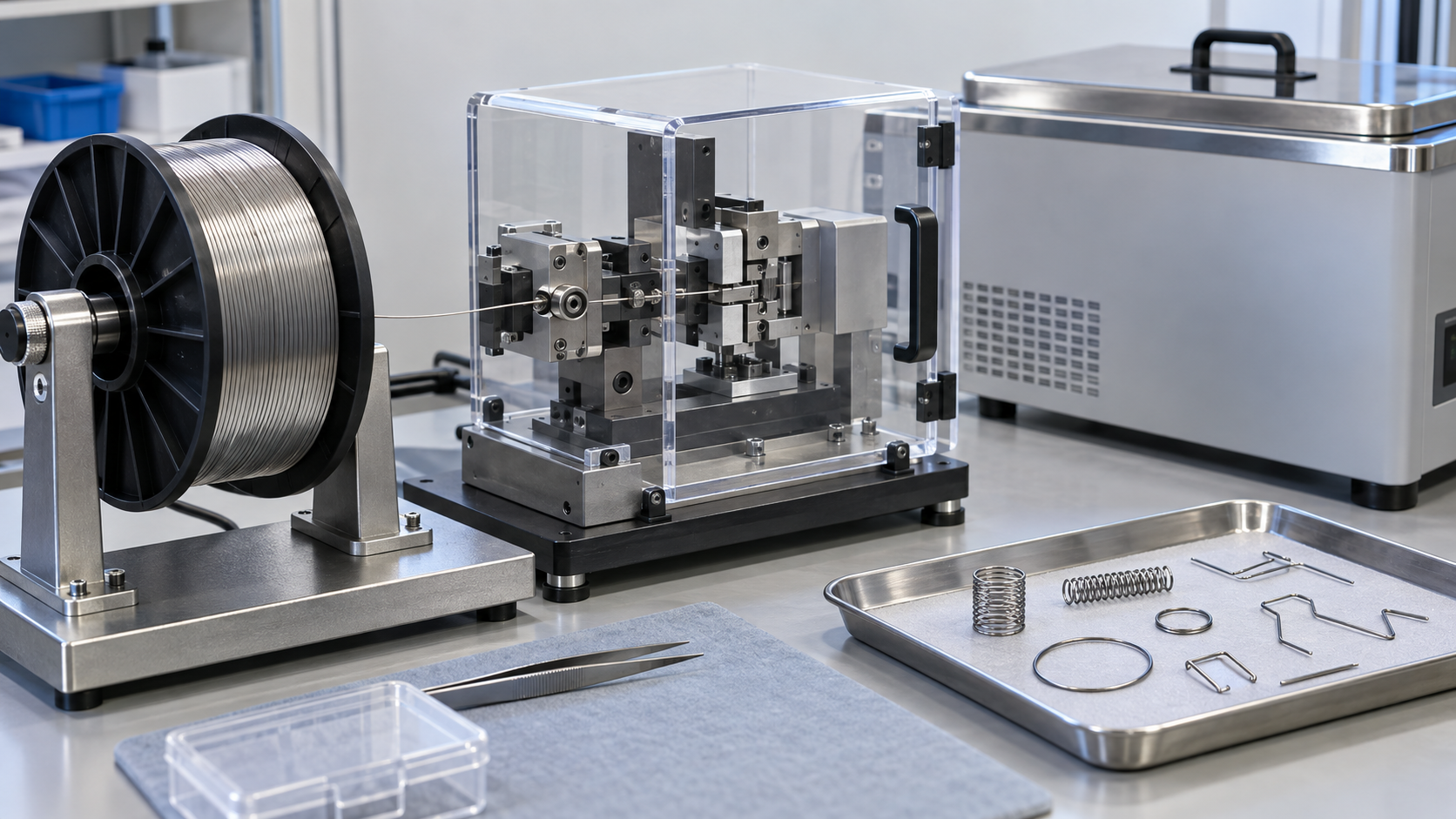
| Manufacturing and quality system | Melting and casting in a high-frequency vacuum induction furnace (in vacuum because the alloy oxidizes easily), hot rolling, cold drawing and annealing. Inspection uses DSC (differential scanning calorimetry) and BFR (Bending Free Recovery) measurement of the product’s transformation temperature, among others. Spring forming and centerless grinding are outsourced |
According to the company’s technical note, shifting the Ni to Ti ratio slightly around an atomic ratio of 50:50 moves the transformation temperature anywhere from 0 to 100°C Sourced. A material whose Af temperature (where reverse transformation to the parent phase finishes) is at or below room temperature is called a superelastic alloy; its recovery strain is at most 7 to 8%, and the company states that this alloy system is clearly better than other practical shape memory alloys in shape recovery and cycling (the company’s view). Adding Cu, Co, Cr or Fe to tune properties is also mentioned. In other words, a small change in composition becomes a change in transformation temperature, and so in the usable temperature range.
For devices left in the body, repeated deformation from pulsation makes fatigue behavior important. In joint research with universities, the company says it identified nonmetallic inclusion phases that tend to start fractures and showed that removing them improves fatigue behavior. The effect of the carbon-to-oxygen (C/O) ratio on the phase change and stability of inclusions was also published in a peer-reviewed paper (Shape Memory and Superelasticity, 2020). One reason for melting its own alloy, the company writes, is that it can control alloy quality, including these inclusions. This is a report by the company and its co-researchers and is not a comparison with other makers’ products.
11. Risks
| Risk | Detail | Status |
|---|---|---|
| Hard to verify from outside | Sales, profit, capacity and customers are not published, so there is no way for outsiders to check the size or direction of the business | Sourced |
| Business concentrated on special metals | After the fire prevention transfer it is a single business. The company itself writes that it “becomes a pure special-metals business,” so the business now depends on nickel-titanium demand | Sourced; the size of the effect is an inference |
| Concentration of sites | The company says it does integrated production from melting to final size at Hiratsuka. We found nothing indicating that production is spread across sites | Inference |
| Possible dependence on the parent for sales | The securities report describes the parent selling its products. The share of sales is unknown | Inference |
| New uses not yet commercialized | For Cu-Al-Mn building members, no product after the JST demonstration project (ended March 2026) could be confirmed | Sourced (not confirmed) |
| Quality demands of medical uses | The company writes that devices left in the body require long-term durability, so maintaining quality is a precondition of the business. This profile says nothing about the safety of any individual medical device | Sourced |
12. Glossary
- Nickel-titanium (Ni-Ti, Nitinol)
- An alloy of nickel and titanium in roughly equal proportions. The best-known alloy showing shape memory and superelasticity.
- Shape memory effect
- The ability to return to the original shape on heating above a certain temperature after being deformed at low temperature.
- Superelasticity
- The ability to return to the original shape when the load is removed after large deformation. It appears above the Af temperature (where reverse transformation to the parent phase ends).
- Martensitic transformation
- A phase change in which atoms shift collectively without diffusing, changing the crystal structure. It underlies shape memory and superelasticity.
- Cu-Al-Mn alloy
- An alloy of copper, aluminum and manganese. A shape memory alloy developed at Tohoku University (Camaroy), said to be easy to work with small temperature dependence.
- DSC
- Differential scanning calorimetry: a method of finding transformation temperatures from heat released or absorbed on heating and cooling.
- Nonmetallic inclusion
- A foreign particle, such as an oxide or carbide, contained in a metal. It can become the starting point of a fatigue fracture.
- A-STEP
- The JST (Japan Science and Technology Agency) program for optimizing and deploying research results, which helps companies turn university findings into businesses.
13. References
- Furukawa Techno Material Company profile (founding, capital, employees, headquarters, product areas; in Japanese). https://www.furukawa-ftm.com/company/
- Furukawa Techno Material Company history, 1958 to 2020 (plants and products; in Japanese). https://www.furukawa-ftm.com/company/history.html
- Furukawa Techno Material President’s message, including the “Furukawa Techno Material 2035 Vision” (in Japanese). https://www.furukawa-ftm.com/company/message.html
- Furukawa Techno Material Notice of the absorption-type split of the fire prevention business, dated 9 March 2026 (in Japanese). https://www.furukawa-ftm.com/%E9%98%B2%E7%81%BD%E4%BA%8B%E6%A5%AD%E5%90%B8%E5%8F%8E%E5%88%86%E5%89%B2%E3%81%AE%E3%81%8A%E7%9F%A5%E3%82%89%E3%81%9B/
- Furukawa Techno Material Website notice dated 1 April 2026 announcing completion of the fire prevention business transfer (in Japanese). https://www.furukawa-ftm.com/%E5%8F%A4%E6%B2%B3%E3%83%86%E3%82%AF%E3%83%8E%E3%83%9E%E3%83%86%E3%83%AA%E3%82%A2%E3%83%ABweb%E3%82%B5%E3%82%A4%E3%83%88%E9%81%8B%E7%94%A8%E3%81%AE%E3%81%8A%E7%9F%A5%E3%82%89%E3%81%9B/
- Furukawa Techno Material Special Metals Division overview: Ni-Ti, Cu-Ni, Ni-Cr and Ni alloys; integrated production from melting to final size at Hiratsuka (in Japanese). https://www.furukawa-ftm.com/tokusyu/business/%E4%BA%8B%E6%A5%AD%E9%83%A8%E7%B4%B9%E4%BB%8B/
- Furukawa Techno Material Technical note “What is a shape memory alloy?” (superelasticity, recovery strain, transformation temperature, DSC method; in Japanese). https://www.furukawa-ftm.com/tokusyu/technical/technical/
- Furukawa Techno Material Manufacturing process: vacuum melting, hot rolling, cold drawing, annealing, inspection (in Japanese). https://www.furukawa-ftm.com/tokusyu/production/%E8%A3%BD%E9%80%A0%E6%96%B9%E6%B3%95-2/
- Furukawa Techno Material Product page, guidewires (NT-N, NT-E4, NT-K, FHP-NT, small-diameter tube; in Japanese). https://www.furukawa-ftm.com/tokusyu/product/%E3%82%AC%E3%82%A4%E3%83%89%E3%83%AF%E3%82%A4%E3%83%A4/
- Furukawa Techno Material Product page, stents (Ni-Ti tube and wire, F-ELI, Pt-cored, Co-Cr tube; in Japanese). https://www.furukawa-ftm.com/tokusyu/product/stent/
- Furukawa Techno Material R&D page, industry-academia-government collaborative research (JST A-STEP, KISTEC; in Japanese). https://www.furukawa-ftm.com/tokusyu/research/f/
- Furukawa Techno Material R&D examples: inclusion control, long single crystals and joining of Cu-Al-Mn superelastic alloy (in Japanese). https://www.furukawa-ftm.com/tokusyu/research/g/
- Furukawa Techno Material Press release, “Observation of atomic arrangement and atomic motion in a next-generation shape memory alloy,” 25 April 2025 (in Japanese). https://www.furukawa-ftm.com/tokusyu/2025/04/25/%e6%ac%a1%e4%b8%96%e4%bb%a3%e5%bd%a2%e7%8a%b6%e8%a8%98%e6%86%b6%e5%90%88%e9%87%91%e3%81%ae%e5%8e%9f%e5%ad%90%e9%85%8d%e5%88%97%e3%81%a8%e5%8e%9f%e5%ad%90%e3%81%ae%e5%8b%95%e3%81%8d%e3%81%ae%e8%a6%b3/
- Furukawa Techno Material Press release, “Phase transformation mechanism of a next-generation shape memory alloy elucidated,” 16 May 2025 (in Japanese). https://www.furukawa-ftm.com/tokusyu/2025/05/16/%e6%ac%a1%e4%b8%96%e4%bb%a3%e5%bd%a2%e7%8a%b6%e8%a8%98%e6%86%b6%e5%90%88%e9%87%91%e3%81%ae%e7%9b%b8%e5%a4%89%e6%85%8b%e6%a9%9f%e6%a7%8b%e3%82%92%e8%a7%a3%e6%98%8e-%e2%94%80%e3%80%80%e5%bd%a2%e7%8a%b6/
- Furukawa Techno Material Notice of the appointment of a technical advisor, 1 April 2025 (in Japanese). https://www.furukawa-ftm.com/%E6%8A%80%E8%A1%93%E9%A1%A7%E5%95%8F%E5%B0%B1%E4%BB%BB%E3%81%AE%E3%81%8A%E7%9F%A5%E3%82%89%E3%81%9B/
- Furukawa Techno Material Ni-Ti alloy site: product lines, trade-show schedule and technical documents (in Japanese). https://www.furukawa-ftm.com/tokusyu/
- Furukawa Electric Annual securities report for the 204th term (1 April 2025 to 31 March 2026), filed 24 June 2026 (EDINET document no. S100YCF0; in Japanese). Furukawa Techno Material as a consolidated subsidiary (100.0%) and the life-science policy. https://disclosure2dl.edinet-fsa.go.jp/searchdocument/pdf/S100YCF0.pdf
- Japan Science and Technology Agency (JST) Project outcome, “Correcting hallux valgus with a copper-based superelastic alloy” (A-STEP, 2011-2015; in Japanese). https://www.jst.go.jp/seika/bt2019-10.html
- Japan Science and Technology Agency (JST) Project outcome, “An iron-based superelastic alloy with no temperature dependence” (A-STEP, 2019-2020; in Japanese). https://www.jst.go.jp/seika/bt2022-07.html
- Kanagawa Institute of Industrial Science and Technology (KISTEC) Research result, “Development of a heat-treatment process toward practical use of the ultra-long-life shape memory alloy Ultra-Nitinol,” 10 December 2024 (in Japanese). https://www.kistec.jp/connect/tech_perform/tech_perform_11840/
- Furukawa Techno Material Official site top page (news column: awards from the Japan Institute of Metals and Materials in September 2021 and March 2025, change of officers in April 2026; in Japanese). https://www.furukawa-ftm.com/
14. Claim-to-source audit
| Claim in the text | Status | Source |
|---|---|---|
| Legal name, headquarters, founding, capital, 220 employees, product areas | Sourced | Reference 1 https://www.furukawa-ftm.com/company/ |
| Furukawa Electric holds 100.0% of the voting rights; the parent sells its products | Sourced | Reference 17 https://disclosure2dl.edinet-fsa.go.jp/searchdocument/pdf/S100YCF0.pdf |
| History (1958 founding, 1981 start of nickel-titanium, 1992 fire prevention transfer and rename, 1999 FHP-NT, 2011 start of copper-based alloy, NT plants in 2019 and 2020, ISO certifications) | Sourced | Reference 2 https://www.furukawa-ftm.com/company/history.html |
| 2035 Vision and the self-description as a specialist maker of medical and industrial alloys | Sourced (company goal is not yet confirmed) | Reference 3 https://www.furukawa-ftm.com/company/message.html |
| Absorption-type split of the fire prevention business (notice of 9 March 2026), completion of the transfer on 1 April 2026, and the pure special-metals business | Sourced | References 4, 5 https://www.furukawa-ftm.com/%E9%98%B2%E7%81%BD%E4%BA%8B%E6%A5%AD%E5%90%B8%E5%8F%8E%E5%88%86%E5%89%B2%E3%81%AE%E3%81%8A%E7%9F%A5%E3%82%89%E3%81%9B/ https://www.furukawa-ftm.com/%E5%8F%A4%E6%B2%B3%E3%83%86%E3%82%AF%E3%83%8E%E3%83%9E%E3%83%86%E3%83%AA%E3%82%A2%E3%83%ABweb%E3%82%B5%E3%82%A4%E3%83%88%E9%81%8B%E7%94%A8%E3%81%AE%E3%81%8A%E7%9F%A5%E3%82%89%E3%81%9B/ |
| Special Metals Division products (Ni-Ti, Cu-Ni, Ni-Cr, Ni alloys) and integrated production at Hiratsuka | Sourced | Reference 6 https://www.furukawa-ftm.com/tokusyu/business/%E4%BA%8B%E6%A5%AD%E9%83%A8%E7%B4%B9%E4%BB%8B/ |
| Ni-Ti superelasticity, recovery strain of up to 7 to 8%, transformation temperature of 0 to 100°C, additive elements, DSC method | Sourced (manufacturer’s stated values) | Reference 7 https://www.furukawa-ftm.com/tokusyu/technical/technical/ |
| Manufacturing process (vacuum melting, hot rolling, cold drawing and annealing, inspection, outsourced processing) | Sourced | Reference 8 https://www.furukawa-ftm.com/tokusyu/production/%E8%A3%BD%E9%80%A0%E6%96%B9%E6%B3%95-2/ |
| Guidewire wire grades, diameters, more than 30 million meters a year (2019 actual) | Sourced (manufacturer’s stated values) | Reference 9 https://www.furukawa-ftm.com/tokusyu/product/%E3%82%AC%E3%82%A4%E3%83%89%E3%83%AF%E3%82%A4%E3%83%A4/ |
| Stent tube and fine wire, F-ELI, Pt-cored, Co-Cr tube, statements of standards conformity | Sourced (manufacturer’s stated values) | Reference 10 https://www.furukawa-ftm.com/tokusyu/product/stent/ |
| Participation in JST A-STEP and KISTEC (periods, titles, participating bodies) | Sourced | References 11, 18, 19, 20 https://www.furukawa-ftm.com/tokusyu/research/f/ https://www.jst.go.jp/seika/bt2019-10.html https://www.jst.go.jp/seika/bt2022-07.html https://www.kistec.jp/connect/tech_perform/tech_perform_11840/ |
| Research on inclusions and fatigue; long single crystals and roll-threaded joining of Cu-Al-Mn | Sourced (company report) | Reference 12 https://www.furukawa-ftm.com/tokusyu/research/g/ |
| Joint research announcements in 2025 on atomic arrangement and phase transformation of Cu-Al-Mn | Sourced | References 13, 14 https://www.furukawa-ftm.com/tokusyu/2025/04/25/%e6%ac%a1%e4%b8%96%e4%bb%a3%e5%bd%a2%e7%8a%b6%e8%a8%98%e6%86%b6%e5%90%88%e9%87%91%e3%81%ae%e5%8e%9f%e5%ad%90%e9%85%8d%e5%88%97%e3%81%a8%e5%8e%9f%e5%ad%90%e3%81%ae%e5%8b%95%e3%81%8d%e3%81%ae%e8%a6%b3/ https://www.furukawa-ftm.com/tokusyu/2025/05/16/%e6%ac%a1%e4%b8%96%e4%bb%a3%e5%bd%a2%e7%8a%b6%e8%a8%98%e6%86%b6%e5%90%88%e9%87%91%e3%81%ae%e7%9b%b8%e5%a4%89%e6%85%8b%e6%a9%9f%e6%a7%8b%e3%82%92%e8%a7%a3%e6%98%8e-%e2%94%80%e3%80%80%e5%bd%a2%e7%8a%b6/ |
| Appointment of the technical advisor (1 April 2025) | Sourced | Reference 15 https://www.furukawa-ftm.com/%E6%8A%80%E8%A1%93%E9%A1%A7%E5%95%8F%E5%B0%B1%E4%BB%BB%E3%81%AE%E3%81%8A%E7%9F%A5%E3%82%89%E3%81%9B/ |
| Trade-show schedule and product lines (stents, guidewires, dental and others) | Sourced (schedule is not yet confirmed) | Reference 16 https://www.furukawa-ftm.com/tokusyu/ |
| Parent’s life-science policy (co-creation with medical-device makers) | Sourced (policy is not yet confirmed) | Reference 17 https://disclosure2dl.edinet-fsa.go.jp/searchdocument/pdf/S100YCF0.pdf |
| Start of sales of the ingrown-nail correction device in 2011; research on iron-based superelastic alloy | Sourced | References 18, 19 https://www.jst.go.jp/seika/bt2019-10.html https://www.jst.go.jp/seika/bt2022-07.html |
| KISTEC’s wording “top domestic share of the shape memory alloy business” | Sourced (KISTEC’s wording; no basis is shown) | Reference 20 https://www.kistec.jp/connect/tech_perform/tech_perform_11840/ |
| Awards from the Japan Institute of Metals and Materials (September 2021, March 2025) | Sourced (company notices) | Reference 21 https://www.furukawa-ftm.com/ |
| Classification of Furukawa Techno Material as a materials and raw-material maker | Our calculation | Our own classification in this article |
| Sales, profit, market share, capacity, capital expenditure and customer names | Not yet confirmed | Not disclosed or not stated; we do not estimate them. Reference 1 https://www.furukawa-ftm.com/company/ |
| Investments in or acquisitions of other companies | Not yet confirmed | Not confirmed; we do not assert that none exist. Reference 17 https://disclosure2dl.edinet-fsa.go.jp/searchdocument/pdf/S100YCF0.pdf |
| 2035 Vision, trade-show schedule, commercialization of Cu-Al-Mn | Not yet confirmed | Company goals and schedules, not achieved results. References 3, 16 https://www.furukawa-ftm.com/company/message.html https://www.furukawa-ftm.com/tokusyu/ |
| That the business is narrowing to nickel-titanium material for medical use | Inference | Our own reading of the fire prevention transfer and the company’s self-description |
| That Cu-Al-Mn is a candidate for the next pillar | Inference | Our own reading of the R&D examples page |
| Concentration of sites, dependence on the parent for sales, and the effect of becoming a single business | Inference | Our own reading of integrated production at Hiratsuka, the parent’s sales role and the move to a single business |
Last updated: 10 October 2026 / Troy Technical
This article rests on the company’s official site, Furukawa Electric’s securities report, and public materials from JST and KISTEC. The company is unlisted and publishes no sales, profit or other financial information. We use no market-research estimates or press-report figures. Product performance values and production figures are the company’s stated values, and no comparison with other makers’ products is made. This article is not advice about medical devices or treatment. Passages marked “Inference” are our own reading of the primary sources and are not statements by the company.