COMPANY PROFILE / FUNCTIONAL MATERIALS
Lumotive
A privately held company in Washington State whose chip steers a beam of light electrically, with no moving parts; it is moving from LiDAR (laser distance sensing) toward optical circuit switches for AI data centers
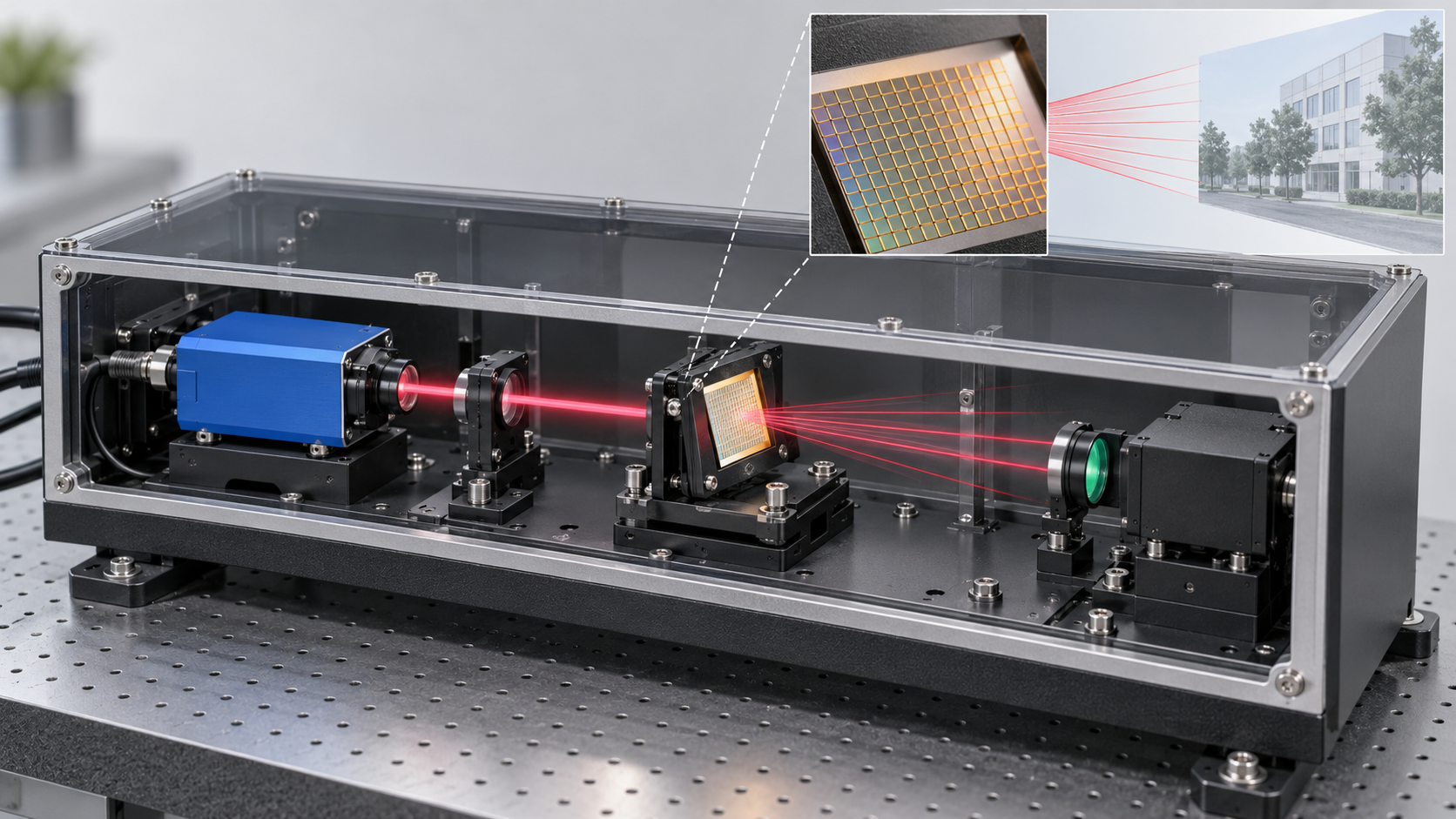
Lumotive makes a chip it calls the Light Control Metasurface (LCM), which changes the direction of laser light electrically, without mechanical parts. Instead of rotating a mirror, it bends light with a surface of structures smaller than the wavelength of light. It is headquartered in Redmond, Washington, and is privately held. Its sales and profit could not be confirmed from official materials.
Its main chip, the LM10, was announced by Lumotive and SkyWater, a U.S. semiconductor manufacturer, as qualified for volume production in SkyWater’s process in May 2024. Customer products built on the LM10 that have been announced include Hokuyo’s 3D LiDAR YLM-10LX (announced as commercially released in May 2024). In 2025 the company raised a Series B (US$45 million announced, later described as “US$59 million”), and in March 2026 it announced a demonstration of a two-dimensional beam-steering chip aimed at data centers. That 2D chip is at the demonstration stage, and no shipments of data-center products could be confirmed.
This article draws on the company’s website and press releases and on official materials from counterparties (SkyWater, Hokuyo), and sets out what could be confirmed and what could not. All performance figures are manufacturer’s stated values, and many come without stated conditions.
- At a glance: Lumotive and its place in functional materials
- Logo and naming
- Where the company sits in functional materials
- Company scale
- Resources committed to functional materials
- Track record
- Plans
- What the company is aiming for in functional materials
- Partnership map for functional materials
- Technologies, products and services
- Risks
- Glossary
- References
- Claim-to-source audit
1. At a glance: Lumotive and its place in functional materials
Washington, U.S.The dateline of its July and December 2025 releases. Releases of 2023-2024 also carry a Seattle dateline. A street address could not be confirmed
Components & devices (secondary)Supplies beam-steering chips, modules and reference designs; manufacturing is done by outside semiconductor fabs
(LCM)A metasurface on a CMOS chip steers light. The LM10 works at 905 and 940 nm. Counterparty and company pages describe liquid crystal as part of the tuning
(May 2024)In December 2025 the company said it had broadened to “leading CMOS and advanced packaging partners” (not named)
Lumotive’s position is that of a company making a metasurface into a “moving optical part” and building and selling it in semiconductor fabs. The facts confirmed by counterparties’ official materials are the LM10’s qualification for volume production (SkyWater, May 2024), Hokuyo’s product page (Hokuyo itself writes “solid-state 3D LiDAR developed with Lumotive”), and product announcements by NAMUGA and others Sourced.
However, shipment volume, sales and adoption by customer could not be confirmed. The optical circuit switch for data centers is at the stage of an announced 2D-chip demonstration (March 2026), and figures such as “10,000 x 10,000 ports” are the company’s design targets. Many performance figures are manufacturer’s stated values with no stated conditions Not yet confirmed.
2. Logo and naming

The logo is the image at the top of the company’s official website (lumotive.com): a grid of nine dots beside the word “LUMOTIVE”. It is taken as it is; it has not been recreated with generated images.
Naming: the company is Lumotive (only the first letter in capitals). LCM (Light Control Metasurface) is the name of its chip, and LM10, M30, NM120, MD41 and MD42 are product and development-kit model names. “Beam steering” (or beamforming) means changing the direction or shape of a beam of light.
Official site: https://lumotive.com/3. Where the company sits in functional materials
Lumotive’s main type is startups & new approaches (commercializing a new principle: steering light electrically with a metasurface), and its secondary type is components & devices (supplying chips, development kits and reference designs). It is the business form of the principles in our explainer on metamaterials and metasurfaces, made “tunable”. What the official materials confirm about its businesses is below.
| Business / product | Role at Lumotive | Primary information found | Status |
|---|---|---|---|
| LM10 (one-dimensional beam-steering chip) | Core product. 11 x 9 mm active aperture; 905 and 940 nm. Qualified for volume production at SkyWater (May 2024); both companies say it ships inside customers’ sensors | Company website; joint announcement with SkyWater | Sourced (joint announcement) / shipment volume not confirmed |
| Development kits and reference designs (M30, NM120, MD41, MD42) | The company says they cut the time to build a sensor from 18 months to 3-6 months. They support both iToF and dToF | Company website; releases (September to December 2024) | Sourced (company statement) |
| Customer products (LiDAR) | Hokuyo YLM-10LX (announced May 2024); NAMUGA Stella and Stella-2 (announced December 2024 to May 2025); E-Photonics (plans manufacturing in Saudi Arabia) | Releases; Hokuyo’s product page | Sourced (company statement) / shipment volume not confirmed |
| Two-dimensional beam-steering chip | Demonstration announced in March 2026. Intended for optical circuit switches, optical communications and sensors | Release (March 2026) | Sourced (announcement of a demonstration) / commercialization Not yet confirmed |
| Optical circuit switch (OCS) | For AI data centers, the website presents configurations from 256 x 256 to 10,000 x 10,000 as design targets. It states 50 µs switching and 1-2 dB insertion loss (no basis for the measurements is given) | OCS page on the website | Not yet confirmed (design targets) |
| Defense and satellite communications | Listed as uses on the website (LiDAR, optical communications). No customers or adoptions could be found | Defense page on the website | List of uses / adoption not confirmed |
4. Company scale
Lumotive is privately held and publishes no financial statements. The scale that official materials allow us to confirm is shown below Sourced.
| Item | What was confirmed |
|---|---|
| Sales, profit, debt | Not disclosed. Not stated on the website or in press releases |
| Employees | Not disclosed. The company said it grew its workforce by 50% in 2025 (December 2025). Sites: Redmond (headquarters), a Center of Excellence in Muscat, Oman, and Taiwan |
| Founding | Could not be confirmed from official materials. Third-party sources disagree on the year (not used here) |
| Leadership | CEO: Sam Heidari (earlier roles include Quantenna Communications; company leadership page). Founder and CTO: Gleb Akselrod (Ph.D. from MIT; the company says he led commercialization of optical metamaterials at Intellectual Ventures and researched metasurfaces at Duke University). Product: Apurva Jain. Business development: Axel Fuchs. ASIC: Sajid Husain. Sales: Clement Kong. Tristan Joo as Executive Vice President of Global Business (December 2025) |
| Investors | February 2025 release: new investors Swisscom Ventures, East Bridge, EDOM, Grazia, Hokuyo and TSVC; existing investors Gates Frontier, MetaVC Partners, Quan Funds, USAA and HiMax. July 2025: Amazon Industrial Innovation Fund and ITHCA Group (described as Oman’s sovereign tech fund). The company’s descriptions also list Samsung Ventures as an investor |
| Patents | The company’s statements differ by document: “100+” on the technology page and in September 2024; “200+” in the July 2025 release; “160+” on the website’s company page and in the March 2026 release. The as-of dates and whether applications are counted are not stated |
| Funding (announced amounts) | February 2025: Series B of US$45 million. The December 2025 release describes “an oversubscribed US$59 million Series B round”. The July 2025 Amazon and ITHCA investments carry no amount, and financing from Stifel Bank is also mentioned. The US$14 million difference cannot be broken down from official materials |
The website’s home page carries a remark by the investor Bill Gates. This is a quotation the company uses about an investor, and this article does not use it as grounds for technology or business. The OCS page also cites a figure that “Google’s public deployment of optical circuit switching cut network power by 40% and cost by 30%”; this is a third party’s figure that Lumotive quotes without a source, so it is not used here. Expressions such as “world’s first” and “first commercial” are the company’s own, and independent verification was not checked here.
5. Resources committed to functional materials
Because the company is privately held, disclosure of amounts is limited. The four points of people, money, external moves, and universities and public funding are set out below, showing what could and could not be confirmed.
| Item | What was confirmed | Status |
|---|---|---|
| People (R&D base and staff) | Redmond is the center. A site in Muscat, Oman for customer engineering and program management, and a site in Taiwan for manufacturing, sales and technical support (December 2025). R&D headcount is not disclosed | Sourced / headcount not confirmed |
| Money (R&D spend, capital spending, funding) | Actual R&D spend and capital spending are not disclosed. Funding is the Series B (US$45 million in February 2025, described as US$59 million in December 2025). Because manufacturing is outsourced, capital spending on its own plants could not be confirmed | Sourced / actual spend not disclosed |
| External investments, acquisitions, joint ventures, divestments | No investment, acquisition, joint venture or divestment by Lumotive in another company could be confirmed. Hokuyo and EDOM (a Taiwanese electronics distributor) are investors and also customers or sales partners | Not confirmed (its own investments) |
| Universities, research institutes, public funding | University: the founder researched at Duke University (the company’s description of his background). The March 2026 release carries a comment from Prof. David R. Smith of Duke, but no joint research is stated. Public funding: no U.S. government grant could be confirmed from official materials. ITHCA (Oman’s state-linked fund) is an investor | Public funding not confirmed |
Status of main products and facilities
The table below covers what could be confirmed from official materials of the company and its counterparties. Production capacity and shipments are not disclosed in any case.
| Product / facility | Manufacturing and shipping route | Scale (stated) | Stage | Date and source |
|---|---|---|---|---|
| LM10 (LCM chip) | Qualified for volume production at SkyWater (a U.S. semiconductor manufacturer headquartered in Bloomington, Minnesota; the fab location is not stated). A “custom photonics process” was co-developed in under two years | Not disclosed (11 x 9 mm active aperture; 905 and 940 nm) | Qualified and shipping (inside customers’ sensors, per both companies) | Joint SkyWater-Lumotive announcement (1 May 2024) |
| Other CMOS and packaging manufacturing | “Leading CMOS and advanced packaging partners” (not named). In September 2024 the company said “full production at multiple silicon foundries” | Not disclosed | Statement only (names and capacity not confirmed) | Releases of September 2024 and December 2025 |
| Hokuyo YLM-10LX | Hokuyo builds it around the LM10. Hokuyo’s page says it is a solid-state 3D LiDAR developed with Lumotive | Not disclosed | Commercial release (announced by Lumotive on 22 May 2024) | Release; Hokuyo’s product page |
| NAMUGA Stella / Stella-2 | NAMUGA makes and sells them. Stella-2 was first shown in May 2025; Stella-180 (180 degrees) is a prototype, with samples for OEMs targeted for “later this year” (2026) | Not disclosed | Announced as launched (December 2024; commercial deployment said to be scheduled for Q2 2025) / Stella-180 Not yet confirmed | Releases (December 2024, May 2025, April 2026) |
| E-Photonics (Saudi Arabia) | Plans to make the L30 and L42 locally (announced at LEAP 2025) | Not disclosed | Plan. Not yet confirmed | Release (February 2025) |
| 2D beam-steering chip, OCS | Demonstrated (March 2026). No manufacturing details. The OCS page says “CMOS fabrication plus liquid-crystal-on-silicon assembly” | Design targets: 256 x 256 (4 x 3 x 2 cm3) to 10,000 x 10,000 (3RU chassis) | Demonstration. Product Not yet confirmed | Release (March 2026); OCS page |
6. Track record
| When | What happened | Meaning |
|---|---|---|
| November 2023 | Described the LM10 as “the world’s first commercially available digital beam steering solution for 3D sensing”. Added sales and distribution partners Macnica Cytech, Uniquest and Redtree Solutions for China, South Korea and Europe | Building a sales network for the chip |
| April and May 2024 | April: partnership with the Taiwanese distributor EDOM. 1 May: LM10 qualified for volume production at SkyWater. 22 May: Hokuyo announced its YLM-10LX | Securing manufacturing, and the first customer product |
| September to December 2024 | September: Open Development Platform (ODP). November: MD41 using Sony sensors. December: NAMUGA’s Stella; MD42 with a Lattice FPGA; a collaboration with MulticoreWare on AI | Moving to kit form that customers can use |
| January to May 2025 | January: integration with Sony SPAD sensors (IMX459, IMX560) announced at CES. February: E-Photonics (Saudi Arabia) and a Series B (US$45 million). May: NAMUGA’s Stella-2, and E-Photonics’ announcement in Spain | Wider funding and sales regions |
| July 2025 | 14 July: joint development with SolidVue (a Korean SPAD sensor company). 22 July: investments by Amazon Industrial Innovation Fund and ITHCA announced | Expanding industrial-robot customers and funding |
| December 2025 | 9 December: sites in Oman and Taiwan, Tristan Joo’s appointment, and a 50% larger workforce announced. The same month: the Global Semiconductor Alliance’s “Start Up to Watch” | Building out the organization |
| March and April 2026 | 19 March: demonstration of a 2D beam-steering chip announced. 9 April: a fully solid-state 180-degree LiDAR at 30 FPS announced, using the LM10 and Adaps Photonics’ dToF sensor | Extension toward data centers, and higher-performance LiDAR |
7. Plans
(targeted for 2026)A NAMUGA prototype, per the company. Based on the April 2026 release
(planned)Announced in February 2025. The start date and scale of manufacturing could not be confirmed
Distributors in Japan, Korea, China, TaiwanRestar (Japan), Uniquest (South Korea), EDOM (Taiwan), Macnica Cytech (China)
The website also lists defense and satellite communications as uses (LiDAR at 50 m to over 5,000 m; satellite-to-satellite and aircraft-to-satellite links). These are lists of uses, not confirmed adoptions or plans Not yet confirmed.
None of the following is stated in primary sources Not yet confirmed.
Sales, profit, headcount, R&D spend; the founding year; LM10 shipment counts and adoption by customer; sales of each customer product; names and capacity of manufacturers other than SkyWater; measured performance of the 2D chip (port count, loss, switching time) and when OCS might be commercialized; OCS customers or evaluators; the guaranteed operating temperature range and lifetime of the LM10; the test conditions for each stated figure; adoption in defense and satellite communications; the breakdown of the difference between US$45 million and “US$59 million” for the Series B.
8. What the company is aiming for in functional materials
This section includes points the company does not state directly. They are set out as inferences, within what the primary information allows, with their grounds.
| What can be read | Primary information behind it | Status |
|---|---|---|
| It is repositioning itself from LiDAR to a general-purpose part that “programs light electrically” | 2024 announcements centered on 3D sensing. In the February 2025 funding it named data centers and satellite communications as growth areas, and in March 2026 it referred to the possibility of “general-purpose flat optics” | Sourced (company statement) / the positioning is an Inference |
| It is increasing the combinations with sensor-component makers to make the LM10 a standard part | Announcements with Sony, Adaps, SolidVue, Lattice, ams OSRAM and Seoul Robotics. The ODP lets customers choose components | Sourced (company statement) / the intent is an Inference |
| It is seeking funding and customers in industrial robotics, Asia and the Middle East | Investments from Amazon’s industrial fund, ITHCA (Oman), and Hokuyo and EDOM (Asia); sites in Muscat and Taiwan; E-Photonics (Saudi Arabia) | Inference |
| It leaves manufacturing to outside semiconductor fabs and creates value through design and IP | The joint development with SkyWater; several CMOS and packaging companies; repeated emphasis on its patent count (though counts differ by document) | Inference |
The reading that the company is “repositioning from LiDAR to a general-purpose part that programs light electrically” rests on how the subject of its own description has changed. The 2023-2024 releases were about “solid-state beam steering that replaces the mirror in LiDAR”. By July 2025 the wording was “pioneering the era of programmable optics, where light is controlled as intelligently and flexibly as software”, and the home page also leads with “Programmable Optics”. The March 2026 announcement of the 2D chip says the same chip can perform functions of mirrors, lenses, beam splitters and the like.
That said, official materials do not allow us to say the LiDAR business has shrunk, since a 180-degree LiDAR announcement followed in April 2026. This is our reading of what the announcements say Not yet confirmed.
9. Partnership map for functional materials
The company’s relationships are characterized by the breadth of its combinations with sensor-component makers and by Hokuyo and EDOM being both investors and customer or sales partners. No joint venture or acquisition with an operating company could be confirmed. Customer product names have been announced, but shipment volumes and sales could not be confirmed Not yet confirmed.
10. Technologies, products and services
What follows is what official materials of the company and its counterparties state. All figures are manufacturer’s stated values; where the materials give no baseline or conditions, that is noted. They do not rank any product against others, and values under different conditions cannot be compared. For the principles, see our explainer on metamaterials and metasurfaces Sourced.
| Item | Manufacturer’s stated value or description | Basis and conditions (as given in the materials) |
|---|---|---|
| LM10 (chip) | 11 x 9 mm active aperture. 905 and 940 nm. 160 degrees native field of view, over 180 degrees with expansion optics. Works with both VCSELs and edge-emitting lasers. Compatible with iToF and dToF | The definition of “native” field of view, and output and loss, are not stated |
| Scanning speed | “Without mechanical inertia, LCMs can shape light in any pattern across the field of view in the order of microseconds” (technology page) | What is being switched in “microseconds”, and the measurement conditions, are not stated |
| M30 development kit | Maximum range 25 m (85% target, 10 klux ambient) and 10 m (10% target, 100 klux). Field of view 120 degrees (non-steering) x 90 degrees (steering). 10 Hz. 8 W. 55 x 35 x 25 mm. Operating temperature -20 to +70 C. Class 1 eye safety | Noted as software-configurable. The company’s “M30 Reference Design” page says “over 10 meters”, differing from the “25 m” on the development-kit page |
| NM120 development kit | dToF. 256 x 192 pixels (Adaps ADS6311). 30 Hz full frame, 900 Hz in regions of interest. Range class 72 m (32 m for a 10% target at 100 klux). Field of view 120 x 90 degrees. Under 17 W | Field of view and regions of interest are software-configurable |
| Hokuyo YLM-10LX (customer product) | Hokuyo’s own specification: detection range 0.3-10 m (10% reflectance) and 1-15 m (90%), field of view 110 degrees (H) x 80 degrees (V), 2-60 Hz, 25 W or less | Subject to the conditions and footnotes on Hokuyo’s page. These are Hokuyo’s stated values |
| NAMUGA Stella / Stella-2 (customer products) | Stella: 25 m, 10 Hz, 120 x 90 degrees. Stella-2: 80 m, 20 Hz. Said to shorten development from 18 months to 3-6 months | From the December 2024 announcement; no measurement conditions given |
| 180-degree dToF (LM10 + Adaps) | 180 degrees horizontal, up to 140 degrees vertical, 30 FPS, range up to 50 m, up to 900 Hz in regions of interest | April 2026 announcement. At the reference-design stage; no measurement conditions given |
| OCS (design targets) | 50 µs switching, 1-2 dB insertion loss (said to be independent of port count), 256 x 256 in 4 x 3 x 2 cm3, 10,000 x 10,000 in a 3RU chassis | The 2D chip was demonstrated in March 2026. Measured OCS values could not be confirmed |
(1) What it is made of: a metasurface on a CMOS chip, plus liquid crystal. The company’s technology page says “a CMOS chip with no mechanical components” and “structures smaller than the wavelength of light”, and the OCS page says “CMOS fabrication plus liquid-crystal-on-silicon assembly”. Hokuyo’s page, a counterparty’s, says “liquid crystal deflection (LCM)”. This reads as a structure in which the state of the metasurface resonance is switched by changing the state of a liquid crystal electrically (commentary; the nanostructure material and the type and thickness of the liquid crystal are not published).
(2) Polarization handling appears to be a premise of the design. The development-kit page says the transmit module includes “a VCSEL, collimating optics and polarization optics“. Devices that use liquid crystals commonly act on light of one polarization (commentary), so one can infer that a part to align the laser’s polarization is needed. The company’s materials do not explain this directly.
(3) Speed and temperature are a liquid-crystal trade-off. The response of liquid crystals is generally said to be on the order of milliseconds (commentary), yet the company writes “microseconds” and “50 µs” without giving conditions. Liquid crystals also change in viscosity and alignment with temperature, so operating temperature is a design issue. The technology page says the chip is “suitable for automotive temperature ranges”, but the M30 development kit’s operating temperature is -20 to +70 C, and the LM10’s guaranteed temperature range alone cannot be confirmed from official materials.
(4) Reading the numbers. Range (25 m, 80 m, 50 m) varies with target reflectance, ambient light, laser power and receiving sensor, and the company itself writes that system performance depends on laser power, optics field of view and sensor choice. The figures in the table are not on the same conditions as each other. This article does not judge superiority over other approaches.
11. Risks
| Risk | Detail | Status |
|---|---|---|
| Opaque finances | Sales, profit and cash are not in official materials. The funding figure is written both “US$45 million” and “US$59 million”, with no breakdown. This article cannot assess financial health | Not confirmed |
| Opaque shipments and sales | LM10 shipments and adoption by customer are not disclosed. Because Hokuyo and EDOM are investors as well as customers or sales partners, the independence of demand cannot be judged from official materials | Not confirmed / Inference |
| Manufacturing dependence | SkyWater is the only manufacturer for which qualification has been announced. Names and capacity of other partners are not stated. Where and at what scale the liquid-crystal-based assembly is done could not be confirmed either | Not confirmed |
| New field (OCS) at the demonstration stage | The 2D chip is at the stage of a March 2026 announced demonstration; measured port count, loss and switching time could not be confirmed. “10,000 x 10,000” is a design target. No data-center customer or evaluator is named | Not yet confirmed |
| Inconsistent claims and figures | The patent count appears as “100+”, “160+” and “200+” in different documents. The M30 range is written “over 10 m” in one document and “over 25 m” in another. The conditions of counterparties’ stated values and of the company’s figures are not the same | Sourced (inconsistency between documents) |
| Competing technologies and alternatives | Mechanical scanning, MEMS, optical phased arrays and other approaches coexist. The advantage of metasurface plus liquid crystal is the company’s claim and this article does not compare. Market-size estimates are also not used | Not confirmed |
| Regional and policy dependence | Expansion into Oman, Saudi Arabia and Taiwan has been announced. Its relationship to specific regulations, subsidies or export controls is not stated in official materials and was not checked here | Not confirmed |
12. Glossary
- LCM (Light Control Metasurface)
- Lumotive’s chip. A metasurface changes the direction and shape of light electrically.
- Beam steering (beamforming)
- Changing the direction, shape or position of a beam of light or laser. In LiDAR it scans across the field of view.
- LiDAR
- A sensor that measures distance with laser light and builds a cloud of 3D points of the surroundings.
- iToF / dToF
- Indirect time of flight, which infers the return time from a phase shift, and direct time of flight, which counts the time directly.
- VCSEL
- Vertical-cavity surface-emitting laser. Small, and used as a light source in LiDAR and face authentication.
- LCOS
- Liquid crystal on silicon: a liquid-crystal layer on a silicon substrate, in which the phase or polarization of light is changed electrically pixel by pixel.
- Optical circuit switch (OCS)
- A switch that connects input and output ports while keeping the signal as light, without converting it to electricity.
- MEMS
- Tiny mechanical parts (here, tilting mirrors) made with semiconductor technology.
- Manufacturer’s stated value
- A description or performance figure given by the manufacturer itself. It cannot be compared with other products unless the test conditions and version are the same.
13. References
- Lumotive Official website (home page; source of the logo image). https://lumotive.com/
- Lumotive Official website, “About”. Company description, leadership, patent count, awards. https://lumotive.com/about/
- Lumotive Official website, “Technology”. LCM features (field of view, wavelengths, patent count). https://lumotive.com/technology/
- Lumotive Official website, “LM10”. Main specifications. https://lumotive.com/products/lm10/
- Lumotive Official website, “M30 Development Kit”. Specification table (manufacturer’s stated values). https://lumotive.com/products/m30-dev/
- Lumotive Official website, “NM120 Development Kit”. Specifications (manufacturer’s stated values). https://lumotive.com/products/nm120-development-kit/
- Lumotive Official website, “LCM Development & Evaluation Kit”. Kit contents (the transmit module includes polarization optics). https://lumotive.com/products/lek/
- Lumotive Official website, “M30 Reference Design”. https://lumotive.com/products/m30-ref/
- Lumotive Official website, “Optical Circuit Switching & Communications”. OCS design targets and the liquid-crystal LCOS statement. https://lumotive.com/optical-circuit-switching-communications/
- Lumotive Official website, “Defense”. Uses in defense and optical communications. https://lumotive.com/defense/
- SkyWater Technology and Lumotive SkyWater and Lumotive Announce Qualification and Production Start for World’s First Commercially Available Optical Beamforming Chip (joint announcement, 1 May 2024). https://lumotive.com/press-releases/skywater-and-lumotive-announce-qualification-and-production-start-for-worlds-first-commercially-available-optical-beamforming-chip/
- Lumotive and Hokuyo Lumotive and Hokuyo Announce Commercial Release of World’s First 3D Lidar Sensor With True Solid-State Beam Steering (22 May 2024). https://lumotive.com/press-releases/lumotive-and-hokuyo-announce-commercial-release-of-worlds-first-3d-lidar-sensor-with-true-solid-state-beam-steering/
- Hokuyo Automatic Co., Ltd. YLM-10LX (3D LiDAR product page; specifications and the liquid-crystal deflection statement). https://www.hokuyo-aut.jp/search/single.php?serial=250
- Lumotive Lumotive Extends Global Reach, Announces New Sales and Distribution Partners Worldwide (30 November 2023). https://lumotive.com/press-releases/lumotive-extends-global-reach-announces-new-sales-and-distribution-partners-worldwide/
- Lumotive Lumotive Partners with Leading Electronics Distributor EDOM to Accelerate Solid-State Lidar Adoption in Taiwan (16 April 2024). https://lumotive.com/press-releases/lumotive-partners-with-leading-electronics-distributor-edom-to-accelerate-solid-state-lidar-adoption-in-taiwan/
- Lumotive Lumotive Unveils Groundbreaking Open Development Platform (ODP) (12 September 2024). https://lumotive.com/press-releases/lumotive-unveils-groundbreaking-open-development-platform-odp-moves-to-democratize-the-future-of-3d-sensing/
- Lumotive Lumotive Unveils MD41 Development Kit (20 November 2024; integrates Sony sensors). https://lumotive.com/press-releases/lumotive-unveils-md41-development-kit-elevating-3d-sensing-with-enhanced-flexibility-and-efficiency/
- Lumotive and Lattice Semiconductor Lumotive and Lattice Semiconductor to Demo Chip-Based Beam Steering for 3D Sensing at DevCon 2024 (5 December 2024). https://lumotive.com/press-releases/lumotive-and-lattice-semiconductor-to-demo-chip-based-beam-steering-for-3d-sensing-at-devcon-2024/
- MulticoreWare and Lumotive MulticoreWare and Lumotive Announce Collaboration Designed to Advance 3D Sensing and LiDAR Technology (17 December 2024). https://lumotive.com/press-releases/multicoreware-and-lumotive-announce-collaboration-designed-to-advance-3d-sensing-and-lidar-technology/
- Lumotive and NAMUGA NAMUGA Launches Next-Generation 3D Sensing Solutions, Powered by Lumotive (18 December 2024). https://lumotive.com/press-releases/namuga-launches-next-generation-3d-sensing-solutions-powered-by-lumotive/
- Lumotive E-Photonics Launches Lidar-based 3D Sensing Solutions Powered by Lumotive (11 February 2025). https://lumotive.com/press-releases/e-photonics-launches-lidar-based-3d-sensing-solutions-powered-by-lumotive/
- Lumotive Lumotive Raises $45 Million to Expand Sales of Programmable Optical Semiconductors (19 February 2025). https://lumotive.com/press-releases/lumotive-raises-45-million-to-expand-sales-of-programmable-optical-semiconductors/
- Lumotive and NAMUGA NAMUGA Unveils Stella-2: Compact, Solid-State Lidar Powered by Lumotive, at Embedded Vision Summit (21 May 2025). https://lumotive.com/press-releases/namuga-unveils-stella-2-compact-solid-state-lidar-powered-by-lumotive-at-embedded-vision-summit/
- SolidVue and Lumotive SolidVue and Lumotive Collaborate to Advance Next-Generation Lidar Systems (14 July 2025). https://lumotive.com/press-releases/solidvue-and-lumotive-collaborate-to-advance-next-generation-lidar-systems/
- Lumotive Amazon and ITHCA Invest in Lumotive (22 July 2025). https://lumotive.com/press-releases/amazon-and-ithca-invest-in-lumotive/
- Lumotive Lumotive Expands Global Footprint and Adds Key Leaders Amid Growing Demand for Programmable Optical Semiconductors (9 December 2025). https://lumotive.com/press-releases/lumotive-expands-global-footprint-and-adds-key-leaders-amid-growing-demand-for-programmable-optical-semiconductors/
- Lumotive Lumotive Creates World’s First 2D Photonic Beamforming Semiconductor (19 March 2026). https://lumotive.com/press-releases/lumotive-creates-worlds-first-2d-photonic-beamforming-semiconductor/
- Lumotive Lumotive’s LCM Optical Semiconductor Platform Enables First Solid-State 180° dTOF LiDAR at 30 FPS (9 April 2026). https://lumotive.com/press-releases/lumotives-lcm-optical-semiconductor-platform-enables-first-solid-state-180-dtof-lidar-at-30-fps/
- Lumotive Lumotive Introduces Transformative Advanced 3D Sensing Utilizing Sony’s Sensors at CES 2025 (7 January 2025). https://lumotive.com/press-releases/lumotive-introduces-transformative-advanced-3d-sensing-utilizing-sonys-sensors-at-ces-2025/
14. Claim-to-source audit
| Claim in the text | Category | Source |
|---|---|---|
| The company name as written, the logo image, the Bill Gates remark on the home page, the home-page description (Programmable Optics) | Sourced (company statement) | Reference 1 https://lumotive.com/ |
| Company description, 160+ patents, leadership and biographies (CEO, CTO, product, business development, ASIC, sales) | Sourced (company statement) | Reference 2 https://lumotive.com/about/ |
| LCM features (160 and 180 degree fields of view, microsecond scanning, 905, 1310 and 1550 nm, CMOS, 100+ patents) | Sourced (manufacturer’s stated value) | Reference 3 https://lumotive.com/technology/ |
| LM10 specifications (11 x 9 mm, 160 degrees, 905 and 940 nm, iToF and dToF support) | Sourced (manufacturer’s stated value) | Reference 4 https://lumotive.com/products/lm10/ |
| M30 development kit specifications (range, field of view, power, size, operating temperature) | Sourced (manufacturer’s stated value) | Reference 5 https://lumotive.com/products/m30-dev/ |
| NM120 development kit specifications (256 x 192, 30 Hz, 900 Hz, 72 m, under 17 W) | Sourced (manufacturer’s stated value) | Reference 6 https://lumotive.com/products/nm120-development-kit/ |
| Development-kit contents (VCSEL, collimating optics, polarization optics) | Sourced (company statement) | Reference 7 https://lumotive.com/products/lek/ |
| The range wording on the M30 reference-design page (“over 10 meters”) | Sourced (company statement) | Reference 8 https://lumotive.com/products/m30-ref/ |
| OCS design targets (256 x 256, 10,000 x 10,000, 50 µs, 1-2 dB), the CMOS and liquid-crystal LCOS statement, the Google example quoted | Sourced (company statement) / design targets Not yet confirmed | Reference 9 https://lumotive.com/optical-circuit-switching-communications/ |
| Uses in defense and optical communications (range 50 m to over 5,000 m and others) | Sourced (list of uses) | Reference 10 https://lumotive.com/defense/ |
| Qualification of the LM10 for volume production at SkyWater, co-development of a custom process, shipping inside customers’ sensors | Sourced (joint announcement) | Reference 11 https://lumotive.com/press-releases/skywater-and-lumotive-announce-qualification-and-production-start-for-worlds-first-commercially-available-optical-beamforming-chip/ |
| Announcement of Hokuyo’s YLM-10LX commercial release (22 May 2024) | Sourced (joint announcement) | Reference 12 https://lumotive.com/press-releases/lumotive-and-hokuyo-announce-commercial-release-of-worlds-first-3d-lidar-sensor-with-true-solid-state-beam-steering/ |
| YLM-10LX specifications (0.3-10 m, 110 x 80 degrees, 25 W or less); statements of “developed with Lumotive” and “liquid crystal deflection” | Sourced (counterparty’s stated value) | Reference 13 https://www.hokuyo-aut.jp/search/single.php?serial=250 |
| Distribution partners (Macnica Cytech, Uniquest, Redtree Solutions) and the LM10 positioning | Sourced (company statement) | Reference 14 https://lumotive.com/press-releases/lumotive-extends-global-reach-announces-new-sales-and-distribution-partners-worldwide/ |
| Partnership with EDOM (Taiwan) | Sourced (company statement) | Reference 15 https://lumotive.com/press-releases/lumotive-partners-with-leading-electronics-distributor-edom-to-accelerate-solid-state-lidar-adoption-in-taiwan/ |
| ODP (development time from 18 months to 3-6 months, full production at multiple silicon foundries, 100+ patents) | Sourced (company statement) | Reference 16 https://lumotive.com/press-releases/lumotive-unveils-groundbreaking-open-development-platform-odp-moves-to-democratize-the-future-of-3d-sensing/ |
| MD41 (integration of Sony sensors) and the comparison with the MD42 | Sourced (company statement) | Reference 17 https://lumotive.com/press-releases/lumotive-unveils-md41-development-kit-elevating-3d-sensing-with-enhanced-flexibility-and-efficiency/ |
| MD42 with a Lattice FPGA | Sourced (company statement) | Reference 18 https://lumotive.com/press-releases/lumotive-and-lattice-semiconductor-to-demo-chip-based-beam-steering-for-3d-sensing-at-devcon-2024/ |
| AI collaboration with MulticoreWare | Sourced (company statement) | Reference 19 https://lumotive.com/press-releases/multicoreware-and-lumotive-announce-collaboration-designed-to-advance-3d-sensing-and-lidar-technology/ |
| NAMUGA Stella and Stella-2 specifications (25 m and 10 Hz; 80 m and 20 Hz), shorter development time, commercial deployment scheduled for Q2 2025 | Sourced (company statement) / plans Not yet confirmed | Reference 20 https://lumotive.com/press-releases/namuga-launches-next-generation-3d-sensing-solutions-powered-by-lumotive/ |
| E-Photonics’ plan for manufacturing in Saudi Arabia (L30, L42) | Sourced (company statement) / plans Not yet confirmed | Reference 21 https://lumotive.com/press-releases/e-photonics-launches-lidar-based-3d-sensing-solutions-powered-by-lumotive/ |
| US$45 million Series B (February 2025) and its investors; growth areas (data centers, aerospace and defense) | Sourced (company statement) | Reference 22 https://lumotive.com/press-releases/lumotive-raises-45-million-to-expand-sales-of-programmable-optical-semiconductors/ |
| First showing of NAMUGA’s Stella-2 (May 2025), under 15 W | Sourced (company statement) | Reference 23 https://lumotive.com/press-releases/namuga-unveils-stella-2-compact-solid-state-lidar-powered-by-lumotive-at-embedded-vision-summit/ |
| Joint development with SolidVue (reference design) | Sourced (company statement) | Reference 24 https://lumotive.com/press-releases/solidvue-and-lumotive-collaborate-to-advance-next-generation-lidar-systems/ |
| Investments by Amazon and ITHCA (July 2025), financing from Stifel Bank, 200+ patents | Sourced (company statement) | Reference 25 https://lumotive.com/press-releases/amazon-and-ithca-invest-in-lumotive/ |
| Sites in Oman and Taiwan, a 50% larger workforce, “US$59 million Series B”, Tristan Joo’s appointment, distribution partners and the ecosystem | Sourced (company statement) | Reference 26 https://lumotive.com/press-releases/lumotive-expands-global-footprint-and-adds-key-leaders-amid-growing-demand-for-programmable-optical-semiconductors/ |
| Demonstration of the 2D beam-steering chip (March 2026), the functions of mirrors, lenses and beam splitters, 160+ patents | Sourced (announcement of a demonstration) / commercialization Not yet confirmed | Reference 27 https://lumotive.com/press-releases/lumotive-creates-worlds-first-2d-photonic-beamforming-semiconductor/ |
| 180-degree dTOF (LM10 plus Adaps, 30 FPS, up to 50 m); Stella-180 samples (targeted for 2026) | Sourced (company statement) / samples Not yet confirmed | Reference 28 https://lumotive.com/press-releases/lumotives-lcm-optical-semiconductor-platform-enables-first-solid-state-180-dtof-lidar-at-30-fps/ |
| Integration of the MD41 with Sony SPAD sensors (IMX459, IMX560), January 2025 at CES | Sourced (company statement) | Reference 29 https://lumotive.com/press-releases/lumotive-introduces-transformative-advanced-3d-sensing-utilizing-sonys-sensors-at-ces-2025/ |
| The US$14 million difference (US$59 million minus US$45 million) | Our calculation | Our calculation (the difference between the figures in References 22 and 26; the breakdown is not in official materials) |
| Sales, profit, headcount, founding year, shipments, adoption by customer, manufacturers other than SkyWater, measured 2D-chip values, OCS commercialization and customers, guaranteed temperature, test conditions, the breakdown of the funding difference, adoption in defense and satellite communications | Not yet confirmed | This article’s summary and outlook (items that could not be confirmed in primary sources; this article) |
| The readings that it is repositioning from LiDAR to a general-purpose light-programming part, increasing combinations with sensor-component makers, seeking funding and customers in industrial robotics, Asia and the Middle East, and creating value through design and IP; and why polarization optics are needed | Inference | References 2, 7, 22, 25, 26, 27 https://lumotive.com/about/ https://lumotive.com/products/lek/ https://lumotive.com/press-releases/lumotive-raises-45-million-to-expand-sales-of-programmable-optical-semiconductors/ https://lumotive.com/press-releases/amazon-and-ithca-invest-in-lumotive/ https://lumotive.com/press-releases/lumotive-expands-global-footprint-and-adds-key-leaders-amid-growing-demand-for-programmable-optical-semiconductors/ https://lumotive.com/press-releases/lumotive-creates-worlds-first-2d-photonic-beamforming-semiconductor/ |
| Classifying Lumotive as “Startups & new approaches (main), Components & devices (secondary)”, the four-type grouping, and the glossary | Our calculation | This article’s own grouping and outlook (this article) |
| A materials engineer’s view (CMOS plus liquid crystal, polarization handling, the speed and temperature trade-off, reading the numbers) | Commentary | Commentary by this article (official materials read from a materials viewpoint; this article) |
Last updated: 10 October 2026 / Troy Technical
This article is based on Lumotive’s website and press releases, the joint announcement with SkyWater, and Hokuyo’s product page. It does not use market-research estimates or press-report figures. Passages marked “Inference” are our own readings of primary information, not company statements. Product performance figures are the stated values of the company and its counterparties and cannot be compared with values measured under other conditions. Company plans and targets are not confirmed and do not guarantee realization. This article does not advise individual readers on equipment selection or on investment or procurement decisions.