COMPANY PROFILE / FUNCTIONAL MATERIALS
TDK
Founded in 1935 to industrialise ferrite, and now also in magnets and piezoelectric ceramics
TDK is a Japanese company whose pillars are electronic components, sensors and rechargeable batteries. The name comes from Tokyo Denki Kagaku Kogyo. It was set up in 1935 to industrialise the magnetic material ferrite, which was invented at the Tokyo Institute of Technology (now the Institute of Science Tokyo). This profile does not cover the whole group. It covers the parts that touch functional materials: ferrite, neodymium magnets and piezoelectric ceramics. In the year to March 2026 group sales were ¥2,504.8 billion; Passive Components, the segment closest to this field, was ¥593.2 billion (23.7%), and Magnetic Application Products, which includes magnets, was ¥262.9 billion (10.5%). However, sales of magnets alone and of piezoelectric parts alone appear in no disclosure we could find. This article does not estimate them; it separates what we could confirm from what we could not.
- TDK in 30 seconds, and where it stands in functional materials
- The logo and how the name is written
- Where the company sits in the functional-materials field
- Scale (the group in brief)
- Resources committed to functional materials
- What it has done so far
- What comes next
- What the company is aiming for in functional materials
- Map of partnerships in functional materials
- Technology, products and services
- The risks this company carries
- Glossary, references and claim-to-source audit
1. TDK in 30 seconds, and where it stands in functional materials
(secondary: materials)Also owns the ferrite, magnet and piezoelectric materials behind its parts
Neodymium magnets, piezoelectric ceramicsNamed in the annual report and product pages
¥741.0 billion (up 38.3%)Passive Components up 28.0%; Magnetic Application Products up 49.6%
TDK is a long-standing name in ceramics and magnetic materials, but most of today’s sales lie outside this field Sourced. In the year to March 2026 the largest segment was Energy Application Products, mainly rechargeable batteries, at ¥1,370.3 billion (54.7%). Inductive devices, which apply ferrite, were ¥216.2 billion. Magnets sit in the same Magnetic Application Products segment as HDD heads, and the sales of magnets are not disclosed. Piezoelectric products are likewise a part of “Other Passive Components” (which also includes high-frequency and circuit-protection components), with no separate figure. The Annual Securities Report says the magnets business recorded an impairment in the year to March 2025 and that its loss “was reduced” in the year to March 2026. So TDK’s functional materials are the origin of its name and the base of its technology, yet as businesses much of them stays hard to see. That is the starting point of this profile.
2. The logo and how the name is written

A note on names: the legal entity is TDK Corporation. Its European subsidiary TDK Electronics AG (listed as a main company in the Passive Components segment of the Annual Securities Report) publishes product information on ferrites and piezoelectric parts. This profile is written from a functional-materials viewpoint, separately from any TDK article in other fields of this series. The logo is the vector image taken from the company’s official website.
Official site: https://www.tdk.com/en/ir/ir_library/index.html3. Where the company sits in the functional-materials field
We classify TDK as a components and devices maker (primary type) that also straddles materials and raw-material making (secondary type) because ferrite, magnet and piezoelectric materials are at the core of its technology Our calculation. The Annual Securities Report says the company was founded to industrialise ferrite, and lists “Materials Technology” first among its five core technologies. For next-generation passive components it also states a policy of combining thin-film, materials and roll-to-roll technologies. For the physics and markets of the topics involved, see our explainers on permanent magnets and rare earths, rare-earth-free magnets, piezoelectric materials and lead-free alternatives, and ferroelectrics and dielectric materials; this profile concentrates on TDK’s business and products.
4. Scale (the group in brief)
The group’s wider businesses (rechargeable batteries, HDD heads, sensors) are not the subject here, so we give the scale and the segment figures closest to functional materials Sourced.
| Metric (year to March, ¥ million) | Year to March 2025 | Year to March 2026 | Note |
|---|---|---|---|
| Net sales (group) | 2,204,806 | 2,504,820 | Up 13.6% |
| Operating profit (group) | 224,192 | 272,415 | Up 21.5% |
| Passive Components | 559,639 | 593,201 | 23.7% of group sales. Segment profit of ¥41,831 million |
| of which Capacitors (ceramic, aluminium electrolytic, film) | 234,260 | 257,472 | Up 9.9% |
| of which Inductive Devices (coils, ferrite cores, transformers) | 204,282 | 216,210 | Up 5.8% |
| of which Other Passive Components (high-frequency, piezoelectric material products, circuit protection) | 121,097 | 119,518 | Down 1.3%. No breakdown for piezoelectrics |
| Magnetic Application Products (HDD heads, HDD suspension assemblies, magnets) | 223,637 | 262,903 | Up 17.6%. Magnet sales not disclosed |
| R&D expenses (group) | 253,586 | 289,668 | 11.6% of net sales |
| Capital expenditure (group) | – | 298,591 | Passive Components 40,239 / Magnetic Application Products 33,342 / Energy Application Products 193,090 |
| Consolidated employees (persons) | 105,067 | 106,545 | Passive Components 32,535 / Magnetic Application Products 10,642 |
| Latest quarter (April to June, ¥ million) | 2025 | 2026 | Change |
|---|---|---|---|
| Net sales (group) | 535,753 | 741,005 | Up 38.3% |
| Passive Components | 138,140 | 176,803 | Up 28.0% |
| Magnetic Application Products | 54,554 | 81,608 | Up 49.6% (magnets up on automotive demand) |
These figures are for the whole group or a segment. Sales, profit and headcount for ferrite alone, magnets alone or piezoelectrics alone appear in neither the Annual Securities Report nor the results summaries Not yet confirmed. The increase in Magnetic Application Products came mainly from HDD heads and suspension assemblies for data centres, and has to be read apart from magnets (the report says shipments of HDD heads rose about 14% and suspension assemblies about 35% in the year to March 2026). For magnets it says only that sales rose on automotive demand and that the loss narrowed through cost reduction such as quality improvements.
5. Resources committed to functional materials
For each of the four points we show whether official materials let us confirm it.
| Type of resource | What we found | Status |
|---|---|---|
| People | 106,545 consolidated employees at the end of March 2026: 32,535 in Passive Components and 10,642 in Magnetic Application Products. Group R&D is organised in four regions (Japan, North America, Europe, Asia). Headcount for ferrite, magnets or piezoelectrics alone is not disclosed | Sourced / not confirmed |
| Money | R&D spending of ¥289.7 billion for the group (11.6% of net sales), with ¥310 billion planned for the year to March 2027. Capital expenditure was ¥298.6 billion in the year to March 2026, of which ¥40.2 billion in Passive Components and ¥33.3 billion in Magnetic Application Products (mainly for HDDs). For the year to March 2027 it plans ¥370 billion (company forecast), including ¥50 billion for Passive Components and ¥50 billion for Magnetic Application Products (HDD heads and suspension assemblies). No capital expenditure specific to magnets or piezoelectrics is stated | Sourced / not confirmed |
| Outside investments, acquisitions, joint ventures, divestments | The German company EPCOS joined the TDK Group in 2008 (as described in its history). The corporate venture capital firm TDK Ventures was set up in 2019. We could not confirm any acquisition or investment specific to magnets or piezoelectrics. In the year to March 2026 it booked about ¥2.8 billion of restructuring costs in Passive Components, mainly in the first half, for portfolio management of aluminium electrolytic and film capacitors | Sourced / not confirmed |
| Universities, research institutes, public funding | The Annual Securities Report cites joint research and organisational collaboration with the Institute of Science Tokyo and Akita University. Individual public grants (for example from NEDO) were not confirmed in the materials we reviewed | Sourced / not confirmed |
The status of main facilities is below.
| Product / facility | Plant / equipment | Scale | Stage | Date | Reference |
|---|---|---|---|---|---|
| Passive components (ferrites, capacitors and others) | Honjo Plant (Yurihonjo, Akita) and others; TDK’s Akita manufacturing company, and sites in Hungary, China (Xiamen, Zhuhai), India and elsewhere | Capacity figures not disclosed. Capital expenditure of ¥40.2 billion in the year to March 2026 | Operating | End of March 2026 | Reference 1 |
| Magnets | The Narita Plant (Chiba) and a plant in Shizuoka are listed as manufacturing “magnetic application products” (not magnets specifically) | Not disclosed | Operating. No magnet item in the facilities plan for the year to March 2027 | End of March 2026 | Reference 1 |
| Piezoelectric actuators (HAS series, PowerHap) | The official product pages do not state where they are made | Not disclosed | On sale (some grades marked “preliminary”) | Checked 10 October 2026 | References 5, 6 |
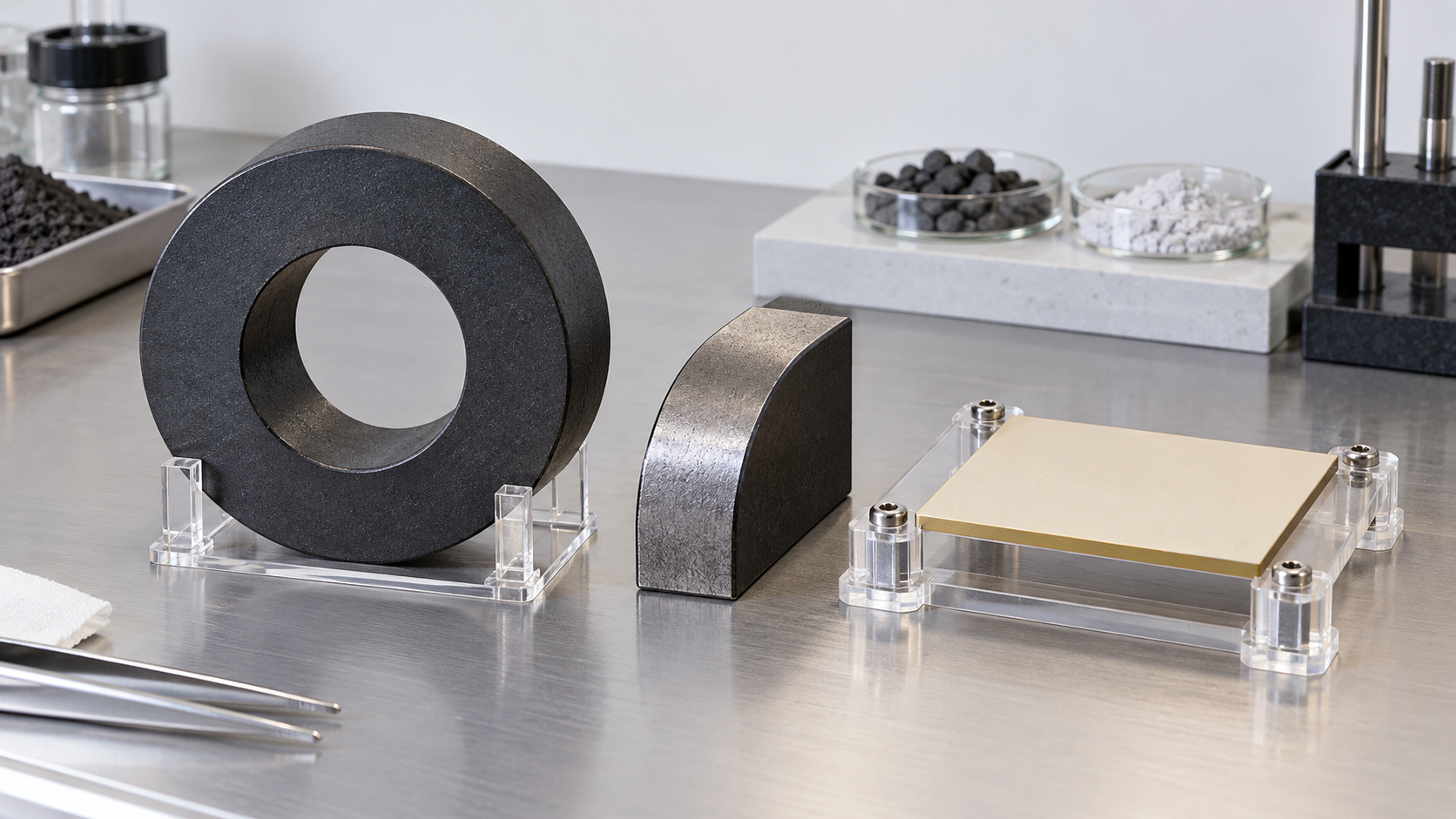
Ferrite, neodymium magnets and piezoelectric ceramics are all materials built on a common process: make a powder, shape it, and fire it into a solid (sintering). The Annual Securities Report lists five core technologies for TDK: materials, process, evaluation and simulation, product design, and production engineering Sourced. In ferrite, composition and sintering conditions set permeability and loss. TDK Electronics’ catalogue groups its MnZn ferrite materials by use (power by frequency, EMI, signal) and lists the initial permeability of each (for example N87 at 2,200 and T38 at 10,000). In neodymium magnets (NEOREC), the crystal grains of the sintered body and the composition of the grain boundaries govern coercivity, and TDK says it uses its own method (HAL) to diffuse dysprosium (Dy) along the grain boundaries. In piezoelectric actuators, the material of the internal electrodes between the stacked piezoelectric ceramic layers decides reliability (Chapter 10). So even within “sintered ceramics”, what is controlled differs from product to product (grain boundaries, composition, internal electrodes), and that is what characterises TDK as a materials company.
6. What it has done so far
| When | What happened | Why it matters |
|---|---|---|
| 1935 | Founded as Tokyo Denki Kagaku Kogyo (TDK) and began commercial production of ferrite cores. Mass production began in 1937 | The origin of the name and of the technology |
| 1951 | Began mass production of ceramic capacitors | Extension into dielectric ceramics |
| 1980 | Introduced multilayer inductors | Layering of ferrite |
| 2008 | The German electronic-components maker EPCOS joined the TDK Group | A European component company was added (the history entry; the Annual Securities Report does not describe its business) |
| 2009 | “TDK’s Development of Ferrite Materials and Their Applications” was recognised as an IEEE Milestone (the company’s description) | A technical recognition of its ferrite work |
| 2019 | Set up the corporate venture capital firm TDK Ventures | Exploration of new technologies |
| Year to March 2025 | Booked an impairment of ¥3,256 million on the Magnets business (lower profitability on lower sales) | Worsening profitability of magnets |
| Year to March 2026 | Magnet sales rose, mainly on automotive demand, and the loss narrowed through quality improvements. In Passive Components, about ¥2.8 billion of restructuring costs for aluminium electrolytic and film capacitors | Magnets are still loss-making. Portfolio review continues |
| April to June 2026 | Group sales up 38.3%, Passive Components up 28.0%, Magnetic Application Products up 49.6% | Led by HDDs for AI data centres and by automotive magnets |
7. What comes next
These forecasts are company targets, not results already achieved Not yet confirmed. For the year to March 2027 the results summary expects production of ICT products such as smartphones to fall, while nearline HDDs for data centres and the AI data-centre market stay robust. The Annual Securities Report says that, in high-performance rare-earth magnets, TDK is developing ways to reduce the use of rare-earth elements in consideration of geopolitical risks. For passive components it plans to advance next-generation MLCCs, inductors and EMC components, and higher-value products that combine thin-film, materials and roll-to-roll technologies.
Sales targets for magnets and piezoelectrics, numerical production capacity, concrete targets and dates for cutting rare-earth use and plans to commercialise lead-free piezoelectric materials appear in none of the official materials Not yet confirmed.
8. What the company is aiming for in functional materials
This chapter includes points the company has not stated directly. They are inferences drawn from primary sources, set out with their grounds.
| What we infer | Primary-source basis | Status |
|---|---|---|
| It sells its functional-materials know-how as parts and sensors, not as materials | Magnets and piezoelectrics are not separate sales categories, and the products are described as components and devices such as inductors, actuators and sensors | Inference |
| The magnets business is on the way to profitability | An impairment of ¥3,256 million in the year to March 2025 and a loss that “was reduced” in the year to March 2026. No magnet item in the facilities plan for the year to March 2027 | Sourced |
| It has technology aimed at using less heavy rare earth (Dy) | The official pages describe Dy-free NEOREC materials and the HAL method, and the Annual Securities Report speaks of developing ways to reduce rare-earth use | Sourced |
| The centre of investment is batteries and HDDs, with magnets and piezoelectrics set apart | Of ¥370 billion planned for the year to March 2027, ¥230 billion is for Energy Application Products; the ¥50 billion for Magnetic Application Products is for HDDs | Inference |
The last row is a trend visible in the sums. The ¥370 billion capital plan for the year to March 2027 breaks down as ¥230 billion for Energy Application Products, ¥50 billion for Passive Components, ¥50 billion for Magnetic Application Products, ¥20 billion for Sensor Application Products, ¥3 billion for Other and ¥17 billion for headquarters and R&D Sourced. The ¥50 billion for Magnetic Application Products is described as for next-generation HDD heads and suspension assemblies, with no magnet item. The ¥50 billion for Passive Components is for increasing capacity of and rationalising inductive devices, aluminium electrolytic capacitors and ceramic capacitors, with no mention of ferrite cores or piezoelectrics. From this we read magnets and piezoelectrics as not being treated as investment targets on the scale of batteries and HDDs Not yet confirmed. This does not mean the businesses have low value. The amounts may simply be small, or included in other categories.
9. Map of partnerships in functional materials
10. Technology, products and services
Ferrites
TDK Electronics’ product catalogue sorts its MnZn-based ferrite materials by application Sourced.
| Material (manufacturer’s stated values) | Initial permeability µi | Use and features (as described in the catalogue) |
|---|---|---|
| N87 | 2,200 | The standard power material (transformers, output chokes) |
| N95 | 3,000 | Power. Flat temperature behaviour |
| PC200 | 800 | Power. For frequencies up to 4 MHz |
| N91 | 1,100 | For output chokes. The highest saturation |
| T38 | 10,000 | EMI and signal use. High inductance |
| E16 | 6,000 | EMI. Below 5 MHz, high saturation and high Curie temperature |
The table shows part of the catalogue. Measurement frequency, temperature and flux density are given in each material’s data sheet and are not reproduced here. Values measured under different conditions cannot be used to rank materials or other makers’ products.
Neodymium magnets (NEOREC)
According to TDK’s technical material (updated March 2017), the NEOREC series is a sintered magnet based on neodymium, iron and boron, built on its powder-metallurgy technology, and the company says it has attained a maximum energy product of 406 kJ/m3 (51 MGOe) Sourced. The same document says that dysprosium (Dy) carries “a high risk of uneven distribution or market fluctuations”, that the company has set up a mass-production and supply system for Dy-free materials, and that it has developed the HAL (High Anisotropy field Layer) method, which selectively diffuses Dy along grain boundaries to raise coercivity. It also states that all products in the series comply with the RoHS Directive. This document was last updated in March 2017, and we could not confirm whether it matches the current values and range.
Piezoelectric ceramics
| Product (manufacturer’s stated values) | Example specification | Features (as described on the official page) |
|---|---|---|
| High Active Stack (HAS) multilayer piezo actuators | COM30S5: 5.2 × 5.2 × 30 mm, stroke 55 µm (±10%, at 160 V), blocking force 1,400 N. Voltage range -10 to +180 V | Copper inner electrodes. Compared with conventional silver-palladium alloy electrodes, it says it avoids short circuits from migration under humidity and has steadier cost than palladium. A lead-free high-melting metal bond for the outer electrodes (passed 2,000 hours at 200 °C; in the company’s comparison, a conventional solder contact failed after 1,500 hours at 180 °C) |
| PowerHap haptic actuators | 1313: 12.7 × 12.7 × 1.8 mm, capacitance 0.9 µF, 0 to 120 V, displacement 65 µm, acceleration 7 g (load mass 100 g, 200 Hz single pulse, peak) | A multilayer piezoceramic core with stainless-steel bows that amplify the motion. Copper inner electrodes for humidity resistance. It also produces a charge under pressure (it can act as a sensor) |
TDK positions HAS for motion control in semiconductor manufacturing, fluid control, scientific instruments and space systems, and describes “more than 20 years of proven field experience” (a company claim). Neither page states the composition of the piezoelectric ceramic (whether it is PZT) Not yet confirmed. We could not confirm from the official pages whether lead is contained.
In multilayer piezoelectric actuators and MLCCs, ceramic and inner electrode are fired together, so the electrode metal has to withstand the firing temperature and atmosphere. Silver-palladium alloys were the conventional choice, but TDK’s page explains that silver moves under humidity and an electric field (migration), causing shorts and failures between layers Sourced. Copper migrates less and its price is steadier than palladium’s, but copper oxidises easily, so it has to be fired in a reducing atmosphere, which asks for a ceramic designed to resist reduction (a general explanation, not a statement in TDK’s documents). The company says its copper-electrode technology is patented, but specific firing conditions and compositions are not published Not yet confirmed. The same issue appears with nickel inner electrodes in MLCCs: in mass production of functional ceramics, designing the combination of electrode metal and ceramic is a shared challenge.
Annex III to the EU RoHS Directive (Directive 2011/65/EU) grants time-limited exemptions for lead, including in piezoelectric ceramics (PZT). Under Commission Delegated Directive (EU) 2025/2363, adopted on 8 September 2025 and published in the Official Journal on 21 November 2025, entry 7(c)-I expires on 30 June 2027, and the new entry 7(c)-VI (lead in PZT piezoelectric ceramics and in PTC ceramics) expires on 31 December 2027 Sourced. On TDK’s official pages we could not confirm whether its piezoelectric products use PZT or which exemption entry they rely on. We therefore do not assess the effect of this rule on TDK’s piezoelectric business.
11. The risks this company carries
| Risk | What it is | Status |
|---|---|---|
| Profitability of the magnets business | An impairment of ¥3,256 million in the year to March 2025. The loss narrowed in the year to March 2026 but continues. There is no magnet item in the facilities plan | Sourced |
| Rare-earth sourcing and geopolitics | The Annual Securities Report says that for major raw materials TDK may rely on a limited number of hard-to-replace suppliers, and that it is developing ways to cut rare-earth use in view of geopolitical risks. No specific regulation or amount of impact is given | Sourced |
| Coarse disclosure | Sales, profit, equipment and headcount for magnets, piezoelectrics and ferrite are not reported separately, so growth and profitability cannot be assessed from outside | Sourced |
| Smartphone demand | The company’s outlook expects production of smartphones and similar ICT products to fall in the year to March 2027. The high-frequency components business has kept posting operating losses and booked an impairment in the year to March 2025 (none in the year to March 2026) | Sourced |
| Expiry of the lead exemptions | The exemption for lead in PZT piezoelectric ceramics expires on 31 December 2027 (renewal undecided). The effect on TDK’s piezoelectric business cannot be confirmed | Sourced / not confirmed |
| Exchange rates | A stronger yen reduces sales. The report says it eases the effect by increasing overseas procurement of raw materials and similar steps. In the year to March 2026, exchange rates reduced net sales by about ¥2.5 billion and operating profit by about ¥10.6 billion | Sourced |
12. Glossary
- Ferrite
- A ceramic magnetic material based on iron oxide. It conducts electricity poorly and works at high frequencies. It is used as the core of coils and transformers.
- MnZn ferrite
- A ferrite containing manganese and zinc. High permeability makes it useful in power supplies and noise suppression.
- Initial permeability (µi)
- How readily a material carries magnetism in a weak field. The larger it is, the more easily flux passes.
- Neodymium magnet (NdFeB)
- A strong sintered magnet of neodymium, iron and boron, used in motors and similar products.
- Coercivity and maximum energy product
- A measure of how hard a magnet is to demagnetise, and of the energy it can deliver outside itself.
- HAL method
- By TDK’s description, a way of raising coercivity by diffusing a heavy rare earth (Dy) from the magnet surface into its grain boundaries.
- Piezoelectricity
- The property of producing a voltage when force is applied, and of deforming when a voltage is applied.
- Migration
- The movement of electrode metal under an electric field and humidity, which can cause short circuits.
13. References
- TDK Corporation Annual Securities Report, The 130th Term (1 April 2025 to 31 March 2026), English translation, filed with the Kanto Local Finance Bureau on 17 June 2026. Business, history, segment sales, R&D, capital expenditure, facilities plan, employees, risks and impairments. Retrieved 10 October 2026. https://www.tdk.com/system/files/ir_library_report_pdf_T130_en.pdf
- TDK Corporation Consolidated Financial Results for FY March 2026 (IFRS) (results summary, 28 April 2026). Sales by product and the forecast for the year to March 2027. https://www.tdk.com/system/files/2026042800_0mqf56xw_en.pdf
- TDK Corporation Consolidated Financial Results for the Three Months Ended June 30, 2026 (IFRS) (results summary, 31 July 2026). Sales for April to June 2026. https://www.tdk.com/system/files/2026073100_lda9mypa_en.pdf
- TDK Electronics AG Ferrite Materials (product catalogue: MnZn ferrite materials and initial permeability). Retrieved 10 October 2026. https://www.tdk-electronics.tdk.com/en/529404/products/product-catalog/ferrites-and-accessories/ferrite-materials
- TDK Electronics AG Multilayer Piezo Actuator Stacks (High Active Stack). Retrieved 10 October 2026. https://www.tdk-electronics.tdk.com/en/542398/products/product-catalog/switching-heating-piezo-components-buzzers-microphones/multilayer-piezo-actuator-stacks
- TDK Electronics AG PowerHap Piezoelectric Actuators. Retrieved 10 October 2026. https://www.tdk-electronics.tdk.com/en/2124786/products/product-catalog/switching-heating-piezo-components-buzzers-microphones/powerhap
- TDK Corporation Neodymium Magnets (official product page: NEOREC series, Dy-free). Retrieved 10 October 2026. https://product.tdk.com/en/products/magnet/magnet/neodymium/index.html
- TDK Corporation Neodymium Magnets NEOREC Series Product Guide (technical material, contents updated March 2017). https://product.tdk.com/en/system/files?file=dam/doc/product/magnet/magnet/neodymium/datasheets/magnet_neo_summary_en.pdf
- TDK Corporation Dy Free Neodymium Magnet (official page: the HAL method). Retrieved 10 October 2026. https://product.tdk.com/en/products/magnet/renaissance/video02.html
- European Commission Commission Delegated Directive (EU) 2025/2363 of 8 September 2025 amending Directive 2011/65/EU as regards an exemption for lead in glass or ceramic components (OJ L, 21.11.2025). Text read through the EU Publications Office. http://data.europa.eu/eli/dir_del/2025/2363/oj
- TDK Corporation Official website (logo; company overview; IR library). https://www.tdk.com/en/ir/ir_library/index.html
14. Claim-to-source audit
| Claim in the text | Status | Source |
|---|---|---|
| Legal name, headquarters, Tokyo Stock Exchange Prime listing, founding in 1935 to industrialise ferrite, history, the IEEE Milestone, TDK Ventures, EPCOS | Sourced | Reference 1 https://www.tdk.com/system/files/ir_library_report_pdf_T130_en.pdf |
| Sales, operating profit, segment sales, employees, R&D and capital expenditure for the year to March 2026; the statements on magnets; the ¥3,256 million impairment of the Magnets business (year to March 2025) | Sourced | Reference 1 https://www.tdk.com/system/files/ir_library_report_pdf_T130_en.pdf |
| R&D policy (cutting rare-earth use; thin-film, materials and roll-to-roll), collaboration with the Institute of Science Tokyo and Akita University, the five core technologies, raw-material and exchange-rate risks | Sourced | Reference 1 https://www.tdk.com/system/files/ir_library_report_pdf_T130_en.pdf |
| The facilities plan for the year to March 2027 (¥370 billion and its breakdown) | Not yet confirmed | Company plan in Reference 1 https://www.tdk.com/system/files/ir_library_report_pdf_T130_en.pdf |
| Sales by product (capacitors, inductive devices, other passive components) | Sourced | Reference 2 https://www.tdk.com/system/files/2026042800_0mqf56xw_en.pdf |
| Forecasts for the year to March 2027 (sales ¥2,580 billion, operating profit ¥295 billion, capital expenditure ¥370 billion, R&D ¥310 billion) | Not yet confirmed | Company forecasts in Reference 2 https://www.tdk.com/system/files/2026042800_0mqf56xw_en.pdf |
| Sales of ¥741,005 million for April to June 2026, Passive Components of ¥176,803 million and Magnetic Application Products of ¥81,608 million | Sourced | Reference 3 https://www.tdk.com/system/files/2026073100_lda9mypa_en.pdf |
| MnZn ferrite materials and initial permeability (N87, N95, PC200, N91, T38, E16) | Sourced | Manufacturer’s stated values, Reference 4 https://www.tdk-electronics.tdk.com/en/529404/products/product-catalog/ferrites-and-accessories/ferrite-materials |
| HAS specifications, copper inner electrodes, lead-free metal bond and durability test claims | Sourced | Manufacturer’s stated values, Reference 5 https://www.tdk-electronics.tdk.com/en/542398/products/product-catalog/switching-heating-piezo-components-buzzers-microphones/multilayer-piezo-actuator-stacks |
| PowerHap specifications, copper inner electrodes, sensor function | Sourced | Manufacturer’s stated values, Reference 6 https://www.tdk-electronics.tdk.com/en/2124786/products/product-catalog/switching-heating-piezo-components-buzzers-microphones/powerhap |
| NEOREC series (neodymium, iron, boron; maximum energy product of 406 kJ/m3; Dy-free; HAL method; RoHS compliance) | Sourced | Material updated March 2017, References 7, 8, 9 https://product.tdk.com/en/system/files?file=dam/doc/product/magnet/magnet/neodymium/datasheets/magnet_neo_summary_en.pdf |
| RoHS Annex III expiry dates for 7(c)-I (30 June 2027) and 7(c)-VI (PZT and PTC, 31 December 2027) | Sourced | Reference 10 http://data.europa.eu/eli/dir_del/2025/2363/oj |
| Sales, profit and headcount for magnets, piezoelectrics and ferrite alone; capital expenditure allocation; piezoelectric composition; rare-earth usage; lead-free plans; public grants | Not yet confirmed | All undisclosed or not mentioned. We do not estimate them. https://www.tdk.com/system/files/ir_library_report_pdf_T130_en.pdf |
| The general explanation that copper electrodes must be fired in a reducing atmosphere | Commentary | This article’s general explanation (not a statement in TDK’s documents) |
| Classifying TDK as components and devices (primary) and materials (secondary) | Our calculation | Our own classification. Company names are examples from this series |
| It sells functional-materials know-how as parts and sensors | Inference | This article’s reading of the segment structure and product descriptions |
| The centre of investment is batteries and HDDs, with magnets and piezoelectrics set apart | Inference | This article’s reading of the breakdown of the facilities plan for the year to March 2027 |
Last updated: 10 October 2026 / Troy Technical
Figures in this article are based on TDK’s Annual Securities Report, results summaries, official product pages and technical material, and official European Union documents. Performance values are the manufacturer’s stated values, and we have not compared values measured under different conditions to rank products. We have not used market-research estimates or press-based figures. Passages marked “Inference” are our own reading of primary sources, not statements by the company.