Key Findings
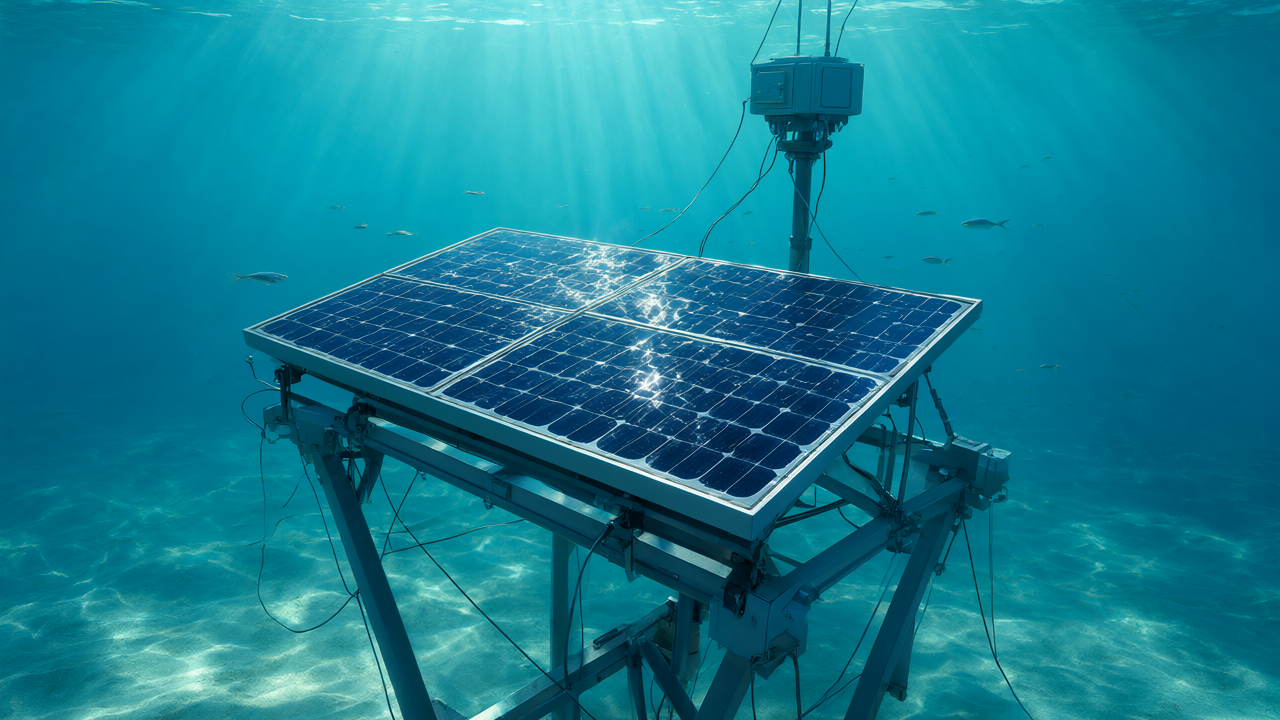
Researchers have successfully developed a polymer-tuned broadband perovskite solar cell capable of efficiently harnessing the blue-green light spectrum dominant in deep-sea environments. This groundbreaking underwater solar cell achieved an unprecedented power conversion efficiency of 34.71% at a simulated depth of 10 meters, significantly surpassing previous benchmarks. Furthermore, the device exhibits a certified efficiency of 16.79% under standard terrestrial illumination and is predicted to maintain 80% of its initial efficiency for approximately 5.49 years of continuous underwater operation, promising to transform power solutions for marine observation and submerged IoT applications.
Technical / Clinical Details
The core innovation behind this underwater solar cell lies in the precise tuning of the perovskite layer composition and interfaces with specific polymers. Unlike terrestrial light, light penetrating deeper into the ocean is predominantly in the blue-green wavelength range. The research team optimized the perovskite material’s bandgap and light absorption properties to maximize photon harvesting and conversion into electricity within this specific spectral window. The incorporation of polymers enhances the stability of the perovskite crystals, mitigating degradation in the aqueous environment and ensuring long-term performance. The projected operational lifetime of 5.49 years represents a substantial advance over existing underwater power sources.
Background & Context
The growing demand for autonomous sensors, observation equipment, and communication buoys in marine environments has highlighted significant challenges in providing reliable power to underwater IoT devices. Conventional battery-powered systems necessitate frequent replacement or recharging, incurring high operational costs and logistical complexities. Terrestrial solar cells are unsuitable for underwater use due to their inability to withstand the unique light spectrum, pressure, and corrosive properties of the ocean. This research addresses these limitations by offering a high-efficiency, long-lifetime solar cell specifically tailored for the harsh underwater environment, enhancing the autonomy of devices in marine science, defense, and resource exploration.
Strategic Significance & Outlook
The 34.71% power conversion efficiency at 10 meters depth marks a revolutionary advancement in underwater power generation capabilities. This technology opens up the possibility of powering submerged devices for years without the need to return to charging stations. Future applications are extensive, encompassing marine robotics, autonomous underwater vehicles (AUVs), subsea cable monitoring systems, and deep-sea exploration probes. Further development of this technology could provide critical infrastructure for deepening humanity’s understanding of the oceans and facilitating sustainable marine resource utilization on a global scale.
Get our weekly technology intelligence — free
Receive an infographic that lets you judge at a glance whether each field’s analysis report is worth reading.
Subscribe Free — Weekly Tech Intelligence
By subscribing, you’ll receive Troy-Technical’s weekly technology intelligence newsletter.
- Your email and selected fields are used only to deliver the newsletter.
- We never share your information with third parties.
- You can unsubscribe anytime via the link in each email.
See our Privacy Policy for details.
Takes about a minute · Unsubscribe anytime