Key Findings
Researchers at Pacific Northwest National Laboratory (PNNL) have developed a machine learning (ML)-based Residual Stress Generator (RSG) designed to infer full-field residual stress distributions in friction-stir processed (FSP) parts from sparse measurement data. This research, published in The International Journal of Advanced Manufacturing Technology, demonstrates that an ML model based on the U-Net architecture, trained on an extensive dataset of process simulations, achieves excellent predictive accuracy and generalization capabilities for simulated stresses. The technology also proved feasible with experimental data, promising to be an indispensable tool for material reliability assessment and manufacturing process optimization.
Technical / Clinical Details
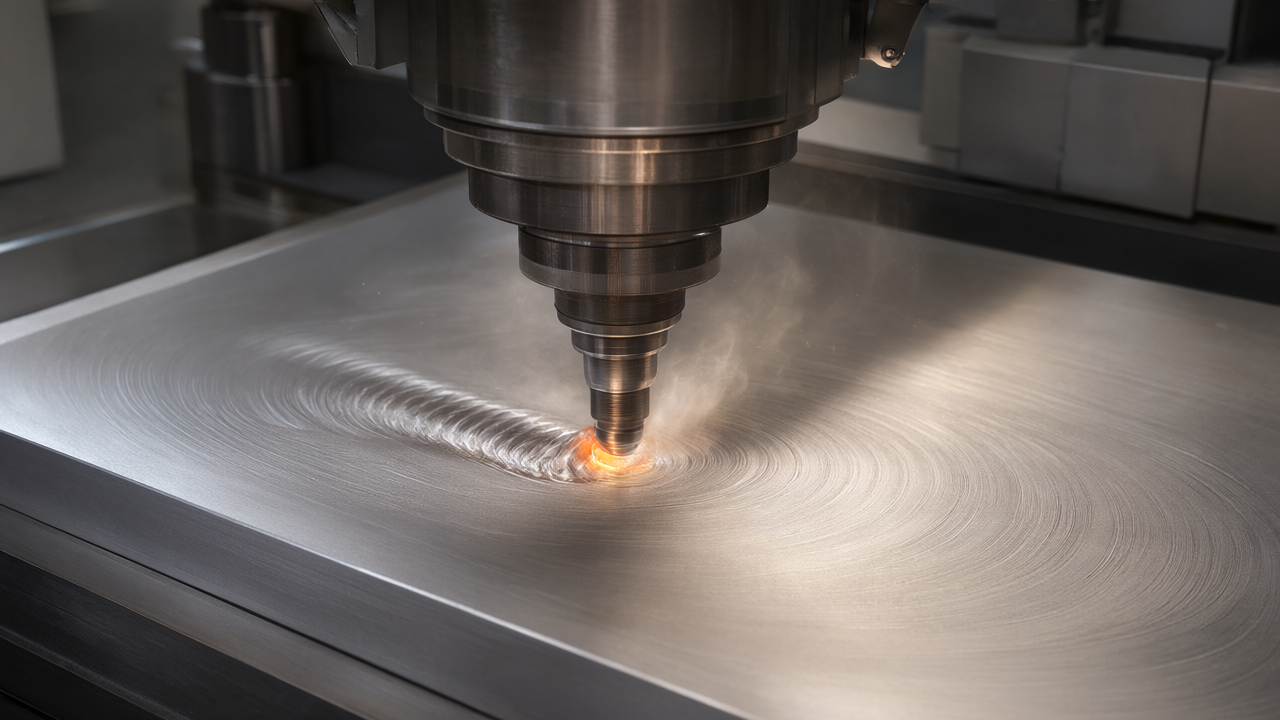
- The developed Residual Stress Generator (RSG) estimates the internal residual stress distributions in friction-stir processed (FSP) parts with high accuracy, using only minimal measurement data. FSP is a solid-state joining technique used to modify material microstructure and enhance mechanical properties.
- The core of the RSG is a machine learning model employing the U-Net architecture, well-proven in image segmentation tasks. This U-Net takes FSP process parameters and sparse stress measurement data as input to generate detailed, full-field residual stress maps for the entire component.
- The model was trained using an extensive dataset derived from numerical simulations of the FSP process. This enabled it to learn stress patterns corresponding to various process conditions and material compositions.
- The trained model exhibited very high predictive accuracy for simulated stress distributions and demonstrated excellent generalization capabilities for new FSP conditions and part geometries not included in the training data.
- Furthermore, the RSG was validated using limited experimental residual stress measurement data, demonstrating its applicability to real-world problems. This significantly reduces the need for time-consuming and costly destructive testing or detailed non-destructive evaluations.
Background & Context
Friction-stir processing (FSP) is a solid-state joining technique widely used for welding and surface modification, particularly for lightweight alloys. However, the residual stresses induced by FSP can significantly impact a component’s fatigue life, corrosion resistance, and dimensional stability, making their accurate assessment and control critical in high-reliability sectors such as aerospace, automotive, and nuclear industries. Traditional methods for residual stress measurement have often been destructive, expensive, or limited in measurement points. The introduction of ML offers a powerful solution to overcome these challenges, enabling faster and more cost-effective residual stress evaluation.
Strategic Significance & Outlook
The RSG developed by PNNL represents a major advancement in quality assurance and performance optimization for FSP parts. This technology will enable the design of desired residual stress profiles by adjusting manufacturing process parameters, thereby improving component durability and reliability. In the future, AI-based tools like RSG are expected to play a central role in automating manufacturing processes and quality control, enhancing digital twin technologies, and facilitating the design and evaluation of new advanced materials. This will have a transformative impact on materials science and manufacturing, especially for critical infrastructure and safety-critical applications, globally.
Get our weekly technology intelligence — free
Receive an infographic that lets you judge at a glance whether each field’s analysis report is worth reading.
Subscribe Free — Weekly Tech Intelligence
By subscribing, you’ll receive Troy-Technical’s weekly technology intelligence newsletter.
- Your email and selected fields are used only to deliver the newsletter.
- We never share your information with third parties.
- You can unsubscribe anytime via the link in each email.
See our Privacy Policy for details.
Takes about a minute · Unsubscribe anytime