TECHNOLOGY EXPLAINER
The EU AI Act
— Checking "from when, to whom, and what applies" against the original text
The EU AI Act (Regulation (EU) 2024/1689) regulates AI systems in four risk categories (prohibited, high-risk, transparency and minimal risk) and imposes separate obligations on general-purpose AI models. It entered into force on 1 August 2024, and its application is being phased in. This field moves fast. In particular, the application dates for high-risk AI were changed by the Digital Omnibus on AI (Regulation (EU) 2026/1744), which entered into force on 27 July 2026: 2 December 2027 for the Annex III areas and 2 August 2028 for AI tied to products under Annex I (originally 2 August 2026 and 2 August 2027). This article was checked on 15 October 2026 against the text on EUR-Lex and the European Commission's pages, and keeps apart the stages of a law (proposal, adoption, entry into force, start of application). It is not legal advice.
- What the EU AI Act is (the short version)
- Stages of application: from entry into force in 2024 to 2030
- The Digital Omnibus: from proposal to entry into force, and what changed
- Scope and roles: providers, deployers, extraterritorial reach, and the research exclusions
- The risk categories
- Prohibited practices
- High-risk AI: two entry points, and what is required
- General-purpose AI models
- Transparency obligations (Article 50)
- Penalties and enforcement: our calculation
- Where this sits for manufacturing and R&D
- Limits, and what we could not confirm
- How to read evaluations and standards
- Glossary
- References
- Claim-to-source audit
Sourced = stated in a law or official document (linked)
Our calculation = a value this article computed from stated assumptions
Not yet confirmed = a draft, plan or future date; no record of implementation has been confirmed
Interpretation is marked "our reading". An inference is shown in bold. Regulatory dates follow the text as of the check date (15 October 2026). We distinguish proposal, adoption, entry into force and start of application.
This article organizes the content of official texts and documents. It does not decide whether a particular company or product is subject to obligations under the EU AI Act. To determine whether the Act applies in practice, check the original text, the European Commission's guidelines, the views of national authorities and professional (legal) advice. We make no guess about the outcome of pending proceedings or future amendments.
1. What the EU AI Act is (the short version)
- Rules scaled to risk. Regulation (EU) 2024/1689 prohibits practices that are unacceptable to society, sets requirements for "high-risk" uses that carry high risks to health, safety or fundamental rights, and imposes transparency duties on chatbots and the labelling of generated content. General-purpose AI models are covered in a separate chapter Sourced [Ref. 1, 3].
- Application is phased, and the dates have moved. Prohibitions and similar provisions applied from 2 February 2025; general-purpose AI models, governance and penalties from 2 August 2025; and general application (transparency and more) from 2 August 2026. For high-risk AI, the Digital Omnibus made the dates 2 December 2027 (Annex III) and 2 August 2028 (Annex I) Sourced [Ref. 1, 2].
- Adopted, but the surroundings are unfinished. The Digital Omnibus entered into force on 27 July 2026. Meanwhile, the high-risk classification guidelines were still at the draft stage on the check date, and we could not confirm that references to harmonised standards under the AI Act have been published in the Official Journal Not yet confirmed [Ref. 13, 14].
The statement that "the EU AI Act's high-risk obligations apply from August 2026" has been out of date since 27 July 2026. Even within the same regulation, different provisions have different application dates. When citing a date, use the amended text (reflecting Regulation (EU) 2026/1744) and state the check date.
2. Stages of application: from entry into force in 2024 to 2030
Regulation (EU) 2024/1689 was published in the Official Journal on 12 July 2024 and entered into force on 1 August 2024, the twentieth day after publication. Article 113 provided that it applies from 2 August 2026, with exceptions by chapter. The 2026 amendment (a rewrite of the third paragraph of Article 113) changed the exceptions for high-risk AI Sourced [Ref. 1, 2].
| Date of application | What applies | Provision | Note |
|---|---|---|---|
| 2 February 2025 | Chapter I (general provisions) and Chapter II (prohibited practices) | Art. 113(a) | Includes Article 4 on AI literacy. Article 5(1)(ba), (bb), (1a) and (1b) were moved to 2 December 2026 by the 2026 amendment (see Chapter 3) |
| 2 August 2025 | Chapter III Section 4 (notified bodies), Chapter V (general-purpose AI models), Chapter VII (governance), Chapter XII (penalties) and Article 78 (confidentiality). Article 101 excepted | Art. 113(b) | General-purpose AI models placed on the market before 2 August 2025 must comply by 2 August 2027 (Art. 111(3)) |
| 2 August 2026 | General date of application of the regulation. The transparency obligations of Article 50, Article 101 (Commission fines on providers of GPAI models) and others | Art. 113, main text | The Commission's page says that from this date the AI Office and Member State authorities are responsible for implementation, supervision and enforcement [Ref. 3] |
| 2 December 2026 | Article 5(1)(ba) and (bb) and Article 5(1a) and (1b) (new prohibited practices). Article 111(4): meeting Article 50(2) for generative systems placed on the market before 2 August 2026 | Amended Art. 113(a); Art. 111(4) | Added by Regulation (EU) 2026/1744 |
| 2 August 2027 | Deadline for general-purpose AI models placed on the market before 2 August 2025. Deadline for the Commission to adopt delegated acts under Article 2(13) | Art. 111(3); amended Art. 2(13) | The delegated acts are to limit obligations where Annex I Section A harmonisation legislation gives an equivalent or higher level of protection |
| 2 December 2027 | Chapter III Sections 1-3, for high-risk AI under Article 6(2) and Annex III | Amended Art. 113(c)(i) | Originally 2 August 2026 |
| 2 August 2028 | Chapter III Sections 1-3, for high-risk AI under Article 6(1) and Annex I | Amended Art. 113(c)(ii) | Originally 2 August 2027 |
| 2 August 2030 / 31 December 2030 | Transitional rule for high-risk AI used by public authorities (Art. 111(2)) / components of large-scale IT systems in Annex X (Art. 111(1)) | Art. 111 | Transitional rules for existing systems |
All entries are statements in the text (Sourced). Items from 2 December 2026 onwards are Not yet confirmed as of the check date, in that the dates have not yet arrived.
3. The Digital Omnibus: from proposal to entry into force, and what changed
The "Digital Omnibus on AI" is an amendment to simplify implementation of the AI Act. It has moved from the proposal stage to being adopted and in force. We separate the dates by stage.
| Date | Stage | Source checked |
|---|---|---|
| 19 November 2025 | Proposal: the European Commission publishes the AI Omnibus proposal | Commission page [Ref. 4] |
| 7 May 2026 | Political agreement | Commission AI Act page [Ref. 3] |
| 16 June / 29 June 2026 | Adoption: position of the European Parliament (16 June) and decision of the Council (29 June) | Footnote to Regulation (EU) 2026/1744 [Ref. 2] |
| 8 July 2026 | Signature (Strasbourg) | Regulation (EU) 2026/1744 [Ref. 2] |
| 24 July 2026 | Publication in the Official Journal (OJ L, 2026/1744) | Regulation (EU) 2026/1744 [Ref. 2] |
| 27 July 2026 | Entry into force (the third day after publication) | Article 4 of Regulation (EU) 2026/1744; Commission page [Ref. 2, 4] |
All entries are Sourced (as stated in each source).
The amending regulation's recitals give as reasons for the amendment that the delayed preparation of standards, which give providers of high-risk AI systems technical solutions for compliance, and the delayed establishment of governance and conformity assessment frameworks at national level, made the compliance burden heavier than expected; they also say the level of protection for health, safety and fundamental rights is not to be reduced Sourced [Ref. 2]. The main changes are as follows.
| Change | Content (text of the amending regulation) | Provision |
|---|---|---|
| Dates for high-risk AI | Annex III: 2 December 2027; Annex I: 2 August 2028 | Rewrite of Art. 113(c) |
| New prohibited practices | Placing on the market, putting into service or using AI systems that generate or manipulate realistic images, video or audio of an identifiable person's intimate parts or sexually explicit activity without that person's explicit consent, or material constituting child sexual abuse material, and similar. This includes systems whose design makes such output a reasonably foreseeable and reproducible outcome and which lack adequate technical safeguards. From 2 December 2026 | Art. 5(1)(ba), (bb), (1a), (1b) |
| AI literacy | From "take measures to ensure a sufficient level of AI literacy" to "take measures to support the development of AI literacy". The text states that this does not require guaranteeing any specific level. The Commission and Member States are to support providers and deployers | Replacement of Art. 4 |
| Transparency grace period and implementation | Providers of generative systems placed on the market before 2 August 2026 are to meet Article 50(2) by 2 December 2026. Article 50(7) is rewritten on the assessment of codes of practice and on implementing acts if a code is inadequate | Art. 111(4); Art. 50(7) |
| Small mid-cap enterprises (SMCs) | Some simplifications for SMEs are extended to SMCs. Fines: the "whichever is lower" rule applies | Art. 3(14b); Art. 99(6a) |
| Powers of the AI Office | The AI Office has exclusive competence to supervise and enforce for AI systems built on a GPAI model where the model and the system are developed by the same provider, among others (with some exceptions) | Art. 75(1) |
| Definition of safety component | AI used solely for non-safety aspects such as user assistance, performance optimisation, service efficiency, automation, convenience or quality control is not a safety component. AI whose failure or malfunction would endanger health and safety is | Art. 6(1a)-(1c); Art. 3(14) |
| Other | Processing of special categories of personal data for bias detection and correction (Art. 4a), changes to Annex I (deleting the Machinery Directive item and adding Machinery Regulation (EU) 2023/1230), wider access to regulatory sandboxes | Art. 4a; Annex I |
All entries summarise the text of Regulation (EU) 2026/1744 (Sourced). Read the full text in Reference 2.
4. Scope and roles: providers, deployers, extraterritorial reach, and the research exclusions
Article 2(1) sets out whom the regulation applies to Sourced [Ref. 1]. A notable feature is that it reaches operators outside the EU.
| Party | Summary of the text | Point of view of a Japanese company (our reading) |
|---|---|---|
| Providers | Providers placing AI systems on the market or putting them into service in the Union, or placing general-purpose AI models on the market in the Union, irrespective of whether they are established in the Union or in a third country (Art. 2(1)(a)) | A company that puts a product with built-in AI on the EU market can be covered even if it is based in Japan |
| Deployers | Deployers established or located in the Union (point (b)). Providers and deployers in a third country where the output produced by the AI system is used in the Union (point (c)) | When employees at an EU site use AI tools in their work, the company at that site can be treated as a deployer |
| Importers, distributors, manufacturers and others | Importers and distributors (point (d)); product manufacturers placing an AI system on the market together with their product under their own name (point (e)); authorised representatives of providers not established in the Union (point (f)); affected persons in the Union (point (g)) | A product manufacturer is covered when it builds an AI system into its product and puts it on the market under its own name |
The text is Sourced. The right-hand column is our reading and does not decide whether any individual company is covered.
Some definitions are worth noting. Article 3(1) defines an "AI system" as a machine-based system that is designed to operate with varying levels of autonomy and that may exhibit adaptiveness after deployment, and that, for explicit or implicit objectives, infers, from the input it receives, how to generate outputs such as predictions, content, recommendations or decisions that can influence physical or virtual environments. A "deployer" is a person using an AI system under its authority, except in the course of a personal non-professional activity [Ref. 1].
Where the regulation does not apply
- AI systems used exclusively for military, defence or national security purposes (Art. 2(3)).
- AI systems or models, including their output, specifically developed and put into service for the sole purpose of scientific research and development (Art. 2(6)).
- Research, testing or development activity before the AI system or model is placed on the market or put into service (Art. 2(8)). However, testing in real world conditions is not covered by this exclusion.
- The obligations of deployers who are natural persons using AI systems in the course of a purely personal non-professional activity (Art. 2(10)).
The research exclusion concerns activity before placing on the market. Once a system is placed on the market, put into service or tested in real conditions, whether the regulation applies has to be checked again (our reading).
5. The risk categories
The European Commission describes the AI Act in four levels of risk: unacceptable risk (prohibited), high risk, transparency risk, and minimal or no risk. General-purpose AI models have separate rules [Ref. 3].
| Category | What it covers | Main requirements | Start of application |
|---|---|---|---|
| Prohibited | Practices unacceptable to society (Article 5; Chapter 6 of this article) | Ban on placing on the market, putting into service and use | 2 February 2025 (the new points: 2 December 2026) |
| High-risk | Safety components of products under Annex I and similar (Art. 6(1)); eight areas in Annex III (Art. 6(2)) | Requirements on risk management, data governance, technical documentation, record-keeping, human oversight and more. Obligations of providers and deployers; conformity assessment | Annex III: 2 December 2027; Annex I: 2 August 2028 |
| Transparency | AI interacting directly with people, AI generating synthetic content, emotion recognition and biometric categorisation, deepfakes, published text on matters of public interest | Informing people that it is AI, machine-readable marking, disclosure | 2 August 2026 (Article 50) |
| Minimal risk | Most other AI (for example AI-enabled video games, spam filters) | No new obligations under the regulation [Ref. 3] | — |
The table organizes statements in the regulation and the Commission page (Sourced). Categories can overlap (for example, high-risk AI can also be subject to transparency duties).
6. Prohibited practices
Article 5(1) prohibits the following practices from being placed on the market, put into service or used. They have applied since 2 February 2025. The Commission published guidelines on prohibited practices on 4 February 2025 and notes that they are non-binding and that authoritative interpretation is reserved for the Court of Justice of the European Union Sourced [Ref. 1, 5].
| Point | What is prohibited (summary) | Limits and exceptions in the text |
|---|---|---|
| (a) | AI that deploys subliminal techniques, or purposefully manipulative or deceptive techniques, materially distorting the behaviour of a person and causing, or being reasonably likely to cause, significant harm | It must appreciably impair the ability to make an informed decision, leading the person to take a decision they would not otherwise have taken |
| (b) | AI that exploits vulnerabilities due to age, disability or a specific social or economic situation, materially distorting behaviour and causing, or being reasonably likely to cause, significant harm | |
| (c) | Evaluation or classification of persons based on social behaviour or personality characteristics (social scoring) leading to detrimental treatment in unrelated contexts, or unjustified or disproportionate treatment | |
| (d) | AI assessing or predicting the risk of a person committing a criminal offence based solely on profiling or on personality traits | Not applicable to AI supporting a human assessment already based on objective and verifiable facts |
| (e) | Creating or expanding facial recognition databases through untargeted scraping of facial images from the internet or CCTV | |
| (f) | Inferring emotions in the workplace and in education institutions | Exception for medical or safety reasons |
| (g) | Biometric categorisation inferring race, political opinions, trade union membership, religious or philosophical beliefs, sex life or sexual orientation | Labelling or filtering of lawfully acquired biometric datasets, and categorising in law enforcement, are not covered |
| (h) | Use of "real-time" remote biometric identification in publicly accessible spaces for law enforcement | Exceptions only where strictly necessary for searching for victims of abduction or trafficking, preventing a specific imminent threat, or locating a suspect of a serious offence (conditions in Art. 5(2) onwards) |
| (ba), (bb) | AI systems that generate or manipulate realistic material showing an identifiable person's intimate parts or sexually explicit activity without consent, or child sexual abuse material (added by the 2026 amendment) | From 2 December 2026. Limited to cases where this is the intended purpose, or a reasonably foreseeable and reproducible outcome without safeguards. For deployers, use is covered only if used for that purpose (Art. 5(1a)). Not yet confirmed (date not yet reached) |
A summary of the (amended) text (Sourced), not the full requirements of each point. The Commission counts these as one prohibition and describes nine prohibited practices in total [Ref. 3].
Closest to enterprise AI deployment is point (f), inferring emotions in the workplace. AI that infers employees' emotions from facial expressions or voice is prohibited, except for medical or safety reasons. Uses that manipulate or score people, as in points (a), (b) and (c), are also covered (our reading).
7. High-risk AI: two entry points, and what is required
There are two entry points to being classified as high-risk. Article 6(1) applies when an AI system is a safety component of a product covered by the Union harmonisation legislation in Annex I (or is itself such a product) and that product must undergo a third-party conformity assessment. Article 6(2) covers AI systems for the uses listed in Annex III. An Annex III system is not high-risk where it does not pose a significant risk (Article 6(3)), but an Annex III system that performs profiling of natural persons is always high-risk Sourced [Ref. 1].
The eight areas of Annex III
| Area | Summary of the text |
|---|---|
| 1. Biometrics | Remote biometric identification, biometric categorisation by sensitive attributes, and emotion recognition, where permitted by law |
| 2. Critical infrastructure | Safety components in the management and operation of critical digital infrastructure, road traffic, and the supply of water, gas, heating or electricity |
| 3. Education and vocational training | Decisions on access or admission, evaluation of learning outcomes, assessing the appropriate level of education, and monitoring prohibited behaviour during tests |
| 4. Employment and workers' management | Recruitment and selection (placing job advertisements, analysing and filtering applications, evaluating candidates); decisions on terms of work, promotion and termination; allocating tasks based on individual behaviour or traits; monitoring and evaluating performance and behaviour |
| 5. Essential services | Eligibility for public benefits; creditworthiness and credit scoring (excluding fraud detection); risk assessment and pricing for life and health insurance; classifying emergency calls and dispatching emergency services |
| 6. Law enforcement | Risk of becoming a victim, polygraphs and similar tools, evaluating the reliability of evidence and so on, where permitted by law |
| 7. Migration, asylum and border control | Polygraphs and similar tools and so on, where permitted by law |
| 8. Administration of justice and democratic processes | Assisting a judicial authority in researching and interpreting facts and the law; AI intended to influence the outcome of an election or similar |
A summary of Annex III (Sourced), not the full text of each point. Most relevant to manufacturers are area 4 (employment and workers' management: recruitment, performance evaluation and monitoring) and AI that is a safety component of an Annex I product (our reading).
Annex I Section A lists legislation including toys, recreational craft, lifts, equipment for explosive atmospheres, radio equipment, pressure equipment, cableway installations, personal protective equipment, gas appliances and medical devices. The 2026 amendment deleted the Machinery Directive item from Section A and added Machinery Regulation (EU) 2023/1230 to Section B [Ref. 1, 2]. For high-risk AI related to Section B legislation, only some provisions of the AI Act apply directly (Art. 2(2)). On the machinery side, an amendment provides that delegated acts reflecting AI requirements are to apply by 2 August 2028 [Ref. 2].
Overview of what is required
| Who | What is required (the text) | Provision |
|---|---|---|
| System requirements | A risk management system (a continuous iterative process over the whole lifecycle), data and data governance, technical documentation, record-keeping, transparency and information to deployers, human oversight, accuracy, robustness and cybersecurity | Art. 9-15 |
| Providers | Compliance with the requirements, a quality management system, keeping documentation, keeping logs (where under their control), conformity assessment before placing on the market, EU declaration of conformity, CE marking, registration, corrective actions, and demonstrating conformity on request of an authority | Art. 16-22; Art. 43-49 |
| Deployers | Use in accordance with the instructions for use; assign human oversight to people with competence, training and authority; make sure input data is relevant and representative (where under their control); monitor operation; inform and suspend use if there is reason to consider a risk or a serious incident | Art. 26 |
| Some deployers | Bodies governed by public law, private entities providing public services, and deployers of Annex III point 5(b) and (c) systems carry out a fundamental rights impact assessment before deployment | Art. 27 |
| After placing on the market | Post-market monitoring by providers; reporting of serious incidents | Art. 72, 73 |
A summary of the text (Sourced). See the articles and annexes for the detailed requirements.
The method of conformity assessment differs by area. High-risk AI under Annex III points 2 to 8 follows the procedure based on internal control (Annex VI), with no notified body involved (Art. 43(2)). For Annex III point 1 (biometrics), where harmonised standards have been applied the provider can choose between internal control and the involvement of a notified body, and in other cases (for example where no standards exist) follows the Annex VII procedure (Art. 43(1)). Products under Annex I Section A follow the conformity assessment procedure of the legislation concerned, with the Section 2 requirements forming part of it (Art. 43(3)) [Ref. 1].
Harmonised standards, and where things stand
Where references to harmonised standards have been published in the Official Journal, a high-risk AI system in conformity with them is presumed to meet the Section 2 requirements to the extent the standards cover them (Art. 40(1)) [Ref. 1]. The CEN-CENELEC Joint Technical Committee 21 (JTC 21) is developing harmonised standards in support of the AI Act, with AI risk management, an AI quality management system, AI conformity assessment and an AI trustworthiness framework among the main items [Ref. 14]. We could not confirm, in this survey, that references to harmonised standards under the AI Act had been published in the Official Journal as of the check date. The recitals of the amending regulation give the delay in standards as one reason for postponing the high-risk dates [Ref. 2]. We also could not confirm that international standards such as ISO/IEC 42001 have been cited as harmonised standards in the Official Journal.
To help with classification in practice, the Commission was asked under Article 6(5) to issue guidelines (including a list of practical examples of high-risk and non-high-risk use cases) by 2 February 2026. The Commission's page says it has published a draft, held a further targeted consultation until 23 July 2026, and will incorporate the feedback before adopting the final version Not yet confirmed [Ref. 1, 13]. The guidelines are not legally binding and reflect the Commission's interpretation [Ref. 13]. The Commission also says it is preparing other guidelines, for example on the practical application of the high-risk requirements, responsibilities along the AI value chain, substantial modification, a voluntary template for post-market monitoring, and a template for the fundamental rights impact assessment [Ref. 15].
8. General-purpose AI models
A general-purpose AI (GPAI) model is defined as an AI model, including where trained with a large amount of data using self-supervision at scale, that displays significant generality, is capable of competently performing a wide range of distinct tasks, and can be integrated into a variety of downstream systems or applications (Article 3(63); models used for research, development or prototyping before being placed on the market are excluded). "Systemic risk" is a risk specific to the high-impact capabilities of GPAI models, with a significant impact on the Union market and able to propagate at scale across the value chain (Article 3(65)) Sourced [Ref. 1].
The compute reference points
Article 51 treats a GPAI model as a systemic-risk model if it has high-impact capabilities. A model is presumed to have high-impact capabilities when the cumulative compute used for training exceeds 1025 floating point operations (FLOP) (Art. 51(2)). The Commission can amend this by delegated act (Art. 51(3)). A provider must notify the Commission without delay, and in any event within two weeks, after the condition is met (Art. 52(1)) [Ref. 1]. The Commission's guidelines (18 July 2025) give an indicative criterion for whether a model is a GPAI model: training compute greater than 1023 FLOP and the ability to generate language (text or audio), text-to-image or text-to-video. They explain that this roughly corresponds to the compute typically used to train a model with one billion parameters on a large amount of data [Ref. 7]. The indicative criterion for when a downstream modifier becomes the provider of a modified GPAI model is that the compute used for the modification exceeds one third of the training compute of the original model. If that cannot be known or estimated, one third of 1025 FLOP is used when the original is a systemic-risk model, and otherwise one third of 1023 FLOP [Ref. 7]. These are the Commission's non-binding interpretation.
The annex to the Commission guidelines gives two ways to estimate training compute: a hardware-based formula (C = number of GPUs x time x peak performance x utilization) and an architecture-based one (C ≈ 6 x parameters x training tokens). In its example, a model trained for 370,000 GPU-hours on 80 GB H100 GPUs, with an assumed peak of 989 TFLOP/s and utilization of 0.5, comes to 6.6 x 10²³ FLOP [Ref. 7]. We back-solve with those assumptions Our calculation.
- Compute per GPU-hour is 9.89 x 1014 x 0.5 x 3,600 ≈ 1.78 x 10¹⁸ FLOP.
- 1023 FLOP is about 56,000 GPU-hours (56,173 hours); 1025 FLOP is about 5.6 million GPU-hours (5,617,346 hours).
- With the 6PD formula, a model of about one billion parameters needs 1023 / (6 x 10⁹) ≈ about 17 trillion training tokens to reach 1023 FLOP.
Assumptions and limits: the peak performance and utilization are the guidelines' example assumptions. Real training varies greatly with precision, parallelism and utilization. The calculation is a guide to the scale of the thresholds and does not decide whether any model is a GPAI model or a systemic-risk model.
Obligations of providers
| Who | Obligation (summary of the text) | Provision |
|---|---|---|
| Providers of all GPAI models | (a) Draw up and keep up to date technical documentation, including the training and testing process and evaluation results, for the AI Office and authorities on request. (b) Provide information and documentation to downstream providers who integrate the model. (c) Put in place a policy to comply with Union copyright law, in particular the rights reservation under Article 4(3) of Directive (EU) 2019/790 on copyright in the Digital Single Market. (d) Publish a sufficiently detailed summary of the content used for training, using the AI Office template | Art. 53(1) |
| Open-source models | Models released under a free and open-source licence, with parameters (weights), architecture information and usage information made public, are exempt from (a) and (b). The exemption does not apply to systemic-risk models | Art. 53(2) |
| Providers of systemic-risk models | In addition: model evaluation with standardised protocols and tools (including documented adversarial testing), assessment and mitigation of systemic risks, tracking, documenting and reporting serious incidents and corrective measures to the AI Office, and cybersecurity for the model and its physical infrastructure | Art. 55(1) |
| Showing compliance | Providers may rely on codes of practice (Article 56) until a harmonised standard is published. Conformity with harmonised standards gives a presumption of conformity. A provider using neither must show alternative adequate means to the Commission | Art. 53(4); Art. 55(2) |
A summary of the text (Sourced).
In July 2025 the Commission published three instruments: the guidelines on the scope of the obligations of GPAI model providers (18 July 2025); the GPAI Code of Practice (10 July 2025; chapters on transparency, copyright, and safety and security, the last for providers of systemic-risk models); and the template for the public summary of training content (24 July 2025). The Commission and the AI Board have confirmed the code of practice as an adequate voluntary tool for GPAI model providers to demonstrate compliance Sourced [Ref. 6-9]. The obligations have applied since 2 August 2025, and the Commission's enforcement powers (including fines) apply from 2 August 2026. Models placed on the market before 2 August 2025 must comply by 2 August 2027 [Ref. 6].
9. Transparency obligations (Article 50)
Article 50 sets the following transparency obligations for certain AI systems. They apply from 2 August 2026 Sourced [Ref. 1, 12].
| Paragraph | Who | What is required | Main exceptions |
|---|---|---|---|
| (1) | Providers | Design AI systems that interact directly with people so that people are informed they are interacting with AI | Where obvious to a reasonably well-informed person; law enforcement |
| (2) | Providers (including of general-purpose AI systems) | When generating synthetic audio, image, video or text, mark outputs in a machine-readable format so they are detectable as artificially generated or manipulated. Technical solutions must be effective, interoperable, robust and reliable as far as technically feasible | Assistive functions for standard editing, or no substantial alteration of the input; law enforcement |
| (3) | Deployers | Inform people exposed to an emotion recognition or biometric categorisation system of its operation, and process personal data in accordance with data protection law | Where permitted by law for law enforcement purposes |
| (4) | Deployers | Deployers of AI generating or manipulating image, audio or video that constitutes a deep fake must disclose that it is artificially generated or manipulated. Deployers of AI that generates or manipulates text published to inform the public on matters of public interest must also disclose it | For evidently artistic, creative, satirical or fictional works, disclosure of the existence of the content in a way that does not hamper enjoyment of the work. For text, not required where there has been human review or editorial control and someone holds editorial responsibility |
| (5) | — | Information must be given clearly and distinguishably, at the latest at the time of the first interaction or exposure, and meet accessibility requirements |
A summary of the (amended) text (Sourced). "Deep fake" is defined in Article 3(60) as AI-generated or manipulated image, audio or video content that resembles existing persons, objects, places, entities or events and would falsely appear to a person to be authentic or truthful.
The Commission has published documents to help with implementation. 1. Code of practice (transparency of AI-generated content): on 8 July 2026 the Commission concluded that the code adequately covers Article 50(2), (4) and (5), and the next day the AI Board adopted its adequacy assessment. Providers and deployers who sign can rely on its measures to demonstrate compliance. However, adherence to the code is not conclusive evidence of compliance [Ref. 10, 11]. The Commission's page says about 190 companies and organisations had signed by the end of July 2026 [Ref. 10]. 2. Guidelines (Article 50): published on 20 July 2026, they clarify the scope, definitions and exceptions [Ref. 12]. 3. Transitional rule: providers of generative systems placed on the market before 2 August 2026 are to meet Article 50(2) by 2 December 2026 (Art. 111(4)) [Ref. 2].
Content provenance and watermarking techniques, and national legal regimes on deepfakes, are covered in our explainer on copyright, provenance and deepfakes.
10. Penalties and enforcement: our calculation
Article 99 provides that Member States lay down penalties and enforcement measures (including administrative fines, warnings and non-monetary measures), which must be effective, proportionate and dissuasive. The ceilings are below. The 2026 amendment added to the "whichever is lower" rule for SMEs a parallel rule for small mid-cap enterprises (SMCs) Sourced [Ref. 1, 2].
| Type of infringement | Ceiling for an administrative fine (for an undertaking) | Provision |
|---|---|---|
| Prohibited practices of Article 5 | EUR 35,000,000 or 7% of total worldwide annual turnover, whichever is higher | Art. 99(3) |
| Obligations of providers, authorised representatives, importers, distributors, deployers and notified bodies, the transparency obligations of Article 50 and others (the amendment adds obligations under Article 25(2) and (4)) | EUR 15,000,000 or 3%, whichever is higher | Art. 99(4) |
| Incorrect, incomplete or misleading information to notified bodies or authorities | EUR 7,500,000 or 1%, whichever is higher | Art. 99(5) |
| SMEs (including start-ups) and SMCs | The amounts and percentages above, whichever is lower | Art. 99(6), (6a) |
| Providers of GPAI models (by the Commission) | 3% or EUR 15,000,000, whichever is higher (for intentional or negligent infringements and similar). From 2 August 2026 | Art. 101 |
The text is Sourced. In deciding on a fine, regard is given to the nature, gravity and duration of the infringement, the number of persons affected, the size and turnover of the operator, cooperation, and whether the infringement was intentional or negligent (Art. 99(7)).
Apply turnover to the Article 99(3) ceiling (EUR 35 million or 7%, whichever is higher) Our calculation.
- Turnover EUR 200 million: 7% is EUR 14 million, below EUR 35 million, so the ceiling is EUR 35 million.
- Turnover EUR 1 billion: 7% is EUR 70 million, above EUR 35 million, so the ceiling is EUR 70 million. The kink is at turnover of EUR 500 million (35 million / 7%).
- An SME with turnover of EUR 10 million: the "lower" rule applies, so the ceiling is 7%, or EUR 700,000 (not EUR 35 million).
Assumptions and limits: this calculates the ceiling, not a forecast of an actual fine. "Turnover" is total worldwide annual turnover for the preceding financial year. We have not considered the treatment of corporate groups or exchange rates.
Enforcement lies with Member State market surveillance authorities and the AI Office (for GPAI models and the AI systems set out in Article 75 as amended). According to the Commission's page, from 2 August 2026 the AI Office and Member State authorities are responsible for implementation, supervision and enforcement [Ref. 3].
11. Where this sits for manufacturing and R&D
For materials, chemicals and manufacturing companies, the EU AI Act is not a regulation only for companies that build AI. There are two points of contact: when a company puts a product with AI built in on the EU market, and when it uses AI in its work at an EU site (our reading). We organize what can be read from the text.

Article 2(6) excludes AI systems and models developed and put into service for the sole purpose of scientific research and development, and Article 2(8) excludes research, testing and development activity before an AI system or model is placed on the market or put into service. Testing in real world conditions is not covered by the exclusion (Article 2(8)) [Ref. 1]. A stage in which a materials lab uses AI for experimental design or property prediction looks close to the kind of activity these exclusions may cover (our reading). But once that AI is built into a product or process control that is shipped, or offered to customers as a service, whether the regulation applies has to be checked against the text. Which stage falls under which provision depends on the individual facts, and this article does not decide.
One entry point to high-risk status is AI that is a safety component of an Annex I product (machinery, pressure equipment, equipment for explosive atmospheres, medical devices and so on) where the product needs third-party conformity assessment (Article 6(1)). The 2026 amendment defines a "safety component" as a component that fulfils a safety function for the product or AI system, or whose failure or malfunction endangers the health and safety of persons or property (Article 3(14)), and states that AI used solely for non-safety aspects of user assistance, performance optimisation, service efficiency, automation, convenience or quality control is not a safety component, while AI whose failure would endanger health and safety is (Article 6(1a), (1b)) [Ref. 2]. Which side an AI that judges inspection images or optimises yield falls on depends on its purpose and on what its failure would mean for safety (our reading). Check this against the text, the Commission's (draft) guidelines and professional advice. For products under Annex I the dates apply from 2 August 2028.
AI literacy (Article 4) applies to deployers located in the Union. As amended in 2026, Article 4 requires providers and deployers of AI systems to take measures to support the development of AI literacy of their staff and does not require guaranteeing a specific level [Ref. 2]. When employees use a general-purpose generative AI tool in their work, the company at an EU site may be positioned as a deployer, so in-house training and guidelines can be one response (our reading). Also, where customers who buy materials and parts (makers of machinery, medical devices or vehicles) build AI into products covered by the regulation, they may ask suppliers for data, traceability or documentation. This is an inference; we have not confirmed any provision that places a direct obligation on suppliers of materials.
12. Limits, and what we could not confirm
(1) Interpretation and individual application
This article summarizes the text and the Commission's published documents. It does not decide whether any particular company or product has obligations. The guidelines are non-binding, and authoritative interpretation belongs to the Court of Justice of the European Union. We do not cover national authorities' practice or case law.
(2) Drafts and future items
The high-risk classification guidelines were at the draft stage on the check date. For dates from 2 December 2026 onwards (the new prohibited practices, high-risk AI under Annex III and Annex I, the transitional rules in Article 111 and so on), the dates have not yet arrived and we have not confirmed implementation.
(3) Harmonised standards
We could not confirm in this survey that references to harmonised standards under the AI Act have been published in the Official Journal. We have not checked the final status of individual CEN-CENELEC JTC 21 standards in the official standards catalogue.
(4) Signatories and operation of the codes of practice
The lists of signatories to the GPAI Code of Practice and the Code of Practice on transparency of AI-generated content, and the responses of individual signatories, are not covered.
(5) Relationship with other laws
The relationship with laws that apply in parallel, such as data protection (GDPR), product safety, copyright and consumer protection, is covered only in outline.
- Application is phased. 2 February 2025 (prohibited practices, AI literacy), 2 August 2025 (GPAI, governance, penalties), 2 August 2026 (general application, transparency, the Commission's fining powers) Sourced
- The high-risk dates moved. Regulation (EU) 2026/1744, in force from 27 July 2026, made them 2 December 2027 for Annex III and 2 August 2028 for Annex I Sourced
- The surroundings are unfinished. The high-risk classification guidelines are a draft, and we could not confirm Official Journal references for harmonised standards Not yet confirmed
- Fine ceilings are "whichever is higher". EUR 35 million or 7% for prohibited practices, and "whichever is lower" for SMEs Our calculation
- The research exclusion lasts until placing on the market. Real-world testing is not excluded Sourced
13. How to read evaluations and standards
The EU AI Act has to be read with a distinction between the legal obligation (the requirement) and the means used in practice to show compliance (guidelines, codes of practice, harmonised standards and international standards). Legal obligations are binding; guidelines are the Commission's interpretation; codes of practice are an optional means; and harmonised standards are a means that gives a presumption of conformity once their references are published in the Official Journal. The table below lines up, for each regulated subject, the evaluation methods and the standards or guidance, as far as they could be confirmed.
| What is assessed | Representative benchmarks and methods (name, source) | Standards and guidance (EU, ISO/IEC and others) | Reading note |
|---|---|---|---|
| Whether a practice is prohibitedSourced | Could not be confirmed (there is no numerical benchmark; the elements of the text decide) | Commission guidelines on prohibited practices (4 February 2025, non-binding) [Ref. 5] | Authoritative interpretation rests with the Court of Justice of the EU. The new points of Article 5 apply from 2 December 2026 |
| High-risk classificationSourced | Could not be confirmed | Article 6 and Annexes III and I [Ref. 1]. Commission classification guidelines (draft; consultation until 23 July 2026) [Ref. 13] | The draft is not the final version (Not yet confirmed). The guidelines are non-binding |
| Conformity with high-risk requirementsSourced | Conformity assessment (internal control under Annex VI; assessment of the quality management system and technical documentation under Annex VII) [Ref. 1] | Harmonised standards (CEN-CENELEC JTC 21); conformity is presumed once references are published in the Official Journal (Art. 40) [Ref. 1, 14]. ISO/IEC 42001:2023 (AI management system) [Ref. 16] and ISO/IEC 23894:2023 (risk management) [Ref. 17] are international standards, and we did not find that they have been published as harmonised standards under the AI Act | Conformity with an international standard does not mean conformity with the AI Act. We could not confirm Official Journal references to harmonised standards |
| Scale and impact of GPAI modelsSourced | Evaluation of high-impact capabilities (including indicators and benchmarks). Presumption above 10^25 FLOP of cumulative training compute (Art. 51(1), (2)) [Ref. 1]. For systemic-risk models, evaluation with standardised protocols and adversarial testing (Art. 55(1)(a)) | Commission guidelines (18 July 2025): indicative criterion of more than 10^23 FLOP plus generative capability. GPAI Code of Practice (10 July 2025, voluntary). Template for the training-content summary (24 July 2025) [Ref. 6-9] | Compute is an estimate and changes with assumptions on precision and utilization. The indicative criterion is a non-binding interpretation. The code of practice is an optional means |
| Transparency (marking and detection)Sourced | Could not be confirmed (we did not find a common benchmark measuring the performance of detection techniques) | Code of Practice on Transparency of AI-generated Content (Commission assessment 8 July 2026; AI Board adequacy assessment 9 July 2026) [Ref. 10, 11]. Article 50 guidelines (20 July 2026) [Ref. 12] | Signing the code is not conclusive evidence of compliance. Those who do not sign must show adequacy by other means |
| AI literacySourced | Could not be confirmed | Article 4 (as amended in 2026). The text provides that the Commission is to publish practical examples and the AI Board is to adopt recommendations [Ref. 2] | The text states that it does not require guaranteeing a specific level |
Checked against the text of the laws, the European Commission's official pages and ISO's pages (Sourced; checked 15 October 2026). The arrangement of this table is Our calculation (a reordering by this article), and the reading-note column is commentary.
Notes on reading
- Legal obligations and guidelines, codes and standards are different layers. Guidelines are the Commission's interpretation (non-binding), a code of practice is an optional way to show compliance, and a presumption of conformity from harmonised standards operates only once their references are published in the Official Journal. Certification to ISO/IEC 42001 does not mean conformity with the AI Act (our reading).
- Dates differ by provision and move with amendments. When citing one, give the article number, whether it has been amended, and the check date. "High-risk from August 2026" has been out of date since 27 July 2026.
- Distinguish a presumption from an indicative criterion. 10^25 FLOP is a presumption in the text (Art. 51(2)); 10^23 FLOP is an indicative criterion in the Commission's guidelines (non-binding). Compute depends on assumptions about precision and utilization, so even the same model can have a range of estimates.
14. Glossary
- AI system
- A machine-based system that operates with varying levels of autonomy and infers from input how to generate outputs such as predictions, content, recommendations or decisions (Art. 3(1)).
- Provider
- A person that develops an AI system or GPAI model and places it on the market or puts it into service under its own name or trademark (Art. 3(3)).
- Deployer
- A person using an AI system under its authority, other than in a personal non-professional activity (Art. 3(4)).
- High-risk AI
- AI classified under Article 6 as a safety component of an Annex I product and similar (1), or as an Annex III use (2), to which requirements apply.
- General-purpose AI (GPAI) model
- An AI model displaying significant generality, able to competently perform a wide range of tasks and to be integrated into many downstream systems (Art. 3(63)).
- Systemic risk
- A risk specific to the high-impact capabilities of GPAI models that can propagate at scale across the value chain (Art. 3(65)).
- AI Office
- The body within the European Commission that implements the AI Regulation. It has supervisory and enforcement powers over GPAI models.
- AI Board
- A body of Member State representatives that helps ensure consistent application of the AI Regulation.
- Deep fake
- AI-generated or manipulated image, audio or video content that resembles existing persons, objects, places, entities or events and would falsely appear authentic or truthful (Art. 3(60)).
- Harmonised standard
- A European standard whose reference is published in the Official Journal and which gives a presumption of conformity with requirements (Art. 40).
- Conformity assessment
- The procedure for confirming before placing on the market that a high-risk AI system meets the requirements (Art. 43): internal control (Annex VI) or a procedure involving a notified body (Annex VII).
- Digital Omnibus on AI
- The amendment simplifying implementation of the AI Regulation. It entered into force on 27 July 2026 as Regulation (EU) 2026/1744.
- FLOP
- The number of floating point operations; the unit of the compute used for training.
- Small mid-cap enterprise (SMC)
- A company that has outgrown the SME definition, as defined in the annex to Recommendation (EU) 2025/1099 (Art. 3(14b)).
15. References
- European Parliament and Council Regulation (EU) 2024/1689 laying down harmonised rules on artificial intelligence (Artificial Intelligence Act), of 13 June 2024, OJ L, 2024/1689, 12.7.2024 (as originally published) — eur-lex.europa.eu/eli/reg/2024/1689/oj
- European Parliament and Council Regulation (EU) 2026/1744 amending Regulations (EU) 2024/1689, (EU) 2018/1139 and (EU) 2023/1230 as regards the simplification of the implementation of harmonised rules on artificial intelligence (Digital Omnibus on AI), of 8 July 2026, OJ L, 2026/1744, 24.7.2026 — eur-lex.europa.eu/eli/reg/2026/1744/oj
- European Commission "AI Act", Shaping Europe's digital future (the Commission's explainer page; checked 15 October 2026) — digital-strategy.ec.europa.eu/en/policies/regulatory-framework-ai
- European Commission "Digital Omnibus on AI Regulation Proposal" (published 19 November 2025; links to the news item of 27 July 2026, "AI Omnibus enters into force") — digital-strategy.ec.europa.eu/en/library/digital-omnibus-ai-regulation-proposal
- European Commission "Commission publishes the Guidelines on prohibited artificial intelligence (AI) practices, as defined by the AI Act" (4 February 2025) — digital-strategy.ec.europa.eu/en/library/commission-publishes-guidelines-prohibited-artificial-intelligence-ai-practices-defined-ai-act
- European Commission "Guidelines for providers of general-purpose AI models" (overview page, with application and enforcement dates) — digital-strategy.ec.europa.eu/en/policies/guidelines-gpai-providers
- European Commission "Guidelines on the scope of the obligations for general-purpose AI models established by AI Act" (English PDF; guidelines of 18 July 2025) — ec.europa.eu/newsroom/dae/redirection/document/118340
- European Commission "The General-Purpose AI Code of Practice" (published 10 July 2025) — digital-strategy.ec.europa.eu/en/policies/contents-code-gpai
- European Commission "Explanatory Notice and Template for the Public Summary of Training Content for general-purpose AI models" (24 July 2025) — digital-strategy.ec.europa.eu/en/library/explanatory-notice-and-template-public-summary-training-content-general-purpose-ai-models
- European Commission "Code of Practice on Transparency of AI-generated Content" (page of the code; states that about 190 companies and organisations had signed by the end of July 2026) — digital-strategy.ec.europa.eu/en/policies/code-practice-ai-generated-content
- European Commission "Commission opinion on the assessment of the Code of Practice on Transparency of AI-generated Content" (posted 9 July 2026; Commission conclusion of 8 July, AI Board adequacy assessment the next day) — digital-strategy.ec.europa.eu/en/library/commission-opinion-assessment-code-practice-transparency-ai-generated-content
- European Commission "Guidelines on transparency obligations for providers and deployers of AI systems" (20 July 2026) — digital-strategy.ec.europa.eu/en/library/guidelines-transparency-obligations-providers-and-deployers-ai-systems
- European Commission "Guidelines for providers and deployers of AI high-risk systems" (page of the draft guidelines; further consultation until 23 July 2026; last updated 6 July 2026) — digital-strategy.ec.europa.eu/en/policies/guidelines-ai-high-risk-systems
- CEN-CENELEC "Artificial Intelligence" (page on JTC 21; states that harmonised standards in support of the AI Act are being developed and give a presumption of conformity once published in the Official Journal) — www.cencenelec.eu/areas-of-work/cen-cenelec-topics/artificial-intelligence/
- European Commission "Supporting the implementation of the AI Act with clear guidelines" (posted 4 December 2025, updated 31 July 2026) — digital-strategy.ec.europa.eu/en/news/supporting-implementation-ai-act-clear-guidelines
- ISO/IEC "ISO/IEC 42001:2023" (Information technology — Artificial intelligence — Management system; edition 1, December 2023) — www.iso.org/standard/81230.html
- ISO/IEC "ISO/IEC 23894:2023" (Information technology — Artificial intelligence — Guidance on risk management; edition 1, February 2023) — www.iso.org/standard/77304.html
16. Claim-to-source audit
| Claim in the text | Basis | Category |
|---|---|---|
| Publication of Regulation (EU) 2024/1689 (OJ L, 2024/1689, 12.7.2024), entry into force (the twentieth day after publication, 1 August 2024), the original dates in Article 113 (general 2 August 2026; Chapters I and II 2 February 2025; Chapter III Section 4, Chapters V, VII and XII and Article 78 on 2 August 2025 with Article 101 excepted; Article 6(1) on 2 August 2027) | Reference 1 https://eur-lex.europa.eu/eli/reg/2024/1689/oj | Sourced |
| Regulation (EU) 2026/1744: dated 8 July 2026, OJ L 2026/1744 (24 July 2026), entry into force on the third day after publication (27 July 2026), the rewrite of the third paragraph of Article 113 (parts of Article 5 on 2 December 2026, Annex III on 2 December 2027, Annex I on 2 August 2028, Articles 102 to 110 on 27 July 2026), Article 111(2) and (4), amendments to Articles 4, 4a, 5, 6(1a)-(1c), 50(7), 75 and 99, changes to Annex I, the reasons in the recitals, the Parliament position (16 June 2026) and Council decision (29 June) | Reference 2 https://eur-lex.europa.eu/eli/reg/2026/1744/oj | Sourced |
| The four risk levels of the AI Act, nine prohibited practices (the last added by the AI Omnibus), the overview of dates, application from February and August 2025, supervision and enforcement by the AI Office and national authorities from 2 August 2026, the AI Omnibus (proposal 19 November 2025, political agreement 7 May 2026, in force 27 July 2026), examples of minimal-risk AI | Reference 3 https://digital-strategy.ec.europa.eu/en/policies/regulatory-framework-ai | Sourced |
| Publication date of the Digital Omnibus on AI proposal (19 November 2025) and the pointer to the Commission news that it entered into force on 27 July 2026 | Reference 4 https://digital-strategy.ec.europa.eu/en/library/digital-omnibus-ai-regulation-proposal | Sourced |
| Guidelines on prohibited practices (4 February 2025): non-binding, authoritative interpretation reserved to the Court of Justice of the EU | Reference 5 https://digital-strategy.ec.europa.eu/en/library/commission-publishes-guidelines-prohibited-artificial-intelligence-ai-practices-defined-ai-act | Sourced |
| Overview of the GPAI provider guidelines: obligations from 2 August 2025; Commission enforcement powers from 2 August 2026; models placed on the market before 2 August 2025 by 2 August 2027 | Reference 6 https://digital-strategy.ec.europa.eu/en/policies/guidelines-gpai-providers | Sourced |
| The indicative criterion for a GPAI model (training compute above 10^23 FLOP and ability to generate language, images or video), the indicative criterion for a downstream modifier becoming the provider (above one third of the original training compute), fallback thresholds, formulas for estimating training compute (hardware-based and 6PD), and the H100 example (370,000 GPU-hours, 989 TFLOP/s, utilization 0.5, 6.6 x 10^23 FLOP) | Reference 7 https://ec.europa.eu/newsroom/dae/redirection/document/118340 | Sourced |
| Publication date of the GPAI Code of Practice (10 July 2025), its three chapters, and confirmation by the Commission and AI Board that it is an adequate voluntary tool | Reference 8 https://digital-strategy.ec.europa.eu/en/policies/contents-code-gpai | Sourced |
| Publication date of the template for the public summary of training content (24 July 2025) | Reference 9 https://digital-strategy.ec.europa.eu/en/library/explanatory-notice-and-template-public-summary-training-content-general-purpose-ai-models | Sourced |
| Code of practice on the transparency of AI-generated content: a voluntary tool covering Article 50(2), (4) and (5), the effect of signing, number of signatories at the end of July 2026 (about 190) | Reference 10 https://digital-strategy.ec.europa.eu/en/policies/code-practice-ai-generated-content | Sourced |
| The Commission opinion (conclusion of 8 July 2026) and the AI Board adequacy assessment (9 July), and that adherence is not conclusive evidence of compliance | Reference 11 https://digital-strategy.ec.europa.eu/en/library/commission-opinion-assessment-code-practice-transparency-ai-generated-content | Sourced |
| Article 50 guidelines (20 July 2026): scope, definitions, exceptions and the relationship with the code of practice | Reference 12 https://digital-strategy.ec.europa.eu/en/library/guidelines-transparency-obligations-providers-and-deployers-ai-systems | Sourced |
| That the high-risk classification guidelines are a draft, that further consultation ran until 23 July 2026, that they are non-binding, and the new dates | Reference 13 https://digital-strategy.ec.europa.eu/en/policies/guidelines-ai-high-risk-systems | Not yet confirmed |
| That CEN-CENELEC JTC 21 is developing harmonised standards, which give a presumption of conformity once published in the Official Journal | Reference 14 https://www.cencenelec.eu/areas-of-work/cen-cenelec-topics/artificial-intelligence/ | Sourced |
| Other guidelines the Commission is preparing (practical application of high-risk requirements, value chain responsibilities, substantial modification, a post-market monitoring template, a fundamental rights impact assessment template and so on) | Reference 15 https://digital-strategy.ec.europa.eu/en/news/supporting-implementation-ai-act-clear-guidelines | Sourced |
| Numbers, titles, editions and dates of ISO/IEC 42001:2023 and ISO/IEC 23894:2023 | Reference 16 https://www.iso.org/standard/81230.html Reference 17 https://www.iso.org/standard/77304.html | Sourced |
| Content of Article 2 (scope and exclusions: Art. 2(1), (3), (6), (8), (10)), the definitions in Article 3 ((1) AI system, (3) provider, (4) deployer, (60) deep fake, (63) GPAI model, (65) systemic risk), the prohibited practices in Article 5(1)(a)-(h), Article 6, the eight areas of Annex III, Annex I, Articles 9-17, 26, 27, 40 and 43, Article 50, Articles 51-53 and 55, and Articles 99, 101 and 111 | Reference 1 https://eur-lex.europa.eu/eli/reg/2024/1689/oj | Sourced |
| GPU-hours equivalent to the thresholds (10^23 FLOP = about 56,173 GPU-hours; 10^25 FLOP = about 5,617,346 GPU-hours; one GPU-hour = about 1.78 x 10^18 FLOP), training tokens needed for 10^23 FLOP at about one billion parameters (about 17 trillion), fine ceilings by turnover (EUR 200 million gives 35 million; EUR 1 billion gives 70 million; an SME with EUR 10 million gives 0.7 million) and the kink at EUR 500 million | Our calculation; assumptions and limits are stated where used | Our calculation |
| Whether international standards have been published as harmonised standards, the overlap between risk categories, the reading of the research exclusion, the safety-component discussion, the reading for AI use at EU sites, the possibility of customer requests (inference), and the arrangement of the evaluation-and-standards table | Commentary: this article's own arrangement and reading of published content, not views expressed by any body | Commentary |
| Official Journal references to harmonised standards, whether the Act applies to any individual company or product, national authorities' practice, and implementation of items from 2 December 2026 | Not confirmed from the primary sources reachable within this survey, so not described (this article's own note) | Commentary |
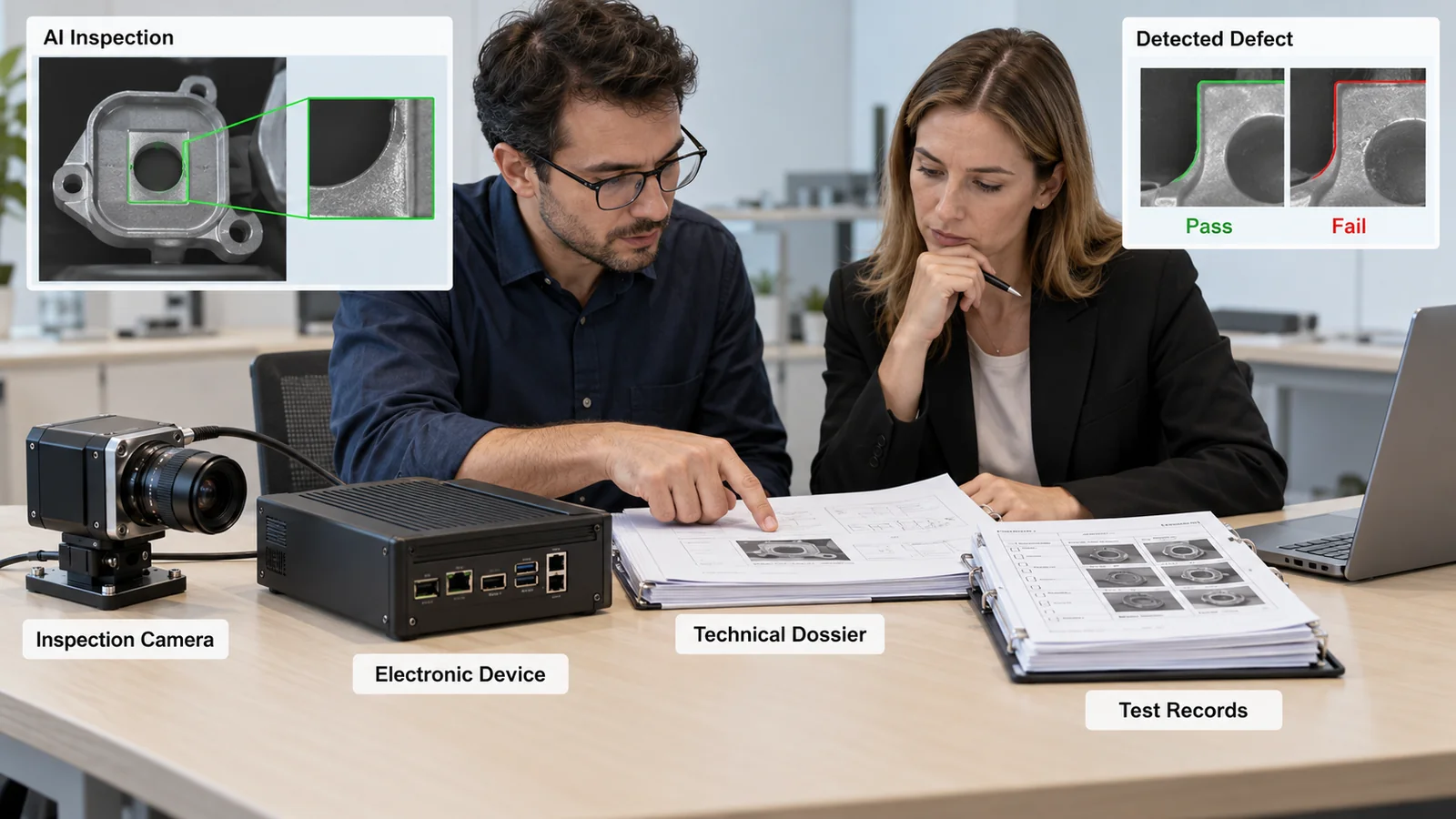
| That Figures 2 to 6 are explanatory drawings, and that Figures 1 and 7 are frames for AI-generated images | Note by this article | Commentary |
Last updated: 15 October 2026 / Sources are limited to primary material (the texts of Regulation (EU) 2024/1689 and Regulation (EU) 2026/1744 on EUR-Lex, official pages and guidelines of the European Commission, the CEN-CENELEC official page and ISO standard pages). The full texts of standards are paid and were not read. Summaries of the text and practical readings are marked as commentary or our calculation to keep them apart from sourced facts. Whether the Act applies to any individual company or product, Official Journal references for harmonised standards, national authorities' practice, and the implementation of items from 2 December 2026 onwards could not be confirmed and are not described. This article is not legal advice. We make no guess about the outcome of pending proceedings or future amendments. Figures 2 to 6 are vector drawings; Figures 1 and 7 are frames for AI-generated images (not yet created). None of them depicts a real company, product or site.