TECHNOLOGY EXPLAINER
World Models and Embodied AI
— how AI that predicts "what happens next" and moves a body works, and how to read its evaluation
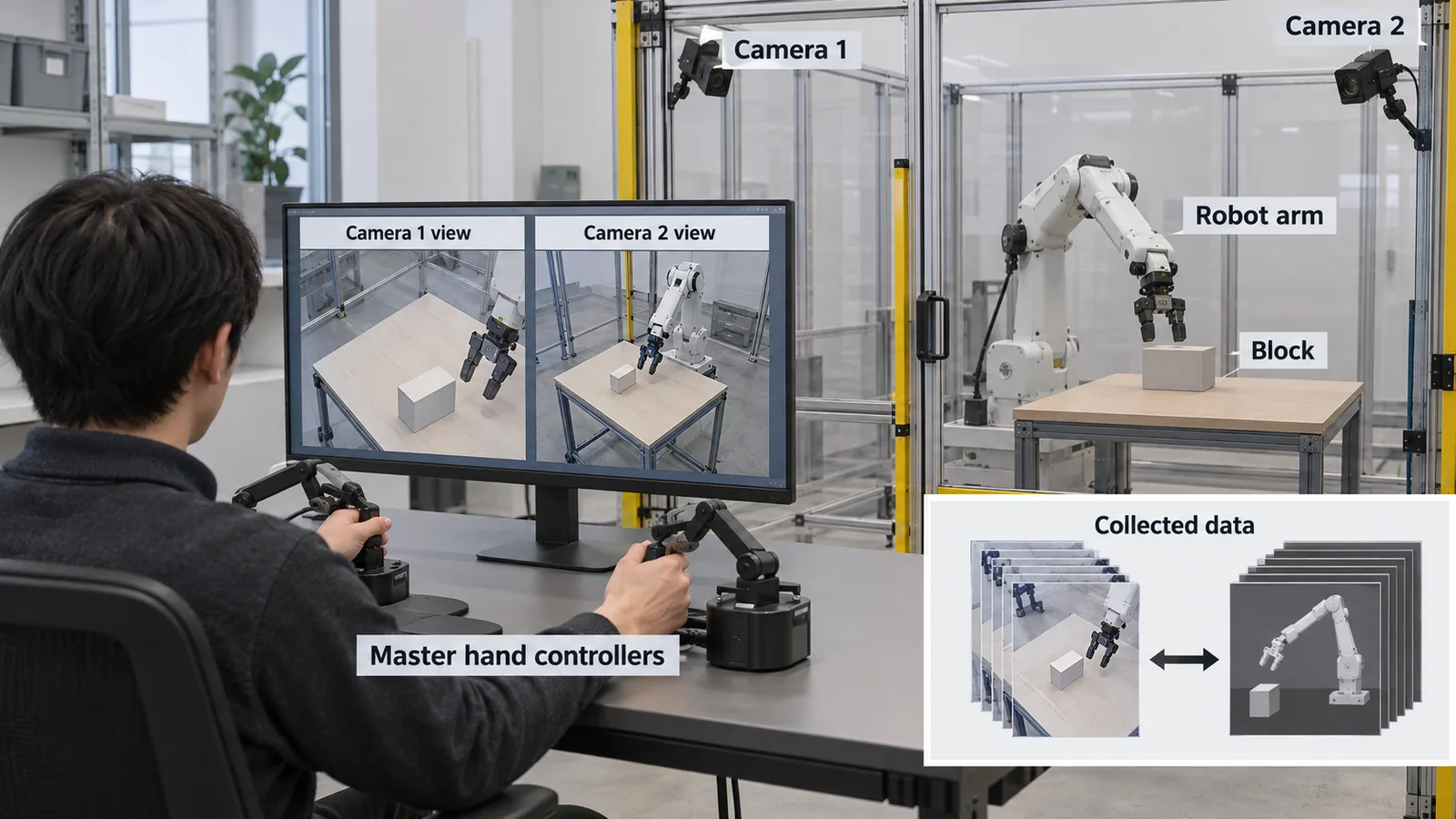
AI that has a body, as a robot does, and acts in the physical world is called embodied AI. Unlike a language model, a mistake here means hitting something, breaking it or striking a person, so "how to check it" matters as much as "how to build it". This article sets out, from primary sources, the three ways the phrase "world model" is used, robot foundation models (models that connect vision, language and action), the gap between simulation and real machines, data collection by teleoperation, and how to read success rates and safety standards. Robot mechanisms and drones are covered in this series' explainers on drones and robotics, so here we stay on the AI side.
- What embodied AI is (the short version)
- What a world model is — three uses
- Robot foundation models — connecting vision, language and action
- The gap between simulation and real machines
- Data collection — teleoperation and its neighbours
- How to read success rates (with our calculation)
- Limits, and what could not be confirmed
- How to read evaluations and standards
- Glossary
- References (primary sources)
- Claim-to-source audit
Sourced = stated in published material (link given)
Our calculation = a figure this article derived, with the assumptions spelled out
Not yet confirmed = a plan, schedule or standard still being drafted, whose outcome is not confirmed
Other readings are marked separately as Commentary. Inference is shown in bold.
This field moves fast, and the state of models and standards changes within months. The model names, dates and standard stages here are what could be confirmed in public documents on 15 October 2026. Robot success rates are values reported by developers or researchers for a particular robot, task, environment and number of trials. Numbers from different settings are not lined up here to rank models. Words such as "first" and "general-purpose" are treated as the developers' own claims.
1. What embodied AI is (the short version)
- "World model" has three meanings: (1) an environment model for control that predicts how the environment changes with the agent's actions, (2) a model that generates video and so "simulates" a world, and (3) JEPA-type models that learn representations by predicting video features. The same phrase differs in what is predicted and how it is checkedSourced [Sources 1, 7, 6]
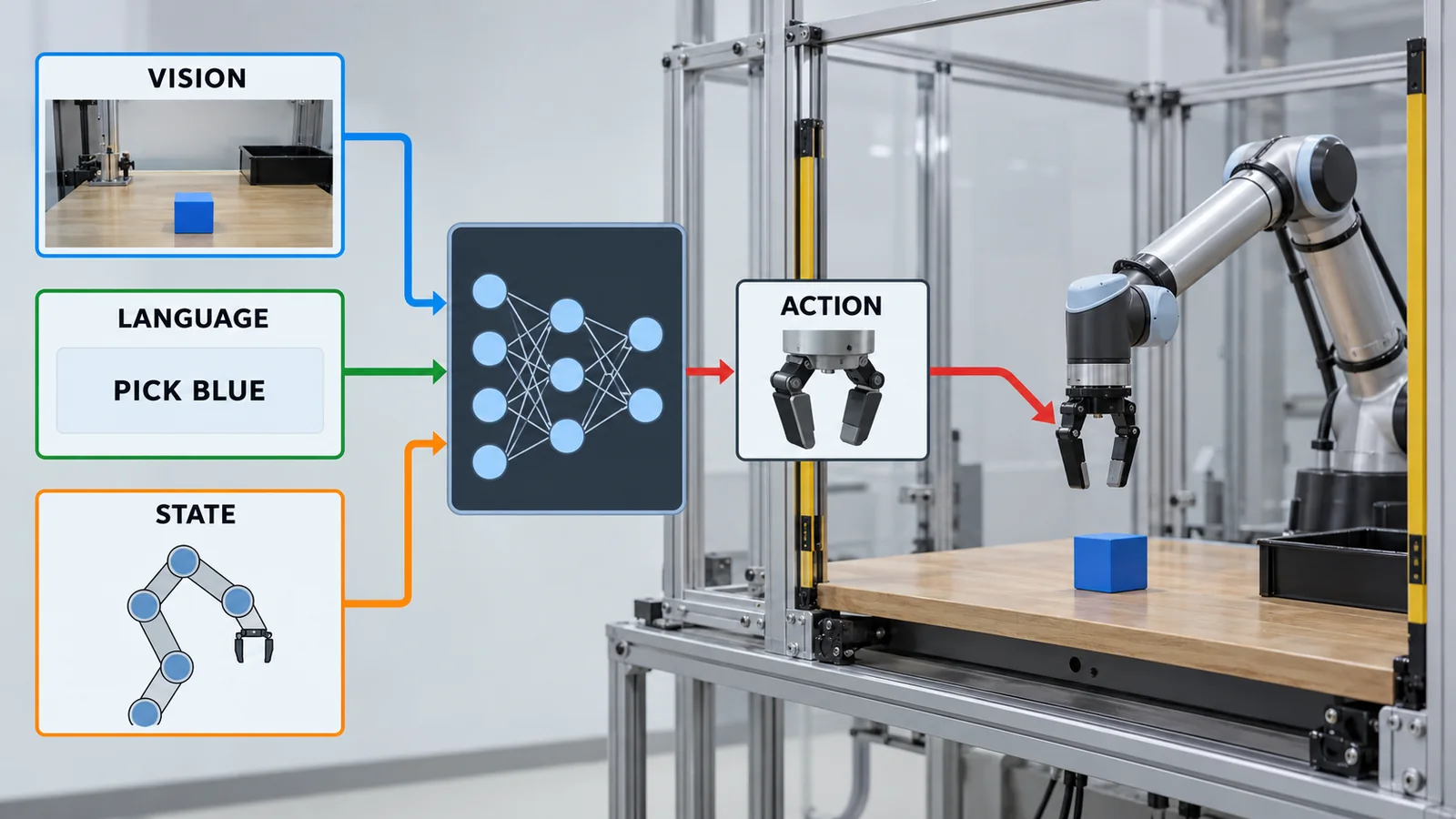
- Robot foundation models (VLA) are built by making a vision-language model output "actions": they take images and a language instruction and output robot actions. Training data is a mixture of teleoperation records, human video and simulationSourced [Sources 12, 15, 16, 18]
- "Success in simulation" is not "success on the real robot": physical quantities such as friction, contact, vision and latency all drift. A robot's success rate has a wide range when trials are few, and what "90%" means depends on the number of trialsSourced / Our calculation
A robot's success rate cannot be compared as a number unless the number of trials and the conditions are stated. The same "90%" has a 95% confidence interval of roughly 60-98% if it is 9 of 10, and roughly 88-92% if it is 900 of 1,000Our calculation (Section 6).
2. What a world model is — three uses
"World model" refers to the idea that an AI holds internally how the world changes (including as a result of its own actions). In research, however, there are three different uses. Below they are sorted according to the papers and technical reports.
(1) An environment model for control: from World Models to Dreamer
"World Models" by Ha and Schmidhuber (2018) builds generative models of reinforcement-learning environments that learn a compressed spatial and temporal representation in an unsupervised way. Features taken from it are fed to a very small policy that solves the task, and the authors report that they could even train the agent entirely inside its own "hallucinated dream" generated by the world model and transfer the policy back to the real environmentSourced [Source 1]. Dreamer (Hafner et al.) learns behaviors from trajectories "imagined" in the latent space of a learned world model and reports exceeding existing approaches in data efficiency, computation time and final performance on 20 visual control tasks [Source 2]. Its successor DreamerV3 handles over 150 diverse tasks with a single configuration and is reported as the first algorithm to collect diamonds in Minecraft from scratch without human data or curricula (Nature 640, 2025)Sourced [Source 3].
(2) A "world simulator" made by video generation
There is a view that treats video generation models as simulators of the world. OpenAI's technical report on Sora (15 February 2024) suggests that scaling video generation is a promising path toward general-purpose simulators of the physical world, while the same report lists limits: it does not accurately model the physics of many basic interactions such as glass shattering, and interactions like eating food do not always yield correct changes in object stateSourced [Source 10].
Genie (Bruce et al., 2024) is a "generative interactive environment" trained in an unsupervised manner from unlabelled Internet videos; at 11 billion parameters it is positioned as a foundation world model, made of a spatiotemporal video tokenizer, an autoregressive dynamics model and a latent action model. The paper says users can act frame by frame in the generated environments although training used no ground-truth action labels [Source 7]. Genie 3 (blog post of Google DeepMind dated 5 August 2025) describes generating from text a world that can be navigated in real time at 24 frames per second and 720p, with consistency retained for a few minutes. The same blog lists current limits: the range of actions the agent itself can perform is limited, accurately modeling interactions between multiple agents is still a research challenge, real-world locations cannot be simulated with perfect accuracy, and continuous interaction lasts a few minutes rather than hoursSourced [Source 8].
NVIDIA's Cosmos, on the premise that "Physical AI needs to be trained digitally first", is a platform with a video curation pipeline, pretrained world foundation models and video tokenizers; the paper says the models are released as open weights under permissive licensesSourced [Source 9].
(3) Predicting representations: JEPA
JEPA (Joint-Embedding Predictive Architecture) is a design that predicts representations (features) rather than reconstructing pixels. I-JEPA is a non-generative self-supervised method that predicts the representations of several target blocks of an image from one context block of the same image [Source 4]. V-JEPA is trained only with feature prediction on video (2 million videos) and, the paper reports, yields representations that work for both motion and appearance tasks even with a frozen backbone [Source 5]. V-JEPA 2 was pretrained without actions on over 1 million hours of Internet video, then post-trained into an action-conditioned latent world model (V-JEPA 2-AC) using fewer than 62 hours of unlabelled robot video from the Droid dataset. The paper reports deploying it zero-shot on Franka arms in two labs, picking and placing objects by planning with image goals, without extra trainingSourced [Source 6].
Even though Sora is called a "world simulator", the same report lists its physical errors. Genie 3's "consistency for a few minutes" is the developer's description. Looking natural as video is a different property from predicting accurately in response to actions, and a common standard metric for the latter was not found in what we checked (Section 8). Results for robots that use world models are likewise reports for "a particular robot and a particular task", as with V-JEPA 2-AC.
3. Robot foundation models — connecting vision, language and action
After the success of language models, the idea spread of "pretraining one model on large, diverse data and using it for many robots and tasks". A vision-language model that outputs robot actions is called a VLA (vision-language-action) model.
View original SVG, values and source annotations
(1) The thread: from RT-1 and RT-2 to generalist policies
RT-1 (Brohan et al., 2022) built on large-scale data collection with real robots, studied generalization as a function of data size, model size and data diversity, and argued that high-capacity models can absorb diverse robot data [Source 11]. RT-2 co-fine-tunes a web-scale vision-language model on robot trajectory data and web vision-language tasks, expressing actions as text tokens in the same format as language. It reports, over 6,000 evaluation trials, better generalization to novel objects and the ability to interpret commands not in the robot training dataSourced [Source 12].
Open X-Embodiment puts data from 22 robots collected by 21 institutions, showing 527 skills (160,266 tasks), into standardized formats, and reports that RT-X trained on it shows "positive transfer" from other platforms' experience [Source 13]. Octo is an open policy trained on 800,000 trajectories of that data and, it says, can be fine-tuned to new sensors and action spaces within a few hours on consumer GPUs [Source 14]. OpenVLA is a 7-billion-parameter open VLA trained on 970,000 real-robot demonstrations; the paper reports that it beats RT-2-X (55 billion) by 16.5% in absolute task success rate across 29 tasks with 7 times fewer parameters (a value under the paper's conditions)Sourced [Source 15].
(2) How actions are generated: diffusion, flow, text
Ways of producing actions fall into three groups (Fig. 3): as text tokens, as in RT-2; by diffusion, as in Diffusion Policy (Chi et al.); and by flow matching, as in π0. Diffusion Policy reports an average improvement of 46.9% over existing state-of-the-art methods across 12 tasks from 4 robot-manipulation benchmarks [Source 21]. π0 (Physical Intelligence) places a flow-matching architecture on a pretrained VLM, trains on data from several dexterous platforms (single-arm, dual-arm and mobile manipulators), and evaluates on tasks including laundry folding, table cleaning and box assemblySourced [Source 16].
(3) Recent models (developers' technical reports)
| Model (source) | Key points of the design (as the report describes it) | Data and reported evaluation | Cautions when reading |
|---|---|---|---|
| π0.5 (Physical Intelligence) [Source 17] | Builds on π0 and aims at broad generalization through co-training on heterogeneous tasks. Uses data from several robots, high-level semantic prediction, web data and other sources | Reports, for the first time, that an end-to-end learning-enabled robotic system performed long, dexterous work such as cleaning a kitchen or bedroom in entirely new homes | A report on the developer's own tasks and robots. The number of "new homes" and the conditions of success rates must be checked in the text |
| GR00T N1 (NVIDIA) [Source 18] | An open foundation model for humanoid robots. A vision-language module (System 2) and a diffusion transformer that generates motion in real time (System 1) are trained together | Trained on a mixture of real-robot trajectories, human video and synthetic data. Reports beating imitation-learning baselines on simulation benchmarks and a bimanual demonstration on the Fourier GR-1 | The baselines and benchmarks were chosen by the paper. This is not a ranking against other companies' models |
| Gemini Robotics (Google DeepMind) [Source 19] | Two models: a VLA built on Gemini 2.0 and Gemini Robotics-ER, with stronger spatial and temporal understanding (object detection, pointing, trajectory and grasp prediction and more) | Reports that with additional fine-tuning, new short-horizon tasks can be learned from as few as 100 demonstrations | Reports on the developer's own tasks. Reproduction could not be confirmed |
| Gemini Robotics 1.5 [Source 20] | Motion Transfer to learn from data of different embodiments, multi-level reasoning in natural language before acting, and ER 1.5, which is described as state of the art | Describes improved decomposition and execution of multi-step tasks | "State of the art" is the developer's description |
All Sourced (descriptions in each technical report). This is not an evaluation comparison table. Robots, tasks, environments and trial counts differ, so these results cannot be lined up to rank models.
4. The gap between simulation and real machines
Training a robot entirely on a real machine takes time and money. So robots are trained in simulation and transferred to the real machine (sim-to-real), but the difference between simulation and reality (the reality gap) is an obstacle. The sources of the gap are sorted below from the papers.
- Randomizing rendering (Tobin et al., 2017): randomizing the simulator's rendering so that "the real world may appear to the model as just another variation". The paper reports that from simulator data with only non-realistic random textures, an object detector accurate to 1.5 cm in the real world could be trained and used for grasping in a cluttered environmentSourced [Source 22]
- Randomizing physical quantities (OpenAI, 2018): in-hand object reorientation on a Shadow Dexterous Hand was trained entirely in a simulation that randomizes many physical properties such as friction coefficients and object appearance, and transferred to the real hand without human demonstrations [Source 23]. A later paper reports solving a Rubik's cube with a humanoid robot hand using automatic domain randomization (ADR)Sourced [Source 24]
- Legged robots: Hwangbo et al. report transferring a neural-network policy trained in simulation to ANYmal, achieving velocity-command tracking, faster running and recovery from falls [Source 25]. Lee et al. then describe a learning-based locomotion controller that enables ANYmal to traverse challenging natural environments [Source 26]Sourced
- A GPU-parallel simulation framework (Isaac Lab): the paper describes it as one framework combining high-fidelity GPU-parallel physics, photorealistic rendering, actuator models, sensor simulation, data collection and domain-randomization toolsSourced [Source 27]
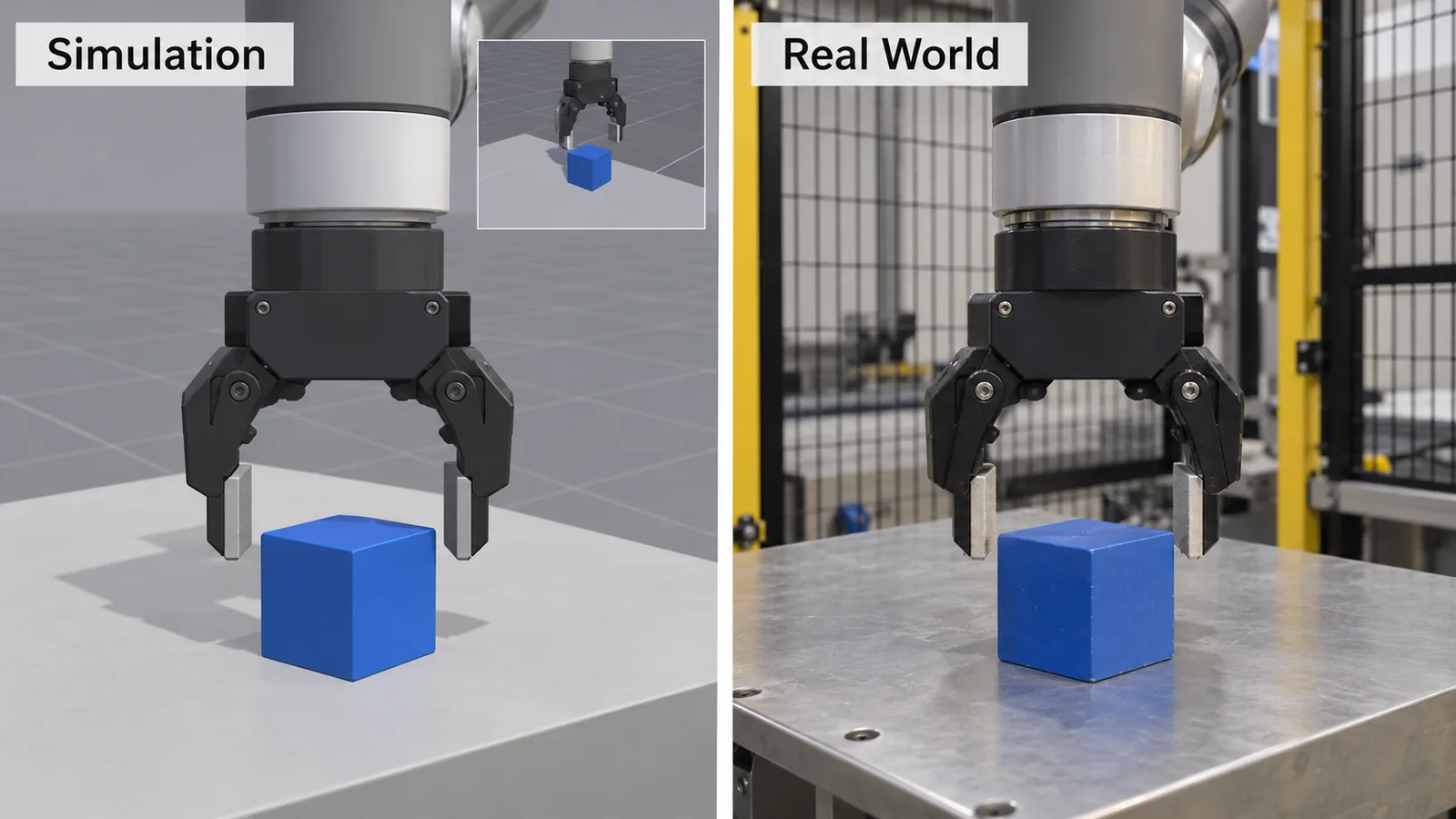
Note that the things being randomized include material parameters such as friction coefficients [Source 23]. A simulator approximates contact with simplified models, so if friction, stiffness, damping or surface roughness differ from the real thing, the policy does not behave as expected on the real machine. Materials that deform or flow — cloth, cables, powders, liquids — are harder still to reproduce (this is this article's commentary; we did not confirm a primary source that measured the reproduction accuracy of deformable materials).
This is where materials knowledge helps: give a property not as a single point but as a measured range. For example, use the spread of measured friction coefficients and elastic moduli of the grasped objects and of the floor or fixture surfaces as the basis for the randomization range. There may be a trade-off: too wide a range makes the policy overly cautious, too narrow and it fails on the real machine (an inference; a general view, not a quantified result in a paper).
The gap in evaluation: SIMPLER (Li et al.) starts from the point that real-world evaluation of policies does not scale and has reproducibility problems, and builds simulated evaluation environments that mitigate the control and visual disparities. In paired real and simulated evaluations it reports a strong correlation between policy performance in the two, and that behavior modes such as sensitivity to distribution shift are also reflected. This is a result for particular robot setups and does not necessarily hold for every robot and taskSourced [Source 34].
5. Data collection — teleoperation and its neighbours
The "fuel" of robot foundation models is records of robot actions. Unlike the web documents of language models, robot data does not pile up by itself; it has to be gathered by people operating. The main methods are sorted below from the papers.
| Method | Examples (sources) | Key points (as the papers describe them) | Cautions |
|---|---|---|---|
| Low-cost teleoperation | ALOHA / ACT [Source 28], Mobile ALOHA [Source 29] | ALOHA tests whether low-cost, imprecise hardware can do fine tasks through imitation learning from demonstrations. With ACT, a generative model over action sequences, it learns 6 difficult tasks (opening a translucent condiment cup, slotting a battery and so on) with 80-90% success from only 10 minutes of demonstrations, the paper reports. Mobile ALOHA adds a mobile base and whole-body teleoperation, and reports that co-training with existing data on 50 demonstrations per task raised success rates by up to 90% | The paper itself lists as challenges that policy errors can compound over time and that human demonstrations can be non-stationary |
| Humans demonstrating with hand-held tools | UMI [Source 30] | Collect in-the-wild demonstrations with hand-held grippers, without robots, and transfer them directly to robot policies. With inference-time latency matching and a relative-trajectory action representation, the resulting policies are hardware-agnostic and deployable across several robots, it says | The quality of the demonstration (the person's skill, conditions) is reflected directly in the policy (commentary) |
| Large distributed collection | DROID [Source 31] | 76,000 demonstration trajectories (350 hours) across 564 scenes and 84 tasks, collected by 50 people in North America, Asia and Europe over 12 months. Training on diverse data improved performance and generalization, it reports | The paper notes that collecting data in diverse environments needs large investments in logistics, safety, hardware and labour |
| Shared data across institutions | Open X-Embodiment [Source 13] | Standardizes 21 institutions, 22 robots and 527 skills | Action spaces differ between robots. A mechanism for fine-tuning to new action spaces is needed, as in Octo [Source 14] |
| Combining human video and synthetic data | GR00T N1 [Source 18], V-JEPA 2 [Source 6] | GR00T N1 trains on a mixture of real-robot, human-video and synthetic data. V-JEPA 2-AC conditions on actions using fewer than 62 hours of robot video | How to treat video that has no action labels is a key design point |
All Sourced (descriptions in each paper). The way of grouping the methods is this article's own (commentary).
Our calculation DROID has 350 hours and 76,000 trajectories. 350 hours = 350 x 3,600 = 1,260,000 seconds, so the average trajectory is 1,260,000 / 76,000 = about 16.6 seconds. The Droid robot video used by V-JEPA 2-AC is under 62 hours (paper), at most about 18% of 350 hours (62 / 350).
Assumptions and limits: these are simple divisions of values stated in the papers. Which part of DROID the 62 hours came from was not checked beyond what the paper says. The averages say nothing about the distribution of trajectory lengths or the difficulty of the operations.
Data collected by teleoperation contains the operator's skill, habits and day-to-day variation of conditions. That is the point the ACT paper makes when it says human demonstrations can be non-stationary [Source 28]. As with factory process data, records of the data's quality and conditions (who, when, with which robot, on which objects, in what environment) become the clue for tracing a policy's failures later. Controlling variation, and deciding whether to keep failed demonstrations, are questions of data design (this article's commentary).
Using a person's skill as training data also raises questions about how expert know-how is handled (rights, labour, confidentiality), but this article does not give legal advice.
6. How to read success rates (with our calculation)
Robot papers show performance as the success rate of a task. In words familiar to materials and process engineers, it is yield. As with yield, a success rate cannot be interpreted without how many times it was tried and under what conditions.
Our calculation Assuming that trials are independent and conditions are the same, we calculate 95% confidence intervals with the Wilson method.
- When the observed rate is 90%: 9 of 10 gives about 59.6-98.2%, 18 of 20 about 69.9-97.2%, 45 of 50 about 78.6-95.7%, 90 of 100 about 82.6-94.5%, and 900 of 1,000 about 88.0-91.7%
- When every trial succeeds: even with 20 of 20, the lower end of the 95% interval is about 83.9%; about 92.9% at 50, about 96.3% at 100 and about 98.7% at 300
- The "rule of three": with zero failures in n trials, the 95% upper bound on the failure rate is about 3 / n. To say the failure rate is at most 1% takes about 300 consecutive successes (3 / 299 = about 1.0%)
- Chained steps: if each step succeeds 90% of the time, independently, the chance of succeeding at five steps in a row is 0.95 = about 59%
Assumptions and limits: real-robot trials vary with object placement, lighting, wear and so on, and need not be independent. The interval expresses only the statistical spread of the sample and does not include errors from biased conditions. These are not results of any real robot.
The scale of evaluation in real papers varies. RT-2 reports 6,000 evaluation trials [Source 12], and RoboArena ranks seven policies with more than 600 real-robot head-to-head episodes (double-blind pairwise comparisons) [Source 35]. RoboArena starts from the point that conventional evaluation, which standardizes fixed tasks, environments and locations, does not readily scale to generalist policies across many tasks and environments, and proposes a crowd-sourced method in which evaluators freely choose the tasks and environments and compare two policies double-blind. Evaluators at seven academic institutions took part using the DROID platform, and the paper reports that it ranks policies more accurately than conventional centralized evaluation and is more scalable, resilient and trustworthySourced [Source 35].
Simulated benchmarks are also used. LIBERO is a lifelong-learning benchmark for robot manipulation that provides four task suites (130 tasks in total) and human-teleoperated demonstrations [Source 32]. CALVIN is a benchmark for learning language-conditioned policies for long-horizon robot manipulation [Source 33]Sourced. Success in simulation, however, does not guarantee success on the real machine (Section 4).
Nobody would claim a process yield of "90%" on 20 prototypes. The same holds for robots: a "90%" from a handful of trials is weak as a claim of process capability. When considering adoption, check (1) how many times it was tried, (2) over what range objects, placement and lighting were varied, (3) what the failures were (missed grasps, drops, collisions, stops), and (4) whether a person intervened (this article's commentary). The "product over chained steps" (0.9 to the fifth power is about 59%) also shows that overall success falls quickly as work gets longer. Look at the success rate of the whole task, not only of each step.
7. Limits, and what could not be confirmed
(1) Performance of current models
The models here (π0, GR00T N1, Gemini Robotics and others) and their success rates are values for the time and settings of each report. We have not covered every latest model as of 15 October 2026 or later evaluations. We have not checked independent third-party reproduction of real-robot results.
(2) Verifying world models
A common standard metric for the "physical accuracy" of world models could not be confirmed. For Genie 3 we did not check details of availability, such as whether it is a limited research preview. The text of Yann LeCun's 2022 position paper (on OpenReview) was not checked because automated retrieval was refused. The explanation of JEPA is limited to what the I-JEPA, V-JEPA and V-JEPA 2 papers describe.
(3) Standards
ISO's standard pages refuse automated retrieval, so numbers, titles, editions, dates and scope were checked from the official-page entries shown in search results; the texts of the standards were not checked. A standard that directly defines how to evaluate the safety of learned policies (robot foundation models) could not be found.
(4) What is not covered
Robot mechanisms, actuators and sensors, and drones are covered in the explainer on drones and robotics; materials discovery and self-driving laboratories in the explainer on materials informatics; autonomous driving in the explainer on autonomous driving and AI. Humanoid products and business plans, robot prices and market size are not covered.
- "World model" is used in three senses. An environment model for control, a video-generating simulator, and JEPA, which predicts representations. We do not infer capability from the nameSourced
- Robot foundation models are built by making a vision-language model output actions. Actions are generated as text, by diffusion or by flow, and the data mixes teleoperation, human video and synthetic dataSourced
- The sim-to-real gap lies in material parameters, contact, vision and latency. It is eased by randomization and by paired evaluation against real machinesSourced
- Read success rates through the number of trials and the conditions. A "90%" of 9 in 10 spans about 60-98%; 900 in 1,000 spans about 88-92%Our calculation
- Safety rests mainly on existing standards such as those for industrial robots; a standard directly addressing learned policies could not be foundSourced
8. How to read evaluations and standards
Evaluating embodied AI has four sides: (1) task success rates (on real robots and in simulation), (2) the quality of a world model's predictions, (3) the quality and quantity of data, and (4) safety. Benchmarks differ by study in tasks, environments and robots, and safety rests on existing standards such as those for industrial robots. An international standard that directly evaluates a learned policy itself could not be found in what we checked.
| What is evaluated | Representative benchmarks and methods (name, source) | Standards and guidance (ISO, NIST and others) | Cautions when reading |
|---|---|---|---|
| Policy evaluation in simulation | LIBERO: four task suites, 130 tasks, with teleoperated demonstrations (Liu et al.) [Source 32]. CALVIN: language-conditioned long-horizon manipulation (Mees et al.) [Source 33]. SIMPLER: simulated environments that reproduce real-robot policy evaluation (Li et al.) [Source 34] | Not found | SIMPLER reports a strong correlation with real-robot results for particular robot setups; generalization to other setups is not guaranteed. A simulated score is no substitute for a real-robot score Sourced |
| Policy evaluation on real robots | RT-2: 6,000 evaluation trials [Source 12]. RoboArena: distributed double-blind pairwise evaluation in which evaluators freely choose tasks and environments (Atreya et al.; seven policies, over 600 episodes) [Source 35] | ISO 18646-3:2021 (test methods for the performance of service robots in grasp size, grasp strength, resistance to grasp slip and opening doors; not usable to verify safety) [Source 42]. ISO 18646-1:2016 (locomotion of wheeled robots) [Source 40], ISO 18646-2:2024 (navigation) [Source 41] | The width of a success rate changes with the number of trials and the conditions (Section 6). ISO 18646 provides test methods for the performance of indoor service robots and does not define how to evaluate the generalization of learned policies (per its stated scope) Sourced |
| Locomotion of legged robots | (a standard, not a benchmark) | ISO/FDIS 18646-5 (performance tests for locomotion of legged robots; final draft stage) [Source 43] | Still being drafted; the content is not settled Not yet confirmed |
| Quality of a world model's predictions | V-JEPA 2: motion understanding (top-1 77.3 on Something-Something v2), human action anticipation (recall-at-5 39.7 on Epic-Kitchens-100) and robot planning (pick and place on Franka arms), as reported in the paper [Source 6]. Genie 3 and Sora: developers' descriptions and demonstrations [Sources 8, 10] | Not found | No common standard metric was found. Looking natural as video is separate from accuracy of prediction in response to actions. Developers' demonstrations may be selected examples (commentary) Sourced |
| Safety of industrial robots | (a standard, not a benchmark) | ISO 10218-1:2025 (safety requirements for the industrial robot itself; Edition 3, February 2025) [Source 36]. ISO 10218-2:2025 (industrial robot applications and robot cells) [Source 37]. ISO/TS 15066:2016 (collaborative robots; confirmed in 2022; listed as to be revised) [Source 38] | The ISO page lists among the changes in ISO 10218-1:2025 clearer functional-safety requirements, cybersecurity, and safety requirements for collaborative applications (formerly in ISO/TS 15066). It does not directly define how to evaluate learned policies Sourced |
| Safety of personal care robots | (a standard, not a benchmark) | ISO 13482:2014 (personal care robots: mobile servant, physical assistant and person carrier robots; sets out design, protective measures and user information, with a hazard catalogue in an annex; Edition 1, February 2014) [Source 39] | Positioned as complementing the industrial ISO 10218. The text is paid, so only the scope is given Sourced |
| Safety of dynamically stable industrial mobile robots | (a standard, not a benchmark) | ISO/CD 25785-1 (safety requirements for industrial mobile robots, legged, wheeled or otherwise, that stay stable through active control; committee draft stage) [Source 44] | Still being drafted; the content is not settled. ISO 18646-5, the performance standard for legged locomotion, must not be used in place of safety requirements Not yet confirmed |
| Using AI in safety-related functions | (a technical report, not a benchmark) | ISO/IEC TR 5469:2024 (functional safety and AI systems; describes the properties, risk factors and methods for using AI inside a safety-related function, for using non-AI safety functions to protect AI-controlled equipment, and for using AI to design safety-related functions; a technical report, not normative) [Source 46]. The ISO/IEC TS 22440 series is being drafted (committee draft stage) | A technical report gives information and does not set requirements. The text is paid, so only the scope is given Sourced |
| Terminology and risk-management frameworks | (a framework, not a benchmark) | ISO 8373:2021 (robotics vocabulary; a revision, ISO/DIS 8373, is in progress) [Source 45]. NIST AI RMF 1.0 (NIST AI 100-1, January 2023) [Source 47] | The NIST AI RMF is a framework intended for voluntary use. ISO 8373 is a vocabulary standard Sourced |
The organization of the table is this article's own (commentary). The texts of ISO standards are paid and were not checked. Standard stages follow the entries on ISO's official pages shown in search results (checked 15 October 2026).
Three cautions for materials engineers
- Success rates change with settings and evaluator. Results change with the robot model, task, object placement and evaluator. A developer's own report is not an independent evaluation. A simulated score is no substitute for a real-robot score, and real-robot trials should be read with confidence intervals based on the number of trials (Section 6)
- Saturation and contamination of benchmarks: in robotics, using the same tasks and the same environment for training and evaluation measures familiarity rather than generalization (a general point that includes an inference). Check that the evaluation environment is not part of training and that the objects and scenes are new. Saturation and contamination of benchmarks in general are covered in this series' explainer on benchmarks and how to read AI evaluations
- Standards: tell "requirement", "information" and "being drafted" apart. ISO 10218 sets safety requirements for industrial robots, ISO/IEC TR 5469 is a technical report that provides information, and ISO 25785-1 and ISO/IEC TS 22440 are being drafted. "Conforms to the standard" does not mean that a learned policy is safe. Legally binding regulation is covered in this series' explainer on the EU AI Act and others
9. Glossary
- Embodied AI
- AI that has a body, such as a robot, and perceives and acts in the physical world.
- World model
- A model that predicts how the environment changes in response to actions. It is used in several senses.
- VLA (vision-language-action)
- A model that takes images and language as input and outputs robot actions.
- Robot foundation model
- A large model pretrained on diverse robots and tasks and fine-tuned for use.
- Imitation learning (behavior cloning)
- Learning a policy from human demonstrations as training data.
- Teleoperation
- A person operates a robot remotely, and the record is used as learning data.
- Policy
- A function that decides actions from observations; here, a neural network.
- Sim-to-real
- Transferring a policy trained in simulation to a real machine.
- Reality gap
- The difference between simulation and reality.
- Domain randomization
- Randomly varying a simulator's rendering or physical quantities to make the policy robust to differences.
- JEPA
- Joint-Embedding Predictive Architecture: predicts representations (features), not pixels.
- Latent action
- An internal representation corresponding to an action, learned from unlabelled video (Genie).
- Embodiment
- The differences in a robot's body (shape, joints, sensors).
- Success rate
- The fraction of trials in which the task was achieved; to be read together with the number of trials and conditions.
- Confidence interval
- The statistical range of a value estimated from a sample. This article uses the 95% Wilson interval.
10. References (primary sources)
- Ha D., Schmidhuber J. "World Models", arXiv:1803.10122 (2018) — arxiv.org/abs/1803.10122
- Hafner D. et al. "Dream to Control: Learning Behaviors by Latent Imagination", arXiv:1912.01603 (2019) — arxiv.org/abs/1912.01603
- Hafner D. et al. "Mastering diverse control tasks through world models", Nature 640, 647-653 (2025); preprint arXiv:2301.04104, DOI 10.1038/s41586-025-08744-2 — doi.org/10.1038/s41586-025-08744-2
- Assran M. et al. "Self-Supervised Learning from Images with a Joint-Embedding Predictive Architecture", arXiv:2301.08243 (2023) — arxiv.org/abs/2301.08243
- Bardes A. et al. "Revisiting Feature Prediction for Learning Visual Representations from Video", arXiv:2404.08471 (2024) — arxiv.org/abs/2404.08471
- Assran M. et al. "V-JEPA 2: Self-Supervised Video Models Enable Understanding, Prediction and Planning", arXiv:2506.09985 (2025) — arxiv.org/abs/2506.09985
- Bruce J. et al. "Genie: Generative Interactive Environments", arXiv:2402.15391 (2024) — arxiv.org/abs/2402.15391
- Google DeepMind "Genie 3: A new frontier for world models" (blog post dated 5 August 2025). Checked 15 October 2026 — deepmind.google/discover/blog/genie-3-a-new-frontier-for-world-models
- NVIDIA et al. "Cosmos World Foundation Model Platform for Physical AI", arXiv:2501.03575 (2025) — arxiv.org/abs/2501.03575
- OpenAI "Video generation models as world simulators", technical report (15 February 2024). The official page blocks automated fetching, so the full text was checked in an Internet Archive copy — openai.com/index/video-generation-models-as-world-simulators
- Brohan A. et al. "RT-1: Robotics Transformer for Real-World Control at Scale", arXiv:2212.06817 (2022) — arxiv.org/abs/2212.06817
- Brohan A. et al. "RT-2: Vision-Language-Action Models Transfer Web Knowledge to Robotic Control", arXiv:2307.15818 (2023) — arxiv.org/abs/2307.15818
- Open X-Embodiment Collaboration "Open X-Embodiment: Robotic Learning Datasets and RT-X Models", arXiv:2310.08864 (2023) — arxiv.org/abs/2310.08864
- Octo Model Team "Octo: An Open-Source Generalist Robot Policy", arXiv:2405.12213 (2024) — arxiv.org/abs/2405.12213
- Kim M. J. et al. "OpenVLA: An Open-Source Vision-Language-Action Model", arXiv:2406.09246 (2024) — arxiv.org/abs/2406.09246
- Black K. et al. (Physical Intelligence) "π0: A Vision-Language-Action Flow Model for General Robot Control", arXiv:2410.24164 (2024; v4 of January 2026) — arxiv.org/abs/2410.24164
- Physical Intelligence et al. "π0.5: a Vision-Language-Action Model with Open-World Generalization", arXiv:2504.16054 (2025) — arxiv.org/abs/2504.16054
- NVIDIA et al. "GR00T N1: An Open Foundation Model for Generalist Humanoid Robots", arXiv:2503.14734 (2025) — arxiv.org/abs/2503.14734
- Gemini Robotics Team "Gemini Robotics: Bringing AI into the Physical World", arXiv:2503.20020 (2025) — arxiv.org/abs/2503.20020
- Gemini Robotics Team "Gemini Robotics 1.5: Pushing the Frontier of Generalist Robots with Advanced Embodied Reasoning, Thinking, and Motion Transfer", arXiv:2510.03342 (2025) — arxiv.org/abs/2510.03342
- Chi C. et al. "Diffusion Policy: Visuomotor Policy Learning via Action Diffusion", arXiv:2303.04137 (2023) — arxiv.org/abs/2303.04137
- Tobin J. et al. "Domain Randomization for Transferring Deep Neural Networks from Simulation to the Real World", arXiv:1703.06907 (2017) — arxiv.org/abs/1703.06907
- OpenAI et al. "Learning Dexterous In-Hand Manipulation", arXiv:1808.00177 (2018) — arxiv.org/abs/1808.00177
- OpenAI et al. "Solving Rubik's Cube with a Robot Hand", arXiv:1910.07113 (2019) — arxiv.org/abs/1910.07113
- Hwangbo J. et al. "Learning agile and dynamic motor skills for legged robots", Science Robotics 4, eaau5872 (2019), DOI 10.1126/scirobotics.aau5872 — doi.org/10.1126/scirobotics.aau5872
- Lee J. et al. "Learning quadrupedal locomotion over challenging terrain", Science Robotics 5, eabc5986 (2020), DOI 10.1126/scirobotics.abc5986 — doi.org/10.1126/scirobotics.abc5986
- NVIDIA et al. "Isaac Lab: A GPU-Accelerated Simulation Framework for Multi-Modal Robot Learning", arXiv:2511.04831 (2025) — arxiv.org/abs/2511.04831
- Zhao T. Z. et al. "Learning Fine-Grained Bimanual Manipulation with Low-Cost Hardware", arXiv:2304.13705 (2023) — arxiv.org/abs/2304.13705
- Fu Z. et al. "Mobile ALOHA: Learning Bimanual Mobile Manipulation with Low-Cost Whole-Body Teleoperation", arXiv:2401.02117 (2024) — arxiv.org/abs/2401.02117
- Chi C. et al. "Universal Manipulation Interface: In-The-Wild Robot Teaching Without In-The-Wild Robots", arXiv:2402.10329 (2024) — arxiv.org/abs/2402.10329
- Khazatsky A. et al. "DROID: A Large-Scale In-The-Wild Robot Manipulation Dataset", arXiv:2403.12945 (2024) — arxiv.org/abs/2403.12945
- Liu B. et al. "LIBERO: Benchmarking Knowledge Transfer for Lifelong Robot Learning", arXiv:2306.03310 (2023) — arxiv.org/abs/2306.03310
- Mees O. et al. "CALVIN: A Benchmark for Language-Conditioned Policy Learning for Long-Horizon Robot Manipulation Tasks", arXiv:2112.03227 (2021) — arxiv.org/abs/2112.03227
- Li X. et al. "Evaluating Real-World Robot Manipulation Policies in Simulation", arXiv:2405.05941 (2024) — arxiv.org/abs/2405.05941
- Atreya P. et al. "RoboArena: Distributed Real-World Evaluation of Generalist Robot Policies", arXiv:2506.18123 (2025) — arxiv.org/abs/2506.18123
- ISO ISO 10218-1:2025, "Robotics — Safety requirements — Part 1: Industrial robots" (Edition 3, February 2025) — iso.org/standard/73933.html
- ISO ISO 10218-2:2025, "Robotics — Safety requirements — Part 2: Industrial robot applications and robot cells" — iso.org/standard/73934.html
- ISO ISO/TS 15066:2016, "Robots and robotic devices — Collaborative robots" (February 2016; confirmed in 2022; listed as to be revised) — iso.org/standard/62996.html
- ISO ISO 13482:2014, "Robots and robotic devices — Safety requirements for personal care robots" (Edition 1, February 2014) — iso.org/standard/53820.html
- ISO ISO 18646-1:2016, "Robotics — Performance criteria and related test methods for service robots — Part 1: Locomotion for wheeled robots" — iso.org/standard/63127.html
- ISO ISO 18646-2:2024, "Robotics — Performance criteria and related test methods for service robots — Part 2: Navigation" — iso.org/standard/82643.html
- ISO ISO 18646-3:2021, "Robotics — Performance criteria and related test methods for service robots — Part 3: Manipulation" — iso.org/standard/73591.html
- ISO ISO/FDIS 18646-5, "Robotics — Performance criteria and related test methods for service robots — Part 5: Locomotion for legged robots" (final draft stage, per the search-result entry) — iso.org/standard/86850.html
- ISO ISO/CD 25785-1, "Robotics — Safety requirements for dynamically stable industrial mobile robots (legged, wheeled, or other forms of locomotion) — Part 1: Robots" (committee draft; under development) — iso.org/standard/91469.html
- ISO ISO 8373:2021, "Robotics — Vocabulary" (Edition 3, November 2021; a revision, ISO/DIS 8373, is in progress) — iso.org/standard/75539.html
- ISO ISO/IEC TR 5469:2024, "Artificial intelligence — Functional safety and AI systems" (technical report, Edition 1, January 2024) — iso.org/standard/81283.html
- NIST NIST AI 100-1, "Artificial Intelligence Risk Management Framework (AI RMF 1.0)" (January 2023) — doi.org/10.6028/NIST.AI.100-1
11. Claim-to-source audit
| Claim in the text | Basis | Class |
|---|---|---|
| World Models (a generative model of the environment; training a policy in a dream and transferring it); Dreamer (latent imagination; 20 visual control tasks); DreamerV3 (over 150 tasks, a single configuration, Minecraft diamonds, Nature 640) | Reference 1 https://arxiv.org/abs/1803.10122 Reference 2 https://arxiv.org/abs/1912.01603 Reference 3 https://doi.org/10.1038/s41586-025-08744-2 | Sourced |
| Sora report (15 February 2024; "general-purpose simulators of the physical world" as a suggestion; limits such as glass shattering); Genie (11 billion parameters; unsupervised; latent action model); Genie 3 (blog dated 5 August 2025; 24 frames/s at 720p; consistency for a few minutes; stated limits); Cosmos (a world foundation model platform; open weights) | Reference 10 https://openai.com/index/video-generation-models-as-world-simulators/ Reference 7 https://arxiv.org/abs/2402.15391 Reference 8 https://deepmind.google/discover/blog/genie-3-a-new-frontier-for-world-models/ Reference 9 https://arxiv.org/abs/2501.03575 | Sourced |
| I-JEPA (representation prediction across blocks); V-JEPA (2 million videos; feature prediction only); V-JEPA 2 (over 1 million hours of video; V-JEPA 2-AC from under 62 hours of robot video; zero-shot pick-and-place on Franka arms; motion understanding 77.3; action anticipation 39.7) | Reference 4 https://arxiv.org/abs/2301.08243 Reference 5 https://arxiv.org/abs/2404.08471 Reference 6 https://arxiv.org/abs/2506.09985 | Sourced |
| RT-1 (data size, model size, diversity and generalization); RT-2 (actions as text tokens; 6,000 evaluation trials); Open X-Embodiment (21 institutions, 22 robots, 527 skills, 160,266 tasks); Octo (800k trajectories; fine-tuning in hours on consumer GPUs); OpenVLA (7B, 970k demonstrations; +16.5% absolute success over RT-2-X on 29 tasks; 7x fewer parameters); Diffusion Policy (+46.9% on average over 12 tasks); π0 (flow matching on a VLM) | Reference 11 https://arxiv.org/abs/2212.06817 Reference 12 https://arxiv.org/abs/2307.15818 Reference 13 https://arxiv.org/abs/2310.08864 Reference 14 https://arxiv.org/abs/2405.12213 Reference 15 https://arxiv.org/abs/2406.09246 Reference 21 https://arxiv.org/abs/2303.04137 Reference 16 https://arxiv.org/abs/2410.24164 | Sourced |
| π0.5 (co-training; long dexterous tasks in new homes; "for the first time" is the developer's statement); GR00T N1 (System 2 and System 1; real-robot, human-video and synthetic data; Fourier GR-1); Gemini Robotics (built on Gemini 2.0; ER model; about 100 demonstrations); Gemini Robotics 1.5 (Motion Transfer; reasoning before acting) | Reference 17 https://arxiv.org/abs/2504.16054 Reference 18 https://arxiv.org/abs/2503.14734 Reference 19 https://arxiv.org/abs/2503.20020 Reference 20 https://arxiv.org/abs/2510.03342 | Sourced |
| Rendering randomization (object detection to 1.5 cm); physical-parameter randomization (friction coefficients and others; trained only in simulation); ADR and the Rubik's cube; ANYmal locomotion and rough-terrain traversal; Isaac Lab's components; SIMPLER (strong correlation with real robots, for particular robot setups) | Reference 22 https://arxiv.org/abs/1703.06907 Reference 23 https://arxiv.org/abs/1808.00177 Reference 24 https://arxiv.org/abs/1910.07113 Reference 25 https://doi.org/10.1126/scirobotics.aau5872 Reference 26 https://doi.org/10.1126/scirobotics.abc5986 Reference 27 https://arxiv.org/abs/2511.04831 Reference 34 https://arxiv.org/abs/2405.05941 | Sourced |
| ALOHA/ACT (80-90% on 6 tasks; 10 minutes of demonstrations); Mobile ALOHA (50 demonstrations; up to +90% by co-training); UMI (hand-held gripper; hardware-agnostic); DROID (76,000 trajectories, 350 hours, 564 scenes, 84 tasks, 50 collectors, 12 months); compounding policy errors and non-stationary human demonstrations | Reference 28 https://arxiv.org/abs/2304.13705 Reference 29 https://arxiv.org/abs/2401.02117 Reference 30 https://arxiv.org/abs/2402.10329 Reference 31 https://arxiv.org/abs/2403.12945 Reference 13 https://arxiv.org/abs/2310.08864 Reference 14 https://arxiv.org/abs/2405.12213 | Sourced |
| Average DROID trajectory of about 16.6 s (350 hours / 76,000 trajectories); the video used by V-JEPA 2-AC is at most about 18% of 350 hours (under 62 hours / 350 hours) | Our calculation: simple division of values stated in the papers (DROID: 350 hours, 76,000 trajectories; V-JEPA 2-AC: under 62 hours). Which part of DROID the 62 hours came from was not checked beyond the paper | Our calculation |
| 95% confidence intervals of success rates (Wilson method): 9 of 10 gives about 59.6-98.2%; 18 of 20 about 69.9-97.2%; 45 of 50 about 78.6-95.7%; 90 of 100 about 82.6-94.5%; 900 of 1,000 about 88.0-91.7%. Lower bounds when all trials succeed (about 83.9% at n = 20, 92.9% at 50, 96.3% at 100, 98.7% at 300); the rule of three; 0.9 to the fifth power = about 59% | Our calculation assuming independent trials under the same conditions; real runs vary and may not be independent. Not results of any real robot | Our calculation |
| LIBERO (four suites, 130 tasks, teleoperated demonstrations); CALVIN (language-conditioned long-horizon manipulation); RoboArena (double-blind pairwise comparison; seven policies; over 600 episodes; DROID platform; seven institutions) | Reference 32 https://arxiv.org/abs/2306.03310 Reference 33 https://arxiv.org/abs/2112.03227 Reference 35 https://arxiv.org/abs/2506.18123 Reference 12 https://arxiv.org/abs/2307.15818 | Sourced |
| ISO 10218-1:2025 (Edition 3, February 2025) and 10218-2:2025; ISO/TS 15066:2016; ISO 13482:2014; ISO 18646-1:2016, -2:2024 and -3:2021 (-5 at final draft stage); ISO/CD 25785-1 (under development); ISO/IEC TR 5469:2024 (technical report); ISO 8373:2021; NIST AI 100-1 (January 2023). Numbers, titles, editions and stages follow the official ISO pages (checked through search results); full texts were not checked | Reference 36 https://www.iso.org/standard/73933.html Reference 37 https://www.iso.org/standard/73934.html Reference 38 https://www.iso.org/standard/62996.html Reference 39 https://www.iso.org/standard/53820.html Reference 40 https://www.iso.org/standard/63127.html Reference 41 https://www.iso.org/standard/82643.html Reference 42 https://www.iso.org/standard/73591.html Reference 43 https://www.iso.org/standard/86850.html Reference 44 https://www.iso.org/standard/91469.html Reference 46 https://www.iso.org/standard/81283.html Reference 45 https://www.iso.org/standard/75539.html Reference 47 https://doi.org/10.6028/NIST.AI.100-1 | Sourced |
| Latest model performance and independent reproduction; a standard metric for the physical accuracy of world models; a standard directly defining the safety of learned policies; full texts of ISO standards; the text of LeCun's 2022 position paper; Genie 3's availability; primary sources measuring how well deformable materials are reproduced | Could not be confirmed in the primary sources accessible within this article's scope, so not stated | Commentary |
| The readings "do not infer capability from the name world model", "much of the gap is material parameters and contact", "teleoperation data is the operator's skill itself", "read success rates with the same statistics as process yield", "give randomization ranges from measured ranges (inference)", and the tables in Sections 2, 3, 5 and 8 | This article's own organization and explanation based on published content; not views expressed by any company or institution | Commentary |
| Figs. 2 to 4 and 6 are explanatory drawings, not measured data; Figs. 1 and 5 are AI-generated image slots | A note by this article | Commentary |
Last updated 15 October 2026. Sources are limited to primary material (arXiv papers, papers in Nature and Science Robotics, developers' technical reports and blog posts, ISO standard pages and official NIST documents). The texts of ISO standards are paid and could not be checked. Because the article includes readings and organization of its own, these are marked as Commentary and kept separate from sourced fact. Latest model performance, independent reproduction, a standard metric for world models, a standard that directly defines the safety of learned policies, and the texts of the standards could not be confirmed and are not stated here. Evaluation values such as success rates are for the settings of each report and do not show which model is better. Figs. 2 to 4 and 6 are vector drawings; Figs. 1 and 5 are AI-generated image slots (none of them shows a real measurement result or a physical robot).