TECHNOLOGY EXPLAINER
Deploying AI in Enterprises
— What lies between "we tried it" and "it keeps running"
More companies are using AI, but "using it" and "running it in daily operations" are different states. Official statistics report that 19.95% of EU enterprises with 10 or more employees used AI technologies in 2025, and that about one in five US businesses used AI in the past two weeks as of early May 2026. In a Japanese government survey of companies, 86.4% of respondents (excluding "don't know" answers) said they used generative AI in at least one business function. The surveys define "use" differently, so this article does not rank countries. We cover the main patterns of deployment (personal use, internal search, workflows, agents, and AI built into products), how a proof of concept (PoC) differs from operation at scale, data preparation, evaluation, how to measure cost and benefit, why projects fail, and governance, all within what official sources support. Cautions for manufacturing and R&D are added from a materials engineer's point of view.
- What deploying AI in an enterprise means (the short version)
- Where adoption stands: what public statistics show
- Patterns of deployment: from personal tools to AI in products
- How a PoC differs from operation at scale
- Data preparation — what "readable by AI" means
- Evaluation — measuring on three levels
- Measuring cost and benefit — our calculation
- Workflow automation — what happens as steps are added
- Why projects fail
- Governance structures
- Cautions for manufacturing and R&D
- Limits, and what we could not confirm
- How to read evaluations and standards
- Glossary
- References
- Claim-to-source audit
Sourced = stated in a published source (linked)
Our calculation = a value this article computed from stated assumptions
Not yet confirmed = a plan, schedule or proposal; no result has been confirmed
Interpretation of how to deploy AI is marked "our reading". An inference is shown in bold. This field changes quickly, so statistics, standards and guidelines carry a check date (15 October 2026).
Adoption rates, accuracy figures and productivity figures here come from specific surveys, experiments or company announcements. Performance figures that companies announce are treated as company claims; where the definition (what counts as correct, and how many cases were used) is not published, we say "could not be confirmed". We do not rank figures that come from different surveys, settings or evaluators. This article does not recommend deploying any particular product or company's offering, and it is not legal or investment advice.
1. What deploying AI in an enterprise means (the short version)
- "Using AI" covers a wide range. It runs from a general-purpose chat tool for drafting emails, to a system that answers from internal documents, to a system that hands part of a fixed procedure to AI, to AI built into a product customers see. Each needs different data, a different unit of evaluation, and a different weight of responsibility Sourced [Ref. 9, 14].
- A trial and daily operation are different problems. Daikin Industries announced a detection accuracy of 91% in an experiment at a training facility and 76% in a verification on actual field work, for an AI agent that checks work for omissions (company-announced values) Sourced [Ref. 11]. The same system gives different numbers once the data comes closer to the field.
- Benefit depends on how it is measured. In a field deployment in customer support, productivity rose by 15% on average, with a small drop in quality among the most experienced agents; in a randomized trial with experienced developers, completion time actually increased by 19% Sourced [Ref. 15, 17]. "It feels more convenient" and a measured result can disagree.
Deploying AI is less a job of choosing a model than a job of deciding which task, using which data, judged against what definition of success, with whom accountable. A RAND report, based on interviews with 65 experienced engineers, named "misunderstandings or miscommunication about what problem is to be solved" as the most common reason AI projects fail [Ref. 13]. Model performance is only one factor among several (our reading).
2. Where adoption stands: what public statistics show
Public statistics are the starting point for how widely AI is used. Surveys differ in who is covered (size and sector), how the question is worded and when it was run, so this article does not line numbers up to rank countries. We read each statistic for what it actually measures.
EU: Eurostat (2025)
According to Eurostat, 19.95% of EU enterprises with 10 or more employees used at least one AI technology in 2025. The list covers text mining, speech recognition, generation of written or spoken language or code, generation of images or audio, image recognition, machine learning for data analysis, automation of workflows or decision support, and machines that move autonomously. The figure is 6.47 percentage points higher than in 2024. By size, 17.00% of small, 30.36% of medium and 55.03% of large enterprises used AI; by country, Denmark was highest at 42.03% and Romania lowest at 5.21% Sourced [Ref. 1]. By sector, information and communication (62.52%) and professional, scientific and technical services (40.43%) stood out; every other sector was below 25% [Ref. 1].
Among enterprises that used AI in 2025, the most common purposes were marketing or sales (34.70%) and organising business administration processes or management (31.05%); logistics (6.08%) was the least common. In manufacturing, too, the leading purposes were marketing or sales (30.41%) and management (27.05%) [Ref. 1]. Among enterprises that had considered AI but did not use it, the most common reasons were lack of relevant expertise (70.89%), lack of clarity about legal consequences (52.52%) and concerns about data protection and privacy (48.83%) [Ref. 1].
United States: Census Bureau BTOS (December 2025 to May 2026)
The US Business Trends and Outlook Survey (BTOS) is a biweekly national survey. In data for 14 December 2025 to 3 May 2026, the share of businesses reporting AI use stayed in a 17-20% range, with a national value of 19.8% on 3 May 2026; 20-23% expected to use AI within six months. Among firms with 250 or more employees, 37% reported using AI; for firms with 100-249 employees it was 32% (period ending 3 May); and for firms with four or fewer employees it was under 20% Sourced [Ref. 2]. Caution: the Census Bureau explains that in November 2025 it changed the question from AI use "in producing goods or services" to AI use "in any business function" [Ref. 2]. Numbers before and after that change should not be read as one continuous time series.
Japan: MIC's 2026 White Paper (FY2025 corporate survey)
In the FY2025 corporate questionnaire run by the Ministry of Internal Affairs and Communications (MIC) in Japan, the United States, Germany and China, 68.9% of Japanese companies (49.7% in the previous year's survey) said their policy is to use generative AI actively or to use it in limited areas (74.0% of large companies, 58.1% of small and medium-sized ones). The white paper notes that Japan remains lower than the other three countries [Ref. 3]. Separately, excluding "don't know" answers to the policy question, 86.4% of Japanese companies said they use generative AI in at least one business function, up sharply from the previous survey and narrowing the gap with the other three countries [Ref. 4]. The two percentages have different denominators. The business types where Japanese companies use generative AI most are drafting minutes and emails (about 70%), sales (about 60%) and internal help desks (about 50%); about 70% also reported a sense of benefit for minutes and email drafting [Ref. 4].
For the expected effects of generative AI, the white paper reports that in Japan "greater efficiency through shorter work time" was highest at 61.6%, while in the other three countries "better products and services, for example through more accurate quality control or personalization" was highest [Ref. 5]. The white paper also offers the observation that in the other three countries companies are using generative AI in customer-facing products and services, and that pre-deployment review and post-deployment evaluation structures may be developing accordingly [Ref. 6]. That is the white paper's reading, not proof of cause.
1. What counts as AI? Eurostat counts any of eight technologies, the Census Bureau counts use in the past two weeks, and MIC counts a respondent company's business use of generative AI.
2. Who answered? Company size and the respondent's role (management or front line) change what "using" means (our reading).
3. Does it measure depth? These statistics mainly ask whether AI is used. Whether it is embedded in core operations, or whether it produces results, needs a different kind of study (our reading).
3. Patterns of deployment: from personal tools to AI in products
The MIC white paper describes the staged approach of advanced companies as moving from "improving individual work with general-purpose AI" to "redesigning whole business processes on the premise of AI" [Ref. 9]. On the developer side, Anthropic distinguishes workflows, where large language models (LLMs) and tools are orchestrated through predefined code paths, from agents, where the LLM dynamically directs its own process and tool use, and recommends finding the simplest solution possible and adding complexity only when needed (the developer's own view) [Ref. 14]. The AI Guidelines for Business (version 1.2) define an AI agent as "an AI system that senses its environment and acts autonomously to achieve a specific goal" [Ref. 34]. The figure below is this article's own arrangement based on those sources. The division into patterns is ours and may not match how individual companies label their systems.
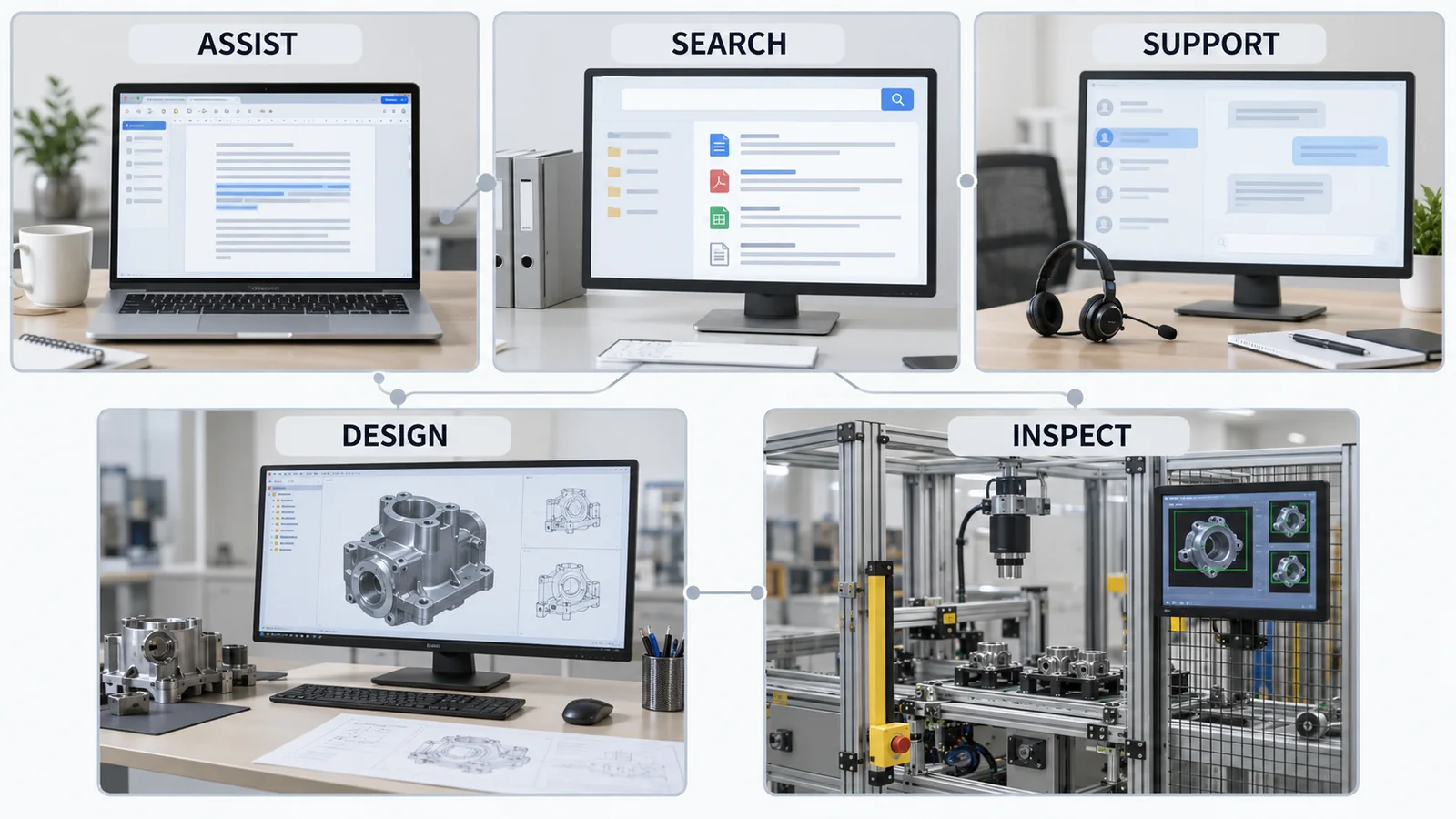
View original SVG, values and source annotations
| Pattern | What it does | Related examples found in official sources | Caution |
|---|---|---|---|
| 1 Personal tool | Individuals use general-purpose generative AI for summaries, drafts and lookups | The white paper says that introducing a general-purpose tool alone can bring some benefit, but that employees using AI on their own ("shadow AI") risk leaking confidential input [Ref. 9]. Nissin Foods Holdings selected target tasks by department, built prompt templates, measured the effect and rolled it out; the white paper reports that internal use of generative AI recently exceeded 70% [Ref. 9, 12] | The white paper warns that only a few enthusiastic employees may use the tool, without company-wide effect [Ref. 9] |
| 2 Internal search (RAG) | Searches internal documents and answers with a stated basis | The AI Guidelines for Business note that retrieval-augmented generation (RAG) is expected to help suppress hallucination and make the basis of outputs more transparent [Ref. 34] | This is an "expected" effect, not a guarantee. Document freshness and access rights are prerequisites |
| 3 Workflow | An LLM handles part of a procedure that humans have defined | Chugai Pharmaceutical states a policy of rewriting business processes that were designed on the premise that humans do the whole job (a company policy) [Ref. 7] | The path is fixed, so behaviour is predictable, but overall success falls as steps are added (Chapter 8) |
| 4 Agent | The LLM chooses procedures and how to use tools | Daikin Industries and Hitachi's equipment-fault diagnosis agent, which answers a maintenance engineer's question with a cause and countermeasure; Daikin Industries and Fairy Devices' omission-checking agent. Each company calls its system an "AI agent" [Ref. 10, 11] | Whether each company's "agent" matches this article's definition (the system chooses its own steps) cannot be confirmed from the published material |
| 5 In a product | Puts generative AI in products or services offered to customers | The white paper observes that companies in the other three countries are applying generative AI to customer-facing products and services, and that pre-deployment review and post-deployment evaluation structures seem to be developing [Ref. 6] | External accountability arises. In the AI Guidelines for Business the matters for "AI providers" are central [Ref. 34] |
All entries are statements in published sources (Sourced). The pattern arrangement and the caution column are our reading.
4. How a PoC differs from operation at scale
A PoC (proof of concept) asks "can it technically be done?"; operation asks "will it keep running in daily work, at a set quality, under someone's responsibility?" (our reading). Three examples from official sources show the difference.
| Example (official source) | Stage | Published performance figures (company announcements) | What we could not confirm |
|---|---|---|---|
| Daikin Industries and Hitachi Equipment-fault diagnosis AI agent (Sakai Plant, Rinkai Factory) | A pilot run from April 2025. The companies said they planned to finish the pilot and put it into practical use by September 2025 (Not yet confirmed) [Ref. 10]. The 2026 white paper says the companies "developed and introduced" it [Ref. 8] | In a prior verification, it answered with cause and countermeasure within 10 seconds at 90% or higher accuracy. For 5 types of equipment, cause-and-countermeasure proposals were estimated for 5 fault cases each (25 cases in all), and two expert maintenance engineers rated correctness on a 5-point scale [Ref. 10] | No company material announcing completion of the pilot or practical use was found within this survey. How "90% or higher" maps to the 5-point scale is not defined in the announcement |
| Daikin Industries and Fairy Devices Detecting omissions in inspection and repair from work video | Demonstration experiments. Full-scale use worldwide is a goal (Not yet confirmed) [Ref. 11] | Detection accuracy 91% in an experiment at a training facility and 76% in a verification on actual field work. The work won the top prize of the GENIAC-PRIZE (organised by METI and NEDO) [Ref. 11] | The definition of detection accuracy, the number of work items evaluated and the treatment of false alarms are not stated in the announcement |
| Chugai Pharmaceutical Company-wide generative AI app | Operation. Built in-house for about 7,800 employees, with an average of about 5,400 unique users (figure supplied by Chugai) [Ref. 7] | Number of users. Also, its "Digital Innovation Lab" lets the digital division fund projects up to the PoC stage; adoption at first did not ask for ROI, but now that a bottom-up culture has taken hold, the company says it introduces ideas into real work agilely as a minimum viable product (MVP) [Ref. 7] | Conversion of benefit into hours or money is not given in the white paper |
All entries are company announcements or white paper statements (Sourced); performance figures are company claims. Where the definition is not published, we do not compare them with other examples.
With few evaluation cases, the uncertainty of the result is large. As a general binomial example, suppose 22 of 25 cases are correct (88%) Our calculation.
- The 95% Wilson confidence interval is about 70.0% to 95.8%. With 25 cases, 88% and 76% cannot be told apart statistically.
- If the same 88% were 220 of 250, the interval narrows to about 83.4% to 91.5%.
Assumptions and limits: this is a generic example in which each case is judged right or wrong; it is not a recalculation of Hitachi's evaluation, which used a 5-point scale. It ignores bias in the sample of cases and variation between raters. Use it as a guide for choosing the number of cases.
An announcement of 91% at a training facility and 76% in the field resembles what happens in materials development when a property seen at laboratory scale does not reproduce on a pilot or production line (our reading). The sources of variation (people, equipment, lots, seasons) multiply once the system is in real use. The same logic applies to evaluating AI: design the trial so that it includes part of the worst real-world conditions, just as one runs condition sweeps when moving a material to mass production. In the Daikin Industries and Hitachi example, equipment drawings and past maintenance records were organised and loaded as a knowledge graph, and field users ask questions in plain language [Ref. 10]. The work of turning field knowledge into a form AI can use comes first.
5. Data preparation — what "readable by AI" means
The RAND report names five root causes of failed AI projects, and two of them concern data: the organization lacks the data needed to train an effective model, and it lacks the infrastructure to manage its data and deploy completed models Sourced [Ref. 13]. The MIC white paper likewise quotes Professor Sato of the National Institute of Informatics (Japan) as saying that the first step to successful AI deployment is whether the data is ready for AI ("AI-Ready"), and that for AI agents in particular the accuracy and freshness of data matter more Sourced [Ref. 36]. In the same white paper's survey, more than half of companies in the US, Germany and China answered that they train generative AI on internal data or have built databases that generative AI can consult; the share in Japan was much lower [Ref. 37].
The international standard series for data quality is ISO/IEC 5259 (data quality for analytics and machine learning); Part 1, ISO/IEC 5259-1:2024, covers an overview, terminology and examples. ISO's pages also list a package of the five parts (ISO/IEC 5259-1 to -5) [Ref. 24, 30]. On the management of scientific data, the FAIR principles (Findable, Accessible, Interoperable, Reusable) were proposed in Scientific Data in 2016 [Ref. 23]. These are recommendations and guidance; compliance is not legally required (our reading). The standards' full texts are paid and were not read, so their detailed requirements are not described here.
| Item to check | The question | Examples in materials and R&D (our reading) |
|---|---|---|
| Inventory of locations | Which data exists, where, and in what format? | Lab notebooks (paper and electronic), local folders on measuring instruments, PDF reports, test certificates received from suppliers |
| Metadata on conditions | Does each number carry the conditions under which it was obtained? | Temperature, humidity, specimen geometry, standard and edition, lot, instrument, operator. A property table stripped of conditions is misread by AI and by people alike |
| Unified units and notation | Is the same quantity written in the same unit and form? | MPa versus kgf/cm²; wt% versus mol%; full-width and half-width characters; abbreviations versus full names; internal code names |
| Failed and rejected data | Are unsuccessful experiments kept? | Rejected lots and records of aborted tests. With only successes, one can learn only the conditions that work |
| Permissions and confidentiality | Who may see which documents through AI? | Formulations, process conditions, customer-specific information. The white paper notes that leading companies narrow the range of data AI can consult [Ref. 36] |
| Freshness and ownership of updates | Are old versions left behind? Who updates? | Superseded standards and internal specifications, withdrawn specification sheets. There is no guarantee that AI will choose the "latest edition" |
The items and examples are our reading, not requirements listed by the standards or the white paper.
A material property changes meaning when the test method, specimen, temperature, humidity or history is removed. Before letting AI read internal documents, check that the conditions are written next to each number (our reading). When conditions sit away from the table (in body text, footnotes or another file), a search may retrieve only the number, and it ends up in an answer without its conditions. One remedy is to register each value with its unit, conditions and source (the test report number) in the same row at the time of entry. In many cases, deploying AI turns out to prompt an unglamorous but valuable job: standardising how data is written.
In ChemBench (more than 2,700 question-and-answer pairs on chemistry), the best of the evaluated models outperformed, on average, the best chemists in the study, but also struggled with some basic tasks and gave overconfident predictions [Ref. 22]. A confident-sounding answer is no guarantee that a number is right.
6. Evaluation — measuring on three levels
It helps to split the evaluation of AI into three levels according to the question asked (our arrangement): 1. the general capability of the model, 2. performance on your own tasks, and 3. business outcomes. A high result at level 1 can coexist with a low one at level 2, and a high result at level 2 may not translate into the outcome at level 3.
| Level | The question | Published evaluations (source and settings) | Reading note |
|---|---|---|---|
| 1 Model capability | How capable is the model in general? | HELM (Liang et al., arXiv 2022, TMLR 2023): measures 7 metrics (accuracy, calibration, robustness, fairness, bias, toxicity, efficiency) on 16 core scenarios, and evaluates 30 models on 42 scenarios under the same conditions [Ref. 19]. ChemBench (Mirza et al., Nature Chemistry 2025): evaluates chemical knowledge and reasoning with more than 2,700 questions [Ref. 22] | Results for the models and versions evaluated at the time; they do not apply to current models. The question distribution may differ from your own work |
| 2 Your own tasks | Does it reach the required quality on your questions, documents and procedures? | Public examples: τ-bench (Yao et al., arXiv 2024) evaluates dialogue with a user, tool calls and rule-following by comparing the database state at the end of a conversation with the goal state, and proposes pass^k for repeat reliability. In the original paper, the function-calling agents of the time (such as gpt-4o) succeeded on fewer than half of the tasks, and pass^8 was below 25% in the retail domain [Ref. 20]. SWE-bench (Jimenez et al., arXiv 2023): 2,294 real GitHub issues; in the original paper the best model of the time solved 1.96% [Ref. 21] | Both numbers are from the original papers (2023-2024) and do not show today's level (not checked). Benchmarks saturate and can be contaminated by training data, so keep your own evaluation set (our reading) |
| 3 Business outcomes | In practice, how did time, quality and rework change after deployment? | Customer support (Brynjolfsson et al., QJE 2025): staggered rollout of a generative AI assistant to 5,172 agents. Issues resolved per hour rose by 15% on average; less experienced workers improved in speed and quality, while the most experienced saw small speed gains and small quality declines [Ref. 15]. Management consultants (Dell’Acqua et al., Organization Science 2026): 758 people, 18 tasks. For tasks inside AI’s capability frontier, 12.2% more tasks completed and 25.1% faster; for a task outside it, people using AI were 19% less likely to produce a correct solution [Ref. 16]. Experienced developers (Becker et al., METR, arXiv 2025): 16 developers, 246 tasks, early-2025 tools. Developers forecast a 24% reduction in time and estimated afterwards that AI had cut it by 20%, but the measured time increased by 19% [Ref. 17] | Occupations, tasks, tool versions and periods differ, so we do not rank the numbers. Even "productivity" is measured differently (counts, time, quality raters) |
| (Supplement) Broad evaluation of professional tasks | How well can it produce deliverables close to those of real occupations? | GDPval (OpenAI, arXiv 2025): real work tasks for 44 occupations in the 9 sectors that contribute most to US GDP. Tasks were built by professionals with an average of 14 years of experience, and 220 tasks are public. The authors state that the best frontier models are approaching experts in deliverable quality (the evaluation was run by the developer) [Ref. 18] | A developer-designed and developer-run evaluation, and the authors' claim. There is no guarantee that it matches your work, or the practice of materials and chemistry |
All entries are Sourced (as reported by each source). The level arrangement is our reading. We do not rank numbers from different settings, versions or evaluators.
The three studies differ in task, worker experience and AI tool version. Rather than line them up as one scale, take only these points: 1. Effects are not uniform across people and tasks (QJE, Organization Science). 2. Perception and measurement can disagree (METR: forecast and post-hoc estimate were reductions, the measurement was an increase). The authors add that experimental artifacts cannot be entirely ruled out. 3. These studies use designs with a comparison without AI (a control) to measure effects.
Keep your own evaluation set
Public benchmarks are a guide for comparing models; they are not quality assurance for your operations. In the Daikin Industries and Hitachi example, the evaluation cases were divided by equipment type (5 types by 5 cases) and rated by experienced engineers [Ref. 10]. Points for building your own evaluation set are as follows (our reading).
- Collect from real questions and cases: build from past inquiries and defect reports, not only from imagined questions.
- Fix the criterion for correctness first: who scores, against what standard. If several people score, check how well they agree.
- Include hard cases on purpose: exceptions, old versions, contradictory documents and questions with no answer. Also evaluate whether the system can say "there is no answer".
- Rerun at every change: when the model version, retrieval settings or documents change, confirm no regression on the same set.
7. Measuring cost and benefit — our calculation
The cost of AI is not only usage fees (token charges or licences). The main components are usage fees, data preparation, labour for evaluation and verification, platform operation and maintenance, training, governance and review, and handling changes to models and documents (our reading). On the benefit side, some companies, such as Chugai Pharmaceutical, have a structure in which the digital division works alongside the front line and handles effect measurement [Ref. 36]. Below, hypothetical numbers show how costs break down and how to think about break-even.
Every number is an assumption. They are neither the prices of any real product nor the results of any company Our calculation.
- Usage: 20,000 questions a month. Each uses 6,000 input tokens (including retrieved documents) and 600 output tokens.
- Assumed unit prices: 450 yen for input and 2,250 yen for output (both per million tokens).
- Human checking: a staff member spends 3 minutes checking 20% of answers against the source. The staff cost is 5,000 yen per hour.
- Fixed operating cost: 1,000,000 yen a month for data updates, upkeep of the evaluation set and handling inquiries.
Usage cost per question is 6,000 × 450 / 1,000,000 + 600 × 2,250 / 1,000,000 = 2.7 + 1.35 = 4.05 yen, or 81,000 yen a month. Checking labour is 20,000 × 20% × 3 minutes = 12,000 minutes = 200 hours, or 1,000,000 yen. With the fixed cost, the monthly total is 2,081,000 yen.
- Usage fees are only about 3.9% of the total (81,000 / 2,081,000); checking labour (about 48%) and fixed cost (about 48%) make up most of it.
- Break-even is 2,081,000 yen divided by 5,000 yen, or 416.2 hours: 24,972 minutes a month divided by 20,000 questions, or about 1.25 minutes saved per question.
- If volume halves to 10,000 questions, the monthly total is 40,500 + 500,000 + 1,000,000 = 1,540,500 yen, and break-even rises to about 1.85 minutes per question.
Assumptions and limits: time "saved" does not necessarily go to other work and turn into value. As in the METR trial, perception and measurement can diverge [Ref. 17]. The share checked and the time per check vary greatly with the quality required (how many errors can be tolerated). The numbers illustrate how to read a cost breakdown.
Basics of measuring benefit
- Measure outcomes, not usage: logins and question counts show only that the tool is used. Choose indicators you can measure from before deployment, such as rework counts, lead time, missed inspection findings or time to resolve inquiries (our reading).
- Provide a comparison: the QJE study used the staggered rollout of a generative AI assistant to compare before and after, and adopters with non-adopters [Ref. 15]. If everyone gets the tool at once, its effect cannot be separated from seasons or other initiatives (our reading).
- Measure quality as well: looking only at speed misses quality declines. Even in the QJE study, quality dropped slightly among the most experienced agents [Ref. 15].
- Assume models will be updated: Chugai Pharmaceutical explains that AI technology evolves quickly and that a new technology can give similar output at lower cost, so it provides an in-house environment (an AI platform) where the latest tools from several vendors are always available [Ref. 7]. The cost assumptions are not fixed.
8. Workflow automation — what happens as steps are added
When tasks are chained for automation, the more steps there are, the lower the overall success rate. If each step succeeds independently with probability p, the probability that all n steps succeed is p to the power n.
With per-step success probability p, the overall probability is pn Our calculation.
- p = 0.98: 90.4% for 5 steps, 81.7% for 10 steps
- p = 0.95: 77.4% for 5 steps, 59.9% for 10 steps
- p = 0.90: 59.0% for 5 steps, 34.9% for 10 steps
Assumptions and limits: steps are independent and a failure is not recovered. In practice a later step may catch an earlier error, or errors may chain and grow. The reason τ-bench introduced a repeat-reliability metric (pass^k) is that what matters in operation is whether it succeeds stably when repeated, not whether it succeeded once [Ref. 20].
Anthropic summarises that workflows offer predictability and consistency for well-defined tasks, while agents are the better option when flexibility and model-driven decision-making are needed at scale (the developer's view) [Ref. 14]. Chugai Pharmaceutical says that in redesigning business processes it is important to decide which steps to leave to AI and where humans must take responsibility, and to keep humans in the loop for judgment and confirmation [Ref. 7]. The design points are as follows (our reading).
- Put human checks before the steps where an error is costly: checking every step defeats automation; checking none lets errors accumulate.
- Record the output of each step: keeping intermediate outputs, not just the final result, shows which step broke.
- Make actions reversible: allow executed operations to be undone, or put an approval step before execution.
- Decide what AI is not given: the AI Guidelines for Business note a proposal that, when a person approves an AI evaluation or judgment, the person should first think independently about the reasons and grounds for approving [Ref. 34].

9. Why projects fail
A source close to a public analysis of why AI projects fail is the RAND report RR-A2680-1, published in August 2024. Based on interviews with 65 experienced data scientists and engineers (at least five years of experience building AI/ML models, in industry and academia), it summarises five root causes Sourced [Ref. 13]. The report cites the estimate that "more than 80 percent of AI projects fail" as an estimate "by some estimates"; it is not a measurement made by the report itself [Ref. 13]. We therefore do not use that number as a statement of the failure rate.
| Root cause named by RAND | Summary of the report's explanation | Recommended response (the report's principles) | Our reading |
|---|---|---|---|
| 1. Misunderstanding the problem | The problem to solve with AI is misunderstood or miscommunicated, and models optimized for the wrong metrics, or that do not fit the business workflow, are deployed | Technical staff understand the project's purpose and domain context | Named as the most common cause. The business side and developers need a place to agree on what success means |
| 2. Lack of data | The organization lacks the data needed to train an effective model | Invest up front in infrastructure that supports data governance and model deployment | See Chapter 5. Build the data collection mechanism before the project |
| 3. Chasing the latest technology | The focus is on using the newest technology rather than solving real problems for the intended users | Focus on the problem, not the technology | Assume models will be swapped, and design so an evaluation set can decide the switch (Chapter 6) |
| 4. Inadequate infrastructure | The organization lacks infrastructure to manage data and deploy completed models | Invest up front in infrastructure | The main source of the step between a PoC and operation (Chapter 4) |
| 5. Problems too difficult for AI | The technology is applied to problems AI cannot solve; even the most advanced models cannot automate some tasks | Understand AI's limits, and include technical experts to assess feasibility | That the boundary between what AI does well and what it does not is uneven is also shown by the Organization Science study [Ref. 16] |
One of the report's five principles, to choose problems that are worth sustained effort (the report asks that each team commit to a specific problem for at least a year), does not map one-to-one onto the five causes above, so it is not in the table [Ref. 13]. The right-hand column is our reading.
Public statistics and the white paper show barriers from other angles. In the EU, among enterprises that had considered AI but did not use it, the most common reasons were lack of expertise (70.89%), lack of clarity about legal consequences (52.52%) and data protection and privacy concerns (48.83%) [Ref. 1]. The risk Japanese companies are most concerned about is "security risks such as leakage of internal information", followed by "problems with the accuracy of outputs" and "the possibility of infringing copyright and other rights" [Ref. 6]. In the white paper's survey, 27.0% of Japanese companies answered that they had "no organized effort" on business transformation with generative AI, notably higher than in the US, Germany and China, with a stronger tendency among small and medium-sized companies [Ref. 37].
When a defect appears in materials work, we separate causes by step: raw material, formulation, compounding, forming and inspection. The same approach works here (our reading). When an AI deployment stalls, do not stop at "AI did not work"; record where it broke: 1. the framing of the question, 2. the data, 3. the model and retrieval, 4. the evaluation criteria, 5. operations and permissions, 6. how people used it. Much of the RAND list corresponds to 1, 2, 4 and 5. Keeping failure records also creates data for the next project.
10. Governance structures
As AI use spreads from personal tools to business processes and products, an organization needs a structure that says who decides what, who checks what, and who explains when something goes wrong. Japan's AI Guidelines for Business (version 1.2) were published by the Ministry of Internal Affairs and Communications and the Ministry of Economy, Trade and Industry (METI) on 31 March 2026, and are a non-binding soft law (guidance with no legal force) Sourced [Ref. 34, 35]. The versions were published as 1.0 (19 April 2024), 1.01 (22 November 2024), 1.1 (28 March 2025) and 1.2 (31 March 2026) [Ref. 35]. The guidelines distinguish three actors (AI developers, AI providers and AI users), and set out common guiding principles and the building of AI governance. For governance they say that, rather than fixing rules and procedures in advance, it is important to practise agile governance: multiple stakeholders continuously and rapidly run a cycle of environment and risk analysis, goal setting, system design, operation and evaluation [Ref. 34].
Among the leading companies the white paper interviewed, many started from the needs of business units on the front line, with the AI promotion (digital transformation) unit supporting them with idea generation, technical advice, security measures, effect measurement and learning opportunities. The same unit also built shared platforms with an eye to overall optimisation and drove cross-unit change [Ref. 36]. On rules, the companies were developing usage policies and guidelines and evaluation schemes, limiting the range of data AI may consult through access permissions, and beginning to consider review structures at the planning and design stage [Ref. 36]. In the Japanese survey, the most common risk measure was "company-wide guidelines are in place" (41.1%), while in the US, Germany and China, expert review before introduction and periodic evaluation afterwards were more common than in Japan [Ref. 6].
Where standards and guidance fit
| Document | Title, edition, date | Nature | Use (our reading) |
|---|---|---|---|
| ISO/IEC 42001 | Information technology — Artificial intelligence — Management system (edition 1, December 2023) [Ref. 25] | Requirements for an AI management system (AIMS). ISO describes it as specifying requirements for establishing, implementing, maintaining and continually improving an AIMS in organizations that provide or use AI | A framework for policy, roles, risk treatment and continual improvement across an organization. Whether to seek certification is an optional management decision |
| ISO/IEC 42006 | Requirements for bodies providing audit and certification of AI management systems (edition 1, July 2025) [Ref. 26] | Requirements for bodies that audit and certify an AIMS under 42001 | Tells you what a certification body must satisfy when you use certification |
| ISO/IEC 23894 | Guidance on risk management (edition 1, February 2023) [Ref. 27] | Guidance (not requirements) on AI-specific risk management | Organises the viewpoints for risk assessment |
| ISO/IEC 38507 | Governance implications of the use of artificial intelligence by organizations (edition 1, 2022) [Ref. 28] | Guidance for the governing body (such as a board) | Clarifies the role of management |
| ISO/IEC 42005 | AI system impact assessment (edition 1, 2025) [Ref. 29] | Guidance on impact assessment of AI systems | Documents impacts on individuals, groups and society across the lifecycle |
| NIST AI RMF 1.0 | NIST AI 100-1 (January 2023) [Ref. 31]. NIST's page (checked 15 October 2026) says AI RMF 1.0 is being revised as part of the White House AI Action Plan [Ref. 33] | A framework for voluntary use (four functions: GOVERN, MAP, MEASURE, MANAGE). The content and timing of the revision are not yet confirmed (Not yet confirmed) | A US framework. Consider using it together with the international standards ISO/IEC 23894 and 42001 |
| NIST AI 600-1 | Generative AI Profile (July 2024) [Ref. 32] | A generative-AI profile of the AI RMF. It organises 12 risks that are unique to or exacerbated by generative AI (for example confabulation, data privacy, intellectual property, information security, and value chain and component integration) | Use as a checklist of generative AI risks. Prepared under Executive Order 14110 (the current status of that order is covered in our explainer on AI policy in the United States, China and Japan) [Ref. 32] |
| AI Guidelines for Business | Version 1.2 (31 March 2026, MIC and METI) [Ref. 34] | Non-binding soft law. Items for developers, providers and users | Guidance that Japanese businesses refer to. The text notes that compliance with applicable law is separately required |
Titles, editions and dates were checked on each body's official page (Sourced; checked 15 October 2026). The standards' full texts are paid and were not read, so their detailed requirements are not described. The use column is our reading.
Applicable law differs by region and by the purpose of the AI: personal data protection, intellectual property, product safety, national AI regulation and more. The AI Guidelines for Business also note that the applicable law must be followed [Ref. 34]. The EU AI regulation (Regulation (EU) 2024/1689) and the policies of the United States, China and Japan are covered in our explainers on the EU AI Act and on AI policy in the United States, China and Japan. Check the original legal texts and obtain professional advice to determine actual obligations.
11. Cautions for manufacturing and R&D
Manufacturing sites and R&D differ from general office work. We organise what has been covered so far from the standpoint of a materials engineer (our reading).
(1) Where a number comes from: check any property value or condition AI gives against the relevant part of the original (paper, test certificate, standard). NIST AI 600-1 lists confabulation, the generation of confidently stated errors, as a risk unique to generative AI [Ref. 32].
(2) Confidentiality and IP: formulations, process conditions and customer specifications are sources of competitiveness. Decide what may be entered. The AI Guidelines for Business note that, even where no law prohibits it, use of data may be prohibited by a contract between stakeholders [Ref. 34].
(3) Reproducibility: if the model version, retrieval settings or document versions change, the same question can get a different answer. As with a lab notebook, record which model version produced a result.
(4) Bringing in field knowledge: as in the Daikin Industries and Hitachi example, organising equipment drawings and maintenance records so that AI can use them is the foundation of accuracy [Ref. 10]. Turning the tacit knowledge of experts into explicit knowledge was also a theme of the GENIAC-PRIZE [Ref. 11].
(5) What people remain responsible for: for decisions that bear on safety (running equipment, conditions of use for a material, pass or fail of a test), a person makes and records the final judgment even when AI output is consulted. Chugai Pharmaceutical also states a policy of identifying where humans must take responsibility [Ref. 7].
AI-driven materials discovery and self-driving laboratories are covered in our explainers on materials informatics. For AI drug discovery, see our explainer on AI drug discovery and screening; for the power and cooling of AI data centers, see our explainers on AI data center power and cooling and on data centers and energy storage.
12. Limits, and what we could not confirm
(1) International comparison and definitions
The surveys by Eurostat, the Census Bureau and MIC cover different populations and use different questions, so we do not set adoption rates side by side to compare them. Japan's 86.4% uses answers excluding "don't know" as its denominator, which differs from the denominator of 68.9%.
(2) Companies' performance figures
The figures for Daikin Industries, Hitachi, Fairy Devices, Chugai Pharmaceutical and Nissin Foods Holdings are company announcements, or figures the white paper reports from material supplied by the companies. For some of them, the definition of detection accuracy or usage rate, the population and the measurement period could not be confirmed from the published material. We could not confirm completion of the pilot run, or an actual record of practical use and full-scale rollout.
(3) Actual cost-effectiveness
We could not confirm, within the scope of this survey, a primary source that gives the cost-effectiveness of an AI deployment as the actual record of a real company. The numbers in Chapter 7 are assumptions, not prices of any real product.
(4) Standards texts and the application of regulation
The full texts of ISO/IEC 42001, 23894, 38507, 42005, 42006 and 5259-1 are paid and were not read. We do not describe detailed requirements or the status of certification. Whether EU, US, Chinese or Japanese law applies is not covered.
(5) Current models and benchmark values
The τ-bench and SWE-bench numbers are from the original papers and we have not checked the level of current models. Evaluations such as GDPval are run by the developer, and we have not confirmed independent third-party replication.
- Read adoption statistics with their definitions aligned. The EU reports 19.95% of enterprises in 2025, the US 19.8% in early May 2026, and the Japanese white paper 86.4% business use of generative AI (excluding "don't know"), but the definitions differ Sourced
- A PoC and operation are different problems. In one case, the detection accuracy of a system fell from 91% at a training facility to 76% in a verification on actual work (company-announced values) Sourced
- Evaluate on three levels. Model capability, your own tasks and business outcomes. One study found perception and measurement disagreeing Sourced
- Checking and operation can cost more than usage fees. In the hypothetical calculation, usage fees were about 3.9% of the total Our calculation
- The more steps, the lower the overall success rate. With p = 0.95 and 10 steps, about 59.9% (assuming independence) Our calculation
- Governance is a division of roles among management, the AI promotion unit, the front line and cross-functional units, plus a cycle that is rerun as the environment changes. Japan's AI Guidelines for Business, version 1.2, is non-binding soft law Sourced
13. How to read evaluations and standards
Enterprise AI deployment is assessed on four fronts: the reality of adoption (statistics), model capability (benchmarks), business outcomes (field effect studies) and structure and risk (standards and guidance). A benchmark asks how much a model can do, a field study asks what changed through deployment, and a standard or guideline asks how an organization manages it. These are separate questions. The table below lines up the evaluation methods and the standards or guidance for each, as far as sources could be confirmed. Where nothing could be confirmed, the cell says so.
| What is evaluated | Representative benchmarks and methods (name, source) | Standards and guidance (ISO/IEC, NIST, Japanese guidelines) | Reading note |
|---|---|---|---|
| Reality of adoption (use rates)Sourced | Eurostat "Use of artificial intelligence in enterprises" (2025 data, enterprises with 10+ employees, extracted December 2025) [Ref. 1]. US Census Bureau Business Trends and Outlook Survey (biweekly, data from 14 December 2025 to 3 May 2026, question changed in November 2025) [Ref. 2]. MIC 2026 White Paper (FY2025 corporate survey in Japan, the US, Germany and China) [Ref. 3, 4] | Could not be confirmed (public statistics, not standards) | Check the definition (what counts as AI), the denominator and the question wording. Do not use them to rank countries |
| General model capabilitySourced | HELM (Holistic Evaluation of Language Models): arXiv:2211.09110 (v2), TMLR 2023. 7 metrics, 30 models, 42 scenarios [Ref. 19]. ChemBench: Nature Chemistry 17, 1027–1034 (2025). More than 2,700 questions [Ref. 22] | ISO/IEC 22989:2022 (AI concepts and terminology, edition 1, July 2022) [Ref. 30] | Results for the models at the time of evaluation. Beware contamination (leakage into training data) and saturation. The evaluators were the paper authors (not an independent replication) |
| Agents and professional tasksSourced | τ-bench: arXiv:2406.12045 (v1), pass^k [Ref. 20]. SWE-bench: arXiv:2310.06770 (v3), 2,294 issues [Ref. 21]. GDPval: arXiv:2510.04374 (v1), 220 public tasks, run by the developer (OpenAI) [Ref. 18] | Could not be confirmed (no ISO/IEC or NIST standard or guidance corresponding to these benchmarks was found) | Original-paper values are for the models of the time and are out of date. Settings (tools, number of attempts, raters) change the values. Evaluations run by the developer are treated as the authors' claims |
| Measured business outcomesSourced | Customer support: QJE 140(2), 889–942 (2025) [Ref. 15]. Management consultants: Organization Science 37(2), 403–423 (2026) [Ref. 16]. Randomized trial with developers: arXiv:2507.09089 (v2) [Ref. 17] | Could not be confirmed | Occupation, task, tool version and period differ. Check for a control group and how quality was measured. Mind the gap between perception and measurement |
| Data qualitySourced | FAIR principles: Scientific Data 3, 160018 (2016) [Ref. 23] | ISO/IEC 5259-1:2024 (Data quality for analytics and machine learning, Part 1: overview, terminology and examples; edition 1). The 5259 series has five parts [Ref. 24] | Standards and guidance are recommendations; no legal duty to comply is stated. The text is paid and its requirements were not read |
| AI management structureSourced | Could not be confirmed (confirmed through certification and audit, not benchmarks) | ISO/IEC 42001:2023 (AI management system, requirements, edition 1, December 2023) [Ref. 25]. ISO/IEC 42006:2025 (requirements for certification bodies, July 2025) [Ref. 26]. ISO/IEC 38507:2022 (guidance for governing bodies) [Ref. 28] | Certification is an optional management decision. It confirms a management system; it is not a guarantee of any AI system's performance or safety |
| Risk management and impact assessmentSourced | NIST AI 600-1 (Generative AI Profile, July 2024, 12 risks) [Ref. 32] | ISO/IEC 23894:2023 (guidance on risk management, February 2023) [Ref. 27]. ISO/IEC 42005:2025 (guidance on impact assessment) [Ref. 29]. NIST AI 100-1 (AI RMF 1.0, January 2023); under revision (Not yet confirmed) [Ref. 31, 33] | All are voluntary frameworks or guidance; no statement of legal force was found. The NIST AI RMF is being revised, and the content and timing are not yet confirmed |
| Japanese guidance for businessesSourced | Could not be confirmed | AI Guidelines for Business, version 1.2 (31 March 2026, MIC and METI). The guidelines describe themselves as "non-binding soft law" [Ref. 34, 35] | Compliance with applicable law is separately required. Revisions have continued since version 1.0 (19 April 2024), so check the latest version |
Titles, editions and dates were checked on each body's official page, paper or official document (Sourced; checked 15 October 2026). The arrangement of this table is Our calculation (a reordering by this article), and the reading-note column is commentary.
Notes on reading
- Benchmark values depend on settings and on who ran them. Even under the same benchmark name, values cannot be compared if the version, tool use, number of attempts or scoring method differ. Evaluations run by a developer are distinguished from independent third-party evaluations. Public benchmarks can saturate (approach the ceiling so differences vanish) or be contaminated by training data.
- Check whether a standard or guideline is a recommendation or a requirement, and whether it has legal force. ISO/IEC 42001 is a set of requirements an organization adopts voluntarily, ISO/IEC 23894 and 42005 are guidance, the NIST AI RMF is a voluntary framework, and Japan's AI Guidelines for Business are non-binding soft law. These are separate from legislation (for example, the EU AI regulation), and conforming to a standard does not necessarily mean complying with a law (our reading).
- Distinguish stated values from measured ones, and trials from the field. An "accuracy" or "reduction rate" a company announces is the company's claim, and it can be evaluated only when the definition (what counts as correct), the number of cases and the measurement period are shown. As in the announcement of 91% at a training facility and 76% in the field, values change when conditions change [Ref. 11].
14. Glossary
- PoC (proof of concept)
- A small-scale trial of whether something can technically be done. It does not test operational quality or accountability structures.
- LLM (large language model)
- A model trained on large amounts of text that generates text.
- RAG (retrieval-augmented generation)
- A method in which relevant documents are retrieved and an LLM answers using their content as its basis.
- Workflow
- A system that embeds an LLM or tools in a procedure that humans have defined in advance.
- AI agent
- A system in which an LLM chooses its own steps and uses of tools toward a goal. Usage of the term differs between companies and documents.
- Human in the loop
- A design in which a person's judgment or check is inserted during or after AI processing.
- MVP (minimum viable product)
- An approach of putting a minimal version into real work and improving it through use.
- Shadow AI
- AI that employees use on their own judgment without the company knowing or managing it.
- AI-Ready
- The state in which data is in an accuracy, freshness and format that AI can use.
- Knowledge graph
- A data model that represents knowledge as elements (nodes) and the relations between them (edges).
- AIMS (AI management system)
- The set of policies, structures and procedures an organization uses to manage AI. The subject of ISO/IEC 42001.
- pass^k
- A metric for the probability that a task succeeds on all of k repeated attempts (τ-bench).
- Confidence interval
- A range in which the true value of an observed proportion may lie. It is wide when the number of cases is small.
- Benchmark contamination
- When benchmark questions or answers leak into a model's training data and make the evaluation too lenient.
- GENIAC
- Generative AI Accelerator Challenge: a METI and NEDO project to strengthen Japan's capability to develop generative AI foundation models.
- Soft law
- Guidance with no legal force. Japan's AI Guidelines for Business describe themselves as "non-binding soft law".
15. References
- Eurostat "Use of artificial intelligence in enterprises", Statistics Explained (2025 data, extracted December 2025; next update planned for December 2026) — ec.europa.eu/eurostat/statistics-explained/index.php?title=Use_of_artificial_intelligence_in_enterprises
- U.S. Census Bureau "Large Firms With at Least 20 Employees Biggest AI Users" (America Counts: Stories, 26 May 2026; Business Trends and Outlook Survey data from 14 December 2025 to 3 May 2026) — www.census.gov/library/stories/2026/05/ai-use-businesses.html
- Ministry of Internal Affairs and Communications (MIC), Japan MIC, 2026 White Paper on Information and Communications in Japan (in Japanese), Part I, Chapter 2, Section 1: (1) Policies on using generative AI (in Japanese) — www.soumu.go.jp/johotsusintokei/whitepaper/ja/r08/html/nd121110.html
- MIC, Japan Same: (3) Business use of generative AI (in Japanese) — www.soumu.go.jp/johotsusintokei/whitepaper/ja/r08/html/nd121130.html
- MIC, Japan Same: (5) Effects that generative AI may bring (in Japanese) — www.soumu.go.jp/johotsusintokei/whitepaper/ja/r08/html/nd121150.html
- MIC, Japan Same: (4) Risks of concern and measures against them (in Japanese) — www.soumu.go.jp/johotsusintokei/whitepaper/ja/r08/html/nd121140.html
- MIC, Japan Same: 3 (1) Case study of Chugai Pharmaceutical (from individual interviews; in Japanese) — www.soumu.go.jp/johotsusintokei/whitepaper/ja/r08/html/nd121310.html
- MIC, Japan Same: 2 (3) Manufacturing and production (includes the Daikin Industries case; in Japanese) — www.soumu.go.jp/johotsusintokei/whitepaper/ja/r08/html/nd121230.html
- MIC, Japan Same: 4 (2) Steps toward creating effects from AI deployment (in Japanese) — www.soumu.go.jp/johotsusintokei/whitepaper/ja/r08/html/nd121420.html
- Daikin Industries and Hitachi "Daikin and Hitachi co-create and begin a pilot run toward practical use of an AI agent that supports equipment fault diagnosis in factories" (22 April 2025; in Japanese) — www.hitachi.com/ja-jp/press/articles/2025/04/0422/
- Daikin Industries and Fairy Devices "AI agent developed by Daikin and Fairy Devices wins first place and the AI Agent Award at the GENIAC-PRIZE organised by METI and NEDO" (25 March 2026; in Japanese) — www.daikin.co.jp/press/2026/20260325
- Nissin Foods Holdings "Initiatives on the use of generative AI" (thematic IR material for the fiscal year ended March 2024, 14 March 2024; in Japanese) — media.www.nissin.com/jp/company/ir/library/event/pdf/20240314_2.pdf
- Ryseff J., De Bruhl B. F., Newberry S. J. (RAND) "The Root Causes of Failure for Artificial Intelligence Projects and How They Can Succeed: Avoiding the Anti-Patterns of AI", RAND Research Report RR-A2680-1 (13 August 2024) — www.rand.org/pubs/research_reports/RRA2680-1.html
- Anthropic "Building effective agents" (19 December 2024; a developer's technical article. The page notes that the tooling landscape it describes has changed since December 2024) — www.anthropic.com/engineering/building-effective-agents
- Brynjolfsson E., Li D., Raymond L. "Generative AI at Work", Q. J. Econ. 140(2), 889–942 (2025), DOI 10.1093/qje/qjae044 — doi.org/10.1093/qje/qjae044
- Dell’Acqua F. et al. "Navigating the Jagged Technological Frontier: Field Experimental Evidence of the Effects of Artificial Intelligence on Knowledge Worker Productivity and Quality", Organization Science 37(2), 403–423 (2026), DOI 10.1287/orsc.2025.21838 (published version of HBS Working Paper 24-013, 2023) — doi.org/10.1287/orsc.2025.21838
- Becker J., Rush N., Barnes E. et al. (METR) "Measuring the Impact of Early-2025 AI on Experienced Open-Source Developer Productivity", arXiv:2507.09089 (v2) (first posted 12 July 2025) — arxiv.org/abs/2507.09089
- Patwardhan T. et al. (OpenAI) "GDPval: Evaluating AI Model Performance on Real-World Economically Valuable Tasks", arXiv:2510.04374 (v1) — arxiv.org/abs/2510.04374
- Liang P. et al. "Holistic Evaluation of Language Models", arXiv:2211.09110 (v2), Transactions on Machine Learning Research (2023) — arxiv.org/abs/2211.09110
- Yao S. et al. "τ-bench: A Benchmark for Tool-Agent-User Interaction in Real-World Domains", arXiv:2406.12045 (v1) — arxiv.org/abs/2406.12045
- Jimenez C. E. et al. "SWE-bench: Can Language Models Resolve Real-World GitHub Issues?", arXiv:2310.06770 (v3) — arxiv.org/abs/2310.06770
- Mirza A. et al. "A framework for evaluating the chemical knowledge and reasoning abilities of large language models against the expertise of chemists", Nat. Chem. 17, 1027–1034 (2025), DOI 10.1038/s41557-025-01815-x — doi.org/10.1038/s41557-025-01815-x
- Wilkinson M. D. et al. "The FAIR Guiding Principles for scientific data management and stewardship", Sci. Data 3, 160018 (2016), DOI 10.1038/sdata.2016.18 — doi.org/10.1038/sdata.2016.18
- ISO/IEC "ISO/IEC 5259-1:2024" (Artificial intelligence — Data quality for analytics and machine learning (ML) — Part 1: Overview, terminology, and examples; edition 1) — www.iso.org/standard/81088.html
- ISO/IEC "ISO/IEC 42001:2023" (Information technology — Artificial intelligence — Management system; edition 1, December 2023, JTC 1/SC 42) — www.iso.org/standard/81230.html
- ISO/IEC "ISO/IEC 42006:2025" (Requirements for bodies providing audit and certification of artificial intelligence management systems; edition 1, July 2025) — www.iso.org/standard/42006
- ISO/IEC "ISO/IEC 23894:2023" (Information technology — Artificial intelligence — Guidance on risk management; edition 1, February 2023) — www.iso.org/standard/77304.html
- ISO/IEC "ISO/IEC 38507:2022" (Governance of IT — Governance implications of the use of artificial intelligence by organizations; edition 1) — www.iso.org/standard/56641.html
- ISO/IEC "ISO/IEC 42005:2025" (Information technology — Artificial intelligence (AI) — AI system impact assessment; edition 1) — www.iso.org/standard/42005
- ISO/IEC "ISO/IEC 22989:2022" (Artificial intelligence concepts and terminology; edition 1, July 2022. The page also lists the five-part ISO/IEC 5259 series as an "AI data quality management package") — www.iso.org/standard/74296.html
- National Institute of Standards and Technology (NIST) "Artificial Intelligence Risk Management Framework (AI RMF 1.0)", NIST AI 100-1 (January 2023), DOI 10.6028/NIST.AI.100-1 — doi.org/10.6028/NIST.AI.100-1
- NIST "Artificial Intelligence Risk Management Framework: Generative Artificial Intelligence Profile", NIST AI 600-1 (July 2024), DOI 10.6028/NIST.AI.600-1 — doi.org/10.6028/NIST.AI.600-1
- NIST "AI Risk Management Framework" (NIST overview page. As checked on 15 October 2026, it states that AI RMF 1.0 is being revised as part of the White House AI Action Plan) — www.nist.gov/itl/ai-risk-management-framework
- MIC and Ministry of Economy, Trade and Industry (METI), Japan "AI Guidelines for Business, Version 1.2" (31 March 2026; in Japanese) — www.meti.go.jp/shingikai/mono_info_service/ai_shakai_jisso/pdf/20260331_1.pdf
- METI, Japan "Study Group on AI Guidelines for Business" page (list of publication dates for versions 1.0 to 1.2; last updated 24 August 2026; in Japanese) — www.meti.go.jp/shingikai/mono_info_service/ai_shakai_jisso/index.html
- MIC, Japan MIC, 2026 White Paper on Information and Communications in Japan (in Japanese), Part I, Chapter 2, Section 1: 4 (1) Elements that matter for effective AI deployment and use (in Japanese) — www.soumu.go.jp/johotsusintokei/whitepaper/ja/r08/html/nd121410.html
- MIC, Japan Same: (2) Organizational efforts (in Japanese) — www.soumu.go.jp/johotsusintokei/whitepaper/ja/r08/html/nd121120.html
16. Claim-to-source audit
| Claim in the text | Basis | Category |
|---|---|---|
| EU: 19.95% of enterprises with 10+ employees used AI in 2025 (6.47 points above 2024); by size (small 17.00%, medium 30.36%, large 55.03%); by country (Denmark 42.03%, Romania 5.21%); by sector (information and communication 62.52%, professional, scientific and technical 40.43%); purposes (marketing or sales 34.70%, management 31.05%, logistics 6.08%; in manufacturing marketing or sales 30.41% and management 27.05%); reasons for not using (lack of expertise 70.89%, legal uncertainty 52.52%, data protection 48.83%). Survey run in early 2025 | Reference 1 https://ec.europa.eu/eurostat/statistics-explained/index.php?title=Use_of_artificial_intelligence_in_enterprises | Sourced |
| US BTOS: AI use of 17-20% from 14 December 2025 to 3 May 2026, 20-23% expected within six months, 37% for 250+ employees, 32% for 100-249, under 20% for four or fewer, national value 19.8% on 3 May 2026; the question change in November 2025 | Reference 2 https://www.census.gov/library/stories/2026/05/ai-use-businesses.html | Sourced |
| Japan: policy of using generative AI 68.9% (49.7% in the previous year), large companies 74.0%, small and medium-sized 58.1%; the white paper's statement that Japan remains lower than the other three countries | Reference 3 https://www.soumu.go.jp/johotsusintokei/whitepaper/ja/r08/html/nd121110.html | Sourced |
| Japan: 86.4% use generative AI in at least one business function (excluding "don't know"); minutes and email drafting about 70%, sales about 60%, internal help desk about 50%; sense of benefit about 70% for minutes and email drafting | Reference 4 https://www.soumu.go.jp/johotsusintokei/whitepaper/ja/r08/html/nd121130.html | Sourced |
| Japan: expected effects of generative AI (efficiency 61.6%, quality 32.2%, labour shortage 26.8%); in the other three countries product and service quality is highest | Reference 5 https://www.soumu.go.jp/johotsusintokei/whitepaper/ja/r08/html/nd121150.html | Sourced |
| Japan: risks of concern (security, accuracy, copyright, in that order); company-wide guidelines in place 41.1%; the white paper's statement that review before and evaluation after introduction are higher in the other three countries, and its observation about customer-facing products | Reference 6 https://www.soumu.go.jp/johotsusintokei/whitepaper/ja/r08/html/nd121140.html | Sourced |
| Japan: 27.0% with no organized effort (65.6% with efforts); more than half of companies in the other three countries train or give AI access to internal data | Reference 37 https://www.soumu.go.jp/johotsusintokei/whitepaper/ja/r08/html/nd121120.html | Sourced |
| Chugai Pharmaceutical: Chugai AI Assistant (about 7,800 employees, an average of about 5,400 unique users), the digital unit structure, the Digital Innovation Lab (PoC funding, ROI not asked at first, now MVP into real work), human in the loop, AI platform with the latest tools | Reference 7 https://www.soumu.go.jp/johotsusintokei/whitepaper/ja/r08/html/nd121310.html | Sourced |
| Daikin Industries: expert-worker AI agent, fault-diagnosis AI agent (developed and introduced with Hitachi), GENIAC-PRIZE award; start of work on an in-house LLM | Reference 8 https://www.soumu.go.jp/johotsusintokei/whitepaper/ja/r08/html/nd121230.html Reference 36 https://www.soumu.go.jp/johotsusintokei/whitepaper/ja/r08/html/nd121410.html | Sourced |
| The white paper's staged approach (individual efficiency with general-purpose AI, then business transformation), the risk of shadow AI, and Nissin Foods Holdings' rollout (target tasks, prompt templates, use above 70%) | Reference 9 https://www.soumu.go.jp/johotsusintokei/whitepaper/ja/r08/html/nd121420.html | Sourced |
| Equipment-fault diagnosis AI agent: pilot run from April 2025 at the Sakai Plant, Rinkai Factory; answers within 10 seconds at 90% or higher accuracy; 5 types of equipment by 5 cases rated on a 5-point scale by two expert maintenance engineers; plan to finish the pilot and put it into practical use by September 2025 | Reference 10 https://www.hitachi.com/ja-jp/press/articles/2025/04/0422/ | Sourced |
| Omission detection: detection accuracy 91% at a training facility and 76% in a verification on actual field work; top prize and AI Agent Award at the GENIAC-PRIZE; aim of full-scale worldwide use | Reference 11 https://www.daikin.co.jp/press/2026/20260325 | Sourced |
| Nissin Foods Holdings IR material: four steps (identifying target tasks, training, creating prompt templates, calculating the effect) run within one month | Reference 12 https://media.www.nissin.com/jp/company/ir/library/event/pdf/20240314_2.pdf | Sourced |
| RAND: interviews with 65 people, five root causes and five principles; the estimate that more than 80% fail is cited as "by some estimates" | Reference 13 https://www.rand.org/pubs/research_reports/RRA2680-1.html | Sourced |
| Anthropic: the distinction between workflows and agents; the recommendation to find the simplest solution; the fact that it is the developer's view | Reference 14 https://www.anthropic.com/engineering/building-effective-agents | Sourced |
| Customer support, 5,172 agents; issues resolved per hour up 15% on average; speed and quality improved among less experienced workers; small quality decline among the most experienced | Reference 15 https://doi.org/10.1093/qje/qjae044 | Sourced |
| 758 people and 18 tasks; 12.2% more tasks and 25.1% faster inside the frontier; 19% less likely to produce a correct solution outside it; Organization Science 37(2) | Reference 16 https://doi.org/10.1287/orsc.2025.21838 | Sourced |
| 16 developers and 246 tasks; forecast of 24% less time; post-hoc estimate of 20% less; measured 19% more time | Reference 17 https://arxiv.org/abs/2507.09089 | Sourced |
| GDPval: 44 occupations and 9 sectors; tasks by professionals with an average of 14 years of experience; 220 public tasks; the authors' claim | Reference 18 https://arxiv.org/abs/2510.04374 | Sourced |
| HELM: 7 metrics, 16 core scenarios, 30 models, 42 scenarios | Reference 19 https://arxiv.org/abs/2211.09110 | Sourced |
| τ-bench: pass^k; in the original paper gpt-4o succeeds on fewer than half the tasks and pass^8 is below 25% in retail | Reference 20 https://arxiv.org/abs/2406.12045 | Sourced |
| SWE-bench: 2,294 issues from 12 repositories; the best model in the original paper at 1.96% | Reference 21 https://arxiv.org/abs/2310.06770 | Sourced |
| ChemBench: more than 2,700 questions; the best models outperformed the best chemists on average but struggled with some basic tasks and made overconfident predictions | Reference 22 https://doi.org/10.1038/s41557-025-01815-x | Sourced |
| Title, journal and year of the FAIR principles | Reference 23 https://doi.org/10.1038/sdata.2016.18 | Sourced |
| Numbers, titles, editions and dates of ISO/IEC 5259-1:2024 and ISO/IEC 22989:2022; the listing of the five-part 5259 package | Reference 24 https://www.iso.org/standard/81088.html Reference 30 https://www.iso.org/standard/74296.html | Sourced |
| Numbers, titles, editions, dates and scope descriptions of ISO/IEC 42001:2023, 42006:2025, 23894:2023, 38507:2022 and 42005:2025 | Reference 25 https://www.iso.org/standard/81230.html Reference 26 https://www.iso.org/standard/42006 Reference 27 https://www.iso.org/standard/77304.html Reference 28 https://www.iso.org/standard/56641.html Reference 29 https://www.iso.org/standard/42005 | Sourced |
| NIST AI 100-1 (January 2023); NIST AI 600-1 (July 2024, 12 risks, prepared under EO 14110) | Reference 31 https://doi.org/10.6028/NIST.AI.100-1 Reference 32 https://doi.org/10.6028/NIST.AI.600-1 | Sourced |
| The NIST page states that AI RMF 1.0 is under revision (checked 15 October 2026); content and timing unknown | Reference 33 https://www.nist.gov/itl/ai-risk-management-framework | Not yet confirmed |
| Contents of the AI Guidelines for Business, version 1.2 (31 March 2026): non-binding soft law, three actors, agile governance, the note on RAG expectations, the proposal on human approval, the note on contractual bans on data use, and the definition of an AI agent | Reference 34 https://www.meti.go.jp/shingikai/mono_info_service/ai_shakai_jisso/pdf/20260331_1.pdf | Sourced |
| Publication dates of the versions of the AI Guidelines for Business (1.0 on 19 April 2024, 1.01 on 22 November 2024, 1.1 on 28 March 2025, 1.2 on 31 March 2026) | Reference 35 https://www.meti.go.jp/shingikai/mono_info_service/ai_shakai_jisso/index.html | Sourced |
| Structure at leading companies (business-unit-led needs, support from the digital unit, shared platforms, limiting AI's data access); AI-Ready data and the accuracy and freshness of data | Reference 36 https://www.soumu.go.jp/johotsusintokei/whitepaper/ja/r08/html/nd121410.html | Sourced |
| 95% confidence intervals for a 25-case evaluation (22/25: about 70.0-95.8%; 220/250: about 83.4-91.5%), the hypothetical monthly cost (4.05 yen per question, 81,000 yen, 1,000,000 yen, 2,081,000 yen, break-even of 1.25 and 1.85 minutes per question), and success probability against the number of steps (p to the power n) | Our calculation; assumptions and limits are stated where used | Our calculation |
| The five-way division of deployment patterns, the gates, the data-preparation checklist, the three levels of evaluation, the reading of failure factors, the governance diagram, the five checks for R&D, and the arrangement of the evaluation-and-standards table | Commentary: this article's own arrangement and reading of published content, not views expressed by any body or company | Commentary |
| Completion of pilot runs and records of practical use, actual cost-effectiveness, detailed requirements of the standards, whether national laws apply, and the current level of τ-bench and SWE-bench | Not confirmed from the primary sources reachable within this survey, so not described (this article's own note) | Commentary |
| That Figures 2 to 5 and 7 are explanatory drawings, and that Figures 1 and 6 are frames for AI-generated images | Note by this article | Commentary |
Last updated: 15 October 2026 / Sources are limited to primary material (official pages of Eurostat, the US Census Bureau, MIC and METI; a RAND report; peer-reviewed papers; arXiv papers; official pages of standards bodies and NIST; and official company announcements). The full texts of standards are paid and were not read. The arrangement of deployment patterns, the cost assumptions and the readings of how to deploy are marked as commentary or our calculation to keep them apart from sourced facts. Companies' performance figures (detection accuracy, number of users and so on) are company-announced values; where the definition is not published we could not confirm it and do not compare them. We could not confirm the completion of pilot runs or records of practical use, actual cost-effectiveness, detailed requirements of the standards, or whether any national law applies, so they are not described. This article is not legal or investment advice and does not recommend deploying any particular product or company's offering. Figures 2 to 5 and 7 are vector drawings; Figures 1 and 6 are frames for AI-generated images (not yet created). None of them depicts a real factory, company, product or measured data.