TECHNOLOGY EXPLAINER
Training Clusters and Interconnects
- Running tens of thousands of GPUs as one computer: how to read parallelism, communication and failure
Training a large language model fits on neither one GPU nor one server. The model and data are split across thousands to tens of thousands of GPUs, which exchange gradients and other data at every step. So speed depends not only on the GPUs' arithmetic performance but on how the work is split (parallelism), which paths carry the data (NVLink, InfiniBand, Ethernet), how little is wasted (MFU), and how little is lost when something breaks (fault tolerance). This article covers data, tensor and pipeline parallelism, scale-up versus scale-out, collective communication, training efficiency (MFU), and failures and fault tolerance, within what could be confirmed in official material and papers. Optical interconnects, SerDes, co-packaged optics and optical transceivers have their own explainers in this series and are only mentioned here.
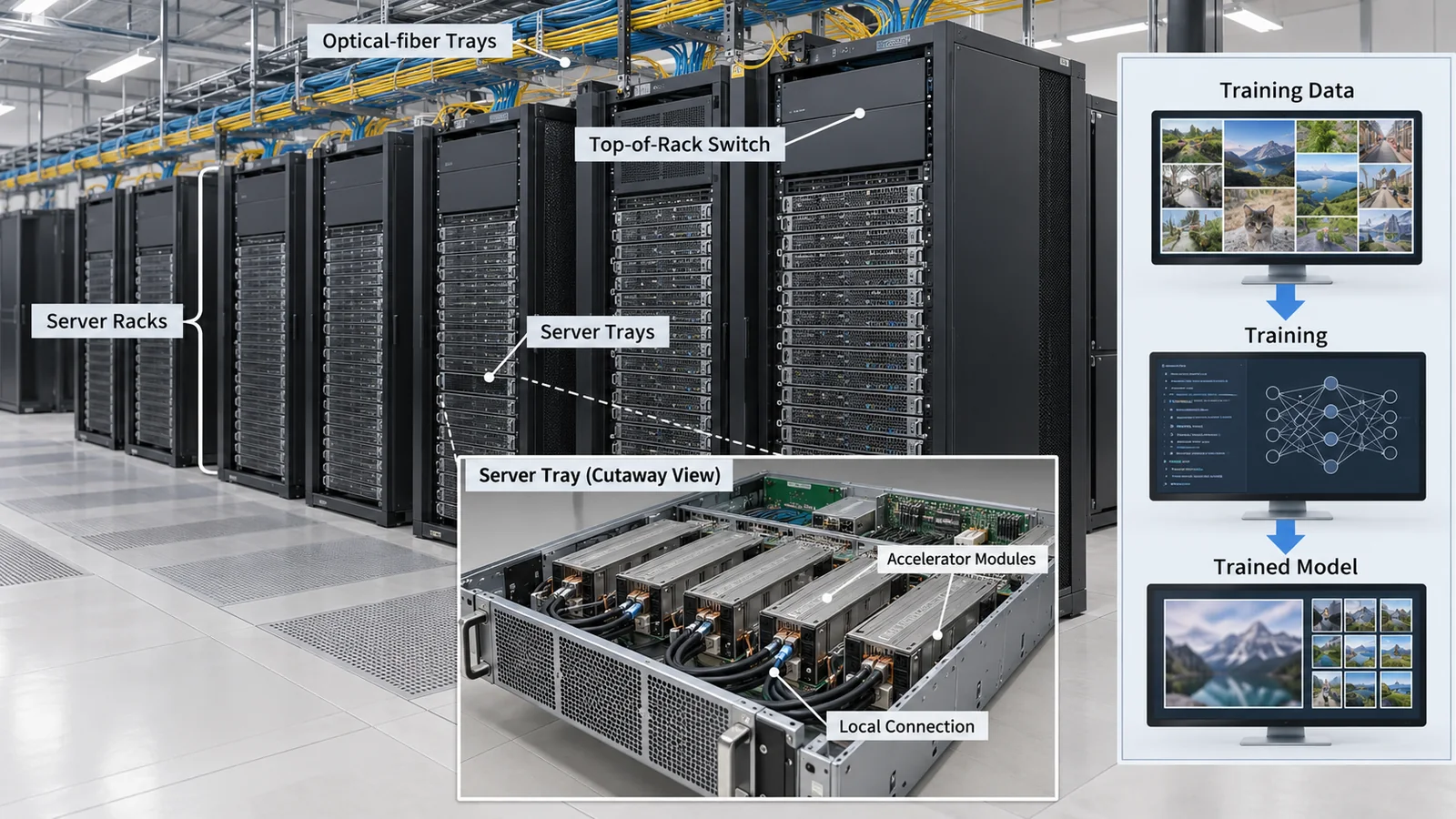
- What is a training cluster? (in three points)
- Parallelism: data, tensor and pipeline
- Scale-up and scale-out: NVLink, InfiniBand and Ethernet
- Collective communication: all-reduce and estimating traffic
- Training efficiency: how to read MFU
- Failures and fault tolerance
- A materials engineer's view: the failure breakdown, temperature and cabling
- Limits, and what could not be confirmed
- How to read evaluations and standards
- Glossary
- References (primary sources)
- Claim-to-source audit
Sourced = stated in an official document, paper or standards-body page (with a link)
Our calculation = a value this article derived from stated assumptions
Not yet confirmed = items in development, planned, or whose status could not be confirmed
Interpretation is marked as commentary. Inference appears in bold.
Figures on training efficiency and failures are results from one organization's cluster over one period. They need not hold for other clusters or models. MFU and bandwidth values differ in chip, precision and counting convention (one-way or bidirectional), so they are not lined up to rank anything. The "our calculation" items are rough figures derived from published values, not measurements.
1. What is a training cluster? (in three points)
- The model does not fit on one machine: Narayanan et al. explain that GPU memory is limited, so large models cannot fit even on a multi-GPU server, and the number of operations required would give unrealistically long training times Sourced [Ref. 15]. So the model and the data are split across many GPUs.
- Splitting requires communication: the pieces exchange results at every step. Llama 3 405B was trained on up to 16K (16,384) H100 GPUs, with the eight GPUs of a server joined by NVLink and servers connected over a 400 Gbps network Sourced [Ref. 1].
- Keeping it running is hard: the same paper reports 466 interruptions in 54 days, 419 of them unexpected, because training proceeds synchronously and one GPU failure can require restarting the whole job Sourced [Ref. 1].
A cluster's speed is not the number of GPUs times the performance of one. Communication and waiting, failure and recovery decide how much time and how much arithmetic ends up usable for training. In the published example, MFU (the share of peak arithmetic that does useful work) was 38-43% in BF16, and effective training time exceeded 90% [Ref. 1].
2. Parallelism: data, tensor and pipeline
Parallelism comes in kinds according to what is split. The table summarizes representative papers and published configurations.
| Kind | How it works, and what representative sources say | Communication and placement |
|---|---|---|
| Data parallelism (DP) | Keep the same model on several GPUs, split the data, and synchronize gradients at each step. The PyTorch DDP paper summarizes implementation experience [Ref. 19]. ZeRO (eliminating memory redundancy) [Ref. 17] and PyTorch FSDP (reported to match DDP performance while supporting much larger models with near-linear TFLOPS scaling) [Ref. 18] also split model state | Gradient collectives (all-reduce, reduce-scatter) and, in FSDP, weight all-gather. Placed outermost (Llama 3: DP = 64 to 128) |
| Tensor parallelism (TP) | Split one layer's weight matrices across several GPUs. Megatron-LM reports that it needs only a few communication operations inserted into native PyTorch, trained models of up to 8.3 billion parameters on 512 GPUs, and kept 76% scaling efficiency against a single-GPU baseline [Ref. 14] | Because collectives are needed in every layer, it goes on the fastest path (Llama 3: TP = 8, the 8 GPUs of one server) |
| Pipeline parallelism (PP) | Split the layers into front-to-back stages and assign a group of GPUs to each stage. GPipe proposed feeding micro-batches through the stages [Ref. 16]. Narayanan et al. report that TP, PP and DP can be composed to scale to thousands of GPUs and trillion-parameter models, and that an interleaved schedule improves throughput by over 10% [Ref. 15] | Activations are handed over point to point at stage boundaries. Placed on the outside (Llama 3: PP = 16). Waiting time ("bubbles") is the challenge |
| Sequence and context parallelism (SP, CP) | Korthikanti et al. report that sequence parallelism with selective activation recomputation cut activation memory 5x and cut the recomputation time overhead by over 90% (a 530B-parameter model on 2,240 A100 GPUs at 54.2% MFU) [Ref. 9]. Llama 3 uses context parallelism for long sequences [Ref. 1] | Sequence segments are exchanged during attention. In Llama 3, CP = 16 at the 131,072-token stage |
| Expert parallelism (EP) | Place the experts of an MoE across GPUs. DeepSeek-V3 was trained on 2,048 H800 GPUs, uses a dedicated cross-node all-to-all implementation to exploit InfiniBand and NVLink bandwidth, avoids costly tensor parallelism, and overlaps computation and communication with DualPipe [Refs. 2, 20] | All-to-all routing of tokens to experts. Cross-node communication dominates |
All Sourced (the papers). The Llama 3 combination is "4D parallelism" (TP, CP, PP, DP), and the outer the dimension in the order [TP, CP, PP, DP], the slower the link it is placed on [Ref. 1].
The more a model is split, the less memory each device needs, but the more communication there is. The Llama 3 paper says it chose combinations in which each GPU's parameters, optimizer state, gradients and activations fit in HBM, and built a memory-consumption estimator and a performance-projection tool to explore configurations [Ref. 1]. The best configuration differs per model, GPU and network, and there is no standard answer (commentary).
3. Scale-up and scale-out: NVLink, InfiniBand and Ethernet
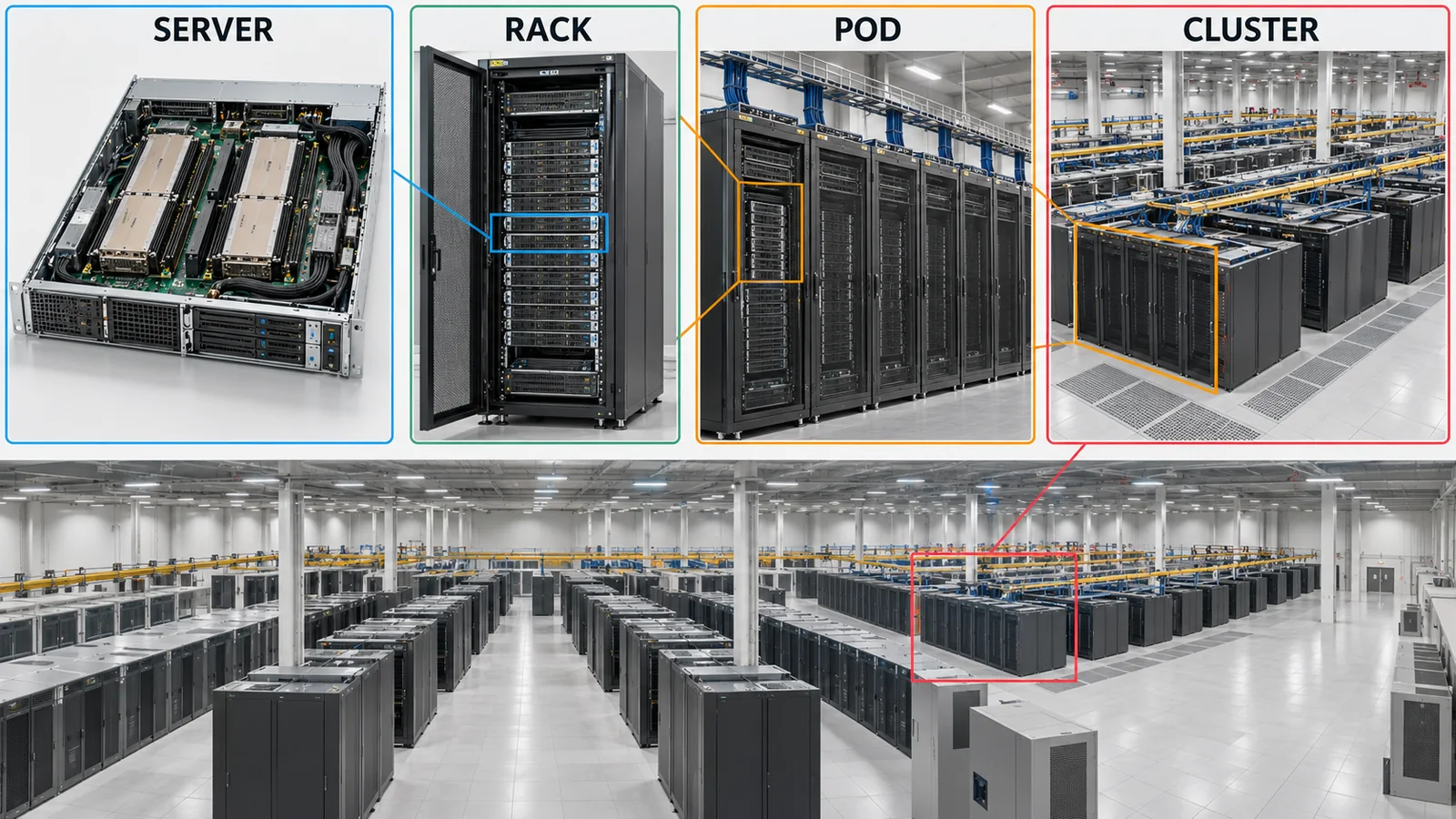
View original SVG, values and source annotations
Communication paths are described in two layers: scale-up (a small number of GPUs wired together very widely) and scale-out (many servers joined by a network). The UALink Consortium says UALink addresses efficient scale-up architectures and the UEC primarily scale-out, and that the two are complementary Sourced [Ref. 24].
| Technology | Role | What official material says, and status (as of the confirmation date) |
|---|---|---|
| NVLink / NVSwitch | Scale-up. Direct GPU-to-GPU links (NVIDIA's own) | NVLink 4 (H100) is 900 GB/s, NVLink 5 (Blackwell) 1.8 TB/s and NVLink 6 (Rubin) 3.6 TB/s [Refs. 3, 5, 13]. GB200 NVL72 puts 72 GPUs in one NVLink domain, with 130 TB/s of NVLink bandwidth across the rack, liquid cooled [Ref. 4]. Some sources do not state whether a value is one-way or a bidirectional total |
| InfiniBand | Scale-out. A high-speed network built around RDMA | The IBTA publishes the InfiniBand and RoCE specifications (Volume 1 Release 2.1 and Volume 2 Release 2.1) [Ref. 25]. Smaller Llama 3 models were trained on InfiniBand [Ref. 1] |
| Ethernet (RoCE) | Scale-out. RDMA over standard Ethernet | Llama 3 405B was trained on a RoCE network (24K GPUs, a three-tier Clos, 1:7 oversubscription at the top); it reports balancing load by splitting traffic into 16 flows between GPUs and using an enhanced ECMP, and running the 24K-GPU cluster without conventional congestion control (DCQCN) [Refs. 1, 29]. IEEE Std 802.3df-2024 (400 Gb/s and 800 Gb/s Ethernet) was approved on 16 February 2024 [Ref. 26]. P802.3dj (200 Gb/s to 1.6 Tb/s) has a task-force page, but its status as of the confirmation date could not be confirmed Not yet confirmed [Ref. 27] |
| Ultra Ethernet (UEC) | A communication stack that optimizes Ethernet for AI and HPC | Specification 1.0 came on 11 June 2025, and 1.1 was published on 12 October 2026, three days before the confirmation date, and is shown as the current published version. The UEC is a Joint Development Foundation project, an affiliate of the Linux Foundation [Ref. 21] |
| UALink | A consortium specification for scale-up (accelerator-to-accelerator load/store) | The 200G 1.0 specification was ratified and released on 8 April 2025, with 200G per lane for up to 1,024 accelerators; it is copper-based with a reach of a few meters without a repeater, and optics are future work [Refs. 23, 24]. Other specifications, such as Common 2.0 (in-network compute), have been published [Ref. 22] |
All Sourced (publications by manufacturers and bodies). The list mixes finalized standards (IEEE), consortium specifications (UEC, UALink, IBTA) and vendor technology (NVLink). This article did not check product implementations or interoperability track records.
Llama 3 says it made both its model-parallelism methods and its job scheduler aware of network topology (which pods a job crosses). Knowing the tiers of the network and placing the communication-heavy parallelism on the inside is the basic design rule [Ref. 1] (this article's organization). Optical interconnects, CPO and optical transceivers are covered in our explainers on optical interconnects and SerDes, co-packaged optics, and optical transceivers.
4. Collective communication: all-reduce and estimating traffic
Training uses collective communication: all-reduce, which sums everyone's gradients and returns the result to everyone; reduce-scatter, which sums and leaves each rank with a piece; all-gather, which collects pieces onto everyone; and all-to-all, in which everyone sends a different piece to everyone. The documentation of NVIDIA's communication library NCCL lists AllReduce, Broadcast, Reduce, AllGather, ReduceScatter, AlltoAll and others as its collective operations Sourced [Ref. 31].
Ring all-reduce cuts the data into n pieces and keeps passing them to the neighbor around a ring. Patarasuk and Yuan showed that this is bandwidth-optimal (under the cluster conditions they assume) [Ref. 6]. The NCCL-tests documentation writes the best-case time of an all-reduce of total size S, with per-rank bandwidth B, as t = (S/B) x 2(n-1)/n (common to point-to-point-based algorithms such as ring and tree). As n grows the factor only approaches 2; traffic does not grow in proportion to the number of GPUs Sourced [Ref. 7].
The formula is an ideal best case set by bandwidth alone. For small messages the latency term, proportional to the number of steps, dominates, and network congestion, a single slow rank (a straggler) and the software implementation make real runs slower. The Llama 3 paper says that communication on the outermost PP and DP dimensions crosses a multi-hop network whose latency can reach tens of microseconds, and that the original NCCL collectives were inefficient because of many small control messages and extra memory copies, so it used NCCLX, tuned for its network [Ref. 1].
A traffic estimate: synchronizing gradients in Llama 3 405B
From the published configuration, we estimate a lower bound on the time to synchronize gradients Our calculation. For the 16K-GPU, DP = 128 setting of Llama 3 405B, the paper publishes 16M tokens per batch and 400 TFLOPS per GPU (41% BF16 MFU) [Ref. 1].
- Compute time per step: approximating compute as 6 x parameters x tokens, 6 x 405 x 109 x 16 x 106 / (16,384 x 400 x 1012) = about 5.93 s.
- Size of a gradient shard: the full BF16 (2-byte) gradients are 405 x 109 x 2 = 810 GB. Shared across TP x PP = 8 x 16 = 128, that is about 6.3 GB per GPU.
- Best-case lower bound for all-reduce: taking each GPU's network bandwidth as 400 Gbps = 50 GB/s, (6.3 / 50) x 2 x 127 / 128 = about 0.25 s, about 4% of the step.
This is a rough lower bound that does not overlap with compute and excludes latency, FSDP weight all-gather, and gradient communication in FP32 (the paper does the reduce-scatter in FP32) [Ref. 1]. In practice the trade-off is between tricks that hide communication behind computation (such as DeepSeek-V3's DualPipe) [Ref. 2] and whatever they cannot hide.
5. Training efficiency: how to read MFU
A widely used measure of training efficiency is MFU (Model FLOPs Utilization). The PaLM paper defines MFU as the ratio of the observed throughput (tokens per second) to the theoretical maximum throughput of a system running at peak FLOPs, counting in the numerator only the operations needed for the forward and backward passes and not rematerialization Sourced [Ref. 8]. The point of the proposal was a metric independent of implementation that allows a cleaner comparison between systems.
- Published values: PaLM 540B reached an MFU of 46.2% on 6,144 TPU v4 chips (hardware FLOPs utilization, HFU, of 57.8%); GPT-3 21.3%, Gopher 32.5% and Megatron-Turing NLG 30.2% [Ref. 8]. Llama 3 405B reached 38-43% in BF16 (43% on 8K GPUs and 41% on 16K GPUs) [Ref. 1]. MegaScale trained a 175B model on 12,288 GPUs at 55.2% MFU (1.34x Megatron-LM) [Ref. 10]. A 530B run using selective activation recomputation reached 54.2% on 2,240 A100 GPUs [Ref. 9].
- Lining up MFU values does not settle superiority: chips (TPU or GPU), precision, model structure, era and counting convention (whether attention is included) all differ. The PaLM paper itself notes differences in counting, for example that the GPT-3 value is derived from non-attention model TFLOP/s and that the MT-NLG value is given both with and without attention [Ref. 8].
- Higher MFU is better, but it never reaches 100%: communication, a slow rank, memory reads and writes, checkpoints and failure recovery all show up as losses against the peak denominator. The "effective training time" in the next chapter is another loss.
- Overlapping communication with computation: the DeepSeek-V3 report says DualPipe hides most communication behind computation and that, as long as the computation-to-communication ratio stays constant, fine-grained experts can be placed across nodes with near-zero all-to-all overhead even as the model scales [Ref. 2] (the authors' claim).
(1) The peak FLOPs are conditioned on precision and sparsity (see our explainer on AI accelerators), and the denominator changes MFU. (2) How operations are counted (attention, recomputation) changes the numerator. (3) A 1% difference between different chips often means little, so MFU is safest used to see the improvement from changing settings on your own cluster (commentary).
6. Failures and fault tolerance
The Llama 3 paper says that because training is synchronous, one GPU failure can lead to a restart of the whole job. For a 54-day record, it reports 466 interruptions (47 planned, such as maintenance and configuration updates, and 419 unexpected), says about 78% of the unexpected ones were attributed to confirmed or suspected hardware issues (GPU and host-component failures, silent data corruption, unplanned maintenance and the like), and says significant manual intervention was needed only three times Sourced [Ref. 1]. Even so, including automated maintenance such as firmware and Linux kernel upgrades, effective training time exceeded 90% [Ref. 1].
| Item | Llama 3 record (54 days, 16K GPUs) | How to read it |
|---|---|---|
| Average interval between unexpected interruptions | 1,296 h / 419 = about 3.1 h Our calculation | At large scale, even if each component fails rarely, failures appear often overall. The system-level failure interval is roughly the component interval divided by the count (a simplification) |
| Breakdown of causes (counts) | Faulty GPU 148, GPU HBM3 memory 72, software bug 54, network (switch, cable) 35, unplanned host maintenance 32, GPU SRAM 19, GPU system processor 17, GPU thermal interface and sensor 6, silent data corruption 6, other 30 (total 419) | The causes classified as GPU total 268 (64.0%) Our calculation. Of the percentages in the paper's table, the 30.1% for "Faulty GPU" does not match 148 / 419 = 35.3%, and the text's "GPU 58.7%" appears to use that 30.1%. This article mainly uses the counts |
| Countermeasures (as the paper describes them) | Shorter job start-up and checkpoint times, fast diagnosis tools, communication records (the NCCL flight recorder), and finding stragglers. A single slow GPU can slow thousands of others | Assume failures and automate detection, isolation and recovery. Observability is key (MegaScale likewise says stability problems that appear only at scale are solved with deep observability [Ref. 10]) |
| Checkpoints | 1 MB to 4 GB of state saved per GPU. Storage sustains 2 TB/s with a 7 TB/s peak [Ref. 1] | Saving the maximum size on all GPUs is 16,384 x 4 GB = about 65.5 TB: about 9 s at the 7 TB/s peak and about 33 s at the sustained 2 TB/s Our calculation (an upper-end sketch) |
The "record" column is Sourced (the Llama 3 paper). In the right-hand column, the items marked Our calculation and the interpretation are this article's.
A rule of thumb for the checkpoint interval
The more often checkpoints (saves of intermediate progress) are taken, the less work is lost, but the more time goes on saving. In the first-order approximation of Young and Daly, with save time d and mean time between failures M, the optimal interval is tau ~ sqrt(2dM) [Refs. 11, 12]. Putting M = 3.1 h (11,130 s) and an assumed save time d = 60 s gives tau ~ 1,155 s (about 19 min), and the fraction of wasted time is roughly d/tau + tau/(2M), about 10% Our calculation. If d could be cut to 10 s, tau ~ 472 s (about 8 min) and the fraction about 4%. This illustrates that the faster the save, the less is wasted even when failures are frequent; d is an assumption and the formula a first-order approximation.
Problems specific to scale: power swings and temperature
- Power swings: the Llama 3 paper says that when tens of thousands of GPUs raise or lower power together (all waiting for a checkpoint or a collective to finish, or the job starting or stopping), data-center power can swing instantly by tens of megawatts, stretching the limits of the power grid [Ref. 1]. NVIDIA also says power smoothing in its Rubin rack cut 50 ms peak power by about 20% (the company's own figure) [Ref. 5]. Power and cooling are covered in our explainers on power and cooling for AI data centers and on data centers and energy storage.
- Effect of temperature: in training Llama 3 405B there was a diurnal throughput variation of 1-2% depending on time of day, which the paper attributes to higher mid-day temperatures affecting GPU dynamic voltage and frequency scaling [Ref. 1].
- The analysis by Kokolis et al.: analyzing two large Meta clusters (11 months, 4 million jobs, over 150 million A100 GPU hours), they report that large jobs are the most vulnerable to failures but small jobs are the majority and should be included in optimization objectives, and that a failure model can project mean time to failure by scale [Ref. 28].
7. A materials engineer's view: the failure breakdown, temperature and cabling
The table of 419 unexpected interruptions in Llama 3 lists, as items, GPU HBM3 memory at 72 (17.2%), GPU thermal interface and sensor at 6 (1.4%), network switches and cables at 35 (8.4%) and silent data corruption at 6 (1.4%) [Ref. 1]. The percentages (count / 419) are Our calculation. HBM falls under our explainers on HBM and CoWoS, thermal interfaces under the one on thermal interface materials, and cables under those on optical transceivers and on optical interconnects and SerDes.
However, the table is a classification of failures and does not say whether degradation of a material was the cause. For instance, whether the HBM3 count reflects the memory cells or problems of stacking, encapsulation or heat cannot be read from it (could not be confirmed). What a materials engineer can read is that at large scale a rare component failure shows up overall as "about once every three hours". With 16,384 GPUs at 700 W (TDP) each, the GPUs alone come to about 11.5 MW Our calculation, so the number of thermal cycles and the temperature swing become large inputs to component reliability (commentary; Inference: the relationship between failure counts and materials or temperature could not be confirmed from public material).
The Llama 3 paper also attributes a 1-2% time-of-day throughput variation to mid-day temperatures affecting GPU voltage and frequency control [Ref. 1]. It is an example of cooling margin turning directly into arithmetic usable for training.
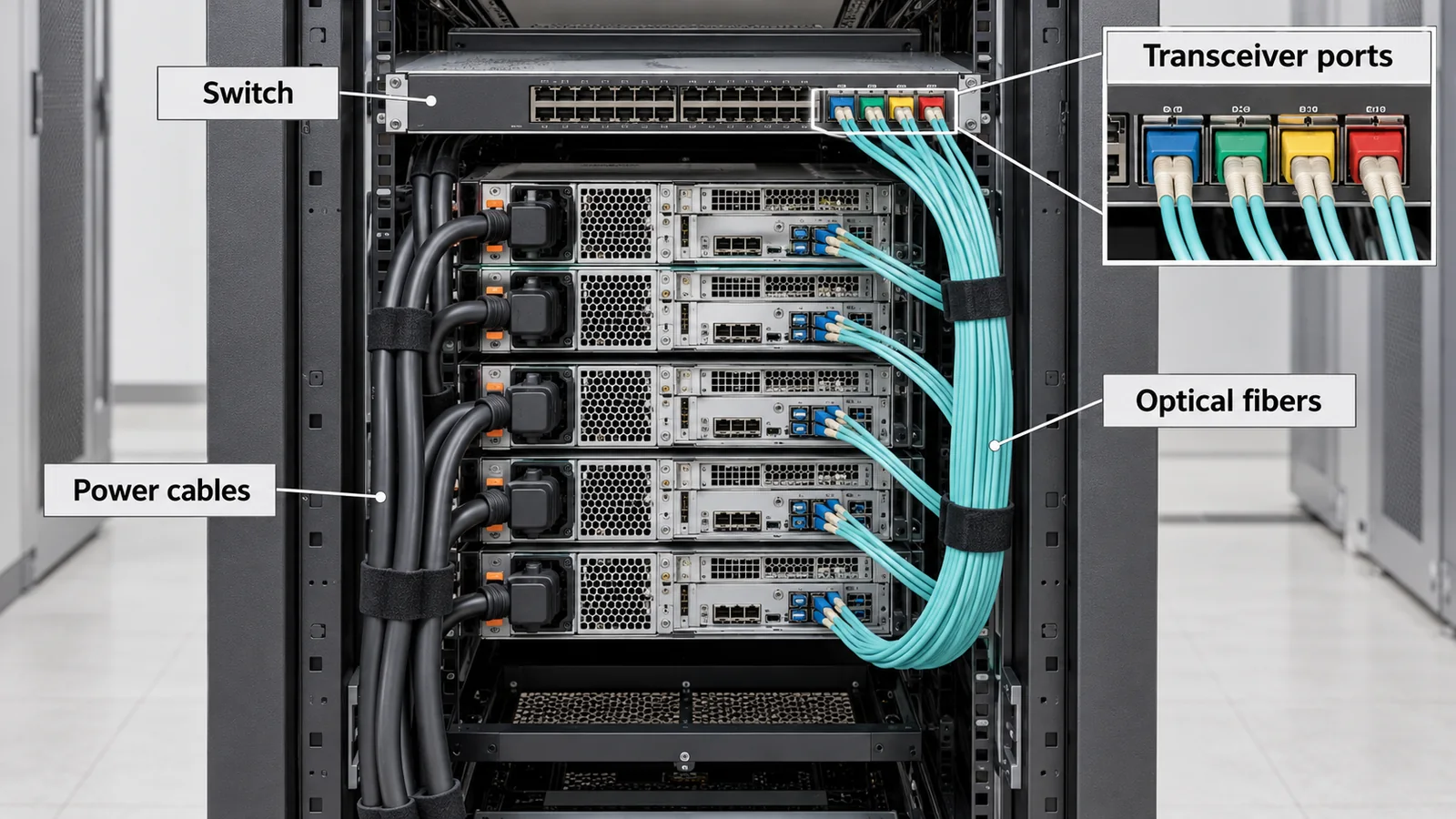
Scale-up communication joins GPUs over short distances at very high bandwidth, and copper has been used for it. The UALink Consortium says the 200G 1.0 specification is copper-based with a maximum reach of a few meters without a repeater, and that optics are future work Sourced [Ref. 24]. NVIDIA describes the Rubin rack as having cable-free compute and switch trays and 45 C liquid cooling [Ref. 5].
From the materials side, the higher the signal rate, the more the dielectric of the board, the connectors and the cables and their losses decide how far copper reaches, and so how many GPUs fit in one scale-up domain. Light is used beyond it (scale-out), and even in Llama 3, network switches and cables accounted for 8.4% of unexpected interruptions [Ref. 1]. Optical components are covered in our explainers on optical transceivers, co-packaged optics, and optical interconnects and SerDes (commentary; specific material loss values are not assessed here).
8. Limits, and what could not be confirmed
(1) Scope of what is published
Most figures are from one organization's one cluster over one period (such as Llama 3's 54 days). The configurations and failure rates of other organizations' latest large training runs could not be confirmed from published material.
(2) Direction and definition of bandwidth
For NVLink and similar figures, some sources do not state whether a value is one-way or a bidirectional total, so they cannot be compared directly with a network's 400 Gbps (a one-way line rate). The "18x" in Fig. 3 is approximate.
(3) Status of specifications
UEC 1.1 (12 October 2026) was published three days before the confirmation date, and its implementation track record was not checked. The status of IEEE P802.3dj could not be confirmed. The texts of the specifications were not read.
(4) Causes of failures
The Llama 3 table is a classification and does not show a causal link to materials or temperature. A part of the table's percentages also has an inconsistency within the paper (30.1% for faulty GPUs against 35.3% from 148 / 419).
(5) Premises of the calculations
The traffic and checkpoint calculations rest on idealizations and assumptions (d = 60 s and so on) and are not measurements. MFU settings differ, so values cannot be ranked.
- Splitting a model requires communication. Data, tensor and pipeline parallelism (plus sequence and expert) are combined to suit the tiers of the communication paths. Llama 3 placed TP = 8 inside one server Sourced
- Communication paths have two layers, scale-up and scale-out. NVLink is 1.8 to 3.6 TB/s against a network of 400 Gbps (50 GB/s) in the example. UEC 1.1 was published on 12 October 2026, and UALink reaches a few meters over copper Sourced
- All-reduce traffic levels off at about twice the data as GPUs increase (in the best, bandwidth-limited case). A lower bound for Llama 3's gradient synchronization is about 4% of a step Our calculation
- MFU has published values from 38% to 55%, but settings differ and they are not ranked. It is the metric PaLM defined, counting only the required operations Sourced
- At large scale rare failures become frequent. 419 unexpected interruptions in 54 days (about one per 3.1 hours), with effective training time over 90% Sourced / Our calculation
9. How to read evaluations and standards
The performance of a training cluster is evaluated along five lines: (1) training speed (time to reach a target accuracy on a common task), (2) efficiency (such as MFU), (3) communication performance and conformance to standards, (4) reliability (number of interruptions, effective training time) and (5) power and cooling. Line 1 is MLCommons' MLPerf; lines 2 and 4 rest mainly on definitions and reports in papers; line 3 involves standards and specifications from IEEE, IBTA, UEC and UALink. As of the confirmation date (15 October 2026) we could not confirm a finalized international standard (ISO/IEC, IEEE) that directly targets MFU (2) or reliability (4).
| What is evaluated | Representative benchmarks and methods (name, source) | Standards and guidance (IEEE, IBTA, UEC, UALink, ISO/IEC and so on) | Notes on reading |
|---|---|---|---|
| Training speed Sourced | MLPerf Training v6.0 (MLCommons, 16 June 2026): 24 organizations submitted 95 systems (60% multi-node) using 13 types of accelerators; the announcement says tasks based on DeepSeek V3 (671B total, 37B active) and GPT-OSS 20B were added [Ref. 30] | MLPerf is a benchmark of an industry consortium, not an ISO/IEC or IEEE standard | Only submissions meeting the accuracy threshold are comparable. Read the system scale, configuration, software and version. It does not report MFU or failure rates |
| Efficiency (MFU) Sourced | MFU as defined in the PaLM paper (counting only the required forward and backward operations in the numerator) [Ref. 8]. Published values: PaLM 46.2%, Llama 3 405B 38-43%, MegaScale 55.2% and others [Refs. 1, 8-10] | No finalized standard defining MFU could be confirmed (it is a definition in a paper) | Chips, precision and counting differ, so values are not ranked. The peak in the denominator depends on precision and sparsity. Use it to confirm improvement |
| Communication performance Sourced | algbw and busbw of NCCL-tests (an NVIDIA document): for all-reduce, busbw is algbw x 2(n-1)/n [Ref. 7] | IEEE Std 802.3df-2024 (400/800 Gb/s Ethernet; approved 2024-02-16) [Ref. 26]. IEEE P802.3dj (200 Gb/s to 1.6 Tb/s; status could not be confirmed) Not yet confirmed [Ref. 27]. IBTA InfiniBand and RoCE specifications (Volumes 1 and 2, Release 2.1) [Ref. 25]. UEC Specification 1.1 (2026-10-12; 1.0 on 2025-06-11) [Ref. 21]. UALink 200G 1.0 (2025-04-08) and others [Refs. 22, 23] | Conformance to a specification does not guarantee real-world speed. UEC, UALink and IBTA are consortium specifications. UEC 1.1 is newly published and its implementation record was not checked. Align direction (one-way or bidirectional) and unit (Gbps or GB/s) before comparing |
| Reliability Sourced | Llama 3: 466 interruptions in 54 days (419 unexpected), effective training time over 90% [Ref. 1]. Kokolis et al.: an analysis of 11 months and 4 million jobs, with metrics such as the Effective Training Time Ratio [Ref. 28]. MegaScale: stability and observability [Ref. 10] | No applicable finalized standard could be confirmed | Values for one cluster and one period cannot be generalized. The definition and classification of a "failure" differ between reports |
| Power and cooling Sourced | Llama 3: power swings of tens of megawatts [Ref. 1]. NVIDIA: power smoothing and 45 C liquid cooling in the Rubin rack [Ref. 5] | No finalized international standard could be confirmed in this article | Manufacturers' and operators' stated values, not third-party measurements. Details are in our explainer on power and cooling for AI data centers |
The arrangement of the table is Our calculation (editing by this article). The standards' texts were not checked, so no requirements are described.
Notes on reading
- Benchmark values change with settings and evaluator. MLPerf differs in system scale, configuration and version, and MFU differs in chip, precision and counting. This article transcribes values from papers and announcements and ranks nothing.
- Saturation and contamination: MLPerf updates its tasks to match the workloads of the day (this round added MoE-model tasks) [Ref. 30]. Results on older tasks may not represent the latest training workloads.
- A "standard", a "consortium specification" and a "report" are different things. IEEE Std 802.3df-2024 is a standard, UEC, UALink and IBTA are consortium specifications, and MFU and interruption counts are reports in papers. None is itself law.
- Declared versus measured. NVLink's 1.8 TB/s or the network's 400 Gbps is a line-rate ceiling. The communication speed actually obtained in training falls with latency, congestion and software.
10. Glossary
- Data / tensor / pipeline parallelism
- Splitting the data / one layer's matrices / the layers into front-to-back stages.
- FSDP / ZeRO
- Data parallelism that shards the model, optimizer state and gradients across GPUs.
- Scale-up / scale-out
- Direct links among a few GPUs / networking of many servers.
- NVLink / NVSwitch
- NVIDIA's direct GPU-to-GPU links and their switch.
- InfiniBand / RoCE
- A high-speed network using RDMA / RDMA over Ethernet.
- UEC / UALink
- A consortium for AI-oriented Ethernet / a consortium for scale-up connections.
- Collectives (all-reduce and so on)
- Communication performed jointly by many GPUs: summing, gathering, distributing.
- NCCL
- NVIDIA's communication library for multiple GPUs.
- MFU / HFU
- Utilization counting only required operations / utilization including recomputation.
- Effective training time
- The share of elapsed time that went into useful training.
- Straggler
- One rank that is running but slow, holding up the rest.
- Checkpoint
- A save of intermediate progress, from which to resume after a failure.
- Silent data corruption
- A fault that makes results wrong without raising an error.
- Oversubscription
- When upper-tier bandwidth is narrower than the sum below it (for example 1:7).
11. References (primary sources)
- Grattafiori A. et al. (Meta) "The Llama 3 Herd of Models", arXiv:2407.21783 — arxiv.org/abs/2407.21783
- DeepSeek-AI "DeepSeek-V3 Technical Report", arXiv:2412.19437 — arxiv.org/abs/2412.19437
- NVIDIA "NVIDIA HGX Platform" (specifications of HGX Rubin NVL8, B300 and B200) — www.nvidia.com/en-us/data-center/hgx/
- NVIDIA "GB200 NVL72" — www.nvidia.com/en-us/data-center/gb200-nvl72/
- NVIDIA "Inside NVIDIA Rubin GPU Architecture: Powering the Era of Agentic AI", NVIDIA Technical Blog (21 July 2026) — developer.nvidia.com/blog/inside-nvidia-rubin-gpu-architecture-powering-the-era-of-agentic-ai/
- Patarasuk P. and Yuan X. "Bandwidth optimal all-reduce algorithms for clusters of workstations", J. Parallel Distrib. Comput. 69, 117-124 (2009), DOI 10.1016/j.jpdc.2008.09.002 — doi.org/10.1016/j.jpdc.2008.09.002
- NVIDIA "Performance reported by NCCL tests" (nccl-tests, GitHub) — github.com/NVIDIA/nccl-tests/blob/master/doc/PERFORMANCE.md
- Chowdhery A. et al. (Google) "PaLM: Scaling Language Modeling with Pathways", arXiv:2204.02311 — arxiv.org/abs/2204.02311
- Korthikanti V. et al. "Reducing Activation Recomputation in Large Transformer Models", arXiv:2205.05198 — arxiv.org/abs/2205.05198
- Jiang Z. et al. "MegaScale: Scaling Large Language Model Training to More Than 10,000 GPUs", arXiv:2402.15627 — arxiv.org/abs/2402.15627
- Young J. W. "A first order approximation to the optimum checkpoint interval", Commun. ACM 17(9), 530-531 (1974), DOI 10.1145/361147.361115 — doi.org/10.1145/361147.361115
- Daly J. T. "A higher order estimate of the optimum checkpoint interval for restart dumps", Future Gener. Comput. Syst. 22, 303-312 (2006), DOI 10.1016/j.future.2004.11.016 — doi.org/10.1016/j.future.2004.11.016
- NVIDIA "H100 GPU" — www.nvidia.com/en-us/data-center/h100/
- Shoeybi M. et al. "Megatron-LM: Training Multi-Billion Parameter Language Models Using Model Parallelism", arXiv:1909.08053 — arxiv.org/abs/1909.08053
- Narayanan D. et al. "Efficient Large-Scale Language Model Training on GPU Clusters Using Megatron-LM", arXiv:2104.04473 — arxiv.org/abs/2104.04473
- Huang Y. et al. "GPipe: Efficient Training of Giant Neural Networks using Pipeline Parallelism", arXiv:1811.06965 — arxiv.org/abs/1811.06965
- Rajbhandari S. et al. "ZeRO: Memory Optimizations Toward Training Trillion Parameter Models", arXiv:1910.02054 — arxiv.org/abs/1910.02054
- Zhao Y. et al. "PyTorch FSDP: Experiences on Scaling Fully Sharded Data Parallel", arXiv:2304.11277 — arxiv.org/abs/2304.11277
- Li S. et al. "PyTorch Distributed: Experiences on Accelerating Data Parallel Training", arXiv:2006.15704 — arxiv.org/abs/2006.15704
- Zhao C. et al. "Insights into DeepSeek-V3: Scaling Challenges and Reflections on Hardware for AI Architectures", arXiv:2505.09343 — arxiv.org/abs/2505.09343
- Ultra Ethernet Consortium "Specification History" — ultraethernet.org/specification-history/
- UALink Consortium "Specifications" — ualinkconsortium.org/specification/
- UALink Consortium "UALink Consortium Releases the Ultra Accelerator Link 200G 1.0 Specification" (news release, 8 April 2025) — ualinkconsortium.org/wp-content/uploads/2025/04/UALink-1.0-Specification-PR_FINAL.pdf
- UALink Consortium "FAQ" — ualinkconsortium.org/faq/
- InfiniBand Trade Association "InfiniBand Trade Association" (InfiniBand and RoCE Specifications) — www.infinibandta.org/
- IEEE 802.3 "IEEE P802.3df 400 Gb/s and 800 Gb/s Ethernet Task Force" (IEEE Std 802.3df-2024) — www.ieee802.org/3/df/index.html
- IEEE 802.3 "IEEE P802.3dj 200 Gb/s, 400 Gb/s, 800 Gb/s, and 1.6 Tb/s Ethernet Task Force" — www.ieee802.org/3/dj/index.html
- Kokolis A. et al. (Meta) "Revisiting Reliability in Large-Scale Machine Learning Research Clusters", arXiv:2410.21680 — arxiv.org/abs/2410.21680
- Gangidi A. et al. (Meta) "RDMA over Ethernet for Distributed Training at Meta Scale", Proc. ACM SIGCOMM 2024, 57-70, DOI 10.1145/3651890.3672233 — doi.org/10.1145/3651890.3672233
- MLCommons "MLCommons Releases MLPerf Training v6.0 Results" (16 June 2026) — mlcommons.org/2026/06/mlperf-training-v6-0-results/
- NVIDIA "Collective Operations", NCCL 2.32.3 documentation — docs.nvidia.com/deeplearning/nccl/user-guide/docs/usage/collectives.html
- Liu H. et al. "Ring Attention with Blockwise Transformers for Near-Infinite Context", arXiv:2310.01889 — arxiv.org/abs/2310.01889
12. Claim-to-source audit
| Claim in the text | Basis | Category |
|---|---|---|
| The Llama 3 405B training (up to 16K H100 at 700 W TDP with 80 GB HBM3; 8 GPUs per server on NVLink; 400 Gbps links; a 24K-GPU RoCE cluster with a 3-tier Clos and 1:7 at the top; 4D parallelism TP, CP, PP, DP; MFU 38-43%; Table 4 configurations and 400 TFLOPS; NCCLX; 466 interruptions and 419 unexpected in 54 days; about 78% hardware; over 90% effective training time; stragglers; a 1-2% diurnal variation; power swings of tens of megawatts; checkpoint sizes and storage bandwidth; the Table 5 counts) | The Llama 3 paper Reference 1 https://arxiv.org/abs/2407.21783 | Sourced |
| DeepSeek-V3 (2,048 H800 GPUs; NVLink, NVSwitch and InfiniBand; DualPipe and computation-communication overlap; cross-node all-to-all; no costly tensor parallelism) and the companion analysis paper | The DeepSeek technical report and analysis paper Reference 2 https://arxiv.org/abs/2412.19437 Reference 20 https://arxiv.org/abs/2505.09343 | Sourced |
| NVLink bandwidth by generation (H100 900 GB/s, Blackwell 1.8 TB/s, Rubin 3.6 TB/s), network bandwidth of 0.8 TB/s for HGX B200 and 1.8 TB/s for Rubin NVL8, GB200 NVL72 (a 72-GPU NVLink domain, 130 TB/s, liquid cooled), and the Rubin rack (cable-free compute and switch trays, 45 C liquid cooling, power smoothing cutting 50 ms peak power by about 20%) | NVIDIA product pages and technical blog Reference 3 https://www.nvidia.com/en-us/data-center/hgx/ Reference 4 https://www.nvidia.com/en-us/data-center/gb200-nvl72/ Reference 5 https://developer.nvidia.com/blog/inside-nvidia-rubin-gpu-architecture-powering-the-era-of-agentic-ai/ Reference 13 https://www.nvidia.com/en-us/data-center/h100/ | Sourced |
| The bandwidth optimality of ring all-reduce, the best-case all-reduce time t = (S/B) x 2(n-1)/n and busbw, and the list of NCCL collectives | The paper and NVIDIA documentation Reference 6 https://doi.org/10.1016/j.jpdc.2008.09.002 Reference 7 https://github.com/NVIDIA/nccl-tests/blob/master/doc/PERFORMANCE.md Reference 31 https://docs.nvidia.com/deeplearning/nccl/user-guide/docs/usage/collectives.html | Sourced |
| The definition of MFU, GPT-3 21.3%, Gopher 32.5%, MT-NLG 30.2% and PaLM 46.2% (HFU 57.8%), 54.2% for the 530B run, and MegaScale 55.2% (1.34x Megatron-LM) | The papers Reference 8 https://arxiv.org/abs/2204.02311 Reference 9 https://arxiv.org/abs/2205.05198 Reference 10 https://arxiv.org/abs/2402.15627 | Sourced |
| Young's first-order approximation and Daly's higher-order estimate (optimal checkpoint interval) | The papers (DOIs) Reference 11 https://doi.org/10.1145/361147.361115 Reference 12 https://doi.org/10.1016/j.future.2004.11.016 | Sourced |
| Representative sources on parallelism: Megatron-LM (512 GPUs, 8.3B, 76%), Narayanan et al. (over 10% improvement), GPipe, ZeRO, FSDP, DDP and context parallelism (Ring Attention) | The papers Reference 14 https://arxiv.org/abs/1909.08053 Reference 15 https://arxiv.org/abs/2104.04473 Reference 16 https://arxiv.org/abs/1811.06965 Reference 17 https://arxiv.org/abs/1910.02054 Reference 18 https://arxiv.org/abs/2304.11277 Reference 19 https://arxiv.org/abs/2006.15704 Reference 32 https://arxiv.org/abs/2310.01889 | Sourced |
| The UEC specification history (1.0 on 2025-06-11, 1.0.3 on 2026-07-16, 1.1 on 2026-10-12 as current) and its status as an affiliate of the Linux Foundation | The UEC page Reference 21 https://ultraethernet.org/specification-history/ | Sourced |
| The UALink specifications (200G 1.0 ratified and released on 2025-04-08; 200G per lane; up to 1,024 accelerators; Common 2.0 and others), copper with a few meters of reach, optics as future work, and complementarity with UEC | UALink Consortium material Reference 22 https://ualinkconsortium.org/specification/ Reference 23 https://ualinkconsortium.org/wp-content/uploads/2025/04/UALink-1.0-Specification-PR_FINAL.pdf Reference 24 https://ualinkconsortium.org/faq/ | Sourced |
| The IBTA InfiniBand and RoCE specifications (Volumes 1 and 2, Release 2.1), IEEE Std 802.3df-2024 (approved 2024-02-16), the P802.3dj page (status not confirmed) and Meta's RoCE paper | IBTA, IEEE 802.3 and ACM pages Reference 25 https://www.infinibandta.org/ Reference 26 https://www.ieee802.org/3/df/index.html Reference 27 https://www.ieee802.org/3/dj/index.html Reference 29 https://doi.org/10.1145/3651890.3672233 | Not yet confirmed |
| The analysis by Kokolis et al. (11 months, 4 million jobs, over 150 million A100 GPU hours; larger jobs are more vulnerable; mean-time-to-failure projection; effective training time ratio) | The paper Reference 28 https://arxiv.org/abs/2410.21680 | Sourced |
| MLPerf Training v6.0 (2026-06-16; 24 organizations; 95 systems, 60% multi-node; 13 accelerator types; DeepSeek V3 and GPT-OSS 20B added; accuracy threshold) | The MLCommons announcement Reference 30 https://mlcommons.org/2026/06/mlperf-training-v6-0-results/ | Sourced |
| The lower-bound gradient synchronization calculation (compute time about 5.93 s, gradient shard about 6.3 GB, all-reduce about 0.25 s, about 4%), the values of the factor 2(n-1)/n, the interruption interval of about 3.1 h, percentages (count / 419), the GPU-classified total of 268 (64.0%), checkpoint times (about 9 s and 33 s), the Young/Daly examples (tau about 19 min, about 10%; about 8 min and 4% for d = 10 s) and 16,384 x 700 W = about 11.5 MW | Our calculation. Idealizations and assumptions from published values (d = 60 s and so on), not measurements; compute is approximated as 6 x parameters x tokens | Our calculation |
| The note on an inconsistency inside the paper (148 / 419 = 35.3% for "Faulty GPU" against 30.1% in the table and 58.7% in the text) | This article's cross-check of Table 5 against the text of the Llama 3 paper Reference 1 https://arxiv.org/abs/2407.21783 | Sourced |
| Failure rates of the latest large training runs, comparisons with aligned bandwidth definitions, causality between failures and materials, the texts of standards, and implementation track record for UEC 1.1 | Not checked within this article's scope | Commentary |
| The readings that "materials and packaging names appear in the failure table", that "near links use copper and far links use light, and as speed rises materials decide reach", that "parallelism trades memory against communication", and the organization of the figures | This article's organization and commentary based on published material; not views stated by any organization | Commentary |
| That Figs. 2 to 6 are explanatory drawings, not real product structures or data, and that Figs. 1 and 7 are AI-generated images | Note by this article | Commentary |
Last updated: 15 October 2026 / Sources are limited to primary material (papers on Llama 3, PaLM, MegaScale and DeepSeek-V3, official NVIDIA, UEC, UALink, IBTA and IEEE pages, and MLCommons announcements). The texts of the standards were not checked. This field moves fast, and versions and statuses of standards and specifications are those of the confirmation date (15 October 2026). Failure rates of the latest large training runs, comparisons with aligned bandwidth definitions, causality between failures and materials, and the texts of standards could not be confirmed and are therefore not stated. Figs. 2 to 6 are vector drawings and Figs. 1 and 7 are AI-generated images; none of them depicts a real facility, product or measurement result.