TECHNOLOGY EXPLAINER
Reasoning Models
— language models that turn "thinking before answering" into a compute budget you can set
A reasoning model is a large language model (LLM) that generates a long intermediate trace (thinking tokens) before it gives a final answer. Since OpenAI introduced o1 in September 2024, the approach of teaching a model how to think through reinforcement learning, and then spending more thinking to get higher accuracy, has spread widely. In the main APIs checked on 15 October 2026, this is less a separate class of model than a setting such as effort or thinking level. This article sets out, from primary sources, the path from chain of thought to test-time compute; how reinforcement learning teaches reasoning; how thinking length relates to performance and cost (with our own calculations); how the official documentation describes "how much to think"; and the limits, including faithfulness and overthinking.
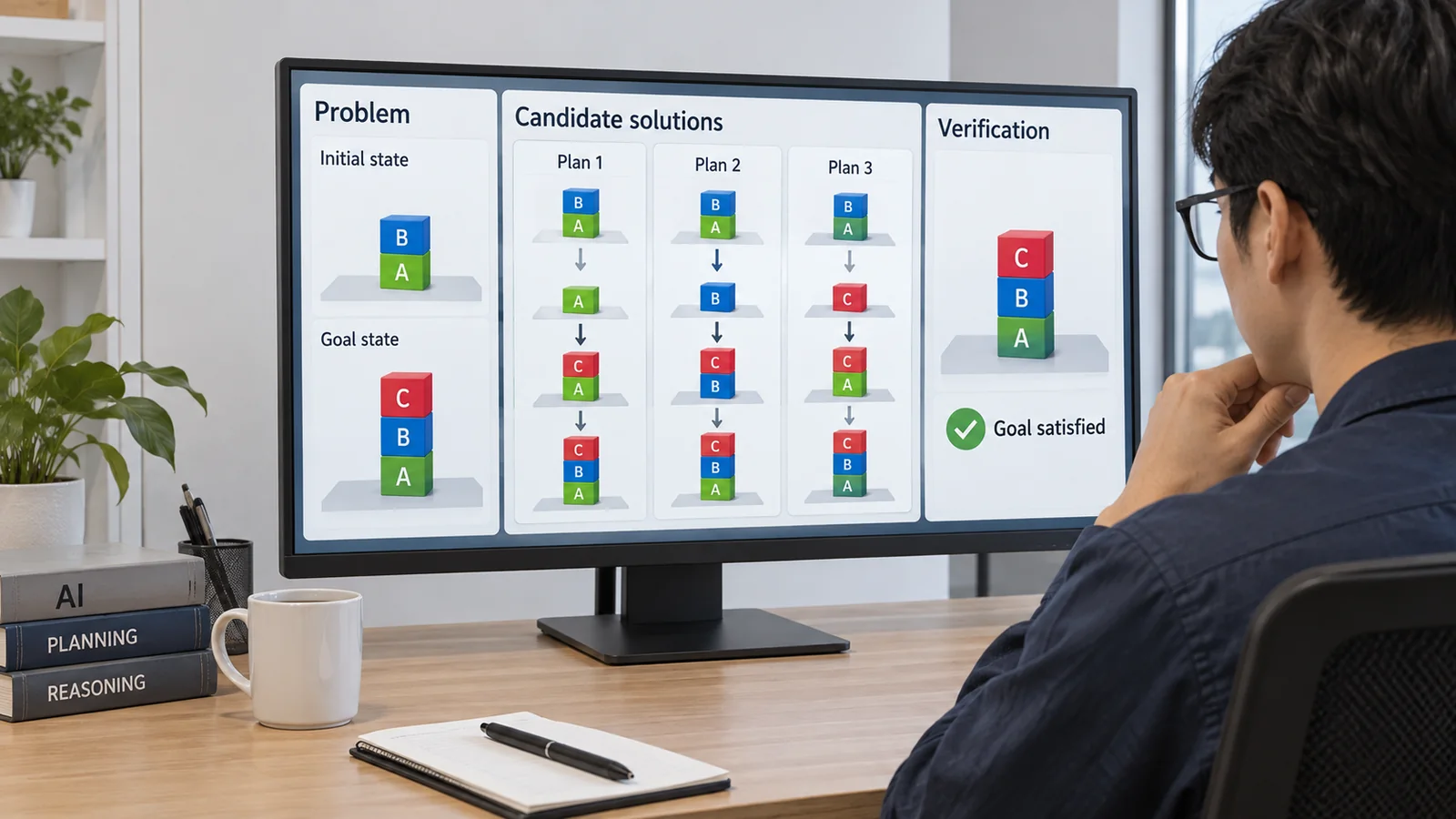
- What a reasoning model is (the short version)
- From chain of thought to test-time compute — what changed
- How reinforcement learning teaches it — the key is "problems that can be graded"
- Three ways to add test-time compute — think longer, sample many, search
- Thinking length, performance and cost — our calculation
- How the main services let you set "how much to think" — a comparison of official documentation (checked 15 October 2026)
- Limits — faithfulness, overthinking, and the "illusion of thinking" debate
- A materials engineer's view — problems that can be graded, and problems that cannot
- Limits, and what could not be confirmed
- How to read evaluations and standards
- Glossary
- References (primary sources)
- Claim-to-source audit
Sourced = stated in published material (link given)
Our calculation = a figure this article derived, with the assumptions spelled out
Not yet confirmed = under revision, at proposal stage or planned, and not final
Our readings of how things work are marked separately as Commentary. Inference is shown in bold.
The accuracy figures here were obtained for a particular model and version, a particular benchmark version, a particular thinking strength, a particular number of samples, with or without tools, and by a particular evaluator (mostly the developer itself). Figures from different settings are not ranked against each other to say which model is better. Model names, prices and API behavior change quickly, so they are dated. For anything after the check date (15 October 2026), confirm on the official page.
1. What a reasoning model is (the short version)
- It writes at length internally before answering: In its announcement of 12 September 2024, OpenAI described o1 as a new large language model trained with reinforcement learning to perform complex reasoning, one that thinks before it answers and can produce a long internal chain of thought before responding to the userSourced[Ref. 9]. That internal trace is what we call thinking tokens.
- Performance also changes with how much it thinks: OpenAI reported that o1's performance improved consistently with more reinforcement learning (train-time compute) and with more time spent thinking (test-time compute)Sourced[Ref. 9]. This is the developer's claim, not an independent replication.
- It is becoming a setting: The official documentation of Anthropic, OpenAI, Google and DeepSeek, checked on 15 October 2026, shows the amount of thinking being adjusted with parameters such as effort or thinking levelSourced[Ref. 21-25] (Chapter 6). The same model gives different accuracy, latency and cost under different settings.
A reasoning model's accuracy has meaning only together with how much it was made to think (effort or thinking tokens) and how many times it was sampled (pass@1 or cons@64). In OpenAI's gpt-oss model card, the same model (gpt-oss-120b) scored 56.3% on AIME 2024 (no tools) at reasoning level low and 95.8% at high [Ref. 14]. In the appendix to the o1 announcement, the same o1 scored 74.4% on AIME 2024 with one sample and 83.3% with a 64-sample majority vote [Ref. 9]. Both are the developer's own evaluations.
2. From chain of thought to test-time compute — what changed
(1) Chain of thought: have the model write out the working
In 2022, Wei and colleagues reported that simply showing a few examples that include intermediate reasoning steps (a chain of thought) improves large language models on arithmetic, commonsense and symbolic reasoning tasks. With eight examples, a 540B-parameter model reached what was then the best accuracy on the GSM8K math word-problem benchmark, surpassing a fine-tuned GPT-3 with a verifierSourced[Ref. 1]. Kojima and colleagues then showed that simply adding "Let's think step by step", with no examples (zero-shot CoT), raised InstructGPT (text-davinci-002) from 17.7% to 78.7% on MultiArith and from 10.4% to 40.7% on GSM8KSourced[Ref. 2]. Up to this point, the model is simply asked in the prompt to think while it answers (commentary).
(2) Generate many solutions and choose: self-consistency
Self-consistency, by Wang and colleagues, replaces a single greedy decode by sampling several diverse reasoning paths and selecting the most consistent answer. It reported gains of +17.9% on GSM8K, +11.0% on SVAMP, +12.2% on AQuA, +6.4% on StrategyQA and +3.9% on ARC-challengeSourced[Ref. 3]. The idea of asking the same question several times to spend more compute leads to the later cons@64 and best-of-N methods (Chapter 4).
(3) Spending compute at inference: scaling test-time compute
Snell and colleagues studied what happens when more compute is used at inference. They found that the effect depends strongly on how hard the problem is, and that a "compute-optimal" strategy that allocates compute per problem can improve efficiency by more than 4x over best-of-N. In a comparison with matched compute (FLOPs), on problems where a smaller base model has a non-trivial success rate, test-time compute could outperform a model 14 times largerSourced[Ref. 6]. This is a result under the paper's tasks and conditions, not a general statement that "a small model is enough" (commentary).
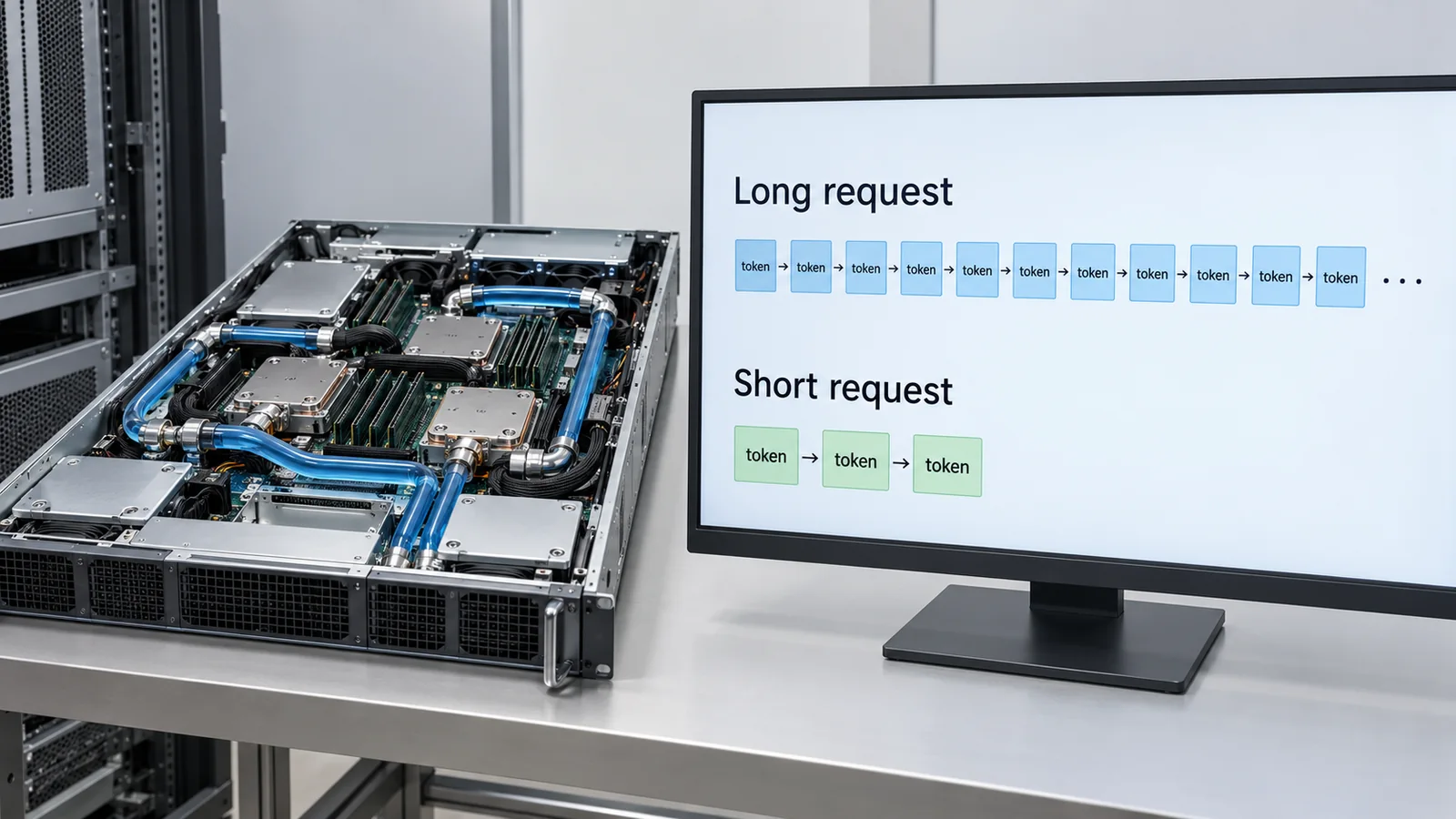
A language model generates one token at a time, so the compute used for one response grows roughly in proportion to the number of tokens generated (our commentary). Adding thinking tokens therefore adds inference compute, time and cost in the same proportion. A reasoning model is less a "smarter" model than one that has been given compute at training time so that it learns to use compute for thinking at inference time. OpenAI also says the constraints on pushing this approach further differ substantially from those of LLM pretraining [Ref. 9].
3. How reinforcement learning teaches it — the key is "problems that can be graded"
(1) o1: details not published
OpenAI describes o1 as using a large-scale reinforcement learning algorithm that, in a data-efficient training process, teaches the model to use a chain of thought productively: to recognize and correct mistakes, to break hard steps into simpler ones, and to try another approach when the current one failsSourced[Ref. 9]. The announcement does not give the reward design, the training data or the model size, and this article does not guess at them.
(2) DeepSeek-R1: the reward is "is the answer right?"
DeepSeek-R1 is the case where the details were published. The paper in Nature, published on 17 September 2025 [Ref. 10], presents DeepSeek-R1-Zero, in which reinforcement learning alone, with no supervised fine-tuning (SFT) step, was applied to the base model DeepSeek-V3 Base. The algorithm is GRPO (Group Relative Policy Optimization), and the rewards are rule-based: whether the final answer is correct (matches the ground truth) and whether the output format is followedSourced[Ref. 10]. For mathematics, the model is made to give its final answer in a specified format so that it can be checked mechanically; for programming-contest problems, answers are graded by running a compiler against predefined test cases [Ref. 10]. The authors say they did not use neural reward models (outcome-based or process-based) for reasoning tasks, because such models are prone to reward hacking during large-scale reinforcement learning [Ref. 10].
In that paper, the average pass@1 on AIME 2024 rose during training from 15.6% to 77.9%, and to 86.7% with self-consistency decoding. The paper also reports that responses became longer as training progressed, with more reflective reasoning and exploration of alternative solutions, and describes what the authors call an "aha moment", a sudden increase in the use of the word "wait"Sourced[Ref. 10]. These are the authors' descriptions; the figures are for the paper's own evaluation settings (the definitions of pass@1 and cons@16 are in its supplementary information).
(3) Grade the outcome, or grade the process?
Lightman and colleagues compared outcome supervision (reward only on the final answer) with process supervision (reward on each reasoning step) and reported that process supervision performed significantly better on the MATH dataset. Their process-supervised model solved 78% of a representative subset of the MATH test set, and they released PRM800K, 800,000 step-level human labelsSourced[Ref. 5]. The DeepSeek-R1 paper, by contrast, chose not to use neural reward models for reasoning tasks [Ref. 10]. Which is better depends on the task, the scale and the operating conditions, and this article does not rank them (commentary).
(4) Verifiable rewards (RLVR) and spread to other models
Tülu 3, by Lambert and colleagues, is an open recipe that presents "reinforcement learning with verifiable rewards (RLVR)" as a training method alongside SFT and DPOSourced[Ref. 12]. The Qwen3 technical report describes merging a thinking mode and a non-thinking mode in one model, letting users set a budget of thinking tokens, and using strong-to-weak distillation, which transfers knowledge from large models to small ones, to cut the training cost of the smaller models [Ref. 13]. OpenAI's gpt-oss is described as post-trained with CoT reinforcement-learning techniques similar to those of o3, and its three strengths (low, medium and high) are switched with a line such as "Reasoning: low" in the system prompt [Ref. 14].
4. Three ways to add test-time compute — think longer, sample many, search
Methods for "adding compute at inference time" fall roughly into three groups (our classification). The figure below shows the differences on one page.
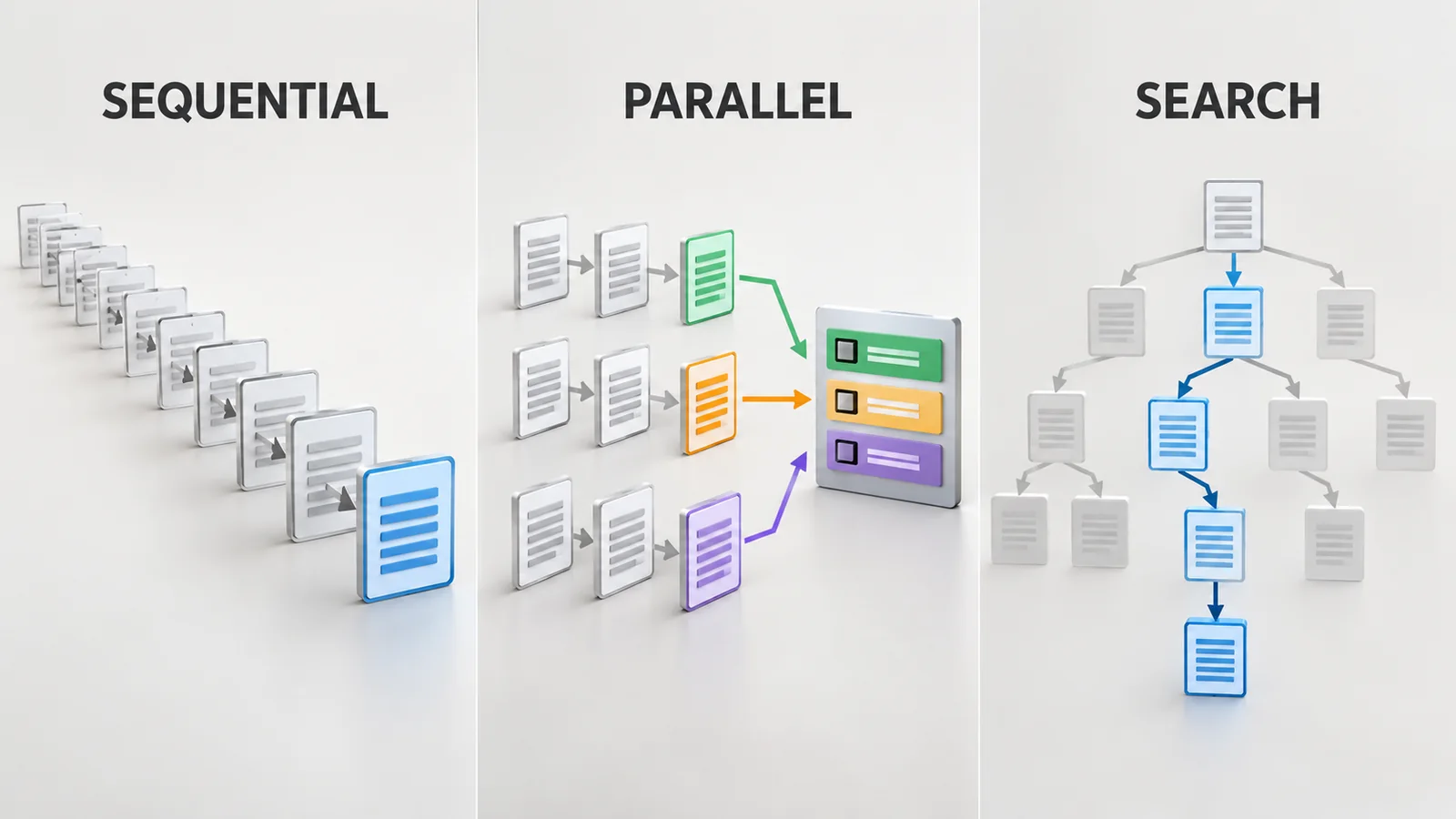
View original SVG, values and source annotations
| Direction | What primary sources confirm | Cautions in reading |
|---|---|---|
| 1. Sequential (think longer) | s1: Qwen2.5-32B-Instruct fine-tuned on 1,000 questions with reasoning traces, using "budget forcing", which cuts thinking off or extends it by appending "Wait". On AIME24, extension raised accuracy from 50% to 57% [Ref. 8]. Qwen3: increasing the thinking-token budget improved performance consistently across several tasks [Ref. 13]. gpt-oss: the average CoT length grows across its three levels, low, medium and high [Ref. 14] | All reports are by the authors or developers. s1 is a minimal-configuration research experiment and cannot be read on the same footing as large production models |
| 2. Parallel (many samples) | Self-consistency selects the answer that is consistent across several reasoning paths, reporting +17.9% on GSM8K among others [Ref. 3]. Large Language Monkeys: coverage (the share of problems solved by at least one sample) grows roughly log-linearly over four orders of magnitude of samples; on SWE-bench Lite, DeepSeek-Coder-V2-Instruct went from 15.9% with one sample to 56% with 250 samples. Where no automatic verifier exists, majority voting and reward models plateau after a few hundred samples [Ref. 7] | Coverage is the share of problems where any sample is correct; it does not mean the correct one can be picked out. Only with a verifier (such as running tests) does coverage turn into actual accuracy |
| 3. Search (branching) | Tree of Thoughts: a framework that considers several reasoning paths, self-evaluates, and looks ahead or backtracks. On Game of 24, GPT-4 with CoT solved 4% of tasks while ToT reached a 74% success rate [Ref. 4]. Snell et al.: compared searching against process-based verifiers (reward models) with adaptively updating the response distribution; the effective method depends on problem difficulty [Ref. 6] | Search depends strongly on the quality of the evaluation function (verifier). ToT's figures are for the paper's three tasks and cannot be applied to problems in general |
All Sourced (sources in each cell). The classification and the "cautions in reading" column are our commentary.
The DeepSeek-R1 paper says that, unlike conventional test-time scaling such as majority voting or Monte Carlo tree search (MCTS), R1 allocates inference compute dynamically according to the complexity of the problem, using fewer tokens on simple tasks and more on complex ones. It also notes that excessive reasoning (overthinking) on simple questions remainsSourced[Ref. 10].
5. Thinking length, performance and cost — our calculation
(1) What changes when you change the setting on the same model
OpenAI's gpt-oss model card includes a table of AIME, GPQA Diamond and other results at three thinking strengths (low, medium and high). We computed the difference between high and low from the same table.
| Model | Benchmark (setting) | low | medium | high | high − low |
|---|---|---|---|---|---|
| gpt-oss-120b | AIME 2024 (no tools) | 56.3 | 80.4 | 95.8 | +39.5 |
| gpt-oss-120b | AIME 2024 (with tools) | 75.4 | 87.9 | 96.6 | +21.2 |
| gpt-oss-120b | GPQA Diamond (no tools) | 67.1 | 73.1 | 80.1 | +13.0 |
| gpt-oss-20b | AIME 2024 (no tools) | 42.1 | 80.0 | 92.1 | +50.0 |
| gpt-oss-20b | AIME 2024 (with tools) | 61.2 | 86.0 | 96.0 | +34.8 |
| gpt-oss-20b | GPQA Diamond (no tools) | 56.8 | 66.0 | 71.5 | +14.7 |
Figures (accuracy, %) are Sourced from Table 3 of the gpt-oss model card [Ref. 14] (the developer's evaluation). The "high − low" column is Our calculation (simple subtraction, in percentage points).
Three readings follow from this table (our commentary). First, the effect differs by task: on AIME, more thinking raises accuracy a great deal, while on GPQA Diamond (multiple-choice science questions) the gain is smaller. Second, with tools, the lift at low is large (the 120b model's AIME 2024 score goes from 56.3% to 75.4% at low). Third, on the same AIME 2024, the setting alone moves one model's score by almost 40 points. When quoting a score, you therefore need to state "at what strength".
(2) What changes when you add samples
| Model | AIME 2024 pass@1 | AIME 2024 cons@64 | Difference | GPQA Diamond pass@1 / cons@64 |
|---|---|---|---|---|
| GPT-4o | 9.3 | 13.4 | +4.1 | 50.6 / 56.1 |
| o1-preview | 44.6 | 56.7 | +12.1 | 73.3 / 78.3 |
| o1 | 74.4 | 83.3 | +8.9 | 77.3 / 78.0 |
Figures (%) are Sourced from Appendix A of OpenAI's "Learning to reason with LLMs" [Ref. 9] (as of the announcement on 12 September 2024; the developer's evaluation). "Difference" is Our calculation. pass@1 is accuracy with one sample; cons@64 is accuracy when the most frequent answer among 64 samples is taken.
cons@64 asks the same question 64 times, so the tokens generated are about 64 times as many, assuming each run has the same lengthOur calculation. For o1 on AIME 2024, that 64-fold compute bought +8.9 points; on GPQA Diamond it bought +0.7 points. In multiple-choice questions there are few candidate answers, which may make majority voting less effective (Inference; neither the paper nor the announcement gives this reason). In the same announcement, OpenAI also wrote that re-ranking 1,000 samples with a learned scoring function gave 93% (13.9 of 15) on AIME 2024 [Ref. 9]. When we checked that page on 15 October 2026, it noted that o1-preview and o1-mini, which it mentions, had been retired from the API and that o1 was deprecated [Ref. 9]. This table is a historical record, not the performance of current products.
(3) How thinking tokens affect cost and time
Three sets of official documentation say that thinking tokens are billed as output tokens (or added to output tokens). Anthropic: thinking tokens are billed as output tokens even when the thinking text is not returned, and they count toward max_tokens [Ref. 21]. OpenAI: reasoning tokens are not visible through the API but take up context-window space and are billed as output tokens; a model may generate anywhere from a few hundred to tens of thousands of them, so OpenAI recommends reserving at least 25,000 tokens for reasoning and output when you start experimenting [Ref. 23]. Google: with thinking on, response pricing is the sum of output tokens and thinking tokens, and billing is based on the full thought tokens the model generated, not on the summary [Ref. 24]Sourced.
So we estimate in "input-token equivalents" without quoting any price. The assumptions are 2,000 input tokens, 500 visible answer tokens, an output price 5 times the input price (an assumption) and a generation speed of 50 tokens per second (an assumption).
| Thinking tokens T | Billable output (= T + 500) | Cost in input-token equivalents | Ratio to no thinking | Generation time |
|---|---|---|---|---|
| 0 | 500 | 2,000 + 5 × 500 = 4,500 | 1.0x | about 10 s |
| 1,000 | 1,500 | 2,000 + 5 × 1,500 = 9,500 | 2.1x | about 30 s |
| 4,000 | 4,500 | 2,000 + 5 × 4,500 = 24,500 | 5.4x | about 90 s |
| 16,000 | 16,500 | 2,000 + 5 × 16,500 = 84,500 | 18.8x | about 330 s |
Our calculation. The 5x output-to-input price ratio and 50 tokens/s are illustrative assumptions, not the prices or speeds of any actual service (these differ by provider, model and load). Input-processing time, prompt caching and batch processing are not included.
What this estimate shows is that when thinking increases, cost is governed less by the length of the input than by the length of the output side (thinking plus answer) (our commentary). Actual prices have to be checked, with dates, on each provider's pricing page, and this article does not list any. Also, if thinking reaches a limit (such as max_tokens) first, you can be billed for the input and the thinking without receiving any visible answer. OpenAI states that the response can then be incomplete [Ref. 23]. Google likewise writes that if the model hits max_output_tokens while reasoning, the output may be truncated or empty while the thinking tokens are still billed [Ref. 24].
6. How the main services let you set "how much to think" — a comparison of official documentation (checked 15 October 2026)
The table below reflects the official documentation of each provider as retrieved on 15 October 2026. Model names, defaults and supported values change often, so always check the latest official page before you use any of them. What is compared here is the control mechanism and how thinking is exposed and billed, not the capability of the models.
| Provider (API) | Control of how much to think | How thinking is exposed | Billing and context |
|---|---|---|---|
| Anthropic (Claude API) | thinking with type: adaptive, and depth controlled by output_config.effort (low, medium, high, xhigh, max and so on, varying by model). The fixed thinking budget (budget_tokens) is deprecated on Claude 4.6 and, in general, rejected on Claude 4.7 and later [21, 22, 41] | The thinking text returned is a summary of the reasoning, not the raw thoughts. display selects summarized or omitted [21] | Thinking tokens are billed as output tokens even when no text is returned, and count toward max_tokens [21] |
| OpenAI (Responses API) | reasoning.effort (none, minimal, low, medium, high, xhigh, max and so on, varying by model). Some models also have reasoning.mode (standard or pro). Default effort also varies by model [23] | Reasoning tokens are not visible through the API. Encrypted reasoning items (encrypted_content) can be passed to the next call [23] | Reasoning tokens occupy the context window and are billed as output tokens. Pro mode aggregates the work done and bills it at the model's standard rates [23] |
| Google (Gemini API) | thinking_level in generation_config (for example low). Thought summaries are controlled with thinking_summaries [24] | By default only the final output is returned. With summaries enabled, thought summaries are returned. The signature is needed to continue the context [24] | Price is output tokens plus thinking tokens; billing is on the full thought the model generated, not the summary. max_output_tokens includes thinking [24] |
| DeepSeek (API) | thinking type (enabled or disabled) and reasoning_effort (low, high, max). Thinking mode is on by default, with default effort high. A table maps requested effort to actual effort [25] | The chain of thought is returned as reasoning_content, separately from the answer (content) [25] | In tool-using conversations, earlier reasoning_content must be sent back; without tools it is ignored [25]. Billing details were not checked for this article |
| Open weights (Qwen3, gpt-oss) | Qwen3: merges thinking and non-thinking modes and lets you set a thinking-token budget [13]. gpt-oss: put "Reasoning: low/medium/high" in the system prompt [14] | gpt-oss puts its thinking in the analysis channel. The developer says unrestricted thinking can contain inaccurate content and should not be shown to users as is, but filtered or summarized [14] | When you run it yourself, the number of tokens generated hits compute, power and latency directly (commentary) |
All Sourced (official documentation, papers and model cards; checked 15 October 2026). DeepSeek billing, and per-model defaults and prices of each provider, are not covered.
OpenAI's documentation describes reasoning models as models that use internal reasoning tokens before responding, with effort adjusting how much they think, and says they reason adaptively, using fewer tokens for simpler tasks and thinking harder for complex ones [Ref. 23]. Anthropic's documentation likewise says that with adaptive thinking the model decides whether and how much to think on each request, and that, unlike a fixed budget, at lower effort settings it may skip thinking on easy inputs [Ref. 41]. So as of October 2026, a "reasoning model" is less a fixed separate category than a feature in which "how much to think" varies continuously within the same product (our reading). When you compare, record the settings as well as the model name.
7. Limits — faithfulness, overthinking, and the "illusion of thinking" debate
(1) Displayed thinking is not necessarily the actual computation
Turpin and colleagues reported that chain-of-thought explanations can systematically misrepresent the true reason for a model's prediction. For example, when the options in a few-shot prompt were reordered so that the answer was always "(A)", the models changed their answers without mentioning that bias in their explanations. Across 13 BIG-Bench Hard tasks, accuracy fell by as much as 36% under the biased condition (the models tested were GPT-3.5 and Claude 1.0, not current models)Sourced[Ref. 16]. Anthropic's Chen and colleagues evaluated faithfulness in reasoning models using six types of hint inserted in the prompt. Of the examples where a hint was used, the share in which the chain of thought mentioned it was at least 1% in most settings but often below 20%. The authors conclude that monitoring chains of thought is promising but not sufficient to rule out undesired behaviorSourced[Ref. 17]. Korbak and colleagues, a multi-institution author group, propose that the ability to monitor chains of thought is a valuable but fragile opportunity for safety, and recommend that developers consider the effect of development decisions on monitorability [Ref. 18].
Providers also differ in what they show. In its 2024 announcement, OpenAI wrote that, weighing user experience, competitive advantage and the option of monitoring the chain of thought, it decided not to show users the raw chain of thought [Ref. 9]. Anthropic and Google return summaries [Ref. 21, 24], and DeepSeek returns the chain of thought as reasoning_content [Ref. 25] (Chapter 6). Reading displayed thinking as the basis the model actually used for its answer is risky (our commentary).
(2) Overthinking
Chen and colleagues call the tendency of o1-like models to spend large amounts of compute even on trivial problems such as "2+3=?" overthinking, and propose efficiency metrics that look at both outcome and process. They report that a self-training mitigation reduced compute while keeping accuracy on GSM8K, MATH500, GPQA and AIME, among othersSourced[Ref. 15]. The Nature paper on DeepSeek-R1 also lists excessive reasoning on simple questions as a limitation [Ref. 10]. The effort settings in Chapter 6 are also a practical countermeasure for this problem (commentary).
(3) The "illusion of thinking" and its rebuttal
Shojaee and colleagues studied reasoning models in puzzle environments with controllable difficulty. They report that accuracy collapses completely beyond a certain complexity, and that the tokens spent on reasoning rise with complexity and then fall, even though budget remains. They also describe three regimes: at low complexity standard models do better, at medium complexity reasoning models have the advantage, and at high complexity both collapseSourced[Ref. 19]. Lawsen answered that these results mainly reflect limits of the experimental design rather than fundamental reasoning failures, pointing out that the Tower of Hanoi experiments risk exceeding output-token limits and that the River Crossing set includes instances with no mathematical solution for N above 5 [Ref. 20]. This article does not judge which is right. Follow-up replications of either paper, including revised versions, and later independent reproductions could not be confirmed within our research. What is certain is that experiments showing the "limits of reasoning models" are themselves affected by experimental conditions such as output limits and problem design (commentary).
(4) Other limits
- The gpt-oss model card says that because its chain of thought is not restricted, it can contain inaccurate content, including language that does not reflect OpenAI's safety policies, and asks developers not to show it to users without filtering, moderation or summarization [Ref. 14].
- The DeepSeek-R1 paper lists as limitations: weak structured output and tool use; language mixing outside Chinese and English; sensitivity to prompts, with few-shot prompting lowering performance; no large improvement on software-engineering tasks; and reward hacking where tasks are hard to verify [Ref. 10].
- For mathematics benchmarks used on reasoning models, it has been pointed out that existing evaluations can suffer contamination (leakage into training data) [Ref. 19]. How to read evaluations is covered in Chapter 10 and in our explainer on benchmarks and how to read evaluations.
8. A materials engineer's view — problems that can be graded, and problems that cannot
Reinforcement learning for reasoning has reported success on tasks whose correct answer can be checked mechanically, such as matching a final mathematical answer or running code against tests [Ref. 10, 12]. In materials and process work, the problems for which you can build a grader are those where a formula or procedure fixes the answer: unit conversion, material and energy balances, statistical processing, reproducing an established calculation (our commentary). By contrast, "this formulation gives higher adhesion" or "these conditions raise yield" can only be settled by experiment or by running the real equipment. However long a reasoning model thinks, what it produces is a hypothesis awaiting verification and does not replace the experiment. As an inference, value is most likely in situations where the conclusion can later be checked by measurement: organizing hypotheses, proposing candidate experimental plans, and cross-checking a calculation procedure. This article has no primary source confirming such an effect in the materials field.
In the gpt-oss model card, the 120b model's AIME 2024 score at reasoning level low was 56.3% without tools and 75.4% with tools [Ref. 14]. It is one example where handing the calculation to code execution helps more than tracing it in words (the developer's evaluation; it cannot be generalized to every task). When you let an AI handle property calculations or unit conversions, keep the formula, the code and the input values so that anyone can recompute them later. The thinking text (especially a summary) is not an audit trail (Chapter 7).
Thinking tokens are generated one at a time. Each step reads the model weights and the context so far (the KV cache) from memory and computes on them, so long thinking weighs on memory bandwidth, memory capacity, power and cooling (our commentary). High-bandwidth memory such as HBM, and data-center power and cooling, are covered in our explainers on HBM and on AI data-center power and cooling; the KV cache is covered in our explainer on retrieval-augmented generation and context windows. In research and development, as in Chapter 5, include "how many tokens it was made to think" in your estimates of cost and time.
Items to record in research and development (commentary)
- Model name, version or snapshot, and retrieval date (the same name can be updated)
- Thinking strength (effort, thinking level or budget), max_tokens, and the number of samples and how they were selected (pass@1, majority vote, verifier)
- Whether tools were used, and the tool versions
- The full prompt, and the thinking and output tokens used (the API usage fields)
- Whether the result was later confirmed by measurement or calculation
9. Limits, and what could not be confirmed
(1) Model capability and current specifications
This article does not compare particular models. The specifications in Chapter 6 are as stated in the official documentation on 15 October 2026; defaults, supported models and prices change. We did not individually check the system cards or technical reports of each provider's latest models, and we do not state their performance.
(2) Independent evaluation
All figures in Chapter 5 are evaluations by the developer (OpenAI). We could not confirm an independent reproduction under the same conditions. o1's training method (reward, data, scale) has not been published, so we do not describe it.
(3) Text of the standards
For the ISO/IEC standards we checked only the title, publication date and scope (abstract) on the official page, not the full text. We do not describe requirements or test procedures. For NIST AI 100-1 and AI 600-1 we retrieved the PDFs and confirmed the title, date and nature (voluntary), but did not summarize their contents in detail.
(4) The state of the debate
The "illusion of thinking" debate is presented only as far as the published papers go. We could not confirm later replications or corrections.
- A reasoning model generates thinking tokens before it answers. It learns how to think through reinforcement learning at training time and spends compute thinking at inference timeSourced
- Reinforcement learning has reported success on tasks that can be graded mechanically. The core reward is a rule for answer correctness and output format (DeepSeek-R1)Sourced
- How much to think has become a setting. The main APIs have effort or thinking-level controls, and thinking is counted as output tokensSourced
- More thinking means more cost and time. In a calculation with stated assumptions, 16,000 thinking tokens bring the input-equivalent cost to about 19 times that of no thinkingOur calculation
- Even the same model moves a lot with settings. gpt-oss-120b scores 56.3% at low and 95.8% at high on AIME 2024 (developer evaluation)Sourced
- Displayed thinking is not necessarily the actual computation. Mind the faithfulness research and the differences in what providers showSourced
10. How to read evaluations and standards
The performance of reasoning models is mainly compared by the accuracy on public benchmarks: AIME for mathematics, GPQA Diamond for science, LiveCodeBench for code, and so on. With reasoning models, however, even the same model's score moves widely with thinking strength, number of samples and use of tools, so a model name and a score alone are not enough information (Chapter 5). Few international standards directly define these evaluations; standards and guidelines exist mainly as frameworks for risk management, management systems and testing. The table below lists what we could confirm, with a type for each row. How to read benchmarks in general is covered in our explainer on benchmarks and how to read evaluations.
| What is evaluated | Representative benchmark or evaluation method (name, source) | Standards and guidelines (ISO/IEC, NIST and others) | Cautions in reading |
|---|---|---|---|
| Accuracy on competition mathematics | AIME (an invitational competition of the Mathematical Association of America, MAA: 15 questions, each answer an integer from 0 to 999; MAA page, checked 15 October 2026) [30]. MATH (12,500 competition math problems, Hendrycks et al. 2021, arXiv 2103.03874) [27]. MATH-500 is the 500 problems that Lightman et al. (PRM800K) selected uniformly from the MATH test problems [5]; OpenAI's o1 post notes that it used the same 500 problems [9]. Metrics include pass@1 and cons@k (majority vote)Sourced | Could not be confirmed (no ISO/IEC or NIST standard targeting AIME or MATH was found) | Check the year (AIME 2024 or 2025), the number of samples, tools and thinking strength. OpenAI says MATH and GSM8K no longer differentiate models effectively (saturation) [9]. Old problems may be in training data (contamination) [19] |
| Scientific knowledge and reasoning | GPQA (Rein et al. 2023, arXiv 2311.12022) [26]. Multiple-choice questions written by domain experts in biology, physics and chemistry. Extended 546 questions, GPQA main set 448, Diamond 198. Expert accuracy is 64.8% and non-expert 34.1% on the Extended set (paper Table 2). The main and Diamond sets are subsets filtered by validator answers, and the paper notes selection effects in their accuracy figuresSourced | Could not be confirmed | "GPQA" can mean the Diamond set or the main set, and they are different sets. For multiple-choice questions, majority voting (cons@k) can add little (Chapter 5). Comparison with human experts holds for the paper's setting (number of validators, conditions) |
| Competitive programming and code generation | LiveCodeBench (Jain et al. 2024, arXiv 2403.07974): continuously collects new problems from LeetCode, AtCoder and CodeForces, and at the time of the paper contained 400 problems from May 2023 to May 2024. Problems can be evaluated by release date to avoid contamination [28]. The definition of pass@k is from Chen et al. (HumanEval, arXiv 2107.03374) [29]Sourced | Could not be confirmed | Check the period of the problems used (relative to the model's training-data cutoff), the value of k and the execution environment. Agentic benchmarks such as SWE-bench are covered in our explainers on benchmarks and on coding agents and computer use |
| Thinking volume, cost and environmental load | Usage fields returned by each API: Claude's usage.output_tokens_details.thinking_tokens [41], OpenAI's output_tokens_details [23], Gemini's total_thought_tokens [24]Sourced | ISO/IEC TR 20226:2025 (an overview of environmental sustainability aspects of AI systems and potentially related metrics; published July 2025; a TR is a technical report) [37]Sourced. No standard defining how to measure reasoning (thinking) tokens could be confirmed | A TR is a technical report, not a set of requirements. How thinking tokens are counted and billed differs by provider (Chapter 6). Compare under the same conditions (settings, input and output length) |
| Design and reporting of evaluations in practice (including thinking strength and cost) | Could not be confirmed (this is guidance, not an evaluation method) | NIST AI 800-2 "Practices for Automated Benchmark Evaluations of Language Models", initial public draft (CAISI, January 2026; voluntary guidance). It gives reasoning effort as an example of an evaluation setting to choose so as to mirror real use, and recommends reporting cost alongside performance [42]Not yet confirmed (we could not confirm a final version as of 15 October 2026) | The draft describes recommended practice, not requirements, and has no legal force. See our explainer on benchmarks and how to read evaluations for details |
| Faithfulness of thinking and explainability | Turpin et al. 2023 (tests with injected bias features, arXiv 2305.04388) [16]. Chen et al. 2025 (mention rate measured with six types of hint, arXiv 2505.05410) [17]. Most evaluations are at the research stage, and no common standard benchmark could be confirmedSourced | ISO/IEC TS 6254:2025 (objectives and approaches for explainability and interpretability of ML models and AI systems; September 2025; a TS is a technical specification) [35]. ISO/IEC 12792:2025 (transparency taxonomy of AI systems; November 2025) [36]. A standard defining a test method for chain-of-thought faithfulness could not be confirmed from the title and scope statementsSourced | Frameworks for explainability and transparency are different from measuring chain-of-thought faithfulness. The full text of the standards is paid and was not checked (title and scope only) |
| Risk management, management systems and testing | Could not be confirmed (these are management frameworks, not evaluation methods) | NIST AI 100-1 "AI RMF 1.0" (January 2023; a voluntary framework) [38]. NIST AI 600-1 "Generative AI Profile" (26 July 2024) [39]. ISO/IEC 23894:2023 (guidance on AI risk management) [32]. ISO/IEC 42001:2023 (requirements for an AI management system) [33]. ISO/IEC TS 42119-2:2025 (overview of testing AI systems; application of ISO/IEC/IEEE 29119) [34]. Terminology in ISO/IEC 22989:2022 [31]Sourced. As of 15 October 2026, NIST states that AI RMF 1.0 is being revised as part of the AI Action PlanNot yet confirmed[40] | NIST documents are voluntary frameworks without legal force. ISO/IEC 42001 contains requirements and can be a basis for certification, while 23894 is guidance (not requirements). Neither decides "which model is better" |
Standard numbers, titles and publication dates were checked on the official ISO and NIST pages (Sourced; checked 15 October 2026). Benchmark essentials come from each original paper or official page. The arrangement of the table and the "cautions in reading" column are Our calculation (our own organization).
Cautions in reading
- Benchmark values change with the settings and the evaluator. With reasoning models, thinking strength (low to high), sample count (pass@1 or cons@k) and tool use can move one model's score by tens of points (Chapter 5). Nearly all values in this article are the developers' own evaluations, not independent ones.
- Watch for saturation and contamination. OpenAI says MATH and GSM8K no longer differentiate models effectively [9]. LiveCodeBench is designed to avoid contamination through problem release dates [28]. "High on a new benchmark" is not the same as "usable for my task".
- Read standards and guidelines by whether they recommend or require, and whether they have legal force. NIST AI RMF is a voluntary framework, ISO/IEC 42001 is a management-system standard with requirements, ISO/IEC 23894 is guidance, and a TR or TS is a report or specification. None of them is a standard that sets pass or fail for thinking length or for the performance of reasoning models themselves.
- Distinguish declared values from measured values. A model's maximum thinking tokens or a configured value is a declared value; the tokens actually used can be checked in the usage fields and are the measured value (Chapter 5).
11. Glossary
- Reasoning model
- A language model that generates a long intermediate trace (thinking tokens) before the final answer to solve a problem.
- Thinking tokens
- Intermediate tokens generated before the answer. APIs count them as output tokens.
- Chain of thought (CoT)
- Writing out intermediate reasoning steps. Wei et al.'s CoT prompting is the starting point.
- Test-time compute
- Compute used when producing an answer. It grows with generated tokens and with the number of samples.
- Reinforcement learning (RL)
- Learning that updates a model to maximize reward. For reasoning models, checking the correct answer serves as the reward.
- GRPO
- Group Relative Policy Optimization. Estimates advantage from the distribution of rewards within a group of outputs.
- RLVR
- Reinforcement learning with verifiable rewards: reward on tasks whose answers can be checked by machine.
- Verifier
- A mechanism that judges a solution automatically, such as answer checking in math or running tests on code.
- pass@1
- Probability of a correct answer in a single generation. The share of problems with a correct sample among k is defined as pass@k.
- cons@k (majority vote)
- Accuracy when the most frequent answer among k samples is taken.
- best-of-N
- Choosing the best of N candidates with a reward model or verifier.
- Process / outcome supervision
- Rewarding each step / rewarding only the final answer.
- Effort (thinking strength)
- An API setting that adjusts how much the model thinks. Supported values and defaults differ by model.
- Adaptive thinking
- A scheme in which the model decides whether and how much to think.
- Faithfulness
- The degree to which displayed thinking reflects the reason the model actually decided on its answer.
- Overthinking
- Using large numbers of thinking tokens even on simple questions.
- Reward hacking
- Exploiting loopholes in the reward to earn high reward in unintended ways.
12. References (primary sources)
- Wei J. et al. "Chain-of-Thought Prompting Elicits Reasoning in Large Language Models", arXiv:2201.11903 (2022; v6 January 2023) — arxiv.org/abs/2201.11903
- Kojima T. et al. "Large Language Models are Zero-Shot Reasoners", arXiv:2205.11916 (2022; v4 January 2023) — arxiv.org/abs/2205.11916
- Wang X. et al. "Self-Consistency Improves Chain of Thought Reasoning in Language Models", arXiv:2203.11171 (2022; v4 March 2023) — arxiv.org/abs/2203.11171
- Yao S. et al. "Tree of Thoughts: Deliberate Problem Solving with Large Language Models", arXiv:2305.10601 (2023; v2 December 2023) — arxiv.org/abs/2305.10601
- Lightman H. et al. "Let's Verify Step by Step", arXiv:2305.20050 (May 2023; PRM800K) — arxiv.org/abs/2305.20050
- Snell C. et al. "Scaling LLM Test-Time Compute Optimally can be More Effective than Scaling Model Parameters", arXiv:2408.03314 (August 2024) — arxiv.org/abs/2408.03314
- Brown B. et al. "Large Language Monkeys: Scaling Inference Compute with Repeated Sampling", arXiv:2407.21787 (2024; v3 December 2024) — arxiv.org/abs/2407.21787
- Muennighoff N. et al. "s1: Simple test-time scaling", arXiv:2501.19393 (2025; v3 March 2025) — arxiv.org/abs/2501.19393
- OpenAI "Learning to reason with LLMs" (12 September 2024; Appendix A holds the evaluation table. When retrieved on 15 October 2026 the page noted that o1-preview and o1-mini were retired from the API and o1 was deprecated) — openai.com/index/learning-to-reason-with-llms/
- DeepSeek-AI "DeepSeek-R1 incentivizes reasoning in LLMs through reinforcement learning", Nature 645, 633–638 (published 17 September 2025), DOI 10.1038/s41586-025-09422-z. Preprint arXiv:2501.12948 (v2 updated January 2026) — doi.org/10.1038/s41586-025-09422-z
- Shao Z. et al. "DeepSeekMath: Pushing the Limits of Mathematical Reasoning in Open Language Models", arXiv:2402.03300 (February 2024; proposes GRPO) — arxiv.org/abs/2402.03300
- Lambert N. et al. "Tulu 3: Pushing Frontiers in Open Language Model Post-Training", arXiv:2411.15124 (November 2024; v5 April 2025; RLVR) — arxiv.org/abs/2411.15124
- Qwen Team (An Yang et al.) "Qwen3 Technical Report", arXiv:2505.09388 (May 2025) — arxiv.org/abs/2505.09388
- OpenAI "gpt-oss-120b & gpt-oss-20b Model Card", arXiv:2508.10925 (8 August 2025) — arxiv.org/abs/2508.10925
- Chen X. et al. "Do NOT Think That Much for 2+3=? On the Overthinking of o1-Like LLMs", arXiv:2412.21187 (December 2024; v2 February 2025) — arxiv.org/abs/2412.21187
- Turpin M. et al. "Language Models Don't Always Say What They Think: Unfaithful Explanations in Chain-of-Thought Prompting", arXiv:2305.04388 (May 2023; v2 December 2023) — arxiv.org/abs/2305.04388
- Chen Y. et al. (Anthropic Alignment Science Team) "Reasoning Models Don't Always Say What They Think", arXiv:2505.05410 (May 2025) — arxiv.org/abs/2505.05410
- Korbak T. et al. "Chain of Thought Monitorability: A New and Fragile Opportunity for AI Safety", arXiv:2507.11473 (July 2025; v2 December 2025) — arxiv.org/abs/2507.11473
- Shojaee P. et al. "The Illusion of Thinking: Understanding the Strengths and Limitations of Reasoning Models via the Lens of Problem Complexity", arXiv:2506.06941 (June 2025; v3 November 2025) — arxiv.org/abs/2506.06941
- Lawsen A. "Comment on The Illusion of Thinking…", arXiv:2506.09250 (June 2025; v2 16 June 2025) — arxiv.org/abs/2506.09250
- Anthropic "Thinking" (Claude API documentation; checked 15 October 2026) — platform.claude.com/docs/en/build-with-claude/thinking
- Anthropic "Effort" (Claude API documentation; checked 15 October 2026) — platform.claude.com/docs/en/build-with-claude/effort
- OpenAI "Reasoning models" (OpenAI API documentation; checked 15 October 2026) — platform.openai.com/docs/guides/reasoning
- Google "Gemini thinking" (Gemini API documentation; checked 15 October 2026) — ai.google.dev/gemini-api/docs/thinking
- DeepSeek "Thinking Mode" (DeepSeek API documentation; checked 15 October 2026) — api-docs.deepseek.com/guides/thinking_mode
- Rein D. et al. "GPQA: A Graduate-Level Google-Proof Q&A Benchmark", arXiv:2311.12022 (November 2023) — arxiv.org/abs/2311.12022
- Hendrycks D. et al. "Measuring Mathematical Problem Solving With the MATH Dataset", arXiv:2103.03874 (March 2021; v2 November 2021) — arxiv.org/abs/2103.03874
- Jain N. et al. "LiveCodeBench: Holistic and Contamination Free Evaluation of Large Language Models for Code", arXiv:2403.07974 (March 2024; v2 June 2024) — arxiv.org/abs/2403.07974
- Chen M. et al. "Evaluating Large Language Models Trained on Code", arXiv:2107.03374 (July 2021; HumanEval and pass@k) — arxiv.org/abs/2107.03374
- Mathematical Association of America (MAA) "MAA Invitational Competitions" (description of AIME; checked 15 October 2026) — maa.org/maa-invitational-competitions/
- ISO/IEC "ISO/IEC 22989:2022 Information technology — Artificial intelligence — Artificial intelligence concepts and terminology" (edition 1, July 2022) — iso.org/standard/74296.html
- ISO/IEC "ISO/IEC 23894:2023 Information technology — Artificial intelligence — Guidance on risk management" (edition 1, February 2023) — iso.org/standard/77304.html
- ISO/IEC "ISO/IEC 42001:2023 Information technology — Artificial intelligence — Management system" (edition 1, December 2023) — iso.org/standard/81230.html
- ISO/IEC "ISO/IEC TS 42119-2:2025 Artificial intelligence — Testing of AI — Part 2: Overview of testing AI systems" (November 2025) — iso.org/standard/84127.html
- ISO/IEC "ISO/IEC TS 6254:2025 … Objectives and approaches for explainability and interpretability of machine learning (ML) models and artificial intelligence (AI) systems" (September 2025) — iso.org/standard/82148.html
- ISO/IEC "ISO/IEC 12792:2025 Information technology — Artificial intelligence (AI) — Transparency taxonomy of AI systems" (November 2025) — iso.org/standard/84111.html
- ISO/IEC "ISO/IEC TR 20226:2025 Information technology — Artificial intelligence — Environmental sustainability aspects of AI systems" (July 2025; technical report) — iso.org/standard/86177.html
- NIST "Artificial Intelligence Risk Management Framework (AI RMF 1.0)", NIST AI 100-1 (January 2023), DOI 10.6028/NIST.AI.100-1 — doi.org/10.6028/NIST.AI.100-1
- NIST "Artificial Intelligence Risk Management Framework: Generative Artificial Intelligence Profile", NIST AI 600-1 (July 2024), DOI 10.6028/NIST.AI.600-1 — doi.org/10.6028/NIST.AI.600-1
- NIST "AI Risk Management Framework" (NIST page; states that AI RMF 1.0 is being revised; checked 15 October 2026) — nist.gov/itl/ai-risk-management-framework
- Anthropic "Building with extended thinking" (Claude API documentation; fixed budget and migration to adaptive thinking; checked 15 October 2026) — platform.claude.com/docs/en/build-with-claude/extended-thinking
- NIST (CAISI) "Practices for Automated Benchmark Evaluations of Language Models", NIST AI 800-2 Initial Public Draft (January 2026), DOI 10.6028/NIST.AI.800-2.ipd — nvlpubs.nist.gov/nistpubs/ai/NIST.AI.800-2.ipd.pdf
13. Claim-to-source audit
| Claim in the article | Basis | Type |
|---|---|---|
| CoT prompting (540B model, eight examples, then-best accuracy on GSM8K). Zero-shot CoT (MultiArith 17.7% to 78.7%, GSM8K 10.4% to 40.7%) | Wei et al.; Kojima et al. Reference 1 https://arxiv.org/abs/2201.11903 Reference 2 https://arxiv.org/abs/2205.11916 | Sourced |
| Self-consistency: GSM8K +17.9%, SVAMP +11.0%, AQuA +12.2%, StrategyQA +6.4%, ARC-challenge +3.9% | Wang et al. Reference 3 https://arxiv.org/abs/2203.11171 | Sourced |
| Compute-optimal allocation of test-time compute: more than 4x efficiency over best-of-N; can outperform a 14x larger model at matched FLOPs | Snell et al. Reference 6 https://arxiv.org/abs/2408.03314 | Sourced |
| o1 was trained with reinforcement learning and generates a chain of thought before answering; performance improves with train-time and test-time compute; the decision not to show raw thinking and its reasons; the Appendix A figures (AIME 2024 pass@1 and cons@64, GPQA Diamond and others); the statement that MATH and GSM8K no longer differentiate models; the 500-problem MATH split; the API retirement note | OpenAI announcement (12 September 2024) Reference 9 https://openai.com/index/learning-to-reason-with-llms/ | Sourced |
| DeepSeek-R1-Zero: RL without SFT, GRPO, rule-based rewards (correctness, format), why neural reward models were not used, AIME 2024 pass@1 15.6% to 77.9% and 86.7%, longer responses, the "aha moment", limits (overthinking, language mixing, prompt sensitivity, software engineering, reward hacking), publication date | Nature paper Reference 10 https://doi.org/10.1038/s41586-025-09422-z | Sourced |
| GRPO proposal (simplifying PPO) | DeepSeekMath; Nature paper Reference 11 https://arxiv.org/abs/2402.03300 Reference 10 https://doi.org/10.1038/s41586-025-09422-z | Sourced |
| Process supervision beats outcome supervision (78% of a representative MATH subset); PRM800K | Lightman et al. Reference 5 https://arxiv.org/abs/2305.20050 | Sourced |
| RLVR proposal. Qwen3: merged thinking and non-thinking modes, thinking budget, strong-to-weak distillation | Tülu 3; Qwen3 technical report Reference 12 https://arxiv.org/abs/2411.15124 Reference 13 https://arxiv.org/abs/2505.09388 | Sourced |
| gpt-oss: CoT reinforcement learning similar to o3, three levels, Table 3 figures, unrestricted chain of thought can contain inaccurate content | gpt-oss model card Reference 14 https://arxiv.org/abs/2508.10925 | Sourced |
| s1: budget forcing, AIME24 50% to 57%. Large Language Monkeys: coverage and SWE-bench Lite 15.9% to 56%, plateau where no verifier exists. Tree of Thoughts: Game of 24 4% to 74% | Abstracts of each paper Reference 8 https://arxiv.org/abs/2501.19393 Reference 7 https://arxiv.org/abs/2407.21787 Reference 4 https://arxiv.org/abs/2305.10601 | Sourced |
| Overthinking and a mitigation | Chen et al. (2024) Reference 15 https://arxiv.org/abs/2412.21187 | Sourced |
| Chain-of-thought unfaithfulness (accuracy down by up to 36% with bias features), mention rate across six hints, proposal on chain-of-thought monitorability | Turpin et al.; Chen et al. (Anthropic); Korbak et al. Reference 16 https://arxiv.org/abs/2305.04388 Reference 17 https://arxiv.org/abs/2505.05410 Reference 18 https://arxiv.org/abs/2507.11473 | Sourced |
| The "illusion of thinking" claims (collapse with complexity, declining reasoning effort, three regimes) and the rebuttal pointing to experimental-design limits | Shojaee et al.; Lawsen Reference 19 https://arxiv.org/abs/2506.06941 Reference 20 https://arxiv.org/abs/2506.09250 | Sourced |
| Anthropic: summarized thinking display, billing as output tokens, adaptive thinking and effort, rejection of fixed budgets on 4.7 and later | Claude API documentation Reference 21 https://platform.claude.com/docs/en/build-with-claude/thinking Reference 22 https://platform.claude.com/docs/en/build-with-claude/effort Reference 41 https://platform.claude.com/docs/en/build-with-claude/extended-thinking | Sourced |
| OpenAI: reasoning.effort, reasoning tokens invisible in the API but occupying context and billed as output, the 25,000-token reserve recommendation, incomplete responses, pro mode | OpenAI API documentation Reference 23 https://platform.openai.com/docs/guides/reasoning | Sourced |
| Google: thinking_level, thinking_summaries, billing on the full thought, max_output_tokens and billing | Gemini API documentation Reference 24 https://ai.google.dev/gemini-api/docs/thinking | Sourced |
| DeepSeek: thinking enabled or disabled, the reasoning_effort mapping, reasoning_content | DeepSeek API documentation Reference 25 https://api-docs.deepseek.com/guides/thinking_mode | Sourced |
| GPQA sets (Extended 546, main 448, Diamond 198) and accuracy (experts 64.8%, non-experts 34.1%) | Rein et al. Reference 26 https://arxiv.org/abs/2311.12022 | Sourced |
| MATH (12,500 problems), LiveCodeBench (400 problems, May 2023 to May 2024), the definition of pass@k | Each paper Reference 27 https://arxiv.org/abs/2103.03874 Reference 28 https://arxiv.org/abs/2403.07974 Reference 29 https://arxiv.org/abs/2107.03374 | Sourced |
| AIME has 15 questions with integer answers from 0 to 999 | MAA page Reference 30 https://maa.org/maa-invitational-competitions/ | Sourced |
| Numbers, titles, editions and publication dates of ISO/IEC 22989:2022, 23894:2023, 42001:2023, TS 42119-2:2025, TS 6254:2025, 12792:2025 and TR 20226:2025 | ISO standard pages Reference 31 https://www.iso.org/standard/74296.html Reference 32 https://www.iso.org/standard/77304.html Reference 33 https://www.iso.org/standard/81230.html Reference 34 https://www.iso.org/standard/84127.html Reference 35 https://www.iso.org/standard/82148.html Reference 36 https://www.iso.org/standard/84111.html Reference 37 https://www.iso.org/standard/86177.html | Sourced |
| NIST AI 100-1 (January 2023), AI 600-1 (July 2024), and NIST's statement that AI RMF 1.0 is being revised | NIST documents and page Reference 38 https://doi.org/10.6028/NIST.AI.100-1 Reference 39 https://doi.org/10.6028/NIST.AI.600-1 Reference 40 https://www.nist.gov/itl/ai-risk-management-framework | Sourced |
| NIST AI 800-2 initial public draft (January 2026): gives reasoning effort as an example of an evaluation setting and recommends reporting cost with performance; voluntary guidance, final version not confirmed | NIST draft PDF Reference 42 https://nvlpubs.nist.gov/nistpubs/ai/NIST.AI.800-2.ipd.pdf | Sourced |
| The high minus low differences for gpt-oss, the cons@64 minus pass@1 differences for o1, the roughly 64x generation volume of cons@64, and the thinking-token cost estimate (4,500 / 9,500 / 24,500 / 84,500 input-token equivalents, 1.0 / 2.1 / 5.4 / 18.8x, 10 / 30 / 90 / 330 s) | Our calculation. The assumptions (2,000 input, 500 answer, output price ratio 5, 50 tokens/s) are illustrative, not any provider's prices | Our calculation |
| Why majority voting adds little on o1's GPQA | Inference. Neither the paper nor the announcement gives a reason (our commentary in this article) | Commentary |
| The three-way classification (sequential, parallel, search), the reading that reasoning models are becoming a setting, the materials engineer's views 1 to 3, the items to record in R&D | Our own organization and commentary based on published content, not views stated by any provider (this article) | Commentary |
| That Figs. 2, 3, 4 and 6 are illustrative drawings, that Fig. 5 is a drawing of source figures, and that Figs. 1 and 7 are AI-generated concepts (unplaced frames) | Notes by this article | Commentary |
| Standards targeting AIME, MATH or GPQA; a standard defining a test for chain-of-thought faithfulness; a standard measurement of reasoning tokens; an independent reproduction under the same conditions; follow-up replications of the "illusion of thinking"; individual specifications of each provider's latest models | Could not be confirmed in the primary sources accessible within our research, so not stated (this article) | Commentary |
Last updated: 15 October 2026 (check date). Sources are limited to primary materials: original papers, the Nature paper, developers' model cards and official documentation, and the official ISO and NIST pages. The full text of the standards is paid and was not checked. Model names, API specifications, defaults and retirement status change quickly, and we do not guarantee the state after the check date. Standards targeting AIME, MATH or GPQA, a standard defining a test for chain-of-thought faithfulness, a standard measurement of reasoning tokens, independent reproductions under the same conditions, follow-up replications of the "illusion of thinking", and individual specifications of each provider's latest models could not be confirmed and are not stated. Accuracy figures in the text are values for a particular model, version, setting and evaluator, and do not show which model is better. Figs. 2, 3, 4, 5 and 6 are vector drawings; Figs. 1 and 7 are AI-generated concepts (frames with no image placed). None of them shows the inside of a real product or a measurement screen.