TECHNOLOGY EXPLAINER
AI Policy in the United States, China and Japan
— Telling statutes, rules, guidelines and plans apart, with their stages and dates, from official texts
AI policy takes different forms in each country. In the United States it centres on executive orders, state laws and export controls, and we could not confirm a comprehensive federal AI statute. China has built up departmental rules (generative AI, algorithmic recommendation, deep synthesis, labeling and anthropomorphic interaction), and its amended Cybersecurity Law, in force since 1 January 2026, contains an AI provision for the first time. Japan combines promotion and appropriateness through the AI Promotion Act (Act No. 53 of 2025), a basic plan and guidelines. This article checked original texts on 15 October 2026 from the Federal Register, the White House, China's Cyberspace Administration (CAC), e-Gov and the Cabinet Office, among others, and separates the stages (proposal, adoption, entry into force, plan) and the dates. It does not rank countries and is not legal advice.

- What the AI policies of the three countries are (the short version)
- Reading types and stages of documents
- United States: the flow of executive orders
- United States: a change of terminology — Executive Order 14434 and "Super Intelligence"
- United States: federal law, state laws and Congress
- United States: export controls
- United States: the name of NIST's AI evaluation unit
- China: generative AI, labeling and the Cybersecurity Law
- Japan: the AI Promotion Act, the basic plan and guidelines
- Where this touches materials and manufacturing
- Limits, and what we could not confirm
- How to read evaluations and standards
- Glossary
- References
- Claim-to-source audit
Sourced = stated in a law, Federal Register notice or official government document (linked)
Our calculation = a value this article computed from stated assumptions
Not yet confirmed = a plan, deadline or proposal; no record of implementation has been confirmed
Interpretation is marked "our reading". An inference is shown in bold. Dates of regulation and policy follow official documents as of the check date (15 October 2026).
This article organizes official documents and does not decide whether the laws of any country apply to a particular company or product. We make no guess about the outcome of pending lawsuits or future legislation, and we neither support nor criticize any country, administration or company. Check the original text and professional advice for actual obligations.
1. What the AI policies of the three countries are (the short version)
- United States: Executive Order 14110 of 2023 was rescinded in January 2025. Since then, activity has run through executive orders (14179 in January 2025, 14365 in December, 14409 in June 2026, 14434 in September and others), state laws (California, Texas, Colorado, New York) and export controls Sourced [Ref. 1-12].
- China: Since 2022, departmental rules (algorithmic recommendation, deep synthesis, generative AI, labeling, anthropomorphic interaction) have come into force one after another, and the amended Cybersecurity Law took effect on 1 January 2026 Sourced [Ref. 32-39].
- Japan: The AI Promotion Act was promulgated on 4 June 2025 and fully in force from 1 September. The AI Strategy Headquarters sets a basic plan (23 December 2025; Phase II on 14 July 2026). For businesses there are the AI Guidelines for Business (version 1.2, 31 March 2026) Sourced [Ref. 40-48].
Even under the same label "AI regulation", statutes, executive orders, departmental rules, guidelines and plans differ in binding force, in how they are changed, and in what their dates mean. When setting the three countries side by side, look not at which country is ahead but at which stage each document is at.
2. Reading types and stages of documents
The figure below sorts the documents of the three countries into "statute", "orders and rules", "guidance and plans" and "states and localities". It does not compare documents of different stages for strength or superiority.
| Stage | Meaning | Reading note |
|---|---|---|
| Statute | Enacted by a legislature: Congress (US), the Standing Committee of the National People's Congress (China), the Diet (Japan) | Promulgation and entry into force can differ. Japan's AI Promotion Act came into force partly on promulgation and the rest on 1 September 2025 |
| Executive orders and rules | US executive orders are instructions to the executive branch. Chinese departmental rules are joint orders of bodies such as the CAC | Executive orders carry limits such as "to the maximum extent permitted by law" and typically state that they create no rights enforceable by private parties. Departmental rules impose duties on operators |
| Guidance and plans | Japan's guidelines and basic plan, the US AI Action Plan, the State Council's opinions in China | Not legally binding, or setting a direction. Japan's AI Guidelines for Business describe themselves as "non-binding soft law" |
| Standards | The US NIST AI RMF (voluntary), China's mandatory national standards, international standards | A mandatory national standard in China is mandatory. NIST's framework is voluntary |
The arrangement of stages is our reading. See each chapter and the original text for the binding force of each document.
3. United States: the flow of executive orders
In the United States, much of the federal activity on AI is set out in executive orders. We line up, in time order, the main executive orders whose signing dates could be confirmed in the Federal Register Sourced [Ref. 1-12].
| Document | Content (summary of the text) | Note |
|---|---|---|
| EO 14148 (20 Jan 2025) | "Initial Rescissions of Harmful Executive Orders and Actions". The list of rescinded orders includes EO 14110 (30 October 2023; Safe, Secure, and Trustworthy Development and Use of Artificial Intelligence) [Ref. 1] | The review of federal actions under 14110 was directed by section 5 of EO 14179 |
| EO 14179 (23 Jan 2025) | "Removing Barriers to American Leadership in Artificial Intelligence". Sets the policy of sustaining and enhancing US AI dominance and directs an action plan within 180 days. AI is defined by 15 U.S.C. 9401(3) [Ref. 2] | Directs review of policies, directives, regulations and actions taken under 14110, with suspension, revision or rescission as appropriate |
| AI Action Plan (Jul 2025) | "America's AI Action Plan". Three pillars: accelerate AI innovation, build American AI infrastructure, and lead in international AI diplomacy and security [Ref. 3] | A plan; it imposes no legal obligations (the text has no legal form) |
| EO 14318, 14319, 14320 (23 Jul 2025) | 14318: speeding federal permitting of data center infrastructure. 14319: asks agencies to procure only large language models developed under "truth-seeking" and "ideological neutrality" principles. 14320: an export program for full-stack American AI technology packages (hardware, models, security, applications) [Ref. 4-6] | The procurement principles of 14319 are implemented through OMB guidance (within 120 days) |
| EO 14363 (24 Nov 2025) | Genesis Mission. The Department of Energy builds an AI platform using federal scientific datasets, with scientific foundation models and AI agents to accelerate research [Ref. 7] | Relevance to materials and chemistry research: see Chapter 10 |
| EO 14365 (11 Dec 2025) | "Ensuring a National Policy Framework for Artificial Intelligence". Directs the Attorney General to set up an AI Litigation Task Force (within 30 days) and the Secretary of Commerce to evaluate state AI laws (within 90 days). Policy of building a comprehensive federal framework together with Congress [Ref. 8] | The task force was set up by an Attorney General memorandum of 9 January 2026 [Ref. 9]. We could not confirm publication of Commerce's evaluation |
| EO 14409 (2 Jun 2026) | "Promoting Advanced Artificial Intelligence Innovation and Security". Cyber defence of national security systems and others, an AI cybersecurity clearinghouse, a classified benchmarking process for the cyber capabilities of AI models, and a voluntary framework for "covered frontier models" (up to 30 days of government access before release) [Ref. 10] | States expressly that it does not authorize a mandatory licensing or preclearance requirement for new AI models (section 3(c)). NSPM-11 followed on 5 June |
| EO 14434 (29 Sep 2026) | "Inaugurating the Era of Super Intelligence". See Chapter 4 | Published in the Federal Register on 2 October 2026 [Ref. 11] |
A summary of the text in the Federal Register or on the White House site (Sourced). We did not check whether the deadlines set by the orders were met.
Date arithmetic Our calculation.
- EO 14365 (11 December 2025): within 30 days = 10 January 2026; within 90 days = 11 March 2026.
- EO 14409 (2 June 2026): within 30 days = 2 July 2026; within 60 days = 1 August 2026.
- EO 14434 (29 September 2026): within 60 days = 28 November 2026 (not yet reached on the check date).
Assumptions and limits: counted in calendar days from the signing date; we did not confirm whether each was done. The Attorney General's task force under EO 14365 was set up by the memorandum of 9 January 2026 (the deadline was 10 January) [Ref. 9].
4. United States: a change of terminology — Executive Order 14434 and "Super Intelligence"
Executive Order 14434, "Inaugurating the Era of Super Intelligence" (29 September 2026), made it policy for the executive branch to use "Super Intelligence" and "SI" in place of "Artificial Intelligence" and "AI" in official documents. The main points of the text are as follows Sourced [Ref. 11, 12].
- Policy (section 1): to the maximum extent permitted by law, the executive branch is to use "Super Intelligence" and "SI" in place of "Artificial Intelligence" and "AI" and will not acknowledge the usage of the latter in any applicable setting.
- Implementation (section 2): agencies are to use the new terms in official correspondence, public communications, websites, reports, policy documents and other non-statutory documents. Nothing requires the alteration of previously issued regulations, Presidential actions, contracts, grants or other historical documents.
- Definition (section 3): "Super Intelligence" and "SI" mean the technologies and systems encompassed by the term "artificial intelligence" as defined in 15 U.S.C. 9401(3). Within 60 days, the Assistant to the President for Science and Technology is to submit proposed legislative language to establish a Federal definition, including an assessment of whether it should modify, expand or supersede the existing statutory definition.
- General provisions (section 4): it does not impair agencies' legal authority and creates no rights enforceable by private parties.
The order does not change the wording of existing statutes, regulations or contracts (section 2(b)), and the definition points to the same technology as the existing term "artificial intelligence" (section 3(a)). This article therefore keeps the original titles when citing the titles or provisions of laws and official documents (for example "NIST AI Risk Management Framework", "Regulation (EU) 2024/1689", "Executive Order 14179"), and uses "AI" in explanatory prose. "SI" is not used here as a term for a different technology. What would change if the federal statutory definition were amended depends on the proposal under section 3(b), and we make no guess about it Not yet confirmed.
As of the check date, the new term appears on some US government sites. For example, the White House list page carries the order as "Inaugurating The Era Of Super Intelligence", and the top menu of NIST's site has a "Super intelligence" entry [Ref. 12, 30]. The body of the Bureau of Industry and Security (BIS) press release of 13 May 2025 also uses "SI" in its text as of the check date [Ref. 21]. We did not check whether the body of earlier announcements was revised after publication or was worded that way originally.
5. United States: federal law, state laws and Congress
Federal law
A federal statute specific to AI that we could confirm is the TAKE IT DOWN Act (Public Law 119-12, 19 May 2025). It criminalizes the intentional disclosure of nonconsensual intimate visual depictions (including "digital forgeries" made with software, machine learning or artificial intelligence), and requires "covered platforms", within one year of enactment, to set up a notice-and-removal process and to remove a depiction within 48 hours of a valid request, making reasonable efforts to remove known identical copies. The Federal Trade Commission (FTC) enforces it Sourced [Ref. 14]. On the other hand, we could not confirm the enactment of a comprehensive federal AI statute, or of a federal statute that generally preempts state AI laws. On 20 March 2026 the White House published legislative recommendations for Congress. They cover protecting children, communities and energy, intellectual property, speech, innovation, the workforce, and a federal framework with preemption of state law; they say that states should not be permitted to regulate AI development, and state the administration's belief that training AI models on copyrighted material does not violate copyright law while leaving the question to the courts Sourced [Ref. 13]. The recommendations are a request to Congress and are not legally binding.
State laws
EO 14365 made the relation to state law a policy issue, but a federal order does not by itself void state law; preemption requires a federal statute or a valid federal regulation (our reading). The main state laws we could confirm are as follows.
| State and law | Official record checked | Content (summary) | Stage |
|---|---|---|---|
| California SB 53 Transparency in Frontier AI Act | Approved by the Governor on 29 September 2025, Chapter 138, Statutes of 2025 (bill status page) [Ref. 15] | Defines a "frontier model" (a foundation model trained with more than 1026 operations of computing power) and a "large frontier developer" (annual gross revenue above USD 500 million in the preceding calendar year). Large developers must publish a frontier AI framework, publish transparency reports when releasing models, and report critical safety incidents (within 15 days; within 24 hours for an imminent risk). The civil penalty is up to USD 1 million per violation, recoverable only by the Attorney General [Ref. 16] | A non-urgency statute (normally effective on 1 January of the next year; our reading) |
| Texas HB 149 TRAIGA | Signed by the Governor on 22 June 2025; effective 1 January 2026 (legislature record) [Ref. 17] | Bans developing or deploying AI that intentionally aims to incite self-harm, harm to others or crime; bans social scoring by governmental entities; bans AI intended solely to infringe constitutional rights; and more. Only the Attorney General enforces; there is no private right of action. Civil penalties are USD 10,000-12,000 for curable violations, USD 80,000-200,000 for uncurable ones, and USD 2,000-40,000 per day for continued violations. A regulatory sandbox program | In force |
| Colorado SB 26-189 | Signed 14 May 2026 (bill page) [Ref. 18] | Repeals and reenacts the provisions of SB 24-205 around "automated decision-making technology" (ADMT) used in "consequential decisions" (education, employment, housing, finance, insurance, health care, essential public services). Developer technical documentation from 1 January 2027, consumer notice by deployers, an explanation within 30 days of an adverse outcome, and a right to request human review. Enforced by the Attorney General | Main duties from 1 January 2027 (Not yet confirmed) |
| New York RAISE Act | S6953B signed 19 December 2025 (Chapter 699) [Ref. 19]. S8828 (chapter amendment) signed 27 March 2026 (Chapter 96) [Ref. 20] | Requires developers of frontier models to provide transparency about safety plans and to report serious incidents. The chapter amendment sets the effective date of the underlying law at 1 January 2027 | From 1 January 2027 (Not yet confirmed) |
A summary of the official pages and texts of each legislature (Sourced). Check each legislature's page for the full text and the latest amendments.
By a memorandum of 9 January 2026, the Attorney General set up the AI Litigation Task Force, which is to challenge state AI laws on grounds that they "unconstitutionally regulate interstate commerce", are preempted by existing Federal regulations or are otherwise unlawful, and to consult White House officials [Ref. 9]. We make no guess about the outcomes of individual lawsuits over state laws, which are pending proceedings.
6. United States: export controls
Export controls on AI chips are set by the Bureau of Industry and Security (BIS) of the Department of Commerce in the Export Administration Regulations (EAR). We list the main developments confirmed in the Federal Register in time order Sourced.
| Date | Document | Content (summary) |
|---|---|---|
| 15 January 2025 | "Framework for Artificial Intelligence Diffusion" (90 FR 4544) [Ref. 22] | The AI Diffusion Rule. Created, among other things, a worldwide licence requirement for advanced computing items. Compliance requirements were due to apply on 15 May 2025 [Ref. 21] |
| 13 May 2025 | BIS press release, "Department of Commerce Announces Rescission of Biden-Era Artificial Intelligence Diffusion Rule..." [Ref. 21] | Announced rescission of the AI Diffusion Rule and instructed BIS enforcement officials not to enforce it. Said BIS plans to publish a regulation formalizing the rescission and will issue a replacement rule in the future |
| 15 January 2026 | "Revision to License Review Policy for Advanced Computing Commodities" (91 FR 1684; effective the same day) [Ref. 23] | For certain semiconductors to China and Macau (those with a TPP below 21,000 and total DRAM bandwidth below 6,500 GB/s, for example the NVIDIA H200 or AMD MI325X), the licence review policy changes from a presumption of denial to case-by-case review. Conditions include commercial availability in the United States, sufficient US supply, no diversion of capacity for US-bound products, adequate security procedures by the recipient, and independent third-party testing in the United States |
| 31 May 2026 | BIS guidance [Ref. 24] | Clarifies that the licence requirement introduced on 17 November 2023 continues to apply to advanced computing items for entities headquartered in Country Group D:5 or Macau (or whose ultimate parent is), even when the entity is located elsewhere. Explains BIS's May 2025 announcement of non-enforcement of the new compliance requirements of the AI Diffusion Rule |
| 14 July 2026 (effective 10 July) | "Enhanced Favorable Treatment for the United Arab Emirates Under the EAR" (91 FR 43034) [Ref. 25] | Removes the UAE from Country Groups D:3 and D:4 and adds it to A:5. Gives the UAE Government and approved commercial entities licence-free access to advanced computing items (in line with the May 2025 US-UAE AI cooperation framework) |
A summary of statements in the Federal Register or official BIS documents (Sourced). Whether a licence is needed depends on the classification of the item (ECCN), the destination, and the end use and end user; check the original text and professional advice for any particular case.
7. United States: the name of NIST's AI evaluation unit
The name of NIST's AI evaluation unit has changed over time. The figure below follows NIST's public pages. The titles of documents such as the NIST AI RMF and NIST AI 600-1 have not changed (and are kept as originally titled here).
- August 2024: NIST announced that the U.S. AI Safety Institute had signed agreements on research, testing and evaluation with Anthropic and OpenAI [Ref. 27].
- June 2025: NIST's document of June 2025 says that, under the direction of the President, the Secretary of Commerce announced plans to reform the U.S. AI Safety Institute into the "Center for AI Standards and Innovation (CAISI)", which would serve as industry's primary point of contact within the U.S. Government for testing and collaborative research on commercial AI systems and operate within NIST [Ref. 26].
- As of the check date: NIST's site (nist.gov/caissi) names it the "Center for Advancing Innovation and Standards for Super Intelligence (CAISSI)". Its listed roles include being industry's primary point of contact, unclassified evaluations of capabilities that may pose national security risks (cybersecurity, biosecurity, chemical weapons) under voluntary agreements, evaluations and assessments of US and adversary systems, and engagement with international standards [Ref. 29]. NIST's hub page for the field (nist.gov/super-intelligence) also uses the new term [Ref. 30].
- On 17 February 2026, NIST announced the "AI Agent Standards Initiative" under the CAISI name (three pillars: industry-led agent standards, open-source protocols, and research on agent security and identity) [Ref. 28].
We could not find an announcement of the change of name, so documents under either name may be encountered. This article gives the name in use at the date of a document (CAISI) alongside the name on the current page (CAISSI). The role of evaluation bodies is covered in our explainer on AI safety evaluation and risk management.
8. China: generative AI, labeling and the Cybersecurity Law
China's AI regulation has advanced by layering departmental rules issued jointly by the Cyberspace Administration of China (CAC) and other bodies. We organize the main AI-related documents in order of entry into force. The originals were checked on the CAC's official site Sourced [Ref. 32-39].
| Document (number) | Date | Content (summary of the text) |
|---|---|---|
| Provisions on the Administration of Algorithmic Recommendations in Internet Information Services (Order No. 9) | Signed 31 December 2021; in force 1 March 2022 [Ref. 34] | Rules for internet information services that use algorithmic recommendation technology. Issued jointly by the CAC, the Ministry of Industry and Information Technology, the Ministry of Public Security and the State Administration for Market Regulation |
| Provisions on the Administration of Deep Synthesis in Internet Information Services (Order No. 12) | Signed 25 November 2022; in force 10 January 2023 [Ref. 33] | Rules for information services using deep synthesis technology. Joint order of the CAC, the Ministry of Industry and Information Technology and the Ministry of Public Security |
| Interim Measures for the Administration of Generative Artificial Intelligence Services (Order No. 15) | Signed 10 July 2023; in force 15 August 2023 [Ref. 32] | Apply to services that generate text, images, audio or video for the public within China. They do not apply when research institutions, enterprises and others develop or apply the technology without offering generative AI services to the domestic public (Art. 2). Training data must come from lawful sources and base models be lawful, must not infringe intellectual property rights, must have a basis such as consent for personal information, and data quality must be improved (Art. 7). Services with public-opinion attributes or social mobilization capability must undergo a security assessment and algorithm filing (Art. 17). Where other laws do not provide, penalties are warnings, public criticism, orders to correct within a time limit, and suspension of services (Art. 21) |
| Measures for Labeling AI-Generated Synthetic Content (CAC Notice [2025] No. 2) | Dated 7 March 2025; in force 1 September 2025 [Ref. 35] | Explicit labels (text, sound or graphics that users can clearly perceive) and implicit labels (metadata in the file recording the content attribute, the provider's name or code and a content number; digital watermarks are encouraged). Dissemination platforms check the metadata and add prominent notices around content identified as, declared as or suspected to be generated. When a user asks for content without an explicit label, the provider may supply it after the user agreement clarifies the user's duties, and keeps logs for at least six months. Maliciously deleting, altering, forging or concealing labels is prohibited. Labeling must also comply with mandatory national standards (Art. 11) |
| Decision amending the Cybersecurity Law | Adopted 28 October 2025 (18th session of the Standing Committee of the 14th National People's Congress); in force 1 January 2026 [Ref. 37] | A CAC expert commentary explains that the new Article 20 deals with AI safety and development: the State supports basic theoretical research and key technology development for AI, builds infrastructure such as training data resources and computing power, improves ethical norms, and strengthens risk monitoring and assessment and safety supervision. The AI provision is said to have been added in the final stage of deliberation (we did not check the original text of the article) |
| Interim Measures for the Administration of Anthropomorphic AI Interaction Services (Order No. 21) | Issued 10 April 2026; in force 15 July 2026 [Ref. 36] | Apply to services for the public that simulate the personality traits, thinking patterns and communication styles of natural persons and provide continuous emotional interaction (emotional care, companionship and similar). They do not apply to intelligent customer service, knowledge Q&A, work assistants, learning and education, or scientific research that does not involve continuous emotional interaction (Art. 2). Prohibited activities include excessively catering to users or inducing emotional dependence, and inducing unreasonable decisions through emotional manipulation (Art. 8) |
A summary of the originals on the CAC site (Sourced). Check the original for the full text and the latest amendments.
The technical details of labeling are in the mandatory national standard GB 45438-2025, "Cybersecurity technology — Labeling method for content generated by artificial intelligence" (issued by the State Administration for Market Regulation and the Standardization Administration on 28 February 2025; in force 1 September 2025). The text of the standard (checked in a copy posted on a law firm's website) specifies, for example, that the text height of an explicit label must be at least 5% of the shortest side of the picture, that a video label must last at least 2 seconds at normal playback speed, and that the implicit metadata label is recorded in an extension field containing "AIGC" with the label type (1 = generated, 2 = possibly, 3 = suspected), the provider's name or code, a content number, the disseminator's name or code and a dissemination number. Implicit labels embedded in the content itself, such as digital watermarks, are not required by this standard (Annex A) Sourced [Ref. 39]. We could not confirm an official publication page for the standard.
We apply screen sizes to the provisions of GB 45438-2025 (explicit label text height of at least 5% of the shortest side for pictures and video; at least 2 seconds for video at normal playback speed) Our calculation.
- An image or video of 1,920 x 1,080 pixels: 5% of the shortest side (1,080) = at least 54 pixels.
- An image of 4,000 x 3,000 pixels: 5% of 3,000 = at least 150 pixels.
- Two seconds of video: at 24 frames per second, 48 frames; at 30 frames per second, 60 frames (frame rates are assumptions).
Assumptions and limits: screen sizes and frame rates are illustrative assumptions. The standard also sets conditions on position (an edge or corner) and legibility of the font.
The State Council issued its opinions on the "AI Plus" initiative (Guofa [2025] No. 11), dated 21 August 2025 and published on 26 August. They set targets: by 2027, penetration of new-generation intelligent terminals, agents and similar applications above 70%; by 2030, above 90%; and by 2035, entry into a new stage of an intelligent economy and society. They list actions in science and technology, industry, consumption, people's wellbeing, governance and international cooperation Not yet confirmed [Ref. 38]. These are policy targets, not results.
9. Japan: the AI Promotion Act, the basic plan and guidelines
The centre of Japan's AI policy is the "Act on the Promotion of Research and Development, and Utilization of Artificial Intelligence-Related Technologies" (Act No. 53 of 2025; the AI Promotion Act, called the AI Act in Japan). According to the e-Gov law data, it was promulgated on 4 June 2025; the parts other than Chapters III (the AI Basic Plan) and IV (the AI Strategy Headquarters) and a few supplementary provisions came into force on promulgation, and the rest on 1 September 2025 (the current version has an enforcement date of 1 September 2025) Sourced [Ref. 40, 41].
| Article | Content (summary of the text) |
|---|---|
| Arts. 1 and 2 | Purpose: in light of AI-related technologies being a foundation of economic and social development, to set the basic principles for measures to promote their research, development and utilization, the basic plan and the establishment of the AI Strategy Headquarters, and thereby contribute to people's quality of life and the sound development of the national economy. "AI-related technologies" means technologies needed to realize functions that substitute for human cognitive, inferential and judgmental abilities by artificial means, and similar |
| Art. 3 | Basic principles. Efficiency and sophistication of administration and business, creation of new industries, the security viewpoint, international competitiveness, and comprehensive and planned promotion from basic research to utilization. Because improper purposes or methods may encourage crime, leaks of personal information, copyright infringement and so on, measures such as ensuring transparency in the process of research, development and utilization must be taken (paragraph 4). International coordination (paragraph 5) |
| Arts. 4-8 | Responsibilities of the State, local governments, research and development institutions, businesses that utilize AI, and citizens. Businesses that utilize AI are to endeavour, in line with the basic principles, to improve the efficiency and sophistication of business activities and create new industries through active use of AI, and must cooperate with measures of the State and local governments (Art. 7) |
| Art. 13 | The State is to take necessary measures, including developing guidelines in line with the purport of international norms, to ensure appropriate research, development and utilization |
| Art. 16 | Beyond surveying trends, the State is to analyse cases in which people's rights and interests were infringed through research, development or utilization of AI for improper purposes or by improper methods, consider countermeasures, and take necessary measures such as guidance, advice and provision of information to research institutions, businesses that utilize AI and others |
| Art. 18 | The Government is to set an AI Basic Plan. The AI Strategy Headquarters prepares a draft, a Cabinet decision follows, and the plan is published |
| Art. 19 onward | An AI Strategy Headquarters is established in the Cabinet (Chapter IV) |
| Supplementary Provision Art. 2 | The Government is to review the status of enforcement, taking international trends into account, and take necessary measures where it deems necessary |
A summary of the text (e-Gov) (Sourced). The Act's chapters are General Provisions, Basic Measures, the AI Basic Plan, and the AI Strategy Headquarters; it has no chapter on penalties. It is a framework for promotion and appropriateness, not direct regulation of businesses (our reading).
The basic plan and the guidelines
- AI Basic Plan: the first plan was adopted by the Cabinet on 23 December 2025, and Phase II was adopted on 14 July 2026 (English provisional title: "Japan's Second Artificial Intelligence Basic Plan - Japan AI Transformation; A Stronger Nation. Greater Prosperity.") [Ref. 42-44]. Phase II, noting the rapid growth of agentic AI, organizes measures in four sections: Accelerating AI Deployment, Strengthening AI Development Capabilities, Leading AI Governance, and Building an AI-powered Society (official provisional English titles). Under AI governance it lists "responsible agile governance", a radical strengthening of the functions of the AI Safety Institute (AISI), engagement with the Hiroshima AI Process and international standards, support for technologies that identify AI-generated content (such as digital watermarks), and active review of institutions including the AI Act [Ref. 43]. The plan's measures and targets are Not yet confirmed and are not results.
- Guideline for Ensuring the Appropriateness of Research & Development and Utilization of Artificial Intelligence-Related Technology (provisional English title): decided by the Artificial Intelligence Strategic Headquarters (the AI Strategy Headquarters) on 19 December 2025 under Article 13 of the AI Act. They encourage voluntary and proactive efforts by all actors, state that they do not set "a single definition or absolute level" of appropriateness, and present elements such as human-centricity, fairness, safety, transparency, accountability, security and privacy. For research institutions and businesses utilizing AI, they list ensuring appropriateness through AI governance, ensuring transparency, ensuring sufficient safety, ensuring business continuity, and consideration of the importance of data [Ref. 45].
- AI Guidelines for Business (version 1.2): non-binding soft law published by MIC and METI on 31 March 2026 (see our explainer on deploying AI in enterprises) [Ref. 47, 48].
The appropriateness guidelines refer to the "Hiroshima AI Process", launched at the G7 Hiroshima Summit in 2023. They state that the Hiroshima AI Process Friends Group, launched in May 2024, had 60 countries and regions participating (as of December 2025), and that 24 organizations had submitted responses to the "reporting framework" in which developers voluntarily report on their adherence to the international code of conduct (same date) [Ref. 45]. The AI Strategy Headquarters is headed by the Prime Minister, and all Ministers of State are members [Ref. 46].
10. Where this touches materials and manufacturing
The policies of the three countries touch not only companies that build AI but also materials and manufacturing companies that use it (our reading). We organize what can be read from the texts and plans.
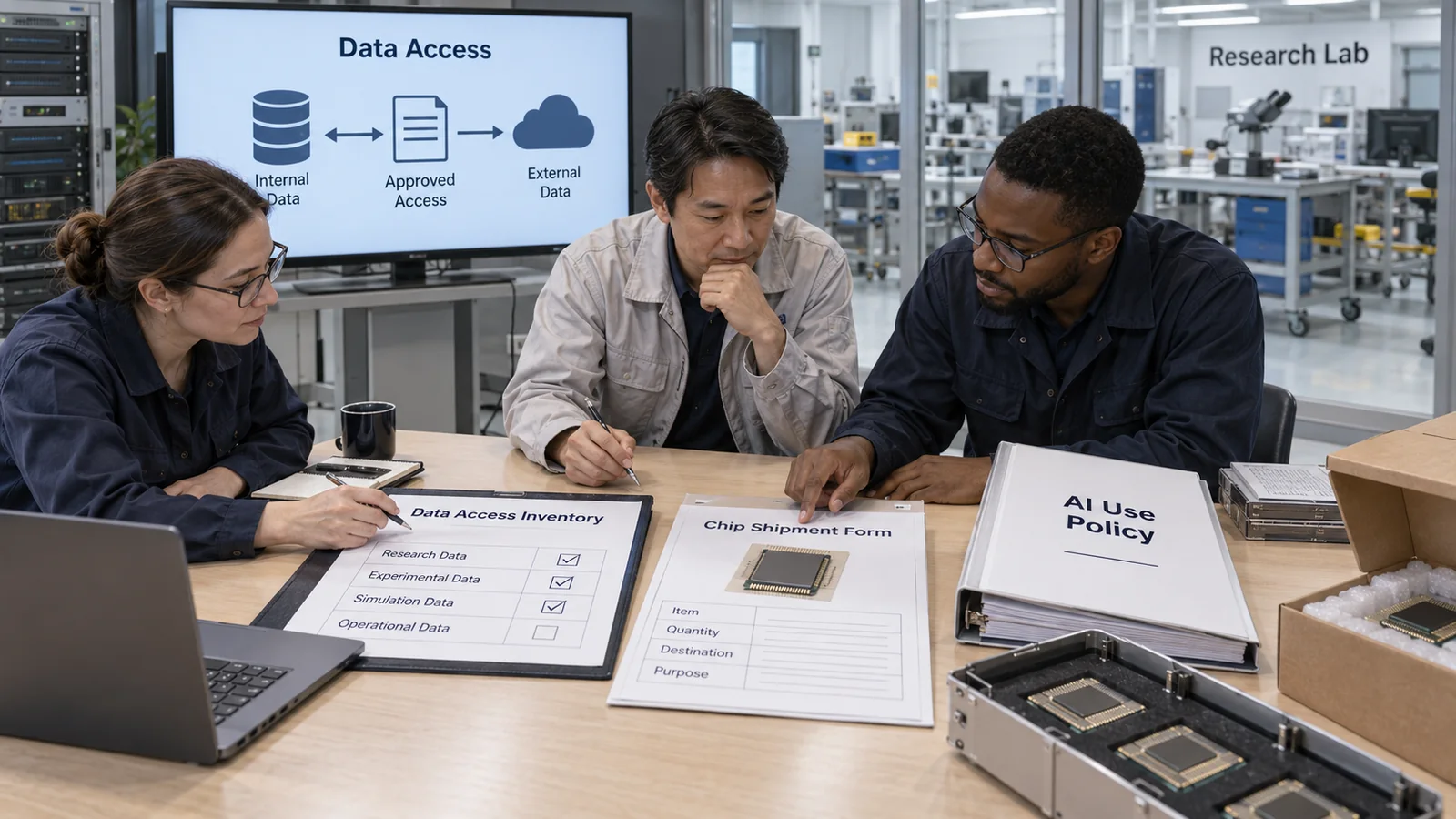
US Executive Order 14363 (the Genesis Mission) sets out a plan under which the Department of Energy builds an AI platform integrating federal scientific datasets and uses scientific foundation models and AI agents to automate and accelerate research workflows [Ref. 7]. China's "AI Plus" opinions list, under science and technology, new AI-driven research paradigms and the building of high-quality scientific datasets [Ref. 38]. Japan's basic plan (Phase II) also names research and development leading "AI for Science" and the introduction of vertical AI and physical AI in manufacturing and other fields; it promotes sharing data across organizations while securing the safety of Japan's data, including addressing the risk of outflow of sensitive information such as trade secrets [Ref. 43]. In materials and chemistry research, what decides the real benefit is whether public data with its conditions aligned (test method, specimen, temperature) becomes available (our reading). But these are descriptions at the stage of concepts and targets; we did not confirm concrete results in the materials field or the terms of data use Not yet confirmed. AI-driven materials discovery itself is covered in our explainer on materials informatics.
BIS guidance of 31 May 2026 clarifies that the licence requirement applies to advanced computing items for entities headquartered in Country Group D:5 or Macau (or whose ultimate parent is), even when the entity operates outside those places [Ref. 24]. Whether an AI chip may be exported depends on the combination of item classification, destination and end user (Chapter 6). Even when a materials, parts or equipment company does not export AI chips itself, a customer's plans for data centers or manufacturing facilities can be affected by export controls. This is an inference; check any individual transaction with professionals.
In China, the labeling measures (in force 1 September 2025) require providers of generative and synthetic services to apply explicit and implicit labels [Ref. 35]. The transparency obligations of Article 50 of the EU AI Act have applied since 2 August 2026 (see our explainer on the EU AI Act). In Japan, the AI Promotion Act sets no direct labeling duty for businesses, and the appropriateness guidelines present transparency as a voluntary effort [Ref. 40, 45]. In the United States, the TAKE IT DOWN Act is limited to removing nonconsensual intimate depictions [Ref. 14]. When images for technical documents or catalogues are made with generative AI, whether an in-house labeling rule is needed depends on which country's market they are put on (our reading). A minimum that can be explained across countries is to record the tool and version used for AI-generated figures and text.
11. Limits, and what we could not confirm
(1) Limits of comparison
The documents of the three countries differ in legal character and in how they are changed. This article only lines up stages and dates and does not evaluate strength or superiority.
(2) Implementation and pending proceedings
We could not confirm whether the deadlines in executive orders were met (publication of Commerce's evaluation of state laws, the BEAD notice, deliverables within the deadlines of EO 14409 and 14434). We make no guess about the outcomes of lawsuits over state laws or of bills in Congress on preemption (including drafts).
(3) Originals we could not check
For China's amended Cybersecurity Law, we confirmed the content in the CAC's commentary and did not check the text of the amending decision. For GB 45438-2025, we checked a copy of the standard's text on a law firm's site and could not confirm an official publication page. The Department of Commerce's June 2025 statement (by the Secretary) could not be reached on its site, and we confirmed the plan in NIST's document instead.
(4) The history of names
We could not find an announcement giving the date or reasons for NIST's unit becoming CAISSI. How far EO 14434 changes the term for US "AI" may change after the definition proposal under section 3(b), so we keep to what the current text says.
(5) Countries and fields not covered
The EU is covered in our explainer on the EU AI Act. We do not cover the policies of the United Kingdom, Korea, India and others, or AI policy in the military field.
- The United States centres on executive orders, state laws and export controls. We could not confirm a comprehensive federal AI statute. Executive Order 14434 of 29 September 2026 asks the executive branch to use "Super Intelligence" in its documents, but does not change the wording of existing laws or contracts Sourced
- China has layered departmental rules, and the amended Cybersecurity Law took effect on 1 January 2026. Labeling of generated content has applied since 1 September 2025, and anthropomorphic interaction rules since 15 July 2026 Sourced
- Japan combines promotion and appropriateness through the AI Promotion Act (fully in force 1 September 2025), the basic plan (Phase II on 14 July 2026) and guidelines. The Act's text has no chapter on penalties Sourced
- NIST's AI evaluation unit went from the AI Safety Institute to CAISI, and the current page says CAISSI. We could not find an announcement of the change Sourced
- Read documents by stage. Statutes, orders and rules, and guidance and plans differ in binding force and in how they change (our reading)
12. How to read evaluations and standards
Policy documents contain few numerical benchmarks. Instead there are thresholds that decide what is regulated (compute, performance), evaluations carried out by businesses or governments, and standards and guidance used to show conformity. The table below lines them up as far as they could be confirmed; where nothing could be confirmed the cell says so.
| What is assessed | Representative evaluation methods and thresholds (name, source) | Standards and guidance (NIST, ISO/IEC, national) | Reading note |
|---|---|---|---|
| US: AI risk managementSourced | Could not be confirmed (a framework and practice documents, not a benchmark) | NIST AI RMF 1.0 (NIST AI 100-1, January 2023). NIST's page says AI RMF 1.0 is being revised as part of the AI Action Plan [Ref. 31]. NIST's document titles have not changed | A framework for voluntary use. The content and timing of the revision are not yet confirmed (Not yet confirmed) |
| US: evaluating the capabilities of advanced modelsSourced | EO 14409: a classified benchmarking process for cyber capabilities and a threshold for "covered frontier models" (decided by the Director of the NSA) [Ref. 10]. NIST's CAISI/CAISSI publishes evaluations of open-weight models from Chinese companies and others [Ref. 29] | The NIST unit's name: CAISI to CAISSI (Fig. 4). EO 14409 states that it does not authorize a licensing requirement | The content of the classified benchmark is not public. Read government evaluations together with their methods and limits |
| US state laws: thresholds of applicationSourced | California SB 53: models trained with more than 1026 operations (including computing for fine-tuning and similar); large developers with annual gross revenue above USD 500 million [Ref. 16] | Could not be confirmed (no ISO/IEC or NIST standard corresponding to the state thresholds was found) | Compute is an estimate. It is a threshold in a different system from the EU's 10^25 FLOP (a presumption), and we do not rank them |
| US: export control thresholdsSourced | BIS rule of 15 January 2026: items with a TPP below 21,000 and DRAM bandwidth below 6,500 GB/s go to case-by-case review [Ref. 23] | ECCN 3A090 and others in the Export Administration Regulations. The definition of TPP is in a technical note to the EAR | TPP is a performance metric; actual licensing depends on destination and end use. Conditions and thresholds change with amendments |
| China: security assessment and filing for generative AISourced | Services with public-opinion attributes or social mobilization capability require a security assessment and algorithm filing (Interim Measures for generative AI, Art. 17) [Ref. 32] | Mandatory national standard GB 45438-2025 (labeling method; in force 1 September 2025) [Ref. 39] | The standard is mandatory. Digital watermarks are not required. We could not confirm an official publication page |
| Japan: technical evaluation and guidelinesSourced | Strengthening technical evaluation of AI models by the AI Safety Institute (AISI) is stated in the basic plan (Phase II) [Ref. 43] | Appropriateness guidelines (19 December 2025) [Ref. 45]. AI Guidelines for Business version 1.2 (31 March 2026; non-binding soft law) [Ref. 47]. The plan states participation in international AI standardization at ISO/IEC JTC 1 | The guidelines encourage voluntary efforts; the AI Act has no penalties. The plan's measures are future targets |
Checked against laws, the Federal Register, official government pages and the text of a standard (Sourced; checked 15 October 2026). The arrangement of this table is Our calculation (a reordering by this article), and the reading-note column is commentary.
Notes on reading
- A threshold means different things in each system. California's 1026 FLOP, the EU's 1025 FLOP presumption, the TPP in US export controls and China's security-assessment scope are criteria for different purposes, and are not lined up to compare "strictness".
- Check whether a document is mandatory or voluntary. China's mandatory national standard is mandatory, the NIST AI RMF is voluntary, Japan's AI Guidelines for Business are non-binding, and a US executive order is an instruction to the executive branch.
- Names and dates change. The NIST unit's name, AI-related terms (Executive Order 14434) and the version of the basic plan have all changed. When citing, keep the document's title as originally given and add the check date and version.
13. Glossary
- Executive order
- An instruction by the US President to the executive branch. It is not a statute enacted by Congress; its signing date and number are published in the Federal Register.
- Federal Register
- The official journal of the US Government, in which executive orders and rules are published.
- Preemption
- The displacement of state law by federal law. It requires a federal statute or a valid federal regulation.
- BIS
- The Bureau of Industry and Security of the US Department of Commerce, which administers the Export Administration Regulations (EAR).
- EAR
- The Export Administration Regulations. Whether a licence is needed depends on item classification (ECCN), destination, and end use and end user.
- TPP
- Total processing performance: the measure of performance of advanced computing items in the EAR, defined in a technical note to the EAR.
- CAISI / CAISSI
- NIST's AI evaluation unit. Its reform into CAISI was announced in June 2025, and its current page as checked uses CAISSI.
- Departmental rules (China)
- Rules issued by departments of the State Council (such as the Cyberspace Administration of China), promulgated as numbered orders.
- Explicit and implicit labels
- In China's labeling measures, labels users can clearly perceive, and labels placed in file metadata and similar.
- Mandatory national standard (GB)
- A Chinese national standard compliance with which is mandatory.
- AI Promotion Act (Japan)
- The Act on the Promotion of Research and Development, and Utilization of Artificial Intelligence-Related Technologies; it sets a framework for promotion and appropriateness.
- AI Basic Plan
- The basic plan the Government sets under Article 18 of the AI Promotion Act, adopted by the Cabinet.
- AISI (Japan)
- The AI Safety Institute, which handles technical evaluation of AI models among other tasks.
- Hiroshima AI Process
- An international framework for AI governance launched at the 2023 G7 Hiroshima Summit.
- Soft law
- Guidance with no legal force.
14. References
- US President / Federal Register Executive Order 14148 "Initial Rescissions of Harmful Executive Orders and Actions" (signed 20 January 2025; Federal Register 28 January 2025; the list of rescinded orders includes EO 14110) — www.federalregister.gov/documents/2025/01/28/2025-01901/initial-rescissions-of-harmful-executive-orders-and-actions
- US President / Federal Register Executive Order 14179 "Removing Barriers to American Leadership in Artificial Intelligence" (signed 23 January 2025; published 31 January 2025) — www.federalregister.gov/documents/2025/01/31/2025-02172/removing-barriers-to-american-leadership-in-artificial-intelligence
- The White House "America's AI Action Plan" (July 2025) — www.whitehouse.gov/wp-content/uploads/2025/07/Americas-AI-Action-Plan.pdf
- US President / Federal Register Executive Order 14318 "Accelerating Federal Permitting of Data Center Infrastructure" (signed 23 July 2025) — www.federalregister.gov/documents/2025/07/28/2025-14212/accelerating-federal-permitting-of-data-center-infrastructure
- US President / Federal Register Executive Order 14319 "Preventing Woke AI in the Federal Government" (signed 23 July 2025) — www.federalregister.gov/documents/2025/07/28/2025-14217/preventing-woke-ai-in-the-federal-government
- US President / Federal Register Executive Order 14320 "Promoting the Export of the American AI Technology Stack" (signed 23 July 2025) — www.federalregister.gov/documents/2025/07/28/2025-14218/promoting-the-export-of-the-american-ai-technology-stack
- US President / Federal Register Executive Order 14363 "Launching the Genesis Mission" (signed 24 November 2025; published 28 November 2025) — www.federalregister.gov/documents/2025/11/28/2025-21665/launching-the-genesis-mission
- US President / Federal Register Executive Order 14365 "Ensuring a National Policy Framework for Artificial Intelligence" (signed 11 December 2025; published 16 December 2025) — www.federalregister.gov/documents/2025/12/16/2025-23092/ensuring-a-national-policy-framework-for-artificial-intelligence
- US Department of Justice Attorney General memorandum "Artificial Intelligence Litigation Task Force" (9 January 2026) — justice.gov/ag/media/1422986/dl
- The White House Executive Order 14409 "Promoting Advanced Artificial Intelligence Innovation and Security" (signed 2 June 2026; Federal Register document 2026-11415) — www.whitehouse.gov/presidential-actions/2026/06/promoting-advanced-artificial-intelligence-innovation-and-security/
- US President / Federal Register Executive Order 14434 "Inaugurating the Era of Super Intelligence" (signed 29 September 2026; published 2 October 2026) — www.federalregister.gov/documents/2026/10/02/2026-20321/inaugurating-the-era-of-super-intelligence
- The White House "Inaugurating The Era Of Super Intelligence" (page of Executive Order 14434, 29 September 2026; also listed on the executive orders page) — www.whitehouse.gov/presidential-actions/2026/09/inaugurating-the-era-of-super-intelligence/
- The White House "National Policy Framework for Artificial Intelligence: Legislative Recommendations" (20 March 2026) — www.whitehouse.gov/wp-content/uploads/2026/03/03.20.26-National-Policy-Framework-for-Artificial-Intelligence-Legislative-Recommendations.pdf
- US Congress / Government Publishing Office Public Law 119-12, "TAKE IT DOWN Act" (S. 146, 19 May 2025) — www.govinfo.gov/content/pkg/PLAW-119publ12/html/PLAW-119publ12.htm
- California Legislature SB-53 "Artificial intelligence models: large developers" (bill status page; approved by the Governor on 29 September 2025, Chapter 138, Statutes of 2025) — leginfo.legislature.ca.gov/faces/billStatusClient.xhtml?bill_id=202520260SB53
- California Legislature SB-53, chaptered bill text — leginfo.legislature.ca.gov/faces/billTextClient.xhtml?bill_id=202520260SB53
- Texas Legislature 89(R) HB 149 "Texas Responsible Artificial Intelligence Governance Act" (bill history page; the enrolled text is at capitol.texas.gov/tlodocs/89R/billtext/html/HB00149F.htm) — capitol.texas.gov/BillLookup/History.aspx?LegSess=89R&Bill=HB149
- Colorado General Assembly SB26-189 "Automated Decision-Making Technology" (bill page; Signed Act, 14 May 2026) — leg.colorado.gov/bills/sb26-189
- New York State Legislature S6953B, relating to the training and use of artificial intelligence frontier models (signed 19 December 2025, Chapter 699) — www.nysenate.gov/legislation/bills/2025/S6953
- New York State Legislature S8828 (chapter amendment; signed 27 March 2026, Chapter 96) — www.nysenate.gov/legislation/bills/2025/S8828
- US Department of Commerce, BIS "Department of Commerce Announces Rescission of Biden-Era Artificial Intelligence Diffusion Rule, Strengthens Chip-Related Export Controls" (press release dated 13 May 2025; the body as checked uses the term "SI") — www.bis.gov/press-release/department-commerce-announces-rescission-biden-era-artificial-intelligence-diffusion-rule-strengthens
- BIS / Federal Register "Framework for Artificial Intelligence Diffusion", 90 FR 4544 (15 January 2025) — www.federalregister.gov/documents/2025/01/15/2025-00636/framework-for-artificial-intelligence-diffusion
- BIS / Federal Register "Revision to License Review Policy for Advanced Computing Commodities", 91 FR 1684 (15 January 2026) — www.federalregister.gov/documents/2026/01/15/2026-00789/revision-to-license-review-policy-for-advanced-computing-commodities
- BIS "Guidance Regarding Enforcement of License Requirements for Advanced Computing Items for Entities Headquartered in Country Group D:5 and Macau" (31 May 2026) — www.bis.gov/media/documents/bis-guidance-may-31-2026.pdf
- BIS / Federal Register "Enhanced Favorable Treatment for the United Arab Emirates Under the Export Administration Regulations", 91 FR 43034 (14 July 2026; effective 10 July) — www.federalregister.gov/documents/2026/07/14/2026-14132/enhanced-favorable-treatment-for-the-united-arab-emirates-under-the-export-administration
- NIST "NIST Announcements" (June 2025; includes the plan to reform the U.S. AI Safety Institute into CAISI) — www.nist.gov/document/nist-announcements-june-2025
- NIST "U.S. AI Safety Institute Signs Agreements Regarding AI Safety Research, Testing and Evaluation With Anthropic and OpenAI" (August 2024) — www.nist.gov/news-events/news/2024/08/us-ai-safety-institute-signs-agreements-regarding-ai-safety-research
- NIST "Announcing the 'AI Agent Standards Initiative' for Interoperable and Secure Innovation" (17 February 2026; announced under the CAISI name) — www.nist.gov/news-events/news/2026/02/announcing-ai-agent-standards-initiative-interoperable-and-secure
- NIST "Center for Advancing Innovation and Standards for Super Intelligence (CAISSI)" (current page as checked 15 October 2026; its news list carries evaluation articles under the CAISI name) — www.nist.gov/caissi
- NIST NIST hub page on AI ("Super intelligence"), as checked 15 October 2026 — www.nist.gov/super-intelligence
- NIST "AI Risk Management Framework" (as checked 15 October 2026; states that AI RMF 1.0 is being revised) — www.nist.gov/itl/ai-risk-management-framework
- Cyberspace Administration of China and others Interim Measures for the Administration of Generative Artificial Intelligence Services, Order No. 15 (signed 10 July 2023; in force 15 August 2023; in Chinese) — www.cac.gov.cn/2023-07/13/c_1690898327029107.htm
- Cyberspace Administration of China and others Provisions on the Administration of Deep Synthesis in Internet Information Services, Order No. 12 (signed 25 November 2022; in force 10 January 2023; in Chinese) — www.cac.gov.cn/2022-12/11/c_1672221949354811.htm
- Cyberspace Administration of China and others Provisions on the Administration of Algorithmic Recommendations in Internet Information Services, Order No. 9 (signed 31 December 2021; in force 1 March 2022; in Chinese) — www.cac.gov.cn/2022-01/04/c_1642894606364259.htm
- Cyberspace Administration of China and others Measures for Labeling AI-Generated Synthetic Content, CAC Notice [2025] No. 2 (dated 7 March 2025; in force 1 September 2025; in Chinese) — www.cac.gov.cn/2025-03/14/c_1743654684782215.htm
- Cyberspace Administration of China and others Interim Measures for the Administration of Anthropomorphic AI Interaction Services, Order No. 21 (issued 10 April 2026; in force 15 July 2026; in Chinese) — www.cac.gov.cn/2026-04/10/c_1777558395078289.htm
- Cyberspace Administration of China Expert commentary on the amendment of the Cybersecurity Law (2 January 2026; in Chinese; explains the decision adopted on 28 October 2025, in force 1 January 2026, and the new Article 20) — www.cac.gov.cn/2026-01/02/c_1769093523928606.htm
- State Council of China State Council Opinions on Deepening the Implementation of the "AI Plus" Initiative, Guofa [2025] No. 11 (dated 21 August 2025; published 26 August; in Chinese) — www.gov.cn/zhengce/content/202508/content_7037861.htm
- State Administration for Market Regulation and Standardization Administration of China GB 45438-2025, Cybersecurity technology - Labeling method for content generated by artificial intelligence (issued 28 February 2025; in force 1 September 2025). We used a copy of the standard's text posted on a law firm's website — sidley.com (PDF copy of GB 45438-2025)
- Japan (e-Gov Law Search) Act on the Promotion of Research and Development, and Utilization of Artificial Intelligence-Related Technologies (Act No. 53 of 2025; promulgated 4 June 2025; current version in force from 1 September 2025; in Japanese) — laws.e-gov.go.jp/law/507AC0000000053
- Cabinet Office, Japan Page on the AI Promotion Act (in Japanese) — www8.cao.go.jp/cstp/ai/ai_act/ai_act.html
- Cabinet Office, Japan Page on the AI Basic Plan (Cabinet decision of 14 July 2026; earlier plan: Cabinet decision of 23 December 2025; in Japanese) — www8.cao.go.jp/cstp/ai/ai_plan/ai_plan.html
- Cabinet Office, Japan Japan's Second Artificial Intelligence Basic Plan (Cabinet decision of 14 July 2026; in Japanese, with an official provisional English translation) — www8.cao.go.jp/cstp/ai/ai_plan/aiplan_20260714.pdf
- Cabinet Office, Japan Artificial Intelligence Basic Plan (Cabinet decision of 23 December 2025; in Japanese) — www8.cao.go.jp/cstp/ai/ai_plan/aiplan_20251223.pdf
- Artificial Intelligence Strategic Headquarters, Japan Guideline for Ensuring the Appropriateness of Research & Development and Utilization of Artificial Intelligence-Related Technology (decision of 19 December 2025; in Japanese, with an official provisional English translation) — www8.cao.go.jp/cstp/ai/ai_guideline/ai_gl_2025.pdf
- Cabinet Office, Japan Page of the Artificial Intelligence Strategic Headquarters (membership; in Japanese) — www8.cao.go.jp/cstp/ai/ai_hq/ai_hq.html
- MIC and METI, Japan AI Guidelines for Business, Version 1.2 (31 March 2026; in Japanese) — www.meti.go.jp/shingikai/mono_info_service/ai_shakai_jisso/pdf/20260331_1.pdf
- METI, Japan Page of the Study Group on AI Guidelines for Business (list of publication dates for versions 1.0 to 1.2; in Japanese) — www.meti.go.jp/shingikai/mono_info_service/ai_shakai_jisso/index.html
15. Claim-to-source audit
| Claim in the text | Basis | Category |
|---|---|---|
| EO 14148 (20 January 2025) lists EO 14110 (30 October 2023) among the rescinded orders | Reference 1 https://www.federalregister.gov/documents/2025/01/28/2025-01901/initial-rescissions-of-harmful-executive-orders-and-actions | Sourced |
| EO 14179 (23 January 2025): policy, definition of AI (15 U.S.C. 9401(3)), an action plan within 180 days, review of actions under 14110 | Reference 2 https://www.federalregister.gov/documents/2025/01/31/2025-02172/removing-barriers-to-american-leadership-in-artificial-intelligence | Sourced |
| The three pillars of the AI Action Plan (July 2025) | Reference 3 https://www.whitehouse.gov/wp-content/uploads/2025/07/Americas-AI-Action-Plan.pdf | Sourced |
| Content of EO 14318, 14319 and 14320 (23 July 2025): data center permitting, principles for LLMs procured, export of full-stack US AI technology | Reference 4 https://www.federalregister.gov/documents/2025/07/28/2025-14212/accelerating-federal-permitting-of-data-center-infrastructure Reference 5 https://www.federalregister.gov/documents/2025/07/28/2025-14217/preventing-woke-ai-in-the-federal-government Reference 6 https://www.federalregister.gov/documents/2025/07/28/2025-14218/promoting-the-export-of-the-american-ai-technology-stack | Sourced |
| EO 14363 Genesis Mission (24 November 2025): the Department of Energy builds an AI platform on federal scientific data | Reference 7 https://www.federalregister.gov/documents/2025/11/28/2025-21665/launching-the-genesis-mission | Sourced |
| EO 14365 (11 December 2025): AI Litigation Task Force, evaluation of state laws, policy for a federal framework | Reference 8 https://www.federalregister.gov/documents/2025/12/16/2025-23092/ensuring-a-national-policy-framework-for-artificial-intelligence | Sourced |
| Establishment of the AI Litigation Task Force by the Attorney General memorandum of 9 January 2026 | Reference 9 https://www.justice.gov/ag/media/1422986/dl?inline= | Sourced |
| EO 14409 (2 June 2026): cyber defence, clearinghouse, classified benchmarking, voluntary framework, no licensing requirement, NSPM-11 (5 June) | Reference 10 https://www.whitehouse.gov/presidential-actions/2026/06/promoting-advanced-artificial-intelligence-innovation-and-security/ | Sourced |
| EO 14434 (29 September 2026; Federal Register 2 October 2026): policy, implementation, definition and general provisions; no change to earlier documents required; a definition proposal within 60 days | Reference 11 https://www.federalregister.gov/documents/2026/10/02/2026-20321/inaugurating-the-era-of-super-intelligence Reference 12 https://www.whitehouse.gov/presidential-actions/2026/09/inaugurating-the-era-of-super-intelligence/ | Sourced |
| The White House legislative recommendations (20 March 2026): children, IP, preemption and so on; leaving AI training and copyright to the courts | Reference 13 https://www.whitehouse.gov/wp-content/uploads/2026/03/03.20.26-National-Policy-Framework-for-Artificial-Intelligence-Legislative-Recommendations.pdf | Sourced |
| TAKE IT DOWN Act (Public Law 119-12, 19 May 2025): digital forgery, notice and removal (a process within one year; removal within 48 hours), FTC enforcement | Reference 14 https://www.govinfo.gov/content/pkg/PLAW-119publ12/html/PLAW-119publ12.htm | Sourced |
| California SB 53: approved 29 September 2025, Chapter 138. Definition of frontier model (above 10^26 operations) and large frontier developer (gross revenue above USD 500 million), publication of a framework, transparency reports, reports within 15 days or 24 hours, civil penalty up to USD 1 million | Reference 15 https://leginfo.legislature.ca.gov/faces/billStatusClient.xhtml?bill_id=202520260SB53 Reference 16 https://leginfo.legislature.ca.gov/faces/billTextClient.xhtml?bill_id=202520260SB53 | Sourced |
| Texas HB 149: signed 22 June 2025, effective 1 January 2026; prohibited conduct, exclusive Attorney General enforcement, civil penalty amounts, sandbox | Reference 17 https://capitol.texas.gov/BillLookup/History.aspx?LegSess=89R&Bill=HB149 | Sourced |
| Colorado SB26-189 (signed 14 May 2026): ADMT in consequential decisions, developer documentation from 1 January 2027, consumer notice, explanation within 30 days, Attorney General enforcement | Reference 18 https://leg.colorado.gov/bills/sb26-189 | Sourced |
| New York RAISE Act: S6953B (signed 19 December 2025, Chapter 699), chapter amendment S8828 (signed 27 March 2026, Chapter 96), effective 1 January 2027 | Reference 19 https://www.nysenate.gov/legislation/bills/2025/S6953 Reference 20 https://www.nysenate.gov/legislation/bills/2025/S8828 | Sourced |
| AI Diffusion Rule (90 FR 4544, 15 January 2025), the BIS rescission announcement (13 May 2025), the case-by-case review policy (91 FR 1684, 15 January 2026), BIS guidance (31 May 2026) and the UAE rule (91 FR 43034, 14 July 2026) | Reference 21 https://www.bis.gov/press-release/department-commerce-announces-rescission-biden-era-artificial-intelligence-diffusion-rule-strengthens Reference 22 https://www.federalregister.gov/documents/2025/01/15/2025-00636/framework-for-artificial-intelligence-diffusion Reference 23 https://www.federalregister.gov/documents/2026/01/15/2026-00789/revision-to-license-review-policy-for-advanced-computing-commodities Reference 24 https://www.bis.gov/media/documents/bis-guidance-may-31-2026.pdf Reference 25 https://www.federalregister.gov/documents/2026/07/14/2026-14132/enhanced-favorable-treatment-for-the-united-arab-emirates-under-the-export-administration | Sourced |
| History of the NIST unit name: U.S. AI Safety Institute (agreements of August 2024), the plan to reform it into CAISI (June 2025), the AI Agent Standards Initiative (17 February 2026), the CAISSI name on the current page, its listed roles, and the hub page | Reference 26 https://www.nist.gov/document/nist-announcements-june-2025 Reference 27 https://www.nist.gov/news-events/news/2024/08/us-ai-safety-institute-signs-agreements-regarding-ai-safety-research Reference 28 https://www.nist.gov/news-events/news/2026/02/announcing-ai-agent-standards-initiative-interoperable-and-secure Reference 29 https://www.nist.gov/caissi Reference 30 https://www.nist.gov/super-intelligence | Sourced |
| NIST's page statement (checked 15 October 2026) that AI RMF 1.0 is being revised | Reference 31 https://www.nist.gov/itl/ai-risk-management-framework | Not yet confirmed |
| Interim Measures for generative AI (Order No. 15): scope, training data, labeling, security assessment and filing, penalties | Reference 32 https://www.cac.gov.cn/2023-07/13/c_1690898327029107.htm | Sourced |
| Numbers, signing dates and effective dates of the deep synthesis provisions (Order No. 12) and the algorithmic recommendation provisions (Order No. 9) | Reference 33 https://www.cac.gov.cn/2022-12/11/c_1672221949354811.htm Reference 34 https://www.cac.gov.cn/2022-01/04/c_1642894606364259.htm | Sourced |
| Measures for Labeling AI-Generated Synthetic Content: explicit and implicit labels, metadata elements, duties of dissemination platforms, six-month logs, conformity with mandatory national standards, in force 1 September 2025 | Reference 35 https://www.cac.gov.cn/2025-03/14/c_1743654684782215.htm | Sourced |
| Interim Measures for anthropomorphic AI interaction services (Order No. 21): issued 10 April 2026, in force 15 July 2026, scope and prohibited activities | Reference 36 https://www.cac.gov.cn/2026-04/10/c_1777558395078289.htm | Sourced |
| Decision amending the Cybersecurity Law (adopted 28 October 2025, in force 1 January 2026) and the purport of the new Article 20 (CAC expert commentary) | Reference 37 https://www.cac.gov.cn/2026-01/02/c_1769093523928606.htm | Sourced |
| State Council "AI Plus" opinions (Guofa [2025] No. 11): the 2027 and 2030 penetration targets, priority fields, the science and technology section | Reference 38 https://www.gov.cn/zhengce/content/202508/content_7037861.htm | Not yet confirmed |
| GB 45438-2025: issue and effective dates, position, size and duration of explicit labels, the format of implicit metadata labels (AIGC field), and that digital watermarks are not required | Reference 39 https://www.sidley.com/en/-/media/resource-pages/ai-monitor/20250314-china-standard-gb-454382025-labeling-method-for-content-generated-by-ai.pdf?la=en | Sourced |
| The AI Promotion Act (Act No. 53 of 2025): promulgated 4 June 2025, in force 1 September 2025, chapter structure, content of Arts. 1-3, 7, 13, 16, 18 and supplementary Art. 2 | Reference 40 https://laws.e-gov.go.jp/law/507AC0000000053 Reference 41 https://www8.cao.go.jp/cstp/ai/ai_act/ai_act.html | Sourced |
| The AI Basic Plan: Cabinet decisions of 23 December 2025 and 14 July 2026, the structure of Phase II, measures on AI governance (strengthening AISI, the Hiroshima AI Process, international standards, AI for Science and so on) | Reference 42 https://www8.cao.go.jp/cstp/ai/ai_plan/ai_plan.html Reference 43 https://www8.cao.go.jp/cstp/ai/ai_plan/aiplan_20260714.pdf Reference 44 https://www8.cao.go.jp/cstp/ai/ai_plan/aiplan_20251223.pdf | Not yet confirmed |
| The appropriateness guideline (decision of 19 December 2025): position, approach, items to address, participation in the Hiroshima AI Process | Reference 45 https://www8.cao.go.jp/cstp/ai/ai_guideline/ai_gl_2025.pdf | Sourced |
| Membership of the AI Strategy Headquarters (the Prime Minister as head; all Ministers of State as members) | Reference 46 https://www8.cao.go.jp/cstp/ai/ai_hq/ai_hq.html | Sourced |
| AI Guidelines for Business version 1.2 (31 March 2026) and the publication dates of the versions | Reference 47 https://www.meti.go.jp/shingikai/mono_info_service/ai_shakai_jisso/pdf/20260331_1.pdf Reference 48 https://www.meti.go.jp/shingikai/mono_info_service/ai_shakai_jisso/index.html | Sourced |
| The arrangement of the three countries' documents by stage (Fig. 2), date arithmetic for EO 14365, 14409 and 14434, the size and duration calculation for labels (for example 54 pixels at 1,920 x 1,080), the arrangement of the evaluation-and-standards table, and the readings for materials and manufacturing | Our calculation or commentary; assumptions and limits are stated where used | Our calculation |
| Whether executive order deadlines were met, publication of Commerce's evaluation of state laws, the original text of the amended Cybersecurity Law, an announcement of NIST's change of name, an official publication page for GB 45438-2025, and the original of the Commerce statement of June 2025 | Not confirmed from the primary sources reachable within this survey, so not described (the Commerce site could not be reached; NIST's document was used instead) | Commentary |
| That Figures 2 to 4 are explanatory drawings, and that Figures 1 and 5 are frames for AI-generated images | Note by this article | Commentary |
Last updated: 15 October 2026 / Sources are limited to primary material (the Federal Register, the White House, official pages of the US Congress and state legislatures, official documents of BIS and NIST, the CAC, the State Council and the central government portal of China, the e-Gov law database, and the Cabinet Office, MIC and METI of Japan). The arrangement of document stages and the readings for materials and manufacturing are marked as commentary or our calculation to keep them apart from sourced facts. Whether the deadlines in executive orders were met, publication of Commerce's evaluation of state laws, the original text of the amended Cybersecurity Law, an announcement of NIST's change of unit name, and an official publication page for GB 45438-2025 could not be confirmed and are not described. This article is not legal advice and neither supports nor criticizes any country, administration or company. We make no guess about the outcome of pending proceedings or future legislation. Figures 2 to 4 are vector drawings; Figures 1 and 5 are frames for AI-generated images (not yet created). None of them depicts a real organization or document.