COMPANY PROFILE / AI & MACHINE LEARNING
Intel
A U.S. chipmaker with the "host" CPUs of AI servers and its own fabs and packaging
Intel is a U.S. chipmaker with the CPUs (Xeon) that run alongside GPUs in AI servers, AI accelerators (Gaudi and a GPU in development), and its own manufacturing foundry. Revenue in 2025 was US$52.85 billion, of which the Data Center and AI segment (DCAI) was US$16.92 billion. In 2025 NVIDIA, SoftBank and the U.S. government all took equity stakes. This profile sets out the state of its AI chips, its fabs and advanced packaging, and the government and corporate equity, within what the company has filed and announced. Revenue from AI accelerators on their own is not disclosed, and press figures are not used. Products, contracts and investments change quickly, so every status carries its check date (15 October 2026).
- Intel in 30 seconds, and where it stands in AI and machine learning
- The logo and how the name is written
- Where the company sits in the AI and machine learning field
- Scale (limited to the AI-related business)
- Resources committed to AI and machine learning
- What it has done so far
- What comes next
- What the company is aiming for in AI and machine learning
- Map of partnerships in AI and machine learning
- Technology, products and services
- The risks this company carries
- Glossary / References / Claim-to-source audit
1. Intel in 30 seconds, and where it stands in AI and machine learning
(CPUs, AI chips, fabs)It both designs and manufactures. The classification is ours
in August 2025Plus 159 million escrowed shares and warrants, per the 10-K
GPU systems draw the most demand in AI compute, and the 10-K says customers prioritised GPU systems, often at the expense of CPU investment Sourced. Intel takes part in AI through the CPUs (Xeon) that run beside those GPUs, its own fabs (foundry) and its advanced packaging (EMIB). In AI-specific chips, it booked US$922 million of Gaudi inventory-related charges in 2024 and in 2025 changed strategy toward annual generations of inference-optimised GPUs Sourced. The other feature is the flow of money. In 2025 the government, SoftBank and NVIDIA took equity stakes, and in August 2026 Intel also sold US$20 billion of stock to the public Sourced. This profile reads the company through those two points: the position of its AI-specific chips, and fab investment backed by equity.
2. The logo and how the name is written

A note on names: the legal entity is Intel Corporation. Altera (the FPGA company) was 51% sold by Intel in September 2025 and is no longer consolidated. Mobileye is an Intel subsidiary included in figures such as headcount. Gaudi, Xeon and Crescent Island are product names, not company names.
Official site (investor relations): https://www.intc.com/3. Where the company sits in the AI and machine learning field
4. Scale (limited to the AI-related business)
The table centres on the AI-related parts of the company (DCAI and Foundry). Figures are from the 10-K, in US$ millions. Segment results include intersegment activity Sourced.
| Indicator (US$ millions) | 2023 | 2024 | 2025 |
|---|---|---|---|
| Net revenue (company) | 54,228 | 53,101 | 52,853 |
| DCAI revenue | 15,980 | 16,125 | 16,919 |
| DCAI operating income | 945 | 1,414 | 3,422 |
| Intel Foundry revenue (including intersegment) | 18,504 | 17,317 | 17,826 |
| of which external revenue | Not confirmed | 159 | 307 |
| Intel Foundry operating loss | (7,083) | (13,291) | (10,318) |
| R&D expense (company) | 16,046 | 16,546 | 13,774 |
| Capital expenditure (additions to PP&E) | 25,750 | 23,944 | 14,646 |
Headcount at the end of 2025 was 85,100 (including subsidiaries such as Mobileye), and the 2025 restructuring plan reduced the core Intel workforce by about 15% by year-end compared with the end of the second quarter. Net property, plant and equipment exceeded US$100 billion, the substantial majority of which the 10-K estimates relates to the foundry business Sourced. Figures for the latest quarter follow Sourced.
| Second quarter of 2026 (to 27 June) | Value | Note |
|---|---|---|
| Net revenue (company) | US$16.1 billion | Up 25% year on year |
| DCAI revenue / operating income | US$6,262 million / US$2,474 million | Up 59%. Operating margin 40% (16% a year earlier) |
| Server ASP and volume | ASP up 48%, volume up 9% | Mainly a higher mix of premium products and demand-based pricing; hyperscaler demand |
| Other DCAI revenue | US$951 million | Mainly higher demand for purpose-built silicon (ASICs) |
| Intel Foundry revenue (including intersegment) | US$5.8 billion | Up 31%. US$5.5 billion was internal. Includes the effect of Altera becoming an external customer |
| Third-quarter outlook | Revenue US$15.8-16.8 billion | Company outlook Not yet confirmed |
The DCAI figures are not only AI accelerators. DCAI groups Xeon, AI accelerators, NICs, IPUs and custom ASICs, and revenue from Gaudi or any future GPU is not separately disclosed. What the 10-K gives is the Gaudi-related inventory charge in 2024 (US$922 million) and a statement that it was lower in 2025 Sourced. From 2026 the client segment has also been renamed the Client Computing and Physical AI Group (CCPG; formerly CCG). A new name does not make AI revenue visible.
5. Resources committed to AI and machine learning
The table shows whether the four items (people, money, outside investments, acquisitions and divestitures, and ties with universities and public bodies) could be confirmed in the 10-K, 10-Q, 8-Ks and official materials.
| Type of resource | Details | Status |
|---|---|---|
| People | 85,100 people on 27 December 2025. R&D in 2025 focused on AI integration, heterogeneous computing and 18A/14A. The number dedicated to AI is not disclosed | Sourced |
| Money: R&D | US$13.8 billion in 2025 (US$16.5 billion in 2024; US$16.0 billion in 2023). The fall reflects headcount cuts and other cost measures | Sourced |
| Money: capex | US$14.65 billion in 2025 (US$23.94 billion in 2024). Construction in progress was US$34.5 billion (US$50.4 billion at the end of 2024) as the first Arizona assets were placed in service. The second-quarter 2026 release says investment in equipment, cleanroom space and substrates will rise meaningfully | Sourced |
| Funding (equity) | U.S. government: received US$5.7 billion of accelerated CHIPS Act funding in August 2025 and issued 275 million shares plus warrants and other instruments. SoftBank: US$2.0 billion (87 million shares at US$23.00). NVIDIA: US$5.0 billion (215 million shares at US$23.28). August 2026: a US$20 billion public offering (210,526,315 shares at US$95) | Sourced |
| Acquisitions, JVs and divestitures | Altera: 51% sold in September 2025 (net consideration US$4.3 billion, to an SLP affiliate). Fab 34 (Ireland): repurchased Apollo's 49% interest for US$14.2 billion in April 2026 (cash plus a US$6.5 billion loan, later repaid with notes) | Sourced |
| Public funding | Agreement with the Department of Commerce (August 2025): amended the commercial CHIPS Act agreement and removed milestone conditions. The US$3.2 billion for Secure Enclave is tied to releasing escrowed shares at US$20 each as funds are received. In 2025: US$5.4 billion of Advanced Manufacturing Investment Credit and US$769 million of CHIPS Act capital incentives | Sourced |
| Universities and research bodies | The 10-K and 10-Q name no specific university or research body for AI that we could confirm (references to ecosystem partnerships are general) | Not confirmed |
Key products and facilities, as far as the company's materials let us confirm (check date 15 October 2026).
| Product or facility | Scale and content | Stage | Date | Source |
|---|---|---|---|---|
| Gaudi 3 (AI accelerator) | 128 GB HBM2e, 3.7 TB/s, 1.8 PFlops of FP8 and BF16, 24 x 200 GbE ports (Intel technical paper). These are Intel's stated values; conditions are per the paper | Current sales status not confirmed here | Paper dated July 2025 | Reference 8 https://cdrdv2-public.intel.com/817486/gaudi-3-ai-accelerator-white-paper.pdf |
| Crescent Island / GPU D270 | Xe3P inference-optimised data center GPU. The October 2025 announcement says 160 GB of LPDDR5X; the product page says up to 480 GB, 350 W air-cooled, 32 Xe3P cores and 256 XMX engines | In development. Customer sampling was expected in the second half of 2026 (actual start not confirmed) Not yet confirmed | 14 October 2025 | Reference 9, 10 https://www.intel.com/content/www/us/en/newsroom/news/artificial-intelligence/intel-to-expand-ai-accelerator-portfolio-with-new-gpu.html https://www.intel.com/content/www/us/en/products/details/discrete-gpus/data-center-gpu/d-series.html |
| Jaguar Shores | The next-generation GPU architecture, designed to enhance AI workload capability per the 10-K | In development Not yet confirmed | January 2026 (10-K) | Reference 1 https://www.sec.gov/Archives/edgar/data/50863/000005086326000011/intc-20251227.htm |
| Xeon 6 / Xeon 6+ | Xeon 6 has Intel 3 compute dies and Intel 7 I/O dies joined by EMIB, with AMX for AI. Xeon 6+ is the first server product on 18A | Shipping | January 2026; July 2026 | Reference 1, 3 https://www.sec.gov/Archives/edgar/data/50863/000005086326000011/intc-20251227.htm https://www.sec.gov/Archives/edgar/data/50863/000005086326000155/q226earningsrelease.htm |
| Intel 18A / 18A-P | RibbonFET (gate-all-around transistor) and PowerVia (backside power). Volume production began in late 2025, starting with Core Ultra Series 3. 18A-P entered risk production in June 2026 | Volume production / risk production | July 2026 (10-Q) | Reference 1, 2 https://www.sec.gov/Archives/edgar/data/50863/000005086326000011/intc-20251227.htm https://www.sec.gov/Archives/edgar/data/50863/000005086326000157/intc-20260627.htm |
| Intel 14A | A next-generation node designed to potentially use high-NA EUV lithography and built from the start for external customers | In development. Committed in the second quarter of 2026 to completing development; investment scale depends on committed demand Not yet confirmed | July 2026 (10-Q) | Reference 1, 2 https://www.sec.gov/Archives/edgar/data/50863/000005086326000011/intc-20251227.htm https://www.sec.gov/Archives/edgar/data/50863/000005086326000157/intc-20260627.htm |
| EMIB-T / Foveros | EMIB-T introduced in 2025 with adoption expected to scale from 2026; Foveros-B and Foveros-R targeted for volume production in 2027; Foveros Direct hybrid bonding planned on 18A-PT in 2028 | Introduced / planned Not yet confirmed | January 2026 (10-K) | Reference 1 https://www.sec.gov/Archives/edgar/data/50863/000005086326000011/intc-20251227.htm |
| Joint development with NVIDIA | Intel to build custom x86 CPUs for NVIDIA linked by NVLink, and x86 SoCs with RTX GPU chiplets | Development (announced); product timing not confirmed Not yet confirmed | 18 September 2025 | Reference 4 https://www.sec.gov/Archives/edgar/data/50863/000005086325000155/a09152025form8-kex991.htm |
| Xeon capacity investment (EUR 5 billion) | Announced to expand capacity for Xeon 6 and next-generation Xeon on Intel 3; location and timing not confirmed here | Announced Not yet confirmed | 23 July 2026 | Reference 3 https://www.sec.gov/Archives/edgar/data/50863/000005086326000155/q226earningsrelease.htm |
"In development", "planned" and "expected" do not mean the outcome is certain.
6. What it has done so far
| When | What happened | Why it matters |
|---|---|---|
| 2024 | Booked US$922 million of Gaudi inventory-related charges. In September, Secure Enclave direct funding of up to US$3.0 billion was awarded; in November, a commercial CHIPS Act Direct Funding Agreement was signed (per the 10-K) | A year when Gaudi inventory was written down and the government-support framework took shape |
| April-September 2025 | Signed the sale of 51% of Altera (14 April), completed 12 September. Began a company-wide culture transformation and restructuring plan in the second quarter | Narrowing the business and cutting costs |
| August 2025 | Agreed to sell US$2.0 billion of stock to SoftBank (18 August). Agreement with the Department of Commerce (22 August), closed on 27 August: US$5.7 billion of accelerated CHIPS Act funding, 275 million shares, warrants and 159 million escrowed shares | Government and other companies became providers of capital |
| September-December 2025 | Announced joint development with NVIDIA and a US$5.0 billion investment (announced 18 September, completed 26 December). Announced Crescent Island on 14 October. Intel 18A entered volume production at year-end | In AI, a move to work with a leading GPU company, NVIDIA |
| April 2026 | Repurchased Apollo's 49% interest in the Fab 34 (Ireland) joint venture for US$14.2 billion (8 April) | Bringing a fab's ownership back in-house |
| June-July 2026 | 18A-P entered risk production (June). Committed to completing 14A development in the second quarter. Results on 23 July, with DCAI up 59% year on year | Recovery in server demand and a decision to continue 14A |
| August 2026 | Priced a public stock offering upsized from US$15 billion to US$20 billion (10 August, US$95 per share) | Said to fund capex and working capital |
7. What comes next
The company presents these as outlook, expectations and plans, not as achieved facts Not yet confirmed. The 10-Q also says shortages of substrates, memory and other components are expected to persist into next year and may limit its ability to meet demand.
None of the following could be confirmed in the company's 10-K, 10-Q or earnings materials Not yet confirmed: revenue from AI accelerators (Gaudi and GPUs) on their own; current Gaudi sales status; the start of availability of Crescent Island (GPU D270); the names and scale of 14A external customers; the location and timing of the EUR 5 billion Xeon capacity investment. The government's ownership percentage is not given in the 10-K or 10-Q, and press figures are not used (we can calculate only the ratio of shares at issue).
8. What the company is aiming for in AI and machine learning
This chapter includes points the company does not state directly. They are written as inferences from primary sources, with the evidence alongside.
| What can be read | Primary evidence | Status |
|---|---|---|
| In AI it leans toward capturing value beside GPUs, via CPUs, custom ASICs, fabs and packaging, rather than competing head-on | The 10-K acknowledges GPU systems draw the demand and Intel announced joint development with NVIDIA. The second-quarter release names CPUs, ASICs, advanced packaging and its foundry network as growth pillars | Inference |
| It is rebuilding its AI GPUs with a focus on inference | The 10-K describes a revised strategy of successive inference-optimised GPUs on an annual cadence; Crescent Island is for inference and uses LPDDR5X | Inference |
| It will size 14A investment according to committed external demand | The 10-Q says the scale and pace of manufacturing expansion will be dictated by committed demand from its own roadmap and external customer design wins | Sourced |
| Government and corporate equity have become a source of funds for fab investment | In 2025 the government, SoftBank and NVIDIA took stock, followed by a US$20 billion offering in 2026. The 10-K ties the placements to "strategic investments in advanced manufacturing, AI infrastructure" | Inference |
| It continues to make some tiles at competitor TSMC | The 10-K expects to keep using TSMC and other foundries for key tiles and says there is no long-term contract | Sourced |
On 14A the 10-K wrote that if Intel cannot secure a significant external foundry customer, it may pause or discontinue its pursuit of next-generation leading-edge nodes Sourced. The reason given is that the cost structure of such nodes requires wafer volumes beyond what its own products would provide. In the second-quarter 2026 10-Q, however, it says it committed to completing 14A development, that several future Intel products are designed to use the node, and that manufacturing expansion will follow committed demand Sourced. From this we read that Intel keeps its leading-edge fab path conditional until external commitments become visible. Customer names and contract status are not disclosed, so the outcome cannot be judged Not yet confirmed.
9. Map of partnerships in AI and machine learning
10. Technology, products and services
| Layer | Main products | What the 10-K and official materials say |
|---|---|---|
| Server CPUs | Xeon 6 (P-cores and E-cores) and Xeon 6+ | Includes AMX for AI, QAT for cryptography and TDX for security. The 10-K calls Xeon a central category for AI and other data-intensive workloads |
| AI accelerators | Gaudi 3, Crescent Island (GPU D270) and Jaguar Shores | A revised strategy of annual inference-optimised GPUs. Gaudi inventory charges were US$922 million in 2024 |
| Custom ASICs and networking | Custom ASICs (purpose-built silicon), IPUs and Ethernet | The 10-K says it competes with Broadcom in custom ASIC development; the E835 Ethernet portfolio was announced in the second quarter of 2026 |
| Foundry | Intel 18A / 18A-P and Intel 14A | Offers wafer fabrication, advanced packaging, chiplet integration and design enablement to external customers; seeks to make 18A its first significant foundry node for government and commercial customers |
| Advanced packaging | EMIB, EMIB-T, Foveros (-B, -R, -S) and Foveros Direct | Joins several chips (tiles) into one product. EMIB is 2.5D interconnect in volume since 2017; Foveros is 3D stacking |
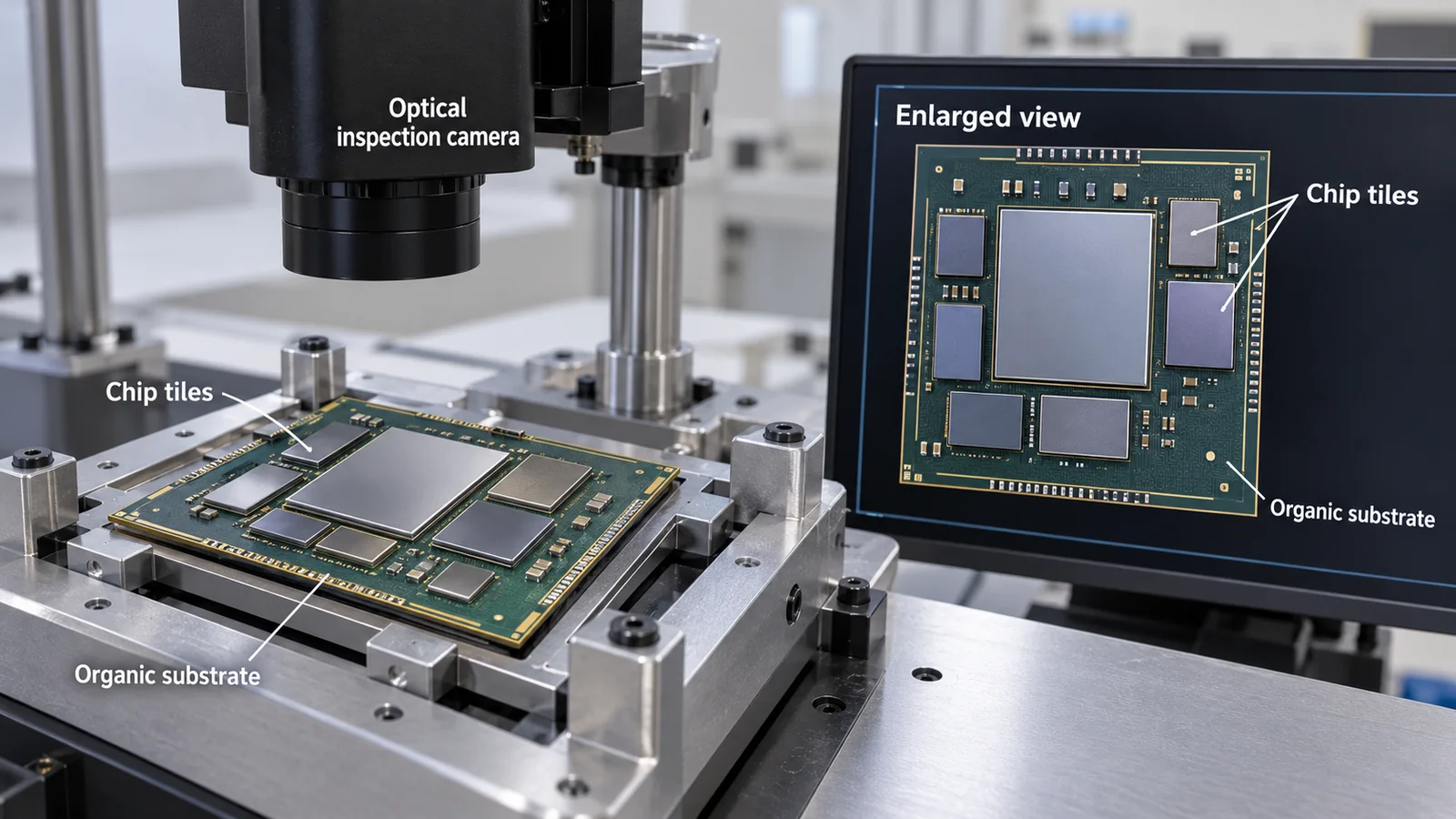
Tiles and packaging: the 10-K says newer high-end products combine several chips (tiles) in one product; small tiles improve yield and let each tile use the best process, but design and manufacturing become more complex and advanced substrates and other materials can become a bottleneck when supply is constrained Sourced. EMIB-T is described as improving power delivery and bandwidth scalability for larger package formats and next-generation memory (see our explainers on EMIB and EMIB-T, chiplets and heterogeneous integration).
Choice of memory: Gaudi 3 has eight HBM2e stacks for 128 GB and 3.7 TB/s. Crescent Island instead uses LPDDR5X (160 GB, and up to 480 GB on the product page) rather than HBM Sourced. The general understanding is that HBM offers high bandwidth while LPDDR makes capacity easier to add, so for inference, where capacity and cost weigh heavily, this may be why it was chosen, but Intel does not state the reason Not yet confirmed (see our explainers on HBM and AI accelerators).
Transistors and power delivery: 18A's RibbonFET (a gate-all-around structure) and PowerVia (power delivered from the back side) aim to relieve wiring congestion and improve power efficiency. 14A may use high-NA EUV, and the 10-K says Intel could stop pursuing it without a significant external customer.
Supply constraints: the 10-Q says capacity at its Intel 7 and Intel 3 fabs and industry-wide shortages of substrates, memory and other components are limiting its ability to meet demand. In the second quarter of 2026 client volume fell 8% while ASPs rose 27% on a richer mix. Tight materials and components appear to show up in price rather than volume.
11. The risks this company carries
| Risk | Details | Status |
|---|---|---|
| 14A and the external foundry | If Intel cannot secure a significant external customer it may pause or discontinue 14A and later nodes; the 10-K says that would increase dependence on TSMC and others and could cost eligibility for incentives. It also says Intel has "been unsuccessful to date in attracting significant customers" to its external foundry | Sourced |
| The U.S. government as a major shareholder | The 10-K lists the possibility that the transactions could later be found unauthorised or voidable, dilution, reduced voting influence for other holders and effects on non-U.S. business (70% of revenue). The government agreed to vote as the board recommends, subject to exceptions | Sourced |
| Uncertainty in AI-specific chips | US$922 million of Gaudi inventory-related charges in 2024. The 10-K says GPU systems draw the demand and CPU competition is intense. The start of Crescent Island availability is not confirmed | Sourced |
| Supply and component shortages | The 10-Q expects Intel 7 and Intel 3 fab constraints and industry-wide shortages of substrates and memory to persist into next year | Sourced |
| Dependence on TSMC | Some tiles and products are made by competitor TSMC. There is no long-term contract and capacity or pricing may not be secured, per the 10-K | Sourced |
| Customer concentration | The three largest customers were 43% of revenue in 2025, 45% in 2024 and 40% in 2023 | Sourced |
| Geopolitics and the Middle East | The 10-Q describes the military conflict between the U.S. and Israel and Iran that began on 28 February 2026, including possible effects on the Intel 7 fab in Israel that supports a significant share of revenue, the absence of business-interruption insurance and helium shortage risk. The 10-K also cites U.S.-China trade tensions and tensions between mainland China and Taiwan | Sourced |
| Pending litigation and fines | As of 27 June 2026 the company had accrued US$1.0 billion for litigation involving VLSI and US$308 million for the European Commission fine (10-Q). This article does not speculate on outcomes | Sourced |
12. Glossary
- x86
- The family of CPU instruction sets Intel created; the foundation of PC and server software.
- DCAI
- Data Center and AI, Intel's business segment including Xeon, AI accelerators, NICs, IPUs and custom ASICs.
- Gaudi
- Intel's AI accelerator. Gaudi 3 carries HBM2e and can be used for training and inference.
- Foundry
- A business that manufactures chips designed by others. Intel makes its own products and is trying to serve external customers too.
- Tile / chiplet
- A small chip that forms part of one product; several are combined inside a package.
- EMIB / Foveros
- Intel's advanced packaging technologies: EMIB joins chips with small bridges (2.5D) and Foveros stacks chips (3D).
- RibbonFET / PowerVia
- Intel 18A's gate-all-around transistor and its backside power delivery technology.
- High-NA EUV
- Next-generation extreme ultraviolet lithography able to print finer circuits; its use is envisaged for 14A.
- CHIPS Act / Secure Enclave
- The U.S. semiconductor support law and, within it, a programme that supports trusted domestic manufacturing of leading-edge chips.
- Warrant / escrowed shares
- A warrant is a right to buy shares at a set price; escrowed shares are held in trust until conditions are met.
- 10-K / 10-Q / 8-K
- The annual report, quarterly report and current report filed with the U.S. SEC.
13. References
- Intel Form 10-K for the fiscal year ended December 27, 2025 (filed with the U.S. SEC on 23 January 2026). Business, segment results, R&D, capital expenditure, headcount, U.S. government agreements, share sales to NVIDIA and SoftBank, the Altera sale, Gaudi inventory charges and risk factors. https://www.sec.gov/Archives/edgar/data/50863/000005086326000011/intc-20251227.htm
- Intel Form 10-Q for the quarterly period ended June 27, 2026 (filed with the U.S. SEC on 24 July 2026). Segment results for the second quarter and first half of 2026, the status of 14A and 18A, the U.S. government shares, the Fab 34 buyback, supply constraints and litigation. https://www.sec.gov/Archives/edgar/data/50863/000005086326000157/intc-20260627.htm
- Intel Intel Reports Second-Quarter 2026 Financial Results (earnings release, exhibit to Form 8-K, 23 July 2026). Business highlights and the third-quarter outlook. https://www.sec.gov/Archives/edgar/data/50863/000005086326000155/q226earningsrelease.htm
- Intel and NVIDIA Intel to design and manufacture custom data center and client CPUs with NVIDIA NVLink; NVIDIA to invest $5 billion in Intel common stock (joint press release, exhibit to Form 8-K, 18 September 2025). https://www.sec.gov/Archives/edgar/data/50863/000005086325000155/a09152025form8-kex991.htm
- Intel Form 8-K (filed 12 August 2026). Underwriting agreement for the public offering of common stock (10 August 2026). https://www.sec.gov/Archives/edgar/data/50863/000119312526346806/d117670d8k.htm
- Intel Intel Announces Upsize and Pricing of $20 Billion Common Stock Offering (press release, exhibit to Form 8-K, 10 August 2026). https://www.sec.gov/Archives/edgar/data/50863/000119312526346806/d117670dex992.htm
- Intel Form 8-K (filed 30 April 2026). The repurchase of Apollo's 49% interest in the Fab 34 (Ireland) joint venture (8 April 2026). https://www.sec.gov/Archives/edgar/data/50863/000119312526197845/d143782d8k.htm
- Intel Intel Gaudi 3 AI Accelerator Technical Paper (July 2025, V1 Rev. 3). The configuration and specifications of Gaudi 3. https://cdrdv2-public.intel.com/817486/gaudi-3-ai-accelerator-white-paper.pdf
- Intel Intel to Expand AI Accelerator Portfolio with New GPU (newsroom, 14 October 2025). The announcement of Crescent Island. https://www.intel.com/content/www/us/en/newsroom/news/artificial-intelligence/intel-to-expand-ai-accelerator-portfolio-with-new-gpu.html
- Intel Intel GPU D270 - Inference-Optimized Data Center GPU (product page; specifications and footnotes; checked 15 October 2026). https://www.intel.com/content/www/us/en/products/details/discrete-gpus/data-center-gpu/d-series.html
- Intel Investor relations site (source of the logo image; checked 15 October 2026). https://www.intc.com/
14. Claim-to-source audit
| Claim in the text | Status | Reference |
|---|---|---|
| Revenue, DCAI and Foundry results, R&D and capex, 2023-2025 | Sourced | Reference 1 https://www.sec.gov/Archives/edgar/data/50863/000005086326000011/intc-20251227.htm |
| 85,100 people (27 December 2025) and a core-workforce reduction of about 15% in 2025 | Sourced | Reference 1 https://www.sec.gov/Archives/edgar/data/50863/000005086326000011/intc-20251227.htm |
| Foundry external revenue of $307 million (2025); 14A may be paused or discontinued without a significant external customer | Sourced | Reference 1 https://www.sec.gov/Archives/edgar/data/50863/000005086326000011/intc-20251227.htm |
| Gaudi inventory charges ($922 million in 2024); the strategy of annual inference-optimised GPUs; Crescent Island and Jaguar Shores | Sourced | Reference 1 https://www.sec.gov/Archives/edgar/data/50863/000005086326000011/intc-20251227.htm |
| Descriptions of Xeon 6, EMIB, EMIB-T, Foveros, 18A and 14A; use of TSMC for some tiles | Sourced | Reference 1 https://www.sec.gov/Archives/edgar/data/50863/000005086326000011/intc-20251227.htm |
| The U.S. government agreement (August 2025): 275 million shares, warrants for 241 million shares, 159 million escrowed shares and $5.7 billion of accelerated CHIPS Act funding | Sourced | Reference 1 https://www.sec.gov/Archives/edgar/data/50863/000005086326000011/intc-20251227.htm |
| Share sales to SoftBank ($2.0 billion) and NVIDIA ($5.0 billion); the sale of 51% of Altera ($4.3 billion) | Sourced | Reference 1 https://www.sec.gov/Archives/edgar/data/50863/000005086326000011/intc-20251227.htm |
| Risks around the U.S. government's holding; top three customers at 43% of revenue; 70% of revenue outside the U.S. | Sourced | Reference 1 https://www.sec.gov/Archives/edgar/data/50863/000005086326000011/intc-20251227.htm |
| Second-quarter 2026 DCAI and Foundry revenue, server ASP and volume, supply constraints, the commitment to complete 14A and 18A-P risk production | Sourced | Reference 2 https://www.sec.gov/Archives/edgar/data/50863/000005086326000157/intc-20260627.htm |
| Escrowed shares not yet released (143 million at 27 June 2026); VLSI and EC accruals; Middle East risks | Sourced | Reference 2 https://www.sec.gov/Archives/edgar/data/50863/000005086326000157/intc-20260627.htm |
| The third-quarter revenue outlook ($15.8-16.8 billion); Xeon 6+; collaborations with SambaNova, Foxconn and Fortinet; the EUR 5 billion Xeon capacity investment announcement | Not yet confirmed | Reference 3 https://www.sec.gov/Archives/edgar/data/50863/000005086326000155/q226earningsrelease.htm |
| The joint development with NVIDIA (x86 CPUs linked by NVLink and SoCs with RTX GPU chiplets) and the announcement of a $5 billion investment | Sourced | Reference 4 https://www.sec.gov/Archives/edgar/data/50863/000005086325000155/a09152025form8-kex991.htm |
| The underwriting agreement (210,526,315 shares at $95 each, plus an option for 31,578,947 shares) | Sourced | Reference 5 https://www.sec.gov/Archives/edgar/data/50863/000119312526346806/d117670d8k.htm |
| The offering was upsized from $15 billion to $20 billion (announced 10 August 2026) | Sourced | Reference 6 https://www.sec.gov/Archives/edgar/data/50863/000119312526346806/d117670dex992.htm |
| Repurchase of Apollo's 49% interest in Fab 34 for $14.2 billion (8 April 2026) | Sourced | Reference 7 https://www.sec.gov/Archives/edgar/data/50863/000119312526197845/d143782d8k.htm |
| Gaudi 3 specifications (128 GB HBM2e, 3.7 TB/s, 1.8 PFlops of FP8 and BF16, 24 x 200 GbE) | Sourced | Reference 8 https://cdrdv2-public.intel.com/817486/gaudi-3-ai-accelerator-white-paper.pdf |
| The Crescent Island announcement (Xe3P, 160 GB LPDDR5X, customer sampling expected in the second half of 2026) | Not yet confirmed | Reference 9 https://www.intel.com/content/www/us/en/newsroom/news/artificial-intelligence/intel-to-expand-ai-accelerator-portfolio-with-new-gpu.html |
| The GPU D270 product page (up to 480 GB, 350 W air-cooled, 32 Xe3P cores, 256 XMX engines); no availability stated | Sourced | Reference 10 https://www.intel.com/content/www/us/en/products/details/discrete-gpus/data-center-gpu/d-series.html |
| Source of the logo image | Sourced | Reference 11 https://www.intc.com/ |
| The ratio of the 275 million shares issued to the U.S. government to about 5.5% of shares outstanding on 16 January 2026 | Our calculation | Our calculation (275 million / 4,995 million shares); based on shares at issue, without considering any later sales |
| The four-type classification and where Intel sits | Our calculation | Our own classification; company names are examples from firms covered in this series (this article) |
| AI accelerator (Gaudi and GPU) revenue; the names of 14A external customers; the start of Crescent Island shipments; the location and timing of the EUR 5 billion investment; current Gaudi sales status | Not yet confirmed | Not in the 10-K, 10-Q or earnings materials; press figures are not used. These are items we could not confirm, not company outlook |
| The readings that Intel takes part in AI through CPUs, fabs and packaging while GPU systems are at the centre, and that government and corporate equity back its fab investment | Inference | This article's interpretation of the 10-K, 10-Q and earnings materials |
| The materials engineer's view (tiles, EMIB-T, memory, 18A and 14A, substrates) | Commentary | General technical commentary, not a company disclosure |
Last updated 15 October 2026 / Troy Technical
Figures in this article come from Intel's statutory filings with the U.S. Securities and Exchange Commission (Forms 10-K, 10-Q and 8-K) and from its press releases, technical papers and product pages. No research-firm estimates or press-based figures have been used. Product performance values are Intel's stated values. Passages marked "Inference" are this article's interpretation of primary sources, not statements made by the company.