COMPANY PROFILE / AI & MACHINE LEARNING
Microsoft
Delivering AI through compute (Azure) and Copilot, and recasting its OpenAI relationship from exclusivity to negotiated terms
The Form 10-K for the year to June 2026 shows capital expenditure of US$115.9 billion and a commercial RPO (backlog) of US$678 billion. Neither is an AI-only figure, but this was the year in which investment in AI infrastructure showed up in company-wide numbers. This profile looks not at the whole company but at the parts that touch AI and machine learning: Azure AI, the Maia chip, Copilot, and the relationships with OpenAI and Anthropic, and sets out from primary sources what it is investing in, who it works with and what it is aiming for. Contracts, investments and datacenter plans reflect what was published as of 15 October 2026 and are treated as not yet confirmed.
- Microsoft in 30 seconds, and where it stands in AI and machine learning
- The logo and how the name is written
- Where the company sits in AI and machine learning
- Scale (limited to the parts that touch AI)
- Resources committed to AI and machine learning
- What it has done so far
- What comes next
- What the company is aiming for in AI and machine learning
- Map of AI and machine learning partnerships
- Technologies, products and services
- Risks this company carries
- Glossary, references and claim-to-source audit
1. Microsoft in 30 seconds, and where it stands in AI and machine learning
Platforms & adopters (secondary)Not a model developer; a major investor in OpenAI
Microsoft 365 CopilotThe FY2026 10-K says “Azure AI Foundry”; the January 2026 blog says “Microsoft Foundry”
(as-converted)Per the 10-K. Agreement amended in April 2026 (checked 15 October 2026)
In AI and machine learning, Microsoft is less a seller of its own frontier models than a company that rents out compute (Azure) and builds models into its own applications (Copilot). On top of that it is both a large investor in OpenAI and one of OpenAI’s largest customers. According to the 10-K, revenue from commercial arrangements with OpenAI, including revenue-sharing payments, was US$24.1 billion in FY2026, about 7.3% of total revenue of US$331.8 billion Our calculation.
However, Microsoft does not disclose AI-only revenue or profit Sourced. We can read Azure’s growth rate (41%) and the commercial RPO, but this profile does not estimate how much Microsoft earns from AI alone.
2. The logo and how the name is written

A note on names: the legal name is Microsoft Corporation. The Japanese subsidiary is a separate company, and this profile covers the U.S. parent. Several products share similar names: Microsoft 365 Copilot (the paid workplace feature) and Microsoft Copilot on the search and browser side (described in the 10-K as a “digital companion”) are different products Sourced.
Official website: https://www.microsoft.com/en-us/3. Where the company sits in AI and machine learning
4. Scale (limited to the parts that touch AI)
Microsoft also runs advertising, gaming and PC businesses, but this profile covers only the parts related to AI: cloud, datacenters and Copilot. Figures come from the Form 10-K for the year ended 30 June 2026 Sourced.
| Measure (US$ million) | FY2024 (year to June 2024) | FY2025 (year to June 2025) | FY2026 (year to June 2026) |
|---|---|---|---|
| Total revenue | 245,122 | 281,724 | 331,839 |
| Research and development | 29,510 | 32,488 | 35,562 |
| Capital expenditure (Additions to property and equipment) | 44,477 | 64,551 | 115,948 |
| Intelligent Cloud segment revenue | 87,464 | 106,265 | 137,791 |
| Server products and cloud services revenue | 79,828 | 98,435 | 129,425 |
| Microsoft Cloud revenue (as stated in the 10-K, US$ billion) | 137.7 | 168.9 | 214.4 |
Revenue from Azure and other cloud services grew 41% in FY2026. However, the 10-K does not give Azure’s revenue in dollars Sourced. Microsoft Cloud is the company’s own measure, combining Microsoft 365 Commercial cloud, Azure and other cloud services, the commercial portion of LinkedIn, and Dynamics 365.
| Other basics (30 June 2026) | Details |
|---|---|
| Employees | About 223,000 (121,000 in the U.S. and 102,000 elsewhere). Of these, 77,000 are in product research and development and 89,000 in operations, which includes datacenter operations |
| Headquarters | Redmond, Washington. About 14 million square feet in King County, Washington (about 12 million owned and about 2 million leased) |
| Cash and short-term investments | US$76.8 billion (US$94.6 billion at 30 June 2025) |
| Cash from operations (FY2026) | US$182.9 billion |
The figures above are company-wide (or combine several businesses) and do not show the size of AI alone. For example, Intelligent Cloud includes Azure but also server products with no AI link, such as SQL Server and Windows Server. In a Form 8-K dated 2 September 2026, Microsoft said that from fiscal 2027 (July 2026 onward) it will report two segments, “Agents and Infra” and “Devices and Consumer”, in place of three. The figures here use the old three-segment structure, so from FY2027 the categories change and past figures will be recast Sourced.
5. Resources committed to AI and machine learning
Microsoft does not disclose headcount, R&D spending or capital expenditure for AI alone. The table shows what could be confirmed from the 10-K and official blog posts.
| Resource | What could be confirmed | Type |
|---|---|---|
| People | About 223,000 employees overall and 77,000 in product R&D (10-K). The number of AI-dedicated staff is not disclosed. The 10-K’s explanation of operating expenses cites investment in “AI talent”. The January 2026 blog says the “Microsoft Superintelligence team” will use Maia 200 to improve its in-house models | Sourced |
| Money (R&D and capital expenditure) | R&D of US$35.56 billion and capital expenditure of US$115.95 billion in FY2026. The AI share of capital expenditure is not disclosed. The 10-K says investment in AI infrastructure pushed Microsoft Cloud gross margin down to 66% | Sourced |
| Outside investments and acquisitions | OpenAI: an equity-method investment (about 25% as-converted). Total funding commitments of US$13.0 billion, of which US$11.9 billion had been funded at 30 June 2026. Anthropic: the November 2025 blog announces an investment of “up to” US$5 billion (the amount actually invested is not in the 10-K) | Sourced |
| Universities, research institutions and public funding | No AI-related university collaboration or public funding such as NAIRR appears in the 10-K or in the sources used here. The Maia SDK preview is open to “developers, AI startups and academics” (official blog) | Not found |
| Datacenter power (MW or GW) | Not in the 10-K. The Fairwater blog gives only design figures: about 140 kW per rack and 1,360 kW per row (it does not say whether these are IT load or utility capacity). The April 2026 OpenAI announcement says only that the companies are scaling “gigawatts of new datacenter capacity”, with no figures or dates | Not yet confirmed |
Contractual obligations as disclosed (30 June 2026, using the 10-K’s own definitions)
| Item (US$ million) | Due in FY2027 | Thereafter | Total |
|---|---|---|---|
| Long-term debt (principal) | 9,250 | 36,886 | 46,136 |
| Construction commitments | 29,848 | 4,718 | 34,566 |
| Leases (operating and finance, including imputed interest) | 32,411 | 411,095 | 443,506 |
| Purchase commitments (mainly datacenter-related) | 169,008 | 25,052 | 194,060 |
This is the 10-K’s table of contractual obligations. The lease total covers leases that have already commenced (including imputed interest). Separately, there are leases that have not yet commenced, mainly for datacenters, of US$329.1 billion. They will commence between FY2027 and FY2033 with lease terms of 1 to 20 years, and the 10-K says some are subject to contractual conditions being met Sourced. These are obligations as disclosed, not an assessment of Microsoft’s finances.
Microsoft’s “commercial remaining performance obligation (RPO)” is defined in the 10-K as the commercial portion of revenue allocated to remaining performance obligations, which includes unearned revenue and amounts that will be invoiced and recognized as revenue in future periods. At 30 June 2026 it stood at US$678 billion (up 84%), with a weighted-average duration of about 2.3 years, and about 30% is expected to be recognized as revenue over the next 12 months Sourced.
Two points matter. It is not an AI-only figure but the total across all commercial contracts, Microsoft 365 included, and the 10-K does not give the share held by OpenAI or any other single customer. The official blog says OpenAI contracted in October 2025 to purchase an incremental US$250 billion of Azure services Sourced, but we could not confirm how that is reflected in the commercial RPO Not yet confirmed.
6. What it has done so far
| When | What happened | Why it matters |
|---|---|---|
| 2019 | Began a long-term strategic partnership with OpenAI (10-K) | The starting point of today’s AI strategy; investment and compute supply were added over time |
| 18 September 2025 | Introduced Fairwater in Wisconsin: hundreds of thousands of NVIDIA GPUs (GB200 servers) on a single flat network. The official blog says similar datacenters are under construction elsewhere in the U.S. | AI datacenters designed separately from general-purpose cloud |
| 28 October 2025 | New definitive agreement with OpenAI. OpenAI reorganised as a public benefit corporation. Microsoft described its holding in OpenAI Group PBC as valued at about US$135 billion and roughly 27% (as-converted diluted). OpenAI contracted to buy an incremental US$250 billion of Azure services, and Microsoft gave up its right of first refusal to be OpenAI’s compute provider | From an exclusive relationship to one whose terms are set out contract by contract |
| 12 November 2025 | Unveiled a second Fairwater site in Atlanta, linked to Wisconsin by a dedicated wide-area optical network (the AI WAN) and described as an “AI superfactory” | An idea of running several sites as one pool of compute |
| 18 November 2025 | Announced strategic partnerships with Anthropic and NVIDIA. Anthropic committed to buy US$30 billion of Azure compute and to contract additional capacity of up to one gigawatt. Microsoft said it would invest up to US$5 billion in Anthropic and NVIDIA up to US$10 billion | Models other than OpenAI’s became major customers and partners |
| 26 January 2026 | Announced its own AI accelerator, Maia 200. The official blog says it is deployed in the US Central region near Des Moines, Iowa | An in-house inference chip entered production use |
| 27 April 2026 | Amended the OpenAI agreement. OpenAI products ship first on Azure, but OpenAI can serve customers on any cloud. Microsoft’s IP licence runs to 2032 but becomes non-exclusive. Microsoft stops paying a revenue share to OpenAI | Exclusivity thinned further than in October 2025 |
| 29 July 2026 | Filed the Form 10-K for the year to June 2026 (capital expenditure US$115.9 billion, commercial RPO US$678 billion) | The first full year in which the scale of AI investment shows up in company-wide figures |
| 2 September 2026 | Disclosed (Form 8-K) that from fiscal 2027 it will report two segments, “Agents and Infra” and “Devices and Consumer” | Re-framing the business around AI and agents |
7. What comes next
All of the above are company targets or plans, and none is guaranteed Not yet confirmed. On expanding datacenters, the 10-K says Microsoft depends on “permitted and buildable land, predictable energy, networking supplies, and servers, including graphics processing units and other components” Sourced.
None of the following appears in the sources used here Not yet confirmed.
The number of Maia 200 units deployed / specifications and timing of the next Maia / Fairwater start dates and power (MW) / AI-only revenue and profit / OpenAI’s share of commercial RPO / outlook for FY2027 capital expenditure. Figures from press reports or earnings-call remarks are not used here.
8. What the company is aiming for in AI and machine learning
This part includes points the company has not stated directly. They are inferences from primary sources, set out with their basis.
| What can be read | Primary-source basis | Type |
|---|---|---|
| A move away from reliance on one model maker, towards offering several models on its own platform | Microsoft’s OpenAI IP licence became non-exclusive in the April 2026 amendment. In November 2025 it announced Anthropic’s Claude in Foundry and Copilot. The 10-K says its AI offerings compete with those of hyperscalers, “many of which are also current or potential partners” | Inference |
| Cutting the unit cost of inference is the main purpose of its own chip | The blog positions Maia 200 for inference and states “30% better performance per dollar than the latest generation hardware in our fleet”, to be used for Microsoft Foundry and Microsoft 365 Copilot | Inference |
| A mixed approach: buy GPUs in volume while running its own chips alongside | The blog describes Fairwater as built on NVIDIA GB200/GB300 and Maia as part of “heterogenous AI infrastructure” | Inference |
| Investing in AI ahead of revenue | The 10-K says the investments are made “in advance of fully developed revenue streams”, and capital expenditure rose about 80% on the year (our calculation) | Sourced |
| Re-framing the business around AI and agents | The 8-K of 2 September 2026 creates an “Agents and Infra” segment | Sourced |
The October 2025 agreement said OpenAI remains Microsoft’s frontier model partner and that Azure API exclusivity continues until AGI. The April 2026 amendment lets OpenAI serve all its products on any cloud and makes Microsoft’s IP licence non-exclusive Sourced. Microsoft nonetheless keeps its IP licence through 2032, receives revenue-share payments through 2030 (subject to a total cap) and remains a major shareholder.
We read this as Microsoft moving from a position of holding OpenAI exclusively to one of keeping its role as OpenAI’s investor and primary cloud while widening to other models Not yet confirmed. The finer terms, such as the size of the cap, are not stated in the official documents, and nothing here guarantees how the relationship will develop.
9. Map of AI and machine learning partnerships
10. Technologies, products and services
| Product or facility | Scale and specifications (developer’s stated values) | Stage | Date and source |
|---|---|---|---|
| Azure AI (Microsoft Foundry) | A unified platform for developers to design, customise and manage AI applications and agents (10-K description). The number of models is not in the 10-K | In service | 10-K (29 July 2026). Named “Azure AI Foundry” in the FY2026 10-K and “Microsoft Foundry” in the November 2025 and January 2026 blogs |
| Microsoft 365 Copilot | AI features within Microsoft 365 Commercial. Seats and revenue are not disclosed (the 10-K cites growth in revenue per user driven by Copilot) | In service | 10-K |
| GitHub (Copilot and others) | A collaboration platform for developers to “incorporate AI and agent-based tools across the software development lifecycle” (10-K). No user or revenue figures | In service | 10-K |
| Maia 200 | TSMC 3nm; over 140 billion transistors; 216 GB of HBM3e at 7 TB/s; 272 MB of on-chip SRAM; over 10 petaFLOPS at FP4 and over 5 petaFLOPS at FP8; 750 W SoC TDP. Scale-up over standard Ethernet, with clusters of up to 6,144 accelerators | Deploying (near Des Moines); Phoenix area next. Unit count not disclosed | Official blog (26 January 2026) |
| Fairwater (Wisconsin) | 315 acres; three buildings with a combined 1.2 million square feet under roof. Hundreds of thousands of NVIDIA GPUs (GB200 servers) on a single network (design). 72 GPUs per rack; 1.8 TB/s GPU-to-GPU bandwidth over NVLink | Announced (operating status not stated) | Official blog (18 September 2025) |
| Fairwater (Atlanta) | Designed to connect hundreds of thousands of GB200 and GB300 GPUs on one flat network. About 140 kW per rack and 1,360 kW per row (design). 800 Gbps GPU-to-GPU over a two-tier Ethernet back-end network | Announced (start date not stated) | Official blog (12 November 2025) |
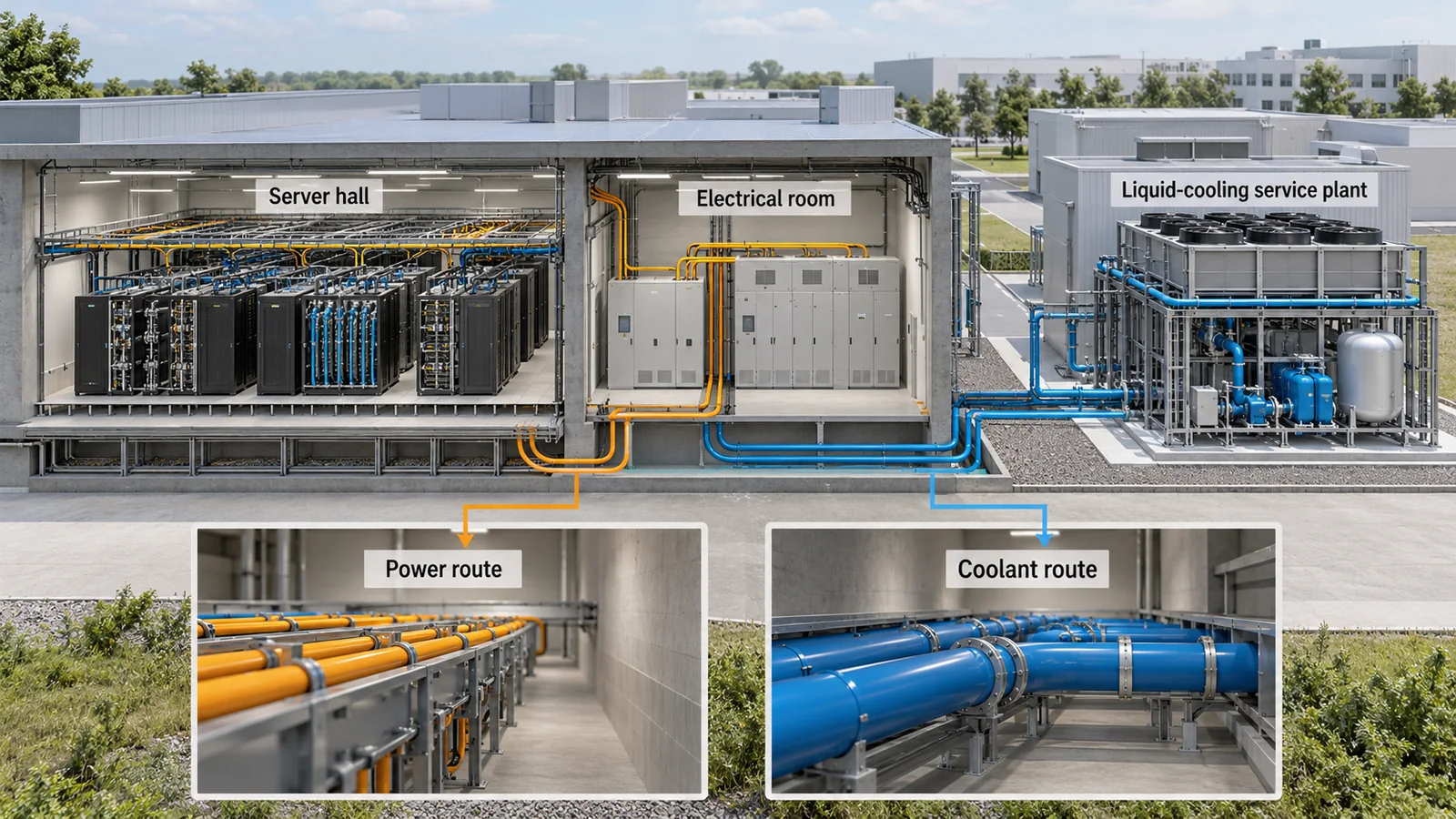
Reading the numbers in the official blogs, Microsoft’s design choices centre on putting GPUs close together, removing the heat, and delivering data without delay Sourced. Fairwater handles a density of about 140 kW per rack with facility-wide closed-loop liquid cooling. According to the blog, the coolant is filled once and reused without evaporation, and the two-storey building exists to shorten cable runs and reduce latency.
For Maia 200 the blog stresses not only compute (over 10 petaFLOPS at FP4) but also 216 GB of HBM3e at 7 TB/s and 272 MB of on-chip SRAM. In inference, reading model weights and the KV cache (memory bandwidth) is often the limit, so the blog’s explanation is that pairing low-precision arithmetic (FP4 and FP8) with this memory lowers the cost per token. The 750 W TDP is cooled, the blog says, by a second-generation closed-loop liquid-cooled Heat Exchanger Unit. See also our explainers on HBM, AI accelerators, and power and cooling for AI datacenters.
11. Risks this company carries
| Risk | Details | Type |
|---|---|---|
| Uncertain return on investment | The 10-K says AI investments are made “at significant scale and on an accelerated timeline” and “in advance of fully developed revenue streams”, and that the associated revenue may not be realized in the expected timeframes or at expected levels | Sourced |
| Dependence on a key partner | Commercial arrangements with OpenAI brought in US$24.1 billion in FY2026 (about 7.3% of total revenue; our calculation). The 10-K says relationships with AI partners “may change over time” and that many partners compete with Microsoft | Sourced |
| Power, land and components | The 10-K cites securing power, delays in grid connections, shortages of semiconductors, networking equipment and cooling equipment, and community opposition | Sourced |
| Size of future obligations | US$329.1 billion of leases not yet commenced and US$194.1 billion of purchase commitments, among others (table in section 5). Some are conditional. These are disclosed obligations, not an assessment of Microsoft’s financial health | Sourced |
| Volatile OpenAI-related gains and losses | Investments in OpenAI produced net gains of US$6.5 billion in FY2026 (mainly a dilution gain from OpenAI’s recapitalisation), net losses of US$4.8 billion in FY2025 and US$1.5 billion in FY2024 | Sourced |
| AI regulation | The 10-K says the EU AI Act and other rules could raise costs or limit offerings, and that governments may restrict development, deployment or cross-border access to advanced models (for the EU AI Act’s status, see our explainer on the EU AI Act) | Sourced |
| Changing contract terms with partners | The OpenAI agreement was rewritten twice within about six months (October 2025 and April 2026). Future terms can be confirmed only through official documents | Inference |
12. Glossary
- Azure
- Microsoft’s cloud platform. The 10-K describes it as providing computing, networking, storage and AI, among other services.
- Maia
- The series of AI accelerators (in-house chips) designed by Microsoft. Fabricated by TSMC.
- Copilot
- An umbrella brand for AI assistants: a paid workplace version (Microsoft 365 Copilot) and consumer versions on search and the browser.
- Commercial RPO
- Under the 10-K definition, the commercial portion of revenue allocated to remaining performance obligations, including unearned revenue and amounts to be invoiced and recognized.
- Equity method
- An accounting treatment that takes the investee’s profit or loss into one’s own results in proportion to the holding. Microsoft uses it for its roughly 25% OpenAI stake and computes results with the hypothetical liquidation at book value (HLBV) method.
- As-converted
- A way of counting a holding as if preferred shares had been converted into common shares.
- Fairwater
- Microsoft’s name for datacenters designed specifically for AI training and inference, in Wisconsin and Atlanta.
- Form 10-K / 8-K
- The annual report and the current report that U.S.-listed companies file with the SEC.
13. References
- Microsoft Form 10-K for the fiscal year ended June 30, 2026 (filed with the U.S. SEC on 29 July 2026). Segments, Azure and Microsoft Cloud revenue, commercial RPO, capital expenditure, contractual obligations, leases, OpenAI disclosures, headcount and risk factors. https://www.sec.gov/Archives/edgar/data/789019/000119312526323660/msft-20260630.htm
- Microsoft Official blog post “The next chapter of the Microsoft–OpenAI partnership” (28 October 2025; filed as Exhibit 99.2 to the Form 8-K submitted on 29 October 2025). Terms of the new definitive agreement. https://www.sec.gov/Archives/edgar/data/789019/000119312525256310/msft-ex99_2.htm
- Microsoft Official blog post “The next phase of the Microsoft-OpenAI partnership” (27 April 2026). The amended agreement. https://blogs.microsoft.com/blog/2026/04/27/the-next-phase-of-the-microsoft-openai-partnership/
- Microsoft Official blog post “Maia 200: The AI accelerator built for inference” (Scott Guthrie, 26 January 2026). Maia 200 specifications (developer's stated values) and deployment status. https://blogs.microsoft.com/blog/2026/01/26/maia-200-the-ai-accelerator-built-for-inference/
- Microsoft Official blog post “Inside the world’s most powerful AI datacenter” (Scott Guthrie, 18 September 2025). The Fairwater AI datacenter in Wisconsin. https://blogs.microsoft.com/blog/2025/09/18/inside-the-worlds-most-powerful-ai-datacenter/
- Microsoft Official blog post “Infinite scale: The architecture behind the Azure AI superfactory” (Scott Guthrie, 12 November 2025). The Atlanta Fairwater site and its design figures. https://blogs.microsoft.com/blog/2025/11/12/infinite-scale-the-architecture-behind-the-azure-ai-superfactory/
- Microsoft Official blog post “Microsoft, NVIDIA and Anthropic announce strategic partnerships” (18 November 2025). What was announced with Anthropic. https://blogs.microsoft.com/blog/2025/11/18/microsoft-nvidia-and-anthropic-announce-strategic-partnerships/
- Microsoft Form 8-K (filed 2 September 2026, Item 7.01) and its Exhibit 99.1 “FY27 Segments and Investor Metrics”. Change of reportable segments from fiscal 2027. https://www.sec.gov/Archives/edgar/data/789019/000119312526380280/d291965d8k.htm
- Microsoft Official website (to confirm company details; the logo was taken from the site header). https://www.microsoft.com/en-us/
14. Claim-to-source audit
| Claim in the text | Type | Source |
|---|---|---|
| Legal name, headquarters, NASDAQ listing, fiscal year end (30 June) | Sourced | Reference 1, 9 https://www.sec.gov/Archives/edgar/data/789019/000119312526323660/msft-20260630.htm https://www.microsoft.com/en-us/ |
| Revenue, R&D, capital expenditure, segment revenue and Microsoft Cloud revenue (FY2024 to FY2026) | Sourced | Reference 1 https://www.sec.gov/Archives/edgar/data/789019/000119312526323660/msft-20260630.htm |
| 41% growth in Azure and other cloud services revenue; no dollar figure in the 10-K | Sourced | Reference 1 https://www.sec.gov/Archives/edgar/data/789019/000119312526323660/msft-20260630.htm |
| About 223,000 employees, 77,000 in R&D, 89,000 in operations | Sourced | Reference 1 https://www.sec.gov/Archives/edgar/data/789019/000119312526323660/msft-20260630.htm |
| Commercial RPO of US$678 billion (up 84%), its definition, weighted-average duration of about 2.3 years, about 30% within 12 months | Sourced | Reference 1 https://www.sec.gov/Archives/edgar/data/789019/000119312526323660/msft-20260630.htm |
| Contractual obligations (debt, construction, leases, purchase commitments) and US$329.1 billion of leases not yet commenced | Sourced | Reference 1 https://www.sec.gov/Archives/edgar/data/789019/000119312526323660/msft-20260630.htm |
| OpenAI disclosures in the 10-K (about 25% stake, US$24.1 billion revenue, US$13.0 billion commitments and US$11.9 billion funded, gains and losses) | Sourced | Reference 1 https://www.sec.gov/Archives/edgar/data/789019/000119312526323660/msft-20260630.htm |
| New definitive agreement with OpenAI (28 October 2025): about US$135 billion and 27%, an incremental US$250 billion of Azure, end of the right of first refusal, IP terms | Sourced | Reference 2 https://www.sec.gov/Archives/edgar/data/789019/000119312525256310/msft-ex99_2.htm |
| Amended OpenAI agreement (27 April 2026): non-exclusive licence, revenue-share changes | Sourced | Reference 3 https://blogs.microsoft.com/blog/2026/04/27/the-next-phase-of-the-microsoft-openai-partnership/ |
| Maia 200 specifications, deployment and partners (developer’s stated values) | Sourced | Reference 4 https://blogs.microsoft.com/blog/2026/01/26/maia-200-the-ai-accelerator-built-for-inference/ |
| Fairwater (Wisconsin) scale and design | Sourced | Reference 5 https://blogs.microsoft.com/blog/2025/09/18/inside-the-worlds-most-powerful-ai-datacenter/ |
| Fairwater (Atlanta) design figures (140 kW per rack, 800 Gbps) and the AI WAN | Sourced | Reference 6 https://blogs.microsoft.com/blog/2025/11/12/infinite-scale-the-architecture-behind-the-azure-ai-superfactory/ |
| Partnership with Anthropic (US$30 billion, up to 1 GW, up to US$5 billion investment) | Sourced | Reference 7 https://blogs.microsoft.com/blog/2025/11/18/microsoft-nvidia-and-anthropic-announce-strategic-partnerships/ |
| Change of reportable segments from fiscal 2027 (Agents and Infra / Devices and Consumer) | Sourced | Reference 8 https://www.sec.gov/Archives/edgar/data/789019/000119312526380280/d291965d8k.htm |
| OpenAI business at about 7.3% of total revenue (US$24.1 billion over US$331.8 billion); capital expenditure up about 80% (US$115.9 billion over US$64.6 billion) | Our calculation | Our calculation from the figures in Reference 1 |
| Classification used in the partnership map and type chart (cloud & infrastructure primary, platforms & adopters secondary) | Our calculation | Our own classification, based on the business descriptions in Reference 1 |
| AI-dedicated headcount, AI share of capital expenditure, AI-only revenue | Not yet confirmed | None disclosed; not estimated here (not in Reference 1) https://www.sec.gov/Archives/edgar/data/789019/000119312526323660/msft-20260630.htm |
| Datacenter power (MW or GW), Maia unit counts, Fairwater start dates | Not yet confirmed | Not in References 1, 4, 5 or 6. Press figures are not used https://www.sec.gov/Archives/edgar/data/789019/000119312526323660/msft-20260630.htm |
| University or public-funding collaboration | Not yet confirmed | Not in Reference 1. We do not claim it does not exist https://www.sec.gov/Archives/edgar/data/789019/000119312526323660/msft-20260630.htm |
| Next Maia generations, roll-out to US West 3, up to US$5 billion investment in Anthropic, commencement of leases not yet started | Not yet confirmed | Reference 1, 4, 7 https://www.sec.gov/Archives/edgar/data/789019/000119312526323660/msft-20260630.htm https://blogs.microsoft.com/blog/2026/01/26/maia-200-the-ai-accelerator-built-for-inference/ https://blogs.microsoft.com/blog/2025/11/18/microsoft-nvidia-and-anthropic-announce-strategic-partnerships/ |
| Reading: moving towards offering several models on its own platform | Inference | Our own reading of the non-exclusive IP licence (April 2026) and the Claude announcement |
| Reading: lower inference unit cost is the main purpose of its own chip | Inference | Our own reading of how Maia 200 is positioned and the stated performance per dollar |
| Reading: a mixed approach of GPUs and in-house chips | Inference | Our own reading of the descriptions of Fairwater and Maia |
| Risk that the OpenAI contract terms can change again | Inference | Our own reading of the October 2025 and April 2026 amendments |
Last updated: 15 October 2026 (date checked) / Troy Technical
All figures in this article are based on documents Microsoft filed with the U.S. Securities and Exchange Commission and on its official blog posts. Market-research estimates and press figures are not used. Product performance figures are the developer’s stated values, not independent measurements. Passages marked “Inference” are our reading of primary sources and are not statements by the company. Contracts, investments and datacenter plans reflect what had been published as of 15 October 2026.