COMPANY PROFILE / AI & MACHINE LEARNING
NVIDIA
An "AI infrastructure company" that supplies GPUs, networking, racks and software as one system
NVIDIA sits at the centre of the computers used to train and run AI models. In its 10-K the company describes itself as a "data center scale AI infrastructure company". Revenue for the fiscal year ended 25 January 2026 (FY2026) was US$215.9 billion, of which Data Center was US$193.7 billion. In the quarter ended 26 July 2026 (the second quarter of FY2027), Data Center alone reached US$89.0 billion. This profile sets out what NVIDIA actually sells (chips or whole racks), where it is putting its money, how concentrated its sales are, and how export controls have affected it, within what the company has filed and published. Products and contracts in this field change quickly, so every status carries its check date (15 October 2026).
- NVIDIA in 30 seconds, and where it stands in AI and machine learning
- The logo and how the name is written
- Where the company sits in the AI and machine learning field
- Scale (limited to the AI-related business)
- Resources committed to AI and machine learning
- What it has done so far
- What comes next
- What the company is aiming for in AI and machine learning
- Map of partnerships in AI and machine learning
- Technology, products and services
- The risks this company carries
- Glossary / References / Claim-to-source audit
1. NVIDIA in 30 seconds, and where it stands in AI and machine learning
Platforms & adopters (secondary)The secondary role is software such as CUDA. The classification is ours
Vera RubinThe August 2026 10-Q says Rubin production shipments have begun
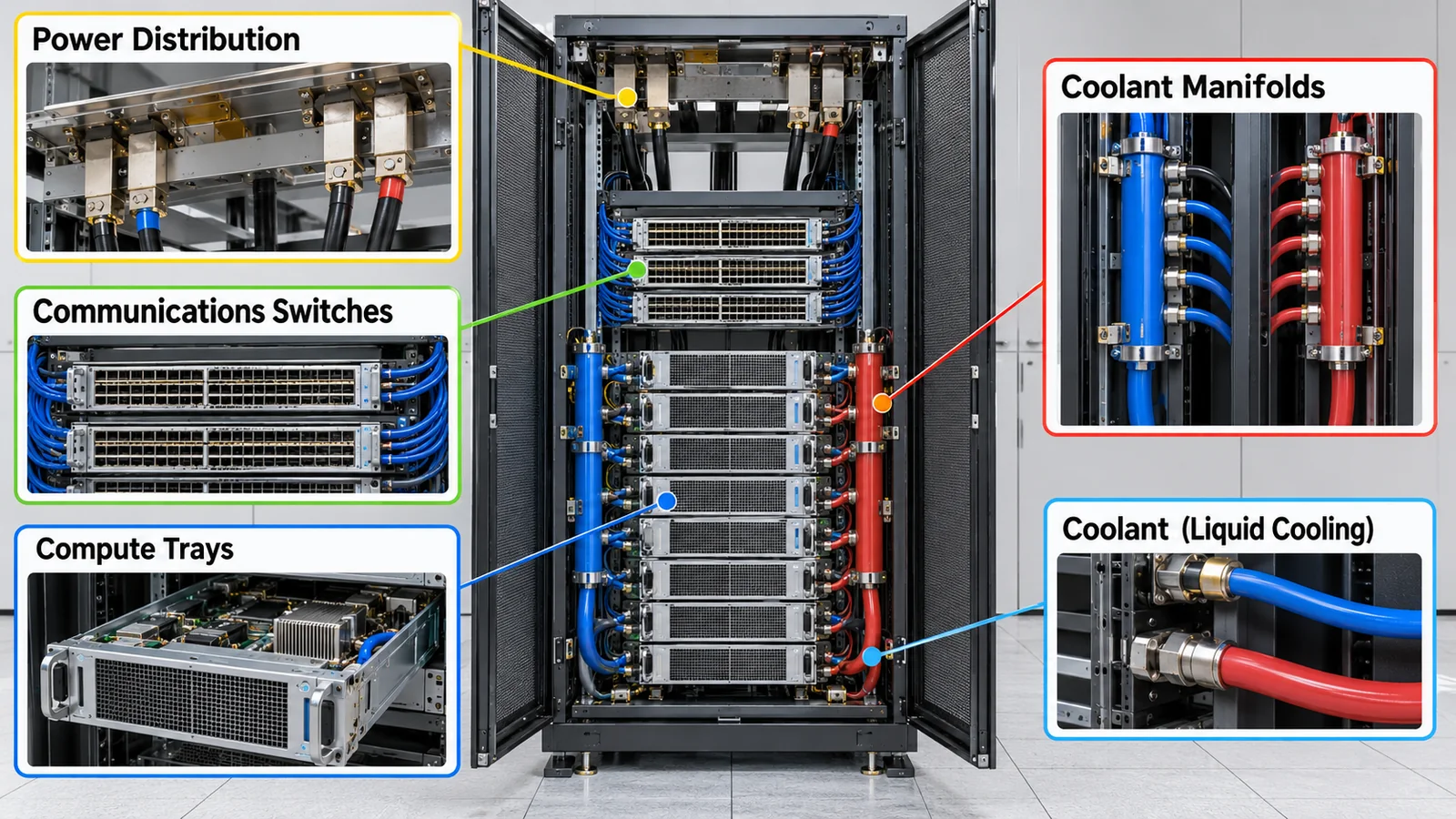
In its 10-K, NVIDIA calls itself a "data center scale AI infrastructure company" and says its chips, networking, systems, software and algorithms are designed together, which it calls "extreme co-design" Sourced. The 10-K describes its data center products as typically delivered as rack-scale systems (one rack combining 72 GPUs and 36 CPUs). In the company's own account, then, what it sells has moved from "a chip" to "a rack plus networking plus software". At the same time, its sales are concentrated in a few customers: in FY2026 one direct customer accounted for 22% of revenue and another for 14% Sourced. This profile reads NVIDIA through those two points: integrated supply and customer concentration.
2. The logo and how the name is written
A note on names: the legal entity is NVIDIA Corporation, shortened here to NVIDIA. Groq, Inc., with which NVIDIA signed a licence agreement in December 2025, is a separate company; "Groq 3 LPX" in NVIDIA's product names refers to a product line that uses the licensed technology. The generation names of its GPUs and CPUs (Blackwell, Rubin, Grace, Vera) are product names, not company names.
Official site: https://www.nvidia.com/en-us/about-nvidia/legal-info/logo-brand-usage/3. Where the company sits in the AI and machine learning field
4. Scale (limited to the AI-related business)
Most of NVIDIA's revenue now comes from the data center. Mind the fiscal-year labels: FY2026 ran from 27 January 2025 to 25 January 2026, and FY2027 runs to around January 2027 (the current 10-Q covers the first half). Figures are as filed in the 10-K and 10-Q Sourced.
| Metric (US$ million) | FY2024 (to 28 Jan 2024) | FY2025 (to 26 Jan 2025) | FY2026 (to 25 Jan 2026) |
|---|---|---|---|
| Revenue | 60,922 | 130,497 | 215,938 |
| Data Center | 47,525 | 115,186 | 193,737 |
| of which compute | 38,950 | 102,196 | 162,361 |
| of which networking | 8,575 | 12,990 | 31,376 |
| Research and development | 8,675 | 12,914 | 18,497 |
| Operating income (company-wide) | 32,972 | 81,453 | 130,387 |
NVIDIA has two reportable segments: Compute & Networking, which includes Data Center and Automotive (FY2026 revenue US$193,479 million), and Graphics, for gaming and workstation GPUs (US$22,459 million) Sourced.
| FY2027 so far (US$ million) | Second quarter (to 26 Jul 2026) | Same quarter a year earlier (to 27 Jul 2025) | First half (six months) |
|---|---|---|---|
| Revenue | 96,221 | 46,743 | 177,837 |
| Data Center | 89,023 | 41,096 | 164,269 |
| Hyperscale | 48,710 | 24,168 | 91,761 |
| AI Clouds, Industrial & Enterprise (ACIE) | 40,313 | 16,928 | 72,508 |
| Edge Computing | 7,198 | 5,647 | 13,568 |
| Research and development | 7,054 | 4,291 | 13,375 |
NVIDIA changed how it presents revenue by market in the first quarter of FY2027. The FY2026 10-K uses Data Center, Gaming, Professional Visualization and Automotive; the FY2027 10-Q uses Data Center and Edge Computing, and prior periods have been recast. In the second quarter the company also moved one customer from ACIE to Hyperscale and recast the earlier period Sourced. Because the categories differ, do not splice the two tables together even where the row names match. The rest of FY2027 is the company's outlook and therefore unconfirmed: it guides to third-quarter revenue of US$108.0 billion, plus or minus 2%, and says that outlook assumes no Data Center compute revenue from China Not yet confirmed.
5. Resources committed to AI and machine learning
The table below sets out the four resource points (people, money, outside investments and acquisitions, and ties to universities and public bodies) and whether each could be confirmed in the 10-K, the 10-Q or company releases.
| Type of resource | Details | Status |
|---|---|---|
| People | About 42,000 employees in 38 countries at the end of FY2026: about 31,000 in R&D and about 11,000 in sales, operations and administration. More than half of its engineers work on software. The 10-Q puts about 6,200 employees in Israel, supporting networking | Sourced |
| Money: R&D | US$18,497 million in FY2026 (8.6% of revenue) against US$12,914 million a year earlier; US$13,375 million in the first half of FY2027. The 10-K cites a 79% rise in compute and infrastructure costs as a driver of the FY2026 increase | Sourced |
| Money: capital expenditure | US$6.1 billion in FY2026 and US$3.4 billion in FY2025. The company expects to raise it in FY2027 (an expectation, not a result) | Sourced |
| Outside investments | In FY2026 it invested US$17.5 billion in private companies and infrastructure funds, mainly early-stage start-ups, including AI model makers that buy its products. The 10-Q cites equity investments of US$99 billion and equity investment commitments of US$25 billion at 26 July 2026 | Sourced |
| Guarantees for partners' sites | US$3.5 billion of land, power and shell guarantees for early-stage companies' data center leases (FY2026), plus up to US$105 billion more tied to SB Energy in August 2026 (next table) | Sourced |
| Investment in Intel | On 18 September 2025 it announced an investment of US$5 billion in Intel common stock at US$23.28 per share. The 10-K says gains on its Intel shares helped lift other income | Sourced |
| The Groq agreement | In December 2025 it signed a non-exclusive licence to Groq, Inc.'s language processing unit technology and hired certain Groq employees. No customer contracts, existing products or equity interests were acquired. Consideration was US$13.0 billion at closing plus US$4 billion (including imputed interest) payable within a year | Sourced |
| An investment and partnership agreement with OpenAI | The February 2026 10-K says the company was finalising one, with no assurance of completion. The August 2026 10-Q text we read does not report the outcome | Not confirmed |
| Acquisitions, joint ventures, divestments | The 10-K recounts the 2020 Mellanox acquisition, which gave it networking. No FY2026 divestment or joint venture was found | Sourced |
| Universities and research bodies | The 10-K cites partnerships with hundreds of universities, tens of thousands of start-ups through its Inception programme, and training through its Deep Learning Institute. On 13 October 2026 it announced compute worth US$250 million over five years for UK agentic safety and security research | Sourced |
| Public funding received | No record of NVIDIA receiving public funding (such as grants) was found in the 10-K or 10-Q | Not confirmed |
The table below lists the main products and facilities, as far as company materials confirm them (checked 15 October 2026).
| Product or facility | Scale / content | Stage | Date | Reference |
|---|---|---|---|---|
| Blackwell (GB200 NVL72 and others) | 72 GPUs and 36 Grace CPUs in one rack. The majority of FY2026 Data Center revenue | Shipping | February 2026 (10-K) | Reference 1 https://www.sec.gov/Archives/edgar/data/1045810/000104581026000021/nvda-20260125.htm |
| Blackwell Ultra (GB300 and others) | For inference and agentic workloads. Production shipments began in the second quarter of FY2026 | Shipping | February 2026 (10-K) | Reference 1 https://www.sec.gov/Archives/edgar/data/1045810/000104581026000021/nvda-20260125.htm |
| Vera Rubin NVL72 | 72 Rubin GPUs and 36 Vera CPUs; third generation of the MGX rack design | Shipments begun (company statement) | 26 August 2026 (10-Q) | Reference 2, 4 https://www.sec.gov/Archives/edgar/data/1045810/000104581026000075/nvda-20260726.htm |
| NVIDIA Groq 3 LPX | An interactive inference accelerator; one of the racks in the Vera Rubin platform | In full production (company statement) | 26 August 2026 | Reference 3 https://nvidianews.nvidia.com/news/nvidia-announces-financial-results-for-second-quarter-fiscal-2027 |
| Spectrum-X Ethernet Photonics | Co-packaged optics (CPO) Ethernet switches with 200Gb/s SerDes | In production (company statement) | 31 May 2026 | Reference 4 https://nvidianews.nvidia.com/news/vera-rubin-full-production-agentic-ai-factory |
| Japan national AI infrastructure (with Noetra Corp.) | An AI factory of 13,750 Vera CPUs and 27,500 Rubin GPUs | Planned | Product-page text (checked 15 October 2026) | Reference 6 https://www.nvidia.com/en-us/data-center/vera-rubin-nvl72/ |
| SB Energy PORTS Technology Campus (Ohio) | About 4.25 gigawatts of IT load; 20-year leases to an OpenAI affiliate; NVIDIA provides guarantees | Guarantees contracted; site not built (first phase expected in FY2029) | August 2026 (10-Q) | Reference 2 https://www.sec.gov/Archives/edgar/data/1045810/000104581026000075/nvda-20260726.htm |
| Supply and capacity commitments | US$279 billion at 26 July 2026, up from US$119 billion a quarter earlier | Contracted | 26 August 2026 | Reference 2 https://www.sec.gov/Archives/edgar/data/1045810/000104581026000075/nvda-20260726.htm |
"Planned" and "guarantees contracted" do not mean the outcome is certain. Construction and operation of the sites are not confirmed in the company's disclosures.
6. What it has done so far
| When | What happened | Why it matters |
|---|---|---|
| 1999 / 2006 | Launched the GPU (1999). Introduced CUDA, opening the GPU's parallel processing to a wide range of computing (2006) | The start of the hardware (GPU) and software (CUDA) pairing, per the 10-K's own history |
| 2012 | The 10-K says AlexNet, trained on NVIDIA GPUs, won the ImageNet image-recognition competition | What the company presents as the turning point for AI |
| 2017 / 2020 | First Tensor Core GPU (2017). The Mellanox acquisition brought networking and the DPU (2020) | It took in the interconnect technology that data-center-scale products need |
| 2023 / 2024 | First data center CPU, Grace (2023). Launched the Blackwell line, a rack of 72 GPUs and 36 Grace CPUs (2024) | The start of rack-level supply |
| April 2025 | The U.S. government required licences to export H20 chips to China and other destinations; NVIDIA booked a US$4.5 billion charge in the first quarter of FY2026 | The first large case of export controls hitting sales and inventory (10-K) |
| September / December 2025 | US$5 billion investment in Intel announced (September). Non-exclusive licence agreement with Groq (December) | Moves to bring in new CPU and inference technology |
| February 2026 | The U.S. government granted a licence to ship small amounts of H200 to specific China-based customers | But the 10-K says no revenue had yet been generated under it when filed |
| 31 May 2026 | Announced Vera Rubin was ramping into full production, with production shipments to start in the autumn | A new generation roughly every year (10-K) |
| August 2026 | The 10-Q records the start of Vera Rubin production shipments. Guarantees tied to SB Energy (up to US$105 billion) and memoranda of understanding on financing platforms were announced | The company is now involved in land, power and capital beyond the rack |
| 13 October 2026 | Announced compute worth US$250 million over five years for UK agentic safety research | Research support through donated compute |
7. What comes next
The company presents these as outlooks and expectations, not as achieved facts Not yet confirmed. The 10-Q says it will ship Blackwell and Rubin systems side by side and is currently experiencing certain supply constraints.
None of the following could be confirmed from the company's 10-K, 10-Q or releases Not yet confirmed. Prices of individual products / unit shipments by product / revenue by named customer (the 10-K describes the 22% and 14% customers anonymously) / the scale of Rubin production / the final outcome of the OpenAI investment and partnership agreement / firm start and operating dates for the SB Energy sites. The financing platforms (with Apollo, BlackRock and others, aiming to mobilise more than US$500 billion) were confirmed only at the memorandum-of-understanding stage, not as definitive contracts.
8. What the company is aiming for in AI and machine learning
This section includes points the company does not state directly. They are inferences from what the primary sources say, given with their grounds.
| What can be read from it | Primary-source basis | Status |
|---|---|---|
| NVIDIA is shifting from selling chips to supplying the whole data center (the AI factory) | The 10-K calls it a data center scale AI infrastructure company and says racks, networking and software are designed together. Its product pages treat the rack and the POD (five types of rack) as the unit | Inference |
| It sees the ceiling on sales as customers' land, power and capital, and is getting involved there | The 10-Q says a shortage of land, power, shell and capital could affect future revenue, and NVIDIA has announced guarantees (up to US$105 billion) and financing-platform MOUs | Inference |
| It is positioned so that customers using their own chips (XPUs) still stay on NVIDIA's networking and platform | The 10-K says NVLink Fusion lets custom CPUs and XPUs connect to NVIDIA's platform, and its competition section names large cloud companies with in-house chips | Inference |
| It uses open models (Nemotron, Cosmos and others) partly as a way to widen demand for compute | The 10-Q says its cloud commitments support R&D on Nemotron, Cosmos and GR00T, while warning that open models running mainly on competitors' platforms could reduce demand | Inference |
| Revenue concentration in a few customers continues in FY2027 | In the second quarter of FY2027 one direct customer was 16%; in the first half three were 16%, 15% and 13% | Sourced |
Right after discussing new products, the "Recent Developments" section of the 10-Q says that securing land, power, shell and capital is crucial, and then lists the guarantees, the commitments to AI clouds and the financing-platform MOUs Sourced. A chip company's filing usually centres on products and supply. Here it shows NVIDIA taking on part of what customers find hard to arrange themselves. This article reads that as the company treating infrastructure constraints, rather than demand, as the thing most likely to stall growth. Whether that is the company's intent cannot be judged from the disclosures Not yet confirmed.
9. Map of partnerships in AI and machine learning
10. Technology, products and services
| Layer | Main products | What the 10-K and company materials say |
|---|---|---|
| Compute | GPUs (Blackwell, Blackwell Ultra, Rubin), CPUs (Grace, Vera), DPUs | Supplies all three processor types in AI servers: GPUs, CPUs and DPUs (10-K) |
| Connectivity | NVLink (switches), InfiniBand, Spectrum-X Ethernet, co-packaged optics (CPO), NVLink Fusion | Can interconnect up to hundreds of thousands of compute nodes. NVLink Fusion connects custom silicon to the platform |
| Software | CUDA, CUDA-X, NVIDIA AI Enterprise (NIM, NeMo), Dynamo | More than 7.5 million CUDA developers (10-K). AI Enterprise is sold under paid licences |
| Open models | Nemotron (agentic AI), Cosmos (physical AI), GR00T | The 10-K says it has accelerated the release cadence of its open AI model platforms |
| Dedicated inference | NVIDIA Groq 3 LPX | An inference accelerator using technology licensed from Groq (company statement) |
The table below sets representative racks of two generations side by side, using the developer's stated values from NVIDIA's product pages (checked 15 October 2026). The figures differ in precision, sparsity and footnotes from row to row.
| Item (NVIDIA stated values) | GB200 NVL72 (Blackwell) | Vera Rubin NVL72 (Rubin) |
|---|---|---|
| Configuration | 72 Blackwell GPUs, 36 Grace CPUs | 72 Rubin GPUs, 36 Vera CPUs |
| NVFP4 (4-bit floating point) compute | 1,440 PFLOPS (with sparsity); 720 PFLOPS dense | Inference 3,600 PFLOPS (with sparsity); training 2,520 PFLOPS (dense) |
| GPU memory | 13.4 TB (HBM3E) | 20.7 TB (HBM4) |
| GPU memory bandwidth (rack total) | 576 TB/s | 1,400 TB/s |
| NVLink bandwidth (rack total) | 130 TB/s | 216 TB/s |
| Cooling | Liquid-cooled (10-K) | Inlet temperature 45°C (product-page table); cooling method not confirmed here |
Source: NVIDIA product pages. The GB200 table shows "sparse | dense" and notes that dense is one-half of the sparse figure; the Vera Rubin table gives inference with sparsity and training as dense (per its footnotes). Because precision and sparsity conditions differ by row, this article calculates no generation-to-generation ratios and makes no claim of superiority. The 10-K also says Rubin delivers up to a 10x reduction in cost per token versus Blackwell; that is a company claim, and the product-page footnote ties it to a specific model and input/output lengths.
Memory bandwidth and capacity: as the table shows, GPU memory moves from HBM3E to HBM4, and rack-level bandwidth and capacity dominate the figures listed Sourced. The 10-Q describes supply commitments as "primarily memory and manufacturing facilities" and says elevated memory and systems prices tempered consumer PC sales. In AI workloads, faster arithmetic units do not help if data cannot be fed to them, so memory is commonly the bottleneck (see our explainer on HBM).
Packaging and manufacturing: NVIDIA contracts TSMC and Samsung for wafers and says it uses CoWoS technology, which packages several chips on one substrate, for packaging Sourced (see our explainers on CoWoS and heterogeneous integration). Because manufacturing is outsourced, the 10-K lists securing manufacturing capacity among its risks.
Cooling and power: the 10-K describes the Blackwell rack as liquid-cooled. For Rubin, the product page shows a 100-megawatt AI factory of about 40,000 Rubin GPUs and a 45-degree inlet temperature. These are values NVIDIA gives for a specific configuration and operating condition Sourced. The 10-Q names the availability of power, land and shell as a constraint on revenue, which suggests the unit of compute is shifting from the chip to tokens per unit of power (see our explainer on AI data center power and cooling).
Connecting with light: the company says its co-packaged optics (CPO) switches are in production and that they deliver 5x better power efficiency than networks using traditional transceivers. This is a company claim, and the basis of comparison could not be checked here (see our explainers on co-packaged optics and optical transceivers).
11. The risks this company carries
| Risk | Details | Status |
|---|---|---|
| Customer concentration | In FY2026 one direct customer was 22% of revenue and another 14%. In the second quarter of FY2027 one was 16%; in the first half three were 16%, 15% and 13%. The 10-K estimates that one AI research and deployment company contributed a meaningful amount of revenue by buying cloud services from NVIDIA's customers | Sourced |
| Export controls | The 10-K says U.S. export controls affected data center products for China and other destinations. It booked a US$4.5 billion H20 charge in the first quarter of FY2026 and says it was effectively foreclosed from China's data center compute market. In the first half of FY2027 it booked a further US$0.4 billion H200 charge, and H200 shipments were under 1% of Data Center revenue. It states that licensed H200s face a 25% tariff on import into the United States. The rules can change (company statement) | Sourced |
| Supply and product transitions | Supply commitments rose to US$279 billion. The 10-Q says product transitions and supply constraints can cause production delays, quality issues, inventory provisions and higher costs | Sourced |
| Power, land and capital | The 10-Q says customers' access to land, power, shell and capital could limit revenue. Maximum gross exposure under guarantees is US$108.5 billion (US$3.5 billion plus US$105 billion). If a guarantee is triggered by, for example, a default by the OpenAI affiliate, NVIDIA could take over the lease (OpenAI has agreed to reimburse and indemnify certain losses, but NVIDIA may not recover them in full) | Sourced |
| Return on investments | The 10-K says many investees may not become profitable in the near term and a return is not assured. Investees include AI model makers that buy NVIDIA products | Sourced |
| Technology integration | The 10-K says incorporating the Groq licensed technology needs significant engineering effort and may not happen on expected timelines or at all | Sourced |
| Competition and customers' own chips | The 10-K lists large cloud companies with in-house chips, and says competitors may offer lower-priced products | Sourced |
| Regulation | The 10-Q says the EU AI Act and U.S. state laws could affect its ability to train, deploy or release AI models | Sourced |
| Pending litigation | A securities class action filed in 2018 (concerning disclosures about cryptocurrency mining) is pending; a class was certified on 25 March 2026. The company says it cannot estimate a loss. This article does not predict the outcome | Sourced |
12. Glossary
- GPU
- Graphics processing unit. Originally for graphics; strong at parallel computing and used to train and run AI.
- CUDA
- NVIDIA's development platform for GPUs, used together with many libraries.
- NVLink
- NVIDIA's high-speed link between GPUs, used to make 72 GPUs in a rack work as one computer.
- HBM
- High bandwidth memory, stacked right next to the GPU. Generations include HBM3E and HBM4.
- NVFP4 and sparsity
- A 4-bit floating-point format. Sparsity skips zero-heavy calculations, and performance figures quoted with sparsity are larger.
- NVL72
- The name of a system that puts 72 GPUs in one rack (GB200, Vera Rubin and so on).
- AI factory
- NVIDIA's term for a data center that does AI computing at scale.
- Hyperscale / ACIE
- NVIDIA's market categories: large cloud companies, and AI Clouds, Industrial and Enterprise (the FY2027 10-Q categories).
- XPU
- A general term for custom AI processors, including those that are not GPUs.
- 10-K / 10-Q
- The annual and quarterly reports filed with the U.S. SEC. Fiscal years differ from company to company.
13. References
- NVIDIA Form 10-K for the fiscal year ended January 25, 2026 (filed with the U.S. SEC on February 25, 2026). Business, segments, revenue by market, customer concentration, R&D, capital expenditure, headcount, export controls, investments, the Groq licence, purchase commitments and risk factors. https://www.sec.gov/Archives/edgar/data/1045810/000104581026000021/nvda-20260125.htm
- NVIDIA Form 10-Q for the quarterly period ended July 26, 2026 (filed with the U.S. SEC on August 26, 2026). Revenue for the second quarter and first half of FY2027, revenue by market platform, the start of Vera Rubin production shipments, commitments and guarantees, the SB Energy guarantees, export controls (H200) and litigation. https://www.sec.gov/Archives/edgar/data/1045810/000104581026000075/nvda-20260726.htm
- NVIDIA NVIDIA Announces Financial Results for Second Quarter Fiscal 2027 (press release, August 26, 2026). Third-quarter revenue outlook and highlights (Vera Rubin, Groq 3 LPX, financing platforms, the SK hynix partnership and others). https://nvidianews.nvidia.com/news/nvidia-announces-financial-results-for-second-quarter-fiscal-2027
- NVIDIA NVIDIA Vera Rubin Ramps Into Full Production to Power Agentic AI Factories Worldwide (press release, May 31, 2026). Make-up of the Vera Rubin platform, the production ramp and Spectrum-X Ethernet Photonics. https://nvidianews.nvidia.com/news/vera-rubin-full-production-agentic-ai-factory
- NVIDIA NVIDIA GB200 NVL72 (product page with specification table; checked October 15, 2026). https://www.nvidia.com/en-us/data-center/gb200-nvl72/
- NVIDIA NVIDIA Vera Rubin NVL72 (product page with specification table and performance footnotes; checked October 15, 2026). https://www.nvidia.com/en-us/data-center/vera-rubin-nvl72/
- NVIDIA NVIDIA and Intel to Develop AI Infrastructure and Personal Computing Products (press release, September 18, 2025). https://nvidianews.nvidia.com/news/nvidia-and-intel-to-develop-ai-infrastructure-and-personal-computing-products
- NVIDIA NVIDIA Commits $250 Million to Advance UK Agentic Safety and Security Research Over the Next Five Years (press release, October 13, 2026). https://nvidianews.nvidia.com/news/nvidia-commits-250-million-to-advance-uk-agentic-safety-and-security-research-over-the-next-five-years
- NVIDIA Official logo and brand-usage page (source of the logo image; checked October 15, 2026). https://www.nvidia.com/en-us/about-nvidia/legal-info/logo-brand-usage/
14. Claim-to-source audit
| Claim in the text | Status | Reference |
|---|---|---|
| Revenue, Data Center revenue, segments, R&D and operating income (FY2024 to FY2026) | Sourced | Reference 1 https://www.sec.gov/Archives/edgar/data/1045810/000104581026000021/nvda-20260125.htm |
| About 42,000 employees, about 31,000 in R&D, capital expenditure, US$17.5 billion of investments, US$3.5 billion of guarantees | Sourced | Reference 1 https://www.sec.gov/Archives/edgar/data/1045810/000104581026000021/nvda-20260125.htm |
| Customer concentration (FY2026: 22% and 14%) and the export-control history (H20, H200, AI Diffusion IFR) | Sourced | Reference 1 https://www.sec.gov/Archives/edgar/data/1045810/000104581026000021/nvda-20260125.htm |
| The terms and consideration of the non-exclusive Groq licence | Sourced | Reference 1 https://www.sec.gov/Archives/edgar/data/1045810/000104581026000021/nvda-20260125.htm |
| The OpenAI agreement described as being finalised (February 2026) | Sourced | Reference 1 https://www.sec.gov/Archives/edgar/data/1045810/000104581026000021/nvda-20260125.htm |
| Revenue, revenue by market and R&D for the second quarter and first half of FY2027 | Sourced | Reference 2 https://www.sec.gov/Archives/edgar/data/1045810/000104581026000075/nvda-20260726.htm |
| The start of Vera Rubin shipments (third quarter of FY2027) and US$279 billion of supply commitments | Sourced | Reference 2 https://www.sec.gov/Archives/edgar/data/1045810/000104581026000075/nvda-20260726.htm |
| SB Energy guarantees (up to US$105 billion, about 4.25 GW, 20-year leases); equity investments of US$99 billion and commitments of US$25 billion | Sourced | Reference 2 https://www.sec.gov/Archives/edgar/data/1045810/000104581026000075/nvda-20260726.htm |
| Limited H200 shipments, under 1% of Data Center revenue, and the US$0.4 billion charge | Sourced | Reference 2 https://www.sec.gov/Archives/edgar/data/1045810/000104581026000075/nvda-20260726.htm |
| Status of the securities class action (class certified 25 March 2026) | Sourced | Reference 2 https://www.sec.gov/Archives/edgar/data/1045810/000104581026000075/nvda-20260726.htm |
| Q3 FY2027 revenue outlook (US$108.0 billion, plus or minus 2%), Groq 3 LPX in production, and the SK hynix partnership announcement | Sourced | Reference 3 https://nvidianews.nvidia.com/news/nvidia-announces-financial-results-for-second-quarter-fiscal-2027 |
| Start of Vera Rubin full production and its make-up; Spectrum-X Ethernet Photonics (31 May 2026) | Sourced | Reference 4 https://nvidianews.nvidia.com/news/vera-rubin-full-production-agentic-ai-factory |
| GB200 NVL72 specifications (NVFP4, HBM3E, NVLink) | Sourced | Reference 5 https://www.nvidia.com/en-us/data-center/gb200-nvl72/ |
| Vera Rubin NVL72 specifications, 45-degree inlet temperature and the Noetra Corp. plan | Sourced | Reference 6 https://www.nvidia.com/en-us/data-center/vera-rubin-nvl72/ |
| The US$5 billion investment in Intel and the co-development announcement | Sourced | Reference 7 https://nvidianews.nvidia.com/news/nvidia-and-intel-to-develop-ai-infrastructure-and-personal-computing-products |
| Compute worth US$250 million for UK research | Sourced | Reference 8 https://nvidianews.nvidia.com/news/nvidia-commits-250-million-to-advance-uk-agentic-safety-and-security-research-over-the-next-five-years |
| Source of the logo image | Sourced | Reference 9 https://www.nvidia.com/en-us/about-nvidia/legal-info/logo-brand-usage/ |
| The four company types and NVIDIA's placement | Our calculation | This article's own classification. Company names are examples from firms covered in this series |
| Data Center at about 90% of company revenue | Our calculation | Our calculation (193,737 / 215,938) |
| Rubin shipment timing, operation of the SB Energy sites, the financing platforms, the OpenAI agreement outcome and operation of Japan's national AI infrastructure | Not yet confirmed | Company outlooks, plans and memoranda, not settled facts. Items that could not be confirmed are stated in the text. Reference 2 https://www.sec.gov/Archives/edgar/data/1045810/000104581026000075/nvda-20260726.htm |
| The reading that NVIDIA is shifting to supplying the whole data center | Inference | This article's interpretation of the 10-K and product pages |
| The reading that it is getting involved in customers' land, power and capital constraints | Inference | This article's interpretation of the 10-Q |
| The reading that NVLink Fusion keeps customers with in-house chips on its platform | Inference | This article's interpretation of the 10-K |
| The reading that open models partly serve to widen demand for compute | Inference | This article's interpretation of the 10-Q |
| The materials engineer's view on memory, heat, power and optical connection | Commentary | General technical commentary, not a company disclosure. Figures are the company's stated values from product pages and the 10-Q |
Last updated 15 October 2026 / Troy Technical
Figures in this article come from NVIDIA's statutory filings with the U.S. Securities and Exchange Commission (the 10-K and 10-Q) and from its press releases and product pages. No research-firm estimates or press-based figures have been used. Product performance values are NVIDIA's stated values; because precision and sparsity conditions differ, no claim of superiority between generations is made. Passages marked "Inference" are this article's interpretation of primary sources, not statements made by the company.