INSTITUTION PROFILE / AI & MACHINE LEARNING
NIST (National Institute of Standards and Technology)
The U.S. standards body that shows how to measure and manage AI. Its guidance is voluntary and not legally binding
NIST is a federal research agency inside the U.S. Department of Commerce. It does not build AI models, and it does not regulate AI. Its role in AI and machine learning is to publish a risk management framework (the AI RMF), a companion profile for generative AI (NIST AI 600-1), and methods for evaluating models. Organizations use these voluntarily. Where other laws or procurement rules cite them, they can become a de facto benchmark within that scope. This profile looks at one question: how much influence NIST actually has over AI and machine learning. The unit that evaluates AI models has been renamed more than once, so its name is given with a check date (15 October 2026).
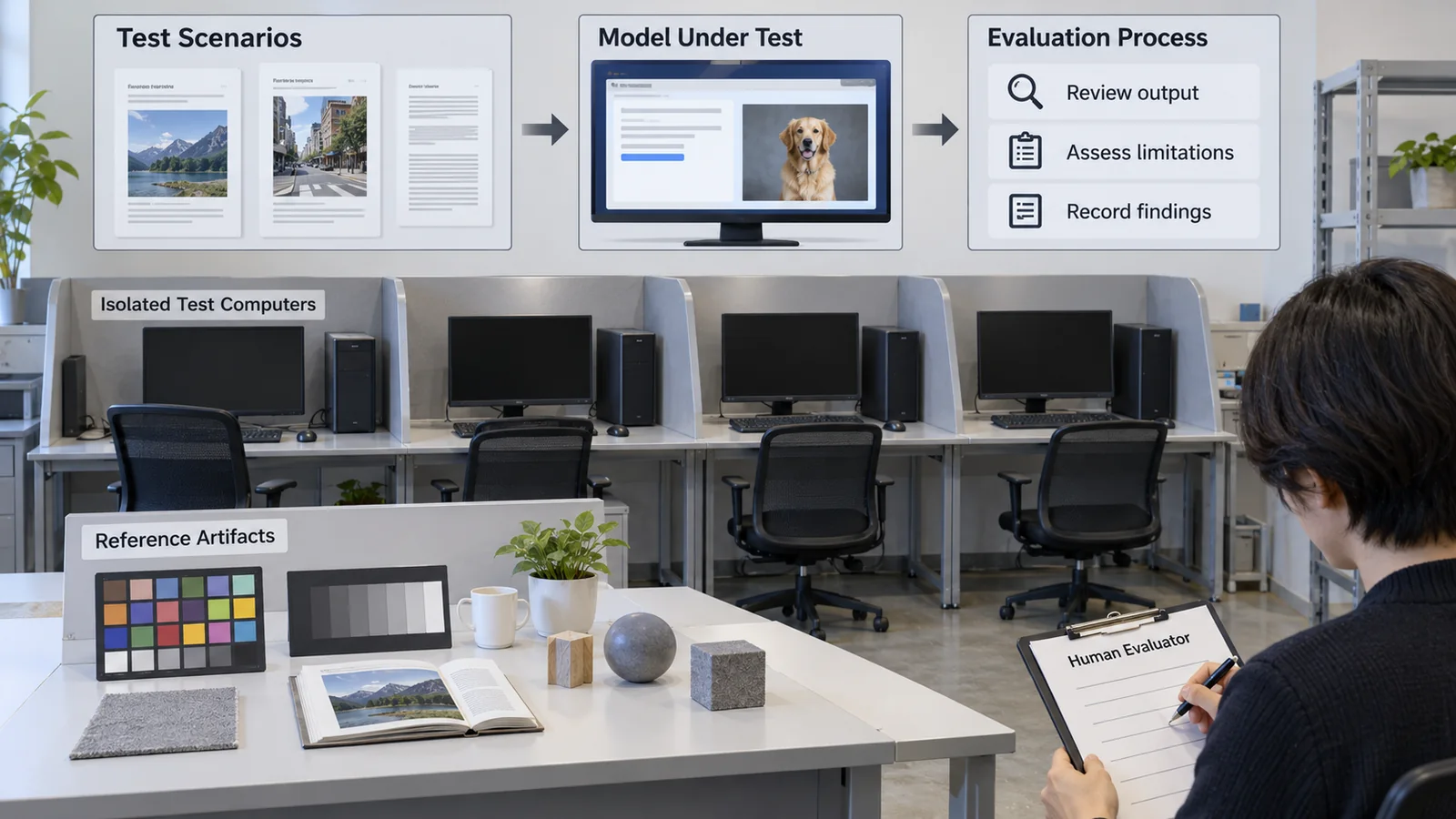
- NIST in 30 seconds
- What kind of body it is: the four types of influence
- What it does for AI and machine learning
- How far its influence reaches (powers and geography)
- Companies and organizations it works with
- Outlook
- Glossary, references and claim-to-source audit
1. NIST in 30 seconds
NIST's AI guidance is not a set of rules you must follow. It is a framework that organizations choose to use. The text of AI RMF 1.0 says it is intended to be voluntary and not specific to any sector or use case Sourced. At the same time, Congress has directed NIST, through laws such as the National Artificial Intelligence Initiative Act of 2020, to develop AI frameworks and guidance Sourced. So NIST is asked by Congress to write the guidance, but has no power to make anyone adopt it. Its influence comes from being the reference that companies, agencies and other frameworks point to when they say "we follow this".
As of 15 October 2026, NIST's pages call the unit that evaluates AI the Center for Advancing Innovation and Standards for Super Intelligence (CAISSI) Sourced. A note on NIST's August 2024 news item says that in June 2025 the AI Safety Institute was re-established as CAISI (the Center for AI Standards and Innovation) by the Secretary of Commerce Sourced. NIST news dated 17 September 2026 still uses the name CAISI. We could not find a NIST announcement explaining the change from CAISI to CAISSI Not yet confirmed. The backdrop is Executive Order 14434 of 29 September 2026, which directs the executive branch to use "Super Intelligence" in place of "Artificial Intelligence" Sourced. The order defines the new term as the same technology covered by the existing statutory definition of artificial intelligence, and it does not change existing laws or regulations. In this article, document titles keep the original "AI" wording, and the unit is named as CAISSI (the name at the check date) with its earlier name added.
2. What kind of body it is: the four types of influence
Unlike the companies in this series, none of the institutions that appear in AI coverage builds AI models. What separates them is the route by which they influence the industry, and that gives four types.
3. What it does for AI and machine learning
NIST's work on AI falls into three strands: publishing guidance, researching evaluation, and building frameworks that bring stakeholders together Sourced.
| Activity | Date / version | What it covers | Binding force |
|---|---|---|---|
| AI Risk Management Framework AI RMF 1.0 (NIST AI 100-1) | Released 26 January 2023. Under revision as part of the White House AI Action Plan (checked 15 October 2026) | Handles AI risk through four functions: Govern, Map, Measure and Manage. Lists the characteristics of trustworthy AI: valid and reliable, safe, secure and resilient, accountable and transparent, explainable and interpretable, privacy-enhanced, and fair with harmful bias managed. A Playbook and an AI Resource Center accompany it | Voluntary. The text says so explicitly |
| Generative AI Profile NIST AI 600-1 | Released 26 July 2024 | A companion to the AI RMF for generative AI. Sets out 12 risks that are unique to or made worse by generative AI (including CBRN information, confabulation, data privacy, information integrity, intellectual property and value chain), with suggested actions. Written under Executive Order 14110 as it stood at the time | Voluntary. A companion to the AI RMF |
| Profile for critical infrastructure | Concept note released 7 April 2026 | Meant to guide critical infrastructure operators on specific risk management practices when they use AI. It is at the concept-note stage today | Not yet confirmed (we found no draft or final version) |
| AI evaluation (CAISSI, formerly CAISI) | Re-established as CAISI in June 2025. Named CAISSI at the check date | Signs voluntary agreements with developers and evaluates models before release. Focuses on demonstrable national security risks such as cyber, biological and chemical weapons. Also publishes evaluations of foreign models (for example DeepSeek V4 Pro, published 1 May 2026). CAISSI is a research unit reporting directly to the NIST Director | Cooperation is voluntary. It is not regulation |
| NIST AI Consortium | Scope expanded on 29 May 2026 | More than 280 organizations from industry, academia and civil society work with NIST on AI measurement science and guidance. Members sign a cooperative research and development agreement (CRADA) | Participation is optional |
| AI Agent Standards Initiative | Described on NIST's page (start date not confirmed) | Three pillars: support industry-led standards, reduce barriers to interoperable agent protocols, and research on areas such as agent authentication and identity | Supports the drafting of voluntary guidance |
In its evaluation of DeepSeek V4 Pro, CAISI reports the developer's self-reported results separately from CAISI's own evaluation, which includes non-public benchmarks Sourced. A model's score depends on which benchmark was used, who ran it, and under what conditions. When reading AI figures, the basic habit is to tell the developer's stated value apart from a third-party evaluation. For more, see our explainers on reading benchmarks and evaluations, and on AI safety evaluation and risk management.
4. How far its influence reaches (powers and geography)
| Aspect | What NIST has | What NIST does not have |
|---|---|---|
| Powers | Under acts of Congress, a mandate to support AI frameworks, guidance and standards. It carries out research and evaluation, signs voluntary agreements with developers and runs a consortium | Power to regulate, to certify, or to require companies to be evaluated (we found no such provision in the sources we checked) |
| Geography | Mainly U.S. industry and federal agencies. Publications are free, and a Japanese translation of the AI RMF is listed. It also runs joint evaluations with agencies in other countries, such as the UK AI Security Institute | Power over other countries' laws, or over obligations that reach beyond borders, such as those in the EU AI Act |
| Binding force | The AI RMF and AI 600-1 are voluntary guidance. They can become a de facto benchmark within the scope of whoever cites them, such as federal agencies, other laws or contracts | Power to make its own guidance mandatory. We did not verify individual cases of citation Not yet confirmed |
| Size | FY2025 enacted budget of US$1.157 billion (research programs US$857.2 million, facilities US$87.8 million, industrial technology services US$212.0 million). US$10.0 million planned for AI | The number of AI-dedicated staff is not in the published material we checked. CAISSI's headcount was not confirmed either |
US$1.157 billion is the FY2025 enacted amount for NIST as a whole, not for AI Sourced. The US$10.0 million for AI is a plan in the June 2025 briefing, not money actually spent. The briefing also says staff fell by about 420, but it does not give the resulting total. We do not cover budgets for FY2026 and later Not yet confirmed.
5. Companies and organizations it works with
| Party | Relationship described in NIST's publications | Link to this series |
|---|---|---|
| OpenAI, Anthropic | On 29 August 2024 the then U.S. AI Safety Institute announced a memorandum of understanding with each, giving it access to major new models before and after release for evaluation research | See our company profiles, where written. We could not confirm how the agreements operate today |
| DeepSeek | CAISI evaluated DeepSeek V4 Pro in April 2026 and published the results on 1 May. The evaluation included non-public benchmarks | See our company profile, where written. The evaluation was done by NIST, and the page does not say whether DeepSeek took part |
| Z.ai, Moonshot AI | CAISI published assessments of Z.ai's GLM-5.2 and GLM-5.3 and, with the UK AISI, of Moonshot AI's Kimi K3, mainly on cyber capabilities (July to September 2026) | Not covered in this series |
| UK AI Security Institute | Jointly evaluated the cyber capabilities of Kimi K3 (dated 23 July 2026) | See our institution profile, where written |
* This is not a judgment of any company's merits or safety. It shows only what NIST evaluated and when, based on primary sources. Check the conditions on NIST's pages before using any evaluation figure.
6. Outlook
| What we can read from the sources | Primary evidence | Type |
|---|---|---|
| AI RMF 1.0 is under revision. No release date for the revised version | NIST's AI RMF page says it is being revised as part of the AI Action Plan. The AI RMF text itself said a review with formal community input would take place no later than 2028 | Sourced (under revision). Date is Not yet confirmed |
| The change to "Super Intelligence" does not necessarily mean existing document titles and numbers change right away | NIST says it is working to update its wording, and the executive order does not require changes to earlier regulations or documents (Section 2(b)). On 15 October 2026 the AI RMF page still uses "AI" | Inference |
| CAISSI will probably keep centering on evaluation through voluntary cooperation with developers | CAISSI's page and careers page describe voluntary cooperation and support for voluntary standards. Neither gives a reason for the name change or any change in mandate | Inference |
| The critical infrastructure profile may move from a concept note to a draft | A concept note was released on 7 April 2026. We found no later draft at the check date | Inference |
7. Glossary
- AI RMF
- Artificial Intelligence Risk Management Framework. NIST's voluntary framework for managing AI risk. Version 1.0 appeared in January 2023.
- Profile
- An application of the AI RMF to a specific use or technology. The generative AI profile is NIST AI 600-1.
- CAISI / CAISSI
- NIST's AI evaluation unit, formerly the U.S. AI Safety Institute. NIST's page uses CAISSI at the check date.
- CRADA
- Cooperative research and development agreement. The contract NIST uses for joint research with outside organizations, including AI Consortium membership.
- Voluntary
- Users can choose whether to adopt it. It is not a legal obligation.
- Open-weight model
- A model whose trained parameters (weights) are publicly released. NIST's evaluations include such models.
8. References
- NIST About NIST (founding year; part of the Department of Commerce; checked 15 October 2026). https://www.nist.gov/about-nist
- NIST AI Risk Management Framework (release dates of AI RMF 1.0 and AI 600-1, voluntary use, concept note for the critical infrastructure profile, revision notice; checked 15 October 2026). https://www.nist.gov/itl/ai-risk-management-framework
- NIST NIST AI 100-1, Artificial Intelligence Risk Management Framework (AI RMF 1.0) (January 2023; four functions, trustworthiness characteristics, voluntary use, update policy). https://doi.org/10.6028/NIST.AI.100-1
- NIST NIST AI 600-1, Artificial Intelligence Risk Management Framework: Generative Artificial Intelligence Profile (July 2024; 12 risks; written under Executive Order 14110). https://doi.org/10.6028/NIST.AI.600-1
- NIST Center for Advancing Innovation and Standards for Super Intelligence (CAISSI) (role, voluntary agreements, scope of evaluations; checked 15 October 2026). https://www.nist.gov/caissi
- NIST Careers at CAISSI (research unit reporting to the NIST Director, designation by the Secretary of Commerce, seventeen taskings under the AI Action Plan, voluntary evaluation partnerships, office locations). https://www.nist.gov/caissi/careers-caissi
- NIST Super intelligence (NIST's AI hub page; note on terminology following Executive Order 14434). https://www.nist.gov/super-intelligence
- The White House Executive Order 14434, Inaugurating the Era of Super Intelligence (29 September 2026; Sections 1 to 4). https://www.whitehouse.gov/presidential-actions/2026/09/inaugurating-the-era-of-super-intelligence/
- NIST AI Congressional Mandates, Executive Orders and Actions (National Artificial Intelligence Initiative Act, CHIPS and Science Act, AI Action Plan). https://www.nist.gov/artificial-intelligence/ai-congressional-mandates-executive-orders-and-actions
- NIST NIST AI Consortium (more than 280 organizations, scope expanded on 29 May 2026, participation through a CRADA). https://www.nist.gov/artificial-intelligence/nist-ai-consortium
- NIST AI Agent Standards Initiative (three pillars). https://www.nist.gov/artificial-intelligence/ai-agent-standards-initiative
- NIST NIST Budget Update, 11 June 2025 (FY2025 enacted amounts, planned AI funding, staffing reduction). https://www.nist.gov/document/budget-updates-and-discussion-0
- NIST U.S. AI Safety Institute Signs Agreements Regarding AI Safety Research, Testing and Evaluation With Anthropic and OpenAI (29 August 2024; note on re-establishment as CAISI in June 2025). https://www.nist.gov/news-events/news/2024/08/us-ai-safety-institute-signs-agreements-regarding-ai-safety-research
- NIST CAISI Evaluation of DeepSeek V4 Pro (1 May 2026). https://www.nist.gov/news-events/news/2026/05/caisi-evaluation-deepseek-v4-pro
- NIST UK AISI / CAISI Preliminary Assessment of Kimi K3's Cyber Capabilities (23 July 2026). https://www.nist.gov/news-events/news/2026/07/uk-aisi-caisi-preliminary-assessment-kimi-k3s-cyber-capabilities
- NIST CAISI's Assessment of Z.ai's GLM-5.3 Cyber Capabilities (17 September 2026; still uses the name CAISI). https://www.nist.gov/news-events/news/2026/09/caisis-assessment-zais-glm-53-cyber-capabilities
9. Claim-to-source audit
| Claim in the text | Type | Source |
|---|---|---|
| Founded in 1901; part of the Department of Commerce | Sourced | Reference 1 https://www.nist.gov/about-nist |
| AI RMF 1.0 (26 January 2023), AI 600-1 (26 July 2024), concept note for the critical infrastructure profile (7 April 2026), voluntary use, under revision | Sourced | Reference 2 https://www.nist.gov/itl/ai-risk-management-framework |
| The four AI RMF functions, trustworthiness characteristics, voluntary and non-sector-specific design, purpose under the National Artificial Intelligence Initiative Act, review by 2028 | Sourced | Reference 3 https://doi.org/10.6028/NIST.AI.100-1 |
| The 12 risks in AI 600-1; written under Executive Order 14110 | Sourced | Reference 4 https://doi.org/10.6028/NIST.AI.600-1 |
| CAISSI's name, role, voluntary agreements, and focus on cyber, biological and chemical risks | Sourced | Reference 5 https://www.nist.gov/caissi |
| CAISSI is a research unit reporting to the NIST Director; designation by the Secretary of Commerce; seventeen AI Action Plan taskings; offices in Washington, D.C. and San Francisco | Sourced | Reference 6 https://www.nist.gov/caissi/careers-caissi |
| NIST is working to update its terminology | Sourced | Reference 7 https://www.nist.gov/super-intelligence |
| Content of Executive Order 14434 (term replacement, definition, no change to existing regulations and contracts) | Sourced | Reference 8 https://www.whitehouse.gov/presidential-actions/2026/09/inaugurating-the-era-of-super-intelligence/ |
| Acts of Congress direct NIST to develop AI frameworks and guidance | Sourced | Reference 9 https://www.nist.gov/artificial-intelligence/ai-congressional-mandates-executive-orders-and-actions |
| AI Consortium size (more than 280), expansion on 29 May 2026, CRADA | Sourced | Reference 10 https://www.nist.gov/artificial-intelligence/nist-ai-consortium |
| The three pillars of the AI Agent Standards Initiative | Sourced | Reference 11 https://www.nist.gov/artificial-intelligence/ai-agent-standards-initiative |
| FY2025 enacted budget of US$1.157 billion (breakdown), planned AI funding of US$10.0 million, staff down by about 420 | Sourced | Reference 12 https://www.nist.gov/document/budget-updates-and-discussion-0 |
| August 2024 memoranda with OpenAI and Anthropic; note on the June 2025 re-establishment | Sourced | Reference 13 https://www.nist.gov/news-events/news/2024/08/us-ai-safety-institute-signs-agreements-regarding-ai-safety-research |
| Evaluation of DeepSeek V4 Pro (including non-public benchmarks) | Sourced | Reference 14 https://www.nist.gov/news-events/news/2026/05/caisi-evaluation-deepseek-v4-pro |
| Joint evaluation of Kimi K3 with the UK AISI | Sourced | Reference 15 https://www.nist.gov/news-events/news/2026/07/uk-aisi-caisi-preliminary-assessment-kimi-k3s-cyber-capabilities |
| The 17 September 2026 news item uses the name CAISI; assessment of GLM-5.3 | Sourced | Reference 16 https://www.nist.gov/news-events/news/2026/09/caisis-assessment-zais-glm-53-cyber-capabilities |
| The four-type grouping of institutions | Our calculation | This article's own grouping |
| A NIST announcement explaining the change from CAISI to CAISSI | Not yet confirmed | Not in References 5 to 7, 13 or 16. This article does not guess at the reason |
| Release date of the revised AI RMF, a draft of the critical infrastructure profile, budgets for FY2026 and later, AI-dedicated headcount, individual cases of other laws or procurement citing NIST guidance | Not yet confirmed | Not in References 2 or 12. This article does not estimate them |
| The outlook in Section 6 (effect of the terminology change, CAISSI's position, progress of the profile) | Inference | This article's reading of References 2, 5 to 8 and 16 |
Last updated 15 October 2026 / Troy Technical
Figures and names come from NIST's website and publications and from the White House executive order. This field moves fast, so unit names and revision status are as of the check date. Items marked "Inference" are this article's reading of the primary information, not statements by NIST.