INSTITUTION PROFILE / AI & MACHINE LEARNING
U.S. Department of Energy (DOE)
A federal agency behind national-laboratory AI computing and data centre power. It does not regulate AI
On AI, the U.S. Department of Energy (DOE) is the federal department responsible for the national laboratories' supercomputers, a national effort to use AI in science (the Genesis Mission), plans for data centres on federal land, and analysis of data centre electricity demand. It has no power to regulate AI models or to set AI standards. Electricity rules are decided by an independent regulatory commission (FERC) that sits inside the department. This profile looks at how much influence DOE really has over AI, in terms of the kinds of power it holds and how far they reach. The U.S. government changed its document terminology in September 2026, so we also explain how names are handled.
- DOE in 30 seconds
- What kind of body it is: the four types of influence
- What it does for AI and machine learning
- How far its influence reaches (powers and geography)
- Organisations it works with
- Outlook
- Glossary, references and claim-to-source audit
1. DOE in 30 seconds
On AI, DOE is a body that advances research and holds infrastructure. It is not a body that makes AI regulation or standards. For example, Executive Order 14409 of 2 June 2026 assigns the framework for secure frontier-model deployment to the Treasury, the Department of War (through NSA), the Department of Homeland Security (through CISA) and the Department of Commerce (through NIST), among others, and does not name the Department of Energy Sourced (as far as we checked in the full text of the order). On data centre electricity, DOE directed FERC in October 2025 to consider a proposed rulemaking, but it is FERC that decides, and FERC took a different route in June 2026 Sourced. DOE's real sources of influence are the national laboratories and their computing, research funding, and federal land.
Executive Order 14434 of 29 September 2026 directs executive agencies, to the extent permitted by law, to use "Super Intelligence" and "SI" in place of "Artificial Intelligence" and "AI" in official documents and websites. The terms are defined to mean what "artificial intelligence" means in the U.S. Code Sourced. DOE's announcement of 8 October 2026 uses SI, but the Genesis Mission website still said AI when we checked. DOE's office name also appeared as the Office of Artificial Intelligence and Quantum (AIQ) in the April 2026 budget document, and we could not confirm a new name since the order. To stay consistent with other articles and with search, this article uses "AI" in explanations and adds SI where DOE's current wording is SI.
2. What kind of body it is: the four types of influence
Unlike the companies in this series, the institutions that appear in AI coverage build neither AI models nor chips. What separates them is the route by which they influence the industry, and that gives four types. DOE is the Funding type: it hands out research grants and provides national-laboratory supercomputers and land. Its official materials show no power to regulate AI or set AI standards.
3. What it does for AI and machine learning
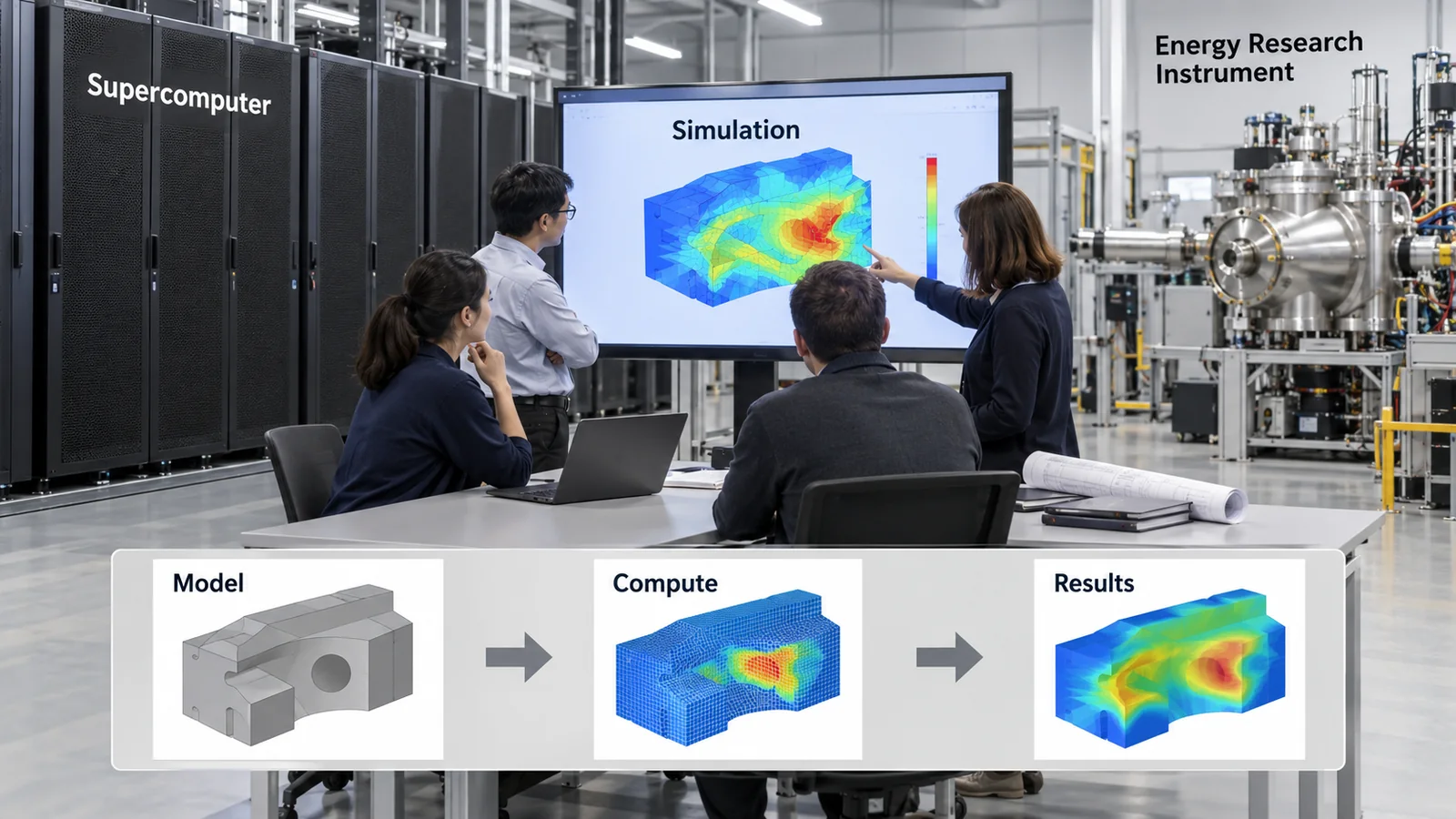
DOE's work on AI falls into three strands: using AI for science, computing infrastructure, and land and power for data centres Sourced.
| Initiative | When | What it is (primary source) | Type |
|---|---|---|---|
| Genesis Mission | Executive Order 14363: 24 November 2025 | The Secretary of Energy implements it within DOE, and the White House science and technology adviser provides general leadership. It builds an AI platform (the American Science and Security Platform) on federal scientific data. DOE says it will mobilise its 17 national laboratories and about 40,000 staff. On 22 July 2026 it selected 278 projects (87 led by national laboratories, 168 by universities, 19 by companies and 4 by nonprofits), the largest a three-year, US$60 million nuclear project. On 8 October it added 12 Phase II awards (US$159 million in total), bringing the first-year cohort to 297 projects | Sourced |
| Investment in AI-for-science infrastructure | 10 December 2025 | Over US$320 million: the American Science Cloud, the Transformational AI Models Consortium, 14 robotics and automation projects and 37 foundational model awards | Sourced |
| AI supercomputers (Argonne) | Announced 28 October 2025 | A public-private partnership with NVIDIA and Oracle. Solstice, with 100,000 NVIDIA Blackwell GPUs, is described as the largest AI supercomputer in the DOE laboratory complex. Equinox, with 10,000 GPUs, was expected in 2026. We could not confirm delivery as of our check date | Sourced (announcement). Operation not confirmed |
| AI supercomputers (Oak Ridge) | Announced 27 October 2025 | With AMD and HPE. Lux, built under a public-private model, was due in 2026, and Discovery in 2028. Half of Lux's annual 3.5 million node-hours go to the Genesis Mission, and the rest is open for paid use (per the OLCF page) | Sourced (announcement). Operation not confirmed |
| Data centres on federal land | Four sites chosen 24 July 2025 | Idaho, Oak Ridge, Paducah and Savannah River were chosen to invite private data centre and power proposals. On 20 July 2026 NNSA selected Amentum to negotiate at Savannah River (a 1 GW data centre with about 2 GW of on-site generation). On 29 July DOE announced a partnership with Brookfield, NextEra Energy and others at Paducah (described as over US$100 billion of private investment) | Selections and announcements are Sourced. Whether construction and investment happen is Not yet confirmed |
| Analysis of data centre electricity demand | 20 December 2024 | Produced by Lawrence Berkeley National Laboratory with DOE funding. US data centres used 176 TWh in 2023 (about 4.4% of US electricity), and are estimated at about 6.7% to 12% (325 to 580 TWh) by 2028 | An estimate (not an observed value) |
Amounts are in US dollars and are not converted or added in this article. Counts are as DOE announced them. "Over US$100 billion of private investment" was an expectation at the time of the announcement, not investment that has been made.
Electricity rules and DOE: the relationship with FERC
| Event | When | What happened (primary source) | Who decides |
|---|---|---|---|
| DOE's direction to FERC | 23 October 2025 | Under section 403 of the DOE Organization Act, the Secretary directed FERC to consider an advance notice of proposed rulemaking (ANOPR) on connecting large loads (over 20 MW, such as data centres) to the transmission system. FERC's page said it would act on the docket by June 2026 | DOE proposes. FERC decides |
| FERC's response | 18 June 2026 | FERC issued orders to each of the six regional transmission organisations and independent system operators (RTOs and ISOs) prompting them to propose ways of improving large load interconnection. A commissioner writes that the orders were informed by the record of DOE's ANOPR. They were not a broad rule | FERC |
The FY2027 budget document (April 2026) requests US$1.2 billion for the Office of Artificial Intelligence and Quantum (AIQ), to support several AI supercomputers at Argonne and Oak Ridge. But this is a request, not an enacted budget. The document also says the request repurposes unobligated funds from earlier infrastructure legislation (IIJA) Sourced. The Genesis Mission's aim to double the productivity of science within a decade is a goal, and the investment figures for data centre plans are expectations at the time of announcement Not yet confirmed. Global figures from the IEA and other bodies' estimates also cannot be set directly beside the LBNL figures, because years and scope definitions differ.
4. How far its influence reaches (powers and geography)
| Aspect | What DOE has | What it does not have |
|---|---|---|
| Legal force | The power under section 403 of the DOE Organization Act to propose rules to FERC. The terms of its own federal land leases and research grants | Power to regulate AI or set AI standards (Executive Order 14409 of June 2026 gives DOE no role). Power to decide the rules for connecting large loads (FERC's domain, and FERC is an independent commission within the department). State electricity tariffs and siting permits |
| Money | Genesis Mission research awards (278 selected in July 2026) and investment in national laboratories. About US$49.1 billion department-wide in FY2026 | The final say on the budget (Congress decides). Power to make the FY2027 request happen |
| Computing and land | AI supercomputers at national laboratories and federal land such as Oak Ridge. A way to open part of its computing time to paying private users (Lux) | Building or operating private data centres (DOE leases land; the businesses are private). A guarantee that systems come online |
| Geography | The United States. Universities, companies and national laboratories across the country can receive awards (342 institutions took part). In July 2026 the White House said more than 15 federal agencies would join the Genesis Mission | Direct power over foreign companies or other countries' policy (none found) |
| Scale | About 40,000 scientists, engineers and technical staff (DOE), about US$49.1 billion (FY2026) | Department-wide headcount and the total spent on AI alone could not be confirmed |
5. Organisations it works with
DOE's AI activity reaches national laboratories and private partners under the White House's executive order. Electricity rules belong to FERC. Fig. 2 shows only relationships documented in primary sources.
Organisations named in official materials (selection)
| Organisation | Relationship to DOE (primary source) | Link to this series |
|---|---|---|
| NVIDIA, Oracle | Partners for the Solstice and Equinox systems at Argonne (28 October 2025). Oracle is also to provide near-term AI computing resources to DOE | See our NVIDIA and Oracle profiles, where those are published |
| AMD | Partner for Oak Ridge's Lux (co-investment) and Discovery (27 October 2025). HPE builds Discovery | See our AMD profile, where one is published |
| The 24 Genesis Mission collaborators (MOUs) | As of 18 December 2025, signatories include Anthropic, OpenAI, Google, Microsoft, Amazon Web Services, NVIDIA, AMD, Intel, Cerebras, CoreWeave, Oracle and xAI, among others. DOE says products will be architecture-agnostic | See each company's profile, where published |
| FERC | An independent regulatory commission established within DOE by the DOE Organization Act. Acting on DOE's proposal, it issued orders on large loads to the RTOs and ISOs in June 2026 | None |
| Brookfield, NextEra Energy and others | At the Paducah site, a data centre (1.8 GW) with 2 GW of natural gas generation and up to 2.6 GW of battery storage (29 July 2026) | Data centres and storage are covered in our technical explainers |
| Amentum | Chosen by NNSA at Savannah River to negotiate (20 July 2026; negotiations ongoing) | None |
| NIST (CAISSI) | NIST says its centre will develop guidelines, best practice and voluntary standards for SI systems, a role that is not DOE's. NIST also contributed its own initiatives to the Genesis Mission announcement | See our NIST profile |
| International Energy Agency (IEA) | The IEA also publishes global data centre electricity figures. They differ from DOE's in year and scope | See our IEA profile |
DOE does not endorse or certify any particular AI company (as far as we checked). Signing an MOU expresses willingness to cooperate and is not a commitment to trade. Nor does this article recommend the organisations listed.
6. Outlook
| What can be read from the sources | Primary evidence | Type |
|---|---|---|
| The FY2027 AI-related budget is likely to differ from the request | DOE's request is about US$53.9 billion (FY2026 enacted: about US$49.1 billion) and asks US$1.2 billion for AIQ. Congress decides the budget | Inference |
| The deadline for an initial operating capability of the platform fell around August 2026 | Executive Order 14363 says to seek to demonstrate an initial operating capability for at least one challenge within 270 days. Adding 270 days to 24 November 2025 gives about 21 August 2026 Our calculation. We could not confirm from DOE's official materials whether it has been demonstrated | Not yet confirmed |
| The report due within one year of the order (around November 2026) is next | The order says the Secretary reports to the President within one year and annually after that. One year after 24 November 2025 is 24 November 2026 Our calculation. Whether it will be published is unknown | Not yet confirmed |
| Large-load interconnection will take shape through FERC and regional operators' procedures | FERC's June 2026 orders asked RTOs and ISOs to propose responses, and were not a broad rule. We cannot confirm that DOE's proposal became a rule in full | Inference |
| For federal-land data centres, selections at Idaho and Oak Ridge are unconfirmed, and delivery is undecided | We could not confirm on official pages any selection other than Paducah (partnership announced) and Savannah River (in negotiation) | Not yet confirmed |
| "AI" in official documents will be replaced by "SI" | Executive Order 14434 asks for proposed legislative language for a federal definition of SI within 60 days (60 days after 29 September 2026 is about 28 November Our calculation). It does not require rewriting existing laws or contracts | Sourced (the order's wording). The definition's content is not yet confirmed |
7. Glossary
- Genesis Mission
- A U.S. national effort to use AI for science, launched by Executive Order 14363 in November 2025 and carried out by DOE. In July 2026 more than 15 federal agencies were announced as joining.
- National laboratories
- Research institutions under DOE. DOE says there are 17.
- Section 403 (DOE Organization Act)
- The provision letting the Secretary propose rules to FERC (42 U.S.C. section 7173). FERC decides.
- FERC
- The Federal Energy Regulatory Commission, an independent commission within DOE that oversees interstate transmission and wholesale electricity.
- Large load
- A customer with very large electricity demand. FERC's materials generally define it as over 20 MW, including data centres.
- SI (Super Intelligence)
- The term that Executive Order 14434 of September 2026 directs executive agencies to use in place of "AI" in official documents. It is defined as having the same meaning as "artificial intelligence" in the U.S. Code.
8. References
- U.S. Code 42 U.S.C. section 7131 (establishment of DOE; Pub. L. 95-91, 4 August 1977). https://www.law.cornell.edu/uscode/text/42/7131
- U.S. Code 42 U.S.C. section 7171 (FERC is an independent regulatory commission within the department). https://www.law.cornell.edu/uscode/text/42/7171
- U.S. Code 42 U.S.C. section 7173 (section 403 of the DOE Organization Act; the Secretary and FERC may propose rules). https://www.law.cornell.edu/uscode/text/42/7173
- DOE FY 2027 Budget in Brief (April 2026; FY2026 enacted, FY2027 request, AIQ). https://www.energy.gov/documents/doe-fy-2027-budget-brief
- Federal Register Executive Order 14363, Launching the Genesis Mission (24 November 2025; 90 FR 55035). https://www.federalregister.gov/documents/2025/11/28/2025-21665/launching-the-genesis-mission
- DOE Energy Department Launches 'Genesis Mission' (24 November 2025; 17 national laboratories, about 40,000 staff). https://www.energy.gov/articles/energy-department-launches-genesis-mission-transform-american-science-and-innovation
- DOE Energy Department Advances Investments in AI for Science (10 December 2025; over US$320 million). https://www.energy.gov/articles/energy-department-advances-investments-ai-science
- DOE Energy Department Announces Collaboration Agreements with 24 Organizations (18 December 2025). https://www.energy.gov/articles/energy-department-announces-collaboration-agreements-24-organizations-advance-genesis
- DOE Secretary of Energy Chris Wright Announces First Genesis Mission Projects Selected (22 July 2026; 278 projects). https://www.energy.gov/articles/secretary-energy-chris-wright-announces-first-genesis-mission-projects-selected-accelerate
- DOE Energy Department Announces New Genesis Mission Awards (8 October 2026; 12 Phase II awards, first-year cohort of 297). https://www.energy.gov/articles/energy-department-announces-new-genesis-mission-awards-advance-super-intelligence-science
- The White House Trump Administration Announces More Than $5 Billion for the Genesis Mission (22 July 2026; more than 15 federal agencies). https://www.whitehouse.gov/releases/2026/07/45502/
- DOE Energy Department Announces New Partnership with NVIDIA and Oracle (28 October 2025; Solstice and Equinox). https://www.energy.gov/articles/energy-department-announces-new-partnership-nvidia-and-oracle-build-largest-doe-ai
- DOE Energy Department Announces New Public-Private Partnership Model, Two Supercomputers (27 October 2025; Lux and Discovery). https://www.energy.gov/articles/energy-department-announces-new-public-private-partnership-model-two-supercomputers
- Oak Ridge National Laboratory (OLCF) Lux (half of its computing time for the Genesis Mission, the rest for paid use). https://www.olcf.ornl.gov/olcf-resources/compute-systems/lux/
- DOE DOE Announces Site Selection for AI Data Center and Energy Infrastructure Development on Federal Lands (24 July 2025; four sites). https://www.energy.gov/articles/doe-announces-site-selection-ai-data-center-and-energy-infrastructure-development-federal
- DOE (NNSA) NNSA Selects Amentum for AI Data Center and Energy Project at Savannah River Site (20 July 2026). https://www.energy.gov/nnsa/articles/nnsa-selects-amentum-ai-data-center-and-energy-project-savannah-river-site
- DOE Energy Department Announces Partnership to Expand Reliable, Affordable Energy Access and Power America's AI Future in Western Kentucky (29 July 2026; Paducah). https://www.energy.gov/articles/energy-department-announces-partnership-expand-reliable-affordable-energy-access-and-power
- DOE DOE Releases New Report Evaluating Increase in Electricity Demand from Data Centers (20 December 2024; the LBNL report). https://www.energy.gov/articles/doe-releases-new-report-evaluating-increase-electricity-demand-data-centers
- DOE Secretary of Energy's direction to FERC on large load interconnection (letter of 23 October 2025). https://www.energy.gov/sites/default/files/2025-10/403%20Large%20Loads%20Letter.pdf
- FERC Interconnection of Large Loads to the Interstate Transmission System (Docket No. RM26-4-000; over 20 MW, action by June 2026). https://www.ferc.gov/rm26-4
- FERC Commissioner Rosner's Remarks on the Large Load Show Cause Orders (18 June 2026; orders to six RTOs and ISOs). https://www.ferc.gov/news-events/news/commissioner-rosners-remarks-large-load-show-cause-orders-e-7-e-12-june-18-2026
- Federal Register Executive Order 14434, Inaugurating the Era of Super Intelligence (29 September 2026; 91 FR 63129). https://www.federalregister.gov/documents/2026/10/02/2026-20321/inaugurating-the-era-of-super-intelligence
- The White House Executive Order 14409, Promoting Advanced Artificial Intelligence Innovation and Security (2 June 2026). https://www.whitehouse.gov/presidential-actions/2026/06/promoting-advanced-artificial-intelligence-innovation-and-security/
- NIST Center for Advancing Innovation and Standards for Super Intelligence (CAISSI) (NIST's official page; guidelines, best practice, voluntary standards). https://www.nist.gov/caissi
- Genesis Mission (DOE) Official website (checked 15 October 2026; wording says AI). https://genesis.energy.gov/
9. Claim-to-source audit
| Claim in the text | Type | Source |
|---|---|---|
| Establishment of DOE (Pub. L. 95-91, 4 August 1977) | Sourced | Reference 1 https://www.law.cornell.edu/uscode/text/42/7131 |
| FERC is an independent regulatory commission within the department | Sourced | Reference 2 https://www.law.cornell.edu/uscode/text/42/7171 |
| The Secretary and FERC may propose rules (section 403) | Sourced | Reference 3 https://www.law.cornell.edu/uscode/text/42/7173 |
| FY2026 enacted of about US$49.1 billion, FY2027 request of about US$53.9 billion, the US$1.2 billion AIQ request and the repurposing of IIJA funds, the AIQ name | Sourced | Reference 4 https://www.energy.gov/documents/doe-fy-2027-budget-brief |
| Contents of Executive Order 14363 (the Secretary's implementation, the platform, the deadlines) | Sourced | Reference 5 https://www.federalregister.gov/documents/2025/11/28/2025-21665/launching-the-genesis-mission |
| 17 national laboratories, about 40,000 staff | Sourced | Reference 6 https://www.energy.gov/articles/energy-department-launches-genesis-mission-transform-american-science-and-innovation |
| Investments of 10 December 2025 (over US$320 million) | Sourced | Reference 7 https://www.energy.gov/articles/energy-department-advances-investments-ai-science |
| MOUs with 24 organisations (18 December 2025) | Sourced | Reference 8 https://www.energy.gov/articles/energy-department-announces-collaboration-agreements-24-organizations-advance-genesis |
| 278 projects, 342 institutions and the largest US$60 million project (22 July 2026) | Sourced | Reference 9 https://www.energy.gov/articles/secretary-energy-chris-wright-announces-first-genesis-mission-projects-selected-accelerate |
| 12 Phase II awards (US$159 million) on 8 October 2026, 297 projects in the first year, use of SI | Sourced | Reference 10 https://www.energy.gov/articles/energy-department-announces-new-genesis-mission-awards-advance-super-intelligence-science |
| More than 15 federal agencies joining, more than US$5 billion in federal commitments | Sourced | Reference 11 https://www.whitehouse.gov/releases/2026/07/45502/ |
| Scale and timing of Solstice and Equinox (28 October 2025) | Sourced | Reference 12 https://www.energy.gov/articles/energy-department-announces-new-partnership-nvidia-and-oracle-build-largest-doe-ai |
| Announcement of Lux and Discovery (27 October 2025) | Sourced | Reference 13 https://www.energy.gov/articles/energy-department-announces-new-public-private-partnership-model-two-supercomputers |
| How Lux's computing time is allocated (Genesis Mission and paid use) | Sourced | Reference 14 https://www.olcf.ornl.gov/olcf-resources/compute-systems/lux/ |
| Selection of four federal sites (24 July 2025) | Sourced | Reference 15 https://www.energy.gov/articles/doe-announces-site-selection-ai-data-center-and-energy-infrastructure-development-federal |
| Amentum selected at Savannah River (20 July 2026; in negotiation) | Sourced | Reference 16 https://www.energy.gov/nnsa/articles/nnsa-selects-amentum-ai-data-center-and-energy-project-savannah-river-site |
| Partnership announced at Paducah (29 July 2026) | Sourced | Reference 17 https://www.energy.gov/articles/energy-department-announces-partnership-expand-reliable-affordable-energy-access-and-power |
| US data centre electricity: 176 TWh in 2023, about 4.4%, about 6.7% to 12% by 2028 | Sourced | Reference 18 https://www.energy.gov/articles/doe-releases-new-report-evaluating-increase-electricity-demand-data-centers |
| The direction to FERC of 23 October 2025 (section 403, large loads) | Sourced | Reference 19 https://www.energy.gov/sites/default/files/2025-10/403%20Large%20Loads%20Letter.pdf |
| FERC's large load docket (over 20 MW, action by June 2026) | Sourced | Reference 20 https://www.ferc.gov/rm26-4 |
| FERC's orders of 18 June 2026 to six RTOs and ISOs | Sourced | Reference 21 https://www.ferc.gov/news-events/news/commissioner-rosners-remarks-large-load-show-cause-orders-e-7-e-12-june-18-2026 |
| Executive Order 14434 (SI terminology, definition, proposal within 60 days) | Sourced | Reference 22 https://www.federalregister.gov/documents/2026/10/02/2026-20321/inaugurating-the-era-of-super-intelligence |
| Executive Order 14409 (DOE not named for secure frontier-model deployment) | Sourced | Reference 23 https://www.whitehouse.gov/presidential-actions/2026/06/promoting-advanced-artificial-intelligence-innovation-and-security/ |
| The role and current name of NIST's evaluation centre (CAISSI) | Sourced | Reference 24 https://www.nist.gov/caissi |
| The Genesis Mission website using the word AI (checked date) | Sourced | Reference 25 https://genesis.energy.gov/ |
| 270 days after is about 21 August 2026, one year after is 24 November 2026, 60 days after is about 28 November 2026, the four-type classification, the arrangement of Fig. 2 | Our calculation | This article's own arrangement (a calculation from the dates in references 5 and 22) |
| Department-wide headcount, the total spent on AI alone, demonstration of the platform's initial operating capability, when the supercomputers come online, data centre selections at Idaho and Oak Ridge, the amount of private investment actually made | Not yet confirmed | Not stated in the sources. Could not be confirmed; this article does not estimate them |
| In the outlook, the likelihood that the budget differs from the request and that large loads are handled through FERC procedures | Inference | Our reading of references 4 and 21 (inference) |
Last updated: 15 October 2026 / Troy Technical
Figures and dates in this article come from official materials of DOE, FERC, the White House, the Federal Register and the U.S. Code. Passages marked "Inference" are our own interpretation of the primary sources.