TECHNOLOGY EXPLAINER
Reusable Rockets
— ways of recovery, what changes and what does not, the track record and the challenge of refurbishment
A rocket's first stage lands by itself and flies again. The sight is no longer rare. But we cannot assert that "reusable rockets always make launches cheaper". This article sorts out, in plain terms, the ways of recovery (landing, catching, gliding, parachute), what reuse changes and what it does not (the rocket equation does not change), the track record that official sources confirm (counts, dates, vehicle names), and the refurbishment and materials challenges that matter to a materials engineer. Companies' plans are marked Not yet confirmed.
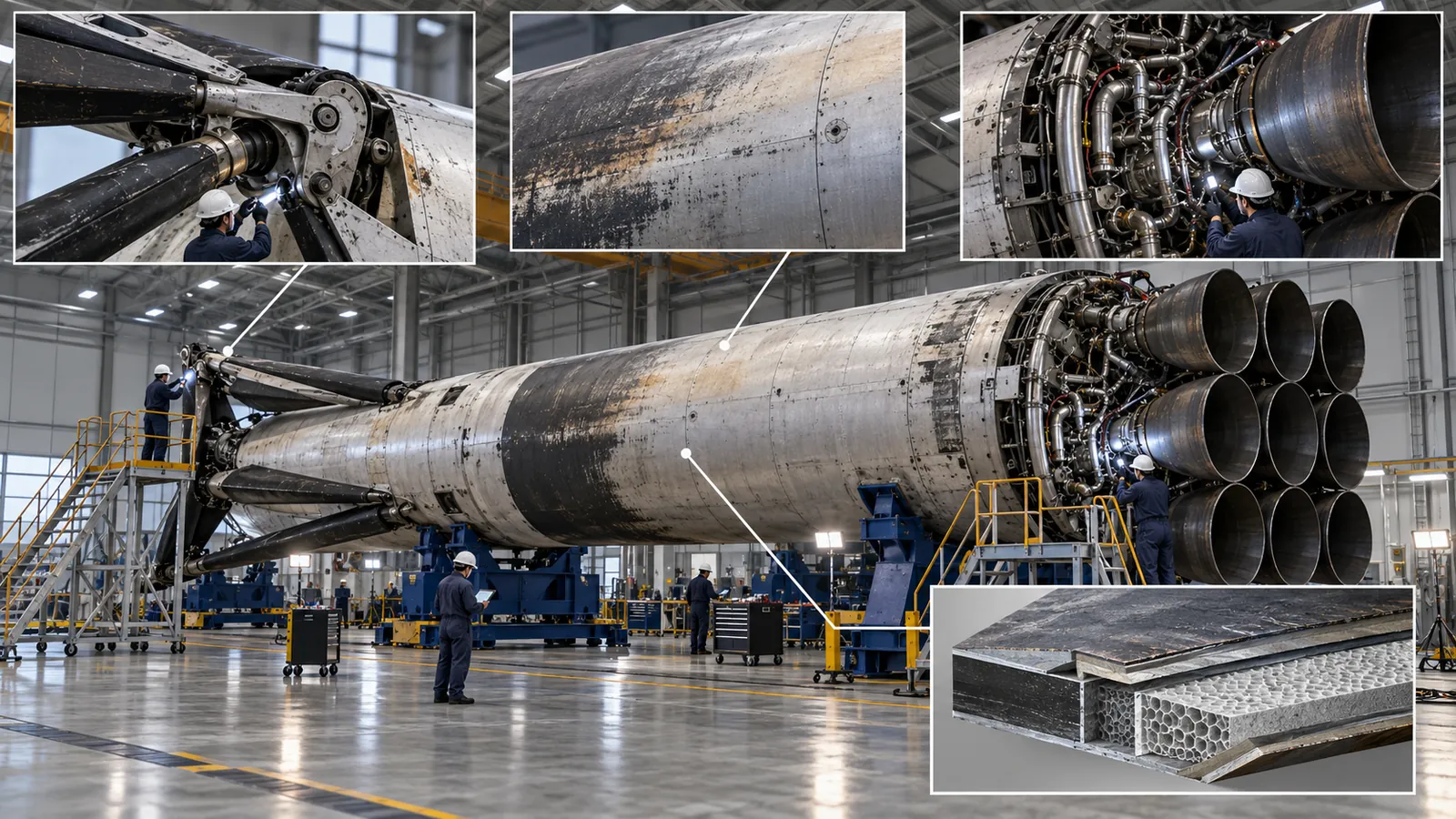
- The short version / what to know first / where this sits in the series
- Which parts are recovered and reused
- Four ways of recovery
- The track record confirmed in official sources
- What reuse changes: payload and vehicle
- What does not change: the rocket equation, and the materials challenge
- The challenge of refurbishment, and why cost cannot be asserted
- Companies' plans (not yet confirmed)
- How to read the yardsticks and standards / limits / glossary / references / claim-to-source audit
Sourced = stated in a public document (source linked)
Our calculation = a value we derived from stated assumptions
Not yet confirmed = company plans, targets and other unsettled matters
Our reading for materials is marked Commentary. Inference is shown in bold. Every analogy comes with its limits.
Flight counts, landing counts and the like are displays on the manufacturers' own official pages, and the definitions of the counts are theirs. "World's first" and "first" are written as each company's claim. Failures and accidents are written neutrally within the scope of official announcements, without asserting causes by inference. Because this field changes fast, vehicles and plans carry a checked date (17 October 2026). The "payload given up" in the figure comes from our assumed model, not from the losses of any real vehicle.
1. The short version / what to know first / where this sits in the series
- The track record of reuse is officially confirmed. Falcon 9 recovered a first stage on 21 December 2015 and, on 30 March 2017, flew a recovered first stage again for the first time (both per SpaceX) [Ref. 7, 8]Sourced. The mission of 15 October 2026 is described as the 28th flight of its first-stage booster [Ref. 9]Sourced.
- Even with reuse, some things do not change. The required speed and the rocket equation stay the same. Payload falls by the propellant held back for return and by legs and similar hardware. In our assumed model, holding back 5 % of first-stage propellant for the return cuts payload from about 3.6 % to about 2.8 % Our calculation.
- We cannot assert "reuse is always cheaper". A NASA paper says reuse succeeds when refurbishment costs less than new production. The Space Shuttle needed two to three months of maintenance after each flight [Ref. 2]Sourced. Cost is set by turnaround time, the number of reuses and launch cadence.
No prior knowledge is needed. That a rocket moves "burning propellant and getting lighter", why stages are dropped, and that payload is only a few percent of liftoff mass are explained in the article on rocket basics. The needed points are repeated briefly here so that this article stands alone.
This article connects best when read after the introduction to the space industry and the article on rocket basics. Engine reuse is covered in the article on rocket engines and propellants, re-entry heat protection in the one on thermal protection systems, and tank and structural materials in the one on lightweight structural materials.
2. Which parts are recovered and reused
Even among "reusable rockets", how much is recovered differs by vehicle. A NASA paper defines reuse as hardware not only designed for it but actually retrieved, recertified and flown multiple times. By that definition even the Space Shuttle was "partially reusable", since its external tank was discarded in the ocean [Ref. 2]Sourced.
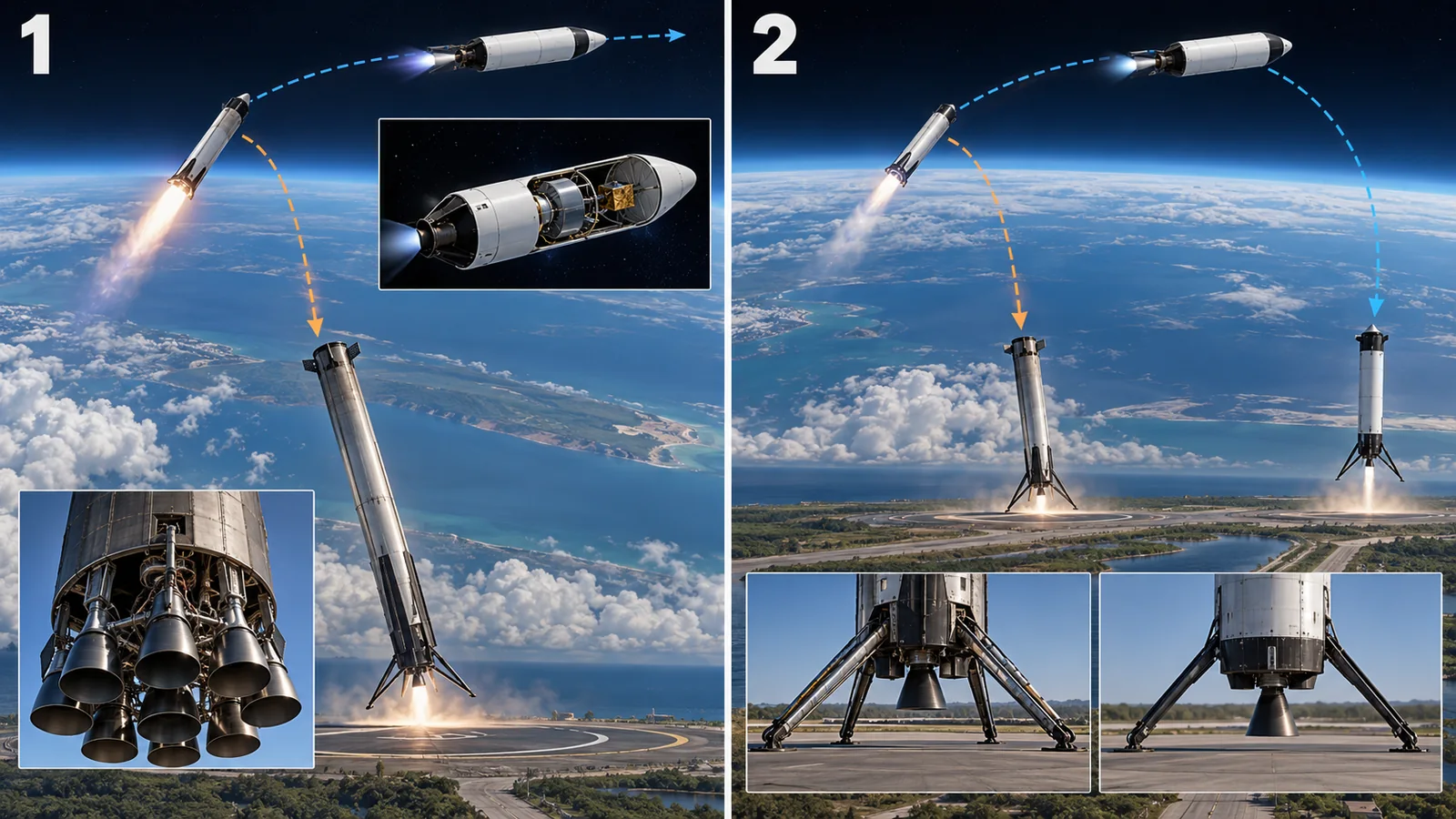
View original SVG, values and sources
Original SVG reference: Concept diagram (vector drawing). What is recovered differs by vehicle. A grouping based on official sources from NASA [Ref. 2, 1], SpaceX [Ref. 5, 6, 10] and Blue Origin [Ref. 12, 13] (our grouping). The △ in the Starship column shows that full reuse is the goal; a reflight record was not confirmed.
So far, what official sources confirm as recovered and reused is, in most cases, the first stage (with its engines) and the fairing. Falcon 9 recovers the first stage and fairing [Ref. 6]; the Space Shuttle recovered the orbiter, main engines and solid boosters (the external tank was discarded) [Ref. 2]. Full reuse including the upper stage is Starship's goal, but we could not confirm a track record [Ref. 11]. Limits of the analogy: an airliner reuses the whole airframe every time, but a rocket's upper stage accelerates all the way to orbital speed, so the burden of heat and mass on the way back is far greater (our commentary).
3. Four ways of recovery
Recovery methods fall into four groups. The first is vertical landing: re-fire the engines to slow down and set down on legs. Falcon 9's first stage carries four grid fins (small wings that steer in the air) and four deployable legs [Ref. 6]Sourced. The second is catching: not touching down but being caught in the air by the arms of a launch tower. SpaceX announced that on Starship's fifth flight on 13 October 2024 the Super Heavy booster was caught by the "chopstick" arms of the tower [Ref. 10]Sourced.
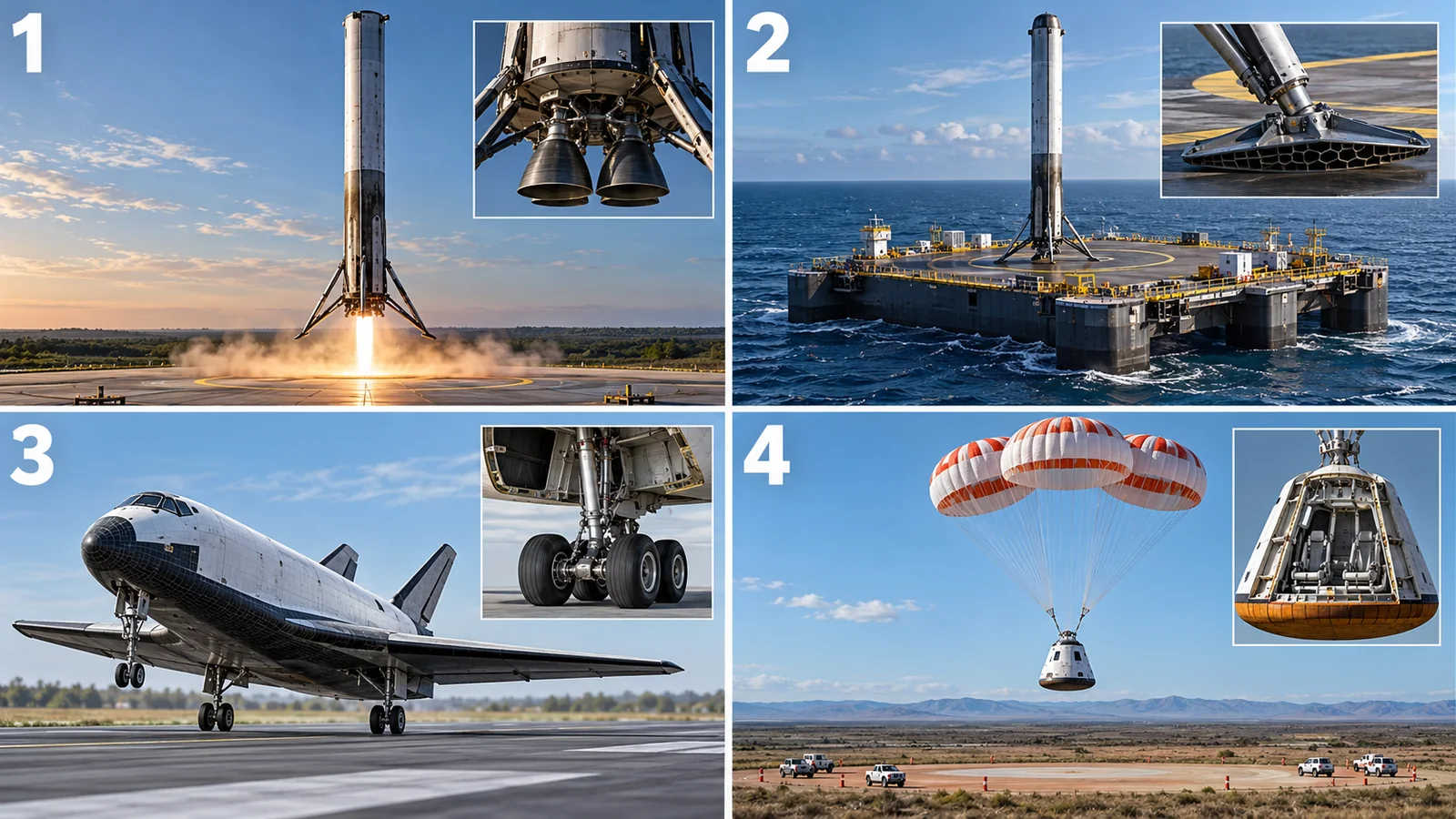
View original SVG, values and sources
Original SVG reference: Concept diagram (vector drawing). Four ways of recovery. A concept diagram. Sources for the examples: Falcon 9 legs and grid fins [Ref. 6], New Glenn landing on a ship [Ref. 13, 14], the Starship booster catch [Ref. 10], the Space Shuttle [Ref. 2, 4].
The third is gliding landing: gliding on wings to a runway, as the Space Shuttle orbiter did [Ref. 1]. The fourth is parachute to the sea. NASA's 1985 report describes the Shuttle's solid boosters being recovered by ship and returned to a disassembly facility for refurbishment and reuse [Ref. 4]Sourced. Rocket Lab calls Electron "the only reusable-capable small launch vehicle" (the manufacturer's claim) [Ref. 18].
In a landing, the vehicle stands on its own legs. In a catch, the tower arms support a part of the vehicle's side. A catch may let the vehicle do without landing legs, which bear the shock of touchdown, and so save that mass (our commentary; we could not confirm the real size of the effect). Limits of the analogy: like a catch in baseball, failure follows unless position and speed match exactly, so aligning tower and vehicle is a demanding requirement.
4. The track record confirmed in official sources
Here is the track record in date order (checked 17 October 2026). The word "first" is each company's claim.
| Vehicle | Track record confirmed in official sources (dates and names) | Notes for reading |
|---|---|---|
| Space Shuttle (NASA) | 135 missions from the first launch on 12 April 1981 to the final landing on 21 July 2011. Orbiters: Columbia, Challenger, Discovery, Atlantis and Endeavour [Ref. 1]Sourced | Partial reuse (external tank discarded). As of 2016, a NASA paper says the Shuttle was the only reusable launch vehicle to have flown repeatedly and the SSME the only demonstrated reusable engine |
| Falcon 9 (SpaceX) | 21 December 2015: on ORBCOMM-2 the first stage landed at Landing Zone 1 (SpaceX calls it the world's first recovery of an orbital class rocket) [Ref. 7] / 30 March 2017: on SES-10 a first stage that had flown CRS-8 (April 2016) flew again and landed on the droneship OCISLY (called the first reflight) [Ref. 8] / 15 October 2026: on USSF-481 the first stage flew for the 28th time [Ref. 9]Sourced | Displayed on the manufacturer's page (17 October 2026): 693 completed missions, 647 total landings, 613 total reflights [Ref. 5]Sourced. The user's guide says that as of February 2025 first stages had been re-flown more than 384 times and fairing halves on 307 missions [Ref. 6] |
| Starship (SpaceX) | On the fifth flight on 13 October 2024 the Super Heavy booster was caught by the tower arms [Ref. 10] / the 14th flight on 28 September 2026 was the first orbital flight and delivered 26 Starlink V3 satellites; the ship splashed down in the Pacific and the booster in the Gulf, where its flight termination system was triggered [Ref. 11]Sourced | A reflight (flying the same vehicle again) was not confirmed on the pages we read |
| New Shepard (Blue Origin, suborbital) | Flew 38 times and carried 98 people above the Kármán line. On 30 January 2026 Blue Origin announced a pause of no less than two years [Ref. 17]Sourced | A vehicle that does not reach orbit (suborbital). Treated separately from reuse of orbital rockets |
| New Glenn (Blue Origin) | On the second mission in November 2025 the first stage "Never Tell Me The Odds" launched and landed [Ref. 13, 14]Sourced. The third mission (NG-3) was to use the same refurbished first stage, with a launch announced for no earlier than 19 April 2026 [Ref. 14]. We could not confirm the outcome of NG-3 on the pages we read | On 28 May 2026 a significant anomaly occurred during an integrated hotfire test at the launch pad; an update of 5 August 2026 says it originated at the main oxygen valve of one BE-4 engine [Ref. 15, 16]Sourced. The company aims to return to flight this year (a company plan, Not yet confirmed) |
Our calculationThe table is organized by us. Numbers are as displayed on manufacturers' pages and their definitions are the manufacturers'. Causes of failures and accidents are limited to what official investigation reports state; we do not infer.
The manufacturer's figures are defined by the manufacturer, and the breakdown of failures and partial successes must be checked separately (official investigation reports and authority statements). Even as reflight counts grow, degradation of each vehicle and the margin left for inspection are separate matters. The user's guide says the first stage is designed to survive atmospheric entry and recovery loads, and that examining recovered hardware lets the design and material selection be improved [Ref. 6]Sourced.
5. What reuse changes: payload and vehicle
First, the payload. For a first stage to come back, propellant must be held in reserve. The NASA paper likewise says a reusable vehicle needs elements an expendable one does not: thermal protection that survives re-entry repeatedly, more robust structures, tanks with higher safety factors, and extra propellant for the return maneuvers [Ref. 2]Sourced.
Let us check this with the two-stage model of the rocket-basics article (specific impulse 350 s, structure share 8 %, 4.7 km/s per stage). If 5 % of first-stage propellant is held back for the return, the payload share goes from 3.6 % to 2.8 %, a cut of about 23 %. If the first-stage structure merely gets 10 % heavier from legs and so on, it is 3.5 % (about 4 % less). With both it is 2.6 %, and with 10 % held back plus 10 % heavier it is 1.7 % Our calculation (all assumptions). The share of propellant held back for the return cuts payload more than the weight of the legs and similar hardware.
When the first stage burns out, the return propellant, left unburned, is extra weight that keeps being accelerated along. In the rocket equation, the larger the mass after burnout, the higher the mass ratio needed for the same speed, and the room for payload shrinks quickly (see the rocket-basics article). Limits of the analogy: on real vehicles, return propellant is used not only for landing but also for attitude control during re-entry, and the amount needed differs by method of recovery (catch, ship landing, return to a landing site) (our commentary).
6. What does not change: the rocket equation, and the materials challenge
Even with reuse, the required speed and the rocket equation do not change. What changes is that the first stage is no longer an "empty box to throw away" but a "tool to use again", and that the loads on the vehicle increase accordingly. The figure lines up what materials go through in one cycle of reuse.
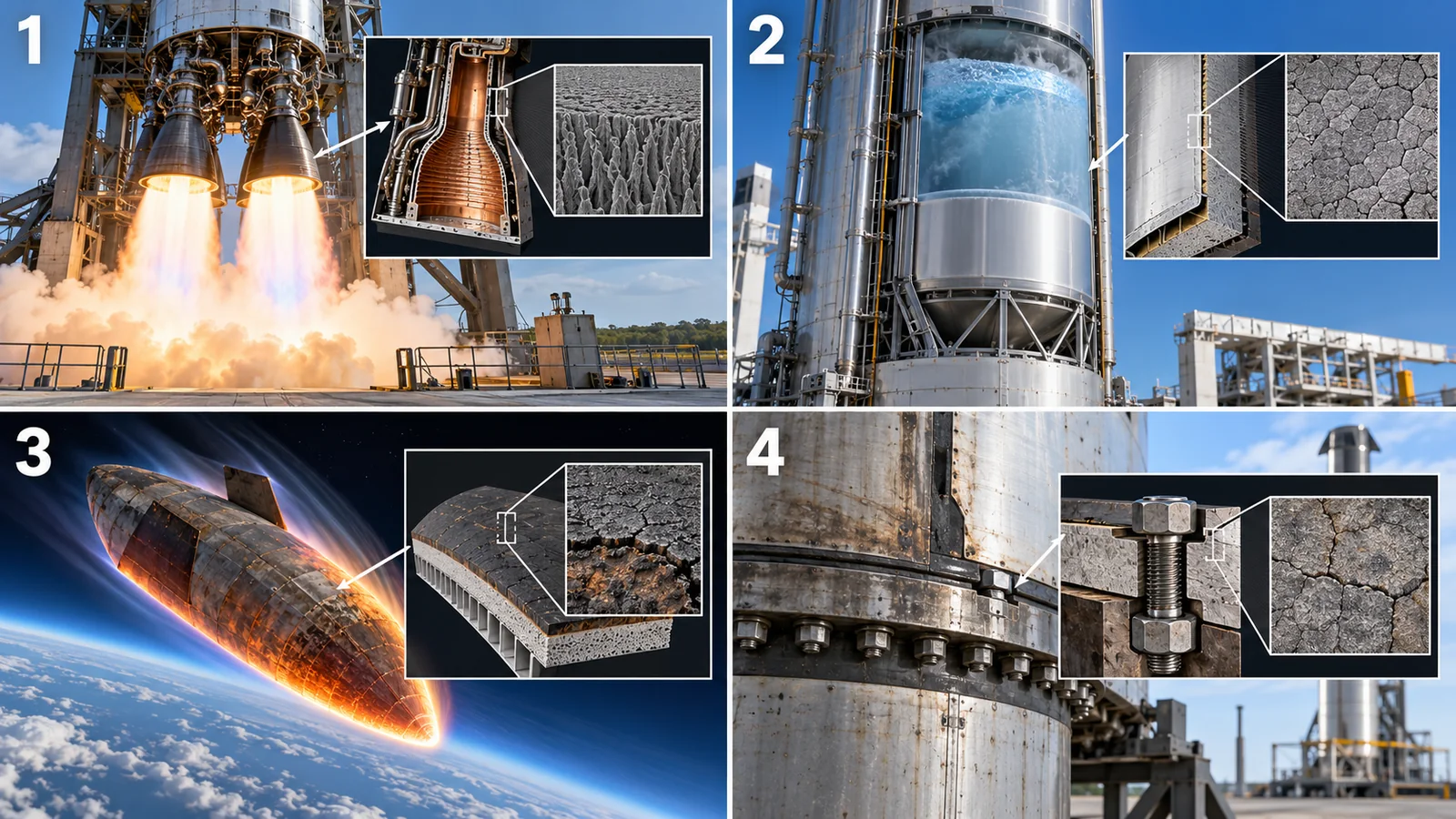
View original SVG, values and sources
Original SVG reference: Concept diagram (vector drawing). What materials go through in one cycle of reuse. A concept diagram. Our grouping of the elements the NASA paper [Ref. 2] describes: the re-entry environment, thermal protection, structure, safety factors and inspection.
On the materials side there are several concrete examples. SpaceX says Falcon 9's first-stage tanks use aluminum-lithium alloy [Ref. 5]. ESA's Themis (a reuse demonstrator) is to use lightweight stainless steel tanks [Ref. 20]. Blue Origin says New Glenn's BE-4 engines use liquefied natural gas (LNG) because it "improves engine reusability" compared with kerosene-grade fuels [Ref. 12]Sourced. The NASA paper says hydrocarbon fuels can cause soot deposition (coking) and that an oxygen-rich combustion cycle, with its clean exhaust, has an advantage for reuse [Ref. 2]Sourced.
An expendable vehicle can be designed on the principle that surviving one flight is enough. For a reusable vehicle, the same parts go through heating and cooling, loads, vibration and landing shock again and again. So fatigue, thermal cycling, corrosion (seawater is conceivable for ocean landings; this is our inference), and the detection and repair of damage become central to material selection (our commentary). The NASA paper cites designing tanks with high safety factors to limit stress damage [Ref. 2]. SpaceX also says it examines recovered first stages to improve design and material selection [Ref. 6]. Track-record data are valuable to materials makers too: "which parts that flew how many times showed what degradation, where" becomes the next material requirement.
7. The challenge of refurbishment, and why cost cannot be asserted
The Space Shuttle record gives a reference for how much refurbishment takes. In NASA's 1985 report, launch turnaround fell from 187 days for STS-2 to 60 days for STS-7, and post-landing turnaround from 14 days to 5 [Ref. 3]Sourced. Even so, a 2016 NASA paper puts Shuttle maintenance at "two to three months" and says the main engines (SSME) were removed after each flight for servicing, which took more than 20,000 hours of direct and indirect labor and two months [Ref. 2]Sourced.
The NASA paper says reuse succeeds "when refurbishment costs less than new production", and relays a view (quoting Bowcutt) that life-cycle cost is driven more strongly by turnaround time than by engine specific impulse or vehicle mass. By that view, a change of about 30 % in specific impulse or 100 % in vehicle dry weight equals the effect of a 15-day change in turnaround time [Ref. 2]Sourced. This is a view the paper cites, not a figure checked on current vehicles.
It cannot be asserted. The cost of refurbishment, the number of reuses, launch cadence, payload given up, and the loss when something fails are all involved. The NASA paper says reuse requires upfront investment and planning from the conceptual phase, and is "neither easy nor free" [Ref. 2]Sourced. This article gives no manufacturers' prices or cost-comparison figures.
8. Companies' plans (not yet confirmed)
The following are statements on each company's official pages and are treated as Not yet confirmed.
- New Glenn (Blue Origin): the first stage has a design goal of "a minimum of 25 flights" (a company target) [Ref. 12]. The company aims to return to flight this year [Ref. 15].
- Neutron (Rocket Lab): a reusable medium-lift rocket with 13,000 kg to low Earth orbit and a first stage planned to land at sea. We could not confirm the state of its first flight on the page we read (manufacturer's stated values) [Ref. 19].
- Themis (ESA): a demonstrator of reuse technologies. The first flight is planned as a "hop" of up to 100 m from Esrange in Sweden [Ref. 20].
- Starship (SpaceX): full reuse is the goal. The 14th flight was the first orbital flight [Ref. 11]. A reflight record was not confirmed.
A "minimum of 25 flights" is a design goal, not a track record. The track record counts flights actually made after recovery and recertification (the NASA paper's definition [Ref. 2]). Even when a goal count is written, check in official records whether any vehicle has reached that count.
9. How to read the yardsticks and standards
The yardsticks of reusable rockets are centered not on performance numbers but on operating numbers: the number of reuses (how "flights", "landings" and "reflights" are counted), the days and labor hours of refurbishment, the success rate of recovery, and the safety of recovery and re-entry. Bare numbers invite misreading, because counting differs by manufacturer and the definitions are the manufacturer's (checked 17 October 2026).
| What is evaluated | Typical numbers and source | Standards, guidelines and regulation | How to read it |
|---|---|---|---|
| Number of reuses and track record | Displays on manufacturers' official pages (flights, landings, reflights) [Ref. 5], mission pages (flight number of each vehicle) [Ref. 9]Sourced | Not found (we could not identify a standard that defines how reuse is counted; the NASA paper says that as of 2016 standards for reuse had not been developed) | Counting definitions are the manufacturer's; "world's first" is a claim; compare under the same definition and date |
| Refurbishment and inspection | Turnaround days and labor hours (Shuttle record: NASA) [Ref. 3][Ref. 2]Sourced | Not found (we could not confirm official figures for the turnaround days or labor hours of current reusable rockets) | Shuttle figures are not a guide to current vehicles' turnaround |
| Safety of recovery and re-entry | USA: 14 CFR Part 450 "Launch and Reentry License Requirements" [Ref. 23]Sourced. Japan: JERG-0-047, the safety standard for re-entry flight of re-entry vehicles (JAXA; title in Japanese; title only confirmed) [Ref. 22]Sourced | ISO 27875:2026 "Space systems — Re-entry risk management for uncrewed spacecraft and launch vehicle orbital stages" / ISO 23020:2021 "Space systems — Determination of test methods to characterize material or component properties required for break-up models used for Earth re-entry" (under systematic review) / ISO 20893:2021 "Space systems — Detailed space debris mitigation requirements for launch vehicle orbital stages" [Ref. 21]Sourced | Licensing requirements (regulation) and technical standards (ISO) are different things. We did not check the contents. This is not legal advice |
| Qualification of materials and structure | Evaluation against the repeated loads of reuse (heat, load, landing). The NASA paper says a reusable vehicle needs thermal protection, robust structure and high safety factors [Ref. 2]Sourced | ISO 24917:2020 "Space systems — General test requirements for launch vehicles" (we could not confirm whether it presumes reuse) [Ref. 21]Sourced | "Qualification for one flight" and "qualification for multiple flights" are different. Check the number of flights qualified |
Our calculationThe table is organized by us. ISO numbers, titles, years and status were checked in the catalogue of standards (checked 17 October 2026); for JAXA only titles in the list, and for the FAA only the existence of the title in the eCFR. The texts of the standards and regulation were not checked and no requirements are stated. No ASTM standards are treated.
Cautions in reading (for materials engineers)
- Ground tests differ from in-service track records: passing one qualification test does not guarantee dozens of reuses. Read track-record data with the vehicle, the count and the inspection results.
- A manufacturer's stated value differs from third-party verification: flight and landing counts are the manufacturer's own displays.
- Check whether a standard is a recommendation or a requirement: ISO standards are not legally binding. Launch and re-entry licenses are permissions under regulation [Ref. 23].
- Plans and achievements are different: New Glenn's "25 flights", Neutron's first flight and Starship's full reuse are Not yet confirmed.
- Qualification and acceptance differ: reuse involves both inspection after each flight (close to acceptance) and qualification of the design (up to how many flights).
10. Limits, and what could not be confirmed
- The outcome of New Glenn NG-3 could not be confirmed: we confirmed the launch plan for no earlier than 19 April 2026 and the plan to use the same refurbished first stage, but the actual result was not on the pages we read.
- The highest flight count of a Falcon 9 first stage could not be confirmed: we confirmed only the "28th flight" on the 15 October 2026 mission. It is not necessarily the highest.
- A reflight record for Starship or Electron could not be confirmed: Electron's recovery capability is the manufacturer's claim.
- Other countries and companies, such as China, are not covered: we limited ourselves to US and European agencies and companies within what we could confirm in official sources.
- Official figures for refurbishment days, cost and payload given up could not be confirmed: the payload effect is our assumed model, and no monetary figures are given. The Shuttle turnaround figures are not a guide to current vehicles.
- The texts of standards and regulation were not checked: for ISO and JAXA only titles and years, and for FAA Part 450 only the existence of the title.
11. Glossary
- Reuse (NASA definition)
- Hardware not only designed for it but actually retrieved, recertified and flown multiple times.
- Full and partial reuse
- Reusing all of the vehicle / only part of it.
- Vertical landing
- Recovery by slowing with engines and touching down on legs.
- Catch
- Recovery by tower arms catching the vehicle in the air.
- Grid fins
- Lattice-shaped fins that steer the vehicle in the air.
- Booster (first stage)
- The stage that burns first and pushes the vehicle up.
- Fairing
- The nose covering that protects the payload from air.
- Droneship
- An uncrewed ship that waits at sea as a landing platform.
- Orbiter
- The body of the Space Shuttle, which glided to a landing.
- SSME
- Space Shuttle Main Engine; recovered, serviced and reused.
- External tank
- The Shuttle's large fuel tank, which was discarded.
- Turnaround
- Inspection, servicing and preparation from landing to the next launch.
- Recertification
- The procedure of re-confirming that hardware is fit to fly again.
- Coking
- Soot deposition from burning hydrocarbon fuels.
- Life-cycle cost
- The total cost of making, using and servicing.
- Mass ratio
- Mass before burning ÷ mass after burnout.
- Flight termination system
- A safety device that ends a vehicle's flight in an emergency.
- LEO
- Low Earth orbit.
- Manufacturer's stated value
- A value given by the manufacturer itself; distinct from third-party verification.
- Design-goal count
- The number of reuses aimed at in design; not a track record.
12. References
- NASA "Space Shuttle" — www.nasa.gov/space-shuttle/
- Childress-Thompson R., Thomas D., Farrington P. (NASA) "A Framework for Assessing the Reusability of Hardware (Reusable Rocket Engines)" (December 2016) — ntrs.nasa.gov/citations/20170000606
- Schwartz R. (NASA) "Overview of STS ground operations/orbiter turnaround STS-1 through STS-7" (1985) — ntrs.nasa.gov/citations/19850008617
- Rasmussen A. M. (NASA) "Solid rocket booster retrieval operations" (1985) — ntrs.nasa.gov/citations/19850008619
- SpaceX "Falcon 9" product page (manufacturer's stated values; checked 17 October 2026) — www.spacex.com/vehicles/falcon-9
- SpaceX "Falcon User's Guide" (9 May 2025) — content.spacex.com/cms-assets/assets/falcon-users-guide-2025-05-09.pdf
- SpaceX "ORBCOMM-2 Mission" (21 December 2015) — www.spacex.com/launches/orbcomm2
- SpaceX "SES-10 Mission" (30 March 2017) — www.spacex.com/launches/ses10
- SpaceX "USSF-481 Mission" (15 October 2026) — www.spacex.com/launches/ussf481
- SpaceX "Starship's Fifth Flight Test" (13 October 2024) — www.spacex.com/launches/starship-flight-5
- SpaceX "Starship Flight 14" (28 September 2026) — www.spacex.com/launches/starship-flight-14
- Blue Origin "New Glenn" — www.blueorigin.com/new-glenn
- Blue Origin "New Glenn-3 to Launch AST SpaceMobile's BlueBird Satellite" (22 January 2026) — www.blueorigin.com/news/new-glenn-3-to-launch-ast-spacemobile-bluebird-satellite
- Blue Origin "New Glenn's Third Mission Slated for April 19" (16 April 2026) — www.blueorigin.com/news/new-glenn-ng-3-mission
- Blue Origin "New Glenn Return to Flight" (30 June 2026) — www.blueorigin.com/news/new-glenn-return-to-flight
- Blue Origin "GS1-3 Hotfire Updates" (updated 5 August 2026) — www.blueorigin.com/news/gs1-3-hotfire-updates
- Blue Origin "Blue Origin to Pause New Shepard Flights for No Less Than Two Years" (30 January 2026) — www.blueorigin.com/news/new-shepard-to-pause-flights
- Rocket Lab "Electron" product page (manufacturer's stated values; checked 17 October 2026) — www.rocketlabcorp.com/launch/electron/
- Rocket Lab "Neutron" product page (manufacturer's stated values; checked 17 October 2026) — www.rocketlabcorp.com/launch/neutron/
- ESA "Themis" — www.esa.int/Enabling_Support/Space_Transportation/Themis
- ISO/TC 20/SC 14 Catalogue of standards (titles, years and status of ISO 27875:2026, ISO 23020:2021, ISO 20893:2021 and ISO 24917:2020 checked) — www.iso.org/committee/46614/x/catalogue/p/1/u/0/w/0/d/0
- JAXA JAXA Safety and Mission Assurance Department, list of JAXA common technical documents (JERG and JMR) — sma.jaxa.jp/techdoc.html
- U.S. Government Publishing Office / eCFR 14 CFR Part 450 "Launch and Reentry License Requirements" — www.ecfr.gov/current/title-14/chapter-III/part-450
13. Claim-to-source audit
| Claim in the text | Basis | Type |
|---|---|---|
| Space Shuttle: first launch 12 April 1981, final landing 21 July 2011, 135 missions, five orbiters | NASA Space Shuttle page Reference 1 https://www.nasa.gov/space-shuttle/ | Sourced |
| Definition of reuse (retrieval, recertification, reflight), the Shuttle as partial reuse, as of 2016 the only reusable launch vehicle and the SSME the only demonstrated reusable engine, elements needed for reuse (thermal protection, robust structure, high safety factors, return propellant), Shuttle maintenance of two to three months, SSME servicing over 20,000 hours and two months, success when refurbishment cost < new production, Bowcutt's view, coking, no standards for reuse yet, "neither easy nor free" | NASA paper (December 2016) Reference 2 https://ntrs.nasa.gov/citations/20170000606 | Sourced |
| Launch turnaround 187 days (STS-2) → 60 days (STS-7), post-landing turnaround 14 → 5 days | NASA 1985 report Reference 3 https://ntrs.nasa.gov/citations/19850008617 | Sourced |
| Solid boosters recovered by ship and returned to a disassembly facility for refurbishment and reuse | NASA 1985 report Reference 4 https://ntrs.nasa.gov/citations/19850008619 | Sourced |
| Falcon 9: 693 completed, 647 landings, 613 reflights (display of 17 October 2026), aluminum-lithium alloy tanks | SpaceX product page (manufacturer's stated values) Reference 5 https://www.spacex.com/vehicles/falcon-9 | Sourced |
| First-stage re-flights over 384 and fairing re-flights on 307 missions (February 2025), design to survive entry and recovery, examining recovered hardware to improve design and material selection, four grid fins and four legs | SpaceX Falcon User's Guide (9 May 2025) Reference 6 https://content.spacex.com/cms-assets/assets/falcon-users-guide-2025-05-09.pdf | Sourced |
| 21 December 2015 ORBCOMM-2: landing at LZ-1, "the world's first recovery of an orbital class rocket" (SpaceX's claim) | SpaceX mission page Reference 7 https://www.spacex.com/launches/orbcomm2 | Sourced |
| 30 March 2017 SES-10: reflight of the CRS-8 (April 2016) first stage, landing on the droneship OCISLY, "the world's first reflight" (claim) | SpaceX mission page Reference 8 https://www.spacex.com/launches/ses10 | Sourced |
| 15 October 2026 USSF-481: 28th flight of the first stage | SpaceX mission page Reference 9 https://www.spacex.com/launches/ussf481 | Sourced |
| 13 October 2024 Starship fifth flight: Super Heavy booster caught by the tower arms | SpaceX mission page Reference 10 https://www.spacex.com/launches/starship-flight-5 | Sourced |
| 28 September 2026 Starship 14th flight: first orbital flight, 26 Starlink V3 satellites, ship splashed down in the Pacific, booster in the Gulf with flight termination system triggered | SpaceX mission page Reference 11 https://www.spacex.com/launches/starship-flight-14 | Sourced |
| New Glenn: first stage designed for "a minimum of 25 flights", BE-4 LNG improves reusability | Blue Origin product page Reference 12 https://www.blueorigin.com/new-glenn | Sourced |
| Landing of the NG-2 first stage "Never Tell Me The Odds"; plan to use the same stage on NG-3 | Blue Origin announcement (22 January 2026) Reference 13 https://www.blueorigin.com/news/new-glenn-3-to-launch-ast-spacemobile-bluebird-satellite | Sourced |
| NG-3 plan (no earlier than 19 April 2026); NG-2 in November 2025 | Blue Origin announcement (16 April 2026) Reference 14 https://www.blueorigin.com/news/new-glenn-ng-3-mission | Sourced |
| The anomaly in the 28 May 2026 hotfire test, aim to return to flight this year | Blue Origin announcement (30 June 2026) Reference 15 https://www.blueorigin.com/news/new-glenn-return-to-flight | Sourced |
| Anomaly originated at the BE-4 main oxygen valve (update of 5 August 2026) | Blue Origin update Reference 16 https://www.blueorigin.com/news/gs1-3-hotfire-updates | Sourced |
| New Shepard: 38 flights, 98 people, pause of two years or more announced 30 January 2026 | Blue Origin announcement Reference 17 https://www.blueorigin.com/news/new-shepard-to-pause-flights | Sourced |
| Electron: 97 launches, "the only reusable-capable small launch vehicle" (claim) | Rocket Lab product page (manufacturer's stated values) Reference 18 https://www.rocketlabcorp.com/launch/electron/ | Sourced |
| Neutron: reusable medium-lift, 13,000 kg to LEO, planned sea landing | Rocket Lab product page (manufacturer's stated values) Reference 19 https://www.rocketlabcorp.com/launch/neutron/ | Sourced |
| Themis: demonstrator of reuse technologies, lightweight stainless steel tanks, first flight a hop of up to 100 m (Esrange) | ESA introduction page Reference 20 https://www.esa.int/Enabling_Support/Space_Transportation/Themis | Sourced |
| Numbers, titles, years and status of ISO 27875:2026, ISO 23020:2021, ISO 20893:2021 and ISO 24917:2020 | ISO/TC 20/SC 14 catalogue Reference 21 https://www.iso.org/committee/46614/x/catalogue/p/1/u/0/w/0/d/0 | Sourced |
| Title of JAXA JERG-0-047, the safety standard for re-entry flight of re-entry vehicles | JAXA S&MA list (titles only) Reference 22 https://sma.jaxa.jp/techdoc.html | Sourced |
| Existence of 14 CFR Part 450 "Launch and Reentry License Requirements" | eCFR (current) Reference 23 https://www.ecfr.gov/current/title-14/chapter-III/part-450 | Sourced |
| Payload share of the two-stage model (Isp 350 s, structure 8 %, 4.7 km/s per stage) with 5 % and 10 % return propellant and 10 % extra mass (reference 3.6 %, 2.8 % at 5 %, 3.5 % at 10 % heavier, 2.6 % with both, 1.7 % at 10 % + 10 %), and the formula for λ | Our calculation (all assumptions; not values of real vehicles) | Our calculation |
| The four-way classification of recovery, "a catch may let legs be omitted", the loads that grow with reuse, "life is strength over repetition", implications for material makers, the value of track-record data, cautions on how flights are counted, and the grouping in Fig. 2 | Our organization and commentary based on public information | Commentary |
| Figures 1 to 9 are explanatory drawings, not measurements; Figure 1 is a slot for an AI-generated image | Note by this article | Commentary |
Last updated: 17 October 2026. Sources are limited to NASA technical reports and pages, official pages of SpaceX and Blue Origin (manufacturers' stated values), Rocket Lab product pages, ESA's introduction page, and official pages of JAXA, ISO and the FAA (eCFR). Manufacturers' figures are defined by the manufacturers and are not third-party verification. The payload effect is our assumed model, not values of real vehicles. The outcome of NG-3, the highest flight count of each vehicle, official figures for refurbishment days, cost and payload given up, the state of reuse in other countries, and the texts of standards and regulation could not be checked and are not stated.