TECHNOLOGY EXPLAINER
Introduction to the Space Industry
— from "falling sideways" to how the industry is built and what materials do in it
The space industry lifts payloads into orbit with rockets, runs satellites and probes there, and uses the results on the ground. We start with the question "what is an orbit?", answered with a cannonball picture and a few small calculations. Then we split the industry into five jobs and look at who does what, how big launch counts and public budgets are, and the "five enemies" of the space environment as seen by a materials engineer. We use no market-size estimates: every number comes from public agencies or official documents. This is the entry point to the whole series.
Read first: The Space Industry Today and Its Future — a business-oriented introduction
- The short version / what to know first / where this sits in the series
- What an orbit is: falling while moving sideways
- Three orbits: low Earth, geostationary and the Moon
- How the industry is built: five jobs
- Who does what: governments, companies, universities, and a budget example
- How crowded it is: launches and object counts
- Space through a materials engineer's eyes: the "five enemies"
- The series map
- How to read the yardsticks and standards / limits / glossary / references / claim-to-source audit
Sourced = stated in a public document (source linked)
Our calculation = a value we derived from stated assumptions
Not yet confirmed = plans, targets, or items still being drafted
Our reading for materials is marked Commentary. Inference is shown in bold. Every analogy comes with its limits.
The speeds and periods are illustrative values we computed from the law of gravitation; they differ slightly from any real vehicle. Launch and object counts come from ESA's annual report, and the budget from the text of an enacted US statute. We use no market-size estimates from research firms. Because this field changes fast, vehicles, plans and standards carry a checked date (17 October 2026).
1. The short version / what to know first / where this sits in the series
- A spacecraft is "falling all the time, but moving sideways fast enough that it never hits the ground". That is an orbit. The International Space Station (ISS) circles the Earth in about 90 minutes [Ref. 1, 3]Sourced, at a speed of about 7.7 km per second (our calculation) Our calculation
- The industry is easier to grasp as five jobs: launch, spacecraft (satellites and similar), ground, exploration, and making things in space. In 2025 there were more than 300 launches worldwide and over 4,000 new payloads reached orbit [Ref. 7, 9]Sourced
- For a materials engineer, space is a place to fight "five enemies": vacuum, radiation, temperature swings, atomic oxygen and ultraviolet light, and microgravity plus debris. Which enemy a technology faces decides how its materials are chosen and tested (our commentary).
No prior knowledge is needed. If you know that gravity pulls things down and that a faster throw goes farther, you can follow. Equations are kept to a minimum; each one is explained in words and checked with numbers.
This is the first article of the space-industry series. Read next the explainer on the space environment and its effects on materials (the five enemies in detail), then the one on how to read evaluations of space materials (yardsticks and standards), then rocket basics and reusable rockets. The map in section 8 shows where the other articles fit.
2. What an orbit is: falling while moving sideways
Let us begin with a plain question. The ISS flies at about 400 km. That is only about 6% of the Earth's radius (about 6,400 km), a thin skin above the surface. Is gravity weaker up there?
NASA's explanation says that even at about 250 miles (about 400 km), Earth's gravity is 88.8% of its surface strength [Ref. 2]Sourced. So gravity has hardly weakened. Why, then, do astronauts appear to float?
The answer is: because they are falling. The ISS is falling toward the Earth all the time. But it is also moving sideways so fast that the ground it is falling toward curves away. A cannonball makes this easy to picture.
(1) Checking with numbers (our calculation)
The speed on a circular orbit depends only on the strength of Earth's gravity (GM) and the distance from Earth's center (r): v = √(GM / r). GM is the product of Earth's mass and the gravitational constant; NASA's Earth data give 3.986 × 10¹⁴ m³/s² [Ref. 5]. Earth's equatorial radius is 6,378 km, so at 400 km altitude r = 6,778 km.
The result is v ≈ 7.67 km/s (about 27,600 km/h). NASA describes the ISS as moving at "five miles per second", or 17,500 miles per hour (about 28,000 km/h) [Ref. 1, 2], which is about the same. One lap is 2πr ÷ v ≈ 5,550 s, or about 92.6 minutes, consistent with NASA's "about 90 minutes" [Ref. 1]Our calculation.
Finally, check the heart of the cannon picture. Moving sideways 7.67 km in one second, a straight path would drift away from the circular orbit by v²/(2r) ≈ 4.3 m. Meanwhile gravity at this altitude (about 8.7 m/s²) pulls an object down ½ × 8.7 × 1² ≈ 4.3 m in one second. The amount that sideways motion "escapes" and the amount that gravity "pulls back" are the same, so the height does not change Our calculation.
| Altitude | Orbit radius r (from Earth center) | Speed v | Time for one lap | Gravity there (vs surface) |
|---|---|---|---|---|
| 400 km | 6,778 km | ~7.67 km/s | ~92.6 min | 88.5% |
| 1,000 km | 7,378 km | ~7.35 km/s | ~105 min | 74.7% |
| 20,200 km | 26,578 km | ~3.87 km/s | ~12.0 h | 5.8% |
| 35,786 km | 42,164 km | ~3.07 km/s | ~23.9 h | 2.3% |
Our calculationv = √(GM/r), period T = 2π√(r³/GM), gravity = GM/r². Computed with GM = 3.986×10¹⁴ m³/s² and equatorial radius 6,378.137 km (NASA Earth data). Ideal circular orbits, no atmospheric drag.
This is not accurate. Even at the ISS's altitude, gravity is about 90% of its surface value [Ref. 2]. Astronauts float not because gravity is absent but because the station and the astronauts are in the same free fall. This state is called microgravity (only a tiny net gravity is felt). NASA describes microgravity inside the ISS as about 10-6 g [Ref. 2].
Because the ground it is falling toward curves away at the same rate. In Fig. 2, case 4, the ball keeps falling but its height above the ground does not change. Put another way, an orbit is a fall that never ends and never hits the ground. Limits of the analogy: real orbits are not perfect circles and change slowly because of the thin atmosphere's drag and uneven gravity. ESA also reports that atmospheric drag in the lower part of low Earth orbit naturally clears debris [Ref. 9].
3. Three orbits: low Earth, geostationary and the Moon
The character of an orbit changes a great deal with height. The higher it is, the longer one lap takes and the slower the speed. NASA divides orbits by altitude into low, medium and high [Ref. 4]. For this article you only need to remember three.
- Low Earth orbit (LEO): just above the atmosphere. The ISS at about 400 km is an example. One lap takes about 90 minutes. Many Earth-observing satellites and crewed spacecraft use it [Ref. 4, 3].
- Geostationary orbit (GEO): above the equator at about 36,000 km. One lap takes about 24 hours, the same as Earth's rotation (precisely 23 hours 56 minutes 4 seconds), so from the ground the satellite appears fixed in the sky. Communications and weather satellites use it [Ref. 4, 3].
- The Moon: about 384,400 km from Earth's center (semi-major axis of its orbit), with a lap of about 27.3 days [Ref. 6]. Lunar orbit and the lunar surface are far more distant than low Earth orbit; for example, Artemis II, which looped around the Moon and returned, flew for about 9 days [Ref. 12].
Between them lies medium Earth orbit (MEO); one example is an orbit at about 20,200 km with a 12-hour period, used by positioning (navigation) satellites and others [Ref. 4].
Higher up, gravity is weaker and pulls less, so a slower sideways speed is enough (in the table, 7.67 km/s at 400 km versus 3.07 km/s in geostationary orbit). The circle is also bigger, so one lap is a longer path, and the period grows quickly. NASA likewise says the higher the orbit, the slower the satellite moves [Ref. 4]. Memory aid: high means a long detour at a leisurely pace.
4. How the industry is built: five jobs
Many people picture rockets when they hear "space industry", but rockets are only one job. The OECD's way of organizing the space economy separates the "upstream", the technological and scientific backbone, from the "downstream", the ground-based infrastructure and services that depend on it [Ref. 11]. For materials engineers we use five jobs (this grouping is our own organization, not an official statistical classification).
View original SVG, values and sources
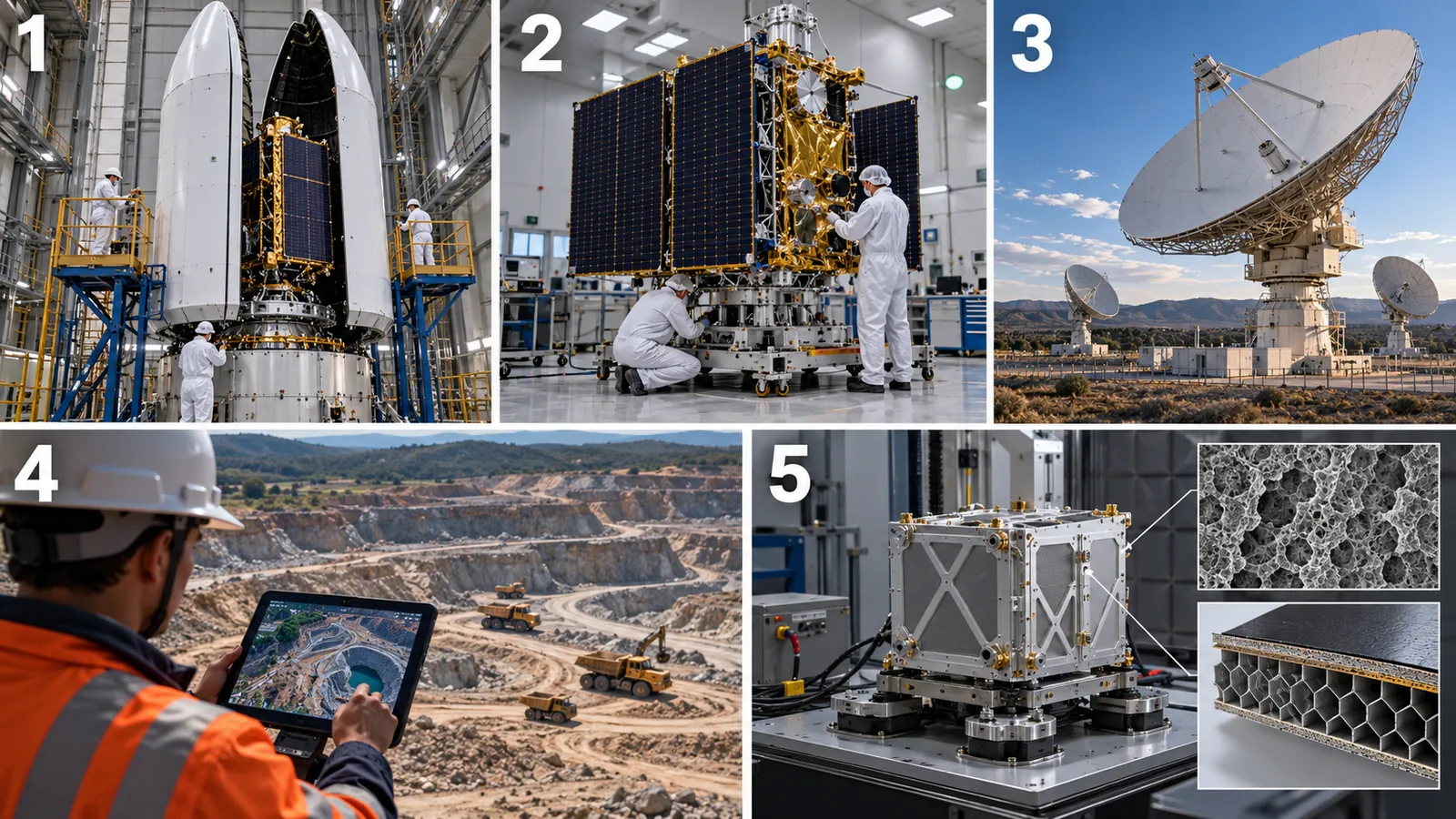
Original SVG reference: Concept diagram (vector drawing). The five jobs of the space industry. Jobs 1 to 3 form the basic flow; 4 (exploration) and 5 (making things in space) put the same tools to different uses. The grouping is our own.
(1) Launch: the "carry" job
A rocket is a vehicle that burns propellant and gets lighter as it goes. Its job is to carry payloads from the ground to orbit, and light weight and reliability are everything. The articles on rocket basics and reusable rockets cover it in detail.
(2) Spacecraft: the "work" job
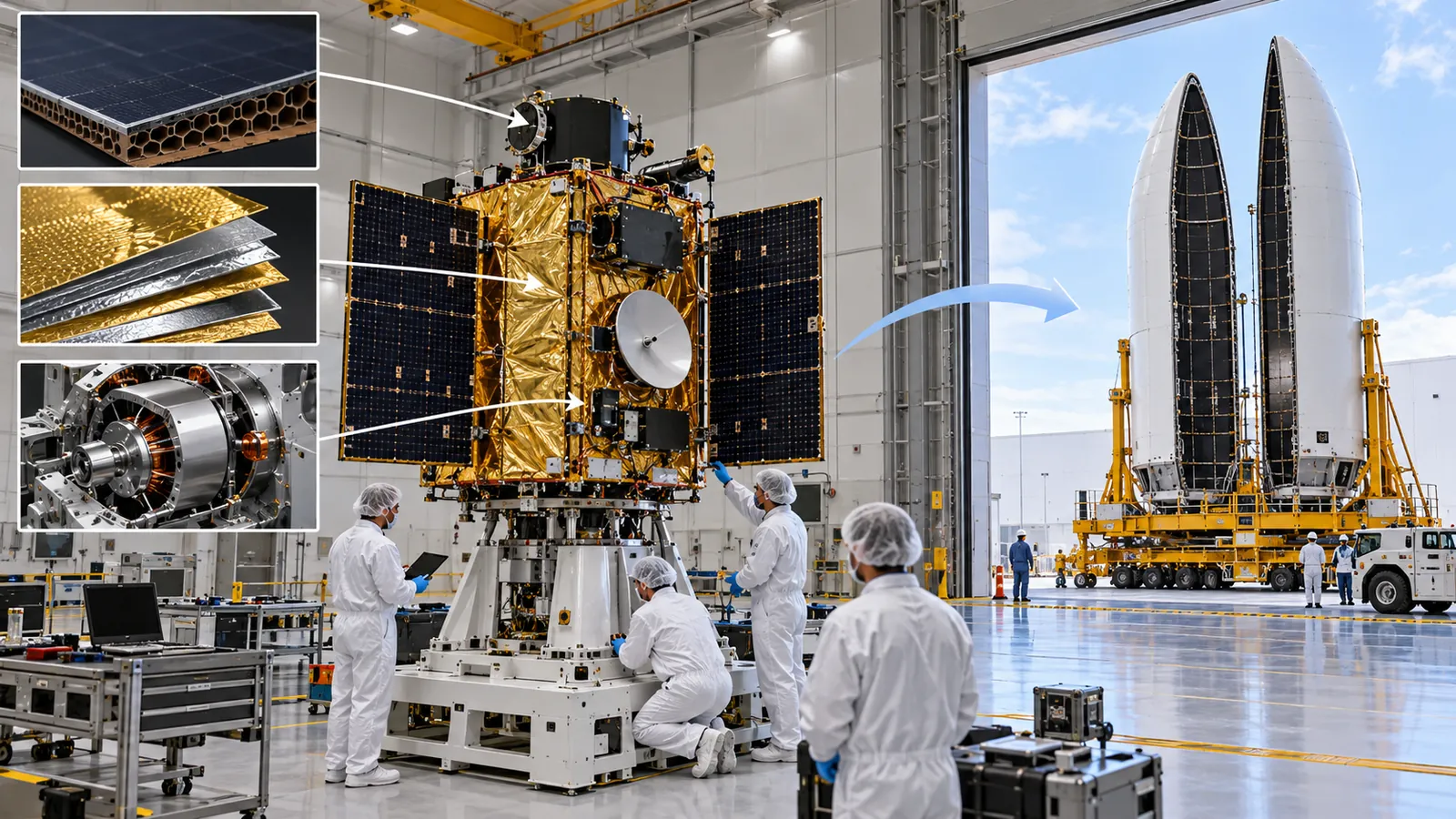
Spacecraft is the general name for machines that work in orbit. It includes satellites for communications, observation and positioning, probes that travel far, and crewed vehicles. Solar cells that make power, radiating surfaces that shed heat, and the structure that holds it all together make this the area where materials matter most.
(3) Ground: the "use" job
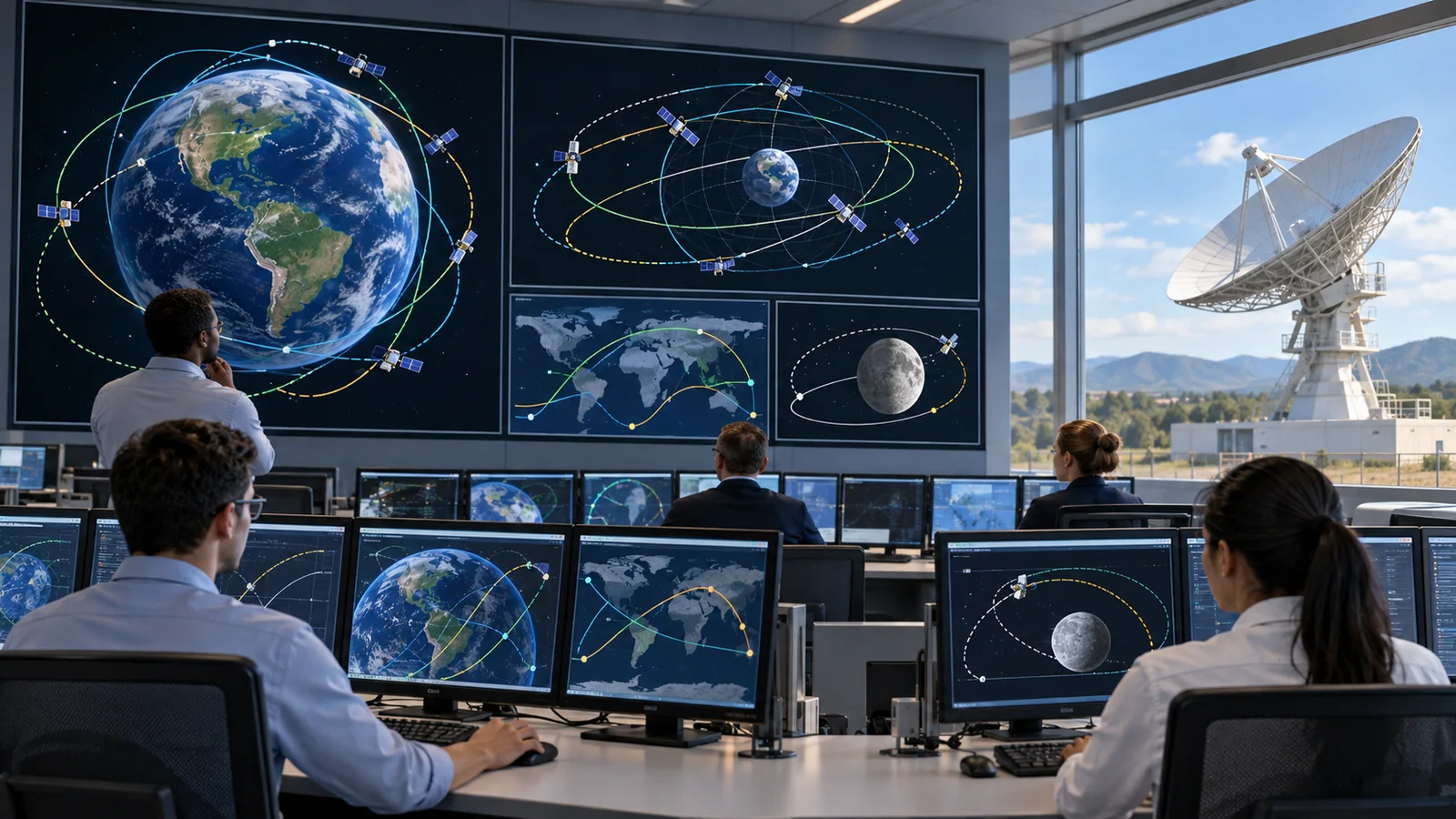
Mission control, radio links with satellites (ground stations), and the processing and use of the data received belong here. Much of it is shared with ordinary electronics and information industries, so there is less that is specific to space materials.
(4) Exploration: the "go far" job
Going to the Moon, Mars or asteroids. For example, the crewed lunar flyby Artemis II launched on 1 April 2026 and splashed down on 10 April 2026. NASA describes its Orion spacecraft as having radiation protection and "the world's largest heat shield" [Ref. 12]Sourced. Materials that survive the heat of atmospheric entry are the stars here.
(5) Making things in space: the "manufacture" job
Attempts to make crystals or materials in microgravity, an environment hard to get on the ground. At present this is mostly research and demonstration; its scale and value as a business are not settled. The explainers on in-space manufacturing and on microgravity drug discovery treat the stages separately.
For launch the worry is "light, strong, and able to take cryogenic cold and high heat". For spacecraft it is "surviving vacuum, radiation and temperature swings for years". For exploration it is "the heat of atmospheric entry, and lunar dust" (our commentary). Even for the same family of polymers, a rocket insulator, a satellite's multi-layer insulation and the resin in ground electronics face completely different tests. The next article, on the space environment, lays out the conditions that cause these differences.
5. Who does what: governments, companies, universities, and a budget example
The work of space is shared among government agencies, companies and universities and research institutes. Agencies include NASA in the United States, the European Space Agency (ESA), and the Japan Aerospace Exploration Agency (JAXA). The ISS is run by five space agencies from 15 countries [Ref. 1].
In general, government agencies set science and exploration missions and provide funds, while companies design, build and operate the vehicles and satellites. In recent years companies increasingly offer launch and transport as services that agencies buy (our commentary). Differences between national systems are covered in the explainer on national space strategies and regulation.
A government budget is one clue to scale. NASA's appropriation for fiscal year 2026 (October 2025 to September 2026) is written in the law enacted on 23 January 2026 (Public Law 119-74) [Ref. 10]. The chart shows its amounts by account.
Our calculationTotal = 7.783 + 7.250 + 4.175 + 3.000 + 0.935 + 0.9205 + 0.1853 + 0.143 + 0.0465 ≈ 24.44 (US$ billion). Account names follow the headings in the statute.
Budget words come in stages: request (what the government asks Congress for) → authorization (a law allowing a ceiling) → appropriation (a law permitting spending) → allocation → contract → actual spending. The same word "budget" can mean different things. This chart is an appropriation, in US dollars, in the US fiscal year (which differs from Japan's or Europe's). Other statutes may have added funds, but we did not check. The accounts are NASA's accounting categories and do not map onto our "five jobs".
6. How crowded it is: launches and object counts
The "volume" of space activity can be counted without market estimates: ESA publishes an annual Space Environment Report. In Issue 10.1, dated 8 September 2026 (data to the end of 2025), there were more than 300 launches in 2025 and over 4,000 new payloads reached orbit [Ref. 9, 7]Sourced. ESA states that about ten new payloads are launched each day and more than three objects re-enter the atmosphere each day [Ref. 7].
In ESA's debris model (MASTER), as of 1 February 2026 there are estimated to be 68,450 objects larger than 10 cm (including about 11,300 active payloads), about 1.5 million pieces of debris of 1 to 10 cm, and about 230 million of 1 mm to 1 cm [Ref. 9]Sourced. The chart lines up these orders of magnitude.
Objects in low Earth orbit move at 7 to 8 km per second. In a head-on meeting the relative speed could reach about 15 km/s (7.67 × 2; our calculation). ESA describes debris larger than 1 cm as large enough to cause catastrophic damage [Ref. 8]. Think "small but fast, therefore dangerous" rather than "small, therefore safe". The next article on the space environment covers this.
7. Space through a materials engineer's eyes: the "five enemies"
A material sent to space finds itself in conditions unlike anything on the ground. This series organizes them as the "five enemies" and, in each article, shows which enemy a technology faces. Here we give only the names and a one-line summary.
| Place | Enemies that matter most | In a word |
|---|---|---|
| Low Earth orbit | 4 atomic oxygen and UV, 3 repeated temperature cycles, 5 debris | Moves between sun and shadow every ~90 min |
| Geostationary orbit | 2 radiation, 1 vacuum | Used for many years, so accumulated effects matter |
| Lunar surface | 3 large temperature swings (long day and night), lunar dust | Day and night last about two weeks each (a lunar day is ~29.5 Earth days) |
SourcedThe Moon's 27.3-day orbital period and 29.53-day synodic period are from NASA's Moon data [Ref. 6]. The assignment of enemies to places is our own organization (commentary), checked with sources in the next article.
Both are wrong. Even in vacuum, materials degrade through atomic oxygen, ultraviolet light, radiation, and gas released by the materials themselves (outgassing). And with no air there is no convection to carry heat away; heat can leave only by radiation (infrared), so spacecraft designers are always concerned about heat building up. The articles on spacecraft thermal control and on thermal-control materials cover this.
A product on the ground can be recalled or replaced. A spacecraft in orbit usually cannot be repaired. So in space, choosing a material, showing by test that "it withstands this environment", and then making it to the same quality again and again, called qualification, is a large part of the technology (our commentary). That is why a new material with higher performance alone is hard to adopt. The article on reading material evaluations deals with the yardsticks of those tests.
A rocket can carry only so much mass, so low weight comes first (the rocket equation is explained with numerical examples in the rocket-basics article). Spacecraft parts, meanwhile, are made in small numbers and each must be highly reliable. The thinking about yield and quality assurance differs from mass production on the ground (our commentary).
8. The series map
The space-industry series consists of 40 technology explainers. The map shows where each topic sits. Each article is written to be read alone, but reading the three entry articles first speeds things up.
9. How to read the yardsticks and standards
The yardsticks for the industry as a whole differ from technology-specific ones: they measure how mature a technology is, how to prepare for crowding in space, and who acts under which rules. Tests of individual materials (outgassing, thermal vacuum, radiation and so on) are covered in the next article on reading material evaluations (checked 17 October 2026).
| What is evaluated | Typical method or document | Standard or guideline | How to read it |
|---|---|---|---|
| Technology maturity | NASA technology readiness levels (TRL 1 to 9): TRL 1 is the start of basic research, TRL 7 is demonstration in the space environment, TRL 8 is "flight qualified", and TRL 9 is "flight proven" on a real mission [Ref. 13]Sourced | ISO 16290:2013 "Space systems — Definition of the Technology Readiness Levels (TRLs) and their criteria of assessment" (Edition 1, November 2013; reviewed and confirmed in 2024, so current) [Ref. 14]Sourced | TRL is a stage indicator, not a performance ranking. A company's "TRL x" is often self-declared |
| Orbital crowding and debris | ESA Space Environment Report (annual): launches, object counts, disposal compliance [Ref. 9]Sourced | ISO 24113:2023 "Space systems — Space debris mitigation requirements" (Edition 4, May 2023; a revision, ISO/CD 24113, is under development) [Ref. 15]Sourced / IADC "Space Debris Guidelines" Rev 4 (posted January 2025) [Ref. 16]Sourced | These standards and guidelines bind only when adopted in national law or contracts. ESA's report includes "estimates" of compliance |
| International rules | Not found (there is no standard that measures overall industry performance) | Outer Space Treaty (in force October 1967): basic principles such as that exploration and use of outer space is for the benefit of all countries and that outer space is free for exploration and use by all States [Ref. 17]Sourced | The treaty sets principles; it does not judge individual technologies. National laws give them effect (this is not legal advice) |
| Fitness of materials for space | Outgassing, thermal vacuum, radiation and atomic-oxygen tests (organized in the next article) | ECSS, NASA standards, ISO, JAXA technical standards (organized in the next article) | Ground tests are not the same as in-orbit results, and so on; details in the next article |
Our calculationThe table is organized by us. Numbers, titles and status were checked on the ISO pages (TRL, debris mitigation), the IADC public documents list and the UNOOSA treaty page (checked 17 October 2026). Standard texts are paid or unchecked, so we give only titles and scope, not requirements.
Cautions in reading (for materials engineers)
- Ground tests differ from in-orbit results: passing on the ground does not guarantee the same in space. Between TRL 7 (demonstration in the space environment) and TRL 9 (proven on real missions) there is a clear step
- Check whether a standard is a recommendation or a requirement: ISO 24113 sets requirements, but whether they apply depends on law or contract. IADC guidelines rest on agreement among agencies
- Plans and achievements are different: ISS operations, lunar plans and company roadmaps can change. This series marks plans as Not yet confirmed
10. Limits, and what could not be confirmed
- We do not cover market size: "industry revenue" and "size of the space economy" are defined differently by each research firm, so this series does not use them. Public budgets, launch counts and object counts are shown instead
- Budgets other than NASA's (ESA, JAXA, other countries) are not shown: currency, fiscal year and budget stage (request, authorization, appropriation) must be checked one by one. Country comparisons are in the explainer on national space strategies and regulation
- We could not read the full OECD definition of the space economy: the OECD site could not be reached, so we relied on ESA's summary (upstream and downstream). Our "five jobs" are our own organization, separate from that split
- Nature of ESA's numbers: launch and object counts rest on observation, but counts of small debris and disposal compliance include estimates
- The orbit calculations are idealized: circular orbits, no drag, a spherical Earth; real vehicles differ
11. Glossary
- Orbit
- The path along which an object keeps circling under a body's gravity: "falling while moving sideways".
- Low Earth orbit (LEO)
- Just above the atmosphere. The ISS is at ~400 km with a lap of ~90 minutes.
- Medium Earth orbit (MEO)
- Between LEO and GEO. An orbit at ~20,200 km with a 12-hour period is used by positioning satellites and others.
- Geostationary orbit (GEO)
- Above the equator at ~36,000 km. Appears fixed in the sky from the ground.
- Altitude
- Height above the surface. Orbit calculations also use the distance from Earth's center (radius).
- Period
- The time to complete one lap of an orbit.
- Free fall
- Falling under gravity alone. Objects in orbit are in free fall.
- Microgravity
- A state in which only a tiny net gravity is felt; occurs inside a freely falling spacecraft.
- Rocket
- A vehicle propelled by the reaction of burning propellant expelled backward. It carries spacecraft to orbit.
- Spacecraft
- General name for machines working in space: satellites, probes, crewed vehicles.
- Satellite
- A spacecraft orbiting the Earth, used for communications, observation, positioning and more.
- Payload
- The cargo a rocket carries (such as a satellite).
- ISS
- International Space Station: a crewed facility in low Earth orbit run by five space agencies from 15 countries.
- NASA / ESA / JAXA
- US National Aeronautics and Space Administration / European Space Agency / Japan Aerospace Exploration Agency.
- Ground station
- A facility on the ground that exchanges radio signals with satellites.
- Debris
- Unwanted objects in orbit such as spent satellites and rocket fragments ("space junk").
- TRL
- Technology Readiness Level: a 1 to 9 scale of how far a technology has progressed from basic research to operation.
- Qualification
- The procedure of showing by test that a material or part can be used in the space environment.
- Appropriation
- In the US, the amount set by a law that allows spending. It differs from actual spending or contract value.
- Five enemies
- The series' way of organizing the space environment: vacuum, radiation, temperature swings, atomic oxygen and UV, microgravity and debris.
- Outgassing
- Gas released from a material in vacuum; it can contaminate nearby surfaces.
12. References
- NASA "Space Station Facts and Figures" — www.nasa.gov/international-space-station/space-station-facts-and-figures/
- NASA "What is Microgravity?" (orbits and gravity at altitude) — www.nasa.gov/missions/station/iss-research/what-is-microgravity/
- NASA Space Place "What Is an Orbit?" — spaceplace.nasa.gov/orbits/en/
- NASA Earth Observatory "Catalog of Earth Satellite Orbits" — science.nasa.gov/earth/earth-observatory/catalog-of-earth-satellite-orbits
- NASA NSSDC "Earth Fact Sheet" — nssdc.gsfc.nasa.gov/planetary/factsheet/earthfact.html
- NASA NSSDC "Moon Fact Sheet" — nssdc.gsfc.nasa.gov/planetary/factsheet/moonfact.html
- ESA "ESA Space Environment Report 2026" — www.esa.int/Space_Safety/Space_Debris/ESA_Space_Environment_Report_2026
- ESA "ESA Space Environment Report 2025" — www.esa.int/Space_Safety/Space_Debris/ESA_Space_Environment_Report_2025
- ESA Space Debris Office "ESA's Annual Space Environment Report", Issue 10.1 (8 September 2026), data to the end of 2025 — www.sdo.esoc.esa.int/publications/Space_Environment_Report_I10R1_20260908.pdf
- U.S. Congress / GovInfo Public Law 119-74 (H.R. 6938, 23 January 2026; includes NASA fiscal year 2026 appropriations) — www.govinfo.gov/content/pkg/PLAW-119publ74/html/PLAW-119publ74.htm
- ESA Space Economy Portal "The OECD publishes the 2nd Edition of the Handbook on Measuring the Space Economy" — space-economy.esa.int/article/148/the-oecd-publishes-the-2nd-edition-of-the-handbook-on-measuring-the-space-economy
- NASA "Artemis II" mission page (launch 1 April 2026, splashdown 10 April 2026) — www.nasa.gov/mission/artemis-ii/
- NASA "Technology Readiness Levels" — www.nasa.gov/directorates/somd/space-operations/technology-readiness-levels/
- ISO ISO 16290:2013 "Space systems — Definition of the Technology Readiness Levels (TRLs) and their criteria of assessment" — www.iso.org/standard/56064.html
- ISO ISO 24113:2023 "Space systems — Space debris mitigation requirements" — www.iso.org/standard/83494.html
- IADC (Inter-Agency Space Debris Coordination Committee) Public documents list ("IADC 02-01 Space Debris Guidelines Rev 4", posted 22 January 2025) — iadc-home.org/documents_public
- UNOOSA "Outer Space Treaty" (introduction page) — www.unoosa.org/oosa/en/ourwork/spacelaw/treaties/introouterspacetreaty.html
13. Claim-to-source audit
| Claim in the text | Basis | Type |
|---|---|---|
| Gravity is 88.8% of surface value at ~250 miles (~400 km) on the ISS; orbit is free fall; microgravity ~10⁻⁶ g; Newton's cannon thought experiment; ISS speed 17,500 mph (~28,000 km/h) | NASA explanation Reference 2 https://www.nasa.gov/missions/station/iss-research/what-is-microgravity/ | Sourced |
| ISS orbits about every 90 minutes, 16 times a day; run by five agencies from 15 countries; continuously occupied since November 2000 | NASA ISS facts Reference 1 https://www.nasa.gov/international-space-station/space-station-facts-and-figures/ | Sourced |
| The explanation of orbits (falling while moving sideways); LEO ~90 min, GEO ~24 h | NASA Space Place Reference 3 https://spaceplace.nasa.gov/orbits/en/ | Sourced |
| Low/medium/high orbit classes; MEO 20,200 km and 12 h; GEO ~36,000 km and 23 h 56 min 4 s; higher means slower | NASA Earth Observatory Reference 4 https://science.nasa.gov/earth/earth-observatory/catalog-of-earth-satellite-orbits | Sourced |
| Earth's mass, equatorial radius 6,378.137 km, GM = 0.39860 × 10⁶ km³/s² | NASA NSSDC Earth data Reference 5 https://nssdc.gsfc.nasa.gov/planetary/factsheet/earthfact.html | Sourced |
| Moon's semi-major axis 0.3844 × 10⁶ km, period 27.3217 days, synodic period 29.53 days, mean orbital velocity 1.022 km/s | NASA NSSDC Moon data Reference 6 https://nssdc.gsfc.nasa.gov/planetary/factsheet/moonfact.html | Sourced |
| Table of circular-orbit speed, period and gravity by altitude (400 km: 7.67 km/s, ~92.6 min, 4.3 m offset) | Our calculation (using NASA Earth data); not real vehicle values | Our calculation |
| More than 300 launches and over 4,000 new payloads in 2025; ~10 launched and >3 re-entering per day | ESA Space Environment Report 2026 (overview page) and Issue 10.1 Reference 7 https://www.esa.int/Space_Safety/Space_Debris/ESA_Space_Environment_Report_2026 Reference 9 https://www.sdo.esoc.esa.int/publications/Space_Environment_Report_I10R1_20260908.pdf | Sourced |
| MASTER estimates at 1 February 2026: 68,450 objects >10 cm (~11,300 active), ~1.5 million of 1-10 cm, ~230 million of 1 mm-1 cm | ESA Issue 10.1 (section 2.4) Reference 9 https://www.sdo.esoc.esa.int/publications/Space_Environment_Report_I10R1_20260908.pdf | Sourced |
| Debris larger than 1 cm is large enough to cause catastrophic damage | ESA Space Environment Report 2025 (overview page) Reference 8 https://www.esa.int/Space_Safety/Space_Debris/ESA_Space_Environment_Report_2025 | Sourced |
| Atmospheric drag naturally clears debris from the lower LEO region | ESA Issue 10.1 (section 6.1) Reference 9 https://www.sdo.esoc.esa.int/publications/Space_Environment_Report_I10R1_20260908.pdf | Sourced |
| The nine NASA accounts for fiscal year 2026 (Science $7,250,000,000; Exploration $7,783,000,000; and others), enactment date 23 January 2026, Public Law 119-74 | Statute text (GovInfo) Reference 10 https://www.govinfo.gov/content/pkg/PLAW-119publ74/html/PLAW-119publ74.htm | Sourced |
| The NASA total of about US$24.44 billion | Our calculation (sum of the nine accounts) | Our calculation |
| The OECD upstream/downstream split (the 2012 definition unchanged in the 2nd edition) | Summary by the ESA Space Economy Portal Reference 11 https://space-economy.esa.int/article/148/the-oecd-publishes-the-2nd-edition-of-the-handbook-on-measuring-the-space-economy | Sourced |
| Artemis II: launched 1 April 2026, splashdown 10 April 2026, crewed lunar flyby; Orion radiation protection and "the world's largest heat shield" | NASA Artemis II page Reference 12 https://www.nasa.gov/mission/artemis-ii/ | Sourced |
| TRL 1-9 definitions (TRL 7 = demonstration in space environment, TRL 8 = flight qualified, TRL 9 = flight proven) | NASA TRL page Reference 13 https://www.nasa.gov/directorates/somd/space-operations/technology-readiness-levels/ | Sourced |
| ISO 16290:2013 number, title, Edition 1 (November 2013), confirmed in 2024 | ISO page Reference 14 https://www.iso.org/standard/56064.html | Sourced |
| ISO 24113:2023 number, title, Edition 4 (May 2023), to be revised (ISO/CD 24113) | ISO page Reference 15 https://www.iso.org/standard/83494.html | Sourced |
| IADC Space Debris Guidelines Rev 4 (posted 22 January 2025) | IADC public documents list (full text not checked) Reference 16 https://iadc-home.org/documents_public | Sourced |
| The Outer Space Treaty entered into force in October 1967 as the basic framework of international space law | UNOOSA introduction page Reference 17 https://www.unoosa.org/oosa/en/ourwork/spacelaw/treaties/introouterspacetreaty.html | Sourced |
| The five-jobs grouping, materials worries by job, roles of government and companies, the mapping of enemies to places, the importance of qualification, small-volume high reliability | Our organization and commentary based on public information | Commentary |
| Figures 1 to 9 are explanatory drawings, not measurements; Figures 1 and 5 are slots for AI-generated images | Note by this article | Commentary |
Last updated: 17 October 2026. Sources are limited to official materials from NASA, ESA, ISO, IADC, UNOOSA and US statutes. No market-size estimates are used. Worked examples (orbital speed, period and so on) are our own illustrative calculations, not values of real vehicles. The full OECD definition, budgets of ESA, JAXA and other countries, and the texts of standards could not be checked and are not stated.