TECHNOLOGY EXPLAINER
How to Read Evaluations of Space Materials
— the yardsticks of outgassing, thermal vacuum, radiation and atomic oxygen, and where the standards fit
"This material is usable in space" means it survived which tests, under which conditions, and by how much. This article explains the yardsticks of outgassing, thermal vacuum and thermal cycling, radiation and ultraviolet light, atomic oxygen and debris impact, with numerical examples, and maps which parts the ECSS, NASA, ISO, JAXA and ASTM standards each cover. For materials engineers, it collects the cautions to keep in mind when reading a test record: the gap between ground and orbit, what a minimum cycle count means, and how qualification differs from acceptance.
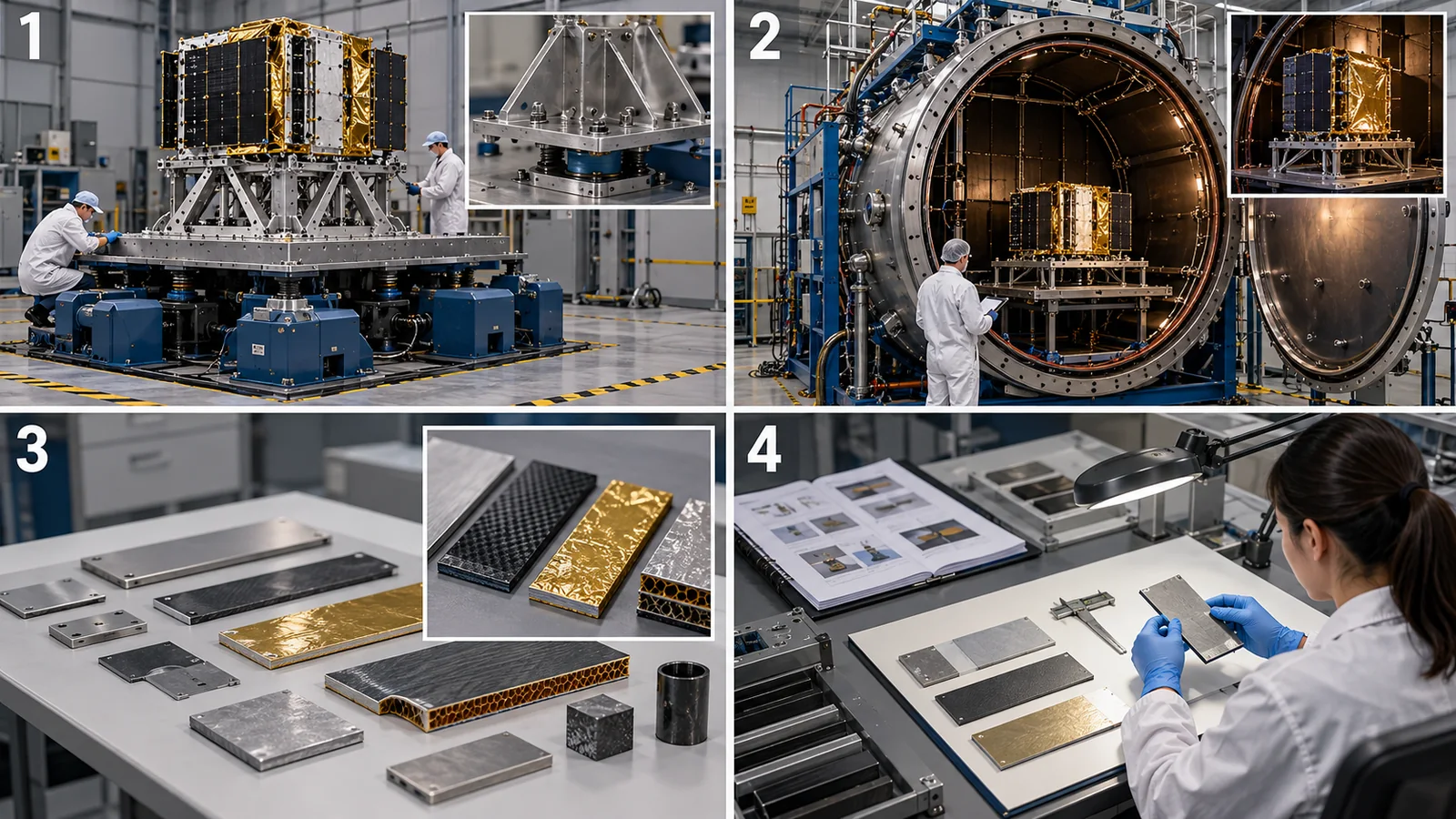
- The short version / what to know first / where this sits in the series
- The big picture: select, evaluate, qualify, accept
- Outgassing tests: reading TML, RML and CVCM
- Thermal vacuum and thermal cycling tests: what the number of cycles means
- Radiation and ultraviolet tests: equivalent Sun hours
- Atomic-oxygen tests: the Kapton reference and "acceleration"
- Other tests: thermo-optical properties, debris impact and more
- The paperwork: lists of materials in use, and approval
- How to read the yardsticks and standards (a map of standards)
- Limits / glossary / references / claim-to-source audit
Sourced = stated in a public document (source linked)
Our calculation = a value we derived from stated assumptions
Not yet confirmed = drafts, items under revision, plans and other unsettled matters
Our reading for materials is marked Commentary. Inference is shown in bold. Every analogy comes with its limits.
Numbers, titles, editions and status of standards were checked on official pages (ISO, ECSS, NASA technical standards, JAXA). ECSS standards are public, so we quote their main test parameters. ASTM International's site states that AI use is prohibited, so we did not open it. For ASTM standards we give only number, title and what they measure, as other public documents (NASA, ECSS and so on) state them, and write no test conditions, procedures or acceptance criteria from the standard texts (acceptance values that a NASA standard writes as its own requirement are quoted as NASA's requirement). For ISO and JAXA standards we give only titles and scope, no requirements. The checked date is 17 October 2026.
1. The short version / what to know first / where this sits in the series
- Evaluating a space material follows "select → evaluate → qualify → accept". A new material is first evaluated to find the limits of use, then validated to meet mission requirements with margin, and can be used only once approved [Ref. 1]Sourced.
- There are four main yardsticks: outgassing (TML, RML, CVCM), thermal cycling (number and range), radiation and UV (dose or equivalent Sun hours), and atomic oxygen (erosion yield). For example, ECSS gives RML < 1.0 % and CVCM < 0.10 % as a minimum for material selection [Ref. 4]Sourced.
- Passing a test is not a guarantee in orbit. The minimum in the ECSS thermal cycling test is 100 cycles, while low Earth orbit sees about 5,840 a year [Ref. 5]SourcedOur calculation. Always read "how many" and "under what conditions".
No prior knowledge is needed. The "five enemies" of the space environment (vacuum, radiation, temperature swings, atomic oxygen with UV, and microgravity with debris) are explained in the article on the space environment and its effects on materials. Here we deal with how those enemies are tested on the ground and how to read the results (the environment definitions come from the ECSS environment standard [Ref. 25]). Equations are kept to a minimum; each is explained in words and checked with numbers.
Read this after the entry article, the introduction to the space industry, and the article on the space environment. The articles on individual materials (polyimides, CFRP, super engineering plastics and so on) read their test results using the yardsticks here. Radiation testing of electronic parts is in the article on radiation and electronic parts, and thermal design in the one on spacecraft thermal control.
2. The big picture: select, evaluate, qualify, accept
On the ground too, materials are chosen by whether they "meet the specification". In space one must also show, as a test record, that the material "withstands the space environment". The ECSS standard (ECSS-Q-ST-70C Rev.2, 15 October 2019) covers management, selection criteria, evaluation, validation and qualification or verification testing, procurement and receiving inspection, and rules of use for materials, mechanical parts and processes [Ref. 1]Sourced.
Let us sort the vocabulary of tests a step further. The ECSS testing standard (ECSS-E-ST-10-03C Rev.1, 31 May 2022) distinguishes three kinds. A qualification test shows on a dedicated qualification model that the specification is met with the specified margins. An acceptance test is run on every flight item to confirm freedom from workmanship defects and flawed materials, after qualification is complete. A protoflight test combines the two aims on the first flight model [Ref. 3]Sourced.
It is not the material itself that is recognized as "space grade"; it means it has been shown to meet mission requirements for a given use, environment and period. NASA's standard says a material that does not meet the standard can still be accepted individually through a Materials Usage Agreement (MUA) if technically acceptable [Ref. 8]Sourced. It helps to think of qualification as a conditional permit. Limits of the analogy: a permit needs renewal when conditions change, but differences in the conditions of qualification are easy to overlook unless the documents are read.
3. Outgassing tests: reading TML, RML and CVCM
The problem of gas leaving a material in vacuum and landing on nearby cold surfaces (lenses, sensors, solar cells), outgassing, was seen in the article on the space environment. The test that examines it is the thermal vacuum outgassing test. ECSS-Q-ST-70-02C (15 November 2008) defines it as a screening of materials for spacecraft, launchers and vacuum test facilities [Ref. 4]Sourced.
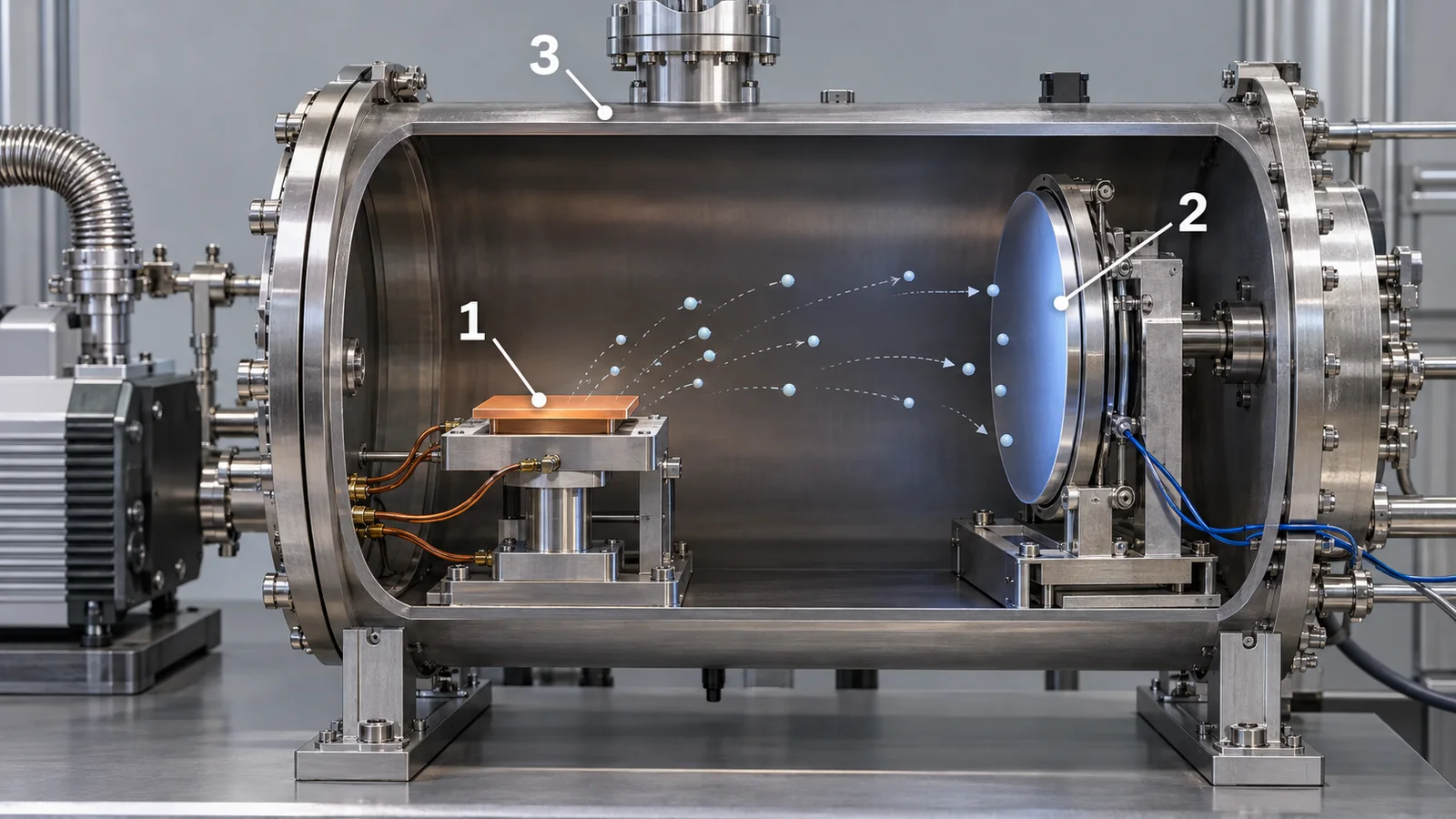
View original SVG, values and sources
Original SVG reference: Concept diagram (vector drawing). How the outgassing test works. An outline of ECSS-Q-ST-70-02C [Ref. 4]. The specimen is heated at 125 °C for 24 hours in a vacuum chamber and the amount of volatiles condensing on a 25 °C collector plate is measured. Before and after, specimens are conditioned at (22 ± 3) °C and (55 ± 10)% relative humidity. The conditions are those set by the ECSS standard, not values from other standards.
Three quantities are measured. TML (total mass loss) is the share of the specimen's mass lost. WVR (water vapour regained) is the water taken back after the test; TML minus WVR is the RML (recovered mass loss). Water is not a troublesome contaminant on every spacecraft, hence the RML. CVCM (collected volatile condensable material) is the share of mass condensed on the cold plate [Ref. 4]Sourced.
The standard decides the criteria. ECSS gives RML < 1.0 % and CVCM < 0.10 % as a minimum for selecting materials, and says they can be stricter near optics. For materials that absorb much water (such as polyimide film and polyurethane paint), a TML above 1.0 % can be accepted if conditions are met, such as fast water desorption and no equipment below −100 °C or at high voltage [Ref. 4]Sourced. NASA's standard (NASA-STD-6016C) requires, for nonmetallic materials exposed to space vacuum (except ceramics, metal oxides, inorganic glasses and a few others), CVCM ≤ 0.1 % and TML minus WVR ≤ 1.0 %. Materials in line of sight of contamination-sensitive surfaces such as optics can face stricter conditions, such as CVCM ≤ 0.01 % [Ref. 8]Sourced.
Let us get a feel with numbers. If a 5 g specimen has an RML of 0.25 %, the mass lost is 5 g × 0.0025 = 12.5 mg. If the CVCM is 0.02 %, the amount landing on the cold plate is 5 g × 0.0002 = 1 mg Our calculation (illustrative). One milligram is small, but if the same material totals many grams in an instrument with a lens nearby, it can matter. That is why NASA's standard allows exceptions for materials with small exposed area or sealed ones, while requiring hardware containing materials above the limit to be vacuum-baked at the highest tolerable temperature [Ref. 8]Sourced.
NASA Goddard collects results of this kind of test in an outgassing database. It describes the data as determined by testing under ASTM E595 (titled "Standard Test Method for Total Mass Loss and Collected Volatile Condensable Materials from Outgassing in a Vacuum Environment") to find mass loss in vacuum and the amount of volatile condensable material [Ref. 9]Sourced. NASA's standard also names ASTM E1559 (titled "Standard Test Method for Contamination Outgassing Characteristics of Spacecraft Materials", used to measure deposition on surfaces such as optics as a function of source and target temperature) and ASTM E2900 (titled "Standard Practice for Spacecraft Hardware Thermal Vacuum Bakeout", a guide to bake-out) [Ref. 8]Sourced. NASA's standard also notes that the 125 °C screening temperature of E595 can damage some hardware, so the bake-out temperature should be as high as possible without damage [Ref. 8].
The outgassing test is a screening of materials. ECSS says the criteria depend on where and how a material is used and can be stricter than the standard's [Ref. 4]Sourced. ECSS also notes that baking critical hardware (structural parts, harness, electronics boxes, thermal blankets) at the highest permissible temperature for a few days to remove residual, process and handling contaminants is becoming standard practice [Ref. 4]. Testing materials in the state they will have in the hardware, after such baking, comes closer to reality.
Even for a "low-outgassing grade", what matters is which standard, under which conditions (temperature, time, cure conditions), on what sample, gave the value. The same adhesive can vary with cure conditions, thickness and post-treatment (our commentary). The NASA database includes the material's application category and cure time and temperature [Ref. 9], so it is not built to judge by material name alone. Read a manufacturer's stated value together with a third-party database value and a check under your own hardware conditions.
4. Thermal vacuum and thermal cycling tests: what the number of cycles means
Resistance to temperature swings is tested by cycling the temperature in vacuum. ECSS-Q-ST-70-04C (15 November 2008) is the standard for evaluating materials, processes, mechanical parts and assemblies by thermal cycling in vacuum. Its targets include adhesives, bonded joints, coatings (paint, thermal and protective), insulating materials, metallic bonded joints, plated items and metallized plastic films [Ref. 5]Sourced.
The standard's default conditions are a vacuum of 1×10⁻⁵ Pa, cycling between +100 °C and −100 °C (±5 °C) at a nominal rate of 10 ± 2 °C per minute, a dwell of at least 5 minutes at each extreme, and a minimum of 100 cycles. For samples where thermal fatigue matters, more cycles are specified before the tests start [Ref. 5]Sourced.
Now compare with the numbers in the article on the space environment. In low Earth orbit there are about 16 cycles a day, or about 5,840 a year. The minimum of 100 is only about 1.7 % of that (100 ÷ 5,840) Our calculation. This test is a screen that weeds out materials whose joints or coatings fail under temperature cycling, not a test that guarantees a 15-year life (our commentary). To show life, additional tests or analyses are needed, such as raising the cycle count to the expected number or extrapolating with a fatigue model.
There are separate standards for thermal vacuum testing of whole hardware. ISO 24412:2023 "Space systems — Thermal vacuum environmental testing" gives methods and general requirements for spacecraft-level thermal balance and thermal vacuum tests [Ref. 16]Sourced. NASA Goddard's General Environmental Verification Standard, GSFC-STD-7000B (GEVS, 28 April 2021), is a guide to environmental verification of payloads, subsystems and components for Goddard flight programs [Ref. 10]Sourced. JAXA's common technical documents include the general test standard for spacecraft (JERG-2-130) and its thermal vacuum test handbook (JERG-2-130-HB005) (titles only confirmed) [Ref. 24]Sourced. These are standards for testing hardware, not materials.
5. Radiation and ultraviolet tests: equivalent Sun hours
ECSS-Q-ST-70-06C (31 July 2008) sets a baseline for tests of particle radiation and ultraviolet light on materials. Targets include thermal control materials, windows, coatings and structural materials; electronic components are excluded [Ref. 6]Sourced. ISO 15856:2010 "Space systems — Space environment — Simulation guidelines for radiation exposure of non-metallic materials" gives guidance for simulated exposure of non-metallic materials such as glass, ceramics and metal composites to charged particles (electrons and protons), solar UV and soft X-rays from flares; semiconductors are excluded [Ref. 17]Sourced. ISO 17851:2016 "Space systems — Space environment simulation for material tests — General principles and criteria" sets general principles and criteria for simulating the environment in material tests, including synergistic effects [Ref. 15]Sourced.
The amount of UV is expressed in equivalent Sun hours (ESH): how many hours at one Sun's intensity it equals. As examples of what is received in one year (8,760 hours), the ECSS standard gives, for a geostationary cylindrical satellite whose axis is parallel to Earth's revolution axis, 1,112 ESH on the north and south faces and about 2,500 ESH on the periphery, and, for the ISS low orbit, 2,500 ESH on ram and anti-ram faces, 2,200 ESH at zenith, 1,500 ESH on the side faces and 250 ESH at nadir [Ref. 6]Sourced.
To reproduce this in a short time, a test may use a lamp at an intensity of several "Suns". The ECSS standard calls the ratio of ground-test intensity to intensity in space the acceleration factor [Ref. 6]Sourced. For example, reproducing 2,500 ESH at five Suns takes 2,500 ÷ 5 = 500 hours Our calculation (illustrative). However, NASA's guide says accelerated UV tests can heat the sample, that accuracy depends on whether sample temperature is controlled, and that tests must be done in vacuum [Ref. 12]Sourced. The more one accelerates, the harder it is to sustain the assumption that shortening the time gives the same degradation (our commentary).
6. Atomic-oxygen tests: the Kapton reference and "acceleration"
The yardstick of atomic-oxygen (AO) tests is the erosion yield (volume lost per incident AO atom, cm³/atom). In orbit and on the ground alike, Kapton H is placed with the test materials, the AO dose is found from Kapton H's mass loss, and that is used to derive each material's erosion yield [Ref. 13]Sourced. NASA's guide names ASTM E2089 (titled "Standard Practices for Ground Laboratory Atomic Oxygen Interaction Evaluation of Materials for Space Applications", standard practices for evaluating AO-material interaction in a ground laboratory) as the practice that, when followed, can reduce variability in results [Ref. 12]Sourced.
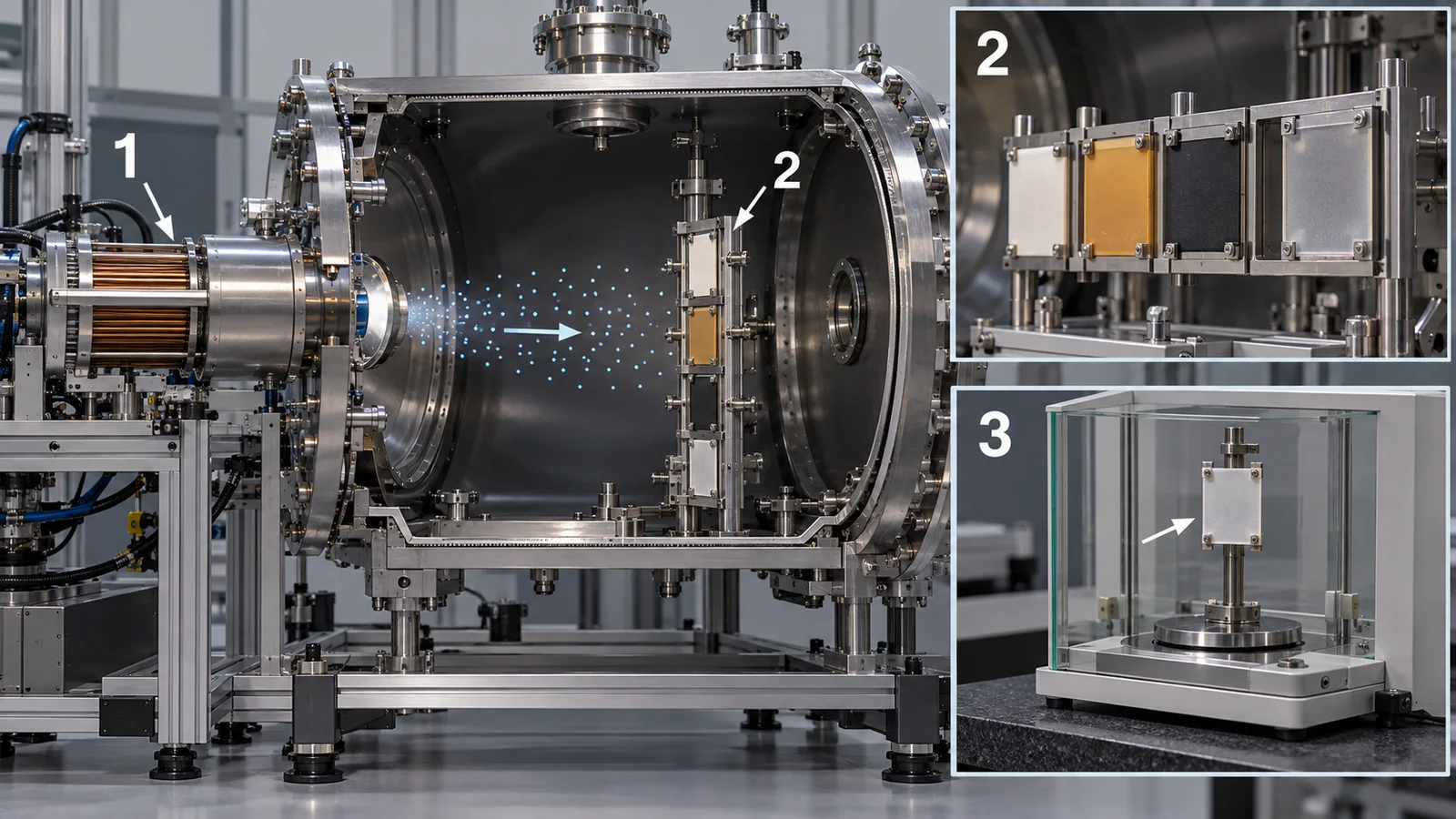
View original SVG, values and sources
Original SVG reference: Drawing with our calculation (vector drawing). How an atomic-oxygen test works, and acceleration. Left: Kapton H exposed alongside as a ruler [Ref. 13]. Right: the time needed to reach the MISSE 2 PEACE dose (8.43×10²¹ atoms/cm²) [Ref. 13] at the orbital flux (5.23×10¹³ /cm²·s) [Ref. 13] and at assumed facility fluxes (10¹⁵ to 10¹⁷ /cm²·s): our calculation. The facility values are not those of any real facility.
At the orbital flux, reaching 8.43×10²¹ atoms/cm² takes 8.43×10²¹ ÷ 5.23×10¹³ ≈ 1.6×10⁸ seconds, about 5.1 years. If a facility's flux is assumed to be 10¹⁶ /cm²·s, it takes about 8.4×10⁵ seconds, about 9.8 days. The acceleration is 10¹⁶ ÷ 5.23×10¹³ ≈ 190 times Our calculation (assumed values).
But "the same dose gives the same erosion" does not always hold. NASA's guide says plasma ashers mix in heat, intense Lyman-alpha UV and ions, so erosion was higher than in space for all 40 polymers compared; thermal-energy AO sources avoid heating but lack the energy to break some bonds and may need a much higher dose to reproduce the same erosion; beam facilities using lasers or microwaves can produce energies close to orbital and are within about ±10 % of flight for polymers without fluorine, while fluoropolymers show higher reactivity because of the UV generated at the same time [Ref. 12]Sourced. ISO 23129:2021 covers requirements, properties, test methods and selection guidance for atomic-oxygen protective coatings on polyimide film (ITO, SiOx, germanium, silicone and others), and is under systematic review [Ref. 20]Sourced.
When reading AO results, check the kind of facility (plasma, beam, in orbit), the fluence, the simultaneous UV, the sample temperature and the reference material. The same material can show different erosion yields in different facilities (our commentary). NASA notes in particular that fluoropolymers react differently in a ground beam facility and in orbit [Ref. 12]. For materials protected by a coating, undercutting at defects can be hard to reveal in a test, so designs matter that put in deliberate defects or combine the test with thermal cycling [Ref. 12].
7. Other tests: thermo-optical properties, debris impact and more
Thermo-optical properties (solar absorptance α and infrared emissivity ε) fix a spacecraft's temperature. ECSS-Q-ST-70-09C "Measurements of thermo-optical properties of thermal control materials" (31 July 2008) [Ref. 7] and ISO 16378:2022 "Space systems — Measurements of thermo-optical properties of thermal control materials" set how to measure them. ISO 16378:2022 presents several methods and instruments, compares their features, limits and biases, and sets requirements for calibration and reference materials to keep data quality [Ref. 18]Sourced. ISO 16691:2014 "Space systems — Thermal control coatings for spacecraft — General requirements" gives general requirements for thermal control coatings that provide αs and ε [Ref. 19]Sourced. ISO 15104:2025 "Space systems — Environmental testing for spacecraft thermal control materials" covers ground test methods for charged particles, solar UV, AO and thermal cycling [Ref. 14]Sourced.
For debris and micrometeoroid impact, ISO 11227:2012 "Space systems — Test procedure to evaluate spacecraft material ejecta upon hypervelocity impact" sets a way to rank, under identical conditions, the ejecta produced when materials used on external surfaces are hit (with a 2021 amendment on oblique impacts and others) [Ref. 21]Sourced. ISO 16126:2024 is a standard on the survivability of unmanned spacecraft against debris and meteoroid impacts for the purpose of debris mitigation [Ref. 23]Sourced. JAXA has the micro-debris impact resistance evaluation standard (JERG-2-144; title only confirmed) [Ref. 24]Sourced. As noted in the article on the space environment, ground impact tests are often slower than the orbital average (about 10 km/s).
For contamination control (managing the cleanliness of hardware, outgassing included) there are ECSS-Q-ST-70-01C Rev.1 "Cleanliness and contamination control" (15 October 2025) [Ref. 7], ISO 15388:2022 "Space systems — Contamination and cleanliness control" [Ref. 23] and JAXA's JMR-010 (contamination control standard; title only confirmed) [Ref. 24]. In crewed compartments, separate from vacuum outgassing, compounds released into the air the crew breathes (offgassing) matter, and ISO 14624-3:2023 "Safety and compatibility of materials — Part 3: Determination of off-gassed compounds from materials and assembled articles", ECSS-Q-ST-70-29C and NASA-STD-6001B (Change 3, 9 June 2025) apply [Ref. 23][Ref. 11]Sourced. This is different from the vacuum outgassing test; do not confuse them.
8. The paperwork: lists of materials in use, and approval
Test results are gathered into documents that lead to project approval. In ECSS-Q-ST-70C Rev.2, project approval is by a request for approval (RFA) and a declared materials list (DML), a declared mechanical parts list (DMPL) and a declared processes list (DPL). A new material gets its approval mark in the DML after evaluation and validation [Ref. 1]Sourced. NASA's standard (NASA-STD-6016C) fills the same role with a Materials Identification and Usage List (MIUL) and a Materials and Processes Selection, Control, and Implementation Plan, and says material ratings and test results are in the registration-only database MAPTIS [Ref. 8]Sourced. ISO 10794:2018 "Space systems — Programme management — Material, mechanical parts and processes" gives programme management requirements for the same area (selection criteria, evaluation, validation and qualification or verification testing, procurement and receiving inspection) [Ref. 22]Sourced. ECSS-Q-ST-70-71C Rev.1 "Materials, processes and their data selection" sets selection and use criteria [Ref. 2]Sourced.
A spacecraft maker asks for property values, lot control and test records to put a material in the DML or MIUL. ECSS asks that the material's guaranteed characteristics and the supplier's inspection methods be available for customer review before evaluation or qualification [Ref. 1]Sourced. NASA's standard also, for materials rated as requiring lot testing, can require the lot used to pass the test [Ref. 8]. So for a material maker, keeping formulation, process and lot unchanged, and giving notice of any change, is as important a condition as performance (our commentary).
9. How to read the yardsticks and standards
The map below gathers the yardsticks so far and the standards that set them (checked 17 October 2026). It shows numbers only; titles, editions and status are in the table below. No cell is left blank; those we could not confirm say "not found".
| What is evaluated | Typical test or evaluation (name, source) | Standards and guidelines (number, title, date) | How to read it |
|---|---|---|---|
| Framework for selection and qualification | Evaluation → validation → approval (DML) [Ref. 1]; MIUL, MUA, MAPTIS [Ref. 8]Sourced | ECSS-Q-ST-70C Rev.2 (2019-10-15) / ECSS-Q-ST-70-71C Rev.1 (2019-10-15) / ECSS-E-ST-10-03C Rev.1 (2022-05-31) / NASA-STD-6016C Change 1 (2021-09-30, change 2023-11-15) / ISO 10794:2018 / ISO 15865:2022 "Space systems — Qualification assessment" [Ref. 1][Ref. 2][Ref. 3][Ref. 8][Ref. 22][Ref. 23]Sourced | These give the framework of how to test and approve, not a ranking of materials. We could not identify a JAXA standard dedicated to materials in the list |
| Vacuum and outgassing | TML, RML, CVCM. ECSS: 125 °C, 24 h, 10⁻³ Pa or lower, collector plate 25 °C [Ref. 4]Sourced. NASA requires CVCM ≤ 0.1 % and TML−WVR ≤ 1.0 % [Ref. 8] | ECSS-Q-ST-70-02C (2008-11-15) / NASA-STD-6016C 4.2.3.6 / NASA outgassing database [Ref. 9] / JAXA JMR-010, the contamination control standard (title only) [Ref. 24] / ASTM E595, E1559 and E2900 (titles in the text above; what they measure: E595 mass loss and condensable volatiles, E1559 deposition as a function of source and target temperature, E2900 a guide to bake-out) Sourced | A screening of materials. The judgment changes with the state in hardware (after bake-out) and the nearby optics. Offgassing in crewed compartments (ISO 14624-3:2023) is a different test |
| Thermal vacuum and cycling | ECSS: +100/−100 °C, 10 °C per minute, dwell of at least 5 minutes, minimum 100 cycles, 1×10⁻⁵ Pa [Ref. 5]Sourced | ECSS-Q-ST-70-04C (2008-11-15) / GSFC-STD-7000B (2021-04-28) [Ref. 10] / ISO 24412:2023 / ISO/TR 6832:2023 "Space systems — Development technology of a thermal vacuum chamber" [Ref. 16][Ref. 23] / JAXA JERG-2-130 (HB005 thermal vacuum test handbook; titles only) [Ref. 24]Sourced | The minimum count is a screen, not a guarantee of life. One year in LEO is about 5,840 cycles |
| Radiation and UV | Particle dose, equivalent Sun hours (ESH), acceleration factor [Ref. 6]Sourced | ECSS-Q-ST-70-06C (2008-07-31; electronic parts excluded) / ISO 15856:2010 / ISO 17851:2016 / ISO 15104:2025 [Ref. 17][Ref. 15][Ref. 14] / JAXA JERG-2-143, the space-environment-resistant design standard covering radiation hardness (title only) [Ref. 24] / ASTM E490 "Standard Solar Constant and Zero Air Mass Solar Spectral Irradiance Tables" (cited by ECSS; tables of the solar spectrum) [Ref. 6]Sourced | The more the acceleration, the weaker the assumption of equivalent degradation. We could not find a dedicated radiation-test section in NASA's standard |
| Atomic oxygen | Erosion yield (cm³/atom), Kapton H-referenced fluence [Ref. 13]Sourced | ISO 23129:2021 (under systematic review) / ISO 15104:2025 / ISO 17851:2016 [Ref. 20][Ref. 14][Ref. 15] / ASTM E2089 (title in the text above; a practice for evaluating AO-material interaction in a ground laboratory) [Ref. 12]Sourced. We could not find a standard dedicated to AO testing in ECSS, NASA or JAXA | Results differ by facility (plasma, beam). Fluoropolymers show a synergy with UV. NASA's standard lists AO as an environment to evaluate {{n6016}} |
| Thermo-optical properties | Solar absorptance α, infrared emissivity ε | ECSS-Q-ST-70-09C (2008-07-31) [Ref. 7] / ISO 16378:2022 / ISO 16691:2014 [Ref. 18][Ref. 19] / JAXA JERG-2-310, the thermal control system design standard (title only) [Ref. 24]Sourced | Each method has its biases. Check calibration and reference materials |
| Coatings and bonding | Coating durability, bonding | ECSS-Q-ST-70-17C (2018-02-01, durability testing of coatings) / ECSS-Q-ST-70-31C Rev.1 (2019-10-15, application of paints) / ECSS-Q-ST-70-16C (2020-12-01, adhesive bonding) [Ref. 7] / ISO 23230:2023 "Paints and varnishes — Processes, procedures, and requirements for coating materials and coatings" / ISO 24564:2022 "Space systems — Adhesives — General requirements" (to be revised) [Ref. 23] / JAXA JERG-0-040, the adhesive bonding process standard for electronics (title only) [Ref. 24]Sourced | Bond lines break easily under thermal cycling. Check process standards separately from material standards |
| Debris impact | Ejecta comparison, survivability | ISO 11227:2012 + Amd 1:2021 (the 2012 edition is to be revised) [Ref. 21] / ISO 16126:2024 [Ref. 23] / JAXA JERG-2-144 (title only) [Ref. 24]Sourced. We could not find a dedicated test standard in ECSS or NASA | Ground impact tests are often slower than the orbital average |
Our calculationThe table is organized by us. ISO numbers, titles and years were checked on ISO's official pages and the TC 20/SC 14 list of standards (checked 17 October 2026; ISO 11227:2012 and ISO 24564:2022 are to be revised, and ISO 23129:2021 is under systematic review). ECSS dates were checked on ECSS's official pages and NASA editions and dates on NASA's technical standards pages. ECSS standards are public, so we quoted their main test parameters, but for ISO and JAXA we give only titles and scope, no requirements. For ASTM we give only numbers, titles and what they measure, as NASA, ECSS and others state them.
Cautions in reading (for materials engineers)
- Ground tests differ from in-orbit results: a test reproduces part of the environment, in a short time, under simplified conditions. When the direction of the gap is known, as with plasma ashers eroding more than space, read that direction [Ref. 12].
- A manufacturer's stated value differs from third-party verification: "low outgassing" on a datasheet is the maker's figure. Read it together with the NASA database and a check under your own hardware conditions [Ref. 9].
- Check whether a standard is a recommendation or a requirement: ECSS, NASA and JAXA standards become requirements only when a project adopts them. ECSS standards say they can be tailored to a project's circumstances [Ref. 4]. ISO standards are not legally binding.
- Qualification and acceptance differ: qualification shows that the design and materials meet requirements; acceptance confirms each flight item is free of workmanship defects [Ref. 3]. Even for a "qualified" material, a new lot is checked at acceptance.
- Plans and achievements are different: standards get revised (ECSS-Q-ST-70-01C was revised in October 2025, ISO 24564:2022 is to be revised, and NASA-STD-6016C had its next five-year review scheduled for 30 September 2026 [Ref. 8]). Always record the edition used and the date checked.
10. Limits, and what could not be confirmed
- ASTM standard texts were not checked: we did not open ASTM International's site. For E595, E1559, E2900, E2089 and E490 we have only the numbers, titles and what they measure as NASA's standard and guide and the ECSS standards state them. We write no test conditions, procedures or acceptance criteria from ASTM texts.
- Texts and requirements of ISO and JAXA standards were not checked: only titles, scope (the abstract on ISO's page), edition and status. For JAXA standards we only saw titles in the list; editions are unchecked.
- We could not find a dedicated ECSS standard for AO testing, a dedicated NASA section for radiation testing, or dedicated ECSS or NASA standards for debris impact: this does not mean they do not exist, only that we could not identify them in our research.
- Worked examples are illustrative: the three materials in Fig. 5 and the facility fluxes in Fig. 8 are assumed values, not those of real materials or facilities. The 5 g specimen calculation is also an example.
- Matching with in-orbit track records: this is an article on reading tests and does not state how many years a given material lasts in orbit. Track records are in the article on the space environment (MISSE, LDEF, Hubble) and in the articles on each material.
11. Glossary
- Outgassing
- Volatile components released from a material in vacuum.
- TML
- Total Mass Loss: share of the specimen's mass lost in the test.
- WVR
- Water Vapour Regained: share of water taken back after the test.
- RML
- Recovered Mass Loss: TML minus WVR.
- CVCM
- Collected Volatile Condensable Material: share of volatiles condensed on the cold plate.
- Bake-out
- Heating in vacuum to drive off a material's volatiles beforehand.
- Thermal cycling test
- A test cycling temperature high and low in vacuum to see how joints and coatings fail.
- ESH (equivalent Sun hours)
- Equivalent Sun Hour: how many hours at one Sun's intensity an exposure equals.
- Acceleration factor
- The ratio of ground-test intensity to intensity in space.
- Erosion yield
- Volume of material lost per incident atomic-oxygen atom (cm³/atom).
- Fluence
- Total number of particles striking a surface over a period (atoms/cm²).
- Thermo-optical properties
- Solar absorptance α and infrared emissivity ε.
- Screening
- A test that quickly weeds out candidates that do not meet a criterion.
- Evaluation
- The stage that finds the limits of use of a new material or one used very differently (ECSS).
- Validation
- The stage that confirms a material meets mission requirements with margin (ECSS).
- Qualification test
- A test on a dedicated model showing the specification is met with specified margins.
- Acceptance test
- A test on every flight item confirming freedom from workmanship defects and flawed materials.
- Protoflight test
- A test on the first flight model combining qualification and acceptance.
- DML
- Declared Materials List: the project's list of materials in use, carrying approval marks.
- MIUL and MUA
- NASA's Materials Identification and Usage List / Materials Usage Agreement (individually accepts a technically acceptable material that misses the standard).
- Tailoring
- Adjusting a standard to a project's circumstances.
- ECSS, JERG, JMR
- Standards of the European Cooperation for Space Standardization / JAXA technical standards / JAXA programme management requirements.
12. References
- ECSS ECSS-Q-ST-70C Rev.2 "Materials, mechanical parts and processes" (15 October 2019) — ecss.nl/standard/ecss-q-st-70c-rev-2-materials-mechanical-parts-and-processes-15-october-2019/
- ECSS ECSS-Q-ST-70-71C Rev.1 "Materials, processes and their data selection" (15 October 2019) — ecss.nl/standard/ecss-q-st-70-71c-rev-1-materials-processes-and-their-data-selection-15-october-2019/
- ECSS ECSS-E-ST-10-03C Rev.1 "Testing" (31 May 2022) — ecss.nl/standard/ecss-e-st-10-03c-rev-1-testing-31-may-2022/
- ECSS ECSS-Q-ST-70-02C "Thermal vacuum outgassing test for the screening of space materials" (15 November 2008) — ecss.nl/standard/ecss-q-st-70-02c-thermal-vacuum-outgassing-test-for-the-screening-of-space-materials/
- ECSS ECSS-Q-ST-70-04C "Thermal testing for the evaluation of space materials, processes, mechanical parts and assemblies" (15 November 2008) — ecss.nl/standard/ecss-q-st-70-04c-thermal-testing-for-the-evaluation-of-space-materials-processes-mechanical-parts-and-assemblies/
- ECSS ECSS-Q-ST-70-06C "Particle and UV radiation testing for space materials" (31 July 2008) — ecss.nl/standard/ecss-q-st-70-06c-particle-and-uv-radiation-testing-for-space-materials/
- ECSS List of active standards (titles and dates of ECSS-Q-ST-70-09C, -70-17C, -70-31C, -70-16C and -70-01C checked) — ecss.nl/standards/active-standards/
- NASA NASA-STD-6016C w/Change 1 "Standard Materials and Processes Requirements for Spacecraft" (document date 30 September 2021, change date 15 November 2023) — standards.nasa.gov/standard/nasa/nasa-std-6016
- NASA Goddard Engineering and Technology Directorate "Outgassing Database" — outgassing.nasa.gov/
- NASA Goddard Space Flight Center GSFC-STD-7000B "General Environmental Verification Standard (GEVS) for GSFC Flight Programs and Projects" (28 April 2021) — standards.nasa.gov/standard/gsfc/gsfc-std-7000
- NASA NASA-STD-6001B w/Change 3 "Flammability, Offgassing, and Compatibility Requirements and Test Procedures" (change date 9 June 2025) — standards.nasa.gov/standard/nasa/nasa-std-6001
- NASA ISS Research Integration Office (Finckenor M. M., de Groh K. K.) "A Researcher's Guide to: Space Environmental Effects" (revised September 2020) — www.nasa.gov/wp-content/uploads/2020/10/researchers-guide-space-environment-effects_tagged.pdf
- de Groh K. K. et al. "MISSE PEACE Polymers Atomic Oxygen Erosion Results", NASA/TM—2006-214482 — ntrs.nasa.gov/citations/20070002707
- ISO ISO 15104:2025 "Space systems — Environmental testing for spacecraft thermal control materials" — www.iso.org/standard/84447.html
- ISO ISO 17851:2016 "Space systems — Space environment simulation for material tests — General principles and criteria" — www.iso.org/standard/60820.html
- ISO ISO 24412:2023 "Space systems — Thermal vacuum environmental testing" — www.iso.org/standard/78733.html
- ISO ISO 15856:2010 "Space systems — Space environment — Simulation guidelines for radiation exposure of non-metallic materials" — www.iso.org/standard/45843.html
- ISO ISO 16378:2022 "Space systems — Measurements of thermo-optical properties of thermal control materials" — www.iso.org/standard/79696.html
- ISO ISO 16691:2014 "Space systems — Thermal control coatings for spacecraft — General requirements" — www.iso.org/standard/57440.html
- ISO ISO 23129:2021 "Space systems — Thermal control coatings for spacecraft — Atomic oxygen protective coatings on polyimide film" — www.iso.org/standard/74657.html
- ISO ISO 11227:2012 "Space systems — Test procedure to evaluate spacecraft material ejecta upon hypervelocity impact" — www.iso.org/standard/57535.html
- ISO ISO 10794:2018 "Space systems — Programme management — Material, mechanical parts and processes" — www.iso.org/standard/72935.html
- ISO/TC 20/SC 14 Catalogue of standards (titles and years of ISO/TR 6832:2023, ISO 14624-3:2023, ISO 15388:2022, ISO 15865:2022, ISO 16126:2024, ISO 23230:2023, ISO 24564:2022 and others checked) — www.iso.org/committee/46614/x/catalogue/p/1/u/0/w/0/d/0
- JAXA JAXA Safety and Mission Assurance Department, list of JAXA common technical documents (JERG and JMR) — sma.jaxa.jp/techdoc.html
- ECSS ECSS-E-ST-10-04C Rev.1 "Space environment" (15 June 2020) — ecss.nl/standard/ecss-e-st-10-04c-rev-1-space-environment-15-june-2020/
13. Claim-to-source audit
| Claim in the text | Basis | Type |
|---|---|---|
| Scope of the standard for materials, mechanical parts and processes (management, selection, evaluation, validation and qualification, procurement and receiving inspection, use); evaluation for new materials with unknown characteristics; validation plan by PDR, status at CDR; approval in the DML; options if approval is not granted; guaranteed characteristics and supplier inspection methods available in advance | ECSS-Q-ST-70C Rev.2 (15 October 2019) Reference 1 https://ecss.nl/standard/ecss-q-st-70c-rev-2-materials-mechanical-parts-and-processes-15-october-2019/ | Sourced |
| Number, title and date of ECSS-Q-ST-70-71C Rev.1 and that it sets selection and use criteria | ECSS official page Reference 2 https://ecss.nl/standard/ecss-q-st-70-71c-rev-1-materials-processes-and-their-data-selection-15-october-2019/ | Sourced |
| Definitions of qualification, acceptance and protoflight tests; durations and levels are minimum values | ECSS-E-ST-10-03C Rev.1 (31 May 2022) Reference 3 https://ecss.nl/standard/ecss-e-st-10-03c-rev-1-testing-31-may-2022/ | Sourced |
| Purpose of the thermal vacuum outgassing test, 125 °C, 24 h, 10⁻³ Pa or lower, collector 25 °C, conditioning, definitions of TML, RML, CVCM and WVR, RML < 1.0 % and CVCM < 0.10 %, conditions for the exception for water-absorbing materials, bake-out as standard practice | ECSS-Q-ST-70-02C (15 November 2008) Reference 4 https://ecss.nl/standard/ecss-q-st-70-02c-thermal-vacuum-outgassing-test-for-the-screening-of-space-materials/ | Sourced |
| Target materials of the thermal cycling test, default conditions (10⁻⁵ Pa, ±100 °C, 10 °C per minute, dwell of 5 minutes or more, minimum 100 cycles), specification of additional cycles | ECSS-Q-ST-70-04C (15 November 2008) Reference 5 https://ecss.nl/standard/ecss-q-st-70-04c-thermal-testing-for-the-evaluation-of-space-materials-processes-mechanical-parts-and-assemblies/ | Sourced |
| Baseline for particle and UV tests (electronic components excluded), definition of the acceleration factor, ESH examples (GEO 1,112 and about 2,500; ISS orbit 2,500, 2,200, 1,500 and 250), citation of the ASTM E490 title | ECSS-Q-ST-70-06C (31 July 2008) Reference 6 https://ecss.nl/standard/ecss-q-st-70-06c-particle-and-uv-radiation-testing-for-space-materials/ | Sourced |
| Titles and dates of ECSS-Q-ST-70-09C, -70-17C, -70-31C, -70-16C and -70-01C | ECSS list of active standards Reference 7 https://ecss.nl/standards/active-standards/ | Sourced |
| NASA-STD-6016C: the CVCM ≤ 0.1 % and TML−WVR ≤ 1.0 % requirement, an example of a stricter condition (CVCM ≤ 0.01 %), bake-out requirements and exemptions, the 125 °C caution, titles and uses of ASTM E595, E1559 and E2900, external-environment survivability (AO, UV, ionizing radiation, plasma, vacuum, thermal cycling, contamination, dust), MIUL, MUA, MAPTIS and plans, edition and dates | NASA Technical Standards System page and the standard text Reference 8 https://standards.nasa.gov/standard/nasa/nasa-std-6016 | Sourced |
| That NASA's outgassing database holds ASTM E595 test data, and its fields (application category, cure time and temperature and so on) | NASA Goddard database page Reference 9 https://outgassing.nasa.gov/ | Sourced |
| Title, date and scope of GSFC-STD-7000B (GEVS) | NASA Technical Standards System page Reference 10 https://standards.nasa.gov/standard/gsfc/gsfc-std-7000 | Sourced |
| Title and date of NASA-STD-6001B Change 3 (offgassing in crewed compartments and others) | NASA Technical Standards System page Reference 11 https://standards.nasa.gov/standard/nasa/nasa-std-6001 | Sourced |
| AO testing: title and use of ASTM E2089, plasma asher higher than space for all 40 polymers, properties of thermal-energy sources and beam facilities (±10 %, fluoropolymer difference), heating and in-vacuum irradiation in accelerated UV tests, 16 thermal cycles a day | NASA guide for ISS researchers Reference 12 https://www.nasa.gov/wp-content/uploads/2020/10/researchers-guide-space-environment-effects_tagged.pdf | Sourced |
| How erosion yield is determined against Kapton H, Kapton H erosion yield 3.0×10⁻²⁴ cm³/atom, fluence 8.43×10²¹ atoms/cm², orbital flux 5.23×10¹³ /cm²·s | NASA/TM—2006-214482 Reference 13 https://ntrs.nasa.gov/citations/20070002707 | Sourced |
| ISO 15104:2025 number and title, covering ground tests for charged particles, UV, AO and thermal cycling | Official page Reference 14 https://www.iso.org/standard/84447.html | Sourced |
| ISO 17851:2016 number and title, general principles and criteria of environment simulation (including synergistic effects) | Official page Reference 15 https://www.iso.org/standard/60820.html | Sourced |
| ISO 24412:2023 number, title, January 2023, spacecraft-level thermal balance and thermal vacuum tests | Official page Reference 16 https://www.iso.org/standard/78733.html | Sourced |
| ISO 15856:2010 number and title, guidance on simulated radiation exposure of non-metallic materials (semiconductors excluded) | Official page Reference 17 https://www.iso.org/standard/45843.html | Sourced |
| ISO 16378:2022 number and title, measurement methods, calibration and reference materials for thermo-optical properties | Official page Reference 18 https://www.iso.org/standard/79696.html | Sourced |
| ISO 16691:2014 number and title, general requirements for thermal control coatings | Official page Reference 19 https://www.iso.org/standard/57440.html | Sourced |
| ISO 23129:2021 number, title, September 2021, under systematic review, AO protective coatings on polyimide film | Official page Reference 20 https://www.iso.org/standard/74657.html | Sourced |
| ISO 11227:2012 number and title, a procedure to compare ejecta on impact (2021 amendment) | Official page Reference 21 https://www.iso.org/standard/57535.html | Sourced |
| ISO 10794:2018 number and title, programme management requirements for materials, mechanical parts and processes | Official page Reference 22 https://www.iso.org/standard/72935.html | Sourced |
| Numbers, titles, years and status of ISO/TR 6832:2023, ISO 14624-3:2023, ISO 15388:2022, ISO 15865:2022, ISO 16126:2024, ISO 23230:2023 and ISO 24564:2022 | Official page Reference 23 https://www.iso.org/committee/46614/x/catalogue/p/1/u/0/w/0/d/0 | Sourced |
| Existence of ECSS-E-ST-10-04C Rev.1 (space environment), the source of environment definitions for tests | Official page Reference 25 https://ecss.nl/standard/ecss-e-st-10-04c-rev-1-space-environment-15-june-2020/ | Sourced |
| Titles of JAXA common technical documents: JMR-010, JERG-2-130 (HB005), JERG-2-143, JERG-2-144, JERG-2-310, JERG-0-040 and others | JAXA S&MA list (titles only; text and edition unchecked) Reference 24 https://sma.jaxa.jp/techdoc.html | Sourced |
| Calculations of mass loss of a 5 g specimen (12.5 mg, 1 mg), 100 cycles as about 1.7 % of a year in LEO, 2,500 ESH ÷ 5 Suns = 500 hours, time needed for the AO dose (about 5.1 years, 98 days, 9.8 days, 23 hours), the acceleration (about 190 times), and the hypothetical values in Figs. 5 and 8 | Our calculation (using sourced values); hypothetical values are not those of real materials or facilities | Our calculation |
| The five-step figure, the meaning of a "qualified material", the organization of the standards map and its "not found" cells, the materials-engineer views (reading datasheets, the kind of facility, evidence expected of makers), and the cautions in reading tests | Our organization and commentary based on public information | Commentary |
| ASTM standards (E595, E1559, E2900, E2089, E490): only numbers, titles and what they measure were confirmed in NASA and ECSS documents, and the ASTM site was not opened | Note by this article | Commentary |
| Figures 1 to 9 are explanatory drawings, not measurements; Figure 1 is a slot for an AI-generated image | Note by this article | Commentary |
Last updated: 17 October 2026. Sources are limited to ECSS (public standards), NASA technical standards and guide, ISO official pages, the JAXA list of common technical documents and NASA technical reports. The ASTM site was not opened. Worked examples (outgassing, cycles, UV, AO time) are our own illustrative calculations, not values for real materials or facilities. The texts of ASTM, ISO and JAXA standards, the requirements of each standard, and a dedicated ECSS standard for AO testing and so on could not be checked and are not stated.