TECHNOLOGY EXPLAINER
Batteries for Space
— sizing a battery to carry the eclipse, effects of vacuum and temperature, safety, and where solid-state and other next-generation cells stand
Satellites and space stations make their electricity with solar cells, but they cannot generate power once they enter the Earth's shadow. Batteries carry them through that time. The mainstream space battery is the same kind of cell that powers smartphones and cars (lithium-ion), but a dozen or more charge-discharge cycles a day, vacuum, large temperature swings, and safety on crewed vehicles are added to the demands. This article is written for readers who know nothing about spaceflight. With figures and small calculations it covers: (1) why batteries are needed (we calculate how long the eclipse lasts); (2) how lithium-ion batteries are used; (3) how big a battery has to be; (4) the "five enemies" of the space environment and batteries; (5) safety and standards; (6) the research stage of solid-state and other next-generation batteries. It does not say new batteries are "ready to use" nor that they are "only a ground-based story". It separates what was confirmed, what is only planned, and what could not be confirmed.
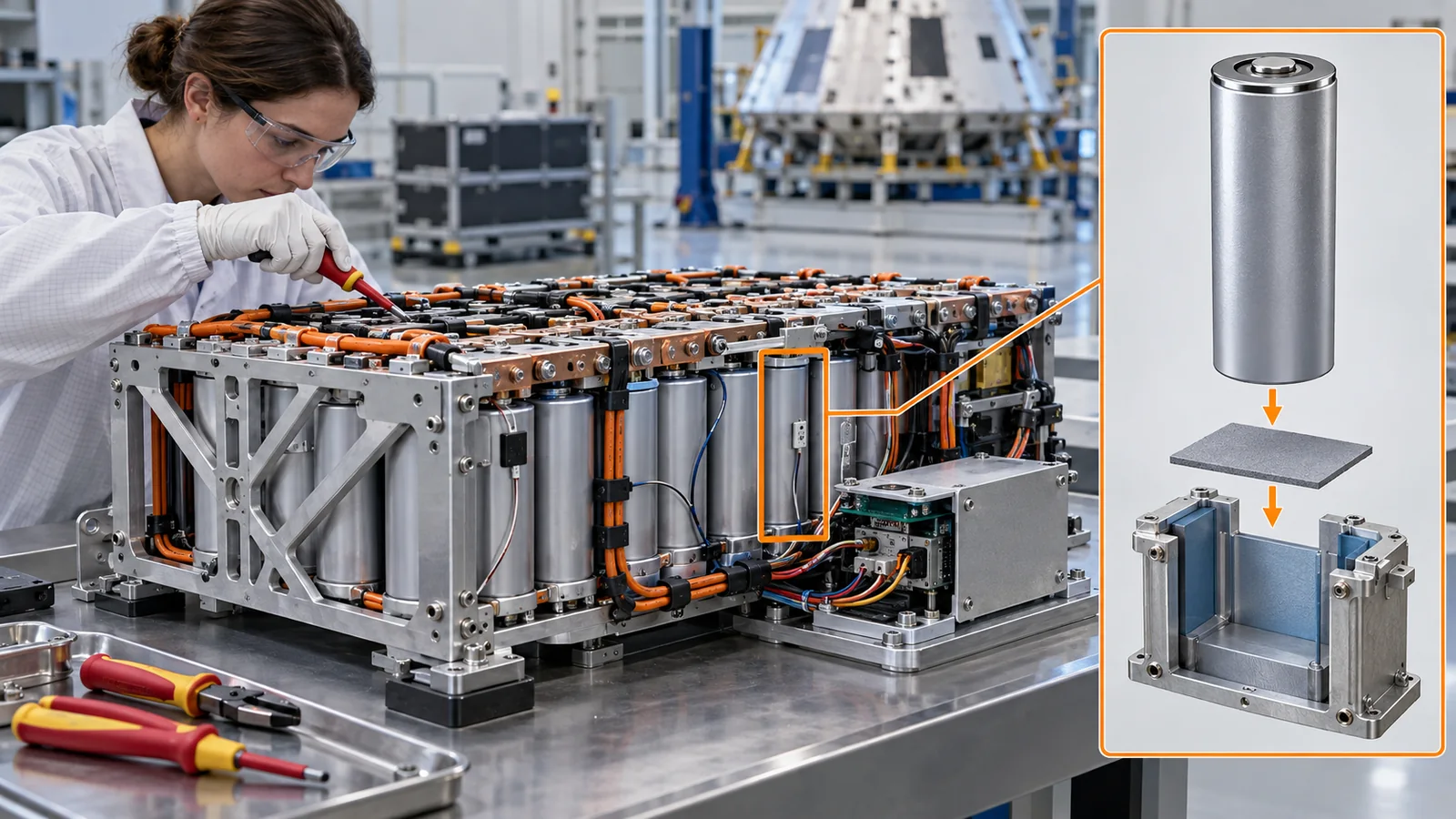
- The short version / what to know first / where this sits in the series
- Why batteries are needed in space: calculating the length of an eclipse
- Lithium-ion is the mainstay: the ISS battery swap and small satellites
- Sizing a battery, and the "usage" that sets its life
- The "five enemies" of the space environment and batteries: vacuum, temperature, radiation
- Safety: thermal runaway, and what crewed vehicles require
- Solid-state and other next-generation batteries: the research stage aimed at the lunar night
- Where things stand now (checked 17 October 2026)
- How to read the yardsticks and standards
- Glossary / References / Claim-to-source audit
Sourced = stated in published material (link given)
Our calculation = a value this article calculated or organized, with the assumptions stated
Not yet confirmed = a plan, a target, or research under way with no confirmed track record
Structural readings and materials-design interpretations are marked separately as Commentary. Inference is shown in bold. Every analogy comes with a "limit of the analogy".
Battery performance figures (Wh/kg, cycle counts, temperature ranges) are given only together with whether they are for a cell or a pack, the manufacturer's stated value or a measurement, and the conditions. NASA itself notes that manufacturer values in its tables have not been independently verified by NASA. Numbers under different conditions (different chemistries, cell versus pack, ground test versus orbit) are not ranked against each other. New batteries such as solid-state cells are at the research and demonstration stage, and no benefit or value is asserted for them. Battery safety depends on the individual equipment, design and operation. This article is a general explanation; it does not guarantee the safety of any product or give handling advice. This field changes fast, so the status carries a checking date (17 October 2026).
1. The short version / what to know first / where this sits in the series
- Batteries carry the "electricity of the eclipse": in low orbit, a lap of about 92 minutes includes up to about 36 minutes in the Earth's shadow (our simple calculation for a 400 km circular orbit)Our calculation. Solar cells make nothing in that time, so the battery supplies the equipment. The ISS makes 16 laps a day, so the battery charges and discharges 16 times a daySourced[Ref. 7].
- Lithium-ion is today's mainstay: NASA describes lithium-ion and similar batteries as having replaced the older nickel-cadmium and nickel-hydrogen types as the standard in modern aerospace [Ref. 1]. On the ISS, from 2017 to 2021, 48 nickel-hydrogen batteries were replaced by 24 lithium-ion batteriesSourced[Ref. 4, 5].
- The next generation uses a "solid electrolyte" and is still at the research and demonstration stage: an all-solid-state lithium-ion battery spent 434 days outside the ISS and underwent 562 charge-discharge cycles, with no significant degradation of its characteristics reported (a 140 mAh-class cell, one type)Sourced[Ref. 2]. NASA's prototype cells aimed at the south-polar lunar night (about −200 °C) come from research that began in 2026Sourced[Ref. 3]. Operation as a main power source could not be confirmed in the sources used here.
You need no prior knowledge. "A battery stores electricity and gives it back when needed" is enough. The inside of a lithium-ion cell (positive electrode, negative electrode, electrolyte, separator) is in this series' explainer on lithium-ion battery basics, and the mechanism of thermal runaway in the explainer on thermal runaway and battery safety (the necessary points are briefly explained here too). As for orbits, think of "falling all the time while moving sideways fast enough never to hit the ground" (the picture of a cannonball fired very fast; limit of the analogy: in reality the thin atmosphere's drag and the uneven pull of gravity change an orbit slowly).
Of the "five enemies" of the space environment (1. vacuum, 2. radiation, 3. large temperature swings, 4. atomic oxygen and ultraviolet light, 5. microgravity and debris), batteries mainly fight 3. temperature and 1. vacuum, plus safety (thermal runaway). This article is the partner of the solar-cell article; reading our explainer on solar cells for space first makes the link between "generation" and "storage" easier to follow. Where the dark lasts long, as in the lunar night, batteries alone are not enough and nuclear power sources are considered (see our explainer on nuclear power for space).
2. Why batteries are needed in space: calculating the length of an eclipse
A solar cell can generate only while light falls on it. A spacecraft circling the Earth spends part of each lap in the Earth's "shadow", because the Earth blocks the sunlight. During that time it runs its equipment on electricity stored in advance in its battery.
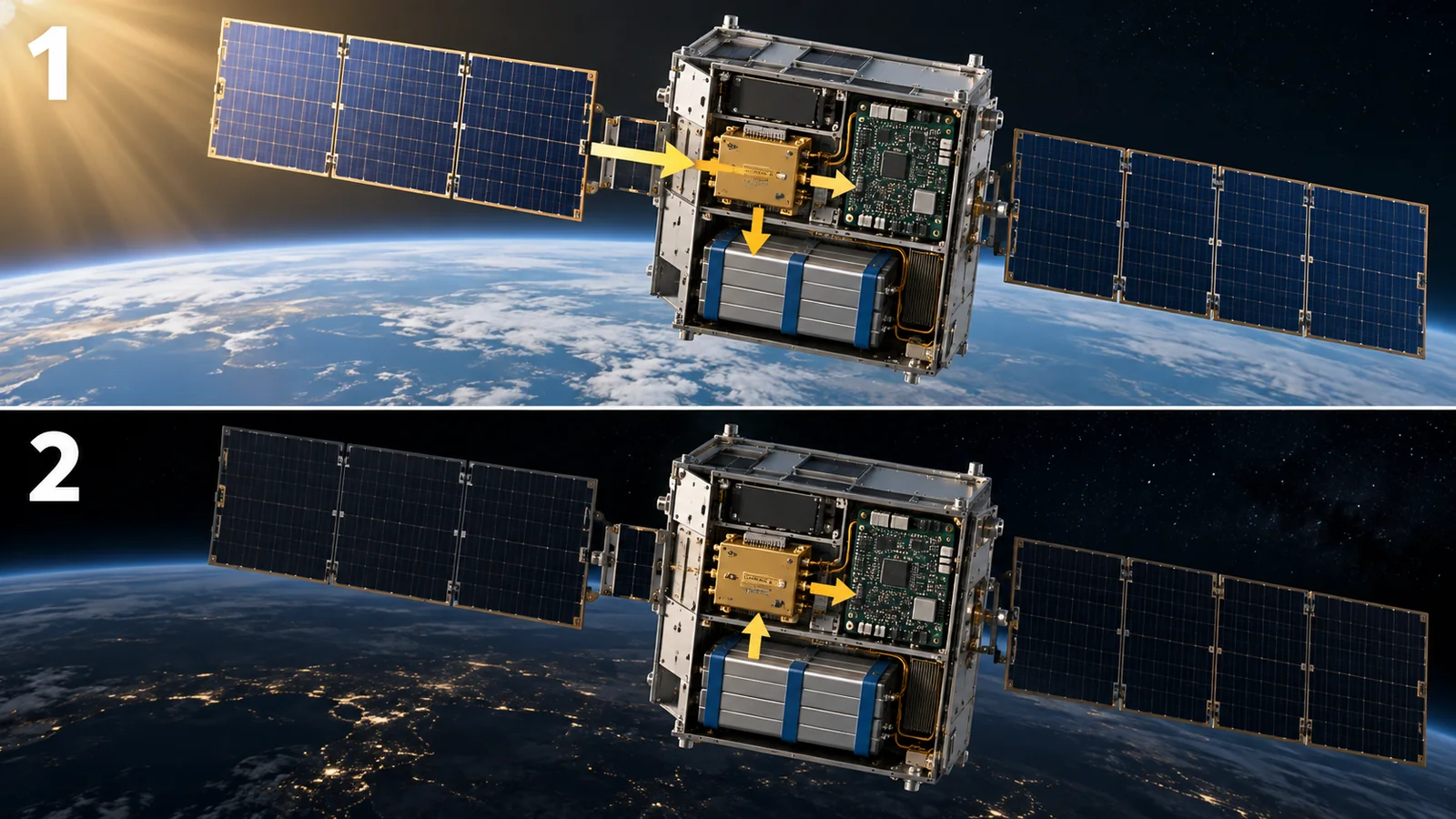
View original SVG, values and sources
Original SVG reference: Drawing that includes our calculation (vector drawing). About 56 min sunlit and 36 min eclipse is a simple calculation for a 400 km circular orbit whose plane contains the Sun direction (longest eclipse), treating the Earth's shadow as a cylinder and ignoring the penumbraOur calculation. The 16 laps and 16 sunrises and sunsets per day come from NASA's ISS description, and storing about half of the daytime power in batteries from a NASA articleSourced.
Let us estimate the eclipse length. In a circular orbit at 400 km altitude (an example), the orbit radius is about 6771 km and the period about 92.4 minutes. If sunlight is parallel and the Earth's shadow is a cylinder, the arc inside the shadow is 2 x arcsin (Earth radius / orbit radius), about 140.4 degrees, or about 39% of a lap, so up to about 36 minutesOur calculation (NASA explains that the ISS circles the Earth about every 90 minutes and makes 16 laps a day [Ref. 7]). In geostationary orbit (about 36,000 km up) the shadow arc is only about 17.4 degrees, so the eclipse is at most about 69 minutes, and only in limited seasons around the equinoxesOur calculation.
A low orbit hugs the Earth, so the Earth blocks a large part of the sky and about 40% of a lap is in shadow. Geostationary orbit is far from the Earth, which looks small from there, so only a small part of a lap (about 5% or less) is in shadow. But a geostationary lap takes about 24 hours, so a single eclipse can be longer than in low orbit (up to about 69 minutes). Limit of the analogy: this calculation is a simple version that ignores orbital tilt, the season (the Sun's height) and the penumbra. Real eclipse lengths vary with these.
Moreover, according to a NASA article on the ISS, about half of the power that the original eight solar arrays make in daylight is stored in the batteries [Ref. 8]. The battery is not an emergency spare; it is a principal player that handles about half of the daily electricity.
3. Lithium-ion is the mainstay: the ISS battery swap and small satellites
Space batteries divide into single-use primary batteries and rechargeable secondary batteries. According to NASA's material, lithium primary batteries (LiSO2, LiCFx, LiSOCl2 and others) are favored for high energy density but have short lives, are used on short missions, and are not regarded as state-of-the-art energy storage. Among rechargeable secondary batteries, lithium-ion (Li-ion) and lithium polymer (LiPo) have replaced the older nickel-cadmium (NiCd) and nickel-hydrogen (NiH2) types as the standardSourced[Ref. 1].
(1) A large crewed vehicle: the ISS battery swap
The ISS long used nickel-hydrogen batteries to store the electricity from its solar arrays. According to NASA, work to replace them with new lithium-ion batteries and mounting adapter plates began in January 2017 and proceeded by robotic work and spacewalks [Ref. 5]. A NASA article of 1 February 2021 states that the work of replacing 48 nickel-hydrogen batteries with 24 lithium-ion batteries was completeSourced[Ref. 4]. Replacing 48 with 24 means one new unit stands in for two old ones (Our calculation 48 / 24 = 2). Inference: lighter, smaller batteries were probably an advantage even for a large crewed facility, but the detailed reasons for the swap could not be confirmed in the NASA articles opened for this article.
(2) Small satellites: commercial cylindrical cells
On small satellites, commercial cylindrical 18650 cells (18 mm diameter, 65 mm long) are among the most used parts. NASA's material says many of them have flown on multiple spacecraft and lists flight heritage in a table. For example, the Sony US18650VTC4 (250 Wh/kg) flew on the Mars helicopter Ingenuity, the Panasonic NCR18650B (243 Wh/kg) on MarCO, BioSentinel and others, and the LG Chem INR18650-MJ1 (260 Wh/kg) on NASA's PACE missionSourced[Ref. 1]. The figures are the manufacturers' stated values for single cells, and NASA notes they have not been independently verified.
NASA puts commercial lithium-ion energy cells at 150–270 Wh/kg (average voltage 3.6 V), and notes laboratory and high-altitude designs that have reached 450–500 Wh/kg [Ref. 1]. These are values for the single cell. On a spacecraft the case, wiring, protection circuits and heaters are added, so the pack figure is lower. How to read what sits in the denominator of "Wh/kg" (active material, cell, pack) is covered in our explainer on lithium-ion battery basics.
4. Sizing a battery, and the "usage" that sets its life
How big does a battery that carries the eclipse have to be? As an example, take a 1 kW (1000 W) load run on the battery alone for a 36-minute eclipse. The energy needed is 1000 W x 36/60 h = 600 Wh.
What matters here is the depth of discharge (DoD): the fraction of the rated capacity used in one discharge. (NASA's guideline explains that a battery charged to 70% and run down to 40% has used 30% of its energy, so its DoD is 30%Sourced[Ref. 6].) To lengthen life, spacecraft may be designed to use only part of the battery's capacity (commentary). The shallower the use, the larger the battery needed to deliver the same 600 Wh.
In this example a DoD of 20% needs a capacity of 3000 Wh and 40% needs 1500 Wh. At a cell specific energy of 150 Wh/kg that is 20 kg and 10 kg, and at 250 Wh/kg it is 12 kg and 6 kgOur calculation. The DoD values in this figure are examples, not real design values. In a pack the case and heaters add more weight.
Life is set by "how it is used" and "how it is kept"
Why use it shallowly, then? NASA/TM-2009-215751 states that temperature and depth of discharge affect the capacity that can be delivered as cycles accumulate [Ref. 6]. State of charge and temperature also affect aging in storage. The same document gives an example in which a commercial cell stored for a year lost less than 2% of its capacity at 0% charge and 0 °C, but about 13% at 100% charge and 40 °CSourced[Ref. 6].
On the ISS in low orbit there are 16 laps a day, so there are about 5,840 charge-discharge cycles a year (16 x 365)Our calculation; over five years, about 29,200. Compare a smartphone battery charged about once a day: the way it is used is entirely different. NASA's material also says that, for spacecraft batteries, life testing under mission-specific conditions is essential [Ref. 1].
Cook and co-workers (2021) cycled three types of commercial cylindrical cell used on low-orbit small satellites (CubeSats) with a low-orbit power profile under three conditions: "standardized" (101 kPa, 20 °C), "low temperature" (101 kPa, 10 °C) and "LEO" (0.2 kPa, 10 °C, using a vacuum chamber). They found that the standardized and low-temperature conditions did not represent the capacity loss that occurs in low orbit, that the "LEO" condition including vacuum gave results similar to the manufacturers' datasheets, and concluded that testing under a partial representation of the condition is not recommendedSourced[Ref. 9]. Commentary: change the test conditions and the same cell gives different results. When you read a manufacturer's datasheet, check the conditions under which it was measured.
5. The "five enemies" of the space environment and batteries: vacuum, temperature, radiation
Most battery parts sit inside the vehicle, so they are not as directly exposed to the space environment as solar cells are. Even so, vacuum, temperature and radiation affect batteries. The figure below separates what the sources show from our own commentary and inference.
Vacuum: liquids evaporate, and pouches swell?
The electrolyte inside a battery is a liquid. NASA's SPEARS article states that the liquid in a conventional lithium-ion battery evaporates if exposed to the vacuum of spaceSourced[Ref. 3]. So space batteries are checked for sealing leaks. NASA/TM-2009-215751 lists a vacuum leak check and a functional charge-discharge check as acceptance tests for flight batteriesSourced[Ref. 6]. For NASA Glenn Research Center payloads, it also records a test in which batteries are exposed for six hours to a vacuum of 0.1 psi (about 0.7 kPa) [Ref. 6].
NASA/TM-2009-215751 explains that lithium-ion polymer batteries are made by putting the cell in a pouch of aluminized plastic [Ref. 6]. Commentary: if gas remains inside the pouch, a vacuum outside lets it push the pouch outward and swell it. The strength of the pouch seal, the permeability of the sealing material and the vapor pressure of the electrolyte decide reliability in space. Even in metal cylindrical or prismatic cases, the seals (gaskets and vents) are the weak point for vacuum leaks. What a test looks at is not only "the chemistry inside" but "the container's materials and its seal".
Temperature: a battery is "heat-averse and cold-averse"
It is easy to think "space is cold, so batteries need no cooling", but a battery is a part with a narrow usable temperature range. Miyazawa and co-workers state, for conventional lithium-ion batteries whose electrolyte is an organic solvent, that at low temperature the electrolyte may solidify and lithium may plate out, and that the practical operating range is limited to 5–40 °C for safety and performanceSourced[Ref. 2]. NASA's material also says space batteries are exposed to large temperature swings and high charge voltages, which accelerate degradation [Ref. 1]. That is why batteries come with heaters and thermal control (see our explainer on thermal control of spacecraft).
This is not correct. Space has no air, and heat can leave only by radiation. A battery makes heat while charging and discharging, so unless the heat path is designed its temperature rises. In eclipse, on the other hand, it gets cold. A battery has to be kept within a defined temperature range, and the thermal control for that becomes part of the weight of the battery system. Instead of thinking "space is so many degrees", think that orbit, sunlight and the heat of the equipment set the temperature.
Radiation: the electronics around the cell, more than the cell itself
On radiation, what could be confirmed from the sources is limited as far as batteries go. For an all-solid-state battery, Miyazawa and co-workers report a test in which single cells were irradiated with 2 Mrad and 8 Mrad of gamma rays, and no abnormality appeared in the discharge characteristics at 25 °C before and after exposure up to 8 MradSourced[Ref. 2] (8 Mrad corresponds to 80 kGy, Our calculation). The radiation effects on liquid-electrolyte batteries could not be confirmed in the sources used here. The electronics that manage charging and discharging are separate parts that radiation can affect; they are covered in our explainer on radiation and electronic components.
6. Safety: thermal runaway, and what crewed vehicles require
Lithium-ion batteries are high in energy and their electrolyte is flammable, so safety design is indispensable. NASA's material says that batteries with a liquid electrolyte can go into thermal runaway through damage, overheating, overcharging, water ingress or manufacturing defects, which can lead to fire or explosionSourced[Ref. 1]. NASA/TM-2009-215751 says that the lithium-ion chemistry is highly energetic because of its inherent high specific energy and its flammable electrolyte, and recommends that, especially where humans are involved, the guideline be used for design, test and hazard control [Ref. 6]. The mechanism of thermal runaway and the ground-based fire-safety standards are covered in detail in our explainer on thermal runaway and battery safety.
What do tests check?
NASA/TM-2009-215751 lists, as battery-level safety tests, verification under at least overcharge, overdischarge, over-temperature, over-pressurization, internal cell short and external cell short, and an evaluation of whether the failure of one cell could propagate to a neighboring cell or partSourced[Ref. 6]. Cell-level abuse tests listed include overcharge, overdischarge, external short, internal short and crush, heat-to-vent, vibration, drop, and determination of vent and burst pressure [Ref. 6].
NASA/TM-2009-215751 asks that the safety features built into the cell (for example PTC devices, current interrupt devices, shutdown separators) be understood and characterized, and that the behavior of the battery's protection circuitry (fuses, overcharge and overdischarge protection switches) be understood [Ref. 6]. Commentary: seen as materials, there is "safety built into the materials": a separator that closes its pores as temperature rises (shutdown), a case that opens by design when internal pressure rises, and so on. In space, whether these functions still work as expected in vacuum and low pressure matters, and tests confirm it.
On crewed vehicles, approval is given configuration by configuration
NASA/TM-2009-215751 includes a summary of NASA Johnson Space Center requirements for crewed spaceflight. It says every battery, with its verification and screening program, its on-orbit usage plan and its post-flight processing, must be evaluated and approved by battery engineers of the relevant power systems office or by the Payload Safety Review Panel, and that approval of a battery design for a particular piece of hardware is not a general certification: approval of battery use must be obtained for each hardware configurationSourced[Ref. 6]. The same document lists, in its references, the NASA document "Crewed Space Vehicle Battery Safety Requirements" (JSC-20793; the document cites Rev. B, April 2006) [Ref. 6]. The latest edition of that document could not be confirmed for this article.
7. Solid-state and other next-generation batteries: the research stage aimed at the lunar night
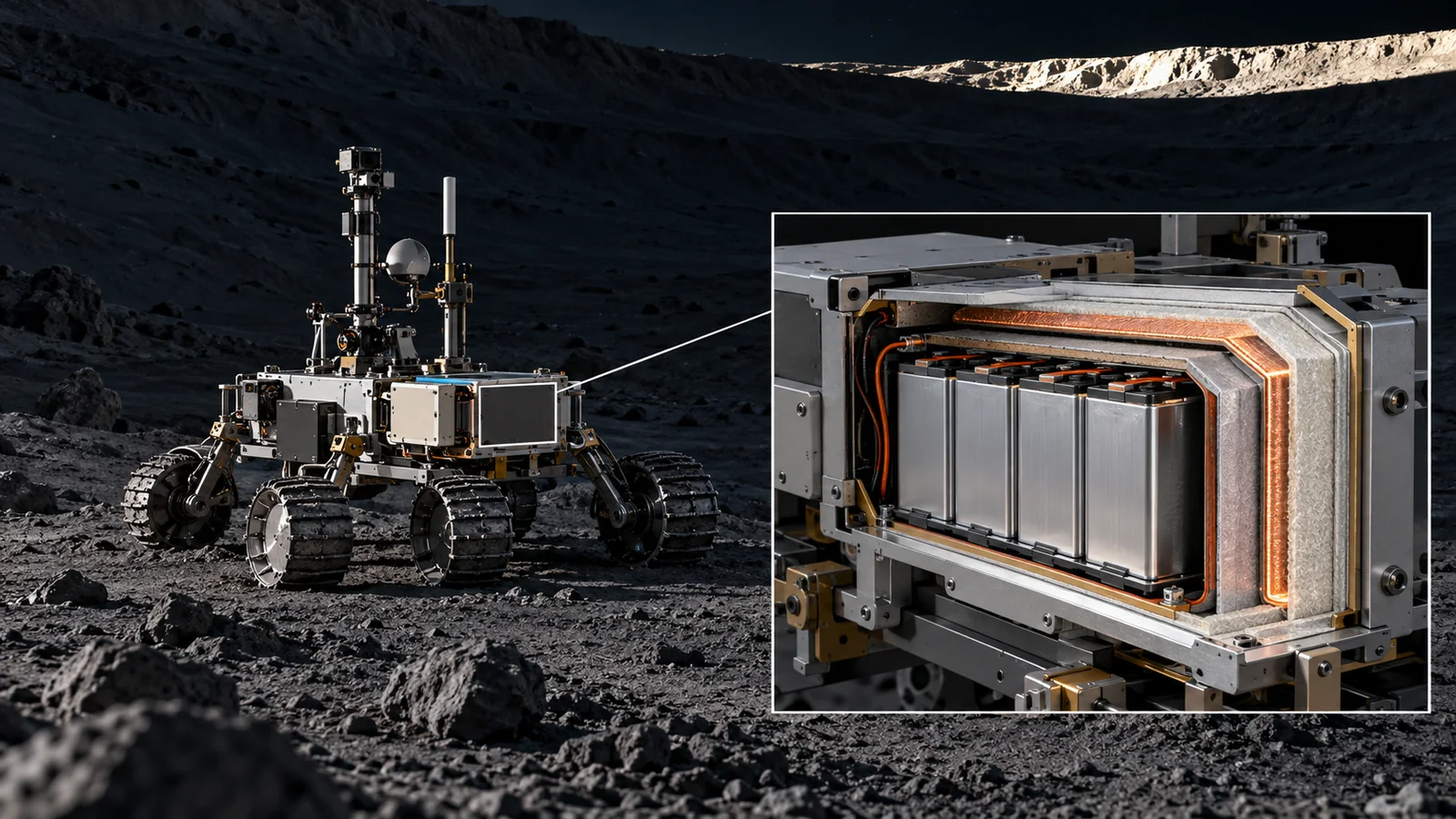
A NASA article says the lunar south-polar night drops to about −200 °C (−328 °F), and that the lunar day reaches about 100 °C (212 °F)Sourced[Ref. 3]. Conventional lithium-ion batteries have weak points: the liquid electrolyte freezes, evaporates, or, if too hot, stops working. So "solid-state batteries", which replace the liquid with a solid ceramic or polymer, are being studied.
(1) NASA's SPEARS: thermal-vacuum tests of prototype small cells
NASA's SPEARS (Solid Power for Extreme Environment Adaptability and Resilience in Space) is research that began in 2026 and is led by NASA Glenn Research Center. In thermal-vacuum tests at NASA Langley Research Center, prototype small cells operated normally up to 80 °C and down to −60 °C, and operated with somewhat reduced performance down to −80 °C. They were also undamaged after exposure to temperatures from 100 °C to −170 °CSourced[Ref. 3]. The article explains that even a solid-state battery does not work at −170 °C (−274 °F), but because a solid electrolyte does not freeze like a liquid it survives, and small heaters can warm it to operating temperature so it works again [Ref. 3]. The article describes a stage that focuses first on technology development, with a possible later shift toward commercial collaborationNot yet confirmed.
(2) A demonstration outside the ISS: 434 days and 562 cycles
According to the paper by Miyazawa and co-workers (2025), a 140 mAh-class all-solid-state lithium-ion battery with a sulfide solid electrolyte, a nickel-cobalt-manganese (ternary) cathode and a graphite-based anode was kept for 434 days in the ISS exposed section; besides basic charge-discharge characterization, 562 charge-discharge cycles were run, and no significant degradation was seen in the characteristics or the appearanceSourced[Ref. 2]. The battery's operating range is given as −40 to +120 °C, and the paper says that ground-based tests of temperature, vacuum, mechanical durability and gamma rays preceded the demonstration in space [Ref. 2]. The paper says it was confirmed that lifetime characteristics of such batteries can be estimated from ground-based charge-discharge characteristics, but this is a result for one type and a small capacity; scaling up and long-term operation on the Moon could not be confirmed in the sources used here.
A solid electrolyte solves the liquid's problems (freezing, evaporation, flammability) but brings new ones. NASA's material says solid electrolytes have low thermal conductivity, so heat can build up into local hot spots that degrade the materials; that the mismatch in thermal expansion among the materials inside the cell creates stress during temperature changes and may harm structure and performance; and that a lithium-metal anode requires careful engineering to prevent dendrite formation (needle-like deposits)Sourced[Ref. 1]. The paper by Miyazawa and co-workers sorts sulfide solid electrolytes as having high ionic conductivity at room temperature and good processability, suited to high-capacity cells, and oxide solid electrolytes as more chemically stable and safer but needing high-temperature processing, having lower contact with the electrodes and being hard to scale to several Ah [Ref. 2]. Commentary: for solid-state cells, the central issues are therefore materials and process questions: how to make solid-solid interfaces adhere, how to shed heat, and how to tolerate differences in expansion.
(3) Other research targets
NASA's material names lithium metal, lithium-sulfur, silicon-rich anodes, high-voltage cathodes and solid-state cells as candidate successors to lithium-ion, promising in energy density but with trade-offs in cycle life and stability [Ref. 1]. Its solid-state table lists manufacturers' values such as a Solid Power lithium-metal cell (440 Wh/kg) and a QuantumScape NMC cell (300 Wh/kg, projected)Sourced[Ref. 1]. These are values the manufacturers published; NASA has not verified them and they do not show operation in space. NASA's material also reports that a silicon-anode battery from Amprius flew on a stratospheric high-altitude pseudo-satellite for 67 days at 450 Wh/kg [Ref. 1], but that is not outer space.
That cannot be said at present. Solid electrolytes are expected to be hard to ignite and to work over a wide temperature range, but NASA's SPEARS began in 2026 and its thermal-vacuum tests concern small prototype cells. The ISS exposure experiment used one 140 mAh-class battery type for 434 days. An example showing the large capacity, long life and manufacturability a main power source needs, including the space environment, could not be confirmed in the sources used here. Also keep "the electric-vehicle story on the ground" apart from "the space story".
8. Where things stand now (checked 17 October 2026)
This field changes quickly, so we set out what could be confirmed from primary sources, with a checking date. A company's claim is written as that company's claim.
| Item | What was confirmed | Class |
|---|---|---|
| The mainstay battery | In NASA's summary (version of 7 May 2026), lithium-ion and lithium polymer have replaced nickel-cadmium and nickel-hydrogen as the standard. Commercial lithium-ion energy cells are 150–270 Wh/kg (single cell) [Ref. 1] | Sourced |
| Batteries of a crewed facility | From 2017 to 2021 the ISS replaced 48 nickel-hydrogen batteries with 24 lithium-ion batteries (NASA article; work complete as of 1 February 2021) [Ref. 4, 5] | Sourced |
| Orbital test of an all-solid-state battery | A 140 mAh-class sulfide all-solid-state lithium-ion battery spent 434 days outside the ISS and underwent 562 cycles with no significant degradation (2025 paper; one type of battery) [Ref. 2] | Sourced |
| Solid-state battery for the lunar night | NASA's SPEARS (begun in 2026). In thermal-vacuum tests, prototype small cells operated from 80 °C to −60 °C, operated with reduced performance at −80 °C, and were undamaged by exposure from 100 °C to −170 °C. Early technology-development stage (NASA article, 14 October 2026) [Ref. 3] | Sourced |
| Solid-state batteries as main power | No case of an all-solid-state battery operating as a spacecraft's main power source could be confirmed in the sources used here. Radiation effects on liquid-electrolyte batteries also could not be confirmed | Not yet confirmed |
| Battery-specific standards | ISO 17546:2024 (design and verification requirements for lithium-ion batteries for space vehicles) is published and under revision (ISO/CD 17546-1 and -2 are in development). No standard titled for batteries was found in ECSS's list of active standards [Ref. 10, 11] | Sourced |
Checked 17 October 2026. Roadmaps and research targets are distinct from achieved facts.
Space batteries carry the electricity of the eclipse and cycle a dozen or more times a day. The mainstay is the lithium-ion battery, and the ISS has swapped to 24 of them. A battery's size and life are set by its usage: depth of discharge, temperature and how it is kept; and tests reproduce the space conditions as closely as they can. Solid-state batteries are at the research and demonstration stage, aimed at extreme settings such as the lunar night, and a track record as a main power source has not yet been confirmed.
9. How to read the yardsticks and standards
The quality of a space battery cannot be captured by one number. "Wh/kg" means different things for a cell and a pack. "Cycle life" is read together with the depth of discharge, temperature and charge voltage. "Safety" is checked by abuse tests such as overcharge and short circuit. And "will it really work in space?" is judged by qualification under a standard, by environmental tests such as vacuum and thermal vacuum, and by actual flight records. The table sets out what each yardstick measures and does not measure, as far as could be confirmed.
| Item assessed | Representative test or method (name, source) | Standards and guidance (ISO, ECSS, NASA and others) | Cautions in reading |
|---|---|---|---|
| Energy density (Wh/kg) | Calculated from a cell's rated capacity and mass. NASA's table collects manufacturers' published values [Ref. 1]Sourced | Could not be confirmed (NASA notes that it has not independently verified the table's values) | Cell or pack; company's stated value or measurement. See "check the denominator three times" in our explainer on lithium-ion battery basics |
| Life (cycles and storage) | Life tests under mission-specific conditions (NASA's material calls them essential) [Ref. 1]. Cook et al. report that only a low-orbit condition including vacuum and low temperature is representative [Ref. 9]Sourced | ISO 17546:2024 "Space systems — Lithium ion battery for space vehicles — Design and verification requirements" (ISO/TC 20/SC 14, edition 2, February 2024, Published; it specifies design and minimum verification requirements from the perspectives of performance, safety and logistics; the text is paid and was not checked) [Ref. 10]Sourced | Compare with DoD, temperature and state of charge matched. A test that reproduces only part of the conditions is not recommended (Cook et al.) |
| Safety (abuse tests) | NASA/TM-2009-215751: at battery level, verification under overcharge, overdischarge, over-temperature, over-pressurization, internal cell short and external short, and an evaluation of propagation between cells. Cell-level abuse tests (overcharge, overdischarge, external short, internal short and crush, heat-to-vent, vibration, drop, vent and burst pressure) [Ref. 6]Sourced | NASA/TM-2009-215751 (NESC-RP-08-75, 2009; a guideline, not a standard) [Ref. 6]. For crewed vehicles, JSC-20793 (the document cites Rev. B). ISO 17546:2024 (above) | A "guideline" and a "requirement" are different. On crewed vehicles approval is needed for each hardware configuration (summary in NASA/TM-2009-215751) |
| Vacuum and thermal vacuum | A vacuum leak check of flight batteries (acceptance test); in a NASA Glenn payload example, six hours at a vacuum of 0.1 psi [Ref. 6]Sourced. Thermal-vacuum and gamma-ray tests of an all-solid-state battery [Ref. 2] | ISO 17546:2024 (above). ECSS: no standard titled for batteries was found in the list of active standards (ECSS-E-ST-20-20C covers distribution of main-bus power by LCLs and RLCLs, and no passage on batteries was found in its scope) [Ref. 11, 12]Sourced | Temperature range, number of cycles and vacuum level differ from test to test. A result is the value under that condition |
| Radiation | Gamma irradiation of single all-solid-state cells at 2 Mrad and 8 Mrad with before-and-after comparison of discharge (ground, 2025) [Ref. 2]Sourced | A radiation-test standard specific to batteries could not be confirmed | A total-dose gamma test is not the same as the effect of space electrons and protons. Liquid-electrolyte cells could not be confirmed |
| Transport (before launch) | UN 38.3 (transport). Organized in our explainer on thermal runaway and battery safety | The text of UN 38.3 was not checked for this article | The transport test is not a test of operation in space or of thermal propagation |
| On-orbit record | The 24 lithium-ion batteries on the ISS (swap complete in 2021) [Ref. 4]. The all-solid-state battery's 434-day, 562-cycle exposure [Ref. 2]Sourced | No corresponding standard could be confirmed. Whether JAXA's technical standards (JERG) have a matching item could not be confirmed because the site could not be accessed | Results differ with orbit, duration and temperature. Do not generalize one battery type's result |
The arrangement of the table is Our calculation (organization). Numbers, titles and status of standards were checked on the ISO and ECSS pages (checked 17 October 2026). The text of ISO standards is paid and was not checked, so only titles and scope are given. The ASTM International website and its standards were not consulted.
Cautions in reading (for materials engineers)
- Ground tests and on-orbit records are different: NASA's guideline tests (vibration, thermal vacuum, leak checks) and gamma-ray irradiation tests simplify the space environment. The ISS exposure result is also for one battery type over about one year.
- A company's stated value and third-party verification are different: the manufacturers' values in NASA's table have not been independently verified by NASA [Ref. 1]. The SPEARS results are a report by NASA's research team, for prototype small cells.
- A guideline is not a requirement: NASA/TM-2009-215751 is a guideline, not a legally binding standard. The text of ISO 17546 was not checked. For any claim of "compliance with a standard", check which standard and which clause.
- Plans and achievements are different: SPEARS is research begun in 2026 and does not show a finished "battery for the lunar night".
10. Glossary
- Sunlit / eclipse
- Time in sunlight / time in the shadow of the Earth or another body. Solar cells cannot generate in eclipse.
- Primary / secondary battery
- Primary = cannot be recharged (single use). Secondary = can be recharged and reused.
- Lithium-ion battery
- A battery that charges and discharges as lithium ions move between positive and negative electrodes. The space mainstay.
- Nickel-hydrogen (NiH2) / nickel-cadmium (NiCd)
- Secondary batteries used in space before lithium-ion.
- Electrolyte
- The medium in which ions move inside a battery. Liquid in conventional cells, solid in solid-state cells.
- Specific energy (Wh/kg)
- Energy stored per unit weight. Its meaning changes between cell and pack.
- Depth of discharge (DoD)
- The fraction of rated capacity used in one discharge.
- State of charge (SOC)
- The present level of charge (full charge = 100%).
- Cycle life
- The number of times a battery can be used, counting one charge and one discharge as a cycle.
- Thermal runaway
- A chain of heat and reactions inside a battery that makes temperature rise sharply. Covered in our explainer on thermal runaway and battery safety.
- Abuse test
- A test that deliberately puts a battery in severe conditions such as overcharge, overdischarge, short circuit, crushing or overheating to check safety.
- Pouch cell
- A cell packed in a bag of aluminized plastic.
- 18650 cell
- A cylindrical cell 18 mm in diameter and 65 mm long. Commercial versions are widely used on small satellites.
- COTS
- Commercial off-the-shelf: ordinary commercial products.
- Thermal-vacuum test
- A test that cycles temperature in a vacuum to check operation and durability.
- Vacuum leak check
- A check that a sealed cell or battery does not leak in a vacuum.
- All-solid-state battery
- A battery in which the electrolyte (and the separator) are replaced by solids.
- Sulfide-type / oxide-type
- Two main kinds of solid electrolyte. The former is easier to process, the latter more stable.
- Dendrite
- A needle-like crystal that can grow at a lithium-metal anode during charging and cause an internal short.
- Mrad / kGy
- Units of absorbed radiation dose. 1 Mrad = 10 kGy (8 Mrad = 80 kGy).
- Qualification
- Confirming by tests under a standard that a product design meets its requirements. Separate from acceptance testing.
11. References (primary sources)
- NASA "State-of-the-Art of Small Spacecraft Technology, 3.0 Power" (version of 7 May 2026; checked 17 October 2026) — nasa.gov/smallsat-institute/sst-soa/power-subsystems/
- Miyazawa Y. et al. "Space Demonstration of All-Solid-State Lithium-Ion Batteries Aboard the International Space Station", Aerospace 12, 514 (2025), DOI 10.3390/aerospace12060514 — doi.org/10.3390/aerospace12060514
- NASA "NASA Develops Batteries to Power Humanity's Return to Moon" (Joe Atkinson, 14 October 2026) — nasa.gov/centers-and-facilities/langley/nasa-develops-batteries-to-power-humanitys-return-to-moon/
- NASA Space Station blog "Spacewalkers Wrap Up Battery Work and Camera Installations" (1 February 2021) — nasa.gov/blogs/spacestation/2021/02/01/spacewalkers-wrap-up-battery-work-and-camera-installations/
- NASA Space Station blog "Astronauts Complete First of Two Power Upgrade Spacewalks" (6 January 2017) — nasa.gov/blogs/spacestation/2017/01/06/astronauts-complete-first-of-two-power-upgrade-spacewalks/
- McKissock B., Loyselle P., Vogel E. "Guidelines on Lithium-ion Battery Use in Space Applications", NASA/TM-2009-215751 (NESC-RP-08-75 / 06-069-I, May 2009) — ntrs.nasa.gov/citations/20090023862
- NASA "Space Station Facts and Figures" (checked 17 October 2026) — nasa.gov/international-space-station/space-station-facts-and-figures/
- NASA "New Solar Arrays to Power NASA's International Space Station Research" (11 January 2021; checked 17 October 2026) — nasa.gov/missions/station/new-solar-arrays-to-power-nasas-international-space-station-research/
- Cook R., Swan L., Plucknett K. "Impact of Test Conditions While Screening Lithium-Ion Batteries for Capacity Degradation in Low Earth Orbit CubeSat Space Applications", Batteries 7, 20 (2021), DOI 10.3390/batteries7010020 — doi.org/10.3390/batteries7010020
- ISO "ISO 17546:2024 Space systems — Lithium ion battery for space vehicles — Design and verification requirements" (ISO page; status Published, edition 2; checked 17 October 2026) — iso.org/standard/83872.html
- ECSS List of active ECSS standards (checked 17 October 2026) — ecss.nl/standards/active-standards/
- ECSS "ECSS-E-ST-20-20C – Electrical design and interface requirements for power supply (15 April 2016)" (standard page; scope checked) — ecss.nl/standard/ecss-e-st-20-20c-space-engineering-electrical-design-and-interface-requirements-for-power-supply-15-april-2016-2/
12. Claim-to-source audit
| Claim in the text | Basis | Class |
|---|---|---|
| Lithium primary batteries are for short missions and not regarded as state-of-the-art storage; lithium-ion and lithium polymer have replaced NiCd and NiH2 as the standard; commercial lithium-ion energy cells at 150–270 Wh/kg (average 3.6 V), 450–500 Wh/kg in laboratory and high-altitude designs, an Amprius battery at 450 Wh/kg for 67 days on a stratospheric pseudo-satellite; flight heritage and specific energies of 18650 cells (Ingenuity, MarCO, PACE and others); the listed causes of thermal runaway; that space batteries face large temperature swings and high charge voltages and that mission-specific life testing is essential; strengths and challenges of solid-state cells (thermal conductivity, thermal-expansion mismatch, dendrites), the Solid Power and QuantumScape values (manufacturers' values), candidate successors to lithium-ion and the trade-offs; that NASA has not independently verified the table values | NASA, State-of-the-Art of Small Spacecraft Technology, Power chapter (version of 7 May 2026) Reference 1 https://www.nasa.gov/smallsat-institute/sst-soa/power-subsystems/ | Sourced |
| The ISS exposure experiment of an all-solid-state battery (434 days, 562 cycles, no significant degradation, 140 mAh class, sulfide electrolyte, NMC cathode, graphite anode), operating range −40 to +120 °C, practical range of 5–40 °C for conventional lithium-ion, no abnormality in discharge after gamma irradiation at 2 and 8 Mrad, differences between sulfide and oxide types, ground pre-tests (temperature, vacuum, mechanical durability, gamma rays) | Abstract and text of Miyazawa et al. (2025) Reference 2 https://doi.org/10.3390/aerospace12060514 | Sourced |
| SPEARS (begun in 2026, led by Glenn), the lunar south-polar night at about −200 °C and lunar day at about 100 °C, freezing and evaporation of liquids, prototype small cells operating from 80 °C to −60 °C and with reduced performance at −80 °C, undamaged by exposure from 100 °C to −170 °C, restart with heaters, early technology-development stage | NASA article (14 October 2026) Reference 3 https://www.nasa.gov/centers-and-facilities/langley/nasa-develops-batteries-to-power-humanitys-return-to-moon/ | Sourced |
| That the work of replacing 48 nickel-hydrogen batteries with 24 lithium-ion batteries was complete (article of 1 February 2021) | NASA ISS blog Reference 4 https://www.nasa.gov/blogs/spacestation/2021/02/01/spacewalkers-wrap-up-battery-work-and-camera-installations/ | Sourced |
| The replacement of nickel-hydrogen batteries by new lithium-ion batteries and adapter plates that began in January 2017 | NASA ISS blog (6 January 2017) Reference 5 https://www.nasa.gov/blogs/spacestation/2017/01/06/astronauts-complete-first-of-two-power-upgrade-spacewalks/ | Sourced |
| The definition of DoD and its example, that temperature and DoD affect the capacity over cycles, capacity lost in a year of storage (less than 2% at 0% charge and 0 °C, about 13% at 100% and 40 °C), the hazard of lithium-ion and the use of the guideline for human-related use, the battery-level safety tests, abuse tests, vacuum leak checks, the vacuum exposure for Glenn payloads (0.1 psi, six hours), the pouch-cell construction, built-in cell safety features and protection circuitry, the summary of battery approval for crewed vehicles, the reference to JSC-20793 Rev. B | NASA/TM-2009-215751 Reference 6 https://ntrs.nasa.gov/citations/20090023862 | Sourced |
| That the ISS circles about every 90 minutes and makes 16 laps, with 16 sunrises and sunsets, a day | NASA ISS description Reference 7 https://www.nasa.gov/international-space-station/space-station-facts-and-figures/ | Sourced |
| That about half of the power the original eight ISS arrays make in daylight is stored in the batteries | NASA article Reference 8 https://www.nasa.gov/missions/station/new-solar-arrays-to-power-nasas-international-space-station-research/ | Sourced |
| Testing of commercial cells for low-orbit CubeSats under standardized (101 kPa, 20 °C), low-temperature (10 °C) and low-orbit (0.2 kPa, 10 °C) conditions, and the conclusion that a partial representation is not recommended | Abstract of Cook et al. (2021) Reference 9 https://doi.org/10.3390/batteries7010020 | Sourced |
| ISO 17546:2024 number, title, scope and status (Published, edition 2, February 2024; under revision with ISO/CD 17546-1 and -2 in development) | ISO standard page (checked 17 October 2026) Reference 10 https://www.iso.org/standard/83872.html | Sourced |
| That no standard titled for batteries was found in ECSS's list of active standards | ECSS list of standards (checked 17 October 2026; titles were checked, not the texts) Reference 11 https://ecss.nl/standards/active-standards/ | Sourced |
| The scope of ECSS-E-ST-20-20C (distribution of main-bus power by LCLs and RLCLs; no passage on batteries was found) | ECSS standard page Reference 12 https://ecss.nl/standard/ecss-e-st-20-20c-space-engineering-electrical-design-and-interface-requirements-for-power-supply-15-april-2016-2/ | Sourced |
| Eclipse length (up to about 36 min and period about 92.4 min at 400 km; up to about 69 min and period 1436 min in geostationary orbit), 1 kW x 36 min = 600 Wh, capacity and mass estimates (3000 / 2000 / 1500 Wh; 20 / 13.3 / 10 kg and 12 / 8 / 6 kg), about 5,840 cycles a year (16 x 365), about 29,200 over five years, 48 / 24 = 2, 8 Mrad = 80 kGy | Calculated from geometry and simple formulas; assumptions stated in the text and figures Our calculation | Our calculation |
| Operation of an all-solid-state battery as a spacecraft's main power, radiation effects on liquid-electrolyte batteries, the text of ISO 17546, the latest edition of JSC-20793, matching items in JAXA's technical standards, the text of UN 38.3, and the detailed reasons for the ISS battery swap | Could not be confirmed in the primary sources reachable for this article, and so are not stated | Commentary |
| The readings "a battery's reliability is set by the container's materials and its seal", "for solid-state cells interfaces, heat and expansion are the issues", and "the effects of 4. atomic oxygen and ultraviolet light and 5. microgravity and debris on batteries", and the cannonball analogy with its limit | Commentary and inference in this article (readings based on sourced facts) | Commentary |
| That Figs. 1 to 9 are explanatory drawings and not observations of real data, and that Figs. 1 and 9 are frames for AI-generated concept images | A note by this article | Commentary |
Last updated 17 October 2026. Sources are limited to primary material (NASA material and articles, NASA/TM-2009-215751, peer-reviewed papers, and standards pages of ISO and ECSS). Manufacturer values are labelled as the company's stated values and kept apart from independently verified ones. The worked examples (eclipse length, battery size, number of cycles) are explanatory calculations made for this article and are not design values for any particular satellite. This article is a general explanation and not advice on battery handling or safety. Operation of solid-state batteries as a main power source, radiation effects on liquid-electrolyte batteries, the text of ISO 17546, and matching items in JAXA's technical standards could not be confirmed and are not stated here. All figures are explanatory conceptual drawings or drawings that include our own calculation; Figs. 1 and 9 are frames for AI-generated images (images not yet placed). They do not show any real facility, product or appearance.