TECHNOLOGY EXPLAINER
Lunar Resources and ISRU
— What can be obtained from lunar "soil" and "water ice," and how far has it been proven
If oxygen, water and construction material can be made on the Moon, the mass carried from Earth can be reduced; that is the idea behind ISRU (In-Situ Resource Utilization). But claims that "the Moon has water" or "oxygen can be extracted from regolith" easily mix very different stages: concept, ground test, lunar-environment simulation and actual demonstration on the Moon. For materials engineers, this article sorts, from primary sources, (1) the properties of regolith (lunar soil), (2) observations of water ice and their uncertainty, (3) ways to extract oxygen and metals, (4) construction material by sintering and 3D printing and (5) the stages of ISRU demonstration.
The stage (concept, ground test, lunar-environment simulation, lunar demonstration) is always distinguished, and values from ground tests on simulant are not presented as values for real regolith. Company statements are marked as company claims and Not yet confirmed plans are not mixed with achievements. Facts were checked on 17 October 2026.
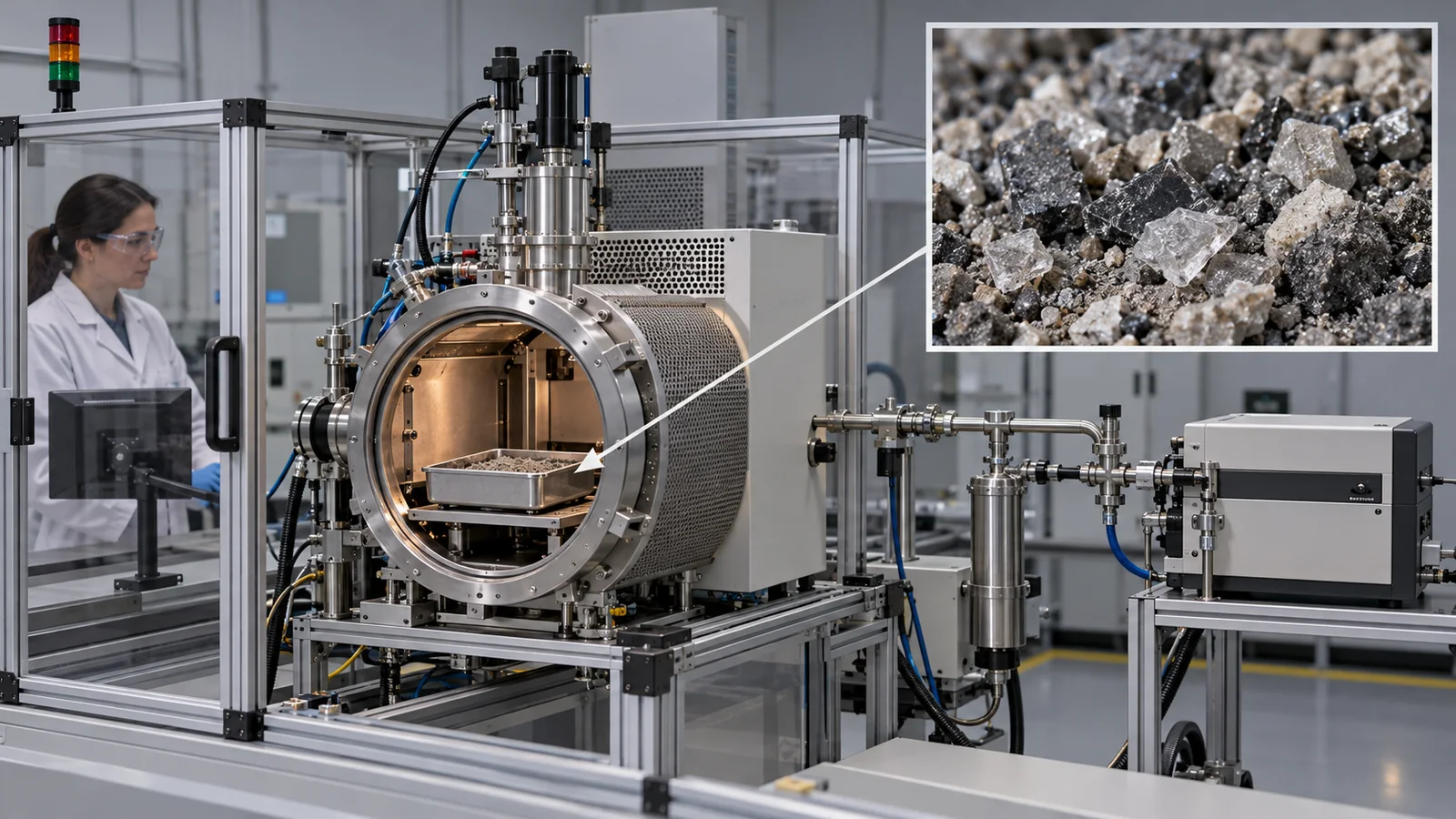
- Summary / before you read / place in the series
- What regolith is: properties and the dust problem
- Lunar resources: what and where
- Extracting oxygen and metals
- Stages of ISRU demonstration
- Sintering and 3D printing as construction material
- A materials engineer's view, and what could not be confirmed
- How to read the yardsticks / glossary / references / audit
Sourced = stated in a published source (linked)
Our calculation = a value this article converted or organized from stated assumptions
Not yet confirmed = plans, targets and schedules that are not yet confirmed
Interpretation is marked commentary and inference is shown in bold.
Most ISRU figures are from ground tests on simulant or from tests simulating lunar vacuum and temperature. They are neither values for real regolith nor for actual operation on the Moon. NASA's own material says water mining carries "significant risk" because resource knowledge is insufficient. Read each figure with its conditions (simulant or real sample, ground or simulated lunar environment).
1. Summary / before you read / place in the series
- Regolith is a different material from soil on Earth: a poorly sorted powder made by meteorite impacts breaking bedrock, containing sharp agglutinates and with strong grain adhesion. On Apollo this dust affected suits and equipment in nine ways. [Ref. 1, 2]
- Water ice exists, but how much is usable is not known: in 2009 LCROSS estimated ice concentration at 5.6 ± 2.9% by mass from a single impact. NASA's 2025 material says water mining carries significant risk because resource knowledge is insufficient. [Ref. 4, 6]
- Oxygen extraction has advanced on the ground and in simulated lunar environments, but no demonstration on the Moon could be confirmed: carbothermal reduction and molten regolith electrolysis reached TRL 5-6 in simulated lunar environments. The lunar ISRU instrument PRIME-1 missed its goals because the lander ended up on its side. [Ref. 5, 6]
All you need is the materials commonsense that extracting oxygen from an oxide needs a reaction that pulls the bound oxygen away (reduction) and that this takes heat or electricity. Landings and plans on the Moon are in the series article on lunar exploration and Artemis.
Read this after the article on lunar exploration and Artemis. Dust and temperature relate to the article on the space environment and its effects on materials, construction by additive manufacturing to the article on additive manufacturing for space, and national budgets and the legal treatment of space resources to the article on national space strategies and regulation.
2. What regolith is: properties and the dust problem
Regolith is the layer of broken rock and powder covering bedrock. On the Moon, meteorite and micrometeorite impacts broke up bedrock over billions of years. According to NASA's McKay, about 90% of regolith is submillimeter particles (the part called lunar soil) and the rest ranges from rock fragments to boulders. The soil includes particles tens of nanometres in size. In addition there is "space weathering": melting and vapor condensation from impacts and implantation by solar wind and cosmic rays. [Ref. 1] Real samples are the 382 kg that Apollo brought back over six flights. [Ref. 3]Sourced
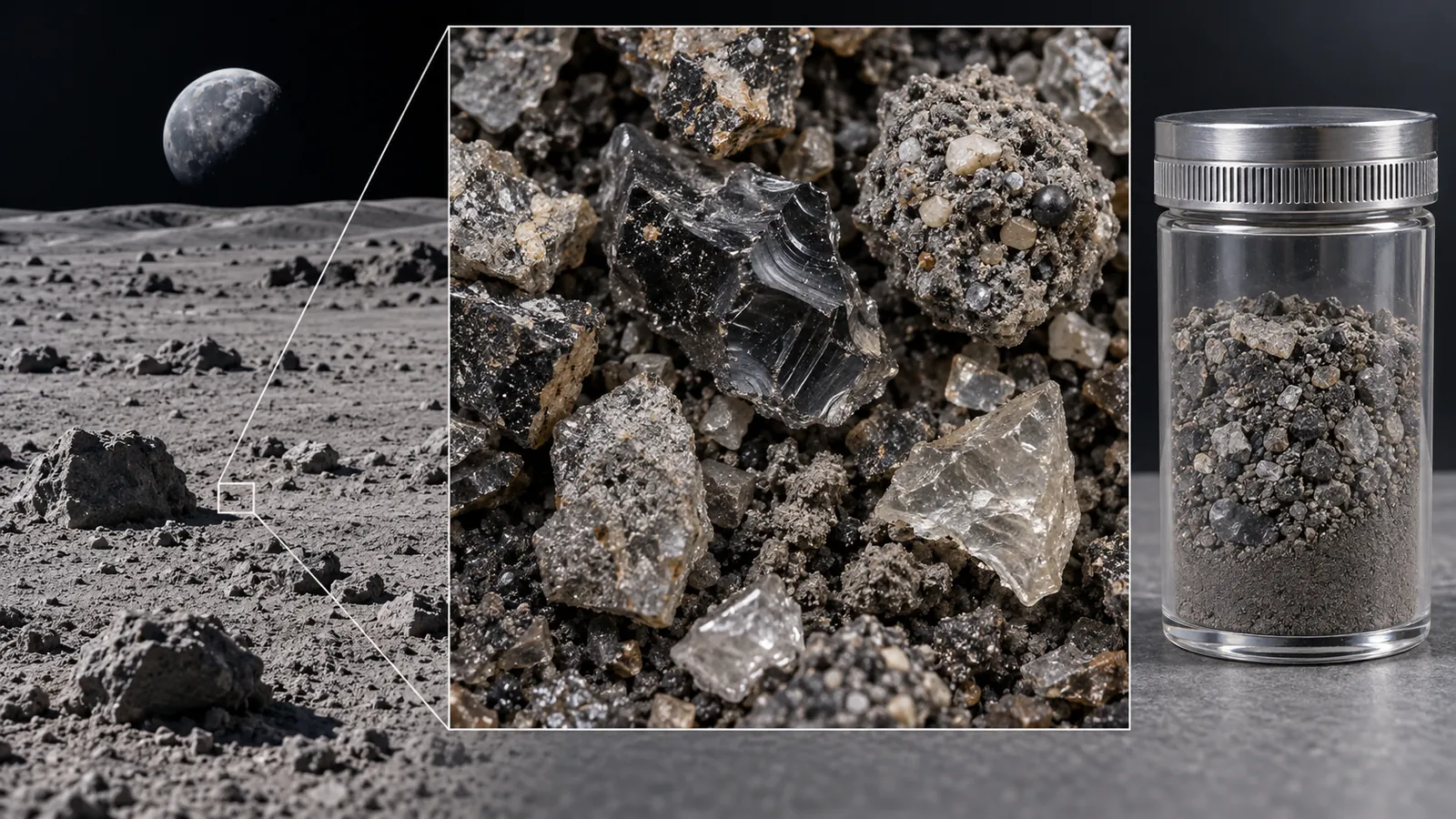
View original SVG, values and sources
Original SVG reference: Conceptual diagram (vector drawing). Left: a schematic section (number and size of grains illustrative). Right: characteristics as summarized by NASA's McKay.
What stands out for engineering is that it is less well sorted than terrestrial soil, has strong grain adhesion, has many sharp-cornered agglutinates and an over-compacted density. [Ref. 1] Agglutinates are lumps in which impact-melted glass has bonded fine grains together (see glossary).Sourced
On Apollo the loose surface material was called "soil" and catalogued as soil samples. Today it is usually called "regolith" to keep in mind how different it is from terrestrial soil (as explained in NASA's simulant guide). [Ref. 14] It is unlike terrestrial soil, which contains living things and organic matter.
(1) What dust did on Apollo
NASA's Gaier examined records of the six landings and sorted dust effects into nine categories: vision obscuration, false instrument readings, coating and contamination, loss of traction, clogging of mechanisms, abrasion, thermal-control problems, seal failures, and inhalation and irritation. Simple measures stopped only some (such as loss of traction); serious effects such as clogging, abrasion and reduced heat rejection were not stopped. The report also says the severity of dust problems was consistently underestimated by ground tests. [Ref. 2] Suit components were approaching failure at the end of missions lasting 21 to 75 hours on the surface. [Ref. 2]Sourced
The effect on radiators shows up in numbers. The report says that only 11% dust coverage doubled solar absorptance, and that residual contamination depended mainly on particles smaller than 2 μm. [Ref. 2] This ties directly to the series articles on spacecraft thermal control and on thermal-control materials and radiative cooling.Sourced
Correctly: with no air, particles fall at the same rate regardless of size, and those raised at landing flew out radially and settled almost immediately. That did not make it harmless: the problem was that dust stuck to equipment and suits and could not be removed. The report also identifies walking, rover wheels and landing and take-off of spacecraft as the main causes of moving dust. [Ref. 2]
3. Lunar resources: what and where
NASA's ISRU material lists the "commodities" it wants to produce on the Moon: oxygen, water and hydrogen, bulk and refined regolith, metals (aluminum, iron, titanium), silicon and ceramics, construction and manufacturing feedstock, fuels, plastics and hydrocarbons, and food feedstock. [Ref. 6] Broadly there are two families: extraction from regolith, which is everywhere (a powder of oxide minerals), and from water ice that may lie in the shadows of the polar regions.Sourced
(1) Water ice: the LCROSS observation and remaining uncertainty
To obtain direct evidence, the LCROSS mission on 9 October 2009 struck a spent rocket upper stage into the shadowed crater Cabeus near the south pole, and a second craft observed the ejected material with nine instruments. Near-infrared absorption and ultraviolet emission confirmed water vapor and ice; the maximum total of water vapor and ice observed was 155 ± 12 kg, and from the mass of excavated lunar soil that reached sunlight the ice concentration at the impact site was estimated at 5.6 ± 2.9% by mass. Light hydrocarbons, sulfur-bearing species and carbon dioxide were also found. [Ref. 4]Sourced
But this is an observation of one impact. NASA's 2025 material says the performance and viability of water extraction depend greatly on the form, concentration and distribution of the ice, which are currently unknown. It also says instruments that collect icy soil, heat it and measure water and volatiles still need to be developed to flight, and that no US instrument was funded for it. The water-prospecting rover VIPER is scheduled to arrive at the south pole in late 2027, carried by Blue Origin's second Blue Moon MK1 and equipped with a 1 m drill. [Ref. 6, 9] VIPER's arrival is still Not yet confirmed.SourcedNot yet confirmed
Correctly: that water ice exists in lunar shadows has been confirmed by LCROSS and others, but where, in what form and how much is still unknown. LCROSS's 5.6 ± 2.9% is an estimate for one site. Talk of "fuel factories using lunar water" rests on this uncertainty. [Ref. 4, 6]
4. Extracting oxygen and metals
Lunar regolith is made of oxide minerals in which oxygen is bound to metals. Extracting oxygen needs reduction, pulling the bound oxygen away, and the heat and electricity for it would come from sunlight. NASA's material sorts ways of extracting oxygen from regolith by risk and performance into three: hydrogen reduction (low risk, low performance), carbothermal reduction (medium risk, medium performance) and molten regolith electrolysis (MRE) (high risk, high performance). [Ref. 6]Sourced
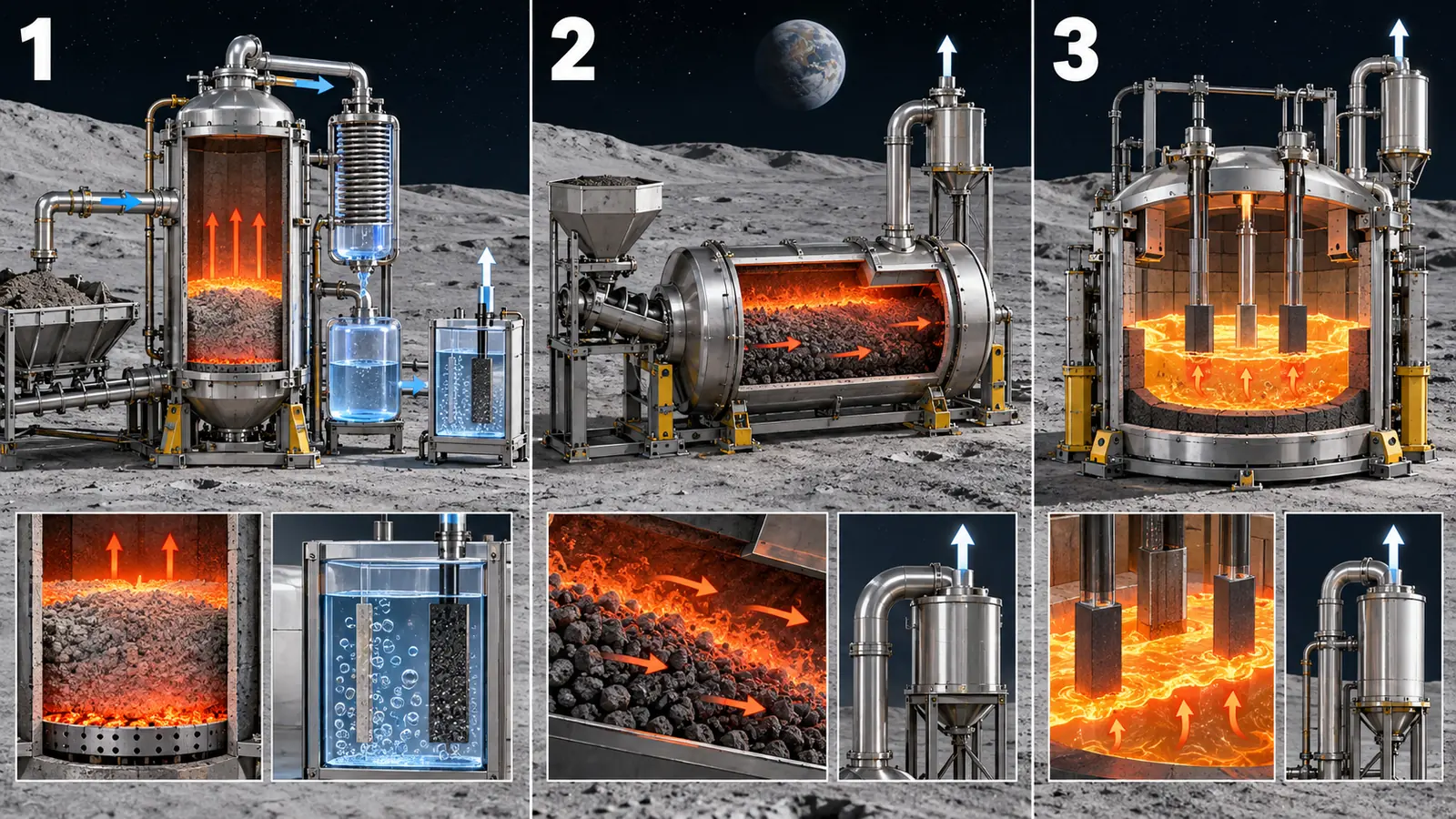
View original SVG, values and sources
Original SVG reference: Conceptual diagram (vector drawing). Key points of the three methods with figures from NASA material and papers. TRL is technology readiness level (1-9). Figures include simulant and ground tests.
(1) Reading the numbers: oxygen yield from a real sample and how many tonnes of regolith are needed
A 1994 NASA paper reduced 10 g of Apollo 17 high-titanium basalt (sample 70035) with hydrogen at 900-1050 C and reported an oxygen yield of 2.93 to 4.61% of the sample weight. It was the first experimental demonstration of making oxygen from a lunar rock; water evolution was essentially complete in tens of minutes and yield depended little on temperature or pressure. Fe(2+) in ilmenite was fully reduced, while olivine and pyroxene were only slightly reduced. [Ref. 7] NASA's 2025 material, by contrast, reports for carbothermal reduction on a highland simulant a yield above 20% by weight, more than 20 g of oxygen per kWh of thermal energy and recovery of more than 99.7% of the carbon used (under simulated lunar vacuum and thermal conditions, five consecutive melts). [Ref. 6]Sourced
Converting these figures with a materials engineer's eye (Our calculation): to obtain one tonne of oxygen one needs about 25 tonnes of regolith at a 4% yield and about 5 tonnes at 20%. At 20 g/kWh of thermal energy, one tonne of oxygen needs at most about 50 MWh (thermal) (1,000,000 g / 20 g per kWh), an estimate for the best case that excludes equipment losses and the power for excavation and transport. The real constraints are therefore the quantity processed and the power to run it, not whether regolith is limitless.Our calculation
(2) Metals and other methods
Molten regolith electrolysis aims to obtain not only oxygen but also the metals iron, silicon and aluminum. According to NASA's material, Lunar Resources processed 25 kg of simulant over 36 hours (24 hours of electrolysis) and measured an oxygen rate matching theory; Blue Origin is developing MRE and purification reactors and equipment for solar cells and aluminum wire, with an integrated lunar-environment test planned for 2026 (company efforts and plans). [Ref. 6] In addition, vacuum vapor pyrolysis is at TRL 4, and all steps of hydrochloric reduction and molten-salt electrolysis of aluminum chloride are described as demonstrated. [Ref. 6] A meeting abstract also gives a proof of concept in which the FFC Cambridge (Metalysis) process electrochemically deoxidizes powdered regolith to give oxygen and metal-alloy powder. [Ref. 16] There is also a non-peer-reviewed preprint studying a configuration for extracting 10 tonnes of oxygen per year. [Ref. 18]SourcedNot yet confirmed
Hydrogen reduction, carbothermal reduction and molten-salt or molten-oxide electrolysis are in the same family as terrestrial ironmaking, aluminum smelting and titanium production. NASA's material also says these technologies have spin-in and spin-off potential for terrestrial mining and metal processing. [Ref. 6] What is hard on the Moon is less the reactions themselves than vacuum, handling powder in low gravity, thermal management through long nights, abrasion by dust and scarce power (our commentary). The work amounts to remaking terrestrial experience for lunar regolith powder that is poorly sorted, sharp and adhesive.
5. Stages of ISRU demonstration
ISRU has clear stages. (1) Ground analog tests: NASA tests ISRU hardware that extracts water and carbon dioxide on the volcanic terrain of Mauna Kea in Hawaii (described as usable also to validate technology for finding lunar ice). [Ref. 8] (2) Tests in a simulated lunar environment: in facilities simulating vacuum and temperature, carbothermal reduction ran five consecutive melts and MRE ran a single operation under near-lunar conditions. [Ref. 6] (3) Demonstration in actual space or on the Moon: this is the stage that is still sparse.Sourced
On the Moon, PRIME-1 (the drill TRIDENT and the mass spectrometer MSOLO aboard IM-2) touched down at Mons Mouton on 6 March 2025 at about 11:30, but because the lander was on its side, the PRIME-1 instruments were unable to accomplish their science, exploration and technology goals (NASA). [Ref. 5] TRIDENT was to retrieve samples down to 1 m and MSOLO to examine volatiles. NASA's 2025 material also says several important resource-exploration missions have "failed, cancelled or delayed." [Ref. 6] On Mars, MOXIE made oxygen from Martian carbon dioxide as the first ISRU demonstration on another planet (seven times between landing in February 2021 and the end of 2021). [Ref. 10]Sourced
The conclusions of NASA's 2025 material, as given (NASA's own view): (1) flight demonstrations of oxygen and metal extraction can proceed with reasonable risk; (2) extraction of lunar water and volatiles cannot proceed without significant risk because resource knowledge is lacking; (3) the performance and viability of water-mining methods depend greatly on the form, concentration and distribution of ice; (4) NASA has no technology-development work on processing icy regolith at present (work proceeds on company funds and investment). [Ref. 6]Sourced
Correctly: within this check, no demonstration of making oxygen or water from regolith or ice on the Moon could be confirmed. What was confirmed are ground analog tests, tests in a simulated lunar environment, oxygen production on Mars (MOXIE) and an attempt at drilling and analysis on the Moon (PRIME-1, goals not met). Read company "lunar oxygen factory" talk as plans that are Not yet confirmed. [Ref. 5, 6, 10]
6. Sintering and 3D printing as construction material
Consolidating regolith as it is into landing pads, roads, walls and foundations is the ISRU closest to a materials engineer. Landing pads are needed because a lander's engine plume blows the surface away, and NASA plans to carry an instrument (SCALPSS) on Blue Moon MK1 that images plume-surface interaction. [Ref. 9] Ways of consolidating include sintering (heating powder below its melting point so grains bond), melting, using binders and low-temperature chemical setting.Sourced
NASA's McKay says NASA programs have supported research on bricks by solar or microwave sintering, concrete, and microwave sintering and glazing. [Ref. 1] A 2022 Marshall Space Flight Center report studies sintering by microwave using the Moon's surface itself as a powder bed. Regolith has low thermal conductivity, but microwaves heat the whole volume and can bond the grains. The concept adds regolith layer by layer to build landing pads, blast shields and roads, and microwave systems, procedures and sintering conditions are being developed for a planned lunar demonstration. [Ref. 11]SourcedNot yet confirmed
Strength figures are in the reports. A 2016 NASA Kennedy report says sintering regolith needs heating above 1,000 C, gives compressive strengths of 14,000-28,000 psi (about 97-193 MPa) that depend heavily on porosity, and is brittle, and reports that bricks of the simulant JSC-1A made by a low-temperature method cured at 60 C reached 3,050 psi (about 21 MPa) (mean of two). [Ref. 13] Another 2023 NASA paper points out that many publications do not quantify how processing conditions affect strength and investigated, in vacuum, the factors that set quality using the highland simulant CSM-LHT-1G, which contains 30 wt% glass. [Ref. 12]SourcedOur calculation
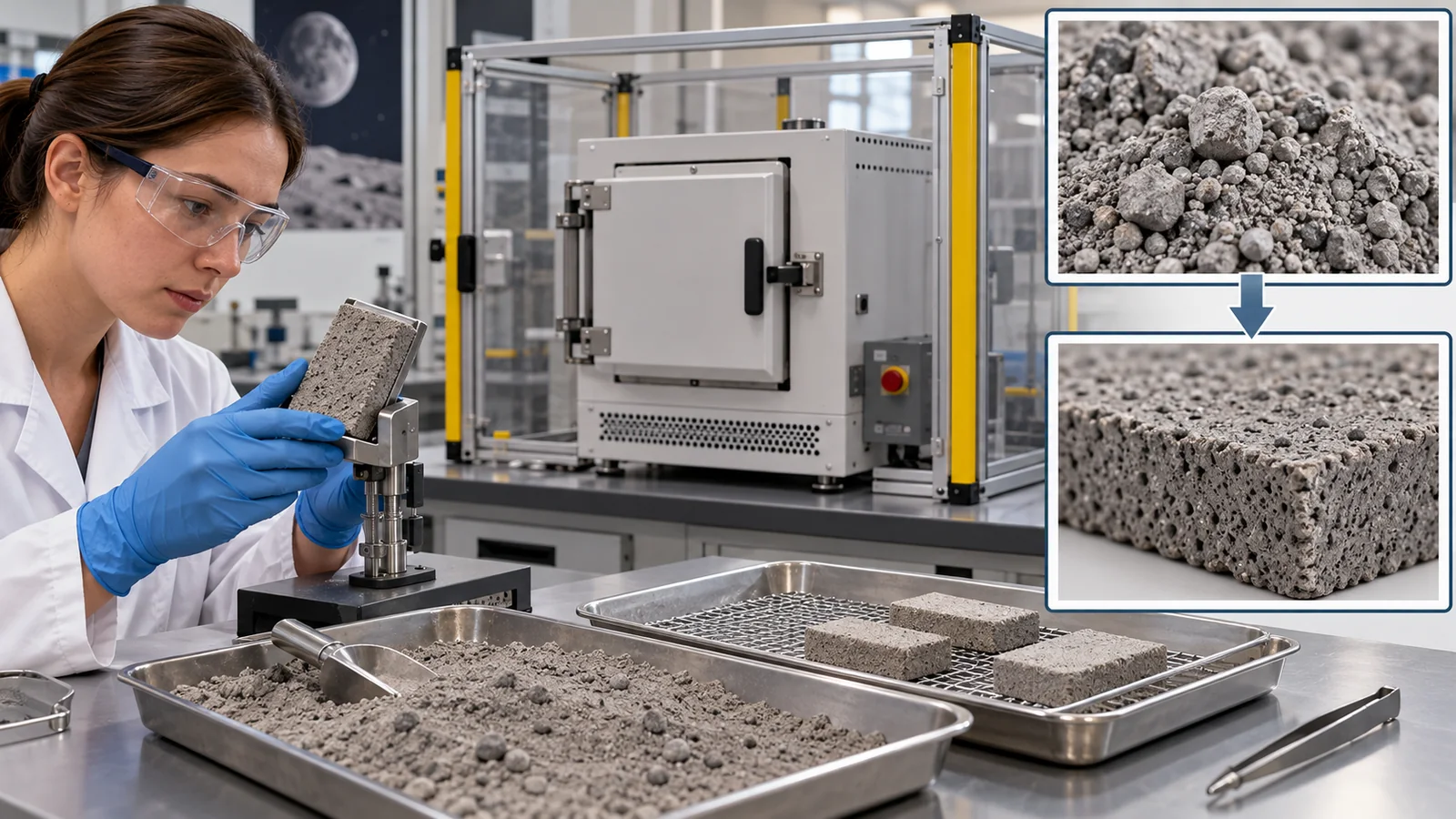
(1) Simulant is only a stand-in for the real thing. The NASA report says it carefully selected a simulant from which components absent on the Moon were removed for high-temperature processing. [Ref. 12] Apollo experience showed that ground tests consistently underestimated dust severity. [Ref. 2] Strength of simulant cannot be written as strength of real regolith. (2) As with ceramic sintering, sintering is governed by temperature, time, particle size, glass content and porosity (our commentary); strength figures without conditions cannot be compared. (3) Sintered bodies are strong but brittle, so thermal-stress cracking could become an issue on the Moon with its large temperature swings (inference; tests under lunar thermal cycling could not be confirmed within the sources).
7. A materials engineer's view, and what could not be confirmed
(1) Which stage does the number belong to? (ground analog test, simulated lunar environment, demonstration on the Moon; not only the TRL number but what was tested). (2) What is the gap between real and simulant? (simulants are made by removing components absent on the Moon and so on; dust, adhesion and sharp shapes are hard to reproduce in ground tests). [Ref. 2, 12] (3) Is it really better than carrying from Earth? (mass of soil processed, power, plant mass, failure and maintenance; the conversion that one tonne of oxygen needs several tonnes of soil shows the scale). [Ref. 6] These are general questions for any new resource-use technology, not an assessment of a particular company or plan (our commentary).
What could not be confirmed
- Any demonstration on the Moon of making oxygen or water from regolith or ice (none within what was checked)
- Reliable figures for the concentration, form and distribution of lunar water ice beyond LCROSS's single site
- The percentage chemical composition of regolith (this article states only figures confirmed in primary sources and gives no composition table)
- The durability of sintered bodies under lunar thermal cycling and any international standard for ISRU
- Reliable plant mass, power and operating time figures for companies' MRE and carbothermal systems (NASA's material gives only some performance figures)
- The current status of non-US ISRU instruments such as ESA's PROSPECT and ProSPA (NASA's material lists them but they were not individually checked)
Summary
Regolith is a material unlike terrestrial soil: poorly sorted, with sharp agglutinates and strongly adhesive grains, and on Apollo its dust affected equipment in nine ways. Water ice was confirmed by LCROSS but the usable amount is unknown. For oxygen extraction, carbothermal reduction and MRE reached TRL 5-6 in simulated lunar environments, and sintered bricks have reported compressive strengths of tens to over a hundred MPa on the ground. But no demonstration of making oxygen or water by ISRU on the Moon could be confirmed, and PRIME-1 missed its goals. ISRU is at the stage where concept and ground testing are advanced and lunar demonstration is yet to come.
8. How to read the yardsticks and standards
ISRU yardsticks still have few common standards and divide into technology readiness level (TRL), yield and energy, resource estimates and material strength. Checked on 17 October 2026.
| What is evaluated | Typical test or evaluation method (name, source) | Standard or guideline (name, edition, source checked) | How to read it |
|---|---|---|---|
| Technology maturity | TRL (1-9). NASA's material labels methods TRL 4-6 (hydrogen reduction, carbothermal reduction and MRE at 5-6 in simulated environments). [Ref. 6]Sourced | NPR 7123.1D "NASA Systems Engineering Processes and Requirements," Appendix E (technology readiness levels); effective 5 July 2023, expires 5 July 2028. [Ref. 15]Sourced | A document mandatory for NASA employees, not legally binding on the public. TRL 5-6 means testing in a relevant environment; demonstration on the Moon corresponds to TRL 7-9 (our commentary) |
| Oxygen yield and energy | Yield (weight %), oxygen per unit of thermal energy (g/kWh) and carbon recovery; for hydrogen reduction of a real sample 2.93-4.61% (Apollo 17 basalt 70035). [Ref. 6, 7]Sourced | not found | Do not compare values under different conditions (sample, temperature, vacuum or not, thermal or electrical). "> 20%" is as stated in NASA's material and is not whole-plant efficiency |
| Resource amount (water ice) | LCROSS impact observation (5.6 ± 2.9% by mass); VIPER drilling and mapping is planned (late 2027). [Ref. 4, 9]SourcedNot yet confirmed | not found | An estimate for one site. No standard definition of reserves was found |
| Strength of sintered and construction material | Compressive strength (14,000-28,000 psi = about 97-193 MPa; low-temperature method 3,050 psi = about 21 MPa; simulant); investigation of vacuum-sintering factors. [Ref. 12, 13]SourcedOur calculation | not found | Strengths without stated test conditions cannot be compared (as a NASA paper points out). Not values for real regolith |
| Simulant | NASA's Lunar Regolith Simulant User's Guide, Rev A (1 October 2024) organizes the use and characteristics of simulants. [Ref. 14]Sourced | The guide is NASA guidance, not an international standard. No applicable ASTM standard was found | A simulant is a stand-in for the real thing; dust severity was underestimated in ground tests (Gaier). [Ref. 2] |
| Dust effects | Nine categories from Apollo records (NASA/TM-2005-213610); 11% coverage of a radiator doubled absorptance. [Ref. 2]Sourced | not found | Ground tests consistently underestimated the effects |
The arrangement of the table is Our calculation (organization and conversion). No applicable ASTM standard was found.
Reading notes (for materials engineers)
- TRL depends on where it was tested: TRL 5-6 means testing in a simulated environment (ground vacuum and thermal facilities), not demonstration on the Moon. Do not read it as having operated on the Moon.
- Do not overlook "on simulant": many strengths, yields and powder behaviors are for simulant. Real regolith, especially at the south pole, has not yet been directly sampled.
- Separate company plans from NASA's assessment: the integrated MRE test (2026) and companies' lunar equipment are Not yet confirmed plans.
9. Glossary
- ISRU (in-situ resource utilization)
- Using local resources to reduce what is carried from Earth.
- Regolith
- The layer of broken rock and powder over bedrock; lunar "soil".
- Simulant
- A test powder made on Earth from minerals and so on to resemble lunar regolith.
- Agglutinate
- A sharp-cornered lump in which impact-melted glass bonds fine grains.
- Space weathering
- Alteration of surface material by solar wind, cosmic rays and micrometeorite impacts.
- Lunar dust
- Fine regolith grains that stick to equipment and suits and cause abrasion and clogging.
- Water ice
- Frozen water that may lie in permanently shadowed regions.
- LCROSS
- The 2009 NASA mission that struck a south-polar crater and observed water.
- Permanently shadowed region
- A place the Sun never reaches; extremely cold.
- Reduction
- A reaction that pulls oxygen off an oxide to give metal and so on.
- Hydrogen reduction
- Reducing iron oxide with hydrogen to make water, then electrolyzing the water for oxygen.
- Carbothermal reduction
- Extracting oxygen from oxides using carbon such as from methane.
- Molten regolith electrolysis (MRE)
- Passing current through molten regolith to obtain oxygen and metals.
- Ilmenite
- An iron-titanium oxide mineral (FeTiO3) that is relatively easy to reduce with hydrogen.
- FFC Cambridge process
- A method that electrochemically deoxidizes an oxide in molten salt to obtain metal.
- TRL (technology readiness level)
- A 1-9 scale of technology maturity; 9 is actual operation.
- MOXIE
- The experiment on the Perseverance rover that made oxygen from Martian carbon dioxide.
- PRIME-1
- The pair of the drill TRIDENT and the mass spectrometer MSOLO to study lunar ice and volatiles.
- VIPER
- A rover to prospect for water ice at the lunar south pole (planned late 2027).
- Sintering
- Heating powder below its melting point so the grains bond into a solid.
- Microwave sintering
- Sintering by heating the whole volume of powder with microwaves.
- Powder bed
- A bed of spread powder; here the Moon's surface itself.
- Compressive strength (MPa)
- The strength to resist crushing; 1 psi is about 0.00689 MPa.
- Porosity
- The fraction of void space in a material; it strongly affects strength.
10. References
- NASA (NTRS) McKay D. "The Evolution and Development of the Lunar Regolith and Implications for Lunar Surface Operations and Construction" (2009: grain size, grain adhesion, agglutinates) — ntrs.nasa.gov/citations/20090022120
- NASA (NTRS) Gaier J. R. "The Effects of Lunar Dust on EVA Systems During the Apollo Missions", NASA/TM-2005-213610 (2005: nine categories of effects) — ntrs.nasa.gov/citations/20050160460
- NASA (Lunar Sample Laboratory) Lunar Samples (382 kg of Apollo samples) — curator.jsc.nasa.gov/lunar/
- Science Colaprete A. et al. "Detection of Water in the LCROSS Ejecta Plume" (22 October 2010, DOI 10.1126/science.1186986; abstract) — doi.org/10.1126/science.1186986
- NASA PRIME-1 Science (ISRU-related instruments on IM-2; unable to achieve goals because the lander was on its side) — science.nasa.gov/lunar-science/clps-deliveries/prime-1-im/
- NASA (NTRS) Sanders G. and Kleinhenz J. "Progress Review of NASA Lunar ISRU Development: 2019 to 2025" (presentation at Luxembourg Space Resources Week, 19 May 2025) — ntrs.nasa.gov/citations/20250003730
- NASA (NTRS) Gibson M. A. et al. "Reduction of lunar basalt 70035: Oxygen yield and reaction product analysis" (1994: oxygen yield 2.93-4.61%) — ntrs.nasa.gov/citations/19950028432
- NASA In-Situ Resource Utilization (ISRU) (page on analog field testing at Mauna Kea, Hawaii) — www.nasa.gov/mission/in-situ-resource-utilization-isru/
- NASA Moon Base Phases (VIPER: scheduled to arrive at the south pole in late 2027 aboard Blue Moon MK1) — www.nasa.gov/moonbase-phases/
- Science Advances Hoffman J. A. et al. "Mars Oxygen ISRU Experiment (MOXIE)—Preparing for human Mars exploration" (2022, DOI 10.1126/sciadv.abp8636; PMC version) — pmc.ncbi.nlm.nih.gov/articles/PMC9432831/
- NASA (NTRS) Effinger M. et al. "Scaleup of Microwave Powder Bed Fusion for Lunar Infrastructure Construction" (2022, Marshall Space Flight Center) — ntrs.nasa.gov/citations/20220005023
- NASA (NTRS) Sibille L. et al. "Vacuum Sintering of Highland Simulant CSM-LHT-1G" (2023, Kennedy Space Center) — ntrs.nasa.gov/citations/20230008596
- NASA (NTRS) Grossman K. et al. "Low Temperature Regolith Bricks for In-Situ Structural Material" (2016: sintered bricks 14,000-28,000 psi; low-temperature method 3,050 psi) — ntrs.nasa.gov/citations/20160007410
- NASA (NTRS) Slabic A. et al. "Lunar Regolith Simulant User's Guide: Revision A" (1 October 2024) — ntrs.nasa.gov/citations/20240011783
- NASA NPR 7123.1D "NASA Systems Engineering Processes and Requirements" (effective 5 July 2023; Appendix E Technology Readiness Levels) — nodis3.gsfc.nasa.gov/displayDir.cfm?t=NPR&c=7123&s=1D
- ECS Meeting Abstracts Symes M. D. et al. "Proving the Viability of an Electrochemical Process for the Simultaneous Extraction of Oxygen and Production of Metal Alloys from Lunar Regolith" (2019, meeting abstract, DOI 10.1149/ma2019-02/57/2455) — doi.org/10.1149/ma2019-02/57/2455
- NASA Commercial Lunar Payload Services (CLPS overview; updated 6 July 2026) — www.nasa.gov/commercial-lunar-payload-services/
- EarthArXiv (preprint) Runyon K. et al. "A Systems-Level Approach to Extracting Oxygen from Lunar Regolith via Molten Regolith Electrolysis" (12 February 2025, DOI 10.31223/X5G438; not peer reviewed) — doi.org/10.31223/x5g438
11. Claim-to-source audit
| Claim in the text | Basis | Type |
|---|---|---|
| Regolith: about 90% submillimeter, tens-of-nm grains, poorly sorted, strong adhesion, sharp agglutinates, over-compacted density, space weathering | McKay (NASA, 2009) Reference 1 https://ntrs.nasa.gov/citations/20090022120 | Sourced |
| Apollo samples of 382 kg | NASA lunar sample laboratory Reference 3 https://curator.jsc.nasa.gov/lunar/ | Sourced |
| Nine dust effects, those stopped and not stopped by simple measures, underestimation in ground tests, 21-75 hours on the surface, 11% radiator coverage doubling absorptance, particles below 2 μm | Gaier (NASA/TM-2005-213610) Reference 2 https://ntrs.nasa.gov/citations/20050160460 | Sourced |
| LCROSS: 9 October 2009, impact into Cabeus, total water vapor and ice 155 ± 12 kg, ice concentration 5.6 ± 2.9% by mass, other volatiles | Abstract of Colaprete et al. (Science, 2010) Reference 4 https://doi.org/10.1126/science.1186986 | Sourced |
| PRIME-1: touched down at Mons Mouton on 6 March 2025 at about 11:30, on its side and unable to meet goals, TRIDENT and MSOLO configuration | NASA PRIME-1 page Reference 5 https://science.nasa.gov/lunar-science/clps-deliveries/prime-1-im/ | Sourced |
| NASA ISRU review (19 May 2025): list of commodities, positioning of three methods, TRLs and test results (carbothermal, MRE, hydrogen reduction, vacuum vapor pyrolysis, aluminum chloride electrolysis), ice excavation and processing tests, water mining as significant risk from insufficient knowledge, remarks on funding, failures and cancellations, NASA's conclusions | Sanders and Kleinhenz (NASA presentation) Reference 6 https://ntrs.nasa.gov/citations/20250003730 | SourcedNot yet confirmed |
| Apollo 17 basalt 70035: 10 g, hydrogen at 900-1050 C, oxygen yield 2.93-4.61%, complete reduction of Fe(2+) | Gibson et al. (1994) Reference 7 https://ntrs.nasa.gov/citations/19950028432 | Sourced |
| NASA's ground analog ISRU tests at Mauna Kea | NASA ISRU page Reference 8 https://www.nasa.gov/mission/in-situ-resource-utilization-isru/ | Sourced |
| VIPER: scheduled to arrive at the south pole in late 2027, second Blue Moon MK1, 1 m drill; SCALPSS images plume-surface interaction | NASA Moon Base Phase page Reference 9 https://www.nasa.gov/moonbase-phases/ | SourcedNot yet confirmed |
| MOXIE: first ISRU demonstration on another planet, seven times in 2021 | Hoffman et al. (Science Advances, 2022) Reference 10 https://pmc.ncbi.nlm.nih.gov/articles/PMC9432831/ | Sourced |
| Microwave powder-bed fusion (sintering): concept using the lunar surface as a powder bed, low thermal conductivity, volumetric heating, development for a demonstration plan | Effinger et al. (NASA Marshall, 2022) Reference 11 https://ntrs.nasa.gov/citations/20220005023 | SourcedNot yet confirmed |
| Vacuum-sintering study: publications not quantifying conditions versus strength, CSM-LHT-1G (30 wt% glass) | Sibille et al. (NASA Kennedy, 2023) Reference 12 https://ntrs.nasa.gov/citations/20230008596 | Sourced |
| Sintered bricks: above 1,000 C, 14,000-28,000 psi, porosity-dependent, brittle; low-temperature method: 60 C, 3,050 psi (JSC-1A, mean of two) | Grossman et al. (NASA Kennedy, 2016) Reference 13 https://ntrs.nasa.gov/citations/20160007410 | Sourced |
| NASA's simulant guide Rev A (1 October 2024), the term "regolith" | Slabic et al. (NASA, 2024) Reference 14 https://ntrs.nasa.gov/citations/20240011783 | Sourced |
| NPR 7123.1D: effective 5 July 2023, Appendix E technology readiness levels | NASA NODIS Reference 15 https://nodis3.gsfc.nasa.gov/displayDir.cfm?t=NPR&c=7123&s=1D | Sourced |
| Proof of concept of electro-deoxidation of powdered regolith by the FFC Cambridge process (meeting abstract) | Symes et al. (ECS, 2019) Reference 16 https://doi.org/10.1149/ma2019-02/57/2455 | Sourced |
| Overview of CLPS (17 deliveries, five vendors) | NASA CLPS page Reference 17 https://www.nasa.gov/commercial-lunar-payload-services/ | Sourced |
| A study of an MRE configuration for extracting 10 tonnes of oxygen per year (not peer reviewed) | Runyon et al. (EarthArXiv, 2025) Reference 18 https://doi.org/10.31223/x5g438 | SourcedNot yet confirmed |
| Regolith for one tonne of oxygen (about 25 tonnes at 4% yield, about 5 tonnes at 20%), at most about 50 MWh (thermal) per tonne of oxygen at 20 g/kWh, psi to MPa conversion | Our calculation (assumptions stated in the text) | Our calculation |
| The "materials engineer's views," the relation to ironmaking and smelting, the concern about thermal stress (inference), the evaluation table layout, reading notes and the stage ladder | Commentary in this article | Commentary |
| ISRU demonstration of oxygen or water on the Moon, water-ice concentration beyond LCROSS, percentage chemical composition of regolith, durability of sintered bodies under lunar thermal cycling, international ISRU standards, plant mass and power of company systems, status of non-US instruments, ASTM standards | This article does not state them (could not be confirmed) | Commentary |
| Figures 1 and 9 are frames for AI-generated images; Figures 2-8 are conceptual diagrams or our own charts | Note by this article | Commentary |
Last updated: 17 October 2026. Sources are limited to primary materials (NASA technical reports, presentations and official pages, peer-reviewed papers and meeting abstracts). ISRU demonstration of oxygen or water on the Moon, water-ice concentration beyond LCROSS, the percentage chemical composition of regolith, durability of sintered bodies under lunar thermal cycling, international ISRU standards and ASTM standards could not be confirmed and are not stated. Many figures are from ground tests on simulant or in simulated lunar environments, and company plans are unconfirmed. All figures are conceptual diagrams or our own charts.