TECHNOLOGY EXPLAINER
Thermal Management Materials and Radiative Cooling
— passing, blocking, switching and sending heat to the sky, read through phonons and light
Heat is harder than electricity to confine to a chosen path, and the numbers shift with conditions. This article sets out, from primary sources, the phonons that carry heat in insulators and semiconductors and the thermal conductivity they set; an example of very high conductivity (boron arsenide); thermal switches and thermal diodes that change the heat flow; radiative cooling, which reflects sunlight while radiating infrared through the atmospheric window (8–13 µm) to space; thermal metamaterials that design the flow of heat; and the cautions on conditions when measuring thermal conductivity, solar reflectance and emissivity. Thermal interface materials for semiconductors and batteries are covered in this series’ explainer on thermal interface materials (TIM) in the adhesives and encapsulants field, so they are touched on here only in text.
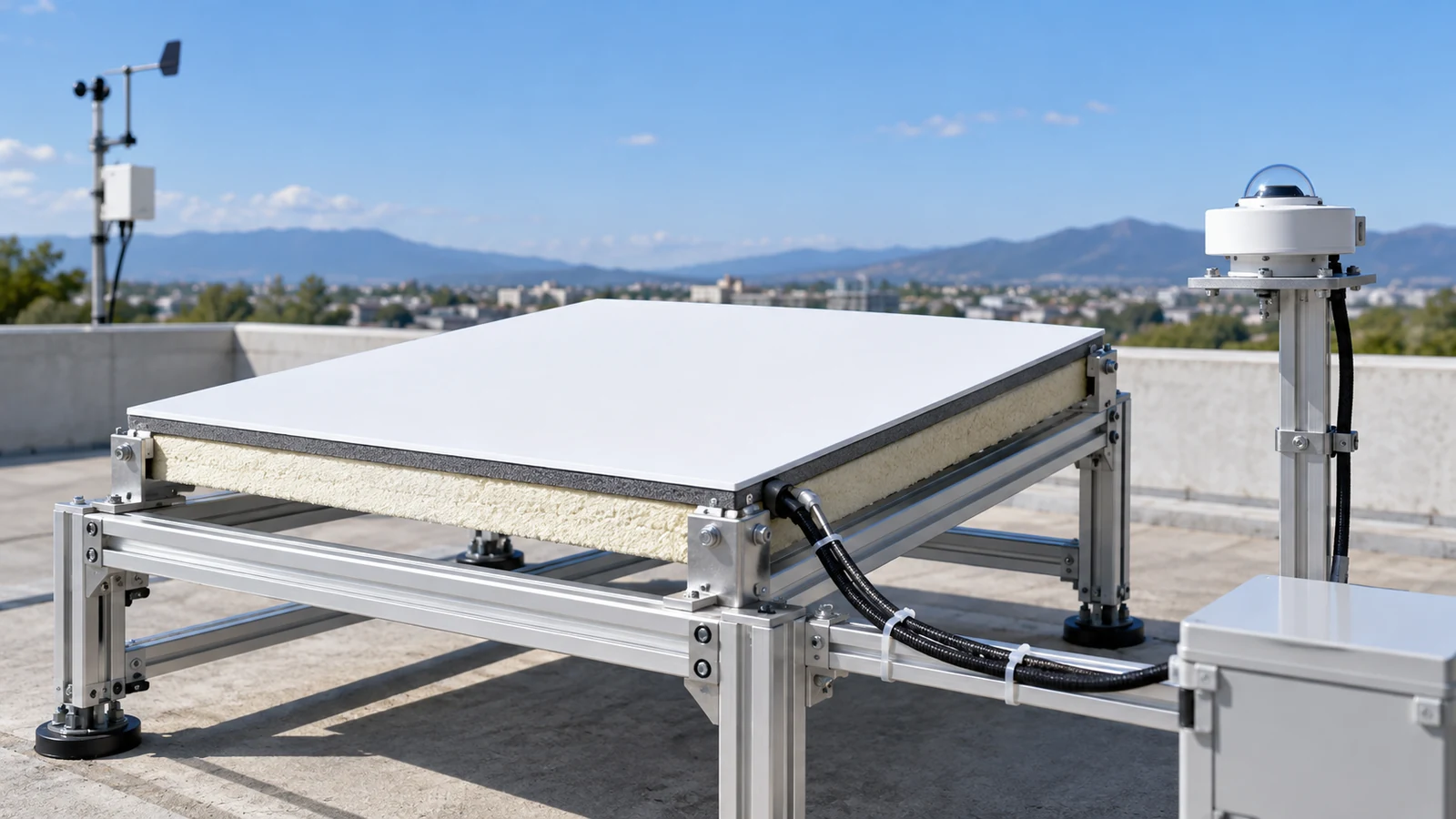
- What thermal management materials are (the short version)
- What carries heat — phonons and thermal conductivity
- Materials that conduct heat well — boron arsenide, and where composites fit
- Thermal switches and thermal diodes — switching (our calculation)
- Radiative cooling — reflecting sunlight and radiating infrared to space
- The “weight of the numbers” in radiative cooling — our calculation
- Thermal metamaterials — designing the flow of heat
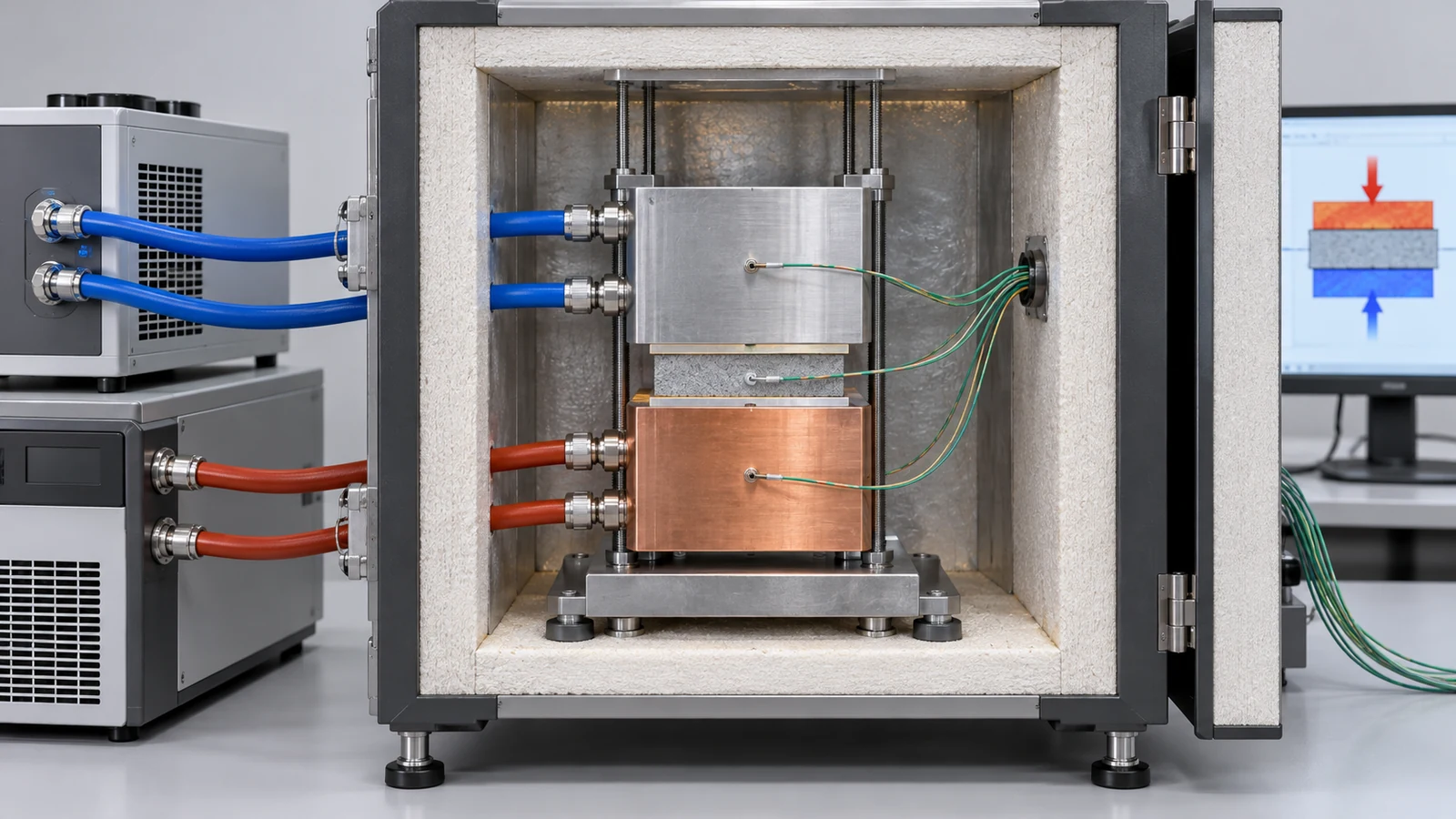
- Measurement methods and cautions — laser flash, hot disc, steady state
- How to read the evaluation standards
- Limits, and what could not be confirmed
- Glossary / References / Claim-to-source audit
Sourced = stated in published material (link given)
Our calculation = a figure this article derived, with the assumptions spelled out
Not yet confirmed = a plan or schedule whose record has not been confirmed
Materials-design interpretations are marked separately as Commentary. Inference is shown in bold.
The thermal conductivity, cooling power and temperature-drop figures are laboratory or outdoor test results that change with sample form (single crystal, thin film, coating, film), temperature, solar irradiance, weather and measurement method. Radiative-cooling reports differ in solar intensity and in the temperature they compare against, so the numbers are not ranked against each other. Please do not read laboratory champion data as the performance of a product or of the real environment (dirt, humidity, ageing).
1. What thermal management materials are (the short version)
- They design the motion of what carries heat (phonons and electrons): in solids that do not conduct electricity, most heat is carried by vibrations of the crystal lattice (phonons). Defects, interfaces, and the mass and bond strength of the atoms change thermal conductivity by orders of magnitude [Refs. 1, 3]
- There are four ways of use: moving heat fast (high conductivity), stopping it (insulation), switching it according to conditions (thermal switches and diodes), and sending it to the sky as infrared (radiative cooling). What is measured, and what is hard, differs for each
- The numbers carry conditions: thermal conductivity changes with temperature, direction, sample form and method, and in radiative cooling a change of 1% in solar reflectance moves a heat flow comparable to the cooling power (our calculation, Chapter 6)
Radiative cooling does not work with high emissivity alone; only by reflecting nearly 99% of sunlight does a surface cool below the surrounding air in daytime. In Raman and co-authors’ demonstration of daytime radiative cooling, a seven-layer optical multilayer reflected 97% of sunlight and emitted strongly in the atmospheric window, cooling to 4.9 °C below the surrounding air on a rooftop under sunlight above 850 W/m²Sourced[Ref. 7]. A few percent of difference in solar reflectance separates cooling from not cooling (our calculation, Chapter 6).
2. What carries heat — phonons and thermal conductivity
Thermal conductivity κ is carried mainly by electrons in metals, and mainly by lattice vibrations (phonons) in crystals that do not conduct electricity and in semiconductors. A rule of thumb for the phonon contribution is κ ≈ (1/3) × C × v × ℓ, where C is the heat capacity per unit volume, v the speed of the phonons and ℓ their mean free path (this article’s explanation). ℓ is shortened by defects, impurities, grain boundaries, interfaces, and scattering of phonons by each other (anharmonicity).
Kang and co-authors synthesized single crystals of boron arsenide (BAs) with no detectable defects and measured a room-temperature thermal conductivity of 1,300 W/(m·K). Spectroscopy and ab initio calculation indicated that the band structure of BAs allows very long phonon mean free paths and strong higher-order anharmonicity through four-phonon processes. They state that this value is higher than that of other metals and semiconductorsSourced[Ref. 1].
The 1,300 W/(m·K) of BAs is a value for a high-quality single crystal close to defect-free (Kang and co-authors say “no detectable defects”) [Ref. 1]. For the same composition, a polycrystal, a sintered powder or a thin film would be expected to have shorter ℓ from grain boundaries and defects, and a much lower value; this is the qualitative reading from κ ≈ C v ℓ/3 (Inference; values for polycrystalline or thin-film BAs were not checked in this article). When using a thermal-conductivity number in design, always look at the sample form (single crystal, sintered body, thin film or composite) and the temperature. “Thermal conductivity X W/(m·K)” with only a material name is not a usable number (this article’s commentary).
3. Materials that conduct heat well — boron arsenide, and where composites fit
In practical thermal management, what is used is less the best single-crystal value than composites in which resin or grease is packed with a highly conductive filler, graphite sheets and metals. These are handled as “thermal interface materials (TIM)” in this series’ explainers on thermal interface materials, thermal pads, heat sinks, and high-conductivity pastes and gap fillers (adhesives and encapsulants field). Three points are worth keeping here.
- A material’s conductivity and the thermal resistance of an assembly are different things: real thermal resistance is also set by thickness and by the poor quality of contact (TIM explainer). A Laird presentation lists ASTM D5470 (for thick materials), ISO 22007-2 (hot disc) and laser flash as test methods for thermal conductivity, and says D5470 cannot measure anisotropy and is difficult for thin, high-performance materials such as grease and phase change materialsSourced[Ref. 15].
- Anisotropy: ISO 22007-2 gives guidance for testing homogeneous isotropic materials and anisotropic materials with a uniaxial structureSourced[Ref. 20]. For a material whose value differs by direction, such as graphite, always state in-plane or through-thickness (commentary).
- Relation to PCMs: compounding with graphite and the like to make up for the low thermal conductivity of a PCM is covered in this series’ explainer on phase change materials and thermal storage.
4. Thermal switches and thermal diodes — switching (our calculation)
A thermal switch is a device whose thermal conduction is made larger or smaller by an external signal; a thermal diode (thermal rectifier) is one whose thermal conduction differs with the direction of heat flow. The review by Li and co-authors (Rev. Mod. Phys. 2012) says that phonons can be manipulated like electrons and photons, and that analogues of electronic devices such as thermal diodes, thermal transistors, thermal logic gates and memories can be envisagedSourced[Ref. 3]. Two experimental examples follow.
- Thermal rectification (Chang and co-authors, 2006): when high-conductivity carbon and boron nitride nanotubes were mass-loaded externally and inhomogeneously with heavy molecules, they showed asymmetric thermal conductance with more heat flowing in the direction of decreasing mass density. The effect could not be explained by ordinary perturbative wave theories, and the authors suggest that solitons may be involvedSourced[Ref. 4].
- Electrochemical thermal transistor (Sood and co-authors, 2018): reversible electrochemical lithium intercalation in MoS2 thin films gave switchable thermal conductance with an order-of-magnitude on/off ratio. In the lithiated state the film’s thickness and surface roughness increased, and the authors report that phonons are scattered by lithium “rattler” modes, c-axis strain and stacking disorderSourced[Ref. 5].
Let the on-state thermal resistance of the switching element be R, its off-state resistance r × R (r: the material’s on/off ratio), and the other series thermal resistance in the path x × R. The overall on/off ratio is (r × R + x × R)/(R + x × R) = (r + x)/(1 + x)Our calculation. For r = 10, x = 0 gives 10, x = 0.25 gives 8.2, x = 1 gives 5.5, x = 3 gives 3.25 and x = 9 gives 1.9.
Assumptions and limits: a simple path with series resistances only. In real equipment the path includes parallel branches, and r itself changes with temperature difference and temperature. The point is that an element’s own “order-of-magnitude on/off ratio” is nearly halved if the other resistances (contacts, thermal interfaces, the heat-rejection side) are comparable to the element’s on-state resistance.
The switching in Sood and co-authors’ device works by changing phonon scattering inside the material through lithium insertion and removal [Ref. 5]. From the materials side, how high the on-state conductivity can be kept (without letting other resistances dominate) decides practicality as a switching element. If thin-film or interface resistance is large, however far the material’s off-state conductivity falls, the overall ratio does not grow (calculation above). Also, Chang and co-authors’ thermal rectification and Sood and co-authors’ thermal transistor are demonstrations in nanoscale devices, and are not necessarily performance that can be used unchanged in macroscopic systems such as building materials or refrigerators. The review mentions thermal logic and thermal management as possible applications [Refs. 3, 4], but the performance of practical devices has not been confirmed in this article.
5. Radiative cooling — reflecting sunlight and radiating infrared to space
Radiative cooling is the phenomenon in which an object radiates heat to space as infrared. The atmosphere has a “window” that transmits infrared of wavelength 8–13 µm, and heat can be radiated to space through it. At night, temperatures below the surrounding air can be reached without electricity, but in daytime the object is warmed by sunlight, and cooling it below the surroundings has been considered difficult. Raman and co-authors, with an optical multilayer of seven layers of HfO2 and SiO2, reflected 97% of sunlight while emitting strongly in the atmospheric window, and demonstrated cooling to about 5 °C (4.9 °C) below the surrounding air under direct sunlight (above 850 W/m²), with a cooling power of 40.1 W/m² at ambient temperatureSourced[Ref. 7].
| Report (sample form) | Reported values | Note when reading |
|---|---|---|
| Raman et al. (2014): seven-layer HfO2/SiO2 optical multilayer | Reflects 97% of sunlight. On a rooftop under sunlight above 850 W/m², 4.9 °C below the surrounding air, cooling power 40.1 W/m² at ambient temperature [7] | An optical multilayer. The conditions are one rooftop example |
| Zhai et al. (2017): a “randomized” metamaterial of glass microspheres dispersed in a polymer (with silver backing) | Emissivity above 0.93 across the window. Cooling power 93 W/m² at noon under direct sunshine. Roll-to-roll manufacturing demonstrated [8] | A construction in which sunlight passes through, with the silver backing reflecting it |
| Mandal et al. (2018): hierarchically porous polymer coating P(VdF-HFP) | Hemispherical solar reflectance 0.96 ± 0.03 (substrate-independent), long-wave infrared emittance 0.97 ± 0.02. About 6 °C below ambient and cooling power about 96 W/m² under solar intensities of 890 and 750 W/m² respectively [9] | The authors stress paint-like simplicity. Two solar conditions are stated |
| Li et al. (2021): film of electrospun polymer nanofibres | Selective emissivity of 78% at 8–13 µm, reflectivity of 96.3% at 0.3–2.5 µm. About 3 °C better than a non-selective emitter at night, and 5 °C below ambient under sunlight [10] | An example of a selective emitter |
All Sourced (statements in each reference). Solar intensity, weather, reference temperature and sample form differ from row to row, so the rows are not ranked against each other. The definition of cooling power (the value at ambient temperature, or under a particular sunlight) also differs between reports. The review by Yin and co-authors summarizes progress in materials for subambient daytime cooling and the widening of applications through scalable manufacturing [11].
6. The “weight of the numbers” in radiative cooling — our calculation
Our calculation
- Blackbody radiation: a blackbody at 300 K radiates over all wavelengths σT&sup4; = 5.67 × 10−8 × 3004 = about 459 W/m². Integrating Planck’s law over 8–13 µm gives about 148 W/m² (about 32% of the total)
- Absorbed sunlight: of the solar irradiance G (W/m²), the part not reflected, G × (1 − ρs) for solar reflectance ρs, becomes heat. For G = 850 W/m², ρs = 0.97 gives about 25.5 W/m², 0.94 gives about 51.0 W/m² and 0.90 gives about 85.0 W/m²
- Comparison: against the cooling power of 40.1 W/m² at ambient temperature in Raman and co-authors’ work, a 3-point fall in solar reflectance from 0.97 to 0.94 adds 25.5 W/m² of absorption, which is about 64% of the cooling power
Assumptions and limits: the blackbody radiation is the value for an ideal emitter (emissivity 1); in practice it is offset by back-radiation from the atmosphere and by convective and conductive heat exchange. The 850 W/m² is an example borrowed from the test conditions of Raman and co-authors. The comparison here is a guide to magnitude and sensitivity and not a prediction of the cooling power of real equipment.
Because the cooling power is the same order as the absorbed sunlight, maintaining reflectance is the core of performance. Mandal and co-authors say the high solar reflectance of their coating is independent of the substrate [Ref. 9]. From the materials side, a thin coating lets the substrate show through and absorb sunlight, so a reflectance independent of the substrate at sufficient thickness is needed (this article’s commentary). Outdoors, dirt, ultraviolet degradation and moisture change reflectance and emissivity. CRRC, the rating program for roofing products, prepares measurements after three years of outdoor exposure (or an accelerated method) in addition to testing of new productSourced[Ref. 16]. Many values in papers come from short tests on new samples, so solar reflectance and emissivity after ageing have to be confirmed separately (Inference; whether the individual papers contain durability tests was not checked in this article).
7. Thermal metamaterials — designing the flow of heat
Thermal metamaterials are artificial structures that combine several materials to guide heat flow in ways natural materials do not. Narayana and Sato (2012) designed and built a multilayered composite and showed experimentally that diffusive heat flow can be shielded, concentrated and invertedSourced[Ref. 12]. The review by Li and co-authors (Nature Reviews Materials 2021) organizes thermal conductivity in conduction, emissivity in radiation, and multiphysical effects (introducing heat sources, external tuning of properties) as complementary frameworks for controlling heat flow with artificial structures, and discusses challenges and new possibilities (topological thermal effects, heat waves, quantum thermal effects)Sourced[Ref. 13].
Designs that bend heat paths with layered composites use the ratio of thermal conductivities between materials. From the materials side, a large ratio needs a highly conductive material on one side and a poorly conductive one on the other, and the thermal resistance of the bonded interfaces cuts into design freedom (this article’s commentary). What Narayana and Sato showed was mainly the control of diffusive thermal conduction [Ref. 12], and the same effect is not guaranteed in real environments involving radiation or convection. Product-scale performance has not been confirmed in this article.
8. Measurement methods and cautions — laser flash, hot disc, steady state
Thermal conductivity is measured by several methods, each suited to different samples and with its own cautions. The flash method reported by Parker and co-authors in 1961 applies a short light pulse to the front face of a specimen, determines the thermal diffusivity from the temperature history of the rear face, and obtains the thermal conductivity as the product of heat capacity, thermal diffusivity and densitySourced[Ref. 6].
| Method | What is measured | Scope and cautions confirmed |
|---|---|---|
| Flash method (laser or light) | Thermal diffusivity (through thickness). Thermal conductivity is calculated as diffusivity × specific heat × density | ISO 22007-4:2024: a thin disc of plastics or composites. Thermal diffusivity 1 × 10⁻⁷ to 1 × 10⁻⁴ m²/s, −100 to +400 °C. For inhomogeneous specimens the value may depend on thickness [14]. ISO 18755:2022: homogeneous ceramics with porosity below 10%. Thermal diffusivity 0.1–1,000 mm²/s, about 100–2,300 K [19] |
| Hot-disc (transient plane source) method | Thermal conductivity and thermal diffusivity (volumetric specific heat can also be derived) | ISO 22007-2:2022: thermal conductivity about 0.010–500 W/(m·K), thermal diffusivity 5 × 10⁻⁸ to 10−4 m²/s, about 50–1,000 K. For homogeneous isotropic materials and anisotropic materials with a uniaxial structure. No thermal barrier within the probing depth of the probe [20] |
| Steady-state methods (heat flow meter, guarded hot plate) | Steady-state thermal resistance and conductivity of flat slabs | ISO 8301:1991 (heat flow meter apparatus) [21], ISO 8302:1991 (guarded hot plate apparatus) [22]. Both are thermal-insulation standards and cover flat slab specimens |
| Tests for TIMs | Thermal conductivity and thermal resistance (including contact) | A Laird presentation lists ASTM D5470 for thermal conductivity and thermal resistance of thick materials, and says it cannot measure anisotropy, is difficult for thin high-performance materials such as grease and phase change materials, and must be combined with real-application tests [15] |
| Thin films and nanostructures | Thermal conductivity and thermal conductance of films | Sood and co-authors used spatially resolved time-domain thermoreflectance (TDTR) to map the lithium distribution [5]. A standard for thin-film measurement could not be confirmed in this article |
All Sourced (sources in each cell). Scopes are as stated on the official page of each standard; the conditions in the texts were not checked.
In the flash method the time for heat to diffuse across a thickness L is proportional to L²/α (α: thermal diffusivity), a general property of diffusion and this article’s explanation. So when α is found from a measured time, α is proportional to L²Our calculation. For a 2 mm specimen, a 0.1 mm (5%) error in the thickness measurement shifts α by about 10% (2 × 5%), and κ = α × specific heat × density moves by the same amount. Assumptions and limits: surface finish, heat loss and pulse-width corrections are not included. As shown in this series’ explainer on thermoelectric materials, the measurement of specific heat is more uncertain than that of thermal diffusivity, and the error in thermal conductivity is a combination of them.
9. How to read the evaluation standards
The performance of thermal management materials is evaluated by thermal conductivity, thermal diffusivity and thermal resistance (how readily heat passes), and for radiative cooling by solar reflectance and emissivity in the atmospheric window. Thermal conductivity is measured by the methods above, and solar reflectance is generally measured with a spectrophotometer and an integrating sphere (this article’s explanation). Test standards for thermal conductivity are well established in ISO and JIS, but standards for measuring the performance of thermal switches, thermal diodes and thermal metamaterials could not be confirmed. For radiative cooling, standards for the solar reflectance and thermal emittance of roofing materials and paints form the foundation for evaluating cooling performance.
| Item evaluated | ISO | IEC / IEEE | JIS | ASTM | What changes the value with test conditions |
|---|---|---|---|---|---|
| Thermal diffusivity and conductivity (flash method) | ISO 22007-4:2024, plastics, determination of thermal conductivity and thermal diffusivity, Part 4: light flash method [14]. ISO 18755:2022, fine ceramics, determination of thermal diffusivity of monolithic ceramics by flash method [19] | Could not be confirmed | JIS H 7801, measurement of thermal diffusivity of metals by the laser flash method (enacted 2005, confirmed 2024) [24]. JIS R 1611, measurement methods of thermal diffusivity, specific heat capacity and thermal conductivity of fine ceramics by flash method [23] | ASTM E1461 (thermal diffusivity by the flash method): listed by an instrument maker as a standard it complies with [29] | Specimen thickness and homogeneity, surface coating, temperature, atmosphere |
| Thermal conductivity and diffusivity (hot-disc method) | ISO 22007-2:2022, Part 2: transient plane heat source (hot disc) method [20] | Could not be confirmed | Could not be confirmed | Could not be confirmed | Whether the specimen is large enough relative to the probing depth, anisotropy, temperature |
| Steady-state methods (thermal resistance, conductivity) | ISO 8301:1991 (heat flow meter apparatus) [21], ISO 8302:1991 (guarded hot plate apparatus) [22] | Could not be confirmed | JIS A 1412-2, measurement of thermal resistance and thermal conductivity of thermal insulations, Part 2: heat flow meter method (enacted 1999, confirmed 2021) [28] | ASTM D5470: listed by a Laird presentation as a test for the thermal conductivity and resistance of TIMs [15] | Specimen thickness, pressure, temperature, contact. Some methods cannot measure anisotropy [15] |
| Solar reflectance | Could not be confirmed | Could not be confirmed | JIS K 5602, how to determine the solar reflectance of paint films (enacted 2008, confirmed 2023) [25]. JIS K 5675, high solar reflectance paints for roofs (enacted 2011, confirmed 2021) [26] | ASTM E903, ASTM E1918 and ASTM C1549: CRRC lists them as test methods for the solar reflectance of roofing products. ANSI/CRRC S100 (2025) is an American National Standard for measuring initial and aged solar reflectance and thermal emittance of roofing and wall products [16, 17] | Wavelength range, hemispherical or specular, the substrate under the sample, new or aged |
| Thermal emittance | Could not be confirmed | Could not be confirmed | JIS R 3106, testing method on transmittance, reflectance and emittance of flat glasses and evaluation of solar heat gain coefficient (enacted 1985; for flat glass) [27] | ASTM C1371: CRRC lists it as a test method for the thermal emittance of roofing products [16] | Total emittance, or emissivity in the atmospheric window (8–13 µm). A standard directly targeting the window emissivity could not be confirmed |
| Ageing and durability | Could not be confirmed | Could not be confirmed | Could not be confirmed | ASTM D7897: a practice that CRRC uses in its rapid rating for simulated soiling and weathering of roofing products [18]. CRRC asks for measurements when new, after laboratory ageing and after three years outdoors [16] | Dirt, ultraviolet light, moisture, regional weather |
| Thermal switches, thermal diodes, thermal metamaterials | Could not be confirmed | Could not be confirmed | Could not be confirmed | Could not be confirmed | There is no test standard, and conditions (temperature difference ΔT, direction) differ between papers |
Numbers, titles and editions were confirmed on the official page of each body Sourced. For ASTM, only the number and the quantity measured are given, only where confirmed from non-ASTM public material (CRRC, instrument makers, a Laird presentation). The arrangement of this table is Our calculation (this article’s rearrangement).
Notes on reading standards
- A standard is a “test method”, not a guarantee of material performance. JIS K 5675 is a standard for high-solar-reflectance paints for roofs, but this article did not check its text and states no numerical criteria. A standard measuring radiative-cooling performance (how far below ambient a surface cools) could not be confirmed
- Read solar-reflectance standards separating “new” and “aged”. CRRC asks for both new and three-year outdoor measurements [16], so a value for a new sample in a paper does not show real-environment performance
- Standards for the thermal conductivity of plastics cannot be applied unchanged to metals or ceramics. ISO 22007-4 covers plastics and composites, ISO 18755 ceramics and JIS H 7801 metals. Choose the standard closest to the sample and align thickness and surface treatment
10. Limits, and what could not be confirmed
(1) Standard texts
The texts of ISO 22007, ISO 18755, ISO 8301 and 8302, and the JIS standards were not checked. Test conditions, procedures and acceptance criteria are not stated. The ASTM website was not opened, and ASTM standards are given only as the numbers and quantities measured confirmed in CRRC, instrument-maker and Laird material.
(2) Performance of radiative cooling in real environments
The numbers in Chapters 5 and 6 are reports of particular rooftop or outdoor tests; the effects of weather (humidity, cloud), dirt and ageing were not confirmed quantitatively. The general explanation that the atmospheric window narrows with humidity or cloud was not given a quantitative value in this article’s sources, so no figure is stated. Markets and prices for radiative-cooling products are not covered.
(3) Practical performance of thermal switches and diodes
The size of the rectification ratio in Chang and co-authors’ work, and the response speed and cycling durability of Sood and co-authors’ device, were not confirmed here. Another review (Wehmeyer and co-authors, Applied Physics Reviews 2017) was confirmed as a bibliographic record only and its content was not consulted [Ref. 2].
(4) Comparison of highly conductive materials
Thermal conductivities of diamond, graphite and metals were not confirmed in primary sources and no values are stated. Comparison with measurements of BAs by other research groups was not checked either.
(5) Regulation
The application of building and energy-efficiency codes or certification schemes (in Japan or elsewhere) was not checked and is not stated.
- Thermal conductivity is set by the phonon mean free path. A room-temperature value of 1,300 W/(m·K) has been reported for a boron arsenide single crystal close to defect-free, and the basic expectation is that defects, grain boundaries and interfaces lower itSourced
- A thermal switch’s on/off ratio is diluted by system design. Even if the element’s own ratio is 10, the whole is 5.5 when another series resistance equals the element’s on-state resistanceOur calculation
- In radiative cooling, reflecting sunlight is decisive. At 850 W/m² of sunlight, a fall in reflectance from 0.97 to 0.94 adds 25.5 W/m² of absorption, the same order as the reported cooling powers (40.1–96 W/m²)Our calculation / Sourced
- Each measurement method has its own scope, and there are no standards for thermal switches or thermal metamaterials. In the flash method, error in thickness counts squaredOur calculation
11. Glossary
- Phonon
- The quantum of lattice vibration of a crystal. Carries heat in insulators and semiconductors.
- Mean free path
- The average distance a phonon travels without being scattered.
- Anharmonicity
- Scattering of phonons by each other because interatomic forces are not spring-like.
- Thermal switch
- A device whose thermal conduction is made larger or smaller by an external signal.
- Thermal diode
- A device whose thermal conduction differs with direction of heat flow (thermal rectifier).
- On/off ratio
- The ratio of thermal conduction (conductance) in the on and off states.
- Atmospheric window
- The wavelength band (8–13 µm) in which the atmosphere transmits infrared well.
- Solar reflectance
- The fraction of sunlight (about 0.3–2.5 µm) that is reflected.
- Emissivity
- The ratio of thermal radiation to that of a blackbody at the same temperature.
- Cooling power
- The net heat lost per unit area by radiative cooling (W/m²). The definition differs between reports.
- Thermal metamaterial
- An artificial structure that guides heat flow in ways natural materials do not.
- Flash method
- Heating the front of a specimen with a light pulse and finding thermal diffusivity from the temperature change at the rear.
12. References
- Kang J. S. et al. “Experimental observation of high thermal conductivity in boron arsenide”, Science 361, 575–578 (2018), DOI 10.1126/science.aat5522 — doi.org/10.1126/science.aat5522
- Wehmeyer G. et al. “Thermal diodes, regulators, and switches: Physical mechanisms and potential applications”, Appl. Phys. Rev. 4, 041304 (2017), DOI 10.1063/1.5001072 (bibliographic record only) — doi.org/10.1063/1.5001072
- Li N. et al. “Colloquium: Phononics: Manipulating heat flow with electronic analogs and beyond”, Rev. Mod. Phys. 84, 1045 (2012), DOI 10.1103/RevModPhys.84.1045 (arXiv abstract checked) — doi.org/10.1103/RevModPhys.84.1045
- Chang C. W. et al. “Solid-State Thermal Rectifier”, Science 314, 1121–1124 (2006), DOI 10.1126/science.1132898 — doi.org/10.1126/science.1132898
- Sood A. et al. “An electrochemical thermal transistor”, Nat. Commun. 9, 4510 (2018), DOI 10.1038/s41467-018-06760-7 (open access) — doi.org/10.1038/s41467-018-06760-7
- Parker W. J. et al. “Flash Method of Determining Thermal Diffusivity, Heat Capacity, and Thermal Conductivity”, J. Appl. Phys. 32, 1679–1684 (1961), DOI 10.1063/1.1728417 — doi.org/10.1063/1.1728417
- Raman A. P. et al. “Passive radiative cooling below ambient air temperature under direct sunlight”, Nature 515, 540–544 (2014), DOI 10.1038/nature13883 — doi.org/10.1038/nature13883
- Zhai Y. et al. “Scalable-manufactured randomized glass-polymer hybrid metamaterial for daytime radiative cooling”, Science 355, 1062–1066 (2017), DOI 10.1126/science.aai7899 — doi.org/10.1126/science.aai7899
- Mandal J. et al. “Hierarchically porous polymer coatings for highly efficient passive daytime radiative cooling”, Science 362, 315–319 (2018), DOI 10.1126/science.aat9513 — doi.org/10.1126/science.aat9513
- Li D. et al. “Scalable and hierarchically designed polymer film as a selective thermal emitter for high-performance all-day radiative cooling”, Nat. Nanotechnol. 16, 153–158 (2021), DOI 10.1038/s41565-020-00800-4 — doi.org/10.1038/s41565-020-00800-4
- Yin X. et al. “Terrestrial radiative cooling: Using the cold universe as a renewable and sustainable energy source”, Science 370, 786–791 (2020), DOI 10.1126/science.abb0971 — doi.org/10.1126/science.abb0971
- Narayana S., Sato Y. “Heat Flux Manipulation with Engineered Thermal Materials”, Phys. Rev. Lett. 108, 214303 (2012), DOI 10.1103/PhysRevLett.108.214303 — doi.org/10.1103/PhysRevLett.108.214303
- Li Y. et al. “Transforming heat transfer with thermal metamaterials and devices”, Nat. Rev. Mater. 6, 488–507 (2021), DOI 10.1038/s41578-021-00283-2 (arXiv abstract checked) — doi.org/10.1038/s41578-021-00283-2
- ISO “ISO 22007-4:2024” (Edition 3, January 2024) — iso.org/standard/86202.html
- Strader J. et al. (Laird) “Thermal Interface Materials (TIMs) and Challenges Faced by TIM Suppliers”, Thermal & Fluids Analysis Workshop TFAWS 2014 (NASA Glenn Research Center, presentation) — s3vi.ndc.nasa.gov (TFAWS-2014-PT-06)
- Cool Roof Rating Council (CRRC) “Roof Rating Program” (test methods and three-year outdoor exposure) — coolroofs.org/programs/roof-rating-program
- Cool Roof Rating Council (CRRC) “ANSI/CRRC S100 Standard” (2025) — coolroofs.org/resources/ansi-crrc-s100
- Cool Roof Rating Council (CRRC) “Testing FAQs” (rapid rating and ASTM D7897) — coolroofs.org/…/testing-faqs
- ISO “ISO 18755:2022” (Edition 2, December 2022) — iso.org/standard/81531.html
- ISO “ISO 22007-2:2022” (Edition 3, June 2022) — iso.org/standard/81836.html
- ISO “ISO 8301:1991” (Edition 1, reconfirmed in 2025) — iso.org/standard/15421.html
- ISO “ISO 8302:1991” (Edition 1, reconfirmed in 2024) — iso.org/standard/15422.html
- Japanese Industrial Standards Committee (JISC) “JIS R 1611” search result and detail page (enacted 1 November 1991, last revised 21 September 2010, last confirmed 20 October 2025) — jisc.go.jp (JIS R 1611)
- Japanese Industrial Standards Committee (JISC) “JIS H 7801” search result and detail page (enacted 20 February 2005, last confirmed 21 October 2024) — jisc.go.jp (JIS H 7801)
- Japanese Industrial Standards Committee (JISC) “JIS K 5602” search result and detail page (enacted 20 September 2008, last confirmed 20 October 2023) — jisc.go.jp (JIS K 5602)
- Japanese Industrial Standards Committee (JISC) “JIS K 5675” search result and detail page (enacted 20 July 2011, last confirmed 20 October 2021) — jisc.go.jp (JIS K 5675)
- Japanese Industrial Standards Committee (JISC) “JIS R 3106” search result and detail page (enacted 1 February 1985) — jisc.go.jp (JIS R 3106)
- Japanese Industrial Standards Committee (JISC) “JIS A 1412-2” search result and detail page (enacted 20 April 1999, last confirmed 20 October 2021) — jisc.go.jp (JIS A 1412-2)
- NETZSCH “LFA 467 HyperFlash” (statement of compliant standards, including ASTM E1461, ISO 22007-4 and ISO 18755) — analyzing-testing.netzsch.com (LFA 467)
13. Claim-to-source audit
| Claim in the text | Basis | Class |
|---|---|---|
| BAs single crystal room-temperature thermal conductivity of 1,300 W/(m·K), crystals with no detectable defects, long phonon mean free paths and four-phonon anharmonicity, and the authors’ statement that it is higher than other metals and semiconductors | Kang et al. (Science 2018) Reference 1 https://doi.org/10.1126/science.aat5522 | Sourced |
| The existence of a review of thermal switches and diodes (Applied Physics Reviews 2017, bibliographic record only) | Crossref bibliographic record Reference 2 https://doi.org/10.1063/1.5001072 | Sourced |
| The review’s statement that phonons can be manipulated like electrons and photons and that analogues of thermal diodes, transistors, logic gates and memories can be envisaged | Abstract of Li et al. (Rev. Mod. Phys. 2012) Reference 3 https://doi.org/10.1103/RevModPhys.84.1045 | Sourced |
| Nanotube thermal rectification (heavy molecules loaded inhomogeneously on the outside, more heat flowing in the direction of decreasing mass density, possible solitons) | Chang et al. (Science 2006) Reference 4 https://doi.org/10.1126/science.1132898 | Sourced |
| Thermal transistor by lithium intercalation in MoS2 thin films (order-of-magnitude on/off ratio, increased thickness and roughness, causes of phonon scattering, TDTR) | Sood et al. (Nat. Commun. 2018) Reference 5 https://doi.org/10.1038/s41467-018-06760-7 | Sourced |
| The principle of the flash method (light pulse, thermal diffusivity from the rear-face temperature history, conductivity as the product of heat capacity, diffusivity and density) | Abstract of Parker et al. (J. Appl. Phys. 1961) Reference 6 https://doi.org/10.1063/1.1728417 | Sourced |
| Seven-layer HfO2/SiO2 reflecting 97% of sunlight, rooftop under sunlight above 850 W/m², 4.9 °C below ambient, cooling power 40.1 W/m², atmospheric window of 8–13 µm | Raman et al. (Nature 2014) Reference 7 https://doi.org/10.1038/nature13883 | Sourced |
| Glass-microsphere/polymer metamaterial (emissivity above 0.93, 93 W/m² at noon with silver backing, roll-to-roll) | Zhai et al. (Science 2017) Reference 8 https://doi.org/10.1126/science.aai7899 | Sourced |
| Porous P(VdF-HFP) coating (hemispherical solar reflectance 0.96 ± 0.03, substrate-independent, emittance 0.97 ± 0.02, about 6 °C drop, about 96 W/m², solar intensities of 890 and 750 W/m²) | Mandal et al. (Science 2018) Reference 9 https://doi.org/10.1126/science.aat9513 | Sourced |
| Electrospun nanofibre film (78% emissivity at 8–13 µm, 96.3% reflectivity at 0.3–2.5 µm, about 3 °C improvement at night, 5 °C drop under sunlight) | Li et al. (Nat. Nanotechnol. 2021) Reference 10 https://doi.org/10.1038/s41565-020-00800-4 | Sourced |
| Progress in materials for subambient daytime radiative cooling and the widening of applications through scalable manufacturing | Abstract of Yin et al. (Science 2020) Reference 11 https://doi.org/10.1126/science.abb0971 | Sourced |
| Shielding, concentrating and inverting heat flow with a multilayered composite | Narayana and Sato (Phys. Rev. Lett. 2012) Reference 12 https://doi.org/10.1103/PhysRevLett.108.214303 | Sourced |
| The review’s framework for thermal metamaterials (conductivity, emissivity, multiphysical effects; outlook to topological, heat-wave and quantum thermal effects) | Abstract of Li et al. (Nat. Rev. Mater. 2021) Reference 13 https://doi.org/10.1038/s41578-021-00283-2 | Sourced |
| Numbers, titles, editions and scope of ISO 22007-4:2024, ISO 18755:2022, ISO 22007-2:2022, ISO 8301:1991 and ISO 8302:1991 | ISO standard pages Reference 14 https://www.iso.org/standard/86202.html Reference 19 https://www.iso.org/standard/81531.html Reference 20 https://www.iso.org/standard/81836.html Reference 21 https://www.iso.org/standard/15421.html Reference 22 https://www.iso.org/standard/15422.html | Sourced |
| That the presentation lists ASTM D5470, ISO 22007-2 and laser flash as tests of TIM thermal conductivity, and that D5470 cannot measure anisotropy and is difficult for thin high-performance materials | Laird presentation (NASA TFAWS 2014) Reference 15 https://s3vi.ndc.nasa.gov/ssri-kb/static/resources/TFAWS-2014-PT-06.pdf | Sourced |
| Test methods for the solar reflectance of roofing products (ASTM C1549, E1918, E903 and others), for thermal emittance (ASTM C1371 and others), new and three-year outdoor exposure, ANSI/CRRC S100 (2025), and ASTM D7897 in the rapid rating | CRRC pages (non-ASTM public material) Reference 16 https://coolroofs.org/programs/roof-rating-program Reference 17 https://coolroofs.org/resources/ansi-crrc-s100 Reference 18 https://coolroofs.org/programs/product-testing-and-weathering/testing-faqs | Sourced |
| Numbers, titles, enactment dates and confirmation dates of JIS R 1611, H 7801, K 5602, K 5675, R 3106 and A 1412-2 | JISC database Reference 23 https://www.jisc.go.jp/app/jis/general/GnrJISNumberNameSearchList?show&jisStdNo=R1611 Reference 24 https://www.jisc.go.jp/app/jis/general/GnrJISNumberNameSearchList?show&jisStdNo=H7801 Reference 25 https://www.jisc.go.jp/app/jis/general/GnrJISNumberNameSearchList?show&jisStdNo=K5602 Reference 26 https://www.jisc.go.jp/app/jis/general/GnrJISNumberNameSearchList?show&jisStdNo=K5675 Reference 27 https://www.jisc.go.jp/app/jis/general/GnrJISNumberNameSearchList?show&jisStdNo=R3106 Reference 28 https://www.jisc.go.jp/app/jis/general/GnrJISNumberNameSearchList?show&jisStdNo=A1412-2 | Sourced |
| That ASTM E1461 is listed by an instrument maker alongside ISO 22007-4 and ISO 18755 as a standard it complies with (the ASTM website was not consulted) | NETZSCH page (non-ASTM public material) Reference 29 https://analyzing-testing.netzsch.com/en/footer/legacy-products/lfa-467-hyper-flash-light-flash-apparatus | Sourced |
| The dilution of a switch’s on/off ratio ((r + x)/(1 + x): 10, 8.2, 5.5, 3.25, 1.9), blackbody radiation at 300 K (459 W/m²) and its integral over 8–13 µm (about 148 W/m²), absorbed sunlight (25.5, 51.0, 85.0 W/m²), the comparison with cooling power (about 64%), the thickness error in the flash method (5% to about 10%), and the arrangement of the standards table | Our calculation. Assumptions and limits are stated in each place (series resistances only, ideal blackbody, 850 W/m² as an example, and so on) | Our calculation |
| The texts of standards, test standards for thermal switches, diodes and metamaterials, performance of radiative cooling in real environments (humidity, cloud, ageing), thermal conductivities of diamond, graphite and metals, measurements of BAs by other groups, rectification ratios and device durability, and application to codes and certification | Could not be confirmed in the primary sources accessible within the scope of this survey, so they are not stated | Commentary |
| The readings that “thermal conductivity is also an index of crystal perfection”, “a thermal switch is decided by system design”, “radiative cooling is whiteness, thickness and years”, and “practicality of thermal metamaterials is set by the limits of material combinations”. The κ ≈ C v ℓ/3 rule of thumb and the concepts in Figs. 2 and 4 | This article’s arrangement and commentary based on published content. Not views stated by any institution or company | Commentary |
| That Figs. 2, 3, 4 and 5 are explanatory drawings, not real observations or data, and that Figs. 1 and 6 are AI-generated images | Note by this article | Commentary |
Last updated 10 October 2026. Sources are limited to primary material (peer-reviewed papers, public material from CRRC and Laird (NASA), and standards-body pages). The texts of standards are paid and could not be checked. The ASTM International website was not consulted. Because the article includes structural readings and materials-design interpretations, those are marked as Commentary and kept separate from sourced fact. The texts of standards, test standards for thermal switches, thermal diodes and thermal metamaterials, performance of radiative cooling in real environments, thermal conductivities of diamond, graphite and metals, rectification ratios and device durability, and application to codes and certification could not be confirmed and are not stated here. The thermal conductivity, cooling power and temperature-drop figures are results for particular samples and test conditions and cannot be generalised to other samples or real environments. All figures are explanatory concept graphics. Figs. 2, 3, 4 and 5 are vector drawings; Figs. 1 and 6 are AI-generated images, and none of them shows a real cross-section, micrograph or physical product.