TECHNOLOGY EXPLAINER
In-orbit servicing and space debris
— Life extension, refuelling and debris removal, the state of debris, and mitigation guidelines
Pieces of retired satellites and rockets stay in orbit as space debris. This article is written so that a materials engineer with no background in spaceflight can follow it: (1) the state of debris, with public-agency figures and dates, (2) why even small fragments are dangerous (the energy at about 10 km/s), (3) the shielding materials that protect satellites, (4) guidelines and standards for not creating debris, and (5) the idea of "in-orbit servicing" - life extension, refuelling and removal - and the state of demonstrations. Demonstration missions are described by separating achievements from planned, unconfirmed ones. No legal advice is given.
- The short version / what to know first / place in the series
- The state of debris: counts and residence time, dated
- Why small fragments are dangerous: energy, with numbers
- Protecting materials: shielding that breaks and catches fragments
- Not creating: mitigation guidelines and standards
- Three kinds of in-orbit service
- State of demonstration missions: separating achievements from plans
- A materials engineer's view
- Yardsticks and standards / glossary / references / audit
Sourced = stated in a published source (link given)
Our calculation = a value this article calculated from stated assumptions
Not yet confirmed = company targets and plans, pending applications and proceedings — anything not settled
Inference is shown in bold. Every analogy comes with its limits.
The energy numbers in Chapter 3 are explanatory values calculated here. Debris counts are written as they appear in NASA and ESA documents, with a check date (17 October 2026). Model estimates and the catalogue of objects actually tracked are kept apart. Missions are described by separating confirmed achievements from plans that are not yet settled. This field moves fast, so statuses are as of the check date.
1. The short version, what to know first, and where this fits
- The number is growing: ESA estimates about 68,000 objects over 10 cm (including about 11,300 active payloads; model estimate at 1 February 2026), about 1.5 million at 1-10 cm and about 230 million at 1 mm-1 cm Sourced [ref. 2]
- Small does not mean harmless: collisions average about 10 km/s. A 1 cm aluminium sphere carries about 71 kJ (our calculation). The ISS shielding is designed to withstand fragments up to 1 cm Our calculationSourced [ref. 1]
- Servicing is at the stage where results are appearing: life extension of geostationary satellites (MEV-1 and MEV-2) is in service. Debris inspection (ADRAS-J) and the magnetic-capture demonstration (ELSA-d) have ended, while debris removal is still at the planning stage SourcedNot yet confirmed [ref. 17, 20, 18, 21]
No background in spaceflight is needed. An orbit is falling continuously while moving sideways fast enough never to hit the ground. Low Earth orbit (LEO) is a few hundred to about 2,000 km up and geostationary orbit (GEO) about 36,000 km. "Debris" is retired satellites and rockets and their fragments; NASA defines orbital debris as any human-made object orbiting Earth that no longer serves a useful purpose Sourced [ref. 1]. "Passivation" removes the stored energy - fuel, pressure and electricity - from a retired craft to prevent explosions.
The number, authorisation and re-entry of low-orbit satellites are in the explainer on low-Earth-orbit constellations, the space environment and materials in the one on the space environment and materials, and composites in the one on space CFRP and composites. This article continues from there and focuses on the state of debris and three actions: protect, do not create, and clear.
2. The state of debris: counts and residence time, dated
First, the numbers. Debris differs in character by size, so we look by size. NASA estimates about 50,000 large trackable objects and about 100 million millimetre-sized fragments, and says that as of August 2026 the US Space Surveillance Network had catalogued more than 34,000 objects Sourced [ref. 1]. ESA's 2026 report (data to the end of 2025) estimates with its model 68,450 objects over 10 cm (including about 11,300 active payloads), about 1.5 million at 1-10 cm and about 230 million at 1 mm-1 cm Sourced [ref. 2].
ESA's 2026 report says that in 2025 there were more than 300 launches and over 4,000 new satellites, with about ten launched daily while more than three re-enter. It records that over the past two decades an average of about 9.8 non-deliberate fragmentations (explosions and the like) occurred each year Sourced [ref. 2, 3]. ESA also says more than 650 in-orbit fragmentations have been recorded since 1961 and that, collisions aside, most were explosions of spacecraft and upper stages (from leftover fuel, material fatigue or pressure rise in batteries) Sourced [ref. 4].
Once in orbit, how long debris stays depends on altitude. NASA explains that debris below 600 km normally falls back within several years, at 800 km decay often takes centuries, and above 1,000 km it normally keeps orbiting for 1,000 years or more. It also says debris is not evenly distributed, with the greatest concentration around 1,000 km Sourced [ref. 1].
The time to fall differs by orders of magnitude with altitude: several years in a low orbit (below 600 km), but centuries at 800 km and 1,000 years or more above 1,000 km. Even a low-orbit satellite can stay long if it does not lower itself after end of mission (NASA) Sourced [ref. 1]. And what burned-up material leaves in the atmosphere is still under research, as touched on in the earlier article on low-Earth-orbit constellations.
Article VIII of the Outer Space Treaty provides that ownership of objects launched into outer space is not affected by their presence in outer space Sourced [ref. 16]. So even retired debris may remain under the jurisdiction and ownership of the registering State. Beyond the technical problem of removal, there is a separate matter of authority and agreement when approaching and removing another State's or company's object (we quote the text only and give no legal advice). There is no international treaty on debris (NASA) Sourced [ref. 1].
3. Why small fragments are dangerous: energy, with numbers
NASA explains that low-orbit debris travels at 7-8 km/s, that the average relative speed in a collision between objects is about 10 km/s and can reach about 15 km/s, more than ten times the speed of a bullet Sourced [ref. 1]. Kinetic energy is half the mass times the square of the speed (½mv²): ten times the speed gives 100 times the energy, and 1,000 times the mass gives 1,000 times the energy. Check it with numbers.
A sphere 1 mm across carries about 71 J, 1 cm about 71 kJ, and 10 cm about 71 MJ Our calculation. A tenfold larger diameter means 1,000 times the volume and 1,000 times the energy. ESA likens the energy of a 1 cm object hitting a satellite to an exploding hand grenade Sourced [ref. 4]. NASA explains that millimetre-sized debris poses the highest mission-ending penetration risk to most robotic missions, since it can damage fuel tanks and pressurised parts, whereas sub-millimetre debris and micrometeoroids routinely strike with little or no effect Sourced [ref. 1].
One can imagine a chain: a collision creates fragments and the fragments cause more collisions. Kessler and Cour-Palais discussed in a 1978 paper how the collision frequency of satellites could create a debris belt Sourced [ref. 15]. ESA says that even if all launches stopped, debris would keep growing through collisions, and its 2026 report states that projections of objects and collisions in low orbit are rising in a runaway fashion Sourced [ref. 3]. This is a projection (a model) and not a settled future. ESA's environment index shows that the long-term effect of 2025's activity worsened by an order of magnitude in one year Sourced [ref. 3].
4. Protecting materials: shielding that breaks and catches fragments
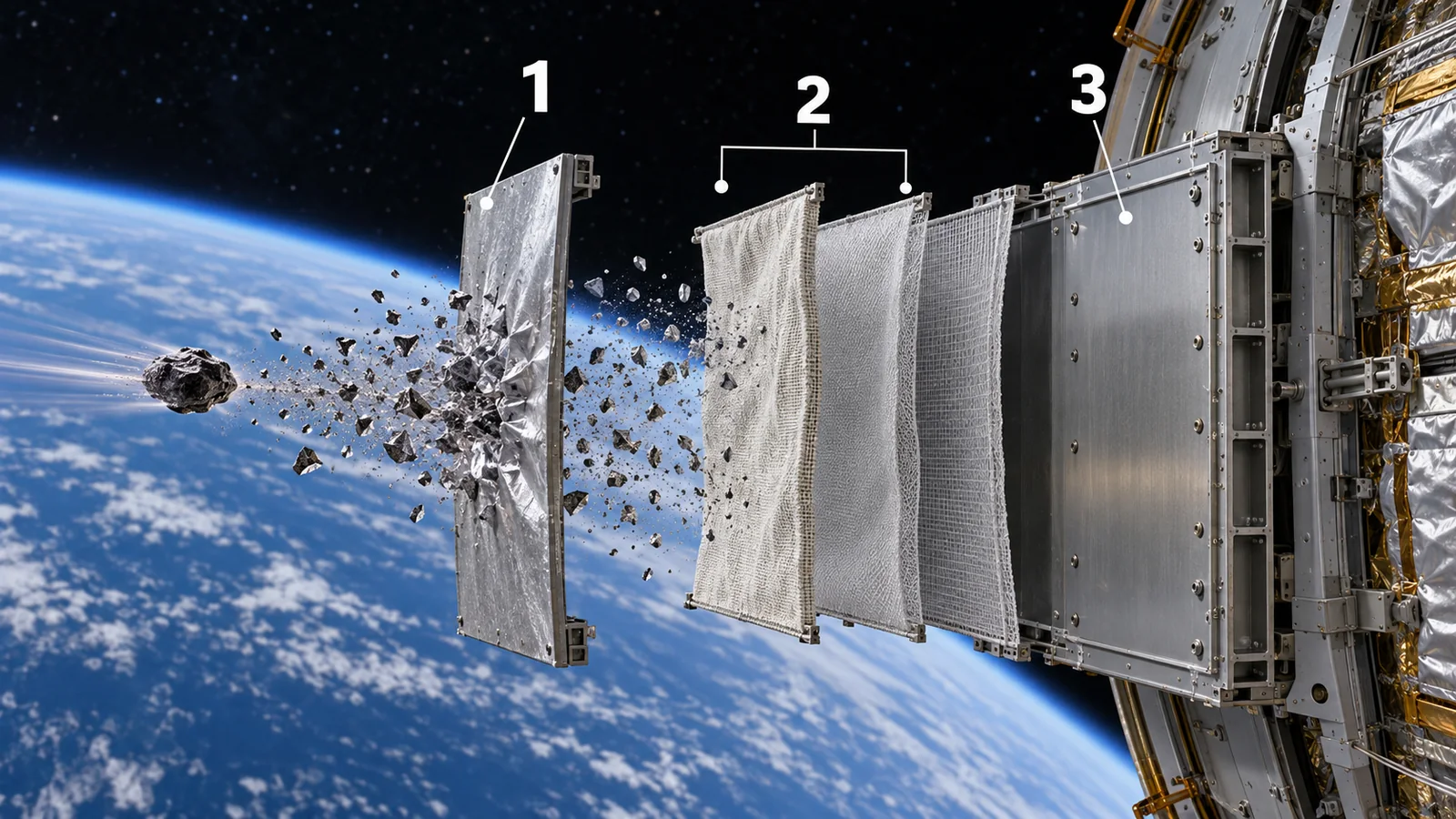
Small fragments cannot be avoided entirely, so important parts of a satellite carry shielding. The naive approach is a thick wall, but that is heavy. So the idea of the Whipple shield is used: a thin plate breaks the fragment first, the gap lets it spread, and later layers catch its momentum. According to NASA, ISS shielding lets habitable compartments and high-pressure tanks normally withstand impacts from fragments up to 1 cm in diameter Sourced [ref. 1]. The ISS US modules use the "stuffed Whipple shield", combining metal plates with ceramic and Kevlar fabrics Sourced [ref. 13].
View original SVG, values and sources
Original SVG reference: Conceptual diagram (vector drawing). The number, thickness and spacing of layers illustrate the concept. The right panel lists points confirmed in NASA material.
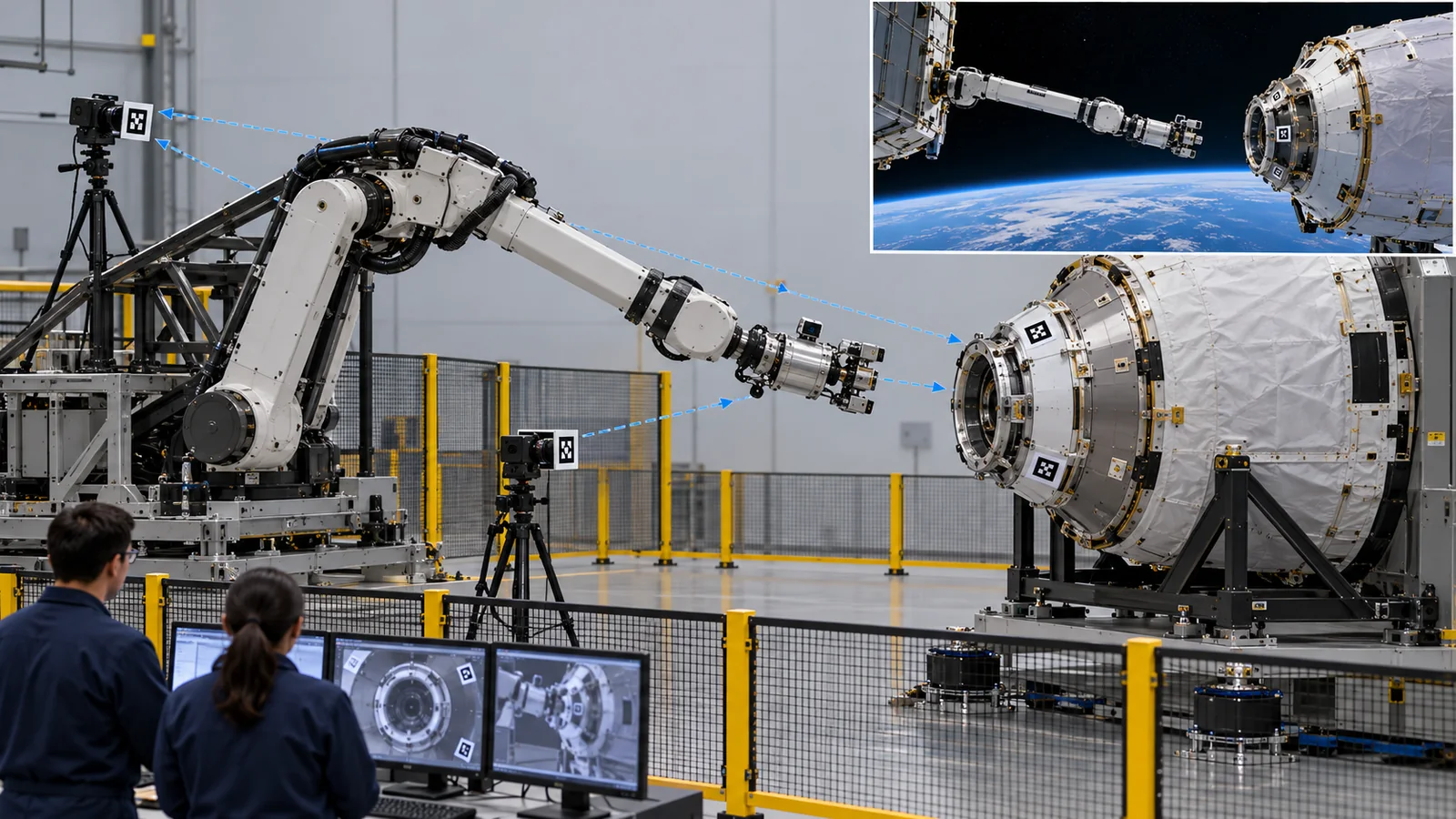
NASA used the same idea for the fuel tank of a robotic satellite. For the PACE satellite, the risk of tank damage from impacts did not meet NASA requirements, so the ISS stuffed Whipple shield was scaled down into a shield for the tank on the ram (forward-facing) side Sourced [ref. 13]. On the materials side, another NASA report explains that ceramic (Nextel) fibres are dense, so they raise the shock pressure of an impact more than aluminium does and break the fragment up. That report describes tests substituting basalt fabric for Nextel: ten shots of aluminium projectiles at about 7 km/s on shields at 25% of the scale of the ISS US modules, with results that varied by configuration from marginally worse to better than the baseline. Because the scale was small, it also says four full-scale tests were planned Sourced [ref. 14].
Simply making a shield thick makes it heavy and raises launch cost. NASA's research aims at new materials and designs that give better protection at lower mass Sourced [ref. 14]. Shielding also targets fragments up to about 1 cm; for 1-10 cm fragments a slight risk of hitting a critical part remains even on the ISS (NASA) Sourced [ref. 1]. Large objects are handled not by shielding but by collision avoidance (moving out of the way). NASA says the ISS normally manoeuvres away when a tracked object is projected to pass within a few miles and the collision probability exceeds 1 in 10,000, and has done so 41 times since 1999 Sourced [ref. 1].
5. Not creating: mitigation guidelines and standards
The most effective step is not to create new debris. NASA likewise says the most important action is preventing unnecessary new debris, while cleaning up the environment remains a technical and economic challenge Sourced [ref. 1]. The guidelines of the UN Committee on the Peaceful Uses of Outer Space (COPUOS), in the edition published in 2010, number seven: (1) limit debris released in normal operations, (2) minimise the potential for break-ups in operation, (3) limit the probability of accidental collision in orbit, (4) avoid intentional destruction, (5) minimise post-mission break-ups from stored energy (passivation), (6) limit long-term presence in low orbit after the mission, and (7) limit long-term interference with the geostationary region Sourced [ref. 6].
The 2007 first edition of the IADC (Inter-Agency Space Debris Coordination Committee) guidelines says that craft ending operations in low orbit should, where possible, be de-orbited (direct re-entry preferred) or moved to an orbit with reduced lifetime, and that studies and national guidelines found 25 years after operations a reasonable lifetime limit. In geostationary orbit the protected region spans 200 km above and below an altitude of 35,786 km, and craft are moved outside it after operations Sourced [ref. 7]. The latest IADC edition is Rev. 4 (posted 22 January 2025), but this article did not read its text Sourced [ref. 8]. ISO 24113:2023 is the top-level requirements standard on debris mitigation, applying to unmanned systems including operating spacecraft and launch-vehicle orbital stages, and ECSS shows its adoption in ECSS-U-AS-10C Rev.2 (9 February 2024) Sourced [ref. 9, 11].
National and agency rules are moving toward shortening this 25 years. In an order adopted on 29 September 2022 (FCC 22-74) the FCC set a rule that craft re-enter within five years of end of mission in low orbit, applying to satellites launched after 29 September 2024 Sourced [ref. 12]. ESA's Zero Debris requirements call for removing space systems that interfere with LEO within five years of end of mission, passivation, and, where the ground casualty expectancy of an uncontrolled re-entry exceeds 0.0001 per event, a controlled re-entry over unpopulated ocean Sourced [ref. 4]. ESA's report says this five-year rule binds ESA projects only and is paired with a collision probability limit of 10⁻³ Sourced [ref. 2].
A "guideline" is an international agreement with no duty to comply (COPUOS, IADC). A "standard" is a common way to write down design and testing (ISO, ECSS); whether it is followed depends on contracts and adoption. A "rule" is a licensing condition of a specific country or agency (FCC, ESA requirements). Even "five years" differs in standing: the FCC's five years is a US licence condition, ESA's applies only to ESA projects, and the IADC guideline stays at 25 years (in the edition checked).
6. Three kinds of in-orbit service
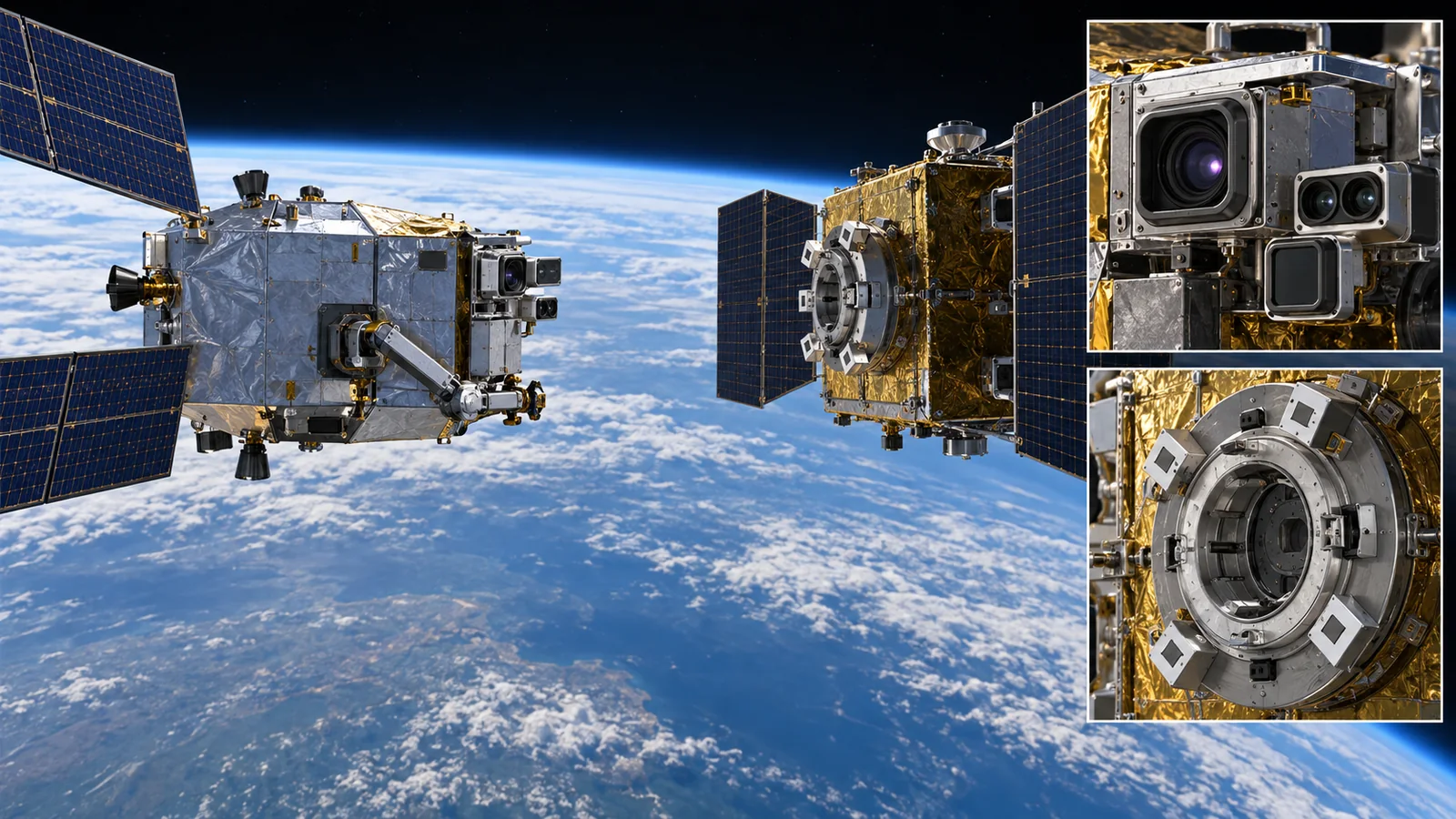
"In-orbit servicing" is the technology of caring for satellites in space without bringing them back. A tow truck, a petrol station and a repair shop make a useful analogy (limit: in space both craft move at several km/s, so approaching and attaching is itself the hardest part). ESA explains that in-orbit servicing can extend satellite lifetimes and also support the safe removal of retired satellites Sourced [ref. 5].
- Life extension (in service): Northrop Grumman's MEV docks with a geostationary satellite whose fuel is nearly depleted and extends its life with its own propulsion. MEV-1 first docked with Intelsat IS-901 on 25 February 2020, completed its five-year mission in April 2025 and docked with its next client in May 2025. MEV-2 docked with IS-10-02 on 12 April 2021 (company description). The company says it is the only one to have docked with an operational geostationary satellite (a company claim) Sourced [ref. 17]
- Refuelling and repair (preparation stage): Northrop Grumman's MRV (a robotic spacecraft) carries a Passive Refueling Module (PRM), which the company calls the first refuelling interface standard approved by the US Space Force (a company claim). Orbit Fab says it offers an interface called RAFTI (company description). ESA lists refuelling high-value satellites and adding equipment among the roles of a multi-purpose servicing vehicle Sourced [ref. 17, 23, 5]
- Removal and inspection (demonstration and planning): difficulty differs by whether the target is a "cooperative" (prepared) satellite or an "uncooperative" (unprepared) object. ELSA-d demonstrated attaching by magnet, and ADRAS-J approached an unprepared large rocket stage to 15 m and observed it. Removal itself is under development as ADRAS-J2 (JAXA) and ELSA-M (Eutelsat, ESA and the UK Space Agency) SourcedNot yet confirmed [ref. 18, 20, 21, 19]
A prepared satellite carries attachment parts (a magnetic plate or a standard coupling) and markers for approach (such as reflectors) from the start. ESA calls this "Design for Removal" Sourced [ref. 4]. An unprepared object gives no position or attitude data (GPS or telemetry) and may be tumbling, so one must first approach and observe (inspect) to understand its motion. Astroscale describes the purpose of ISSA-J1 as inspecting such a large defunct satellite and aims for completion in March 2028 SourcedNot yet confirmed [ref. 22].
7. State of demonstration missions: separating achievements from plans
| Mission | What, how large, when | Type |
|---|---|---|
| MEV-1 and MEV-2 (Northrop Grumman) | In geostationary orbit, MEV-1 docked with a client on 2020-02-25 and MEV-2 on 2021-04-12 to extend life (company description). MEV-1 finished its five-year mission in April 2025 and moved to its next client in May Sourced [ref. 17] | Sourced |
| ELSA-d (Astroscale) | Servicer and client stacked and launched in March 2021 (the company page gives both 22 and 23 March). Repeated magnetic capture demonstrated on 2021-08-25, a complex rendezvous completed on 2022-05-04, and the mission ended with deorbit on 2024-01-24. The demonstration used its own client satellite, not real debris Sourced [ref. 18] | Sourced |
| ADRAS-J (Astroscale and JAXA) | Phase I of JAXA's Commercial Removal of Debris Demonstration (CRD2). Launched 2024-02-18; as the first attempt to approach an existing large piece of debris (a rocket stage), it reached 15 m on 2024-11-30 and observed it. Operations ended on 2026-03-25 and deorbit began. No capture or removal was performed Sourced [ref. 20] | Sourced |
| MRV and three MEPs (Northrop Grumman) | The robotic MRV and three Mission Extension Pods (small life-extension units) launched on a Falcon 9 on 2026-07-21. No service results could be confirmed as of the check date Sourced [ref. 17] | Sourced |
| ADRAS-J2 (Astroscale Japan and JAXA) | Plan to approach the same rocket stage, capture it with a robotic arm and bring it down. The Phase II contract with JAXA is worth about ¥13.2 billion (including tax). A launch provider was chosen on 2026-09-01. In development; the date could not be confirmed Not yet confirmed [ref. 21] | Not yet confirmed |
| ELSA-M (Astroscale) | A commercial-service demonstration of removing prepared commercial satellites by magnetic capture. Customers are Eutelsat, ESA and the UK Space Agency. The design review was completed in June 2025 and a launch provider was chosen on 2026-03-16. In development; the date could not be confirmed Not yet confirmed [ref. 19] | Not yet confirmed |
| RISE (D-Orbit and ESA) | A commercial-service demonstration of rendezvous and docking with a geostationary client to extend its life. ESA's first in-orbit servicing mission, developed and co-funded by D-Orbit. The date could not be confirmed Not yet confirmed [ref. 5] | Not yet confirmed |
| ISSA-J1 (Astroscale Japan and MEXT) | An inspection demonstration that images and diagnoses a large defunct satellite. Completion is targeted for March 2028. In development Not yet confirmed [ref. 22] | Not yet confirmed |
The arrangement of this table is Our calculation (organisation only). Company descriptions are company statements; third-party verification was not found.
As far as confirmed, no capture and removal of real debris from orbit was found. ELSA-d's capture used the company's own client satellite, and ADRAS-J approached and observed (to 15 m) without capturing or removing. Life extension (MEV) is in service but is a different use from debris removal. Removal is still in development as ADRAS-J2, ELSA-M and others SourcedNot yet confirmed [ref. 18, 20, 21, 19, 17]. ESA's September 2026 article also places in-orbit servicing at the stage of moving from demonstration missions to operational services Sourced [ref. 5].
8. A materials engineer's view
As in Chapter 4, the stuffed Whipple shield combines metal plate, ceramic cloth and Kevlar cloth. The NASA report says ceramic (Nextel) fibres are dense and raise impact pressure more than aluminium, and its tests replacing them with basalt fabric show that performance flips depending on the Kevlar type combined with it Sourced [ref. 14]. From a materials viewpoint, the density, weave and combination of the fabric fibres and the gap decide protection at the same mass. The report itself cautions that a small-scale test can distort results if the gap is too short, so the test scale must be part of how results are read.
ELSA-d and ELSA-M use a magnetic plate (a docking plate) fitted to the client satellite, to which the servicer attaches magnetically (Astroscale) Sourced [ref. 18, 19]. The part fitted to the satellite must be light and keep properties such as magnetism under the space environment (temperature cycling, radiation) (commentary). The plate's material and magnetic strength, however, have no figures in the sources checked and could not be confirmed. For unprepared objects, where a robotic arm grasps the target (ADRAS-J2), the surface and shape of the target are unknown, so gripper materials and margin against impact and slipping are probably challenges (Inference).
ESA names two ideas: "Design for Demise", where a satellite meets the ground-safety standard by design when it re-enters uncontrolled, and "Design for Removal", where coupling points and navigation markers make a failed satellite easy to remove Sourced [ref. 4]. Choosing materials that reliably melt on re-entry and having attachment points strong enough for removal must both be achieved on the same satellite. There is also the matter of structural aluminium turning into oxide particles on re-entry (see the earlier article), so material choice is made under three constraints: durability, demise and particles (Inference).
This article could not confirm from primary sources (1) the text of the latest IADC edition (Rev. 4) and the requirements of ISO 24113, (2) any case of capturing real debris and bringing it down from orbit, (3) docking-plate materials and magnetic strength and gripper materials of robotic arms, (4) details of why ESA's and NASA's debris estimates differ, or (5) service results of MRV and the MEPs as of the check date.
9. How to read the yardsticks and standards
The yardsticks of debris and in-orbit servicing appear less in performance figures than in what is protected under which conditions. Read a combination of (1) debris counts (estimate or catalogue, and from what size), (2) shield protection (up to what fragment size and speed, and at what test scale), (3) post-mission disposal deadlines (how many years, applying to whom) and (4) maturity of in-orbit servicing (in service, demonstrated, or planned).
| What is assessed | Typical test or method (name, source) | Standards, guidance and rules | Reading notes |
|---|---|---|---|
| Debris counts | NASA: tracking catalogue plus statistics and models. ESA: MASTER model (reference epoch 1 February 2026) Sourced | Not found (no standard for counting was checked) [ref. 1, 2] | Estimates and catalogues differ. Check the lower size limit (10 cm, 1 cm, 1 mm) |
| Hypervelocity protection | Hypervelocity tests with a light-gas gun (NASA: aluminium projectiles at about 7 km/s on 25%-scale shields) and risk-analysis tools. ISS is designed to withstand fragments up to 1 cm Sourced | Not found (no number of a standard fixing shield test methods was checked) [ref. 14, 1] | Check scale, projectile speed and size, and impact angle. Ground tests differ from in-orbit impacts |
| Post-mission disposal deadline | Orbit-lifetime estimation and checking years after end of mission. FCC: within five years; ESA: under five years + collision probability under 10⁻³; IADC (Rev. 1): 25 years Sourced | FCC 22-74 (adopted 29 September 2022) [ref. 12] / ISO 24113:2023 [ref. 9] / ISO 27852:2024 [ref. 10] / ECSS-U-AS-10C Rev.2 (9 February 2024) [ref. 11] / IADC-02-01 Rev. 1 (2007) and Rev. 4 (posted 2025) [ref. 7, 8] / UN COPUOS guidelines (2010 edition) [ref. 6] Sourced | Check to whom it applies (US licensing, ESA projects, an international guideline). The standards' texts were not checked |
| Passivation and break-up prevention | Removing leftover fuel, pressure and electrical energy after the mission. Break-up statistics (about 9.8 non-deliberate fragmentations a year) Sourced | UN COPUOS Guideline 5 [ref. 6] / ESA Zero Debris requirements [ref. 4] Sourced | No public figure for the rate of passivation was checked here |
| Ground risk of re-entry | Expected ground casualties. ESA requires controlled re-entry above 0.0001 per event Sourced | ESA Zero Debris requirements [ref. 4] Sourced | Applies to ESA projects; other countries and agencies may use other values |
| Maturity of in-orbit servicing | Check by dividing into in service (MEV), demonstrated (ELSA-d, ADRAS-J) and planned (ADRAS-J2, ELSA-M, RISE, ISSA-J1) SourcedNot yet confirmed | Not found (no international standard number for in-orbit servicing was checked; the company calls MRV's refuelling interface the first standard approved by the US Space Force) [ref. 17] | Company claims differ from third-party verification; plans differ from achievements |
| Legal standing | Outer Space Treaty Article VIII: ownership of launched objects is not affected by their presence in space Sourced | Outer Space Treaty (UNOOSA hosts the text) [ref. 16] Sourced. There is no international treaty on debris (NASA) [ref. 1] | Quotation of the text only; no legal advice |
The arrangement of this table is Our calculation (organisation only). NASA and ESA figures were checked in each document, ISO items on ISO pages, ECSS items in the ECSS list, and IADC items on the IADC and UNOOSA pages (checked 17 October 2026). The texts of standards and rules were not checked.
Reading notes for materials engineers
- Estimates and catalogues differ: NASA's about 50,000 and ESA's 68,450 are estimates with different methods, reference dates and size limits and cannot be compared directly.
- Ground tests are not in-orbit impacts: shield tests have conditions of scale, projectile type and speed. In-orbit impacts vary in angle and size.
- Company announcements are not third-party verification: MEV's "only one" and MRV's "first standard" are company claims. Check the scope of the demonstration (the company's own client or real debris).
- Guidelines, standards and rules differ in force: even the same "five years" applies to different parties. Plans also differ from achievements.
10. Glossary
- Space debris
- Retired human-made objects and their fragments.
- Catalogue
- The list of objects tracked and registered by the space surveillance network, roughly those over 10 cm.
- Fragmentation
- An object breaking into many pieces by explosion or collision.
- Kessler syndrome
- A chain in which collisions create fragments that cause further collisions.
- Relative speed
- The speed difference between two objects; about 10 km/s on average in low-orbit collisions.
- Kinetic energy
- The energy of a moving object: ½ × mass × speed².
- MMOD (micrometeoroid and orbital debris)
- Micrometeoroids and orbital debris.
- Whipple shield
- A shield in which a thin plate breaks a fragment, a gap spreads it and a rear wall stops it.
- Stuffed Whipple shield
- An improved version with ceramic and Kevlar fabric in the gap.
- Nextel
- The trade name of a ceramic-fibre cloth used in shields.
- Kevlar
- A high-strength organic fibre that absorbs impact.
- Collision avoidance
- A satellite manoeuvring to avoid an approaching object.
- Passivation
- Removing the fuel, pressure and electrical energy of a retired craft.
- Design for demise
- Building so that a craft burns up reliably on re-entry.
- Design for removal
- Fitting coupling points and markers so a failed craft is easy to remove.
- Graveyard orbit
- An orbit slightly above geostationary orbit to which satellites are moved after operations.
- Protected region
- The regions of low orbit (below 2,000 km) and 200 km above and below geostationary orbit.
- In-orbit servicing
- Extending life, refuelling, repairing or removing satellites in space.
- Rendezvous and proximity operations (RPO)
- Approaching a target and operating while holding relative position.
- Docking plate
- A metal plate fitted to a satellite so that a servicer can attach magnetically.
- Cooperative / uncooperative object
- A satellite with preparations (markers and couplings) versus an object without.
- MEV, MEP and MRV
- Northrop Grumman's life-extension vehicle, small life-extension pod and robotic vehicle.
- IADC
- The Inter-Agency Space Debris Coordination Committee of space agencies.
- COPUOS
- The UN Committee on the Peaceful Uses of Outer Space.
11. References
- NASA Orbital Debris Program Office "Frequently Asked Questions" (checked 17 October 2026; includes figures as of August 2026) — orbitaldebris.jsc.nasa.gov/faq/
- ESA Space Debris Office "ESA's Annual Space Environment Report", Issue 10.1 (8 September 2026; data to the end of 2025) — sdo.esoc.esa.int/environment_report/Space_Environment_Report_latest.pdf
- ESA "ESA Space Environment Report 2026" (summary page) — esa.int/Space_Safety/Space_Debris/ESA_Space_Environment_Report_2026
- ESA Clean Space "Zero Debris Technologies" (requirements, passivation, design for demise and design for removal; its figures are older than the report's) — esa.int/Space_Safety/Clean_Space/Zero_Debris_Technologies
- ESA Clean Space "Unlocking the commercial potential of in-orbit servicing" (23 September 2026; introduces the RISE mission) — esa.int/…/Unlocking_the_commercial_potential_of_in-orbit_servicing
- UNOOSA "Space Debris Mitigation Guidelines of the Committee on the Peaceful Uses of Outer Space" (published 2010; seven guidelines) — unoosa.org/pdf/publications/st_space_49E.pdf
- IADC IADC-02-01 "Space Debris Mitigation Guidelines" Revision 1 (September 2007; hosted by UNOOSA) — unoosa.org/documents/pdf/spacelaw/sd/IADC-2002-01-…-Revision1.pdf
- IADC IADC public documents list: IADC-02-01 "Space Debris Mitigation Guidelines" Rev. 4 (posted 22 January 2025; text not read) — iadc-home.org/documents_public/view/id/318
- ISO ISO 24113:2023 "Space systems — Space debris mitigation requirements" (Edition 4, May 2023; to be revised) — iso.org/standard/83494.html
- ISO ISO 27852:2024 "Space systems — Estimation of orbit lifetime" (Edition 3, February 2024) — iso.org/standard/85364.html
- ECSS "List of published ECSS Standards (long)" (ECSS-U-AS-10C Rev.2 and others; checked 17 October 2026) — ecss.nl/list-of-published-ecss-standards-long
- FCC FCC 22-74 "Second Report and Order" (disposal in low orbit within five years; adopted 29 September 2022) — docs.fcc.gov/public/attachments/FCC-22-74A1.pdf
- NASA (Technical Reports Server) "Application of Stuffed Whipple Shield to Robotic Spacecraft" (NTRS 20230015317; October 2023) — ntrs.nasa.gov/citations/20230015317
- Cline C. J. et al. (NASA) "Evaluating Basalt Fabric in Stuffed Whipple and Multishock Shields Through Comparative Hypervelocity Tests" (NTRS 20240012941; October 2024) — ntrs.nasa.gov/citations/20240012941
- Kessler D. J., Cour-Palais B. G. "Collision frequency of artificial satellites: The creation of a debris belt", J. Geophys. Res. 83, 2637-2646 (1978), DOI 10.1029/JA083iA06p02637 — doi.org/10.1029/JA083iA06p02637
- UNOOSA "Treaty on Principles Governing the Activities of States in the Exploration and Use of Outer Space, including the Moon and Other Celestial Bodies" (Outer Space Treaty; Article VIII) — unoosa.org/oosa/en/ourwork/spacelaw/treaties/outerspacetreaty.html
- Northrop Grumman (SpaceLogistics) "SpaceLogistics" (MEV, MRV and MEP; company page; checked 17 October 2026) — northropgrumman.com/space/space-logistics-services
- Astroscale "ELSA-d" (mission page; company page) — astroscale.com/missions/elsa-d/
- Astroscale "ELSA-M" (mission page; under development) — astroscale.com/missions/elsa-m/
- Astroscale "ADRAS-J" (mission page; Phase I of JAXA's CRD2) — astroscale.com/missions/adras-j/
- Astroscale "ADRAS-J2" (mission page; under development; checked 17 October 2026) — astroscale.com/missions/adras-j2/
- Astroscale "ISSA-J1" (mission page; under development; checked 17 October 2026) — astroscale.com/missions/issa-j1/
- Orbit Fab "Refueling Services" (company page; describes its RAFTI refuelling interface) — orbitfab.com
12. Claim-to-source audit
| Claim in the text | Basis | Type |
|---|---|---|
| NASA: about 50,000 large trackable objects, about 100 million mm-sized, over 34,000 catalogued (August 2026), definition of debris, speed 7-8 km/s, average relative about 10 km/s, up to about 15 km/s, ISS withstands 1 cm, 41 avoidance manoeuvres since 1999 at 1 in 10,000, mm-sized the top penetration risk, below 600 km several years, 800 km centuries, over 1,000 km 1,000 years or more, most concentrated around 1,000 km, no international treaty, NASA-STD-8719.14 | NASA FAQ Reference 1 https://orbitaldebris.jsc.nasa.gov/faq/ | Sourced |
| ESA 2026: 68,450 objects over 10 cm, about 11,300 active, about 1.5 million at 1-10 cm, about 230 million at 1 mm-1 cm, over 300 launches and 4,000 new satellites in 2025, about 10 launches and over 3 re-entries daily, about 9.8 non-deliberate fragmentations a year, ESA standard (under five years and collision probability under 10⁻³), growth even if launches stop, runaway projections, environment index worsening by an order of magnitude in a year | ESA report and summary page Reference 2 https://www.sdo.esoc.esa.int/environment_report/Space_Environment_Report_latest.pdf Reference 3 https://www.esa.int/Space_Safety/Space_Debris/ESA_Space_Environment_Report_2026 | Sourced |
| ESA Clean Space: over 650 fragmentations, 1 cm equal to an exploding hand grenade, LEO within five years of end of mission, casualty expectancy 0.0001 and controlled re-entry, passivation, design for demise and design for removal | ESA explanatory page Reference 4 https://www.esa.int/Space_Safety/Clean_Space/Zero_Debris_Technologies | Sourced |
| The seven UN COPUOS guidelines (2010 edition), IADC Rev. 1 (2007): direct re-entry preferred in low orbit and 25 years reasonable, GEO protected region 35,786 km ±200 km, IADC Rev. 4 (posted 22 January 2025), ISO 24113:2023 (Edition 4, to be revised), ISO 27852:2024, ECSS-U-AS-10C Rev.2 (9 February 2024) | Official material of UNOOSA, IADC, ISO and ECSS Reference 6 https://www.unoosa.org/pdf/publications/st_space_49E.pdf Reference 7 https://www.unoosa.org/documents/pdf/spacelaw/sd/IADC-2002-01-IADC-Space_Debris-Guidelines-Revision1.pdf Reference 8 https://iadc-home.org/documents_public/view/id/318 Reference 9 https://www.iso.org/standard/83494.html Reference 10 https://www.iso.org/standard/85364.html Reference 11 https://ecss.nl/list-of-published-ecss-standards-long/ | Sourced |
| FCC 22-74: within five years of end of mission in low orbit, applying to satellites launched after 29 September 2024 | Text of the FCC order Reference 12 https://docs.fcc.gov/public/attachments/FCC-22-74A1.pdf | Sourced |
| Stuffed Whipple shield (metal plate, ceramic and Kevlar), PACE fuel-tank shield, Nextel's density and shock pressure, basalt substitution tests (25% scale, about 7 km/s, ten shots, results vary by configuration, full-scale follow-up planned) | NASA technical reports (NTRS) Reference 13 https://ntrs.nasa.gov/citations/20230015317 Reference 14 https://ntrs.nasa.gov/citations/20240012941 | Sourced |
| Kessler and Cour-Palais (1978): collision frequency and creation of a debris belt; Outer Space Treaty Article VIII: ownership unaffected by presence in space | Bibliographic record; treaty text Reference 15 https://doi.org/10.1029/JA083iA06p02637 Reference 16 https://www.unoosa.org/oosa/en/ourwork/spacelaw/treaties/outerspacetreaty.html | Sourced |
| Northrop Grumman: MEV-1 at IS-901 on 2020-02-25, mission done April 2025 and next client May, MEV-2 at IS-10-02 on 2021-04-12, MRV and three MEPs launched 2026-07-21, passive refuelling module (company claim), "only one" (company claim). Orbit Fab: RAFTI (company description) | Company pages Reference 17 https://www.northropgrumman.com/space/space-logistics-services Reference 23 https://www.orbitfab.com/ | Sourced |
| Astroscale: ELSA-d (launched March 2021, magnetic capture 2021-08-25, 2022-05-04, deorbit 2024-01-24), ADRAS-J (2024-02-18, 15 m on 2024-11-30, deorbit start 2026-03-25), ADRAS-J2 (about ¥13.2 billion, launch provider 2026-09-01, in development), ELSA-M (design review 2025-06, launch provider 2026-03-16, in development), ISSA-J1 (completion targeted March 2028) | Astroscale pages (company descriptions) Reference 18 https://astroscale.com/missions/elsa-d/ Reference 20 https://astroscale.com/missions/adras-j/ Reference 21 https://astroscale.com/missions/adras-j2/ Reference 19 https://astroscale.com/missions/elsa-m/ Reference 22 https://astroscale.com/missions/issa-j1/ | Not yet confirmed |
| ESA's RISE (developed by D-Orbit, geostationary life extension, ESA's first in-orbit servicing mission) and in-orbit servicing moving from demonstration to operation | ESA article (23 September 2026) Reference 5 https://www.esa.int/Space_Safety/Clean_Space/Unlocking_the_commercial_potential_of_in-orbit_servicing | Not yet confirmed |
| Kinetic energy of 1 mm, 1 cm and 10 cm aluminium spheres (about 71 J, 71 kJ and 71 MJ) and the TNT equivalent of 1 cm (about 17 g) | Our calculation (Python; assuming density 2.7 g/cm³, relative speed 10 km/s and TNT at 4.184 MJ/kg) | Our calculation |
| The text requirements of IADC Rev. 4 and ISO 24113, any capture and removal of real debris, docking-plate materials and magnetic strength, gripper materials, details of why ESA and NASA estimates differ, and service results of MRV and the MEPs | Not confirmed within the scope of this article's survey, so not stated (commentary) | Explanation |
| The readings and explanations "debris does not simply fall soon", "small fragments are dangerous too", "shielding is a design of density, combination and gap", "balancing design for demise with design for removal" and "a docking plate is a material that attaches to the target" | This article's own organisation of the published material | Explanation |
Last updated 17 October 2026. Sources are limited to primary material (official documents of NASA, ESA, UNOOSA, IADC, ISO, ECSS and the FCC, NASA technical reports, papers and company pages). Company descriptions are treated as company statements and nothing is ranked. The numerical examples are explanatory calculations, not design values of real fragments or shields. Any capture and removal of real debris from orbit, the texts of IADC Rev. 4 and ISO 24113, docking-plate materials and magnetic strength, and service results of MRV and the MEPs could not be confirmed and are not stated. The figures are conceptual diagrams or drawings including our calculations; Figs. 1 and 9 are AI-image frames (images not yet placed). No legal advice is given.