TECHNOLOGY EXPLAINER
Lightweight Structural Materials
— Aluminum-lithium, titanium and magnesium alloys that lighten rockets and spacecraft
A rocket is a machine in which every extra kilogram of structure costs almost a kilogram of cargo. So space structural materials must above all be light and strong. Written for materials engineers who know little about space engineering, this article first checks why lightness pays with numbers, then explains aluminum alloys (including aluminum-lithium), titanium alloys and magnesium alloys with diagrams. Carbon-fiber composites (CFRP) have their own article. We also see that material performance is protected by a chain of forming, heat treatment, welding and inspection, not by composition alone.
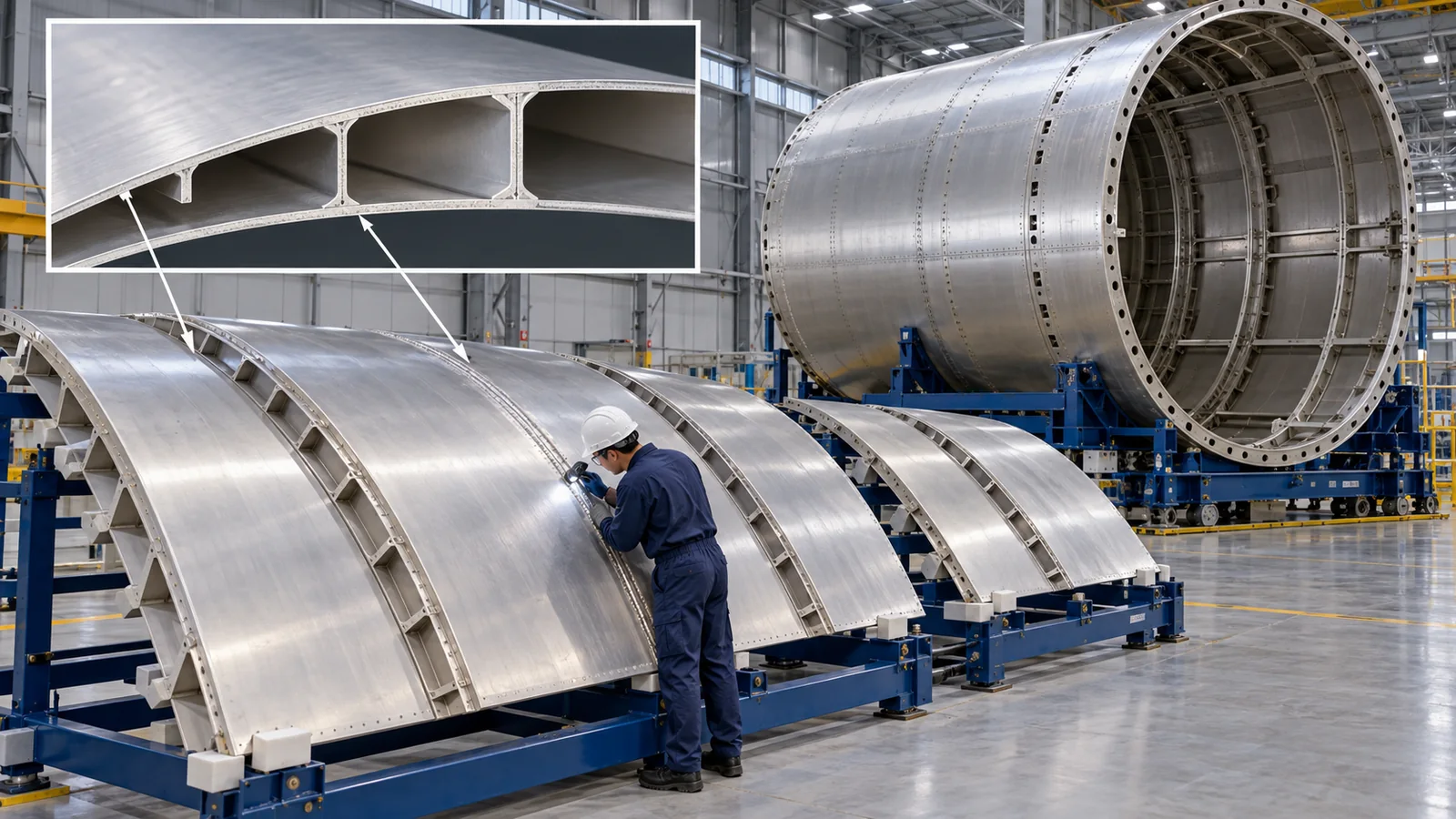
- The short version / what to know first / where this fits
- Why lightness pays
- A map of light metals by density
- Aluminum alloys: from 2219 to aluminum-lithium
- Getting stronger in the cold
- Protecting performance by process: forming, heat treatment, welding, inspection
- Titanium alloys
- Magnesium alloys
- How to read the yardsticks and standards / glossary / references / claim-to-source audit
Sourced = stated in a published source (linked)
Our calculation = a value this article calculated from stated assumptions
Not yet confirmed = company targets, plans, drafts of standards, and other items not yet settled
Our own reading for materials engineers is marked as commentary. Inference is shown in bold. Every analogy comes with a note on where it stops working.
Strength and toughness values depend on alloy, temper, plate thickness, orientation, temperature and test method. The values here carry the conditions of NASA reports and values under different conditions are not ranked. Parts of Figs. 2 to 5 are explanatory values we calculated from published figures. Vehicles and plans carry a check date (17 October 2026). Military applications are not covered.
1. The short version, what to know first, and where this fits
- Lightness becomes payload. A top-stage structure 100 kg lighter can carry 100 kg more payload (a simple example of ours).Our calculation The Space Shuttle external tank was cut from 76,000 lb to 58,500 lb by changing materials.Sourced[Ref. 1]
- Aluminum alloys, especially lithium-bearing ones, are the mainstay. Lithium is the lightest metal; adding it lowers an alloy's density and raises stiffness. SpaceX says the Falcon 9 first-stage tanks are aluminum-lithium alloy.Sourced[Refs. 7, 13] Titanium alloys serve in high-temperature, high-pressure and cryogenic parts, while magnesium alloys are at the research and validation stage.
- The material and how it is made are one product. Forming, a two-step heat treatment, friction-stir welding, X-ray inspection and cryogenic tests form a chain that protects performance.Sourced[Refs. 5, 4, 9]
No space knowledge is needed. Knowing density, yield strength, tensile strength and toughness is enough. The idea of rocket stages (parts dropped after their fuel is used) is explained briefly in Section 2. Equations are kept to a minimum, explained in words and checked with numbers.
It is easiest after the series overview, "space environment and materials" and "rocket basics". Carbon-fiber composites are in CFRP and composites for space, metal 3D printing in additive manufacturing for space, engine materials in rocket engines and propellants, and re-entry materials in thermal protection systems.
2. Why lightness pays
A rocket moves while becoming lighter as it burns fuel. For a stage (the part dropped once its fuel is used), the structure mass (dry mass) counts on the same side as the payload we want to carry. The velocity gain Δv is set by the specific impulse (the "fuel economy" of the propellant) and the ratio of initial to final mass.Sourced[Refs. 24, 23]
In this example, if the structure gets 100 kg heavier with the same payload, Δv falls from about 7,907 m/s to about 7,728 m/s.Our calculation To keep Δv, payload must drop by 100 kg. Conversely, a structure 100 kg lighter allows 10% more payload.Our calculation Structure mass trades almost one for one against cargo, which is why light materials are so valuable.
More detail: the calculation
Multiplying the specific impulse of 450 s by g0 = 9.80665 m/s² gives an effective exhaust velocity of 4,413 m/s. The baseline is ln((1,000 + 10,000 + 1,000) / (1,000 + 1,000)) = ln 6 ≈ 1.7918, so Δv ≈ 7,907 m/s. With 1,100 kg of dry mass, ln(12,100 / 2,100) ≈ 1.7513 and Δv ≈ 7,728 m/s (about 2.3% lower).Our calculation If the sum of dry mass and payload is constant, the content of the logarithm does not change and Δv is kept.
Lightness matters, but in space a material must also withstand cryogenic temperatures, vacuum, radiation and repeated heating, be weldable and inspectable, and not react with propellants. Some of the lightest metals (magnesium) need care about corrosion and flammability. Lightness is one criterion among several.
3. A map of light metals by density
In NIST's table, metal densities are 0.534 for lithium, 1.740 for magnesium, 2.699 for aluminum, 4.540 for titanium and 7.874 g/cm³ for iron.Sourced[Ref. 14] Lithium is the lightest metal, lighter than magnesium, at about 0.2 times aluminum.Our calculation Aluminum-lithium alloys add a little of this lithium to make aluminum alloys lighter and stiffer.Sourced[Ref. 7]
Density alone does not decide a material. Specific strength (strength divided by density) and specific stiffness (elastic modulus divided by density) are the gauges of light and strong. For example, the typical yield strength of 2195-T8 (1.85 in plate) is 76 ksi (524 MPa); with a density similar to the 0.098 lb/in³ (2.71 g/cm³) of alloy 2050, the specific strength is about 193 kN·m/kg.Our calculation[Ref. 6]
Imagine bars of equal weight. A 1 kg iron bar and a 1 kg aluminum bar differ: the aluminum bar is thicker (larger volume). A thicker bar bends less, so at equal weight a lighter material can sometimes make a stronger or stiffer part. Where the analogy stops: in real designs shape (thin plates stiffened by ribs), joints and cost also matter, and the order of specific strengths does not become the order of parts.
4. Aluminum alloys: from 2219 to aluminum-lithium
The mainstay of rocket tanks is aluminum alloy, and the Space Shuttle external tank shows its history well. According to a 2011 NASA presentation, the first "standard weight tank" was an aluminum 2219 structure weighing 76,000 lb, the "light weight tank" weighed 66,000 lb and flew 86 missions, and the "super light weight tank" weighed 58,500 lb and was primarily an aluminum-lithium structure.Sourced[Ref. 1] Because the tank flies to orbital velocity with the orbiter, every pound saved can go to payload.Sourced[Ref. 1]
The main material of the super light weight tank is the aluminum-copper-lithium alloy 2195. A 2002 NASA report says that using 2195 on the external tank saved more than 7,000 lb and enabled the launch of International Space Station components.Sourced[Ref. 2] A 1999 NASA presentation says the super light weight tank provided two thirds of the weight savings needed to place the station in a 51.6° orbit.Sourced[Ref. 3]
The lineage continues in later plans. A 2014 NASA paper says 2195 has higher mechanical properties and lower density than 2219, that 2219 is the baseline material for SLS cryogenic tank components, and that replacing 2219 with 2195 would give large weight savings, as on the Shuttle external tank.Sourced[Ref. 5] SpaceX says the Falcon 9 first stage holds liquid oxygen and kerosene (RP-1) in aluminum-lithium alloy tanksSourced[Ref. 13] (company statement; the alloy number could not be confirmed).
| Alloy | Family and character | Space example (source) | Key point |
|---|---|---|---|
| 2219 | Aluminum-copper; the strengthening phase is Al2Cu (theta) | Standard weight external tank; baseline for SLS cryogenic tank componentsSourced[Refs. 1, 5, 11] | Heavier than 2195 but with a long track record (our commentary) |
| 2195 | Aluminum-copper-lithium | Super light weight external tank; the incumbent cryogenic tank alloy, plate up to 1.95 inSourced[Refs. 1, 6] | Quench sensitivity limits plate thicknessSourced[Ref. 6] |
| 2050 | Aluminum-copper-lithium (about 3.5% Cu, 0.9% Li, plus Mg, Mn, Ag, Zr; weight percent) | Candidate: plate up to 5 in, studied to cut cryogenic tank massSourced[Refs. 6, 7] | Less quench sensitive, said to keep uniform properties in thick plateSourced[Ref. 6] |
The 2050 composition is from the analysis of two plates in NASA TM-2011-217163 (Cu 3.48 to 3.56, Li 0.88 to 0.90 weight percent) and the AMS 4413 range (Li 0.70 to 1.30).Sourced[Ref. 6]
NASA reports that 2050 was designed to raise strength, toughness, elastic modulus and fatigue-crack resistance while lowering density.Sourced[Ref. 6] A tank wall made of thin skin with stiffening ribs gets lighter as the ribs get taller, but the plate thickness of 2195 is limited to 1.95 in by quench sensitivity, which capped rib height at about 2 in.Sourced[Ref. 6] A strong alloy and a thick plate you can actually make are different things; the metallurgical property of quench sensitivity sets the design freedom (our commentary).
5. Getting stronger in the cold
Tanks for liquid hydrogen and liquid oxygen operate on the cold side. NASA TM-2011-217163 gives values for 2195 and 2050 at room temperature (75 °F) and at −320 °F (about −196 °C). For 2195-T8 (1.85 in plate), typical values in the L direction rise from 76 to 93 ksi in yield strength and from 80 to 101 ksi in tensile strength. In the 2050-T84 (4 in plate) tests, means in the L direction at t/2 rose from 74.6 to 85.9 ksi in yield strength and from 79.2 to 95.7 ksi in tensile strength.Sourced[Ref. 6]
Fracture toughness too is reported to rise for 2050 when temperature falls from room temperature to −320 °F.Sourced[Ref. 6] In contrast to many steels that turn brittle in the cold, aluminum alloys stay strong and tough when cold (general remark; our commentary). This is one reason aluminum alloys are the mainstay of cryogenic tanks.
When the thermal vibration of metal atoms shrinks, dislocations (slips in the crystal) move less easily and yield strength rises (a general metallurgy explanation; our commentary). Where the analogy stops: in body-centered-cubic metals such as steels, the same cooling causes a ductile-to-brittle transition and sudden brittleness. Aluminum alloys, being face-centered cubic, do not readily show it.
6. Protecting performance by process: forming, heat treatment, welding, inspection
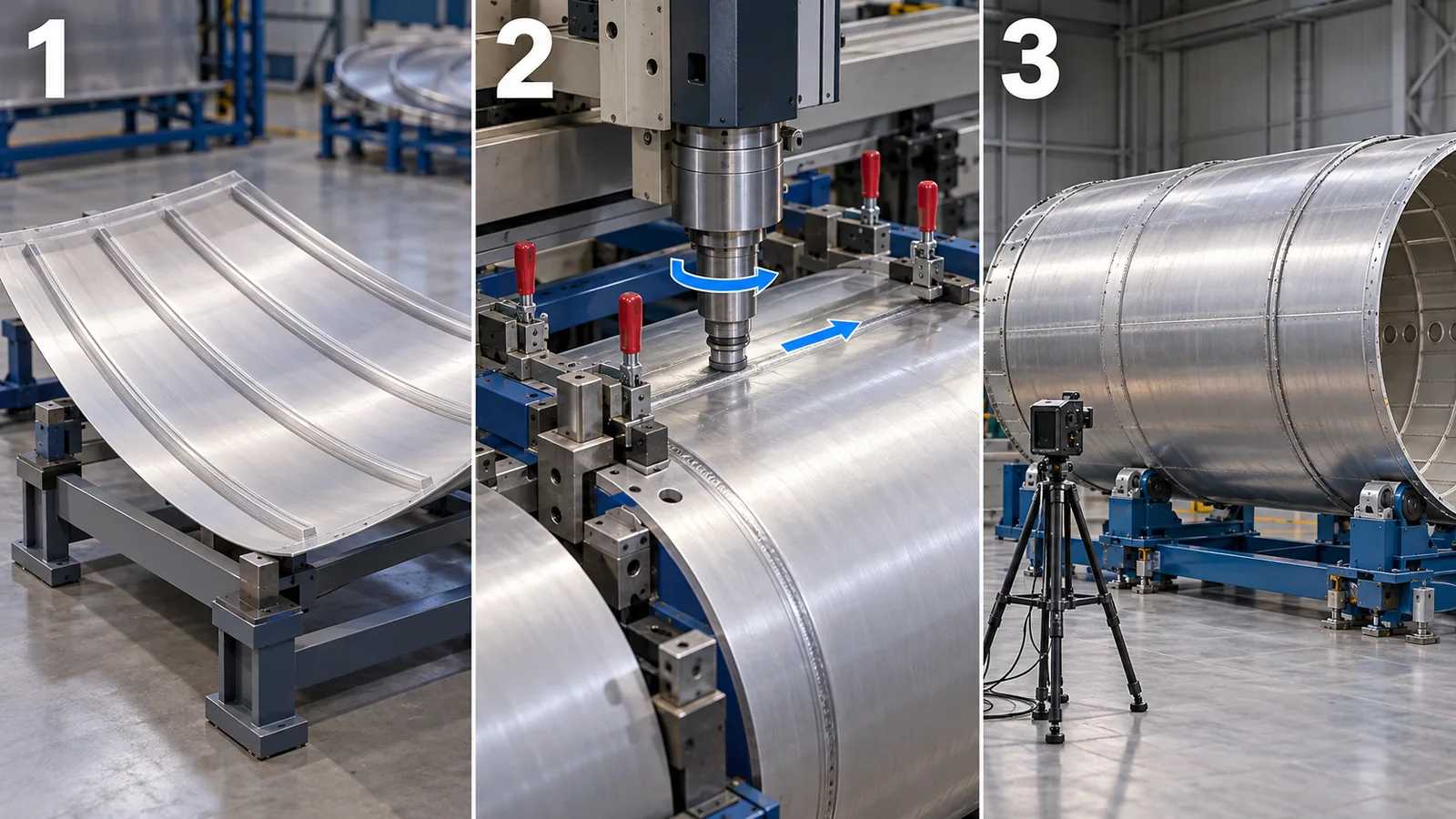
Tank material is no good as plate. Performance appears only after bending, heat treating, welding and inspecting. Here are four process steps documented by NASA.
View original SVG, values and sources
Original SVG reference: Conceptual diagram (vector drawing). The process chain of an aluminum-lithium tank. The content of each step is in NASA sources.
(1) Forming: stretching and bending gores
The rounded ends (domes) of a tank are welded from curved "gores" (petal-shaped pieces). 2195 was hard to form into thick gores. NASA Marshall developed an annealing treatment that widened the forming range and raised the strain-hardening exponent, and made gores 0.525 in and 0.75 in thick by stretch forming. Tests showed higher than expected strength, modulus and elongation.Sourced[Ref. 5]
(2) Heat treatment: a two-step age
NASA Marshall developed a two-step artificial age for 2195 (20 hours at 132 °C followed by 42 hours at 138 °C) that raises cryogenic fracture toughness and stress-corrosion resistance. It kept the same yield strength, improved short-transverse ductility, and five previously rejected lots passed simulated service testing. The stress-corrosion test required at least 10 days in alternate immersion in 3.5% salt water at 45 ksi, and lives ranged from 57 to 83 days.Sourced[Ref. 4]
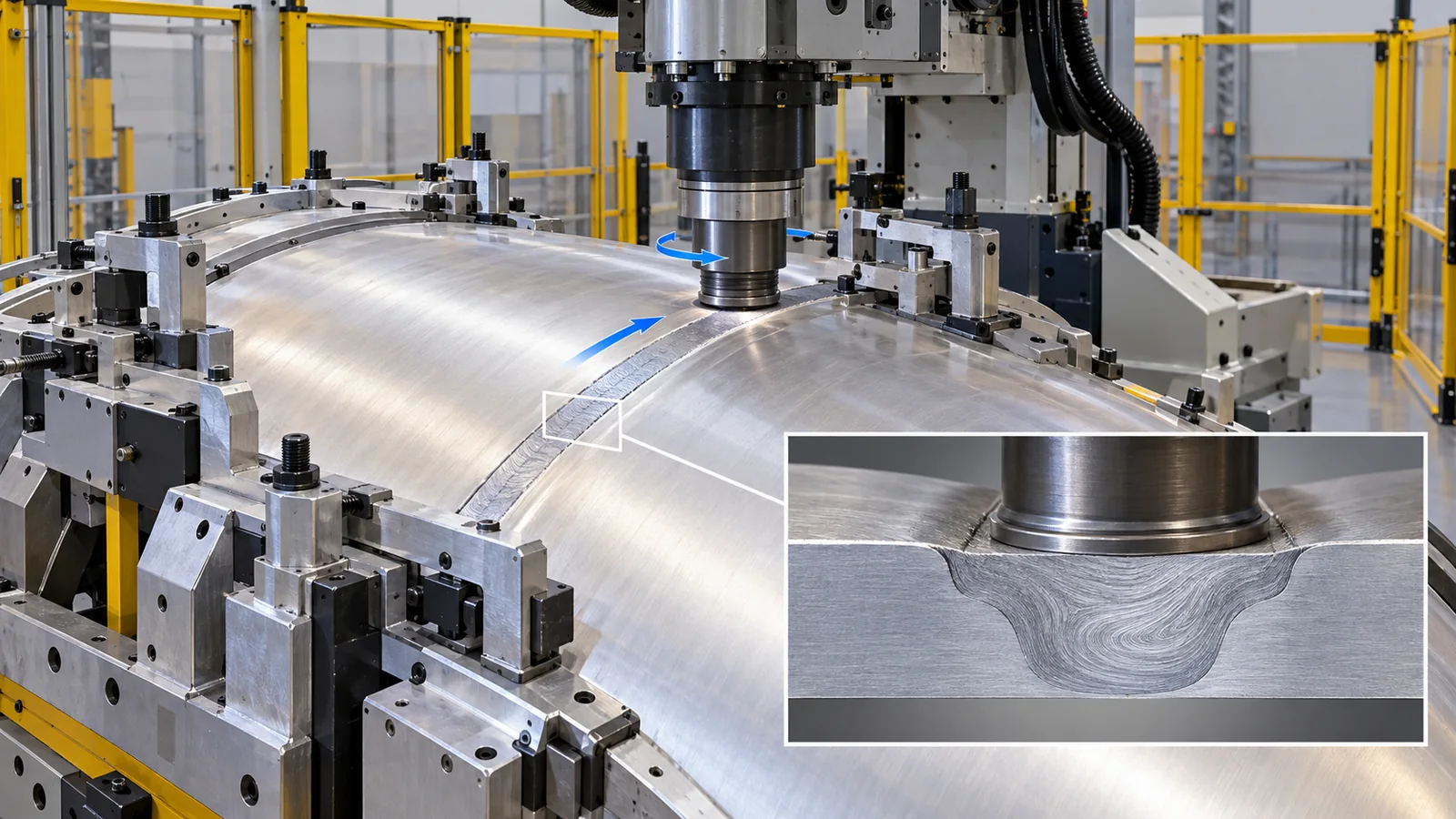
(3) Welding: joining without melting
Aluminum-lithium alloys tend to crack and form porosity in conventional fusion welding (general remark). Friction-stir welding softens and mixes the material with a rotating tool and joins it without melting. According to Ding et al., when it was brought to NASA in 1994 it was little more than a laboratory curiosity; the first weld was made in the fall of 1995 and it went into external tank production.Sourced[Ref. 9] For 2195 plate and extrusions, the large forces on the tool were a production challenge that Lockheed Martin Michoud addressed with tooling.Sourced[Ref. 8] Marshall set up a facility able to make longitudinal welds about 5 m long by retrofitting a welding system designed for tank barrels 2 to 10 m in diameter.Sourced[Ref. 10]
(4) Inspection: the "heavy inclusions" that turned up
In friction-stir welds between a 2219 forging and 2195 plate on the external tank, radiography first revealed "heavy inclusions" (HI). They were small particles (about 0.005 to 0.025 in) or clusters, and elemental analysis showed large agglomerations of Al2Cu (theta phase), the strengthening precipitate of 2219. They were not foreign material or tool debris. Areas with HI were tested in room-temperature and cyclic cryogenic (−423 °F) tension and compared with specimens without HI and historical data; no significant adverse effect was found.Sourced[Ref. 11] Non-destructive inspection methods to verify friction-stir welds were also developed for the external tank.Sourced[Ref. 12]
The heavy inclusions were found because radiography existed, identified as agglomerated Al2Cu by elemental analysis, and shown by tests to have little effect. The finer the inspection, the more new "anomalies" turn up. The materials engineer's job is to connect them to understanding (which phase gathers and why) and to tests of effect on performance. What was confirmed here applies to specific welding conditions and tests and need not hold for other alloys or conditions (our commentary).
7. Titanium alloys
Titanium is about 1.68 times denser than aluminum (NIST elemental values),Our calculation[Ref. 14] but it is strong and holds up to heat and cryogenic temperatures, so it serves in high-pressure and high-temperature parts. What matters is that compatibility with the partner (propellant, hydrogen) is checked by testing before use.
- Pressure vessels and propellant tanks: forged Ti-6Al-4V was used in Apollo spacecraft propellant tanks (pressure vessels) and its flaw growth was studied (1967).Sourced[Ref. 15] Ti-6Al-4V for satellite propellant tanks was not adversely affected by 2,000 hours in nitrogen tetroxide (MON-1), after 1,000 hours in Freon, at stresses up to 80% of the experimentally found critical value (1983 tests at 49 °C).Sourced[Ref. 16]
- New propellants: for the green propellants AF-M315E and LMP-103S, the threshold stress intensity for environment-assisted cracking (KEAC) of Ti-6Al-4V was measured at 50 °C over 1,000 hours: at least 22.0 ksi√in for base metal and 31.3 ksi√in for welds with AF-M315E,Sourced[Ref. 17] and 22.5 and 36.2 ksi√in with LMP-103S (interim results).Sourced[Ref. 18] These are input values for safe-life analyses of tanks.
- Liquid-hydrogen pumps: Ti-5Al-2.5Sn ELI was used in critical liquid-hydrogen components of the SSME. Titanium's reactivity demanded special compositions and processing.Sourced[Ref. 19] The notch strength of Ti-6Al-4V in low-temperature, high-pressure hydrogen was examined in 1970.Sourced[Ref. 20]
- Spacecraft carrier structure: the Orion heat-shield carrier combines a titanium skeleton with a composite skin.Sourced[Ref. 21]
Even for the same alloy, the cracking threshold (KEAC) must be measured again each time the partner propellant changes. For satellite tanks using new propellants, the combination of propellant chemistry and the material's cracking behavior is an input to safe-life analysis.Sourced[Refs. 17, 18] For materials engineers, propellant development and material qualification must proceed together (our commentary). NASA's report says KEAC was measured following ASTM E1681 (Standard Test Method for Determining Threshold Stress Intensity Factor for Environment-Assisted Cracking of Metallic Materials).Sourced[Ref. 18]
8. Magnesium alloys
Magnesium is among the lightest structural metals. In NIST elemental values its density is about 0.64 times that of aluminum (1.740 / 2.699).Our calculation[Ref. 14] A 2017 NASA Kennedy Space Center intern report says that although recent magnesium alloy development has widened the potential for spacecraft use, NASA has not been able to consider adoption for lack of test data.Sourced[Ref. 22]
Traditional magnesium alloys tended to be passed over in flight part selection because they are flammable and hard to extinguish and because they are galvanically active and weak in salt water. The report says the recent WE43 and Elektron 21 are described as self-extinguishing and passing an FAA flammability rating, and an anodizing process for magnesium (Tagnite) was formulated to curb galvanic and salt-water corrosion. KSC planned to compare three alloys, AZ31B, WE43 and Elektron 21, against 7075-T6 aluminum and 304 stainless steel for flammability (Test 17 of NASA-STD-6001B), stress corrosion (MSFC-STD-3029), seashore corrosion and mechanical properties.Sourced[Ref. 22]
This KSC report itself writes the density of magnesium as "about one third that of aluminum", but NIST elemental values (1.740 and 2.699 g/cm³) give about 0.64 times (about two thirds).Our calculation[Refs. 14, 22] Even primary sources can be wrong, so numbers should be cross-checked in two sources. The lightness benefit is about 36% (1 − 0.64) lighter, not two thirds lighter.
According to NASA's report, magnesium alloys are hard to use in spacecraft less because of limits of the material itself than because of a lack of test data and preconceptions about flammability and corrosion.Sourced [Ref. 22] For materials engineers there is a path of removing weaknesses from the material side through alloy design (WE43 and the like) and improved surface treatment (anodizing); what remains is gathering test data that satisfy the standards (NASA-STD-6016 requirements). The report is at the plan and early-data stage and does not mean flight qualification.
9. How to read the yardsticks and standards
The performance of lightweight structural materials is measured by yield strength, tensile strength and elastic modulus (at each temperature), fracture toughness (strength with a crack present), resistance to fatigue-crack growth, resistance to stress-corrosion cracking, weld quality, and compatibility with the partner propellant or oxygen. No single number decides; read each with its conditions (temperature, thickness, orientation, environment).
| What is assessed | Typical test or method (name, source) | Standards and guidance (NASA, ECSS, etc.) | Reading notes |
|---|---|---|---|
| Strength, modulus, fracture toughness (including cryogenic) | Tension, compression and fracture-toughness tests at room temperature and −320 °F (NASA TM-2011-217163); the specification for 2050 plate is AMS 4413.Sourced[Ref. 6] | ECSS-Q-ST-70-71C Rev.1 (materials, processes and their data selection; 15 October 2019) and NASA-STD-6016 (materials and processes requirements).Sourced[Refs. 31, 25] A handbook of design allowables was not confirmed in this article. | Values vary with thickness, orientation, temperature and lot. Typical values differ from design allowables such as A-basis. |
| Stress-corrosion cracking | Alternate immersion in salt water (3.5% NaCl, 45 ksi, at least 10 days)Sourced[Ref. 4] and three-point bend in salt fog (75% of yield strength, 1,000 hours)Sourced[Ref. 22] | MSFC-STD-3029 (Version A, 25 February 2005; Active), ECSS-Q-ST-70-36C (6 March 2009) and NASA-STD-6012 (Version A, 23 March 2022; corrosion protection).Sourced[Refs. 27, 30, 26] | These are salt-environment criteria; cracking in propellants and in space environments is tested separately (KEAC). |
| Safety against cracks and flaws | Crack-growth tests and safe-life analysis (KEAC as an input).Sourced[Refs. 17, 18] | NASA-STD-5019 (Version A with Change 4, change dated 12 July 2024; fracture control for human-rated systems) and ECSS-E-ST-32-01C Rev.2 (30 July 2021).Sourced[Refs. 28, 32] | Applicability differs for crewed versus uncrewed systems and by contract. The requirements themselves were not checked here. |
| Flammability | Promoted combustion (Test 17) planned for magnesium alloys.Sourced[Ref. 22] | NASA-STD-6001 (Version B with Change 3; Active).Sourced[Ref. 29] | Results change with specimen diameter. Do not label a material simply non-burning. |
| Weld quality | Radiography, cryogenic tension (−423 °F) and non-destructive inspection of friction-stir welds.Sourced[Refs. 11, 12] | Could not be confirmed (an international standard for friction-stir welding was not checked here). | The "effect" of a flaw found is judged within the welding conditions and tests used. |
| ASTM standards | NASA documents mention the use of ASTM E8 (tension), E9 (compression), E18 (Rockwell hardness), E1004 (electrical conductivity) and E1681 (threshold for environment-assisted cracking).Sourced[Refs. 6, 22, 18] | Numbers and uses follow NASA documents. The ASTM website was not opened; texts, test conditions and editions were not checked. | — |
The arrangement of the table is Our calculation (organizing). Numbers, titles and status were checked on ecss.nl and the NASA Technical Standards System (17 October 2026). Standard texts were not read; only titles and scope are given.
Reading notes (for materials engineers)
- Ground tests and flight differ. The values here come from laboratory tests of specific plates by specific methods. Real tanks see welds, thickness variations, repeated filling and pressurization, and environmental effects.
- Typical values and design allowables differ. The 2195 values are "typical" and the 2050 values are "test means". Designs use statistically guaranteed A- or B-basis values, which were not checked here.
- Check whether a standard is a recommendation or a requirement. NASA-STD and ECSS standards become requirements when a project adopts them by contract (general remark). If something claims compliance, check which document and edition.
- Company statements differ from independent verification. That the Falcon 9 tanks are aluminum-lithium is a company statement, and the alloy number could not be confirmed.
10. Glossary
- Structure (dry) mass
- The mass of the structure and other parts, excluding propellant.
- Payload
- The cargo to be carried, such as a satellite.
- Stage
- A part of a rocket that is dropped once its fuel is used up.
- Δv (delta-v)
- The velocity gain; how much a rocket can change its speed.
- Specific strength / stiffness
- Strength (elastic modulus) divided by density.
- Yield / tensile strength
- The stress at which permanent deformation begins / the maximum stress.
- Fracture toughness
- How well a material with a crack resists fracture.
- Aluminum-lithium alloy
- An aluminum alloy made lighter and stiffer by lithium, such as 2195 and 2050.
- 2219 / 2195 / 2050
- Aluminum alloy numbers: 2219 is Al-Cu; 2195 and 2050 are Al-Cu-Li.
- Aging
- A heat treatment that precipitates strengthening phases to give strength.
- Temper (T8 etc.)
- A code for the heat-treatment and working state.
- Quench sensitivity
- How much properties change with cooling rate; a problem in thick plate.
- Gore
- A petal-shaped curved plate used to make a tank dome.
- Friction-stir welding (FSW)
- A weld that softens material with a rotating tool and joins it without melting.
- Al2Cu (theta phase)
- The strengthening phase of 2219.
- Ti-6Al-4V
- The most widely used titanium alloy.
- ELI
- Extra Low Interstitial: a grade with reduced interstitial impurities.
- KEAC
- The threshold stress intensity for environment-assisted cracking; below it a crack is not found to grow.
- Stress-corrosion cracking (SCC)
- Cracking from the combination of stress and a corrosive environment.
- WE43 / Elektron 21
- Magnesium alloys for aerospace described as self-extinguishing.
- Tagnite
- An anodizing process for magnesium.
- SSME / SLS
- Space Shuttle Main Engine / Space Launch System.
- ECSS
- European Cooperation for Space Standardization.
11. References
- Pilet J. C. et al. (NASA) "External Tank Program - Legacy of Success" (2011) — ntrs.nasa.gov/citations/20120001570
- Shah S. et al. (NASA Marshall) "Effects of Thermal Exposure on Properties of Al-Li Alloys" (2002) — ntrs.nasa.gov/citations/20030001044
- Bickley F., Schwinghamer R. J. (NASA) "NASA Experience with the Shuttle External Tank" (1999) (only the abstract of the slides was checked) — ntrs.nasa.gov/citations/19990047392
- Chen P. S., Stanton W. P. (NASA Marshall) "Cryogenic Fracture Toughness Improvement for the Super Lightweight Tank's Main Structural Alloy" (2002) — ntrs.nasa.gov/citations/20020030745
- Volz M. P. et al. (NASA Marshall) "Development of Aluminum-Lithium 2195 Gores by the Stretch Forming Process" (2014) — ntrs.nasa.gov/citations/20140011616
- Hafley R. A. et al. (NASA Langley) "Evaluation of Aluminum Alloy 2050-T84 Microstructure and Mechanical Properties at Ambient and Cryogenic Temperatures", NASA TM-2011-217163 — ntrs.nasa.gov/citations/20160010564
- Hales S. J. (NASA Langley) "Aerospace Applications of Aluminum-Lithium Alloy Thick Plate" (abstract, 2010) — ntrs.nasa.gov/citations/20200010741
- Loftus Z. et al. "Friction Stir Weld Tooling Development for Application on the 2195 Al-Cu-Li Space Transportation System External Tank" (1998) — ntrs.nasa.gov/citations/19980201001
- Ding J. et al. (NASA Marshall) "A Decade of Friction Stir Welding R and D at NASA's Marshall Space Flight Center and a Glance into the Future" (2006) — ntrs.nasa.gov/citations/20080009619
- Russell C., Ding R. J. (NASA Marshall) "Friction Stir Welding of Large Scale Cryogenic Tanks for Aerospace Applications" (1998) — ntrs.nasa.gov/citations/19990103022
- Rietz W. W., Jr. "Friction-Stir Welding - Heavy Inclusions in Bi-metallic welds of Al 2219/2195" (2008) — ntrs.nasa.gov/citations/20080036591
- Suits M. W. et al. (NASA) "Nondestructive Inspection Techniques for Friction Stir Weld Verification on the Space Shuttle External Tank" (2003) — ntrs.nasa.gov/citations/20030112192
- SpaceX "Falcon 9" (vehicle page) (company statement; checked 17 October 2026) — www.spacex.com/vehicles/falcon-9/
- NIST "X-Ray Mass Attenuation Coefficients: Table 1, elemental data (density)" (checked 17 October 2026) — physics.nist.gov/PhysRefData/XrayMassCoef/tab1.html
- Tiffany C. F., Masters J. N. (NASA) "Investigation of the flaw growth characteristics of 6Al-4V titanium used in the Apollo spacecraft pressure vessels" (1967) (only the abstract was checked) — ntrs.nasa.gov/citations/19670015308
- Bjorklund R. A. "Stress-corrosion crack-growth study of titanium alloy Ti-6Al-4V exposed to freon PCA and nitrogen tetroxide MON-1" (1983) — ntrs.nasa.gov/citations/19830026835
- Sampson J. W. et al. (NASA) "Fracture Growth Testing of Titanium 6AL-4V in AF-M315E" (2015) — ntrs.nasa.gov/citations/20150022931
- Mulkey H. W. et al. (NASA) "Fracture Mechanics Testing of Titanium 6AL-4V in LMP-103S Propellant" (2024) (interim results) — ntrs.nasa.gov/citations/20240005074
- Halchak J. A. et al. "The Development of Titanium Alloys for Application in the Space Shuttle Main Engine" (2010) — ntrs.nasa.gov/citations/20100021913
- Chandler W. T., Walter R. J. "Low-temperature embrittlement of Ti-6Al-4V and Inconel-718 by high pressure hydrogen" (1970) (only the abstract was checked) — ntrs.nasa.gov/citations/19700000351
- Koenig W. J. et al. "Orion Heat Shield Manufacturing Producibility Improvements for the EM-1 Flight Test Program" (2019) — ntrs.nasa.gov/citations/20190001310
- Aroh J. (NASA Kennedy Space Center) "Magnesium Alloys for Space Hardware Design" (intern final report, 2017) (an intern report at the plan and early-data stage) — ntrs.nasa.gov/citations/20170011677
- Huzel D. K., Huang D. H. "Design of Liquid Propellant Rocket Engines", NASA SP-125 (2nd ed.) (the rocket equation is referenced as a textbook relation) — ntrs.nasa.gov/citations/19710019929
- NASA Glenn Research Center "Specific Impulse" (Beginner's Guide to Aeronautics) (checked 17 October 2026) — www1.grc.nasa.gov/beginners-guide-to-aeronautics/specific-impulse
- NASA NASA-STD-6016 "Standard Materials and Processes Requirements for Spacecraft" (Version C with Change 1, change date 15 November 2023) (Active; checked 17 October 2026) — standards.nasa.gov/standard/NASA/NASA-STD-6016
- NASA NASA-STD-6012 "Corrosion Protection for Space Flight Hardware" (Version A, 23 March 2022) (Active; checked 17 October 2026) — standards.nasa.gov/standard/NASA/NASA-STD-6012
- NASA Marshall MSFC-STD-3029 "Guidelines for the Selection of Metallic Materials for Stress Corrosion Cracking Resistance in Sodium Chloride Environments" (Version A, 25 February 2005) (Active; checked 17 October 2026) — standards.nasa.gov/standard/MSFC/MSFC-STD-3029
- NASA NASA-STD-5019 "Fracture Control Requirements for Spaceflight Hardware" (Version A with Change 4, change date 12 July 2024) (Active; checked 17 October 2026) — standards.nasa.gov/standard/NASA/NASA-STD-5019
- NASA NASA-STD-6001 "Flammability, Offgassing, and Compatibility Requirements and Test Procedures" (Version B with Change 3) (Active; checked 17 October 2026) — standards.nasa.gov/standard/NASA/NASA-STD-6001
- ECSS ECSS-Q-ST-70-36C "Material selection for controlling stress-corrosion cracking" (6 March 2009) (checked 17 October 2026) — ecss.nl/standard/ecss-q-st-70-36c-material-selection-for-controlling-stress-corrosion-cracking/
- ECSS ECSS-Q-ST-70-71C Rev.1 "Materials, processes and their data selection" (15 October 2019) (checked 17 October 2026) — ecss.nl/standard/ecss-q-st-70-71c-rev-1-materials-processes-and-their-data-selection-15-october-2019/
- ECSS ECSS-E-ST-32-01C Rev.2 "Fracture control" (30 July 2021) (checked 17 October 2026) — ecss.nl/standard/ecss-e-st-32-01c-rev-2-fracture-control-30-july-2021/
12. Claim-to-source audit
| Claim in the text | Basis | Type |
|---|---|---|
| External tank masses (standard weight 76,000 lb in 2219, light weight 66,000 lb flew 86 missions, super light weight 58,500 lb mainly aluminum-lithium); weight matters because the tank flies to orbital velocity | NASA (Pilet et al., 2011) Reference 1 https://ntrs.nasa.gov/citations/20120001570 | Sourced |
| Over 7,000 lb saved by applying 2195; 2195 optimization and thermal-exposure tests | NASA (Shah et al., 2002) Reference 2 https://ntrs.nasa.gov/citations/20030001044 | Sourced |
| The super light weight tank provided two thirds of the weight savings needed for the 51.6° orbit | NASA presentation (1999; abstract only) Reference 3 https://ntrs.nasa.gov/citations/19990047392 | Sourced |
| 2195 having higher mechanical properties and lower density than 2219; 2219 as the SLS cryogenic tank baseline; stretch forming of gores; the annealing treatment; gores 0.75 in thick | NASA (Volz et al., 2014) Reference 5 https://ntrs.nasa.gov/citations/20140011616 | Sourced |
| The composition of 2050, density 0.098 lb/in³, plate thickness, quench sensitivity, the 1.95 in plate limit of 2195, yield and tensile strength and modulus of 2195 and 2050 at 75 °F and −320 °F, temperature dependence of fracture toughness | NASA TM-2011-217163 (Hafley et al.) Reference 6 https://ntrs.nasa.gov/citations/20160010564 | Sourced |
| Weight reduction and stiffness gain of aluminum-lithium alloys; 2195 as the incumbent plate alloy and 2050 as a candidate | NASA abstract (Hales, 2010) Reference 7 https://ntrs.nasa.gov/citations/20200010741 | Sourced |
| The two-step age (132 °C for 20 h + 138 °C for 42 h) and stress-corrosion test conditions and results | NASA (Chen and Stanton, 2002) Reference 4 https://ntrs.nasa.gov/citations/20020030745 | Sourced |
| The introduction of friction-stir welding at NASA (1994), the first weld (fall 1995), its entry into external tank production, tooling challenges, and the large welding facility | NASA (Ding et al., Loftus et al., Russell and Ding) Reference 9 https://ntrs.nasa.gov/citations/20080009619 Reference 8 https://ntrs.nasa.gov/citations/19980201001 Reference 10 https://ntrs.nasa.gov/citations/19990103022 | Sourced |
| Heavy inclusions (agglomerated Al2Cu) found in 2219/2195 friction-stir welds, the cryogenic tension results, and non-destructive inspection of friction-stir welds | NASA (Rietz, 2008; Suits et al., 2003) Reference 11 https://ntrs.nasa.gov/citations/20080036591 Reference 12 https://ntrs.nasa.gov/citations/20030112192 | Sourced |
| The Falcon 9 first stage holds liquid oxygen and RP-1 in aluminum-lithium alloy tanks | SpaceX official page (company statement) Reference 13 https://www.spacex.com/vehicles/falcon-9/ | Sourced |
| Densities of lithium, magnesium, aluminum, titanium and iron | NIST elemental data Reference 14 https://physics.nist.gov/PhysRefData/XrayMassCoef/tab1.html | Sourced |
| Ti-6Al-4V: Apollo pressure vessels, MON-1 compatibility tests, KEAC with AF-M315E and LMP-103S, Ti-5Al-2.5Sn ELI (SSME), the hydrogen notch-strength study, Orion carrier structure (titanium skeleton) | NASA reports Reference 15 https://ntrs.nasa.gov/citations/19670015308 Reference 16 https://ntrs.nasa.gov/citations/19830026835 Reference 17 https://ntrs.nasa.gov/citations/20150022931 Reference 18 https://ntrs.nasa.gov/citations/20240005074 Reference 19 https://ntrs.nasa.gov/citations/20100021913 Reference 20 https://ntrs.nasa.gov/citations/19700000351 Reference 21 https://ntrs.nasa.gov/citations/20190001310 | Sourced |
| Magnesium alloys: self-extinguishing alloys (WE43, Elektron 21), anodizing (Tagnite), the KSC test plan; and that the report's density statement disagrees with NIST values | NASA KSC intern report (2017), NIST Reference 22 https://ntrs.nasa.gov/citations/20170011677 Reference 14 https://physics.nist.gov/PhysRefData/XrayMassCoef/tab1.html | Sourced |
| The definition of specific impulse and the rocket equation (a textbook relation) | NASA Glenn, NASA SP-125 Reference 24 https://www1.grc.nasa.gov/beginners-guide-to-aeronautics/specific-impulse Reference 23 https://ntrs.nasa.gov/citations/19710019929 | Sourced |
| Numbers, titles, versions and status of NASA-STD-6016, -6012, -5019, -6001 and MSFC-STD-3029; numbers, titles and dates of ECSS-Q-ST-70-36C, -70-71C and ECSS-E-ST-32-01C | NASA Technical Standards System, ECSS Reference 25 https://standards.nasa.gov/standard/NASA/NASA-STD-6016 Reference 26 https://standards.nasa.gov/standard/NASA/NASA-STD-6012 Reference 28 https://standards.nasa.gov/standard/NASA/NASA-STD-5019 Reference 29 https://standards.nasa.gov/standard/NASA/NASA-STD-6001 Reference 27 https://standards.nasa.gov/standard/MSFC/MSFC-STD-3029 Reference 30 https://ecss.nl/standard/ecss-q-st-70-36c-material-selection-for-controlling-stress-corrosion-cracking/ Reference 31 https://ecss.nl/standard/ecss-q-st-70-71c-rev-1-materials-processes-and-their-data-selection-15-october-2019/ Reference 32 https://ecss.nl/standard/ecss-e-st-32-01c-rev-2-fracture-control-30-july-2021/ | Sourced |
| The Δv examples (7,907 and 7,728 m/s, −2.3%, payload ±100 kg), mass differences (17,500 and 7,500 lb, about 11%) and kg conversions, density ratios (0.64, 1.68, about 0.2), specific strength of about 193 kN·m/kg, and MPa conversions | Our calculation (including illustrative numbers) | Our calculation |
| Comparisons across lots of alloy 2050, design allowables (A-basis), an international standard for friction-stir welding, flight qualification of magnesium alloys, other material data for aluminum and titanium alloys, ASTM standard texts | Could not be confirmed in primary sources within this survey, so not stated (this article) | Commentary |
| The explanation of "stronger when cold", quench sensitivity setting design freedom, finer inspection and new anomalies, propellant chemistry and cracking behavior, the distinction between a data gap and a material flaw, and analogies and their limits | Our organization and commentary based on the published material | Commentary |
| Figs. 1 and 8 are AI-generated concept images, and Figs. 2 to 7 and 9 are explanatory drawings | Note by this article | Commentary |
Last updated: 17 October 2026. Sources are limited to primary materials (NASA reports, presentations and standards, ECSS, NIST, an official SpaceX page). Company announcements are treated as company statements. Numerical examples (Δv, mass differences, density ratios, specific strength) are explanatory calculations made for this article. Design allowables, an international standard for friction-stir welding, flight qualification of magnesium alloys and the alloy number of the Falcon 9 tanks could not be confirmed and are not stated. The magnesium density statement in the NASA KSC intern report disagrees with NIST values, so NIST values were used. Figs. 1 and 8 are AI-generated concept images and do not depict real facilities or products.