COMPANY PROFILE / SPACE INDUSTRY
Microchip Technology
The part of a US$4.7 billion semiconductor group that makes parts that survive in space. Space revenue is not disclosed
The electronics aboard satellites and probes must be shown, by testing and qualification, not to malfunction or fail under space radiation. Microchip Technology is a large U.S. semiconductor company that supplies radiation-tolerant FPGAs, microcontrollers, power parts and timing parts, among other things, and space is one part of its business. On 9 October 2026 it acquired VORAGO Technologies, a maker of radiation-hardened microcontrollers. This profile does not cover the whole company. It focuses on the space products and how to read their "qualification", using statutory filings and official announcements.
- Microchip in 30 seconds, and where it stands in the space industry
- The logo and how the name is written
- Where the company sits in the space industry
- Scale (the whole company in brief; space is not disclosed)
- Resources committed to space
- What it has done so far
- What comes next
- What the company is aiming for in space
- Map of space-industry partnerships
- Technology, products and services
- The risks this company carries
- Glossary, references and claim-to-source audit
1. Microchip in 30 seconds, and where it stands in the space industry
(radiation-tolerant semiconductors)Not a space specialist. Space is one unit of a large company
Acquired VORAGOA maker of radiation-hardened microcontrollers. Price not disclosed
Microchip does not make the star chip of a PC or a phone. It makes the parts that handle control inside machines, from home appliances, cars and industrial equipment to spacecraft (chips for embedded control) Sourced. Space is one part of that. The 10-K lists "satellites and spacecrafts" among its applications and includes space among the uses of its FPGAs and its 64-bit RISC-V processors (PIC64).
What matters for a space part is which radiation it withstands and how far, shown by testing, and the grade shown by a qualification such as the QML (Qualified Manufacturers List) managed by the U.S. Defense Logistics Agency (DLA). This article explains what terms such as "QML Q" and "QML V" mean and which stage each product has reached, as separate matters. Space revenue and headcount are not disclosed, so this article does not estimate the scale Not yet confirmed.
2. The logo and how the name is written

A note on names: the legal entity is Microchip Technology Incorporated (also written Microchip Technology Inc.). It has nothing to do with the identification microchips that are implanted in pets. VORAGO Technologies, acquired in October 2026, was a separate company, and with the completion of the deal its product lines became part of Microchip's (announcement of 9 October 2026).
Official site: https://ir.microchip.com/The logo is the header image of the investor relations website (ir.microchip.com). Retrieved 17 October 2026.
3. Where the company sits in the space industry
In space, particles from the Sun and cosmic rays strike semiconductors. Two things follow: performance degrades little by little (the total ionizing dose effect, TID), and a single particle can cause a sudden malfunction or failure (the single-event effect, SEE). A radiation-tolerant part is tested against both and the results are given as numbers. The company has two families: "RT" (radiation-tolerant) and "RH" (radiation-hardened, meaning stronger still) (press releases).
Our series explainers on radiation and electronic parts, and on space-grade semiconductors and COTS, cover this in detail.
4. Scale (the whole company in brief; space is not disclosed)
The scale of the whole company can be checked in its 10-K. But space revenue, headcount and R&D spending are not disclosed Sourced.
| Indicator (whole company, US$ million) | Year to March 2025 | Year to March 2026 |
|---|---|---|
| Net sales | 4,401.6 | 4,713.1 |
| R&D spending | 983.8 | about 1,090 (stated as $1.09 billion) |
| Capital expenditure | 126.0 | 91.1 |
| More on the whole company (year to March 2026) | What it is | Category |
|---|---|---|
| Employees | About 17,900 (whole company) | Sourced |
| Sales by region | About 75% to customers outside the U.S., including 18% in China and 15% in Taiwan | Sourced |
| Reliance on outside wafer foundries | About 65% of net sales came from products made at outside foundries | Sourced |
| Share of the "other" product line | "Other" (which includes FPGAs, licensing income and some aerospace products, among others) was 21.8% of net sales. That is not a space share | Sourced |
| Dedicated aerospace and defense sites | Dedicated assembly and test sites for aerospace and defense products exist in Germany, France, Ireland, the United Kingdom, the Philippines, Thailand and the United States (whether any is space-only is not stated) | Sourced |
The figures above are for the whole company. They do not show the scale of its space business. The 10-K lists "satellites and spacecrafts" only among applications and gives no space revenue, headcount or R&D spending Not yet confirmed.
Some of the press releases quoted below include market-size figures from outside bodies such as the World Economic Forum. This article uses no research-firm or outside-body market estimates.
5. Resources committed to space
The tables show four items (people, money, outside investments and acquisitions, and contracts with public bodies) and the status of main products and plans, as far as primary sources confirm them. "Not in the record" is itself a finding.
| Type of resource | What it is | Category |
|---|---|---|
| People | Space headcount is not disclosed. About 17,900 people company-wide. Dedicated aerospace and defense assembly and test sites exist in seven countries. The company says the VORAGO deal adds a team with deep radiation-hardening expertise | Not disclosed / Sourced |
| Money: R&D | About $1.09 billion company-wide (year to March 2026). The space share is not disclosed | Not disclosed |
| Money: capital expenditure | $91.1 million company-wide. Space-specific investment is not disclosed | Not disclosed |
| Outside investments, acquisitions, joint ventures, divestments | On 9 October 2026 it acquired VORAGO Technologies (Austin, Texas), which has radiation-hardened microcontrollers and microprocessors. Terms were not disclosed, and the company says it does not expect a material effect on consolidated results | Sourced |
| Contracts or ties with public bodies | With NASA's Jet Propulsion Laboratory, a contract to develop a high-performance spaceflight processor (HPSC), August 2022. The amount is a firm-fixed-price $50 million, with the company also paying a significant share of the R&D cost. Amounts paid so far are not disclosed | Sourced |
| Ties with private companies | For the PIC64-HPSC ecosystem the company names SiFive, Moog, IDEAS-TEK, Ibeos, 3D PLUS, Micropac, Wind River, the Linux Foundation, RTEMS, Xen, Lauterbach, Entrust and others (July 2024) | Sourced |
Status of the main products and plans (company's stated values; checked 17 October 2026)
| Product or plan | Type | Main specifications (company's stated values) | Qualification and record | Stage and date | Source |
|---|---|---|---|---|---|
| RTG4 FPGA | Radiation-tolerant FPGA | A structure whose configuration is not corrupted by radiation (resistant to configuration upsets). Lead-free flip-chip bumps | The company says it holds QML Class V qualification (6 February 2026). It says the RT Mil-Plastic version has its first flight heritage | In volume supply | Reference 5 |
| RT PolarFire (RTPF500ZT) | Radiation-tolerant FPGA | Non-volatile structure, resistant to configuration upsets. The company says it uses up to 50% less power than mid-range SRAM-based alternatives | MIL-STD-883 Class B and QML Class Q qualification (announced 10 July 2025) | In supply. QML V not confirmed | Reference 4 |
| RT PolarFire SoC | Radiation-tolerant FPGA (with RISC-V) | An FPGA with a RISC-V processor that can run Linux | Engineering samples available (July 2025). A roadmap to QML Class V and Class Y | In development / plan | Reference 4 |
| PIC64-HPSC (RH and RT versions) | 64-bit space processor | Eight 64-bit RISC-V cores (SiFive X280), up to 2 TOPS (int8) or 1 TFLOPS (bfloat16) of vector performance, a 240 Gbps TSN Ethernet switch | Announced 9 July 2024. NASA confirmed first operation in February 2026 ("Hello Universe"), and as of March 2026 testing of power, performance, reliability and radiation tolerance continued. "Space qualified" comes after testing ends | Under testing | References 6 and 8 |
| POL-05-20S-T | Radiation-tolerant power (GaN) | 20 A output, 25 g. Parameters specified up to a TID of 50 krad and characterised for SEE up to LET 43 MeV·cm²/mg. Full load from -55 to +100 °C | Shipping in production quantities (14 October 2026) | Supply started | Reference 3 |
| Space CSAC-SA65 | Atomic clock (chip scale) | Tolerates at least 30 kRad, under 120 mW, under 17 cc. A commercial off-the-shelf design using radiation-tolerant components | Available for purchase (announced 13 August 2026) | In supply | Reference 9 |
| DSA504RT | Clock generator (radiation-tolerant) | Six outputs, jitter as low as 200 femtoseconds (12 kHz to 20 MHz) | Limited sampling (25 June 2026) | Samples | Reference 10 |
| ATA6571RT | CAN FD transceiver (radiation-tolerant) | Up to 5 Mbps, frames of up to 64 bytes. Designed to withstand SEE and TID | $210 each in 10-unit quantities (4 November 2025) | In supply | Reference 11 |
| VORAGO's MCUs, MPUs and HARDSIL technology | Radiation-hardened microcontrollers / process technology | Withstand radiation and extreme temperatures (up to 200 °C). A patented HARDSIL process | Acquisition completed (9 October 2026). How the products will be handled after integration could not be confirmed | Acquired / integration ahead | Reference 2 |
A radiation-tolerant FPGA avoids configuration errors by keeping its wiring settings not in volatile SRAM (whose values can flip when a particle strikes) but in a non-volatile structure Sourced (the company's account). The lead-free flip-chip bumps of the RTG4 (the small projections joining the chip to its package) were reliability-tested through up to 2,000 temperature cycles from -65 to 150 °C, and the company says no "tin whiskers", a common problem with lead-free solder, appeared.
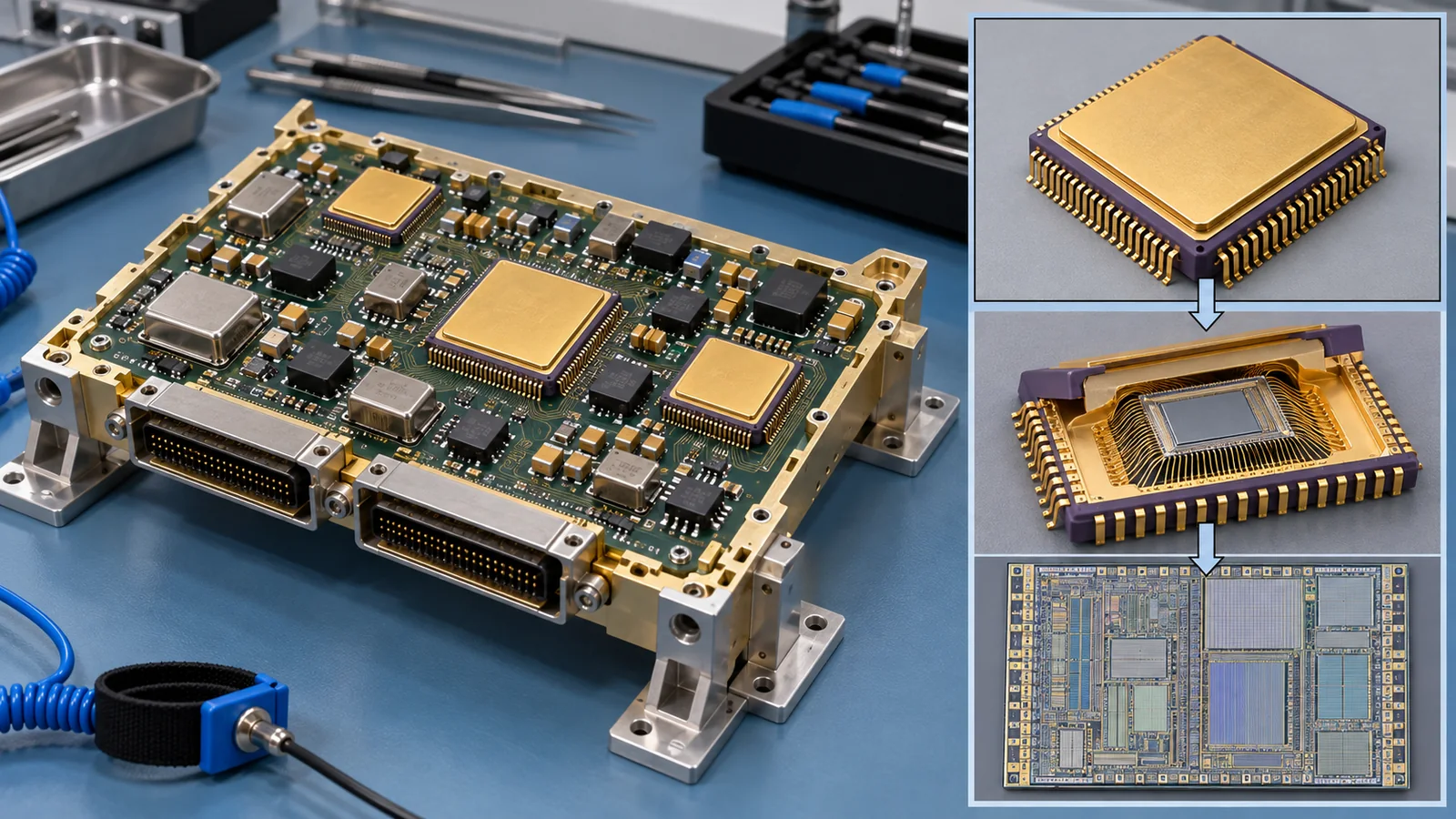
Ceramic, hermetically sealed packages are the tradition in space, but for low Earth orbit there is also "RT Mil-Plastic", the same silicon die in a plastic package (the same chip, with a different outer material and a different level of screening). Power parts use GaN (gallium nitride) devices, and the company says VORAGO's technology can raise the radiation tolerance of existing products without a redesign (the company's claim).
6. What it has done so far
| When | What happened | What it means |
|---|---|---|
| Over the years | The company says on its website it has "more than 60 years of flight heritage" and products on "over 90 space missions" | This article has not checked the breakdown by mission (the company's claim) |
| August 2022 | NASA chose Microchip to develop the high-performance spaceflight processor (HPSC): a firm-fixed-price contract of $50 million, with the company paying a significant share of the R&D cost | The first large record of a contract with a public body |
| 9 July 2024 | Announced the first PIC64-HPSC products and the ecosystem partners | From development to product |
| 10 July 2025 | RT PolarFire RTPF500ZT qualified to MIL-STD-883 Class B and QML Class Q. Engineering samples of the RT PolarFire SoC announced | Moved up one qualification step |
| 4 November 2025 | Announced a radiation-tolerant CAN FD transceiver (ATA6571RT) | A wider range of parts |
| February 2026 | NASA's HPSC ran for the first time (it sent an email saying "Hello Universe") | A major milestone (NASA's announcement) |
| 6 February 2026 | The company said in a blog that the RTG4 FPGA (lead-free bumps) holds QML Class V qualification | The highest-level qualification |
| 25 June 2026 | Announced the radiation-tolerant clock generator DSA504RT (limited sampling) | A wider range of timing parts |
| 13 August 2026 | Announced the Space CSAC-SA65 (a radiation-tolerant atomic clock) | A clock for small satellites |
| 9 October 2026 | Acquired VORAGO Technologies | Radiation-hardened microcontrollers added |
| 14 October 2026 | Began shipping a radiation-tolerant GaN power converter (POL-05-20S-T) | Meeting power demand as processing grows |
7. What comes next
All four items are plans or outlooks, not things that have been achieved Not yet confirmed. In its press-release cautions the company states that such outlooks may differ greatly from actual results.
None of the following appears in the primary sources checked for this article Not yet confirmed.
Space revenue, profit, headcount and R&D spending / when HPSC space qualification will finish and volume supply begin / when RT PolarFire will gain QML Class V / the price of the VORAGO acquisition and how its products will be handled / the registration status of each product on the DLA qualification lists. Outside estimates such as research-firm market sizes are not used.
8. What the company is aiming for in space
This section includes things the company has not said directly. They are inferences within what the primary sources support, given with their grounds.
| What can be read from the record | Primary-source basis | Category |
|---|---|---|
| It offers the same product across a range from COTS to QML V so users can choose by use | The Space Applications page ("the same product can be upgraded from COTS to QML"), the RTG4 RT Mil-Plastic version, and the RH and RT versions of the PIC64-HPSC | Sourced (company's account) |
| It also puts its growth weight on small-satellite networks in low Earth orbit (New Space) | The HPSC RT is described as for low-orbit constellations that put low cost first, the CSAC-SA65 as for the growing New Space market, and there is the RTG4 Mil-Plastic | Inference |
| It aims to widen its range of radiation-tolerant microcontrollers and take in radiation-hardening technology and people | The VORAGO announcement (a team with radiation-hardening expertise, the patented HARDSIL, a larger share of the aerospace, defense and space markets) | Sourced (company's account) |
| HPSC will enter full-scale supply after qualification is complete | NASA says the processor will be considered space qualified once testing ends and will then be offered commercially by Microchip. As of March 2026 it was under test | Inference |
| The scale of its space revenue will stay hard to check from outside | The 10-K does not disclose space revenue and only lists it among applications | Inference |
The July 2024 HPSC announcement describes the RH (radiation-hardened) version as for "rover hazard avoidance on the Moon's surface and long-duration deep-space missions like Mars expeditions", and the RT (radiation-tolerant) version as for "Low Earth Orbit (LEO) constellations where system providers must prioritize low cost over longevity" Sourced. Within one family, then, it separates working for a long time without fail from being cheap enough to fly in large numbers.
The Space CSAC-SA65 announcement also gives demand for "smaller, less expensive space hardware for short-duration missions" as its reason. Putting these together, this article reads Microchip as seeing mass-produced low-orbit networks as a source of demand alongside the traditional high-reliability space market Not yet confirmed.
9. Map of space-industry partnerships
10. Technology, products and services
The space products are easiest to follow in four roles: computing (processors and FPGAs), power, clocks (timing) and communication (an arrangement based on the company's descriptions).
| Role | Example products | The company's description | Category |
|---|---|---|---|
| Computing | RTG4, RT PolarFire, PIC64-HPSC, VORAGO's MCUs | Radiation-resistant configuration memory, a high-performance RISC-V processor and radiation-hardened microcontrollers | Sourced |
| Power | POL-05-20S-T, DC-DC converters, EMI filters | Supplying, small and stable, the large current that more capable processors need | Sourced |
| Clocks (timing) | Space CSAC-SA65, DSA504RT | An atomic clock that keeps synchronisation even when GNSS (satellite navigation) is unavailable, and a clock generator that replaces several oscillators with one | Sourced |
| Communication | ATA6571RT, Ethernet, MIL-STD-1553 and SpaceWire | Parts for data links inside a spacecraft. Radiation-tolerant and radiation-hardened products are offered | Sourced |
The POL-05-20S-T is specified to a "TID of 50 krad" and characterised for "SEE up to LET 43 MeV·cm²/mg", and the Space CSAC-SA65 tolerates "at least 30 kRad": radiation tolerance is given as numbers Sourced (all company-stated values). The krad (kilorad) is a unit for the total radiation a semiconductor receives, and the value needed depends on the mission's orbit and duration.
To read such numbers you need the test conditions (temperature, voltage, particle type, edition of the standard). The numbers in this article are copied from the press releases and have not been confirmed by third-party testing. Whether a part suits a given mission must be checked by the user from the data sheet and test reports.
11. The risks this company carries
| Risk | What it is | Category |
|---|---|---|
| The scale of space business cannot be seen from outside | Space revenue, headcount and R&D spending are not in the 10-K, so there is no way to check the scale or profitability from outside | Sourced |
| Waiting for qualification and testing | The PIC64-HPSC was still under testing in March 2026, and space qualification follows testing. QML Class V and Y for the RT PolarFire SoC are at the plan stage | Sourced |
| Integrating an acquisition | The VORAGO price is not disclosed. The 10-K says that integrating acquisitions generally costs money and time and expected benefits may not appear | Sourced |
| Reliance on outside wafer foundries | About 65% of company-wide net sales came from products made at outside foundries. The space share is unknown | Sourced |
| Changes in government procurement and export controls | The 10-K says changes in U.S. procurement rules (such as CMMC) and export controls could affect the business (company-wide risk) | Sourced |
| Claims over failures in an application | The 10-K notes the possibility of claims if a system fails in uses such as aerospace, defense and medical | Sourced |
| Misreading the numbers | Values such as radiation tolerance are company-stated values with test conditions, and suitability for each mission needs separate checking | Sourced |
| Effects of lower-cost parts for low orbit | A product built on commercial parts with radiation-tolerant components is not at the same level as a high-reliability deep-space part. Users need to understand the difference in screening when they choose | Inference |
12. Glossary
- RT (radiation-tolerant) and RH (radiation-hardened)
- RT means reasonably resistant to radiation; RH means designed and built to be more so. The company uses both in product names.
- TID (total ionizing dose)
- Gradual loss of a semiconductor's performance from the total radiation received. Measured in krad (kilorad).
- SEE (single-event effect)
- A sudden malfunction or damage caused by one high-energy particle. Its strength is shown by LET (the energy deposited in the material the particle passes through).
- QML
- The Qualified Manufacturers List of high-reliability semiconductors managed by the U.S. Defense Logistics Agency (DLA). It has grades such as QML Q and QML V (the highest).
- MIL-STD-883
- A U.S. Department of Defense standard for environmental, mechanical and electrical test methods for semiconductors.
- COTS
- Commercial off-the-shelf parts. They have not been through space-specific screening.
- FPGA
- A semiconductor whose wiring can be rewritten afterwards. In space it can be used to change functions after launch.
- HPSC
- NASA's program for a high-performance spaceflight processor (High-Performance Spaceflight Computing).
- GaN (gallium nitride)
- A semiconductor material used in high-efficiency power devices.
- Form 10-K
- The audited annual report that a U.S. listed company files each year with the SEC.
13. References
- Microchip Technology Form 10-K for the fiscal year ended March 31, 2026 (filed with the U.S. SEC on 21 May 2026, accession no. 0000827054-26-000016). Business, net sales, R&D spending, employees, manufacturing sites and risks. https://www.sec.gov/Archives/edgar/data/827054/000082705426000016/mchp-20260331.htm
- Microchip Technology Press release, "Microchip Technology Acquires VORAGO Technologies" (9 October 2026). The acquisition of VORAGO, a maker of radiation-hardened microcontrollers. https://ir.microchip.com/news-events/press-releases/detail/1419/microchip-technology-acquires-vorago-technologies
- Microchip Technology Press release, "Microchip Expands Space Power Portfolio with New Radiation-Tolerant GaN Point-of-Load Converter" (14 October 2026). The POL-05-20S-T. https://ir.microchip.com/news-events/press-releases/detail/1421/microchip-expands-space-power-portfolio-with-new-radiation-tolerant-gan-point-of-load-converter
- Microchip Technology Press release, "Microchip Expands Space-Qualified FPGA Portfolio with New RT PolarFire Device Qualifications and SoC Availability" (10 July 2025). https://ir.microchip.com/news-events/press-releases/detail/1323/microchip-expands-space-qualified-fpga-portfolio-with-new-rt-polarfire-device-qualifications-and-soc-availability
- Microchip Technology Blog post, "RTG4 FPGAs: A Journey From QML-V Qualification for Traditional Space to RT Mil-Plastic Qualification for New Space" (6 February 2026). https://www.microchip.com/en-us/about/media-center/blog/2026/rtg4-fpgas-qml-v-to-rt-mil-plastic
- Microchip Technology Press release, "Microchip Unveils Industry's Highest Performance 64-bit HPSC Microprocessor (MPU) Family" (9 July 2024). The PIC64-HPSC. https://www.microchip.com/en-us/about/news-releases/products/microchip-unveils-industrys-highest-performance-64-bit-hpsc-mpu
- NASA News release, "NASA Awards Next-Generation Spaceflight Computing Processor Contract" (August 2022). Microchip to develop the HPSC processor. https://www.nasa.gov/news-release/nasa-awards-next-generation-spaceflight-computing-processor-contract/
- NASA Project page, "High Performance Spaceflight Computing (HPSC)". The first operation in February 2026 and the testing status as of March 2026. https://www.nasa.gov/game-changing-development-projects/high-performance-spaceflight-computing-hpsc/
- Microchip Technology Press release, "Microchip Advances Space-Grade Timing with Enhanced Radiation Tolerance and Extended Temperature Performance" (13 August 2026). The Space CSAC-SA65. https://ir.microchip.com/news-events/press-releases/detail/1411/microchip-advances-space-grade-timing-with-enhanced-radiation-tolerance-and-extended-temperature-performance
- Microchip Technology Press release, "Streamline Spacecraft Timing Architecture with Microchip's Radiation-Tolerant, Low-Power, Low-Jitter Six-Output Clock Generator" (25 June 2026). The DSA504RT. https://ir.microchip.com/news-events/press-releases/detail/1402/streamline-spacecraft-timing-architecture-with-microchips-radiation-tolerant-low-power-low-jitter-six-output-clock-generator
- Microchip Technology Press release, "New Radiation-Tolerant, High-Reliability Communication Interface Solution for Space Applications" (4 November 2025). The ATA6571RT. https://ir.microchip.com/news-events/press-releases/detail/1343/new-radiation-tolerant-high-reliability-communication-interface-solution-for-space-applications
- Microchip Technology Official website, "Space Applications". Overview of its space products and the company's account of its flight heritage (over 60 years, more than 90 missions). Checked on 17 October 2026. https://www.microchip.com/en-us/solutions/aerospace-and-defense/space
- Microchip Technology Investor relations website (the source of the logo, and the press-release list). Checked on 17 October 2026. https://ir.microchip.com/
14. Claim-to-source audit
| Claim in the article | Category | Source |
|---|---|---|
| Legal name, head office address, listing, incorporation (1989, Delaware) and about 17,900 employees | Sourced | Reference 1 https://www.sec.gov/Archives/edgar/data/827054/000082705426000016/mchp-20260331.htm |
| Company-wide net sales (years to March 2025 and 2026), R&D spending, capital expenditure, regional shares and reliance on outside foundries | Sourced | Reference 1 https://www.sec.gov/Archives/edgar/data/827054/000082705426000016/mchp-20260331.htm |
| The "other" product line at 21.8% of net sales, and the countries with dedicated aerospace and defense sites | Sourced | Reference 1 https://www.sec.gov/Archives/edgar/data/827054/000082705426000016/mchp-20260331.htm |
| The 10-K lists "satellites and spacecrafts" among applications and includes space among the uses of PIC64 and FPGAs | Sourced | Reference 1 https://www.sec.gov/Archives/edgar/data/827054/000082705426000016/mchp-20260331.htm |
| The acquisition of VORAGO Technologies (9 October 2026), terms not disclosed, not expected to be material | Sourced | Reference 2 https://ir.microchip.com/news-events/press-releases/detail/1419/microchip-technology-acquires-vorago-technologies |
| POL-05-20S-T (20 A, 25 g, TID 50 krad, LET 43, -55 to +100 °C, shipping) | Sourced | Reference 3 https://ir.microchip.com/news-events/press-releases/detail/1421/microchip-expands-space-power-portfolio-with-new-radiation-tolerant-gan-point-of-load-converter |
| RT PolarFire RTPF500ZT MIL-STD-883 Class B and QML Class Q, SoC engineering samples, roadmap to QML V and Y, up to 50% less power | Sourced | Reference 4 https://ir.microchip.com/news-events/press-releases/detail/1323/microchip-expands-space-qualified-fpga-portfolio-with-new-rt-polarfire-device-qualifications-and-soc-availability |
| RTG4 QML-V qualification, lead-free bump reliability testing (-65 to 150 °C, up to 2,000 cycles, no whiskers), RT Mil-Plastic | Sourced | Reference 5 https://www.microchip.com/en-us/about/media-center/blog/2026/rtg4-fpgas-qml-v-to-rt-mil-plastic |
| The PIC64-HPSC announcement (9 July 2024): RH and RT versions, eight cores, up to 2 TOPS and 1 TFLOPS, named ecosystem partners, sample timing | Sourced | Reference 6 https://www.microchip.com/en-us/about/news-releases/products/microchip-unveils-industrys-highest-performance-64-bit-hpsc-mpu |
| NASA (JPL) selected Microchip (August 2022): a firm-fixed-price contract of $50 million, with the company also bearing R&D cost | Sourced | Reference 7 https://www.nasa.gov/news-release/nasa-awards-next-generation-spaceflight-computing-processor-contract/ |
| NASA HPSC first operation in February 2026, testing as of March 2026, commercial supply by Microchip afterwards | Sourced | Reference 8 https://www.nasa.gov/game-changing-development-projects/high-performance-spaceflight-computing-hpsc/ |
| Space CSAC-SA65 (at least 30 kRad, under 120 mW, under 17 cc, 13 August 2026) | Sourced | Reference 9 https://ir.microchip.com/news-events/press-releases/detail/1411/microchip-advances-space-grade-timing-with-enhanced-radiation-tolerance-and-extended-temperature-performance |
| DSA504RT (six outputs, 200 femtoseconds, limited sampling, 25 June 2026) | Sourced | Reference 10 https://ir.microchip.com/news-events/press-releases/detail/1402/streamline-spacecraft-timing-architecture-with-microchips-radiation-tolerant-low-power-low-jitter-six-output-clock-generator |
| ATA6571RT (5 Mbps, $210 each in 10-unit quantities, 4 November 2025) | Sourced | Reference 11 https://ir.microchip.com/news-events/press-releases/detail/1343/new-radiation-tolerant-high-reliability-communication-interface-solution-for-space-applications |
| Overview of space products, and the company's account of over 60 years of flight heritage and more than 90 missions | Sourced | Reference 12 https://www.microchip.com/en-us/solutions/aerospace-and-defense/space |
| The steps of space-part qualification (COTS, RT Mil-Plastic, QML Q, QML V) | Our calculation | Our own arrangement. The description of each step rests on the company's statements in references 4 and 5 |
| The four types of space company and Microchip's position | Our calculation | Our own classification. Companies shown are examples from this series |
| HPSC space qualification, QML V and Y for the RT PolarFire SoC, integrating VORAGO, volume timing for the DSA504RT | Not yet confirmed | References 8 and 4 https://www.nasa.gov/game-changing-development-projects/high-performance-spaceflight-computing-hpsc/ https://ir.microchip.com/news-events/press-releases/detail/1323/microchip-expands-space-qualified-fpga-portfolio-with-new-rt-polarfire-device-qualifications-and-soc-availability |
| Space revenue, headcount and R&D spending, when HPSC qualification will finish, the VORAGO price, and registration on the DLA lists | Not yet confirmed | Could not be confirmed. This article uses neither estimates nor outside figures |
| The reading that it also puts its growth weight on low Earth orbit (New Space) | Inference | This article's interpretation of the descriptions of the HPSC RT, the CSAC-SA65 and the RTG4 Mil-Plastic |
| The readings that HPSC supply follows qualification, and that space revenue will stay hard to check from outside | Inference | This article's interpretation of NASA's description and of the 10-K's non-disclosure of space revenue |
| The reading of risk that lower-cost products are at a different level from high-reliability deep-space parts | Inference | This article's interpretation of the contrast between the CSAC-SA65 (commercial-based, at least 30 kRad) and QML V |
Last updated 17 October 2026 / Troy Technical
Figures in this article come from Microchip Technology's statutory filing (Form 10-K), its official announcements and NASA's publications. No research-firm market estimates, press-based figures, share prices or company valuations have been used. Passages marked "Inference" are this article's interpretation of primary sources, not statements made by the company. Product performance figures are company-stated values and have not been confirmed by third-party testing. Plans and dates may change.