COMPANY PROFILE / SPACE INDUSTRY
Mitsubishi Heavy Industries (space business)
- The prime contractor for Japan's flagship H3 rocket, still flying after two failures that have been examined in official reports
Mitsubishi Heavy Industries (MHI) is the prime contractor that leads development of the airframe of H3, Japan's main launch vehicle, working with the Japan Aerospace Exploration Agency (JAXA) on its development and launches. H3 has so far flown nine times, with seven successes and two failures (as of 17 October 2026; tallied by this article from JAXA announcements). JAXA has published a cause-investigation report for each of the two failures (Test Flight No. 1 in March 2023 and Flight No. 8 in December 2025). For Flight No. 8, the direct cause was identified as internal delamination, created during the bonding process, in the part that carries the satellite. This article does not cover MHI as a whole. It focuses on the space business and sets out what MHI does, how much can be confirmed, and what is still open, using primary sources only.
- MHI in 30 seconds, and where it sits in the space industry
- Logo and how the name is written
- Where the company sits in the space industry
- Company size (kept brief, focused on space)
- Resources committed to the space industry
- Track record so far
- Plans
- What the company seems to be aiming for
- Partnership map in the space industry
- Technologies, products and services
- Risks the company faces
- Glossary / References / Claim-to-source audit
1. MHI in 30 seconds, and where it sits in the space industry
Tokyo, Japan3-2-3 Marunouchi
code 7011Files an annual securities report in Japan
Exploration, crewed & lunar (secondary)Runs H3. Also develops the ISS cargo vehicle HTV-X
(7 successes, 2 failures)As of 17 October 2026, tallied by this article from JAXA announcements
planned for 20 October 2026Announced by JAXA on 20 August 2026. A plan, not yet flown
It is easy to assume that JAXA designs Japanese rockets and manufacturers simply build them. On H3 the split is different: MHI leads airframe development as prime contractor, while JAXA handles overall system development, key technology development and ground facilities Sourced (per JAXA's cause-investigation report; development began in 2014). H3's success is therefore a national programme and, at the same time, MHI's space business itself. H3 has already reached the stage of launching operational satellites, but it failed on Test Flight No. 1 (2023) and Flight No. 8 (2025), and JAXA has set out causes and preventive measures in a report for each. This article does not argue about those failures as the responsibility of any company or person. It presents only what the official reports say.
2. Logo and how the name is written

A note on naming: the legal name is Mitsubishi Heavy Industries, Ltd. (abbreviated MHI). Inside the company, the space business is run by the Space Systems Division of the Defense & Space Segment, but the reportable segment shown in its financial statements is called "Aerospace, Defense & Space", and space figures are not separated out. H3 is a joint development by JAXA and MHI. JAXA is a separate organisation (a national research and development agency), and this article keeps the two apart.
Official site: https://www.mhi.com/jp/ (the logo used here is the English-language logo shown on MHI's official English site)3. Where the company sits in the space industry
Companies in the space industry are easiest to sort by the role they play in space, which gives four types. MHI is mainly a "Launch" company, carrying payloads up on a rocket, and secondarily an "Exploration, crewed and lunar" company, for example through development of cargo vehicles that supply the International Space Station (ISS). It is not a company that sells satellites or probes under its own brand.
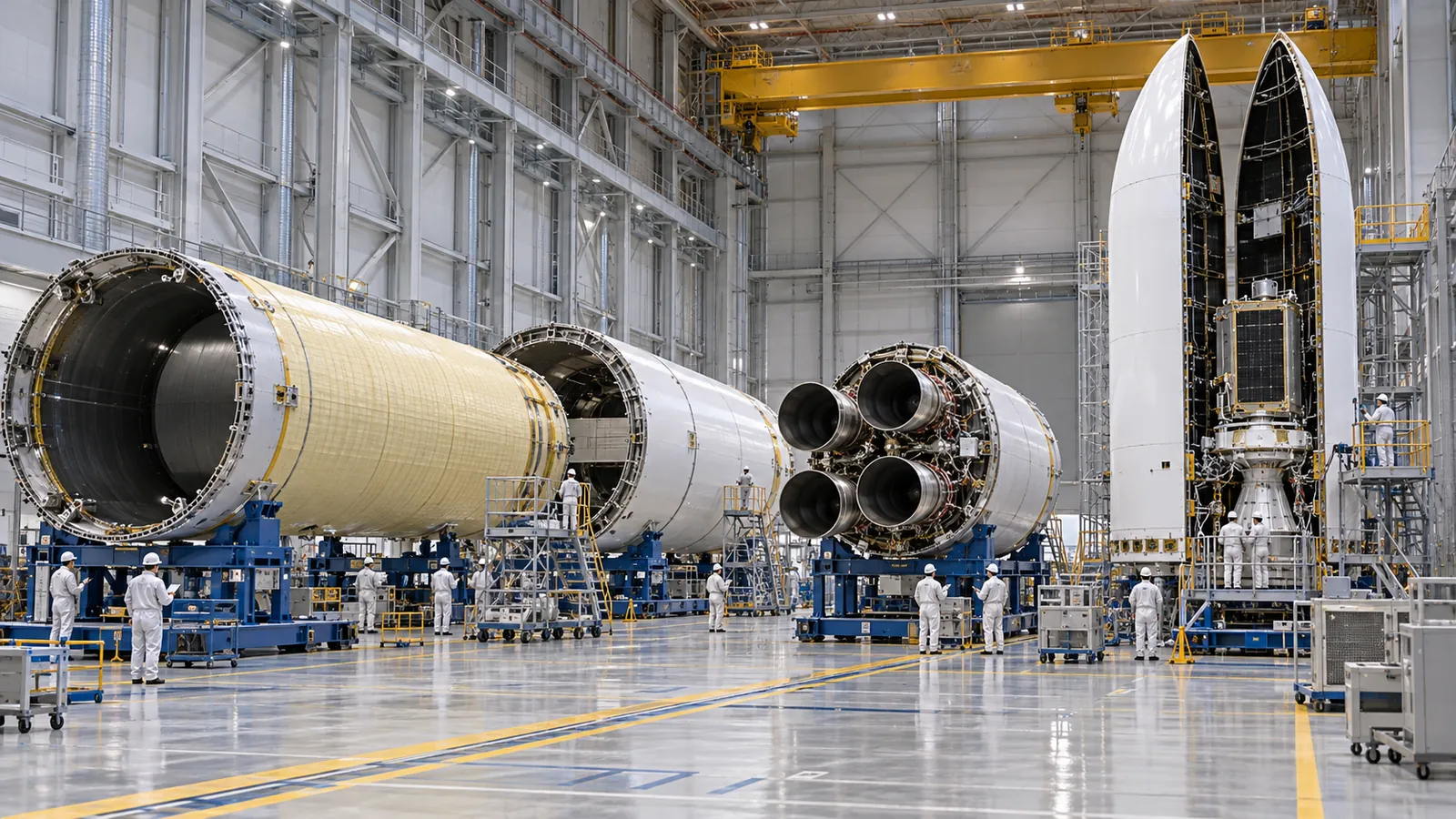
A prime contractor is the company that coordinates the work of many suppliers and delivers the whole vehicle. On H3, MHI coordinates development of the whole airframe, while other companies and agencies take on individual items such as parts of the engines and structures. H3 also changes its combination of parts (its configuration) to suit the payload. The 22 configuration, for example, has two first-stage LE-9 engines and two SRB-3 solid rocket boosters; the 24 configuration has two engines and four boosters; and the 30 configuration lifts off on three engines alone, with no boosters (per JAXA's report). For the basics of rockets, see our explainers on the fundamentals of rockets and on rocket engines and propellants.
4. Company size (kept brief, focused on space)
MHI is a large company with many businesses beyond space. The whole company is covered only by the table below, and the space-related parts are covered in the next section Sourced.
| Measure (consolidated) | FY2023 (year to March 2024) | FY2024 (year to March 2025) | FY2025 (year to March 2026) |
|---|---|---|---|
| Revenue (JPY million) | 4,657,147 | 4,361,127 | 4,974,168 |
| Business profit (JPY million) | 282,541 | 354,965 | 432,218 |
| Employees (people) | 77,697 | 77,274 | 78,793 |
The FY2024 figures are as restated by the company, excluding a business classified as discontinued in FY2025 (the forklift subsidiary). The company's other businesses are not this article's subject, so nothing further is said about them.
| Disclosures closest to space (FY2025) | Figure | Caution |
|---|---|---|
| Revenue and profit of the space business | Not disclosed | Reported inside the "Aerospace, Defense & Space" segment |
| Sales of the "Aerospace, Defense & Space" segment | JPY 1,393,858 million | Total for commercial aircraft, defense and space equipment. The space share is unknown (includes inter-segment transactions) |
| Employees of the same segment (31 March 2026) | 12,048 people | Excludes 1,243 temporary staff. The space-only headcount is not disclosed |
| R&D expenses of the same segment | JPY 185,418 million | The report lists "H3 rocket" among the main R&D items. The space-only amount is not disclosed |
The figures above are for the whole company, or for a segment that includes more than space. The revenue, profit and investment of H3 or of the space business alone are not stated in the annual securities report Not yet confirmed. This article does not estimate them. Figures for "the size of the H3 business" seen in press reports cannot be confirmed from primary sources and are not used.
5. Resources committed to the space industry
Four angles are covered (people, money, outside investments and acquisitions, and contracts with public agencies), showing what could and could not be confirmed. Where a check found no mention, that is kept in the table as a finding in itself.
| Angle | What could be confirmed | Category |
|---|---|---|
| People | The "Aerospace, Defense & Space" segment, which includes space, had 12,048 employees (consolidated, 31 March 2026). The headcount of the space division is not disclosed. H3 is launched from the Tanegashima Space Center, and MHI presents itself as the provider of launch services | Sourced (space-only headcount not confirmed) |
| Money | The segment's R&D expenses were JPY 185,418 million, with H3 development among the main items. The development cost and capital spending for H3 are not disclosed. MHI was selected for JAXA's Space Strategy Fund (first phase; the amount could not be confirmed) | Sourced (amounts not confirmed) |
| Investments, acquisitions, joint ventures, divestments | In January 2026, together with Mitsubishi Electric, MHI invested in the space venture Japan LEO Shachu, set up by Mitsui & Co. (the amount is not in the announcement). No acquisitions or sales in the space business could be confirmed | Sourced (amounts and other deals not confirmed) |
| Contracts and ties with public agencies | H3 development (shared with JAXA, with MHI as prime contractor). The Space Strategy Fund (notice of selection dated 30 January 2025, for manufacturing technology for large cryogenic propellant tanks). H3 launches (JAXA announcements). Contract values could not be confirmed | Sourced (contract values not confirmed) |
Status of main vehicles and products (checked 17 October 2026)
| Vehicle / product | Type | Main specifications (stated values, with conditions) | Track record | Stage |
|---|---|---|---|---|
| H3 rocket | Two-stage flagship launch vehicle (launch) | Diameter 5.2 m. Length 57 m (short fairing) or 63 m (long fairing). Launch capability: 4 t or more to sun-synchronous orbit (500 km altitude), 6.5 t or more to geosynchronous transfer orbit (delta-V of 1,500 m/s) (JAXA's specifications) | 9 flights (7 successes, 2 failures) | In operation. Measures after Flight No. 8 under way (References 15 and 16) |
| LE-9 (first-stage engine) | Liquid hydrogen and liquid oxygen engine | Vacuum thrust 1,471 kN per engine, specific impulse 422 s (JAXA's specifications). Two or three engines on the first stage | Used on H3 flights | In operation |
| LE-5B-3 (second-stage engine) | Liquid hydrogen and liquid oxygen engine | Vacuum thrust 137 kN, specific impulse 448 s (JAXA's specifications) | Used on H3 flights | In operation |
| SRB-3 (solid rocket booster) | Solid-fuel strap-on rocket | Vacuum thrust 2,300 kN per booster, specific impulse 283.6 s. Zero, two or four boosters are fitted (JAXA's specifications) | Used on H3 flights (not used on the 30 configuration) | In operation |
| Payload support structure (PSS) | Structure connecting the satellite to the second stage | Sandwich structure with carbon-fibre-reinforced polymer (CFRP) skins and an aluminium honeycomb core. The H3 version is a new development | The part identified as the direct cause of the Flight No. 8 failure (JAXA report) | Back in service with corrective measures (a repaired PSS flew on Flight No. 6) |
| New space station cargo vehicle (HTV-X) | Resupply vehicle for the ISS | MHI says it has developed the overall system, the pressurised module and other parts (announcement of January 2026). Specifications are not covered here | Flight No. 1 launched on H3 Flight No. 7 on 26 October 2025 and placed in orbit (JAXA announcement) | In operation |
| H-IIA rocket | Previous-generation flagship rocket | H3 is its successor | Flight No. 50 launched on 29 June 2025 (MHI announcement). Current operating status could not be confirmed | Could not be confirmed |
MHI has been selected for JAXA's Space Strategy Fund (first phase) for "research on manufacturing technology for lightweight, low-cost large cryogenic propellant tanks using WAAM" Sourced. WAAM (wire arc additive manufacturing) is a 3D-printing technique that melts metal wire with an electric arc and builds a part up layer by layer. The official summary says that although deposition is fast, the technology is less mature than powder-based methods, so (1) stabilising build quality, (2) raising strength, (3) quality assurance and (4) building large parts are the main challenges. The plan is to prototype domes 1 to 2 m in diameter to find the problems that come with larger size. What can be read from this is an aim to cut the time and cost of making propellant tanks (containers for cryogenic liquids such as liquid hydrogen). This is, however, a description at the stage of selection for research, and it does not show that the technique will be used on production H3 vehicles Not yet confirmed.
6. Track record so far
H3 launch record (from JAXA announcements)
| Date | Event | What it means |
|---|---|---|
| 2014 | H3 development began. MHI coordinates airframe development as prime contractor, while JAXA handles the overall system, key technologies and ground facilities | Developed as the successor to H-IIA (JAXA report) |
| 6 December 2018 | Inmarsat (UK) and MHI announced an agreement for Inmarsat to be the first commercial company to launch on H3. Launch was expected in 2022 or later | An announcement of the time. The current status could not be confirmed |
| 7 March 2023 | H3 Test Flight No. 1 failed. The second-stage engine did not ignite, and a destruct command was sent (JAXA announcement) | Failure of the first vehicle. Cause-investigation report on 26 October 2023 |
| 17 February 2024 | First successful launch, on Test Flight No. 2 | H3's first success |
| 1 July 2024 to 2 February 2025 | Flight No. 3 (ALOS-4), No. 4 (Kirameki-3) and No. 5 (Michibiki-6) succeeded in a row | Moved into launching operational satellites |
| 30 January 2025 | Selected for JAXA's Space Strategy Fund (first phase) for WAAM-based manufacturing of large cryogenic propellant tanks | Manufacturing-technology research (not a sign of adoption in production) |
| 29 June 2025 | Launched IBUKI-GW on H-IIA Flight No. 50 (MHI announcement) | H-IIA reached 50 flights |
| 26 October 2025 | Flight No. 7 launched the new space station cargo vehicle, HTV-X1, and placed it in orbit | A new vehicle for ISS resupply |
| 22 December 2025 | Flight No. 8 failed. The second burn of the second-stage engine did not start up, and the Quasi-Zenith Satellite "Michibiki-5" could not be placed in orbit (JAXA announcement) | The second failure. Cause-investigation report on 23 July 2026 |
| 26 January 2026 | Invested in Japan LEO Shachu together with Mitsubishi Electric | Building a position for the post-ISS era |
| 28 April 2026 | Completed the first mission of the "Dassai MOON Project" with the sake brewer Dassai (a sake fermentation test on the ISS). The brewing equipment was launched on H3 Flight No. 7 and HTV-X1 | An example of private use of H3 and HTV-X |
| 11 May 2026 | The onboard AI object detector "AIRIS" succeeded in detecting ships in orbit | Demonstration of space parts and systems |
| 12 June 2026 | Flight No. 6 (a test flight of the 30 configuration) succeeded, carrying a repaired part | The first flight after the Flight No. 8 failure |
| 29 July 2026 | Signed a launch service contract with ispace for its new lander "ULTRA" (a lunar landing mission planned for 2028) | Won the launch of a private lunar mission |
| 11 August 2026 | Flight No. 9 launched the Quasi-Zenith Satellite "Michibiki-7" and placed it in the planned orbit | The first operational-satellite launch after Flight No. 8 |
The two failures: what the official reports say (summary)
| Failure | JAXA report's explanation (summary) | Measures (per the report) |
|---|---|---|
| Test Flight No. 1 7 March 2023 | The first-stage burn and the stage separation went as planned, but the second-stage engine did not ignite. The report narrows the candidates to three scenarios (a short circuit inside the igniter, an overcurrent produced when the igniter is energised, and an overcurrent arising inside an electrical unit (PSC2) and spreading to the other half of the redundant pair) and assesses that one of them was the cause (it was not narrowed to a single cause) | Better insulation, stricter inspection and part screening for the igniter, and removal of a protective component (a Zener diode) in the electrical system, among others |
| Flight No. 8 22 December 2025 | Inside the payload support structure (PSS) there was delamination created in the manufacturing process. The direct cause was identified as that delamination growing under the shock of fairing (payload cover) separation until the whole PSS failed. The main cause of the delamination was that, during bonding, the temperature in part of the panel was higher than expected, which lowered the bond strength there | A "repair method" that fixes the delaminated areas of parts already built, and a "fastener method" that drops the adhesive and joins the panels with bolts or similar. The latter is to be the basic approach from now on |
The Flight No. 8 report also sets out underlying factors: that when H3 development adopted a technically difficult new process (described below), the risk of local overheating was not identified, and that no internal inspection was carried out after qualification testing. At the same time, it states that no deficiency was found in the project-management rules or the personnel-training system themselves. This article presents these as JAXA's assessment and does not discuss the responsibility of any organisation or person.
7. Plans
Everything below is a plan or schedule, not an achieved fact Not yet confirmed.
(planned)JAXA announcement of 20 August 2026. Reserve period to 7 November
space stationsISS retirement is planned for 2030 (Japan LEO Shachu announcement)
None of the following appears in primary sources Not yet confirmed.
The planned number of H3 launches per year / H3 prices (launch fees) / the outlook for revenue and profit of the H3 and space business / the current status of the 2018 agreement with Inmarsat / the future operation of H-IIA / the value of the contract with ispace. Figures such as "so many launches a year" or "so much per launch" mostly come from press reports and are not used in this article.
8. What the company seems to be aiming for
This section includes points the company has not stated directly. They are written as inferences that can be drawn from primary sources, with the basis given.
| What can be read | Primary-source basis | Category |
|---|---|---|
| It is trying to widen H3 from a national launch vehicle to a commercial launch service for private customers | In the ispace announcement MHI says it will support "a wide range of space missions in Japan and abroad", and JAXA's report describes a structure aimed at an early move to a privately led launch system | Inference |
| It values a domestic pairing for lunar transport (a Japanese lander on a Japanese rocket) | The joint announcement with ispace speaks of a "domestic lander and domestic rocket" and of considering cooperation on lunar infrastructure and related technology | Inference |
| It is preparing to take part in business in low Earth orbit after the ISS | Its investment in Japan LEO Shachu, and its reference to using technology built through HTV-X and the Kibo module | Inference |
| It is extending into space equipment and parts beyond launch (AI and semiconductors) | In-orbit demonstration of AIRIS and the next-generation space microprocessor (SOISOC4) | Sourced (the intent to extend is an inference) |
| Restoring confidence in H3 is the top priority for now | After two failures, it continues verifying countermeasures with JAXA, and the cause-investigation report sets out preventive measures | Inference |
The report on the Flight No. 8 failure says that to secure H3's cost competitiveness, a new bonding method (splice bonding without an autoclave) was adopted Sourced. The corresponding H-IIA part was joined with bolts or similar, and H3 changed to adhesive. The corrective action then makes a return to the proven bolted joining method the basic approach. From this, this article reads the future challenge for H3 as striking a balance between adopting new manufacturing methods to lower cost and going back to proven methods for stable quality. This is, however, an interpretation of the report's wording and not a statement of the company's strategy Not yet confirmed.
9. Partnership map in the space industry
10. Technologies, products and services
The core of MHI's space business is launch services on H3. JAXA names three elements as H3's features: flexibility, high reliability and low price Sourced.
| Technology or service | Official explanation | In plain terms |
|---|---|---|
| Launch services on H3 | The first-stage engine count (two or three), the number of boosters (zero, two or four) and the fairing (short or long) are combined to suit the payload | The rocket's configuration can be changed to suit the weight and size of the payload |
| LE-9 engine (first stage) | Uses Japan's own expander bleed cycle and introduces new technology such as 3D printing, aiming to combine high reliability with low cost (JAXA) | A kind of cycle in which liquid hydrogen is warmed into gas by the combustion-chamber wall, and the gas's expansion spins the turbopump |
| New space station cargo vehicle (HTV-X) | MHI developed the overall system and the pressurised module of HTV-X, among other parts (announcement of January 2026) | A supply ship that carries cargo to the ISS. It has a "pressurised" compartment with air |
| Next-generation space microprocessor "SOISOC4" and the AI object detector "AIRIS" | A space microprocessor developed by JAXA and MHI runs AI on the satellite and detects ships in images. It was demonstrated on a satellite launched on 14 December 2025, and success was announced in May 2026 | A radiation-tolerant semiconductor that runs AI inside a satellite |
| Brewing equipment for space | Sake brewing equipment developed jointly with Dassai. It operated on the ISS's Japanese module in an environment simulating lunar gravity | Dedicated equipment to carry out fermentation in space |
| Research on tank manufacturing by WAAM | Selected for JAXA's Space Strategy Fund (first phase) | Research on making large fuel tanks by 3D-printing metal |
The part at the centre of the Flight No. 8 failure was the payload support structure (PSS). According to JAXA's report, the PSS is a sandwich structure made by bonding thin CFRP (carbon-fibre-reinforced polymer) skins to an aluminium honeycomb core. The structure is the same as that of the H-IIA part, but the H3 part uses a different CFRP material, and the panel joints (splices) changed from bolted joints to bonded joints Sourced.
The report says that, to secure competitiveness, a method that does not use an autoclave (a large pressure oven), known as out-of-autoclave or OoA, was adopted for the splice bonding. Because of manufacturing-equipment constraints, lay-up and bonding had to be carried out in separate factories, so the splice was divided into two. As a result, the section between the two heaters became locally hotter than expected, the bond strength dropped, and internal delamination formed, the report explains. It also presents verification results showing that, in vacuum, such delamination can grow under the shock of fairing separation and lead to failure.
From the materials and manufacturing side, two things can be said: how heat is applied (the temperature distribution) decides bond quality, and internal delamination is hard to find from appearance or strength tests alone. The report's preventive measures include carrying out non-destructive inspection after qualification testing and checking margins by destructive testing Sourced. For the basics of composites, see our explainers on CFRP and composite materials for space and on lightweight structural materials.
11. Risks the company faces
| Risk | Content | Category |
|---|---|---|
| Launch failure | H3 has failed twice in nine flights. Official reports have set out causes and measures, and the stage now is one of confirming the measures' effect in later flights | Sourced |
| Confirming the measures | Flight No. 6, which used a repaired PSS, and the later Flight No. 9 both succeeded. However, the PSS method used on Flight No. 9, and the timing and scope of switching to the fastener method, could not be confirmed from the primary sources used here | Not yet confirmed |
| Schedule delays | Flight No. 9 was postponed from its planned date of 1 February 2026 and actually launched on 11 August 2026 (MHI and JAXA announcements) | Sourced |
| Profitability of space is not visible from outside | Revenue, profit and investment are reported together with other businesses, so the profitability of the space business alone cannot be confirmed | Sourced |
| Winning private customers | The ispace contract could be confirmed, but the current status of other private deals (including the 2018 agreement with Inmarsat) could not | Could not be confirmed |
| Risk of introducing new manufacturing methods | As the report shows, on a part that used a new manufacturing method (OoA bonding), the risk of local overheating was not found beforehand | Sourced |
| Dependence on lunar and space-station plans | ispace's lunar landing is a plan for 2028, and the post-ISS era is at the planning stage, led by private companies. MHI depends on how its partners' plans progress | Inference |
12. Glossary
- H3 rocket
- Japan's flagship rocket, developed by JAXA and MHI. The successor to H-IIA.
- Prime contractor
- The company that coordinates the work of many companies and delivers the whole.
- Low Earth orbit (LEO)
- An orbit a few hundred kilometres above the ground, where the ISS and others fly.
- Sun-synchronous orbit (SSO)
- An orbit that passes over the poles and crosses any given place at the same local time each day. Often used by Earth-observation satellites.
- Geosynchronous transfer orbit (GTO)
- A stretched-out orbit on the way to geostationary orbit.
- Fairing
- The cover at the nose of a rocket that encloses the payload. It is separated after the rocket leaves the dense atmosphere.
- Payload support structure (PSS)
- The structural part that connects the satellite to the second-stage rocket.
- CFRP
- Carbon-fibre-reinforced polymer: plastic strengthened with carbon fibres. Light and strong.
- Honeycomb
- A core material shaped like a beehive. Sandwiched between thin sheets, it makes a light panel that resists bending.
- OoA (out-of-autoclave)
- A way of curing or bonding composites without a large pressure oven (autoclave).
- WAAM
- Wire arc additive manufacturing. A 3D-printing method that melts metal wire with an arc and stacks it up.
- Specific impulse (Isp)
- A measure of propellant-use efficiency, in seconds. The engine's equivalent of fuel economy: higher means less propellant for the same job.
- ISS / HTV-X
- The International Space Station / Japan's new cargo vehicle.
- Annual securities report
- The yearly report a listed Japanese company files with the government. It is audited and carries legal liability.
13. References
- Mitsubishi Heavy Industries Annual Securities Report for fiscal 2025 (1 April 2025 to 31 March 2026; filed 24 June 2026) (in Japanese). Revenue, business profit, employees, segment employees, sales and R&D expenses. https://www.mhi.com/jp/finance/library/financial/pdf/2025/2025_04_all.pdf
- JAXA Report on the Cause Investigation of the H3 Flight No. 8 Launch Failure (23 July 2026) (in Japanese). H3 development structure, PSS structure, direct cause, corrective measures, underlying factors. https://www.jaxa.jp/hq-disclosure/h3f8/files/H3-f8_report_01.pdf
- JAXA Response status on the H3 Flight No. 8 launch failure (posted 30 July 2026) (in Japanese). https://www.jaxa.jp/hq-disclosure/h3f8/index_j.html
- JAXA Report on the Cause Investigation of the H3 Test Flight No. 1 Launch Failure (26 October 2023) (in Japanese). https://www.jaxa.jp/hq-disclosure/h3-tf1/files/H3-tf1_report_01.pdf
- JAXA H3 Test Flight No. 1 launch failure and establishment of a response headquarters (7 March 2023) (in Japanese). https://www.jaxa.jp/press/2023/03/20230307-2_j.html
- JAXA Result of the H3 Test Flight No. 2 launch (17 February 2024) (in Japanese). https://www.jaxa.jp/press/2024/02/20240217-1_j.html
- JAXA Result of the launch of the Advanced Land Observing Satellite-4 (ALOS-4) on H3 Flight No. 3 (1 July 2024) (in Japanese). https://www.jaxa.jp/press/2024/07/20240701-1_j.html
- JAXA Result of the launch of the X-band defense communications satellite "Kirameki-3" on H3 Flight No. 4 (4 November 2024) (in Japanese). https://www.jaxa.jp/press/2024/11/20241104-1_j.html
- JAXA Result of the launch of "Michibiki-6" on H3 Flight No. 5 (2 February 2025) (in Japanese). https://www.jaxa.jp/press/2025/02/20250202-1_j.html
- JAXA Result of the launch of the new space station cargo vehicle No. 1 (HTV-X1) on H3 Flight No. 7 (26 October 2025) (in Japanese). https://www.jaxa.jp/press/2025/10/20251026-1_j.html
- JAXA H3 Flight No. 8 launch failure and establishment of a response headquarters (22 December 2025) (in Japanese). https://www.jaxa.jp/press/2025/12/20251222-2_j.html
- JAXA Result of the launch of H3 Flight No. 6 (30 configuration test flight) (12 June 2026) (in Japanese). https://www.jaxa.jp/press/2026/06/20260612-1_j.html
- JAXA Result of the launch of "Michibiki-7" on H3 Flight No. 9 (11 August 2026) (in Japanese). https://www.jaxa.jp/press/2026/08/20260811-1_j.html
- JAXA Launch of the Martian Moons eXploration (MMX) spacecraft on H3 Flight No. 10 (20 August 2026; planned launch date 20 October 2026) (in Japanese). https://www.jaxa.jp/press/2026/08/20260820-1_j.html
- JAXA Space Transportation Mission Directorate H3 rocket specifications (length, thrust, specific impulse, launch capability) (in Japanese). Checked 17 October 2026. https://www.rocket.jaxa.jp/rocket/h3/system.html
- JAXA H3 rocket (project page: the three elements of H3, list of press releases) (in Japanese). Checked 17 October 2026. https://www.jaxa.jp/projects/rockets/h3/index_j.html
- JAXA Space Transportation Mission Directorate H3 rocket (description of LE-9) (in Japanese). Checked 17 October 2026. https://www.rocket.jaxa.jp/rocket/h3/
- Mitsubishi Heavy Industries and ispace ispace and MHI sign a launch service contract for the new lander "ULTRA" on the H3 rocket (29 July 2026) (in Japanese). https://www.mhi.com/jp/news/260729.html
- Mitsubishi Heavy Industries and others MHI and Mitsubishi Electric invest in Japan LEO Shachu, a space venture set up by Mitsui & Co. (26 January 2026) (in Japanese). https://www.mhi.com/jp/news/26012601.html
- Mitsubishi Heavy Industries and Dassai Dassai and MHI succeed in the first sake brewing test in space (28 April 2026) (in Japanese). https://www.mhi.com/jp/news/260428.html
- Mitsubishi Heavy Industries Onboard AI object detector "AIRIS", using a next-generation space microprocessor, succeeds in ship detection in orbit (11 May 2026) (in Japanese). https://www.mhi.com/jp/news/260511.html
- Mitsubishi Heavy Industries Result of the launch of IBUKI-GW on H-IIA Flight No. 50 (29 June 2025) (in Japanese). https://www.mhi.com/jp/news/250629.html
- Mitsubishi Heavy Industries Inmarsat (UK) and MHI reach the first agreement with a commercial company to launch on the new flagship H3 rocket (6 December 2018) (in Japanese). https://www.mhi.com/jp/news/181206.html
- JAXA and Mitsubishi Heavy Industries Postponement of the "Michibiki-7" launch on H3 Flight No. 9 (part 2) (3 February 2026) (in Japanese). https://www.mhi.com/jp/news/260203.html
- JAXA Space Strategy Fund Selection result: research on manufacturing technology for lightweight, low-cost large cryogenic propellant tanks using WAAM (notice and publication date 30 January 2025) (in Japanese). https://fund.jaxa.jp/selectedcompany/theme44/
- Mitsubishi Heavy Industries Official site (to check the company overview and logo). https://www.mhi.com/jp/
14. Claim-to-source audit
| Claim in the article | Category | Source |
|---|---|---|
| Legal name, head office address, revenue, business profit and employees (whole company) | Sourced | Reference 1 https://www.mhi.com/jp/finance/library/financial/pdf/2025/2025_04_all.pdf |
| "Aerospace, Defense & Space" segment: 12,048 employees, sales of JPY 1,393,858 million, R&D of JPY 185,418 million. No space-only figures are stated | Sourced | Reference 1 https://www.mhi.com/jp/finance/library/financial/pdf/2025/2025_04_all.pdf |
| H3 development structure (began 2014, MHI as prime contractor, JAXA for overall system, key technology and ground facilities), the 22, 24 and 30 configurations, PSS structure, direct cause, corrective measures, underlying factors | Sourced | Reference 2 https://www.jaxa.jp/hq-disclosure/h3f8/files/H3-f8_report_01.pdf |
| Response status on the Flight No. 8 failure (adoption of the report and acceptance by the ministry) | Sourced | Reference 3 https://www.jaxa.jp/hq-disclosure/h3f8/index_j.html |
| Cause investigation of the Test Flight No. 1 failure (the three remaining scenarios, measures) | Sourced | Reference 4 https://www.jaxa.jp/hq-disclosure/h3-tf1/files/H3-tf1_report_01.pdf |
| Test Flight No. 1 failure (7 March 2023, second stage did not ignite) | Sourced | Reference 5 https://www.jaxa.jp/press/2023/03/20230307-2_j.html |
| Test Flight No. 2 success (17 February 2024) | Sourced | Reference 6 https://www.jaxa.jp/press/2024/02/20240217-1_j.html |
| Flight No. 3 success (1 July 2024, ALOS-4) | Sourced | Reference 7 https://www.jaxa.jp/press/2024/07/20240701-1_j.html |
| Flight No. 4 success (4 November 2024, Kirameki-3) | Sourced | Reference 8 https://www.jaxa.jp/press/2024/11/20241104-1_j.html |
| Flight No. 5 success (2 February 2025, Michibiki-6) | Sourced | Reference 9 https://www.jaxa.jp/press/2025/02/20250202-1_j.html |
| Flight No. 7 success (26 October 2025, HTV-X1) | Sourced | Reference 10 https://www.jaxa.jp/press/2025/10/20251026-1_j.html |
| Flight No. 8 failure (22 December 2025, second burn of the second stage did not start up) | Sourced | Reference 11 https://www.jaxa.jp/press/2025/12/20251222-2_j.html |
| Flight No. 6 (30 configuration test flight) success (12 June 2026) | Sourced | Reference 12 https://www.jaxa.jp/press/2026/06/20260612-1_j.html |
| Flight No. 9 success (11 August 2026, Michibiki-7) | Sourced | Reference 13 https://www.jaxa.jp/press/2026/08/20260811-1_j.html |
| Planned launch date of Flight No. 10 (MMX): 20 October 2026, with a reserve period to 7 November | Not yet confirmed | A plan, not an achieved fact. Reference 14 https://www.jaxa.jp/press/2026/08/20260820-1_j.html |
| H3 specifications (length, thrust, specific impulse, launch capability) | Sourced | Reference 15 https://www.rocket.jaxa.jp/rocket/h3/system.html |
| The three elements of H3 (flexibility, high reliability, low price) | Sourced | Reference 16 https://www.jaxa.jp/projects/rockets/h3/index_j.html |
| Description of LE-9 (expander bleed cycle, 3D printing) | Sourced | Reference 17 https://www.rocket.jaxa.jp/rocket/h3/ |
| The ULTRA launch service contract with ispace (29 July 2026) and the 2028 mission | Sourced | Reference 18 https://www.mhi.com/jp/news/260729.html |
| Investment in Japan LEO Shachu, the description of HTV-X and other development, the planned ISS retirement | Sourced | Reference 19 https://www.mhi.com/jp/news/26012601.html |
| Completion of the first Dassai MOON Project mission, transport on H3 Flight No. 7 and HTV-X1 | Sourced | Reference 20 https://www.mhi.com/jp/news/260428.html |
| AIRIS ship detection in orbit, SOISOC4 | Sourced | Reference 21 https://www.mhi.com/jp/news/260511.html |
| H-IIA Flight No. 50 launch (29 June 2025) | Sourced | Reference 22 https://www.mhi.com/jp/news/250629.html |
| The 2018 agreement with Inmarsat (launch expected in 2022 or later) | Sourced | Reference 23 https://www.mhi.com/jp/news/181206.html |
| Postponement of Flight No. 9 (from the 1 February 2026 plan; no launch within the reserve period) | Sourced | Reference 24 https://www.mhi.com/jp/news/260203.html |
| Selection for the Space Strategy Fund (first phase; WAAM large cryogenic propellant tank; 30 January 2025) | Sourced | Reference 25 https://fund.jaxa.jp/selectedcompany/theme44/ |
| The four-type grouping and the position in Fig. 1, the tally of H3 successes and failures and the arrangement of the illustration | Our calculation | This article's own arrangement. Company names are examples from companies in this series |
| Revenue, profit and headcount of the space business alone; H3 development cost and capital spending | Not yet confirmed | Not in the annual securities report. This article does not estimate them (our note) |
| H3 prices, planned launches per year, contract values, the current status of the Inmarsat agreement, future operation of H-IIA | Not yet confirmed | Could not be confirmed from primary sources. Press-reported figures are not used (our note) |
| It is trying to widen H3 into a commercial launch service for private customers | Inference | This article's interpretation of the ispace announcement and the JAXA report (our note) |
| It values a domestic pairing for lunar transport | Inference | This article's interpretation of the ispace announcement (our note) |
| It is preparing to take part in business in low Earth orbit after the ISS | Inference | This article's interpretation of the investment in Japan LEO Shachu (our note) |
| Restoring confidence in H3 is the top priority for now | Inference | This article's interpretation of the failures and the report's content (our note) |
| The challenge is the balance between a new low-cost method and a return to a proven method | Inference | This article's interpretation of the Flight No. 8 report (our note) |
| The risk of depending on how partners' plans progress | Inference | This article's interpretation of ispace's 2028 plan and the planning-stage post-ISS era (our note) |
Last updated 17 October 2026 / Troy Technical
The figures in this article are drawn from MHI's annual securities report, JAXA announcements and cause-investigation reports, and MHI press releases. No research-firm estimates or press-based figures have been used. H3 successes and failures follow the dates and results in JAXA announcements. Passages marked "Inference" are this article's interpretation of primary sources, not statements made by the company. This article does not cover MHI as a whole, including its defense business, and focuses on the space business.