COMPANY PROFILE / SPACE INDUSTRY
Northrop Grumman
Boosters for a giant Moon rocket and cargo craft for the space station: reading the space business on its own
Northrop Grumman is a large U.S. group spanning aircraft, defense and space. This article covers only its space business. What stands out there is solid rocket motors (propulsion devices packed with solid fuel), the Cygnus cargo spacecraft and in-orbit servicing that extends the life of satellites in geostationary orbit. The SLS rocket that launched the crewed lunar flyby Artemis II in April 2026 flew on two solid boosters made by the company. This profile uses only the annual report (Form 10-K) and quarterly report (Form 10-Q) filed with the U.S. SEC, plus official announcements from the company and NASA, and sets out what it makes, how much has already happened, and what is still a plan. Its defense businesses, such as missile defense, are outside the scope of this article.
- Northrop Grumman in 30 seconds, and where it stands in the space industry
- The logo and how the name is written
- Where the company sits in the space industry
- Scale of the company (centred on space)
- Resources committed to space
- What it has done so far
- What comes next
- What the company is aiming for in space
- Map of partnerships in the space industry
- Technology, products and services
- The risks this company carries
- Glossary, references and claim-to-source audit
1. Northrop Grumman in 30 seconds, and where it stands in the space industry
Satellites & in-orbit services (secondary)Centred on propulsion (solid rocket motors) and cargo spacecraft
MRV and MEPs (July 2026)NG-24, and servicing craft for geostationary orbit
Companies in the space industry fall into four groups: those that carry things up by rocket, those that go to the Moon or a space station, those that operate or build in orbit, and those that make parts and systems (Figure 1 in chapter 3). Northrop Grumman is mainly in parts and systems, supplying propulsion and structures that work inside other companies' rockets and spacecraft, but it also operates its own cargo spacecraft and in-orbit servicing craft (satellites and in-orbit services), making it a broad company Sourced. One caution: the "space" figures the company reports (the Space Systems segment) also include missile defense and other work. The sales and backlog used here are for the whole segment, not space alone, and no space-only figure is disclosed. Also, about 45% of this segment is restricted programmes whose contents are not published.
2. The logo and how the name is written

A note on names: the legal entity is Northrop Grumman Corporation (short form Northrop Grumman, ticker NOC). Its space division is "Space Systems" (one of four segments), and it has affiliates in several countries, such as Northrop Grumman UK. Press-release datelines vary (Dulles, McLean and others), but the principal office in its SEC filings is Falls Church. The logo is the wordmark shown in the header of the official site.
Official site: https://www.northropgrumman.com/what-we-do/space3. Where the company sits in the space industry
4. Scale of the company (centred on space)
Northrop Grumman is large overall, so the company as a whole is shown briefly, and the focus is the Space Systems segment that covers space (amounts in US$ millions) Sourced.
| Whole company (FY2025) | What we found |
|---|---|
| Sales | US$41,954 million (about 84% to the U.S. government) |
| Employees | About 95,000 (end of 2025) |
| Headquarters and listing | Falls Church, Virginia / NYSE: NOC |
| Backlog (whole company) | US$95,681 million (end of 2025); US$104,692 million (end of June 2026) |
| Space Systems segment (US$ millions) | FY2023 | FY2024 | FY2025 |
|---|---|---|---|
| Sales | 11,873 | 11,731 | 10,771 |
| Operating income | 1,130 | 1,254 | 1,183 |
| Operating margin | 9.5% | 10.7% | 11.0% |
| Capital expenditure | 745 | 652 | 403 |
| Depreciation and amortisation | 370 | 362 | 367 |
| Item | What we found | As of |
|---|---|---|
| Space segment backlog | US$26,201 million (of which funded US$9,083 million) | 31 December 2025 |
| Space segment backlog | US$26,981 million (of which funded US$10,281 million) | 30 June 2026 |
| First-half 2026 sales and operating income | Sales US$5,233 million (US$5,214 million a year earlier); operating income US$471 million (US$563 million); operating margin 9.0% (10.8%) | January to June 2026 |
| Company-sponsored R&D (whole company) | About US$1.1 billion (2025; the space share is not disclosed) | FY2025 |
The "Space Systems" figures above are not figures for the space business alone. The company itself says the segment includes satellites and spacecraft, but also missile defense systems and interceptors, launch vehicles and propulsion. About 45% is restricted programmes. Sales, profit and headcount for the space business alone are not disclosed Not yet confirmed. For the 2025 sales fall (about 8%), the company mainly cites the wind-down of restricted programmes and similar work (about US$738 million), plus timing on satellite programmes and lower activity on the SLS booster programme. This article uses these numbers as a guide to the size of the segment and does not claim them as the size of space alone.
5. Resources committed to space
| Type of resource | What we found | Type |
|---|---|---|
| People | About 95,000 across the company. The space headcount is not disclosed | Sourced |
| Money (R&D and capital spending) | Company-sponsored R&D of about US$1.1 billion for the whole company (2025). Space segment capital expenditure was US$403 million (2025; US$652 million the year before). The space share of R&D is not disclosed | Sourced |
| Outside investments, acquisitions and joint ventures | Acquired TRW (spacecraft and payloads) in 2002 and Orbital ATK (satellites, rockets and propulsion) in 2018. On 29 May 2025 it invested US$50 million in Firefly Aerospace and is co-developing the Eclipse rocket. Under an agreement announced in 2023 it is developing Cygnus docking capability for Voyager Technologies' Starlab space station | Sourced |
| Public bodies: NASA | Operates Cygnus under Commercial Resupply Services (CRS) contracts. Also SLS solid boosters, HALO for the lunar Gateway and science satellites. Individual contract values are not checked in this article | Sourced |
| Public bodies: U.S. Space Force, SDA and DARPA | The Space Development Agency (SDA) satellite-layer programmes are among its key programmes. With DARPA it is the commercial partner on the geostationary Robotic Servicing programme (RSGS), building an in-orbit servicing craft. This article does not cover the details | Sourced |
| Undisclosed programmes | About 45% of the space segment is restricted programmes. Contents and amounts cannot be confirmed | Not disclosed |
Status of the main spacecraft, missions and products
| Product or effort | Type and content (company's account) | Record and status (with dates) | Stage |
|---|---|---|---|
| Cygnus / Cygnus XL | A cargo spacecraft for the International Space Station (ISS), made of a pressurised cargo module and a service module. Cygnus XL carries 33% more cargo than the earlier variant | First flew in 2013 and has delivered more than 71,000 kg (as of September 2025). NG-23 (14 September 2025; the first Cygnus XL; over 11,000 lb) and NG-24 (11 April 2026; the second XL; nearly 11,000 lb). It can also reboost (raise) the ISS orbit | In service |
| GEM 63 / GEM 63XL | Graphite Epoxy Motors: solid boosters that assist launches of Atlas V and Vulcan (63 inches in diameter; XL is the extended version) | About US$2.5 billion of new awards for GEM 63 in 2025. The 10-Q says there was a solid rocket motor anomaly in a Q1 2026 launch, and the company booked US$71 million in estimate revisions in Q1 and US$91 million in Q2 on GEM 63XL | In service (with issues) |
| SLS solid boosters | The two five-segment solid boosters that provide most of the thrust of NASA's large SLS rocket | Artemis II launched on 1 April 2026 and splashed down on 10 April (NASA). The company says the two boosters together gave about 7.2 million lb of thrust, more than 75% of SLS's total at launch | Flown |
| HALO (Habitation and Logistics Outpost) | The habitation module for NASA's lunar Gateway station | On 24 April 2025 the company announced the start of integration and testing in Arizona. The 10-Q says activity on HALO fell in H1 2026. We could not confirm its present standing (chapters 7 and 11) | In development (uncertain) |
| Lunar Infrastructure Demos (LID-1 to 3) | A concept that uses HALO-derived technology for lunar surface power, data and lunar-night demonstrations | Announced 4 August 2026. We could not find a schedule | Not yet confirmed |
| Mission Robotic Vehicle (MRV) and Mission Extension Pods (MEP) | An in-orbit servicing craft for geostationary orbit (life extension, inspection, repair and more) and three small life-extension units | Launched on a Falcon 9 on 21 July 2026. We could not find results from operations after launch | Launched (results unconfirmed) |
| Mission Extension Vehicle (MEV) | A craft that docks with a satellite to extend its life when fuel is low | The company says the two MEVs in orbit have together provided more than a decade of life extension | In service |
| Eclipse (with Firefly Aerospace) | A medium rocket as the successor to Antares. Up to 16,300 kg to low Earth orbit (company's stated value) | Investment and development status announced 29 May 2025. First launch targeted for 2026 or later. We could not find later results | Not yet confirmed |
A solid rocket motor is a propulsion device in which solid fuel (propellant) is cast into a metal or composite case in advance and burns on when lit. The name GEM (Graphite Epoxy Motor) suggests that the case uses a composite of graphite (carbon fibre) and epoxy resin Not yet confirmed. The materials and manufacturing interest lies in (1) a case that is light yet withstands high pressure and heat, (2) casting the fuel evenly without voids or cracks, and (3) materials for the hot area around the nozzle. The company's 10-Q says that on GEM 63XL the projected cost and quantity of material needed to finish the programme rose, which shows how directly procurement and manufacturing of materials affect this programme's earnings. For the basics, see our explainers on rocket engines and propellants, and on space CFRP and composites.
6. What it has done so far
| When | What happened | What it means |
|---|---|---|
| 2002 | Acquired TRW | Added civil and military spacecraft and payload businesses |
| 2013 | First Cygnus flight (ISS resupply) | Began carrying NASA's resupply as a commercial cargo craft |
| 2018 | Acquired Orbital ATK | Brought in satellites, rockets and solid motors, the base of today's Space Systems |
| 2023 | Agreement to develop automated docking for Cygnus with Starlab (Voyager Technologies) | Looks ahead to resupplying commercial stations after the ISS |
| 12 September 2023 | Northrop Grumman UK and Space Forge agreed to explore in-space manufacturing | Cooperation on advice, training and materials testing. No results are reported |
| 24 April 2025 | Began integration and testing of HALO | The assembly stage for the Gateway habitation module |
| 29 May 2025 | Invested US$50 million in Firefly Aerospace | Moving the Eclipse rocket towards production |
| 14 September 2025 | First Cygnus XL flight (NG-23) | 33% more cargo capacity than the earlier variant |
| 28 September 2025 | A test of automated rendezvous and docking against a Starlab docking port | A test in a ground facility (not a demonstration in orbit) |
| 1 April 2026 | Artemis II launched (splashdown 10 April). The two SLS boosters are its make | It provided propulsion for the crewed lunar flyby (NASA and company announcements) |
| 11 April 2026 | Launched NG-24, the second Cygnus XL | Continued ISS resupply |
| Q1 2026 | The 10-Q reports a solid rocket motor anomaly in a launch, and US$71 million of estimate revisions on GEM 63XL | Linked to evaluating and carrying out corrective actions (company's account) |
| 21 July 2026 | Launched the MRV and three MEPs | A commercial robotic servicing craft for geostationary orbit |
| 4 August 2026 | Announced the Lunar Infrastructure Demo (LID-1 to 3) concept | Turning HALO technology to the lunar surface |
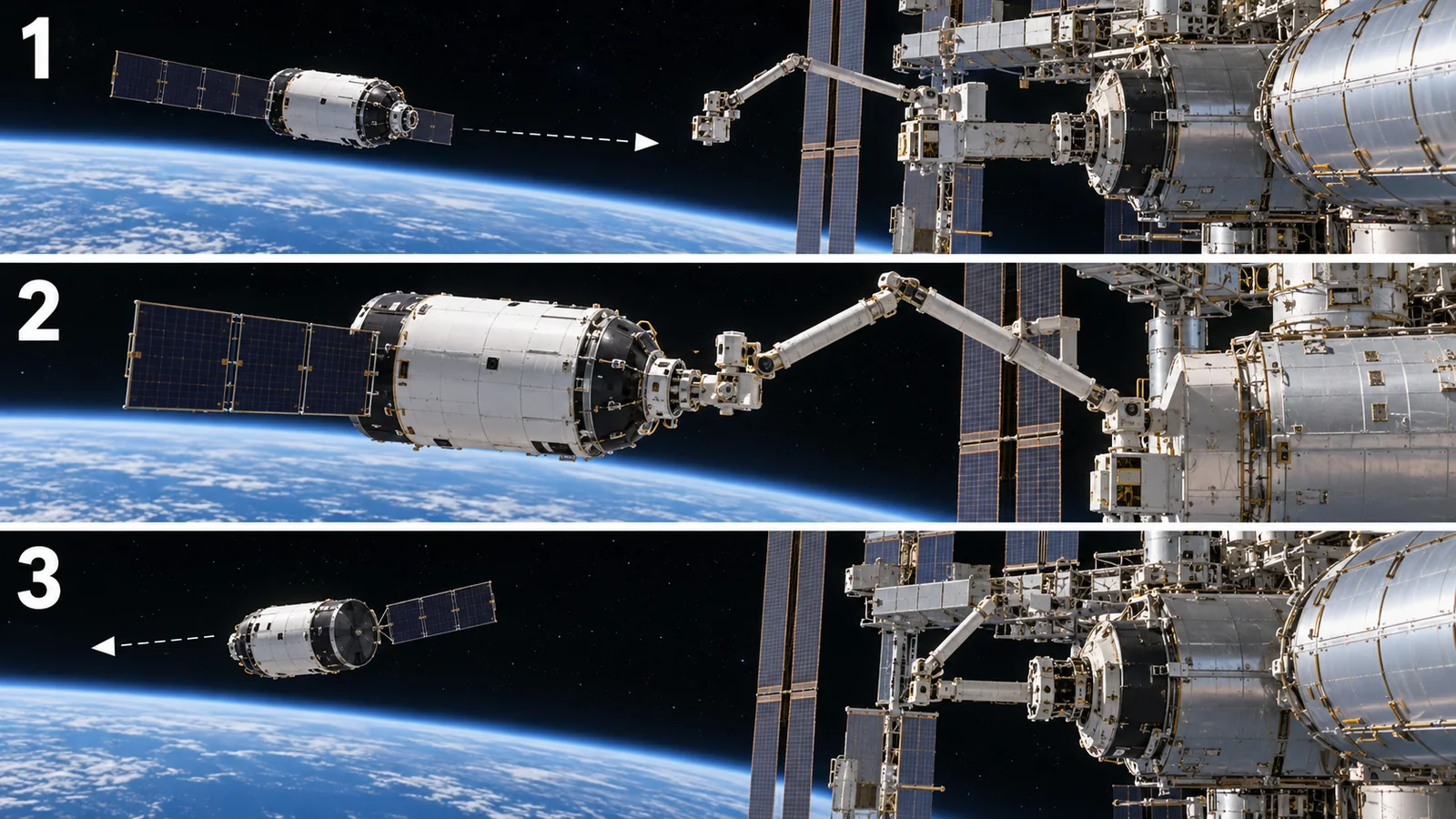
View original SVG, values and sources
Illustration How Cygnus resupplies the International Space Station (ISS). A simplified diagram based on the company's announcements and website; sizes and scale are not to reality Sourced.
7. What comes next
lunar surface conceptAnnounced 4 August 2026. Schedule not found
for CygnusAgreement with Starlab. Schedule for an in-orbit demonstration not found
The company states a policy of extending Cygnus to commercial space stations and making in-orbit servicing "routine" Sourced. These are company plans and goals, however. How the lunar Gateway, including HALO, is treated depends on the source. NASA's Gateway page (as shown on 17 October 2026) still presents Gateway, while another company's (Redwire's) 10-Q says that NASA announced in March 2026 that it would pause development of the lunar station and redirect resources to the lunar surface. In August 2026 Northrop Grumman announced that it would use HALO-derived technology for lunar surface demonstrations. HALO's own present standing could not be confirmed from official material Not yet confirmed.
None of the following appears in official material Not yet confirmed.
Sales, profit and headcount for the space business alone / HALO's future flight plans / Eclipse's first launch date / the schedule of the LID missions / results from MRV and MEP operations after launch / the cause of the solid rocket motor anomaly in Q1 2026 and which launch it was / the contents and amounts of the restricted programmes. This article does not discuss share prices or valuation.
8. What the company is aiming for in space
This chapter includes points the company has not stated directly. They are offered as inferences that the primary material supports, with the evidence.
| What we read from it | Primary evidence | Type |
|---|---|---|
| The space business has three pillars: propulsion (solid rocket motors), spacecraft and in-orbit servicing | The 10-K lists GEM 63 and the SLS boosters (propulsion), Cygnus, HALO and satellite programmes (spacecraft), and MEV and MRV (in-orbit servicing) among its key programmes, and the website uses the same grouping | Sourced |
| Solid rocket motors are a big pillar of orders and also a source of swings in earnings | About US$2.5 billion of new awards for GEM 63 in 2025, against US$162 million of unfavourable estimate revisions on GEM 63XL in H1 2026 | Inference |
| It is trying to widen into commercial space stations and launch markets | The Starlab docking test for Cygnus, the investment in Eclipse, and the account of commercial life extension with MEPs | Inference |
| Its main customer is the U.S. government | About 84% of sales go to the U.S. government (whole company). About 45% of the space segment is restricted programmes | Inference |
The company's website describes in-orbit servicing as "making satellite servicing routine" and says two MEVs have together provided more than a decade of life extension Sourced. In July 2026 it then launched the MRV, which can also repair, inspect, replace parts and assemble, together with the MEPs, which are dedicated life-extension units. This reads as a move from "extending one fuel-starved satellite at a time" towards fitting units to many satellites for cheaper life extension Not yet confirmed. However, official material gives neither the results of the MRV and MEP after launch nor the service's contribution to revenue.
9. Map of partnerships in the space industry
10. Technology, products and services
| Offering | What it is (company's account) | Type |
|---|---|---|
| Solid rocket motors and boosters | GEM 63 and GEM 63XL (for Atlas V and Vulcan), five-segment boosters for SLS, Orion's abort-system motors and more. The company says it has built more than 1.3 million solid rocket motors | Sourced |
| Small and medium launch vehicles | Pegasus (air-launched), Minotaur and Antares. Nearly 100 launches across the three (company's account). Eclipse is in joint development | Sourced |
| Cygnus cargo spacecraft | Cargo resupply to the ISS. The XL variant carries 33% more. Automated docking is being developed for commercial space stations | Sourced |
| In-orbit servicing (SpaceLogistics) | MEV (life extension), MRV (inspection, repair, assembly and more) and MEP (small life-extension units). The company says it was the first and is still the only company to have docked with an operational geostationary satellite for servicing | Sourced |
| Spacecraft, satellites and payloads | Satellite and spacecraft systems, sensors and payloads, ground systems. Among science satellites it works on the James Webb Space Telescope and others | Sourced |
| Space components (Mission Enabling Products) | Deployables, solar arrays, propellant tanks, thermal control and power, cryocoolers, laser crystals and more. The company says its products have flown on nearly every high-performance U.S. satellite of the last four decades | Sourced |
What Northrop Grumman sells in space is largely parts that cannot be allowed to fail. The company itself describes such parts as ones on which "the success of a mission depends". On the materials side, its products include propellant-tank metals and composites, springs and composites in deployable structures, highly reliable parts for cryocoolers (machines that make very low temperatures) and synthetic crystals for lasers Sourced. Official material does not give detail on which materials are made by which methods, so we could not confirm those points. For how space parts and materials are judged, see our explainers on the space environment and its effects on materials, lightweight structural materials, and spacecraft thermal control.
11. The risks this company carries
| Risk | What it involves | Type |
|---|---|---|
| Booster anomaly and estimate revisions | The 10-Q reports a solid rocket motor anomaly in a Q1 2026 launch, and US$71 million of revisions on GEM 63XL. In Q2 there was a further US$91 million as the cost and quantity of material needed rose (US$162 million for H1). This article does not assess the cause | Sourced |
| Lower space segment sales and margin | 2025 sales fell 8% year on year. The H1 2026 operating margin was 9.0%, down from 10.8% a year earlier (estimate revisions) | Sourced |
| Changes to lunar plans | The treatment of the Gateway, including HALO, reads differently in NASA's page and another company's 10-Q. The company says HALO activity fell in H1 2026 | Sourced |
| Large undisclosed programmes | About 45% of the space segment is restricted, so progress cannot be checked from outside | Sourced |
| Reliance on the U.S. government | About 84% of company-wide sales go to the U.S. government, so budget and policy changes could affect it | Inference |
| New competitors | The 10-K says competition now includes growing numbers of "new entrants and startups" as well as large firms | Sourced |
| Eclipse schedule | The first launch is still a target of 2026 or later. Coordination with its joint-development partner and test results could delay it | Inference |
| Space-only earnings cannot be seen | The segment includes missile defense and other work, so the profitability of space alone cannot be checked from outside | Not yet confirmed |
12. Glossary
- Solid rocket motor
- A propulsion device with solid fuel packed into a case. Once lit, it burns on.
- GEM 63 / GEM 63XL
- Graphite Epoxy Motor. A solid booster that assists a rocket's launch. XL is the extended version.
- SLS
- Space Launch System. NASA's large rocket for Moon and Mars exploration.
- Cygnus
- A spacecraft that carries cargo to the ISS. The XL variant has more capacity.
- CRS
- Commercial Resupply Services. NASA contracts that hand ISS resupply to private companies.
- HALO
- Habitation and Logistics Outpost. The habitation module of the lunar Gateway station.
- In-orbit servicing
- Extending the life of, inspecting or repairing satellites in space. MEV and MRV are examples.
- Geostationary orbit (GEO)
- An orbit about 36,000 km above the equator that matches Earth's rotation. Used by communications satellites.
- Restricted programme
- Government work whose contents and amounts are not published.
- Estimate revision (EAC adjustment)
- A revision of the expected cost to finish a contract, which adjusts reported sales and profit.
- SDA
- The U.S. Space Development Agency, which builds large networks of satellites.
- Form 10-K / 10-Q
- Annual and quarterly reports that U.S. listed companies file with the SEC. They carry audit and legal responsibility.
13. References
- Northrop Grumman Corporation (filed with the U.S. SEC) Form 10-K for the fiscal year ended December 31, 2025 (filed 27 January 2026). Business overview, Space Systems segment sales, operating income, backlog and capital spending, headcount, customer mix, R&D spending. https://www.sec.gov/Archives/edgar/data/1133421/000113342126000003/noc-20251231.htm
- Northrop Grumman Corporation (filed with the U.S. SEC) Form 10-Q for the quarterly period ended June 30, 2026 (filed 21 July 2026). First-half 2026 Space Systems sales, operating income and backlog; GEM 63XL estimate revisions. https://www.sec.gov/Archives/edgar/data/1133421/000113342126000034/noc-20260630.htm
- U.S. SEC EDGAR filing index for Northrop Grumman Corp (CIK 0001133421): NYSE listing, ticker NOC, Falls Church, Virginia address. https://data.sec.gov/submissions/CIK0001133421.json
- Northrop Grumman Official website, "Space" (overview of the space business). https://www.northropgrumman.com/what-we-do/space
- Northrop Grumman Official website, "Space Launch" (Pegasus, Minotaur, Antares, Eclipse). https://www.northropgrumman.com/what-we-do/space/Launch-Vehicles/space-launch
- Northrop Grumman Official website, "Science and Exploration" (Cygnus, Artemis, GEM 63XL, science satellites and more). https://www.northropgrumman.com/what-we-do/space/science-and-exploration
- Northrop Grumman Official website, "Cygnus" (the cargo craft and its delivery record). https://www.northropgrumman.com/what-we-do/space/Spacecraft/cygnus
- Northrop Grumman Official website, "Space Logistics Services" (Mission Robotic Vehicle, Mission Extension Pods and Mission Extension Vehicle; the launch of 21 July 2026). https://www.northropgrumman.com/what-we-do/space/space-logistics-services
- Northrop Grumman Official website, "Eclipse" (the rocket co-developed with Firefly Aerospace). https://www.northropgrumman.com/what-we-do/space/eclipse
- Northrop Grumman Official website, "GEM 63XL" (tests of the Vulcan booster and related announcements). https://www.northropgrumman.com/what-we-do/space/Propulsion/GEM-63/static-test
- Northrop Grumman Official website, "Mission Enabling Products" (deployables, solar arrays, propellant tanks, thermal control, coolers and more). https://www.northropgrumman.com/what-we-do/space/mission-enabling-products
- Northrop Grumman Article "Propelling Artemis II" (the SLS solid rocket boosters and the Orion abort motors). https://www.northropgrumman.com/what-we-do/space/Missions/artemis/artemis-ii/propelling-artemis-ii
- Northrop Grumman Press release "Northrop Grumman's Cygnus XL Launches to International Space Station on NG-23 Cargo Resupply Mission" (launched 14 September 2025; dated 15 September). https://news.northropgrumman.com/cygnus/Northrop-Grummans-Cygnus-XL-Launches-to-International-Space-Station-on-NG-23-Cargo-Resupply-Mission
- Northrop Grumman Press release "Northrop Grumman Expands Cargo Capacity with NG-24 Cygnus XL Launch" (11 April 2026). https://news.northropgrumman.com/cygnus/Northrop-Grumman-Expands-Cargo-Capacity-with-NG-24-Cygnus-XL-Launch
- Northrop Grumman Press release "Northrop Grumman Demonstrates Autonomous Rendezvous and Docking Technology with Starlab Commercial Space Station" (28 September 2025). https://news.northropgrumman.com/cygnus/Northrop-Grumman-Demonstrates-Autonomous-Rendezvous-and-Docking-Technology-with-Starlab-Commercial-Space-Station
- Northrop Grumman Press release "Northrop Grumman Begins Integration and Testing of NASA's Habitation and Logistics Outpost" (24 April 2025). https://news.northropgrumman.com/halo/Northrop-Grumman-Begins-Integration-and-Testing-of-NASAs-Habitation-and-Logistics-Outpost
- Northrop Grumman Press release "Northrop Grumman's Lunar Infrastructure Demos to Help Build NASA's Moon Base" (4 August 2026). https://news.northropgrumman.com/civil-space/northrop-grummans-lunar-infrastructure-demos-to-help-build-nasas-moon-base
- Northrop Grumman Press release "Northrop Grumman Invests $50 Million in Firefly Aerospace to Advance Eclipse Medium Launch Vehicle" (29 May 2025). https://news.northropgrumman.com/launch/Northrop-Grumman-Invests-50-Million-in-Firefly-Aerospace-to-Advance-Eclipse-Medium-Launch-Vehicle
- National Aeronautics and Space Administration (NASA) "Artemis II: NASA's First Crewed Lunar Flyby in 50 Years" (launched 1 April 2026, splashdown 10 April 2026). https://www.nasa.gov/mission/artemis-ii/
- National Aeronautics and Space Administration (NASA) "Gateway" mission page (as shown on 17 October 2026). https://www.nasa.gov/mission/gateway/
- Redwire Corporation (filed with the U.S. SEC) Form 10-Q for the quarterly period ended June 30, 2026 (filed 6 August 2026). Its mention of NASA's March 2026 change of course on the Lunar Gateway (another company's filing). https://www.sec.gov/Archives/edgar/data/1819810/000181981026000124/rdw-20260630.htm
- Space Forge Press release "Northrop Grumman UK and Space Forge to explore in-space manufacturing" (12 September 2023; a collaboration agreement). https://www.spaceforge.com/press-releases/northrop-grumman-uk-and-space-forge-to-explore-in-space-manufacturing
14. Claim-to-source audit
| Claim in the text | Type | Source |
|---|---|---|
| Legal name, NYSE listing and ticker (NOC), headquarters (Falls Church, Virginia) | Sourced | References 3 and 1 Press-release datelines (McLean and others) differ from the filing's principal office address https://data.sec.gov/submissions/CIK0001133421.json https://www.sec.gov/Archives/edgar/data/1133421/000113342126000003/noc-20251231.htm |
| About 95,000 employees (company-wide), US$41,954 million sales (2025), about 84% from the U.S. government | Sourced | Reference 1 Company-wide figures that include defense and aeronautics https://www.sec.gov/Archives/edgar/data/1133421/000113342126000003/noc-20251231.htm |
| Space Systems segment sales, operating income and margin (2023 to 2025) | Sourced | Reference 1 Figures for the whole segment, which includes missile defense and other work https://www.sec.gov/Archives/edgar/data/1133421/000113342126000003/noc-20251231.htm |
| Space Systems capital spending and depreciation (2023 to 2025) | Sourced | Reference 1 https://www.sec.gov/Archives/edgar/data/1133421/000113342126000003/noc-20251231.htm |
| Space Systems backlog (end of 2025: US$26,201 million; end of June 2026: US$26,981 million) | Sourced | References 1 and 2 Includes missile defense and other work https://www.sec.gov/Archives/edgar/data/1133421/000113342126000003/noc-20251231.htm https://www.sec.gov/Archives/edgar/data/1133421/000113342126000034/noc-20260630.htm |
| First-half 2026 Space Systems sales US$5,233 million and operating income US$471 million | Sourced | Reference 2 https://www.sec.gov/Archives/edgar/data/1133421/000113342126000034/noc-20260630.htm |
| About 45% of the business is restricted programmes | Sourced | Reference 1 Contents are undisclosed and are not covered in this article https://www.sec.gov/Archives/edgar/data/1133421/000113342126000003/noc-20251231.htm |
| The 2025 fall in Space Systems sales (mainly the wind-down of restricted programmes) | Sourced | Reference 1 https://www.sec.gov/Archives/edgar/data/1133421/000113342126000003/noc-20251231.htm |
| Acquisition of Orbital ATK in 2018 and TRW in 2002 | Sourced | Reference 1 https://www.sec.gov/Archives/edgar/data/1133421/000113342126000003/noc-20251231.htm |
| Company-sponsored R&D of about US$1.1 billion (2025) | Sourced | Reference 1 Company-wide figure https://www.sec.gov/Archives/edgar/data/1133421/000113342126000003/noc-20251231.htm |
| Cygnus XL's first flight, NG-23 (14 September 2025), with 33% more cargo capacity than the earlier variant | Sourced | Reference 13 https://news.northropgrumman.com/cygnus/Northrop-Grummans-Cygnus-XL-Launches-to-International-Space-Station-on-NG-23-Cargo-Resupply-Mission |
| NG-24 (11 April 2026), the second Cygnus XL | Sourced | Reference 14 https://news.northropgrumman.com/cygnus/Northrop-Grumman-Expands-Cargo-Capacity-with-NG-24-Cygnus-XL-Launch |
| Cygnus deliveries to date (more than 71,000 kg since the first flight in 2013, as of September 2025) | Sourced | References 13 and 7 https://news.northropgrumman.com/cygnus/Northrop-Grummans-Cygnus-XL-Launches-to-International-Space-Station-on-NG-23-Cargo-Resupply-Mission https://www.northropgrumman.com/what-we-do/space/Spacecraft/cygnus |
| Automated rendezvous and docking test for a Starlab space station (September 2025) | Sourced | Reference 15 A test in a ground facility, not a demonstration in orbit https://news.northropgrumman.com/cygnus/Northrop-Grumman-Demonstrates-Autonomous-Rendezvous-and-Docking-Technology-with-Starlab-Commercial-Space-Station |
| GEM 63 and GEM 63XL: boosters for Atlas V and Vulcan; about US$2.5 billion of new awards for GEM 63 in 2025 | Sourced | References 1 and 10 https://www.sec.gov/Archives/edgar/data/1133421/000113342126000003/noc-20251231.htm https://www.northropgrumman.com/what-we-do/space/Propulsion/GEM-63/static-test |
| GEM 63XL estimate revisions (US$71 million in Q1 2026, US$91 million in Q2) and the mention of a solid rocket motor anomaly in a Q1 2026 launch | Sourced | Reference 2 The company's 10-Q statement. This article does not assess causes or consequences https://www.sec.gov/Archives/edgar/data/1133421/000113342126000034/noc-20260630.htm |
| The SLS solid rocket boosters and Artemis II (launched 1 April 2026, splashdown 10 April) | Sourced | References 19, 12 and 1 https://www.nasa.gov/mission/artemis-ii/ https://www.northropgrumman.com/what-we-do/space/Missions/artemis/artemis-ii/propelling-artemis-ii https://www.sec.gov/Archives/edgar/data/1133421/000113342126000003/noc-20251231.htm |
| HALO: the habitation module for the Lunar Gateway; integration and testing began in April 2025 | Sourced | References 16 and 1 https://news.northropgrumman.com/halo/Northrop-Grumman-Begins-Integration-and-Testing-of-NASAs-Habitation-and-Logistics-Outpost https://www.sec.gov/Archives/edgar/data/1133421/000113342126000003/noc-20251231.htm |
| HALO's present standing (NASA policy, flight plans) | Not yet confirmed | References 20, 21 and 17 NASA's Gateway page, another company's 10-Q and the company's August 2026 release read differently. We could not confirm https://www.nasa.gov/mission/gateway/ https://www.sec.gov/Archives/edgar/data/1819810/000181981026000124/rdw-20260630.htm https://news.northropgrumman.com/civil-space/northrop-grummans-lunar-infrastructure-demos-to-help-build-nasas-moon-base |
| The Lunar Infrastructure Demo concept (LID-1 to LID-3, 4 August 2026) | Not yet confirmed | Reference 17 No schedule is given https://news.northropgrumman.com/civil-space/northrop-grummans-lunar-infrastructure-demos-to-help-build-nasas-moon-base |
| Launch of the MRV and MEPs (21 July 2026, Falcon 9) | Sourced | Reference 8 We could not find results from operations after launch https://www.northropgrumman.com/what-we-do/space/space-logistics-services |
| The statement that two Mission Extension Vehicles have provided more than a decade of life extension | Sourced | Reference 8 The company's account https://www.northropgrumman.com/what-we-do/space/space-logistics-services |
| Investment in Firefly Aerospace (US$50 million, 29 May 2025) and co-development of Eclipse | Sourced | References 18 and 9 https://news.northropgrumman.com/launch/Northrop-Grumman-Invests-50-Million-in-Firefly-Aerospace-to-Advance-Eclipse-Medium-Launch-Vehicle https://www.northropgrumman.com/what-we-do/space/eclipse |
| Eclipse's first launch (targeted for 2026 or later) | Not yet confirmed | Reference 18 A company target as of May 2025. We could not find later results https://news.northropgrumman.com/launch/Northrop-Grumman-Invests-50-Million-in-Firefly-Aerospace-to-Advance-Eclipse-Medium-Launch-Vehicle |
| Launch record for Pegasus, Minotaur and Antares (nearly 100 launches) | Sourced | Reference 5 The company's account https://www.northropgrumman.com/what-we-do/space/Launch-Vehicles/space-launch |
| Mission Enabling Products (deployables, solar arrays, propellant tanks, thermal control, coolers and more) | Sourced | Reference 11 https://www.northropgrumman.com/what-we-do/space/mission-enabling-products |
| Collaboration agreement with Space Forge (Northrop Grumman UK, September 2023) | Sourced | Reference 22 An agreement to explore; no results are reported https://www.spaceforge.com/press-releases/northrop-grumman-uk-and-space-forge-to-explore-in-space-manufacturing |
| Missile defense and other work within Space Systems | Not yet confirmed | Outside the scope of this article (this article does not cover defense generally) |
| The four-type classification (parts and systems as the main type; satellites and in-orbit services as the secondary type) | Our calculation | Our own grouping. Company names are examples from the companies covered in this series |
| How to read the Space Systems segment figures (sales and margin path) | Our calculation | Our calculation: figures from the 10-K are set side by side. Percentage changes are the 10-K's own |
| Solid rocket motors as the core of the space business, and as the centre of both revenue and difficulties | Inference | References 1 and 2 Our reading of awards and estimate revisions in the filings https://www.sec.gov/Archives/edgar/data/1133421/000113342126000003/noc-20251231.htm https://www.sec.gov/Archives/edgar/data/1133421/000113342126000034/noc-20260630.htm |
| A push into commercial space stations and launch markets | Inference | References 15, 18 and 8 Our reading of the announcements https://news.northropgrumman.com/cygnus/Northrop-Grumman-Demonstrates-Autonomous-Rendezvous-and-Docking-Technology-with-Starlab-Commercial-Space-Station https://news.northropgrumman.com/launch/Northrop-Grumman-Invests-50-Million-in-Firefly-Aerospace-to-Advance-Eclipse-Medium-Launch-Vehicle https://www.northropgrumman.com/what-we-do/space/space-logistics-services |
| A heavy reliance on the U.S. government | Inference | Reference 1 Our reading of the share of sales to the U.S. government https://www.sec.gov/Archives/edgar/data/1133421/000113342126000003/noc-20251231.htm |
| The risk summary (estimate revisions, anomaly, plan changes, undisclosed programmes) | Inference | References 1 and 2 Our reading of the filings https://www.sec.gov/Archives/edgar/data/1133421/000113342126000003/noc-20251231.htm https://www.sec.gov/Archives/edgar/data/1133421/000113342126000034/noc-20260630.htm |
Last updated: 17 October 2026 / Troy Technical
The figures in this article rest on the statutory filings that Northrop Grumman Corporation made to the U.S. Securities and Exchange Commission (Form 10-K and Form 10-Q) and on official material from the company and NASA. Market-research estimates and figures that rest on press reports alone are not used. This field moves quickly, so spacecraft, missions and plans are as of the checking date (17 October 2026). The Space Systems segment figures include missile defense and other work and are not space-only figures. Defense businesses are outside the scope of this article. Passages marked "Inference" are our own reading of the primary material and are not statements by the company. This article is not investment advice.