COMPANY PROFILE / SPACE INDUSTRY
Redwire
Built on the solar arrays and docking mechanisms that keep space stations powered and connected, and now reaching into spacecraft and microgravity work
Redwire is known less for whole spacecraft than for the parts and systems that spacecraft and space stations need in order to work. Typical examples are ROSA, the roll-out solar array that boosted power on the International Space Station (ISS), docking mechanisms that join spacecraft, and sensors that read star positions. In recent years it has also moved into small spacecraft (satellite platforms) and into PIL-BOX, equipment that grows crystals of drug-candidate molecules in microgravity. This profile uses only the annual report (Form 10-K) and quarterly report (Form 10-Q) filed with the U.S. SEC, plus the company's official announcements, and sets out how big the space business is within the company, what it makes, how much has already happened, and what is still a plan. Redwire also has a defense technology business (uncrewed aircraft and similar), which this article does not cover.
- Redwire in 30 seconds, and where it stands in the space industry
- The logo and how the name is written
- Where the company sits in the space industry
- Scale of the company (centred on space)
- Resources committed to space
- What it has done so far
- What comes next
- What the company is aiming for in space
- Map of partnerships in the space industry
- Technology, products and services
- The risks this company carries
- Glossary, references and claim-to-source audit
1. Redwire in 30 seconds, and where it stands in the space industry
Satellites, in-orbit services & manufacturing (secondary)Centred on power, connection and sensors for spacecraft
Companies in the space industry fall into four groups: those that carry things up by rocket, those that go to the Moon or a space station, those that operate or build in orbit, and those that make parts and systems (Figure 1 in chapter 3). Redwire centres on the fourth group, "parts and systems". Like the solar arrays that added power to the ISS, or its docking mechanisms, the basic pattern is to supply parts that work inside other companies' spacecraft and space stations, as products of its own Sourced. It is also building businesses where it is the lead player: its own spacecraft (satellite platforms and buses) and equipment that crystallises drug-candidate molecules in orbit. Across the whole company, the defense technology business (uncrewed aircraft and similar) acquired in 2025 now makes up about 37% of revenue (125.6 / 335.4, Our calculation), so it matters to read "space figures" and "company-wide figures" separately.
2. The logo and how the name is written

A note on names: the legal entity is Redwire Corporation (short form Redwire, ticker RDW). Its space division is called "Redwire Space". Most acquired companies have been renamed from their old names to "Redwire ..." names (the 10-K's acquisition list gives the old names as "f/k/a"). The subsidiary that runs the microgravity business, SpaceMD (Space Microgravity Development LLC), appears in this article as a separate company formed in 2025.
Official site: https://rdw.com/ (the logo is the SVG image shown in the header of the official site)3. Where the company sits in the space industry
4. Scale of the company (centred on space)
Redwire is a listed company, and its annual report gives separate figures for a Space segment and a Defense Tech segment (two reportable segments since December 2025). This article centres on the Space segment and adds company-wide figures for comparison (amounts in US$ millions) Sourced.
| Measure (US$ millions) | FY2023 | FY2024 | FY2025 |
|---|---|---|---|
| Space segment revenue | 194.0 | 255.3 | 209.8 |
| Space segment operating result | 27.6 (profit) | 16.1 (profit) | (49.2) loss |
| Defense Tech segment revenue (for reference) | 49.8 | 48.8 | 125.6 |
| Company-wide revenue | 243.8 | 304.1 | 335.4 |
| Company-wide net result | (27.3) | (114.3) | (226.6) |
| Item | What we found | As of |
|---|---|---|
| Backlog (firm contracts not yet worked off) | Company-wide US$411.2 million (of which space US$299.8 million) | 31 December 2025 |
| Backlog (same measure) | Company-wide US$542.1 million (of which space US$322.0 million) | 30 June 2026 |
| First-half 2026 Space segment revenue | US$107.9 million (US$108.8 million a year earlier) | January to June 2026 |
| Employees | About 1,410 (North America and Europe). The space-only headcount is not disclosed | 31 December 2025 |
| Sites | 28 sites (23 in North America, 5 in Europe), about 910,000 square feet in total, all leased. Headquarters in Jacksonville | 31 December 2025 |
| Revenue by customer type (company-wide) | National security 46.9%, civil (NASA, ESA and others) 21.6%, commercial 31.5%. Customers outside the U.S. 41.6%. The two largest customers were about 20% and 19% | FY2025 |
The Space segment's share of company revenue fell from about 84% in 2024 to about 63% in 2025 Our calculation (255.3 / 304.1 and 209.8 / 335.4). The cause is both lower space revenue and the June 2025 acquisition of Edge Autonomy (an uncrewed aircraft company), which sharply raised defense technology revenue. When you see a figure described as "Redwire's revenue", check whether it covers the whole company including defense technology, or space alone. This article stays with space and does not cover defense technology (uncrewed aircraft, optical sensors and so on).
5. Resources committed to space
Space is the company's core business, so the table below shows how far its filings confirm people, money, outside investments and acquisitions, and contracts with public bodies (checked on 17 October 2026).
| Type of resource | What we found | Type |
|---|---|---|
| People | About 1,410 across the company. The space-only headcount is not disclosed | Sourced |
| Money (R&D) | R&D spending was US$19.8 million (FY2025, company-wide), up from US$6.1 million in 2024. The space-only split is not disclosed | Sourced |
| Money (capital spending) | The Space segment's capital expenditure was US$8.4 million (FY2025). Company-wide purchases of property, plant and equipment were US$13.5 million | Sourced |
| Outside investments and acquisitions | Eleven acquisitions from 2020 to 2025. Space-related ones include Made In Space, Deployable Space Systems, Techshot, QinetiQ Space NV (Belgium, 2022; now Redwire Space NV) and Hera Systems (spacecraft for national security users, 2024); the 10-K's list mostly gives names only. In 2025 it acquired Edge Autonomy (uncrewed aircraft; Defense Tech) and formed SpaceMD | Sourced |
| Public bodies: NASA and ESA | Involved in the ISS (ROSA), DART (the asteroid impact test), Orion, Artemis I, and ESA's PROBA programme and Skimsat. Most individual contract values are not given | Sourced |
| Public bodies: DARPA | Prime contractor for the Otter programme (a very-low-orbit demonstration). Announced a US$44 million phase 2 on 19 November 2025 | Sourced |
| Public bodies: U.S. Space Force | Selected as one of 15 vendors for Space Systems Command's NITE-STAR (a contract vehicle for space test and training capabilities) on 24 September 2026. The company states that this is a vehicle valued at more than US$980 million in total, with no guaranteed revenue | Sourced |
Status of the main products and missions
Redwire's space business is easiest to follow product by product rather than craft by craft. The table below covers what the 10-K, 10-Q and official announcements confirm (checked on 17 October 2026).
| Product or effort | Type and content | Record and status (with dates) | Stage |
|---|---|---|---|
| ROSA (roll-out solar array) | Solar arrays that are rolled up for launch and unrolled in space. Over 20 kW per wing and over 160 kW for eight wings (company's stated values) | Six wings deployed on the ISS since 2021. On 12 October 2026 the company announced that the fourth and final pair is to launch on NASA's SpaceX CRS-35 mission. Also flown on DART | In service; launch planned |
| ROSA (for commercial space stations) | Two wings each for Axiom Station's first and second modules | Follow-on contract for the second module announced 5 October 2026. Axiom Space plans to launch the first module in 2028 | Not yet confirmed |
| IBDM (International Berthing and Docking Mechanism) | A device that docks spacecraft automatically. Compliant with the international docking standard (IDSS) | Two units for The Exploration Company's Nyx spacecraft, an eight-figure deal (announced 18 December 2025). The company has also worked on a mechanism for the lunar Gateway's habitat | In development; contracted |
| SabreSat / Otter | The company's own platform for very low Earth orbit (VLEO, a low orbit a few hundred km up or less). Otter is a demonstration spacecraft that uses the thin atmosphere for propulsion | The DARPA Otter phase 2 (US$44 million) covers completing manufacturing and delivering the spacecraft to launch. We could not find a launch date | In development |
| Phantom / Hammerhead / Thresher / Mako | A family of spacecraft platforms for low Earth orbit up to geostationary orbit (Phantom and Hammerhead are European-built) | Phantom is used on ESA's Skimsat programme. The company cites more than 50 years of cumulative orbital heritage on the PROBA family (Hammerhead is its development) | Product; in development |
| PIL-BOX (microgravity crystallisation equipment) | Equipment that grows crystals of drug-candidate molecules such as proteins in orbit, used on the ISS | 42 units launched by the end of 2025 (10-K). The August 2026 announcement says 54 have flown on the ISS since November 2023, with 12 more being prepared for 2026. Partners include Bristol Myers Squibb and Eli Lilly | In service |
| SpaceMD's Starfall mission | Up to 32 PIL-BOX units on SpaceX's new Starfall spacecraft | Contract announced 6 August 2026. Launch planned for 2028 | Not yet confirmed |
| Mason (building a base on the Moon) | A concept for building shielding structures, landing pads and roads on the lunar surface | The company says it is "developing" it, but we could not find a demonstration date | In development |
| Orbital data centres (Sophia Space) | A joint study combining deployable structures, power and thermal technology | An MOU (memorandum of understanding) was signed on 30 September 2026. We could not find a demonstration schedule or contract | Not yet confirmed |
The distinctive point about ROSA is that its booms, made of composite (a light, strong material of carbon fibre and similar set in resin), serve both as the structure and as the means of deployment Sourced. At launch the thin solar blanket is rolled up with the booms into a compact cylinder. Once in space the booms do their work and the array opens into a large panel (in the company's account, the booms are both structural members and the deployment actuator). The design is meant to fit a very large array into the limited volume of a rocket, and the company says very large arrays can be stowed compactly. The materials interest lies in a composite that can be bent while rolled, and keep its opened shape through the temperature swings of space. The 10-K does not say how ROSA ages in the space environment or which standards it was assessed against, so we could not confirm those points. For solar cells themselves, see our explainers on space solar cells, lightweight structural materials, and space CFRP and composites.
6. What it has done so far
| When | What happened | What it means |
|---|---|---|
| 2020 | Founded by AE Industrial Partners. Acquired Made In Space, Deep Space Systems, Roccor, LoadPath and others | Brought together space parts, sensor and microgravity companies |
| 2021 | Became public through a merger with Genesis Park Acquisition Corp. (a SPAC). Acquired Oakman Aerospace, Deployable Space Systems and Techshot | Acquisitions widened the business (the 10-K gives each company's old and new names) |
| 2022 | Acquired QinetiQ Space NV (Belgium) | Now Redwire Space NV. The IBDM docking mechanism was developed in Belgium (company's account) |
| 30 August 2024 | Acquired Hera Systems (spacecraft for national security users) | Widened its own-spacecraft range |
| 13 June 2025 | Acquired Edge Autonomy (US$160.0 million in cash plus 49,764,847 common shares) | The Defense Tech segment grew sharply. Space's share of revenue fell (chapter 4) |
| 19 November 2025 | Announced the DARPA Otter phase 2 (US$44 million) | Strengthened its position as prime contractor for a very-low-orbit craft |
| 18 December 2025 | Won an order for two IBDM units from The Exploration Company | Added supply to a European commercial spacecraft |
| End of 2025 | 42 PIL-BOX units launched in total; 11 company payload facilities on the ISS | Microgravity equipment flights built up |
| 8 July 2026 (signed) | Signed a commercial partnership (teaming agreement) with Kanematsu for Japan; announced 12 August | A foothold in the Japanese space market |
| 6 August 2026 | SpaceMD contracted a SpaceX Starfall mission (launch planned for 2028) | Securing flight opportunities beyond the ISS |
| 24 September 2026 | Selected for Space Systems Command's NITE-STAR contract vehicle (15 vendors) | Entry to a contract vehicle, not a commitment of revenue |
| 12 October 2026 | Announced that the fourth and final pair of ISS ROSA wings is to launch on CRS-35 | The final stage of the ISS power upgrade that began in 2021 |
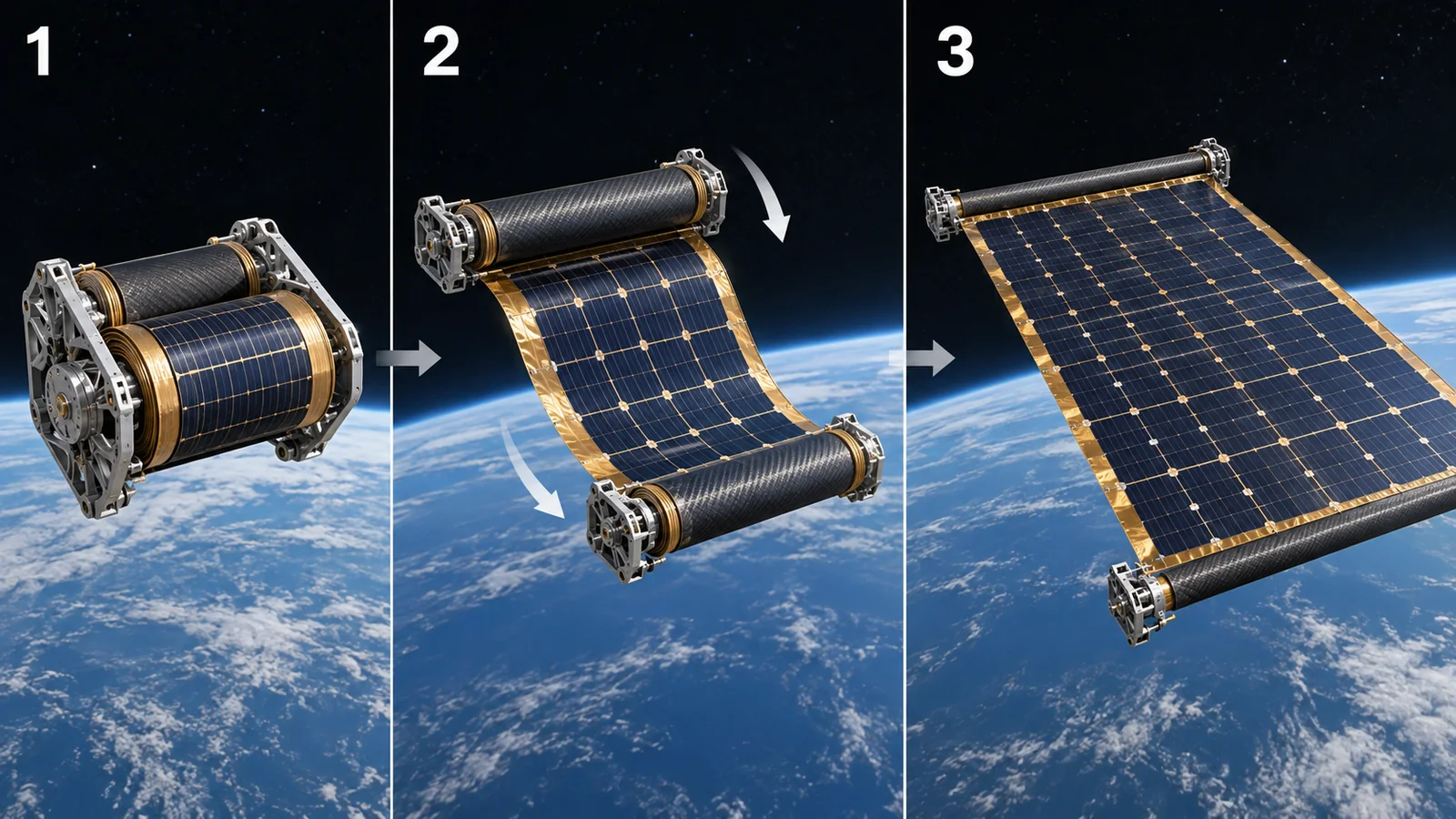
View original SVG, values and sources
Illustration The idea behind ROSA's stowing and deployment. A simplified diagram based on the annual report's description; shape and size are not to reality Sourced.
7. What comes next
to launch on CRS-35Announced 12 October 2026. No launch date found
planned for 2028Axiom Space's plan. Redwire holds orders for two modules
up to 32 PIL-BOX unitsThe company's plan (announced 6 August 2026)
move to launchThe scope of phase 2. Launch date not found
In describing the Space segment's strategy, the company lists its own spacecraft platforms (SabreSat, Mako, Thresher and others), power for commercial space stations, and drug research using orbital microgravity Sourced. The company does not give launch dates or revenue contributions for these in one place. In the chapter 5 table, items marked "Not yet confirmed" are plans of the company or its counterparty, not things achieved.
None of the following appears in the filings or official announcements Not yet confirmed.
The space-only headcount and R&D spending / the launch date of DARPA Otter / a fixed launch date for Starfall / the value of the Axiom Station ROSA contract / a demonstration plan for the Sophia Space study / PIL-BOX revenue as a business. The company also does not break space revenue down by product (ROSA, IBDM, spacecraft and so on). This article does not discuss share prices or valuation.
8. What the company is aiming for in space
This chapter includes points the company has not stated directly. They are offered as inferences that the primary material supports, with the evidence.
| What we read from it | Primary evidence | Type |
|---|---|---|
| The space business is built on infrastructure parts for spacecraft and space stations | The 10-K names spacecraft, large infrastructure (power and docking) and microgravity as the Space segment's three pillars, with a record on the ISS, DART, Orion and GPS | Sourced |
| It is trying to capture demand from commercial space stations | Won ROSA orders for Axiom Station's first and second modules. The company says ROSA can serve commercial space stations | Inference |
| Its microgravity business is moving toward securing its own flight opportunities beyond the ISS | Formed SpaceMD and contracted a Starfall flight for 2028. 54 PIL-BOX units have flown on the ISS in total | Inference |
| It sees in-orbit computing (data centres) as new demand | Signed an MOU with Sophia Space, referring to a joint study combining deployable structures, power and thermal management | Inference |
| Within the whole company, space has a smaller relative weight | The Space segment's share of revenue fell from about 84% (2024) to about 63% (2025) (our calculation). The defense technology acquisition is the main cause | Sourced |
In its 10-K the company says its growth strategy includes bundled sales (selling several products together) and integrations of "systems, payloads, platforms and full mission solutions" Sourced. That reads as an aim to go beyond selling parts, and to combine parts into whole spacecraft and whole missions. Holding products from different systems under one roof (power from ROSA, docking from IBDM, sensors and its own spacecraft such as SabreSat) can be read as the company's view of an advantage in projects that need several technologies at once, such as space stations and orbital computing Not yet confirmed. The 10-K, however, gives no figures showing whether such proposals have turned into revenue.
9. Map of partnerships in the space industry
10. Technology, products and services
| Offering | What it is (company's account) | Type |
|---|---|---|
| Spacecraft platforms | Five models: SabreSat and Phantom (very low orbit), Hammerhead and Thresher (low orbit), and Mako (medium and geostationary orbit; for rendezvous, docking and refuelling). Hammerhead is a small craft carrying up to 70 kg of payload, with a mass under 200 kg | Sourced |
| Power (solar arrays) | ROSA, plus ELSA (Extensible Low-Profile Solar Array). More than 65 wings delivered or in development (company's account) | Sourced |
| Docking mechanism | IBDM. Supports automated rendezvous and docking, and is designed to join crewed vehicles, cargo vehicles and station modules | Sourced |
| Sensors and electronics | Star trackers (devices that find attitude from star positions), sun sensors, power distribution, radio systems and onboard computers. Radiation tolerance is emphasised | Sourced |
| Microgravity payloads | Biotechnology, plant and animal science, in-space additive manufacturing (3D printing), advanced materials manufacturing, PIL-BOX and more. Eleven company facilities on the ISS (end of 2025) | Sourced |
| Digital engineering | Modelling and simulation software for spacecraft and constellations (large groups of satellites) | Sourced |
| Lunar infrastructure (Mason) | A concept for building shielding, landing pads, roads and habitat foundations on the Moon | Not yet confirmed |
Redwire's products are mostly parts that are hard to see from outside a rocket or spacecraft. The places where materials and manufacturing matter differ from one to the next Not yet confirmed. For solar arrays, the keys are a composite boom that combines lightness, rollability and stiffness once opened, and a thin solar blanket. For sensors and electronics, the company itself stresses radiation tolerance; the thinking on space semiconductors overlaps with our explainers on radiation and electronic parts, and on space semiconductors and COTS. For PIL-BOX in microgravity, the company explains that suppressing convection and sedimentation changes how crystals form compared with the ground. This article does not assess the effects or efficacy of any drug. The company has published the number of compounds crystallised (45, in the August 2026 announcement), but that is a record of work done, not a measure of drug performance. For crystallisation basics, see our explainers on space manufacturing and microgravity, and on microgravity drug discovery and protein crystallisation.
11. The risks this company carries
| Risk | What it involves | Type |
|---|---|---|
| A loss in the Space segment | The Space segment posted an operating loss of US$49.2 million in FY2025. The 10-K points to a US$28.1 million negative adjustment to revenue from contract estimate revisions (higher expected costs), a US$34.4 million impairment of the European unit and other factors | Sourced |
| Shifts in contract cost estimates | The company explains that cost estimates can change with technical complexity, delays and other causes. In the first half of 2026 the Space segment again had US$10.4 million of unfavourable revisions | Sourced |
| Internal control over financial reporting | As of 31 December 2025 the company disclosed material weaknesses in internal control. Its auditor gave an adverse opinion on internal control. The company states that no material misstatement of its financial figures resulted | Sourced |
| Customer concentration | The two largest customers were about 20% and 19% of revenue (FY2025, company-wide) | Sourced |
| Changes in government budgets and policy | The 10-Q refers to NASA's March 2026 announcement that it is pausing development of the Lunar Gateway and redirecting funds to the lunar surface, and says the industry impact is still being assessed. Redwire's European sites also worked on an IBDM for the Gateway | Sourced |
| A contract vehicle is not guaranteed revenue | For multi-vendor vehicles such as NITE-STAR, the company itself writes that there is no guaranteed revenue | Sourced |
| Timing of new demand | Commercial space stations (Axiom's first module is planned for 2028), orbital data centres (an MOU) and Starfall (planned for 2028) are all later plans and could slip | Inference |
| A growing weight of defense technology | It is not disclosed how investment will be allocated to the space business while company resources go to integrating defense technology | Inference |
12. Glossary
- ROSA
- Roll-Out Solar Array. A solar array rolled up for launch and unrolled in space.
- IBDM
- International Berthing and Docking Mechanism. A device that joins spacecraft automatically.
- PIL-BOX
- Equipment that grows crystals of drug-candidate molecules in orbit. Used as an ISS facility.
- Very low Earth orbit (VLEO)
- An orbit lower than ordinary low orbit. Closer to Earth, which is said to help imaging and communications.
- ISS
- The International Space Station. A crewed research facility in low Earth orbit.
- Backlog
- The value of firm contracts on which the work is not yet finished.
- IDIQ
- Indefinite-delivery, indefinite-quantity: a contract form that lets the buyer order without fixing quantities or amounts in advance. A large ceiling does not guarantee revenue.
- SPAC
- Special purpose acquisition company. A company that lists in order to acquire or merge with another firm.
- Form 10-K / 10-Q
- Annual and quarterly reports that U.S. listed companies file with the SEC. They carry audit and legal responsibility.
- Composite
- A light, strong material of carbon fibre or similar set in resin.
- SpaceMD
- A Redwire subsidiary that runs its microgravity research and manufacturing business.
- Teaming agreement
- A partnership agreement to pursue projects together.
13. References
- Redwire Corporation (filed with the U.S. SEC) Form 10-K for the fiscal year ended December 31, 2025 (filed 27 February 2026). Business overview, segment revenue and operating results, backlog, headcount, R&D spending, acquisition history, customer mix, regulation and risk factors. https://www.sec.gov/Archives/edgar/data/1819810/000181981026000029/rdw-20251231.htm
- Redwire Corporation (filed with the U.S. SEC) Form 10-Q for the quarterly period ended June 30, 2026 (filed 6 August 2026). First-half 2026 segment revenue, backlog, recent developments, and mention of NASA policy changes. https://www.sec.gov/Archives/edgar/data/1819810/000181981026000124/rdw-20260630.htm
- U.S. SEC EDGAR filing index for Redwire Corp (CIK 0001819810): NYSE listing, ticker RDW, Jacksonville, Florida address, list of filings. https://data.sec.gov/submissions/CIK0001819810.json
- Redwire Corporation Press release "Final Pair of Redwire ROSA Wings Launch to the ISS, Completing Historic Power Modernization Effort" (12 October 2026). https://rdw.com/newsroom/final-pair-of-redwire-rosa-wings-launch-to-the-iss-completing-historic-power-modernization-effort/
- Redwire Corporation Press release "Redwire Awarded Follow-On Contract to Provide Roll-Out Solar Array Wings for Axiom Space's Second Space Station Module" (5 October 2026). https://rdw.com/newsroom/redwire-awarded-follow-on-contract-to-provide-roll-out-solar-array-wings-for-axiom-spaces-second-space-station-module/
- Redwire Corporation Press release "Redwire's SpaceMD Announces Its First Commercial Mission on SpaceX's Starfall Spacecraft to Scale In-Space Pharmaceutical Development" (6 August 2026). https://rdw.com/newsroom/redwires-spacemd-announces-its-first-commercial-mission-on-spacexs-starfall-spacecraft-to-scale-in-space-pharmaceutical-development/
- Redwire Corporation Press release "Redwire Selected for Space Systems Command's $980 Million NITE-STAR IDIQ Contract" (24 September 2026). https://rdw.com/newsroom/redwire-selected-for-space-systems-commands-980-million-nite-star-idiq-contract/
- Redwire Corporation Press release "Redwire and Kanematsu Announce Strategic Collaboration to Drive Innovation and Deliver Next-Generation Space Solutions for Japan's Space Sector" (12 August 2026). https://rdw.com/newsroom/redwire-and-kanematsu-announce-strategic-collaboration-to-drive-innovation-and-deliver-next-generation-space-solutions-for-japans-space-sector/
- Redwire Corporation Press release "Sophia Space and Redwire Team Up to Advance Orbital Data Center Infrastructure" (30 September 2026). https://rdw.com/newsroom/sophia-space-and-redwire-team-up-to-advance-orbital-data-center-infrastructure/
- Redwire Corporation Press release "Redwire Awarded $44 Million DARPA Contract to Advance Very Low Earth Orbit Mission" (19 November 2025). https://rdw.com/newsroom/redwire-awarded-44-million-darpa-contract-to-advance-very-low-earth-orbit-mission/
- Redwire Corporation Press release "Redwire Awarded Contract to Provide Spacecraft Docking Systems for The Exploration Company's European Space Capsule" (18 December 2025). https://rdw.com/newsroom/redwire-awarded-contract-to-provide-spacecraft-docking-systems-for-the-exploration-companys-european-space-capsule/
14. Claim-to-source audit
| Claim in the text | Type | Source |
|---|---|---|
| Legal name, listing (NYSE) and ticker (RDW), headquarters (Jacksonville, Florida) | Sourced | References 3 and 1 https://data.sec.gov/submissions/CIK0001819810.json https://www.sec.gov/Archives/edgar/data/1819810/000181981026000029/rdw-20251231.htm |
| Founded in 2020 by AE Industrial Partners; became public in 2021 through a merger with Genesis Park Acquisition Corp. (a special purpose acquisition company, or SPAC) | Sourced | Reference 1 https://www.sec.gov/Archives/edgar/data/1819810/000181981026000029/rdw-20251231.htm |
| About 1,410 employees (31 December 2025); 28 sites in North America and Europe | Sourced | Reference 1 https://www.sec.gov/Archives/edgar/data/1819810/000181981026000029/rdw-20251231.htm |
| FY2025 revenue, segment revenue and operating results, net loss | Sourced | Reference 1 https://www.sec.gov/Archives/edgar/data/1819810/000181981026000029/rdw-20251231.htm |
| Backlog (end of 2025: US$411.2 million, of which space US$299.8 million; end of June 2026: US$542.1 million, of which space US$322.0 million) | Sourced | References 1 and 2 https://www.sec.gov/Archives/edgar/data/1819810/000181981026000029/rdw-20251231.htm https://www.sec.gov/Archives/edgar/data/1819810/000181981026000124/rdw-20260630.htm |
| First-half 2026 Space segment revenue (US$107.9 million) | Sourced | Reference 2 https://www.sec.gov/Archives/edgar/data/1819810/000181981026000124/rdw-20260630.htm |
| Revenue by customer type (national security 46.9%, civil 21.6%, commercial 31.5%); two largest customers about 19% and 20% | Sourced | Reference 1 Company-wide figures that include the Defense Tech segment https://www.sec.gov/Archives/edgar/data/1819810/000181981026000029/rdw-20251231.htm |
| R&D spending of US$19.8 million (2025, company-wide) | Sourced | Reference 1 https://www.sec.gov/Archives/edgar/data/1819810/000181981026000029/rdw-20251231.htm |
| Five spacecraft platforms (SabreSat, Phantom, Hammerhead, Thresher, Mako) | Sourced | Reference 1 https://www.sec.gov/Archives/edgar/data/1819810/000181981026000029/rdw-20251231.htm |
| ROSA: six wings deployed on the ISS; fourth and final pair to launch on CRS-35; over 20 kW per wing (company's stated value) | Sourced | References 4 and 1 company's stated values https://rdw.com/newsroom/final-pair-of-redwire-rosa-wings-launch-to-the-iss-completing-historic-power-modernization-effort/ https://www.sec.gov/Archives/edgar/data/1819810/000181981026000029/rdw-20251231.htm |
| ROSA for Axiom Station's first and second modules; first module launch planned for 2028 (Axiom Space's plan) | Not yet confirmed | Reference 5 https://rdw.com/newsroom/redwire-awarded-follow-on-contract-to-provide-roll-out-solar-array-wings-for-axiom-spaces-second-space-station-module/ |
| DARPA Otter: US$44 million phase 2 (announced 19 November 2025), based on the SabreSat design | Sourced | References 10 and 1 https://rdw.com/newsroom/redwire-awarded-44-million-darpa-contract-to-advance-very-low-earth-orbit-mission/ https://www.sec.gov/Archives/edgar/data/1819810/000181981026000029/rdw-20251231.htm |
| Two IBDM units for The Exploration Company's Nyx (eight-figure deal, 18 December 2025) | Sourced | References 11 and 1 https://rdw.com/newsroom/redwire-awarded-contract-to-provide-spacecraft-docking-systems-for-the-exploration-companys-european-space-capsule/ https://www.sec.gov/Archives/edgar/data/1819810/000181981026000029/rdw-20251231.htm |
| ESA's Skimsat (Phantom) and involvement in the PROBA programme | Sourced | References 1 and 10 https://www.sec.gov/Archives/edgar/data/1819810/000181981026000029/rdw-20251231.htm https://rdw.com/newsroom/redwire-awarded-44-million-darpa-contract-to-advance-very-low-earth-orbit-mission/ |
| PIL-BOX: 42 launched by end of 2025; the August 2026 announcement says 54 have flown to the ISS since November 2023 | Sourced | References 1 and 6 The counts differ between documents https://www.sec.gov/Archives/edgar/data/1819810/000181981026000029/rdw-20251231.htm https://rdw.com/newsroom/redwires-spacemd-announces-its-first-commercial-mission-on-spacexs-starfall-spacecraft-to-scale-in-space-pharmaceutical-development/ |
| SpaceMD Starfall mission (planned for 2028, up to 32 PIL-BOX units) | Not yet confirmed | Reference 6 https://rdw.com/newsroom/redwires-spacemd-announces-its-first-commercial-mission-on-spacexs-starfall-spacecraft-to-scale-in-space-pharmaceutical-development/ |
| Space Systems Command NITE-STAR IDIQ (a contract vehicle valued at more than US$980 million, 15 vendors, no guaranteed revenue) | Sourced | Reference 7 A ceiling or vehicle, not confirmed revenue https://rdw.com/newsroom/redwire-selected-for-space-systems-commands-980-million-nite-star-idiq-contract/ |
| Teaming agreement with Kanematsu (signed 8 July 2026, announced 12 August) | Sourced | Reference 8 https://rdw.com/newsroom/redwire-and-kanematsu-announce-strategic-collaboration-to-drive-innovation-and-deliver-next-generation-space-solutions-for-japans-space-sector/ |
| MOU with Sophia Space (30 September 2026) to explore orbital data centres | Not yet confirmed | Reference 9 A memorandum of understanding, not a contract or a demonstration https://rdw.com/newsroom/sophia-space-and-redwire-team-up-to-advance-orbital-data-center-infrastructure/ |
| Acquisition history from 2020 to 2025 (Made In Space, QinetiQ Space NV, Hera Systems and others) and the formation of SpaceMD | Sourced | Reference 1 https://www.sec.gov/Archives/edgar/data/1819810/000181981026000029/rdw-20251231.htm |
| Acquisition of Edge Autonomy (13 June 2025; US$160.0 million in cash plus 49,764,847 common shares). A Defense Tech matter, not covered in detail here | Sourced | Reference 1 https://www.sec.gov/Archives/edgar/data/1819810/000181981026000029/rdw-20251231.htm |
| Mason, surface infrastructure for the Moon | Not yet confirmed | Reference 1 The company says it is "developing" it; a plan at development stage https://www.sec.gov/Archives/edgar/data/1819810/000181981026000029/rdw-20251231.htm |
| Mention of an FCC proposal to replace Part 25 (a late-2025 proposal) | Not yet confirmed | Reference 1 A proposal at the time of the annual report. The later status was not checked for this article https://www.sec.gov/Archives/edgar/data/1819810/000181981026000029/rdw-20251231.htm |
| Mention of NASA pausing Lunar Gateway development (March 2026) | Sourced | Reference 2 The company's 10-Q statement; the company says it is still assessing the impact https://www.sec.gov/Archives/edgar/data/1819810/000181981026000124/rdw-20260630.htm |
| The company discloses material weaknesses in internal control over financial reporting (as of 31 December 2025) | Sourced | Reference 1 https://www.sec.gov/Archives/edgar/data/1819810/000181981026000029/rdw-20251231.htm |
| The Space segment's 2025 operating loss and its main causes (estimate revisions, impairment of the European unit) | Sourced | Reference 1 https://www.sec.gov/Archives/edgar/data/1819810/000181981026000029/rdw-20251231.htm |
| The four-type classification (parts and systems as the main type; satellites, in-orbit services and manufacturing as the secondary type) | Our calculation | Our own grouping. Company names are examples from the companies covered in this series |
| How to read the three-year path of Space segment revenue and results | Our calculation | Our calculation: revenue figures from the 10-K are set side by side. Growth rates are not calculated |
| Space share of company revenue (about 84% in 2024, about 63% in 2025; Defense Tech about 37% in 2025) | Our calculation | Our calculation: 255.3 / 304.1, 209.8 / 335.4 and 125.6 / 335.4 |
| A strategy built on space power and connection hardware, extending into spacecraft and microgravity | Inference | References 1, 5 and 6 Our reading of the product line and recent announcements https://www.sec.gov/Archives/edgar/data/1819810/000181981026000029/rdw-20251231.htm https://rdw.com/newsroom/redwire-awarded-follow-on-contract-to-provide-roll-out-solar-array-wings-for-axiom-spaces-second-space-station-module/ https://rdw.com/newsroom/redwires-spacemd-announces-its-first-commercial-mission-on-spacexs-starfall-spacecraft-to-scale-in-space-pharmaceutical-development/ |
| A high dependence on government and large customers | Inference | Reference 1 Our reading of the customer mix and the share of the two largest customers https://www.sec.gov/Archives/edgar/data/1819810/000181981026000029/rdw-20251231.htm |
| Commercial space stations and in-orbit computing seen as new demand | Inference | References 5 and 9 Our reading of the announced contract and MOU https://rdw.com/newsroom/redwire-awarded-follow-on-contract-to-provide-roll-out-solar-array-wings-for-axiom-spaces-second-space-station-module/ https://rdw.com/newsroom/sophia-space-and-redwire-team-up-to-advance-orbital-data-center-infrastructure/ |
| The risk summary on estimate revisions, backlog and policy changes | Inference | References 1 and 2 Our reading of the filings https://www.sec.gov/Archives/edgar/data/1819810/000181981026000029/rdw-20251231.htm https://www.sec.gov/Archives/edgar/data/1819810/000181981026000124/rdw-20260630.htm |
Last updated: 17 October 2026 / Troy Technical
The figures in this article rest on the statutory filings that Redwire Corporation made to the U.S. Securities and Exchange Commission (Form 10-K and Form 10-Q) and on the company's official press releases. Market-research estimates and figures that rest on press reports alone are not used. This field moves quickly, so contracts, missions and plans are as of the checking date (17 October 2026). Passages marked "Inference" are our own reading of the primary material and are not statements by the company. The Defense Tech segment is outside the scope of this article. The article does not address the effects or efficacy of drugs made in microgravity, and is neither investment nor medical advice.