COMPANY PROFILE / SPACE INDUSTRY
Rocket Lab
Growing on its small Electron rocket and satellite parts, while the first flight of the medium-lift Neutron has slipped to 2027
Rocket Lab is a U.S. listed company that builds the small rocket Electron, which carries small satellites to orbit, as well as satellites and satellite parts such as solar cells and attitude-control units. Its SEC filings say Electron had 87 successful launches by 30 June 2026, with 21 launches in 2025 and 12 in the first half of 2026 alone. Most of its revenue now comes from building satellites and parts rather than launching, about 75% in the first half of 2026. Its next flagship, the medium-lift reusable rocket Neutron, has slipped because of a test failure in January 2026 and other work, and on 14 October 2026 the company said its first flight is now expected in 2027. In June 2026 it also agreed to buy the satellite communications company Iridium Communications (the deal has not closed). This profile sets out what it builds, where it invests, who it works with and what remains unconfirmed, within what the company's filings say. This field changes fast, so every vehicle and mission status carries its check date (17 October 2026).
- Rocket Lab in 30 seconds, and where it stands in the space industry
- The logo and how the name is written
- Where the company sits in the space industry
- Scale
- Resources committed to space
- What it has done so far
- What comes next
- What the company is aiming for in space
- Map of partnerships in the space industry
- Technology, products and services
- The risks this company carries
- Glossary / References / Claim-to-source audit
1. Rocket Lab in 30 seconds, and where it stands in the space industry
Parts & systems (primary)Spacecraft manufacturing also touches the satellites type. The classification is ours
Rocket Lab is known as a rocket company, but most of its revenue is already satellites and parts. The 10-Q shows that of US$434.4 million revenue in January to June 2026, Space Systems (satellites, parts and so on) was US$326.2 million and launch was US$108.2 million Sourced. Space Systems is about 75% of the total Our calculation. The company says it aims to be an end-to-end provider of rockets, satellites, parts and operations. Its launch business, however, relies on a single vehicle, Electron, so delay to the next vehicle, Neutron, bears directly on the outlook. When comparing it with other launch companies, read the launch business and the satellite and parts business separately.
2. The logo and how the name is written
A note on names: the legal entity is Rocket Lab Corporation (its SEC registration name is Rocket Lab Corp), known as Rocket Lab. The main subsidiary that is party to deals such as acquisitions is Rocket Lab USA, Inc. To avoid confusing company and product names, this article keeps them apart: rocket names (Electron, Neutron), engine names (Rutherford, Archimedes) and division names (Launch Services, Space Systems).
Official site: https://rocketlabcorp.com/3. Where the company sits in the space industry
4. Scale
Amounts are in US dollars. 2025 figures come from the 10-K and 2026 figures from the 10-Q Sourced. The company reports two divisions: Launch Services, and Space Systems (satellites, parts, optical communications, robotics and more).
| Measure (US$ millions) | 2024 | 2025 | Jan-Jun 2026 |
|---|---|---|---|
| Revenue (total) | 436.2 | 601.8 | 434.4 |
| of which Space Systems | 310.9 | 402.8 | 326.2 |
| of which launch | 125.3 | 199.0 | 108.2 |
| Operating result | n/a | (228.8) | (113.5) |
| Net result | (190.2) | (198.2) | (94.3) |
| R&D (net) | 174.4 | 270.7 | 162.9 |
| Capital expenditure | n/a | 156.3 | 53.1 |
The 2024 division figures are backed out by this article from the 2025 increases (91.9 and 73.7) Our calculation. The 2025 operating result is revenue less costs, our own calculation. "n/a" means a figure was not found in the materials checked.
Main operating measures follow. "Backlog" is contracted revenue not yet earned (excluding customer options not yet exercised) Sourced.
| Measure | Content | Date |
|---|---|---|
| Electron launches | 16 in 2024, 21 in 2025 and 12 in the first half of 2026. About 24 vehicles built in 2025 and about 11 in the first half of 2026 | 30 June 2026 |
| Per launch | First-half 2026 revenue per launch was US$9.2 million and cost US$4.9 million (company measures; they vary widely by customer and orbit) | 30 June 2026 |
| Backlog | US$2,355.9 million (Space Systems US$1,415.8 million, launch US$940.2 million). It was US$1,847.3 million at the end of 2025 | 30 June 2026 |
| Cash on hand | About US$2.1 billion in cash and equivalents, plus US$258.1 million in marketable securities | 30 June 2026 |
| Employees | Over 2,600 (full-time) | 31 December 2025 |
Space Systems made up about 67% of 2025 revenue and about 75% in the first half of 2026 Our calculation.
5. Resources committed to space
The table below shows whether the four resource points (people, money, outside investments and acquisitions, and contracts with public bodies) could be confirmed in the filings.
| Type of resource | Content | Type |
|---|---|---|
| People | Over 2,600 full-time employees on 31 December 2025, with design and manufacturing sites in the U.S., New Zealand and Canada | Sourced |
| Money: R&D | US$270.7 million in 2025 (up 55%) and US$162.9 million in the first half of 2026, mainly for Neutron and for widening its satellite and parts range | Sourced |
| Money: capital expenditure | US$156.3 million in 2025 and US$53.1 million in the first half of 2026 | Sourced |
| Money: funding | Through at-the-market (ATM) share sales, about US$444.9 million in the first quarter of 2026 and about US$1,067.8 million in the second (net of issuance costs). A new sales agreement of up to US$3.0 billion in May and one of up to about US$1.94 billion in August. For the Iridium acquisition, two banks committed to provide a US$3.6 billion bridge loan | Sourced |
| Outside investments and acquisitions | Completed: Sinclair (April 2020), Advanced Solutions (October 2021), Planetary Systems (November 2021), SolAero (January 2022), GEOST (August 2025), Mynaric (April 2026; aggregate consideration value US$155.3 million) and Motiv (May 2026; US$40 million in cash plus up to US$20 million of earn-out). Iridium Communications: agreed in June 2026, not yet closed | Sourced |
| Public contracts: Space Development Agency (SDA) | December 2025: a contract to design, build and operate 18 satellites (total potential value US$816 million: US$806 million base plus US$10 million of options). Delivery is expected in 2029 | Sourced |
| Public contracts: U.S. Space Force | 21 July 2026: 12 suborbital launches (options for up to six more; total potential value US$266 million). 30 July 2026: a contract to design, build, launch and operate satellites (total potential value US$397 million including options) | Sourced |
| Public contracts: NASA and others | It has its own launch pad (LC-2) at NASA's Wallops Flight Facility and holds NASA Category 1 certification. Customers named include the Department of War, NASA, DARPA and the National Reconnaissance Office. No individual NASA contract amount could be confirmed | Sourced |
| University and research links | No university collaboration on the space business appears in the documents checked | Could not be confirmed |
The table below lists the main vehicles and products and their status as far as the filings show (checked 17 October 2026). Performance values are the company's stated values, and vehicles with different conditions are not ranked against each other.
| Vehicle or product | Type and main specifications (company's stated values) | Record or stage | Date | Source |
|---|---|---|---|---|
| Electron | Two-stage small rocket. 300 kg (661 lb) to low Earth orbit. Carbon-composite structure. Nine Rutherford engines on the first stage (LOX and kerosene) | In service since 2017. 87 successes and over 250 spacecraft delivered to orbit (30 June 2026) | 30 June 2026 | Reference 2, 8 https://www.sec.gov/Archives/edgar/data/1819994/000181999426000062/rklb-20260630.htm https://rocketlabcorp.com/launch/electron/ |
| HASTE | A suborbital test vehicle derived from Electron | Two flights in April-June 2026. In service | 30 June 2026 | Reference 1, 2 https://www.sec.gov/Archives/edgar/data/1819994/000181999426000013/rklb-20251231.htm https://www.sec.gov/Archives/edgar/data/1819994/000181999426000062/rklb-20260630.htm |
| Neutron | Two-stage reusable medium-lift rocket. 43 m tall, 7 m in diameter. 13,000 kg to low Earth orbit. LOX and methane. Nine Archimedes engines | In development. A first-stage tank failed in qualification testing in January 2026. First flight expected in 2027 (14 October 2026) | 14 October 2026 | Reference 3, 9 https://www.sec.gov/Archives/edgar/data/1819994/000181999426000067/rklb-10142026ex991.htm https://rocketlabcorp.com/launch/neutron/ |
| Satellites and spacecraft | A family of spacecraft for low, medium and geosynchronous orbit and planetary missions | Flight hardware on over 1,800 missions (31 December 2025) | 31 December 2025 | Reference 1 https://www.sec.gov/Archives/edgar/data/1819994/000181999426000013/rklb-20251231.htm |
| Satellite parts | Attitude-control units, solar cells, radios, separation systems, optical communications, power systems and more | In service. Widened through acquisitions | 30 June 2026 | Reference 1, 2 https://www.sec.gov/Archives/edgar/data/1819994/000181999426000013/rklb-20251231.htm https://www.sec.gov/Archives/edgar/data/1819994/000181999426000062/rklb-20260630.htm |
"In development" does not mean operational use is assured. All performance values are the company's stated values and are not necessarily measured or third-party-certified figures.
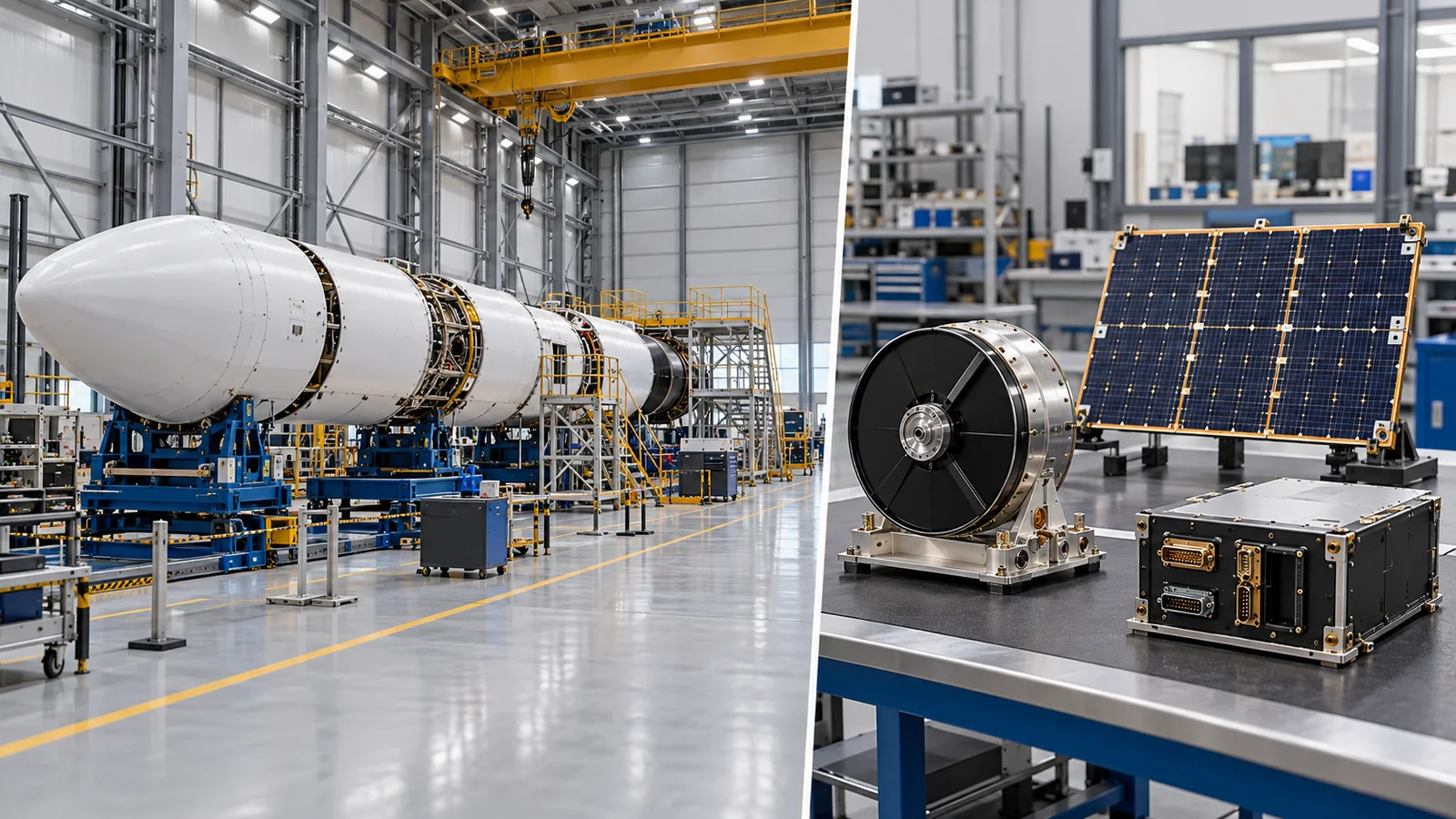
Rocket Lab's rockets are distinguished by carbon-fibre composite structures. Electron is carbon composite throughout, tanks included, and the company says Neutron's first- and second-stage tanks also use carbon composite Sourced. Carbon-fibre composite is light and strong, but as a large tank that holds cryogenic liquids (liquid oxygen and methane) and is reused repeatedly, it is a material where preventing cracks and leaks takes difficult design and inspection Not yet confirmed (our own explanation).
Indeed, the 10-K says an unanticipated failure occurred in qualification testing of the Neutron first-stage tank in January 2026 and affected the timing of the first launch Sourced. The detailed cause is not given in the documents checked, and this article does not guess. The company says that, after re-evaluating the time needed to produce a new tank and test it, the first-launch target moved in steps.
On engines, the company says its Rutherford engine (for Electron) uses additive manufacturing for all primary components of an oxygen and hydrocarbon engine, and that over 800 engines had flown by the end of 2025. Neutron's Archimedes engine is also 3D-printed and uses an oxidizer-rich staged-combustion cycle. The SolAero acquisition also gave it its own space solar cells and solar panels. For space solar cells, composites and additive manufacturing, see our explainers on space solar cells, space CFRP and composite materials, and additive manufacturing in space.
6. What it has done so far
Launch results and acquisitions are listed as far as the filings go. Failures are given only as the company describes them, and causes are not guessed.
| When | What happened | Meaning |
|---|---|---|
| 2017 | First Electron launch (company record) | Small-rocket operations begin |
| April 2020 - January 2022 | Acquired Sinclair, Advanced Solutions, Planetary Systems and SolAero | Owns satellite parts and solar cells |
| March 2021 | Announced development of the reusable medium-lift rocket Neutron | To raise launch capability |
| September 2023 | The 10-K records an Electron launch failure (no detail on cause or investigation) and cites it as an example of the risk that, if government clearance is not granted after a failure, launches cannot continue | Impact of a launch failure |
| August 2025 | Acquired GEOST | Widening parts |
| 17 December 2025 | Contract with the Space Development Agency for 18 satellites (potential value US$816 million) | A large satellite-manufacturing contract |
| January 2026 | The Neutron first-stage tank failed in qualification testing (company record) | One cause of the first-flight delay |
| 14 April 2026 | Completed the acquisition of Mynaric (a German optical-communications company) | Brings in laser communications |
| 26 May 2026 | Acquired Motiv (precision space mechanisms and robotics) | Widening parts and robotics |
| 28 June 2026 | Agreed to acquire Iridium Communications (not yet closed) | A plan to take in a network operator |
| 30 June 2026 | Electron's cumulative successes reached 87 (including suborbital flights) | Operating record |
| 21 and 30 July 2026 | Contracts with the U.S. Space Force for 12 suborbital launches and for satellites | Government contracts |
| 14 October 2026 | Announced that Neutron's first flight slips to 2027 | Delay of a new vehicle |
7. What comes next
The items below are plans and targets, not achievements Not yet confirmed.
| Item | Content (company statements) | Type |
|---|---|---|
| Neutron first flight | On 14 October 2026 the company said the first flight will be in 2027. The August 2026 10-Q had said the window for a flight within the year was narrowing. No specific date could be confirmed | Not yet confirmed |
| Neutron production and operation | The company says it is weighing the first flight against entering service as a vehicle ready for full production and high launch cadence. This depends on first-stage qualification and engine tests | Not yet confirmed |
| Iridium acquisition | The consideration is a mix of cash and shares. By the company's account the enterprise value is about US$8.0 billion, it needs over US$3.0 billion in cash, and about US$1.8 billion more may be needed to repay or refinance existing debt. Closing is expected in 2027, subject to Iridium shareholder approval, U.S. antitrust waiting periods, and approval from the U.S. Federal Communications Commission (FCC) and other countries | Not yet confirmed |
| Launch pad LC-3 | A pad to receive Neutron. The February 2026 10-K expected it in service in 2026. The current status could not be confirmed | Not yet confirmed |
| Satellite deliveries | The 18 SDA satellites are expected to be delivered in 2029 (company). A delivery time for the Space Force satellite contract could not be confirmed | Not yet confirmed |
The following do not appear in the documents checked Not yet confirmed.
The detailed cause of the Neutron first-stage tank failure / a specific date for Neutron's first flight and a launch-frequency target / amounts for individual NASA contracts / a fixed date for LC-3 entering service / when the Iridium acquisition will finally be approved. Press-only figures such as "N satellites in year X" are not used here.
8. What the company is aiming for in space
This section includes points the company does not state directly. They are inferences from what the primary sources show, given with their grounds.
| What can be read | Primary-source grounds | Type |
|---|---|---|
| It is heading toward having launch, satellites, parts and operations all in-house | The company describes itself as an "end-to-end" space company. It says the Motiv acquisition fills a gap in its vertical integration | Sourced |
| The centre of growth is satellites and parts | About 75% of first-half 2026 revenue was Space Systems, and about 60% of backlog is Space Systems | Inference |
| The Iridium deal is a move from building satellites to operating a communications network | The 10-Q says it combines launch and satellite manufacturing with Iridium's global network and spectrum | Inference |
| Neutron is aimed at launching large satellite networks | The company describes Neutron as built for large constellation deployment. 13,000 kg to low Earth orbit | Sourced |
| Government contracts are becoming a big pillar for satellites and launch | Three contracts in December 2025 and July 2026 (potential values total about US$1.48 billion: 816 + 266 + 397 million, including options) | Inference |
In 2026 Rocket Lab was acquiring parts, satellite and communications companies one after another while Neutron development slipped Sourced. The run of Mynaric (April), Motiv (May) and Iridium (agreed in June) reads as a move to grow revenue outside launch and to move away from reliance on Electron alone. The 10-Q's funding discussion also expects the Iridium acquisition to need over US$3.0 billion in cash, and a bridge loan is arranged. But this is the article's reading of how and when the company is using its funds, not something the company has said Not yet confirmed.
9. Map of partnerships in the space industry
10. Technology, products and services
| Area | Main products | What the company's documents say |
|---|---|---|
| Launch (small) | Electron, HASTE | Electron: 300 kg to low Earth orbit, carbon composite, Rutherford engines (3D-printed, electric-pump-fed). First-stage lift-off thrust 190 kN and first-stage specific impulse 311 seconds (company's stated values). Launch sites: LC-1 in New Zealand (capacity up to 120 launches a year) and LC-2 in the U.S. |
| Launch (medium) | Neutron | 43 m tall, 13,000 kg to low Earth orbit, LOX and methane, nine Archimedes engines (733 kN each). The first stage lands on a sea platform, "Return On Investment". The fairing stays attached to the first stage and opens like a clamshell, a design called "Hungry Hippo" (company's stated values) |
| Satellites and spacecraft | A family of spacecraft | From low orbit to planetary missions. Offered with operations and ground stations included |
| Satellite parts | Attitude control, star trackers, radios, separation systems, solar cells and panels, composite structures, propulsion, optical communications, robotics | Flight hardware on over 1,800 missions (31 December 2025). Parts are also sold to other satellite makers |
| Sites | Long Beach, Auckland, Wallops, Middle River, Stennis and others | Long Beach: headquarters and engine production. Auckland: rocket manufacturing. Middle River, Maryland: composite products. Stennis, Mississippi: test site for the Archimedes engine |
Rocket Lab makes satellite parts (solar cells, attitude control, separation systems, optical communications and more) in-house and sells them to others too Sourced. The company says it bought Motiv to bring in-house costly and supply-constrained components such as solar array drive assemblies. Space parts must be qualified against radiation, vacuum and temperature swings, and the fewer the suppliers, the more exposed buyers are to delivery and price; that is the general situation in the world of space materials and parts Not yet confirmed (our own explanation).
In rockets too, the main parts of Electron's engine (Rutherford) are made by metal 3D printing and its tanks are carbon composite. The company says additive manufacturing lets it design and test new parts in a short time. Yet events such as the first-stage tank failure also show how hard it is to combine new materials with large structures.
11. The risks this company carries
| Risk | Content | Type |
|---|---|---|
| Neutron delay | After the January 2026 first-stage tank failure, the company announced that the first flight slips to 2027. The 10-Q says "risk and uncertainty remains" in the complex development cycle of a new rocket | Sourced |
| Reliance on Electron | The 10-K says the launch business currently depends on Electron. It cites the September 2023 launch failure as an example of the risk that, if government clearance is not granted after a failure, the launch rate would fall | Sourced |
| Carrying out the Iridium deal | Closing needs shareholder and regulatory approval and assumes over US$3.0 billion in cash plus a bridge loan. Closing is expected in 2027 and is uncertain | Sourced |
| Continuing losses | Net loss was US$198.2 million in 2025 and US$94.3 million in the first half of 2026. R&D is large | Sourced |
| Reliance on government contracts | U.S. government contracts are growing, but they carry terms that let the government end or change them. Some individual amounts and terms could not be confirmed | Inference |
| Integrating acquisitions | The 10-Q says integrating several acquisitions draws on management resources | Sourced |
| Licences and environment | Launches need licences for each site (from the FAA and others). LC-2 is licensed for eight missions a year (10-K) | Sourced |
12. Glossary
- Electron
- Rocket Lab's small rocket, with a carbon-fibre composite body.
- Neutron
- The medium-lift reusable rocket Rocket Lab is developing.
- HASTE
- A suborbital test vehicle derived from Electron.
- Small launch vehicle
- A rocket that carries satellites of a few hundred kilograms to low Earth orbit.
- Rutherford / Archimedes
- The engines of Electron and Neutron. Both use 3D printing.
- Additive manufacturing (3D printing)
- Making complex parts by fusing metal or other powder in layers.
- Backlog
- Contracted revenue that has not yet been recognized.
- ATM (at-the-market) offering
- A way for a company to raise funds by selling shares gradually on the market through brokers.
- SDA
- The U.S. Space Development Agency, which buys satellite networks for the U.S. government.
- Iridium
- A U.S. company that runs a global satellite communications network. Rocket Lab has agreed to buy it.
13. References
- Rocket Lab Form 10-K (fiscal year ended 31 December 2025; filed with the U.S. SEC on 26 February 2026). Business, vehicles, sites, headcount, main customers, 2025 revenue and results, risk factors. https://www.sec.gov/Archives/edgar/data/1819994/000181999426000013/rklb-20251231.htm
- Rocket Lab Form 10-Q (quarter ended 30 June 2026; filed with the U.S. SEC on 10 August 2026). Revenue, results, backlog, cash, capital expenditure, acquisitions, the Iridium merger agreement, Neutron status. https://www.sec.gov/Archives/edgar/data/1819994/000181999426000062/rklb-20260630.htm
- Rocket Lab Media Release, "Rocket Lab Provides Update on Neutron Development and Adjusts Target Launch Timing" (Exhibit 99.1 to a Form 8-K, 14 October 2026). https://www.sec.gov/Archives/edgar/data/1819994/000181999426000067/rklb-10142026ex991.htm
- Rocket Lab Form 8-K (filed 29 June 2026). The merger agreement for the acquisition of Iridium Communications Inc. (28 June 2026). https://www.sec.gov/Archives/edgar/data/1819994/000175392626001085/g085783_8k.htm
- Rocket Lab Form 8-K (filed 14 April 2026). Completion of the acquisition of Mynaric AG. https://www.sec.gov/Archives/edgar/data/1819994/000175392626000654/g085683_8k.htm
- Rocket Lab Form 8-K (filed 20 May 2026). At-the-market equity distribution agreement (up to US$3.0 billion). https://www.sec.gov/Archives/edgar/data/1819994/000181999426000045/rklb-20260520.htm
- Rocket Lab Form 8-K (filed 13 August 2026). At-the-market equity distribution agreement (up to about US$1.94 billion) and progress on the Iridium acquisition. https://www.sec.gov/Archives/edgar/data/1819994/000175392626001463/g085846_8k.htm
- Rocket Lab Electron (the company's stated vehicle specifications; checked 17 October 2026). https://rocketlabcorp.com/launch/electron/
- Rocket Lab Neutron (stated specifications and development milestones; checked 17 October 2026). https://rocketlabcorp.com/launch/neutron/
- Rocket Lab Official website (source of the logo; checked 17 October 2026). https://rocketlabcorp.com/
- U.S. SEC EDGAR filing index for Rocket Lab Corp (CIK 0001819994), used to confirm the Nasdaq listing and filing dates. https://data.sec.gov/submissions/CIK0001819994.json
14. Claim-to-source audit
| Claim in the text | Type | Source |
|---|---|---|
| Legal name, Nasdaq listing, existence of filings | Sourced | Reference 1, 11 https://www.sec.gov/Archives/edgar/data/1819994/000181999426000013/rklb-20251231.htm https://data.sec.gov/submissions/CIK0001819994.json |
| 2024-2025 revenue, results, R&D, capex; headcount over 2,600; sites | Sourced | Reference 1 https://www.sec.gov/Archives/edgar/data/1819994/000181999426000013/rklb-20251231.htm |
| January-June 2026 revenue, results, R&D, capex; backlog; cash and securities; Electron launch counts; HASTE | Sourced | Reference 2 https://www.sec.gov/Archives/edgar/data/1819994/000181999426000062/rklb-20260630.htm |
| Electron's stated specifications | Sourced | Reference 8 https://rocketlabcorp.com/launch/electron/ |
| Neutron's stated specifications and development milestones | Sourced | Reference 9 https://rocketlabcorp.com/launch/neutron/ |
| Neutron's first flight slipping to 2027 (14 October 2026) | Sourced | Reference 3 https://www.sec.gov/Archives/edgar/data/1819994/000181999426000067/rklb-10142026ex991.htm |
| The January 2026 first-stage tank failure and its effect on the first flight | Sourced | Reference 1 https://www.sec.gov/Archives/edgar/data/1819994/000181999426000013/rklb-20251231.htm |
| The Iridium agreement (28 June 2026), its terms and expected closing | Sourced | Reference 2, 4 https://www.sec.gov/Archives/edgar/data/1819994/000181999426000062/rklb-20260630.htm https://www.sec.gov/Archives/edgar/data/1819994/000175392626001085/g085783_8k.htm |
| Completion of the Mynaric acquisition (14 April 2026) and its consideration value | Sourced | Reference 5 https://www.sec.gov/Archives/edgar/data/1819994/000175392626000654/g085683_8k.htm |
| The Motiv acquisition (26 May 2026) and its consideration | Sourced | Reference 2 https://www.sec.gov/Archives/edgar/data/1819994/000181999426000062/rklb-20260630.htm |
| The ATM sales agreements (20 May and 13 August 2026) | Sourced | Reference 6, 7 https://www.sec.gov/Archives/edgar/data/1819994/000181999426000045/rklb-20260520.htm https://www.sec.gov/Archives/edgar/data/1819994/000175392626001463/g085846_8k.htm |
| The SDA contract (US$816 million) and the Space Force contracts (US$266 million and US$397 million) | Sourced | Reference 1, 2 https://www.sec.gov/Archives/edgar/data/1819994/000181999426000013/rklb-20251231.htm https://www.sec.gov/Archives/edgar/data/1819994/000181999426000062/rklb-20260630.htm |
| NASA Wallops pad, Category 1 certification and named customers | Sourced | Reference 1 https://www.sec.gov/Archives/edgar/data/1819994/000181999426000013/rklb-20251231.htm |
| The company's reference to the September 2023 Electron launch failure | Sourced | Reference 1 https://www.sec.gov/Archives/edgar/data/1819994/000181999426000013/rklb-20251231.htm |
| Space Systems share (67% and 75%) and the backed-out 2024 divisional revenue | Our calculation | Our calculation. The underlying figures are in References 1 and 2 https://www.sec.gov/Archives/edgar/data/1819994/000181999426000013/rklb-20251231.htm https://www.sec.gov/Archives/edgar/data/1819994/000181999426000062/rklb-20260630.htm |
| Total potential value of the three government contracts (about US$1.48 billion) | Our calculation | Our sum. The underlying figures are in References 1 and 2 https://www.sec.gov/Archives/edgar/data/1819994/000181999426000013/rklb-20251231.htm https://www.sec.gov/Archives/edgar/data/1819994/000181999426000062/rklb-20260630.htm |
| The cause of the Neutron tank failure, individual NASA contract amounts and a fixed date for LC-3 entering service | Not yet confirmed | Not found in the documents checked; this article does not guess |
| Neutron's first flight, the Iridium closing, SDA satellite deliveries and LC-3 entering service | Not yet confirmed | Company targets, at the outlook stage; not achievements https://www.sec.gov/Archives/edgar/data/1819994/000181999426000062/rklb-20260630.htm https://www.sec.gov/Archives/edgar/data/1819994/000181999426000067/rklb-10142026ex991.htm |
| The centre of growth is satellites and parts | Inference | Our own reading of the Space Systems revenue share and the backlog split |
| The Iridium deal moves it toward operating a communications network | Inference | Our own reading of the 10-Q's description of the acquisition |
| Government contracts are becoming a pillar | Inference | Our own reading of the contracts of December 2025 and July 2026 |
| It is moving away from reliance on Electron alone | Inference | Our own reading of the timing of the 2026 acquisitions and the funding discussion |
Last updated 17 October 2026 / Troy Technical
Figures in this article come from Rocket Lab's statutory filings with the U.S. Securities and Exchange Commission (Form 10-K, Form 10-Q and Forms 8-K) and the company's official pages. No research-firm estimates or press-based figures have been used. Vehicle performance values are the company's stated values, and no claim of superiority over vehicles under different conditions is made. Passages marked "Inference" are this article's interpretation of primary sources, not statements made by the company. Share prices, valuations and investment judgements are not discussed.