COMPANY PROFILE / SPACE INDUSTRY
Stoke Space
- A medium-lift rocket company built around reusing the upper stage, and one that has not yet flown
When people talk about reusable rockets, they usually mean landing the booster (the first stage) and flying it again. Stoke Space is working on something harder: bringing the second stage (the upper stage) back to Earth and reusing that too, which the company calls full reusability. In September 2026 the company announced that its cumulative capital raised has reached US$2.3 billion, and it is aiming for the first flight of its initial rocket, Nova Pathfinder, in the first part of 2027. However, as of 17 October 2026 the company's official material records no launch to orbit. This article sets out what Stoke Space is trying to build, how much of it can be confirmed, and what remains open, using primary sources only and keeping each category separate.
- Stoke Space in 30 seconds, and where it sits in the space industry
- Logo and how the name is written
- Where the company sits in the space industry
- Company size
- Resources committed to the space industry
- Track record so far
- Plans
- What the company seems to be aiming for
- Partnership map in the space industry
- Technologies, products and services
- Risks the company faces
- Glossary / References / Claim-to-source audit
1. Stoke Space in 30 seconds, and where it sits in the space industry
Washington, USAA Delaware corporation (per its Form D)
(carrying payloads up)Not a maker of satellites or spacecraft
Nova Block 2Both designed so that both stages are reused
SLC-14On a Space Force station; the pad John Glenn flew from in 1962
Most rocket companies first aim to reach orbit and add reuse step by step. Stoke Space has narrowed its focus the other way round: it designed for reuse of both stages from the start Sourced. By the company's account, the second-stage engine is combined with the heat shield that protects the stage when it re-enters the atmosphere, and liquid hydrogen is circulated through the metal surface of that shield to cool it. On the other hand, the flight test of real hardware described in the company's official material is the Hopper2 test of September 2023, in which the vehicle rose about 9 metres and landed, and no re-entry from orbit has yet been flown on real hardware. So Stoke Space is a company where design and ground testing are advanced, but proof in flight is still to come.
2. Logo and how the name is written

A note on naming: the legal name is Stoke Space Technologies, Inc., and the company is commonly called Stoke Space (or just Stoke). "Stoke" is an English verb meaning to feed a fire so that it burns harder. Its rocket is named Nova, the first-stage engine Zenith, and the second-stage engine Andromeda. These are proper names and are kept as they are.
Official site: https://www.stokespace.com/ (the logo used here is the company wordmark shown in the header of the official site)3. Where the company sits in the space industry
Companies in the space industry are easiest to sort by the role they play in space, which gives four types. Stoke Space is a "Launch" company, the leftmost type. Its job is to carry satellites and cargo up on a rocket. It does not build the satellites themselves or lunar landers.
Low Earth orbit (LEO) is an orbit a few hundred kilometres above the ground, where many communications satellites fly. The payload is the cargo a rocket carries, such as satellites. Reuse means recovering part of a spent rocket and flying it again. The reuse best known today applies to the first stage only; the second stage is usually thrown away. Stoke Space's stated design brings the second stage back as well. For the basics of rockets and the logic of reuse, see our explainers on the fundamentals of rockets and on reusable rockets.
4. Company size
Because the company is privately held, it has no obligation to publish revenue or profit on a regular basis. The table below sets out what could be confirmed from the company's official material and filings Sourced.
| Item | What could be confirmed | Source |
|---|---|---|
| Revenue and profit | Not disclosed (no mention in official material; this article does not estimate it) | Could not be confirmed |
| Number of employees | Not disclosed (no headcount on the official site) | Could not be confirmed |
| Cumulative capital raised | US$2.3 billion by the company's own account (8 September 2026, after the initial closing of the Series E) | Reference 4 |
| Headquarters and manufacturing | Headquarters in Kent, Washington (about 168,000 square feet). The company says design and manufacturing are carried out in-house | Reference 2 |
| Test site | Moses Lake Test Site in Moses Lake, Washington. The official site gives 550 acres (about 223 hectares), and the September 2026 post describes an expansion from 75 acres | References 3 and 22 |
| Launch site | Space Launch Complex 14 (SLC-14) at Cape Canaveral Space Force Station, Florida | Reference 18 |
| Founders | Andy Lapsa (CEO and co-founder), Tom Feldman (CTO and co-founder) | Reference 22 |
The figure of about 223 hectares for 550 acres uses 1 acre = about 0.4047 hectares. Likewise, 30 feet is given as about 9 metres using 1 foot = 0.3048 metres Our calculation.
The funding figures are amounts the company announced. They are not revenue, and they are not a measure of what the company is worth. This article does not discuss share prices, valuations or investment decisions. Also, the company's announced amounts and the amounts in the Form D notices filed with the SEC can cover different things (see Section 5).
5. Resources committed to the space industry
For this company, "resources committed to the space industry" means nearly everything it has. Four angles are covered here (people, money, outside investments and acquisitions, and contracts with public agencies), showing what could and could not be confirmed.
| Angle | What could be confirmed | Category |
|---|---|---|
| People | Three sites: Kent (design and manufacturing), Moses Lake (testing) and Cape Canaveral (launch). Headcount is not disclosed. The official site describes ELAT (Entry-Level Aerospace Technician), an in-house training program for technicians | Sourced (headcount not confirmed) |
| Money | Cumulative capital raised is US$2.3 billion by the company's account, broken down in the table below. The split into R&D and capital spending is not disclosed | Sourced (breakdown not confirmed) |
| Investments, acquisitions, joint ventures, divestments | No investments in, acquisitions of, joint ventures with or sales of other businesses appear in official material (could not be confirmed). The company does offer Boltline, a cloud-based tool for managing engineering and parts, as a product | Could not be confirmed |
| Contracts and ties with public agencies | Selected as a provider under the U.S. Space Force's NSSL Phase 3 Lane 1 (March 2025). A US$4.5 million Defense Innovation Unit (DIU) contract (August 2024). Cooperation with NASA (an SBIR award in 2020; a collaboration agreement announced June 2026). Allocation of the launch site SLC-14 (March 2023) | Sourced |
Funding history (company announcements)
| Announced | Content | Cumulative total stated by the company |
|---|---|---|
| 5 October 2023 | Series B, US$100 million (led by Industrious Ventures) | US$175 million |
| 15 January 2025 | Series C, US$260 million | US$480 million |
| 8 October 2025 | Series D, US$510 million (as of 23 September 2025; led by USIT), together with a US$100 million debt facility led by Silicon Valley Bank | US$990 million |
| 10 February 2026 | Series D extended to US$860 million (terms not disclosed) | US$1.34 billion |
| 8 September 2026 | Series E, initial closing of a US$1 billion round (co-led by Point72 Ventures and Spark Capital) | US$2.3 billion |
Two Form D notices (the filing a private company makes with the SEC when it raises money without a public offering) could be confirmed Sourced.
| Filed | Date of first sale | Total offering amount | Amount sold | Investors |
|---|---|---|---|---|
| 6 November 2025 | 23 September 2025 | US$409,999,965 | US$409,999,965 | 29 |
| 16 April 2026 | 6 February 2026 | US$350,000,015 | US$275,000,029 | 28 |
The total offering amount in the second notice (about US$350 million) matches the difference between the company's announced Series D extension (US$510 million to US$860 million). The first notice's figure of about US$410 million does not match the company's announced US$510 million. Because the company's wording makes the relationship between US$510 million and the US$100 million debt facility hard to read, the reason for the gap cannot be confirmed from the filings and announcement Not yet confirmed.
Status of main vehicles and products (checked 17 October 2026)
| Vehicle / product | Type | Main specifications (company's stated values) | Track record | Stage |
|---|---|---|---|---|
| Nova Pathfinder | Two-stage medium-lift rocket (the first flight configuration) | 2,500 kg to LEO (conditions not given on the page). Stage 1: seven Zenith engines, over 700,000 lbf of thrust. Stage 2: Andromeda, over 25,000 lbf | Launch to orbit: not recorded in official material | In development, in final integration ahead of first flight (References 1 and 5) |
| Nova Block 2 | Larger configuration (5-metre fairing) | 15,000 kg to LEO (fully reusable configuration), 4,000 kg to geosynchronous transfer orbit. Stage 1: 14 Zenith engines, over 1,700,000 lbf. Stage 2: Andromeda Block 2, over 150,000 lbf | None | In development. First flight targeted for 2029 (References 2 and 3) |
| Zenith (Stage 1 engine) | Full-flow staged-combustion engine burning liquefied natural gas (LNG) and liquid oxygen | Specific impulse 345 s (company's stated value). Design thrust stated as over 100,000 lbf in June 2024 | First hot-fire test on 5 June 2024 (Reference 15) | In testing |
| Andromeda (Stage 2 engine) | Liquid hydrogen and liquid oxygen engine, integrated with the re-entry heat shield | Pathfinder: specific impulse over 400 s. Block 2: 440 s (company's stated values) | The Hopper flight test (September 2023) used the earlier Andromeda 1. The current design has been tested on the ground (Reference 17) | In testing |
On a reusable rocket, the demand on materials shifts from "must survive once" to "must survive many times without wearing out". Three features of materials and manufacturing can be read from Stoke Space's official material Sourced.
(1) The heat shield is a cooled metal surface rather than ceramic tiles. The company explains that conventional re-entry tiles are brittle, that a cracked tile can be catastrophic, and that every individual tile has to be inspected and repaired. Stoke Space instead takes regenerative cooling (running fuel or coolant through the inside of a wall to cool the metal), long used inside rocket engines, and applies it to the re-entry heat shield. The company says heating inside an engine can be about 20 times higher than during re-entry.
(2) The airframe skin is stainless steel in a skin-and-stringer construction. Thin skin is stiffened by slim reinforcing members (stringers). The company says this needs almost no fixed tooling, which makes design changes and production increases easier.
(3) One reason the company gives for choosing LNG as fuel is that it leaves less soot. It burns more cleanly than kerosene-type fuel and, the company says, removes the need for engine cleaning after tests and flights. All of this is the company's own explanation, and long-term durability in flight has not yet been demonstrated.
6. Track record so far
| Date | Event | What it means |
|---|---|---|
| 7 March 2023 | Announced that the U.S. Space Force's Space Launch Delta 45 had allocated Launch Complex 14 to the company | Secured a launch site; the pad John Glenn flew from in 1962 |
| 17 September 2023 | Hopper2 vertical takeoff and landing test flight. Rose to 30 feet (about 9 metres) and landed at the planned spot after a 15-second flight | Confirmed on hardware part of the reusable upper-stage design (controlling attitude by varying the output of individual thrusters, and a regeneratively cooled heat shield). It did not actually experience re-entry heating (company statement) |
| 5 October 2023 | Series B, US$100 million. The rocket name "Nova" was announced | First public product name |
| 5 June 2024 | First hot-fire test of the Stage 1 engine Zenith (announced 11 June) | The company says it designed and built the engine in 18 months |
| 28 August 2024 | US$4.5 million contract under the DIU's Novel Responsive Space Delivery (NRSD) project | Prototyping, including delivering cargo from space to the ground |
| 20 October 2024 | The company says it completed the Environmental Assessment for SLC-14 and secured permission to develop and operate the site; ground was broken the next day | A process of nearly two years (company statement) |
| 13 February 2025 | Announced Andromeda 2, an improved Stage 2 engine. The number of thrusters was cut from 30 to 24, each made larger | Aimed at fewer parts and lower weight (company statement) |
| 27 March 2025 | The U.S. Space Force's SSC added Rocket Lab and Stoke Space as providers under NSSL Phase 3 Lane 1 | An initial assessment task order of US$5 million each (SSC announcement). Stoke says the ordering period runs to June 2029 (with an option to extend) and that the award lets it compete for a total of US$5.6 billion in contracts. The US$5.6 billion is not a confirmed contract value |
| 23 September to 8 October 2025 | Announced Series D of US$510 million and a US$100 million debt facility | Cumulative US$990 million (company announcement) |
| 20 February 2026 | Flag-raising ceremony at SLC-14 | A milestone for activity at the launch site. Not a launch |
| 8 June 2026 | Announced completion of "proto-qualification" testing of Stage 1: 46 structural test objectives verified over three weeks at Moses Lake | A test of the vehicle structure. Not a launch test with engines |
| 26 June 2026 | Selected under a NASA Space Technology Mission Directorate Announcement of Collaboration Opportunity | Joint work on entry, descent and landing technology |
| 8 September 2026 | Initial closing of a US$1 billion Series E; Nova Block 2 shown publicly for the first time | Cumulative US$2.3 billion (company announcement) |
| 22 September 2026 | Announced the customer payloads for the first Pathfinder flight | Still before launch |
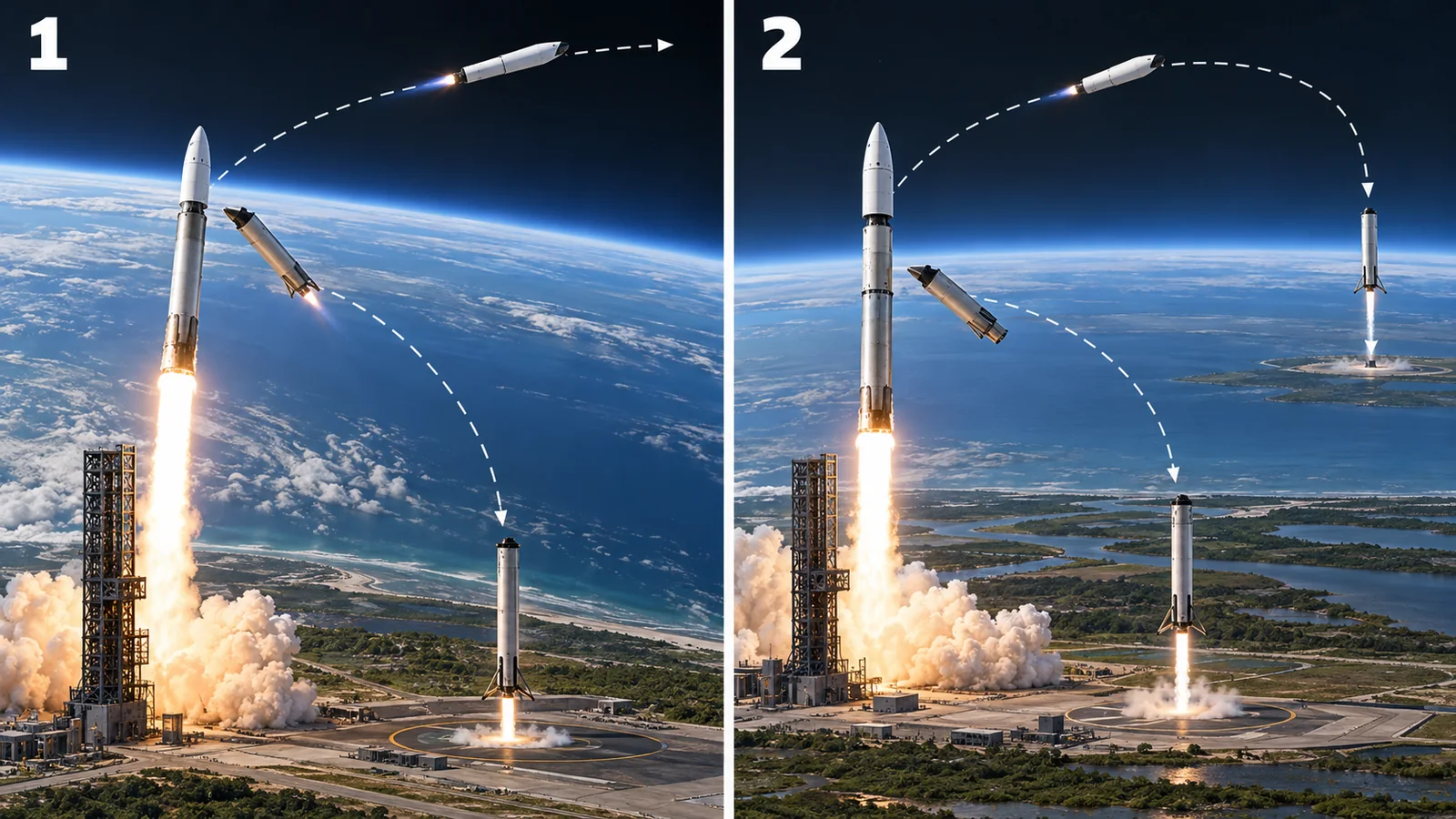
View original SVG, values and sources
Illustration Reusing the second stage (upper stage). This article has arranged the design explanations in Stoke Space's official material (the Andromeda introduction, Scaling Nova and the Hopper2 report) into five steps Our calculation. It does not show an actual flight procedure or result.
7. Plans
Everything below is a company plan or target, not an achieved fact Not yet confirmed.
CelestisAnnounced customers. Autonomy-1 and Infinite Flight
2027 and 2028The number of flights is not disclosed
The company has also announced the following (all plans).
| Item | Company's explanation | Category |
|---|---|---|
| Test-site expansion | Expand the Moses Lake test site from 75 acres to 550 acres | Not yet confirmed |
| Launch-site build-out | A new payload processing facility; an offshore recovery platform being designed and built; long-lead ground equipment for Block 2 already on order | Not yet confirmed |
| Joint research with NASA | Mature the entry, descent and landing technology for the second stage, using facilities such as NASA Ames's hypervelocity free-flight test capability | Not yet confirmed |
| Reuse on Block 2 | 15 tonnes to LEO in a fully reusable configuration. The upper-stage engine is planned to become 12 independent engines | Not yet confirmed |
None of the following appears in official material Not yet confirmed.
The exact launch date of the first flight / the status of the FAA (Federal Aviation Administration) launch licence / launch prices / the number of contracted customers and contract values / when reuse will first be attempted / expected launches per year. Figures such as "so many launches a year" or "so much per launch" mostly come from press reports and are not used in this article.
8. What the company seems to be aiming for
This section includes points the company has not stated directly. They are written as inferences that can be drawn from primary sources, with the basis given.
| What can be read | Primary-source basis | Category |
|---|---|---|
| The goal goes beyond being a rocket company to space logistics, including returning cargo to the ground | The official site repeats "to, through, and from space", and both the NASA collaboration and Scaling Nova refer to demand for downmass (cargo returned from space to the ground) | Inference |
| Pathfinder is a first step to prove full reuse in flight, more than a main product | The company describes Pathfinder as a technology demonstrator and first flight configuration, and writes that Pathfinder proves the technology while Block 2 scales the capability | Inference |
| It expects replenishing satellite constellations to be a main market | Scaling Nova says Block 2 can deploy and replenish constellations in bulk | Inference |
| It is investing ahead in launch and recovery facilities, built around high-cadence operations | The company says SLC-14 has a horizontal integration facility and a payload processing facility, designed to serve Block 2 as well | Inference |
| Defense and national security demand is also an important pillar | Selection under NSSL Lane 1, the DIU contract, and a dedicated "Defense" customer page on the official site | Sourced (the size of the pillar is an inference) |
In its document of 8 September 2026, Stoke Space explains that the Pathfinder upper stage is tapered and capsule-like, while the Block 2 upper stage uses cylindrical tanks Sourced. The company gives the reasons for the cylinder as more propellant and more payload volume inside a 5-metre fairing (the cover that encloses the payload). From its remark that volume, rather than mass, is often the real constraint, this article reads the change as a redesign to match demand to carry many constellation satellites at once. This is an interpretation of an official design explanation, however; no document shows the content of any customer contract Not yet confirmed.
9. Partnership map in the space industry
10. Technologies, products and services
What Stoke Space offers is a launch service that carries payloads to orbit (in development). The company describes the following technologies as the core of its design for reusing both stages Sourced.
| Technology | Company's explanation | What is new (in plain terms) |
|---|---|---|
| Zenith (Stage 1 engine) | A full-flow staged-combustion cycle using LNG and liquid oxygen. All the propellant passes through the turbines before entering the combustion chamber | The company says the strain on turbine temperature and pressure is lower, parts wear less, and the engine is easier to use many times. It is extremely hard to develop |
| Andromeda (Stage 2 engine) | Liquid hydrogen and liquid oxygen. Twenty-four thrusters are embedded around the edge of a metal re-entry heat shield | An unusual layout: instead of one big nozzle, small thrusters are arranged in a ring. The same engine handles ascent, manoeuvres in orbit and landing |
| Differential throttle thrust-vector control | Steering the vehicle by varying the output of individual thrusters (demonstrated with Hopper in 2023) | Removes the need for a mechanism that swivels the whole engine |
| Hot staging | Igniting the Stage 2 thrusters while still attached to Stage 1 | The company says this removes the need for a throwaway heat shield between stages and for separation pushers |
| Stainless-steel tanks and structure | Skin-and-stringer construction. Major elements are sized so they can travel by road | Elements can move between the factory, the test site and the launch site by road, without relying on barges or the Panama Canal |
| Boltline | A cloud-based engineering management tool built to develop Nova. It can track parts | A side product, not part of the rocket itself |
The key to this approach is whether the heat of re-entry can be carried away by a flow of liquid hydrogen Not yet confirmed. Stoke Space uses the same hydrogen to cool both the heat shield and the engine, and shows a plan for Block 2 to add a separate pump for re-entry cooling. On the materials side, the focus is on (1) whether a metal wall with fine hydrogen passages can be made thin, light and long-lived enough for repeated use, and (2) whether it avoids cracking and hydrogen-related degradation of the material across both the cryogenic cold of liquid hydrogen and the heat of re-entry. The company has not published specific materials or life-test results. In addition, Block 2 has cylindrical sides that must be protected from heat, and the company itself writes that managing sidewall heating is a challenge. For the basics of thermal protection, see our explainers on thermal protection systems and on spacecraft thermal control.
11. Risks the company faces
| Risk | Content | Category |
|---|---|---|
| Flight proof is still to come | Official material records no launch to orbit. Re-entry and recovery of the upper stage have not been done on hardware | Sourced |
| First-flight schedule | The first-flight target is "the first part of 2027". First-flight dates for new rockets generally tend to move | Not yet confirmed |
| Contract orders depend on a successful first flight | According to SSC, a provider becomes eligible to compete for launch-service task orders under NSSL Lane 1 only after completing its first successful launch | Sourced |
| Licensing | Launches need approvals such as an FAA licence, but their status could not be confirmed from official material | Could not be confirmed |
| Difficulty of development | The company itself writes that full-flow staged combustion is perhaps the hardest engine cycle. It also notes that, in recent years, early flight tanks and similar structures in the industry have been lost during qualification testing | Sourced |
| Scale and use of funds | The US$2.3 billion raised is the company's own announcement. The breakdown of use is not disclosed, so progress is hard to check from outside | Not yet confirmed |
| Environmental and community impact | With the test-site expansion, the company says it is designing facilities and operating practices to reduce noise and other effects on neighbours | Sourced |
| Relationship with competitors | NSSL Lane 1 has five providers including Stoke Space (SSC announcement). This article does not rank vehicles | Sourced |
12. Glossary
- Low Earth orbit (LEO)
- An orbit a few hundred kilometres above the ground, where communications satellites and the International Space Station fly.
- Geosynchronous transfer orbit (GTO)
- A stretched-out orbit on the way to geostationary orbit (about 36,000 km above the equator, matching Earth's rotation period).
- Payload
- The cargo a rocket carries, such as satellites or probes.
- Fairing
- The cover at the nose of a rocket that encloses the payload. It is jettisoned after the rocket leaves the dense atmosphere.
- Full reusability
- Recovering both the first and second stages and flying them again. This is the company's own term; achievement on hardware is unconfirmed.
- Full-flow staged combustion (FFSC)
- An engine cycle in which all the fuel and all the oxidiser first drive the turbines before entering the combustion chamber. High-performing but hard to develop.
- Regenerative cooling
- Running fuel or a coolant through the inside of a wall to cool a metal wall that gets very hot.
- Specific impulse (Isp)
- How long (in seconds) a unit of propellant can keep up a unit of thrust. The engine's equivalent of fuel economy: higher means less propellant for the same job.
- lbf (pound-force)
- A unit of thrust. This article keeps the company's units and does not convert them.
- Downmass
- The mass of cargo brought back from space to the ground. It matters for the demand to return things made in space.
- NSSL
- National Security Space Launch. The U.S. Space Force programme for choosing providers to launch national security satellites. Phase 3 Lane 1 is the lane that adds newer providers step by step.
- IDIQ
- Indefinite-Delivery Indefinite-Quantity. A contract framework signed without fixing the timing or quantity of deliveries. Actual orders come later as "task orders".
- SBIR
- Small Business Innovation Research. A U.S. government scheme that funds research and development at small companies.
- Form D
- A notice that a U.S. company which raised money without a public offering files with the SEC. It lists the total offering, the amount sold and the number of investors.
13. References
- Stoke Space Nova Pathfinder (official page). Pathfinder specifications (2,500 kg, seven Zenith engines, Andromeda). Checked 17 October 2026. https://www.stokespace.com/pathfinder
- Stoke Space Nova Block 2 (official page). Block 2 specifications, heat-shield explanation, headquarters size, and the history of proto-qualification testing and the SLC-14 flag-raising. Checked 17 October 2026. https://www.stokespace.com/nova-block-2
- Stoke Space Scaling Nova (8 September 2026). Pathfinder and Block 2 design, test-site and launch-site expansion plans, flight plan. https://www.stokespace.com/news/scaling-nova
- Stoke Space Stoke Space Raises $1 Billion to Accelerate Fully Reusable Launch (8 September 2026). Series E, cumulative US$2.3 billion. https://www.stokespace.com/news/stoke-space-series-e
- Stoke Space Manifest Update: Nova Pathfinder Flight 1 (22 September 2026). First-flight payloads and target timing. https://www.stokespace.com/news/Manifest-Update-Nova-Pathfinder-Flight-1
- Stoke Space Stoke Space Technologies Extends Previously Announced Series D Financing to $860 Million (10 February 2026). https://www.stokespace.com/news/stoke-space-technologies-extends-previously-announced-series-d-financing-to-860-million
- Stoke Space Stoke Raises $510 Million to Scale Manufacturing of Fully reusable Nova Launch vehicle (8 October 2025). https://www.stokespace.com/news/stoke-space-technologies-raises-510-million-to-scale-manufacturing-of-fully-reusable-nova-launch-vehicle
- Stoke Space Stoke Space Announces $260 Million in New Investment (15 January 2025). https://www.stokespace.com/news/stoke-space-announces-260-million-in-new-investment
- Stoke Space Stoke Space Announces $100 Million in New Investment (5 October 2023). Series B and the naming of "Nova". https://www.stokespace.com/news/stoke-space-series-b
- Stoke Space Stoke Space selected for the U.S. Space Force's $5.6B NSSL program (28 March 2025). https://www.stokespace.com/news/stoke-space-selected-for-the-u-s-space-forces-5-6b-nssl-program
- U.S. Space Force, Space Systems Command (SSC) Space Systems Command On-Ramps Two New Providers to National Security Space Launch Phase 3 Lane 1 Contract (27 March 2025). https://www.ssc.spaceforce.mil/Newsroom/Article-Display/Article/4137680/space-systems-command-on-ramps-two-new-providers-to-national-security-space-lau
- Stoke Space Stoke Awarded Contract to Develop Critical Space Mobility Capabilities (28 August 2024). The DIU US$4.5 million contract. https://www.stokespace.com/news/stoke-awarded-contract-to-develop-critical-space-mobility-capabilities
- Stoke Space Stoke Space and NASA partner to scale reusable launch and re-entry (26 June 2026). https://www.stokespace.com/news/stoke-space-and-nasa-partner-to-scale-reusable-launch-and-re-entry
- Stoke Space Nova Stage 1 Completes Proto-Qualification Testing (8 June 2026). https://www.stokespace.com/news/nova-stage-1-completes-proto-qualification-testing
- Stoke Space Stoke Space Completes First Successful Hotfire Test of Full-Flow, Staged-Combustion Engine (11 June 2024). https://www.stokespace.com/news/stoke-space-completes-first-successful-hotfire-test-of-full-flow-staged-combustion-engine
- Stoke Space Update on Hopper2: The Hopper Has Landed (18 September 2023). https://www.stokespace.com/news/update-on-hopper2-the-hopper-has-landed
- Stoke Space Introducing Andromeda, our rapidly reusable high-performance upper-stage rocket engine (13 February 2025). https://www.stokespace.com/news/introducing-andromeda
- Stoke Space From Mercury to Nova: Launching the Future at Space Launch Complex 14 (28 July 2025). https://www.stokespace.com/news/from-mercury-to-nova-launching-the-future-at-space-launch-complex-14
- Stoke Space Stoke Space has been allocated historic Launch Complex 14 at Cape Canaveral (8 March 2023). https://www.stokespace.com/news/stoke-space-has-been-allocated-historic-launch-complex-14-at-cape-canaveral
- U.S. SEC Form D of Stoke Space Technologies, Inc. (CIK 0001861415), filed 16 April 2026, accession number 0001861415-26-000001. https://www.sec.gov/Archives/edgar/data/1861415/000186141526000001/primary_doc.xml
- U.S. SEC Form D of Stoke Space Technologies, Inc. (CIK 0001861415), filed 6 November 2025, accession number 0001861415-25-000005. https://www.sec.gov/Archives/edgar/data/1861415/000186141525000005/primary_doc.xml
- Stoke Space Company and site pages on the official site (About Us, Our Team, Moses Lake). Founders, test-site size, technician training program. Checked 17 October 2026. https://www.stokespace.com/locations/moses-lake
14. Claim-to-source audit
| Claim in the article | Category | Source |
|---|---|---|
| Privately held. The only filings on EDGAR are Form D notices; headquarters in Kent; a Delaware corporation | Sourced | Reference 20 https://www.sec.gov/Archives/edgar/data/1861415/000186141526000001/primary_doc.xml |
| Pathfinder specifications (2,500 kg, seven Zenith engines, Andromeda, thrust and specific impulse figures) | Sourced | Reference 1 https://www.stokespace.com/pathfinder |
| Block 2 specifications (15,000 kg, 4,000 kg to GTO, 14 Zenith engines, 5-metre fairing) and the heat-shield explanation | Sourced | Reference 2 https://www.stokespace.com/nova-block-2 |
| Block 2 upper stage as 12 independent engines, cylindrical tanks, stainless skin-and-stringer, test-site expansion, flight plan, Block 2 in 2029 | Sourced | Reference 3 https://www.stokespace.com/news/scaling-nova |
| Initial closing of the US$1 billion Series E, cumulative US$2.3 billion, investors | Sourced | Reference 4 https://www.stokespace.com/news/stoke-space-series-e |
| First-flight target of the first part of 2027; payloads from AstroForge and Celestis | Sourced | Reference 5 https://www.stokespace.com/news/Manifest-Update-Nova-Pathfinder-Flight-1 |
| Extension of Series D (US$860 million, cumulative US$1.34 billion) | Sourced | Reference 6 https://www.stokespace.com/news/stoke-space-technologies-extends-previously-announced-series-d-financing-to-860-million |
| Series D of US$510 million and a US$100 million debt facility, cumulative US$990 million | Sourced | Reference 7 https://www.stokespace.com/news/stoke-space-technologies-raises-510-million-to-scale-manufacturing-of-fully-reusable-nova-launch-vehicle |
| Series C of US$260 million, cumulative US$480 million | Sourced | Reference 8 https://www.stokespace.com/news/stoke-space-announces-260-million-in-new-investment |
| Series B of US$100 million, cumulative US$175 million, the naming of "Nova" | Sourced | Reference 9 https://www.stokespace.com/news/stoke-space-series-b |
| Selection under NSSL Phase 3 Lane 1 and the contract framework (IDIQ, ordering period) | Sourced | Reference 10 https://www.stokespace.com/news/stoke-space-selected-for-the-u-s-space-forces-5-6b-nssl-program |
| SSC announcement: US$5 million initial task order; eligible to compete for launch orders after a first successful launch | Sourced | Reference 11 https://www.ssc.spaceforce.mil/Newsroom/Article-Display/Article/4137680/space-systems-command-on-ramps-two-new-providers-to-national-security-space-lau |
| The US$4.5 million DIU contract | Sourced | Reference 12 https://www.stokespace.com/news/stoke-awarded-contract-to-develop-critical-space-mobility-capabilities |
| Selection for the NASA collaboration (June 2026) and the 2020 SBIR award | Sourced | Reference 13 https://www.stokespace.com/news/stoke-space-and-nasa-partner-to-scale-reusable-launch-and-re-entry |
| Stage 1 proto-qualification testing (46 structural test objectives, three weeks) | Sourced | Reference 14 https://www.stokespace.com/news/nova-stage-1-completes-proto-qualification-testing |
| First Zenith hot-fire test (5 June 2024), designed and built in 18 months | Sourced | Reference 15 https://www.stokespace.com/news/stoke-space-completes-first-successful-hotfire-test-of-full-flow-staged-combustion-engine |
| Hopper2 test flight (17 September 2023, 30 feet, 15 seconds). It did not actually experience re-entry heating | Sourced | Reference 16 https://www.stokespace.com/news/update-on-hopper2-the-hopper-has-landed |
| Andromeda 2 (thrusters cut from 30 to 24), hot staging, regenerative cooling of the heat shield | Sourced | Reference 17 https://www.stokespace.com/news/introducing-andromeda |
| Completion of the SLC-14 environmental assessment (20 October 2024), facility layout, shared-use agreement for the blockhouse (the former control bunker) | Sourced | Reference 18 https://www.stokespace.com/news/from-mercury-to-nova-launching-the-future-at-space-launch-complex-14 |
| Allocation of SLC-14 (7 March 2023, Space Launch Delta 45) | Sourced | Reference 19 https://www.stokespace.com/news/stoke-space-has-been-allocated-historic-launch-complex-14-at-cape-canaveral |
| Form D (first sale 6 February 2026, total offering US$350,000,015, sold US$275,000,029, 28 investors) | Sourced | Reference 20 https://www.sec.gov/Archives/edgar/data/1861415/000186141526000001/primary_doc.xml |
| Form D (first sale 23 September 2025, sold US$409,999,965, 29 investors) | Sourced | Reference 21 https://www.sec.gov/Archives/edgar/data/1861415/000186141525000005/primary_doc.xml |
| Founders, test-site size, the technician training program ELAT | Sourced | Reference 22 https://www.stokespace.com/locations/moses-lake |
| The four-type grouping and the position in Fig. 1, the five-step arrangement in the illustration, the unit conversions | Our calculation | This article's own arrangement. Company names are examples from companies in this series |
| Revenue, headcount and the R&D breakdown | Not yet confirmed | Not in official material. This article does not estimate them (our note) |
| Status of the FAA launch licence, launch prices, contracted customers and contract values, the exact date of the first flight | Not yet confirmed | Could not be confirmed from official material. Press-reported figures are not used (our note) |
| The reason for the gap between the announced Series D of US$510 million and about US$410 million in the Form D | Not yet confirmed | Cannot be confirmed from the filings and announcement (our note) |
| First-flight target (first part of 2027), Block 2 first flight (2029), test-site and launch-site expansion | Not yet confirmed | Company plans, not achieved facts. References 3 and 5 https://www.stokespace.com/news/scaling-nova |
| The goal is space logistics including downmass | Inference | This article's interpretation of the official site's wording and the NASA collaboration (our note) |
| Pathfinder is a first step to prove full reuse in flight | Inference | This article's interpretation of the official page's explanation (our note) |
| Replenishing satellite constellations is expected to be a main market | Inference | This article's interpretation of Scaling Nova (our note) |
| It is investing ahead for high-cadence operations | Inference | This article's interpretation of the launch-site build-out (our note) |
| The cylindrical upper stage is a change to match constellation demand | Inference | This article's interpretation of an official design explanation (our note) |
Last updated 17 October 2026 / Troy Technical
The figures in this article are drawn from Stoke Space's official announcements, announcements by the U.S. Space Force's SSC, and public filings with the U.S. Securities and Exchange Commission (SEC). No research-firm estimates or press-based figures have been used. All performance figures are company-stated values and do not mean they have been confirmed in flight. Passages marked "Inference" are this article's interpretation of primary sources, not statements made by the company.