INSTITUTION PROFILE / SPACE INDUSTRY
Indian Space Research Organisation (ISRO)
India's builder-and-operator space agency, which does not license private firms
ISRO is a major part of India's Department of Space (DOS). It develops and operates rockets, satellites and Moon missions itself. But the body that licenses private launches is a different one (IN-SPACe), and the state-owned company that commercialises mature technology is a third (NSIL). This profile looks at one question: what ISRO can decide in the space industry, and what it cannot.
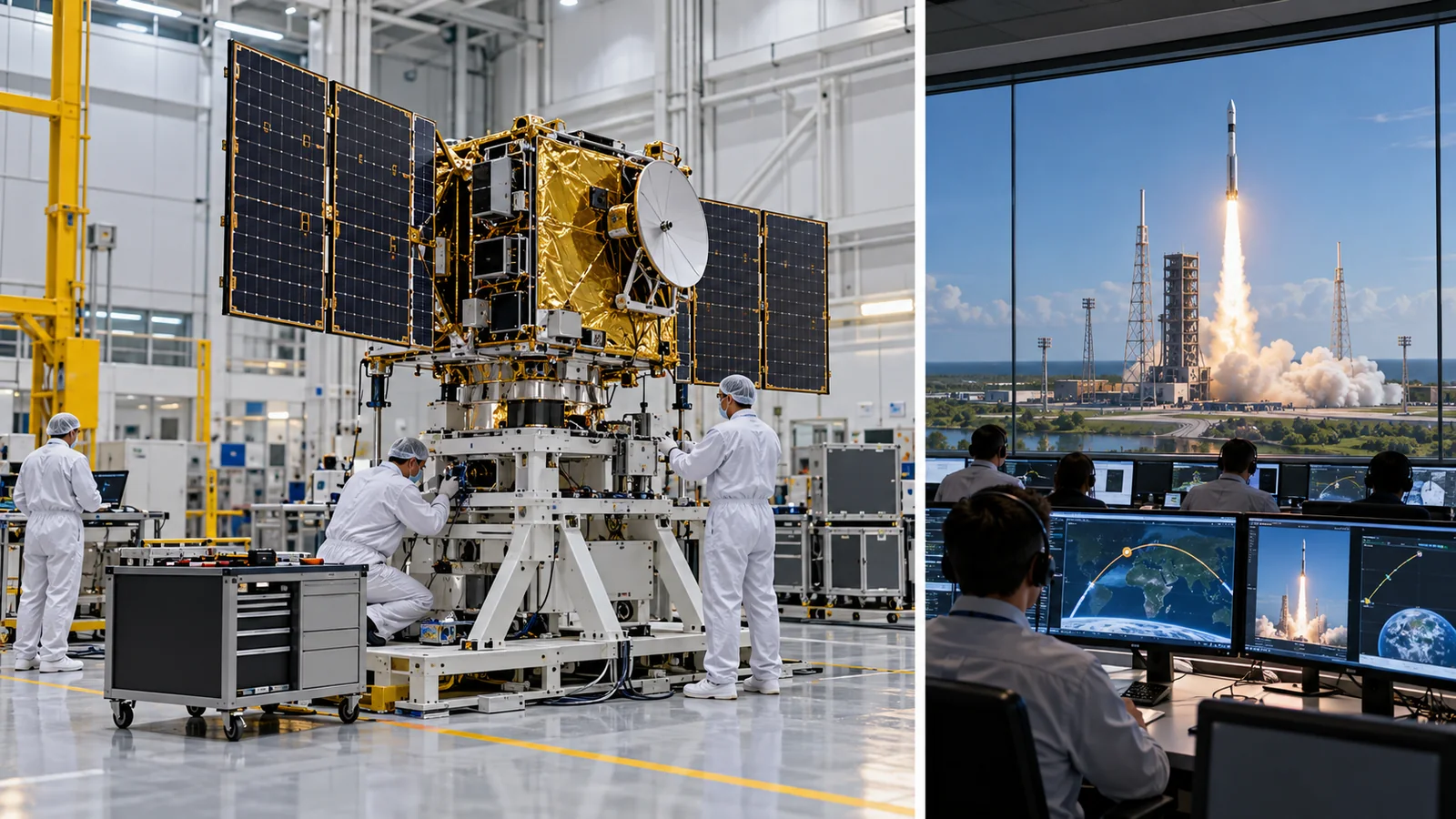
- ISRO in 30 seconds
- What kind of body it is: the four types of influence
- What it does in the space industry
- How far its influence reaches (powers and geography): what it can and cannot decide
- Related organisations and companies
- Outlook
- Glossary, references and claim-to-source audit
1. ISRO in 30 seconds
ISRO is an agency that builds and flies hardware, not one that licenses others. The Indian Space Policy 2023 makes IN-SPACe the single window for authorising space activities, including those of private companies. It asks ISRO to concentrate on research and development of new space technology and applications, and to hand mature technology over to industry Sourced. However, ISRO's Chairman also serves as Secretary of the Department of Space and Chairman of the Space Commission, the body that sets policy Sourced. So one person sits at the centre of policy, but the organisation ISRO does not issue licences to private firms.
2. What kind of body it is: the four types of influence
Institutions in the space industry differ from companies. What separates them is the route by which they influence the industry, and that gives four types. ISRO is unusual because it builds and operates rockets and satellites itself. Among the four types it is closest to "Funding", since it spends the state's money on development.
3. What it does in the space industry
ISRO's core work is research, development and operation of rockets, satellites, exploration missions and human spaceflight. Its headquarters are in Bengaluru, and the work is split between centres: rockets at the Vikram Sarabhai Space Centre (VSSC), satellites at the U R Rao Satellite Centre (URSC), and launches at the Satish Dhawan Space Centre (SDSC) in Sriharikota Sourced. The table shows the position as of 17 October 2026.
| Area | What happens | Status |
|---|---|---|
| Rockets | ISRO operates and develops PSLV, GSLV, LVM3 and SSLV. PSLV-C61 (18 May 2025, EOS-09) failed to complete its mission because of an anomaly in the third-stage solid motor. After a national committee's recommendations, a modified motor was ground-tested on 6 October and 19 November 2025. For PSLV-C62 (planned for 12 January 2026), ISRO's mission page records an anomaly near the end of the PS3 stage and says a detailed analysis has begun. We could not find an official conclusion on the cause for C62. GSLV-F17 launched on 4 September 2026 and placed EOS-05 into orbit | Sourced |
| Human spaceflight (Gaganyaan) | The plan is to send a crew of three to a 400 km orbit for three days and bring them down in Indian waters. Before the crewed flight, ISRO plans uncrewed missions G1, G2 and G3; G1 is set up as an experimental mission for early flight testing. We could not find a launch date for G1 | Sourced (the plan) Not yet confirmed (the schedule) |
| Long-term plan (Space Vision 2047) | The Government has set targets of the first module of the Bharatiya Antariksh Station by 2028, the full station by 2035, and an Indian landing on the Moon by 2040. It has approved five projects: follow-on human flights and the station, the Next Generation Launch Vehicle (NGLV) by 2032, Chandrayaan-4 (aimed at returning lunar samples) by 2027, a Venus orbiter by 2028, and a third launch pad | Sourced (approval) Not yet confirmed (dates) |
| Handing work to industry | The policy says mature systems are to be transferred to industry while ISRO focuses on advanced research. An agreement to transfer SSLV technology to HAL was signed on 10 September 2025 (NSIL, ISRO, IN-SPACe and HAL). NSIL signed a contract with HAL, the lead partner of a HAL and L&T consortium, for end-to-end production of five PSLV-XL vehicles. NSIL has signed 100 technology-transfer agreements in total | Sourced |
| Facilities for private firms | Through IN-SPACe, private firms can use ISRO's solid-motor casting and static-test facilities, liquid-engine test facilities and launch pad. Skyroot Aerospace's Vikram-I lifted off from Sriharikota on 18 July 2026, the first orbital launch by a private company from Indian soil. ISRO says its safety team watched over the operations round the clock | Sourced |
| Satellite data | The policy says ISRO's satellite data at a ground resolution of 5 m or coarser is to be free and open. Finer data is free to government bodies and offered to private firms at fair, transparent prices | Sourced |
| International cooperation | NISAR, a joint satellite with NASA, launched on GSLV-F16 on 30 July 2025. NSIL launched the European Space Agency's Proba-3 on a PSLV in December 2024. An ISRO astronaut flew on the private Axiom-04 mission (launched by SpaceX) on 25 June 2025, for an 18-day stay | Sourced |
| Research grants for academia | Under RESPOND (started in the 1970s), ISRO gives financial and technical support to university faculty working on space-related research | Sourced |
For a company that wants to sell materials or parts to spacecraft makers, the counterparties now come in three kinds: ISRO itself, industry that builds under NSIL contracts (such as the HAL and L&T consortium), and private launch companies. On the PSLV, a national committee examined the third-stage solid motor after C61, the design was modified, and ground tests were repeated. For C62, an anomaly near the end of the third stage was also recorded. However, we could not confirm from official sources whether materials or parts were the cause Not yet confirmed.
4. How far its influence reaches (powers and geography): what it can and cannot decide
Here is a one-glance split of what ISRO can and cannot do.
| Aspect | What ISRO has | What ISRO does not have |
|---|---|---|
| Powers | As the implementing agency of the Department of Space, it develops and operates rockets, satellites, exploration and human spaceflight. The policy also asks it to share technologies, products and know-how with private and government companies | Licensing private space activity (IN-SPACe), contracts to commercialise technology (NSIL), and deciding space policy itself (Space Commission and DOS). The policy says DOS is to see that the bodies do not overlap each other's domains |
| Personal ties | ISRO's Chairman is also Secretary of DOS and Chairman of the Space Commission (Dr V. Narayanan, since 13 January 2025) | These are posts held by one person; they give the organisation ISRO no licensing power. We could not find the membership of the Space Commission in the sources checked |
| Spectrum and registration | Operating its own satellites and rockets | Spectrum management and ITU filings belong to the WPC wing of the Department of Telecommunications. IN-SPACe has issued advisory notes to private firms on ITU filings (49 to date) |
| Geography | Mainly within India (launch site at Sriharikota). It works with NASA and ESA and, through NSIL, has launched foreign satellites (61 foreign satellites on PSLV) | Licensing activity in Indian territory and its exclusive economic zone is IN-SPACe's job, not ISRO's. ISRO has no power to license foreign firms' own activities or to set another country's rules |
| Scale | DOS sanctioned strength of 20,269 (1 December 2025); total staff of 14,637 (staff table); DOS Budget Estimate of ₹13,416.20 crore (FY2025-26) | No power to set the size of the whole space industry. ISRO's statement puts the Indian space economy at about US$8.4 billion, but that is ISRO's own figure and we could not find how it was calculated |
The budget figures are for the whole Department of Space, not ISRO alone. The Annual Report lists a Budget Estimate (BE) of ₹13,416.20 crore for FY2025-26 (April 2025 to March 2026), a Revised Estimate (RE) of ₹12,448.60 crore for the same year, and a BE of ₹13,705.63 crore for FY2026-27 (a crore is 10 million rupees; we do not convert currencies) Sourced. The largest line is "Space Technology": ₹10,230.21 crore (BE) and ₹9,601.99 crore (RE) for FY2025-26. Actual spending after the year ended was not available in the sources we checked Not yet confirmed. Staff numbers also differ: sanctioned strength (20,269) and the staff-table total (14,637) are separate figures with different reference dates.
5. Related organisations and companies
Under the Department of Space, ISRO, IN-SPACe and NSIL have separate roles. Fig. 3 shows only relationships documented in primary sources.
In this series' company profiles, SpaceX and Axiom Space appear in the context of crewed missions. The only tie to ISRO confirmed in primary sources is Axiom-04, in which an ISRO astronaut was launched on SpaceX's Dragon spacecraft and stayed at the International Space Station. Our explainers on lunar exploration and Artemis, on national space strategies and regulation, and on reusable rockets give useful background.
ISRO issued a statement saying that media reports of ISRO being privatised or having its role reduced are baseless. It describes a division of roles: the Department of Space gives policy direction, ISRO stays at the core of advanced research and national missions, IN-SPACe authorises non-government participation, and NSIL commercialises mature capabilities. It adds that ownership and control of critical national space infrastructure and strategic capabilities stay with the Government, and that private participation remains subject to national-security and safety requirements Sourced.
6. Outlook
| What can be read from the sources | Supporting primary source | Status |
|---|---|---|
| When the PSLV returns to normal operation is unclear at present. A modified third-stage motor was tested after C61, but C62 also recorded an anomaly near the end of the third stage | Annual Report (the C61 investigation and the October and November 2025 tests); ISRO's C62 mission page (January 2026). We could not find an official conclusion on the C62 cause, or the result of PSLV-N1, which the Annual Report placed in the first quarter of 2026 | Not yet confirmed |
| The launch date of the uncrewed Gaganyaan mission G1, and the timing of the crewed flight H1 | The Annual Report describes the G1, G2, G3 and then H1 plan; we could not find a date for G1 | Not yet confirmed |
| First station module in 2028, the full station in 2035, and an Indian Moon landing in 2040 | "Space Vision 2047" in the Annual Report. All dates for the five approved projects are targets | Not yet confirmed |
| ISRO's role will gradually shift from production and routine operations toward advanced research and national missions | The policy (mature systems to industry), the SSLV transfer to HAL, NSIL's contract for five industry-built PSLV-XL vehicles, the plan to have industry vendors build 15 SSLVs (launches planned for FY2026-27 and FY2027-28), and ISRO's statement of 6 September 2026 | Inference |
| Private rocket launches from Indian launch sites are likely to become more frequent | Vikram-I's success (18 July 2026), the IN-SPACe mechanism for using ISRO facilities, and the launch pads being prepared for private launches (Annual Report). We could not find the launch dates of other companies | Inference |
| A comprehensive law governing space activities | The list of parliamentary questions in the Annual Report includes a question on a "New Draft Space Law", but we could not find the draft's contents or its stage | Not yet confirmed |
7. Glossary
- Department of Space (DOS)
- The Indian government department that runs the national space programme through ISRO and other bodies.
- Space Commission
- The apex body that formulates space policy and oversees its implementation. ISRO's Chairman chairs it.
- IN-SPACe
- Indian National Space Promotion and Authorisation Centre. An autonomous body attached to DOS that licenses and promotes space activity, including by private firms. Headquartered in Ahmedabad.
- NSIL
- NewSpace India Limited. A public-sector company under DOS that commercialises space technology created with public money.
- PSLV / GSLV / LVM3 / SSLV
- ISRO's rockets. PSLV is the workhorse for polar orbits, GSLV and LVM3 are larger rockets for geosynchronous orbits, and SSLV is for small satellites.
- BE / RE
- Budget Estimate (the original budget) and Revised Estimate (the mid-year revision). Neither is the final accounts figure.
- crore
- An Indian unit of number. One crore is 10 million.
- WPC / ITU
- WPC is the radio-spectrum management wing of India's Department of Telecommunications. ITU is the International Telecommunication Union, where satellite frequencies and orbits are registered internationally.
- NGE
- Non-government entity, such as a private company. A term used in the Indian Space Policy 2023.
8. References
- ISRO About ISRO: organisation, establishment, headquarters, the roles of the centres, and the Chairman's dual posts at DOS and the Space Commission. https://www.isro.gov.in/profile.html
- ISRO Chairman ISRO, Secretary DOS (Dr V. Narayanan, took charge on 13 January 2025). https://www.isro.gov.in/leadership.html
- Government of India (hosted by ISRO) Indian Space Policy - 2023: the roles of IN-SPACe, ISRO, NSIL and DOS, the activities that need authorisation, data-access terms, and the policy's scope. https://www.isro.gov.in/media_isro/pdf/IndianSpacePolicy2023.pdf
- Department of Space Annual Report 2025-2026 (budget: Section 3.1; manpower: Section 3.2 and the staff table; launch vehicles: 2.5; human spaceflight: 2.6; NSIL: 2.12; IN-SPACe: 2.13; Space Vision 2047: 2.14; parliament: 4.2; milestones: 5.1). https://www.isro.gov.in/media_isro/pdf/AnnualReport/Annual_Report_2025_26_Eng_29042026_Rev.pdf
- ISRO Clarification regarding media reports on concerns relating to Space Sector Reforms and the role of ISRO (statement dated 6 September 2026). https://www.isro.gov.in/Clarification_regarding_media_reports.html
- ISRO First private orbital launch lifts off from Sriharikota (Vikram-I, 18 July 2026). https://www.isro.gov.in/First_private_orbital_launch_lifts_from_Sriharikota.html
- ISRO PSLV-C62 / EOS-N1 Mission (anomaly near the end of the PS3 stage, January 2026). https://www.isro.gov.in/Mission_PSLV_C62.html
- ISRO GSLV-F17 / EOS-05 Mission (EOS-05 placed in sub-geosynchronous transfer orbit). https://www.isro.gov.in/Mission_GSLVF17.html
- ISRO Home page news flashes (GSLV-F17 launch date, 4 September 2026; checked 17 October 2026). https://www.isro.gov.in/
- ISRO Gaganyaan (plan for a crew of three, a 400 km orbit and three days; precursor tests). https://www.isro.gov.in/Gaganyaan.html
9. Claim-to-source audit
| Claim in the article | Status | Source |
|---|---|---|
| ISRO's position (a major constituent of DOS), headquarters, establishment (1969), and the roles of the centres | Sourced | Reference 1 https://www.isro.gov.in/profile.html |
| The Chairman's dual posts at DOS and the Space Commission; the 13 January 2025 appointment | Sourced | Reference 2 https://www.isro.gov.in/leadership.html |
| IN-SPACe's licensing powers, ISRO's role (R&D, transfer to industry, data terms), NSIL's role, DOS's coordinating role, the policy's scope | Sourced | Reference 3 https://www.isro.gov.in/media_isro/pdf/IndianSpacePolicy2023.pdf |
| DOS sanctioned strength of 20,269 (1 December 2025), staff-table total of 14,637, FY2025-26 BE and RE, FY2026-27 BE, and the breakdown | Sourced | Reference 4 https://www.isro.gov.in/media_isro/pdf/AnnualReport/Annual_Report_2025_26_Eng_29042026_Rev.pdf |
| The PSLV-C61 anomaly, investigation and tests; the SSLV transfer to HAL (10 September 2025); NSIL's five-vehicle PSLV-XL contract and 100 technology-transfer agreements; the plan for 15 SSLVs; NISAR, Proba-3, Axiom-04; RESPOND | Sourced | Reference 4 https://www.isro.gov.in/media_isro/pdf/AnnualReport/Annual_Report_2025_26_Eng_29042026_Rev.pdf |
| IN-SPACe's 112 authorisations (81 for private firms), 49 ITU-filing advisory notes, and 61 foreign satellites launched on PSLV | Sourced | Reference 4 https://www.isro.gov.in/media_isro/pdf/AnnualReport/Annual_Report_2025_26_Eng_29042026_Rev.pdf |
| Approval of the five Space Vision 2047 projects and their target dates; the Gaganyaan uncrewed-mission plan (G1, G2, G3) | Sourced (approval and plan); dates not yet confirmed | Reference 4 https://www.isro.gov.in/media_isro/pdf/AnnualReport/Annual_Report_2025_26_Eng_29042026_Rev.pdf |
| The content of ISRO's statement of 6 September 2026 (rejecting privatisation, the division of roles, the US$8.4 billion space-economy estimate) | Sourced | Reference 5 https://www.isro.gov.in/Clarification_regarding_media_reports.html |
| The Vikram-I launch (18 July 2026), ISRO's facility support and safety monitoring, IN-SPACe's involvement in launch clearances | Sourced | Reference 6 https://www.isro.gov.in/First_private_orbital_launch_lifts_from_Sriharikota.html |
| The PSLV-C62 anomaly near the end of the PS3 stage | Sourced | Reference 7 https://www.isro.gov.in/Mission_PSLV_C62.html |
| GSLV-F17 placing EOS-05 in orbit, and the launch date (4 September 2026) | Sourced | Reference 8 https://www.isro.gov.in/Mission_GSLVF17.html, Reference 9 https://www.isro.gov.in/ |
| The Gaganyaan crewed plan (three crew, 400 km, three days) | Sourced (the plan) | Reference 10 https://www.isro.gov.in/Gaganyaan.html |
| The four-type classification of institutions and the layout of Figs. 2 and 3 | Our calculation | our own arrangement (this article) |
| The C62 cause, the PSLV-N1 result, the G1 date, Space Commission membership, the draft law's contents, final accounts, processing times for private licences, and application to foreign firms | Not yet confirmed | Not stated in the sources checked; this article makes no estimate |
| Section 6: "ISRO's role will shift toward advanced research" and "private launches will become more frequent" | Inference | our own reading (outlook) of the policies and results in References 3, 4, 5 and 6 |
Last updated: 17 October 2026 / Troy Technical
Figures in this article are based on official materials from ISRO, the Department of Space and the Government of India. Items marked "Inference" are our own reading of the primary sources. This field changes quickly, so the status of vehicles, missions and budgets is as of the date checked.