


Key Findings
Researchers from Google Quantum AI, Google DeepMind, and MIT have demonstrated a modular QEC architecture that achieves a reduction in physical qubit overhead of more than 30x relative to standard 2D surface codes. The architecture utilizes a hyperbolic tiling geometry (genus g ≥ 2) to unlock the high encoding rates associated with Quantum Low-Density Parity-Check (qLDPC) codes.
Technical Details
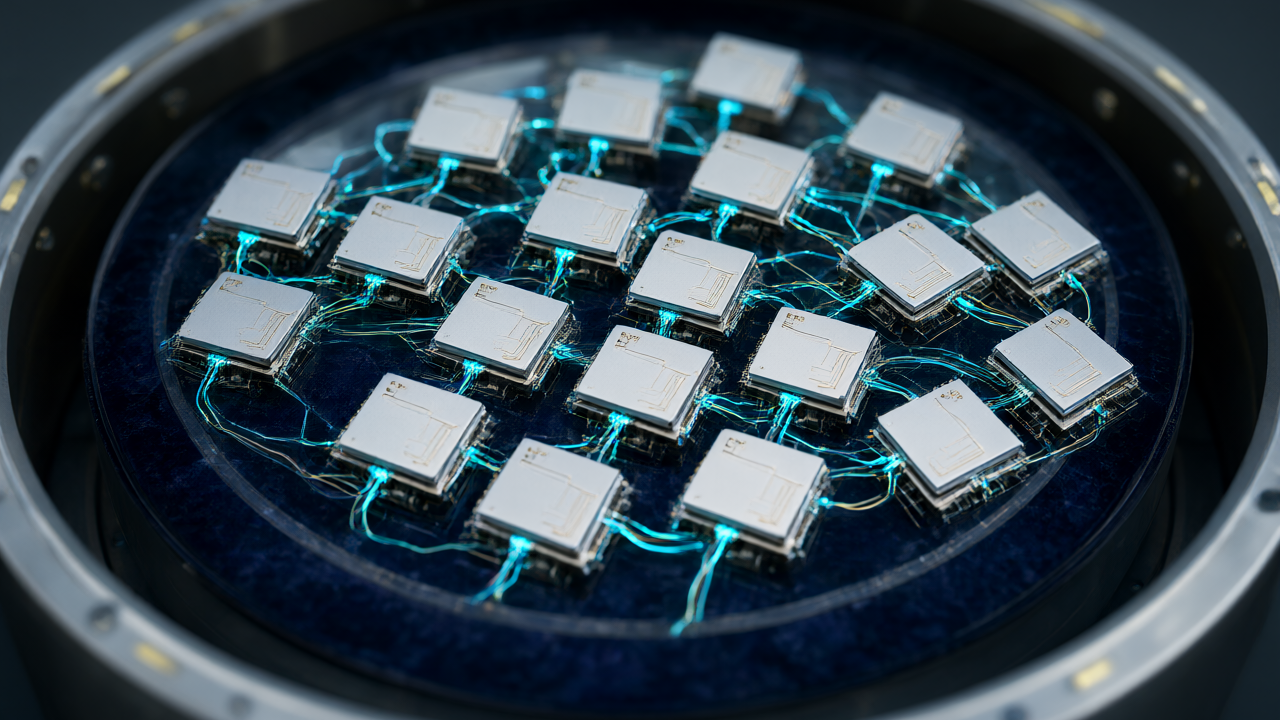
The system networks small, flat 2D Euclidean planar chips containing approximately 100 qubits via sparse, static inter-module boundary couplers. Specifically, the architecture partitions the global QEC code into flat modules of either 72 qubits or 116 qubits by fine-graining closed hyperbolic surfaces with Euclidean lattice patches of side-length L. To manage errors, stabilizers spanning adjacent modules are measured across boundary seams using cat-flagged syndrome extraction circuits.
Performance was validated through circuit-level simulations using the SI1000 noise model (p = 0.1%), decoded via the AlphaQubit neural network and correlated minimum-weight perfect matching (MWPM). The results showed high tolerance to elevated inter-module seam noise (p_seam = 1%), maintaining low logical error rates even when inter-chip cable error rates were 10x higher than on-chip gate errors.
Fault-Tolerant Logic
To enable universal fault-tolerant logic without increasing space overhead, the team implemented two primary mechanisms:
- Fault-tolerant walking circuits: These execute logical gates via code automorphisms, specifically global tiling permutations.
- Modular ribbon extractors: A closed ancilla loop attached along module boundaries that is approximately 4.5x smaller than the memory itself.
Significance and Outlook
This approach allows for the implementation of high-rate qLDPC codes while avoiding the hardware complexity of long-range wire crossings on a single chip. By utilizing a modular design based on hyperbolic geometry, the researchers have demonstrated a path toward significantly lower qubit overhead for fault-tolerant quantum computing.
Get our weekly technology intelligence — free
Receive an infographic that lets you judge at a glance whether each field’s analysis report is worth reading.
Subscribe Free — Weekly Tech Intelligence
By subscribing, you’ll receive Troy-Technical’s weekly technology intelligence newsletter.
- Your email and selected fields are used only to deliver the newsletter.
- We never share your information with third parties.
- You can unsubscribe anytime via the link in each email.
See our Privacy Policy for details.
Takes about a minute · Unsubscribe anytime