


Key Findings
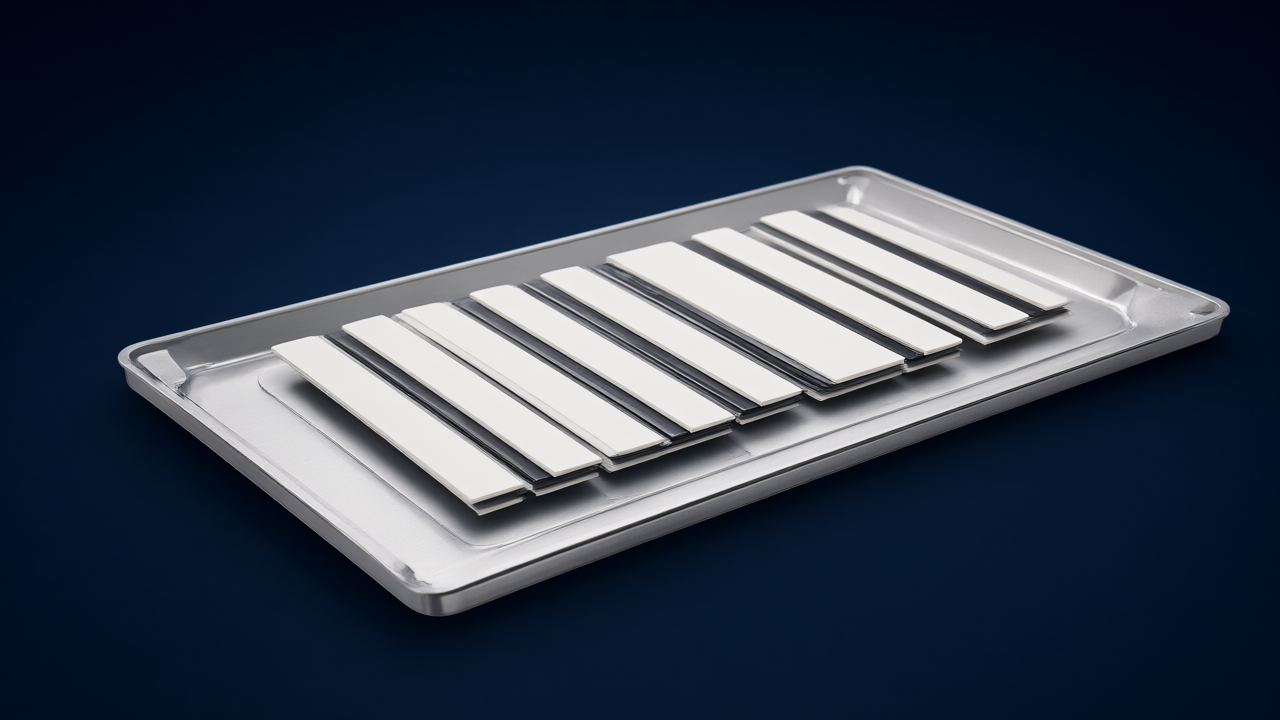
ProLogium and Rimac Technology showcased a battery pack concept mockup at the 2026 Paris Motor Show. The system integrates a “SF-Ceramion Superfluidized Inorganic Solid-State Electrolyte,” a 100% ceramic separator, and an all-silicon anode. The composite silicon anode delivers an activation utilization of 1,800 to 2,300 mAh/g, which is nearly six times that of conventional graphite anodes.
Technical Details
The SF-Ceramion electrolyte combines the high ion concentration of solids with the interfacial contact properties of liquids. It achieves a room-temperature (25°C) ionic conductivity of 57 mS/cm—approximately 5X to 6X higher than liquid and sulfide-based solid electrolytes. At −20°C, it maintains 12.82 mS/cm with 90% to 95% discharge efficiency.
- Safety: The electrolyte is intrinsically non-flammable. An Active Safety Mechanism (ASM) stabilizes the cathode and transitions the anode to a ground state under extreme heat or high voltage to stop thermal runaway.
- Separator: The all-ceramic separator, made from inorganic oxides, remains electrically insulating at 300°C and maintains structural integrity at decomposition temperatures above 1,000°C.
- Structural Architecture: ProLogium uses “Logithium,” a silicone-based frame adhesive, for mechanical strength and moisture resistance. The “Bi-cell” double-side thick-film technology reduces electrode stacking layers to improve gravimetric and volumetric energy density.
Background and Context
The partnership began with a Memorandum of Understanding (MOU) signed in September 2025 to develop a next-generation battery platform. The collaboration merges ProLogium’s cell technology with Rimac’s expertise in battery system development, specifically focusing on a pouch cell-to-pack architecture. Rimac is currently evaluating scalable integration solutions for thermal management, swelling management, and system-level design.
Significance and Outlook
The project is moving from a concept mockup to functional battery segments, which are scheduled for display at CES 2027 in Las Vegas. These segments will serve as the basis for testing thermal management and cell integration. Following these phases, the companies plan to conduct initial vehicle and public-road testing in the second half of 2028.
Get our weekly technology intelligence — free
Receive an infographic that lets you judge at a glance whether each field’s analysis report is worth reading.
Subscribe Free — Weekly Tech Intelligence
By subscribing, you’ll receive Troy-Technical’s weekly technology intelligence newsletter.
- Your email and selected fields are used only to deliver the newsletter.
- We never share your information with third parties.
- You can unsubscribe anytime via the link in each email.
See our Privacy Policy for details.
Takes about a minute · Unsubscribe anytime