


Key Findings
The study demonstrates that combining targeted feed supplementation with an intensified perfusion rate of 1.2 VVD achieves a sustained shift toward desired galactosylated species (G1F, G1F′, G2F) without incurring productivity costs. Conversely, operation at pH 6.7 and 39 °C caused severe productivity penalties and triggered the accumulation of high-mannose (Man5) glycoforms.
Technical Details
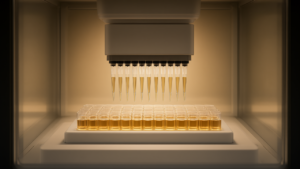
The researchers employed a ~2 mL scale-down microbioreactor perfusion platform using Chinese Hamster Ovary (CHO) cells over a 20-day culture duration. Using an integrated at-line PAT workflow via N-GLYcanyzer, the team screened six perfusion process parameters: carbon source, viable cell density (VCD), perfusion rate, temperature, and pH. Results indicated that thermal and acidic stress, as well as nutrient limitation, significantly disrupted N-glycans maturation. To counteract this, the addition of galactose and MnCl consistently shifted glycoform profiles away from G0F toward galactosylated species.
Background & Context
Controlling monoclonal antibody (mAb) N-glycosylation as a critical quality attribute (CQA) is a persistent challenge in intensified biomanufacturing. Conventional end-point analyses often obscure dynamic pathway responses, making it difficult to manage the time evolution of glycoforms in continuous processes.
Significance & Outlook
The use of automated at-line PAT like N-GLYcanyzer enables real-time, attribute-based control in continuous biomanufacturing. By identifying the specific impact of nutrient feed and perfusion rates, this approach provides a mechanism for steering biologics production toward desired N-glycoform states, reducing the reliance on retrospective end-point analysis.
Source: https://doi.org/10.64898/2026.10.31.763318
Get our weekly technology intelligence — free
Receive an infographic that lets you judge at a glance whether each field’s analysis report is worth reading.
Subscribe Free — Weekly Tech Intelligence
By subscribing, you’ll receive Troy-Technical’s weekly technology intelligence newsletter.
- Your email and selected fields are used only to deliver the newsletter.
- We never share your information with third parties.
- You can unsubscribe anytime via the link in each email.
See our Privacy Policy for details.
Takes about a minute · Unsubscribe anytime